Closing the Divide: 
How Cities Can 
Promote Digital Equity
SESSION GOALS & OVERVIEW 
Present some information… 
@everyone_one / @DigEquity / @DeborahAcosta1
SESSION GOALS & OVERVIEW 
Present some information…Learn from you… 
@everyone_one / @DigEquity / @DeborahAcosta1
SESSION GOALS & OVERVIEW 
Present some information…Learn from you…Walk away with next steps! 
@everyone_one / @DigEquity / @DeborahAcosta1
SESSION GOALS & OVERVIEW 
Present some information…Learn from you…Walk away with next steps! 
1. Scope of Problem and Assumptions 
@everyone_one / @DigEquity / @DeborahAcosta1
SESSION GOALS & OVERVIEW 
Present some information…Learn from you…Walk away with next steps! 
1. Scope of Problem and Assumptions 
2. Models 
@everyone_one / @DigEquity / @DeborahAcosta1
SESSION GOALS & OVERVIEW 
Present some information…Learn from you…Walk away with next steps! 
1. Scope of the Problem and Assumptions 
2. Models 
3. Problem Solving Discussion 
@everyone_one / @DigEquity / @DeborahAcosta1
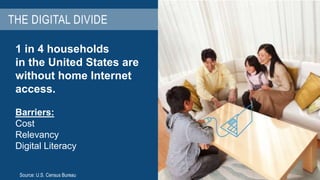
THE DIGITAL DIVIDE 
1 in 4 households 
in the United States are 
without home Internet 
access. 
Barriers: 
Cost 
Relevancy 
Digital Literacy 
Source: U.S. Census Bureau
Source: U.S. Census Bureau, Pew Internet 
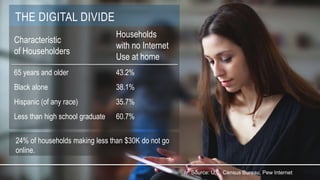
THE DIGITAL DIVIDE 
Characteristic 
of Householders 
Households 
with no Internet 
Use at home 
65 years and older 43.2% 
Black alone 38.1% 
Hispanic (of any race) 35.7% 
Less than high school graduate 60.7% 
24% of households making less than $30K do not go 
online.
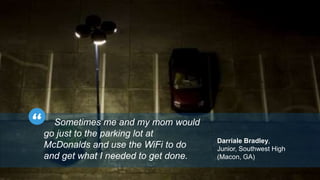
Sometimes me and my mom would 
go just to the parking lot at 
McDonalds and use the WiFi to do 
and get what I needed to get done. 
Darriale Bradley, 
Junior, Southwest High 
(Macon, GA)
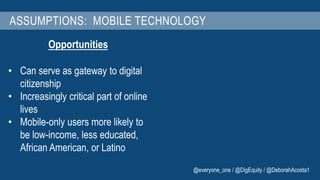
ASSUMPTIONS: MOBILE TECHNOLOGY 
Opportunities 
• Can serve as gateway to digital 
citizenship 
• Increasingly critical part of online 
lives 
• Mobile-only users more likely to 
be low-income, less educated, 
African American, or Latino 
@everyone_one / @DigEquity / @DeborahAcosta1
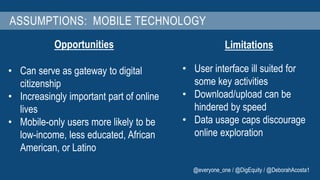
ASSUMPTIONS: MOBILE TECHNOLOGY 
Opportunities 
• Can serve as gateway to digital 
citizenship 
• Increasingly important part of online 
lives 
• Mobile-only users more likely to be 
low-income, less educated, African 
American, or Latino 
Limitations 
• User interface ill suited for 
some key activities 
• Download/upload can be 
hindered by speed 
• Data usage caps discourage 
online exploration 
@everyone_one / @DigEquity / @DeborahAcosta1
ASSUMPTIONS: MOBILE TECHNOLOGY 
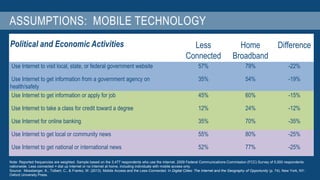
Political and Economic Activities Less 
Connected 
Home 
Broadband 
Difference 
Use Internet to visit local, state, or federal government website 57% 79% -22% 
Use Internet to get information from a government agency on 
health/safety 
35% 54% -19% 
Use Internet to get information or apply for job 45% 60% -15% 
Use Internet to take a class for credit toward a degree 12% 24% -12% 
Use Internet for online banking 35% 70% -35% 
Use Internet to get local or community news 55% 80% -25% 
Use Internet to get national or international news 52% 77% -25% 
Note: Reported frequencies are weighted. Sample based on the 3,477 respondents who use the Internet. 2009 Federal Communications Commission (FCC) Survey of 5,000 respondents 
nationwide. Less connected = dial up Internet or no Internet at home, including individuals with mobile access only. 
Source: Mossberger, K., Tolbert, C., & Franko, W. (2013). Mobile Access and the Less-Connected. In Digital Cities: The Internet and the Geography of Opportunity (p. 74). New York, NY: 
Oxford University Press.
ASSUMPTIONS: MOBILE TECHNOLOGY 
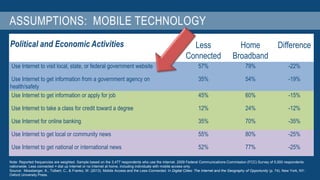
Political and Economic Activities Less 
Connected 
Home 
Broadband 
Difference 
Use Internet to visit local, state, or federal government website 57% 79% -22% 
Use Internet to get information from a government agency on 
health/safety 
35% 54% -19% 
Use Internet to get information or apply for job 45% 60% -15% 
Use Internet to take a class for credit toward a degree 12% 24% -12% 
Use Internet for online banking 35% 70% -35% 
Use Internet to get local or community news 55% 80% -25% 
Use Internet to get national or international news 52% 77% -25% 
Note: Reported frequencies are weighted. Sample based on the 3,477 respondents who use the Internet. 2009 Federal Communications Commission (FCC) Survey of 5,000 respondents 
nationwide. Less connected = dial up Internet or no Internet at home, including individuals with mobile access only. 
Source: Mossberger, K., Tolbert, C., & Franko, W. (2013). Mobile Access and the Less-Connected. In Digital Cities: The Internet and the Geography of Opportunity (p. 74). New York, NY: 
Oxford University Press.
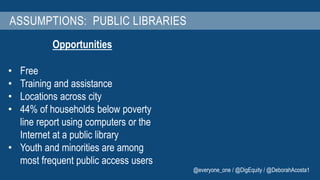
ASSUMPTIONS: PUBLIC LIBRARIES 
Opportunities 
• Free 
• Training and assistance 
• Locations across city 
• 44% of households below poverty 
line report using computers or the 
Internet at a public library 
• Youth and minorities are among 
most frequent public access users 
@everyone_one / @DigEquity / @DeborahAcosta1
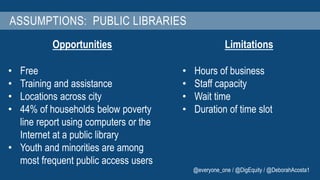
ASSUMPTIONS: PUBLIC LIBRARIES 
Limitations 
• Hours of business 
• Staff capacity 
• Wait time 
• Duration of time slot 
Opportunities 
• Free 
• Training and assistance 
• Locations across city 
• 44% of households below poverty 
line report using computers or the 
Internet at a public library 
• Youth and minorities are among 
most frequent public access users 
@everyone_one / @DigEquity / @DeborahAcosta1
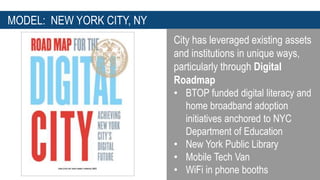
MODEL: NEW YORK CITY, NY 
City has leveraged existing assets 
and institutions in unique ways, 
particularly through Digital 
Roadmap 
• BTOP funded digital literacy and 
home broadband adoption 
initiatives anchored to NYC 
Department of Education 
• New York Public Library 
• Mobile Tech Van 
• WiFi in phone booths
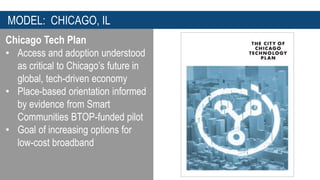
MODEL: CHICAGO, IL 
Chicago Tech Plan 
• Access and adoption understood 
as critical to Chicago’s future in 
global, tech-driven economy 
• Place-based orientation informed 
by evidence from Smart 
Communities BTOP-funded pilot 
• Goal of increasing options for 
low-cost broadband
MODEL: WILSON, NC 
Greenlight Community 
Broadband 
• Network launched in 2008 
• Borrowed $33 million to build the 
network 
• Internet-only packages range 
from $39.95 to $154.95 per 
month 
• Serves 7,000 of 50,000 residents
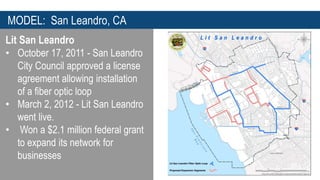
MODEL: San Leandro, CA 
Lit San Leandro 
• October 17, 2011 - San Leandro 
City Council approved a license 
agreement allowing installation 
of a fiber optic loop 
• March 2, 2012 - Lit San Leandro 
went live. 
• Won a $2.1 million federal grant 
to expand its network for 
businesses
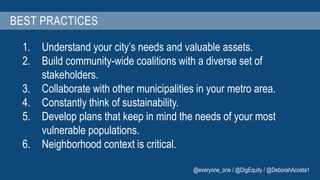
BEST PRACTICES 
1. Understand your city’s needs and valuable assets. 
2. Build community-wide coalitions with a diverse set of 
stakeholders. 
3. Collaborate with other municipalities in your metro area. 
4. Constantly think of sustainability. 
5. Develop plans that keep in mind the needs of your most 
vulnerable populations. 
6. Neighborhood context is critical. 
@everyone_one / @DigEquity / @DeborahAcosta1
DISCUSSION 
• What assets and tools do cities have (dark fiber, 
institutions like libraries, etc.)? 
• How are we integrating broadband adoption in our 
economic development plans? 
• How do we make sure our initiatives are sustainable? 
@everyone_one / @DigEquity / @DeborahAcosta1
CONTACT US 
Sheila Dugan 
EveryoneOn.org / @everyone_on / sheila@everyoneon.org 
Anne Schwieger 
DigitalEquityProject.com / @DigEquity / anne@digitalequityproject.com 
Deborah Acosta 
SanLeandroNext.com / @DeborahAcosta1 / dacosta@sanleandro.org

Closing the Divide- Sheila Dugan

  • 1.
    Closing the Divide: How Cities Can Promote Digital Equity
  • 2.
    SESSION GOALS &OVERVIEW Present some information… @everyone_one / @DigEquity / @DeborahAcosta1
  • 3.
    SESSION GOALS &OVERVIEW Present some information…Learn from you… @everyone_one / @DigEquity / @DeborahAcosta1
  • 4.
    SESSION GOALS &OVERVIEW Present some information…Learn from you…Walk away with next steps! @everyone_one / @DigEquity / @DeborahAcosta1
  • 5.
    SESSION GOALS &OVERVIEW Present some information…Learn from you…Walk away with next steps! 1. Scope of Problem and Assumptions @everyone_one / @DigEquity / @DeborahAcosta1
  • 6.
    SESSION GOALS &OVERVIEW Present some information…Learn from you…Walk away with next steps! 1. Scope of Problem and Assumptions 2. Models @everyone_one / @DigEquity / @DeborahAcosta1
  • 7.
    SESSION GOALS &OVERVIEW Present some information…Learn from you…Walk away with next steps! 1. Scope of the Problem and Assumptions 2. Models 3. Problem Solving Discussion @everyone_one / @DigEquity / @DeborahAcosta1
  • 8.
    THE DIGITAL DIVIDE 1 in 4 households in the United States are without home Internet access. Barriers: Cost Relevancy Digital Literacy Source: U.S. Census Bureau
  • 9.
    Source: U.S. CensusBureau, Pew Internet THE DIGITAL DIVIDE Characteristic of Householders Households with no Internet Use at home 65 years and older 43.2% Black alone 38.1% Hispanic (of any race) 35.7% Less than high school graduate 60.7% 24% of households making less than $30K do not go online.
  • 10.
    Sometimes me andmy mom would go just to the parking lot at McDonalds and use the WiFi to do and get what I needed to get done. Darriale Bradley, Junior, Southwest High (Macon, GA)
  • 11.
    ASSUMPTIONS: MOBILE TECHNOLOGY Opportunities • Can serve as gateway to digital citizenship • Increasingly critical part of online lives • Mobile-only users more likely to be low-income, less educated, African American, or Latino @everyone_one / @DigEquity / @DeborahAcosta1
  • 12.
    ASSUMPTIONS: MOBILE TECHNOLOGY Opportunities • Can serve as gateway to digital citizenship • Increasingly important part of online lives • Mobile-only users more likely to be low-income, less educated, African American, or Latino Limitations • User interface ill suited for some key activities • Download/upload can be hindered by speed • Data usage caps discourage online exploration @everyone_one / @DigEquity / @DeborahAcosta1
  • 13.
    ASSUMPTIONS: MOBILE TECHNOLOGY Political and Economic Activities Less Connected Home Broadband Difference Use Internet to visit local, state, or federal government website 57% 79% -22% Use Internet to get information from a government agency on health/safety 35% 54% -19% Use Internet to get information or apply for job 45% 60% -15% Use Internet to take a class for credit toward a degree 12% 24% -12% Use Internet for online banking 35% 70% -35% Use Internet to get local or community news 55% 80% -25% Use Internet to get national or international news 52% 77% -25% Note: Reported frequencies are weighted. Sample based on the 3,477 respondents who use the Internet. 2009 Federal Communications Commission (FCC) Survey of 5,000 respondents nationwide. Less connected = dial up Internet or no Internet at home, including individuals with mobile access only. Source: Mossberger, K., Tolbert, C., & Franko, W. (2013). Mobile Access and the Less-Connected. In Digital Cities: The Internet and the Geography of Opportunity (p. 74). New York, NY: Oxford University Press.
  • 14.
    ASSUMPTIONS: MOBILE TECHNOLOGY Political and Economic Activities Less Connected Home Broadband Difference Use Internet to visit local, state, or federal government website 57% 79% -22% Use Internet to get information from a government agency on health/safety 35% 54% -19% Use Internet to get information or apply for job 45% 60% -15% Use Internet to take a class for credit toward a degree 12% 24% -12% Use Internet for online banking 35% 70% -35% Use Internet to get local or community news 55% 80% -25% Use Internet to get national or international news 52% 77% -25% Note: Reported frequencies are weighted. Sample based on the 3,477 respondents who use the Internet. 2009 Federal Communications Commission (FCC) Survey of 5,000 respondents nationwide. Less connected = dial up Internet or no Internet at home, including individuals with mobile access only. Source: Mossberger, K., Tolbert, C., & Franko, W. (2013). Mobile Access and the Less-Connected. In Digital Cities: The Internet and the Geography of Opportunity (p. 74). New York, NY: Oxford University Press.
  • 15.
    ASSUMPTIONS: PUBLIC LIBRARIES Opportunities • Free • Training and assistance • Locations across city • 44% of households below poverty line report using computers or the Internet at a public library • Youth and minorities are among most frequent public access users @everyone_one / @DigEquity / @DeborahAcosta1
  • 16.
    ASSUMPTIONS: PUBLIC LIBRARIES Limitations • Hours of business • Staff capacity • Wait time • Duration of time slot Opportunities • Free • Training and assistance • Locations across city • 44% of households below poverty line report using computers or the Internet at a public library • Youth and minorities are among most frequent public access users @everyone_one / @DigEquity / @DeborahAcosta1
  • 17.
    MODEL: NEW YORKCITY, NY City has leveraged existing assets and institutions in unique ways, particularly through Digital Roadmap • BTOP funded digital literacy and home broadband adoption initiatives anchored to NYC Department of Education • New York Public Library • Mobile Tech Van • WiFi in phone booths
  • 18.
    MODEL: CHICAGO, IL Chicago Tech Plan • Access and adoption understood as critical to Chicago’s future in global, tech-driven economy • Place-based orientation informed by evidence from Smart Communities BTOP-funded pilot • Goal of increasing options for low-cost broadband
  • 19.
    MODEL: WILSON, NC Greenlight Community Broadband • Network launched in 2008 • Borrowed $33 million to build the network • Internet-only packages range from $39.95 to $154.95 per month • Serves 7,000 of 50,000 residents
  • 20.
    MODEL: San Leandro,CA Lit San Leandro • October 17, 2011 - San Leandro City Council approved a license agreement allowing installation of a fiber optic loop • March 2, 2012 - Lit San Leandro went live. • Won a $2.1 million federal grant to expand its network for businesses
  • 21.
    BEST PRACTICES 1.Understand your city’s needs and valuable assets. 2. Build community-wide coalitions with a diverse set of stakeholders. 3. Collaborate with other municipalities in your metro area. 4. Constantly think of sustainability. 5. Develop plans that keep in mind the needs of your most vulnerable populations. 6. Neighborhood context is critical. @everyone_one / @DigEquity / @DeborahAcosta1
  • 22.
    DISCUSSION • Whatassets and tools do cities have (dark fiber, institutions like libraries, etc.)? • How are we integrating broadband adoption in our economic development plans? • How do we make sure our initiatives are sustainable? @everyone_one / @DigEquity / @DeborahAcosta1
  • 23.
    CONTACT US SheilaDugan EveryoneOn.org / @everyone_on / sheila@everyoneon.org Anne Schwieger DigitalEquityProject.com / @DigEquity / anne@digitalequityproject.com Deborah Acosta SanLeandroNext.com / @DeborahAcosta1 / dacosta@sanleandro.org

Editor's Notes

  • #9 Image size: 6.333in x 3.569in @72
  • #11 Full template size: 12.667in x 7.139in @ 72dpi