
Guidelines for
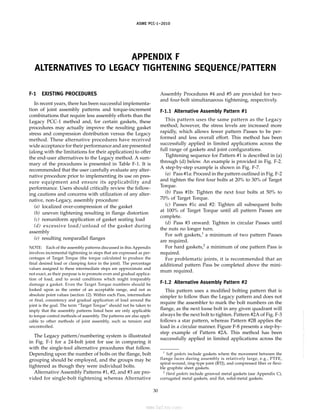
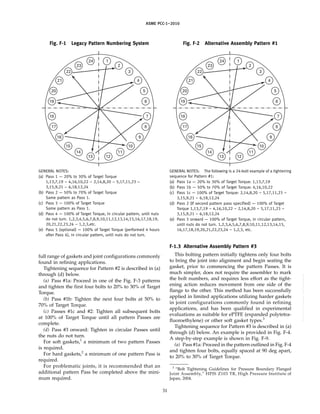
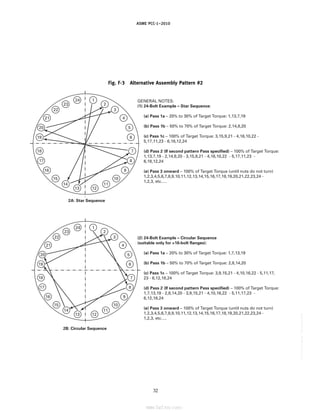
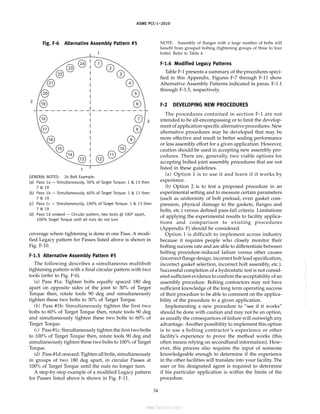
Pressure Boundary
Bolted Flange Joint
Assembly
A N A M E R I C A N N A T I O N A L S TA N D A R D
ASME PCC-1–2010
(Revision of ASME PCC-1–2000)
--``,``,``,```,`,``,,,`,,,````,,-`-`,,`,,`,`,,`---
INTENTIONALLY LEFT BLANK
--``,``,``,```,`,``,,,`,,,````,,-`-`,,`,,`,`,,`---
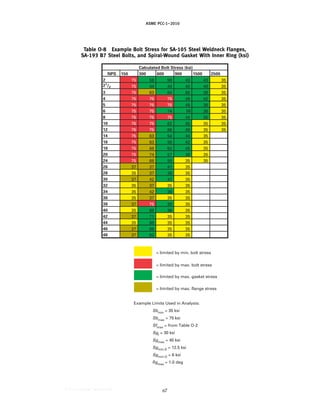
标准分享网 www.bzfxw.com 免费下载
www.bzfxw.com
ASME PCC-1–2010
(Revision of ASME PCC-1–2000)
Guidelines for
Pressure Boundary
Bolted Flange Joint
Assembly
A N A M E R I C A N N AT I O N A L S T A N D A R D
--``,``,``,```,`,``,,,`,,,````,,-`-`,,`,,`,`,,`---
www.bzfxw.com
Date of Issuance: March 5, 2010
This Standard will be revised when the Society approves the issuance of a new edition. There will
be no addenda issued to this edition.
ASME issues written replies to inquiries concerning interpretations of technical aspects of this
document. Interpretations are published on the ASME Web site under the Committee Pages at
http://cstools.asme.org as they are issued.
ASME is the registered trademark of The American Society of Mechanical Engineers.
This code or standard was developed under procedures accredited as meeting the criteria for American National
Standards. The Standards Committee that approved the code or standard was balanced to assure that individuals from
competent and concerned interests have had an opportunity to participate. The proposed code or standard was made
available for public review and comment that provides an opportunity for additional public input from industry, academia,
regulatory agencies, and the public-at-large.
ASME does not “approve,” “rate,” or “endorse” any item, construction, proprietary device, or activity.
ASME does not take any position with respect to the validity of any patent rights asserted in connection with any
items mentioned in this document, and does not undertake to insure anyone utilizing a standard against liability for
infringement of any applicable letters patent, nor assumes any such liability. Users of a code or standard are expressly
advised that determination of the validity of any such patent rights, and the risk of infringement of such rights, is
entirely their own responsibility.
Participation by federal agency representative(s) or person(s) affiliated with industry is not to be interpreted as
government or industry endorsement of this code or standard.
ASME accepts responsibility for only those interpretations of this document issued in accordance with the established
ASME procedures and policies, which precludes the issuance of interpretations by individuals.
No part of this document may be reproduced in any form,
in an electronic retrieval system or otherwise,
without the prior written permission of the publisher.
The American Society of Mechanical Engineers
Three Park Avenue, New York, NY 10016-5990
Copyright © 2010 by
THE AMERICAN SOCIETY OF MECHANICAL ENGINEERS
All rights reserved
Printed in U.S.A.
--``,``,``,```,`,``,,,`,,,````,,-`-`,,`,,`,`,,`---
标准分享网 www.bzfxw.com 免费下载
www.bzfxw.com
CONTENTS
Foreword . . . . . . . . . . . . . . . . . . . . . . . . . . . . . . . . . . . . . . . . . . . . . . . . . . . . . . . . . . . . . . . . . . . . . . . . . . . . . . v
Committee Roster . . . . . . . . . . . . . . . . . . . . . . . . . . . . . . . . . . . . . . . . . . . . . . . . . . . . . . . . . . . . . . . . . . . . . vi
1 Scope. . . . . . . . . . . . . . . . . . . . . . . . . . . . . . . . . . . . . . . . . . . . . . . . . . . . . . . . . . . . . . . . . . . . . . . . . 1
2 Introduction. . . . . . . . . . . . . . . . . . . . . . . . . . . . . . . . . . . . . . . . . . . . . . . . . . . . . . . . . . . . . . . . . . . 1
3 Training, Qualification, and Certification of Joint Assembly Personnel . . . . . . . . . . . . . 1
4 Cleaning and Examination of Flange and Fastener Contact Surfaces . . . . . . . . . . . . . . . 1
5 Alignment of Flanged Joints . . . . . . . . . . . . . . . . . . . . . . . . . . . . . . . . . . . . . . . . . . . . . . . . . . . . 2
6 Installation of Gasket . . . . . . . . . . . . . . . . . . . . . . . . . . . . . . . . . . . . . . . . . . . . . . . . . . . . . . . . . . 2
7 Lubrication of “Working” Surfaces . . . . . . . . . . . . . . . . . . . . . . . . . . . . . . . . . . . . . . . . . . . . . . 5
8 Installation of Bolts. . . . . . . . . . . . . . . . . . . . . . . . . . . . . . . . . . . . . . . . . . . . . . . . . . . . . . . . . . . . 5
9 Numbering of Bolts When a Single Tool Is Used . . . . . . . . . . . . . . . . . . . . . . . . . . . . . . . . . 6
10 Tightening of Bolts . . . . . . . . . . . . . . . . . . . . . . . . . . . . . . . . . . . . . . . . . . . . . . . . . . . . . . . . . . . . 6
11 Tightening Sequence When a Single Tool Is Used . . . . . . . . . . . . . . . . . . . . . . . . . . . . . . . 10
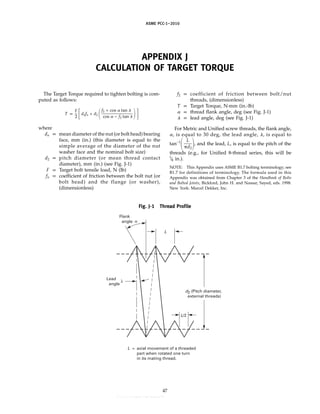
12 Target Torque Determination. . . . . . . . . . . . . . . . . . . . . . . . . . . . . . . . . . . . . . . . . . . . . . . . . . . . 10
13 Joint Pressure and Tightness Testing. . . . . . . . . . . . . . . . . . . . . . . . . . . . . . . . . . . . . . . . . . . . 11
14 Records. . . . . . . . . . . . . . . . . . . . . . . . . . . . . . . . . . . . . . . . . . . . . . . . . . . . . . . . . . . . . . . . . . . . . . . 11
15 Joint Disassembly . . . . . . . . . . . . . . . . . . . . . . . . . . . . . . . . . . . . . . . . . . . . . . . . . . . . . . . . . . . . . 15
16 References . . . . . . . . . . . . . . . . . . . . . . . . . . . . . . . . . . . . . . . . . . . . . . . . . . . . . . . . . . . . . . . . . . . . 16
Figures
1 Indicator-Type Bolting for Through-Bolted Joints . . . . . . . . . . . . . . . . . . . . . . . . . . . . . . 8
2 Indicator-Type Bolting for Studded Joints . . . . . . . . . . . . . . . . . . . . . . . . . . . . . . . . . . . . . 9
3 Example Legacy Pattern 12-Bolt Tightening Sequence . . . . . . . . . . . . . . . . . . . . . . . . . 14
4 48-Bolt Flange Bolt Grouping Example . . . . . . . . . . . . . . . . . . . . . . . . . . . . . . . . . . . . . . . . 15
Tables
1M Reference Values for Calculating Target Torque Values for Low-Alloy Steel
Bolting Based on Target Prestress of 345 MPa (Root Area) (SI Units) . . . . . . . . . 3
1 Reference Values for Calculating Target Torque Values for Low-Alloy Steel
Bolting Based on Target Prestress of 50 ksi (Root Area) (U.S. Customary
Units) . . . . . . . . . . . . . . . . . . . . . . . . . . . . . . . . . . . . . . . . . . . . . . . . . . . . . . . . . . . . . . . . . . . . . 4
2 Torque Increments for Legacy Cross-Pattern Tightening Using a Single Tool . . . . 7
3 Recommended Tool, Tightening Method, and Load-Control Technique
Selection Based on Service Applications . . . . . . . . . . . . . . . . . . . . . . . . . . . . . . . . . . . . 11
4 Legacy Cross-Pattern Tightening Sequence and Bolt Numbering System
When Using a Single Tool . . . . . . . . . . . . . . . . . . . . . . . . . . . . . . . . . . . . . . . . . . . . . . . . . . 12
4.1 Alternative to Legacy Cross-Pattern Tightening Sequence and Bolt
Numbering System When Using a Single Tool . . . . . . . . . . . . . . . . . . . . . . . . . . . . . . 13
Appendices
A Notes Regarding Qualifying Flanged Joint Assemblers . . . . . . . . . . . . . . . . . . . . . . . . 19
B Recommendations for Flanged Joint Assembly Procedure Qualification . . . . . . . . 20
iii
--``,``,``,```,`,``,,,`,,,````,,-`-`,,`,,`,`,,`---
www.bzfxw.com
C Recommended Gasket Contact Surface Finish for Various Gasket Types . . . . . . . . 21
D Guidelines for Allowable Gasket Contact Surface Flatness and Defect
Depth . . . . . . . . . . . . . . . . . . . . . . . . . . . . . . . . . . . . . . . . . . . . . . . . . . . . . . . . . . . . . . . . . . . . . 22
E Flange Joint Alignment Guidelines . . . . . . . . . . . . . . . . . . . . . . . . . . . . . . . . . . . . . . . . . . . . 27
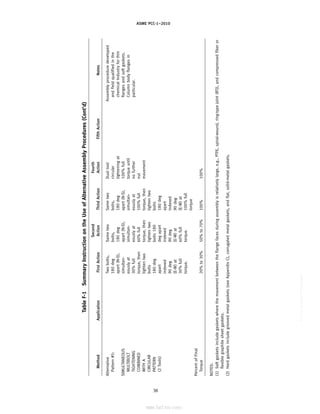
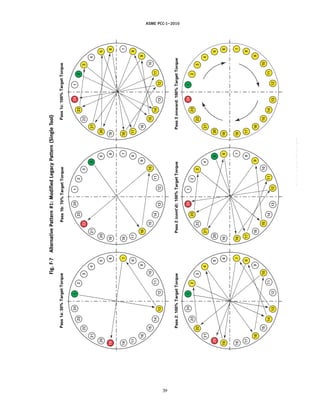
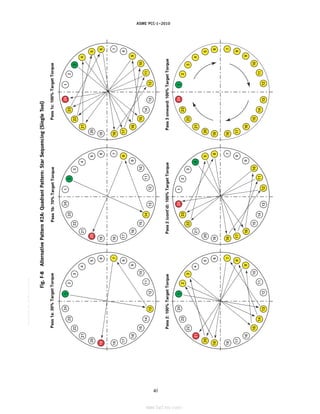
F Alternatives to Legacy Tightening Sequence/Pattern . . . . . . . . . . . . . . . . . . . . . . . . . . 30
G Use of Contractors Specializing in Bolting Services . . . . . . . . . . . . . . . . . . . . . . . . . . . . 44
H Bolt Root and Tensile Stress Areas . . . . . . . . . . . . . . . . . . . . . . . . . . . . . . . . . . . . . . . . . . . . 45
I Interaction During Tightening . . . . . . . . . . . . . . . . . . . . . . . . . . . . . . . . . . . . . . . . . . . . . . . . 46
J Calculation of Target Torque . . . . . . . . . . . . . . . . . . . . . . . . . . . . . . . . . . . . . . . . . . . . . . . . . . 47
K Nut Factor Calculation of Target Torque . . . . . . . . . . . . . . . . . . . . . . . . . . . . . . . . . . . . . . 48
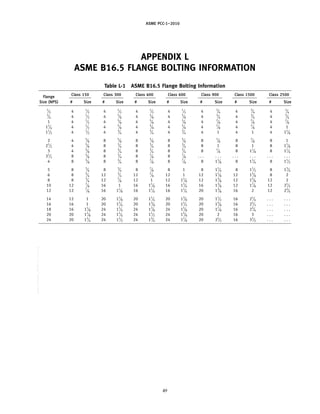
L ASME B16.5 Flange Bolting Information . . . . . . . . . . . . . . . . . . . . . . . . . . . . . . . . . . . . . . 49
M Washer Usage Guidance and Purchase Specification for Through-Hardened
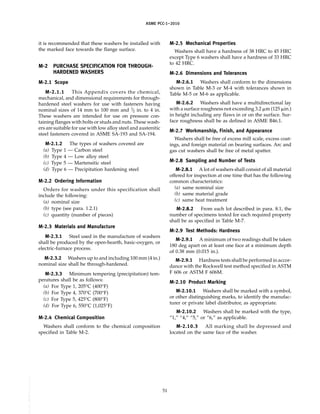
Washers . . . . . . . . . . . . . . . . . . . . . . . . . . . . . . . . . . . . . . . . . . . . . . . . . . . . . . . . . . . . . . . . . . . 50
N Definitions, Commentary, and Guidelines on the Reuse of Bolts . . . . . . . . . . . . . . . 55
O Assembly Bolt Stress Determination . . . . . . . . . . . . . . . . . . . . . . . . . . . . . . . . . . . . . . . . . . 57
P Guidance on Troubleshooting Flanged Joint Leakage Incidents . . . . . . . . . . . . . . . . . 69
iv
--``,``,``,```,`,``,,,`,,,````,,-`-`,,`,,`,`,,`---
标准分享网 www.bzfxw.com 免费下载
www.bzfxw.com
FOREWORD
ASME formed an Ad Hoc Task Group on Post Construction in 1993 in response to an increased
need for recognized and generally accepted engineering standards for the inspection and mainte-
nance of pressure equipment after it has been placed in service. At the recommendation of this
Task Group, the Board on Pressure Technology Codes and Standards (BPTCS) formed the Post
Construction Committee (PCC) in 1995. The scope of this committee was to develop and maintain
standards addressing common issues and technologies related to post-construction activities and
to work with other consensus committees in the development of separate, product-specific codes
and standards addressing issues encountered after initial construction for equipment and piping
covered by Pressure Technology Codes and Standards. The BPTCS covers non-nuclear boilers,
pressure vessels (including heat exchangers), piping and piping components, pipelines, and
storage tanks.
The PCC selects standards to be developed based on identified needs and the availability of
volunteers. The PCC formed the Subcommittee on Inspection Planning and the Subcommittee
on Flaw Evaluation in 1995. In 1998, a Task Group under the PCC began preparation of Guidelines
for Pressure Boundary Bolted Flange Joint Assembly and in 1999 the Subcommittee on Repair
and Testing was formed. Other topics are under consideration and may possibly be developed
into future guideline documents.
The subcommittees were charged with preparing standards dealing with several aspects of the
in-service inspection and maintenance of pressure equipment and piping. Guidelines for Pressure
Boundary Bolted Flange Joint Assembly (PCC-1) provides guidance and is applicable to both new
and in-service bolted flange joint assemblies. The Inspection Planning Using Risk-Based Methods
Standard (PCC-3) provides guidance on the preparation of a risk-based inspection plan. Imperfec-
tions found at any stage of assembly, installation, inspection, operation, or maintenance are then
evaluated, when appropriate, using the procedures provided in the Fitness-For-Service Standard
(API 579-1/ASME FFS-1). If it is determined that repairs are required, guidance on repair proce-
dures is provided in the appropriate portion of the Repair of Pressure Equipment and Piping Standard
(PCC-2). To provide all stakeholders involved in pressure equipment with a guide to identify
publications related to pressure equipment integrity, a Guide to Life Cycle Management of Pressure
Equipment Integrity has been prepared (PTB-2).
None of these documents are Codes. They provide recognized and generally accepted good
practices that may be used in conjunction with Post-Construction Codes, such as API 510, API 570,
and NB-23, and with jurisdictional requirements.
The first edition of ASME PCC-1, Guidelines for Pressure Boundary Bolted Flange Joint Assembly,
was approved for publication in 2000. This revision was approved by ANSI as an American
National Standard on January 14, 2010.
v
--``,``,``,```,`,``,,,`,,,````,,-`-`,,`,,`,`,,`---
www.bzfxw.com
ASME PRESSURE TECHNOLOGY
POST CONSTRUCTION COMMITTEE
(The following is the roster of the Committee at the time of approval of this Standard.)
STANDARDS COMMITTEE OFFICERS
D. A. Lang, Sr., Chair
J. R. Sims, Jr., Vice Chair
S. J. Rossi, Secretary
STANDARDS COMMITTEE PERSONNEL
G. A. Antaki, Becht Engineering Co., Inc.
J. E. Batey, The Dow Chemical Co.
C. Becht IV, Becht Engineering Co., Inc.
D. L. Berger, PPL Generation LLC
W. Brown, The Equity Engineering Group
P. N. Chaku, Lummus Technology, Inc.
E. W. Hayman, Consultant
W. J. Koves, Retired
D. A. Lang, FM Global
D. E. Lay, Hytorc
C. R. Leonard, Life Cycle Engineering
K. Mokhtarian, Consultant
C. C. Neely, Becht Engineering Co., Inc.
POST CONSTRUCTION SUBCOMMITTEE ON FLANGE JOINT ASSEMBLY (PCC)
C. C. Neely, Chair, Becht Engineering Co., Inc.
B. J. Barron, Northrop Grumman Newport News
W. Brown, The Equity Engineering Group
E. W. Hayman, Consultant
D. E. Lay, Hytorc
vi
T. M. Parks, The National Board of Boiler and Pressure Vessel
Inspectors
J. R. Payne, JPAC, Inc.
J. T. Reynolds, Pro-Inspect, Inc.
S. C. Roberts, Shell Global Solutions (US), Inc.
C. D. Rodery, BP North American Products, Inc.
S. J. Rossi, The American Society of Mechanical Engineers
C. W. Rowley, The Wesley Corp.
J. R. Sims, Jr., Becht Engineering Co., Inc.
K. Oyamada, Delegate
T. Tahara, Delegate
C. D. Cowfer, Contributing Member, Consultant
E. Michalopoulos, Contributing Member, City of Kozani, Greece
G. Milne, Hydratight
J. R. Payne, JPAC, Inc.
C. D. Rodery, BP North American Products, Inc.
J. Waterland, Virginia Sealing Products, Inc.
--``,``,``,```,`,``,,,`,,,````,,-`-`,,`,,`,`,,`---
标准分享网 www.bzfxw.com 免费下载
ASME PCC-1–2010
GUIDELINES FOR PRESSURE BOUNDARY
BOLTED FLANGE JOINT ASSEMBLY
1 SCOPE
The bolted flange joint assembly (BFJA) guidelines
described in this document apply to pressure-boundary
flanged joints with ring-type gaskets that are entirely
within the circle enclosed by the bolt holes and with no
contact outside this circle.1
By selection of those features
suitable to the specific service or need, these guidelines
may be used to develop effective joint assembly proce-
dures for the broad range of sizes and service conditions
normally encountered in industry.
Guidance on troubleshooting BFJAs not providing
leak-tight performance is also provided in this document
(Appendix P).
2 INTRODUCTION
A BFJA is a complex mechanical device; therefore,
BFJAs that provide leak-free service are the result of
many selections/activities having been made/per-
formed within a relatively narrow band of acceptable
limits. One of the activities essential to leak-free per-
formance is the joint assembly process. The guidelines
outlined in this document cover the assembly elements
essential for a high level of leak-tightness integrity of
otherwise properly designed/constructed BFJAs. It is
recommended that written procedures, incorporating
the features of these guidelines that are deemed suitable
to the specific application under consideration, be devel-
oped for use by the joint assemblers. Alternative features
and methods for specific applications may be used sub-
ject to endorsement by the user or his designated agent.
3 TRAINING, QUALIFICATION, AND CERTIFICATION
OF JOINT ASSEMBLY PERSONNEL
It is recommended that the user or his designated
agent provide, or arrange to have provided, as appro-
priate, essential training and qualification testing of the
joint assembly personnel who will be expected to follow
procedures developed from this Guideline. Notes
1
Rules for design of bolted flanges with ring-type gaskets are
covered in Mandatory Appendix 2 of ASME Boiler and Pressure
Vessel Code, Section VIII, Division 1; see also Nonmandatory
Appendix S for supplementary considerations for bolted flanges
that are helpful to the designer of Appendix 2 flanges.
1
regarding qualifying flanged joint assemblers are pro-
vided in Appendix A.
See section F-2 of Appendix F for comments on
accepting flange joint assembly procedures not currently
listed in these guidelines.
4 CLEANING AND EXAMINATION OF FLANGE AND
FASTENER CONTACT SURFACES
Before assembly is started, clean and examine flange
and fastener contact surfaces as described in this section.
With one exception, remove all indications of the pre-
vious gasket installation from the gasket contact sur-
faces; use approved solvents and/or soft-wire brushes,
if required, for cleaning to prevent surface contamina-
tion and damage to existing surface finish. Avoid using
carbon steel brushes on stainless steel flanges.
The exception based on experience is flexible graphite
that may remain in the surface finish grooves when
either a flexible graphite clad or a spiral-wound gasket
with flexible graphite filler is to be used as the replace-
ment gasket.
(a) Examine the gasket contact surfaces of both mat-
ing joint flanges for compliance with recommended sur-
face finish (see Appendix C) and for damage to surface
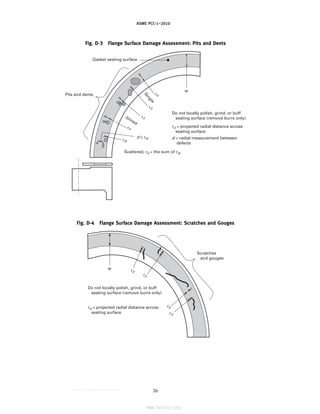
finish such as scratches, nicks, gouges, and burrs. Indica-
tions running radially across the facing are of particular
concern. Refer to Appendix D for guidelines covering
recommended limits on gasket contact surface imperfec-
tions and their locations.
(1) It is recommended that surface-finish compara-
tor gages be available to joint assembly personnel.
(2) Report any questionable imperfections for
appropriate disposition. If weld repair of imperfections
is deemed to be required, see ASME PCC-2, Article 3.5
for repair considerations. Appendix C provides recom-
mended final surface finishes.
(b) When working with problematic or critical service
[see Note (1) of Table 3] flanges of large diameter with
leak histories or suspect fabrication, it is recommended
to check gasket contact surfaces of both joint flanges for
flatness, both radially and circumferentially. This may be
accomplished in many cases using a machinist’s straight
edge and feeler gages, but using a securely mounted
run-out gage or field machining equipment capable of
--``,``,``,```,`,``,,,`,,,````,,-`-`,,`,,`,`,,`---
ASME PCC-1–2010
providing accurate total indicator readings may be nec-
essary when tolerances need to be tight. Appendix D
provides flatness tolerance recommendations.
If weld repair is deemed to be required to achieve the
required flatness, see ASME PCC-2, Article 3.5 for repair
considerations. Appendix C provides recommended
final surface finishes.
(c) Examine bolt2
and nut threads and washer faces
of nuts for damage such as rust, corrosion, and burrs;
replace/correct any damaged components. Likewise
bolt/nut combinations for which the nuts will not turn
freely by hand past where they will come to rest after
tightening should be replaced/corrected; this includes
tapped hole threads. (See ASME PCC-2, Article 3.3 that
covers repair of damaged tapped hole threads.) If sepa-
rate washers are scored or cupped from previous use,
replace with new through-hardened washers3
(surface-hardened washers are not suitable). The condi-
tion of previously-used bolts/nuts has a large influence
on the performance of a bolted joint assembly. The fol-
lowing guidelines relating to the reuse of bolts/nuts are
offered for consideration.
(1) When using bolts and nuts of common grade
as fasteners, the use of new bolts and nuts up to 11
⁄8 in.
diameter is recommended when bolt load-control meth-
ods such as torque or tension are deemed necessary (see
Appendix N). For larger bolt diameters, it is recom-
mended that the cost of cleaning, deburring, and recon-
ditioning be compared to the replacement cost and
considered in the assessment of critical issues of the
assembly. When assessing the cost, consider that work-
ing with and reconditioning fasteners in the field may
be more expensive than the cost of replacement and that
the results of reconditioning can be unpredictable. When
coated bolts are used, the remaining corrosion protection
and self-lubricating functions are additional considera-
tions with respect to continued use or replacement. See
Notes (2) and (3) of Table 1M/Table 1, and paras. 7(e)
and 7(f).
(2) Strong consideration should be given to replac-
ing bolts of any size should it be found that they have
been abused or nonlubricated during previous
assemblies.
(3) Thread dies generally do not result in a smooth,
reconditioned surface; therefore, turning bolt threads in
a lathe is the preferred method to recondition costly
fasteners. The process will remove thread material;
therefore, the user is cautioned to ensure the tolerance
limits of ASME B1.1 for the original class of fit specified
2
“Bolt” as used herein is an all-inclusive term for any type of
threaded fastener that may be used in a pressure-boundary BFJA
such as a bolt, stud, studbolt, cap screw, etc.
3
Use of washers is optional. However, it is generally recognized
that the use of through-hardened steel washers will improve the
translation of torque input into residual bolt stretch. See Appen-
dix M for a suitable through-hardened washer specification
guideline.
2
are not exceeded. Any fastener with thread dimensions
less than the minimum major diameter or the minimum
pitch diameter should be replaced.
(4) Nuts are generally replaced rather than
reconditioned.
Appendix N provides supplementary information on
the bolt reuse topic.
(d) Examine nut-bearing surfaces of flanges for coat-
ing, scores, burrs, visual evidence of out-of-squareness
(indicated by uneven wear), etc. Coatings over approxi-
mately 0.13 mm (0.005 in.) thick should either be
removed or reduced in thickness; remove all coating
for critical joints. Roughness, gouges, and protrusions
should be removed from these surfaces. On severely
damaged flanges, machining this area may be required,
in which case the minimum acceptable residual flange
thickness must be considered. The use of through-hard-
ened, flat washers4
may be appropriate to provide
smooth and square nut-bearing surfaces.
5 ALIGNMENT OF FLANGED JOINTS
Proper alignment of all joint members is the essential
element of flange joint assembly. It results in maximum
sealing surface contact, maximum opportunity for uni-
form and design-level gasket loading, and reduced fric-
tion between the nut and the flange. Guidelines for
aligning flanged joints are provided in Appendix E.
6 INSTALLATION OF GASKET
Place a new gasket in position after determining the
absence of (or having made correction for) unacceptable
gasket sealing surface imperfections and flatness toler-
ance deviations, as well as joint alignment considera-
tions (see Appendices D and E).
Reuse of a gasket is generally not recommended. One
current exception is large, grooved metal gaskets with
facing layers (see Appendix C) that are reused in some
instances after having been reconditioned and refaced
in a manner consistent with the original product specifi-
cations. Use of gaskets so refurbished is not considered
as gasket reuse in the context of the first sentence. For
other gasket types, experience has clearly shown that
only a new gasket will reliably provide the necessary
plastic deformation and elastic recovery characteristics
essential to achieve an effective seal. Visual or physical
inspection of a used gasket for apparent damage is not
4
Flat washers protect the nut-contact surface of the flange from
damage and provide a smooth and low-friction turning surface
for the nuts. These are important considerations when torquing
methods (either manual or hydraulic) are used for bolt tightening.
Flat washers also promote improved load distribution. See Appen-
dix M for a suitable through-hardened washer purchase specifica-
tion guideline.
--``,``,``,```,`,``,,,`,,,````,,-`-`,,`,,`,`,,`---
标准分享网 www.bzfxw.com 免费下载
ASME PCC-1–2010
Table 1M Reference Values for Calculating Target Torque Values for Low-Alloy
Steel Bolting Based on Target Prestress of 345 MPa (Root Area) (SI Units)
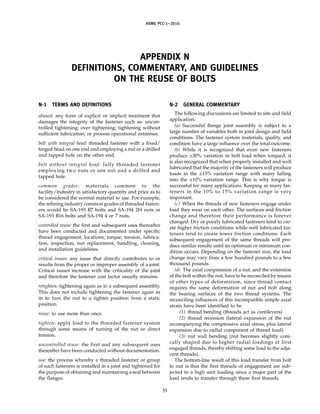
(See section 12 for instructions on how to use this table.)
Target Torque, N·m
Basic Thread Designation Noncoated Bolts [Note (1)] Coated Bolts [Notes (1), (2), and (3)]
M14-2 110 85
M16-2 160 130
M20-2.5 350 250
M24-3 550 450
M27-3 800 650
M30-3 1 150 900
M33-3 1 550 1 200
M36-3 2 050 1 600
M39-3 2 650 2 050
M42-3 3 350 2 550
M45-3 4 200 3 200
M48-3 5 100 3 900
M52-3 6 600 5 000
M56-3 8 200 6 300
M64-3 12 400 9 400
M70-3 16 100 12 200
M76-3 20 900 15 800
M82-3 26 400 20 000
M90-3 35 100 26 500
M95-3 41 600 31 500
M100-3 48 500 36 700
GENERAL NOTE: The values shown are based on a Target Prestress of 345 MPa (root area). See section 12
(Target Torque Determination). The root areas are based on coarse-thread series for sizes M27 and smaller,
and 3 mm pitch thread series for sizes M30 and larger.
NOTES:
(1) Computed values are based on “working” surfaces that comply with section 4 (Cleaning and
Examination of Flange and Fastener Contact Surfaces) and section 7 (Lubrication of “Working”
Surfaces), and the following coefficients of friction: 0.16 for noncoated surfaces and 0.12 for new
coated surfaces. These coefficients were selected to make the computed Target Torques consistent
with that needed for a Target Prestress of 345 MPa as independently verified by accurate bolt
elongation measurements by several users. (See Appendix K for equivalent nut factors.)
(2) The coating on coated bolts is polyimide/amide and is considered to be the sole source of
“working” surface lubrication; the application of a lubricant to the coated surfaces can result in a
considerable reduction in the assumed coefficient of friction of 0.12. (See Appendix K for
equivalent nut factor.)
(3) Coated torque values apply only for initial tightening of new, coated bolts using the torque-
increment rounds shown in Table 2. For second and subsequent tightening by torquing methods,
use of lubricants and torque values as specified for noncoated bolts is recommended.
3
--``,``,``,```,`,``,,,`,,,````,,-`-`,,`,,`,`,,`---
ASME PCC-1–2010
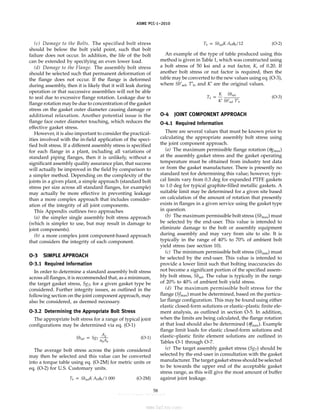
Table 1 Reference Values for Calculating Target Torque Values for Low-Alloy
Steel Bolting Based on Target Prestress of 50 ksi (Root Area)
(U.S. Customary Units)
(See section 12 for instructions on how to use this table.)
Target Torque, ft-lb
Nominal Bolt Size, in. Noncoated Bolts [Note (1)] Coated Bolts [Notes (1), (2), and (3)]
1
⁄2 60 45
5
⁄8 120 90
3
⁄4 210 160
7
⁄8 350 250
1 500 400
11
⁄8 750 550
11
⁄4 1,050 800
13
⁄8 1,400 1,050
11
⁄2 1,800 1,400
15
⁄8 2,350 1,800
13
⁄4 2,950 2,300
17
⁄8 3,650 2,800
2 4,500 3,400
21
⁄4 6,500 4,900
21
⁄2 9,000 6,800
23
⁄4 12,000 9,100
3 15,700 11,900
31
⁄4 20,100 15,300
31
⁄2 25,300 19,100
33
⁄4 31,200 23,600
4 38,000 28,800
GENERAL NOTE: The values shown are based on a Target Prestress of 50 ksi (root area). See section 12
(Target Torque Determination). The root areas are based on coarse-thread series for sizes 1 in. and smaller,
and 8-pitch thread series for sizes 11
⁄8 in. and larger.
NOTES:
(1) Computed values are based on “working” surfaces that comply with section 4 (Cleaning and
Examination of Flange and Fastener Contact Surfaces) and section 7 (Lubrication of “Working”
Surfaces), and the following coefficients of friction: 0.16 for noncoated surfaces and 0.12 for new
coated surfaces. These coefficients were selected to make the computed Target Torques consistent
with that needed for a Target Prestress of 50 ksi as independently verified by accurate bolt
elongation measurements by several users. (See Appendix K for equivalent nut factors.)
(2) The coating on coated bolts is polyimide/amide and is considered to be the sole source of
“working” surface lubrication; the application of a lubricant to the coated surfaces can result in a
considerable reduction in the assumed coefficient of friction of 0.12. (See Appendix K for
equivalent nut factor.)
(3) Coated torque values apply only for initial tightening of new, coated bolts using the torque-
increment rounds shown in Table 2. For second and subsequent tightening by torquing methods,
use of lubricants and torque values as specified for noncoated bolts is recommended.
4
--``,``,``,```,`,``,,,`,,,````,,-`-`,,`,,`,`,,`---
标准分享网 www.bzfxw.com 免费下载
ASME PCC-1–2010
sufficient to detect such sealing surface factors as work-
hardening, brittleness, or the affects of heat or interaction
with the service fluid.
(a) Verify that the gasket complies with the dimen-
sional (O.D., I.D., thickness) and material specifications.
(b) Position the gasket to be concentric with the flange
I.D., taking suitable measures to ensure that it is ade-
quately supported during the positioning process. No
portion of the gasket should project into the flow path.
(c) Ensure that the gasket will remain in place during
the joint assembly process; a very light dusting of spray
adhesive on the gasket (not the flange) may be used.
Particular care should be taken to avoid adhesive chem-
istry that is incompatible with the process fluid or could
result in stress corrosion cracking or pitting of the flange
surfaces. Do not use tape strips radially across the gasket to
hold it in position. Do not use grease.
7 LUBRICATION OF “WORKING” SURFACES5
Lubrication reduces the coefficient of friction and
results in less required torque to achieve a given tension,
improves the consistency of achieved load from bolt to
bolt within the joint, and aids in the subsequent disas-
sembly of the fasteners.
The reference torque values for new, coated bolts/
nuts shown in Table 1M/Table 1 do not consider lubrica-
tion other than that provided by the bolt/nut coating
[see Note (2) of Table 1M/Table 1]. When reusing coated
bolts or if lubricant is applied to new or reused coated
bolts, the Nut Factor will change and therefore the torque
values should be adjusted accordingly (refer to
Appendix K). Do not apply either approved lubricant or
unapproved compounds to the gasket or gasket-contact
surfaces; protect against inadvertent application to these
surfaces.
(a) Ensure that the lubricant is chemically compatible
with the bolt/nut/washer materials and the process
fluid. Particular care should be taken to avoid lubricant
chemistry that could contribute to stress corrosion crack-
ing, galvanic corrosion, oxygen auto-ignition, etc.
(b) Ensure that the lubricant has proven to be suitable
for the expected range of service temperature(s) and
antiseize requirements.
(c) Before lubricant is applied to the bolt and nut
threads, nuts must run freely by hand past where they
will come to rest after tightening. If nuts will not turn
freely by hand, check for cause and make necessary
corrections/replacements.
(d) For noncoated bolts (see Notes to Table 1M/
Table 1), apply lubricant liberally and completely to the
nut contact faces and to the threads on both ends of
the bolts past where the nuts will come to rest after
5
The term “working” surfaces refers to those interfaces between
fastener components and/or fasteners and flanges that slide past
one another during tightening or loosening.
5
tightening; the lubricant should be applied after the
bolts are inserted through the flange bolt holes to avoid
possible contamination with solid particles that could
create unwanted reaction torque.
(e) For new coated bolts and nuts (see Notes to
Table 1M/Table 1), free running nut checks as described
in (c) are required; however, lubricant application as
described in (d) should be limited to the second and
subsequent tightening operations since the coating pro-
vides sufficient lubrication for the first tightening.
(1) The reference torque values for new, coated
bolts/nuts shown in Table 1M/Table 1 do not consider
lubrication other than that provided by the bolt/nut
coating [see Note (2) of Table 1M/Table 1]. When reusing
coated bolts or if lubricant is applied to new or reused
coated bolts, the Nut Factor will change and therefore
the torque values should be adjusted accordingly (refer
to Appendix K).
(f) While it is recognized that the inherent lubricity
of new coated bolts results in less torque being required
during the first tightening operation to achieve a given
level of tension in the bolt (see Table 1M/Table 1), the
major long-term value of coated bolts is to protect
against corrosion of the exposed threads and to mini-
mize break-out and nut-removal torque, thereby pro-
moting ease of joint disassembly [see section 15, and
Note (3) of Table 1M/Table 1].
(g) Do not apply either approved lubricant or unap-
proved compounds to the gasket or gasket-contact sur-
faces; protect against inadvertent application to these
surfaces.
8 INSTALLATION OF BOLTS
Install bolts and nuts so they are hand-tight with the
marked ends of the bolts and nuts located on the same
side of the joint and facing outward to facilitate inspec-
tion; then snug up to 15 N·m (10 ft-lb) to 30 N·m (20 ft-lb),
but not to exceed 20% of the Target Torque (see section
12). If nuts do not hand tighten, check for cause and
make necessary corrections.
8.1 Bolt/Nut Specifications
Verify compliance with bolt and nut specifications
[materials, diameter, length of bolts, thread pitch, and
nut thickness equal to the nominal bolt diameter (heavy
hex series nuts)].
8.2 Bolt Lengths
Check bolts for adequate length. Section VIII, Division
1 of the ASME Boiler and Pressure Vessel Code requires
that nuts engage the threads for the full depth of the
nut (see para. UG-13). The ASME B31.3, Process Piping
Code, has a similar provision but considers the nut to
be acceptably engaged if the lack of complete engage-
ment is not more than one thread (see para. 335.2.3). See
--``,``,``,```,`,``,,,`,,,````,,-`-`,,`,,`,`,,`---
ASME PCC-1–2010
para. 10.1(c) of this document if use of hydraulic bolt
tensioners is planned.
8.2.1 Corrosion of excess threads can hinder joint
disassembly. A practice that facilitates joint disassembly
(see section 15) is to fully engage the nut on one end
(no bolt projection beyond the nut) so that all excess
threads are located on the opposite end; the excess
threads should not project more than 13 mm (1
⁄2 in.)
beyond the nut, unless required for the use of hydraulic
bolt tensioners [see para. 10.1(c)].
8.2.2 When the effective stretching length (“Leff,”
see para. 10.2) is short,6
the total initial bolt elongation
(⌬L; see para. 10.2) resulting from the determined Target
Bolt Stress (see section 12) will be a proportionately
small value, thereby resulting in a significant percentage
reduction in the post-assembly bolt stress due to normal
gasket creep, embedment losses, and joint heat-up. The
sensitivity to this occurrence should be given careful
attention along with other joint considerations when
selecting the level of Target Bolt Stress.
9 NUMBERING OF BOLTS WHEN A SINGLE TOOL
IS USED
Two optional bolt numbering systems that are pre-
sented in this Guideline are as follows:
(a) A system whereby each bolt location, starting with
No. 1 and continuing through N, is numbered sequen-
tially on the flange in a clockwise manner (where N is
the total number of bolts in the joint). This system was
used in ASME PCC-1–2000. It has been retained (there-
fore referenced as the Legacy system), and is the basis
for the Table 4, Legacy Cross-Pattern Tightening
Sequence and Bolt Numbering System. This numbering
system allows, for example, the quick identification of
bolt number 20 in a 40-bolt flange, but requires a refer-
ence table such as Table 4 for the tightening sequence
during the tightening process.
(b) The alternative numbering system (see Table 4.1)
is designed so that the number assigned at each bolt
location represents the sequential order for tightening
that bolt; in other words the cross-pattern tightening
sequence is identified by the assigned bolt number and,
therefore, a separate reference table is not required dur-
ing the tightening process.
See Appendix F for joint assembly patterns and
torque-increment combinations that require less assem-
bly effort than the Table 4 Legacy and the Table 4.1
modified Legacy methods.
9.1 Numbering of Bolts When Multiple Tools Are
Used
See Appendix F (Alternative Patterns #4 and #5).
6
A bolt having an effective length shorter than 5 times its nominal
diameter is generally considered to be “short.”
6
10 TIGHTENING OF BOLTS
Using the selected tightening method/load-control
technique (see para. 10.1), tighten the joint using either
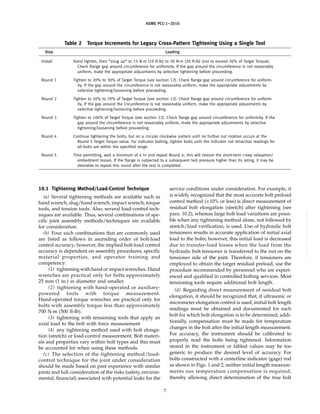
the torque increment rounds shown in Table 2 and either
the companion Table 4 or Table 4.1 cross-pattern tight-
ening sequences when using a single tool as described
in section 11, or one of the alternative tightening/
numbering systems shown in Alternatives #1, #2, and
#3 of Appendix F.
Alternatives #4 and #5 illustrate alternative group
numbering systems and tightening sequences when
simultaneously using multiple tools.
NOTE: When hydraulic bolt tensioners are employed, use the
procedure recommended by personnel who are experienced and
qualified in controlled bolting services. Guidelines on use of con-
tractors specializing in bolting services are provided in
Appendix G.
It is recognized by Appendix S of the ASME Boiler
and Pressure Vessel Code, Section VIII, Division 1 that
the initial tightening of the bolts in a joint comprising
flanges designed in accordance with Appendix 2 of that
Code is a prestressing operation and that the level of
required Target Bolt Prestress can vary considerably
above the code tabulated design-stress value. This is an
acceptable and usually required practice. Appendix S
states that “. . . an initial bolt stress higher than the
design value may and, in some cases, must be developed
in the tightening operation, and it is the intent of this
Division that such a practice is permissible, provided it
includes necessary and appropriate provision to ensure
against excessive flange distortion and gross crushing
of the gasket.” For joints custom designed in accordance
with Appendix 2, a common range of Target Bolt
Prestress that is often found acceptable is around 40%
to 70% of the specified minimum yield strength of the
bolt material (see also para. 8.2.2 regarding the effect of
short bolts on the determination of the Target Torque
value). This range is normally only exceeded in excep-
tional cases that have been assessed by a qualified engi-
neer. However, any maximum Target Bolt Prestress must
be selected to ensure that all three of the joint compo-
nents — bolts, flange, and gasket — are stressed within
acceptable limits.
Section 12 provides guidance on the determination of
the assembly Target Torque value.
Appendix O outlines a method to determine the
assembly bolt stress for a given flange joint (bolt, flange,
gasket assembly). The method is based on a formula and
flange stress limits that are supported by and consistent
with elastic–plastic FEA work. A calculation is provided
that uses an example-specific maximum allowable gas-
ket stress; however, the user must provide this informa-
tion. Tables for maximum bolt load limits are provided
for ASME B16.5/B16.47 Series A flanges and the method
to calculate the assembly bolt load for other standard
and nonstandard flanges is outlined.
--``,``,``,```,`,``,,,`,,,````,,-`-`,,`,,`,`,,`---
标准分享网 www.bzfxw.com 免费下载
www.bzfxw.com
ASME PCC-1–2010
Table 2 Torque Increments for Legacy Cross-Pattern Tightening Using a Single Tool
Step Loading
Install Hand tighten, then “snug up” to 15 N·m (10 ft-lb) to 30 N·m (20 ft-lb) (not to exceed 20% of Target Torque).
Check flange gap around circumference for uniformity. If the gap around the circumference is not reasonably
uniform, make the appropriate adjustments by selective tightening before proceeding.
Round 1 Tighten to 20% to 30% of Target Torque (see section 12). Check flange gap around circumference for uniform-
ity. If the gap around the circumference is not reasonably uniform, make the appropriate adjustments by
selective tightening/loosening before proceeding.
Round 2 Tighten to 50% to 70% of Target Torque (see section 12). Check flange gap around circumference for uniform-
ity. If the gap around the circumference is not reasonably uniform, make the appropriate adjustments by
selective tightening/loosening before proceeding.
Round 3 Tighten to 100% of Target Torque (see section 12). Check flange gap around circumference for uniformity. If the
gap around the circumference is not reasonably uniform, make the appropriate adjustments by selective
tightening/loosening before proceeding.
Round 4 Continue tightening the bolts, but on a circular clockwise pattern until no further nut rotation occurs at the
Round 3 Target Torque value. For indicator bolting, tighten bolts until the indicator rod retraction readings for
all bolts are within the specified range.
Round 5 Time permitting, wait a minimum of 4 hr and repeat Round 4; this will restore the short-term creep relaxation/
embedment losses. If the flange is subjected to a subsequent test pressure higher than its rating, it may be
desirable to repeat this round after the test is completed.
10.1 Tightening Method/Load-Control Technique
(a) Several tightening methods are available such as
hand wrench, slug/hand wrench, impact wrench, torque
tools, and tension tools. Also, several load-control tech-
niques are available. Thus, several combinations of spe-
cific joint assembly methods/techniques are available
for consideration.
(b) Four such combinations that are commonly used
are listed as follows in ascending order of bolt-load
control accuracy; however, the implied bolt-load control
accuracy is dependent on assembly procedures, specific
material properties, and operator training and
competency:
(1) tightening with hand or impact wrenches. Hand
wrenches are practical only for bolts approximately
25 mm (1 in.) in diameter and smaller.
(2) tightening with hand-operated or auxiliary-
powered tools with torque measurement.
Hand-operated torque wrenches are practical only for
bolts with assembly torque less than approximately
700 N·m (500 ft-lb).
(3) tightening with tensioning tools that apply an
axial load to the bolt with force measurement
(4) any tightening method used with bolt elonga-
tion (stretch) or load-control measurement. Bolt materi-
als and properties vary within bolt types and this must
be accounted for when using these methods.
(c) The selection of the tightening method/load-
control technique for the joint under consideration
should be made based on past experience with similar
joints and full consideration of the risks (safety, environ-
mental, financial) associated with potential leaks for the
7
service conditions under consideration. For example, it
is widely recognized that the most accurate bolt preload
control method (±10% or less) is direct measurement of
residual bolt elongation (stretch) after tightening (see
para. 10.2), whereas large bolt load variations are possi-
ble when any tightening method alone, not followed by
stretch/load verification, is used. Use of hydraulic bolt
tensioners results in accurate application of initial axial
load to the bolts; however, this initial load is decreased
due to transfer-load losses when the load from the
hydraulic bolt tensioner is transferred to the nut on the
tensioner side of the joint. Therefore, if tensioners are
employed to obtain the target residual preload, use the
procedure recommended by personnel who are experi-
enced and qualified in controlled bolting services. Most
tensioning tools require additional bolt length.
(d) Regarding direct measurement of residual bolt
elongation, it should be recognized that, if ultrasonic or
micrometer elongation control is used, initial bolt length
readings must be obtained and documented for each
bolt for which bolt elongation is to be determined; addi-
tionally, compensation must be made for temperature
changes in the bolt after the initial length measurement.
For accuracy, the instrument should be calibrated to
properly read the bolts being tightened. Information
stored in the instrument or tabled values may be too
generic to produce the desired level of accuracy. For
bolts constructed with a centerline indicator (gage) rod
as shown in Figs. 1 and 2, neither initial length measure-
ments nor temperature compensation is required,
thereby allowing direct determination of the true bolt
--``,``,``,```,`,``,,,`,,,````,,-`-`,,`,,`,`,,`---
www.bzfxw.com
ASME PCC-1–2010
Fig.
1
Indicator-Type
Bolting
for
Through-Bolted
Joints
Indicator
rod
material
for
low-alloy
steel
bolting
(e.g.,
SA-193
GR-B7)
shall
be
nickel
alloy
UNS
N10276
(C-276)
bare
welding
rod
per
AWS
A5.14.
Indicator
rod
material
for
other
bolting
shall
be
same
as
bolt,
or
a
material
having
essentially
the
same
coefficient
of
expansion
and
a
composition
suitable
for
welding
to
the
bolt.
Indicator
rod
diameter
to
be
reduced
by
centerless
grinding
if
necessary
to
provide
free-fall
movement
of
rod
before
welding.
Washers
are
required
only
when
torquing
methods
(versus
use
of
hydraulic
tensioners)
are
used
for
bolt
tightening.
NOTES:
(1)
(2)
(3)
Drawn
by
Checked
by
Approved
by
Indicator-Type
Bolting
for
Through-Bolted
Joints
Date
Drawing
Number
For
Item
Number
,
see
Reference
Drawing
.
Machine
grind
end
of
bolt
and
indicator
rod
flush
after
rod
is
welded
in
place.
This
end
only.
A
–A–
.001
Drill
through
from
one
end
only
with
hole
centerline
coincident
with
axis
of
bolt
(see
Table
A)
32
Indicator
rod
[see
Table
A
and
Notes
(1)
and
(2)]
Thread
bolt
full
length
(see
Table
B)
Bolt
marking
off
center
on
welded
end
of
bolt
(do
not
deface
marking)
Washers;
two
required
per
bolt
[see
Note
(3)
and
Appendix
M]
Heavy
hex
nut;
two
required
per
bolt
(see
Table
B)
Weld
this
end
of
indicator
rod
to
bolt.
Do
not
grind
after
welding.
L
(see
Table
B)
Nominal
Bolt
Diameter,
in.
Quantity
Required
Materials
Bolt
Nuts
L
Nominal
Bolt
Diameter,
in.
7
/
8
–1
1
/
4
1
3
/
8
–1
7
/
8
Over
2
0.313
0.002
0.000
0.250
0.002
0.000
0.188
0.002
0.000
1
/
8
3
/
16
1
/
4
TABLE
A
TABLE
B
Indicator
Rod
Diameter,
in.
[Note
(2)]
Hole
Diameter,
in.
8
--``,``,``,```,`,``,,,`,,,````,,-`-`,,`,,`,`,,`---
标准分享网 www.bzfxw.com 免费下载
www.bzfxw.com
ASME PCC-1–2010
Fig.
2
Indicator-Type
Bolting
for
Studded
Joints
Indicator-Type
Bolting
for
Studded
Joints
Washer
[see
Note
(3)
and
Appendix
M]
Externally
relieved
end
Plug
weld
this
end
of
indicator
rod
to
bolt.
Minimize
weld
projection
beyond
end
of
bolt.
Heavy
hex
nut
(see
Table
B)
Indicator
rod
material
for
low-alloy
steel
bolting
(e.g.,
SA-193
GR-B7)
shall
be
nickel
alloy
UNS
N10276
(C-276)
bare
welding
rod
per
AWS
A5.14.
Indicator
rod
material
for
other
bolting
shall
be
same
as
bolt,
or
a
material
having
essentially
the
same
coefficient
of
expansion
and
a
composition
suitable
for
welding
to
the
bolt.
Indicator
rod
diameter
to
be
reduced
by
centerless
grinding
if
necessary
to
provide
free-fall
movement
of
rod
before
welding.
Washers
are
required
only
when
torquing
methods
(versus
use
of
hydraulic
tensioners)
are
used
for
bolt
tightening.
NOTES:
(1)
(2)
(3)
Drawn
by
Checked
by
Approved
by
Date
Drawing
Number
For
Item
Number
,
see
Reference
Drawing
.
Machine
grind
end
of
bolt
and
indicator
rod
flush
after
rod
is
welded
in
place.
This
end
only.
A
–A–
.001
Drill
through
from
one
end
only
with
hole
centerline
coincident
with
axis
of
bolt
(see
Table
A)
32
Indicator
rod
[see
Table
A
and
Notes
(1)
and
(2)]
Thread
bolt
full
length
(see
Table
B)
Bolt
marking
off
center
on
welded
end
of
bolt
(do
not
deface
marking)
L
(see
Table
B)
Nominal
Bolt
Diameter,
in.
Quantity
Required
Materials
Bolt
Nuts
L
Nominal
Bolt
Diameter,
in.
7
/
8
–1
1
/
4
1
3
/
8
–1
7
/
8
Over
2
0.313
0.002
0.000
0.250
0.002
0.000
0.188
0.002
0.000
1
/
8
3
/
16
1
/
4
TABLE
A
TABLE
B
Indicator
Rod
Diameter,
in.
[Note
(2)]
Hole
Diameter,
in.
9
--``,``,``,```,`,``,,,`,,,````,,-`-`,,`,,`,`,,`---
www.bzfxw.com
ASME PCC-1–2010
elongation (and hence bolt stress) for both initial assem-
bly and for troubleshooting purposes during operation.
(e) Proprietary force-sensing devices that can provide
accurate and reliable real-time (increasing and decreas-
ing) bolt tension readings/printouts are available from
several manufacturers.
10.2 Bolt Elongation (Bolt Stretch) Determination
When bolt elongation (bolt stretch) measurement is
selected as the load-control technique to be used, the
required bolt elongation is computed according to the
following equation (assumes the bolt is threaded full
length):
⌬L p 冢
Sb x Leff
E 冣冢
Ar
Ats冣
where
Ar p root area, mm2
(in.2
). See Appendix H for bolt
root areas.
Ats p tensile stress area, mm2
(in.2
). See Appendix
H for bolt tensile stress areas.
E p modulus of elasticity, MPa (ksi)
Leff p effective stretching length, mm (in.). The con-
ventional assumption is that the effective
stretching length in a through-bolted joint sys-
tem is the distance between mid-thickness of
the nuts, where the nominal thickness of a
heavy hex series nut is one nominal bolt diame-
ter. By the same standard, the effective length
of the portion of a bolt that is studded into
a tapped hole is one-half of a nominal bolt
diameter.
Sb p Target Bolt Stress (root area), MPa (ksi). It is
noted that bolt stresses computed in accor-
dance with Mandatory Appendix 2 of
Section VIII, Division 1 of the ASME Boiler
and Pressure Vessel Code are based on root
area. If Target Bolt Stress (tensile stress area)
is used, drop the Ar /Ats term from the ⌬L
computation.
⌬L p bolt elongation (bolt stretch), mm (in.). Select
a tolerance on this computed value and include
it in the joint assembly procedure.
10.3 Tightening Method/Load-Control Technique
Selection
Table 3 shows an example of an approach to selecting
the tools, tightening method, and load-control technique
suitable to the need.
NOTE: Table 3 is provided as an illustration; due consideration
of specific conditions and factors applicable to the joint under
consideration should be given when selecting the appropriate
tightening method/load-control technique combination for a given
application.
10
11 TIGHTENING SEQUENCE WHEN A SINGLE TOOL
IS USED
Select from the following:
(a) The Table 4 Legacy pattern and numbering
system.
(b) The Table 4.1 modified Legacy pattern and num-
bering system.
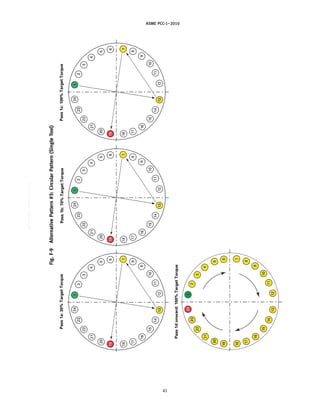
(c) The alternative pattern sequences shown in
Alternatives #1, #2, and #3 of Appendix F; compliance
with the stated limitations for their application is
essential.
The torque increment round-tightening information
for the Table 4 Legacy pattern is detailed in Table 2 (see
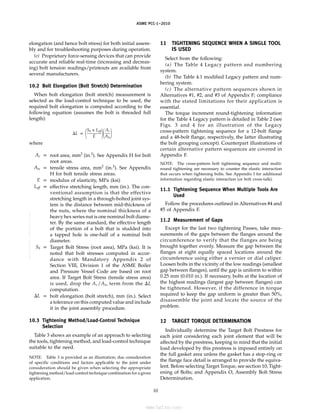
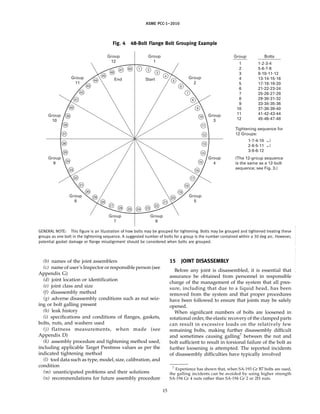
Figs. 3 and 4 for an illustration of the Legacy
cross-pattern tightening sequence for a 12-bolt flange
and a 48-bolt flange, respectively, the latter illustrating
the bolt grouping concept). Counterpart illustrations of
certain alternative pattern sequences are covered in
Appendix F.
NOTE: The cross-pattern bolt tightening sequence and multi-
round tightening are necessary to counter the elastic interaction
that occurs when tightening bolts. See Appendix I for additional
information regarding elastic interaction (or bolt cross-talk).
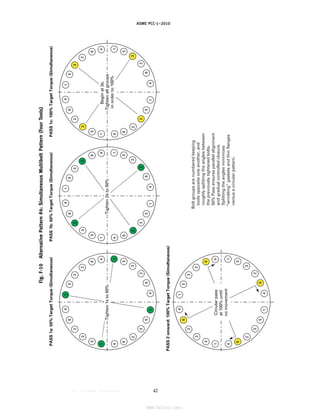
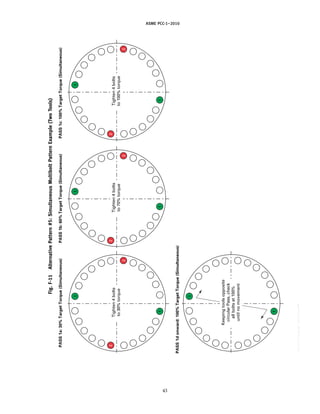
11.1 Tightening Sequence When Multiple Tools Are
Used
Follow the procedures outlined in Alternatives #4 and
#5 of Appendix F.
11.2 Measurement of Gaps
Except for the last two tightening Passes, take mea-
surements of the gaps between the flanges around the
circumference to verify that the flanges are being
brought together evenly. Measure the gap between the
flanges at eight equally spaced locations around the
circumference using either a vernier or dial caliper.
Loosen bolts in the vicinity of the low readings (smallest
gap between flanges), until the gap is uniform to within
0.25 mm (0.010 in.). If necessary, bolts at the location of
the highest readings (largest gap between flanges) can
be tightened. However, if the difference in torque
required to keep the gap uniform is greater than 50%,
disassemble the joint and locate the source of the
problem.
12 TARGET TORQUE DETERMINATION
Individually determine the Target Bolt Prestress for
each joint considering each joint element that will be
affected by the prestress, keeping in mind that the initial
load developed by this prestress is imposed entirely on
the full gasket area unless the gasket has a stop-ring or
the flange face detail is arranged to provide the equiva-
lent. Before selecting Target Torque, see section 10, Tight-
ening of Bolts; and Appendix O, Assembly Bolt Stress
Determination.
--``,``,``,```,`,``,,,`,,,````,,-`-`,,`,,`,`,,`---
标准分享网 www.bzfxw.com 免费下载
www.bzfxw.com
ASME PCC-1–2010
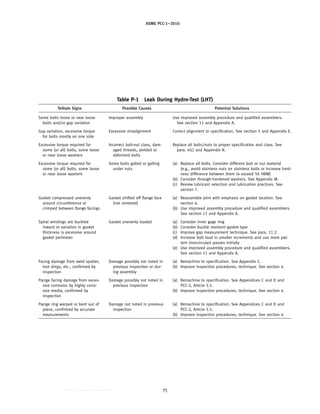
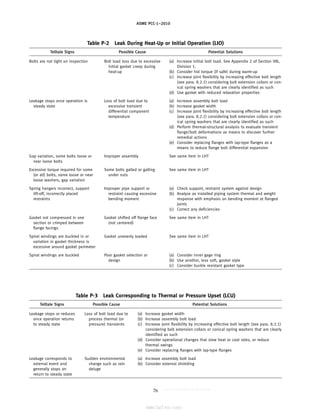
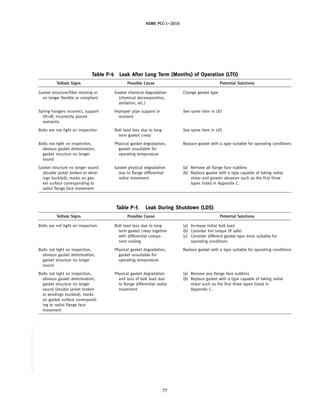
Table 3 Recommended Tool, Tightening Method, and Load-Control Technique Selection
Based on Service Applications
(See para. 10.1)
Service Applications
[Note (1)] Tools [Note (2)] Tightening Method Load-Control Technique
Mild Service Manual or auxiliary powered tools Pattern single or multibolt Consistent procedures per
tightening procedures industry best practices or
torque control
Intermediate Service Manual or auxiliary powered tools Pattern single or multibolt [Note (3)]
or torque or tension measuring tightening procedures
tools
Critical Service Torque or tension measuring Pattern single or multibolt Torque or tension control with
tools tightening procedures final bolt elongation/load
verification optional [Note (4)]
NOTES:
(1) Service Applications should be designated by the user and should consider governing design conditions (pressure, temperature, etc.),
mechanical criteria (bolt diameter, flange diameter, gasket type, etc.), joint leakage history, and fluid service category.
(a) An example of Mild Service could include Category D Fluid Service as defined in ASME B31.3.
(b) An example of Intermediate Service could include Normal Fluid Service as defined in ASME B31.3.
(c) Examples of Critical Service could include service requirements as defined by local jurisdictional requirements [example for
United States is CFR 1910.119 (OSHA PSM rule)], lethal substance service as defined in the ASME Section VIII, Division 1 Code, or
Category M Fluid Service as defined in ASME B31.3.
(2) All tools are to be regularly and properly maintained and calibrated.
(3) It is recognized that many joints are regularly tightened using impact wrenches or manual tools with no precise load control. Experi-
ence may prove this is sufficient for certain applications but unmeasured tightening is not recommended for intermediate service appli-
cations without careful consideration of the risks.
(4) Where past practice with specific or similar equipment warrant or where testing/research validates; elongation and load verification
may be waived.
12.1 Target Prestress
The Reference Torques for a Target Prestress of
345 MPa (50 ksi) (root area) are given in Table 1M/
Table 1. Target Torques for different Target Prestress
levels may be obtained by reducing (or increasing) the
values in Table 1M/Table 1 by the ratio
Target Prestress (MPa)
345 (MPa)
or
Target Prestress (ksi)
50 (ksi)
See Appendix J for calculation of Target Torque for
coefficients of friction other than those listed in Note (1)
of Table 1M/Table 1. See Appendix K for an alternative
method of calculating Target Torque when nut factors
are used.
13 JOINT PRESSURE AND TIGHTNESS TESTING
Bolted joint assemblies should be tested to ensure leak
tightness. Subject to code/regulatory requirements, the
user should establish
(a) the type of leak test (e.g., visual, bubble-forming
solution, sniffer)
(b) test fluid (e.g., air, inert gas, water, service fluid)
11
(c) test pressure (e.g., low pressure or up to a code-
mandated visual inspection pressure)
(d) acceptance criteria (often simply “no detectable
leaks”).
The user is also cautioned to consider that the practice
of using “temporary” gaskets for pressure or tightness
testing of systems that include bolted flange joint assem-
blies has resulted in numerous incidents of injury and
near injury to assembly personnel due to “blow out”
failure of these alternative gasket materials/types. The
use of substitute gaskets during testing instead of those
designed as the final seal for the joint is not recom-
mended.
Refer to ASME PCC-2, Article 5.1 for general good
practices for pressure and tightness testing of pressure
equipment.
14 RECORDS
Consideration should be given to the preparation of
a joint assembly record for each assembled joint, particu-
larly those that are deemed to be in critical service. This
record, which could be a logbook entry, would serve as
a helpful resource for troubleshooting purposes, future
assemblies, etc. The record could include but not neces-
sarily be limited to the following information:
(a) date of assembly
--``,``,``,```,`,``,,,`,,,````,,-`-`,,`,,`,`,,`---
www.bzfxw.com
ASME PCC-1–2010
Table 4 Legacy Cross-Pattern Tightening Sequence and Bolt Numbering System
When Using a Single Tool
No. of
Bolts Sequentially Clockwise Sequence [Note (1)]
4 1-3-2-4
8 1-5-3-7 → 2-6-4-8
12 1-7-4-10 → 2-8-5-11 → 3-9-6-12
16 1-9-5-13 → 3-11-7-15 → 2-10-6-14 → 4-12-8-16
20 1-11-6-16 → 3-13-8-18 → 5-15-10-20 → 2-12-7-17 → 4-14-9-19
24 1-13-7-19 → 4-16-10-22 → 2-14-8-20 → 5-17-11-23 → 3-15-9-21 → 6-18-12-24
28 1-15-8-22 → 4-18-11-25 → 6-20-13-27 → 2-16-9-23 → 5-19-12-26 → 7-21-14-28 ↵
3-17-10-24
32 1-17-9-25 → 5-21-13-29 → 3-19-11-27 → 7-23-15-31 → 2-18-10-26 → 6-22-14-30 ↵
4-20-12-28 → 8-24-16-32
36 1-2-3 → 19-20-21 → 10-11-12 → 28-29-30 → 4-5-6 → 22-23-24 → 13-14-15 ↵
31-32-33 → 7-8-9 → 25-26-27 → 16-17-18 → 34-35-36
40 1-2-3-4 → 21-22-23-24 → 13-14-15-16 → 33-34-35-36 → 5-6-7-8 → 25-26-27-28 ↵
17-18-19-20 → 37-38-39-40 → 9-10-11-12 → 29-30-31-32
44 1-2-3-4 → 25-26-27-28 → 13-14-15-16 → 37-38-39-40 → 5-6-7-8 → 29-30-31-32 ↵
17-18-19-20 → 41-42-43-44 → 9-10-11-12 → 33-34-35-36 → 21-22-23-24
48 1-2-3-4 → 25-26-27-28 → 13-14-15-16 → 37-38-39-40 → 5-6-7-8 → 29-30-31-32 ↵
17-18-19-20 → 41-42-43-44 → 9-10-11-12 → 33-34-35-36 → 21-22-23-24 → 45-46-47-48
52 1-2-3-4 → 29-30-31-32 → 13-14-15-16 → 41-42-43-44 → 5-6-7-8 → 33-34-35-36 ↵
17-18-19-20 → 45-46-47-48 → 21-22-23-24 → 49-50-51-52 → 25-26-27-28 ↵
9-10-11-12 → 37-38-39-40
56 1-2-3-4 → 29-30-31-32 → 13-14-15-16 → 41-42-43-44 → 21-22-23-24 → 49-50-51-52 ↵
9-10-11-12 → 37-38-39-40 → 25-26-27-28 → 53-54-55-56 → 17-18-19-20 ↵
45-46-47-48 → 5-6-7-8 → 33-34-35-36
60 1-2-3-4 → 29-30-31-32 → 45-46-47-48 → 13-14-15-16 → 5-6-7-8 → 37-38-39-40 ↵
21-22-23-24 → 53-54-55-56 → 9-10-11-12 → 33-34-35-36 → 49-50-51-52 → 17-18-19-20 ↵
41-42-43-44 → 57-58-59-60 → 25-26-27-28
64 1-2-3-4 → 33-34-35-36 → 17-18-19-20 → 49-50-51-52 → 9-10-11-12 → 41-42-43-44 ↵
25-26-27-28 → 57-58-59-60 → 5-6-7-8 → 37-38-39-40 → 21-22-23-24 → 53-54-55-56 ↵
13-14-15-16 → 45-46-47-48 → 29-30-31-32 → 61-62-63-64
68 1-2-3-4 → 37-38-39-40 → 21-22-23-24 → 53-54-55-56 → 9-10-11-12 → 45-46-47-48 ↵
29-30-31-32 → 61-62-63-64 → 17-18-19-20 → 57-58-59-60 → 33-34-35-36 → 5-6-7-8 ↵
41-42-43-44 → 13-14-15-16 → 49-50-51-52 → 25-26-27-28 → 65-66-67-68
GENERAL NOTES:
(a) See Table 4.1 covering a modified Legacy pattern and numbering system.
(b) See Appendix F for Alternatives #1, #2, and #3 to Legacy Table 2, torque increments, and Legacy Table 4, single-tool tightening and
bolt numbering. Compliance with the limitations of the application of these alternatives is essential.
(c) See Appendix F for Alternatives #4 and #5 for alternative group numbering and tightening sequence when simultaneously using
multiple tools.
NOTE:
(1) See Figs. 3 and 4 for illustrations of Legacy cross-pattern tightening sequences and bolt numbering system when using a single tool.
12
--``,``,``,```,`,``,,,`,,,````,,-`-`,,`,,`,`,,`---
标准分享网 www.bzfxw.com 免费下载
www.bzfxw.com
ASME PCC-1–2010
Table 4.1 Alternative to Legacy Cross-Pattern Tightening Sequence and Bolt Numbering System
When Using a Single Tool
(See section 9)
No. of
Bolts Bolt Numbering Sequence to Be Marked Clockwise on Flange [Note (1)]
4 1, 3, 2, 4
8 1, 5, 3, 7, 2, 6, 4, 8
12 1, 9, 5, 3, 11, 7, 2, 10, 6, 4, 12, 8
16 1, 9, 5, 13, 3, 11, 7, 15, 2, 10, 6, 14, 4, 12, 8, 16
20 1, 17, 9, 5, 13, 3, 19, 11, 7, 15, 2, 18, 10, 6, 14, 4, 20, 12, 8, 16
24 1, 17, 9, 5, 13, 21, 3, 19, 11, 7, 15, 23, 2, 18, 10, 6, 14, 22, 4, 20, 12, 8, 16, 24
28 1, 25, 17, 9, 5, 13, 21, 3, 27, 19, 11, 7, 15, 23, 2, 26, 18, 10, 6, 14, 22, 4, 28, 20, 12, 8, 16, 24
32 1, 25, 17, 9, 5, 13, 21, 29, 3, 27, 19, 11, 7, 15, 23, 31, 2, 26, 18, 10, 6, 14, 22, 30, 4, 28, 20, 12, 8, 16, 24, 32
36 1, 33, 25, 17, 9, 5, 13, 21, 29, 3, 35, 27, 19, 11, 7, 15, 23, 31, 2, 34, 26, 18, 10, 6, 14, 22, 30, 4, 36, 28, 20, 12, 8,
16, 24, 32
40 1, 33, 25, 17, 9, 5, 13, 21, 29, 37, 3, 35, 27, 19, 11, 7, 15, 23, 31, 39, 2, 34, 26, 18, 10, 6, 14, 22, 30, 38, 4, 36, 28,
20, 12, 8, 16, 24, 32, 40
44 1, 41, 33, 25, 17, 9, 5, 13, 21, 29, 37, 3, 43, 35, 27, 19, 11, 7, 15, 23, 31, 39, 2, 42, 34, 26, 18, 10, 6, 14, 22, 30, 38,
4, 44, 36, 28, 20, 12, 8, 16, 24, 32, 40
48 1, 41, 33, 25, 17, 9, 5, 13, 21, 29, 37, 45, 3, 43, 35, 27, 19, 11, 7, 15, 23, 31, 39, 47, 2, 42, 34, 26, 18, 10, 6, 14, 22,
30, 38, 46, 4, 44, 36, 28, 20, 12, 8, 16, 24, 32, 40, 48
52 1, 49, 41, 33, 25, 17, 9, 5, 13, 21, 29, 37, 45, 3, 51, 43, 35, 27, 19, 11, 7, 15, 23, 31, 39, 47, 2, 50, 42, 34, 26, 18, 10,
6, 14, 22, 30, 38, 46, 4, 52, 44, 36, 28, 20, 12, 8, 16, 24, 32, 40, 48
56 1, 49, 41, 33, 25, 17, 9, 5, 13, 21, 29, 37, 45, 53, 3, 51, 43, 35, 27, 19, 11, 7, 15, 23, 31, 39, 47, 55, 2, 50, 42, 34, 26,
18, 10, 6, 14, 22, 30, 38, 46, 54, 4, 52, 44, 36, 28, 20, 12, 8, 16, 24, 32, 40, 48, 56
60 1, 57, 49, 41, 33, 25, 17, 9, 5, 13, 21, 29, 37, 45, 53, 3, 59, 51, 43, 35, 27, 19, 11, 7, 15, 23, 31, 39, 47, 55, 2, 58, 50,
42, 34, 26, 18, 10, 6, 14, 22, 30, 38, 46, 54, 4, 60, 52, 44, 36, 28, 20, 12, 8, 16, 24, 32, 40, 48, 56
13
--``,``,``,```,`,``,,,`,,,````,,-`-`,,`,,`,`,,`---
www.bzfxw.com
ASME PCC-1–2010
Table 4.1 Alternative to Legacy Cross-Pattern Tightening Sequence and Bolt Numbering System
When Using a Single Tool (Cont’d)
(See section 9)
No. of
Bolts Bolt Numbering Sequence to Be Marked Clockwise on Flange [Note (1)]
64 1, 57, 49, 41, 33, 25, 17, 9, 5, 13, 21, 29, 37, 45, 53, 61, 3, 59, 51, 43, 35, 27, 19, 11, 7, 15, 23, 31, 39, 47, 55, 63, 2,
58, 50, 42, 34, 26, 18, 10, 6, 14, 22, 30, 38, 46, 54, 62, 4, 60, 52, 44, 36, 28, 20, 12, 8, 16, 24, 32, 40, 48, 56, 64
68 1, 65, 57, 49, 41, 33, 25, 17, 9, 5, 13, 21, 29, 37, 45, 53, 61, 3, 67, 59, 51, 43, 35, 27, 19, 11, 7, 15, 23, 31, 39, 47, 55,
63, 2, 66, 58, 50, 42, 34, 26, 18, 10, 6, 14, 22, 30, 38, 46, 54, 62, 4, 68, 60, 52, 44, 36, 28, 20, 12, 8, 16, 24, 32, 40,
48, 56, 64
72 1, 65, 57, 49, 41, 33, 25, 17, 9, 5, 13, 21, 29, 37, 45, 53, 61, 69, 3, 67, 59, 51, 43, 35, 27, 19, 11, 7, 15, 23, 31, 39, 47,
55, 63, 71, 2, 66, 58, 50, 42, 34, 26, 18, 10, 6, 14, 22, 30, 38, 46, 54, 62, 70, 4, 68, 60, 52, 44, 36, 28, 20, 12, 8, 16,
24, 32, 40, 48, 56, 64, 72
76 1, 73, 65, 57, 49, 41, 33, 25, 17, 9, 5, 13, 21, 29, 37, 45, 53, 61, 69, 3, 75, 67, 59, 51, 43, 35, 27, 19, 11, 7, 15, 23, 31,
39, 47, 55, 63, 71, 2, 74, 66, 58, 50, 42, 34, 26, 18, 10, 6, 14, 22, 30, 38, 46, 54, 62, 70, 4, 76, 68, 60, 52, 44, 36, 28,
20, 12, 8, 16, 24, 32, 40, 48, 56, 64, 72
80 1, 73, 65, 57, 49, 44, 33, 25, 17, 9, 5, 13, 21, 29, 37, 45, 53, 61, 69, 77, 3, 75, 67, 59, 51, 43, 35, 27, 19, 11, 7, 15, 23,
31, 39, 47, 55, 63, 71, 79, 2, 74, 66, 58, 50, 42, 34, 26, 18, 10, 6, 14, 22, 30, 38, 46, 54, 62, 70, 78, 4, 76, 68, 60, 52,
44, 36, 28, 20, 12, 8, 16, 24, 32, 40, 48, 56, 64, 72, 80
84 1, 81, 73, 65, 57, 49, 44, 33, 25, 17, 9, 5, 13, 21, 29, 37, 45, 53, 61, 69, 77, 3, 83, 75, 67, 59, 51, 43, 35, 27, 19, 11, 7,
15, 23, 31, 39, 47, 55, 63, 71, 79, 2, 82, 74, 66, 58, 50, 42, 34, 26, 18, 10, 6, 14, 22, 30, 38, 46, 54, 62, 70, 78, 4, 84,
76, 68, 60, 52, 44, 36, 28, 20, 12, 8, 16, 24, 32, 40, 48, 56, 64, 72, 80
88 1, 81, 73, 65, 57, 49, 44, 33, 25, 17, 9, 5, 13, 21, 29, 37, 45, 53, 61, 69, 77, 85, 3, 83, 75, 67, 59, 51, 43, 35, 27, 19, 11,
7, 15, 23, 31, 39, 47, 55, 63, 71, 79, 87, 2, 82, 74, 66, 58, 50, 42, 34, 26, 18, 10, 6, 14, 22, 30, 38, 46, 54, 62, 70, 78,
86, 4, 84, 76, 68, 60, 52, 44, 36, 28, 20, 12, 8, 16, 24, 32, 40, 48, 56, 64, 72, 80, 88
NOTE:
(1) The number assigned at each bolt location represents the sequential order for tightening the bolt.
Fig. 3 Example Legacy Pattern 12-Bolt Tightening Sequence
12 1
2
3
4
5
6
7
8
9
10
11
End Start
Tightening sequence for 12 bolts (Round 1 through Round 3):
1-7-4-10 2-8-5-11 3-9-6-12
14
--``,``,``,```,`,``,,,`,,,````,,-`-`,,`,,`,`,,`---
标准分享网 www.bzfxw.com 免费下载
www.bzfxw.com
ASME PCC-1–2010
Fig. 4 48-Bolt Flange Bolt Grouping Example
48
47
46
45
44
43
42
41
40
39
38
37
36
35
34
33
32
31
30
29
28
27
26 25 24 23
22
21
20
19
18
17
16
15
14
13
12
11
10
9
8
7
6
5
4
3
2
1
Group
1
Start
End
Group
12
Group
2
Group
11
Group
3
Group
4
Group
10
Group
9
Group
5
Group
8
Group
6
Group
7
1
2
3
4
5
6
7
8
9
10
11
12
1-2-3-4
5-6-7-8
9-10-11-12
13-14-15-16
17-18-19-20
21-22-23-24
25-26-27-28
29-30-31-32
33-34-35-36
37-38-39-40
41-42-43-44
45-46-47-48
Tightening sequence for
12 Groups:
(The 12-group sequence
is the same as a 12-bolt
sequence; see Fig. 3.)
1-7-4-10
2-8-5-11
3-9-6-12
Group Bolts
GENERAL NOTE: This figure is an illustration of how bolts may be grouped for tightening. Bolts may be grouped and tightened treating these
groups as one bolt in the tightening sequence. A suggested number of bolts for a group is the number contained within a 30 deg arc. However,
potential gasket damage or flange misalignment should be considered when bolts are grouped.
(b) names of the joint assemblers
(c) name of user’s Inspector or responsible person (see
Appendix G)
(d) joint location or identification
(e) joint class and size
(f) disassembly method
(g) adverse disassembly conditions such as nut seiz-
ing or bolt galling present
(h) leak history
(i) specifications and conditions of flanges, gaskets,
bolts, nuts, and washers used
(j) flatness measurements, when made (see
Appendix D)
(k) assembly procedure and tightening method used,
including applicable Target Prestress values as per the
indicated tightening method
(l) tool data such as type, model, size, calibration, and
condition
(m) unanticipated problems and their solutions
(n) recommendations for future assembly procedure
15
15 JOINT DISASSEMBLY
Before any joint is disassembled, it is essential that
assurance be obtained from personnel in responsible
charge of the management of the system that all pres-
sure, including that due to a liquid head, has been
removed from the system and that proper procedures
have been followed to ensure that joints may be safely
opened.
When significant numbers of bolts are loosened in
rotational order, the elastic recovery of the clamped parts
can result in excessive loads on the relatively few
remaining bolts, making further disassembly difficult
and sometimes causing galling7
between the nut and
bolt sufficient to result in torsional failure of the bolt as
further loosening is attempted. The reported incidents
of disassembly difficulties have typically involved
7
Experience has shown that, when SA-193 Gr B7 bolts are used,
the galling incidents can be avoided by using higher strength
SA-194 Gr 4 nuts rather than SA-194 Gr 2 or 2H nuts.
--``,``,``,```,`,``,,,`,,,````,,-`-`,,`,,`,`,,`---
www.bzfxw.com
ASME PCC-1–2010
(a) flanges larger than DN 600 (NPS 24)
(b) flange thicknesses greater than 125 mm (5 in.)
(c) bolt diameters M45 (13
⁄4 in.) and larger
Accordingly, use of a joint disassembly procedure may
be desirable for joints involving components meeting all
the criteria of paras. 15.1.1, 15.1.2, and 15.1.3. Also, use
of a joint disassembly procedure may be prudent for
joints involving components for which high local strains
could be detrimental (e.g., glass lined equipment, lens
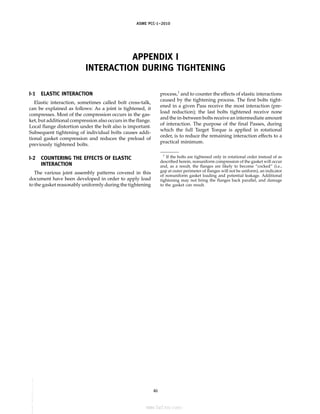
ring joints).
15.1 Disassembly Load Control
15.1.1 When a joint disassembly load-control pro-
cedure is deemed appropriate, start by loosening bolts
on a cross-pattern basis to approximately half the initial
preload on each bolt based on the operator’s judgment.
If the breakaway torque action results in completely
relieving all preload, retighten to approximately half the
original Target Torque.
15.1.2 Check the gap around the circumference
after this first stage loosening round is complete, and
loosen additional bolts selectively if necessary to accom-
plish a reasonably uniform gap.
15.1.3 After reaffirming that all pressure on the
joint has been released and that the joint has separated,
proceed with bolt loosening and nut removal.
15.1.3.1 An aid such as a hydraulic or manual
flange spreader may be used if necessary to separate
the joint.
16 REFERENCES
16.1 General
The following is a list of publications referenced in
this Guideline.
16.2 API Publications
ANSI/API Standard 660, Shell-and-tube Heat
Exchangers, Eighth Edition, August 2007
API Recommended Practice 686, Recommended Prac-
tices for Machinery Installation and Installation
Design, Second Edition, December 2009
Publisher: American Petroleum Institute (API), 1220
L Street, NW, Washington, DC 20005-4070
16.3 ASME Publications
ASME B1.1-2003, Unified Inch Screw Threads (UN and
UNR Thread Form)
ASME B1.7-2006, Screw Threads: Nomenclature,
Definitions, and Letter Symbols
ASME B1.13M-2005, Metric Screw Threads: M Profile
ASME B16.5-2009, Pipe Flanges and Flanged Fittings
NPS 1
⁄2 Through NPS 24 Metric/Inch Standard
16
ASME B16.20-2007, Metallic Gaskets for Pipe Flanges:
Ring-Joint, Spiral-Wound, and Jacketed
ASME B16.47-2006, Large Diameter Steel Flanges NPS 26
Through NPS 60 Metric/Inch Standard
ASME B31.3-2008, Process Piping
ASME B46.1-2002, Surface Texture (Surface Roughness,
Waviness, and Lay)
ASME PCC-2–2008, Repair of Pressure Equipment and
Piping
Publisher: The American Society of Mechanical
Engineers (ASME), Three Park Avenue, New York,
NY 10016-5990; Order Department: 22 Law Drive,
P.O. Box 2300, Fairfield, NJ 07007-2300
16.4 ASME Boiler and Pressure Vessel Code, 2007
Edition (Including Addenda Through 2009)
Section II, Part A — Ferrous Material Specifications:
SA-105/SA-105M, Specification for Carbon Steel Forg-
ings for Piping Applications
SA-182/SA-182M, Specification for Forged or Rolled
Alloy and Stainless Steel Pipe Flanges, Forged
Flanges, and Valves and Parts for High-Temperature
Service
SA-193/SA-193M, Specification for Alloy-Steel and
Stainless Steel Bolting Materials for High-
Temperature or High Pressure Service and Other
Special Purpose Applications
SA-194/SA-194M, Specification for Carbon and Alloy
Steel Nuts for Bolts for High-Pressure or
High-Temperature Service, or Both
SA-240/SA-240M, Specification for Chromium and
Chromium-Nickel Stainless Steel Plate, Sheet, and
Strip for Pressure Vessels and for General Applications
SA-453/SA-453M, Specification for High-Temperature
Bolting Materials With Expansion Coefficients
Comparable to Austenitic Steels
SA-540/SA-540M, Specification for Alloy-Steel Bolting
Materials for Special Applications
SA-693, Specification for Precipitation-Hardening
Stainless and Heat-Resisting Steel Plate, Sheet, and
Strip
Section II, Part B — Nondestructive Examination:
SB-637, Specification for Precipitation-Hardening
Nickel Alloy Bars, Forgings, and Forging Stock for
High-Temperature Service
Section VIII, Division 1 — Rules for Construction of
Pressure Vessels
Publisher: The American Society of Mechanical
Engineers (ASME), Three Park Avenue, New York,
NY 10016-5990; Order Department: 22 Law Drive,
P.O. Box 2300, Fairfield, NJ 07007-2300
16.5 ASTM Publications
ASTM A 829/A 829M-06, Standard Specification for
Alloy Structural Steel Plates
--``,``,``,```,`,``,,,`,,,````,,-`-`,,`,,`,`,,`---
标准分享网 www.bzfxw.com 免费下载
www.bzfxw.com
ASME PCC-1–2010
ASTM F 436-09, Standard Specification for Hardened
Steel Washers
ASTM F 606-09, Standard Test Methods for Determining
the Mechanical Properties of Externally and Internally
Threaded Fasteners, Washers, Direct Tension Indica-
tors, and Rivets
ASTM F 606M-07, Standard Test Methods for Determin-
ing the Mechanical Properties of Externally and Inter-
nally Threaded Fasteners, Washers, and Rivets
(Metric)
Publisher: American Society for Testing and Materials
(ASTM International), 100 Barr Harbor Road,
P.O. Box C700, West Conshohocken, PA 19428-2959
16.6 AWS Publication
AWS A5.14/A5.14M:2009, Specification for Nickel and
Nickel-Alloy Bare Welding Electrodes and Rods —
9th Edition
Publisher: American Welding Society (AWS), 550 NW
LeJeune Road, Miami, FL 33126
16.7 ISO Publication
ISO 7005-1:1992, Metallic Flanges — Part 1: Steel
Flanges, First Edition
Publisher: International Organization for
Standardization (ISO), 1, ch. de la Voie-Creuse, Case
postale 56, CH-1211, Genève 20, Switzerland/Suisse
16.8 U.S. Department of Labor/Occupational Safety
and Health Administration Publication
29 CFR 1910.119, Process Safety Management of Highly
Hazardous Chemicals
Publisher: U.S. Department of Labor/Occupational
Safety & Health Administration, 200 Constitution
Avenue, NW, Washington, DC 20210
16.9 High Pressure Institute of Japan Publication
HPIS Z103 TR 2004, Bolt Tightening Guidelines for
Pressure Boundary Flanged Joint Assembly (in
Japanese)
Publisher: High Pressure Institute of Japan
17
16.10 MSS Publication
MSS SP-9-2008, Spot Facing for Bronze, Iron and Steel
Flanges
Publisher: Manufacturers Standardization Society of the
Valve and Fittings Industry (MSS), 127 Park Avenue,
NE, Vienna, VA 22180-4602
16.11 PIP Pubications
PIP VESV1002, Vessel Fabrication Specification ASME
Code Section VIII, Divisions 1 and 2, May 2009
PIP VESST001, Shell and Tube Heat Exchanger
Specification, May 2009
Publisher: Process Industry Practices (PIP), Construction
Industry Institute, The University of Texas at Austin,
3925 West Braker Lane (R4500), Austin, TX 78759
16.12 WRC Publications
WRC Bulletin 449, Guidelines for the Design and
Installation of Pump Piping Systems
WRC Bulletin 528, Determination of Pressure Boundary
Joint Assembly Bolt Load
Publisher: Welding Research Council (WRC), P.O. Box
201547, Shaker Heights, OH 44120
16.13 Other Publications
Bickford, John H., “An Introduction to the Design and
Behavior of Bolted Joints,” New York, Marcel Dekker,
Inc., 1995
Bickford, John H. and Nassar, Sayed, eds., “Handbook
of Bolts and Bolted Joints,” 1998, New York, Marcel
Dekker, Inc.
Koves, W. J., 2005, “Design for Leakage in Flange Joints
Under External Loads,” Paper no. PVP2005-71254,
2005 Proceedings of the ASME Pressure Vessels and
Piping Conference: Volume 2 — Computer
Technology, ASME, New York, pp. 53–58
Payne, J. R. and Schneider, R. W., 2008, “On the
Operating Tightness of B16.5 Flanged Joints,” Paper
no. PVP2008-61561, Proceedings of the ASME 2008
Pressure Vessels and Piping Conference, ASME,
New York
--``,``,``,```,`,``,,,`,,,````,,-`-`,,`,,`,`,,`---
www.bzfxw.com
INTENTIONALLY LEFT BLANK
18
--``,``,``,```,`,``,,,`,,,````,,-`-`,,`,,`,`,,`---
标准分享网 www.bzfxw.com 免费下载
www.bzfxw.com
ASME PCC-1–2010
APPENDIX A
NOTES REGARDING QUALIFYING FLANGED JOINT ASSEMBLERS
NOTE: A proposed revision to this Appendix to include certifica-
tion of bolted joint assemblers is under consideration by the ASME
Pressure Technology Post Construction Committee. For additional
information contact the Committee Secretary identified at the fol-
lowing URL: http://cstools.asme.org/csconnect/
CommitteePages.cfm?CommitteepN10010000
A-1 PURPOSE
The purpose of qualifying flanged joint assemblers is
to ensure that they are sufficiently familiar with the
specified tools, joint assembly procedures, and bolt size
ranges such that they consistently achieve the specified
Target Prestress within the specified tolerance for the
tools and assembly procedure that are to be used.
A-2 UTILIZATION OF A COMPETENT INSTRUCTOR
Assemblers should be qualified by instruction and
examination by a competent instructor for each joint
assembly procedure and bolt size range to be employed.
19
A-3 BOLT ELONGATION CHECK
The first two joints assembled by each assembler
should be checked for bolt elongation. The resultant bolt
stress should be approximately 345 MPa (50 ksi), or other
specified Target Prestress, within specified tolerance for
the tools and assembly procedure that were used.
A-4 BOLT SIZE QUALIFICATION RANGE
Assemblers should be checked on a sufficient number
of different bolt sizes to be considered qualified across
the complete range of joints, gaskets, and bolt sizes to
be employed.
EXAMPLE: Checking assemblers on an M27 (1 in. diameter) bolt
may qualify them for all bolts M27 (1 in. diameter) bolts and
smaller; checking assemblers on a M52 (2 in. diameter) bolt may
qualify them for all bolts over M27 (1 in. diameter) through M52
(2 in. diameter); checking assemblers on a M56 (21
⁄4 in. diameter)
bolt may qualify them for bolts M56 (21
⁄4 in. diameter) and larger.
--``,``,``,```,`,``,,,`,,,````,,-`-`,,`,,`,`,,`---
www.bzfxw.com
ASME PCC-1–2010
APPENDIX B
RECOMMENDATIONS FOR FLANGED JOINT ASSEMBLY
PROCEDURE QUALIFICATION
DELETED
20
--``,``,``,```,`,``,,,`,,,````,,-`-`,,`,,`,`,,`---
标准分享网 www.bzfxw.com 免费下载
www.bzfxw.com
ASME PCC-1–2010
APPENDIX C
RECOMMENDED GASKET CONTACT SURFACE FINISH FOR
VARIOUS GASKET TYPES
Table C-1 Recommended Gasket Contact Surface Finish for
Various Gasket Types
Gasket Contact Surface
Finish [Note (1)]
Gasket Description ␮m ␮in.
Spiral-wound 3.2–6.4 125–250
Corrugated metal jacket with corrugated metal core; full width and 3.2–6.4 125–250
circumference of both sides to be covered with adhesive-backed
flexible graphite tape
Grooved metal gasket with facing layers such as flexible graphite, 3.2–6.4 125–250
PTFE, or other conformable materials
Flexible graphite reinforced with a metal interlayer insert 3.2–6.4 125–250
Grooved metal 1.6 max. 63 max.
Flat solid metal 1.6 max. 63 max.
Flat metal jacketed 2.5 max. 100 max.
Soft cut sheet, thickness ≤ 1.6 mm (1
⁄16 in.) 3.2–6.4 125–250
Soft cut sheet, thickness > 1.6 mm (1
⁄16 in.) 3.2–13 125–500
NOTE:
(1) Finishes listed are average surface roughness values and apply to either the serrated concentric or
serrated spiral finish on the gasket contact surface of the flange.
21
--``,``,``,```,`,``,,,`,,,````,,-`-`,,`,,`,`,,`---
www.bzfxw.com
ASME PCC-1–2010
APPENDIX D
GUIDELINES FOR ALLOWABLE GASKET CONTACT SURFACE
FLATNESS AND DEFECT DEPTH
D-1 FLANGE FACE FLATNESS TOLERANCES
Existing industry flatness tolerance limits1
do not
include an assessment of the ability of the gasket to
tolerate imperfections. The below tolerances are depen-
dent on the type of gasket employed and are categorized
based on the initial compression of the gasket to the
final assembled load. Soft gaskets, such as spiral wound,
PTFE, fiber, etc., have an assembly compression in excess
of 1.0 mm (0.04 in.). Hard gaskets have less initial com-
pression than this and, while this can help with
improved assembly due to less bolt interaction, it gener-
ally means that they are more susceptible to flange flat-
ness out-of-tolerance. It is not appropriate to classify by
gasket type; for example, 1.5 mm (1
⁄16 in.) thick PTFE or
fiber gaskets do not have sufficient compression to be
classified as soft gaskets. It is suggested that load-
compression test results for the gasket being used are
obtained from the gasket manufacturer in order to deter-
mine which limits may be employed. It should be noted
that the compression limit is measured perpendicular
to the gasket surface and therefore gaskets such as the
RTJ gasket type are to be regarded as hard gaskets.
It is acceptable to gauge mating flanges that have only
one possible alignment configuration and determine
1
For example: PIP VESV1002, Vessel Fabrication Specification,
ASME Boiler and Pressure Vessel Code Section VIII, Divisions 1
and 2 (May 2009), para. 7.3.9; PIP VESST001, Shell and Tube Heat
Exchange Specification (May 2009), para. 7.3.8; and API 660, 8th
edition, Table 3.
22
that any waviness of the flange faces is complimentary,
such that the seating surfaces follow the same pattern.
This is found in multipass exchanger joints and is often
caused by thermal distortion. In this case, it is conserva-
tive to calculate the overall gaps between the flanges at
points around the circumference and utilize the single-
flange tolerances as shown in Table D-1M and Table D-1
to determine acceptability of the gap.
D-2 FLANGE FACE IMPERFECTION TOLERANCES
The tolerances shown in Table D-2M and Table D-2
are separated into two categories, depending on the
gasket being employed in the joint. Soft-faced gaskets are
gaskets that have sufficient soft filler (such as graphite,
rubber, or PTFE) that both the gasket and flange surface
finish will be filled and additional filler exists on the
gasket such that any small imperfections will also be
filled as the gasket is compressed between the flanges.
Care should be taken to ensure the correct tolerances
are employed for the gasket being installed. It may not
be acceptable to categorize by gasket type as extremely
thin gaskets or gaskets without sufficient filler will not
fill imperfections and therefore should be categorized
as hard gaskets. Metal-faced gaskets, such as RTJ or
double jacketed gaskets, are categorized as hard faced.
It is important to note that the tolerances apply to the
gasket seating surface (area where the gasket seats both
initially and finally after assembly).
--``,``,``,```,`,``,,,`,,,````,,-`-`,,`,,`,`,,`---
标准分享网 www.bzfxw.com 免费下载
www.bzfxw.com
ASME PCC-1–2010
Table D-1M Flange Seating Face Flatness Tolerances (Metric)
Measurement Hard Gaskets Soft Gaskets
Acceptable variation in circumferential flange seating surface flatness T1 < 0.15 mm T1 < 0.25 mm
Acceptable variation in radial (across surface) flange seating surface flatness T2 < 0.15 mm T2 < 0.25 mm
Maximum acceptable pass-partition surface height vs. flange face −0.25 mm < P < 0.0 mm −0.5 mm < P < 0.0 mm
GENERAL NOTE: See Figs. D-1 and D-2 for description of T1 and T2 measurement methods.
Table D-1 Flange Seating Face Flatness Tolerances (U.S. Customary)
Measurement Hard Gaskets Soft Gaskets
Acceptable variation in circumferential flange seating surface flatness T1 < 0.006 in. T1 < 0.01 in.
Acceptable variation in radial (across surface) flange seating surface flatness T2 < 0.006 in. T2 < 0.01 in.
Maximum acceptable pass-partition surface height vs. flange face −0.010 in. < P < 0.0 in. −0.020 in. < P < 0.0 in.
GENERAL NOTE: See Figs. D-1 and D-2 for description of T1 and T2 measurement methods.
23
--``,``,``,```,`,``,,,`,,,````,,-`-`,,`,,`,`,,`---
www.bzfxw.com
ASME PCC-1–2010
Fig. D-1 Flange Circumferential Variation Tolerance, T1
T1 = the maximum acceptable
difference between the highest and
lowest measurement for each
circumferential line of measurement.
Must not occur in less than a 22.5 deg arc.
22.5 deg
High
Low
Align the measurement tool and set the datum at four points
around the circumference. Take measurements around the
full circumference to compare to tolerance T1, increment out
6 mm (0.25 in.) and repeat measurement. Repeat until full
gasket seating surface (grey region) has been measured.
24
--``,``,``,```,`,``,,,`,,,````,,-`-`,,`,,`,`,,`---
标准分享网 www.bzfxw.com 免费下载
www.bzfxw.com
ASME PCC-1–2010
Fig. D-2 Flange Radial Variation Tolerance, T2
T2 = the maximum acceptable
difference across each radial
line of measurement
P = distance from the inner edge of
the flange seating surface to the
pass partition plate seating surface
<200 mm
(8 in.) P
Align the measurement tool and set
the datum at four points around the
circumference on the inner edge of the
seating surface. Take measurements
along radial lines across the gasket
seating surface (grey region) every
200 mm (8 in.) or less until the entire
gasket seating surface has been
measured.
Table D-2M Allowable Defect Depth vs.
Width Across Face (Metric)
Measurement Hard-Faced Gaskets Soft-Faced Gaskets
rd < w/4 < 0.76 mm < 1.27 mm
w/4 < rd < w/2 < 0.25 mm < 0.76 mm
w/2 < rd < 3w/4 Not allowed < 0.13 mm
rd > 3w/4 Not allowed Not allowed
GENERAL NOTE: See Figs. D-3 and D-4 for description of defect
measurement.
Table D-2 Allowable Defect Depth vs.
Width Across Face (U.S. Customary)
Measurement Hard-Faced Gaskets Soft-Faced Gaskets
rd < w/4 < 0.030 in. < 0.050 in.
w/4 < rd < w/2 < 0.010 in. < 0.030 in.
w/2 < rd < 3w/4 Not allowed < 0.005 in.
rd > 3w/4 Not allowed Not allowed
GENERAL NOTE: See Figs. D-3 and D-4 for description of defect
measurement.
25
--``,``,``,```,`,``,,,`,,,````,,-`-`,,`,,`,`,,`---
www.bzfxw.com
ASME PCC-1–2010
Fig. D-3 Flange Surface Damage Assessment: Pits and Dents
Pits and dents
Gasket seating surface
S
i
n
g
l
e
Joined
Do not locally polish, grind, or buff
seating surface (remove burrs only)
rd = projected radial distance across
seating surface
d = radial measurement between
defects
Scattered; rd = the sum of rdi
rdi
d ≤ rdi
rd
rd
rd
rd
Fig. D-4 Flange Surface Damage Assessment: Scratches and Gouges
Scratches
and gouges
Do not locally polish, grind, or buff
seating surface (remove burrs only)
rd = projected radial distance across
seating surface
rd
rd
rd
rd
26
--``,``,``,```,`,``,,,`,,,````,,-`-`,,`,,`,`,,`---
标准分享网 www.bzfxw.com 免费下载
www.bzfxw.com
ASME PCC-1–2010
APPENDIX E
FLANGE JOINT ALIGNMENT GUIDELINES
E-1 GENERAL
Proper alignment of all joint members is the essential
element of flange joint assembly. It results in maximum
seating surface contact, maximum opportunity for uni-
form gasket loading, and improves the effectiveness of
all bolt tightening methods. The following guidelines
apply for aligning mating flanges.
E-2 GUIDELINES FOR ALIGNING FLANGES
(a) Out-of-tolerance conditions should be corrected
before the gasket is installed to avoid damaging it. Only
minimum or reasonable adjustments should be made
after the gasket is installed.
(b) When aligning requires more force than can be
exerted by hand or common hand and hammer align-
ment tools such as spud wrenches and alignment pins,
consult an engineer.
(c) Proper alignment will result in the bolts passing
through the flanges at right angles and the nuts resting
flat against the flanges prior to tightening.
(d) Before using jacks or wrench devices, a pipe stress
analysis may be appropriate, especially if the pipe is old
or it is suspected that the walls have thinned from use.
(e) If the flanges that are in need of aligning are con-
nected to pumps or rotating equipment, great care must
be taken to prevent introducing a strain into the equip-
ment housing or bearings. Measuring the movement in
the equipment to ensure that its aligned condition is
not disturbed is a common and necessary practice. (See
“parallelism” and “rotational-two hole” under
para. E-2.4.)
(f) The best practice is to repair the misaligned com-
ponent by replacing it correctly, removing and reinstall-
ing it in the properly aligned position, or using uniform
heat to relieve the stresses.
(g) In joints where one or more of the flanges are not
attached to piping or vessels, such as cover plates and
tube bundles, use ample force to accomplish the best
aligned condition.
(h) Once the flanges are aligned, install the gasket
and tighten the fasteners completely, and then release
the aligning devices. Follow this rule as closely as possi-
ble. External forces have less effect on properly loaded
joints.
27
E-2.1 Large Piping Connected to Load-Sensitive
Equipment
It is recognized that more stringent alignment toler-
ances may be required for large piping connected to
load-sensitive equipment such as machinery. For
machinery, refer to API Recommended Practice 686,
Chapter 6, Sections 4.6 through 4.9 and Fig. B-4.
E-2.2 Critically Stiff Piping System
Stringent alignment tolerance guidelines that apply
to a critically stiff piping system such as may be con-
nected to a pump or other rotating equipment nozzle
are covered in paragraph 1.2.2 of WRC Bulletin 449
(Guidelines for the Design and Installation of Pump
Piping Systems). This guideline accounts for the stiffness
of the system and is based on misalignment not causing
more than 20% of the pump nozzle allowable loading.
Where rotating equipment is not involved a tolerance
4 times as large may be considered.
E-2.3 Stiff or Troublesome Piping Systems
For very stiff or troublesome piping systems larger
than DN 450 (NPS 18), it may be beneficial and more
economical to consider the special guidelines of
paragraph 1.2.3 of WRC Bulletin 449 concerning the
modification or rebuilding of a portion of the system to
assure acceptable alignment.
E-2.4 Terms and Definitions
centerline high/low: the alignment of piping or vessel
flanges so that the seating surfaces, the inside diameter
of the bore, or the outside diameter of the flanges match
or meet with the greatest amount of contact surface.
Tolerance is usually measured by placing a straight
edge on the outside diameter of one flange and
extending it to or over the mating flange. This is done
at four points around the flange, approximately 90 deg
from each other. The tolerance is 1.5 mm (1
⁄16 in.) at any
point (see Fig. E-1).
parallelism: the alignment of piping or vessel flanges so
that there are equal distances between the flange faces at
all points around the circumference of the joint, therefore
making the flange faces parallel to each other.
The tolerance is usually determined by measuring the
closest and farthest distance between the flanges and
comparing. An acceptable practice is a difference no
greater than 0.8 mm (1
⁄32 in.) at the O.D. of the sealing
--``,``,``,```,`,``,,,`,,,````,,-`-`,,`,,`,`,,`---
www.bzfxw.com
ASME PCC-1–2010
surface, achieved using a force of no greater than 10%
of the maximum torque or bolt load for any bolt (see
Fig. E-2).
rotational-two hole: the alignment of piping or vessel
flanges so that the bolt holes align with each other,
allowing the fasteners to pass through perpendicular to
the flanges.
The tolerance is measured by observing a 90 deg angle
where the fastener passes through the flanges or the
holes are within 3 mm (1
⁄8 in.) of perfect alignment (see
Fig. E-3).
excessive spacing or gap: a condition where two flanges
are separated by a distance greater than twice the thick-
ness of the gasket when the flanges are at rest and the
28
flanges will not come together using reasonable force
(see Fig. E-4).
When no external alignment devices are used, the
flanges should be brought into contact with the uncom-
pressed gasket uniformly across the flange faces using
less than the equivalent of 10% of the total target assem-
bly bolt load. When aligning the flanges, no single bolt
should be tightened above 20% of the single bolt maxi-
mum torque or target bolt load.
When external alignment devices are used, the flanges
should be brought to the compressed gasket thickness
uniformly across the flange faces using an external load
equivalent to less than 20% of the total target assembly
bolt load.
If more force is required to bring the flange gap into
compliance, consult an engineer.
--``,``,``,```,`,``,,,`,,,````,,-`-`,,`,,`,`,,`---
标准分享网 www.bzfxw.com 免费下载
www.bzfxw.com
ASME PCC-1–2010
Fig. E-1 Centerline High/Low
1.5 mm (1/16 in.) max.
Fig. E-2 Parallelism
Maximum 0.8 mm (1
/32 in.)
difference between the
widest and narrowest
Fig. E-3 Rotational-Two Hole
3 mm (1/8 in.) max.
Fig. E-4 Excessive Spacing or Gap
29
--``,``,``,```,`,``,,,`,,,````,,-`-`,,`,,`,`,,`---
www.bzfxw.com
ASME PCC-1–2010
APPENDIX F
ALTERNATIVES TO LEGACY TIGHTENING SEQUENCE/PATTERN
F-1 EXISTING PROCEDURES
In recent years, there has been successful implementa-
tion of joint assembly patterns and torque-increment
combinations that require less assembly efforts than the
Legacy PCC-1 method and, for certain gaskets, these
procedures may actually improve the resulting gasket
stress and compression distribution versus the Legacy
method. These alternative procedures have received
wide acceptance for their performance and are presented
(along with the limitations for their application) to offer
the end-user alternatives to the Legacy method. A sum-
mary of the procedures is presented in Table F-1. It is
recommended that the user carefully evaluate any alter-
native procedure prior to implementing its use on pres-
sure equipment and ensure its applicability and
performance. Users should critically review the follow-
ing cautions and concerns with utilization of any alter-
native, non-Legacy, assembly procedure:
(a) localized over-compression of the gasket
(b) uneven tightening resulting in flange distortion
(c) nonuniform application of gasket seating load
(d) excessive load/unload of the gasket during
assembly
(e) resulting nonparallel flanges
NOTE: Each of the assembly patterns discussed in this Appendix
involves incremental tightening in steps that are expressed as per-
centages of Target Torque (the torque calculated to produce the
final desired load or clamping force in the joint). The percentage
values assigned to these intermediate steps are approximate and
not exact, as their purpose is to promote even and gradual applica-
tion of load, and to avoid conditions which might irreparably
damage a gasket. Even the Target Torque numbers should be
looked upon as the center of an acceptable range, and not as
absolute point values (section 12). Within each Pass, intermediate
or final, consistency and gradual application of load around the
joint is the goal. The term “Target Torque” should not be taken to
imply that the assembly patterns listed here are only applicable
to torque control methods of assembly. The patterns are also appli-
cable to other methods of joint assembly, such as tension and
uncontrolled.
The Legacy pattern/numbering system is illustrated
in Fig. F-1 for a 24-bolt joint for use in comparing it
with the single-tool alternative procedures that follow.
Depending upon the number of bolts on the flange, bolt
grouping should be employed, and the groups may be
tightened as though they were individual bolts.
Alternative Assembly Patterns #1, #2, and #3 are pro-
vided for single-bolt tightening whereas Alternative
30
Assembly Procedures #4 and #5 are provided for two-
and four-bolt simultanaeous tightening, respectively.
F-1.1 Alternative Assembly Pattern #1
This pattern uses the same pattern as the Legacy
method; however, the stress levels are increased more
rapidly, which allows fewer pattern Passes to be per-
formed and less overall effort. This method has been
successfully applied in limited applications across the
full range of gaskets and joint configurations.
Tightening sequence for Pattern #1 is described in (a)
through (d) below. An example is provided in Fig. F-2.
A step-by-step example is shown in Fig. F-7.
(a) Pass #1a: Proceed in the pattern outlined in Fig. F-2
and tighten the first four bolts at 20% to 30% of Target
Torque.
(b) Pass #1b: Tighten the next four bolts at 50% to
70% of Target Torque.
(c) Passes #1c and #2: Tighten all subsequent bolts
at 100% of Target Torque until all pattern Passes are
complete.
(d) Pass #3 onward: Tighten in circular Passes until
the nuts no longer turn.
For soft gaskets,1
a minimum of two pattern Passes
are required.
For hard gaskets,2
a minimum of one pattern Pass is
required.
For problematic joints, it is recommended that an
additional pattern Pass be completed above the mini-
mum required.
F-1.2 Alternative Assembly Pattern #2
This pattern uses a modified bolting pattern that is
simpler to follow than the Legacy pattern and does not
require the assembler to mark the bolt numbers on the
flange, as the next loose bolt in any given quadrant will
always be the next bolt to tighten. Pattern #2A of Fig. F-3
follows a star pattern, whereas Pattern #2B applies the
load in a circular manner. Figure F-8 presents a step-by-
step example of Pattern #2A. This method has been
successfully applied in limited applications across the
1
Soft gaskets include gaskets where the movement between the
flange faces during assembly is relatively large, e.g., PTFE,
spiral-wound, ring-type joint (RTJ), and compressed fiber or flexi-
ble graphite sheet gaskets.
2
Hard gaskets include grooved metal gaskets (see Appendix C),
corrugated metal gaskets, and flat, solid-metal gaskets.
--``,``,``,```,`,``,,,`,,,````,,-`-`,,`,,`,`,,`---
标准分享网 www.bzfxw.com 免费下载
www.bzfxw.com
ASME PCC-1–2010
Fig. F-1 Legacy Pattern Numbering System
1
2
3
4
5
6
24
23
22
21
20
19
13
14
15
16
17
18
12
11
10
9
8
7
GENERAL NOTES:
(a) Pass 1 — 20% to 30% of Target Torque
1,13,7,19 – 4,16,10,22 – 2,14,8,20 – 5,17,11,23 –
3,15,9,21 – 6,18,12,24
(b) Pass 2 — 50% to 70% of Target Torque
Same pattern as Pass 1.
(c) Pass 3 — 100% of Target Torque
Same pattern as Pass 1.
(d) Pass 4 — 100% of Target Torque, in circular pattern, until nuts
do not turn. 1,2,3,4,5,6,7,8,9,10,11,12,13,14,15,16,17,18,19,
20,21,22,23,24 – 1,2,3,etc.
(e) Pass 5 (optional) — 100% of Target Torque (performed 4 hours
after Pass 4), in circular pattern, until nuts do not turn.
full range of gaskets and joint configurations commonly
found in refining applications.
Tightening sequence for Pattern #2 is described in (a)
through (d) below.
(a) Pass #1a: Proceed in one of the Fig. F-3 patterns
and tighten the first four bolts to 20% to 30% of Target
Torque.
(b) Pass #1b: Tighten the next four bolts at 50% to
70% of Target Torque.
(c) Passes #1c and #2: Tighten all subsequent bolts
at 100% of Target Torque until all pattern Passes are
complete.
(d) Pass #3 onward: Tighten in circular Passes until
the nuts do not turn.
For soft gaskets,1
a minimum of two pattern Passes
is required.
For hard gaskets,2
a minimum of one pattern Pass is
required.
For problematic joints, it is recommended that an
additional pattern Pass be completed above the mini-
mum required.
31
Fig. F-2 Alternative Assembly Pattern #1
1
2
3
4
5
6
24
23
22
21
20
19
13
14
15
16
17
18
12
11
10
9
8
7
GENERAL NOTES: The following is a 24-bolt example of a tightening
sequence for Pattern #1:
(a) Pass 1a — 20% to 30% of Target Torque: 1,13,7,19
(b) Pass 1b — 50% to 70% of Target Torque: 4,16,10,22
(c) Pass 1c — 100% of Target Torque: 2,14,8,20 – 5,17,11,23 –
3,15,9,21 – 6,18,12,24
(d) Pass 2 (If second pattern pass specified) — 100% of Target
Torque 1,13,7,19 – 4,16,10,22 – 2,14,8,20 – 5,17,11,23 –
3,15,9,21 – 6,18,12,24
(e) Pass 3 onward — 100% of Target Torque, in circular pattern,
until nuts do not turn. 1,2,3,4,5,6,7,8,9,10,11,12,13,14,15,
16,17,18,19,20,21,22,23,24 – 1,2,3, etc.
F-1.3 Alternative Assembly Pattern #3
This bolting pattern initially tightens only four bolts
to bring the joint into alignment and begin seating the
gasket, prior to commencing the pattern Passes. It is
much simpler, does not require the assembler to mark
the bolt numbers, and requires less effort as the tight-
ening action reduces movement from one side of the
flange to the other. This method has been successfully
applied in limited applications utilizing harder gaskets
in joint configurations commonly found in refining
applications, and has been qualified in experimental
evaluations as suitable for ePTFE (expanded polytetra-
fluoroethylene) or other soft gasket types.3
Tightening sequence for Pattern #3 is described in (a)
through (d) below. An example is provided in Fig. F-4.
A step-by-step example is shown in Fig. F-9.
(a) Pass #1a: Proceed in the pattern outlined in Fig. F-4
and tighten four bolts, equally spaced at 90 deg apart,
to 20% to 30% of Target Torque.
3
“Bolt Tightening Guidelines for Pressure Boundary Flanged
Joint Assembly,” HPIS Z103 TR, High Pressure Institute of
Japan, 2004.
--``,``,``,```,`,``,,,`,,,````,,-`-`,,`,,`,`,,`---
www.bzfxw.com
ASME PCC-1–2010
Fig. F-3 Alternative Assembly Pattern #2
1
2
3
4
5
6
24
23
22
21
20
19
13
14
15
16
17
18
12
11
10
9
8
7
1
2
3
4
5
6
24
23
22
21
20
19
13
14
15
16
17
18
12
11
10
9
8
7
GENERAL NOTES:
(1) 24-Bolt Example – Star Sequence:
(a) Pass 1a – 20% to 30% of Target Torque: 1,13,7,19
(b) Pass 1b – 50% to 70% of Target Torque: 2,14,8,20
(c) Pass 1c – 100% of Target Torque: 3,15,9,21 - 4,16,10,22 -
5,17,11,23 - 6,18,12,24
(d) Pass 2 (If second pattern Pass specified) – 100% of Target Torque:
1,13,7,19 - 2,14,8,20 - 3,15,9,21 - 4,16,10,22 - 5,17,11,23 -
6,18,12,24
(e) Pass 3 onward – 100% of Target Torque (until nuts do not turn)
1,2,3,4,5,6,7,8,9,10,11,12,13,14,15,16,17,18,19,20,21,22,23,24 -
1,2,3, etc….
(2) 24-Bolt Example – Circular Sequence
(suitable only for >16-bolt flanges):
(a) Pass 1a – 20% to 30% of Target Torque: 1,7,13,19
(b) Pass 1b – 50% to 70% of Target Torque: 2,8,14,20
(c) Pass 1c – 100% of Target Torque: 3,9,15,21 - 4,10,16,22 - 5,11,17,
23 - 6,12,18,24
(d) Pass 2 (If second pattern Pass specified) – 100% of Target Torque:
1,7,13,19 - 2,8,14,20 - 3,9,15,21 - 4,10,16,22 - 5,11,17,23 -
6,12,18,24
(e) Pass 3 onward – 100% of Target Torque (until nuts do not turn)
1,2,3,4,5,6,7,8,9,10,11,12,13,14,15,16,17,18,19,20,21,22,23,24 -
1,2,3, etc….
2A: Star Sequence
2B: Circular Sequence
32
--``,``,``,```,`,``,,,`,,,````,,-`-`,,`,,`,`,,`---
标准分享网 www.bzfxw.com 免费下载
ASME PCC-1–2010
Fig. F-4 Alternative Assembly Pattern #3
1
2
3
4
5
6
24
23
22
21
20
19
13
14
15
16
17
18
12
11
10
9
8
7
GENERAL NOTES:
(a) Pass 1a — 20% to 30% of Target Torque: 1,13,7,19
(b) Pass 1b — 50% to 70% of Target Torque: 1,13,7,19
(c) Pass 1c — 100% of Target Torque: 1,13,7,19
(d) Pass 1d onward — 100% of Target Torque, in circular pattern,
until nuts do not turn. 1,2,3,4,5,6,7,8,9,10,11,12,13,14,15,
16,17,18,19,20,21,22,23,24 – 1,2,3, etc.
(b) Pass #1b: Tighten the same four bolts to 50% to
70% of Target Torque.
(c) Pass #1c: Tighten the same four bolts to 100% of
Target Torque.
(d) Pass #1d onward: Tighten in circular Passes at
100% of Target Torque until the nuts no longer turn.
F-1.4 Alternative Assembly Pattern #4: Simultaneous
Multibolt Tightening Pattern (Group Numbering
System)
The simultaneous use of multiple tools spaced evenly
around a flange has been shown to give equal or even
superior tightening parity, and parallel closure, in less
time than using a single tool in a cross-pattern (see
Fig. F-5). This method has been successfully applied in
limited applications across the full range of gaskets and
joint configurations commonly found in refining and
petrochemical applications.
As a practical matter, multibolt tightening works best
on larger flanges [bolt diameters M20 (3
⁄4 in.) or larger],
with hydraulic tools connected to a common pressure
source. One tool per every four to eight bolts in the
flange should be used in even numbered groups of tools
equally distributed around the flange. For very critical
and/or time sensitive bolting jobs, 50% or even 100%
tool coverage is recommended.
NOTE: A minimum of four bolts are tightened simultaneously.
33
Fig. F-5 Alternative Assembly Pattern #4
1
3
5
2
4
6
6
4
2
5
3
1
1
3
5
2
4
6
6
4
2
5
3
1
24-BOLT FLANGE
4 TOOLS AT ONCE
F-1.4.1 Group Numbering. Number the flange with
the bolt sequence groups corresponding to the number
of bolts in the flange and the number of tools employed
(for this example, assume as shown in Fig. F-5, with four
tools being used to tighten).
(a) Mark the bolts at the 12, 3, 6, and 9 o’clock positions
with the number one.
(b) Moving clockwise, split the angles between the
marked bolts and number the next group as number two.
(c) Split the remaining large angles as evenly as you
can and continue numbering the groups until all bolts
are numbered. All bolts are now numbered in groups
at 90 deg from each of their own number.
F-1.4.2 Tightening. Tightening is accomplished in
three Passes.
(a) Pass #1a and #1b: Tighten approximately one-
fourth of the bolts to 50% of the Target Torque. In this
example, tighten all of the 1s and then all of the 2s to
50% of the Target Torque. It is not necessary to do the
remaining bolts because the purpose of this initial Pass
is to seat the gasket and square up the flange. Flange
alignment and gap should be checked. The remaining
bolts will have loosened so time can be saved at this
point by snugging them again.
(b) Pass #1c: Tighten all of the bolts to 100% of the
Target Torque beginning with the 3s then 4s then 5s then
6s then returning to the 1s then 2s.
(c) Pass #2 (check Pass): Beginning from the end of
the previous Pass and with the torque value still set at
100% of the target, move the tools clockwise one bolt at
a time until the nuts no longer turn. This is the check
Pass that compensates for elastic interaction and brings
all bolts into parity.
This same three-Pass procedure is used regardless of
the number of tools. The only exception would be 100%
--``,``,``,```,`,``,,,`,,,````,,-`-`,,`,,`,`,,`---
ASME PCC-1–2010
Fig. F-6 Alternative Assembly Pattern #5
1
1
1
2
2
2
3
4
5
6
24
23
22
21
20
19
13
14
15
16
17
18
12
11
10
9
8
7
GENERAL NOTES: 24 Bolt Example:
(a) Pass 1a — Simultaneously, 30% of Target Torque: 1 & 13 then
7 & 19
(b) Pass 1b — Simultaneously, 60% of Target Torque: 1 & 13 then
7 & 19
(c) Pass 1c — Simultaneously, 100% of Target Torque: 1 & 13 then
7 & 19
(d) Pass 1d onward — Circular pattern, two tools @ 180° apart,
100% Target Torque until all nuts do not turn
coverage where tightening is done in one Pass. A modi-
fied Legacy pattern for Passes listed above is shown in
Fig. F-10.
F-1.5 Alternative Assembly Pattern #5
The following describes a simultaneous multibolt
tightening pattern with a final circular pattern with two
tools (refer to Fig. F-6).
(a) Pass #1a: Tighten bolts equally spaced 180 deg
apart on opposite sides of the joint to 30% of Target
Torque then, rotate tools 90 deg and simultaneously
tighten these two bolts to 30% of Target Torque.
(b) Pass #1b: Simultaneously tighten the first two
bolts to 60% of Target Torque then, rotate tools 90 deg
and simultaneously tighten these two bolts to 60% of
Target Torque.
(c) Pass #1c: Simultaneously tighten the first two bolts
to 100% of Target Torque then, rotate tools 90 deg and
simultaneously tighten these two bolts to 100% of Target
Torque.
(d) Pass #1d onward: Tighten all bolts, simultaneously
in groups of two 180 deg apart, in circular Passes at
100% of Target Torque until the nuts no longer turn.
A step-by-step example of a modified Legacy pattern
for Passes listed above is shown in Fig. F-11.
34
NOTE: Assembly of flanges with a large number of bolts will
benefit from grouped bolting (tightening groups of three to four
bolts). Refer to Table 4.
F-1.6 Modified Legacy Patterns
Table F-1 presents a summary of the procedures speci-
fied in this Appendix. Figures F-7 through F-11 show
Alternative Assembly Patterns indicated in paras. F-1.1
through F-1.5, respectively.
F-2 DEVELOPING NEW PROCEDURES
The procedures contained in section F-1 are not
intended to be all-encompassing or to limit the develop-
ment of application-specific alternative procedures. New
alternative procedures may be developed that may be
more effective and result in better sealing performance
or less assembly effort for a given application. However,
caution should be used in accepting new assembly pro-
cedures. There are, generally, two viable options for
accepting bolted joint assembly procedures that are not
listed in these guidelines.
(a) Option 1 is to use it and learn if it works by
experience.
(b) Option 2 is to test a proposed procedure in an
experimental setting and to measure certain parameters
(such as uniformity of bolt preload, even gasket com-
pression, physical damage to the gaskets, flanges and
bolts, etc.) versus defined pass-fail criteria. Limitations
of applying the experimental results to facility applica-
tions and comparison to existing procedures
(Appendix F) should be considered.
Option 1 is difficult to implement across industry
because it requires people who closely monitor their
bolting success rate and are able to differentiate between
bolting procedure-induced failure versus other causes
(incorrect flange design, incorrect bolt load specification,
incorrect gasket selection, incorrect bolt assembly, etc.).
Successful completion of a hydrostatic test is not consid-
ered sufficient evidence to confirm the acceptability of an
assembly procedure. Bolting contractors may not have
sufficient knowledge of the long term operating success
of their procedure to be able to comment on the applica-
bility of the procedure to a given application.
Implementing a new procedure to “see if it works”
should be done with caution and may not be an option,
as usually the consequences of failure will outweigh any
advantage. Another possibility to implement this option
is to use a bolting contractor’s experience or other
facility’s experience to prove the method works (this
often means relying on secondhand information). How-
ever, this process also requires the input of someone
knowledgeable enough to determine if the experience
in the other facilities will translate into your facility. The
user or his designated agent is required to determine
if his particular application is within the limits of the
procedure.
--``,``,``,```,`,``,,,`,,,````,,-`-`,,`,,`,`,,`---
标准分享网 www.bzfxw.com 免费下载
ASME PCC-1–2010
There are many facilities that are successfully using
alternative procedures developed over time and thereby
are reducing their work-load considerably, but over a
limited range of gasket, flange types, and operating con-
ditions. Their experience and the applicability of the
35
procedure may or may not be transferable to other facili-
ties/applications. Sound engineering practice and judg-
ment should be used to determine the applicability of
a specific procedure or part of a procedure to a given
application.
--``,``,``,```,`,``,,,`,,,````,,-`-`,,`,,`,`,,`---
ASME PCC-1–2010
Table
F-1
Summary
Instruction
on
the
Use
of
Alternative
Assembly
Procedures
Second
Fourth
Method
Application
First
Action
Action
Third
Action
Action
Fifth
Action
Notes
Legacy
All
bolted,
flanged
connections
All
bolts,
All
bolts,
All
bolts,
All
bolts,
All
bolts,
circular
This
assembly
procedure
has
been
star
pattern
star
pattern
star
pattern
circular
pattern,
until
no
successfully
applied
throughout
STAR
PATTERN
pattern
further
nut
industry
for
all
gasket
styles
movement
and
flange
types.
It
is
the
stan-
dard
“Best
Practices”
assembly
Percent
of
Final
procedure
for
bolted,
flanged
Torque
30%
70%
100%
100%
100%
connections.
Alternative
The
same
as
the
Legacy
First
four
to
Next
four
to
Remaining
All
bolts,
All
bolts,
circular
For
soft
gaskets
[Note
(1)],
a
Pattern
#1
pattern,
however
the
stress
six
bolts,
six
bolts,
bolts,
star
star
pattern
pattern,
until
no
minimum
of
2
pattern
passes
levels
are
increased
more
star
pattern
star
pattern
pattern
further
nut
are
required.
MODIFIED
rapidly,
allowing
fewer
pat-
movement
For
hard
gaskets
[Note
(2)],
a
LEGACY
tern
passes
to
be
performed
minimum
of
one
pattern
pass
is
PATTERN
and
less
overall
effort.
This
required.
method
has
been
success-
For
problematic
joints,
it
is
fully
applied
in
limited
appli-
recommended
that
an
addi-
cations
across
the
full
range
tional
pattern
pass
be
com-
of
gaskets
and
joint
pleted
above
the
minimum
configurations.
required.
Percent
of
Final
Torque
30%
70%
100%
100%
100%
Alternative
A
modified
pattern
that
is
First
four
Index
one
Index
two
All
bolts,
All
bolts,
circular
For
soft
gaskets
[Note
(1)],
a
Pattern
#2:
simpler
to
follow
than
the
bolts,
star
bolt
from
bolts
from
star
or
pattern,
until
no
minimum
of
two
pattern
passes
Legacy
pattern
and
does
not
or
circular
start,
then
start,
then
circular
further
nut
are
required.
QUADRANT
require
bolt
numbers
on
the
sequence
next
four
remaining
sequence
movement
For
hard
gaskets
[Note
(2)],
a
PATTERN
flange
to
be
marked,
as
the
bolts,
star
bolts
minimum
of
one
pattern
pass
is
next
loose
bolt
in
any
given
or
circular
indexing
required.
For
problematic
joints,
quadrant
will
always
be
the
sequence
another
bolt
additional
pattern
pass
should
next
bolt
to
tighten.
Success-
each
pass,
be
completed
above
the
mini-
fully
applied
in
limited
appli-
star
or
mum
required.
cations
across
the
full
range
circular
of
gaskets
and
joint
configu-
sequence
rations
commonly
found
in
refining
industry.
Percent
of
Final
Torque
20%
to
30%
50%
to
70%
100%
100%
100%
36
--``,``,``,```,`,``,,,`,,,````,,-`-`,,`,,`,`,,`---
标准分享网 www.bzfxw.com 免费下载
ASME PCC-1–2010
Table
F-1
Summary
Instruction
on
the
Use
of
Alternative
Assembly
Procedures
(Cont’d)
Second
Fourth
Method
Application
First
Action
Action
Third
Action
Action
Fifth
Action
Notes
Alternative
This
bolting
pattern
only
12:00
12:00
12:00
All
bolts,
For
hard
gaskets
[Note
(2)],
a
Pattern
#3:
tightens
four
bolts
in
a
pat-
6:00
6:00
6:00
circular
minimum
of
one
pattern
pass
is
tern
to
bring
the
joint
into
3:00
3:00
3:00
pattern,
required.
CIRCULAR
alignment,
prior
to
com-
9:00
bolts
9:00
bolts
9:00
bolts
until
no
For
problematic
joints,
it
is
PATTERN
mencing
the
circular
passes.
further
nut
recommended
that
an
addi-
It
is
easy,
does
not
require
Star
pattern
Star
pattern
Star
pattern
movement
tional
pattern
pass
be
com-
the
assembler
to
mark
the
pleted
above
the
minimum
bolt
numbers,
and
requires
required.
less
effort
for
the
overall
This
procedure
has
recently
been
tightening
process.
This
approved
by
Japan’s
High
method
has
been
success-
Pressure
Institute.
Recent
analy-
fully
applied
in
limited
appli-
sis
shows
it
to
also
be
suitable
cations
across
the
harder
for
soft
materials
such
as
gaskets
[Note
(2)]
in
joint
expanded
PTFE.
configurations
commonly
found
in
refining
applications.
Percent
of
Final
Torque
20%
to
30%
50%
to
70%
100%
100%
Alternative
Eliminates
the
need
for
pat-
12:00
Split
the
Return
to
Complete
a
Purpose
of
50%
initial
tightening
Pattern
#4:
tern
passes.
At
least
four
3:00
angles
start.
circular
of
about
one-fourth
of
the
bolts
bolts
are
tightened
simulta-
6:00
between
Tighten
all
“check
is
to
ensure
parallel
alignment,
SIMULTANEOUS
neously.
Flange
alignment
is
9:00
bolts
tightened
bolts
in
pass”
mov-
seat
gasket,
and
avoid
non-
MULTIBOLT
ensured
without
the
need
bolts
until
groups
of
ing
the
four
recoverable
errors.
PATTERN
for
tightening
patterns.
It
is
approx.
four
at
tools
a
bolt
Purpose
of
splitting
the
angles
is
(4
Tools)
simpler,
does
not
require
one-fourth
90
deg
from
at
a
time
at
to
avoid
potential
“wrinkling”
of
More
than
four
the
assembler
to
mark
the
of
bolts
are
one
another
100%
until
the
gasket
or
flange.
tools
can
be
bolt
numbers
and
requires
at
50%
of
to
100%
of
no
nut
Critical
applications
may
justify
a
used,
always
less
effort.
Requires
an
auto-
final
torque
final
torque
movement
tool
on
every
bolt.
In
this
case
maintaining
matable
tightening
process,
all
bolts
should
be
tightened
even
spac-
such
as
hydraulic
torque
or
Tighten
Tighten
Tighten
Tighten
simultaneously
to
100%
of
tar-
ing
of
tools
tension.
This
method
has
four
at
a
four
at
a
four
at
at
four
at
a
get
torque.
No
check
pass
is
around
the
been
successfully
applied
in
time
time
time
time
then
required.
flange
applications
across
the
full
range
of
gaskets
and
joint
configurations
commonly
found
in
refining
and
petro-
chemical
applications.
Percent
of
Final
Torque
50%
50%
100%
100%
37
--``,``,``,```,`,``,,,`,,,````,,-`-`,,`,,`,`,,`---
ASME PCC-1–2010
Table
F-1
Summary
Instruction
on
the
Use
of
Alternative
Assembly
Procedures
(Cont’d)
Second
Fourth
Method
Application
First
Action
Action
Third
Action
Action
Fifth
Action
Notes
Alternative
Two
bolts,
Same
two
Same
two
Dual
tool
Assembly
procedure
developed
Pattern
#5:
180
deg
bolts,
bolts,
circular
and
field
qualified
in
the
apart
(N-S),
180
deg
180
deg
tightening
at
chemical
Industry
for
thin
SIMULTANEOUS
simultan-
apart
(N-S),
apart
(N-S),
100%
full
flanges
and
soft
gaskets.
MULTIBOLT
eously
at
simultan-
simultan-
torque
until
Column
body
flanges
in
TIGHTENING
30%
full
eously
at
eously
at
no
further
particular.
COMBINED
torque,
then
60%
full
100%
full
nut
WITH
A
tighten
two
torque,
then
torque,
then
movement
CIRCULAR
bolts
tighten
two
tighten
two
PATTERN
180
deg
bolts
180
bolts
(2
Tools)
apart
deg
apart
180
deg
indexed
indexed
apart
90
deg
90
deg
indexed
(E-W)
at
(E-W)
at
90
deg
30%
full
60%
full
(E-W)
at
torque.
torque.
100%
full
torque
Percent
of
Final
Torque
20%
to
30%
50%
to
70%
100%
100%
NOTES:
(1)
Soft
gaskets
include
gaskets
where
the
movement
between
the
flange
faces
during
assembly
is
relatively
large,
e.g.,
PTFE,
spiral-wound,
ring-type
joint
(RTJ),
and
compressed
fiber
or
flexible
graphite
sheet
gaskets.
(2)
Hard
gaskets
include
grooved
metal
gaskets
(see
Appendix
C),
corrugated
metal
gaskets,
and
flat,
solid-metal
gaskets.
38
--``,``,``,```,`,``,,,`,,,````,,-`-`,,`,,`,`,,`---
标准分享网 www.bzfxw.com 免费下载
ASME PCC-1–2010
Fig.
F-7
Alternative
Pattern
#1:
Modified
Legacy
Pattern
(Single
Tool)
Pass
1a:
30%
Target
Torque
1
2
3
4
5
6
24
23
22
21
20
19
13
14
15
16
17
18
12
11
10
9
8
7
Pass
1b:
70%
Target
Torque
1
2
3
4
5
6
24
23
22
21
20
19
13
14
15
16
17
18
12
11
10
9
8
7
Pass
1c:
100%
Target
Torque
1
2
3
4
5
6
24
23
22
21
20
19
13
14
15
16
17
18
12
11
10
9
8
7
Pass
2:
100%
Target
Torque
1
2
3
4
5
6
24
23
22
21
20
19
13
14
15
16
17
18
12
11
10
9
8
7
Pass
2
(cont’d):
100%
Target
Torque
1
2
3
4
5
6
24
23
22
21
20
19
13
14
15
16
17
18
12
11
10
9
8
7
Pass
3
onward:
100%
Target
Torque
1
2
3
4
5
6
24
23
22
21
20
19
13
14
15
16
17
18
12
11
10
9
8
7
39
--``,``,``,```,`,``,,,`,,,````,,-`-`,,`,,`,`,,`---
ASME PCC-1–2010
Fig.
F-8
Alternative
Pattern
#2A:
Quadrant
Pattern:
Star
Sequencing
(Single
Tool)
Pass
1a:
30%
Target
Torque
1
2
3
4
5
6
24
23
22
21
20
19
13
14
15
16
17
18
12
11
10
9
8
7
Pass
1b:
70%
Target
Torque
1
2
3
4
5
6
24
23
22
21
20
19
13
14
15
16
17
18
12
11
10
9
8
7
Pass
1c:
100%
Target
Torque
1
2
3
4
5
6
24
23
22
21
20
19
13
14
15
16
17
18
12
11
10
9
8
7
1
2
3
4
5
6
24
23
22
21
20
19
13
14
15
16
17
18
12
11
10
9
8
7
1
2
3
4
5
6
24
23
22
21
20
19
13
14
15
16
17
18
12
11
10
9
8
7
1
2
3
4
5
6
24
23
22
21
20
19
13
14
15
16
17
18
12
11
10
9
8
7
Pass
2:
100%
Target
Torque
Pass
2
(cont’d):
100%
Target
Torque
Pass
3
onward:
100%
Target
Torque
40
--``,``,``,```,`,``,,,`,,,````,,-`-`,,`,,`,`,,`---
标准分享网 www.bzfxw.com 免费下载
ASME PCC-1–2010
Fig.
F-9
Alternative
Pattern
#3:
Circular
Pattern
(Single
Tool)
Pass
1a:
30%
Target
Torque
1
2
3
4
5
6
24
23
22
21
20
19
13
14
15
16
17
18
12
11
10
9
8
7
1
2
3
4
5
6
24
23
22
21
20
19
13
14
15
16
17
18
12
11
10
9
8
7
1
2
3
4
5
6
24
23
22
21
20
19
13
14
15
16
17
18
12
11
10
9
8
7
Pass
1b:
70%
Target
Torque
Pass
1c:
100%
Target
Torque
Pass
1d
onward:
100%
Target
Torque
1
2
3
4
5
6
24
23
22
21
20
19
13
14
15
16
17
18
12
11
10
9
8
7
41
--``,``,``,```,`,``,,,`,,,````,,-`-`,,`,,`,`,,`---
ASME PCC-1–2010
Fig.
F-10
Alternative
Pattern
#4:
Simultaneous
Multibolt
Pattern
(Four
Tools)
PASS
1a:
50%
Target
Torque
(Simultaneous)
PASS
1b:
50%
Target
Torque
(Simultaneous)
PASS
1c:
100%
Target
Torque
(Simultaneous)
PASS
2
onward:
100%
Target
Torque
(Simultaneous)
1
5
3
2
6
4
4
6
2
3
5
1
1
5
3
2
6
4
4
6
2
3
5
1
1
5
3
2
6
4
4
6
2
3
5
1
1
5
3
2
6
4
4
6
2
3
5
1
1
5
3
2
6
4
4
6
2
3
5
1
1
5
3
2
6
4
4
6
2
3
5
1
1
5
3
2
6
4
4
6
2
3
5
1
1
5
3
2
6
4
4
6
2
3
5
1
Tighten
1s
to
50%
Tighten
2s
to
50%
Begin
at
3s.
Tighten
all
groups
in
order
to
100%
Circular
pass
at
100%
until
no
movement
Bolt
groups
are
numbered
keeping
tools
opposite
one
another,
and
roughly
splitting
the
angles
between
the
previously
tightened
bolts.
50%
Pass
ensures
parallel
alignment
and
gradual
controlled
closure.
Splitting
the
angles
minimizes
“wrinkling”
gaskets
and
thin
flanges
versus
a
circular
pattern.
42
--``,``,``,```,`,``,,,`,,,````,,-`-`,,`,,`,`,,`---
标准分享网 www.bzfxw.com 免费下载
ASME PCC-1–2010
Fig.
F-11
Alternative
Pattern
#5:
Simultaneous
Multibolt
Pattern
Example
(Two
Tools)
PASS
1a:
30%
Target
Torque
(Simultaneous)
PASS
1b:
60%
Target
Torque
(Simultaneous)
PASS
1c:
100%
Target
Torque
(Simultaneous)
PASS
1d
onward:
100%
Target
Torque
(Simultaneous)
1
2
1
2
Tighten
4
bolts
to
30%
torque
1
1
Keeping
tools
opposite
circular
Pass,
check
all
bolts
at
100%
until
no
movement
1
2
1
2
Tighten
4
bolts
to
70%
torque
1
2
1
2
Tighten
4
bolts
to
100%
torque
43
--``,``,``,```,`,``,,,`,,,````,,-`-`,,`,,`,`,,`---
ASME PCC-1–2010
APPENDIX G
USE OF CONTRACTORS SPECIALIZING IN BOLTING SERVICES
G-1 HIRING OF CONTRACTORS
Contractors providing bolting services should prefer-
ably be hired directly by the user. If bolting contractors
are not hired by the user, the user’s approval of the
subcontractor is required.
G-2 CONTRACTOR’S AUTHORITY AND FUNCTIONS
Contractors providing bolting services should be
given authority to execute and verify all aspects of the
assembly process, with the understanding that the con-
tractor should provide the user with a daily report con-
taining sufficient detail, the review of which will allow
the user to verify that the joint assembly activities have
been performed as specified. Contractors’ functions may
include but are not limited to the following:
44
(a) Prepare written joint assembly procedure(s) (or
accept those provided by others) that comply with the
essential elements of this guideline.
(b) Coordinate with user’s Inspector (or other user-
designated agent) for approval of deviations from
agreed-upon procedures.
(c) Provide tools needed for bolt-up procedures (e.g.,
hydraulic torquing and tensioning equipment).
(d) Provide and supervise personnel to perform final
assembly of flanged joints.
(e) Monitor and advise user’s maintenance personnel
used during joint assembly, if any.
(f) Provide and supervise bolt elongation (stretch con-
trol) as specified.
(g) Provide user with report covering each joint
assembled, including, as a minimum, the record infor-
mation listed in section 14 of this Guideline.
--``,``,``,```,`,``,,,`,,,````,,-`-`,,`,,`,`,,`---
标准分享网 www.bzfxw.com 免费下载
ASME PCC-1–2010
APPENDIX H
BOLT ROOT AND TENSILE STRESS AREAS
Table H-1 Bolt Root and Tensile Stress Areas
SI Units U.S. Customary Units
Bolt Size, Tensile Stress Tensile Stress
Basic Thread Designation Root Area, Area, mm2
Bolt Threads Root Area, Area, in.2
[Notes (1), (2)] mm2
[Note (3)] Size, in. per Inch in.2
[Note (3)]
M14-2 102.1 115.4 1
⁄2 13 0.1257 0.1419
M16-2 141.0 156.7 5
⁄8 11 0.2017 0.2260
M20-2.5 220.4 244.8 3
⁄4 10 0.3019 0.3345
M24-3 317.3 352.5 7
⁄8 9 0.4192 0.4617
M27-3 419.1 459.4 1 8 0.5509 0.6057
M30-3 535.0 580.4 11
⁄8 8 0.7276 0.7905
M33-3 665.1 715.6 11
⁄4 8 0.9289 0.9997
M36-3 809.3 864.9 13
⁄8 8 1.155 1.234
M39-3 976.6 1 028 11
⁄2 8 1.405 1.492
M42-3 1 140 1 206 15
⁄8 8 1.680 1.775
M45-3 1 327 1 398 13
⁄4 8 1.979 2.082
M48-3 1 527 1 604 17
⁄8 8 2.303 2.414
M52-3 1 817 1 900 2 8 2.652 2.771
M56-3 2 132 2 222 21
⁄4 8 3.422 3.557
M64-3 2 837 2 940 21
⁄2 8 4.291 4.442
M70-3 3 432 3 545 23
⁄4 8 5.258 5.425
M76-3 4 083 4 207 3 8 6.324 6.506
M82-3 4 791 4 925 31
⁄4 8 7.487 7.686
M90-3 5 822 5 970 31
⁄2 8 8.748 8.963
M95-3 6 518 6 674 33
⁄4 8 10.11 10.34
M100-3 7 253 7 418 4 8 11.57 11.81
NOTES:
(1) Metric thread designations are given in bolt size (mm) and pitch (mm) (e.g., M14-2 refers to a 14 mm diameter bolt with a 2 mm pitch
thread).
(2) The side-by-side placement of the two tables is not meant to infer direct conversion between the listed SI and U.S. Customary units.
(3) The root and tensile stress areas are based on coarse-thread series for sizes M27 and smaller, and 3 mm pitch thread series for sizes
M30 and larger (coarse-thread series for sizes 1 in. and smaller, and 8-pitch thread series for sizes 11
⁄8 in. and larger).
45
--``,``,``,```,`,``,,,`,,,````,,-`-`,,`,,`,`,,`---
ASME PCC-1–2010
APPENDIX I
INTERACTION DURING TIGHTENING
I-1 ELASTIC INTERACTION
Elastic interaction, sometimes called bolt cross-talk,
can be explained as follows: As a joint is tightened, it
compresses. Most of the compression occurs in the gas-
ket, but additional compression also occurs in the flange.
Local flange distortion under the bolt also is important.
Subsequent tightening of individual bolts causes addi-
tional gasket compression and reduces the preload of
previously tightened bolts.
I-2 COUNTERING THE EFFECTS OF ELASTIC
INTERACTION
The various joint assembly patterns covered in this
document have been developed in order to apply load
to the gasket reasonably uniformly during the tightening
46
process,1
and to counter the effects of elastic interactions
caused by the tightening process. The first bolts tight-
ened in a given Pass receive the most interaction (pre-
load reduction); the last bolts tightened receive none
and the in-between bolts receive an intermediate amount
of interaction. The purpose of the final Passes, during
which the full Target Torque is applied in rotational
order, is to reduce the remaining interaction effects to a
practical minimum.
1
If the bolts are tightened only in rotational order instead of as
described herein, nonuniform compression of the gasket will occur
and, as a result, the flanges are likely to become “cocked” (i.e.,
gap at outer perimeter of flanges will not be uniform), an indicator
of nonuniform gasket loading and potential leakage. Additional
tightening may not bring the flanges back parallel, and damage
to the gasket can result.
--``,``,``,```,`,``,,,`,,,````,,-`-`,,
标准分享网 www.bzfxw.com 免费下载
ASME PCC-1–2010
APPENDIX J
CALCULATION OF TARGET TORQUE
The Target Torque required to tighten bolting is com-
puted as follows:
T p
F
2 冤dnfn + d2 冢
f2 + cos ␣ tan ␭
cos ␣ − f2 tan ␭ 冣冥
where
dn p mean diameter of the nut (or bolt head) bearing
face, mm (in.) (this diameter is equal to the
simple average of the diameter of the nut
washer face and the nominal bolt size)
d2 p pitch diameter (or mean thread contact
diameter), mm (in.) (see Fig. J-1)
F p Target bolt tensile load, N (lb)
fn p coefficient of friction between the bolt nut (or
bolt head) and the flange (or washer),
(dimensionless)
Fig. J-1 Thread Profile
axial movement of a threaded
part when rotated one turn
in its mating thread.
L =
d2 (Pitch diameter,
external threads)
L
L/2
Flank
angle
Lead
angle
47
f2 p coefficient of friction between bolt/nut
threads, (dimensionless)
T p Target Torque, N·mm (in.-lb)
␣ p thread flank angle, deg (see Fig. J-1)
␭ p lead angle, deg (see Fig. J-1)
For Metric and Unified screw threads, the flank angle,
␣, is equal to 30 deg, the lead angle, ␭, is equal to
tan−1
冢
L
␲d2冣, and the lead, L, is equal to the pitch of the
threads (e.g., for Unified 8-thread series, this will be
1
⁄8 in.).
NOTE: This Appendix uses ASME B1.7 bolting terminology; see
B1.7 for definitions of terminology. The formula used in this
Appendix was obtained from Chapter 3 of the Handbook of Bolts
and Bolted Joints, Bickford, John H. and Nassar, Sayed, eds. 1998.
New York: Marcel Dekker, Inc.
--``,``,``,```,`,``,,,`,,,````,,-`-`,,`,,`,`,,`---
ASME PCC-1–2010
APPENDIX K
NUT FACTOR CALCULATION OF TARGET TORQUE
A common method for calculating Target Torque is
the use of the following formula:
(SI Units)
T p K D F/1 000 (K-1M)
(U.S. Customary Units)
T p K D F/12 (K-1)
where
D p nominal diameter of the bolt, mm (in.)
F p target bolt load, N (lb)
K p nut factor (see below)
T p Target Torque, N·m (ft-lb)
“K” is an experimentally determined dimensionless
constant related to the coefficient of friction. The value
of K in most applications at ambient temperature is
generally considered to be approximately equal to the
coefficient of friction plus 0.04.1
Based on the above,
friction coefficients of 0.16 and 0.12 (see Table 1M/
Table 1 of this Guideline) correspond approximately to
nut factors of 0.20 and 0.16 for noncoated and coated
bolts, respectively.
Published tables of experimental nut factors are avail-
able from a number of sources; however, care must be
taken to ensure that the factors are applicable to the
application being considered. Typical nut factors for
industrial pressure vessel and piping applications using
1
“An Introduction to the Design and Behavior of Bolted Joints,”
Bickford, p. 233.
48
SA-193 low-alloy steel bolts range from 0.16 to 0.23 at
ambient temperature. It is worthwhile to note the sensi-
tivity of obtained load to an applied torque from rela-
tively small changes in nut factor. For example, a change
from 0.1 to 0.3 does not result in a 20% change in torque,
but a 200% change. Insufficient application of lubricant
to the working surfaces will have the effect of adding
significant variability to the obtained bolt load.
It should also be noted that recent research has shown
there to be nut factor dependence on bolt material, bolt
diameter, and assembly temperature. These factors can
be significant2
and should not be ignored when selecting
the nut factor or antiseize compound. The end-user is
advised to seek test results conducted on similar bolt
and antiseize specifications or to conduct nut factor trials
with their own conditions. Nut factor trials can be con-
ducted relatively easily by tightening a bolt using torque
and measuring the obtained bolt load by calibrated
ultrasonic measurement, use of a calibrated load cell, or
measuring pressure rise on a hydraulic tensioner. In
addition, the maximum temperature listed by the manu-
facturer for a given antiseize product has been found to
not be a good indication that the product will improve
disassembly of the joint after operation at elevated tem-
perature. Once again, it is recommended that test results
on similar materials and operating conditions be sought
to guide the end-user on the appropriate product to be
employed in a given service.
2
In test results the effect of temperature was found to halve the
nut factor over the ambient temperature range often found in the
field [0°C to 40°C (32°F to 100°F)] for one antiseize product. In
addition, the nut factor has been found to increase by 30% with
SA-193 B8M bolts, by comparison to SA-193 B7 bolt material tests.
--``,``,``,```,`,``,,,`,,,````,,-`-`,,`,,`,`,,`---
标准分享网 www.bzfxw.com 免费下载
ASME PCC-1–2010
APPENDIX L
ASME B16.5 FLANGE BOLTING INFORMATION
Table L-1 ASME B16.5 Flange Bolting Information
Class 150 Class 300 Class 400 Class 600 Class 900 Class 1500 Class 2500
Flange
Size (NPS) # Size # Size # Size # Size # Size # Size # Size
1
⁄2 4 1
⁄2 4 1
⁄2 4 1
⁄2 4 1
⁄2 4 3
⁄4 4 3
⁄4 4 3
⁄4
3
⁄4 4 1
⁄2 4 5
⁄8 4 5
⁄8 4 5
⁄8 4 3
⁄4 4 3
⁄4 4 3
⁄4
1 4 1
⁄2 4 5
⁄8 4 5
⁄8 4 5
⁄8 4 7
⁄8 4 7
⁄8 4 7
⁄8
11
⁄4 4 1
⁄2 4 5
⁄8 4 5
⁄8 4 5
⁄8 4 7
⁄8 4 7
⁄8 4 1
11
⁄2 4 1
⁄2 4 3
⁄4 4 3
⁄4 4 3
⁄4 4 1 4 1 4 11
⁄8
2 4 5
⁄8 8 5
⁄8 8 5
⁄8 8 5
⁄8 8 7
⁄8 8 7
⁄8 8 1
21
⁄2 4 5
⁄8 8 3
⁄4 8 3
⁄4 8 3
⁄4 8 1 8 1 8 11
⁄8
3 4 5
⁄8 8 3
⁄4 8 3
⁄4 8 3
⁄4 8 7
⁄8 8 11
⁄8 8 11
⁄4
31
⁄2 8 5
⁄8 8 3
⁄4 8 7
⁄8 8 7
⁄8 . . . . . . . . . . . . . . . . . .
4 8 5
⁄8 8 3
⁄4 8 7
⁄8 8 7
⁄8 8 11
⁄8 8 11
⁄4 8 11
⁄2
5 8 3
⁄4 8 3
⁄4 8 7
⁄8 8 1 8 11
⁄4 8 11
⁄2 8 13
⁄4
6 8 3
⁄4 12 3
⁄4 12 7
⁄8 12 1 12 11
⁄8 12 13
⁄8 8 2
8 8 3
⁄4 12 7
⁄8 12 1 12 11
⁄8 12 13
⁄8 12 15
⁄8 12 2
10 12 7
⁄8 16 1 16 11
⁄8 16 11
⁄4 16 13
⁄8 12 17
⁄8 12 21
⁄2
12 12 7
⁄8 16 11
⁄8 16 11
⁄4 16 11
⁄4 20 13
⁄8 16 2 12 23
⁄4
14 12 1 20 11
⁄8 20 11
⁄4 20 13
⁄8 20 11
⁄2 16 21
⁄4 . . . . . .
16 16 1 20 11
⁄4 20 13
⁄8 20 11
⁄2 20 15
⁄8 16 21
⁄2 . . . . . .
18 16 11
⁄8 24 11
⁄4 24 13
⁄8 24 15
⁄8 20 17
⁄8 16 23
⁄4 . . . . . .
20 20 11
⁄8 24 11
⁄4 24 11
⁄2 24 15
⁄8 20 2 16 3 . . . . . .
24 20 11
⁄4 24 11
⁄2 24 13
⁄4 24 17
⁄8 20 21
⁄2 16 31
⁄2 . . . . . .
49
--``,``,``,```,`,``,,,`,,,````,,-`-`,,`,,`,`,,`---
ASME PCC-1–2010
APPENDIX M
WASHER USAGE GUIDANCE AND PURCHASE SPECIFICATION
FOR THROUGH-HARDENED WASHERS
M-1 WASHER USAGE GUIDANCE
M-1.1 Usage
The use of washers on pressure boundary bolted
flange joints is optional. However, it is generally recog-
nized that the use of through-hardened steel washers
will improve the translation of torque input into bolt
preload by providing a smooth and low friction bearing
surface for the nut.
Washers protect the contact surface of the flange from
damage caused by a turning nut. These are important
considerations when torquing methods (either manual
or hydraulic) are used for bolt tightening.
This Appendix specifies the procurement of through-
hardened washers for bolted flange joints covered within
the scope of this Guideline. The use of surface-hardened
washers is not recommended since the soft interior mate-
rial under direct compression will flow plastically, caus-
ing washer cupping and thinning with associated
reduction in preload.
M-1.2 Dimensions
The outside diameter of the washers detailed in this
Appendix was selected to enable their use on flanges
with spot faces or back facing meeting the requirements
of standard ISO 7005-1 (Metallic Flanges — Part 1: Steel
Flanges) for metric flanges and MSS SP-9 (Spot Facing
for Bronze, Iron and Steel Flanges) for inch flanges.
The inside diameter of these washers was selected to
enable their use under the nut. Use of these washers
under the head of a bolt may lead to interference with
the bolt shank or underhead fillet.
M-1.3 Service Temperature (Washer Temperature)
Service temperature limits are shown in Table M-1.
Note that in operation, actual bolting temperature
may be lower than process fluid temperature.
For uninsulated joints, ASME B31.3 (Process Piping)
considers flange bolting temperature to be 80% of fluid
temperature.
M-1.4 Existing Standards
Washers in accordance with ASTM F 436 have been
used previously on piping flanges. However, the use of
ASTM F 436 washers may lead to interference with the
spotface/backfacing on the flanges. Also, ASTM F 436
50
Table M-1 Service Temperature Limits
Material Single-Use Reuse
Type [Note (1)] [Note (2)]
1 425°C (800°F) 205°C (400°F)
4 540°C (1,000°F) 400°C (750°F)
5 650°C (1,200°F) 425°C (800°F)
6 815°C (1,500°F) 550°C (1,025°F)
NOTES:
(1) Single-use service temperature limits are based on
replacement whenever the existing washer has been exposed
to temperature in excess of the corresponding reuse limit.
(2) Reuse service temperature limits are based on metallurgical
concerns (softening) for the washer material.
does not provide dimensions for certain nominal sizes
needed for pipe or vessel flanges. The intent of the Type 1
washer in this Appendix is to specify a washer of the
same general material as an ASTM F 436 washer but
with revised dimensions to make them compatible with
pipe or vessel flanges.
M-1.5 Previous Material
Figures 1 and 2 in the original edition of PCC-1 refer-
enced ASME SA-540 for the manufacture of washers for
elevated temperature. This Appendix does not continue
the use of this material due to material cost and manufac-
turing concerns. Discontinuation of the use of SA-540
material does not imply that this material is technically
deficient.
M-1.6 Material Application
Types 1 and 4 washer materials are intended for use
with steel fasteners such as Grade 2H, 4, or 7 steel nuts
per ASME SA-194. The Type 4 washer material is an
alloy steel with higher service temperature. Types 5 and
6 washer materials are intended for use with austenitic
steel fasteners such as Grade 8 austenitic steel nuts per
ASME SA-194. The Type 6 washer material is a precipita-
tion hardening stainless steel that has increased corro-
sion resistance as compared to Type 5 washer material.
M-1.7 Installation
To avoid any concerns about the effect of washer mark-
ings on the performance of the washer to nut interface,
--``,``,``,```,`,``,,,`,,,````,,-`-`,,`,,`,`,,`---
标准分享网 www.bzfxw.com 免费下载
ASME PCC-1–2010
it is recommended that these washers be installed with
the marked face towards the flange surface.
M-2 PURCHASE SPECIFICATION FOR THROUGH-
HARDENED WASHERS
M-2.1 Scope
M-2.1.1 This Appendix covers the chemical,
mechanical, and dimensional requirements for through-
hardened steel washers for use with fasteners having
nominal sizes of 14 mm to 100 mm and 1
⁄2 in. to 4 in.
These washers are intended for use on pressure con-
taining flanges with bolts or studs and nuts. These wash-
ers are suitable for use with low alloy steel and austenitic
steel fasteners covered in ASME SA-193 and SA-194.
M-2.1.2 The types of washers covered are
(a) Type 1 — Carbon steel
(b) Type 4 — Low alloy steel
(c) Type 5 — Martensitic steel
(d) Type 6 — Precipitation hardening steel
M-2.2 Ordering Information
Orders for washers under this specification shall
include the following:
(a) nominal size
(b) type (see para. 1.2.1)
(c) quantity (number of pieces)
M-2.3 Materials and Manufacture
M-2.3.1 Steel used in the manufacture of washers
shall be produced by the open-hearth, basic-oxygen, or
electric-furnace process.
M-2.3.2 Washers up to and including 100 mm (4 in.)
nominal size shall be through-hardened.
M-2.3.3 Minimum tempering (precipitation) tem-
peratures shall be as follows:
(a) For Type 1, 205°C (400°F)
(b) For Type 4, 370°C (700°F)
(c) For Type 5, 425°C (800°F)
(d) For Type 6, 550°C (1,025°F)
M-2.4 Chemical Composition
Washers shall conform to the chemical composition
specified in Table M-2.
51
M-2.5 Mechanical Properties
Washers shall have a hardness of 38 HRC to 45 HRC
except Type 6 washers shall have a hardness of 33 HRC
to 42 HRC.
M-2.6 Dimensions and Tolerances
M-2.6.1 Washers shall conform to the dimensions
shown in Table M-3 or M-4 with tolerances shown in
Table M-5 or M-6 as applicable.
M-2.6.2 Washers shall have a multidirectional lay
with a surface roughness not exceeding 3.2 ␮m (125 ␮in.)
in height including any flaws in or on the surface. Sur-
face roughness shall be as defined in ASME B46.1.
M-2.7 Workmanship, Finish, and Appearance
Washers shall be free of excess mill scale, excess coat-
ings, and foreign material on bearing surfaces. Arc and
gas cut washers shall be free of metal spatter.
M-2.8 Sampling and Number of Tests
M-2.8.1 A lot of washers shall consist of all material
offered for inspection at one time that has the following
common characteristics:
(a) same nominal size
(b) same material grade
(c) same heat treatment
M-2.8.2 From each lot described in para. 8.1, the
number of specimens tested for each required property
shall be as specified in Table M-7.
M-2.9 Test Methods: Hardness
M-2.9.1 A minimum of two readings shall be taken
180 deg apart on at least one face at a minimum depth
of 0.38 mm (0.015 in.).
M-2.9.1 Hardness tests shall be performed in accor-
dance with the Rockwell test method specified in ASTM
F 606 or ASTM F 606M.
M-2.10 Product Marking
M-2.10.1 Washers shall be marked with a symbol,
or other distinguishing marks, to identify the manufac-
turer or private label distributor, as appropriate.
M-2.10.2 Washers shall be marked with the type,
“1,” “4,” “5,” or “6,” as applicable.
M-2.10.3 All marking shall be depressed and
located on the same face of the washer.
--``,``,``,```,`,``,,,`,,,````,,-`-`,,`,
ASME PCC-1–2010
Table M-2 Chemical Requirements
Composition, % [Note (1)]
Element Type 1 Type 4 [Note (2)] Type 5 [Note (3)] Type 6 [Note (4)]
Phosphorus (max.) 0.050 0.040 0.040 0.040
Sulfur (max.) 0.060 0.050 0.030 0.030
NOTES:
(1) Maximum.
(2) Type 4 low-alloy steel washers shall be manufactured from SAE number 4130 or 4140 steel listed
in ASTM A 829.
(3) Type 5 martensitic steel washers shall be manufactured from UNS S41000 steel listed in
ASME SA-240.
(4) Type 6 precipitation hardening steel washers shall be manufactured from UNS S17400 steel listed
in ASME SA-693.
Table M-3 Dimensional Requirements
for Metric Washers
O.D.
T
I.D.
Nominal Outside Diameter, Inside Diameter, Thickness,
Size, mm O.D., mm I.D., mm T, mm
14 28 15 3
16 30 17 4
20 37 21 5
24 44 25 6
27 50 28 6
30 56 31 6
33 60 34 6
36 66 37 6
39 72 42 6
42 78 45 6
45 85 48 6
48 92 52 6
52 98 56 6
56 105 62 6
64 115 70 6
70 125 76 6
76 135 82 6
82 145 88 6
90 160 96 6
95 165 101 6
100 175 107 6
GENERAL NOTE: Tolerances are as noted in Table M-5.
52
--``,``,``,```,`,``,,,`,,,````,,-`-`,,`,,`,`,,`---
标准分享网 www.bzfxw.com 免费下载
ASME PCC-1–2010
Table M-4 Dimensional Requirements for U.S. Customary Washers
O.D.
T
I.D.
Outside Diameter,
O.D. Inside Diameter, I.D. Thickness, T
Nominal
Size, in. mm in. mm in. mm in.
1
⁄2 27.0 1.063 14.3 0.563 3.2 0.125
5
⁄8 33.4 1.313 17.5 0.688 4.0 0.156
3
⁄4 38.1 1.500 20.7 0.813 4.8 0.188
7
⁄8 43.6 1.718 23.8 0.938 5.6 0.219
1 50.0 1.968 27.0 1.063 6.4 0.250
11
⁄8 54.8 2.156 30.2 1.188 6.4 0.250
11
⁄4 60.3 2.375 33.4 1.313 6.4 0.250
13
⁄8 65.9 2.593 36.5 1.438 6.4 0.250
11
⁄2 71.4 2.812 39.7 1.563 6.4 0.250
15
⁄8 77.8 3.062 42.9 1.688 6.4 0.250
13
⁄4 82.6 3.250 46.1 1.813 6.4 0.250
17
⁄8 87.3 3.438 49.2 1.938 6.4 0.250
2 93.7 3.688 54.0 2.125 6.4 0.250
21
⁄4 104.8 4.125 60.3 2.375 6.4 0.250
21
⁄2 115.9 4.563 66.7 2.625 6.4 0.250
23
⁄4 127 5.000 73.0 2.875 6.4 0.250
3 138.1 5.438 79.4 3.125 6.4 0.250
31
⁄4 149.2 5.875 85.7 3.375 6.4 0.250
31
⁄2 160.4 6.313 92.1 3.625 6.4 0.250
33
⁄4 173.1 6.813 98.4 3.875 6.4 0.250
4 182.6 7.188 104.8 4.125 6.4 0.250
GENERAL NOTE: Tolerances are as noted in Table M-6.
Table M-5 Dimensional Tolerances for Metric Washers
14–16 mm 20–27 mm 30–42 mm 45–76 mm 82–100 mm
Dimensional Characteristics Nominal Size Nominal Size Nominal Size Nominal Size Nominal Size
Inside diameter, I.D., mm −0, +0.4 −0, +0.5 −0, +0.6 −0, +0.7 −0, +0.9
Outside diameter, O.D., mm −1.3, +0 −1.6, +0 −1.9, +0 −2.2, +0 −2.5, +0
Thickness, T, mm ±0.15 ±0.15 ±0.15 ±0.15 ±0.15
Flatness, mm (max. deviation from 0.25 0.30 0.40 0.50 0.80
straightedge placed on cut
side)
Concentricity, FIM [Note (1)], mm 0.3 0.5 0.5 0.5 0.5
(inside to outside diameters)
Burr height, mm (max. projection 0.25 0.40 0.40 0.50 0.65
above adjacent washer surface)
NOTE:
(1) Full indicator movement.
53
--``,``,``,```,`,``,,,`,,,````,,-`-`,,`,,`,`,,`---
ASME PCC-1–2010
Table M-6 Dimensional Tolerances for U.S. Customary Washers
< 1 in. 1 through 11
⁄2 in. > 11
⁄2 through 3 in. > 3 in.
Nominal Size Nominal Size Nominal Size Nominal Size
Dimensional Characteristics mm in. mm in. mm in. mm in.
Inside diameter, I.D. −0 −0 −0 −0 −0 −0 −0 −0
+0.81 +0.032 +0.81 +0.032 +1.60 +0.063 +1.60 +0.063
Outside diameter, O.D. ±0.81 ±0.032 ±0.81 ±0.032 ±1.60 ±0.063 ±1.60 ±0.063
Thickness, T ±0.13 ±0.005 ±0.13 ±0.005 ±0.13 ±0.005 ±0.13 ±0.005
Flatness (max. deviation from 0.25 0.010 0.38 0.015 0.51 0.020 0.81 0.032
straightedge placed on cut
side)
Concentricity, FIM [Note (1)] 0.81 0.032 0.81 0.032 1.60 0.063 1.60 0.063
(inside to outside diameters)
Burr height (max. projection 0.25 0.010 0.38 0.015 0.51 0.020 0.64 0.025
above adjacent washer
surface)
NOTE:
(1) Full indicator movement.
Table M-7 Sampling
Number of Pieces in Lot Number of Specimens
800 and under 1
801 to 8,000 2
8,001 to 22,000 3
Over 22,000 5
54
--``,``,``,```,`,``,,,`,,,````,,-`-`,,`,,`,`,,`---
标准分享网 www.bzfxw.com 免费下载
ASME PCC-1–2010
APPENDIX N
DEFINITIONS, COMMENTARY, AND GUIDELINES
ON THE REUSE OF BOLTS
N-1 TERMS AND DEFINITIONS
abused: any form of explicit or implicit treatment that
damages the integrity of the fastener such as: uncon-
trolled tightening; over tightening; tightening without
sufficient lubrication; or process operational extremes.
bolt with integral head: threaded fastener with a fixed/
forged head on one end and employing a nut or a drilled
and tapped hole on the other end.
bolt without integral head: fully threaded fastener
employing two nuts or one nut and a drilled and
tapped hole.
common grades: materials common to the
facility/industry in satisfactory quantity and price as to
be considered the normal material to use. For example,
the refining industry common grades of threaded fasten-
ers would be SA-193 B7 bolts and SA-194 2H nuts or
SA-193 B16 bolts and SA-194 4 or 7 nuts.
controlled reuse: the first and subsequent uses thereafter
have been conducted and documented under specific
thread engagement, locations, torque, tension, lubrica-
tion, inspection, nut replacement, handling, cleaning,
and installation guidelines.
critical issues: any issue that directly contributes to or
results from the proper or improper assembly of a joint.
Critical issues increase with the criticality of the joint
and therefore the fastener cost factor usually remains.
retighten: tightening again as in a subsequent assembly.
This does not include tightening the fastener again as
in to turn the nut to a tighter position from a static
position.
reuse: to use more than once.
tighten: apply load to the threaded fastener system
through some means of turning of the nut or direct
tension.
uncontrolled reuse: the first and any subsequent uses
thereafter have been conducted without documentation.
use: the process whereby a threaded fastener or group
of such fasteners is installed in a joint and tightened for
the purpose of obtaining and maintaining a seal between
the flanges.
55
N-2 GENERAL COMMENTARY
The following discussions are limited to site and field
application.
(a) Successful flange joint assembly is subject to a
large number of variables both in joint design and field
conditions. The fastener system materials, quality, and
condition have a large influence over the total outcome.
(b) While it is recognized that even new fasteners
produce ±30% variation in bolt load when torqued, it
is also recognized that when properly installed and well
lubricated that the majority of the fasteners will produce
loads in the ±15% variation range with many falling
into the ±10% variation range. This is why torque is
successful for many applications. Keeping as many fas-
teners in the 10% to 15% variation range is very
important.
(c) When the threads of new fasteners engage under
load they wear on each other. The surfaces and friction
change and therefore their performance is forever
changed. Dry or poorly lubricated fasteners tend to cre-
ate higher friction conditions while well lubricated fas-
teners tend to create lower friction conditions. Each
subsequent engagement of the same threads will pro-
duce similar results until an optimum or minimum con-
dition occurs. Depending on the fastener size, the load
change may vary from a few hundred pounds to a few
thousand pounds.
(d) The axial compression of a nut, and the extension
of the bolt within the nut, have to be reconciled by means
of other types of deformation, since thread contact
requires the same deformation of nut and bolt along
the bearing surfaces of the two thread systems. The
reconciling influences of this incompatible simple axial
strain have been identified to be
(1) thread bending (threads act as cantilevers)
(2) thread recession (lateral expansion of the nut
accompanying the compressive axial stress, plus lateral
expansion due to radial component of thread load)
(3) nut wall bending (nut becomes slightly coni-
cally shaped due to higher radial loadings at first
engaged threads, thereby shifting some load to the adja-
cent threads).
The bottom-line result of this load transfer from bolt
to nut is that the first threads of engagement are sub-
jected to a high unit loading since a major part of the
load tends to transfer through these first threads.
--``,``,``,```,`,``,,,`,,,````,,-`-`,,`,,`,`,,`---
ASME PCC-1–2010
(e) From the previous points it can be seen that work-
ing and reworking the same threads in a proper installa-
tion can be beneficial.
(1) In the case of bolts with an integral head, it is
very simple to rework the same threads over and over
from assembly to assembly by simply properly installing
the same nut on the same bolt each time. Since the flange
determines the grip length (effective stretching length),
the same threads are always being worked.
(2) In the case of bolts without integral head, it is
virtually impossible to work and rework the same
threads given the current workforce practices. When it
becomes necessary to reuse bolts without integral heads,
strict control is advised to ensure that the threaded fas-
teners are correctly installed with some means of
determining that you are working the same threads. A
complete change of the nuts is also a step that may
create more uniformity.
(f) Knowing the thread friction condition of a fastener
is impossible but creating similar and fairly predictable
conditions is possible. Starting with new threaded fas-
teners and treating them all the same is the best way to
minimize load variability from bolt-to-bolt.
(g) Continuous reuse is an option when you have
adequately attended to the issues herein discussed.
(h) If an adequate bolt reuse system is used, it is
advised that the fasteners be periodically replaced based
on the following:
(1) operational fatigue or abuse, surface and/or
integral inspections, mechanical integrity inspections,
galling, nut not running freely, difficult disassembly, or
joint leakage.
(2) if one bolt in a joint is replaced, it is recom-
mended that all be replaced. If all bolts cannot be
changed, and more than one bolt is changed; space them
symmetrically around the bolt circle so that they are
surrounded by old fasteners.
(i) Tightening methods that do not apply friction
loads to the threads during the loading process such as
56
hydraulic or mechanical tensioning usually do not have
a detrimental effect on the threads due to the lack of
friction during the loading.
(j) While factors such as handling, transporting, and
storage are very important, suffice it to say that those
shall be done in a manner as to preserve both the quality
and integrity of the fastener and fastener threads.
(k) Working with and reconditioning fasteners in the
field is expensive and unpredictable when compared to
cost of new. Reconditioning/replacement considera-
tions could include
(1) number of bolts to recondition
(2) availability of new bolts
(3) labor cost
(4) criticality of the BFJ
(5) previously applied coating such as polyimide/
amide [see Notes (2) and (3) of Table 1M/Table 1]
N-3 GUIDELINES
(a) When using bolts and nuts of common grade for
fasteners up to 11
⁄8 in. diameter, the use of new bolts
and nuts is recommended when bolt load control meth-
ods such as torque or tension are deemed necessary. For
larger diameters, it is recommended that the cost of
cleaning, deburring, and reconditioning be compared to
the replacement cost and considered in the assessment
of critical issues of the assembly.
(b) Strong consideration should be given to replacing
bolts of any size should it be found that they have been
abused or nonlubricated during previous assemblies.
(c) Thread dies generally do not yield a highly cleaned
reconditioned surface; therefore, turning bolt threads in
a lathe is the preferred method to recondition costly
fasteners. Although preferred, this process will remove
thread material and tolerance limits specified in
ASME B1.1 must be maintained.
(d) Nuts are not generally reconditioned.
--``,``,``,```,`,``,,,`,,,````,,-`-`,,`,,`,`,,`---
标准分享网 www.bzfxw.com 免费下载
ASME PCC-1–2010
APPENDIX O
ASSEMBLY BOLT STRESS DETERMINATION
O-1 INTRODUCTION
O-1.1 Scope
The intent of this Appendix is to provide guidance
for the determination of an appropriate assembly bolt
stress with due consideration for joint integrity. The
detailed procedures provided in this Appendix are
intended for flange joints for which controlled assembly
methods are to be used. Provisions are made for both a
simple approach and for a joint component approach.
O-1.2 Cautions
The provisions of this Appendix consider that the
PCC-1 guidelines for the joint component condition
(flange surface finish, bolt spacing, flange rigidity, bolt
condition, etc.) are within acceptable limits.
The methodology outlined below assumes that the
gaskets being used undergo a reasonable amount (>15%)
of relaxation during the initial stages of operation, such
that the effects of operational loads in increasing the
bolt stress need not be considered (i.e., gasket relaxation
will exceed any operational bolt load increase). In some
rare cases, this may not be the case, and the limits should
then also be checked at both the ambient and operating
bolt stress and temperatures. For most standard applica-
tions, this will not be necessary.
In addition, the methodology is for ductile materials
(strain at tensile failure in excess of 15%). For brittle
materials, the margin between the specified assembly
bolt stress and the point of component failure may be
considerably reduced and, therefore, additional safety
factors should be introduced to guard against such
failure.
The method does not consider the effect of fatigue,
creep, or environmental damage mechanisms on either
the bolt or flange. These additional modes of failure may
also need to be considered for applications where they
are found and additional reductions in assembly bolt
stress may be required to avoid joint component failure.
O-1.3 Definitions
Ab p bolt root area, mm2
(in.2
)
Ag p gasket area [␲/4 (GO.D.
2
− GI.D.
2
)], mm2
(in.2
)1
1
Where a gasket has additional gasket area, such as a pass parti-
tion gasket, which may not be as compressed as the main outer
sealing element, due to flange rotation, then a reduced portion of
that area, such as half the additional area, should be added to Ag.
57
GI.D., GO.D. p gasket sealing element inner/outer
diameter, mm (in.)
K p nut factor (for bolt material and
temperature)
nb p number of bolts
Pmax p maximum design pressure, MPa (psi)
Sya p flange yield stress at assembly, MPa
(psi)
Syo p flange yield stress at operation, MPa
(psi)
Sbmax p maximum permissible bolt stress,
MPa (psi)
Sbmin p minimum permissible bolt stress,
MPa (psi)
Sbsel p selected assembly bolt stress, MPa (psi)
Sfmax p maximum permissible bolt stress prior
to flange damage, MPa (psi)
SgT p target assembly gasket stress, MPa
(psi)
Sgmax p maximum permissible gasket stress,
MPa (psi)
Sgmin-S p minimum gasket seating stress, MPa
(psi)
Sgmin-O p minimum gasket operating stress,
MPa (psi)
Tb p assembly bolt torque, N·m (ft-lb)
␾b p bolt diameter, mm (in.)
␪fmax p sum of flange rotations at Sfmax, deg
␪gmax p maximum permissible flange rotation
for gasket at the maximum operating
temperature, deg
␸g p fraction of gasket load remaining after
relaxation
O-2 ASSEMBLY BOLT STRESS SELECTION
It is recommended that bolt assembly stresses be
established with due consideration of the following joint
integrity issues.
(a) Sufficient Gasket Stress to Seal the Joint. The assem-
bly bolt stress should provide sufficient gasket stress
to seat the gasket and sufficient gasket stress during
operation to maintain a seal.
(b) Damage to the Gasket. The assembly bolt stress
should not be high enough to cause over-compression
(physical damage) of the gasket or excessive flange rota-
tion of the flange, which can also lead to localized gasket
over-compression.
--``,``,``,```,`,``,,,`,,,````,,-`-`,,`,,`,`,,`---
ASME PCC-1–2010
(c) Damage to the Bolts. The specified bolt stress
should be below the bolt yield point, such that bolt
failure does not occur. In addition, the life of the bolt
can be extended by specifying an even lower load.
(d) Damage to the Flange. The assembly bolt stress
should be selected such that permanent deformation of
the flange does not occur. If the flange is deformed
during assembly, then it is likely that it will leak during
operation or that successive assemblies will not be able
to seal due to excessive flange rotation. Leakage due to
flange rotation may be due to concentration of the gasket
stress on the gasket outer diameter causing damage or
additional relaxation. Another potential issue is the
flange face outer diameter touching, which reduces the
effective gasket stress.
However, it is also important to consider the practical-
ities involved with the in-field application of the speci-
fied bolt stress. If a different assembly stress is specified
for each flange in a plant, including all variations of
standard piping flanges, then it is unlikely, without a
significant assembly quality assurance plan, that success
will actually be improved in the field by comparison to
a simpler method. Depending on the complexity of the
joints in a given plant, a simple approach (standard bolt
stress per size across all standard flanges, for example)
may actually be more effective in preventing leakage
than a more complex approach that includes consider-
ation of the integrity of all joint components.
This Appendix outlines two approaches
(a) the simpler single assembly bolt stress approach
(which is simpler to use, but may result in damage to
joint components).
(b) a more complex joint component-based approach
that considers the integrity of each component.
O-3 SIMPLE APPROACH
O-3.1 Required Information
In order to determine a standard assembly bolt stress
across all flanges, it is recommended that, as a minimum,
the target gasket stress, SgT, for a given gasket type be
considered. Further integrity issues, as outlined in the
following section on the joint component approach, may
also be considered, as deemed necessary.
O-3.2 Determining the Appropriate Bolt Stress
The appropriate bolt stress for a range of typical joint
configurations may be determined via eq. (O-1)
Sbsel p SgT
Ag
nbAb
(O-1)
The average bolt stress across the joints considered
may then be selected and this value can be converted
into a torque table using eq. (O-2M) for metric units or
eq. (O-2) for U.S. Customary units.
Tb p SbselK Ab␾b/1 000 (O-2M)
58
Tb p SbselK Ab␾b/12 (O-2)
An example of the type of table produced using this
method is given in Table 1, which was constructed using
a bolt stress of 50 ksi and a nut factor, K, of 0.20. If
another bolt stress or nut factor is required, then the
table may be converted to the new values using eq. (O-3),
where Sb′sel, T′b, and K′ are the original values.
Tb p
K
K′
Sbsel
Sb′sel T′b
(O-3)
O-4 JOINT COMPONENT APPROACH
O-4.1 Required Information
There are several values that must be known prior to
calculating the appropriate assembly bolt stress using
the joint component approach.
(a) The maximum permissible flange rotation (␪gmax)
at the assembly gasket stress and the gasket operating
temperature must be obtained from industry test data
or from the gasket manufacturer. There is presently no
standard test for determining this value; however, typi-
cal limits vary from 0.3 deg for expanded PTFE gaskets
to 1.0 deg for typical graphite-filled metallic gaskets. A
suitable limit may be determined for a given site based
on calculation of the amount of rotation that presently
exists in flanges in a given service using the gasket type
in question.
(b) The maximum permissible bolt stress (Sbmax) must
be selected by the end-user. This value is intended to
eliminate damage to the bolt or assembly equipment
during assembly and may vary from site to site. It is
typically in the range of 40% to 70% of ambient bolt
yield stress (see section 10).
(c) The minimum permissible bolt stress (Sbmin) must
be selected by the end-user. This value is intended to
provide a lower limit such that bolting inaccuracies do
not become a significant portion of the specified assem-
bly bolt stress, Sbsel. The value is typically in the range
of 20% to 40% of ambient bolt yield stress.
(d) The maximum permissible bolt stress for the
flange (Sfmax) must be determined, based on the particu-
lar flange configuration. This may be found using either
elastic closed-form solutions or elastic–plastic finite ele-
ment analysis, as outlined in section O-5. In addition,
when the limits are being calculated, the flange rotation
at that load should also be determined (␪fmax). Example
flange limit loads for elastic closed-form solutions and
elastic–plastic finite element solutions are outlined in
Tables O-1 through O-7.
(e) The target assembly gasket stress (SgT) should be
selected by the end-user in consultation with the gasket
manufacturer. The target gasket stress should be selected
to be towards the upper end of the acceptable gasket
stress range, as this will give the most amount of buffer
against joint leakage.
--``,``,``,```,`,``,,,`,,,````,,-`-`,,`,,`,`,,`---
标准分享网 www.bzfxw.com 免费下载
ASME PCC-1–2010
(f) The maximum assembly gasket stress (Sgmax) must
be obtained from industry test data or from the gasket
manufacturer. This value is the maximum compressive
stress at the assembly temperature, based on full gasket
area, which the gasket can withstand without permanent
damage (excessive leakage or lack of elastic recovery) to
the gasket sealing element. Any value provided should
include consideration of the effects of flange rotation
for the type of flange being considered in increasing the
gasket stress locally on the outer diameter.
(g) The minimum gasket seating stress (Sgmin-S) must
be obtained from industry test data or from the gasket
manufacturer. This value is the minimum recommended
compressive stress at the assembly temperature and is
based on full gasket area. The value is the stress that
the gasket should be assembled to in order to obtain
adequate redistribution of any filler materials and
ensure an initial seal between the gasket and the
flange faces.
(h) The minimum gasket operating stress (Sgmin-O)
must be obtained from industry test data or from the
gasket manufacturer. This value is the minimum recom-
mended compressive stress during operation and is
based on full gasket area. This is the gasket stress that
should be maintained on the gasket during operation
in order to ensure the leakage does not occur.
(i) The gasket relaxation fraction (␸g) must also be
obtained from industry test data or from the gasket
manufacturer for the gasket in flange assemblies of simi-
lar configuration to the ones being assessed. A default
value of 0.7 may be used if data are not available.
O-4.2 Determining the Appropriate Bolt Stress
Once the limits are defined, it is possible to utilize
the following process for each joint configuration. This
process can be performed using a spreadsheet or soft-
ware program, which allows the determination of many
values simultaneously.
Step 1: Determine the target bolt stress in accordance
with eq. (O-1).
Step 2: Determine if the bolt upper limit controls
Sbsel p min. (Sbsel, Sbmax) (O-4)
Step 3: Determine if the bolt lower limit controls
Sbsel p max. (Sbsel, Sbmin) (O-5)
59
Step 4: Determine if the flange limit controls2
Sbsel p min. (Sbsel, Sfmax) (O-6)
Step 5: Check if the gasket assembly seating stress is
achieved.
Sbsel ≥ Sgmin-S [Ag/(Abnb)] (O-7)
Step 6: Check if the gasket operating stress is
maintained.3
Sbsel ≥ (Sgmin-O Ag + ␲/4PmaxGI.D.
2
)/(␸gAbnb) (O-8)
Step 7: Check if the gasket maximum stress is
exceeded.
Sbsel ≤ Sgmax [Ag/(Abnb)] (O-9)
Step 8: Check if the flange rotation limit is exceeded.
Sbsel ≤ Sfmax (␪gmax/␪fmax) (O-10)
If one of the final checks (Steps 5 through 8) is
exceeded, then judgment should be used to determine
which controlling limit is more critical to integrity and,
therefore, what the selected bolt load ought to be. A
table of assembly bolt torque values can then be calcu-
lated using eq. (O-2M) or (O-2). An example table of
assembly bolt stresses and torque values using this
approach is outlined in Tables O-8 and O-9, respectively.
O-4.3 Example Calculation
NPS 3 Class 300 Flange Operating at Ambient
Temperature (Identical Limits Used as Those in
Table O-8) with nut factor per Table O-9
Ab p 0.3019 in.2
nb p 8
AbWnb p 2.42 in.2
Ag p 5.17 in.2
␾b p 0.75 in.
Pmax. p 750 psig (0.75 ksi)
␸g p 0.7
GI.D. p 4.19 in.
2
In some cases (e.g., high temperature stainless steel flanges)
the yield strength of the flange may reduce significantly during
operation. In those cases, the flange limit should be reduced by
the ratio of the yields (Sfmax Syo/Sya). A useful ratio for determining
if this adjustment must be performed is to compare the reduction
in yield to the amount of relaxation occurring and if the reduction
ratio exceeds the relaxation, the effect should be included. This
check is expressed as follows: the reduction factor should be
included if (1 − Syo/Sya) > 1.25␸g. The additional reduction in gasket
relaxation (1.25 term) is included to capture possible variances in
actual relaxation versus test or assumed values.
3
Note that this simple treatment does not take into account the
changes in bolt load during operation due to component elastic
interaction. A more complex relationship for the operational gasket
stress may be used in lieu of this equation that includes the effects
of elastic interaction in changing the bolt stress.
--``,``,``,```,`,``,,,`,,,````,,-`-`,,`,,`,`,,`---
ASME PCC-1–2010
Determine Bolt Stress:
Equation (O-1): Sbsel p 30.(5.17/2.42) p 64 ksi
Equation (O-4): Sbsel p min. (64, 75) p 64 ksi
Equation (O-5): Sbsel p max. (64, 35) p 64 ksi
Table O-2: Sfmax p 63 ksi (note: Syo p Sya)
Equation (O-6): Sbsel p min. (64, 63) p 63 ksi
Additional Checks:
Equation (O-7): Sbsel ≥ 12.5 (5.17/2.42) ≥ 26.7 ksi ✓
Equation (O-8): Sbsel ≥ (6.0 ⴛ 5.17 + ␲/4 ⴛ 0.75 ⴛ
4.192
)/(0.7 ⴛ 2.42) ≥ 24 ksi ✓
Equation (O-9): Sbsel ≤ 40 (5.17/2.42) ≤ 85 ksi ✓
Table O-4: ␪fmax p 0.32 deg
Equation (O-10): Sbsel ≤ 63 (1.0/0.32) ≤ 197 ksi ✓
Equation (O-2): Tb p 63,000 ⴛ 0.2 ⴛ 0.3019 ⴛ
0.75/12
Tb ≈ 240 ft-lb
Note that for some flanges (NPS 8, class 150 for exam-
ple) the additional limits [eq. (O-7) onward] are not
satisfied. In those cases, engineering judgment should
be used to determine which limits are more critical to the
joint integrity, and the value of Sbsel should be modified
accordingly. It should be noted that the values presented
are not hard limits (i.e., flange leakage will not occur if
the gasket stress falls 0.1 psi below the limit) and there-
fore some leeway in using the values is to be considered
normal.
60
O-5 DETERMINING FLANGE LIMITS
O-5.1 Elastic Analysis
A series of elastic analysis limits have been deter-
mined that allow the calculation of the approximate
assembly bolt stress that will cause significant perma-
nent deformation of the flange. Since this bolt stress is
approximate, and the flange material yield tends to be
lower bound, it is considered appropriate to use these
limits without modification or additional safety factor.
An explanation of the limits and equations used to deter-
mine the bolt stress can be found in WRC Bulletin 528.
O-5.2 Finite Element Analysis
A more accurate approach to determining the appro-
priate limit on assembly bolt load is to analyze the joint
using elastic–plastic nonlinear Finite Element Analysis
(FEA). An explanation of the requirements for per-
forming such an analysis are outlined in WRC Bulletin
528. It is not necessary to rerun the analysis for minor
changes to the joint configuration (such as different gas-
ket dimensions or minor changes to the flange material
yield strength) as linear interpolation using the ratio of
the change in gasket moment arm or ratio of the different
yield strength can be used to estimate the assembly bolt
stress limit for the new case.
--``,``,``,```,`,``,,,`,,,````,,-`-`,,`,,`,`,,`---
标准分享网 www.bzfxw.com 免费下载
ASME PCC-1–2010
Table O-1M Pipe Wall Thickness Used for
Following Tables (mm)
Class
NPS 150 300 600 900 1500 2500
2 1.65 1.65 3.91 2.77 5.54 8.74
2.5 2.11 2.11 3.05 5.16 7.01 14.02
3 2.11 2.11 3.05 5.49 7.62 15.24
4 2.11 2.11 6.02 6.02 11.13 17.12
5 2.77 2.77 6.55 9.52 12.70 19.05
6 2.77 2.77 7.11 10.97 14.27 23.12
8 2.77 3.76 8.18 12.70 20.62 30.10
10 3.40 7.80 12.70 15.09 25.40 37.49
12 3.96 8.38 12.70 17.48 28.58 44.47
14 3.96 6.35 12.70 19.05 31.75 . . .
16 4.19 7.92 14.27 23.83 34.93 . . .
18 4.78 9.53 20.62 26.19 44.45 . . .
20 4.78 9.53 20.62 32.54 44.45 . . .
24 5.54 14.27 24.61 38.89 52.37 . . .
26 7.92 12.70 23.73 35.09 . . . . . .
28 7.92 12.70 25.56 37.79 . . . . . .
30 6.35 15.88 27.38 40.49 . . . . . .
32 7.92 15.88 29.21 43.19 . . . . . .
34 7.92 15.88 31.03 45.89 . . . . . .
36 7.92 19.05 32.86 48.59 . . . . . .
38 9.53 17.60 34.69 51.29 . . . . . .
40 9.53 18.52 36.51 53.99 . . . . . .
42 9.53 19.45 38.34 56.69 . . . . . .
44 9.53 20.37 40.16 59.39 . . . . . .
46 9.53 21.30 41.99 62.09 . . . . . .
48 9.53 22.23 43.81 64.79 . . . . . .
61
Table O-1 Pipe Wall Thickness Used for
Following Tables (in.)
Class
NPS 150 300 600 900 1500 2500
2 0.065 0.065 0.154 0.109 0.218 0.344
2.5 0.083 0.083 0.120 0.203 0.276 0.552
3 0.083 0.083 0.120 0.216 0.300 0.600
4 0.083 0.083 0.237 0.237 0.438 0.674
5 0.109 0.109 0.258 0.375 0.500 0.750
6 0.109 0.109 0.280 0.432 0.562 0.910
8 0.109 0.148 0.322 0.500 0.812 1.185
10 0.134 0.307 0.500 0.594 1.000 1.476
12 0.156 0.330 0.500 0.688 1.125 1.751
14 0.156 0.250 0.500 0.750 1.250 . . .
16 0.165 0.312 0.562 0.938 1.375 . . .
18 0.188 0.375 0.812 1.031 1.750 . . .
20 0.188 0.375 0.812 1.281 1.750 . . .
24 0.218 0.562 0.969 1.531 2.062 . . .
26 0.312 0.500 0.934 1.382 . . . . . .
28 0.312 0.500 1.006 1.488 . . . . . .
30 0.250 0.625 1.078 1.594 . . . . . .
32 0.312 0.625 1.150 1.700 . . . . . .
34 0.312 0.625 1.222 1.807 . . . . . .
36 0.312 0.750 1.294 1.913 . . . . . .
38 0.375 0.693 1.366 2.019 . . . . . .
40 0.375 0.729 1.437 2.126 . . . . . .
42 0.375 0.766 1.509 2.232 . . . . . .
44 0.375 0.802 1.581 2.338 . . . . . .
46 0.375 0.839 1.653 2.444 . . . . . .
48 0.375 0.875 1.725 2.551 . . . . . .
--``,``,``,```,`,``,,,`,,,````,,-`-`,,`,,`,`,,`---
ASME PCC-1–2010
Table O-2M Bolt Stress Limit for SA-105
Steel Flanges Using Elastic–Plastic FEA (MPa)
ASME B16.5 and B16.47 Series A — Weldneck
Class
NPS 150 300 600 900 1500 2500
2 579 398 579 434 471 471
21
⁄2 688 326 434 398 471 543
3 724 434 615 579 471 579
4 543 615 688 434 507 507
5 543 724 652 507 543 543
6 724 579 579 579 615 579
8 724 579 615 507 579 579
10 579 543 543 507 615 579
12 724 543 507 543 579 615
14 579 434 471 543 543 . . .
16 543 434 471 579 507 . . .
18 724 471 579 543 543 . . .
20 615 507 507 579 507 . . .
24 615 471 507 543 507 . . .
26 253 253 362 434 . . . . . .
28 217 253 326 398 . . . . . .
30 253 290 434 434 . . . . . .
32 217 253 398 434 . . . . . .
34 190 290 434 398 . . . . . .
36 217 253 398 434 . . . . . .
38 253 579 579 543 . . . . . .
40 217 543 615 543 . . . . . .
42 253 543 615 579 . . . . . .
44 226 579 615 543 . . . . . .
46 253 615 652 543 . . . . . .
48 253 507 579 579 . . . . . .
62
Table O-2 Bolt Stress Limit for SA-105
Steel Flanges Using Elastic–Plastic FEA (ksi)
ASME B16.5 and B16.47 Series A — Weldneck
Class
NPS 150 300 600 900 1500 2500
2 84 58 84 63 68 68
21
⁄2 100 47 63 58 68 79
3 105 63 89 84 68 84
4 79 89 100 63 74 74
5 79 105 95 74 79 79
6 105 84 84 84 89 84
8 105 84 89 74 84 84
10 84 79 79 74 89 84
12 105 79 74 79 84 89
14 84 63 68 79 79 . . .
16 79 63 68 84 74 . . .
18 105 68 84 79 79 . . .
20 89 74 74 84 74 . . .
24 89 68 74 79 74 . . .
26 37 37 53 63 . . . . . .
28 32 37 47 58 . . . . . .
30 37 42 63 63 . . . . . .
32 32 37 58 63 . . . . . .
34 28 42 63 58 . . . . . .
36 32 37 58 63 . . . . . .
38 37 84 84 79 . . . . . .
40 32 79 89 79 . . . . . .
42 37 79 89 84 . . . . . .
44 33 84 89 79 . . . . . .
46 37 89 95 79 . . . . . .
48 37 74 84 84 . . . . . .
--``,``,``,```,`,``,,,`,,,````,,-`-`,,`,,`,`,,`---
标准分享网 www.bzfxw.com 免费下载
ASME PCC-1–2010
Table O-3 Flange Rotation for SA-105
Steel Flanges Loaded to Table O-2M/O-2
Bolt Stress Using Elastic–Plastic FEA (deg)
Class
NPS 150 300 600 900 1500 2500
2 0.37 0.34 0.23 0.21 0.20 0.16
21
⁄2 0.36 0.31 0.24 0.20 0.21 0.17
3 0.23 0.32 0.26 0.26 0.22 0.16
4 0.50 0.37 0.29 0.26 0.21 0.17
5 0.56 0.33 0.29 0.28 0.20 0.17
6 0.61 0.41 0.30 0.27 0.21 0.16
8 0.46 0.45 0.31 0.28 0.21 0.17
10 0.70 0.43 0.34 0.30 0.21 0.17
12 0.74 0.48 0.35 0.34 0.22 0.16
14 0.68 0.48 0.39 0.33 0.24 . . .
16 0.83 0.48 0.39 0.34 0.23 . . .
18 0.88 0.51 0.41 0.33 0.24 . . .
20 0.87 0.58 0.40 0.32 0.24 . . .
24 0.95 0.59 0.41 0.31 0.26 . . .
26 0.87 0.59 0.43 0.35 . . . . . .
28 0.84 0.50 0.40 0.37 . . . . . .
30 0.97 0.60 0.43 0.35 . . . . . .
32 0.98 0.49 0.48 0.37 . . . . . .
34 0.87 0.52 0.41 0.35 . . . . . .
36 0.85 0.51 0.44 0.38 . . . . . .
38 1.09 0.51 0.39 0.34 . . . . . .
40 0.93 0.52 0.43 0.37 . . . . . .
42 1.04 0.60 0.43 0.35 . . . . . .
44 0.91 0.54 0.43 0.35 . . . . . .
46 1.00 0.52 0.43 0.37 . . . . . .
48 1.04 0.63 0.42 0.35 . . . . . .
63
Table O-4M Bolt Stress Limit for SA-105
Steel Flanges Using Elastic Closed Form Analysis
(MPa)
ASME B16.5 and B16.47 Series A — Weldneck
Class
NPS 150 300 600 900 1500 2500
2 724 381 603 332 413 459
21
⁄2 702 356 500 377 441 499
3 724 511 701 574 472 558
4 534 711 705 468 507 491
5 482 724 701 494 583 549
6 650 724 639 543 669 588
8 724 724 724 463 632 624
10 604 705 566 444 638 610
12 724 657 563 494 554 680
14 665 454 519 526 485 . . .
16 563 398 508 532 487 . . .
18 667 472 594 534 521 . . .
20 572 451 482 545 550 . . .
24 479 365 450 546 524 . . .
26 247 242 359 499 . . . . . .
28 221 264 354 435 . . . . . .
30 257 290 447 492 . . . . . .
32 197 272 396 497 . . . . . .
34 183 296 463 441 . . . . . .
36 233 261 404 448 . . . . . .
38 212 601 687 615 . . . . . .
40 210 572 701 593 . . . . . .
42 238 625 695 652 . . . . . .
44 221 724 703 632 . . . . . .
46 244 724 724 627 . . . . . .
48 222 562 667 693 . . . . . .
ASME B16.5 — Slip-On
Class
NPS 150 300 600 900 1500
2 724 360 572 423 413
21
⁄2 534 321 410 377 441
3 714 446 563 518 . . .
4 394 594 601 467 . . .
5 446 678 507 492 . . .
6 603 458 495 536 . . .
8 724 538 515 456 . . .
10 477 472 430 429 . . .
12 674 476 421 468 . . .
14 445 283 344 504 . . .
16 453 320 370 509 . . .
18 561 376 546 514 . . .
20 487 428 499 524 . . .
24 535 395 500 528 . . .
--``,``,``,```,`,``,,,`,,,````,,-`-`,,`,,`,`,,`---
ASME PCC-1–2010
Table O-4 Bolt Stress Limit for SA-105
Steel Flanges Using Elastic Closed Form Analysis
(ksi)
ASME B16.5 and B16.47 Series A — Weldneck
Class
NPS 150 300 600 900 1500 2500
2 105 55 87 48 60 67
21
⁄2 102 52 73 55 64 72
3 105 74 102 83 68 81
4 77 103 102 68 74 71
5 70 105 102 72 84 80
6 94 105 93 79 97 85
8 105 105 105 67 92 90
10 88 102 82 64 93 88
12 105 95 82 72 80 99
14 96 66 75 76 70 . . .
16 82 58 74 77 71 . . .
18 97 69 86 77 76 . . .
20 83 65 70 79 80 . . .
24 69 53 65 79 76 . . .
26 36 35 52 72 . . . . . .
28 32 38 51 63 . . . . . .
30 37 42 65 71 . . . . . .
32 29 40 58 72 . . . . . .
34 27 43 67 64 . . . . . .
36 34 38 59 65 . . . . . .
38 31 87 100 89 . . . . . .
40 31 83 102 86 . . . . . .
42 35 91 101 95 . . . . . .
44 32 105 102 92 . . . . . .
46 35 105 105 91 . . . . . .
48 32 81 97 100 . . . . . .
ASME B16.5 — Slip-On
Class
NPS 150 300 600 900 1500
2 105 52 83 61 60
21
⁄2 77 47 60 55 64
3 103 65 82 75 . . .
4 57 86 87 68 . . .
5 65 98 74 71 . . .
6 87 66 72 78 . . .
8 105 78 75 66 . . .
10 69 68 62 62 . . .
12 98 69 61 68 . . .
14 65 41 50 73 . . .
16 66 46 54 74 . . .
18 81 55 79 75 . . .
20 71 62 72 76 . . .
24 78 57 73 77 . . .
64
Table O-5 Flange Rotation for SA-105
Steel Flanges Loaded to Table O-4M/O-4
Bolt Stress Using Elastic Closed Form Analysis
(deg)
ASME B16.5 and B16.47 Series A — Weldneck
Class
NPS 150 300 600 900 1500 2500
2 0.20 0.20 0.15 0.13 0.09 0.08
21
⁄2 0.22 0.19 0.17 0.11 0.09 0.07
3 0.20 0.22 0.19 0.15 0.12 0.08
4 0.28 0.27 0.19 0.17 0.14 0.10
5 0.29 0.26 0.20 0.18 0.14 0.10
6 0.33 0.32 0.24 0.16 0.15 0.10
8 0.35 0.36 0.28 0.18 0.15 0.11
10 0.44 0.40 0.27 0.17 0.16 0.10
12 0.46 0.42 0.32 0.21 0.15 0.11
14 0.46 0.38 0.35 0.24 0.15 . . .
16 0.54 0.36 0.36 0.23 0.17 . . .
18 0.54 0.41 0.34 0.26 0.18 . . .
20 0.60 0.39 0.33 0.24 0.19 . . .
24 0.59 0.37 0.34 0.26 0.20 . . .
26 0.77 0.55 0.42 0.33 . . . . . .
28 0.79 0.56 0.43 0.33 . . . . . .
30 0.88 0.58 0.42 0.34 . . . . . .
32 0.84 0.58 0.43 0.34 . . . . . .
34 0.85 0.57 0.43 0.34 . . . . . .
36 0.90 0.56 0.43 0.34 . . . . . .
38 0.93 0.71 0.48 0.35 . . . . . .
40 0.93 0.71 0.48 0.35 . . . . . .
42 0.94 0.71 0.48 0.36 . . . . . .
44 0.96 0.71 0.48 0.36 . . . . . .
46 0.98 0.71 0.48 0.36 . . . . . .
48 0.95 0.71 0.48 0.36 . . . . . .
ASME B16.5 — Slip-On
Class
NPS 150 300 600 900 1500
2 0.34 0.28 0.21 0.14 0.10
21
⁄2 0.35 0.29 0.24 0.12 0.10
3 0.40 0.32 0.27 0.21 . . .
4 0.52 0.38 0.27 0.21 . . .
5 0.64 0.43 0.30 0.20 . . .
6 0.73 0.49 0.33 0.20 . . .
8 0.84 0.57 0.38 0.22 . . .
10 1.02 0.59 0.40 0.27 . . .
12 1.09 0.66 0.47 0.33 . . .
14 1.14 0.70 0.50 0.33 . . .
16 1.26 0.76 0.52 0.33 . . .
18 1.34 0.80 0.52 0.34 . . .
20 1.38 0.86 0.55 0.33 . . .
24 1.52 0.91 0.58 0.33 . . .
--``,``,``,```,`,``,,,`,,,````,,-`-`,,`,,`,`,,`---
标准分享网 www.bzfxw.com 免费下载
ASME PCC-1–2010
Table O-6M Bolt Stress Limit for SA-182 F304
Steel Flanges Using Elastic–Plastic FEA (MPa)
ASME B16.5 and B16.47 Series A — Weldneck
Class
NPS 150 300 600 900 1500 2500
2 434 326 471 362 362 398
21
⁄2 543 253 362 326 398 434
3 724 362 507 471 362 471
4 362 471 543 362 434 434
5 398 615 543 398 434 434
6 543 471 471 471 471 471
8 579 471 507 434 471 471
10 434 434 434 434 507 471
12 471 434 434 434 471 507
14 434 326 362 434 434 . . .
16 362 362 362 471 434 . . .
18 398 398 471 471 434 . . .
20 362 398 398 471 434 . . .
24 362 362 398 434 398 . . .
26 217 181 290 362 . . . . . .
28 181 217 290 326 . . . . . .
30 217 217 362 362 . . . . . .
32 181 217 326 362 . . . . . .
34 172 253 362 326 . . . . . .
36 181 217 326 362 . . . . . .
38 181 471 471 434 . . . . . .
40 145 434 507 434 . . . . . .
42 217 434 507 471 . . . . . .
44 154 471 471 434 . . . . . .
46 217 507 507 434 . . . . . .
48 217 398 471 471 . . . . . .
65
Table O-6 Bolt Stress Limit for SA-182 F304
Steel Flanges Using Elastic–Plastic FEA (ksi)
ASME B16.5 and B16.47 Series A — Weldneck
Class
NPS 150 300 600 900 1500 2500
2 63 47 68 53 53 58
21
⁄2 79 37 53 47 58 63
3 105 53 74 68 53 68
4 53 68 79 53 63 63
5 58 89 79 58 63 63
6 79 68 68 68 68 68
8 84 68 74 63 68 68
10 63 63 63 63 74 68
12 68 63 63 63 68 74
14 63 47 53 63 63 . . .
16 53 53 53 68 63 . . .
18 58 58 68 68 63 . . .
20 53 58 58 68 63 . . .
24 53 53 58 63 58 . . .
26 32 26 42 53 . . . . . .
28 26 32 42 47 . . . . . .
30 32 32 53 53 . . . . . .
32 26 32 47 53 . . . . . .
34 25 37 53 47 . . . . . .
36 26 32 47 53 . . . . . .
38 26 68 68 63 . . . . . .
40 21 63 74 63 . . . . . .
42 32 63 74 68 . . . . . .
44 22 68 68 63 . . . . . .
46 32 74 74 63 . . . . . .
48 32 58 68 68 . . . . . .
--``,``,``,```,`,``,,,`,,,````,,-`-`,,`,,`,`,,`---
ASME PCC-1–2010
Table O-7 Flange Rotation for SA-182 F304
Steel Flanges Loaded to Table O-6M/O-6
Bolt Stress Using Elastic–Plastic FEA (deg)
Class
NPS 150 300 600 900 1500 2500
2 0.47 0.34 0.21 0.17 0.15 0.16
21
⁄2 0.40 0.29 0.20 0.20 0.24 0.13
3 0.21 0.27 0.29 0.23 0.16 0.12
4 0.55 0.41 0.25 0.21 0.19 0.15
5 0.61 0.32 0.27 0.25 0.20 0.18
6 0.64 0.38 0.27 0.24 0.17 0.15
8 0.46 0.42 0.34 0.25 0.19 0.15
10 0.91 0.47 0.26 0.26 0.17 0.15
12 0.79 0.37 0.31 0.26 0.20 0.17
14 0.89 0.41 0.28 0.25 0.19 . . .
16 1.02 0.41 0.29 0.31 0.20 . . .
18 0.93 0.54 0.28 0.25 0.18 . . .
20 1.02 0.53 0.35 0.29 0.20 . . .
24 1.12 0.44 0.37 0.24 0.23 . . .
26 0.81 0.53 0.33 0.29 . . . . . .
28 0.52 0.45 0.37 0.25 . . . . . .
30 0.91 0.41 0.35 0.29 . . . . . .
32 0.59 0.43 0.31 0.31 . . . . . .
34 0.68 0.37 0.34 0.24 . . . . . .
36 0.54 0.44 0.30 0.31 . . . . . .
38 1.00 0.46 0.35 0.26 . . . . . .
40 0.91 0.55 0.35 0.28 . . . . . .
42 0.52 0.64 0.34 0.32 . . . . . .
44 0.54 0.48 0.34 0.27 . . . . . .
46 1.00 0.55 0.41 0.28 . . . . . .
48 0.51 0.55 0.38 0.32 . . . . . .
66
--``,``,``,```,`,``,,,`,,,````,,-`-`,,`,,`,`,,`---
标准分享网 www.bzfxw.com 免费下载
ASME PCC-1–2010
Table O-8 Example Bolt Stress for SA-105 Steel Weldneck Flanges,
SA-193 B7 Steel Bolts, and Spiral-Wound Gasket With Inner Ring (ksi)
= limited by min. bolt stress
= limited by max. bolt stress
= limited by max. gasket stress
= limited by max. flange stress
Calculated Bolt Stress (ksi)
150 300 600 900 1500 2500
2 75 56 56 43 43 35
21/2 75 44 44 40 40 35
3 75 63 64 60 38 35
4 75 75 75 49 42 35
5 75 75 75 48 36 35
6 75 75 74 56 38 35
8 75 75 75 44 35 35
10 75 75 62 40 35 35
12 75 75 66 49 35 35
14 75 63 54 44 35
16 75 63 58 42 35
18 75 68 62 45 35
20 75 74 57 38 35
24 75 68 50 35 35
26 37 37 41 35
28 35 37 38 35
30 37 42 41 35
32 35 37 35 35
34 35 42 36 35
36 35 37 35 35
38 37 75 39 35
40 35 68 36 35
42 37 71 35 35
44 35 68 35 35
46 37 69 35 35
48 37 63 35 35
Example Limits Used in Analysis:
Sbmin
= 35 ksi
Sbmax = 75 ksi
Sfmax = from Table O-2
Sgt = 30 ksi
Sgmax
= 40 ksi
Sgmin-S = 12.5 ksi
Sgmin-O
= 6 ksi
gmax = 1.0 deg
NPS
67
--``,``,``,```,`,``,,,`,,,````,,-`-`,,`,,`,`,,`---
ASME PCC-1–2010
Table O-9 Example Assembly Bolt Torque for SA-105 Steel Weldneck Flanges, SA-193 B7 Steel Bolts,
and Spiral-Wound Gasket With Inner Ring (ft-lb)
NPS 150 300 600 900 1500 2500
2 160 120 120 265 265 325
21
⁄2 160 170 170 370 370 480
3 160 240 245 370 520 680
4 160 285 460 665 810 1,230
5 285 285 690 935 1,275 2,025
6 285 285 680 765 1,015 3,095
8 285 460 1,025 1,175 1,615 3,095
10 460 690 1,210 1,070 2,520 6,260
12 460 1,025 1,270 1,290 3,095 8,435
14 690 860 1,430 1,540 4,495 . . .
16 690 1,220 2,035 1,915 6,260 . . .
18 1,025 1,325 2,825 3,210 8,435 . . .
20 1,025 1,425 2,590 3,380 11,070 . . .
24 1,455 2,400 3,570 6,260 17,865 . . .
26 715 1,675 2,950 8,435 . . . . . .
28 680 1,675 3,370 11,070 . . . . . .
30 715 2,425 3,620 11,070 . . . . . .
32 1,230 2,645 4,495 14,195 . . . . . .
34 1,230 3,025 4,610 17,865 . . . . . .
36 1,230 3,250 6,260 17,865 . . . . . .
38 1,295 2,635 5,050 17,865 . . . . . .
40 1,230 3,085 4,670 17,865 . . . . . .
42 1,295 3,230 6,260 17,865 . . . . . .
44 1,230 3,910 6,260 22,120 . . . . . .
46 1,295 4,985 6,260 27,000 . . . . . .
48 1,295 4,570 8,435 27,000 . . . . . .
GENERAL NOTES:
(a) Nut factor used: K p 0.2.
(b) Torque rounded up to nearest 5 ft-lb.
68
--``,``,``,```,`,``,,,`,,,````,,-`-`,,`,,`,`,,`---
标准分享网 www.bzfxw.com 免费下载
ASME PCC-1–2010
APPENDIX P
GUIDANCE ON TROUBLESHOOTING FLANGED JOINT
LEAKAGE INCIDENTS
P-1 INTRODUCTION
The performance of a pressurized, gasketed, bolted
flanged joint, either standard or Code designed, is mea-
sured in terms of its ability to remain leak free through
all anticipated plant operations. When a leak occurs,
whether minor or major, it is prudent and beneficial to
perform a rigorous investigation to uncover the cause
and understand why.
P-2 SCOPE
This Appendix is intended to assist flanged joint trou-
bleshooting efforts by providing
(a) an investigative and diagnostic evaluation guide
to characterize the joint in terms of its historical,
operating, and mechanical status
(b) a sample “Flanged Joint Leak Report”
(c) a checklist of flange design and acceptable practice
considerations
(d) a set of problem and potential solution diagnostic
troubleshooting tables
P-3 INVESTIGATIVE AND DIAGNOSTIC EVALUATION
GUIDE
Troubleshooting a flanged joint leak is a process that
may involve some or all of the following evaluations (in
no particular order).
P-3.1 Operating History
Time in service overall — general history
(a) Time in service since previous problem, if not new
(b) Timing of leak — where in operating cycle (start-
up, shutdown, upset, normal run cycle, foul weather)
(c) Nature of leak (single or multiple locations around
joint: drip, vapor, flow intermittent, constant, extreme,
or catastrophic)
(d) Nature of previous difficulties, evaluation sum-
maries, and fixes such as reports, practice (system opera-
tion and maintenance) changes
(e) Prior assembly records and procedure
(f) Last applied bolt load: How much? Applied by
what means? Measured by what means? When?
P-3.2 Operating Conditions
(a) Atmospheric: unremarkable, heavy rain, high
wind, very cold, etc.
69
(b) Normal temperature, pressure, service fluid, flow
rate, and/or other loadings.
(c) Anticipated upset temperatures, pressures, flow
rate, and/or other loadings.
(d) Known but unanticipated upset temperatures,
pressures, flow rate, and/or other loadings including
fluid hammer effects.
(e) Recent changes of any kind (process, flow rate,
service fluid, or other) — meet, discuss with manage-
ment and operating personnel.
(f) Actual vessel, flange, and bolt temperatures as
measured with best available means such as contact ther-
mometer, infrared, indicating crayon, etc. (not the pro-
cess operating gages).
(g) Removal or application of insulation to joint or
bolts while operating.
(h) Human error, other factors, time of day or shift,
training.
P-3.3 Attempts to Correct
(a) Hot bolting attempts? Online or while line tempo-
rarily isolated? Number of, method, and result for each.
(b) Gasket replacement attempts — result? In kind or
different gasket?
(c) Sealant injection attempts — number of, method,
and result for each.
P-3.4 Physical Condition, Inspection, and
Maintenance (Refer to Form P-3.4, Sample
Flange Joint Leak Report)
(a) Previous inspection, maintenance records.
(b) Physical changes, layout, support, environmental.
(c) Physical disassembly observations; were there
loose or near loose bolts? How many? Relationship to
leak? Gasket compression and condition? Signs of
galling at nut face or on bolts?
(d) Location of joint: near nozzle or other fixed point?
Proper support? Restraint of thermal expansion OK?
(e) Facing condition (corrosion, warping, weld spat-
ter, leakage path, wire draw?).
(f) Leakage onto the joint from another source creat-
ing corrosion or DTE (differential thermal expansion)
problems?
(g) Has flange been altered such as nubbin removed
or RTJ gasket converted to spiral wound on RF?
--``,``,``,```,`,``,,,`,,,````,,-`-`,,`,,`,`,,`---
ASME PCC-1–2010
Form P-3.4 Sample Flange Joint Leak Report
1. Date: ____________
2. Unit: __________________
3. Equipment: ______________________
4. Joint Identification: ________________
5. ISO or Drawing#:________________
6. Flange Size/ Pressure Class: _____________
7. Gasket Material / Type _____________
8. Flange Temp./ Bolt Temp.: __________________
9. Describe: Leak Type: (wisp, drops, stream, emissions)
10. Leak Timing (@hydro; @first startup; @later startups;
@cool down; @___ months operation;
Other __________________
11. Bolt Lubricant Condition: __________________
12. Describe the use of the joint: i.e., channel cover __________________
13. Circle the best descriptive location and orientation.
Bottom
Top
West
North
East
South
West
North
East
South
Bottom
Top East
West
Piping Joints
Vertical
Horizontal
14. Mark the leak location.
15.
16. Measure the torque it takes to move the nuts.
12
9 3
12
9 3
6
12
9 3
6
Measure eight locations for
flanges larger than 30 in.
Measure the flange
offset at four locations.
Measure the gap between the
flanges at four locations.
12
9 3
6
6
Record applied torque during tightening.
12
9 3
6
12
9 3
6
17. Mark nuts with the following marks after applying torque:
18. Leakage status:
19. Adverse conditions: ______________________________
20. Comments: _______________________________________________________
______________________________________________________________________________________________________
21. Recommendations: _____________
______________________________________________________________________________________________________
22. Names: _________________________________________
23. Signatures: _________________________________________
Nuts do not turn = 0 Nuts turn slightly = X
Nuts turn = XX Nuts turn very easily = XXX
No Change __Reduced __ Stopped __
70
--``,``,``,```,`,``,,,`,,,````,,-`-`,,`,,`,`,,`---
标准分享网 www.bzfxw.com 免费下载
ASME PCC-1–2010
(h) Is the flange within minimum thickness require-
ments? (Check flanged joint standard or Code
calculation.)
(i) Flange alignment measurements — current and
previous?
(j) Support (or lack of) for external loadings (weight
or thermal).
(k) Are the bolts and/or flanges insulated? Condition
of insulation? Condition of portable pads (removable
insulation pads)?
(l) Same effective length for all bolts? Example of
different effective lengths would be a heat exchanger
tubesheet joint where the tubesheet has some but not
all holes threaded for retaining the tubesheet to shell seal
when removing the channel for inspection and cleaning.
The threaded tubesheet creates a different effective bolt
length as it functions as a nut in the middle of the bolt.
Refer to P-4.2.
P-3.5 Previous Assembly Practices
(a) Assembler qualifications, training.
(b) Assembly procedures and/or PCC-1
conformance.
(c) Assembler access — i.e., poor tool access, ineffec-
tive staging, nut socket fit, etc.
(d) Ability to access the joint to perform the assembly.
Assembly tooling employed.
P-3.6 Specifications Conformance
(a) Gasket
(b) Hardware (bolts/studs, nuts, washers), (were
washers through-hardened?), flanges.
(c) Conformance of support arrangements (or lack of)
for external loads (weight, dynamic or thermal), and
piping thermal expansion restraint arrangement.
P-4 CHECKLIST OF FLANGE DESIGN AND
ACCEPTABLE PRACTICE CONSIDERATIONS
A well assembled joint cannot function as intended,
and the correct clamping force cannot be created if the
design, the specification, or the fabrication, including
the gasket, are faulty. Because of the interactions, inter-
dependencies, and interrelationships that are inherent
in a bolted joint assembly, the performance of a properly
assembled bolted joint assembly is contingent upon
many choices made and activities performed within
acceptable limits.
The design and practice checklist below is a tool
intended to assist the troubleshooter in spotting poten-
tial problems associated with a particular joint. It applies
to both standard piping joints and Code designed
flanged joints (as noted) that have experienced chronic
leakage.
71
P-4.1 Loading Effects
Often a flanged joint is designed (or selected) for inter-
nal system pressure loadings only, whereas in reality
significant external forces, pressure surge, and thermal
loadings may occur and affect the gasket load and joint
tightness.
P-4.1.1 External Bending or Axial Force
(a) Review design documents and calculations for any
specified additional forces and compare these with cur-
rent operating circumstances. Consider the reactions of
piping systems against nozzles and vessel joints.
(b) Review against design documents the actual pip-
ing system layout, support, guides, and constraints for
sources of unanticipated bending or axial forces. Con-
sider the effect of unintended restraint of piping thermal
expansion in terms of forces and bending moments.
(c) Evaluate the effect of external loads on the joint.
Reference [1] and its references provide methodology
for the evaluation of external loadings on pressurized
flanged joints. Public computer programs exist that are
fully capable of evaluating external loadings on flanged
joints.
(d) Although not specifically referenced in
Appendix 2 of Section VIII, Division 1 of the Boiler and
Pressure Vessel Code, the requirement that all loads be
considered is covered in Code para. UG-22 which, if
considered, will diminish the likelihood of leakage.
P-4.1.2 Differential Thermal Expansion (DTE). Differ-
ential thermal expansion between the bolts and flanges
is present in all joints operating at non-ambient tempera-
tures. Both axial and radial effects on flange components
must be considered. Generally, when the coefficients of
expansion of flanges and bolting are closely matched,
properly assembled joints with an operating fluid tem-
perature less than about 260°C (500°F) should withstand
normal start-ups and shutdowns.
P-4.1.3 Pressure Surge. Flanged joints within sys-
tems subject to pressure surge should be reviewed to
ascertain the consistency of restraints and anchors for
both DTE and surge loads.
P-4.2 Joint Flexibility Issues
Generally speaking, strong and long bolts provide for
more flexible joints as will a joint with two flanges as
opposed to a single flange joint. A more flexible joint
will withstand more abuse such as DTE loads. Stronger
bolts also permit higher assembly loads if needed.
P-4.2.1 Single Flange Joints. Flange joints con-
sisting of a single flange with bolts threaded into tapped
holes are inherently less flexible and generally more
troublesome because they are less tolerant of gasket
thickness loss, or relaxation, and DTE effects because of
the shorter effective stretching length of the bolts. Such
joints are roughly twice as stiff as a normal two-flange
--``,``,``,```,`,``,,,`,,,````,,-`-`,,`,,`,`,,`---
ASME PCC-1–2010
joint of the same size and rating and therefore will suffer
roughly twice the bolt load loss for each 0.001 in. loss
of gasket thickness (post assembly).
P-4.2.2 Increasing Bolt Flexibility. Consider increas-
ing bolt flexibility with extension collars and longer bolts
to increase effective length if necessary. (Effective
stretching length is normally calculated as the distance
between nut contact faces plus one bolt diameter.)
P-4.2.3 Flange Rigidity. Flange rigidity should meet
ASME Code requirements for best joint performance
[see para. 2-14(a) of Section VIII, Division 1] unless
acceptable successful experience indicates otherwise.
Consider the addition of split backing rings to increase
rigidity for existing flanges to limit excessive flange
rotation.
P-4.3 Bolting Material Considerations
(a) If yielding of low strength bolts is evident (or pre-
dictable by computation), the use of high strength bolt-
ing to allow a greater target bolt prestress should be
considered. For example, SA-193 B7, SA-193 B16, SB-637
(Alloy N07718), etc.
(b) Match coefficients of expansion of flange and bolt-
ing as closely as possible (see P-4.1.2).
(c) Employ and design for high strength bolting [e.g.,
SA-193 B7, SA-193 B16, SB-637 (Alloy N07718), etc.], to
allow 345 MPa (50 ksi) or greater target bolt prestress.
(d) If stainless steel bolting is required, SA-453 Grade
660 is the best choice since it has the strength properties
to allow a 345 MPa (50 ksi) target bolt prestress.
(e) Avoid use of low-strength SA-193 B8 Class 1 stain-
less steel bolts. These will most likely result in unaccept-
ably low assembly loads. Strain-hardened SA-193 B8
Class 2 bolts will provide better results.
P-4.4 Bolt Spacing Considerations
(a) Check minimum bolt spacing based on wrench
clearance considerations to confirm accessibility.
(b) Low gasket stress can result from excessive bolt
spacing. Bolt spacing for non-standard flanges should
normally not exceed 2 times bolt diameter plus 6ⴛ the
flange thickness divided by the quantity (m + 0.5), where
m is the Section VIII, Division 1, Appendix 2 gasket
factor. Use m p Smo/pressure where tightness based
gasket constants are used as in References [2] and [3].
P-4.5 Gasket Considerations
P-4.5.1 Gasket Selection
(a) Spiral-wound gaskets in nominal sizes greater
than 600 mm (24 in.) are fragile and must be carefully
handled. Consider an inner ring.
(b) Avoid double-jacketed gaskets, regardless of the
filler material, for joints subjected to differential radial
movement of the flanges, such as in shell and tube
exchanger girth joints.
72
Fig. P-1 Tapered Hub Type Flange
X
A
B Y
tf
O
Welding Neck
(c) As an exception to (b) for male/female facings,
consider use of 3-ply corrugated metal style gasket with
0.4 mm (0.015 in.) thick expanded graphite adhesive-
backed tape on both sides for sizes greater than NPS 24.
A 0.8 mm (1
⁄32 in.) thick center ply will improve the
gasket elastic recovery characteristic.
(d) Check adequacy of gasket stress under the antici-
pated or specified bolt prestress.
(e) Gasket Width Selection — Normally use 16 mm
(5
⁄8 in.) or wider gaskets. Use widths in the range of
25 mm to 38 mm (1.0 in. to 1.5 in.).
P-4.5.2 Gasket Location and Contact Surface
(a) Check if gasket contact surface location is as close
as practicable to the bolt circle (e.g., minimize hG dimen-
sion) to reduce flange rotation effects at seating surface.
(b) Gasket contact surface finish should be in range
of 3.2 ␮m to 6.3 ␮m (125 ␮in. to 250 ␮in.) for most
nonpiping applications. Follow ASME B16.5 for piping
flange finishes.
(c) Radial scratches deeper than the surface finish
should be repaired. (Refer to Appendix D.)
(d) The use of nubbins is not generally accepted good
engineering practice regardless of gasket type. Nubbins
should be removed if differential radial movement of
flanges occurs or is evidenced by inspection of facing
surfaces.
(e) The use of male/female or tongue and groove
facing to ensure proper gasket centering avoids work-
manship issues.
P-4.6 Flange Type Selection Considerations
P-4.6.1 Tapered Hub Type Flange (See Fig. P-1)
(a) Provides most favorable transition of stress
through the tapered hub from the flange thickness to
the shell thickness, a consideration favorable for services
for which fatigue and brittle fracture avoidance are gov-
erning design requirements.
(b) Allows butt-welded attachment to the shell
(Category C location).
(c) Allows radiographic examination of the
Category C butt joint.
--``,``,``,```,`,``,,,`,,,````,,-`-`,,`,,`,`,,`---
标准分享网 www.bzfxw.com 免费下载
ASME PCC-1–2010
Fig. P-2 Slip-on Type Flange
X
B
Y
tf
O
Slip-on Welding
(d) Provides the most flange rigidity for a given flange
thickness.
(e) Suitable for lethal service application.
P-4.6.2 Slip-On Type Flanges (See Fig. P-2)
(a) Not to be used for lethal service application
(Section VIII, Division 1 Code requirement).
(b) Is double fillet welded to shell, thereby limiting
the nondestructive examination to either MT or PT.
(c) The abrupt transition of stress from the flange (or
flange hub) thickness to the shell via a fillet weld is
not favorable to services for which fatigue and brittle
fracture avoidance are governing design requirements.
(d) Pocket formed by face welds in a companion joint
may create a liquid pool and unequal thermal stresses
with resultant temporary leakage during heat-up cycle.
(e) Good practices that have evolved over time
regarding the use of slip-on type flanges are to
(1) limit use to design temperatures not exceeding
343°C (650°F).
(2) limit use of carbon or low-alloy steel flanges to
solid high-alloy shells to design temperatures no higher
than 232°C (450°F), unless a higher temperature is justi-
fied by a complete stress analysis and accepted by the
user or his designated agent.
(3) provide small [DN 6 (NPS 1
⁄8)] vent through hub
prior to assembly.
(4) avoid for services subject to moderate corrosion
such as to require a corrosion allowance in excess of
1.5 mm (1
⁄16 in.); consider face-weld leakage and resultant
hidden corrosion in crevice between flange I.D. and
shell.
(5) avoid use in hot hydrogen service [defined for
carbon steel as a hydrogen partial pressure exceeding
100 psia with a corresponding coincident temperature
exceeding 200°C (400°F)], or other suitable user, API, or
PIP defined hydrogen service limits.
P-4.6.3 Lap Joint Flange (See Fig. P-3)
(a) Allows use of high strength, carbon, or low-alloy
steel flange material in services where expensive
high-alloy pressure-boundary materials are required.
73
Fig. P-3 Lap Joint Flange
Lap Joint
(b) Allows use of closely matching coefficients of
expansion of flange materials as described above with
high-strength bolting such as SA-193-B7, SA-193-B16,
SB-637 (Alloy N07718), etc.
(c) Superior flange style when the joint will be sub-
jected to rapid heat-up/cooldown temperature cycles.
This is because lap joint flanges do not experience the
discontinuity forces and moments created during a ther-
mal cycle in the tapered hub-type flange which result
in an unwanted flange rotation cycle. Additionally, the
lap-joint flange is not in intimate contact with the service
fluid and hence the heating/cooling rate of the flange
assembly is retarded relative to service-fluid changes,
thereby minimizing the unwanted temperature differen-
tials between the flange and bolts.
(d) Suitable for lethal service application provided
the Category C joint for lap joint stub end meets the
requirement of para. UW-2 of the Section VIII, Division 1
Code.
P-4.6.4 Use of Lap Joint Flanges. Good practices
that have evolved over time regarding the use of lap
joint flanges are to
(a) require a finished lap ring thickness to be a mini-
mum of 5 mm (3
⁄16 in.) greater than the nominal wall
thickness of the shell.
(b) require that the laps be machined front and back
as required to provide parallel surfaces and surfaces
normal to the axis of the shell after all fabrication is
complete.
(c) provide lap type flange-to-shell clearance of 3 mm
(1
⁄8 in.) for nominal diameters up to and including
1 000 mm (40 in.) and 5 mm (3
⁄16 in.) for larger nominal
diameters.
(d) Configure the gasket/lap/flange design so that
the gasket load reaction on the lap (defined as G in
Appendix 2 of Section VIII, Division 1) is as close as
practicable to being coincident with the reaction of the
flange against the back of the lap (taken as the midpoint
of contact between the flange and lap).
--``,``,``,```,`,``,,,`,,,````,,-`-`,,`,,`,`,,`---
ASME PCC-1–2010
Recommended radial lap widths are as follows:
Nozzle/Vessel O.D., mm (in.) Radial Lap Width, mm (in.)
O.D. ≤ 457 (18) 25 (1.00)
457 (18) < O.D. ≤ 914 (36) 38 (1.50)
914 (36) < O.D. ≤ 1 523 (60) 45 (1.75)
O.D. > 1 523 (60) 50 (2.00)
GENERAL NOTES:
(a) Radial lap width is measured from the toe of the lap-to-shell
attachment weld to the outer edge of the lap ring.
(b) Provide a minimum of four lugs on the shell for each lap joint
flange to permit the joint to be pried apart for removing and
replacing the gasket. The lugs for the lowermost flange in a
joint for which the flange ring is in a horizontal plane will also
support the flange when the joint is disassembled.
P-5 Leakage Problems and Potential Solutions
This section provides a series of diagnostic tables with
each dedicated to a specific type of leak event. These are
LHT: Leak during hydro-test (see Table P-1)
74
LIO: Leak during heat-up or initial operation (see
Table P-2)
LCU: Leak corresponding to thermal or pressure upset
(see Table P-3)
LTO: Leak after several months operation — piping (see
Table P-4)
LDS: Leak during shut down (see Table P-5)
P-6 REFERENCES
[1] Koves, W. J., “Design for Leakage in Flange Joints
Under External Loads,” ASME PVP Proceedings, Paper
PVP2005-71254, July 2005
[2] Payne, J. R., “On The Operating Tightness Of B16.5
Flanged Joints,” ASME PVP Proceedings, Paper
PVP2008-61561, July 2008
[3] Bickford, J. H., “An Introduction to the Design and
Behavior of Bolted Joints,” Chapter 19, CRC Press, 1995
--``,``,``,```,`,``,,,`,,,````,,-`-`,,`,,`,`,,`---
标准分享网 www.bzfxw.com 免费下载
ASME PCC-1–2010
Table P-1 Leak During Hydro-Test (LHT)
Telltale Signs Possible Causes Potential Solutions
Some bolts loose or near loose Improper assembly Use improved assembly procedure and qualified assemblers.
bolts and/or gap variation See section 11 and Appendix A.
Gap variation, excessive torque Excessive misalignment Correct alignment to specification. See section 5 and Appendix E.
for bolts mostly on one side
Excessive torque required for Incorrect bolt-nut class, dam- Replace all bolts/nuts to proper specification and class. See
some (or all) bolts, some loose aged threads, yielded or para. 4(c) and Appendix N.
or near loose washers deformed bolts
Excessive torque required for Some bolts galled or galling (a) Replace all bolts. Consider different bolt or nut material
some (or all) bolts, some loose under nuts (e.g., avoid stainless nuts on stainless bolts or increase hard-
or near loose washers ness difference between them to exceed 50 HBW)
(b) Consider through-hardened washers. See Appendix M.
(c) Review lubricant selection and lubrication practices. See
section 7.
Gasket compressed unevenly Gasket shifted off flange face (a) Reassemble joint with emphasis on gasket location. See
around circumference or (not centered) section 6.
crimped between flange facings (b) Use improved assembly procedure and qualified assemblers.
See section 11 and Appendix A.
Spiral windings are buckled Gasket unevenly loaded (a) Consider inner gage ring
inward or variation in gasket (b) Consider buckle resistant gasket type
thickness is excessive around (c) Improve gap measurement technique. See para. 11.2.
gasket perimeter (d) Increase bolt load in smaller increments and use more pat-
tern (noncircular) passes initially
(e) Use improved assembly procedure and qualified assemblers.
See section 11 and Appendix A.
Facing damage from weld spatter, Damage possibly not noted in (a) Remachine to specification. See Appendix C.
tool dings, etc., confirmed by previous inspection or dur- (b) Improve inspection procedures, technique. See section 4.
inspection ing assembly
Flange facing damage from exces- Damage possibly not noted in (a) Remachine to specification. See Appendices C and D and
sive corrosion by highly corro- previous inspection PCC-2, Article 3.5.
sive media, confirmed by (b) Improve inspection procedures, technique. See section 4.
inspection
Flange ring warped or bent out of Damage not noted in previous (a) Remachine to specification. See Appendices C and D and
plane, confirmed by accurate inspection PCC-2, Article 3.5.
measurements (b) Improve inspection procedures, technique. See section 4.
75
--``,``,``,```,`,``,,,`,,,````,,-`-`,,`,,`,`,,`---
ASME PCC-1–2010
Table P-2 Leak During Heat-Up or Initial Operation (LIO)
Telltale Signs Possible Cause Potential Solutions
Bolts are not tight on inspection Bolt load loss due to excessive (a) Increase initial bolt load. See Appendix 2 of Section VIII,
initial gasket creep during Division 1.
heat-up (b) Consider hot torque (if safe) during warm-up
(c) Increase joint flexibility by increasing effective bolt length
(see para. 8.2.1) considering bolt extension collars or con-
ical spring washers that are clearly identified as such
(d) Use gasket with reduced relaxation properties
Leakage stops once operation is Loss of bolt load due to (a) Increase assembly bolt load
steady state excessive transient (b) Increase gasket width
differential component (c) Increase joint flexibility by increasing effective bolt length
temperature (see para. 8.2.1) considering bolt extension collars or con-
ical spring washers that are clearly identified as such
(d) Perform thermal-structural analysis to evaluate transient
flange/bolt deformations as means to discover further
remedial actions
(e) Consider replacing flanges with lap-type flanges as a
means to reduce flange bolt differential expansion
Gap variation, some bolts loose or Improper assembly See same item in LHT
near loose bolts
Excessive torque required for some Some bolts galled or galling See same item in LHT
(or all) bolts, some loose or near under nuts
loose washers, gap variation
Spring hangers incorrect, support Improper pipe support or (a) Check support, restraint system against design
lift-off, incorrectly placed restraint causing excessive (b) Analyze as installed piping system thermal and weight
restraints bending moment response with emphasis on bending moment at flanged
joints
(c) Correct any deficiencies
Gasket not compressed in one Gasket shifted off flange face See same item in LHT
section or crimped between (not centered)
flange facings
Spiral windings are buckled in or Gasket unevenly loaded See same item in LHT
variation in gasket thickness is
excessive around gasket perimeter
Spiral windings are buckled Poor gasket selection or (a) Consider inner gage ring
design (b) Use another, less soft, gasket style
(c) Consider buckle resistant gasket type
Table P-3 Leak Corresponding to Thermal or Pressure Upset (LCU)
Telltale Signs Possible Cause Potential Solutions
Leakage stops or reduces Loss of bolt load due to (a) Increase gasket width
once operation returns process thermal (or (b) Increase assembly bolt load
to steady state pressure) transients (c) Increase joint flexibility by increasing effective bolt length (see para. 8.2.1)
considering bolt extension collars or conical spring washers that are clearly
identified as such
(d) Consider operational changes that slow heat or cool rates, or reduce
thermal swings
(e) Consider replacing flanges with lap-type flanges
Leakage corresponds to Sudden environmental (a) Increase assembly bolt load
external event and change such as rain (b) Consider external shielding
generally stops on deluge
return to steady state
76 --``,``,``,```,`,``,,,`,,,````,,-`-`,,`,,`,`,,`---
标准分享网 www.bzfxw.com 免费下载
ASME PCC-1–2010
Table P-4 Leak After Long Term (Months) of Operation (LTO)
Telltale Signs Possible Cause Potential Solutions
Gasket structure/filler missing or Gasket chemical degradation Change gasket type
no longer flexible or compliant (chemical decomposition,
oxidation, etc.)
Spring hangers incorrect, support Improper pipe support or See same item in LIO
lift-off, incorrectly placed restraint
restraints
Bolts are not tight on inspection Bolt load loss due to long See same item in LIO
term gasket creep
Bolts not tight on inspection, Physical gasket degradation, Replace gasket with a type suitable for operating conditions
obvious gasket deterioration, gasket unsuitable for
gasket structure no longer operating temperature
sound
Gasket structure no longer sound Gasket physical degradation (a) Remove all flange face nubbins
(double jacket broken or wind- due to flange differential (b) Replace gasket with a type capable of taking radial
ings buckled), marks on gas- radial movement shear and greater abrasion such as the first three
ket surface corresponding to types listed in Appendix C.
radial flange face movement
Table P-5 Leak During Shutdown (LDS)
Telltale Signs Possible Cause Potential Solutions
Bolts are not tight on inspection Bolt load loss due to long (a) Increase initial bolt load
term gasket creep together (b) Consider hot torque (if safe)
with differential compo- (c) Consider different gasket type more suitable for
nent cooling operating conditions
Bolts not tight on inspection, Physical gasket degradation, Replace gasket with a type suitable for operating conditions
obvious gasket deterioration, gasket unsuitable for
gasket structure no longer operating temperature
sound
Bolts not tight on inspection, Physical gasket degradation (a) Remove any flange face nubbins
obvious gasket deterioration, and loss of bolt load due (b) Replace gasket with a type capable of taking radial
gasket structure no longer to flange differential radial shear such as the first three types listed in
sound (double jacket broken movement Appendix C.
or windings buckled), marks
on gasket surface correspond-
ing to radial flange face
movement
77
--``,``,``,```,`,``,,,`,,,````,,-`-`,,`,,`,`,,`---
INTENTIONALLY LEFT BLANK
78
--``,``,``,```,`,``,,,`,,,````,,-`-`,,`,,`,`,,`---
标准分享网 www.bzfxw.com 免费下载
INTENTIONALLY LEFT BLANK
--``,``,``,```,`,``,,,`,,,````,,-`-`,,`,,`,`,,`---
A15010
ASME PCC-1–2010
--``,``,``,```,`,``,,,`,,,````,,-`-`,,`,,`,`,,`---
标准分享网 www.bzfxw.com 免费下载

Guidelines for Pressure Boundary Bolted Flange Joint Assembly

  • 1.
    Guidelines for Pressure Boundary BoltedFlange Joint Assembly A N A M E R I C A N N A T I O N A L S TA N D A R D ASME PCC-1–2010 (Revision of ASME PCC-1–2000) --``,``,``,```,`,``,,,`,,,````,,-`-`,,`,,`,`,,`---
  • 2.
  • 3.
    www.bzfxw.com ASME PCC-1–2010 (Revision ofASME PCC-1–2000) Guidelines for Pressure Boundary Bolted Flange Joint Assembly A N A M E R I C A N N AT I O N A L S T A N D A R D --``,``,``,```,`,``,,,`,,,````,,-`-`,,`,,`,`,,`---
  • 4.
    www.bzfxw.com Date of Issuance:March 5, 2010 This Standard will be revised when the Society approves the issuance of a new edition. There will be no addenda issued to this edition. ASME issues written replies to inquiries concerning interpretations of technical aspects of this document. Interpretations are published on the ASME Web site under the Committee Pages at http://cstools.asme.org as they are issued. ASME is the registered trademark of The American Society of Mechanical Engineers. This code or standard was developed under procedures accredited as meeting the criteria for American National Standards. The Standards Committee that approved the code or standard was balanced to assure that individuals from competent and concerned interests have had an opportunity to participate. The proposed code or standard was made available for public review and comment that provides an opportunity for additional public input from industry, academia, regulatory agencies, and the public-at-large. ASME does not “approve,” “rate,” or “endorse” any item, construction, proprietary device, or activity. ASME does not take any position with respect to the validity of any patent rights asserted in connection with any items mentioned in this document, and does not undertake to insure anyone utilizing a standard against liability for infringement of any applicable letters patent, nor assumes any such liability. Users of a code or standard are expressly advised that determination of the validity of any such patent rights, and the risk of infringement of such rights, is entirely their own responsibility. Participation by federal agency representative(s) or person(s) affiliated with industry is not to be interpreted as government or industry endorsement of this code or standard. ASME accepts responsibility for only those interpretations of this document issued in accordance with the established ASME procedures and policies, which precludes the issuance of interpretations by individuals. No part of this document may be reproduced in any form, in an electronic retrieval system or otherwise, without the prior written permission of the publisher. The American Society of Mechanical Engineers Three Park Avenue, New York, NY 10016-5990 Copyright © 2010 by THE AMERICAN SOCIETY OF MECHANICAL ENGINEERS All rights reserved Printed in U.S.A. --``,``,``,```,`,``,,,`,,,````,,-`-`,,`,,`,`,,`--- 标准分享网 www.bzfxw.com 免费下载
  • 5.
    www.bzfxw.com CONTENTS Foreword . .. . . . . . . . . . . . . . . . . . . . . . . . . . . . . . . . . . . . . . . . . . . . . . . . . . . . . . . . . . . . . . . . . . . . . . . . . . . . v Committee Roster . . . . . . . . . . . . . . . . . . . . . . . . . . . . . . . . . . . . . . . . . . . . . . . . . . . . . . . . . . . . . . . . . . . . . vi 1 Scope. . . . . . . . . . . . . . . . . . . . . . . . . . . . . . . . . . . . . . . . . . . . . . . . . . . . . . . . . . . . . . . . . . . . . . . . . 1 2 Introduction. . . . . . . . . . . . . . . . . . . . . . . . . . . . . . . . . . . . . . . . . . . . . . . . . . . . . . . . . . . . . . . . . . . 1 3 Training, Qualification, and Certification of Joint Assembly Personnel . . . . . . . . . . . . . 1 4 Cleaning and Examination of Flange and Fastener Contact Surfaces . . . . . . . . . . . . . . . 1 5 Alignment of Flanged Joints . . . . . . . . . . . . . . . . . . . . . . . . . . . . . . . . . . . . . . . . . . . . . . . . . . . . 2 6 Installation of Gasket . . . . . . . . . . . . . . . . . . . . . . . . . . . . . . . . . . . . . . . . . . . . . . . . . . . . . . . . . . 2 7 Lubrication of “Working” Surfaces . . . . . . . . . . . . . . . . . . . . . . . . . . . . . . . . . . . . . . . . . . . . . . 5 8 Installation of Bolts. . . . . . . . . . . . . . . . . . . . . . . . . . . . . . . . . . . . . . . . . . . . . . . . . . . . . . . . . . . . 5 9 Numbering of Bolts When a Single Tool Is Used . . . . . . . . . . . . . . . . . . . . . . . . . . . . . . . . . 6 10 Tightening of Bolts . . . . . . . . . . . . . . . . . . . . . . . . . . . . . . . . . . . . . . . . . . . . . . . . . . . . . . . . . . . . 6 11 Tightening Sequence When a Single Tool Is Used . . . . . . . . . . . . . . . . . . . . . . . . . . . . . . . 10 12 Target Torque Determination. . . . . . . . . . . . . . . . . . . . . . . . . . . . . . . . . . . . . . . . . . . . . . . . . . . . 10 13 Joint Pressure and Tightness Testing. . . . . . . . . . . . . . . . . . . . . . . . . . . . . . . . . . . . . . . . . . . . 11 14 Records. . . . . . . . . . . . . . . . . . . . . . . . . . . . . . . . . . . . . . . . . . . . . . . . . . . . . . . . . . . . . . . . . . . . . . . 11 15 Joint Disassembly . . . . . . . . . . . . . . . . . . . . . . . . . . . . . . . . . . . . . . . . . . . . . . . . . . . . . . . . . . . . . 15 16 References . . . . . . . . . . . . . . . . . . . . . . . . . . . . . . . . . . . . . . . . . . . . . . . . . . . . . . . . . . . . . . . . . . . . 16 Figures 1 Indicator-Type Bolting for Through-Bolted Joints . . . . . . . . . . . . . . . . . . . . . . . . . . . . . . 8 2 Indicator-Type Bolting for Studded Joints . . . . . . . . . . . . . . . . . . . . . . . . . . . . . . . . . . . . . 9 3 Example Legacy Pattern 12-Bolt Tightening Sequence . . . . . . . . . . . . . . . . . . . . . . . . . 14 4 48-Bolt Flange Bolt Grouping Example . . . . . . . . . . . . . . . . . . . . . . . . . . . . . . . . . . . . . . . . 15 Tables 1M Reference Values for Calculating Target Torque Values for Low-Alloy Steel Bolting Based on Target Prestress of 345 MPa (Root Area) (SI Units) . . . . . . . . . 3 1 Reference Values for Calculating Target Torque Values for Low-Alloy Steel Bolting Based on Target Prestress of 50 ksi (Root Area) (U.S. Customary Units) . . . . . . . . . . . . . . . . . . . . . . . . . . . . . . . . . . . . . . . . . . . . . . . . . . . . . . . . . . . . . . . . . . . . . 4 2 Torque Increments for Legacy Cross-Pattern Tightening Using a Single Tool . . . . 7 3 Recommended Tool, Tightening Method, and Load-Control Technique Selection Based on Service Applications . . . . . . . . . . . . . . . . . . . . . . . . . . . . . . . . . . . . 11 4 Legacy Cross-Pattern Tightening Sequence and Bolt Numbering System When Using a Single Tool . . . . . . . . . . . . . . . . . . . . . . . . . . . . . . . . . . . . . . . . . . . . . . . . . . 12 4.1 Alternative to Legacy Cross-Pattern Tightening Sequence and Bolt Numbering System When Using a Single Tool . . . . . . . . . . . . . . . . . . . . . . . . . . . . . . 13 Appendices A Notes Regarding Qualifying Flanged Joint Assemblers . . . . . . . . . . . . . . . . . . . . . . . . 19 B Recommendations for Flanged Joint Assembly Procedure Qualification . . . . . . . . 20 iii --``,``,``,```,`,``,,,`,,,````,,-`-`,,`,,`,`,,`---
  • 6.
    www.bzfxw.com C Recommended GasketContact Surface Finish for Various Gasket Types . . . . . . . . 21 D Guidelines for Allowable Gasket Contact Surface Flatness and Defect Depth . . . . . . . . . . . . . . . . . . . . . . . . . . . . . . . . . . . . . . . . . . . . . . . . . . . . . . . . . . . . . . . . . . . . . 22 E Flange Joint Alignment Guidelines . . . . . . . . . . . . . . . . . . . . . . . . . . . . . . . . . . . . . . . . . . . . 27 F Alternatives to Legacy Tightening Sequence/Pattern . . . . . . . . . . . . . . . . . . . . . . . . . . 30 G Use of Contractors Specializing in Bolting Services . . . . . . . . . . . . . . . . . . . . . . . . . . . . 44 H Bolt Root and Tensile Stress Areas . . . . . . . . . . . . . . . . . . . . . . . . . . . . . . . . . . . . . . . . . . . . 45 I Interaction During Tightening . . . . . . . . . . . . . . . . . . . . . . . . . . . . . . . . . . . . . . . . . . . . . . . . 46 J Calculation of Target Torque . . . . . . . . . . . . . . . . . . . . . . . . . . . . . . . . . . . . . . . . . . . . . . . . . . 47 K Nut Factor Calculation of Target Torque . . . . . . . . . . . . . . . . . . . . . . . . . . . . . . . . . . . . . . 48 L ASME B16.5 Flange Bolting Information . . . . . . . . . . . . . . . . . . . . . . . . . . . . . . . . . . . . . . 49 M Washer Usage Guidance and Purchase Specification for Through-Hardened Washers . . . . . . . . . . . . . . . . . . . . . . . . . . . . . . . . . . . . . . . . . . . . . . . . . . . . . . . . . . . . . . . . . . . 50 N Definitions, Commentary, and Guidelines on the Reuse of Bolts . . . . . . . . . . . . . . . 55 O Assembly Bolt Stress Determination . . . . . . . . . . . . . . . . . . . . . . . . . . . . . . . . . . . . . . . . . . 57 P Guidance on Troubleshooting Flanged Joint Leakage Incidents . . . . . . . . . . . . . . . . . 69 iv --``,``,``,```,`,``,,,`,,,````,,-`-`,,`,,`,`,,`--- 标准分享网 www.bzfxw.com 免费下载
  • 7.
    www.bzfxw.com FOREWORD ASME formed anAd Hoc Task Group on Post Construction in 1993 in response to an increased need for recognized and generally accepted engineering standards for the inspection and mainte- nance of pressure equipment after it has been placed in service. At the recommendation of this Task Group, the Board on Pressure Technology Codes and Standards (BPTCS) formed the Post Construction Committee (PCC) in 1995. The scope of this committee was to develop and maintain standards addressing common issues and technologies related to post-construction activities and to work with other consensus committees in the development of separate, product-specific codes and standards addressing issues encountered after initial construction for equipment and piping covered by Pressure Technology Codes and Standards. The BPTCS covers non-nuclear boilers, pressure vessels (including heat exchangers), piping and piping components, pipelines, and storage tanks. The PCC selects standards to be developed based on identified needs and the availability of volunteers. The PCC formed the Subcommittee on Inspection Planning and the Subcommittee on Flaw Evaluation in 1995. In 1998, a Task Group under the PCC began preparation of Guidelines for Pressure Boundary Bolted Flange Joint Assembly and in 1999 the Subcommittee on Repair and Testing was formed. Other topics are under consideration and may possibly be developed into future guideline documents. The subcommittees were charged with preparing standards dealing with several aspects of the in-service inspection and maintenance of pressure equipment and piping. Guidelines for Pressure Boundary Bolted Flange Joint Assembly (PCC-1) provides guidance and is applicable to both new and in-service bolted flange joint assemblies. The Inspection Planning Using Risk-Based Methods Standard (PCC-3) provides guidance on the preparation of a risk-based inspection plan. Imperfec- tions found at any stage of assembly, installation, inspection, operation, or maintenance are then evaluated, when appropriate, using the procedures provided in the Fitness-For-Service Standard (API 579-1/ASME FFS-1). If it is determined that repairs are required, guidance on repair proce- dures is provided in the appropriate portion of the Repair of Pressure Equipment and Piping Standard (PCC-2). To provide all stakeholders involved in pressure equipment with a guide to identify publications related to pressure equipment integrity, a Guide to Life Cycle Management of Pressure Equipment Integrity has been prepared (PTB-2). None of these documents are Codes. They provide recognized and generally accepted good practices that may be used in conjunction with Post-Construction Codes, such as API 510, API 570, and NB-23, and with jurisdictional requirements. The first edition of ASME PCC-1, Guidelines for Pressure Boundary Bolted Flange Joint Assembly, was approved for publication in 2000. This revision was approved by ANSI as an American National Standard on January 14, 2010. v --``,``,``,```,`,``,,,`,,,````,,-`-`,,`,,`,`,,`---
  • 8.
    www.bzfxw.com ASME PRESSURE TECHNOLOGY POSTCONSTRUCTION COMMITTEE (The following is the roster of the Committee at the time of approval of this Standard.) STANDARDS COMMITTEE OFFICERS D. A. Lang, Sr., Chair J. R. Sims, Jr., Vice Chair S. J. Rossi, Secretary STANDARDS COMMITTEE PERSONNEL G. A. Antaki, Becht Engineering Co., Inc. J. E. Batey, The Dow Chemical Co. C. Becht IV, Becht Engineering Co., Inc. D. L. Berger, PPL Generation LLC W. Brown, The Equity Engineering Group P. N. Chaku, Lummus Technology, Inc. E. W. Hayman, Consultant W. J. Koves, Retired D. A. Lang, FM Global D. E. Lay, Hytorc C. R. Leonard, Life Cycle Engineering K. Mokhtarian, Consultant C. C. Neely, Becht Engineering Co., Inc. POST CONSTRUCTION SUBCOMMITTEE ON FLANGE JOINT ASSEMBLY (PCC) C. C. Neely, Chair, Becht Engineering Co., Inc. B. J. Barron, Northrop Grumman Newport News W. Brown, The Equity Engineering Group E. W. Hayman, Consultant D. E. Lay, Hytorc vi T. M. Parks, The National Board of Boiler and Pressure Vessel Inspectors J. R. Payne, JPAC, Inc. J. T. Reynolds, Pro-Inspect, Inc. S. C. Roberts, Shell Global Solutions (US), Inc. C. D. Rodery, BP North American Products, Inc. S. J. Rossi, The American Society of Mechanical Engineers C. W. Rowley, The Wesley Corp. J. R. Sims, Jr., Becht Engineering Co., Inc. K. Oyamada, Delegate T. Tahara, Delegate C. D. Cowfer, Contributing Member, Consultant E. Michalopoulos, Contributing Member, City of Kozani, Greece G. Milne, Hydratight J. R. Payne, JPAC, Inc. C. D. Rodery, BP North American Products, Inc. J. Waterland, Virginia Sealing Products, Inc. --``,``,``,```,`,``,,,`,,,````,,-`-`,,`,,`,`,,`--- 标准分享网 www.bzfxw.com 免费下载
  • 9.
    ASME PCC-1–2010 GUIDELINES FORPRESSURE BOUNDARY BOLTED FLANGE JOINT ASSEMBLY 1 SCOPE The bolted flange joint assembly (BFJA) guidelines described in this document apply to pressure-boundary flanged joints with ring-type gaskets that are entirely within the circle enclosed by the bolt holes and with no contact outside this circle.1 By selection of those features suitable to the specific service or need, these guidelines may be used to develop effective joint assembly proce- dures for the broad range of sizes and service conditions normally encountered in industry. Guidance on troubleshooting BFJAs not providing leak-tight performance is also provided in this document (Appendix P). 2 INTRODUCTION A BFJA is a complex mechanical device; therefore, BFJAs that provide leak-free service are the result of many selections/activities having been made/per- formed within a relatively narrow band of acceptable limits. One of the activities essential to leak-free per- formance is the joint assembly process. The guidelines outlined in this document cover the assembly elements essential for a high level of leak-tightness integrity of otherwise properly designed/constructed BFJAs. It is recommended that written procedures, incorporating the features of these guidelines that are deemed suitable to the specific application under consideration, be devel- oped for use by the joint assemblers. Alternative features and methods for specific applications may be used sub- ject to endorsement by the user or his designated agent. 3 TRAINING, QUALIFICATION, AND CERTIFICATION OF JOINT ASSEMBLY PERSONNEL It is recommended that the user or his designated agent provide, or arrange to have provided, as appro- priate, essential training and qualification testing of the joint assembly personnel who will be expected to follow procedures developed from this Guideline. Notes 1 Rules for design of bolted flanges with ring-type gaskets are covered in Mandatory Appendix 2 of ASME Boiler and Pressure Vessel Code, Section VIII, Division 1; see also Nonmandatory Appendix S for supplementary considerations for bolted flanges that are helpful to the designer of Appendix 2 flanges. 1 regarding qualifying flanged joint assemblers are pro- vided in Appendix A. See section F-2 of Appendix F for comments on accepting flange joint assembly procedures not currently listed in these guidelines. 4 CLEANING AND EXAMINATION OF FLANGE AND FASTENER CONTACT SURFACES Before assembly is started, clean and examine flange and fastener contact surfaces as described in this section. With one exception, remove all indications of the pre- vious gasket installation from the gasket contact sur- faces; use approved solvents and/or soft-wire brushes, if required, for cleaning to prevent surface contamina- tion and damage to existing surface finish. Avoid using carbon steel brushes on stainless steel flanges. The exception based on experience is flexible graphite that may remain in the surface finish grooves when either a flexible graphite clad or a spiral-wound gasket with flexible graphite filler is to be used as the replace- ment gasket. (a) Examine the gasket contact surfaces of both mat- ing joint flanges for compliance with recommended sur- face finish (see Appendix C) and for damage to surface finish such as scratches, nicks, gouges, and burrs. Indica- tions running radially across the facing are of particular concern. Refer to Appendix D for guidelines covering recommended limits on gasket contact surface imperfec- tions and their locations. (1) It is recommended that surface-finish compara- tor gages be available to joint assembly personnel. (2) Report any questionable imperfections for appropriate disposition. If weld repair of imperfections is deemed to be required, see ASME PCC-2, Article 3.5 for repair considerations. Appendix C provides recom- mended final surface finishes. (b) When working with problematic or critical service [see Note (1) of Table 3] flanges of large diameter with leak histories or suspect fabrication, it is recommended to check gasket contact surfaces of both joint flanges for flatness, both radially and circumferentially. This may be accomplished in many cases using a machinist’s straight edge and feeler gages, but using a securely mounted run-out gage or field machining equipment capable of --``,``,``,```,`,``,,,`,,,````,,-`-`,,`,,`,`,,`---
  • 10.
    ASME PCC-1–2010 providing accuratetotal indicator readings may be nec- essary when tolerances need to be tight. Appendix D provides flatness tolerance recommendations. If weld repair is deemed to be required to achieve the required flatness, see ASME PCC-2, Article 3.5 for repair considerations. Appendix C provides recommended final surface finishes. (c) Examine bolt2 and nut threads and washer faces of nuts for damage such as rust, corrosion, and burrs; replace/correct any damaged components. Likewise bolt/nut combinations for which the nuts will not turn freely by hand past where they will come to rest after tightening should be replaced/corrected; this includes tapped hole threads. (See ASME PCC-2, Article 3.3 that covers repair of damaged tapped hole threads.) If sepa- rate washers are scored or cupped from previous use, replace with new through-hardened washers3 (surface-hardened washers are not suitable). The condi- tion of previously-used bolts/nuts has a large influence on the performance of a bolted joint assembly. The fol- lowing guidelines relating to the reuse of bolts/nuts are offered for consideration. (1) When using bolts and nuts of common grade as fasteners, the use of new bolts and nuts up to 11 ⁄8 in. diameter is recommended when bolt load-control meth- ods such as torque or tension are deemed necessary (see Appendix N). For larger bolt diameters, it is recom- mended that the cost of cleaning, deburring, and recon- ditioning be compared to the replacement cost and considered in the assessment of critical issues of the assembly. When assessing the cost, consider that work- ing with and reconditioning fasteners in the field may be more expensive than the cost of replacement and that the results of reconditioning can be unpredictable. When coated bolts are used, the remaining corrosion protection and self-lubricating functions are additional considera- tions with respect to continued use or replacement. See Notes (2) and (3) of Table 1M/Table 1, and paras. 7(e) and 7(f). (2) Strong consideration should be given to replac- ing bolts of any size should it be found that they have been abused or nonlubricated during previous assemblies. (3) Thread dies generally do not result in a smooth, reconditioned surface; therefore, turning bolt threads in a lathe is the preferred method to recondition costly fasteners. The process will remove thread material; therefore, the user is cautioned to ensure the tolerance limits of ASME B1.1 for the original class of fit specified 2 “Bolt” as used herein is an all-inclusive term for any type of threaded fastener that may be used in a pressure-boundary BFJA such as a bolt, stud, studbolt, cap screw, etc. 3 Use of washers is optional. However, it is generally recognized that the use of through-hardened steel washers will improve the translation of torque input into residual bolt stretch. See Appen- dix M for a suitable through-hardened washer specification guideline. 2 are not exceeded. Any fastener with thread dimensions less than the minimum major diameter or the minimum pitch diameter should be replaced. (4) Nuts are generally replaced rather than reconditioned. Appendix N provides supplementary information on the bolt reuse topic. (d) Examine nut-bearing surfaces of flanges for coat- ing, scores, burrs, visual evidence of out-of-squareness (indicated by uneven wear), etc. Coatings over approxi- mately 0.13 mm (0.005 in.) thick should either be removed or reduced in thickness; remove all coating for critical joints. Roughness, gouges, and protrusions should be removed from these surfaces. On severely damaged flanges, machining this area may be required, in which case the minimum acceptable residual flange thickness must be considered. The use of through-hard- ened, flat washers4 may be appropriate to provide smooth and square nut-bearing surfaces. 5 ALIGNMENT OF FLANGED JOINTS Proper alignment of all joint members is the essential element of flange joint assembly. It results in maximum sealing surface contact, maximum opportunity for uni- form and design-level gasket loading, and reduced fric- tion between the nut and the flange. Guidelines for aligning flanged joints are provided in Appendix E. 6 INSTALLATION OF GASKET Place a new gasket in position after determining the absence of (or having made correction for) unacceptable gasket sealing surface imperfections and flatness toler- ance deviations, as well as joint alignment considera- tions (see Appendices D and E). Reuse of a gasket is generally not recommended. One current exception is large, grooved metal gaskets with facing layers (see Appendix C) that are reused in some instances after having been reconditioned and refaced in a manner consistent with the original product specifi- cations. Use of gaskets so refurbished is not considered as gasket reuse in the context of the first sentence. For other gasket types, experience has clearly shown that only a new gasket will reliably provide the necessary plastic deformation and elastic recovery characteristics essential to achieve an effective seal. Visual or physical inspection of a used gasket for apparent damage is not 4 Flat washers protect the nut-contact surface of the flange from damage and provide a smooth and low-friction turning surface for the nuts. These are important considerations when torquing methods (either manual or hydraulic) are used for bolt tightening. Flat washers also promote improved load distribution. See Appen- dix M for a suitable through-hardened washer purchase specifica- tion guideline. --``,``,``,```,`,``,,,`,,,````,,-`-`,,`,,`,`,,`--- 标准分享网 www.bzfxw.com 免费下载
  • 11.
    ASME PCC-1–2010 Table 1MReference Values for Calculating Target Torque Values for Low-Alloy Steel Bolting Based on Target Prestress of 345 MPa (Root Area) (SI Units) (See section 12 for instructions on how to use this table.) Target Torque, N·m Basic Thread Designation Noncoated Bolts [Note (1)] Coated Bolts [Notes (1), (2), and (3)] M14-2 110 85 M16-2 160 130 M20-2.5 350 250 M24-3 550 450 M27-3 800 650 M30-3 1 150 900 M33-3 1 550 1 200 M36-3 2 050 1 600 M39-3 2 650 2 050 M42-3 3 350 2 550 M45-3 4 200 3 200 M48-3 5 100 3 900 M52-3 6 600 5 000 M56-3 8 200 6 300 M64-3 12 400 9 400 M70-3 16 100 12 200 M76-3 20 900 15 800 M82-3 26 400 20 000 M90-3 35 100 26 500 M95-3 41 600 31 500 M100-3 48 500 36 700 GENERAL NOTE: The values shown are based on a Target Prestress of 345 MPa (root area). See section 12 (Target Torque Determination). The root areas are based on coarse-thread series for sizes M27 and smaller, and 3 mm pitch thread series for sizes M30 and larger. NOTES: (1) Computed values are based on “working” surfaces that comply with section 4 (Cleaning and Examination of Flange and Fastener Contact Surfaces) and section 7 (Lubrication of “Working” Surfaces), and the following coefficients of friction: 0.16 for noncoated surfaces and 0.12 for new coated surfaces. These coefficients were selected to make the computed Target Torques consistent with that needed for a Target Prestress of 345 MPa as independently verified by accurate bolt elongation measurements by several users. (See Appendix K for equivalent nut factors.) (2) The coating on coated bolts is polyimide/amide and is considered to be the sole source of “working” surface lubrication; the application of a lubricant to the coated surfaces can result in a considerable reduction in the assumed coefficient of friction of 0.12. (See Appendix K for equivalent nut factor.) (3) Coated torque values apply only for initial tightening of new, coated bolts using the torque- increment rounds shown in Table 2. For second and subsequent tightening by torquing methods, use of lubricants and torque values as specified for noncoated bolts is recommended. 3 --``,``,``,```,`,``,,,`,,,````,,-`-`,,`,,`,`,,`---
  • 12.
    ASME PCC-1–2010 Table 1Reference Values for Calculating Target Torque Values for Low-Alloy Steel Bolting Based on Target Prestress of 50 ksi (Root Area) (U.S. Customary Units) (See section 12 for instructions on how to use this table.) Target Torque, ft-lb Nominal Bolt Size, in. Noncoated Bolts [Note (1)] Coated Bolts [Notes (1), (2), and (3)] 1 ⁄2 60 45 5 ⁄8 120 90 3 ⁄4 210 160 7 ⁄8 350 250 1 500 400 11 ⁄8 750 550 11 ⁄4 1,050 800 13 ⁄8 1,400 1,050 11 ⁄2 1,800 1,400 15 ⁄8 2,350 1,800 13 ⁄4 2,950 2,300 17 ⁄8 3,650 2,800 2 4,500 3,400 21 ⁄4 6,500 4,900 21 ⁄2 9,000 6,800 23 ⁄4 12,000 9,100 3 15,700 11,900 31 ⁄4 20,100 15,300 31 ⁄2 25,300 19,100 33 ⁄4 31,200 23,600 4 38,000 28,800 GENERAL NOTE: The values shown are based on a Target Prestress of 50 ksi (root area). See section 12 (Target Torque Determination). The root areas are based on coarse-thread series for sizes 1 in. and smaller, and 8-pitch thread series for sizes 11 ⁄8 in. and larger. NOTES: (1) Computed values are based on “working” surfaces that comply with section 4 (Cleaning and Examination of Flange and Fastener Contact Surfaces) and section 7 (Lubrication of “Working” Surfaces), and the following coefficients of friction: 0.16 for noncoated surfaces and 0.12 for new coated surfaces. These coefficients were selected to make the computed Target Torques consistent with that needed for a Target Prestress of 50 ksi as independently verified by accurate bolt elongation measurements by several users. (See Appendix K for equivalent nut factors.) (2) The coating on coated bolts is polyimide/amide and is considered to be the sole source of “working” surface lubrication; the application of a lubricant to the coated surfaces can result in a considerable reduction in the assumed coefficient of friction of 0.12. (See Appendix K for equivalent nut factor.) (3) Coated torque values apply only for initial tightening of new, coated bolts using the torque- increment rounds shown in Table 2. For second and subsequent tightening by torquing methods, use of lubricants and torque values as specified for noncoated bolts is recommended. 4 --``,``,``,```,`,``,,,`,,,````,,-`-`,,`,,`,`,,`--- 标准分享网 www.bzfxw.com 免费下载
  • 13.
    ASME PCC-1–2010 sufficient todetect such sealing surface factors as work- hardening, brittleness, or the affects of heat or interaction with the service fluid. (a) Verify that the gasket complies with the dimen- sional (O.D., I.D., thickness) and material specifications. (b) Position the gasket to be concentric with the flange I.D., taking suitable measures to ensure that it is ade- quately supported during the positioning process. No portion of the gasket should project into the flow path. (c) Ensure that the gasket will remain in place during the joint assembly process; a very light dusting of spray adhesive on the gasket (not the flange) may be used. Particular care should be taken to avoid adhesive chem- istry that is incompatible with the process fluid or could result in stress corrosion cracking or pitting of the flange surfaces. Do not use tape strips radially across the gasket to hold it in position. Do not use grease. 7 LUBRICATION OF “WORKING” SURFACES5 Lubrication reduces the coefficient of friction and results in less required torque to achieve a given tension, improves the consistency of achieved load from bolt to bolt within the joint, and aids in the subsequent disas- sembly of the fasteners. The reference torque values for new, coated bolts/ nuts shown in Table 1M/Table 1 do not consider lubrica- tion other than that provided by the bolt/nut coating [see Note (2) of Table 1M/Table 1]. When reusing coated bolts or if lubricant is applied to new or reused coated bolts, the Nut Factor will change and therefore the torque values should be adjusted accordingly (refer to Appendix K). Do not apply either approved lubricant or unapproved compounds to the gasket or gasket-contact surfaces; protect against inadvertent application to these surfaces. (a) Ensure that the lubricant is chemically compatible with the bolt/nut/washer materials and the process fluid. Particular care should be taken to avoid lubricant chemistry that could contribute to stress corrosion crack- ing, galvanic corrosion, oxygen auto-ignition, etc. (b) Ensure that the lubricant has proven to be suitable for the expected range of service temperature(s) and antiseize requirements. (c) Before lubricant is applied to the bolt and nut threads, nuts must run freely by hand past where they will come to rest after tightening. If nuts will not turn freely by hand, check for cause and make necessary corrections/replacements. (d) For noncoated bolts (see Notes to Table 1M/ Table 1), apply lubricant liberally and completely to the nut contact faces and to the threads on both ends of the bolts past where the nuts will come to rest after 5 The term “working” surfaces refers to those interfaces between fastener components and/or fasteners and flanges that slide past one another during tightening or loosening. 5 tightening; the lubricant should be applied after the bolts are inserted through the flange bolt holes to avoid possible contamination with solid particles that could create unwanted reaction torque. (e) For new coated bolts and nuts (see Notes to Table 1M/Table 1), free running nut checks as described in (c) are required; however, lubricant application as described in (d) should be limited to the second and subsequent tightening operations since the coating pro- vides sufficient lubrication for the first tightening. (1) The reference torque values for new, coated bolts/nuts shown in Table 1M/Table 1 do not consider lubrication other than that provided by the bolt/nut coating [see Note (2) of Table 1M/Table 1]. When reusing coated bolts or if lubricant is applied to new or reused coated bolts, the Nut Factor will change and therefore the torque values should be adjusted accordingly (refer to Appendix K). (f) While it is recognized that the inherent lubricity of new coated bolts results in less torque being required during the first tightening operation to achieve a given level of tension in the bolt (see Table 1M/Table 1), the major long-term value of coated bolts is to protect against corrosion of the exposed threads and to mini- mize break-out and nut-removal torque, thereby pro- moting ease of joint disassembly [see section 15, and Note (3) of Table 1M/Table 1]. (g) Do not apply either approved lubricant or unap- proved compounds to the gasket or gasket-contact sur- faces; protect against inadvertent application to these surfaces. 8 INSTALLATION OF BOLTS Install bolts and nuts so they are hand-tight with the marked ends of the bolts and nuts located on the same side of the joint and facing outward to facilitate inspec- tion; then snug up to 15 N·m (10 ft-lb) to 30 N·m (20 ft-lb), but not to exceed 20% of the Target Torque (see section 12). If nuts do not hand tighten, check for cause and make necessary corrections. 8.1 Bolt/Nut Specifications Verify compliance with bolt and nut specifications [materials, diameter, length of bolts, thread pitch, and nut thickness equal to the nominal bolt diameter (heavy hex series nuts)]. 8.2 Bolt Lengths Check bolts for adequate length. Section VIII, Division 1 of the ASME Boiler and Pressure Vessel Code requires that nuts engage the threads for the full depth of the nut (see para. UG-13). The ASME B31.3, Process Piping Code, has a similar provision but considers the nut to be acceptably engaged if the lack of complete engage- ment is not more than one thread (see para. 335.2.3). See --``,``,``,```,`,``,,,`,,,````,,-`-`,,`,,`,`,,`---
  • 14.
    ASME PCC-1–2010 para. 10.1(c)of this document if use of hydraulic bolt tensioners is planned. 8.2.1 Corrosion of excess threads can hinder joint disassembly. A practice that facilitates joint disassembly (see section 15) is to fully engage the nut on one end (no bolt projection beyond the nut) so that all excess threads are located on the opposite end; the excess threads should not project more than 13 mm (1 ⁄2 in.) beyond the nut, unless required for the use of hydraulic bolt tensioners [see para. 10.1(c)]. 8.2.2 When the effective stretching length (“Leff,” see para. 10.2) is short,6 the total initial bolt elongation (⌬L; see para. 10.2) resulting from the determined Target Bolt Stress (see section 12) will be a proportionately small value, thereby resulting in a significant percentage reduction in the post-assembly bolt stress due to normal gasket creep, embedment losses, and joint heat-up. The sensitivity to this occurrence should be given careful attention along with other joint considerations when selecting the level of Target Bolt Stress. 9 NUMBERING OF BOLTS WHEN A SINGLE TOOL IS USED Two optional bolt numbering systems that are pre- sented in this Guideline are as follows: (a) A system whereby each bolt location, starting with No. 1 and continuing through N, is numbered sequen- tially on the flange in a clockwise manner (where N is the total number of bolts in the joint). This system was used in ASME PCC-1–2000. It has been retained (there- fore referenced as the Legacy system), and is the basis for the Table 4, Legacy Cross-Pattern Tightening Sequence and Bolt Numbering System. This numbering system allows, for example, the quick identification of bolt number 20 in a 40-bolt flange, but requires a refer- ence table such as Table 4 for the tightening sequence during the tightening process. (b) The alternative numbering system (see Table 4.1) is designed so that the number assigned at each bolt location represents the sequential order for tightening that bolt; in other words the cross-pattern tightening sequence is identified by the assigned bolt number and, therefore, a separate reference table is not required dur- ing the tightening process. See Appendix F for joint assembly patterns and torque-increment combinations that require less assem- bly effort than the Table 4 Legacy and the Table 4.1 modified Legacy methods. 9.1 Numbering of Bolts When Multiple Tools Are Used See Appendix F (Alternative Patterns #4 and #5). 6 A bolt having an effective length shorter than 5 times its nominal diameter is generally considered to be “short.” 6 10 TIGHTENING OF BOLTS Using the selected tightening method/load-control technique (see para. 10.1), tighten the joint using either the torque increment rounds shown in Table 2 and either the companion Table 4 or Table 4.1 cross-pattern tight- ening sequences when using a single tool as described in section 11, or one of the alternative tightening/ numbering systems shown in Alternatives #1, #2, and #3 of Appendix F. Alternatives #4 and #5 illustrate alternative group numbering systems and tightening sequences when simultaneously using multiple tools. NOTE: When hydraulic bolt tensioners are employed, use the procedure recommended by personnel who are experienced and qualified in controlled bolting services. Guidelines on use of con- tractors specializing in bolting services are provided in Appendix G. It is recognized by Appendix S of the ASME Boiler and Pressure Vessel Code, Section VIII, Division 1 that the initial tightening of the bolts in a joint comprising flanges designed in accordance with Appendix 2 of that Code is a prestressing operation and that the level of required Target Bolt Prestress can vary considerably above the code tabulated design-stress value. This is an acceptable and usually required practice. Appendix S states that “. . . an initial bolt stress higher than the design value may and, in some cases, must be developed in the tightening operation, and it is the intent of this Division that such a practice is permissible, provided it includes necessary and appropriate provision to ensure against excessive flange distortion and gross crushing of the gasket.” For joints custom designed in accordance with Appendix 2, a common range of Target Bolt Prestress that is often found acceptable is around 40% to 70% of the specified minimum yield strength of the bolt material (see also para. 8.2.2 regarding the effect of short bolts on the determination of the Target Torque value). This range is normally only exceeded in excep- tional cases that have been assessed by a qualified engi- neer. However, any maximum Target Bolt Prestress must be selected to ensure that all three of the joint compo- nents — bolts, flange, and gasket — are stressed within acceptable limits. Section 12 provides guidance on the determination of the assembly Target Torque value. Appendix O outlines a method to determine the assembly bolt stress for a given flange joint (bolt, flange, gasket assembly). The method is based on a formula and flange stress limits that are supported by and consistent with elastic–plastic FEA work. A calculation is provided that uses an example-specific maximum allowable gas- ket stress; however, the user must provide this informa- tion. Tables for maximum bolt load limits are provided for ASME B16.5/B16.47 Series A flanges and the method to calculate the assembly bolt load for other standard and nonstandard flanges is outlined. --``,``,``,```,`,``,,,`,,,````,,-`-`,,`,,`,`,,`--- 标准分享网 www.bzfxw.com 免费下载
  • 15.
    www.bzfxw.com ASME PCC-1–2010 Table 2Torque Increments for Legacy Cross-Pattern Tightening Using a Single Tool Step Loading Install Hand tighten, then “snug up” to 15 N·m (10 ft-lb) to 30 N·m (20 ft-lb) (not to exceed 20% of Target Torque). Check flange gap around circumference for uniformity. If the gap around the circumference is not reasonably uniform, make the appropriate adjustments by selective tightening before proceeding. Round 1 Tighten to 20% to 30% of Target Torque (see section 12). Check flange gap around circumference for uniform- ity. If the gap around the circumference is not reasonably uniform, make the appropriate adjustments by selective tightening/loosening before proceeding. Round 2 Tighten to 50% to 70% of Target Torque (see section 12). Check flange gap around circumference for uniform- ity. If the gap around the circumference is not reasonably uniform, make the appropriate adjustments by selective tightening/loosening before proceeding. Round 3 Tighten to 100% of Target Torque (see section 12). Check flange gap around circumference for uniformity. If the gap around the circumference is not reasonably uniform, make the appropriate adjustments by selective tightening/loosening before proceeding. Round 4 Continue tightening the bolts, but on a circular clockwise pattern until no further nut rotation occurs at the Round 3 Target Torque value. For indicator bolting, tighten bolts until the indicator rod retraction readings for all bolts are within the specified range. Round 5 Time permitting, wait a minimum of 4 hr and repeat Round 4; this will restore the short-term creep relaxation/ embedment losses. If the flange is subjected to a subsequent test pressure higher than its rating, it may be desirable to repeat this round after the test is completed. 10.1 Tightening Method/Load-Control Technique (a) Several tightening methods are available such as hand wrench, slug/hand wrench, impact wrench, torque tools, and tension tools. Also, several load-control tech- niques are available. Thus, several combinations of spe- cific joint assembly methods/techniques are available for consideration. (b) Four such combinations that are commonly used are listed as follows in ascending order of bolt-load control accuracy; however, the implied bolt-load control accuracy is dependent on assembly procedures, specific material properties, and operator training and competency: (1) tightening with hand or impact wrenches. Hand wrenches are practical only for bolts approximately 25 mm (1 in.) in diameter and smaller. (2) tightening with hand-operated or auxiliary- powered tools with torque measurement. Hand-operated torque wrenches are practical only for bolts with assembly torque less than approximately 700 N·m (500 ft-lb). (3) tightening with tensioning tools that apply an axial load to the bolt with force measurement (4) any tightening method used with bolt elonga- tion (stretch) or load-control measurement. Bolt materi- als and properties vary within bolt types and this must be accounted for when using these methods. (c) The selection of the tightening method/load- control technique for the joint under consideration should be made based on past experience with similar joints and full consideration of the risks (safety, environ- mental, financial) associated with potential leaks for the 7 service conditions under consideration. For example, it is widely recognized that the most accurate bolt preload control method (±10% or less) is direct measurement of residual bolt elongation (stretch) after tightening (see para. 10.2), whereas large bolt load variations are possi- ble when any tightening method alone, not followed by stretch/load verification, is used. Use of hydraulic bolt tensioners results in accurate application of initial axial load to the bolts; however, this initial load is decreased due to transfer-load losses when the load from the hydraulic bolt tensioner is transferred to the nut on the tensioner side of the joint. Therefore, if tensioners are employed to obtain the target residual preload, use the procedure recommended by personnel who are experi- enced and qualified in controlled bolting services. Most tensioning tools require additional bolt length. (d) Regarding direct measurement of residual bolt elongation, it should be recognized that, if ultrasonic or micrometer elongation control is used, initial bolt length readings must be obtained and documented for each bolt for which bolt elongation is to be determined; addi- tionally, compensation must be made for temperature changes in the bolt after the initial length measurement. For accuracy, the instrument should be calibrated to properly read the bolts being tightened. Information stored in the instrument or tabled values may be too generic to produce the desired level of accuracy. For bolts constructed with a centerline indicator (gage) rod as shown in Figs. 1 and 2, neither initial length measure- ments nor temperature compensation is required, thereby allowing direct determination of the true bolt --``,``,``,```,`,``,,,`,,,````,,-`-`,,`,,`,`,,`---
  • 16.
    www.bzfxw.com ASME PCC-1–2010 Fig. 1 Indicator-Type Bolting for Through-Bolted Joints Indicator rod material for low-alloy steel bolting (e.g., SA-193 GR-B7) shall be nickel alloy UNS N10276 (C-276) bare welding rod per AWS A5.14. Indicator rod material for other bolting shall be same as bolt, or a material having essentially the same coefficient of expansion and a composition suitable for welding to the bolt. Indicator rod diameter to be reduced by centerless grinding if necessary to provide free-fall movement of rod before welding. Washers are required only when torquing methods (versus use of hydraulic tensioners) are used for bolt tightening. NOTES: (1) (2) (3) Drawn by Checked by Approved by Indicator-Type Bolting for Through-Bolted Joints Date Drawing Number For Item Number , see Reference Drawing . Machine grind end of bolt and indicator rod flush after rod is welded in place. This end only. A –A– .001 Drill through from one end only with hole centerline coincident with axis of bolt (see Table A) 32 Indicator rod [see Table A and Notes (1) and (2)] Thread bolt full length (see Table B) Bolt marking off center on welded end of bolt (do not deface marking) Washers; two required per bolt [see Note (3) and Appendix M] Heavy hex nut; two required per bolt (see Table B) Weld this end of indicator rod to bolt. Do not grind after welding. L (see Table B) Nominal Bolt Diameter, in. Quantity Required Materials Bolt Nuts L Nominal Bolt Diameter, in. 7 / 8 –1 1 / 4 1 3 / 8 –1 7 / 8 Over 2 0.313 0.002 0.000 0.250 0.002 0.000 0.188 0.002 0.000 1 / 8 3 / 16 1 / 4 TABLE A TABLE B Indicator Rod Diameter, in. [Note (2)] Hole Diameter, in. 8 --``,``,``,```,`,``,,,`,,,````,,-`-`,,`,,`,`,,`--- 标准分享网 www.bzfxw.com免费下载
  • 17.
    www.bzfxw.com ASME PCC-1–2010 Fig. 2 Indicator-Type Bolting for Studded Joints Indicator-Type Bolting for Studded Joints Washer [see Note (3) and Appendix M] Externally relieved end Plug weld this end of indicator rod to bolt. Minimize weld projection beyond end of bolt. Heavy hex nut (see Table B) Indicator rod material for low-alloy steel bolting (e.g., SA-193 GR-B7) shall be nickel alloy UNS N10276 (C-276) bare welding rod per AWS A5.14. Indicator rod material for other bolting shall be same as bolt, or a material having essentially the same coefficient of expansion and a composition suitable for welding to the bolt. Indicator rod diameter to be reduced by centerless grinding if necessary to provide free-fall movement of rod before welding. Washers are required only when torquing methods (versus use of hydraulic tensioners) are used for bolt tightening. NOTES: (1) (2) (3) Drawn by Checked by Approved by Date Drawing Number For Item Number , see Reference Drawing . Machine grind end of bolt and indicator rod flush after rod is welded in place. This end only. A –A– .001 Drill through from one end only with hole centerline coincident with axis of bolt (see Table A) 32 Indicator rod [see Table A and Notes (1) and (2)] Thread bolt full length (see Table B) Bolt marking off center on welded end of bolt (do not deface marking) L (see Table B) Nominal Bolt Diameter, in. Quantity Required Materials Bolt Nuts L Nominal Bolt Diameter, in. 7 / 8 –1 1 / 4 1 3 / 8 –1 7 / 8 Over 2 0.313 0.002 0.000 0.250 0.002 0.000 0.188 0.002 0.000 1 / 8 3 / 16 1 / 4 TABLE A TABLE B Indicator Rod Diameter, in. [Note (2)] Hole Diameter, in. 9 --``,``,``,```,`,``,,,`,,,````,,-`-`,,`,,`,`,,`---
  • 18.
    www.bzfxw.com ASME PCC-1–2010 elongation (andhence bolt stress) for both initial assem- bly and for troubleshooting purposes during operation. (e) Proprietary force-sensing devices that can provide accurate and reliable real-time (increasing and decreas- ing) bolt tension readings/printouts are available from several manufacturers. 10.2 Bolt Elongation (Bolt Stretch) Determination When bolt elongation (bolt stretch) measurement is selected as the load-control technique to be used, the required bolt elongation is computed according to the following equation (assumes the bolt is threaded full length): ⌬L p 冢 Sb x Leff E 冣冢 Ar Ats冣 where Ar p root area, mm2 (in.2 ). See Appendix H for bolt root areas. Ats p tensile stress area, mm2 (in.2 ). See Appendix H for bolt tensile stress areas. E p modulus of elasticity, MPa (ksi) Leff p effective stretching length, mm (in.). The con- ventional assumption is that the effective stretching length in a through-bolted joint sys- tem is the distance between mid-thickness of the nuts, where the nominal thickness of a heavy hex series nut is one nominal bolt diame- ter. By the same standard, the effective length of the portion of a bolt that is studded into a tapped hole is one-half of a nominal bolt diameter. Sb p Target Bolt Stress (root area), MPa (ksi). It is noted that bolt stresses computed in accor- dance with Mandatory Appendix 2 of Section VIII, Division 1 of the ASME Boiler and Pressure Vessel Code are based on root area. If Target Bolt Stress (tensile stress area) is used, drop the Ar /Ats term from the ⌬L computation. ⌬L p bolt elongation (bolt stretch), mm (in.). Select a tolerance on this computed value and include it in the joint assembly procedure. 10.3 Tightening Method/Load-Control Technique Selection Table 3 shows an example of an approach to selecting the tools, tightening method, and load-control technique suitable to the need. NOTE: Table 3 is provided as an illustration; due consideration of specific conditions and factors applicable to the joint under consideration should be given when selecting the appropriate tightening method/load-control technique combination for a given application. 10 11 TIGHTENING SEQUENCE WHEN A SINGLE TOOL IS USED Select from the following: (a) The Table 4 Legacy pattern and numbering system. (b) The Table 4.1 modified Legacy pattern and num- bering system. (c) The alternative pattern sequences shown in Alternatives #1, #2, and #3 of Appendix F; compliance with the stated limitations for their application is essential. The torque increment round-tightening information for the Table 4 Legacy pattern is detailed in Table 2 (see Figs. 3 and 4 for an illustration of the Legacy cross-pattern tightening sequence for a 12-bolt flange and a 48-bolt flange, respectively, the latter illustrating the bolt grouping concept). Counterpart illustrations of certain alternative pattern sequences are covered in Appendix F. NOTE: The cross-pattern bolt tightening sequence and multi- round tightening are necessary to counter the elastic interaction that occurs when tightening bolts. See Appendix I for additional information regarding elastic interaction (or bolt cross-talk). 11.1 Tightening Sequence When Multiple Tools Are Used Follow the procedures outlined in Alternatives #4 and #5 of Appendix F. 11.2 Measurement of Gaps Except for the last two tightening Passes, take mea- surements of the gaps between the flanges around the circumference to verify that the flanges are being brought together evenly. Measure the gap between the flanges at eight equally spaced locations around the circumference using either a vernier or dial caliper. Loosen bolts in the vicinity of the low readings (smallest gap between flanges), until the gap is uniform to within 0.25 mm (0.010 in.). If necessary, bolts at the location of the highest readings (largest gap between flanges) can be tightened. However, if the difference in torque required to keep the gap uniform is greater than 50%, disassemble the joint and locate the source of the problem. 12 TARGET TORQUE DETERMINATION Individually determine the Target Bolt Prestress for each joint considering each joint element that will be affected by the prestress, keeping in mind that the initial load developed by this prestress is imposed entirely on the full gasket area unless the gasket has a stop-ring or the flange face detail is arranged to provide the equiva- lent. Before selecting Target Torque, see section 10, Tight- ening of Bolts; and Appendix O, Assembly Bolt Stress Determination. --``,``,``,```,`,``,,,`,,,````,,-`-`,,`,,`,`,,`--- 标准分享网 www.bzfxw.com 免费下载
  • 19.
    www.bzfxw.com ASME PCC-1–2010 Table 3Recommended Tool, Tightening Method, and Load-Control Technique Selection Based on Service Applications (See para. 10.1) Service Applications [Note (1)] Tools [Note (2)] Tightening Method Load-Control Technique Mild Service Manual or auxiliary powered tools Pattern single or multibolt Consistent procedures per tightening procedures industry best practices or torque control Intermediate Service Manual or auxiliary powered tools Pattern single or multibolt [Note (3)] or torque or tension measuring tightening procedures tools Critical Service Torque or tension measuring Pattern single or multibolt Torque or tension control with tools tightening procedures final bolt elongation/load verification optional [Note (4)] NOTES: (1) Service Applications should be designated by the user and should consider governing design conditions (pressure, temperature, etc.), mechanical criteria (bolt diameter, flange diameter, gasket type, etc.), joint leakage history, and fluid service category. (a) An example of Mild Service could include Category D Fluid Service as defined in ASME B31.3. (b) An example of Intermediate Service could include Normal Fluid Service as defined in ASME B31.3. (c) Examples of Critical Service could include service requirements as defined by local jurisdictional requirements [example for United States is CFR 1910.119 (OSHA PSM rule)], lethal substance service as defined in the ASME Section VIII, Division 1 Code, or Category M Fluid Service as defined in ASME B31.3. (2) All tools are to be regularly and properly maintained and calibrated. (3) It is recognized that many joints are regularly tightened using impact wrenches or manual tools with no precise load control. Experi- ence may prove this is sufficient for certain applications but unmeasured tightening is not recommended for intermediate service appli- cations without careful consideration of the risks. (4) Where past practice with specific or similar equipment warrant or where testing/research validates; elongation and load verification may be waived. 12.1 Target Prestress The Reference Torques for a Target Prestress of 345 MPa (50 ksi) (root area) are given in Table 1M/ Table 1. Target Torques for different Target Prestress levels may be obtained by reducing (or increasing) the values in Table 1M/Table 1 by the ratio Target Prestress (MPa) 345 (MPa) or Target Prestress (ksi) 50 (ksi) See Appendix J for calculation of Target Torque for coefficients of friction other than those listed in Note (1) of Table 1M/Table 1. See Appendix K for an alternative method of calculating Target Torque when nut factors are used. 13 JOINT PRESSURE AND TIGHTNESS TESTING Bolted joint assemblies should be tested to ensure leak tightness. Subject to code/regulatory requirements, the user should establish (a) the type of leak test (e.g., visual, bubble-forming solution, sniffer) (b) test fluid (e.g., air, inert gas, water, service fluid) 11 (c) test pressure (e.g., low pressure or up to a code- mandated visual inspection pressure) (d) acceptance criteria (often simply “no detectable leaks”). The user is also cautioned to consider that the practice of using “temporary” gaskets for pressure or tightness testing of systems that include bolted flange joint assem- blies has resulted in numerous incidents of injury and near injury to assembly personnel due to “blow out” failure of these alternative gasket materials/types. The use of substitute gaskets during testing instead of those designed as the final seal for the joint is not recom- mended. Refer to ASME PCC-2, Article 5.1 for general good practices for pressure and tightness testing of pressure equipment. 14 RECORDS Consideration should be given to the preparation of a joint assembly record for each assembled joint, particu- larly those that are deemed to be in critical service. This record, which could be a logbook entry, would serve as a helpful resource for troubleshooting purposes, future assemblies, etc. The record could include but not neces- sarily be limited to the following information: (a) date of assembly --``,``,``,```,`,``,,,`,,,````,,-`-`,,`,,`,`,,`---
  • 20.
    www.bzfxw.com ASME PCC-1–2010 Table 4Legacy Cross-Pattern Tightening Sequence and Bolt Numbering System When Using a Single Tool No. of Bolts Sequentially Clockwise Sequence [Note (1)] 4 1-3-2-4 8 1-5-3-7 → 2-6-4-8 12 1-7-4-10 → 2-8-5-11 → 3-9-6-12 16 1-9-5-13 → 3-11-7-15 → 2-10-6-14 → 4-12-8-16 20 1-11-6-16 → 3-13-8-18 → 5-15-10-20 → 2-12-7-17 → 4-14-9-19 24 1-13-7-19 → 4-16-10-22 → 2-14-8-20 → 5-17-11-23 → 3-15-9-21 → 6-18-12-24 28 1-15-8-22 → 4-18-11-25 → 6-20-13-27 → 2-16-9-23 → 5-19-12-26 → 7-21-14-28 ↵ 3-17-10-24 32 1-17-9-25 → 5-21-13-29 → 3-19-11-27 → 7-23-15-31 → 2-18-10-26 → 6-22-14-30 ↵ 4-20-12-28 → 8-24-16-32 36 1-2-3 → 19-20-21 → 10-11-12 → 28-29-30 → 4-5-6 → 22-23-24 → 13-14-15 ↵ 31-32-33 → 7-8-9 → 25-26-27 → 16-17-18 → 34-35-36 40 1-2-3-4 → 21-22-23-24 → 13-14-15-16 → 33-34-35-36 → 5-6-7-8 → 25-26-27-28 ↵ 17-18-19-20 → 37-38-39-40 → 9-10-11-12 → 29-30-31-32 44 1-2-3-4 → 25-26-27-28 → 13-14-15-16 → 37-38-39-40 → 5-6-7-8 → 29-30-31-32 ↵ 17-18-19-20 → 41-42-43-44 → 9-10-11-12 → 33-34-35-36 → 21-22-23-24 48 1-2-3-4 → 25-26-27-28 → 13-14-15-16 → 37-38-39-40 → 5-6-7-8 → 29-30-31-32 ↵ 17-18-19-20 → 41-42-43-44 → 9-10-11-12 → 33-34-35-36 → 21-22-23-24 → 45-46-47-48 52 1-2-3-4 → 29-30-31-32 → 13-14-15-16 → 41-42-43-44 → 5-6-7-8 → 33-34-35-36 ↵ 17-18-19-20 → 45-46-47-48 → 21-22-23-24 → 49-50-51-52 → 25-26-27-28 ↵ 9-10-11-12 → 37-38-39-40 56 1-2-3-4 → 29-30-31-32 → 13-14-15-16 → 41-42-43-44 → 21-22-23-24 → 49-50-51-52 ↵ 9-10-11-12 → 37-38-39-40 → 25-26-27-28 → 53-54-55-56 → 17-18-19-20 ↵ 45-46-47-48 → 5-6-7-8 → 33-34-35-36 60 1-2-3-4 → 29-30-31-32 → 45-46-47-48 → 13-14-15-16 → 5-6-7-8 → 37-38-39-40 ↵ 21-22-23-24 → 53-54-55-56 → 9-10-11-12 → 33-34-35-36 → 49-50-51-52 → 17-18-19-20 ↵ 41-42-43-44 → 57-58-59-60 → 25-26-27-28 64 1-2-3-4 → 33-34-35-36 → 17-18-19-20 → 49-50-51-52 → 9-10-11-12 → 41-42-43-44 ↵ 25-26-27-28 → 57-58-59-60 → 5-6-7-8 → 37-38-39-40 → 21-22-23-24 → 53-54-55-56 ↵ 13-14-15-16 → 45-46-47-48 → 29-30-31-32 → 61-62-63-64 68 1-2-3-4 → 37-38-39-40 → 21-22-23-24 → 53-54-55-56 → 9-10-11-12 → 45-46-47-48 ↵ 29-30-31-32 → 61-62-63-64 → 17-18-19-20 → 57-58-59-60 → 33-34-35-36 → 5-6-7-8 ↵ 41-42-43-44 → 13-14-15-16 → 49-50-51-52 → 25-26-27-28 → 65-66-67-68 GENERAL NOTES: (a) See Table 4.1 covering a modified Legacy pattern and numbering system. (b) See Appendix F for Alternatives #1, #2, and #3 to Legacy Table 2, torque increments, and Legacy Table 4, single-tool tightening and bolt numbering. Compliance with the limitations of the application of these alternatives is essential. (c) See Appendix F for Alternatives #4 and #5 for alternative group numbering and tightening sequence when simultaneously using multiple tools. NOTE: (1) See Figs. 3 and 4 for illustrations of Legacy cross-pattern tightening sequences and bolt numbering system when using a single tool. 12 --``,``,``,```,`,``,,,`,,,````,,-`-`,,`,,`,`,,`--- 标准分享网 www.bzfxw.com 免费下载
  • 21.
    www.bzfxw.com ASME PCC-1–2010 Table 4.1Alternative to Legacy Cross-Pattern Tightening Sequence and Bolt Numbering System When Using a Single Tool (See section 9) No. of Bolts Bolt Numbering Sequence to Be Marked Clockwise on Flange [Note (1)] 4 1, 3, 2, 4 8 1, 5, 3, 7, 2, 6, 4, 8 12 1, 9, 5, 3, 11, 7, 2, 10, 6, 4, 12, 8 16 1, 9, 5, 13, 3, 11, 7, 15, 2, 10, 6, 14, 4, 12, 8, 16 20 1, 17, 9, 5, 13, 3, 19, 11, 7, 15, 2, 18, 10, 6, 14, 4, 20, 12, 8, 16 24 1, 17, 9, 5, 13, 21, 3, 19, 11, 7, 15, 23, 2, 18, 10, 6, 14, 22, 4, 20, 12, 8, 16, 24 28 1, 25, 17, 9, 5, 13, 21, 3, 27, 19, 11, 7, 15, 23, 2, 26, 18, 10, 6, 14, 22, 4, 28, 20, 12, 8, 16, 24 32 1, 25, 17, 9, 5, 13, 21, 29, 3, 27, 19, 11, 7, 15, 23, 31, 2, 26, 18, 10, 6, 14, 22, 30, 4, 28, 20, 12, 8, 16, 24, 32 36 1, 33, 25, 17, 9, 5, 13, 21, 29, 3, 35, 27, 19, 11, 7, 15, 23, 31, 2, 34, 26, 18, 10, 6, 14, 22, 30, 4, 36, 28, 20, 12, 8, 16, 24, 32 40 1, 33, 25, 17, 9, 5, 13, 21, 29, 37, 3, 35, 27, 19, 11, 7, 15, 23, 31, 39, 2, 34, 26, 18, 10, 6, 14, 22, 30, 38, 4, 36, 28, 20, 12, 8, 16, 24, 32, 40 44 1, 41, 33, 25, 17, 9, 5, 13, 21, 29, 37, 3, 43, 35, 27, 19, 11, 7, 15, 23, 31, 39, 2, 42, 34, 26, 18, 10, 6, 14, 22, 30, 38, 4, 44, 36, 28, 20, 12, 8, 16, 24, 32, 40 48 1, 41, 33, 25, 17, 9, 5, 13, 21, 29, 37, 45, 3, 43, 35, 27, 19, 11, 7, 15, 23, 31, 39, 47, 2, 42, 34, 26, 18, 10, 6, 14, 22, 30, 38, 46, 4, 44, 36, 28, 20, 12, 8, 16, 24, 32, 40, 48 52 1, 49, 41, 33, 25, 17, 9, 5, 13, 21, 29, 37, 45, 3, 51, 43, 35, 27, 19, 11, 7, 15, 23, 31, 39, 47, 2, 50, 42, 34, 26, 18, 10, 6, 14, 22, 30, 38, 46, 4, 52, 44, 36, 28, 20, 12, 8, 16, 24, 32, 40, 48 56 1, 49, 41, 33, 25, 17, 9, 5, 13, 21, 29, 37, 45, 53, 3, 51, 43, 35, 27, 19, 11, 7, 15, 23, 31, 39, 47, 55, 2, 50, 42, 34, 26, 18, 10, 6, 14, 22, 30, 38, 46, 54, 4, 52, 44, 36, 28, 20, 12, 8, 16, 24, 32, 40, 48, 56 60 1, 57, 49, 41, 33, 25, 17, 9, 5, 13, 21, 29, 37, 45, 53, 3, 59, 51, 43, 35, 27, 19, 11, 7, 15, 23, 31, 39, 47, 55, 2, 58, 50, 42, 34, 26, 18, 10, 6, 14, 22, 30, 38, 46, 54, 4, 60, 52, 44, 36, 28, 20, 12, 8, 16, 24, 32, 40, 48, 56 13 --``,``,``,```,`,``,,,`,,,````,,-`-`,,`,,`,`,,`---
  • 22.
    www.bzfxw.com ASME PCC-1–2010 Table 4.1Alternative to Legacy Cross-Pattern Tightening Sequence and Bolt Numbering System When Using a Single Tool (Cont’d) (See section 9) No. of Bolts Bolt Numbering Sequence to Be Marked Clockwise on Flange [Note (1)] 64 1, 57, 49, 41, 33, 25, 17, 9, 5, 13, 21, 29, 37, 45, 53, 61, 3, 59, 51, 43, 35, 27, 19, 11, 7, 15, 23, 31, 39, 47, 55, 63, 2, 58, 50, 42, 34, 26, 18, 10, 6, 14, 22, 30, 38, 46, 54, 62, 4, 60, 52, 44, 36, 28, 20, 12, 8, 16, 24, 32, 40, 48, 56, 64 68 1, 65, 57, 49, 41, 33, 25, 17, 9, 5, 13, 21, 29, 37, 45, 53, 61, 3, 67, 59, 51, 43, 35, 27, 19, 11, 7, 15, 23, 31, 39, 47, 55, 63, 2, 66, 58, 50, 42, 34, 26, 18, 10, 6, 14, 22, 30, 38, 46, 54, 62, 4, 68, 60, 52, 44, 36, 28, 20, 12, 8, 16, 24, 32, 40, 48, 56, 64 72 1, 65, 57, 49, 41, 33, 25, 17, 9, 5, 13, 21, 29, 37, 45, 53, 61, 69, 3, 67, 59, 51, 43, 35, 27, 19, 11, 7, 15, 23, 31, 39, 47, 55, 63, 71, 2, 66, 58, 50, 42, 34, 26, 18, 10, 6, 14, 22, 30, 38, 46, 54, 62, 70, 4, 68, 60, 52, 44, 36, 28, 20, 12, 8, 16, 24, 32, 40, 48, 56, 64, 72 76 1, 73, 65, 57, 49, 41, 33, 25, 17, 9, 5, 13, 21, 29, 37, 45, 53, 61, 69, 3, 75, 67, 59, 51, 43, 35, 27, 19, 11, 7, 15, 23, 31, 39, 47, 55, 63, 71, 2, 74, 66, 58, 50, 42, 34, 26, 18, 10, 6, 14, 22, 30, 38, 46, 54, 62, 70, 4, 76, 68, 60, 52, 44, 36, 28, 20, 12, 8, 16, 24, 32, 40, 48, 56, 64, 72 80 1, 73, 65, 57, 49, 44, 33, 25, 17, 9, 5, 13, 21, 29, 37, 45, 53, 61, 69, 77, 3, 75, 67, 59, 51, 43, 35, 27, 19, 11, 7, 15, 23, 31, 39, 47, 55, 63, 71, 79, 2, 74, 66, 58, 50, 42, 34, 26, 18, 10, 6, 14, 22, 30, 38, 46, 54, 62, 70, 78, 4, 76, 68, 60, 52, 44, 36, 28, 20, 12, 8, 16, 24, 32, 40, 48, 56, 64, 72, 80 84 1, 81, 73, 65, 57, 49, 44, 33, 25, 17, 9, 5, 13, 21, 29, 37, 45, 53, 61, 69, 77, 3, 83, 75, 67, 59, 51, 43, 35, 27, 19, 11, 7, 15, 23, 31, 39, 47, 55, 63, 71, 79, 2, 82, 74, 66, 58, 50, 42, 34, 26, 18, 10, 6, 14, 22, 30, 38, 46, 54, 62, 70, 78, 4, 84, 76, 68, 60, 52, 44, 36, 28, 20, 12, 8, 16, 24, 32, 40, 48, 56, 64, 72, 80 88 1, 81, 73, 65, 57, 49, 44, 33, 25, 17, 9, 5, 13, 21, 29, 37, 45, 53, 61, 69, 77, 85, 3, 83, 75, 67, 59, 51, 43, 35, 27, 19, 11, 7, 15, 23, 31, 39, 47, 55, 63, 71, 79, 87, 2, 82, 74, 66, 58, 50, 42, 34, 26, 18, 10, 6, 14, 22, 30, 38, 46, 54, 62, 70, 78, 86, 4, 84, 76, 68, 60, 52, 44, 36, 28, 20, 12, 8, 16, 24, 32, 40, 48, 56, 64, 72, 80, 88 NOTE: (1) The number assigned at each bolt location represents the sequential order for tightening the bolt. Fig. 3 Example Legacy Pattern 12-Bolt Tightening Sequence 12 1 2 3 4 5 6 7 8 9 10 11 End Start Tightening sequence for 12 bolts (Round 1 through Round 3): 1-7-4-10 2-8-5-11 3-9-6-12 14 --``,``,``,```,`,``,,,`,,,````,,-`-`,,`,,`,`,,`--- 标准分享网 www.bzfxw.com 免费下载
  • 23.
    www.bzfxw.com ASME PCC-1–2010 Fig. 448-Bolt Flange Bolt Grouping Example 48 47 46 45 44 43 42 41 40 39 38 37 36 35 34 33 32 31 30 29 28 27 26 25 24 23 22 21 20 19 18 17 16 15 14 13 12 11 10 9 8 7 6 5 4 3 2 1 Group 1 Start End Group 12 Group 2 Group 11 Group 3 Group 4 Group 10 Group 9 Group 5 Group 8 Group 6 Group 7 1 2 3 4 5 6 7 8 9 10 11 12 1-2-3-4 5-6-7-8 9-10-11-12 13-14-15-16 17-18-19-20 21-22-23-24 25-26-27-28 29-30-31-32 33-34-35-36 37-38-39-40 41-42-43-44 45-46-47-48 Tightening sequence for 12 Groups: (The 12-group sequence is the same as a 12-bolt sequence; see Fig. 3.) 1-7-4-10 2-8-5-11 3-9-6-12 Group Bolts GENERAL NOTE: This figure is an illustration of how bolts may be grouped for tightening. Bolts may be grouped and tightened treating these groups as one bolt in the tightening sequence. A suggested number of bolts for a group is the number contained within a 30 deg arc. However, potential gasket damage or flange misalignment should be considered when bolts are grouped. (b) names of the joint assemblers (c) name of user’s Inspector or responsible person (see Appendix G) (d) joint location or identification (e) joint class and size (f) disassembly method (g) adverse disassembly conditions such as nut seiz- ing or bolt galling present (h) leak history (i) specifications and conditions of flanges, gaskets, bolts, nuts, and washers used (j) flatness measurements, when made (see Appendix D) (k) assembly procedure and tightening method used, including applicable Target Prestress values as per the indicated tightening method (l) tool data such as type, model, size, calibration, and condition (m) unanticipated problems and their solutions (n) recommendations for future assembly procedure 15 15 JOINT DISASSEMBLY Before any joint is disassembled, it is essential that assurance be obtained from personnel in responsible charge of the management of the system that all pres- sure, including that due to a liquid head, has been removed from the system and that proper procedures have been followed to ensure that joints may be safely opened. When significant numbers of bolts are loosened in rotational order, the elastic recovery of the clamped parts can result in excessive loads on the relatively few remaining bolts, making further disassembly difficult and sometimes causing galling7 between the nut and bolt sufficient to result in torsional failure of the bolt as further loosening is attempted. The reported incidents of disassembly difficulties have typically involved 7 Experience has shown that, when SA-193 Gr B7 bolts are used, the galling incidents can be avoided by using higher strength SA-194 Gr 4 nuts rather than SA-194 Gr 2 or 2H nuts. --``,``,``,```,`,``,,,`,,,````,,-`-`,,`,,`,`,,`---
  • 24.
    www.bzfxw.com ASME PCC-1–2010 (a) flangeslarger than DN 600 (NPS 24) (b) flange thicknesses greater than 125 mm (5 in.) (c) bolt diameters M45 (13 ⁄4 in.) and larger Accordingly, use of a joint disassembly procedure may be desirable for joints involving components meeting all the criteria of paras. 15.1.1, 15.1.2, and 15.1.3. Also, use of a joint disassembly procedure may be prudent for joints involving components for which high local strains could be detrimental (e.g., glass lined equipment, lens ring joints). 15.1 Disassembly Load Control 15.1.1 When a joint disassembly load-control pro- cedure is deemed appropriate, start by loosening bolts on a cross-pattern basis to approximately half the initial preload on each bolt based on the operator’s judgment. If the breakaway torque action results in completely relieving all preload, retighten to approximately half the original Target Torque. 15.1.2 Check the gap around the circumference after this first stage loosening round is complete, and loosen additional bolts selectively if necessary to accom- plish a reasonably uniform gap. 15.1.3 After reaffirming that all pressure on the joint has been released and that the joint has separated, proceed with bolt loosening and nut removal. 15.1.3.1 An aid such as a hydraulic or manual flange spreader may be used if necessary to separate the joint. 16 REFERENCES 16.1 General The following is a list of publications referenced in this Guideline. 16.2 API Publications ANSI/API Standard 660, Shell-and-tube Heat Exchangers, Eighth Edition, August 2007 API Recommended Practice 686, Recommended Prac- tices for Machinery Installation and Installation Design, Second Edition, December 2009 Publisher: American Petroleum Institute (API), 1220 L Street, NW, Washington, DC 20005-4070 16.3 ASME Publications ASME B1.1-2003, Unified Inch Screw Threads (UN and UNR Thread Form) ASME B1.7-2006, Screw Threads: Nomenclature, Definitions, and Letter Symbols ASME B1.13M-2005, Metric Screw Threads: M Profile ASME B16.5-2009, Pipe Flanges and Flanged Fittings NPS 1 ⁄2 Through NPS 24 Metric/Inch Standard 16 ASME B16.20-2007, Metallic Gaskets for Pipe Flanges: Ring-Joint, Spiral-Wound, and Jacketed ASME B16.47-2006, Large Diameter Steel Flanges NPS 26 Through NPS 60 Metric/Inch Standard ASME B31.3-2008, Process Piping ASME B46.1-2002, Surface Texture (Surface Roughness, Waviness, and Lay) ASME PCC-2–2008, Repair of Pressure Equipment and Piping Publisher: The American Society of Mechanical Engineers (ASME), Three Park Avenue, New York, NY 10016-5990; Order Department: 22 Law Drive, P.O. Box 2300, Fairfield, NJ 07007-2300 16.4 ASME Boiler and Pressure Vessel Code, 2007 Edition (Including Addenda Through 2009) Section II, Part A — Ferrous Material Specifications: SA-105/SA-105M, Specification for Carbon Steel Forg- ings for Piping Applications SA-182/SA-182M, Specification for Forged or Rolled Alloy and Stainless Steel Pipe Flanges, Forged Flanges, and Valves and Parts for High-Temperature Service SA-193/SA-193M, Specification for Alloy-Steel and Stainless Steel Bolting Materials for High- Temperature or High Pressure Service and Other Special Purpose Applications SA-194/SA-194M, Specification for Carbon and Alloy Steel Nuts for Bolts for High-Pressure or High-Temperature Service, or Both SA-240/SA-240M, Specification for Chromium and Chromium-Nickel Stainless Steel Plate, Sheet, and Strip for Pressure Vessels and for General Applications SA-453/SA-453M, Specification for High-Temperature Bolting Materials With Expansion Coefficients Comparable to Austenitic Steels SA-540/SA-540M, Specification for Alloy-Steel Bolting Materials for Special Applications SA-693, Specification for Precipitation-Hardening Stainless and Heat-Resisting Steel Plate, Sheet, and Strip Section II, Part B — Nondestructive Examination: SB-637, Specification for Precipitation-Hardening Nickel Alloy Bars, Forgings, and Forging Stock for High-Temperature Service Section VIII, Division 1 — Rules for Construction of Pressure Vessels Publisher: The American Society of Mechanical Engineers (ASME), Three Park Avenue, New York, NY 10016-5990; Order Department: 22 Law Drive, P.O. Box 2300, Fairfield, NJ 07007-2300 16.5 ASTM Publications ASTM A 829/A 829M-06, Standard Specification for Alloy Structural Steel Plates --``,``,``,```,`,``,,,`,,,````,,-`-`,,`,,`,`,,`--- 标准分享网 www.bzfxw.com 免费下载
  • 25.
    www.bzfxw.com ASME PCC-1–2010 ASTM F436-09, Standard Specification for Hardened Steel Washers ASTM F 606-09, Standard Test Methods for Determining the Mechanical Properties of Externally and Internally Threaded Fasteners, Washers, Direct Tension Indica- tors, and Rivets ASTM F 606M-07, Standard Test Methods for Determin- ing the Mechanical Properties of Externally and Inter- nally Threaded Fasteners, Washers, and Rivets (Metric) Publisher: American Society for Testing and Materials (ASTM International), 100 Barr Harbor Road, P.O. Box C700, West Conshohocken, PA 19428-2959 16.6 AWS Publication AWS A5.14/A5.14M:2009, Specification for Nickel and Nickel-Alloy Bare Welding Electrodes and Rods — 9th Edition Publisher: American Welding Society (AWS), 550 NW LeJeune Road, Miami, FL 33126 16.7 ISO Publication ISO 7005-1:1992, Metallic Flanges — Part 1: Steel Flanges, First Edition Publisher: International Organization for Standardization (ISO), 1, ch. de la Voie-Creuse, Case postale 56, CH-1211, Genève 20, Switzerland/Suisse 16.8 U.S. Department of Labor/Occupational Safety and Health Administration Publication 29 CFR 1910.119, Process Safety Management of Highly Hazardous Chemicals Publisher: U.S. Department of Labor/Occupational Safety & Health Administration, 200 Constitution Avenue, NW, Washington, DC 20210 16.9 High Pressure Institute of Japan Publication HPIS Z103 TR 2004, Bolt Tightening Guidelines for Pressure Boundary Flanged Joint Assembly (in Japanese) Publisher: High Pressure Institute of Japan 17 16.10 MSS Publication MSS SP-9-2008, Spot Facing for Bronze, Iron and Steel Flanges Publisher: Manufacturers Standardization Society of the Valve and Fittings Industry (MSS), 127 Park Avenue, NE, Vienna, VA 22180-4602 16.11 PIP Pubications PIP VESV1002, Vessel Fabrication Specification ASME Code Section VIII, Divisions 1 and 2, May 2009 PIP VESST001, Shell and Tube Heat Exchanger Specification, May 2009 Publisher: Process Industry Practices (PIP), Construction Industry Institute, The University of Texas at Austin, 3925 West Braker Lane (R4500), Austin, TX 78759 16.12 WRC Publications WRC Bulletin 449, Guidelines for the Design and Installation of Pump Piping Systems WRC Bulletin 528, Determination of Pressure Boundary Joint Assembly Bolt Load Publisher: Welding Research Council (WRC), P.O. Box 201547, Shaker Heights, OH 44120 16.13 Other Publications Bickford, John H., “An Introduction to the Design and Behavior of Bolted Joints,” New York, Marcel Dekker, Inc., 1995 Bickford, John H. and Nassar, Sayed, eds., “Handbook of Bolts and Bolted Joints,” 1998, New York, Marcel Dekker, Inc. Koves, W. J., 2005, “Design for Leakage in Flange Joints Under External Loads,” Paper no. PVP2005-71254, 2005 Proceedings of the ASME Pressure Vessels and Piping Conference: Volume 2 — Computer Technology, ASME, New York, pp. 53–58 Payne, J. R. and Schneider, R. W., 2008, “On the Operating Tightness of B16.5 Flanged Joints,” Paper no. PVP2008-61561, Proceedings of the ASME 2008 Pressure Vessels and Piping Conference, ASME, New York --``,``,``,```,`,``,,,`,,,````,,-`-`,,`,,`,`,,`---
  • 26.
  • 27.
    www.bzfxw.com ASME PCC-1–2010 APPENDIX A NOTESREGARDING QUALIFYING FLANGED JOINT ASSEMBLERS NOTE: A proposed revision to this Appendix to include certifica- tion of bolted joint assemblers is under consideration by the ASME Pressure Technology Post Construction Committee. For additional information contact the Committee Secretary identified at the fol- lowing URL: http://cstools.asme.org/csconnect/ CommitteePages.cfm?CommitteepN10010000 A-1 PURPOSE The purpose of qualifying flanged joint assemblers is to ensure that they are sufficiently familiar with the specified tools, joint assembly procedures, and bolt size ranges such that they consistently achieve the specified Target Prestress within the specified tolerance for the tools and assembly procedure that are to be used. A-2 UTILIZATION OF A COMPETENT INSTRUCTOR Assemblers should be qualified by instruction and examination by a competent instructor for each joint assembly procedure and bolt size range to be employed. 19 A-3 BOLT ELONGATION CHECK The first two joints assembled by each assembler should be checked for bolt elongation. The resultant bolt stress should be approximately 345 MPa (50 ksi), or other specified Target Prestress, within specified tolerance for the tools and assembly procedure that were used. A-4 BOLT SIZE QUALIFICATION RANGE Assemblers should be checked on a sufficient number of different bolt sizes to be considered qualified across the complete range of joints, gaskets, and bolt sizes to be employed. EXAMPLE: Checking assemblers on an M27 (1 in. diameter) bolt may qualify them for all bolts M27 (1 in. diameter) bolts and smaller; checking assemblers on a M52 (2 in. diameter) bolt may qualify them for all bolts over M27 (1 in. diameter) through M52 (2 in. diameter); checking assemblers on a M56 (21 ⁄4 in. diameter) bolt may qualify them for bolts M56 (21 ⁄4 in. diameter) and larger. --``,``,``,```,`,``,,,`,,,````,,-`-`,,`,,`,`,,`---
  • 28.
    www.bzfxw.com ASME PCC-1–2010 APPENDIX B RECOMMENDATIONSFOR FLANGED JOINT ASSEMBLY PROCEDURE QUALIFICATION DELETED 20 --``,``,``,```,`,``,,,`,,,````,,-`-`,,`,,`,`,,`--- 标准分享网 www.bzfxw.com 免费下载
  • 29.
    www.bzfxw.com ASME PCC-1–2010 APPENDIX C RECOMMENDEDGASKET CONTACT SURFACE FINISH FOR VARIOUS GASKET TYPES Table C-1 Recommended Gasket Contact Surface Finish for Various Gasket Types Gasket Contact Surface Finish [Note (1)] Gasket Description ␮m ␮in. Spiral-wound 3.2–6.4 125–250 Corrugated metal jacket with corrugated metal core; full width and 3.2–6.4 125–250 circumference of both sides to be covered with adhesive-backed flexible graphite tape Grooved metal gasket with facing layers such as flexible graphite, 3.2–6.4 125–250 PTFE, or other conformable materials Flexible graphite reinforced with a metal interlayer insert 3.2–6.4 125–250 Grooved metal 1.6 max. 63 max. Flat solid metal 1.6 max. 63 max. Flat metal jacketed 2.5 max. 100 max. Soft cut sheet, thickness ≤ 1.6 mm (1 ⁄16 in.) 3.2–6.4 125–250 Soft cut sheet, thickness > 1.6 mm (1 ⁄16 in.) 3.2–13 125–500 NOTE: (1) Finishes listed are average surface roughness values and apply to either the serrated concentric or serrated spiral finish on the gasket contact surface of the flange. 21 --``,``,``,```,`,``,,,`,,,````,,-`-`,,`,,`,`,,`---
  • 30.
    www.bzfxw.com ASME PCC-1–2010 APPENDIX D GUIDELINESFOR ALLOWABLE GASKET CONTACT SURFACE FLATNESS AND DEFECT DEPTH D-1 FLANGE FACE FLATNESS TOLERANCES Existing industry flatness tolerance limits1 do not include an assessment of the ability of the gasket to tolerate imperfections. The below tolerances are depen- dent on the type of gasket employed and are categorized based on the initial compression of the gasket to the final assembled load. Soft gaskets, such as spiral wound, PTFE, fiber, etc., have an assembly compression in excess of 1.0 mm (0.04 in.). Hard gaskets have less initial com- pression than this and, while this can help with improved assembly due to less bolt interaction, it gener- ally means that they are more susceptible to flange flat- ness out-of-tolerance. It is not appropriate to classify by gasket type; for example, 1.5 mm (1 ⁄16 in.) thick PTFE or fiber gaskets do not have sufficient compression to be classified as soft gaskets. It is suggested that load- compression test results for the gasket being used are obtained from the gasket manufacturer in order to deter- mine which limits may be employed. It should be noted that the compression limit is measured perpendicular to the gasket surface and therefore gaskets such as the RTJ gasket type are to be regarded as hard gaskets. It is acceptable to gauge mating flanges that have only one possible alignment configuration and determine 1 For example: PIP VESV1002, Vessel Fabrication Specification, ASME Boiler and Pressure Vessel Code Section VIII, Divisions 1 and 2 (May 2009), para. 7.3.9; PIP VESST001, Shell and Tube Heat Exchange Specification (May 2009), para. 7.3.8; and API 660, 8th edition, Table 3. 22 that any waviness of the flange faces is complimentary, such that the seating surfaces follow the same pattern. This is found in multipass exchanger joints and is often caused by thermal distortion. In this case, it is conserva- tive to calculate the overall gaps between the flanges at points around the circumference and utilize the single- flange tolerances as shown in Table D-1M and Table D-1 to determine acceptability of the gap. D-2 FLANGE FACE IMPERFECTION TOLERANCES The tolerances shown in Table D-2M and Table D-2 are separated into two categories, depending on the gasket being employed in the joint. Soft-faced gaskets are gaskets that have sufficient soft filler (such as graphite, rubber, or PTFE) that both the gasket and flange surface finish will be filled and additional filler exists on the gasket such that any small imperfections will also be filled as the gasket is compressed between the flanges. Care should be taken to ensure the correct tolerances are employed for the gasket being installed. It may not be acceptable to categorize by gasket type as extremely thin gaskets or gaskets without sufficient filler will not fill imperfections and therefore should be categorized as hard gaskets. Metal-faced gaskets, such as RTJ or double jacketed gaskets, are categorized as hard faced. It is important to note that the tolerances apply to the gasket seating surface (area where the gasket seats both initially and finally after assembly). --``,``,``,```,`,``,,,`,,,````,,-`-`,,`,,`,`,,`--- 标准分享网 www.bzfxw.com 免费下载
  • 31.
    www.bzfxw.com ASME PCC-1–2010 Table D-1MFlange Seating Face Flatness Tolerances (Metric) Measurement Hard Gaskets Soft Gaskets Acceptable variation in circumferential flange seating surface flatness T1 < 0.15 mm T1 < 0.25 mm Acceptable variation in radial (across surface) flange seating surface flatness T2 < 0.15 mm T2 < 0.25 mm Maximum acceptable pass-partition surface height vs. flange face −0.25 mm < P < 0.0 mm −0.5 mm < P < 0.0 mm GENERAL NOTE: See Figs. D-1 and D-2 for description of T1 and T2 measurement methods. Table D-1 Flange Seating Face Flatness Tolerances (U.S. Customary) Measurement Hard Gaskets Soft Gaskets Acceptable variation in circumferential flange seating surface flatness T1 < 0.006 in. T1 < 0.01 in. Acceptable variation in radial (across surface) flange seating surface flatness T2 < 0.006 in. T2 < 0.01 in. Maximum acceptable pass-partition surface height vs. flange face −0.010 in. < P < 0.0 in. −0.020 in. < P < 0.0 in. GENERAL NOTE: See Figs. D-1 and D-2 for description of T1 and T2 measurement methods. 23 --``,``,``,```,`,``,,,`,,,````,,-`-`,,`,,`,`,,`---
  • 32.
    www.bzfxw.com ASME PCC-1–2010 Fig. D-1Flange Circumferential Variation Tolerance, T1 T1 = the maximum acceptable difference between the highest and lowest measurement for each circumferential line of measurement. Must not occur in less than a 22.5 deg arc. 22.5 deg High Low Align the measurement tool and set the datum at four points around the circumference. Take measurements around the full circumference to compare to tolerance T1, increment out 6 mm (0.25 in.) and repeat measurement. Repeat until full gasket seating surface (grey region) has been measured. 24 --``,``,``,```,`,``,,,`,,,````,,-`-`,,`,,`,`,,`--- 标准分享网 www.bzfxw.com 免费下载
  • 33.
    www.bzfxw.com ASME PCC-1–2010 Fig. D-2Flange Radial Variation Tolerance, T2 T2 = the maximum acceptable difference across each radial line of measurement P = distance from the inner edge of the flange seating surface to the pass partition plate seating surface <200 mm (8 in.) P Align the measurement tool and set the datum at four points around the circumference on the inner edge of the seating surface. Take measurements along radial lines across the gasket seating surface (grey region) every 200 mm (8 in.) or less until the entire gasket seating surface has been measured. Table D-2M Allowable Defect Depth vs. Width Across Face (Metric) Measurement Hard-Faced Gaskets Soft-Faced Gaskets rd < w/4 < 0.76 mm < 1.27 mm w/4 < rd < w/2 < 0.25 mm < 0.76 mm w/2 < rd < 3w/4 Not allowed < 0.13 mm rd > 3w/4 Not allowed Not allowed GENERAL NOTE: See Figs. D-3 and D-4 for description of defect measurement. Table D-2 Allowable Defect Depth vs. Width Across Face (U.S. Customary) Measurement Hard-Faced Gaskets Soft-Faced Gaskets rd < w/4 < 0.030 in. < 0.050 in. w/4 < rd < w/2 < 0.010 in. < 0.030 in. w/2 < rd < 3w/4 Not allowed < 0.005 in. rd > 3w/4 Not allowed Not allowed GENERAL NOTE: See Figs. D-3 and D-4 for description of defect measurement. 25 --``,``,``,```,`,``,,,`,,,````,,-`-`,,`,,`,`,,`---
  • 34.
    www.bzfxw.com ASME PCC-1–2010 Fig. D-3Flange Surface Damage Assessment: Pits and Dents Pits and dents Gasket seating surface S i n g l e Joined Do not locally polish, grind, or buff seating surface (remove burrs only) rd = projected radial distance across seating surface d = radial measurement between defects Scattered; rd = the sum of rdi rdi d ≤ rdi rd rd rd rd Fig. D-4 Flange Surface Damage Assessment: Scratches and Gouges Scratches and gouges Do not locally polish, grind, or buff seating surface (remove burrs only) rd = projected radial distance across seating surface rd rd rd rd 26 --``,``,``,```,`,``,,,`,,,````,,-`-`,,`,,`,`,,`--- 标准分享网 www.bzfxw.com 免费下载
  • 35.
    www.bzfxw.com ASME PCC-1–2010 APPENDIX E FLANGEJOINT ALIGNMENT GUIDELINES E-1 GENERAL Proper alignment of all joint members is the essential element of flange joint assembly. It results in maximum seating surface contact, maximum opportunity for uni- form gasket loading, and improves the effectiveness of all bolt tightening methods. The following guidelines apply for aligning mating flanges. E-2 GUIDELINES FOR ALIGNING FLANGES (a) Out-of-tolerance conditions should be corrected before the gasket is installed to avoid damaging it. Only minimum or reasonable adjustments should be made after the gasket is installed. (b) When aligning requires more force than can be exerted by hand or common hand and hammer align- ment tools such as spud wrenches and alignment pins, consult an engineer. (c) Proper alignment will result in the bolts passing through the flanges at right angles and the nuts resting flat against the flanges prior to tightening. (d) Before using jacks or wrench devices, a pipe stress analysis may be appropriate, especially if the pipe is old or it is suspected that the walls have thinned from use. (e) If the flanges that are in need of aligning are con- nected to pumps or rotating equipment, great care must be taken to prevent introducing a strain into the equip- ment housing or bearings. Measuring the movement in the equipment to ensure that its aligned condition is not disturbed is a common and necessary practice. (See “parallelism” and “rotational-two hole” under para. E-2.4.) (f) The best practice is to repair the misaligned com- ponent by replacing it correctly, removing and reinstall- ing it in the properly aligned position, or using uniform heat to relieve the stresses. (g) In joints where one or more of the flanges are not attached to piping or vessels, such as cover plates and tube bundles, use ample force to accomplish the best aligned condition. (h) Once the flanges are aligned, install the gasket and tighten the fasteners completely, and then release the aligning devices. Follow this rule as closely as possi- ble. External forces have less effect on properly loaded joints. 27 E-2.1 Large Piping Connected to Load-Sensitive Equipment It is recognized that more stringent alignment toler- ances may be required for large piping connected to load-sensitive equipment such as machinery. For machinery, refer to API Recommended Practice 686, Chapter 6, Sections 4.6 through 4.9 and Fig. B-4. E-2.2 Critically Stiff Piping System Stringent alignment tolerance guidelines that apply to a critically stiff piping system such as may be con- nected to a pump or other rotating equipment nozzle are covered in paragraph 1.2.2 of WRC Bulletin 449 (Guidelines for the Design and Installation of Pump Piping Systems). This guideline accounts for the stiffness of the system and is based on misalignment not causing more than 20% of the pump nozzle allowable loading. Where rotating equipment is not involved a tolerance 4 times as large may be considered. E-2.3 Stiff or Troublesome Piping Systems For very stiff or troublesome piping systems larger than DN 450 (NPS 18), it may be beneficial and more economical to consider the special guidelines of paragraph 1.2.3 of WRC Bulletin 449 concerning the modification or rebuilding of a portion of the system to assure acceptable alignment. E-2.4 Terms and Definitions centerline high/low: the alignment of piping or vessel flanges so that the seating surfaces, the inside diameter of the bore, or the outside diameter of the flanges match or meet with the greatest amount of contact surface. Tolerance is usually measured by placing a straight edge on the outside diameter of one flange and extending it to or over the mating flange. This is done at four points around the flange, approximately 90 deg from each other. The tolerance is 1.5 mm (1 ⁄16 in.) at any point (see Fig. E-1). parallelism: the alignment of piping or vessel flanges so that there are equal distances between the flange faces at all points around the circumference of the joint, therefore making the flange faces parallel to each other. The tolerance is usually determined by measuring the closest and farthest distance between the flanges and comparing. An acceptable practice is a difference no greater than 0.8 mm (1 ⁄32 in.) at the O.D. of the sealing --``,``,``,```,`,``,,,`,,,````,,-`-`,,`,,`,`,,`---
  • 36.
    www.bzfxw.com ASME PCC-1–2010 surface, achievedusing a force of no greater than 10% of the maximum torque or bolt load for any bolt (see Fig. E-2). rotational-two hole: the alignment of piping or vessel flanges so that the bolt holes align with each other, allowing the fasteners to pass through perpendicular to the flanges. The tolerance is measured by observing a 90 deg angle where the fastener passes through the flanges or the holes are within 3 mm (1 ⁄8 in.) of perfect alignment (see Fig. E-3). excessive spacing or gap: a condition where two flanges are separated by a distance greater than twice the thick- ness of the gasket when the flanges are at rest and the 28 flanges will not come together using reasonable force (see Fig. E-4). When no external alignment devices are used, the flanges should be brought into contact with the uncom- pressed gasket uniformly across the flange faces using less than the equivalent of 10% of the total target assem- bly bolt load. When aligning the flanges, no single bolt should be tightened above 20% of the single bolt maxi- mum torque or target bolt load. When external alignment devices are used, the flanges should be brought to the compressed gasket thickness uniformly across the flange faces using an external load equivalent to less than 20% of the total target assembly bolt load. If more force is required to bring the flange gap into compliance, consult an engineer. --``,``,``,```,`,``,,,`,,,````,,-`-`,,`,,`,`,,`--- 标准分享网 www.bzfxw.com 免费下载
  • 37.
    www.bzfxw.com ASME PCC-1–2010 Fig. E-1Centerline High/Low 1.5 mm (1/16 in.) max. Fig. E-2 Parallelism Maximum 0.8 mm (1 /32 in.) difference between the widest and narrowest Fig. E-3 Rotational-Two Hole 3 mm (1/8 in.) max. Fig. E-4 Excessive Spacing or Gap 29 --``,``,``,```,`,``,,,`,,,````,,-`-`,,`,,`,`,,`---
  • 38.
    www.bzfxw.com ASME PCC-1–2010 APPENDIX F ALTERNATIVESTO LEGACY TIGHTENING SEQUENCE/PATTERN F-1 EXISTING PROCEDURES In recent years, there has been successful implementa- tion of joint assembly patterns and torque-increment combinations that require less assembly efforts than the Legacy PCC-1 method and, for certain gaskets, these procedures may actually improve the resulting gasket stress and compression distribution versus the Legacy method. These alternative procedures have received wide acceptance for their performance and are presented (along with the limitations for their application) to offer the end-user alternatives to the Legacy method. A sum- mary of the procedures is presented in Table F-1. It is recommended that the user carefully evaluate any alter- native procedure prior to implementing its use on pres- sure equipment and ensure its applicability and performance. Users should critically review the follow- ing cautions and concerns with utilization of any alter- native, non-Legacy, assembly procedure: (a) localized over-compression of the gasket (b) uneven tightening resulting in flange distortion (c) nonuniform application of gasket seating load (d) excessive load/unload of the gasket during assembly (e) resulting nonparallel flanges NOTE: Each of the assembly patterns discussed in this Appendix involves incremental tightening in steps that are expressed as per- centages of Target Torque (the torque calculated to produce the final desired load or clamping force in the joint). The percentage values assigned to these intermediate steps are approximate and not exact, as their purpose is to promote even and gradual applica- tion of load, and to avoid conditions which might irreparably damage a gasket. Even the Target Torque numbers should be looked upon as the center of an acceptable range, and not as absolute point values (section 12). Within each Pass, intermediate or final, consistency and gradual application of load around the joint is the goal. The term “Target Torque” should not be taken to imply that the assembly patterns listed here are only applicable to torque control methods of assembly. The patterns are also appli- cable to other methods of joint assembly, such as tension and uncontrolled. The Legacy pattern/numbering system is illustrated in Fig. F-1 for a 24-bolt joint for use in comparing it with the single-tool alternative procedures that follow. Depending upon the number of bolts on the flange, bolt grouping should be employed, and the groups may be tightened as though they were individual bolts. Alternative Assembly Patterns #1, #2, and #3 are pro- vided for single-bolt tightening whereas Alternative 30 Assembly Procedures #4 and #5 are provided for two- and four-bolt simultanaeous tightening, respectively. F-1.1 Alternative Assembly Pattern #1 This pattern uses the same pattern as the Legacy method; however, the stress levels are increased more rapidly, which allows fewer pattern Passes to be per- formed and less overall effort. This method has been successfully applied in limited applications across the full range of gaskets and joint configurations. Tightening sequence for Pattern #1 is described in (a) through (d) below. An example is provided in Fig. F-2. A step-by-step example is shown in Fig. F-7. (a) Pass #1a: Proceed in the pattern outlined in Fig. F-2 and tighten the first four bolts at 20% to 30% of Target Torque. (b) Pass #1b: Tighten the next four bolts at 50% to 70% of Target Torque. (c) Passes #1c and #2: Tighten all subsequent bolts at 100% of Target Torque until all pattern Passes are complete. (d) Pass #3 onward: Tighten in circular Passes until the nuts no longer turn. For soft gaskets,1 a minimum of two pattern Passes are required. For hard gaskets,2 a minimum of one pattern Pass is required. For problematic joints, it is recommended that an additional pattern Pass be completed above the mini- mum required. F-1.2 Alternative Assembly Pattern #2 This pattern uses a modified bolting pattern that is simpler to follow than the Legacy pattern and does not require the assembler to mark the bolt numbers on the flange, as the next loose bolt in any given quadrant will always be the next bolt to tighten. Pattern #2A of Fig. F-3 follows a star pattern, whereas Pattern #2B applies the load in a circular manner. Figure F-8 presents a step-by- step example of Pattern #2A. This method has been successfully applied in limited applications across the 1 Soft gaskets include gaskets where the movement between the flange faces during assembly is relatively large, e.g., PTFE, spiral-wound, ring-type joint (RTJ), and compressed fiber or flexi- ble graphite sheet gaskets. 2 Hard gaskets include grooved metal gaskets (see Appendix C), corrugated metal gaskets, and flat, solid-metal gaskets. --``,``,``,```,`,``,,,`,,,````,,-`-`,,`,,`,`,,`--- 标准分享网 www.bzfxw.com 免费下载
  • 39.
    www.bzfxw.com ASME PCC-1–2010 Fig. F-1Legacy Pattern Numbering System 1 2 3 4 5 6 24 23 22 21 20 19 13 14 15 16 17 18 12 11 10 9 8 7 GENERAL NOTES: (a) Pass 1 — 20% to 30% of Target Torque 1,13,7,19 – 4,16,10,22 – 2,14,8,20 – 5,17,11,23 – 3,15,9,21 – 6,18,12,24 (b) Pass 2 — 50% to 70% of Target Torque Same pattern as Pass 1. (c) Pass 3 — 100% of Target Torque Same pattern as Pass 1. (d) Pass 4 — 100% of Target Torque, in circular pattern, until nuts do not turn. 1,2,3,4,5,6,7,8,9,10,11,12,13,14,15,16,17,18,19, 20,21,22,23,24 – 1,2,3,etc. (e) Pass 5 (optional) — 100% of Target Torque (performed 4 hours after Pass 4), in circular pattern, until nuts do not turn. full range of gaskets and joint configurations commonly found in refining applications. Tightening sequence for Pattern #2 is described in (a) through (d) below. (a) Pass #1a: Proceed in one of the Fig. F-3 patterns and tighten the first four bolts to 20% to 30% of Target Torque. (b) Pass #1b: Tighten the next four bolts at 50% to 70% of Target Torque. (c) Passes #1c and #2: Tighten all subsequent bolts at 100% of Target Torque until all pattern Passes are complete. (d) Pass #3 onward: Tighten in circular Passes until the nuts do not turn. For soft gaskets,1 a minimum of two pattern Passes is required. For hard gaskets,2 a minimum of one pattern Pass is required. For problematic joints, it is recommended that an additional pattern Pass be completed above the mini- mum required. 31 Fig. F-2 Alternative Assembly Pattern #1 1 2 3 4 5 6 24 23 22 21 20 19 13 14 15 16 17 18 12 11 10 9 8 7 GENERAL NOTES: The following is a 24-bolt example of a tightening sequence for Pattern #1: (a) Pass 1a — 20% to 30% of Target Torque: 1,13,7,19 (b) Pass 1b — 50% to 70% of Target Torque: 4,16,10,22 (c) Pass 1c — 100% of Target Torque: 2,14,8,20 – 5,17,11,23 – 3,15,9,21 – 6,18,12,24 (d) Pass 2 (If second pattern pass specified) — 100% of Target Torque 1,13,7,19 – 4,16,10,22 – 2,14,8,20 – 5,17,11,23 – 3,15,9,21 – 6,18,12,24 (e) Pass 3 onward — 100% of Target Torque, in circular pattern, until nuts do not turn. 1,2,3,4,5,6,7,8,9,10,11,12,13,14,15, 16,17,18,19,20,21,22,23,24 – 1,2,3, etc. F-1.3 Alternative Assembly Pattern #3 This bolting pattern initially tightens only four bolts to bring the joint into alignment and begin seating the gasket, prior to commencing the pattern Passes. It is much simpler, does not require the assembler to mark the bolt numbers, and requires less effort as the tight- ening action reduces movement from one side of the flange to the other. This method has been successfully applied in limited applications utilizing harder gaskets in joint configurations commonly found in refining applications, and has been qualified in experimental evaluations as suitable for ePTFE (expanded polytetra- fluoroethylene) or other soft gasket types.3 Tightening sequence for Pattern #3 is described in (a) through (d) below. An example is provided in Fig. F-4. A step-by-step example is shown in Fig. F-9. (a) Pass #1a: Proceed in the pattern outlined in Fig. F-4 and tighten four bolts, equally spaced at 90 deg apart, to 20% to 30% of Target Torque. 3 “Bolt Tightening Guidelines for Pressure Boundary Flanged Joint Assembly,” HPIS Z103 TR, High Pressure Institute of Japan, 2004. --``,``,``,```,`,``,,,`,,,````,,-`-`,,`,,`,`,,`---
  • 40.
    www.bzfxw.com ASME PCC-1–2010 Fig. F-3Alternative Assembly Pattern #2 1 2 3 4 5 6 24 23 22 21 20 19 13 14 15 16 17 18 12 11 10 9 8 7 1 2 3 4 5 6 24 23 22 21 20 19 13 14 15 16 17 18 12 11 10 9 8 7 GENERAL NOTES: (1) 24-Bolt Example – Star Sequence: (a) Pass 1a – 20% to 30% of Target Torque: 1,13,7,19 (b) Pass 1b – 50% to 70% of Target Torque: 2,14,8,20 (c) Pass 1c – 100% of Target Torque: 3,15,9,21 - 4,16,10,22 - 5,17,11,23 - 6,18,12,24 (d) Pass 2 (If second pattern Pass specified) – 100% of Target Torque: 1,13,7,19 - 2,14,8,20 - 3,15,9,21 - 4,16,10,22 - 5,17,11,23 - 6,18,12,24 (e) Pass 3 onward – 100% of Target Torque (until nuts do not turn) 1,2,3,4,5,6,7,8,9,10,11,12,13,14,15,16,17,18,19,20,21,22,23,24 - 1,2,3, etc…. (2) 24-Bolt Example – Circular Sequence (suitable only for >16-bolt flanges): (a) Pass 1a – 20% to 30% of Target Torque: 1,7,13,19 (b) Pass 1b – 50% to 70% of Target Torque: 2,8,14,20 (c) Pass 1c – 100% of Target Torque: 3,9,15,21 - 4,10,16,22 - 5,11,17, 23 - 6,12,18,24 (d) Pass 2 (If second pattern Pass specified) – 100% of Target Torque: 1,7,13,19 - 2,8,14,20 - 3,9,15,21 - 4,10,16,22 - 5,11,17,23 - 6,12,18,24 (e) Pass 3 onward – 100% of Target Torque (until nuts do not turn) 1,2,3,4,5,6,7,8,9,10,11,12,13,14,15,16,17,18,19,20,21,22,23,24 - 1,2,3, etc…. 2A: Star Sequence 2B: Circular Sequence 32 --``,``,``,```,`,``,,,`,,,````,,-`-`,,`,,`,`,,`--- 标准分享网 www.bzfxw.com 免费下载
  • 41.
    ASME PCC-1–2010 Fig. F-4Alternative Assembly Pattern #3 1 2 3 4 5 6 24 23 22 21 20 19 13 14 15 16 17 18 12 11 10 9 8 7 GENERAL NOTES: (a) Pass 1a — 20% to 30% of Target Torque: 1,13,7,19 (b) Pass 1b — 50% to 70% of Target Torque: 1,13,7,19 (c) Pass 1c — 100% of Target Torque: 1,13,7,19 (d) Pass 1d onward — 100% of Target Torque, in circular pattern, until nuts do not turn. 1,2,3,4,5,6,7,8,9,10,11,12,13,14,15, 16,17,18,19,20,21,22,23,24 – 1,2,3, etc. (b) Pass #1b: Tighten the same four bolts to 50% to 70% of Target Torque. (c) Pass #1c: Tighten the same four bolts to 100% of Target Torque. (d) Pass #1d onward: Tighten in circular Passes at 100% of Target Torque until the nuts no longer turn. F-1.4 Alternative Assembly Pattern #4: Simultaneous Multibolt Tightening Pattern (Group Numbering System) The simultaneous use of multiple tools spaced evenly around a flange has been shown to give equal or even superior tightening parity, and parallel closure, in less time than using a single tool in a cross-pattern (see Fig. F-5). This method has been successfully applied in limited applications across the full range of gaskets and joint configurations commonly found in refining and petrochemical applications. As a practical matter, multibolt tightening works best on larger flanges [bolt diameters M20 (3 ⁄4 in.) or larger], with hydraulic tools connected to a common pressure source. One tool per every four to eight bolts in the flange should be used in even numbered groups of tools equally distributed around the flange. For very critical and/or time sensitive bolting jobs, 50% or even 100% tool coverage is recommended. NOTE: A minimum of four bolts are tightened simultaneously. 33 Fig. F-5 Alternative Assembly Pattern #4 1 3 5 2 4 6 6 4 2 5 3 1 1 3 5 2 4 6 6 4 2 5 3 1 24-BOLT FLANGE 4 TOOLS AT ONCE F-1.4.1 Group Numbering. Number the flange with the bolt sequence groups corresponding to the number of bolts in the flange and the number of tools employed (for this example, assume as shown in Fig. F-5, with four tools being used to tighten). (a) Mark the bolts at the 12, 3, 6, and 9 o’clock positions with the number one. (b) Moving clockwise, split the angles between the marked bolts and number the next group as number two. (c) Split the remaining large angles as evenly as you can and continue numbering the groups until all bolts are numbered. All bolts are now numbered in groups at 90 deg from each of their own number. F-1.4.2 Tightening. Tightening is accomplished in three Passes. (a) Pass #1a and #1b: Tighten approximately one- fourth of the bolts to 50% of the Target Torque. In this example, tighten all of the 1s and then all of the 2s to 50% of the Target Torque. It is not necessary to do the remaining bolts because the purpose of this initial Pass is to seat the gasket and square up the flange. Flange alignment and gap should be checked. The remaining bolts will have loosened so time can be saved at this point by snugging them again. (b) Pass #1c: Tighten all of the bolts to 100% of the Target Torque beginning with the 3s then 4s then 5s then 6s then returning to the 1s then 2s. (c) Pass #2 (check Pass): Beginning from the end of the previous Pass and with the torque value still set at 100% of the target, move the tools clockwise one bolt at a time until the nuts no longer turn. This is the check Pass that compensates for elastic interaction and brings all bolts into parity. This same three-Pass procedure is used regardless of the number of tools. The only exception would be 100% --``,``,``,```,`,``,,,`,,,````,,-`-`,,`,,`,`,,`---
  • 42.
    ASME PCC-1–2010 Fig. F-6Alternative Assembly Pattern #5 1 1 1 2 2 2 3 4 5 6 24 23 22 21 20 19 13 14 15 16 17 18 12 11 10 9 8 7 GENERAL NOTES: 24 Bolt Example: (a) Pass 1a — Simultaneously, 30% of Target Torque: 1 & 13 then 7 & 19 (b) Pass 1b — Simultaneously, 60% of Target Torque: 1 & 13 then 7 & 19 (c) Pass 1c — Simultaneously, 100% of Target Torque: 1 & 13 then 7 & 19 (d) Pass 1d onward — Circular pattern, two tools @ 180° apart, 100% Target Torque until all nuts do not turn coverage where tightening is done in one Pass. A modi- fied Legacy pattern for Passes listed above is shown in Fig. F-10. F-1.5 Alternative Assembly Pattern #5 The following describes a simultaneous multibolt tightening pattern with a final circular pattern with two tools (refer to Fig. F-6). (a) Pass #1a: Tighten bolts equally spaced 180 deg apart on opposite sides of the joint to 30% of Target Torque then, rotate tools 90 deg and simultaneously tighten these two bolts to 30% of Target Torque. (b) Pass #1b: Simultaneously tighten the first two bolts to 60% of Target Torque then, rotate tools 90 deg and simultaneously tighten these two bolts to 60% of Target Torque. (c) Pass #1c: Simultaneously tighten the first two bolts to 100% of Target Torque then, rotate tools 90 deg and simultaneously tighten these two bolts to 100% of Target Torque. (d) Pass #1d onward: Tighten all bolts, simultaneously in groups of two 180 deg apart, in circular Passes at 100% of Target Torque until the nuts no longer turn. A step-by-step example of a modified Legacy pattern for Passes listed above is shown in Fig. F-11. 34 NOTE: Assembly of flanges with a large number of bolts will benefit from grouped bolting (tightening groups of three to four bolts). Refer to Table 4. F-1.6 Modified Legacy Patterns Table F-1 presents a summary of the procedures speci- fied in this Appendix. Figures F-7 through F-11 show Alternative Assembly Patterns indicated in paras. F-1.1 through F-1.5, respectively. F-2 DEVELOPING NEW PROCEDURES The procedures contained in section F-1 are not intended to be all-encompassing or to limit the develop- ment of application-specific alternative procedures. New alternative procedures may be developed that may be more effective and result in better sealing performance or less assembly effort for a given application. However, caution should be used in accepting new assembly pro- cedures. There are, generally, two viable options for accepting bolted joint assembly procedures that are not listed in these guidelines. (a) Option 1 is to use it and learn if it works by experience. (b) Option 2 is to test a proposed procedure in an experimental setting and to measure certain parameters (such as uniformity of bolt preload, even gasket com- pression, physical damage to the gaskets, flanges and bolts, etc.) versus defined pass-fail criteria. Limitations of applying the experimental results to facility applica- tions and comparison to existing procedures (Appendix F) should be considered. Option 1 is difficult to implement across industry because it requires people who closely monitor their bolting success rate and are able to differentiate between bolting procedure-induced failure versus other causes (incorrect flange design, incorrect bolt load specification, incorrect gasket selection, incorrect bolt assembly, etc.). Successful completion of a hydrostatic test is not consid- ered sufficient evidence to confirm the acceptability of an assembly procedure. Bolting contractors may not have sufficient knowledge of the long term operating success of their procedure to be able to comment on the applica- bility of the procedure to a given application. Implementing a new procedure to “see if it works” should be done with caution and may not be an option, as usually the consequences of failure will outweigh any advantage. Another possibility to implement this option is to use a bolting contractor’s experience or other facility’s experience to prove the method works (this often means relying on secondhand information). How- ever, this process also requires the input of someone knowledgeable enough to determine if the experience in the other facilities will translate into your facility. The user or his designated agent is required to determine if his particular application is within the limits of the procedure. --``,``,``,```,`,``,,,`,,,````,,-`-`,,`,,`,`,,`--- 标准分享网 www.bzfxw.com 免费下载
  • 43.
    ASME PCC-1–2010 There aremany facilities that are successfully using alternative procedures developed over time and thereby are reducing their work-load considerably, but over a limited range of gasket, flange types, and operating con- ditions. Their experience and the applicability of the 35 procedure may or may not be transferable to other facili- ties/applications. Sound engineering practice and judg- ment should be used to determine the applicability of a specific procedure or part of a procedure to a given application. --``,``,``,```,`,``,,,`,,,````,,-`-`,,`,,`,`,,`---
  • 44.
    ASME PCC-1–2010 Table F-1 Summary Instruction on the Use of Alternative Assembly Procedures Second Fourth Method Application First Action Action Third Action Action Fifth Action Notes Legacy All bolted, flanged connections All bolts, All bolts, All bolts, All bolts, All bolts, circular This assembly procedure has been star pattern star pattern star pattern circular pattern, until no successfully applied throughout STAR PATTERN pattern further nut industry for all gasket styles movement and flange types. It is the stan- dard “Best Practices” assembly Percent of Final procedure for bolted, flanged Torque 30% 70% 100% 100% 100% connections. Alternative The same as the Legacy First four to Next four to Remaining All bolts, All bolts, circular For soft gaskets [Note (1)], a Pattern #1 pattern, however the stress six bolts, six bolts, bolts, star star pattern pattern, until no minimum of 2 pattern passes levels are increased more star pattern star pattern pattern further nut are required. MODIFIED rapidly, allowing fewer pat- movement For hard gaskets [Note (2)], a LEGACY tern passes to be performed minimum of one pattern pass is PATTERN and less overall effort. This required. method has been success- For problematic joints, it is fully applied in limited appli- recommended that an addi- cations across the full range tional pattern pass be com- of gaskets and joint pleted above the minimum configurations. required. Percent of Final Torque 30% 70% 100% 100% 100% Alternative A modified pattern that is First four Index one Index two All bolts, All bolts, circular For soft gaskets [Note (1)], a Pattern #2: simpler to follow than the bolts, star bolt from bolts from star or pattern, until no minimum of two pattern passes Legacy pattern and does not or circular start, then start, then circular further nut are required. QUADRANT require bolt numbers on the sequence next four remaining sequence movement For hard gaskets [Note (2)], a PATTERN flange to be marked, as the bolts, star bolts minimum of one pattern pass is next loose bolt in any given or circular indexing required. For problematic joints, quadrant will always be the sequence another bolt additional pattern pass should next bolt to tighten. Success- each pass, be completed above the mini- fully applied in limited appli- star or mum required. cations across the full range circular of gaskets and joint configu- sequence rations commonly found in refining industry. Percent of Final Torque 20% to 30% 50% to 70% 100% 100% 100% 36 --``,``,``,```,`,``,,,`,,,````,,-`-`,,`,,`,`,,`--- 标准分享网 www.bzfxw.com免费下载
  • 45.
    ASME PCC-1–2010 Table F-1 Summary Instruction on the Use of Alternative Assembly Procedures (Cont’d) Second Fourth Method Application First Action Action Third Action Action Fifth Action Notes Alternative This bolting pattern only 12:00 12:00 12:00 All bolts, For hard gaskets [Note (2)], a Pattern #3: tightens four bolts in a pat- 6:00 6:00 6:00 circular minimum of one pattern pass is tern to bring the joint into 3:00 3:00 3:00 pattern, required. CIRCULAR alignment, prior to com- 9:00 bolts 9:00 bolts 9:00 bolts until no For problematic joints, it is PATTERN mencing the circular passes. further nut recommended that an addi- It is easy, does not require Star pattern Star pattern Star pattern movement tional pattern pass be com- the assembler to mark the pleted above the minimum bolt numbers, and requires required. less effort for the overall This procedure has recently been tightening process. This approved by Japan’s High method has been success- Pressure Institute. Recent analy- fully applied in limited appli- sis shows it to also be suitable cations across the harder for soft materials such as gaskets [Note (2)] in joint expanded PTFE. configurations commonly found in refining applications. Percent of Final Torque 20% to 30% 50% to 70% 100% 100% Alternative Eliminates the need for pat- 12:00 Split the Return to Complete a Purpose of 50% initial tightening Pattern #4: tern passes. At least four 3:00 angles start. circular of about one-fourth of the bolts bolts are tightened simulta- 6:00 between Tighten all “check is to ensure parallel alignment, SIMULTANEOUS neously. Flange alignment is 9:00 bolts tightened bolts in pass” mov- seat gasket, and avoid non- MULTIBOLT ensured without the need bolts until groups of ing the four recoverable errors. PATTERN for tightening patterns. It is approx. four at tools a bolt Purpose of splitting the angles is (4 Tools) simpler, does not require one-fourth 90 deg from at a time at to avoid potential “wrinkling” of More than four the assembler to mark the of bolts are one another 100% until the gasket or flange. tools can be bolt numbers and requires at 50% of to 100% of no nut Critical applications may justify a used, always less effort. Requires an auto- final torque final torque movement tool on every bolt. In this case maintaining matable tightening process, all bolts should be tightened even spac- such as hydraulic torque or Tighten Tighten Tighten Tighten simultaneously to 100% of tar- ing of tools tension. This method has four at a four at a four at at four at a get torque. No check pass is around the been successfully applied in time time time time then required. flange applications across the full range of gaskets and joint configurations commonly found in refining and petro- chemical applications. Percent of Final Torque 50% 50% 100% 100% 37 --``,``,``,```,`,``,,,`,,,````,,-`-`,,`,,`,`,,`---
  • 46.
    ASME PCC-1–2010 Table F-1 Summary Instruction on the Use of Alternative Assembly Procedures (Cont’d) Second Fourth Method Application First Action Action Third Action Action Fifth Action Notes Alternative Two bolts, Same two Same two Dual tool Assembly procedure developed Pattern #5: 180 deg bolts, bolts, circular and field qualified in the apart (N-S), 180 deg 180 deg tightening at chemical Industry for thin SIMULTANEOUS simultan- apart (N-S), apart (N-S), 100% full flanges and soft gaskets. MULTIBOLT eously at simultan- simultan- torque until Column body flanges in TIGHTENING 30% full eously at eously at no further particular. COMBINED torque, then 60% full 100% full nut WITH A tighten two torque, then torque, then movement CIRCULAR bolts tighten two tighten two PATTERN 180 deg bolts 180 bolts (2 Tools) apart deg apart 180 deg indexed indexed apart 90 deg 90 deg indexed (E-W) at (E-W) at 90 deg 30% full 60% full (E-W) at torque. torque. 100% full torque Percent of Final Torque 20% to 30% 50% to 70% 100% 100% NOTES: (1) Soft gaskets include gaskets where the movement between the flange faces during assembly is relatively large, e.g., PTFE, spiral-wound, ring-type joint (RTJ), and compressed fiber or flexible graphite sheet gaskets. (2) Hard gaskets include grooved metal gaskets (see Appendix C), corrugated metal gaskets, and flat, solid-metal gaskets. 38 --``,``,``,```,`,``,,,`,,,````,,-`-`,,`,,`,`,,`--- 标准分享网 www.bzfxw.com免费下载
  • 47.
  • 48.
  • 49.
  • 50.
    ASME PCC-1–2010 Fig. F-10 Alternative Pattern #4: Simultaneous Multibolt Pattern (Four Tools) PASS 1a: 50% Target Torque (Simultaneous) PASS 1b: 50% Target Torque (Simultaneous) PASS 1c: 100% Target Torque (Simultaneous) PASS 2 onward: 100% Target Torque (Simultaneous) 1 5 3 2 6 4 4 6 2 3 5 1 1 5 3 2 6 4 4 6 2 3 5 1 1 5 3 2 6 4 4 6 2 3 5 1 1 5 3 2 6 4 4 6 2 3 5 1 1 5 3 2 6 4 4 6 2 3 5 1 1 5 3 2 6 4 4 6 2 3 5 1 1 5 3 2 6 4 4 6 2 3 5 1 1 5 3 2 6 4 4 6 2 3 5 1 Tighten 1s to 50% Tighten 2s to 50% Begin at 3s. Tighten all groups in order to 100% Circular pass at 100% until no movement Bolt groups are numbered keeping tools opposite one another, and roughly splitting the angles between the previously tightened bolts. 50% Pass ensures parallel alignment and gradual controlled closure. Splitting the angles minimizes “wrinkling” gaskets and thin flanges versus a circular pattern. 42 --``,``,``,```,`,``,,,`,,,````,,-`-`,,`,,`,`,,`--- 标准分享网 www.bzfxw.com免费下载
  • 51.
  • 52.
    ASME PCC-1–2010 APPENDIX G USEOF CONTRACTORS SPECIALIZING IN BOLTING SERVICES G-1 HIRING OF CONTRACTORS Contractors providing bolting services should prefer- ably be hired directly by the user. If bolting contractors are not hired by the user, the user’s approval of the subcontractor is required. G-2 CONTRACTOR’S AUTHORITY AND FUNCTIONS Contractors providing bolting services should be given authority to execute and verify all aspects of the assembly process, with the understanding that the con- tractor should provide the user with a daily report con- taining sufficient detail, the review of which will allow the user to verify that the joint assembly activities have been performed as specified. Contractors’ functions may include but are not limited to the following: 44 (a) Prepare written joint assembly procedure(s) (or accept those provided by others) that comply with the essential elements of this guideline. (b) Coordinate with user’s Inspector (or other user- designated agent) for approval of deviations from agreed-upon procedures. (c) Provide tools needed for bolt-up procedures (e.g., hydraulic torquing and tensioning equipment). (d) Provide and supervise personnel to perform final assembly of flanged joints. (e) Monitor and advise user’s maintenance personnel used during joint assembly, if any. (f) Provide and supervise bolt elongation (stretch con- trol) as specified. (g) Provide user with report covering each joint assembled, including, as a minimum, the record infor- mation listed in section 14 of this Guideline. --``,``,``,```,`,``,,,`,,,````,,-`-`,,`,,`,`,,`--- 标准分享网 www.bzfxw.com 免费下载
  • 53.
    ASME PCC-1–2010 APPENDIX H BOLTROOT AND TENSILE STRESS AREAS Table H-1 Bolt Root and Tensile Stress Areas SI Units U.S. Customary Units Bolt Size, Tensile Stress Tensile Stress Basic Thread Designation Root Area, Area, mm2 Bolt Threads Root Area, Area, in.2 [Notes (1), (2)] mm2 [Note (3)] Size, in. per Inch in.2 [Note (3)] M14-2 102.1 115.4 1 ⁄2 13 0.1257 0.1419 M16-2 141.0 156.7 5 ⁄8 11 0.2017 0.2260 M20-2.5 220.4 244.8 3 ⁄4 10 0.3019 0.3345 M24-3 317.3 352.5 7 ⁄8 9 0.4192 0.4617 M27-3 419.1 459.4 1 8 0.5509 0.6057 M30-3 535.0 580.4 11 ⁄8 8 0.7276 0.7905 M33-3 665.1 715.6 11 ⁄4 8 0.9289 0.9997 M36-3 809.3 864.9 13 ⁄8 8 1.155 1.234 M39-3 976.6 1 028 11 ⁄2 8 1.405 1.492 M42-3 1 140 1 206 15 ⁄8 8 1.680 1.775 M45-3 1 327 1 398 13 ⁄4 8 1.979 2.082 M48-3 1 527 1 604 17 ⁄8 8 2.303 2.414 M52-3 1 817 1 900 2 8 2.652 2.771 M56-3 2 132 2 222 21 ⁄4 8 3.422 3.557 M64-3 2 837 2 940 21 ⁄2 8 4.291 4.442 M70-3 3 432 3 545 23 ⁄4 8 5.258 5.425 M76-3 4 083 4 207 3 8 6.324 6.506 M82-3 4 791 4 925 31 ⁄4 8 7.487 7.686 M90-3 5 822 5 970 31 ⁄2 8 8.748 8.963 M95-3 6 518 6 674 33 ⁄4 8 10.11 10.34 M100-3 7 253 7 418 4 8 11.57 11.81 NOTES: (1) Metric thread designations are given in bolt size (mm) and pitch (mm) (e.g., M14-2 refers to a 14 mm diameter bolt with a 2 mm pitch thread). (2) The side-by-side placement of the two tables is not meant to infer direct conversion between the listed SI and U.S. Customary units. (3) The root and tensile stress areas are based on coarse-thread series for sizes M27 and smaller, and 3 mm pitch thread series for sizes M30 and larger (coarse-thread series for sizes 1 in. and smaller, and 8-pitch thread series for sizes 11 ⁄8 in. and larger). 45 --``,``,``,```,`,``,,,`,,,````,,-`-`,,`,,`,`,,`---
  • 54.
    ASME PCC-1–2010 APPENDIX I INTERACTIONDURING TIGHTENING I-1 ELASTIC INTERACTION Elastic interaction, sometimes called bolt cross-talk, can be explained as follows: As a joint is tightened, it compresses. Most of the compression occurs in the gas- ket, but additional compression also occurs in the flange. Local flange distortion under the bolt also is important. Subsequent tightening of individual bolts causes addi- tional gasket compression and reduces the preload of previously tightened bolts. I-2 COUNTERING THE EFFECTS OF ELASTIC INTERACTION The various joint assembly patterns covered in this document have been developed in order to apply load to the gasket reasonably uniformly during the tightening 46 process,1 and to counter the effects of elastic interactions caused by the tightening process. The first bolts tight- ened in a given Pass receive the most interaction (pre- load reduction); the last bolts tightened receive none and the in-between bolts receive an intermediate amount of interaction. The purpose of the final Passes, during which the full Target Torque is applied in rotational order, is to reduce the remaining interaction effects to a practical minimum. 1 If the bolts are tightened only in rotational order instead of as described herein, nonuniform compression of the gasket will occur and, as a result, the flanges are likely to become “cocked” (i.e., gap at outer perimeter of flanges will not be uniform), an indicator of nonuniform gasket loading and potential leakage. Additional tightening may not bring the flanges back parallel, and damage to the gasket can result. --``,``,``,```,`,``,,,`,,,````,,-`-`,, 标准分享网 www.bzfxw.com 免费下载
  • 55.
    ASME PCC-1–2010 APPENDIX J CALCULATIONOF TARGET TORQUE The Target Torque required to tighten bolting is com- puted as follows: T p F 2 冤dnfn + d2 冢 f2 + cos ␣ tan ␭ cos ␣ − f2 tan ␭ 冣冥 where dn p mean diameter of the nut (or bolt head) bearing face, mm (in.) (this diameter is equal to the simple average of the diameter of the nut washer face and the nominal bolt size) d2 p pitch diameter (or mean thread contact diameter), mm (in.) (see Fig. J-1) F p Target bolt tensile load, N (lb) fn p coefficient of friction between the bolt nut (or bolt head) and the flange (or washer), (dimensionless) Fig. J-1 Thread Profile axial movement of a threaded part when rotated one turn in its mating thread. L = d2 (Pitch diameter, external threads) L L/2 Flank angle Lead angle 47 f2 p coefficient of friction between bolt/nut threads, (dimensionless) T p Target Torque, N·mm (in.-lb) ␣ p thread flank angle, deg (see Fig. J-1) ␭ p lead angle, deg (see Fig. J-1) For Metric and Unified screw threads, the flank angle, ␣, is equal to 30 deg, the lead angle, ␭, is equal to tan−1 冢 L ␲d2冣, and the lead, L, is equal to the pitch of the threads (e.g., for Unified 8-thread series, this will be 1 ⁄8 in.). NOTE: This Appendix uses ASME B1.7 bolting terminology; see B1.7 for definitions of terminology. The formula used in this Appendix was obtained from Chapter 3 of the Handbook of Bolts and Bolted Joints, Bickford, John H. and Nassar, Sayed, eds. 1998. New York: Marcel Dekker, Inc. --``,``,``,```,`,``,,,`,,,````,,-`-`,,`,,`,`,,`---
  • 56.
    ASME PCC-1–2010 APPENDIX K NUTFACTOR CALCULATION OF TARGET TORQUE A common method for calculating Target Torque is the use of the following formula: (SI Units) T p K D F/1 000 (K-1M) (U.S. Customary Units) T p K D F/12 (K-1) where D p nominal diameter of the bolt, mm (in.) F p target bolt load, N (lb) K p nut factor (see below) T p Target Torque, N·m (ft-lb) “K” is an experimentally determined dimensionless constant related to the coefficient of friction. The value of K in most applications at ambient temperature is generally considered to be approximately equal to the coefficient of friction plus 0.04.1 Based on the above, friction coefficients of 0.16 and 0.12 (see Table 1M/ Table 1 of this Guideline) correspond approximately to nut factors of 0.20 and 0.16 for noncoated and coated bolts, respectively. Published tables of experimental nut factors are avail- able from a number of sources; however, care must be taken to ensure that the factors are applicable to the application being considered. Typical nut factors for industrial pressure vessel and piping applications using 1 “An Introduction to the Design and Behavior of Bolted Joints,” Bickford, p. 233. 48 SA-193 low-alloy steel bolts range from 0.16 to 0.23 at ambient temperature. It is worthwhile to note the sensi- tivity of obtained load to an applied torque from rela- tively small changes in nut factor. For example, a change from 0.1 to 0.3 does not result in a 20% change in torque, but a 200% change. Insufficient application of lubricant to the working surfaces will have the effect of adding significant variability to the obtained bolt load. It should also be noted that recent research has shown there to be nut factor dependence on bolt material, bolt diameter, and assembly temperature. These factors can be significant2 and should not be ignored when selecting the nut factor or antiseize compound. The end-user is advised to seek test results conducted on similar bolt and antiseize specifications or to conduct nut factor trials with their own conditions. Nut factor trials can be con- ducted relatively easily by tightening a bolt using torque and measuring the obtained bolt load by calibrated ultrasonic measurement, use of a calibrated load cell, or measuring pressure rise on a hydraulic tensioner. In addition, the maximum temperature listed by the manu- facturer for a given antiseize product has been found to not be a good indication that the product will improve disassembly of the joint after operation at elevated tem- perature. Once again, it is recommended that test results on similar materials and operating conditions be sought to guide the end-user on the appropriate product to be employed in a given service. 2 In test results the effect of temperature was found to halve the nut factor over the ambient temperature range often found in the field [0°C to 40°C (32°F to 100°F)] for one antiseize product. In addition, the nut factor has been found to increase by 30% with SA-193 B8M bolts, by comparison to SA-193 B7 bolt material tests. --``,``,``,```,`,``,,,`,,,````,,-`-`,,`,,`,`,,`--- 标准分享网 www.bzfxw.com 免费下载
  • 57.
    ASME PCC-1–2010 APPENDIX L ASMEB16.5 FLANGE BOLTING INFORMATION Table L-1 ASME B16.5 Flange Bolting Information Class 150 Class 300 Class 400 Class 600 Class 900 Class 1500 Class 2500 Flange Size (NPS) # Size # Size # Size # Size # Size # Size # Size 1 ⁄2 4 1 ⁄2 4 1 ⁄2 4 1 ⁄2 4 1 ⁄2 4 3 ⁄4 4 3 ⁄4 4 3 ⁄4 3 ⁄4 4 1 ⁄2 4 5 ⁄8 4 5 ⁄8 4 5 ⁄8 4 3 ⁄4 4 3 ⁄4 4 3 ⁄4 1 4 1 ⁄2 4 5 ⁄8 4 5 ⁄8 4 5 ⁄8 4 7 ⁄8 4 7 ⁄8 4 7 ⁄8 11 ⁄4 4 1 ⁄2 4 5 ⁄8 4 5 ⁄8 4 5 ⁄8 4 7 ⁄8 4 7 ⁄8 4 1 11 ⁄2 4 1 ⁄2 4 3 ⁄4 4 3 ⁄4 4 3 ⁄4 4 1 4 1 4 11 ⁄8 2 4 5 ⁄8 8 5 ⁄8 8 5 ⁄8 8 5 ⁄8 8 7 ⁄8 8 7 ⁄8 8 1 21 ⁄2 4 5 ⁄8 8 3 ⁄4 8 3 ⁄4 8 3 ⁄4 8 1 8 1 8 11 ⁄8 3 4 5 ⁄8 8 3 ⁄4 8 3 ⁄4 8 3 ⁄4 8 7 ⁄8 8 11 ⁄8 8 11 ⁄4 31 ⁄2 8 5 ⁄8 8 3 ⁄4 8 7 ⁄8 8 7 ⁄8 . . . . . . . . . . . . . . . . . . 4 8 5 ⁄8 8 3 ⁄4 8 7 ⁄8 8 7 ⁄8 8 11 ⁄8 8 11 ⁄4 8 11 ⁄2 5 8 3 ⁄4 8 3 ⁄4 8 7 ⁄8 8 1 8 11 ⁄4 8 11 ⁄2 8 13 ⁄4 6 8 3 ⁄4 12 3 ⁄4 12 7 ⁄8 12 1 12 11 ⁄8 12 13 ⁄8 8 2 8 8 3 ⁄4 12 7 ⁄8 12 1 12 11 ⁄8 12 13 ⁄8 12 15 ⁄8 12 2 10 12 7 ⁄8 16 1 16 11 ⁄8 16 11 ⁄4 16 13 ⁄8 12 17 ⁄8 12 21 ⁄2 12 12 7 ⁄8 16 11 ⁄8 16 11 ⁄4 16 11 ⁄4 20 13 ⁄8 16 2 12 23 ⁄4 14 12 1 20 11 ⁄8 20 11 ⁄4 20 13 ⁄8 20 11 ⁄2 16 21 ⁄4 . . . . . . 16 16 1 20 11 ⁄4 20 13 ⁄8 20 11 ⁄2 20 15 ⁄8 16 21 ⁄2 . . . . . . 18 16 11 ⁄8 24 11 ⁄4 24 13 ⁄8 24 15 ⁄8 20 17 ⁄8 16 23 ⁄4 . . . . . . 20 20 11 ⁄8 24 11 ⁄4 24 11 ⁄2 24 15 ⁄8 20 2 16 3 . . . . . . 24 20 11 ⁄4 24 11 ⁄2 24 13 ⁄4 24 17 ⁄8 20 21 ⁄2 16 31 ⁄2 . . . . . . 49 --``,``,``,```,`,``,,,`,,,````,,-`-`,,`,,`,`,,`---
  • 58.
    ASME PCC-1–2010 APPENDIX M WASHERUSAGE GUIDANCE AND PURCHASE SPECIFICATION FOR THROUGH-HARDENED WASHERS M-1 WASHER USAGE GUIDANCE M-1.1 Usage The use of washers on pressure boundary bolted flange joints is optional. However, it is generally recog- nized that the use of through-hardened steel washers will improve the translation of torque input into bolt preload by providing a smooth and low friction bearing surface for the nut. Washers protect the contact surface of the flange from damage caused by a turning nut. These are important considerations when torquing methods (either manual or hydraulic) are used for bolt tightening. This Appendix specifies the procurement of through- hardened washers for bolted flange joints covered within the scope of this Guideline. The use of surface-hardened washers is not recommended since the soft interior mate- rial under direct compression will flow plastically, caus- ing washer cupping and thinning with associated reduction in preload. M-1.2 Dimensions The outside diameter of the washers detailed in this Appendix was selected to enable their use on flanges with spot faces or back facing meeting the requirements of standard ISO 7005-1 (Metallic Flanges — Part 1: Steel Flanges) for metric flanges and MSS SP-9 (Spot Facing for Bronze, Iron and Steel Flanges) for inch flanges. The inside diameter of these washers was selected to enable their use under the nut. Use of these washers under the head of a bolt may lead to interference with the bolt shank or underhead fillet. M-1.3 Service Temperature (Washer Temperature) Service temperature limits are shown in Table M-1. Note that in operation, actual bolting temperature may be lower than process fluid temperature. For uninsulated joints, ASME B31.3 (Process Piping) considers flange bolting temperature to be 80% of fluid temperature. M-1.4 Existing Standards Washers in accordance with ASTM F 436 have been used previously on piping flanges. However, the use of ASTM F 436 washers may lead to interference with the spotface/backfacing on the flanges. Also, ASTM F 436 50 Table M-1 Service Temperature Limits Material Single-Use Reuse Type [Note (1)] [Note (2)] 1 425°C (800°F) 205°C (400°F) 4 540°C (1,000°F) 400°C (750°F) 5 650°C (1,200°F) 425°C (800°F) 6 815°C (1,500°F) 550°C (1,025°F) NOTES: (1) Single-use service temperature limits are based on replacement whenever the existing washer has been exposed to temperature in excess of the corresponding reuse limit. (2) Reuse service temperature limits are based on metallurgical concerns (softening) for the washer material. does not provide dimensions for certain nominal sizes needed for pipe or vessel flanges. The intent of the Type 1 washer in this Appendix is to specify a washer of the same general material as an ASTM F 436 washer but with revised dimensions to make them compatible with pipe or vessel flanges. M-1.5 Previous Material Figures 1 and 2 in the original edition of PCC-1 refer- enced ASME SA-540 for the manufacture of washers for elevated temperature. This Appendix does not continue the use of this material due to material cost and manufac- turing concerns. Discontinuation of the use of SA-540 material does not imply that this material is technically deficient. M-1.6 Material Application Types 1 and 4 washer materials are intended for use with steel fasteners such as Grade 2H, 4, or 7 steel nuts per ASME SA-194. The Type 4 washer material is an alloy steel with higher service temperature. Types 5 and 6 washer materials are intended for use with austenitic steel fasteners such as Grade 8 austenitic steel nuts per ASME SA-194. The Type 6 washer material is a precipita- tion hardening stainless steel that has increased corro- sion resistance as compared to Type 5 washer material. M-1.7 Installation To avoid any concerns about the effect of washer mark- ings on the performance of the washer to nut interface, --``,``,``,```,`,``,,,`,,,````,,-`-`,,`,,`,`,,`--- 标准分享网 www.bzfxw.com 免费下载
  • 59.
    ASME PCC-1–2010 it isrecommended that these washers be installed with the marked face towards the flange surface. M-2 PURCHASE SPECIFICATION FOR THROUGH- HARDENED WASHERS M-2.1 Scope M-2.1.1 This Appendix covers the chemical, mechanical, and dimensional requirements for through- hardened steel washers for use with fasteners having nominal sizes of 14 mm to 100 mm and 1 ⁄2 in. to 4 in. These washers are intended for use on pressure con- taining flanges with bolts or studs and nuts. These wash- ers are suitable for use with low alloy steel and austenitic steel fasteners covered in ASME SA-193 and SA-194. M-2.1.2 The types of washers covered are (a) Type 1 — Carbon steel (b) Type 4 — Low alloy steel (c) Type 5 — Martensitic steel (d) Type 6 — Precipitation hardening steel M-2.2 Ordering Information Orders for washers under this specification shall include the following: (a) nominal size (b) type (see para. 1.2.1) (c) quantity (number of pieces) M-2.3 Materials and Manufacture M-2.3.1 Steel used in the manufacture of washers shall be produced by the open-hearth, basic-oxygen, or electric-furnace process. M-2.3.2 Washers up to and including 100 mm (4 in.) nominal size shall be through-hardened. M-2.3.3 Minimum tempering (precipitation) tem- peratures shall be as follows: (a) For Type 1, 205°C (400°F) (b) For Type 4, 370°C (700°F) (c) For Type 5, 425°C (800°F) (d) For Type 6, 550°C (1,025°F) M-2.4 Chemical Composition Washers shall conform to the chemical composition specified in Table M-2. 51 M-2.5 Mechanical Properties Washers shall have a hardness of 38 HRC to 45 HRC except Type 6 washers shall have a hardness of 33 HRC to 42 HRC. M-2.6 Dimensions and Tolerances M-2.6.1 Washers shall conform to the dimensions shown in Table M-3 or M-4 with tolerances shown in Table M-5 or M-6 as applicable. M-2.6.2 Washers shall have a multidirectional lay with a surface roughness not exceeding 3.2 ␮m (125 ␮in.) in height including any flaws in or on the surface. Sur- face roughness shall be as defined in ASME B46.1. M-2.7 Workmanship, Finish, and Appearance Washers shall be free of excess mill scale, excess coat- ings, and foreign material on bearing surfaces. Arc and gas cut washers shall be free of metal spatter. M-2.8 Sampling and Number of Tests M-2.8.1 A lot of washers shall consist of all material offered for inspection at one time that has the following common characteristics: (a) same nominal size (b) same material grade (c) same heat treatment M-2.8.2 From each lot described in para. 8.1, the number of specimens tested for each required property shall be as specified in Table M-7. M-2.9 Test Methods: Hardness M-2.9.1 A minimum of two readings shall be taken 180 deg apart on at least one face at a minimum depth of 0.38 mm (0.015 in.). M-2.9.1 Hardness tests shall be performed in accor- dance with the Rockwell test method specified in ASTM F 606 or ASTM F 606M. M-2.10 Product Marking M-2.10.1 Washers shall be marked with a symbol, or other distinguishing marks, to identify the manufac- turer or private label distributor, as appropriate. M-2.10.2 Washers shall be marked with the type, “1,” “4,” “5,” or “6,” as applicable. M-2.10.3 All marking shall be depressed and located on the same face of the washer. --``,``,``,```,`,``,,,`,,,````,,-`-`,,`,
  • 60.
    ASME PCC-1–2010 Table M-2Chemical Requirements Composition, % [Note (1)] Element Type 1 Type 4 [Note (2)] Type 5 [Note (3)] Type 6 [Note (4)] Phosphorus (max.) 0.050 0.040 0.040 0.040 Sulfur (max.) 0.060 0.050 0.030 0.030 NOTES: (1) Maximum. (2) Type 4 low-alloy steel washers shall be manufactured from SAE number 4130 or 4140 steel listed in ASTM A 829. (3) Type 5 martensitic steel washers shall be manufactured from UNS S41000 steel listed in ASME SA-240. (4) Type 6 precipitation hardening steel washers shall be manufactured from UNS S17400 steel listed in ASME SA-693. Table M-3 Dimensional Requirements for Metric Washers O.D. T I.D. Nominal Outside Diameter, Inside Diameter, Thickness, Size, mm O.D., mm I.D., mm T, mm 14 28 15 3 16 30 17 4 20 37 21 5 24 44 25 6 27 50 28 6 30 56 31 6 33 60 34 6 36 66 37 6 39 72 42 6 42 78 45 6 45 85 48 6 48 92 52 6 52 98 56 6 56 105 62 6 64 115 70 6 70 125 76 6 76 135 82 6 82 145 88 6 90 160 96 6 95 165 101 6 100 175 107 6 GENERAL NOTE: Tolerances are as noted in Table M-5. 52 --``,``,``,```,`,``,,,`,,,````,,-`-`,,`,,`,`,,`--- 标准分享网 www.bzfxw.com 免费下载
  • 61.
    ASME PCC-1–2010 Table M-4Dimensional Requirements for U.S. Customary Washers O.D. T I.D. Outside Diameter, O.D. Inside Diameter, I.D. Thickness, T Nominal Size, in. mm in. mm in. mm in. 1 ⁄2 27.0 1.063 14.3 0.563 3.2 0.125 5 ⁄8 33.4 1.313 17.5 0.688 4.0 0.156 3 ⁄4 38.1 1.500 20.7 0.813 4.8 0.188 7 ⁄8 43.6 1.718 23.8 0.938 5.6 0.219 1 50.0 1.968 27.0 1.063 6.4 0.250 11 ⁄8 54.8 2.156 30.2 1.188 6.4 0.250 11 ⁄4 60.3 2.375 33.4 1.313 6.4 0.250 13 ⁄8 65.9 2.593 36.5 1.438 6.4 0.250 11 ⁄2 71.4 2.812 39.7 1.563 6.4 0.250 15 ⁄8 77.8 3.062 42.9 1.688 6.4 0.250 13 ⁄4 82.6 3.250 46.1 1.813 6.4 0.250 17 ⁄8 87.3 3.438 49.2 1.938 6.4 0.250 2 93.7 3.688 54.0 2.125 6.4 0.250 21 ⁄4 104.8 4.125 60.3 2.375 6.4 0.250 21 ⁄2 115.9 4.563 66.7 2.625 6.4 0.250 23 ⁄4 127 5.000 73.0 2.875 6.4 0.250 3 138.1 5.438 79.4 3.125 6.4 0.250 31 ⁄4 149.2 5.875 85.7 3.375 6.4 0.250 31 ⁄2 160.4 6.313 92.1 3.625 6.4 0.250 33 ⁄4 173.1 6.813 98.4 3.875 6.4 0.250 4 182.6 7.188 104.8 4.125 6.4 0.250 GENERAL NOTE: Tolerances are as noted in Table M-6. Table M-5 Dimensional Tolerances for Metric Washers 14–16 mm 20–27 mm 30–42 mm 45–76 mm 82–100 mm Dimensional Characteristics Nominal Size Nominal Size Nominal Size Nominal Size Nominal Size Inside diameter, I.D., mm −0, +0.4 −0, +0.5 −0, +0.6 −0, +0.7 −0, +0.9 Outside diameter, O.D., mm −1.3, +0 −1.6, +0 −1.9, +0 −2.2, +0 −2.5, +0 Thickness, T, mm ±0.15 ±0.15 ±0.15 ±0.15 ±0.15 Flatness, mm (max. deviation from 0.25 0.30 0.40 0.50 0.80 straightedge placed on cut side) Concentricity, FIM [Note (1)], mm 0.3 0.5 0.5 0.5 0.5 (inside to outside diameters) Burr height, mm (max. projection 0.25 0.40 0.40 0.50 0.65 above adjacent washer surface) NOTE: (1) Full indicator movement. 53 --``,``,``,```,`,``,,,`,,,````,,-`-`,,`,,`,`,,`---
  • 62.
    ASME PCC-1–2010 Table M-6Dimensional Tolerances for U.S. Customary Washers < 1 in. 1 through 11 ⁄2 in. > 11 ⁄2 through 3 in. > 3 in. Nominal Size Nominal Size Nominal Size Nominal Size Dimensional Characteristics mm in. mm in. mm in. mm in. Inside diameter, I.D. −0 −0 −0 −0 −0 −0 −0 −0 +0.81 +0.032 +0.81 +0.032 +1.60 +0.063 +1.60 +0.063 Outside diameter, O.D. ±0.81 ±0.032 ±0.81 ±0.032 ±1.60 ±0.063 ±1.60 ±0.063 Thickness, T ±0.13 ±0.005 ±0.13 ±0.005 ±0.13 ±0.005 ±0.13 ±0.005 Flatness (max. deviation from 0.25 0.010 0.38 0.015 0.51 0.020 0.81 0.032 straightedge placed on cut side) Concentricity, FIM [Note (1)] 0.81 0.032 0.81 0.032 1.60 0.063 1.60 0.063 (inside to outside diameters) Burr height (max. projection 0.25 0.010 0.38 0.015 0.51 0.020 0.64 0.025 above adjacent washer surface) NOTE: (1) Full indicator movement. Table M-7 Sampling Number of Pieces in Lot Number of Specimens 800 and under 1 801 to 8,000 2 8,001 to 22,000 3 Over 22,000 5 54 --``,``,``,```,`,``,,,`,,,````,,-`-`,,`,,`,`,,`--- 标准分享网 www.bzfxw.com 免费下载
  • 63.
    ASME PCC-1–2010 APPENDIX N DEFINITIONS,COMMENTARY, AND GUIDELINES ON THE REUSE OF BOLTS N-1 TERMS AND DEFINITIONS abused: any form of explicit or implicit treatment that damages the integrity of the fastener such as: uncon- trolled tightening; over tightening; tightening without sufficient lubrication; or process operational extremes. bolt with integral head: threaded fastener with a fixed/ forged head on one end and employing a nut or a drilled and tapped hole on the other end. bolt without integral head: fully threaded fastener employing two nuts or one nut and a drilled and tapped hole. common grades: materials common to the facility/industry in satisfactory quantity and price as to be considered the normal material to use. For example, the refining industry common grades of threaded fasten- ers would be SA-193 B7 bolts and SA-194 2H nuts or SA-193 B16 bolts and SA-194 4 or 7 nuts. controlled reuse: the first and subsequent uses thereafter have been conducted and documented under specific thread engagement, locations, torque, tension, lubrica- tion, inspection, nut replacement, handling, cleaning, and installation guidelines. critical issues: any issue that directly contributes to or results from the proper or improper assembly of a joint. Critical issues increase with the criticality of the joint and therefore the fastener cost factor usually remains. retighten: tightening again as in a subsequent assembly. This does not include tightening the fastener again as in to turn the nut to a tighter position from a static position. reuse: to use more than once. tighten: apply load to the threaded fastener system through some means of turning of the nut or direct tension. uncontrolled reuse: the first and any subsequent uses thereafter have been conducted without documentation. use: the process whereby a threaded fastener or group of such fasteners is installed in a joint and tightened for the purpose of obtaining and maintaining a seal between the flanges. 55 N-2 GENERAL COMMENTARY The following discussions are limited to site and field application. (a) Successful flange joint assembly is subject to a large number of variables both in joint design and field conditions. The fastener system materials, quality, and condition have a large influence over the total outcome. (b) While it is recognized that even new fasteners produce ±30% variation in bolt load when torqued, it is also recognized that when properly installed and well lubricated that the majority of the fasteners will produce loads in the ±15% variation range with many falling into the ±10% variation range. This is why torque is successful for many applications. Keeping as many fas- teners in the 10% to 15% variation range is very important. (c) When the threads of new fasteners engage under load they wear on each other. The surfaces and friction change and therefore their performance is forever changed. Dry or poorly lubricated fasteners tend to cre- ate higher friction conditions while well lubricated fas- teners tend to create lower friction conditions. Each subsequent engagement of the same threads will pro- duce similar results until an optimum or minimum con- dition occurs. Depending on the fastener size, the load change may vary from a few hundred pounds to a few thousand pounds. (d) The axial compression of a nut, and the extension of the bolt within the nut, have to be reconciled by means of other types of deformation, since thread contact requires the same deformation of nut and bolt along the bearing surfaces of the two thread systems. The reconciling influences of this incompatible simple axial strain have been identified to be (1) thread bending (threads act as cantilevers) (2) thread recession (lateral expansion of the nut accompanying the compressive axial stress, plus lateral expansion due to radial component of thread load) (3) nut wall bending (nut becomes slightly coni- cally shaped due to higher radial loadings at first engaged threads, thereby shifting some load to the adja- cent threads). The bottom-line result of this load transfer from bolt to nut is that the first threads of engagement are sub- jected to a high unit loading since a major part of the load tends to transfer through these first threads. --``,``,``,```,`,``,,,`,,,````,,-`-`,,`,,`,`,,`---
  • 64.
    ASME PCC-1–2010 (e) Fromthe previous points it can be seen that work- ing and reworking the same threads in a proper installa- tion can be beneficial. (1) In the case of bolts with an integral head, it is very simple to rework the same threads over and over from assembly to assembly by simply properly installing the same nut on the same bolt each time. Since the flange determines the grip length (effective stretching length), the same threads are always being worked. (2) In the case of bolts without integral head, it is virtually impossible to work and rework the same threads given the current workforce practices. When it becomes necessary to reuse bolts without integral heads, strict control is advised to ensure that the threaded fas- teners are correctly installed with some means of determining that you are working the same threads. A complete change of the nuts is also a step that may create more uniformity. (f) Knowing the thread friction condition of a fastener is impossible but creating similar and fairly predictable conditions is possible. Starting with new threaded fas- teners and treating them all the same is the best way to minimize load variability from bolt-to-bolt. (g) Continuous reuse is an option when you have adequately attended to the issues herein discussed. (h) If an adequate bolt reuse system is used, it is advised that the fasteners be periodically replaced based on the following: (1) operational fatigue or abuse, surface and/or integral inspections, mechanical integrity inspections, galling, nut not running freely, difficult disassembly, or joint leakage. (2) if one bolt in a joint is replaced, it is recom- mended that all be replaced. If all bolts cannot be changed, and more than one bolt is changed; space them symmetrically around the bolt circle so that they are surrounded by old fasteners. (i) Tightening methods that do not apply friction loads to the threads during the loading process such as 56 hydraulic or mechanical tensioning usually do not have a detrimental effect on the threads due to the lack of friction during the loading. (j) While factors such as handling, transporting, and storage are very important, suffice it to say that those shall be done in a manner as to preserve both the quality and integrity of the fastener and fastener threads. (k) Working with and reconditioning fasteners in the field is expensive and unpredictable when compared to cost of new. Reconditioning/replacement considera- tions could include (1) number of bolts to recondition (2) availability of new bolts (3) labor cost (4) criticality of the BFJ (5) previously applied coating such as polyimide/ amide [see Notes (2) and (3) of Table 1M/Table 1] N-3 GUIDELINES (a) When using bolts and nuts of common grade for fasteners up to 11 ⁄8 in. diameter, the use of new bolts and nuts is recommended when bolt load control meth- ods such as torque or tension are deemed necessary. For larger diameters, it is recommended that the cost of cleaning, deburring, and reconditioning be compared to the replacement cost and considered in the assessment of critical issues of the assembly. (b) Strong consideration should be given to replacing bolts of any size should it be found that they have been abused or nonlubricated during previous assemblies. (c) Thread dies generally do not yield a highly cleaned reconditioned surface; therefore, turning bolt threads in a lathe is the preferred method to recondition costly fasteners. Although preferred, this process will remove thread material and tolerance limits specified in ASME B1.1 must be maintained. (d) Nuts are not generally reconditioned. --``,``,``,```,`,``,,,`,,,````,,-`-`,,`,,`,`,,`--- 标准分享网 www.bzfxw.com 免费下载
  • 65.
    ASME PCC-1–2010 APPENDIX O ASSEMBLYBOLT STRESS DETERMINATION O-1 INTRODUCTION O-1.1 Scope The intent of this Appendix is to provide guidance for the determination of an appropriate assembly bolt stress with due consideration for joint integrity. The detailed procedures provided in this Appendix are intended for flange joints for which controlled assembly methods are to be used. Provisions are made for both a simple approach and for a joint component approach. O-1.2 Cautions The provisions of this Appendix consider that the PCC-1 guidelines for the joint component condition (flange surface finish, bolt spacing, flange rigidity, bolt condition, etc.) are within acceptable limits. The methodology outlined below assumes that the gaskets being used undergo a reasonable amount (>15%) of relaxation during the initial stages of operation, such that the effects of operational loads in increasing the bolt stress need not be considered (i.e., gasket relaxation will exceed any operational bolt load increase). In some rare cases, this may not be the case, and the limits should then also be checked at both the ambient and operating bolt stress and temperatures. For most standard applica- tions, this will not be necessary. In addition, the methodology is for ductile materials (strain at tensile failure in excess of 15%). For brittle materials, the margin between the specified assembly bolt stress and the point of component failure may be considerably reduced and, therefore, additional safety factors should be introduced to guard against such failure. The method does not consider the effect of fatigue, creep, or environmental damage mechanisms on either the bolt or flange. These additional modes of failure may also need to be considered for applications where they are found and additional reductions in assembly bolt stress may be required to avoid joint component failure. O-1.3 Definitions Ab p bolt root area, mm2 (in.2 ) Ag p gasket area [␲/4 (GO.D. 2 − GI.D. 2 )], mm2 (in.2 )1 1 Where a gasket has additional gasket area, such as a pass parti- tion gasket, which may not be as compressed as the main outer sealing element, due to flange rotation, then a reduced portion of that area, such as half the additional area, should be added to Ag. 57 GI.D., GO.D. p gasket sealing element inner/outer diameter, mm (in.) K p nut factor (for bolt material and temperature) nb p number of bolts Pmax p maximum design pressure, MPa (psi) Sya p flange yield stress at assembly, MPa (psi) Syo p flange yield stress at operation, MPa (psi) Sbmax p maximum permissible bolt stress, MPa (psi) Sbmin p minimum permissible bolt stress, MPa (psi) Sbsel p selected assembly bolt stress, MPa (psi) Sfmax p maximum permissible bolt stress prior to flange damage, MPa (psi) SgT p target assembly gasket stress, MPa (psi) Sgmax p maximum permissible gasket stress, MPa (psi) Sgmin-S p minimum gasket seating stress, MPa (psi) Sgmin-O p minimum gasket operating stress, MPa (psi) Tb p assembly bolt torque, N·m (ft-lb) ␾b p bolt diameter, mm (in.) ␪fmax p sum of flange rotations at Sfmax, deg ␪gmax p maximum permissible flange rotation for gasket at the maximum operating temperature, deg ␸g p fraction of gasket load remaining after relaxation O-2 ASSEMBLY BOLT STRESS SELECTION It is recommended that bolt assembly stresses be established with due consideration of the following joint integrity issues. (a) Sufficient Gasket Stress to Seal the Joint. The assem- bly bolt stress should provide sufficient gasket stress to seat the gasket and sufficient gasket stress during operation to maintain a seal. (b) Damage to the Gasket. The assembly bolt stress should not be high enough to cause over-compression (physical damage) of the gasket or excessive flange rota- tion of the flange, which can also lead to localized gasket over-compression. --``,``,``,```,`,``,,,`,,,````,,-`-`,,`,,`,`,,`---
  • 66.
    ASME PCC-1–2010 (c) Damageto the Bolts. The specified bolt stress should be below the bolt yield point, such that bolt failure does not occur. In addition, the life of the bolt can be extended by specifying an even lower load. (d) Damage to the Flange. The assembly bolt stress should be selected such that permanent deformation of the flange does not occur. If the flange is deformed during assembly, then it is likely that it will leak during operation or that successive assemblies will not be able to seal due to excessive flange rotation. Leakage due to flange rotation may be due to concentration of the gasket stress on the gasket outer diameter causing damage or additional relaxation. Another potential issue is the flange face outer diameter touching, which reduces the effective gasket stress. However, it is also important to consider the practical- ities involved with the in-field application of the speci- fied bolt stress. If a different assembly stress is specified for each flange in a plant, including all variations of standard piping flanges, then it is unlikely, without a significant assembly quality assurance plan, that success will actually be improved in the field by comparison to a simpler method. Depending on the complexity of the joints in a given plant, a simple approach (standard bolt stress per size across all standard flanges, for example) may actually be more effective in preventing leakage than a more complex approach that includes consider- ation of the integrity of all joint components. This Appendix outlines two approaches (a) the simpler single assembly bolt stress approach (which is simpler to use, but may result in damage to joint components). (b) a more complex joint component-based approach that considers the integrity of each component. O-3 SIMPLE APPROACH O-3.1 Required Information In order to determine a standard assembly bolt stress across all flanges, it is recommended that, as a minimum, the target gasket stress, SgT, for a given gasket type be considered. Further integrity issues, as outlined in the following section on the joint component approach, may also be considered, as deemed necessary. O-3.2 Determining the Appropriate Bolt Stress The appropriate bolt stress for a range of typical joint configurations may be determined via eq. (O-1) Sbsel p SgT Ag nbAb (O-1) The average bolt stress across the joints considered may then be selected and this value can be converted into a torque table using eq. (O-2M) for metric units or eq. (O-2) for U.S. Customary units. Tb p SbselK Ab␾b/1 000 (O-2M) 58 Tb p SbselK Ab␾b/12 (O-2) An example of the type of table produced using this method is given in Table 1, which was constructed using a bolt stress of 50 ksi and a nut factor, K, of 0.20. If another bolt stress or nut factor is required, then the table may be converted to the new values using eq. (O-3), where Sb′sel, T′b, and K′ are the original values. Tb p K K′ Sbsel Sb′sel T′b (O-3) O-4 JOINT COMPONENT APPROACH O-4.1 Required Information There are several values that must be known prior to calculating the appropriate assembly bolt stress using the joint component approach. (a) The maximum permissible flange rotation (␪gmax) at the assembly gasket stress and the gasket operating temperature must be obtained from industry test data or from the gasket manufacturer. There is presently no standard test for determining this value; however, typi- cal limits vary from 0.3 deg for expanded PTFE gaskets to 1.0 deg for typical graphite-filled metallic gaskets. A suitable limit may be determined for a given site based on calculation of the amount of rotation that presently exists in flanges in a given service using the gasket type in question. (b) The maximum permissible bolt stress (Sbmax) must be selected by the end-user. This value is intended to eliminate damage to the bolt or assembly equipment during assembly and may vary from site to site. It is typically in the range of 40% to 70% of ambient bolt yield stress (see section 10). (c) The minimum permissible bolt stress (Sbmin) must be selected by the end-user. This value is intended to provide a lower limit such that bolting inaccuracies do not become a significant portion of the specified assem- bly bolt stress, Sbsel. The value is typically in the range of 20% to 40% of ambient bolt yield stress. (d) The maximum permissible bolt stress for the flange (Sfmax) must be determined, based on the particu- lar flange configuration. This may be found using either elastic closed-form solutions or elastic–plastic finite ele- ment analysis, as outlined in section O-5. In addition, when the limits are being calculated, the flange rotation at that load should also be determined (␪fmax). Example flange limit loads for elastic closed-form solutions and elastic–plastic finite element solutions are outlined in Tables O-1 through O-7. (e) The target assembly gasket stress (SgT) should be selected by the end-user in consultation with the gasket manufacturer. The target gasket stress should be selected to be towards the upper end of the acceptable gasket stress range, as this will give the most amount of buffer against joint leakage. --``,``,``,```,`,``,,,`,,,````,,-`-`,,`,,`,`,,`--- 标准分享网 www.bzfxw.com 免费下载
  • 67.
    ASME PCC-1–2010 (f) Themaximum assembly gasket stress (Sgmax) must be obtained from industry test data or from the gasket manufacturer. This value is the maximum compressive stress at the assembly temperature, based on full gasket area, which the gasket can withstand without permanent damage (excessive leakage or lack of elastic recovery) to the gasket sealing element. Any value provided should include consideration of the effects of flange rotation for the type of flange being considered in increasing the gasket stress locally on the outer diameter. (g) The minimum gasket seating stress (Sgmin-S) must be obtained from industry test data or from the gasket manufacturer. This value is the minimum recommended compressive stress at the assembly temperature and is based on full gasket area. The value is the stress that the gasket should be assembled to in order to obtain adequate redistribution of any filler materials and ensure an initial seal between the gasket and the flange faces. (h) The minimum gasket operating stress (Sgmin-O) must be obtained from industry test data or from the gasket manufacturer. This value is the minimum recom- mended compressive stress during operation and is based on full gasket area. This is the gasket stress that should be maintained on the gasket during operation in order to ensure the leakage does not occur. (i) The gasket relaxation fraction (␸g) must also be obtained from industry test data or from the gasket manufacturer for the gasket in flange assemblies of simi- lar configuration to the ones being assessed. A default value of 0.7 may be used if data are not available. O-4.2 Determining the Appropriate Bolt Stress Once the limits are defined, it is possible to utilize the following process for each joint configuration. This process can be performed using a spreadsheet or soft- ware program, which allows the determination of many values simultaneously. Step 1: Determine the target bolt stress in accordance with eq. (O-1). Step 2: Determine if the bolt upper limit controls Sbsel p min. (Sbsel, Sbmax) (O-4) Step 3: Determine if the bolt lower limit controls Sbsel p max. (Sbsel, Sbmin) (O-5) 59 Step 4: Determine if the flange limit controls2 Sbsel p min. (Sbsel, Sfmax) (O-6) Step 5: Check if the gasket assembly seating stress is achieved. Sbsel ≥ Sgmin-S [Ag/(Abnb)] (O-7) Step 6: Check if the gasket operating stress is maintained.3 Sbsel ≥ (Sgmin-O Ag + ␲/4PmaxGI.D. 2 )/(␸gAbnb) (O-8) Step 7: Check if the gasket maximum stress is exceeded. Sbsel ≤ Sgmax [Ag/(Abnb)] (O-9) Step 8: Check if the flange rotation limit is exceeded. Sbsel ≤ Sfmax (␪gmax/␪fmax) (O-10) If one of the final checks (Steps 5 through 8) is exceeded, then judgment should be used to determine which controlling limit is more critical to integrity and, therefore, what the selected bolt load ought to be. A table of assembly bolt torque values can then be calcu- lated using eq. (O-2M) or (O-2). An example table of assembly bolt stresses and torque values using this approach is outlined in Tables O-8 and O-9, respectively. O-4.3 Example Calculation NPS 3 Class 300 Flange Operating at Ambient Temperature (Identical Limits Used as Those in Table O-8) with nut factor per Table O-9 Ab p 0.3019 in.2 nb p 8 AbWnb p 2.42 in.2 Ag p 5.17 in.2 ␾b p 0.75 in. Pmax. p 750 psig (0.75 ksi) ␸g p 0.7 GI.D. p 4.19 in. 2 In some cases (e.g., high temperature stainless steel flanges) the yield strength of the flange may reduce significantly during operation. In those cases, the flange limit should be reduced by the ratio of the yields (Sfmax Syo/Sya). A useful ratio for determining if this adjustment must be performed is to compare the reduction in yield to the amount of relaxation occurring and if the reduction ratio exceeds the relaxation, the effect should be included. This check is expressed as follows: the reduction factor should be included if (1 − Syo/Sya) > 1.25␸g. The additional reduction in gasket relaxation (1.25 term) is included to capture possible variances in actual relaxation versus test or assumed values. 3 Note that this simple treatment does not take into account the changes in bolt load during operation due to component elastic interaction. A more complex relationship for the operational gasket stress may be used in lieu of this equation that includes the effects of elastic interaction in changing the bolt stress. --``,``,``,```,`,``,,,`,,,````,,-`-`,,`,,`,`,,`---
  • 68.
    ASME PCC-1–2010 Determine BoltStress: Equation (O-1): Sbsel p 30.(5.17/2.42) p 64 ksi Equation (O-4): Sbsel p min. (64, 75) p 64 ksi Equation (O-5): Sbsel p max. (64, 35) p 64 ksi Table O-2: Sfmax p 63 ksi (note: Syo p Sya) Equation (O-6): Sbsel p min. (64, 63) p 63 ksi Additional Checks: Equation (O-7): Sbsel ≥ 12.5 (5.17/2.42) ≥ 26.7 ksi ✓ Equation (O-8): Sbsel ≥ (6.0 ⴛ 5.17 + ␲/4 ⴛ 0.75 ⴛ 4.192 )/(0.7 ⴛ 2.42) ≥ 24 ksi ✓ Equation (O-9): Sbsel ≤ 40 (5.17/2.42) ≤ 85 ksi ✓ Table O-4: ␪fmax p 0.32 deg Equation (O-10): Sbsel ≤ 63 (1.0/0.32) ≤ 197 ksi ✓ Equation (O-2): Tb p 63,000 ⴛ 0.2 ⴛ 0.3019 ⴛ 0.75/12 Tb ≈ 240 ft-lb Note that for some flanges (NPS 8, class 150 for exam- ple) the additional limits [eq. (O-7) onward] are not satisfied. In those cases, engineering judgment should be used to determine which limits are more critical to the joint integrity, and the value of Sbsel should be modified accordingly. It should be noted that the values presented are not hard limits (i.e., flange leakage will not occur if the gasket stress falls 0.1 psi below the limit) and there- fore some leeway in using the values is to be considered normal. 60 O-5 DETERMINING FLANGE LIMITS O-5.1 Elastic Analysis A series of elastic analysis limits have been deter- mined that allow the calculation of the approximate assembly bolt stress that will cause significant perma- nent deformation of the flange. Since this bolt stress is approximate, and the flange material yield tends to be lower bound, it is considered appropriate to use these limits without modification or additional safety factor. An explanation of the limits and equations used to deter- mine the bolt stress can be found in WRC Bulletin 528. O-5.2 Finite Element Analysis A more accurate approach to determining the appro- priate limit on assembly bolt load is to analyze the joint using elastic–plastic nonlinear Finite Element Analysis (FEA). An explanation of the requirements for per- forming such an analysis are outlined in WRC Bulletin 528. It is not necessary to rerun the analysis for minor changes to the joint configuration (such as different gas- ket dimensions or minor changes to the flange material yield strength) as linear interpolation using the ratio of the change in gasket moment arm or ratio of the different yield strength can be used to estimate the assembly bolt stress limit for the new case. --``,``,``,```,`,``,,,`,,,````,,-`-`,,`,,`,`,,`--- 标准分享网 www.bzfxw.com 免费下载
  • 69.
    ASME PCC-1–2010 Table O-1MPipe Wall Thickness Used for Following Tables (mm) Class NPS 150 300 600 900 1500 2500 2 1.65 1.65 3.91 2.77 5.54 8.74 2.5 2.11 2.11 3.05 5.16 7.01 14.02 3 2.11 2.11 3.05 5.49 7.62 15.24 4 2.11 2.11 6.02 6.02 11.13 17.12 5 2.77 2.77 6.55 9.52 12.70 19.05 6 2.77 2.77 7.11 10.97 14.27 23.12 8 2.77 3.76 8.18 12.70 20.62 30.10 10 3.40 7.80 12.70 15.09 25.40 37.49 12 3.96 8.38 12.70 17.48 28.58 44.47 14 3.96 6.35 12.70 19.05 31.75 . . . 16 4.19 7.92 14.27 23.83 34.93 . . . 18 4.78 9.53 20.62 26.19 44.45 . . . 20 4.78 9.53 20.62 32.54 44.45 . . . 24 5.54 14.27 24.61 38.89 52.37 . . . 26 7.92 12.70 23.73 35.09 . . . . . . 28 7.92 12.70 25.56 37.79 . . . . . . 30 6.35 15.88 27.38 40.49 . . . . . . 32 7.92 15.88 29.21 43.19 . . . . . . 34 7.92 15.88 31.03 45.89 . . . . . . 36 7.92 19.05 32.86 48.59 . . . . . . 38 9.53 17.60 34.69 51.29 . . . . . . 40 9.53 18.52 36.51 53.99 . . . . . . 42 9.53 19.45 38.34 56.69 . . . . . . 44 9.53 20.37 40.16 59.39 . . . . . . 46 9.53 21.30 41.99 62.09 . . . . . . 48 9.53 22.23 43.81 64.79 . . . . . . 61 Table O-1 Pipe Wall Thickness Used for Following Tables (in.) Class NPS 150 300 600 900 1500 2500 2 0.065 0.065 0.154 0.109 0.218 0.344 2.5 0.083 0.083 0.120 0.203 0.276 0.552 3 0.083 0.083 0.120 0.216 0.300 0.600 4 0.083 0.083 0.237 0.237 0.438 0.674 5 0.109 0.109 0.258 0.375 0.500 0.750 6 0.109 0.109 0.280 0.432 0.562 0.910 8 0.109 0.148 0.322 0.500 0.812 1.185 10 0.134 0.307 0.500 0.594 1.000 1.476 12 0.156 0.330 0.500 0.688 1.125 1.751 14 0.156 0.250 0.500 0.750 1.250 . . . 16 0.165 0.312 0.562 0.938 1.375 . . . 18 0.188 0.375 0.812 1.031 1.750 . . . 20 0.188 0.375 0.812 1.281 1.750 . . . 24 0.218 0.562 0.969 1.531 2.062 . . . 26 0.312 0.500 0.934 1.382 . . . . . . 28 0.312 0.500 1.006 1.488 . . . . . . 30 0.250 0.625 1.078 1.594 . . . . . . 32 0.312 0.625 1.150 1.700 . . . . . . 34 0.312 0.625 1.222 1.807 . . . . . . 36 0.312 0.750 1.294 1.913 . . . . . . 38 0.375 0.693 1.366 2.019 . . . . . . 40 0.375 0.729 1.437 2.126 . . . . . . 42 0.375 0.766 1.509 2.232 . . . . . . 44 0.375 0.802 1.581 2.338 . . . . . . 46 0.375 0.839 1.653 2.444 . . . . . . 48 0.375 0.875 1.725 2.551 . . . . . . --``,``,``,```,`,``,,,`,,,````,,-`-`,,`,,`,`,,`---
  • 70.
    ASME PCC-1–2010 Table O-2MBolt Stress Limit for SA-105 Steel Flanges Using Elastic–Plastic FEA (MPa) ASME B16.5 and B16.47 Series A — Weldneck Class NPS 150 300 600 900 1500 2500 2 579 398 579 434 471 471 21 ⁄2 688 326 434 398 471 543 3 724 434 615 579 471 579 4 543 615 688 434 507 507 5 543 724 652 507 543 543 6 724 579 579 579 615 579 8 724 579 615 507 579 579 10 579 543 543 507 615 579 12 724 543 507 543 579 615 14 579 434 471 543 543 . . . 16 543 434 471 579 507 . . . 18 724 471 579 543 543 . . . 20 615 507 507 579 507 . . . 24 615 471 507 543 507 . . . 26 253 253 362 434 . . . . . . 28 217 253 326 398 . . . . . . 30 253 290 434 434 . . . . . . 32 217 253 398 434 . . . . . . 34 190 290 434 398 . . . . . . 36 217 253 398 434 . . . . . . 38 253 579 579 543 . . . . . . 40 217 543 615 543 . . . . . . 42 253 543 615 579 . . . . . . 44 226 579 615 543 . . . . . . 46 253 615 652 543 . . . . . . 48 253 507 579 579 . . . . . . 62 Table O-2 Bolt Stress Limit for SA-105 Steel Flanges Using Elastic–Plastic FEA (ksi) ASME B16.5 and B16.47 Series A — Weldneck Class NPS 150 300 600 900 1500 2500 2 84 58 84 63 68 68 21 ⁄2 100 47 63 58 68 79 3 105 63 89 84 68 84 4 79 89 100 63 74 74 5 79 105 95 74 79 79 6 105 84 84 84 89 84 8 105 84 89 74 84 84 10 84 79 79 74 89 84 12 105 79 74 79 84 89 14 84 63 68 79 79 . . . 16 79 63 68 84 74 . . . 18 105 68 84 79 79 . . . 20 89 74 74 84 74 . . . 24 89 68 74 79 74 . . . 26 37 37 53 63 . . . . . . 28 32 37 47 58 . . . . . . 30 37 42 63 63 . . . . . . 32 32 37 58 63 . . . . . . 34 28 42 63 58 . . . . . . 36 32 37 58 63 . . . . . . 38 37 84 84 79 . . . . . . 40 32 79 89 79 . . . . . . 42 37 79 89 84 . . . . . . 44 33 84 89 79 . . . . . . 46 37 89 95 79 . . . . . . 48 37 74 84 84 . . . . . . --``,``,``,```,`,``,,,`,,,````,,-`-`,,`,,`,`,,`--- 标准分享网 www.bzfxw.com 免费下载
  • 71.
    ASME PCC-1–2010 Table O-3Flange Rotation for SA-105 Steel Flanges Loaded to Table O-2M/O-2 Bolt Stress Using Elastic–Plastic FEA (deg) Class NPS 150 300 600 900 1500 2500 2 0.37 0.34 0.23 0.21 0.20 0.16 21 ⁄2 0.36 0.31 0.24 0.20 0.21 0.17 3 0.23 0.32 0.26 0.26 0.22 0.16 4 0.50 0.37 0.29 0.26 0.21 0.17 5 0.56 0.33 0.29 0.28 0.20 0.17 6 0.61 0.41 0.30 0.27 0.21 0.16 8 0.46 0.45 0.31 0.28 0.21 0.17 10 0.70 0.43 0.34 0.30 0.21 0.17 12 0.74 0.48 0.35 0.34 0.22 0.16 14 0.68 0.48 0.39 0.33 0.24 . . . 16 0.83 0.48 0.39 0.34 0.23 . . . 18 0.88 0.51 0.41 0.33 0.24 . . . 20 0.87 0.58 0.40 0.32 0.24 . . . 24 0.95 0.59 0.41 0.31 0.26 . . . 26 0.87 0.59 0.43 0.35 . . . . . . 28 0.84 0.50 0.40 0.37 . . . . . . 30 0.97 0.60 0.43 0.35 . . . . . . 32 0.98 0.49 0.48 0.37 . . . . . . 34 0.87 0.52 0.41 0.35 . . . . . . 36 0.85 0.51 0.44 0.38 . . . . . . 38 1.09 0.51 0.39 0.34 . . . . . . 40 0.93 0.52 0.43 0.37 . . . . . . 42 1.04 0.60 0.43 0.35 . . . . . . 44 0.91 0.54 0.43 0.35 . . . . . . 46 1.00 0.52 0.43 0.37 . . . . . . 48 1.04 0.63 0.42 0.35 . . . . . . 63 Table O-4M Bolt Stress Limit for SA-105 Steel Flanges Using Elastic Closed Form Analysis (MPa) ASME B16.5 and B16.47 Series A — Weldneck Class NPS 150 300 600 900 1500 2500 2 724 381 603 332 413 459 21 ⁄2 702 356 500 377 441 499 3 724 511 701 574 472 558 4 534 711 705 468 507 491 5 482 724 701 494 583 549 6 650 724 639 543 669 588 8 724 724 724 463 632 624 10 604 705 566 444 638 610 12 724 657 563 494 554 680 14 665 454 519 526 485 . . . 16 563 398 508 532 487 . . . 18 667 472 594 534 521 . . . 20 572 451 482 545 550 . . . 24 479 365 450 546 524 . . . 26 247 242 359 499 . . . . . . 28 221 264 354 435 . . . . . . 30 257 290 447 492 . . . . . . 32 197 272 396 497 . . . . . . 34 183 296 463 441 . . . . . . 36 233 261 404 448 . . . . . . 38 212 601 687 615 . . . . . . 40 210 572 701 593 . . . . . . 42 238 625 695 652 . . . . . . 44 221 724 703 632 . . . . . . 46 244 724 724 627 . . . . . . 48 222 562 667 693 . . . . . . ASME B16.5 — Slip-On Class NPS 150 300 600 900 1500 2 724 360 572 423 413 21 ⁄2 534 321 410 377 441 3 714 446 563 518 . . . 4 394 594 601 467 . . . 5 446 678 507 492 . . . 6 603 458 495 536 . . . 8 724 538 515 456 . . . 10 477 472 430 429 . . . 12 674 476 421 468 . . . 14 445 283 344 504 . . . 16 453 320 370 509 . . . 18 561 376 546 514 . . . 20 487 428 499 524 . . . 24 535 395 500 528 . . . --``,``,``,```,`,``,,,`,,,````,,-`-`,,`,,`,`,,`---
  • 72.
    ASME PCC-1–2010 Table O-4Bolt Stress Limit for SA-105 Steel Flanges Using Elastic Closed Form Analysis (ksi) ASME B16.5 and B16.47 Series A — Weldneck Class NPS 150 300 600 900 1500 2500 2 105 55 87 48 60 67 21 ⁄2 102 52 73 55 64 72 3 105 74 102 83 68 81 4 77 103 102 68 74 71 5 70 105 102 72 84 80 6 94 105 93 79 97 85 8 105 105 105 67 92 90 10 88 102 82 64 93 88 12 105 95 82 72 80 99 14 96 66 75 76 70 . . . 16 82 58 74 77 71 . . . 18 97 69 86 77 76 . . . 20 83 65 70 79 80 . . . 24 69 53 65 79 76 . . . 26 36 35 52 72 . . . . . . 28 32 38 51 63 . . . . . . 30 37 42 65 71 . . . . . . 32 29 40 58 72 . . . . . . 34 27 43 67 64 . . . . . . 36 34 38 59 65 . . . . . . 38 31 87 100 89 . . . . . . 40 31 83 102 86 . . . . . . 42 35 91 101 95 . . . . . . 44 32 105 102 92 . . . . . . 46 35 105 105 91 . . . . . . 48 32 81 97 100 . . . . . . ASME B16.5 — Slip-On Class NPS 150 300 600 900 1500 2 105 52 83 61 60 21 ⁄2 77 47 60 55 64 3 103 65 82 75 . . . 4 57 86 87 68 . . . 5 65 98 74 71 . . . 6 87 66 72 78 . . . 8 105 78 75 66 . . . 10 69 68 62 62 . . . 12 98 69 61 68 . . . 14 65 41 50 73 . . . 16 66 46 54 74 . . . 18 81 55 79 75 . . . 20 71 62 72 76 . . . 24 78 57 73 77 . . . 64 Table O-5 Flange Rotation for SA-105 Steel Flanges Loaded to Table O-4M/O-4 Bolt Stress Using Elastic Closed Form Analysis (deg) ASME B16.5 and B16.47 Series A — Weldneck Class NPS 150 300 600 900 1500 2500 2 0.20 0.20 0.15 0.13 0.09 0.08 21 ⁄2 0.22 0.19 0.17 0.11 0.09 0.07 3 0.20 0.22 0.19 0.15 0.12 0.08 4 0.28 0.27 0.19 0.17 0.14 0.10 5 0.29 0.26 0.20 0.18 0.14 0.10 6 0.33 0.32 0.24 0.16 0.15 0.10 8 0.35 0.36 0.28 0.18 0.15 0.11 10 0.44 0.40 0.27 0.17 0.16 0.10 12 0.46 0.42 0.32 0.21 0.15 0.11 14 0.46 0.38 0.35 0.24 0.15 . . . 16 0.54 0.36 0.36 0.23 0.17 . . . 18 0.54 0.41 0.34 0.26 0.18 . . . 20 0.60 0.39 0.33 0.24 0.19 . . . 24 0.59 0.37 0.34 0.26 0.20 . . . 26 0.77 0.55 0.42 0.33 . . . . . . 28 0.79 0.56 0.43 0.33 . . . . . . 30 0.88 0.58 0.42 0.34 . . . . . . 32 0.84 0.58 0.43 0.34 . . . . . . 34 0.85 0.57 0.43 0.34 . . . . . . 36 0.90 0.56 0.43 0.34 . . . . . . 38 0.93 0.71 0.48 0.35 . . . . . . 40 0.93 0.71 0.48 0.35 . . . . . . 42 0.94 0.71 0.48 0.36 . . . . . . 44 0.96 0.71 0.48 0.36 . . . . . . 46 0.98 0.71 0.48 0.36 . . . . . . 48 0.95 0.71 0.48 0.36 . . . . . . ASME B16.5 — Slip-On Class NPS 150 300 600 900 1500 2 0.34 0.28 0.21 0.14 0.10 21 ⁄2 0.35 0.29 0.24 0.12 0.10 3 0.40 0.32 0.27 0.21 . . . 4 0.52 0.38 0.27 0.21 . . . 5 0.64 0.43 0.30 0.20 . . . 6 0.73 0.49 0.33 0.20 . . . 8 0.84 0.57 0.38 0.22 . . . 10 1.02 0.59 0.40 0.27 . . . 12 1.09 0.66 0.47 0.33 . . . 14 1.14 0.70 0.50 0.33 . . . 16 1.26 0.76 0.52 0.33 . . . 18 1.34 0.80 0.52 0.34 . . . 20 1.38 0.86 0.55 0.33 . . . 24 1.52 0.91 0.58 0.33 . . . --``,``,``,```,`,``,,,`,,,````,,-`-`,,`,,`,`,,`--- 标准分享网 www.bzfxw.com 免费下载
  • 73.
    ASME PCC-1–2010 Table O-6MBolt Stress Limit for SA-182 F304 Steel Flanges Using Elastic–Plastic FEA (MPa) ASME B16.5 and B16.47 Series A — Weldneck Class NPS 150 300 600 900 1500 2500 2 434 326 471 362 362 398 21 ⁄2 543 253 362 326 398 434 3 724 362 507 471 362 471 4 362 471 543 362 434 434 5 398 615 543 398 434 434 6 543 471 471 471 471 471 8 579 471 507 434 471 471 10 434 434 434 434 507 471 12 471 434 434 434 471 507 14 434 326 362 434 434 . . . 16 362 362 362 471 434 . . . 18 398 398 471 471 434 . . . 20 362 398 398 471 434 . . . 24 362 362 398 434 398 . . . 26 217 181 290 362 . . . . . . 28 181 217 290 326 . . . . . . 30 217 217 362 362 . . . . . . 32 181 217 326 362 . . . . . . 34 172 253 362 326 . . . . . . 36 181 217 326 362 . . . . . . 38 181 471 471 434 . . . . . . 40 145 434 507 434 . . . . . . 42 217 434 507 471 . . . . . . 44 154 471 471 434 . . . . . . 46 217 507 507 434 . . . . . . 48 217 398 471 471 . . . . . . 65 Table O-6 Bolt Stress Limit for SA-182 F304 Steel Flanges Using Elastic–Plastic FEA (ksi) ASME B16.5 and B16.47 Series A — Weldneck Class NPS 150 300 600 900 1500 2500 2 63 47 68 53 53 58 21 ⁄2 79 37 53 47 58 63 3 105 53 74 68 53 68 4 53 68 79 53 63 63 5 58 89 79 58 63 63 6 79 68 68 68 68 68 8 84 68 74 63 68 68 10 63 63 63 63 74 68 12 68 63 63 63 68 74 14 63 47 53 63 63 . . . 16 53 53 53 68 63 . . . 18 58 58 68 68 63 . . . 20 53 58 58 68 63 . . . 24 53 53 58 63 58 . . . 26 32 26 42 53 . . . . . . 28 26 32 42 47 . . . . . . 30 32 32 53 53 . . . . . . 32 26 32 47 53 . . . . . . 34 25 37 53 47 . . . . . . 36 26 32 47 53 . . . . . . 38 26 68 68 63 . . . . . . 40 21 63 74 63 . . . . . . 42 32 63 74 68 . . . . . . 44 22 68 68 63 . . . . . . 46 32 74 74 63 . . . . . . 48 32 58 68 68 . . . . . . --``,``,``,```,`,``,,,`,,,````,,-`-`,,`,,`,`,,`---
  • 74.
    ASME PCC-1–2010 Table O-7Flange Rotation for SA-182 F304 Steel Flanges Loaded to Table O-6M/O-6 Bolt Stress Using Elastic–Plastic FEA (deg) Class NPS 150 300 600 900 1500 2500 2 0.47 0.34 0.21 0.17 0.15 0.16 21 ⁄2 0.40 0.29 0.20 0.20 0.24 0.13 3 0.21 0.27 0.29 0.23 0.16 0.12 4 0.55 0.41 0.25 0.21 0.19 0.15 5 0.61 0.32 0.27 0.25 0.20 0.18 6 0.64 0.38 0.27 0.24 0.17 0.15 8 0.46 0.42 0.34 0.25 0.19 0.15 10 0.91 0.47 0.26 0.26 0.17 0.15 12 0.79 0.37 0.31 0.26 0.20 0.17 14 0.89 0.41 0.28 0.25 0.19 . . . 16 1.02 0.41 0.29 0.31 0.20 . . . 18 0.93 0.54 0.28 0.25 0.18 . . . 20 1.02 0.53 0.35 0.29 0.20 . . . 24 1.12 0.44 0.37 0.24 0.23 . . . 26 0.81 0.53 0.33 0.29 . . . . . . 28 0.52 0.45 0.37 0.25 . . . . . . 30 0.91 0.41 0.35 0.29 . . . . . . 32 0.59 0.43 0.31 0.31 . . . . . . 34 0.68 0.37 0.34 0.24 . . . . . . 36 0.54 0.44 0.30 0.31 . . . . . . 38 1.00 0.46 0.35 0.26 . . . . . . 40 0.91 0.55 0.35 0.28 . . . . . . 42 0.52 0.64 0.34 0.32 . . . . . . 44 0.54 0.48 0.34 0.27 . . . . . . 46 1.00 0.55 0.41 0.28 . . . . . . 48 0.51 0.55 0.38 0.32 . . . . . . 66 --``,``,``,```,`,``,,,`,,,````,,-`-`,,`,,`,`,,`--- 标准分享网 www.bzfxw.com 免费下载
  • 75.
    ASME PCC-1–2010 Table O-8Example Bolt Stress for SA-105 Steel Weldneck Flanges, SA-193 B7 Steel Bolts, and Spiral-Wound Gasket With Inner Ring (ksi) = limited by min. bolt stress = limited by max. bolt stress = limited by max. gasket stress = limited by max. flange stress Calculated Bolt Stress (ksi) 150 300 600 900 1500 2500 2 75 56 56 43 43 35 21/2 75 44 44 40 40 35 3 75 63 64 60 38 35 4 75 75 75 49 42 35 5 75 75 75 48 36 35 6 75 75 74 56 38 35 8 75 75 75 44 35 35 10 75 75 62 40 35 35 12 75 75 66 49 35 35 14 75 63 54 44 35 16 75 63 58 42 35 18 75 68 62 45 35 20 75 74 57 38 35 24 75 68 50 35 35 26 37 37 41 35 28 35 37 38 35 30 37 42 41 35 32 35 37 35 35 34 35 42 36 35 36 35 37 35 35 38 37 75 39 35 40 35 68 36 35 42 37 71 35 35 44 35 68 35 35 46 37 69 35 35 48 37 63 35 35 Example Limits Used in Analysis: Sbmin = 35 ksi Sbmax = 75 ksi Sfmax = from Table O-2 Sgt = 30 ksi Sgmax = 40 ksi Sgmin-S = 12.5 ksi Sgmin-O = 6 ksi gmax = 1.0 deg NPS 67 --``,``,``,```,`,``,,,`,,,````,,-`-`,,`,,`,`,,`---
  • 76.
    ASME PCC-1–2010 Table O-9Example Assembly Bolt Torque for SA-105 Steel Weldneck Flanges, SA-193 B7 Steel Bolts, and Spiral-Wound Gasket With Inner Ring (ft-lb) NPS 150 300 600 900 1500 2500 2 160 120 120 265 265 325 21 ⁄2 160 170 170 370 370 480 3 160 240 245 370 520 680 4 160 285 460 665 810 1,230 5 285 285 690 935 1,275 2,025 6 285 285 680 765 1,015 3,095 8 285 460 1,025 1,175 1,615 3,095 10 460 690 1,210 1,070 2,520 6,260 12 460 1,025 1,270 1,290 3,095 8,435 14 690 860 1,430 1,540 4,495 . . . 16 690 1,220 2,035 1,915 6,260 . . . 18 1,025 1,325 2,825 3,210 8,435 . . . 20 1,025 1,425 2,590 3,380 11,070 . . . 24 1,455 2,400 3,570 6,260 17,865 . . . 26 715 1,675 2,950 8,435 . . . . . . 28 680 1,675 3,370 11,070 . . . . . . 30 715 2,425 3,620 11,070 . . . . . . 32 1,230 2,645 4,495 14,195 . . . . . . 34 1,230 3,025 4,610 17,865 . . . . . . 36 1,230 3,250 6,260 17,865 . . . . . . 38 1,295 2,635 5,050 17,865 . . . . . . 40 1,230 3,085 4,670 17,865 . . . . . . 42 1,295 3,230 6,260 17,865 . . . . . . 44 1,230 3,910 6,260 22,120 . . . . . . 46 1,295 4,985 6,260 27,000 . . . . . . 48 1,295 4,570 8,435 27,000 . . . . . . GENERAL NOTES: (a) Nut factor used: K p 0.2. (b) Torque rounded up to nearest 5 ft-lb. 68 --``,``,``,```,`,``,,,`,,,````,,-`-`,,`,,`,`,,`--- 标准分享网 www.bzfxw.com 免费下载
  • 77.
    ASME PCC-1–2010 APPENDIX P GUIDANCEON TROUBLESHOOTING FLANGED JOINT LEAKAGE INCIDENTS P-1 INTRODUCTION The performance of a pressurized, gasketed, bolted flanged joint, either standard or Code designed, is mea- sured in terms of its ability to remain leak free through all anticipated plant operations. When a leak occurs, whether minor or major, it is prudent and beneficial to perform a rigorous investigation to uncover the cause and understand why. P-2 SCOPE This Appendix is intended to assist flanged joint trou- bleshooting efforts by providing (a) an investigative and diagnostic evaluation guide to characterize the joint in terms of its historical, operating, and mechanical status (b) a sample “Flanged Joint Leak Report” (c) a checklist of flange design and acceptable practice considerations (d) a set of problem and potential solution diagnostic troubleshooting tables P-3 INVESTIGATIVE AND DIAGNOSTIC EVALUATION GUIDE Troubleshooting a flanged joint leak is a process that may involve some or all of the following evaluations (in no particular order). P-3.1 Operating History Time in service overall — general history (a) Time in service since previous problem, if not new (b) Timing of leak — where in operating cycle (start- up, shutdown, upset, normal run cycle, foul weather) (c) Nature of leak (single or multiple locations around joint: drip, vapor, flow intermittent, constant, extreme, or catastrophic) (d) Nature of previous difficulties, evaluation sum- maries, and fixes such as reports, practice (system opera- tion and maintenance) changes (e) Prior assembly records and procedure (f) Last applied bolt load: How much? Applied by what means? Measured by what means? When? P-3.2 Operating Conditions (a) Atmospheric: unremarkable, heavy rain, high wind, very cold, etc. 69 (b) Normal temperature, pressure, service fluid, flow rate, and/or other loadings. (c) Anticipated upset temperatures, pressures, flow rate, and/or other loadings. (d) Known but unanticipated upset temperatures, pressures, flow rate, and/or other loadings including fluid hammer effects. (e) Recent changes of any kind (process, flow rate, service fluid, or other) — meet, discuss with manage- ment and operating personnel. (f) Actual vessel, flange, and bolt temperatures as measured with best available means such as contact ther- mometer, infrared, indicating crayon, etc. (not the pro- cess operating gages). (g) Removal or application of insulation to joint or bolts while operating. (h) Human error, other factors, time of day or shift, training. P-3.3 Attempts to Correct (a) Hot bolting attempts? Online or while line tempo- rarily isolated? Number of, method, and result for each. (b) Gasket replacement attempts — result? In kind or different gasket? (c) Sealant injection attempts — number of, method, and result for each. P-3.4 Physical Condition, Inspection, and Maintenance (Refer to Form P-3.4, Sample Flange Joint Leak Report) (a) Previous inspection, maintenance records. (b) Physical changes, layout, support, environmental. (c) Physical disassembly observations; were there loose or near loose bolts? How many? Relationship to leak? Gasket compression and condition? Signs of galling at nut face or on bolts? (d) Location of joint: near nozzle or other fixed point? Proper support? Restraint of thermal expansion OK? (e) Facing condition (corrosion, warping, weld spat- ter, leakage path, wire draw?). (f) Leakage onto the joint from another source creat- ing corrosion or DTE (differential thermal expansion) problems? (g) Has flange been altered such as nubbin removed or RTJ gasket converted to spiral wound on RF? --``,``,``,```,`,``,,,`,,,````,,-`-`,,`,,`,`,,`---
  • 78.
    ASME PCC-1–2010 Form P-3.4Sample Flange Joint Leak Report 1. Date: ____________ 2. Unit: __________________ 3. Equipment: ______________________ 4. Joint Identification: ________________ 5. ISO or Drawing#:________________ 6. Flange Size/ Pressure Class: _____________ 7. Gasket Material / Type _____________ 8. Flange Temp./ Bolt Temp.: __________________ 9. Describe: Leak Type: (wisp, drops, stream, emissions) 10. Leak Timing (@hydro; @first startup; @later startups; @cool down; @___ months operation; Other __________________ 11. Bolt Lubricant Condition: __________________ 12. Describe the use of the joint: i.e., channel cover __________________ 13. Circle the best descriptive location and orientation. Bottom Top West North East South West North East South Bottom Top East West Piping Joints Vertical Horizontal 14. Mark the leak location. 15. 16. Measure the torque it takes to move the nuts. 12 9 3 12 9 3 6 12 9 3 6 Measure eight locations for flanges larger than 30 in. Measure the flange offset at four locations. Measure the gap between the flanges at four locations. 12 9 3 6 6 Record applied torque during tightening. 12 9 3 6 12 9 3 6 17. Mark nuts with the following marks after applying torque: 18. Leakage status: 19. Adverse conditions: ______________________________ 20. Comments: _______________________________________________________ ______________________________________________________________________________________________________ 21. Recommendations: _____________ ______________________________________________________________________________________________________ 22. Names: _________________________________________ 23. Signatures: _________________________________________ Nuts do not turn = 0 Nuts turn slightly = X Nuts turn = XX Nuts turn very easily = XXX No Change __Reduced __ Stopped __ 70 --``,``,``,```,`,``,,,`,,,````,,-`-`,,`,,`,`,,`--- 标准分享网 www.bzfxw.com 免费下载
  • 79.
    ASME PCC-1–2010 (h) Isthe flange within minimum thickness require- ments? (Check flanged joint standard or Code calculation.) (i) Flange alignment measurements — current and previous? (j) Support (or lack of) for external loadings (weight or thermal). (k) Are the bolts and/or flanges insulated? Condition of insulation? Condition of portable pads (removable insulation pads)? (l) Same effective length for all bolts? Example of different effective lengths would be a heat exchanger tubesheet joint where the tubesheet has some but not all holes threaded for retaining the tubesheet to shell seal when removing the channel for inspection and cleaning. The threaded tubesheet creates a different effective bolt length as it functions as a nut in the middle of the bolt. Refer to P-4.2. P-3.5 Previous Assembly Practices (a) Assembler qualifications, training. (b) Assembly procedures and/or PCC-1 conformance. (c) Assembler access — i.e., poor tool access, ineffec- tive staging, nut socket fit, etc. (d) Ability to access the joint to perform the assembly. Assembly tooling employed. P-3.6 Specifications Conformance (a) Gasket (b) Hardware (bolts/studs, nuts, washers), (were washers through-hardened?), flanges. (c) Conformance of support arrangements (or lack of) for external loads (weight, dynamic or thermal), and piping thermal expansion restraint arrangement. P-4 CHECKLIST OF FLANGE DESIGN AND ACCEPTABLE PRACTICE CONSIDERATIONS A well assembled joint cannot function as intended, and the correct clamping force cannot be created if the design, the specification, or the fabrication, including the gasket, are faulty. Because of the interactions, inter- dependencies, and interrelationships that are inherent in a bolted joint assembly, the performance of a properly assembled bolted joint assembly is contingent upon many choices made and activities performed within acceptable limits. The design and practice checklist below is a tool intended to assist the troubleshooter in spotting poten- tial problems associated with a particular joint. It applies to both standard piping joints and Code designed flanged joints (as noted) that have experienced chronic leakage. 71 P-4.1 Loading Effects Often a flanged joint is designed (or selected) for inter- nal system pressure loadings only, whereas in reality significant external forces, pressure surge, and thermal loadings may occur and affect the gasket load and joint tightness. P-4.1.1 External Bending or Axial Force (a) Review design documents and calculations for any specified additional forces and compare these with cur- rent operating circumstances. Consider the reactions of piping systems against nozzles and vessel joints. (b) Review against design documents the actual pip- ing system layout, support, guides, and constraints for sources of unanticipated bending or axial forces. Con- sider the effect of unintended restraint of piping thermal expansion in terms of forces and bending moments. (c) Evaluate the effect of external loads on the joint. Reference [1] and its references provide methodology for the evaluation of external loadings on pressurized flanged joints. Public computer programs exist that are fully capable of evaluating external loadings on flanged joints. (d) Although not specifically referenced in Appendix 2 of Section VIII, Division 1 of the Boiler and Pressure Vessel Code, the requirement that all loads be considered is covered in Code para. UG-22 which, if considered, will diminish the likelihood of leakage. P-4.1.2 Differential Thermal Expansion (DTE). Differ- ential thermal expansion between the bolts and flanges is present in all joints operating at non-ambient tempera- tures. Both axial and radial effects on flange components must be considered. Generally, when the coefficients of expansion of flanges and bolting are closely matched, properly assembled joints with an operating fluid tem- perature less than about 260°C (500°F) should withstand normal start-ups and shutdowns. P-4.1.3 Pressure Surge. Flanged joints within sys- tems subject to pressure surge should be reviewed to ascertain the consistency of restraints and anchors for both DTE and surge loads. P-4.2 Joint Flexibility Issues Generally speaking, strong and long bolts provide for more flexible joints as will a joint with two flanges as opposed to a single flange joint. A more flexible joint will withstand more abuse such as DTE loads. Stronger bolts also permit higher assembly loads if needed. P-4.2.1 Single Flange Joints. Flange joints con- sisting of a single flange with bolts threaded into tapped holes are inherently less flexible and generally more troublesome because they are less tolerant of gasket thickness loss, or relaxation, and DTE effects because of the shorter effective stretching length of the bolts. Such joints are roughly twice as stiff as a normal two-flange --``,``,``,```,`,``,,,`,,,````,,-`-`,,`,,`,`,,`---
  • 80.
    ASME PCC-1–2010 joint ofthe same size and rating and therefore will suffer roughly twice the bolt load loss for each 0.001 in. loss of gasket thickness (post assembly). P-4.2.2 Increasing Bolt Flexibility. Consider increas- ing bolt flexibility with extension collars and longer bolts to increase effective length if necessary. (Effective stretching length is normally calculated as the distance between nut contact faces plus one bolt diameter.) P-4.2.3 Flange Rigidity. Flange rigidity should meet ASME Code requirements for best joint performance [see para. 2-14(a) of Section VIII, Division 1] unless acceptable successful experience indicates otherwise. Consider the addition of split backing rings to increase rigidity for existing flanges to limit excessive flange rotation. P-4.3 Bolting Material Considerations (a) If yielding of low strength bolts is evident (or pre- dictable by computation), the use of high strength bolt- ing to allow a greater target bolt prestress should be considered. For example, SA-193 B7, SA-193 B16, SB-637 (Alloy N07718), etc. (b) Match coefficients of expansion of flange and bolt- ing as closely as possible (see P-4.1.2). (c) Employ and design for high strength bolting [e.g., SA-193 B7, SA-193 B16, SB-637 (Alloy N07718), etc.], to allow 345 MPa (50 ksi) or greater target bolt prestress. (d) If stainless steel bolting is required, SA-453 Grade 660 is the best choice since it has the strength properties to allow a 345 MPa (50 ksi) target bolt prestress. (e) Avoid use of low-strength SA-193 B8 Class 1 stain- less steel bolts. These will most likely result in unaccept- ably low assembly loads. Strain-hardened SA-193 B8 Class 2 bolts will provide better results. P-4.4 Bolt Spacing Considerations (a) Check minimum bolt spacing based on wrench clearance considerations to confirm accessibility. (b) Low gasket stress can result from excessive bolt spacing. Bolt spacing for non-standard flanges should normally not exceed 2 times bolt diameter plus 6ⴛ the flange thickness divided by the quantity (m + 0.5), where m is the Section VIII, Division 1, Appendix 2 gasket factor. Use m p Smo/pressure where tightness based gasket constants are used as in References [2] and [3]. P-4.5 Gasket Considerations P-4.5.1 Gasket Selection (a) Spiral-wound gaskets in nominal sizes greater than 600 mm (24 in.) are fragile and must be carefully handled. Consider an inner ring. (b) Avoid double-jacketed gaskets, regardless of the filler material, for joints subjected to differential radial movement of the flanges, such as in shell and tube exchanger girth joints. 72 Fig. P-1 Tapered Hub Type Flange X A B Y tf O Welding Neck (c) As an exception to (b) for male/female facings, consider use of 3-ply corrugated metal style gasket with 0.4 mm (0.015 in.) thick expanded graphite adhesive- backed tape on both sides for sizes greater than NPS 24. A 0.8 mm (1 ⁄32 in.) thick center ply will improve the gasket elastic recovery characteristic. (d) Check adequacy of gasket stress under the antici- pated or specified bolt prestress. (e) Gasket Width Selection — Normally use 16 mm (5 ⁄8 in.) or wider gaskets. Use widths in the range of 25 mm to 38 mm (1.0 in. to 1.5 in.). P-4.5.2 Gasket Location and Contact Surface (a) Check if gasket contact surface location is as close as practicable to the bolt circle (e.g., minimize hG dimen- sion) to reduce flange rotation effects at seating surface. (b) Gasket contact surface finish should be in range of 3.2 ␮m to 6.3 ␮m (125 ␮in. to 250 ␮in.) for most nonpiping applications. Follow ASME B16.5 for piping flange finishes. (c) Radial scratches deeper than the surface finish should be repaired. (Refer to Appendix D.) (d) The use of nubbins is not generally accepted good engineering practice regardless of gasket type. Nubbins should be removed if differential radial movement of flanges occurs or is evidenced by inspection of facing surfaces. (e) The use of male/female or tongue and groove facing to ensure proper gasket centering avoids work- manship issues. P-4.6 Flange Type Selection Considerations P-4.6.1 Tapered Hub Type Flange (See Fig. P-1) (a) Provides most favorable transition of stress through the tapered hub from the flange thickness to the shell thickness, a consideration favorable for services for which fatigue and brittle fracture avoidance are gov- erning design requirements. (b) Allows butt-welded attachment to the shell (Category C location). (c) Allows radiographic examination of the Category C butt joint. --``,``,``,```,`,``,,,`,,,````,,-`-`,,`,,`,`,,`--- 标准分享网 www.bzfxw.com 免费下载
  • 81.
    ASME PCC-1–2010 Fig. P-2Slip-on Type Flange X B Y tf O Slip-on Welding (d) Provides the most flange rigidity for a given flange thickness. (e) Suitable for lethal service application. P-4.6.2 Slip-On Type Flanges (See Fig. P-2) (a) Not to be used for lethal service application (Section VIII, Division 1 Code requirement). (b) Is double fillet welded to shell, thereby limiting the nondestructive examination to either MT or PT. (c) The abrupt transition of stress from the flange (or flange hub) thickness to the shell via a fillet weld is not favorable to services for which fatigue and brittle fracture avoidance are governing design requirements. (d) Pocket formed by face welds in a companion joint may create a liquid pool and unequal thermal stresses with resultant temporary leakage during heat-up cycle. (e) Good practices that have evolved over time regarding the use of slip-on type flanges are to (1) limit use to design temperatures not exceeding 343°C (650°F). (2) limit use of carbon or low-alloy steel flanges to solid high-alloy shells to design temperatures no higher than 232°C (450°F), unless a higher temperature is justi- fied by a complete stress analysis and accepted by the user or his designated agent. (3) provide small [DN 6 (NPS 1 ⁄8)] vent through hub prior to assembly. (4) avoid for services subject to moderate corrosion such as to require a corrosion allowance in excess of 1.5 mm (1 ⁄16 in.); consider face-weld leakage and resultant hidden corrosion in crevice between flange I.D. and shell. (5) avoid use in hot hydrogen service [defined for carbon steel as a hydrogen partial pressure exceeding 100 psia with a corresponding coincident temperature exceeding 200°C (400°F)], or other suitable user, API, or PIP defined hydrogen service limits. P-4.6.3 Lap Joint Flange (See Fig. P-3) (a) Allows use of high strength, carbon, or low-alloy steel flange material in services where expensive high-alloy pressure-boundary materials are required. 73 Fig. P-3 Lap Joint Flange Lap Joint (b) Allows use of closely matching coefficients of expansion of flange materials as described above with high-strength bolting such as SA-193-B7, SA-193-B16, SB-637 (Alloy N07718), etc. (c) Superior flange style when the joint will be sub- jected to rapid heat-up/cooldown temperature cycles. This is because lap joint flanges do not experience the discontinuity forces and moments created during a ther- mal cycle in the tapered hub-type flange which result in an unwanted flange rotation cycle. Additionally, the lap-joint flange is not in intimate contact with the service fluid and hence the heating/cooling rate of the flange assembly is retarded relative to service-fluid changes, thereby minimizing the unwanted temperature differen- tials between the flange and bolts. (d) Suitable for lethal service application provided the Category C joint for lap joint stub end meets the requirement of para. UW-2 of the Section VIII, Division 1 Code. P-4.6.4 Use of Lap Joint Flanges. Good practices that have evolved over time regarding the use of lap joint flanges are to (a) require a finished lap ring thickness to be a mini- mum of 5 mm (3 ⁄16 in.) greater than the nominal wall thickness of the shell. (b) require that the laps be machined front and back as required to provide parallel surfaces and surfaces normal to the axis of the shell after all fabrication is complete. (c) provide lap type flange-to-shell clearance of 3 mm (1 ⁄8 in.) for nominal diameters up to and including 1 000 mm (40 in.) and 5 mm (3 ⁄16 in.) for larger nominal diameters. (d) Configure the gasket/lap/flange design so that the gasket load reaction on the lap (defined as G in Appendix 2 of Section VIII, Division 1) is as close as practicable to being coincident with the reaction of the flange against the back of the lap (taken as the midpoint of contact between the flange and lap). --``,``,``,```,`,``,,,`,,,````,,-`-`,,`,,`,`,,`---
  • 82.
    ASME PCC-1–2010 Recommended radiallap widths are as follows: Nozzle/Vessel O.D., mm (in.) Radial Lap Width, mm (in.) O.D. ≤ 457 (18) 25 (1.00) 457 (18) < O.D. ≤ 914 (36) 38 (1.50) 914 (36) < O.D. ≤ 1 523 (60) 45 (1.75) O.D. > 1 523 (60) 50 (2.00) GENERAL NOTES: (a) Radial lap width is measured from the toe of the lap-to-shell attachment weld to the outer edge of the lap ring. (b) Provide a minimum of four lugs on the shell for each lap joint flange to permit the joint to be pried apart for removing and replacing the gasket. The lugs for the lowermost flange in a joint for which the flange ring is in a horizontal plane will also support the flange when the joint is disassembled. P-5 Leakage Problems and Potential Solutions This section provides a series of diagnostic tables with each dedicated to a specific type of leak event. These are LHT: Leak during hydro-test (see Table P-1) 74 LIO: Leak during heat-up or initial operation (see Table P-2) LCU: Leak corresponding to thermal or pressure upset (see Table P-3) LTO: Leak after several months operation — piping (see Table P-4) LDS: Leak during shut down (see Table P-5) P-6 REFERENCES [1] Koves, W. J., “Design for Leakage in Flange Joints Under External Loads,” ASME PVP Proceedings, Paper PVP2005-71254, July 2005 [2] Payne, J. R., “On The Operating Tightness Of B16.5 Flanged Joints,” ASME PVP Proceedings, Paper PVP2008-61561, July 2008 [3] Bickford, J. H., “An Introduction to the Design and Behavior of Bolted Joints,” Chapter 19, CRC Press, 1995 --``,``,``,```,`,``,,,`,,,````,,-`-`,,`,,`,`,,`--- 标准分享网 www.bzfxw.com 免费下载
  • 83.
    ASME PCC-1–2010 Table P-1Leak During Hydro-Test (LHT) Telltale Signs Possible Causes Potential Solutions Some bolts loose or near loose Improper assembly Use improved assembly procedure and qualified assemblers. bolts and/or gap variation See section 11 and Appendix A. Gap variation, excessive torque Excessive misalignment Correct alignment to specification. See section 5 and Appendix E. for bolts mostly on one side Excessive torque required for Incorrect bolt-nut class, dam- Replace all bolts/nuts to proper specification and class. See some (or all) bolts, some loose aged threads, yielded or para. 4(c) and Appendix N. or near loose washers deformed bolts Excessive torque required for Some bolts galled or galling (a) Replace all bolts. Consider different bolt or nut material some (or all) bolts, some loose under nuts (e.g., avoid stainless nuts on stainless bolts or increase hard- or near loose washers ness difference between them to exceed 50 HBW) (b) Consider through-hardened washers. See Appendix M. (c) Review lubricant selection and lubrication practices. See section 7. Gasket compressed unevenly Gasket shifted off flange face (a) Reassemble joint with emphasis on gasket location. See around circumference or (not centered) section 6. crimped between flange facings (b) Use improved assembly procedure and qualified assemblers. See section 11 and Appendix A. Spiral windings are buckled Gasket unevenly loaded (a) Consider inner gage ring inward or variation in gasket (b) Consider buckle resistant gasket type thickness is excessive around (c) Improve gap measurement technique. See para. 11.2. gasket perimeter (d) Increase bolt load in smaller increments and use more pat- tern (noncircular) passes initially (e) Use improved assembly procedure and qualified assemblers. See section 11 and Appendix A. Facing damage from weld spatter, Damage possibly not noted in (a) Remachine to specification. See Appendix C. tool dings, etc., confirmed by previous inspection or dur- (b) Improve inspection procedures, technique. See section 4. inspection ing assembly Flange facing damage from exces- Damage possibly not noted in (a) Remachine to specification. See Appendices C and D and sive corrosion by highly corro- previous inspection PCC-2, Article 3.5. sive media, confirmed by (b) Improve inspection procedures, technique. See section 4. inspection Flange ring warped or bent out of Damage not noted in previous (a) Remachine to specification. See Appendices C and D and plane, confirmed by accurate inspection PCC-2, Article 3.5. measurements (b) Improve inspection procedures, technique. See section 4. 75 --``,``,``,```,`,``,,,`,,,````,,-`-`,,`,,`,`,,`---
  • 84.
    ASME PCC-1–2010 Table P-2Leak During Heat-Up or Initial Operation (LIO) Telltale Signs Possible Cause Potential Solutions Bolts are not tight on inspection Bolt load loss due to excessive (a) Increase initial bolt load. See Appendix 2 of Section VIII, initial gasket creep during Division 1. heat-up (b) Consider hot torque (if safe) during warm-up (c) Increase joint flexibility by increasing effective bolt length (see para. 8.2.1) considering bolt extension collars or con- ical spring washers that are clearly identified as such (d) Use gasket with reduced relaxation properties Leakage stops once operation is Loss of bolt load due to (a) Increase assembly bolt load steady state excessive transient (b) Increase gasket width differential component (c) Increase joint flexibility by increasing effective bolt length temperature (see para. 8.2.1) considering bolt extension collars or con- ical spring washers that are clearly identified as such (d) Perform thermal-structural analysis to evaluate transient flange/bolt deformations as means to discover further remedial actions (e) Consider replacing flanges with lap-type flanges as a means to reduce flange bolt differential expansion Gap variation, some bolts loose or Improper assembly See same item in LHT near loose bolts Excessive torque required for some Some bolts galled or galling See same item in LHT (or all) bolts, some loose or near under nuts loose washers, gap variation Spring hangers incorrect, support Improper pipe support or (a) Check support, restraint system against design lift-off, incorrectly placed restraint causing excessive (b) Analyze as installed piping system thermal and weight restraints bending moment response with emphasis on bending moment at flanged joints (c) Correct any deficiencies Gasket not compressed in one Gasket shifted off flange face See same item in LHT section or crimped between (not centered) flange facings Spiral windings are buckled in or Gasket unevenly loaded See same item in LHT variation in gasket thickness is excessive around gasket perimeter Spiral windings are buckled Poor gasket selection or (a) Consider inner gage ring design (b) Use another, less soft, gasket style (c) Consider buckle resistant gasket type Table P-3 Leak Corresponding to Thermal or Pressure Upset (LCU) Telltale Signs Possible Cause Potential Solutions Leakage stops or reduces Loss of bolt load due to (a) Increase gasket width once operation returns process thermal (or (b) Increase assembly bolt load to steady state pressure) transients (c) Increase joint flexibility by increasing effective bolt length (see para. 8.2.1) considering bolt extension collars or conical spring washers that are clearly identified as such (d) Consider operational changes that slow heat or cool rates, or reduce thermal swings (e) Consider replacing flanges with lap-type flanges Leakage corresponds to Sudden environmental (a) Increase assembly bolt load external event and change such as rain (b) Consider external shielding generally stops on deluge return to steady state 76 --``,``,``,```,`,``,,,`,,,````,,-`-`,,`,,`,`,,`--- 标准分享网 www.bzfxw.com 免费下载
  • 85.
    ASME PCC-1–2010 Table P-4Leak After Long Term (Months) of Operation (LTO) Telltale Signs Possible Cause Potential Solutions Gasket structure/filler missing or Gasket chemical degradation Change gasket type no longer flexible or compliant (chemical decomposition, oxidation, etc.) Spring hangers incorrect, support Improper pipe support or See same item in LIO lift-off, incorrectly placed restraint restraints Bolts are not tight on inspection Bolt load loss due to long See same item in LIO term gasket creep Bolts not tight on inspection, Physical gasket degradation, Replace gasket with a type suitable for operating conditions obvious gasket deterioration, gasket unsuitable for gasket structure no longer operating temperature sound Gasket structure no longer sound Gasket physical degradation (a) Remove all flange face nubbins (double jacket broken or wind- due to flange differential (b) Replace gasket with a type capable of taking radial ings buckled), marks on gas- radial movement shear and greater abrasion such as the first three ket surface corresponding to types listed in Appendix C. radial flange face movement Table P-5 Leak During Shutdown (LDS) Telltale Signs Possible Cause Potential Solutions Bolts are not tight on inspection Bolt load loss due to long (a) Increase initial bolt load term gasket creep together (b) Consider hot torque (if safe) with differential compo- (c) Consider different gasket type more suitable for nent cooling operating conditions Bolts not tight on inspection, Physical gasket degradation, Replace gasket with a type suitable for operating conditions obvious gasket deterioration, gasket unsuitable for gasket structure no longer operating temperature sound Bolts not tight on inspection, Physical gasket degradation (a) Remove any flange face nubbins obvious gasket deterioration, and loss of bolt load due (b) Replace gasket with a type capable of taking radial gasket structure no longer to flange differential radial shear such as the first three types listed in sound (double jacket broken movement Appendix C. or windings buckled), marks on gasket surface correspond- ing to radial flange face movement 77 --``,``,``,```,`,``,,,`,,,````,,-`-`,,`,,`,`,,`---
  • 86.
  • 87.
  • 88.