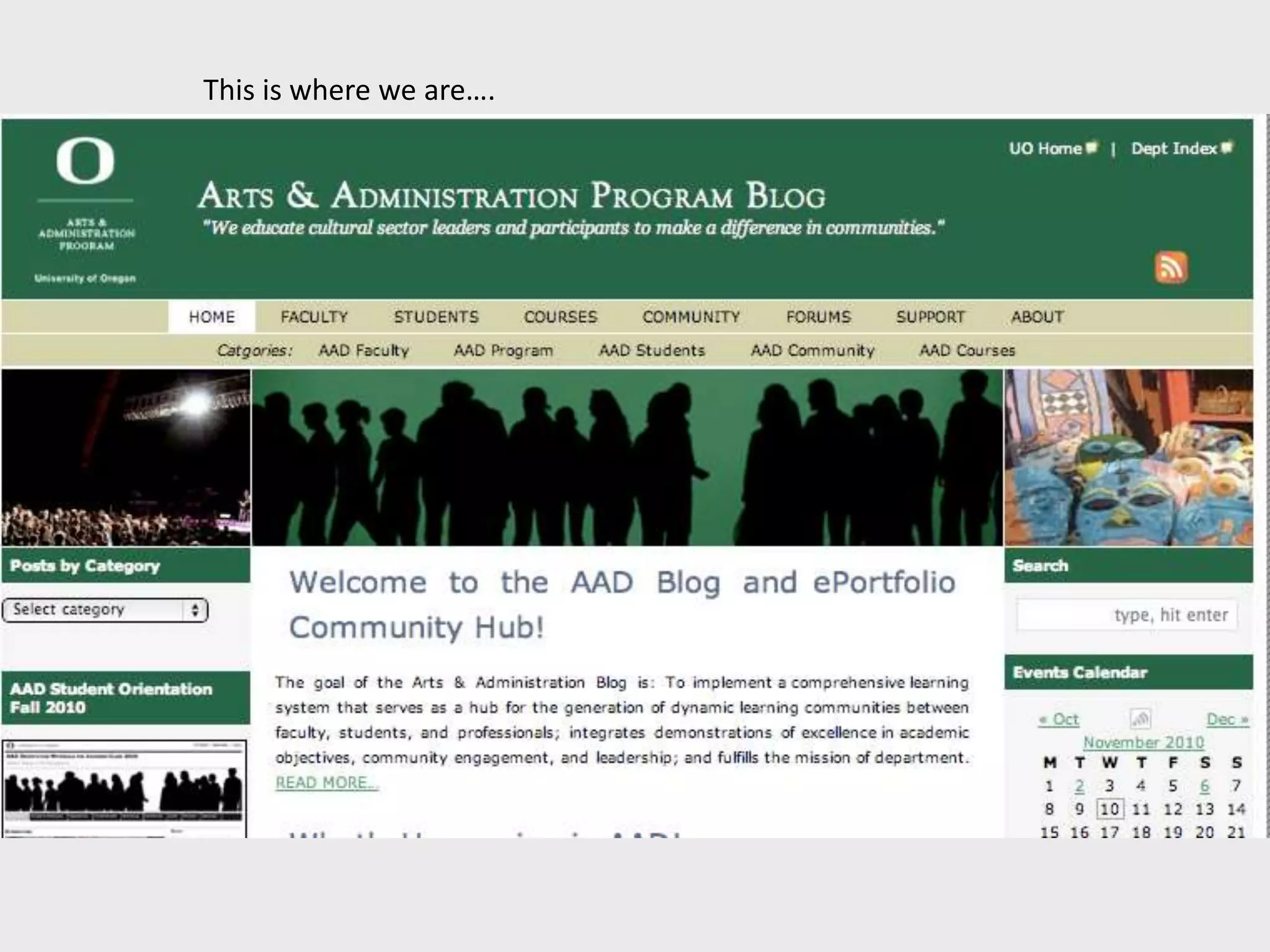
This is where we are….
WE EDUCATE CULTURAL SECTOR
LEADERS AND PARTICIPANTS TO MAKE
A DIFFERENCE IN COMMUNITIES.
The Arts and Administration Program at the University of Oregon informs
cultural sector administration, policy, research, and education. We prepare
and inspire cultural leaders based on the belief that they must be familiar
with the social, economic, environmental, political, technical and ethical
contexts in which arts and culture flourish.
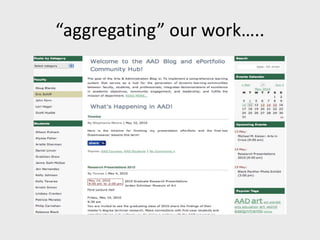
“aggregating” our work…..
What is an eportfolio?
WHAT IS AN EPORTFOLIO? An eportfolio is an electronic collection of evidence
that shows your learning journey over time. Portfolios can relate to specific
academic fields or your lifelong learning. Evidence may include writing
samples, photos, videos, research projects, observations by mentors and
peers, and/or reflective thinking. The key aspect of an eportfolio is your
reflection on the evidence, such as why it was chosen and what you learned
from the process of developing your eportfolio. Adapted from Philippa Butler’s
“Review of the Literature on Portfolios and Eportfolios” (2006), page
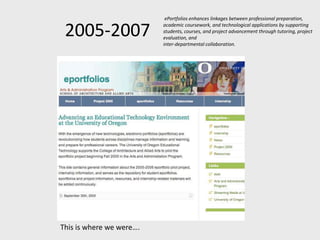
2005-2007
ePortfolios enhances linkages between professional preparation,
academic coursework, and technological applications by supporting
students, courses, and project advancement through tutoring, project
evaluation, and
inter-departmental collaboration.
This is where we were….
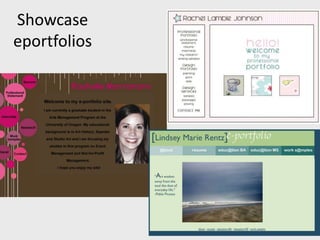
Showcase
eportfolios
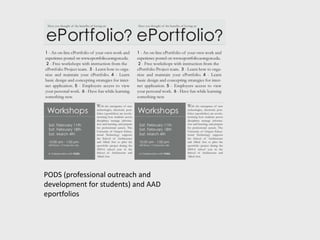
PODS (professional outreach and
development for students) and AAD
eportfolios
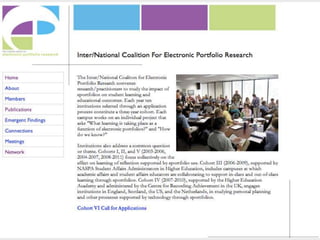
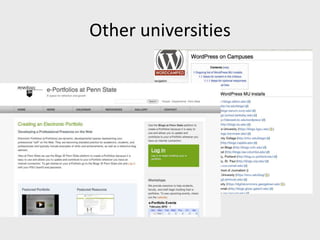
Other universities
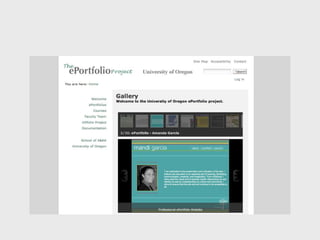
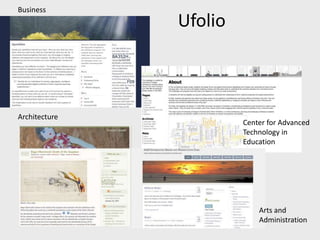
Ufolio
Architecture
Business
Center for Advanced
Technology in
Education
Arts and
Administration
Why social media?
Weblogs as personal learning spaces, professional web
spaces, and communication tool
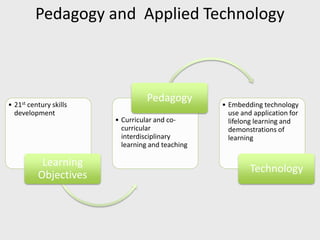
Pedagogy and Applied Technology
• 21st century skills
development
Learning
Objectives
• Curricular and co-
curricular
interdisciplinary
learning and teaching
Pedagogy
• Embedding technology
use and application for
lifelong learning and
demonstrations of
learning
Technology
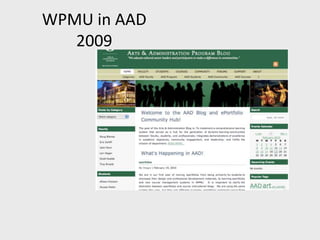
WPMU in AAD
2009
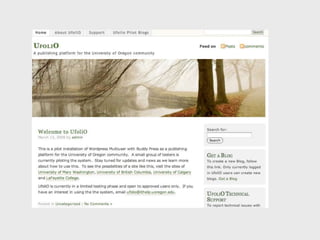
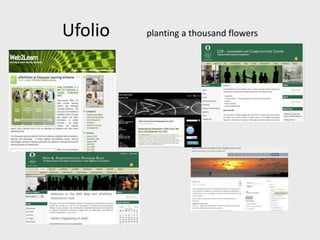
Ufolio planting a thousand flowers
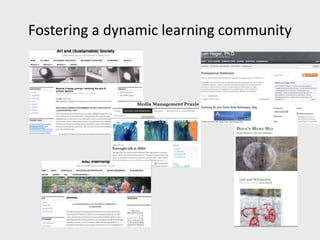
Fostering a dynamic learning community
learning eportfolio requirements
Professional home page – about, professional
statement, bio, navigation
Program learning Objectives –two year
academic plan and overall learning objectives
Course objectives, artifacts, reflections; how
each course contributes to overall learning
objectives
Professional practice – internship, practicum
Research
• Student Learning Objective Statement
For each course, students will state their learning objectives, and provide evidence
and reflections on the process and the final product. At quarterly advising
sessions, students will show these updates on their learning eportfolio blogs.
• Final Project/Evidence: Consists of the project document, if applicable, and if
possible, a visual component of either the project or the process. This is likely to
take the form of a picture (such as a screenshot, cover page, presentations, etc),
process document (first iteration), early blog entry, etc. But it could also be a
video, or other. This will likely take the form of a pdf or word document of their
final research paper or project for the course, which will be attached to their
course page.
• Reflections: Along with the evidence, student should provide narrative on the
following: Objectives of project; what did you do? Describe and interpret - How did
you create it? How did your thinking change as a result?
Tagged by curriculum component, course, learning objectives….
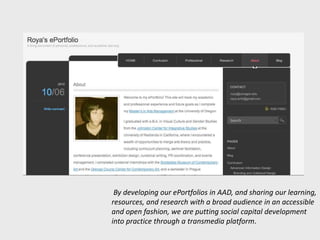
By developing our ePortfolios in AAD, and sharing our learning,
resources, and research with a broad audience in an accessible
and open fashion, we are putting social capital development
into practice through a transmedia platform.
instructional blogs
and student learning eportfolios
CHALLENGES
semantics….
faculty engagement….
curriculum mapping….
assessments….
learning outcomes
eportfolios
undergraduate/graduate
Future thinking:
ePortfolios as compass through 21st century liberal education
Fostering a facile interplay between virtual and embodied spaces
Digital Commons and communities of practice
Engaged learners
Digital Identity/digital citizenship

Hager tep

  • 1.
    This is wherewe are….
  • 2.
    WE EDUCATE CULTURALSECTOR LEADERS AND PARTICIPANTS TO MAKE A DIFFERENCE IN COMMUNITIES. The Arts and Administration Program at the University of Oregon informs cultural sector administration, policy, research, and education. We prepare and inspire cultural leaders based on the belief that they must be familiar with the social, economic, environmental, political, technical and ethical contexts in which arts and culture flourish.
  • 3.
  • 4.
    What is aneportfolio? WHAT IS AN EPORTFOLIO? An eportfolio is an electronic collection of evidence that shows your learning journey over time. Portfolios can relate to specific academic fields or your lifelong learning. Evidence may include writing samples, photos, videos, research projects, observations by mentors and peers, and/or reflective thinking. The key aspect of an eportfolio is your reflection on the evidence, such as why it was chosen and what you learned from the process of developing your eportfolio. Adapted from Philippa Butler’s “Review of the Literature on Portfolios and Eportfolios” (2006), page
  • 5.
    2005-2007 ePortfolios enhances linkagesbetween professional preparation, academic coursework, and technological applications by supporting students, courses, and project advancement through tutoring, project evaluation, and inter-departmental collaboration. This is where we were….
  • 6.
  • 8.
    PODS (professional outreachand development for students) and AAD eportfolios
  • 10.
  • 11.
  • 12.
    Why social media? Weblogsas personal learning spaces, professional web spaces, and communication tool
  • 13.
    Pedagogy and AppliedTechnology • 21st century skills development Learning Objectives • Curricular and co- curricular interdisciplinary learning and teaching Pedagogy • Embedding technology use and application for lifelong learning and demonstrations of learning Technology
  • 14.
  • 16.
    Ufolio planting athousand flowers
  • 17.
    Fostering a dynamiclearning community
  • 19.
    learning eportfolio requirements Professionalhome page – about, professional statement, bio, navigation Program learning Objectives –two year academic plan and overall learning objectives Course objectives, artifacts, reflections; how each course contributes to overall learning objectives Professional practice – internship, practicum Research
  • 20.
    • Student LearningObjective Statement For each course, students will state their learning objectives, and provide evidence and reflections on the process and the final product. At quarterly advising sessions, students will show these updates on their learning eportfolio blogs. • Final Project/Evidence: Consists of the project document, if applicable, and if possible, a visual component of either the project or the process. This is likely to take the form of a picture (such as a screenshot, cover page, presentations, etc), process document (first iteration), early blog entry, etc. But it could also be a video, or other. This will likely take the form of a pdf or word document of their final research paper or project for the course, which will be attached to their course page. • Reflections: Along with the evidence, student should provide narrative on the following: Objectives of project; what did you do? Describe and interpret - How did you create it? How did your thinking change as a result? Tagged by curriculum component, course, learning objectives….
  • 21.
    By developing ourePortfolios in AAD, and sharing our learning, resources, and research with a broad audience in an accessible and open fashion, we are putting social capital development into practice through a transmedia platform.
  • 22.
    instructional blogs and studentlearning eportfolios
  • 23.
  • 24.
  • 25.
    Future thinking: ePortfolios ascompass through 21st century liberal education Fostering a facile interplay between virtual and embodied spaces Digital Commons and communities of practice Engaged learners Digital Identity/digital citizenship

Editor's Notes

  • #2 Gardner Campbells’ mother ship, fostering collaborative spaces to promote digital citizenship and participatory culture/building the infrastructure of the arts and culture sector through education, practice, and research. Start with out hub, based on the WPMU platform, mission The goal of the Arts & Administration Blog is: To implement a comprehensive learning system that serves as a hub for the generation of dynamic learning communities between faculty, students, and professionals; integrates demonstrations of excellence in academic objectives, community engagement, and leadership; and fulfills the mission of department.
  • #3 Mission of the department
  • #4 Bring together faculty, students, courses, alumns, professional and student networks, resources, etc in a dynamic community,. Connect curricular and co-curricular learning through fostering connections between theory and pracitce and make the generation of knowledge visible, explicit, and dynamic
  • #5 So, we being with eportfolios Connects professional development with academic and career advancement Promotes critical thinking and deep thinking Fosters interdisciplinary connections Practices habits of mind for 21st century work place Rehearsal for essential skill sets in 21st cultural economy Generally two types: Showcase Learning Generally 3 functions To demonstrate learning and achievement over time – documents growth and provides evidence for skills and knowledge To showcase accomlishments For assessment
  • #6 Started with showcase eports Received an ed tech grant which provided faculty release tim (Nancy came in at that time), GTFs and tutors, conducted program evaluation and were constantly able to improve our infrastructure and build on open source platform for engaging our eportfolios
  • #7 Showcase eports
  • #8 Europe Lifelong eportfolio for every citizen Digital age for middle school students Digital transcript
  • #9 Video?
  • #10 Funding from the VP to participate in
  • #11 Research other universities using eportfolios and eventually ended up deciding on the WPMU system
  • #12 Ufolio test case
  • #13 Examples of arts blog sites Questions we had to address
  • #15 Blogging platform, bringing the blogs together Semaless portability between social media tools and applications, open forums, selective collaborative spaces, and fully private archives
  • #16 Much more robust than I thought it would be
  • #18 In aad faculty and students are using it in different ways
  • #20 Training and tutors Faculty voluntarily
  • #24 Privacy is a non-issue
  • #25 Forcing us into conversations about learning outcomes, dols, across the curriculum, how we assess, and how connect to movement in the fields of the arts and in higher education – vision for the future
  • #26 As Gardner referred to as digital citizenship – LEAP_ Liberal Education and America’s Promise Moving into undergraduate