Oral Presentation Assignment
Name	
  :	
  Muhammad	
  Mirza	
  Qayyum	
  Bin	
  Mohd	
  Shariff	
  
Student	
  ID	
  :	
  0324031	
  
Module	
  :	
  Effec@ve	
  Public	
  Communica@on	
  
Intake	
  :	
  March	
  2015	
  
Lecturer	
  :	
  Mr.	
  Ridhwan	
  Abdullah	


Description
•  It is affiliated with Islam
•  It has 6 domes
•  It possesses 4 minarets, with
each one located at the four
corners of the mosque
•  The mosque can
accommodate up to around
20000 worshippers at one
time
•  It has 7 main entrances and
12 subsidiary ones
Location
LOCATED IN
THE CITY OF
MADINAH
Background
•  The first mosque in the world, hence
the oldest.
•  Its first stones were positioned by the
Islamic prophet, Muhammad.
•  The mosque was subsequently
completed by his companions.
•  The mosque was built just outside of
Madinah.
•  Muhammad spent more than 20 nights in
this mosque after migrating, praying qasr
while waiting for Ali, who was was settling
Muhammad’s affairs back in Mecca.
•  Ali then left on foot and met up with the
Prophet in Quba.
•  Muhammad made it a habit to come to
the Quba Mosque every Saturday, either
riding his camel or on foot and offer two
raka’at prayers.
•  According to the Islamic tradition,
performing wudu in one’s home and
performing two raka’āt prayers in the
Quba mosque is equivalent to
performing one Umrah.
•  With this, Muhammad advised the
other Muslims to do the same.
•  Umrah is a pilgrimage to Mecca
performed by Muslims that can be
done at anytime. Umrah basically
means ‘ to visit a populated place ‘.
•  Throughout the centuries, the Muslims
have given the Quba Mosque much
attention.
•  The mosque was renovated by a number
of caliphs of different periods such as
Caliph Uthman bin Affan, Caliph Omar
bin Abdul Aziz and also Abu Yali Al-
Husaini.
•  In the year 555 AH, several additions were
made to the mosque by Kamal Al-Din Al-
Isfahani. Successive renovations of the
mosque took place in the years 671, 733,
840, 881 AH
•  The latest changes to the mosque were made
in the era of Sultan Abdul Majid during the
time of the Ottoman Empire.
•  When Abdel-Wahed El-Wakil was
commissioned, in the 20th century, to
conceive a larger mosque, he intended to
incorporate the old structure into his design.
But the old mosque was torn down and
replaced with a new one.
Current State of Quba Mosque
Structure/Layout of the Building
Front	
  Eleva@on	
  
Side	
  Eleva@on	
  
Ground Floor
Minbar
A raised platform at the
front area of the mosque.
It is from here where
speeches are given to the
Muslims visiting the
Quba Mosque.
Prayer Hall
The central are for prayer is called a
musalla. This area of the mosque is
deliberately quite bare, as with
other mosques, because the Muslims
sit, kneel and bow directly on the
floor.
Minarets
Caliph Omar bin Abdul Aziz
built the mosque’s first minaret.
The remaining minarets would
be added on at a later date.
Upper Floor
Inner/Outer Courtyard
Ornamentations of
Quba Mosque
1. Domes
•  6 large domes can
be found on the
rooftop of the
mosque.
•  Although it is
common with
many mosques, it
holds no spiritual
significance and is
purely aesthetic.
2. Mihrab
•  The mihrab is an
ornamental
indentation in the
wall of a mosque,
which marks the
direction of the
qiblah.
•  Usually shaped like
a doorway.
•  It is also decorated
with calligraphy to
make the space
stand out.
Materials Used
•  Stones were used as the
foundation for the
mosque
•  Then, the pillars of the
mosques were made by
using palm tree trunks.
Pictures From Different Angles of the Prayer Hall
A clearer view of
the minaret of
the mosque,
showing the
details.
An aerial view of the
mosque, which shows the
inner courtyard of the
mosque, minarets and the
domes.
References
•  hMp://www.3dmekanlar.com/en/masjid-­‐al-­‐
quba.html	
  
•  hMp://islam.about.com/od/mosques/tp/
architecture_parts.htm	
  
•  hMp://www.arabnews.com/news/600996	


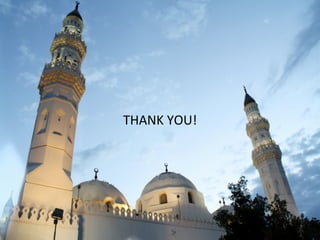
THANK	
  YOU!	
  

EPC Presentation March 2015

  • 1.
    Oral Presentation Assignment Name  :  Muhammad  Mirza  Qayyum  Bin  Mohd  Shariff   Student  ID  :  0324031   Module  :  Effec@ve  Public  Communica@on   Intake  :  March  2015   Lecturer  :  Mr.  Ridhwan  Abdullah    
  • 3.
    Description •  It isaffiliated with Islam •  It has 6 domes •  It possesses 4 minarets, with each one located at the four corners of the mosque •  The mosque can accommodate up to around 20000 worshippers at one time •  It has 7 main entrances and 12 subsidiary ones
  • 4.
  • 5.
    Background •  The firstmosque in the world, hence the oldest. •  Its first stones were positioned by the Islamic prophet, Muhammad. •  The mosque was subsequently completed by his companions. •  The mosque was built just outside of Madinah.
  • 6.
    •  Muhammad spentmore than 20 nights in this mosque after migrating, praying qasr while waiting for Ali, who was was settling Muhammad’s affairs back in Mecca. •  Ali then left on foot and met up with the Prophet in Quba. •  Muhammad made it a habit to come to the Quba Mosque every Saturday, either riding his camel or on foot and offer two raka’at prayers.
  • 7.
    •  According tothe Islamic tradition, performing wudu in one’s home and performing two raka’āt prayers in the Quba mosque is equivalent to performing one Umrah. •  With this, Muhammad advised the other Muslims to do the same. •  Umrah is a pilgrimage to Mecca performed by Muslims that can be done at anytime. Umrah basically means ‘ to visit a populated place ‘.
  • 8.
    •  Throughout thecenturies, the Muslims have given the Quba Mosque much attention. •  The mosque was renovated by a number of caliphs of different periods such as Caliph Uthman bin Affan, Caliph Omar bin Abdul Aziz and also Abu Yali Al- Husaini. •  In the year 555 AH, several additions were made to the mosque by Kamal Al-Din Al- Isfahani. Successive renovations of the mosque took place in the years 671, 733, 840, 881 AH
  • 9.
    •  The latestchanges to the mosque were made in the era of Sultan Abdul Majid during the time of the Ottoman Empire. •  When Abdel-Wahed El-Wakil was commissioned, in the 20th century, to conceive a larger mosque, he intended to incorporate the old structure into his design. But the old mosque was torn down and replaced with a new one.
  • 10.
    Current State ofQuba Mosque
  • 11.
    Structure/Layout of theBuilding Front  Eleva@on   Side  Eleva@on  
  • 12.
    Ground Floor Minbar A raisedplatform at the front area of the mosque. It is from here where speeches are given to the Muslims visiting the Quba Mosque.
  • 13.
    Prayer Hall The centralare for prayer is called a musalla. This area of the mosque is deliberately quite bare, as with other mosques, because the Muslims sit, kneel and bow directly on the floor.
  • 14.
    Minarets Caliph Omar binAbdul Aziz built the mosque’s first minaret. The remaining minarets would be added on at a later date.
  • 15.
  • 16.
  • 17.
    Ornamentations of Quba Mosque 1.Domes •  6 large domes can be found on the rooftop of the mosque. •  Although it is common with many mosques, it holds no spiritual significance and is purely aesthetic.
  • 18.
    2. Mihrab •  Themihrab is an ornamental indentation in the wall of a mosque, which marks the direction of the qiblah. •  Usually shaped like a doorway. •  It is also decorated with calligraphy to make the space stand out.
  • 19.
    Materials Used •  Stoneswere used as the foundation for the mosque •  Then, the pillars of the mosques were made by using palm tree trunks.
  • 20.
    Pictures From DifferentAngles of the Prayer Hall
  • 21.
    A clearer viewof the minaret of the mosque, showing the details. An aerial view of the mosque, which shows the inner courtyard of the mosque, minarets and the domes.
  • 22.
    References •  hMp://www.3dmekanlar.com/en/masjid-­‐al-­‐ quba.html   • hMp://islam.about.com/od/mosques/tp/ architecture_parts.htm   •  hMp://www.arabnews.com/news/600996    
  • 23.