Student Name : Athar Hafeez
Subject: Biochemistry
Enzyme
 substance produced by a
living organism which acts as
a catalyst to bring about a
specific biochemical reaction( reactions
that help sustain life and allow cells to grow.)
Termsrelatedto
Enzyme
 Cofactor: A cofactor is a non-protein chemical compound or metallic
ion that is required for an enzyme's role as a catalyst. Cofactors can
be considered "helper molecules" that assist in biochemical
transformations
 Prosthetic Group : if the non protein part is covalently bonded to
enzyme then it is called prostatic group
Coenzyme : if non protein part is loosely attached to enzyme
then it is termed as Coenzyme
Apoenzyme
&
Holoenzyme
 Apoenzyme or apoprotein is an enzymatically inactive protein part
of an enzyme, which requires a cofactor for its activity
 Holoenzyme is a complete, functional enzyme, which is
catalytically active
Characteristics
ofEnzyme
 Enzymes are globular proteins
 The increase the rate of reaction without being used up
 Their presence does not affect the nature or properties
of end products
 Amount of amount of enzyme can accelerate the
chemical reaction
 Enzymes are highly specific
 They are very sensitive to even minor change in pH ,
temperature,and substrate concentration
 They lower activation energy
Activational
Energy
 Activation energy is defined as the minimum amount of extra
energy required by a reacting molecule to get converted into
product
Mechanismsof
enzymeaction
 An enzyme attracts substrates to its active site, catalyzes the chemical
reaction by which products are formed, and then allows the products
to dissociate (separate from the enzyme surface). The combination
formed by an enzyme and its substrates is called the enzyme–
substrate complex.
 Enzyme + substrate •••• ES complex •••• Enzyme+ product
Enzymes
structure
Lock and key model
Lock-and-key model is a model for enzyme-substrate interaction
suggesting that the enzyme and the substrate possess specific
complementary geometric shapes that fit exactly into one another.
Enzymes are highly specific
. Induced Fit model
The induced-fit model states a substrate binds to an active site and
both change shape slightly, creating an ideal fit for catalysis
Factorsaffecting
theenzyme
action
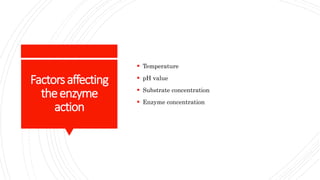
 Temperature
 pH value
 Substrate concentration
 Enzyme concentration
Inhibitor
An enzyme inhibitor is a molecule that binds
to an enzyme and blocks its activity
Typesof
Inhabitor
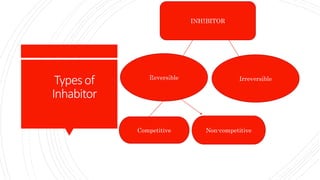
INHIBITOR
Irreversible
Reversible
Competitive Non-competitive

enzymes.pptx

  • 1.
    Student Name :Athar Hafeez Subject: Biochemistry
  • 2.
    Enzyme  substance producedby a living organism which acts as a catalyst to bring about a specific biochemical reaction( reactions that help sustain life and allow cells to grow.)
  • 3.
    Termsrelatedto Enzyme  Cofactor: Acofactor is a non-protein chemical compound or metallic ion that is required for an enzyme's role as a catalyst. Cofactors can be considered "helper molecules" that assist in biochemical transformations  Prosthetic Group : if the non protein part is covalently bonded to enzyme then it is called prostatic group Coenzyme : if non protein part is loosely attached to enzyme then it is termed as Coenzyme
  • 4.
    Apoenzyme & Holoenzyme  Apoenzyme orapoprotein is an enzymatically inactive protein part of an enzyme, which requires a cofactor for its activity  Holoenzyme is a complete, functional enzyme, which is catalytically active
  • 5.
    Characteristics ofEnzyme  Enzymes areglobular proteins  The increase the rate of reaction without being used up  Their presence does not affect the nature or properties of end products  Amount of amount of enzyme can accelerate the chemical reaction  Enzymes are highly specific  They are very sensitive to even minor change in pH , temperature,and substrate concentration  They lower activation energy
  • 6.
    Activational Energy  Activation energyis defined as the minimum amount of extra energy required by a reacting molecule to get converted into product
  • 7.
    Mechanismsof enzymeaction  An enzymeattracts substrates to its active site, catalyzes the chemical reaction by which products are formed, and then allows the products to dissociate (separate from the enzyme surface). The combination formed by an enzyme and its substrates is called the enzyme– substrate complex.  Enzyme + substrate •••• ES complex •••• Enzyme+ product
  • 8.
    Enzymes structure Lock and keymodel Lock-and-key model is a model for enzyme-substrate interaction suggesting that the enzyme and the substrate possess specific complementary geometric shapes that fit exactly into one another. Enzymes are highly specific . Induced Fit model The induced-fit model states a substrate binds to an active site and both change shape slightly, creating an ideal fit for catalysis
  • 9.
    Factorsaffecting theenzyme action  Temperature  pHvalue  Substrate concentration  Enzyme concentration
  • 10.
    Inhibitor An enzyme inhibitoris a molecule that binds to an enzyme and blocks its activity
  • 11.