Importance
• Enzymes playan important role in
Metabolism, Diagnosis, and Therapeutics.
• All biochemical reactions are enzyme
catalyzed in the living organism.
• Level of enzyme in blood are of diagnostic
importance e.g. it is a good indicator in
disease such as myocardial infarction.
• Enzyme can be used therapeutically such as
digestive enzymes.
3.
Definition
(Enzymes as BiologicalCatalysts)
• Enzymes are proteins that increase the rate of
reaction by lowering the energy of activation
• They catalyze nearly all the chemical reactions
taking place in the cells of the body.
• Not altered or consumed during reaction.
• Reusable
4.
ACTIVE SITES
• Enzymemolecules contain a special pocket or
cleft called the active sites.
5.
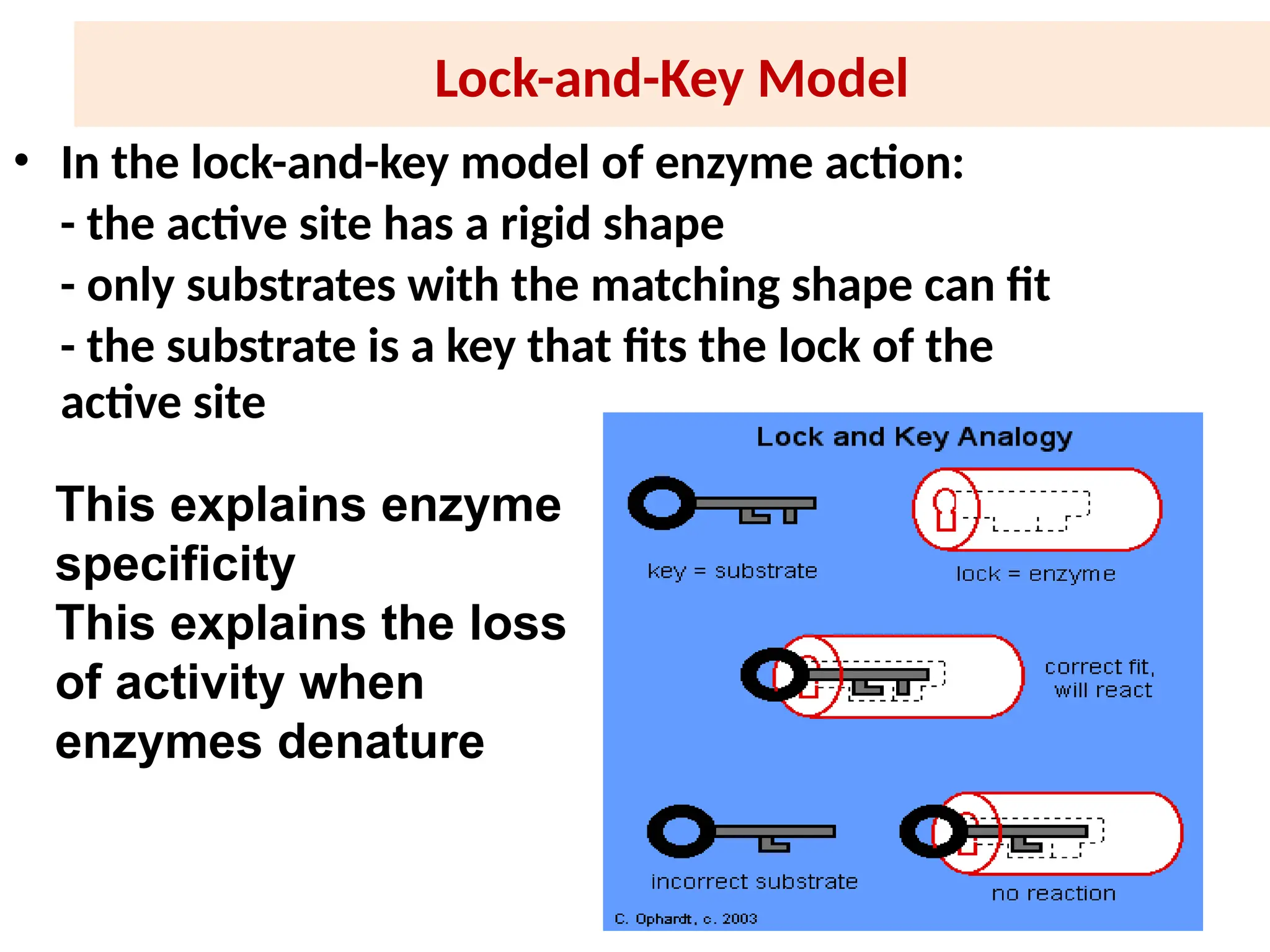
Lock-and-Key Model
• Inthe lock-and-key model of enzyme action:
- the active site has a rigid shape
- only substrates with the matching shape can fit
- the substrate is a key that fits the lock of the
active site
This explains enzyme
specificity
This explains the loss
of activity when
enzymes denature
6.
APOENZYME and HOLOENZYME
•The enzyme without its non protein moiety is termed
as apoenzyme and it is inactive.
• Holoenzyme is an active enzyme with its non protein
component.
7.
Important Terms toUnderstand
Biochemical Nature
And Activity of Enzymes
• Cofactor:
–A cofactor is a non-protein chemical
compound that is bound (either tightly or
loosely) to an enzyme and is required for
catalysis.
–Types of Cofactors:
• Coenzymes.
• Prosthetic groups.
8.
Types of Cofactors
•Coenzyme:
The non-protein component, loosely bound
to apoenzyme by non-covalent bond.
• Examples : vitamins or compound derived
from vitamins.
• Prosthetic group
The non-protein component, tightly bound
to the apoenzyme by covalent bonds is called
a Prosthetic group.
9.
Enzyme Specificity
• Enzymeshave varying degrees of specificity
for substrates
• Enzymes may recognize and catalyze:
- a single substrate
- a group of similar substrates
- a particular type of bond
11.
Important Terms toUnderstand
Biochemical Nature
And Activity of Enzymes
Activation energy or Energy of Activation:
• All chemical reactions require some amount of
energy to get them started.
OR
• It is First push to start reaction.
This energy is called activation energy.
12.
Mechanism of Actionof Enzymes
• Enzymes increase reaction rates by
decreasing the Activation energy:
• Enzyme-Substrate Interactions:
‒Formation of Enzyme substrate
complex by:
‒Lock-and-Key Model
‒Induced Fit Model
Lock-and-Key Model
• Inthe lock-and-key model of enzyme action:
- the active site has a rigid shape
- only substrates with the matching shape can fit
- the substrate is a key that fits the lock of the active site
• This is an older model, however, and does not work for all
enzymes
16.
Induced Fit Model
•In the induced-fit model of enzyme action:
- the active site is flexible, not rigid
- the shapes of the enzyme, active site, and substrate adjust
to maximize the fit, which improves catalysis
- there is a greater range of substrate specificity
• This model is more consistent with a wider range of enzymes
Product
• The enzymeand product separate
• EP E + P The product
is made
Enzyme is
ready
for
another
substrate.
EP
20.
24
What Affects EnzymeActivity?
• Three factors:
1. Environmental Conditions
2. Cofactors and Coenzymes
3. Enzyme Inhibitors
21.
25
1. Environmental Conditions
1.Extreme Temperature are the most
dangerous
- high temps may denature (unfold) the
enzyme.
2. pH (most like 6 - 8 pH near neutral)
3. substrate concentration .
22.
26
2. Cofactors andCoenzymes
• Inorganic substances (zinc, iron) and
vitamins (respectively) are sometimes need
for proper enzymatic activity.
• Example:
Iron must be present in the
quaternary structure - hemoglobin in
order for it to pick up oxygen.
Environmental factors
• pHalso affects the rate of enzyme-
substrate complexes
–Most enzymes have an optimum pH of
around 7 (neutral)
• However, some prefer acidic or basic conditions
25.
Substrate Concentration andReaction Rate
• The rate of reaction increases as substrate
concentration increases (at constant enzyme
concentration)
• Maximum activity occurs when the enzyme is
saturated (when all enzymes are binding substrate)
Naming Enzymes
• Thename of an enzyme in many cases end in –ase
• For example, sucrase catalyzes the hydrolysis of sucrose
• The name describes the function of the enzyme
For example, oxidases catalyze oxidation reactions
• Sometimes common names are used, particularly for the
digestion enzymes such as pepsin and trypsin
• Some names describe both the substrate and the function
• For example, alcohol dehydrogenase oxides ethanol
29.
Enzymes Are Classifiedinto six functional
Classes (EC number Classification) by the
International Union of Biochemists (I.U.B.).
on the Basis of the Types of
Reactions That They Catalyze
• EC 1. Oxidoreductases
• EC 2. Transferases
• EC 3. Hydrolases
• EC 4. Lyases
• EC 5. Isomerases
• EC 6. Ligases
30.
Principle of theinternational
classification
Each enzyme has classification number
consisting of four digits:
Example, EC: (2.7.1.1) HEXOKINASE
31.
• EC: (2.7.1.1)these components indicate the following
groups of enzymes:
• 2. IS CLASS (TRANSFERASE)
• 7. IS SUBCLASS (TRANSFER OF PHOSPHATE)
• 1. IS SUB-SUB CLASS (ALCOHOL IS PHOSPHATE
ACCEPTOR)
• 1. SPECIFIC NAME
ATP,D-HEXOSE-6-PHOSPHOTRANSFERASE (Hexokinase)
32.
H O
O H
H
OH
H
O H
CH 2O H
H
O H
H H O
O H
H
O H
H
O H
CH 2O PO 3
2
H
O H
H
2
3
4
5
6
1 1
6
5
4
3 2
ATP ADP
M g2+
glucose glucose-6-phosphate
Hexokinase
1. Hexokinase catalyzes:
Glucose + ATP glucose-6-P + ADP
Ribbon diagram ofGlucose-6-Phosphate
isomerase
The structural isomers of hexane
Cis-2-butene and Trans-2-butene
Epimers: D-glucose and D-mannose
Editor's Notes
#5 The area on the enzyme where the substrate or substrates attach to is called the active site.
Enzymes are usually very large proteins and the active site is just a small region of the enzyme molecule.
#16 Activation energy is the push needed to start a reaction
#22 Within the active site of the ES complex, the reaction occurs to convert substrate to product (P):
#23 The products are then released, allowing another substrate molecule to bind the enzyme
- this cycle can be repeated millions (or even more) times per minute
The overall reaction for the conversion of substrate to product can be written as follows:
E + S ES E + P
#27 The temp at which enzymatic reaction occur fastest is called Optimum temperature
#28 pepsin (a stomach enzyme) functions best at a low (acidic) pH. At pH 1, pepsin is in it’s functional shape; it would be able to bind to its substate. At pH 5, the enzyme’s shape is different and it no longer has an active site able to bind the substrate. The change in enzyme activity is observed as a difference in reaction rate.
#42 Kinases are specialized transferases that regulate metabolism by transferring phosphate from ATP to other molecules.AST,ALT,hexokinase
Kinases are specialized transferases that regulate metabolism by transferring phosphate from ATP to other molecules.AST,ALT,hexokinase
#48 Isomerases are a general class of enzymes which convert a molecule from one isomer to another.. The general form of such a reaction is as follows:
A–B → B–A
#50 facilitate intramolecular rearrangements in which bonds are broken and formed or they can catalyze conformational changes.