Classification enzymes and coenzymes. Non
vitamin coenzymes.
Classification, nomenclature and code of enzymes.
Cofactors of complex-enzymes. their types: coenzymes
and prosthetic group.
Azerbaijan Medical University
Biochemistry Department, Biochemistry 1
What are Enzymes?
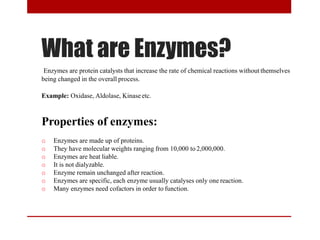
Enzymes are protein catalysts that increase the rate of chemical reactions without themselves
being changed in the overall process.
Example: Oxidase, Aldolase, Kinaseetc.
Properties of enzymes:
o Enzymes are made up of proteins.
o They have molecular weights ranging from 10,000 to2,000,000.
o Enzymes are heat liable.
o It is not dialyzable.
o Enzyme remain unchanged after reaction.
o Enzymes are specific, each enzyme usually catalyses only one reaction.
o Many enzymes need cofactors in order to function.
NOMENCLATURE OF ENZYMES
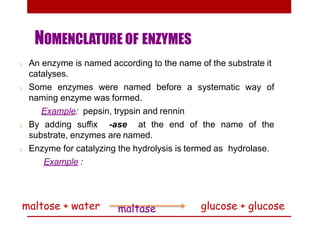
o An enzyme is named according to the name of the substrate it
catalyses.
o Some enzymes were named before a systematic way of
naming enzyme was formed.
Example: pepsin, trypsin and rennin
o By adding suffix -ase at the end of the name of the
substrate, enzymes are named.
o Enzyme for catalyzing the hydrolysis is termed as hydrolase.
Example :
maltose + water glucose + glucosemaltase
EXAMPLES
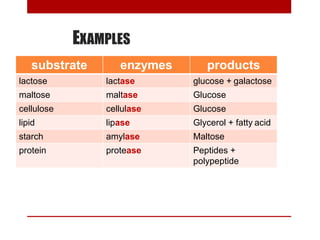
substrate enzymes products
lactose lactase glucose + galactose
maltose maltase Glucose
cellulose cellulase Glucose
lipid lipase Glycerol + fatty acid
starch amylase Maltose
protein protease Peptides +
polypeptide
Nomenclature
• The International Union of Biochemistry and Molecular Biology developed a
nomenclature for enzymes
• Each enzyme is described by a sequence of four numbers preceded by "EC". EC denotes
Enzyme Commission and the number of enzyme is called EC numbers.
• When classified, each enzyme is assigned the EC number, in the form of digits separated
by periods. The first number categorizes the enzyme based on its reaction.
Nomenclature
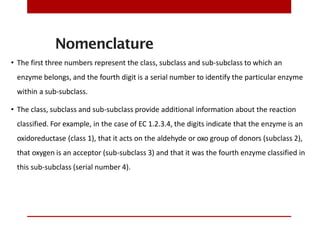
• The first three numbers represent the class, subclass and sub-subclass to which an
enzyme belongs, and the fourth digit is a serial number to identify the particular enzyme
within a sub-subclass.
• The class, subclass and sub-subclass provide additional information about the reaction
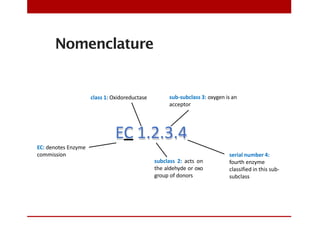
classified. For example, in the case of EC 1.2.3.4, the digits indicate that the enzyme is an
oxidoreductase (class 1), that it acts on the aldehyde or oxo group of donors (subclass 2),
that oxygen is an acceptor (sub-subclass 3) and that it was the fourth enzyme classified in
this sub-subclass (serial number 4).
Nomenclature
EC 1.2.3.4
EC: denotes Enzyme
commission
class 1: Oxidoreductase
subclass 2: acts on
the aldehyde or oxo
group of donors
sub-subclass 3: oxygen is an
acceptor
serial number 4:
fourth enzyme
classified in this sub-
subclass
CLASSIFICATION OF ENZYMES
 A systematic classification of enzymes has been developed by
International Enzyme Commission.
 This classification is based on the type of reactions catalyzed
by enzymes.
 There are six major classes.
 Each class is further divided into sub classes, sub sub-classes
and so on, to describe the huge number of different enzyme-
catalyzed reactions.
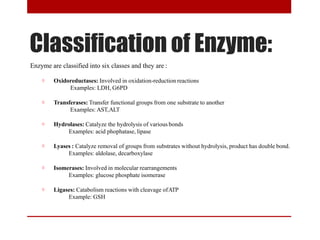
Classification of Enzyme:
Enzyme are classified into six classes and they are :
☼ Oxidoreductases: Involved in oxidation-reduction reactions
Examples: LDH, G6PD
☼ Transferases: Transfer functional groups from one substrate to another
Examples: AST,ALT
☼ Hydrolases: Catalyze the hydrolysis of various bonds
Examples: acid phophatase, lipase
☼ Lyases : Catalyze removal of groups from substrates without hydrolysis, product has double bond.
Examples: aldolase, decarboxylase
☼ Isomerases: Involved in molecular rearrangements
Examples: glucose phosphate isomerase
☼ Ligases: Catabolism reactions with cleavage ofATP
Example: GSH
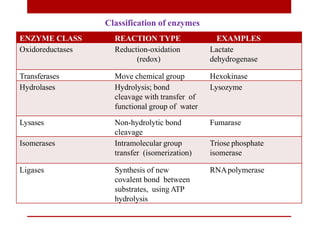
ENZYME CLASS REACTION TYPE EXAMPLES
Oxidoreductases Reduction-oxidation
(redox)
Lactate
dehydrogenase
Transferases Move chemical group Hexokinase
Hydrolases Hydrolysis; bond
cleavage with transfer of
functional group of water
Lysozyme
Lysases Non-hydrolytic bond
cleavage
Fumarase
Isomerases Intramolecular group
transfer (isomerization)
Triose phosphate
isomerase
Ligases Synthesis of new
covalent bond between
substrates, using ATP
hydrolysis
RNApolymerase
Classification of enzymes
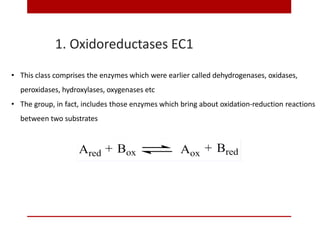
1. Oxidoreductases EC1
• This class comprises the enzymes which were earlier called dehydrogenases, oxidases,
peroxidases, hydroxylases, oxygenases etc
• The group, in fact, includes those enzymes which bring about oxidation-reduction reactions
between two substrates
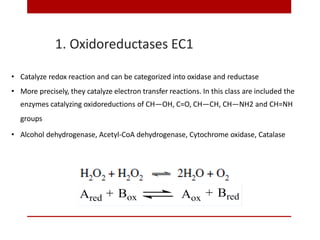
1. Oxidoreductases EC1
• Catalyze redox reaction and can be categorized into oxidase and reductase
• More precisely, they catalyze electron transfer reactions. In this class are included the
enzymes catalyzing oxidoreductions of CH—OH, C=O, CH—CH, CH—NH2 and CH=NH
groups
• Alcohol dehydrogenase, Acetyl-CoA dehydrogenase, Cytochrome oxidase, Catalase
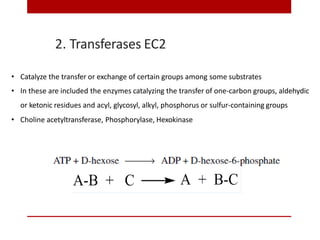
2. Transferases EC2
• Catalyze the transfer or exchange of certain groups among some substrates
• In these are included the enzymes catalyzing the transfer of one-carbon groups, aldehydic
or ketonic residues and acyl, glycosyl, alkyl, phosphorus or sulfur-containing groups
• Choline acetyltransferase, Phosphorylase, Hexokinase
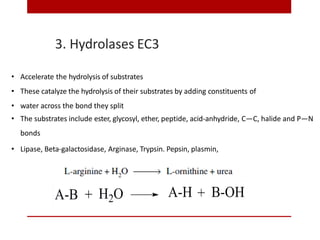
3. Hydrolases EC3
• Accelerate the hydrolysis of substrates
• These catalyze the hydrolysis of their substrates by adding constituents of
• water across the bond they split
• The substrates include ester, glycosyl, ether, peptide, acid-anhydride, C—C, halide and P—N
bonds
• Lipase, Beta-galactosidase, Arginase, Trypsin. Pepsin, plasmin,
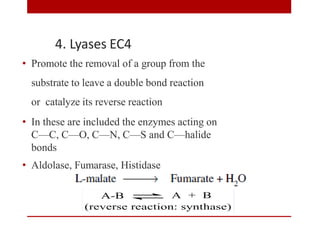
4. Lyases EC4
• Promote the removal of a group from the
substrate to leave a double bond reaction
or catalyze its reverse reaction
• In these are included the enzymes acting on
C—C, C—O, C—N, C—S and C—halide
bonds
• Aldolase, Fumarase, Histidase
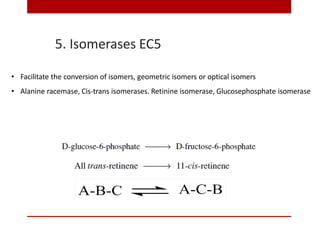
5. Isomerases EC5
• Facilitate the conversion of isomers, geometric isomers or optical isomers
• Alanine racemase, Cis-trans isomerases. Retinine isomerase, Glucosephosphate isomerase
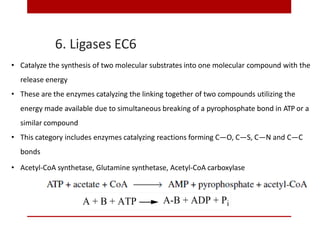
6. Ligases EC6
• Catalyze the synthesis of two molecular substrates into one molecular compound with the
release energy
• These are the enzymes catalyzing the linking together of two compounds utilizing the
energy made available due to simultaneous breaking of a pyrophosphate bond in ATP or a
similar compound
• This category includes enzymes catalyzing reactions forming C—O, C—S, C—N and C—C
bonds
• Acetyl-CoA synthetase, Glutamine synthetase, Acetyl-CoA carboxylase
Coenzymes
• Enzymes functional groups takes part in acid-base reaction, to form transient bonds with
substrate or take part in charge – charge interactions. They are less stable for catalyzing
Redox reaction or transfer of a chemical group.
• Such reactions are carried out by small molecules called cofactors
• Cofactors may be metal ions, such as the Zn2+ required for the catalytic activity of
carboxypeptidase A, or organic molecules known as coenzymes.
Coenzymes
• Some cofactors, for instance NAD+, are but transiently associated with a given enzyme
molecule, so that, in effect, they function as cosubstrates
• Other cofactors, known as prosthetic groups, are essentially permanently associated with
their protein, often by covalent bonds
• For example, the heme prosthetic group of hemoglobin is tightly bound to its protein through
extensive hydrophobic and hydrogen bonding interactions together with a covalent bond
between the heme Fe2+ ion and His F8
Coenzymes
• Coenzymes are chemically changed by the enzymatic reactions in which they participate.
Thus, in order to complete the catalytic cycle, the coenzyme must be returned to its original
state. For prosthetic groups, this can occur only in a separate phase of the enzymatic reaction
sequence
• For transiently bound coenzymes, such as NAD+, however, the regeneration reaction may be
catalyzed by a different enzyme
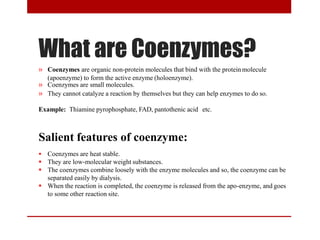
What are Coenzymes?
» Coenzymes are organic non-protein molecules that bind with the proteinmolecule
(apoenzyme) to form the active enzyme (holoenzyme).
» Coenzymes are small molecules.
» They cannot catalyze a reaction by themselves but they can help enzymes to do so.
Example: Thiamine pyrophosphate, FAD, pantothenic acid etc.
Salient features of coenzyme:
 Coenzymes are heat stable.
 They are low-molecular weight substances.
 The coenzymes combine loosely with the enzyme molecules and so, the coenzyme can be
separated easily by dialysis.
 When the reaction is completed, the coenzyme is released from the apo-enzyme, and goes
to some other reaction site.
Inorganic cofactor
Metal Ions
Ion Examplesof enzymes
containing this ion
Cupric Cytochrome oxidase
Ferrous or Ferric
Cy
Catalase
Heme)tochrome
(via
Nitrogen
ase
Hydroge
nase
Magnesium
Glucose 6-phosphatase
Hexokinase
DNA polymerase
A simple [Fe2S2] cluster containing two
iron atoms and two sulfur atoms,
coordinated by four protein cysteine
residues.
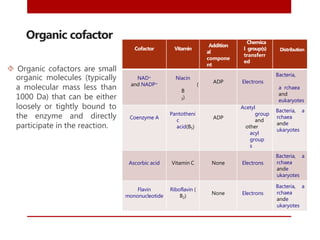
Organic cofactor
 Organic cofactors are small
organic molecules (typically
a molecular mass less than
1000 Da) that can be either
loosely or tightly bound to
the enzyme and directly
participate in the reaction.
Cofactor Vitamin
Addition
al
compone
nt
Chemica
l group(s)
transferr
ed
Distribution
NAD+
and NADP+
Niacin
(
B
3)
ADP Electrons
Bacteria,
a rchaea
and
eukaryotes
Coenzyme A
Pantotheni
c
acid(B5)
ADP
Acetyl
group
and
other
acyl
group
s
Bacteria, a
rchaea
ande
ukaryotes
Ascorbic acid Vitamin C None Electrons
Bacteria, a
rchaea
ande
ukaryotes
Flavin
mononucleotide
Riboflavin (
B2)
None Electrons
Bacteria, a
rchaea
ande
ukaryotes
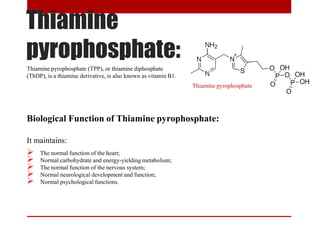
Thiamine
pyrophosphate:
Biological Function of Thiamine pyrophosphate:
It maintains:
 The normal function of the heart;
 Normal carbohydrate and energy-yielding metabolism;
 The normal function of the nervous system;
 Normal neurological development and function;
 Normal psychological functions.
Thiamine pyrophosphate (TPP), or thiamine diphosphate
(ThDP), is a thiamine derivative, is also known as vitamin B1.
Thiamine pyrophosphate
Flavin
Coenzymes:
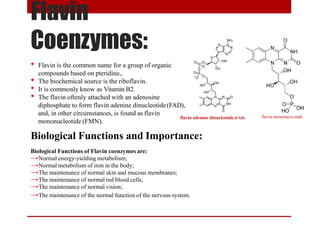
• Flavin is the common name for a group of organic
compounds based on pteridine,.
• The biochemical source is the riboflavin.
• It is commonly know as Vitamin B2.
• The flavin oftenly attached with an adenosine
diphosphate to form flavin adenine dinucleotide(FAD),
and, in other circumstances, is found as flavin
mononucleotide (FMN).
flavin adenine dinucleotide(FAD) flavin mononucleotide
Biological Functions and Importance:
Biological Functions of Flavin coenzymes are:
→Normal energy-yielding metabolism;
→Normal metabolism of iron in the body;
→The maintenance of normal skin and mucous membranes;
→The maintenance of normal red blood cells;
→The maintenance of normal vision;
→The maintenance of the normal function of the nervous system.
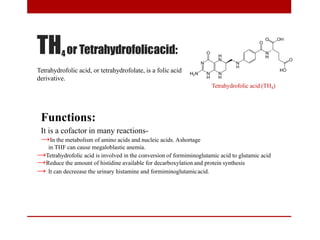
TH4 or Tetrahydrofolicacid:
Tetrahydrofolic acid, or tetrahydrofolate, is a folic acid
derivative.
Tetrahydrofolic acid (TH4)
Functions:
It is a cofactor in many reactions-
→In the metabolism of amino acids and nucleic acids. Ashortage
in THF can cause megaloblastic anemia.
→Tetrahydrofolic acid is involved in the conversion of formiminoglutamic acid to glutamic acid
→Reduce the amount of histidine available for decarboxylation and protein synthesis
→ It can decreease the urinary histamine and formiminoglutamicacid.
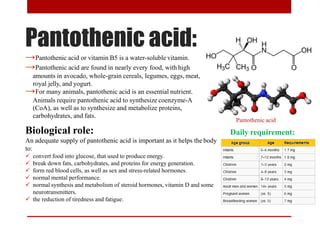
Pantothenic acid:
royal jelly, and yogurt.
→Pantothenic acid or vitamin B5 is a water-soluble vitamin.
→Pantothenic acid are found in nearly every food, with high
amounts in avocado, whole-grain cereals, legumes, eggs, meat,
→For many animals, pantothenic acid is an essential nutrient.
Animals require pantothenic acid to synthesize coenzyme-A
(CoA), as well as to synthesize and metabolize proteins,
carbohydrates, and fats.
Biological role:
An adequate supply of pantothenic acid is important as it helps the body
to:
 convert food into glucose, that used to produce energy.
 break down fats, carbohydrates, and proteins for energy generation.
 form red blood cells, as well as sex and stress-related hormones.
 normal mental performance.
 normal synthesis and metabolism of steroid hormones, vitamin D and some
neurotransmitters.
 the reduction of tiredness and fatigue.
Pantothenic acid
Daily requirement:
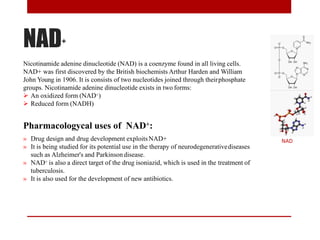
NAD+
Nicotinamide adenine dinucleotide (NAD) is a coenzyme found in all living cells.
NAD+ was first discovered by the British biochemists Arthur Harden and William
John Young in 1906. It is consists of two nucleotides joined through theirphosphate
groups. Nicotinamide adenine dinucleotide exists in two forms:
 An oxidized form (NAD+)
 Reduced form (NADH)
NAD
Pharmacologycal uses of NAD+:
» Drug design and drug development exploitsNAD+
» It is being studied for its potential use in the therapy of neurodegenerativediseases
such as Alzheimer's and Parkinsondisease.
» NAD+ is also a direct target of the drug isoniazid, which is used in the treatment of
tuberculosis.
» It is also used for the development of new antibiotics.
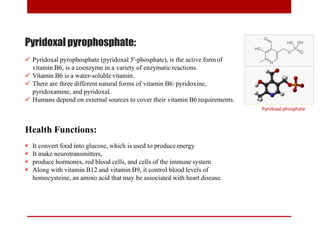
Pyridoxal pyrophosphate:
 Pyridoxal pyrophosphate (pyridoxal 5'-phosphate), is the active formof
vitamin B6, is a coenzyme in a variety of enzymatic reactions.
 Vitamin B6 is a water-soluble vitamin.
 There are three different natural forms of vitamin B6: pyridoxine,
pyridoxamine, and pyridoxal.
 Humans depend on external sources to cover their vitamin B6 requirements.
Pyridoxal phosphate
Health Functions:
 It convert food into glucose, which is used to produceenergy
 It make neurotransmitters,
 produce hormones, red blood cells, and cells of the immune system
 Along with vitamin B12 and vitamin B9, it control blood levels of
homocysteine, an amino acid that may be associated with heart disease.
Coenzymes
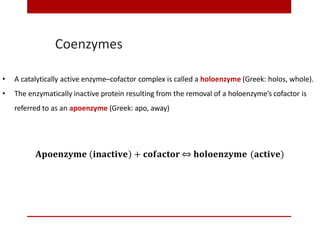
• A catalytically active enzyme–cofactor complex is called a holoenzyme (Greek: holos, whole).
• The enzymatically inactive protein resulting from the removal of a holoenzyme’s cofactor is
referred to as an apoenzyme (Greek: apo, away)
𝐀𝐩𝐨𝐞𝐧𝐳𝐲𝐦𝐞 𝐢𝐧𝐚𝐜𝐭𝐢𝐯𝐞 + 𝐜𝐨𝐟𝐚𝐜𝐭𝐨𝐫 ⇔ 𝐡𝐨𝐥𝐨𝐞𝐧𝐳𝐲𝐦𝐞 (𝐚𝐜𝐭𝐢𝐯𝐞)
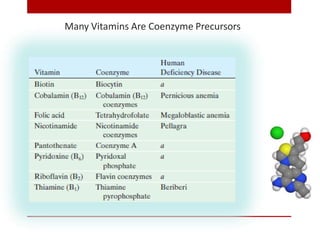
Many Vitamins Are Coenzyme Precursors
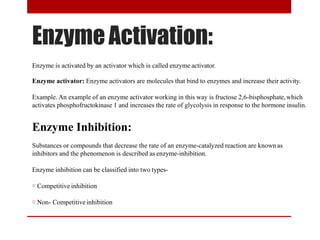
EnzymeActivation:
Enzyme is activated by an activator which is called enzyme activator.
Enzyme activator: Enzyme activators are molecules that bind to enzymes and increase their activity.
Example. An example of an enzyme activator working in this way is fructose 2,6-bisphosphate,which
activates phosphofructokinase 1 and increases the rate of glycolysis in response to the hormone insulin.
Enzyme Inhibition:
Substances or compounds that decrease the rate of an enzyme-catalyzed reaction are known as
inhibitors and the phenomenon is described as enzyme-inhibition.
Enzyme inhibition can be classified into two types-
☼ Competitive inhibition
☼ Non- Competitiveinhibition
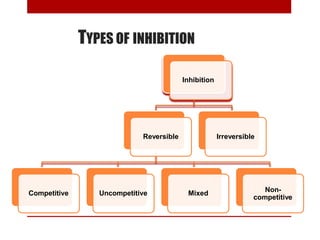
TYPES OF INHIBITION
Inhibition
Reversible
Competitive Uncompetitive Mixed Non-
competitive
Irreversible
REVERSIBLE INHIBITION
o It is an inhibition of enzyme activity in which the inhibiting
molecular entity can associate and dissociate from the
protein„s binding site.
TYPES OF REVERSIBLE INHIBITION
o There are four types:
 Competitive inhibition.
 Uncompetitive inhibition.
 Mixed inhibition.
 Non-competitive inhibition.
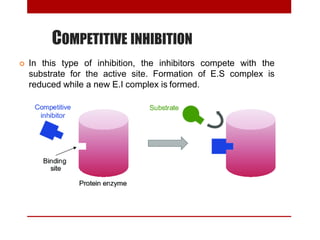
COMPETITIVE INHIBITION
 In this type of inhibition, the inhibitors compete with the
substrate for the active site. Formation of E.S complex is
reduced while a new E.I complex is formed.
Examples of competitive inhibition
 Statin Drug As Example Of Competitive Inhibition:
 Statin drugs such as lipitor compete with HMG-CoA(substrate)
and inhibit the active site of HMG CoA-REDUCTASE (that
bring about the catalysis of cholesterol synthesis).
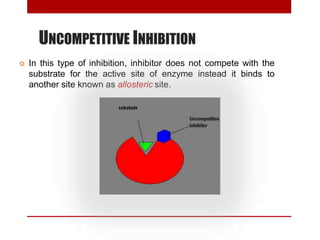
UNCOMPETITIVE INHIBITION
 In this type of inhibition, inhibitor does not compete with the
substrate for the active site of enzyme instead it binds to
another site known as allosteric site.
EXAMPLES OF UNCOMPETITIVE INHIBITION
 Drugs to treat cases of poisoning by methanol or ethylene
glycol act as uncompetitive inhibitors.
 Tetramethylene sulfoxide and 3- butylthiolene 1-oxide are
uncompetitive inhibitors of liver alcohaldehydrogenase.
MIXED INHIBITION
o In this type of inhibition both E.I and E.S.I complexes are
formed.
o Both complexes are catalytically inactive.
NON COMPETITIVE INHIBITION
o It is a special case of inhibition.
o In this inhibitor has the same affinity for either enzyme E or
the E.S complex.
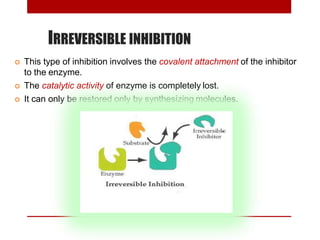
IRREVERSIBLE INHIBITION
 This type of inhibition involves the covalent attachment of the inhibitor
to the enzyme.
 The catalytic activity of enzyme is completely lost.
 It can only be restored only by synthesizing molecules.
EXAMPLES OF IRREVERSIBLE
INHIBITION
 Aspirin which targets and covalently modifies a key enzyme
involved in inflammation is an irreversible inhibitor.
 SUICIDE INHIBITION :
 It is an unusual type of irreversible inhibition where the
enzyme converts the inhibitor into a reactive form in its active
site.
• Enzyme inhibitors are substances which alter the catalytic action of the enzyme and consequently slow down, or in some
cases, stop catalysis
• There are three common types of enzyme inhibition - competitive, non-competitive and substrate inhibition
• Competitive inhibition occurs when the substrate and a substance resembling the substrate are both added
to the enzyme. A theory called the "lock-key theory" of enzyme catalysts can be used to explain why
inhibition occurs.
Inhibitors
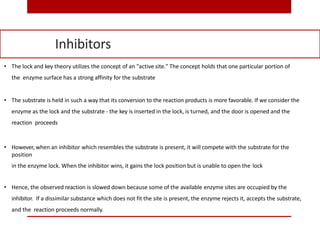
• The lock and key theory utilizes the concept of an "active site." The concept holds that one particular portion of
the enzyme surface has a strong affinity for the substrate
• The substrate is held in such a way that its conversion to the reaction products is more favorable. If we consider the
enzyme as the lock and the substrate - the key is inserted in the lock, is turned, and the door is opened and the
reaction proceeds
• However, when an inhibitor which resembles the substrate is present, it will compete with the substrate for the
position
in the enzyme lock. When the inhibitor wins, it gains the lock position but is unable to open the lock
• Hence, the observed reaction is slowed down because some of the available enzyme sites are occupied by the
inhibitor. If a dissimilar substance which does not fit the site is present, the enzyme rejects it, accepts the substrate,
and the reaction proceeds normally.
Inhibitors
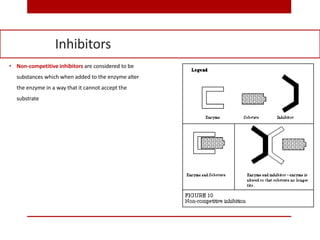
• Non-competitive inhibitors are considered to be
substances which when added to the enzyme alter
the enzyme in a way that it cannot accept the
substrate
Inhibitors
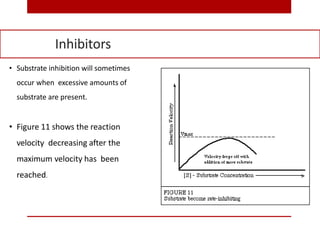
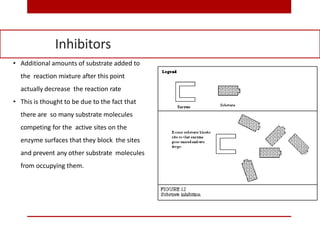
• Substrate inhibition will sometimes
occur when excessive amounts of
substrate are present.
• Figure 11 shows the reaction
velocity decreasing after the
maximum velocity has been
reached.
Inhibitors
• Additional amounts of substrate added to
the reaction mixture after this point
actually decrease the reaction rate
• This is thought to be due to the fact that
there are so many substrate molecules
competing for the active sites on the
enzyme surfaces that they block the sites
and prevent any other substrate molecules
from occupying them.
Inhibitors
ACTIVATION
 Activation is defined as the conversion of an inactive form of
an enzyme to active form which processes the metabolic
activity.
TYPES OF ACTIVATION
 Activation by co-factors.
 Conversion of an enzyme precursor.
ACTIVATIONBY CO FACTORS
 Many enzymes are activated by co-factors.
Examples:
 DNA polymerase is a holoenzyme that catalyzes the
polymerization of de -oxyribonucleotide into a DNA strand. It
uses Mg- ion for catalytic activity.
 Horse liver dehydrogenase uses Zn- ion for it‟sactivation.
CONVERSION OF AN ENZYME
PRECURSOR
 Specific proteolysis is a common method of activating
enzymes and other proteins in biological system.
Example:
 The generation of trypsin from trypsinogen leads to the
activation of other zymogens.

Enzyme

  • 1.
    Classification enzymes andcoenzymes. Non vitamin coenzymes. Classification, nomenclature and code of enzymes. Cofactors of complex-enzymes. their types: coenzymes and prosthetic group. Azerbaijan Medical University Biochemistry Department, Biochemistry 1
  • 2.
    What are Enzymes? Enzymesare protein catalysts that increase the rate of chemical reactions without themselves being changed in the overall process. Example: Oxidase, Aldolase, Kinaseetc. Properties of enzymes: o Enzymes are made up of proteins. o They have molecular weights ranging from 10,000 to2,000,000. o Enzymes are heat liable. o It is not dialyzable. o Enzyme remain unchanged after reaction. o Enzymes are specific, each enzyme usually catalyses only one reaction. o Many enzymes need cofactors in order to function.
  • 3.
    NOMENCLATURE OF ENZYMES oAn enzyme is named according to the name of the substrate it catalyses. o Some enzymes were named before a systematic way of naming enzyme was formed. Example: pepsin, trypsin and rennin o By adding suffix -ase at the end of the name of the substrate, enzymes are named. o Enzyme for catalyzing the hydrolysis is termed as hydrolase. Example : maltose + water glucose + glucosemaltase
  • 4.
    EXAMPLES substrate enzymes products lactoselactase glucose + galactose maltose maltase Glucose cellulose cellulase Glucose lipid lipase Glycerol + fatty acid starch amylase Maltose protein protease Peptides + polypeptide
  • 5.
    Nomenclature • The InternationalUnion of Biochemistry and Molecular Biology developed a nomenclature for enzymes • Each enzyme is described by a sequence of four numbers preceded by "EC". EC denotes Enzyme Commission and the number of enzyme is called EC numbers. • When classified, each enzyme is assigned the EC number, in the form of digits separated by periods. The first number categorizes the enzyme based on its reaction.
  • 6.
    Nomenclature • The firstthree numbers represent the class, subclass and sub-subclass to which an enzyme belongs, and the fourth digit is a serial number to identify the particular enzyme within a sub-subclass. • The class, subclass and sub-subclass provide additional information about the reaction classified. For example, in the case of EC 1.2.3.4, the digits indicate that the enzyme is an oxidoreductase (class 1), that it acts on the aldehyde or oxo group of donors (subclass 2), that oxygen is an acceptor (sub-subclass 3) and that it was the fourth enzyme classified in this sub-subclass (serial number 4).
  • 7.
    Nomenclature EC 1.2.3.4 EC: denotesEnzyme commission class 1: Oxidoreductase subclass 2: acts on the aldehyde or oxo group of donors sub-subclass 3: oxygen is an acceptor serial number 4: fourth enzyme classified in this sub- subclass
  • 8.
    CLASSIFICATION OF ENZYMES A systematic classification of enzymes has been developed by International Enzyme Commission.  This classification is based on the type of reactions catalyzed by enzymes.  There are six major classes.  Each class is further divided into sub classes, sub sub-classes and so on, to describe the huge number of different enzyme- catalyzed reactions.
  • 9.
    Classification of Enzyme: Enzymeare classified into six classes and they are : ☼ Oxidoreductases: Involved in oxidation-reduction reactions Examples: LDH, G6PD ☼ Transferases: Transfer functional groups from one substrate to another Examples: AST,ALT ☼ Hydrolases: Catalyze the hydrolysis of various bonds Examples: acid phophatase, lipase ☼ Lyases : Catalyze removal of groups from substrates without hydrolysis, product has double bond. Examples: aldolase, decarboxylase ☼ Isomerases: Involved in molecular rearrangements Examples: glucose phosphate isomerase ☼ Ligases: Catabolism reactions with cleavage ofATP Example: GSH
  • 10.
    ENZYME CLASS REACTIONTYPE EXAMPLES Oxidoreductases Reduction-oxidation (redox) Lactate dehydrogenase Transferases Move chemical group Hexokinase Hydrolases Hydrolysis; bond cleavage with transfer of functional group of water Lysozyme Lysases Non-hydrolytic bond cleavage Fumarase Isomerases Intramolecular group transfer (isomerization) Triose phosphate isomerase Ligases Synthesis of new covalent bond between substrates, using ATP hydrolysis RNApolymerase Classification of enzymes
  • 11.
    1. Oxidoreductases EC1 •This class comprises the enzymes which were earlier called dehydrogenases, oxidases, peroxidases, hydroxylases, oxygenases etc • The group, in fact, includes those enzymes which bring about oxidation-reduction reactions between two substrates
  • 12.
    1. Oxidoreductases EC1 •Catalyze redox reaction and can be categorized into oxidase and reductase • More precisely, they catalyze electron transfer reactions. In this class are included the enzymes catalyzing oxidoreductions of CH—OH, C=O, CH—CH, CH—NH2 and CH=NH groups • Alcohol dehydrogenase, Acetyl-CoA dehydrogenase, Cytochrome oxidase, Catalase
  • 13.
    2. Transferases EC2 •Catalyze the transfer or exchange of certain groups among some substrates • In these are included the enzymes catalyzing the transfer of one-carbon groups, aldehydic or ketonic residues and acyl, glycosyl, alkyl, phosphorus or sulfur-containing groups • Choline acetyltransferase, Phosphorylase, Hexokinase
  • 14.
    3. Hydrolases EC3 •Accelerate the hydrolysis of substrates • These catalyze the hydrolysis of their substrates by adding constituents of • water across the bond they split • The substrates include ester, glycosyl, ether, peptide, acid-anhydride, C—C, halide and P—N bonds • Lipase, Beta-galactosidase, Arginase, Trypsin. Pepsin, plasmin,
  • 15.
    4. Lyases EC4 •Promote the removal of a group from the substrate to leave a double bond reaction or catalyze its reverse reaction • In these are included the enzymes acting on C—C, C—O, C—N, C—S and C—halide bonds • Aldolase, Fumarase, Histidase
  • 16.
    5. Isomerases EC5 •Facilitate the conversion of isomers, geometric isomers or optical isomers • Alanine racemase, Cis-trans isomerases. Retinine isomerase, Glucosephosphate isomerase
  • 17.
    6. Ligases EC6 •Catalyze the synthesis of two molecular substrates into one molecular compound with the release energy • These are the enzymes catalyzing the linking together of two compounds utilizing the energy made available due to simultaneous breaking of a pyrophosphate bond in ATP or a similar compound • This category includes enzymes catalyzing reactions forming C—O, C—S, C—N and C—C bonds • Acetyl-CoA synthetase, Glutamine synthetase, Acetyl-CoA carboxylase
  • 18.
    Coenzymes • Enzymes functionalgroups takes part in acid-base reaction, to form transient bonds with substrate or take part in charge – charge interactions. They are less stable for catalyzing Redox reaction or transfer of a chemical group. • Such reactions are carried out by small molecules called cofactors • Cofactors may be metal ions, such as the Zn2+ required for the catalytic activity of carboxypeptidase A, or organic molecules known as coenzymes.
  • 19.
    Coenzymes • Some cofactors,for instance NAD+, are but transiently associated with a given enzyme molecule, so that, in effect, they function as cosubstrates • Other cofactors, known as prosthetic groups, are essentially permanently associated with their protein, often by covalent bonds • For example, the heme prosthetic group of hemoglobin is tightly bound to its protein through extensive hydrophobic and hydrogen bonding interactions together with a covalent bond between the heme Fe2+ ion and His F8
  • 20.
    Coenzymes • Coenzymes arechemically changed by the enzymatic reactions in which they participate. Thus, in order to complete the catalytic cycle, the coenzyme must be returned to its original state. For prosthetic groups, this can occur only in a separate phase of the enzymatic reaction sequence • For transiently bound coenzymes, such as NAD+, however, the regeneration reaction may be catalyzed by a different enzyme
  • 21.
    What are Coenzymes? »Coenzymes are organic non-protein molecules that bind with the proteinmolecule (apoenzyme) to form the active enzyme (holoenzyme). » Coenzymes are small molecules. » They cannot catalyze a reaction by themselves but they can help enzymes to do so. Example: Thiamine pyrophosphate, FAD, pantothenic acid etc. Salient features of coenzyme:  Coenzymes are heat stable.  They are low-molecular weight substances.  The coenzymes combine loosely with the enzyme molecules and so, the coenzyme can be separated easily by dialysis.  When the reaction is completed, the coenzyme is released from the apo-enzyme, and goes to some other reaction site.
  • 22.
    Inorganic cofactor Metal Ions IonExamplesof enzymes containing this ion Cupric Cytochrome oxidase Ferrous or Ferric Cy Catalase Heme)tochrome (via Nitrogen ase Hydroge nase Magnesium Glucose 6-phosphatase Hexokinase DNA polymerase A simple [Fe2S2] cluster containing two iron atoms and two sulfur atoms, coordinated by four protein cysteine residues.
  • 23.
    Organic cofactor  Organiccofactors are small organic molecules (typically a molecular mass less than 1000 Da) that can be either loosely or tightly bound to the enzyme and directly participate in the reaction. Cofactor Vitamin Addition al compone nt Chemica l group(s) transferr ed Distribution NAD+ and NADP+ Niacin ( B 3) ADP Electrons Bacteria, a rchaea and eukaryotes Coenzyme A Pantotheni c acid(B5) ADP Acetyl group and other acyl group s Bacteria, a rchaea ande ukaryotes Ascorbic acid Vitamin C None Electrons Bacteria, a rchaea ande ukaryotes Flavin mononucleotide Riboflavin ( B2) None Electrons Bacteria, a rchaea ande ukaryotes
  • 24.
    Thiamine pyrophosphate: Biological Function ofThiamine pyrophosphate: It maintains:  The normal function of the heart;  Normal carbohydrate and energy-yielding metabolism;  The normal function of the nervous system;  Normal neurological development and function;  Normal psychological functions. Thiamine pyrophosphate (TPP), or thiamine diphosphate (ThDP), is a thiamine derivative, is also known as vitamin B1. Thiamine pyrophosphate
  • 25.
    Flavin Coenzymes: • Flavin isthe common name for a group of organic compounds based on pteridine,. • The biochemical source is the riboflavin. • It is commonly know as Vitamin B2. • The flavin oftenly attached with an adenosine diphosphate to form flavin adenine dinucleotide(FAD), and, in other circumstances, is found as flavin mononucleotide (FMN). flavin adenine dinucleotide(FAD) flavin mononucleotide Biological Functions and Importance: Biological Functions of Flavin coenzymes are: →Normal energy-yielding metabolism; →Normal metabolism of iron in the body; →The maintenance of normal skin and mucous membranes; →The maintenance of normal red blood cells; →The maintenance of normal vision; →The maintenance of the normal function of the nervous system.
  • 26.
    TH4 or Tetrahydrofolicacid: Tetrahydrofolicacid, or tetrahydrofolate, is a folic acid derivative. Tetrahydrofolic acid (TH4) Functions: It is a cofactor in many reactions- →In the metabolism of amino acids and nucleic acids. Ashortage in THF can cause megaloblastic anemia. →Tetrahydrofolic acid is involved in the conversion of formiminoglutamic acid to glutamic acid →Reduce the amount of histidine available for decarboxylation and protein synthesis → It can decreease the urinary histamine and formiminoglutamicacid.
  • 27.
    Pantothenic acid: royal jelly,and yogurt. →Pantothenic acid or vitamin B5 is a water-soluble vitamin. →Pantothenic acid are found in nearly every food, with high amounts in avocado, whole-grain cereals, legumes, eggs, meat, →For many animals, pantothenic acid is an essential nutrient. Animals require pantothenic acid to synthesize coenzyme-A (CoA), as well as to synthesize and metabolize proteins, carbohydrates, and fats. Biological role: An adequate supply of pantothenic acid is important as it helps the body to:  convert food into glucose, that used to produce energy.  break down fats, carbohydrates, and proteins for energy generation.  form red blood cells, as well as sex and stress-related hormones.  normal mental performance.  normal synthesis and metabolism of steroid hormones, vitamin D and some neurotransmitters.  the reduction of tiredness and fatigue. Pantothenic acid Daily requirement:
  • 28.
    NAD+ Nicotinamide adenine dinucleotide(NAD) is a coenzyme found in all living cells. NAD+ was first discovered by the British biochemists Arthur Harden and William John Young in 1906. It is consists of two nucleotides joined through theirphosphate groups. Nicotinamide adenine dinucleotide exists in two forms:  An oxidized form (NAD+)  Reduced form (NADH) NAD Pharmacologycal uses of NAD+: » Drug design and drug development exploitsNAD+ » It is being studied for its potential use in the therapy of neurodegenerativediseases such as Alzheimer's and Parkinsondisease. » NAD+ is also a direct target of the drug isoniazid, which is used in the treatment of tuberculosis. » It is also used for the development of new antibiotics.
  • 29.
    Pyridoxal pyrophosphate:  Pyridoxalpyrophosphate (pyridoxal 5'-phosphate), is the active formof vitamin B6, is a coenzyme in a variety of enzymatic reactions.  Vitamin B6 is a water-soluble vitamin.  There are three different natural forms of vitamin B6: pyridoxine, pyridoxamine, and pyridoxal.  Humans depend on external sources to cover their vitamin B6 requirements. Pyridoxal phosphate Health Functions:  It convert food into glucose, which is used to produceenergy  It make neurotransmitters,  produce hormones, red blood cells, and cells of the immune system  Along with vitamin B12 and vitamin B9, it control blood levels of homocysteine, an amino acid that may be associated with heart disease.
  • 30.
    Coenzymes • A catalyticallyactive enzyme–cofactor complex is called a holoenzyme (Greek: holos, whole). • The enzymatically inactive protein resulting from the removal of a holoenzyme’s cofactor is referred to as an apoenzyme (Greek: apo, away) 𝐀𝐩𝐨𝐞𝐧𝐳𝐲𝐦𝐞 𝐢𝐧𝐚𝐜𝐭𝐢𝐯𝐞 + 𝐜𝐨𝐟𝐚𝐜𝐭𝐨𝐫 ⇔ 𝐡𝐨𝐥𝐨𝐞𝐧𝐳𝐲𝐦𝐞 (𝐚𝐜𝐭𝐢𝐯𝐞)
  • 31.
    Many Vitamins AreCoenzyme Precursors
  • 32.
    EnzymeActivation: Enzyme is activatedby an activator which is called enzyme activator. Enzyme activator: Enzyme activators are molecules that bind to enzymes and increase their activity. Example. An example of an enzyme activator working in this way is fructose 2,6-bisphosphate,which activates phosphofructokinase 1 and increases the rate of glycolysis in response to the hormone insulin. Enzyme Inhibition: Substances or compounds that decrease the rate of an enzyme-catalyzed reaction are known as inhibitors and the phenomenon is described as enzyme-inhibition. Enzyme inhibition can be classified into two types- ☼ Competitive inhibition ☼ Non- Competitiveinhibition
  • 33.
    TYPES OF INHIBITION Inhibition Reversible CompetitiveUncompetitive Mixed Non- competitive Irreversible
  • 34.
    REVERSIBLE INHIBITION o Itis an inhibition of enzyme activity in which the inhibiting molecular entity can associate and dissociate from the protein„s binding site. TYPES OF REVERSIBLE INHIBITION o There are four types:  Competitive inhibition.  Uncompetitive inhibition.  Mixed inhibition.  Non-competitive inhibition.
  • 35.
    COMPETITIVE INHIBITION  Inthis type of inhibition, the inhibitors compete with the substrate for the active site. Formation of E.S complex is reduced while a new E.I complex is formed.
  • 36.
    Examples of competitiveinhibition  Statin Drug As Example Of Competitive Inhibition:  Statin drugs such as lipitor compete with HMG-CoA(substrate) and inhibit the active site of HMG CoA-REDUCTASE (that bring about the catalysis of cholesterol synthesis).
  • 37.
    UNCOMPETITIVE INHIBITION  Inthis type of inhibition, inhibitor does not compete with the substrate for the active site of enzyme instead it binds to another site known as allosteric site.
  • 38.
    EXAMPLES OF UNCOMPETITIVEINHIBITION  Drugs to treat cases of poisoning by methanol or ethylene glycol act as uncompetitive inhibitors.  Tetramethylene sulfoxide and 3- butylthiolene 1-oxide are uncompetitive inhibitors of liver alcohaldehydrogenase.
  • 39.
    MIXED INHIBITION o Inthis type of inhibition both E.I and E.S.I complexes are formed. o Both complexes are catalytically inactive. NON COMPETITIVE INHIBITION o It is a special case of inhibition. o In this inhibitor has the same affinity for either enzyme E or the E.S complex.
  • 40.
    IRREVERSIBLE INHIBITION  Thistype of inhibition involves the covalent attachment of the inhibitor to the enzyme.  The catalytic activity of enzyme is completely lost.  It can only be restored only by synthesizing molecules.
  • 41.
    EXAMPLES OF IRREVERSIBLE INHIBITION Aspirin which targets and covalently modifies a key enzyme involved in inflammation is an irreversible inhibitor.  SUICIDE INHIBITION :  It is an unusual type of irreversible inhibition where the enzyme converts the inhibitor into a reactive form in its active site.
  • 42.
    • Enzyme inhibitorsare substances which alter the catalytic action of the enzyme and consequently slow down, or in some cases, stop catalysis • There are three common types of enzyme inhibition - competitive, non-competitive and substrate inhibition • Competitive inhibition occurs when the substrate and a substance resembling the substrate are both added to the enzyme. A theory called the "lock-key theory" of enzyme catalysts can be used to explain why inhibition occurs. Inhibitors
  • 43.
    • The lockand key theory utilizes the concept of an "active site." The concept holds that one particular portion of the enzyme surface has a strong affinity for the substrate • The substrate is held in such a way that its conversion to the reaction products is more favorable. If we consider the enzyme as the lock and the substrate - the key is inserted in the lock, is turned, and the door is opened and the reaction proceeds • However, when an inhibitor which resembles the substrate is present, it will compete with the substrate for the position in the enzyme lock. When the inhibitor wins, it gains the lock position but is unable to open the lock • Hence, the observed reaction is slowed down because some of the available enzyme sites are occupied by the inhibitor. If a dissimilar substance which does not fit the site is present, the enzyme rejects it, accepts the substrate, and the reaction proceeds normally. Inhibitors
  • 44.
    • Non-competitive inhibitorsare considered to be substances which when added to the enzyme alter the enzyme in a way that it cannot accept the substrate Inhibitors
  • 45.
    • Substrate inhibitionwill sometimes occur when excessive amounts of substrate are present. • Figure 11 shows the reaction velocity decreasing after the maximum velocity has been reached. Inhibitors
  • 46.
    • Additional amountsof substrate added to the reaction mixture after this point actually decrease the reaction rate • This is thought to be due to the fact that there are so many substrate molecules competing for the active sites on the enzyme surfaces that they block the sites and prevent any other substrate molecules from occupying them. Inhibitors
  • 47.
    ACTIVATION  Activation isdefined as the conversion of an inactive form of an enzyme to active form which processes the metabolic activity. TYPES OF ACTIVATION  Activation by co-factors.  Conversion of an enzyme precursor.
  • 48.
    ACTIVATIONBY CO FACTORS Many enzymes are activated by co-factors. Examples:  DNA polymerase is a holoenzyme that catalyzes the polymerization of de -oxyribonucleotide into a DNA strand. It uses Mg- ion for catalytic activity.  Horse liver dehydrogenase uses Zn- ion for it‟sactivation.
  • 49.
    CONVERSION OF ANENZYME PRECURSOR  Specific proteolysis is a common method of activating enzymes and other proteins in biological system. Example:  The generation of trypsin from trypsinogen leads to the activation of other zymogens.