Presented By
ZAEEM TAHIR
OBJECTIVES
 INTRODUCTION OF ENZYMES
 CHEMISTRY OF ENZYMES
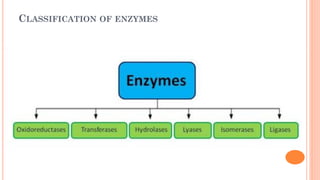
 CLASSIFICATION OF ENZYMES
 MODE OF ACTION OF ENZYMES
INTRODUCTION OF ENZYMES
 Enzymes are the most important group of proteins which
are biologically active
 They tremendously increase the efficiency of a biochemical
reaction and are specific for each type of reaction
 Without these enzymes the would proceed at a very slow
speed making life impossible
INTRODUCTION OF ENZYMES
“Enzymes can be defined as biological polymers that catalyze
biochemical reactions.”
 The majority of enzymes are proteins with catalytic capabilities
crucial to perform different processes.
 Others also have a non-protein part known as a cofactor, which is
essential for the proper functioning of the enzymes.
INTRODUCTION OF ENZYMES
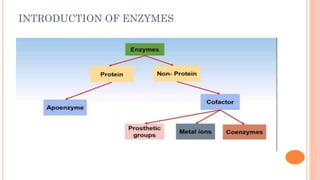
 Cofactors
 Cofactors are non-proteinous substances that associate with
enzymes. A cofactor is essential for the functioning of an enzyme.
The protein part of enzymes in cofactors is apoenzyme. An enzyme
and its cofactor together constitute the holoenzyme.
 There are three kinds of cofactors present in enzymes:
 Prosthetic groups: These are cofactors tightly bound to an
enzyme at all times. FAD (flavin adenine dinucleotide) is a
prosthetic group present in many enzymes.
 Coenzyme: A coenzyme binds to an enzyme only during catalysis.
At all other times, it is detached from the enzyme.
e.g: NAD is a common coenzyme.
 Metal ions: For the catalysis of certain enzymes, a metal ion is
required at the active site to form coordinate bonds.
e.g: Zinc is a metal ion cofactor used by a number of enzymes.
Difference between Apoenzyme and Holoenzyme
The table below shows the main differences between Apoenzyme
and Holoenzyme:
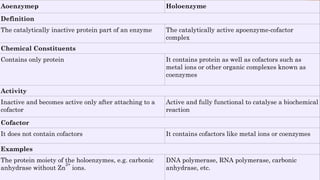
Aoenzymep Holoenzyme
Definition
The catalytically inactive protein part of an enzyme The catalytically active apoenzyme-cofactor
complex
Chemical Constituents
Contains only protein It contains protein as well as cofactors such as
metal ions or other organic complexes known as
coenzymes
Activity
Inactive and becomes active only after attaching to a
cofactor
Active and fully functional to catalyse a biochemical
reaction
Cofactor
It does not contain cofactors It contains cofactors like metal ions or coenzymes
Examples
The protein moiety of the holoenzymes, e.g. carbonic
anhydrase without Zn
2+
ions.
DNA polymerase, RNA polymerase, carbonic
anhydrase, etc.
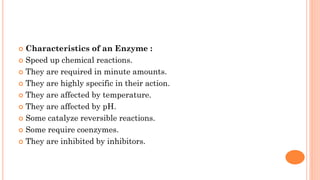
 Characteristics of an Enzyme :
 Speed up chemical reactions.
 They are required in minute amounts.
 They are highly specific in their action.
 They are affected by temperature.
 They are affected by pH.
 Some catalyze reversible reactions.
 Some require coenzymes.
 They are inhibited by inhibitors.
COMPOSITION OF ENZYMES
 Enzymes are a linear chain of amino acids, which give rise to a
three-dimensional structure
 The sequence of amino acids specifies the structure, which in turn
identifies the catalytic activity of the enzyme. Upon heating, the
enzyme’s structure denatures, resulting in a loss of enzyme
activity, which typically is associated with temperature.
 Compared to its substrates, enzymes are typically large with
varying sizes, ranging from 62 amino acid residues to an average of
2500 residues found in fatty acid synthase.
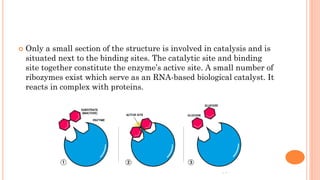
 Only a small section of the structure is involved in catalysis and is
situated next to the binding sites. The catalytic site and binding
site together constitute the enzyme’s active site. A small number of
ribozymes exist which serve as an RNA-based biological catalyst. It
reacts in complex with proteins.
CLASSIFICATION OF ENZYMES
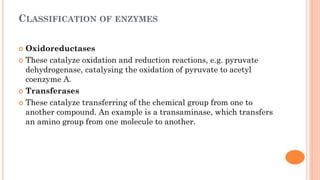
 Oxidoreductases
 These catalyze oxidation and reduction reactions, e.g. pyruvate
dehydrogenase, catalysing the oxidation of pyruvate to acetyl
coenzyme A.
 Transferases
 These catalyze transferring of the chemical group from one to
another compound. An example is a transaminase, which transfers
an amino group from one molecule to another.
CLASSIFICATION OF ENZYMES
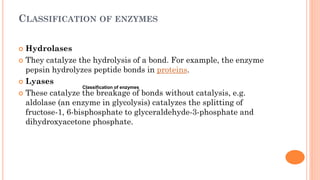
 Hydrolases
 They catalyze the hydrolysis of a bond. For example, the enzyme
pepsin hydrolyzes peptide bonds in proteins.
 Lyases
 These catalyze the breakage of bonds without catalysis, e.g.
aldolase (an enzyme in glycolysis) catalyzes the splitting of
fructose-1, 6-bisphosphate to glyceraldehyde-3-phosphate and
dihydroxyacetone phosphate.
Classification of enzymes
CLASSIFICATION OF ENZYMES
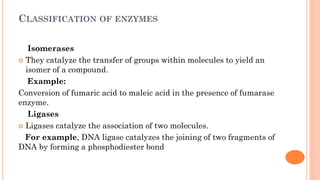
Isomerases
 They catalyze the transfer of groups within molecules to yield an
isomer of a compound.
Example:
Conversion of fumaric acid to maleic acid in the presence of fumarase
enzyme.
Ligases
 Ligases catalyze the association of two molecules.
For example, DNA ligase catalyzes the joining of two fragments of
DNA by forming a phosphodiester bond
enzymes presentation.pdf..................

enzymes presentation.pdf..................

  • 1.
  • 2.
    OBJECTIVES  INTRODUCTION OFENZYMES  CHEMISTRY OF ENZYMES  CLASSIFICATION OF ENZYMES  MODE OF ACTION OF ENZYMES
  • 3.
    INTRODUCTION OF ENZYMES Enzymes are the most important group of proteins which are biologically active  They tremendously increase the efficiency of a biochemical reaction and are specific for each type of reaction  Without these enzymes the would proceed at a very slow speed making life impossible
  • 4.
    INTRODUCTION OF ENZYMES “Enzymescan be defined as biological polymers that catalyze biochemical reactions.”  The majority of enzymes are proteins with catalytic capabilities crucial to perform different processes.  Others also have a non-protein part known as a cofactor, which is essential for the proper functioning of the enzymes.
  • 5.
  • 6.
     Cofactors  Cofactorsare non-proteinous substances that associate with enzymes. A cofactor is essential for the functioning of an enzyme. The protein part of enzymes in cofactors is apoenzyme. An enzyme and its cofactor together constitute the holoenzyme.  There are three kinds of cofactors present in enzymes:  Prosthetic groups: These are cofactors tightly bound to an enzyme at all times. FAD (flavin adenine dinucleotide) is a prosthetic group present in many enzymes.
  • 7.
     Coenzyme: Acoenzyme binds to an enzyme only during catalysis. At all other times, it is detached from the enzyme. e.g: NAD is a common coenzyme.  Metal ions: For the catalysis of certain enzymes, a metal ion is required at the active site to form coordinate bonds. e.g: Zinc is a metal ion cofactor used by a number of enzymes.
  • 8.
    Difference between Apoenzymeand Holoenzyme The table below shows the main differences between Apoenzyme and Holoenzyme:
  • 9.
    Aoenzymep Holoenzyme Definition The catalyticallyinactive protein part of an enzyme The catalytically active apoenzyme-cofactor complex Chemical Constituents Contains only protein It contains protein as well as cofactors such as metal ions or other organic complexes known as coenzymes Activity Inactive and becomes active only after attaching to a cofactor Active and fully functional to catalyse a biochemical reaction Cofactor It does not contain cofactors It contains cofactors like metal ions or coenzymes Examples The protein moiety of the holoenzymes, e.g. carbonic anhydrase without Zn 2+ ions. DNA polymerase, RNA polymerase, carbonic anhydrase, etc.
  • 10.
     Characteristics ofan Enzyme :  Speed up chemical reactions.  They are required in minute amounts.  They are highly specific in their action.  They are affected by temperature.  They are affected by pH.  Some catalyze reversible reactions.  Some require coenzymes.  They are inhibited by inhibitors.
  • 11.
    COMPOSITION OF ENZYMES Enzymes are a linear chain of amino acids, which give rise to a three-dimensional structure  The sequence of amino acids specifies the structure, which in turn identifies the catalytic activity of the enzyme. Upon heating, the enzyme’s structure denatures, resulting in a loss of enzyme activity, which typically is associated with temperature.  Compared to its substrates, enzymes are typically large with varying sizes, ranging from 62 amino acid residues to an average of 2500 residues found in fatty acid synthase.
  • 12.
     Only asmall section of the structure is involved in catalysis and is situated next to the binding sites. The catalytic site and binding site together constitute the enzyme’s active site. A small number of ribozymes exist which serve as an RNA-based biological catalyst. It reacts in complex with proteins.
  • 13.
  • 14.
    CLASSIFICATION OF ENZYMES Oxidoreductases  These catalyze oxidation and reduction reactions, e.g. pyruvate dehydrogenase, catalysing the oxidation of pyruvate to acetyl coenzyme A.  Transferases  These catalyze transferring of the chemical group from one to another compound. An example is a transaminase, which transfers an amino group from one molecule to another.
  • 15.
    CLASSIFICATION OF ENZYMES Hydrolases  They catalyze the hydrolysis of a bond. For example, the enzyme pepsin hydrolyzes peptide bonds in proteins.  Lyases  These catalyze the breakage of bonds without catalysis, e.g. aldolase (an enzyme in glycolysis) catalyzes the splitting of fructose-1, 6-bisphosphate to glyceraldehyde-3-phosphate and dihydroxyacetone phosphate. Classification of enzymes
  • 16.
    CLASSIFICATION OF ENZYMES Isomerases They catalyze the transfer of groups within molecules to yield an isomer of a compound. Example: Conversion of fumaric acid to maleic acid in the presence of fumarase enzyme. Ligases  Ligases catalyze the association of two molecules. For example, DNA ligase catalyzes the joining of two fragments of DNA by forming a phosphodiester bond