• Environmental pollution has a destructive influence on a
global scale - the problem concerns our whole planet and
also local places - the existing threats are different in various
countries.
• On a worldwide people and by-products of their activity in
the form of harmful matters polluting the air, soil and water,
led to the increase in the greenhouse effect and
consequently to global climate warming, the ozone hole and
acidified precipitation.
• Diseases caused by environmental pollution
Harmful effect of environmental pollution manifests itself in lowered
immunity to all kinds of diseases which means that human organism
becomes more liable to pathogenic influence of various factors.
• This influence can be direct or indirect. All harmful chemical
compounds we take in with the air or water have direct, toxic
impact on people. Animals and plants which are also
influenced by pollution in the process of nourishment
become the source of harmful substances which we
assimilate indirectly while eating.
• All kinds of emitted pollution has impact on our health and it
is impossible to discuss it briefly; nevertheless, their influence
is indisputable, especially as in industrialized areas incidence
rate of diseases associated with the progress of civilization
has increased which is contrary to the areas with less
developed industry or with no industry at all; in these areas
contagious diseases are more frequent.
• Even a special field of medicine was distinguished -
environmental medicine. Its aim is to deal with diagnosis,
treatment and, above all, prevention of health problems
caused by environmental pollution.
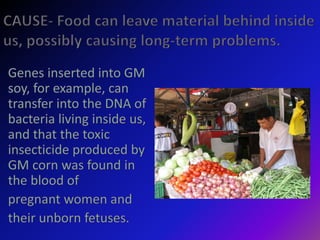
INFO- According to the World Health Organization, Genetically
Modified Organisms are organisms in which the genetic material
has been altered in such a way that does not occur naturally.
Multiple animal studies have shown that GM foods cause damage to
various organ systems in the body. With this mounting evidence,
it is imperative to have a
moratorium on GM foods
for the safety of our patients' and
the public's health.
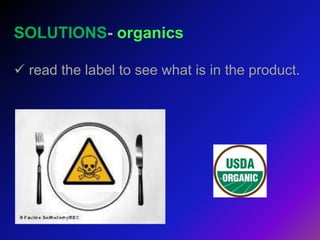
SOLUTIONS- organics
 read the label to see what is in the product.
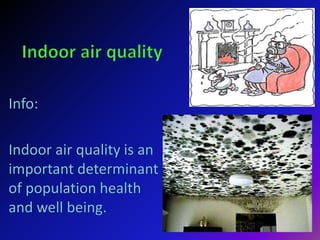
Info:
Indoor air quality is an
important determinant
of population health
and well being.
Cause/Effects
 Molds generally live outdoors but can normally be found in
almost any indoor environment. They easily pass through
open doors and windows and settle indoors, especially where
there is excess heat and humidity.
 Lead poisoning is usually caused by months or years of
exposure to small amounts of lead at home, work, or day care.
The most common source of lead exposure for children is
lead-based paint and dust and soil that are contaminated by it,
especially in older homes and buildings.
 Carbon monoxide is a colorless, odorless gas produced by
burning material containing carbon. Carbon monoxide
poisoning can cause brain damage and death. You can't see it,
smell it, or taste it; but carbon monoxide can kill you.
Outdoor Working
Environment
Working outdoors has so
many factors that play into
your health such as weather,
chemical toxins, air quality,
machines you use, plants,
and even insects.
Causes:
• Weather related : rain, snow, extreme heat or humidity
• Insects and Animals: pass on disease like: West Nile
virus, St. Louis encephalitis, eastern equine
encephalitis, western equine encephalitis, and
LaCrosse encephalitis. Tick-borne diseases include
Lyme disease, babesiosis, ehrlichiosis, Rocky Mountain
spotted fever, southern tick-associated rash illness,
tularemia, tick-borne relapsing fever, anaplasmosis,
Colorado tick fever, Powassan encephalitis, and Q
fever.
• Plants: poison ivy, poison oak, and poison sumac.
• Machines give can give off chemicals which can effect
you like: smoke/carbon monoxide
• Workers who smoke pass on stuff like that
Effects:
• Weather related- Heat stress, UV radiation, Cold
stress, rain and snow causing illness.
• Being bitten by insects or animals can get you
poisoned or diseased
• Plants can give off certain scents or rashes. When
plants are burned like poison oak or ivy and you
inhale that you can get irritation of the lungs
• Machinery gives off gases and exhausts which can
cause headaches, nausea, irritations
• Breathing in smoke from cigarettes can have long
term effects such as cancer.
Solutions:
• Make sure your house gets an adequate
supply of fresh air.
• Place an air filter in your bedroom, and clean
it every 3 months.
• Air conditioning helps keep pollen and other
allergens out of your home, but filters must
be kept clean.
• Change furnace and air conditioner filters
every 2 to 3 months.
Water pollution is the effect of
water contamination by sewage and waste.
Water Pollutants can come from various sources:
 Sewage and farm waste can introduce harmful bacteria.
 Herbicides, pesticides, and fertilizers from agriculture can
wash into the water.
 Beach-goers and boaters often leave their trash behind.
 Silt from construction or land clearing sites can enter the
water through runoff.
 Are environmental pollution
causes on your health?
 There is reasons and evidence
that causes on your health:
EFFECTS: Human health
 Water pollution causes approximately
14,000 deaths per day: of drinking water
by untreated sewage in developing
countries.
 An estimated 700 million Indians have no
access to a proper toilet, and 1,000 Indian
children die of diarrheal sickness every day.
 Pollution can also be the consequence of a natural
disaster. For example, hurricanes often involve
water contamination from sewage, and
petrochemical spills from ruptured boats or
automobiles. Larger scale and environmental
damage is not uncommon when coastal oil rigs or
refineries are involved. Some sources of pollution,
such as nuclear power plants or oil tankers, can
produce widespread and potentially hazardous
releases when accidents occur.
 Clean Water Act: eleven different federal
government agencies and 21 federal government
programs all monitor the quality of water and
regulate pollution.
 The world has spent a lot of money trying to clean
up water. From 1972-1990, the US spent over
$250 billion.
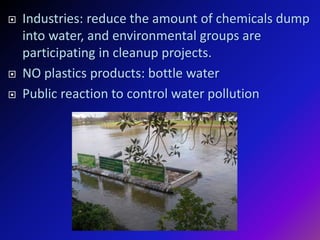
 Industries: reduce the amount of chemicals dump
into water, and environmental groups are
participating in cleanup projects.
 NO plastics products: bottle water
 Public reaction to control water pollution
 Air pollution:- the release of chemicals and
particulates into the atmosphere. Common
gaseous pollutants include carbon monoxide,
sulfur dioxide, chlorofluorocarbons (CFCs) and
nitrogen oxides produced by industry and motor
vehicles. Photochemical ozone and smog are
created as nitrogen oxides and hydrocarbons react
to sunlight. Particulate matter, or fine dust is
characterized by their micrometer size PM10 to
PM2.5.
Air pollution comes from both natural and man made
sources. Such as :
combustion, construction, mining, agriculture and warfare
are increasingly significant in the air pollution equation.
 Motor vehicle
 United States, Russia, Mexico, and Japan are the world
leaders in air pollution emissions. Principal stationary
pollution sources include chemical plants, coal-fired
power plants, oil refineries, petrochemical plants, nuclear
waste disposal activity, incinerators, large livestock farms
(dairy cows, pigs, poultry, etc.), PVC factories, metals
production factories, plastics factories, and other heavy
industry.
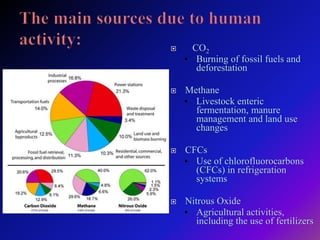
 CO2
• Burning of fossil fuels and
deforestation
 Methane
• Livestock enteric
fermentation, manure
management and land use
changes
 CFCs
• Use of chlorofluorocarbons
(CFCs) in refrigeration
systems
 Nitrous Oxide
• Agricultural activities,
including the use of fertilizers
EFFECTS: Human health
Adverse air quality can kill many
organisms including humans.
Ozone pollution can cause
respiratory disease,
cardiovascular disease,
throat inflammation, chest pain, and congestion.
In India, air pollution is believed to cause 527,700 fatalities a
year. Studies have estimated that the number of people
killed annually in the US could be over 50,000.[31]
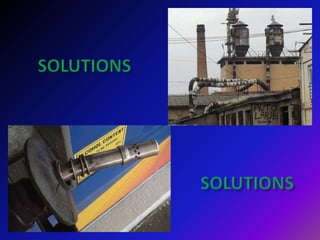
Pollution control:
environmental management
 control of emissions and
effluents into air, water or
soil.
• the waste products:
consumption, heating,
agriculture, mining,
manufacturing,
transportation and other
human activities
 What we propose to examine and why:
We want to analyze the existing systems in cities around
the world related to environmental protection. Then we
will see if these systems are actually working to protect
the environment and react according to those results that
we find. This would be the best way to get to the heart
of the emissions in the city, which is the major cause of
the Environmental Pollution.
Results we expect: We expect there to be a handful of
requirements for industries in the area, but believe they will
not be doing a lot for the protection of the environment and
therefore we must begin.
Our level and confidence: Medium - High
What we know from the data: The Environmental Pollution are definitely control
of emissions and effluents into air, water or soil as well as images we have seen.
What we don't know from the data: The exact long term effects of the
environmental pollution. These are negligible, since they are predictable.
Alternative explanations: Although highly unlikely, these trends could possibly be
anomalies or outliers in a longer line of data. For example, Without pollution control,
the waste products from consumption, heating, agriculture, mining, manufacturing,
transportation and other human activities, whether they accumulate or disperse, will
degrade the environment. these pollution control will return to normal sometime in
the future. A larger time range would help with the dependency of the data and
provide a way to see a larger trend.
 http://library.thinkquest.org/26026/Environmental_Problems/water_pollution_-_solutions.html
 Djogo, M., Dvornic, A., Miloradov, M., Radonic, J., & Vujic, G.. (2011). DETERMINATION OF POLLUTANT PARAMETERS IN
LANDFILL LEACHATE WATER OF VOJVODINA REGION. Annals of the Faculty of Engineering Hunedoara, 9(4), 87-
90. Retrieved November 1, 2011, from Research Library. (Document ID: 2483957711).
 http://en.wikipedia.org/wiki/Pollution
 http://ourecology.org

Environmental Pollution & Health Issues

  • 2.
    • Environmental pollutionhas a destructive influence on a global scale - the problem concerns our whole planet and also local places - the existing threats are different in various countries. • On a worldwide people and by-products of their activity in the form of harmful matters polluting the air, soil and water, led to the increase in the greenhouse effect and consequently to global climate warming, the ozone hole and acidified precipitation. • Diseases caused by environmental pollution Harmful effect of environmental pollution manifests itself in lowered immunity to all kinds of diseases which means that human organism becomes more liable to pathogenic influence of various factors.
  • 3.
    • This influencecan be direct or indirect. All harmful chemical compounds we take in with the air or water have direct, toxic impact on people. Animals and plants which are also influenced by pollution in the process of nourishment become the source of harmful substances which we assimilate indirectly while eating. • All kinds of emitted pollution has impact on our health and it is impossible to discuss it briefly; nevertheless, their influence is indisputable, especially as in industrialized areas incidence rate of diseases associated with the progress of civilization has increased which is contrary to the areas with less developed industry or with no industry at all; in these areas contagious diseases are more frequent. • Even a special field of medicine was distinguished - environmental medicine. Its aim is to deal with diagnosis, treatment and, above all, prevention of health problems caused by environmental pollution.
  • 4.
    INFO- According tothe World Health Organization, Genetically Modified Organisms are organisms in which the genetic material has been altered in such a way that does not occur naturally. Multiple animal studies have shown that GM foods cause damage to various organ systems in the body. With this mounting evidence, it is imperative to have a moratorium on GM foods for the safety of our patients' and the public's health.
  • 6.
    SOLUTIONS- organics  readthe label to see what is in the product.
  • 7.
    Info: Indoor air qualityis an important determinant of population health and well being.
  • 8.
    Cause/Effects  Molds generallylive outdoors but can normally be found in almost any indoor environment. They easily pass through open doors and windows and settle indoors, especially where there is excess heat and humidity.  Lead poisoning is usually caused by months or years of exposure to small amounts of lead at home, work, or day care. The most common source of lead exposure for children is lead-based paint and dust and soil that are contaminated by it, especially in older homes and buildings.  Carbon monoxide is a colorless, odorless gas produced by burning material containing carbon. Carbon monoxide poisoning can cause brain damage and death. You can't see it, smell it, or taste it; but carbon monoxide can kill you.
  • 10.
    Outdoor Working Environment Working outdoorshas so many factors that play into your health such as weather, chemical toxins, air quality, machines you use, plants, and even insects.
  • 11.
    Causes: • Weather related: rain, snow, extreme heat or humidity • Insects and Animals: pass on disease like: West Nile virus, St. Louis encephalitis, eastern equine encephalitis, western equine encephalitis, and LaCrosse encephalitis. Tick-borne diseases include Lyme disease, babesiosis, ehrlichiosis, Rocky Mountain spotted fever, southern tick-associated rash illness, tularemia, tick-borne relapsing fever, anaplasmosis, Colorado tick fever, Powassan encephalitis, and Q fever. • Plants: poison ivy, poison oak, and poison sumac. • Machines give can give off chemicals which can effect you like: smoke/carbon monoxide • Workers who smoke pass on stuff like that
  • 12.
    Effects: • Weather related-Heat stress, UV radiation, Cold stress, rain and snow causing illness. • Being bitten by insects or animals can get you poisoned or diseased • Plants can give off certain scents or rashes. When plants are burned like poison oak or ivy and you inhale that you can get irritation of the lungs • Machinery gives off gases and exhausts which can cause headaches, nausea, irritations • Breathing in smoke from cigarettes can have long term effects such as cancer.
  • 13.
    Solutions: • Make sureyour house gets an adequate supply of fresh air. • Place an air filter in your bedroom, and clean it every 3 months. • Air conditioning helps keep pollen and other allergens out of your home, but filters must be kept clean. • Change furnace and air conditioner filters every 2 to 3 months.
  • 16.
    Water pollution isthe effect of water contamination by sewage and waste. Water Pollutants can come from various sources:  Sewage and farm waste can introduce harmful bacteria.  Herbicides, pesticides, and fertilizers from agriculture can wash into the water.  Beach-goers and boaters often leave their trash behind.  Silt from construction or land clearing sites can enter the water through runoff.
  • 17.
     Are environmentalpollution causes on your health?  There is reasons and evidence that causes on your health:
  • 18.
    EFFECTS: Human health Water pollution causes approximately 14,000 deaths per day: of drinking water by untreated sewage in developing countries.  An estimated 700 million Indians have no access to a proper toilet, and 1,000 Indian children die of diarrheal sickness every day.
  • 19.
     Pollution canalso be the consequence of a natural disaster. For example, hurricanes often involve water contamination from sewage, and petrochemical spills from ruptured boats or automobiles. Larger scale and environmental damage is not uncommon when coastal oil rigs or refineries are involved. Some sources of pollution, such as nuclear power plants or oil tankers, can produce widespread and potentially hazardous releases when accidents occur.
  • 20.
     Clean WaterAct: eleven different federal government agencies and 21 federal government programs all monitor the quality of water and regulate pollution.  The world has spent a lot of money trying to clean up water. From 1972-1990, the US spent over $250 billion.
  • 21.
     Industries: reducethe amount of chemicals dump into water, and environmental groups are participating in cleanup projects.  NO plastics products: bottle water  Public reaction to control water pollution
  • 22.
     Air pollution:-the release of chemicals and particulates into the atmosphere. Common gaseous pollutants include carbon monoxide, sulfur dioxide, chlorofluorocarbons (CFCs) and nitrogen oxides produced by industry and motor vehicles. Photochemical ozone and smog are created as nitrogen oxides and hydrocarbons react to sunlight. Particulate matter, or fine dust is characterized by their micrometer size PM10 to PM2.5.
  • 23.
    Air pollution comesfrom both natural and man made sources. Such as : combustion, construction, mining, agriculture and warfare are increasingly significant in the air pollution equation.  Motor vehicle  United States, Russia, Mexico, and Japan are the world leaders in air pollution emissions. Principal stationary pollution sources include chemical plants, coal-fired power plants, oil refineries, petrochemical plants, nuclear waste disposal activity, incinerators, large livestock farms (dairy cows, pigs, poultry, etc.), PVC factories, metals production factories, plastics factories, and other heavy industry.
  • 26.
     CO2 • Burningof fossil fuels and deforestation  Methane • Livestock enteric fermentation, manure management and land use changes  CFCs • Use of chlorofluorocarbons (CFCs) in refrigeration systems  Nitrous Oxide • Agricultural activities, including the use of fertilizers
  • 27.
    EFFECTS: Human health Adverseair quality can kill many organisms including humans. Ozone pollution can cause respiratory disease, cardiovascular disease, throat inflammation, chest pain, and congestion. In India, air pollution is believed to cause 527,700 fatalities a year. Studies have estimated that the number of people killed annually in the US could be over 50,000.[31]
  • 29.
    Pollution control: environmental management control of emissions and effluents into air, water or soil. • the waste products: consumption, heating, agriculture, mining, manufacturing, transportation and other human activities
  • 30.
     What wepropose to examine and why: We want to analyze the existing systems in cities around the world related to environmental protection. Then we will see if these systems are actually working to protect the environment and react according to those results that we find. This would be the best way to get to the heart of the emissions in the city, which is the major cause of the Environmental Pollution. Results we expect: We expect there to be a handful of requirements for industries in the area, but believe they will not be doing a lot for the protection of the environment and therefore we must begin.
  • 31.
    Our level andconfidence: Medium - High What we know from the data: The Environmental Pollution are definitely control of emissions and effluents into air, water or soil as well as images we have seen. What we don't know from the data: The exact long term effects of the environmental pollution. These are negligible, since they are predictable. Alternative explanations: Although highly unlikely, these trends could possibly be anomalies or outliers in a longer line of data. For example, Without pollution control, the waste products from consumption, heating, agriculture, mining, manufacturing, transportation and other human activities, whether they accumulate or disperse, will degrade the environment. these pollution control will return to normal sometime in the future. A larger time range would help with the dependency of the data and provide a way to see a larger trend.
  • 32.
     http://library.thinkquest.org/26026/Environmental_Problems/water_pollution_-_solutions.html  Djogo,M., Dvornic, A., Miloradov, M., Radonic, J., & Vujic, G.. (2011). DETERMINATION OF POLLUTANT PARAMETERS IN LANDFILL LEACHATE WATER OF VOJVODINA REGION. Annals of the Faculty of Engineering Hunedoara, 9(4), 87- 90. Retrieved November 1, 2011, from Research Library. (Document ID: 2483957711).  http://en.wikipedia.org/wiki/Pollution  http://ourecology.org

Editor's Notes

  • #11 in Alabama, 1942
  • #18 *the coast of Guyana, 2010 *in Montreal Canada
  • #29 *A dust collector in Pristina, Kosovo--   Pollution control   A litter trap catches floating rubbish in the Yarra River, east-central Victoria, Australia *Gas nozzle with vapor recovery