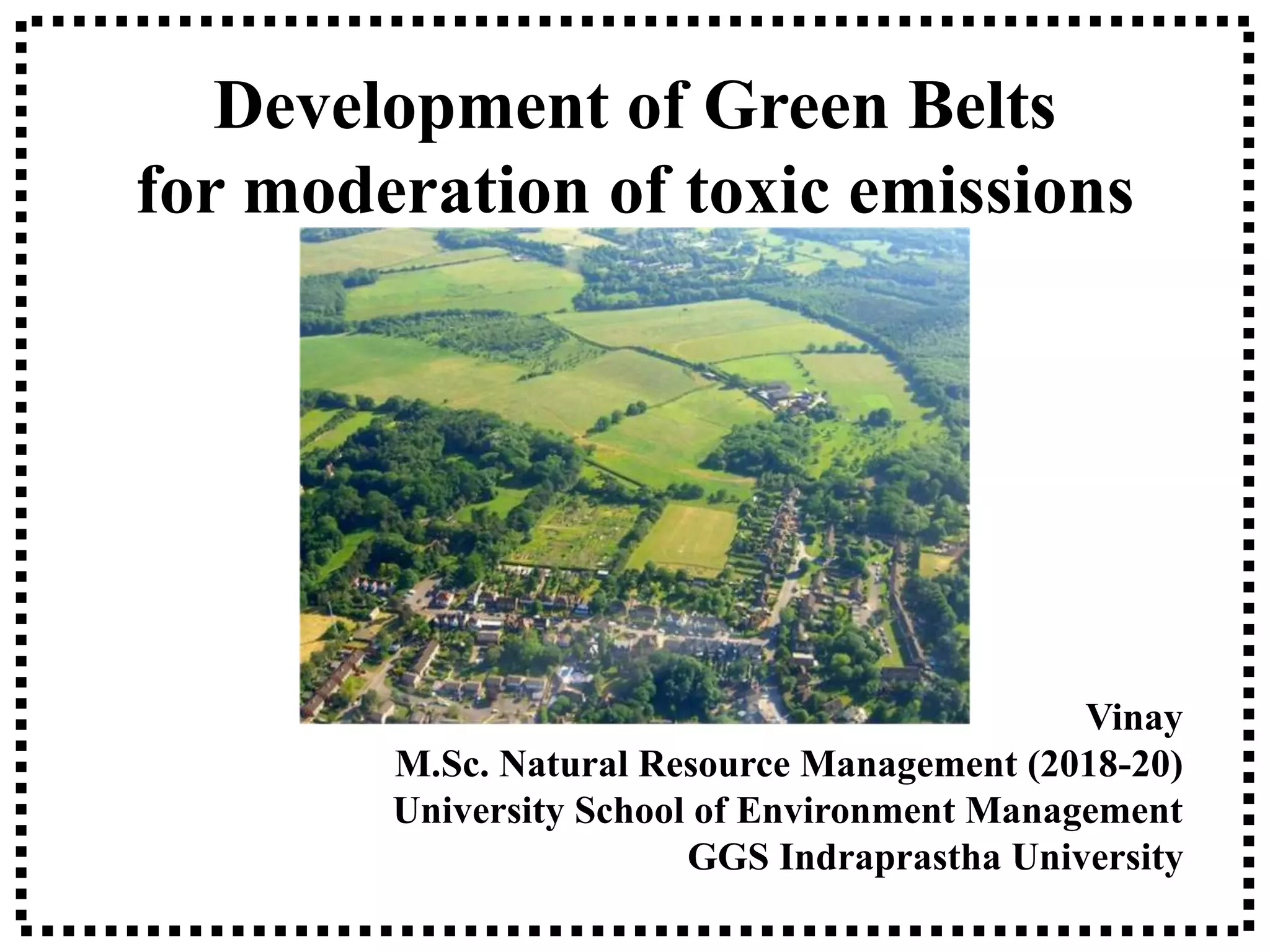
Development of Green Belts
for moderation of toxic emissions
Vinay
M.Sc. Natural Resource Management (2018-20)
University School of Environment Management
GGS Indraprastha University
Introduction
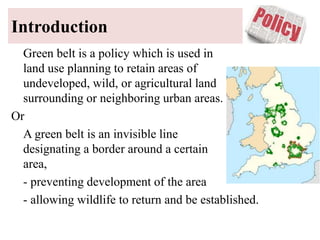
Green belt is a policy which is used in
land use planning to retain areas of
undeveloped, wild, or agricultural land
surrounding or neighboring urban areas.
Or
A green belt is an invisible line
designating a border around a certain
area,
- preventing development of the area
- allowing wildlife to return and be established.
Purpose
• Protection of natural or semi-natural environments
• Improvement of air quality in urban parts
• Confirm that urban inhabitants have admittance to
landscape, with consequent informative and recreational
opportunities
• Protection of rural societies that might otherwise be
absorbed by expanding cities.
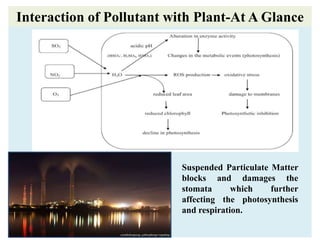
Interaction of Pollutant with Plant-At A Glance
Suspended Particulate Matter
blocks and damages the
stomata which further
affecting the photosynthesis
and respiration.
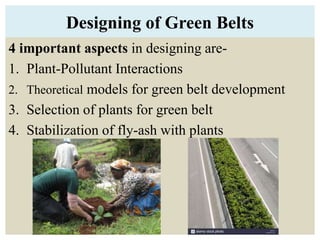
Designing of Green Belts
4 important aspects in designing are-
1. Plant-Pollutant Interactions
2. Theoretical models for green belt development
3. Selection of plants for green belt
4. Stabilization of fly-ash with plants
1. Plant-Pollution Interaction
• Plants are living organisms and hence are prone to suffer toxicity
of air pollutants like any other organism. Still, they are expected to
scavenge pollutants from the ambient air.
• The plants uptake air pollutants in the following order
HF > SO2 > Cl > NO2 > O3 > PAN > NO > CO
• The rate of pollutant removal is found to increase linearly as the
concentration of the pollutant increased over the ranges of
concentration that are encountered in ambient air and which are
low enough not to cause stomata closure.
• Pollutants are absorbed most efficiently by plant foliage near the
canopy surface where diffusion process is high due to favorable
light conditions.
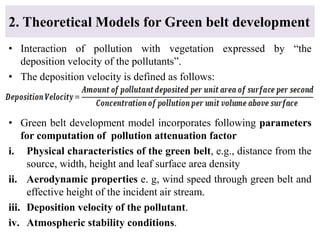
• Interaction of pollution with vegetation expressed by “the
deposition velocity of the pollutants”.
• The deposition velocity is defined as follows:
• Green belt development model incorporates following parameters
for computation of pollution attenuation factor
i. Physical characteristics of the green belt, e.g., distance from the
source, width, height and leaf surface area density
ii. Aerodynamic properties e. g, wind speed through green belt and
effective height of the incident air stream.
iii. Deposition velocity of the pollutant.
iv. Atmospheric stability conditions.
2. Theoretical Models for Green belt development
3. Selection of Plants for Green Belt
• Characters of plants including shapes of crowns considered necessary
for effecting absorption of pollutant gases and removal of dust
particles are as follows:
For absorption of gases
i. Tolerance towards pollutants that is not too high to be
instantaneously lethal
ii. Longer duration of foliage.
iii. Freely exposed foliage through:
a. Adequate height of crown
b. Openness of foliage in canopy
c. Big leaves (long and broad laminar surfaces)
d. Large number of stomatal apertures
e. Stomata well-exposed (in level with the general epidermal
surface)
For removal of suspended particulate matter
i. Height and spread of crown
ii. Leaves supported on firm petioles
iii. Abundance of surfaces on bark and foliage, through
a. Roughness of bark,
b. Epidermal outgrowths on petioles.
c. Abundance of axillary hairs,
d. Hairs or scales on laminar surfaces.
e. Stomata protected (by wax, arches/rings,
hairs, etc)
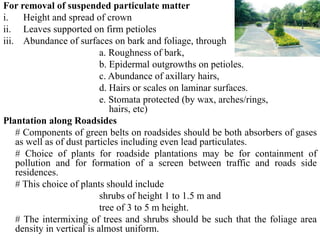
Plantation along Roadsides
# Components of green belts on roadsides should be both absorbers of gases
as well as of dust particles including even lead particulates.
# Choice of plants for roadside plantations may be for containment of
pollution and for formation of a screen between traffic and roads side
residences.
# This choice of plants should include
shrubs of height 1 to 1.5 m and
tree of 3 to 5 m height.
# The intermixing of trees and shrubs should be such that the foliage area
density in vertical is almost uniform.
4. Stabilization of Fly-Ash with Plants
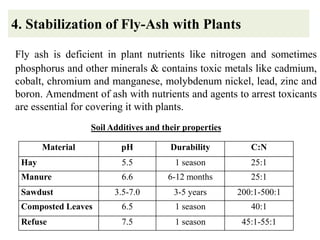
Fly ash is deficient in plant nutrients like nitrogen and sometimes
phosphorus and other minerals & contains toxic metals like cadmium,
cobalt, chromium and manganese, molybdenum nickel, lead, zinc and
boron. Amendment of ash with nutrients and agents to arrest toxicants
are essential for covering it with plants.
Material pH Durability C:N
Hay 5.5 1 season 25:1
Manure 6.6 6-12 months 25:1
Sawdust 3.5-7.0 3-5 years 200:1-500:1
Composted Leaves 6.5 1 season 40:1
Refuse 7.5 1 season 45:1-55:1
Soil Additives and their properties
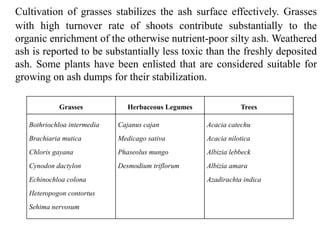
Cultivation of grasses stabilizes the ash surface effectively. Grasses
with high turnover rate of shoots contribute substantially to the
organic enrichment of the otherwise nutrient-poor silty ash. Weathered
ash is reported to be substantially less toxic than the freshly deposited
ash. Some plants have been enlisted that are considered suitable for
growing on ash dumps for their stabilization.
Grasses Herbaceous Legumes Trees
Bothriochloa intermedia
Brachiaria mutica
Chloris gayana
Cynodon dactylon
Echinochloa colona
Heteropogon contortus
Sehima nervosum
Cajanus cajan
Medicago sativa
Phaseolus mungo
Desmodium triflorum
Acacia catechu
Acacia nilotica
Albizia lebbeck
Albizia amara
Azadirachta indica
Two Approaches
A) Source Oriented Approach
B) Receptor Oriented Approach
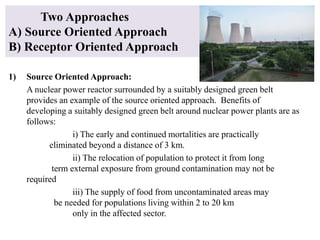
1) Source Oriented Approach:
A nuclear power reactor surrounded by a suitably designed green belt
provides an example of the source oriented approach. Benefits of
developing a suitably designed green belt around nuclear power plants are as
follows:
i) The early and continued mortalities are practically
eliminated beyond a distance of 3 km.
ii) The relocation of population to protect it from long
term external exposure from ground contamination may not be
required
iii) The supply of food from uncontaminated areas may
be needed for populations living within 2 to 20 km
only in the affected sector.
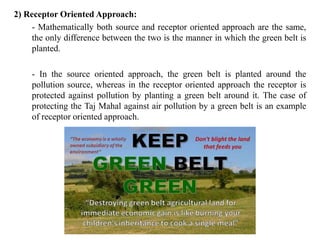
2) Receptor Oriented Approach:
- Mathematically both source and receptor oriented approach are the same,
the only difference between the two is the manner in which the green belt is
planted.
- In the source oriented approach, the green belt is planted around the
pollution source, whereas in the receptor oriented approach the receptor is
protected against pollution by planting a green belt around it. The case of
protecting the Taj Mahal against air pollution by a green belt is an example
of receptor oriented approach.
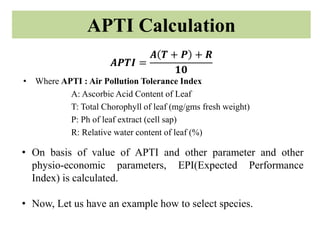
APTI Calculation
𝑨𝑷𝑻𝑰 =
𝑨 𝑻 + 𝑷 + 𝑹
𝟏𝟎
• Where APTI : Air Pollution Tolerance Index
A: Ascorbic Acid Content of Leaf
T: Total Chorophyll of leaf (mg/gms fresh weight)
P: Ph of leaf extract (cell sap)
R: Relative water content of leaf (%)
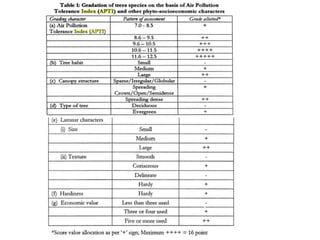
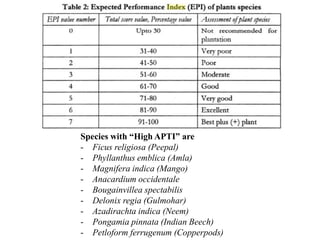
• On basis of value of APTI and other parameter and other
physio-economic parameters, EPI(Expected Performance
Index) is calculated.
• Now, Let us have an example how to select species.
Species with “High APTI” are
- Ficus religiosa (Peepal)
- Phyllanthus emblica (Amla)
- Magnifera indica (Mango)
- Anacardium occidentale
- Bougainvillea spectabilis
- Delonix regia (Gulmohar)
- Azadirachta indica (Neem)
- Pongamia pinnata (Indian Beech)
- Petloform ferrugenum (Copperpods)
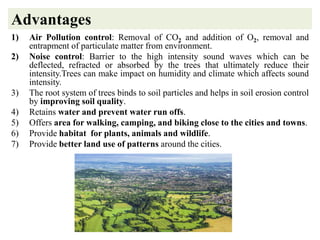
Advantages
1) Air Pollution control: Removal of CO2 and addition of O2, removal and
entrapment of particulate matter from environment.
2) Noise control: Barrier to the high intensity sound waves which can be
deflected, refracted or absorbed by the trees that ultimately reduce their
intensity.Trees can make impact on humidity and climate which affects sound
intensity.
3) The root system of trees binds to soil particles and helps in soil erosion control
by improving soil quality.
4) Retains water and prevent water run offs.
5) Offers area for walking, camping, and biking close to the cities and towns.
6) Provide habitat for plants, animals and wildlife.
7) Provide better land use of patterns around the cities.
Disadvantages
a) Housing crisis and demand:
Although, green belt has huge benefits (public health, environment), but these benefits do not
ensure as claimed. Only a small fraction of the population uses green belt for leisure purposes.
Rather, the decision of the green-belt development is to prevent housing demand within the
zone.
b) Increasing urban sprawl
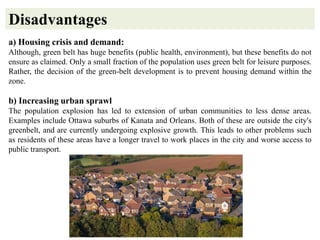
The population explosion has led to extension of urban communities to less dense areas.
Examples include Ottawa suburbs of Kanata and Orleans. Both of these are outside the city's
greenbelt, and are currently undergoing explosive growth. This leads to other problems such
as residents of these areas have a longer travel to work places in the city and worse access to
public transport.
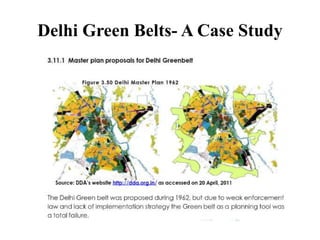
Delhi Green Belts- A Case Study
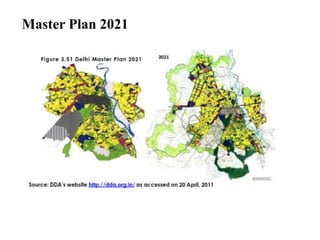
Master Plan 2021
Thank you

Green Belts.pptx

  • 1.
    Development of GreenBelts for moderation of toxic emissions Vinay M.Sc. Natural Resource Management (2018-20) University School of Environment Management GGS Indraprastha University
  • 2.
    Introduction Green belt isa policy which is used in land use planning to retain areas of undeveloped, wild, or agricultural land surrounding or neighboring urban areas. Or A green belt is an invisible line designating a border around a certain area, - preventing development of the area - allowing wildlife to return and be established.
  • 3.
    Purpose • Protection ofnatural or semi-natural environments • Improvement of air quality in urban parts • Confirm that urban inhabitants have admittance to landscape, with consequent informative and recreational opportunities • Protection of rural societies that might otherwise be absorbed by expanding cities.
  • 4.
    Interaction of Pollutantwith Plant-At A Glance Suspended Particulate Matter blocks and damages the stomata which further affecting the photosynthesis and respiration.
  • 5.
    Designing of GreenBelts 4 important aspects in designing are- 1. Plant-Pollutant Interactions 2. Theoretical models for green belt development 3. Selection of plants for green belt 4. Stabilization of fly-ash with plants
  • 6.
    1. Plant-Pollution Interaction •Plants are living organisms and hence are prone to suffer toxicity of air pollutants like any other organism. Still, they are expected to scavenge pollutants from the ambient air. • The plants uptake air pollutants in the following order HF > SO2 > Cl > NO2 > O3 > PAN > NO > CO • The rate of pollutant removal is found to increase linearly as the concentration of the pollutant increased over the ranges of concentration that are encountered in ambient air and which are low enough not to cause stomata closure. • Pollutants are absorbed most efficiently by plant foliage near the canopy surface where diffusion process is high due to favorable light conditions.
  • 7.
    • Interaction ofpollution with vegetation expressed by “the deposition velocity of the pollutants”. • The deposition velocity is defined as follows: • Green belt development model incorporates following parameters for computation of pollution attenuation factor i. Physical characteristics of the green belt, e.g., distance from the source, width, height and leaf surface area density ii. Aerodynamic properties e. g, wind speed through green belt and effective height of the incident air stream. iii. Deposition velocity of the pollutant. iv. Atmospheric stability conditions. 2. Theoretical Models for Green belt development
  • 8.
    3. Selection ofPlants for Green Belt • Characters of plants including shapes of crowns considered necessary for effecting absorption of pollutant gases and removal of dust particles are as follows: For absorption of gases i. Tolerance towards pollutants that is not too high to be instantaneously lethal ii. Longer duration of foliage. iii. Freely exposed foliage through: a. Adequate height of crown b. Openness of foliage in canopy c. Big leaves (long and broad laminar surfaces) d. Large number of stomatal apertures e. Stomata well-exposed (in level with the general epidermal surface)
  • 9.
    For removal ofsuspended particulate matter i. Height and spread of crown ii. Leaves supported on firm petioles iii. Abundance of surfaces on bark and foliage, through a. Roughness of bark, b. Epidermal outgrowths on petioles. c. Abundance of axillary hairs, d. Hairs or scales on laminar surfaces. e. Stomata protected (by wax, arches/rings, hairs, etc) Plantation along Roadsides # Components of green belts on roadsides should be both absorbers of gases as well as of dust particles including even lead particulates. # Choice of plants for roadside plantations may be for containment of pollution and for formation of a screen between traffic and roads side residences. # This choice of plants should include shrubs of height 1 to 1.5 m and tree of 3 to 5 m height. # The intermixing of trees and shrubs should be such that the foliage area density in vertical is almost uniform.
  • 10.
    4. Stabilization ofFly-Ash with Plants Fly ash is deficient in plant nutrients like nitrogen and sometimes phosphorus and other minerals & contains toxic metals like cadmium, cobalt, chromium and manganese, molybdenum nickel, lead, zinc and boron. Amendment of ash with nutrients and agents to arrest toxicants are essential for covering it with plants. Material pH Durability C:N Hay 5.5 1 season 25:1 Manure 6.6 6-12 months 25:1 Sawdust 3.5-7.0 3-5 years 200:1-500:1 Composted Leaves 6.5 1 season 40:1 Refuse 7.5 1 season 45:1-55:1 Soil Additives and their properties
  • 11.
    Cultivation of grassesstabilizes the ash surface effectively. Grasses with high turnover rate of shoots contribute substantially to the organic enrichment of the otherwise nutrient-poor silty ash. Weathered ash is reported to be substantially less toxic than the freshly deposited ash. Some plants have been enlisted that are considered suitable for growing on ash dumps for their stabilization. Grasses Herbaceous Legumes Trees Bothriochloa intermedia Brachiaria mutica Chloris gayana Cynodon dactylon Echinochloa colona Heteropogon contortus Sehima nervosum Cajanus cajan Medicago sativa Phaseolus mungo Desmodium triflorum Acacia catechu Acacia nilotica Albizia lebbeck Albizia amara Azadirachta indica
  • 12.
    Two Approaches A) SourceOriented Approach B) Receptor Oriented Approach 1) Source Oriented Approach: A nuclear power reactor surrounded by a suitably designed green belt provides an example of the source oriented approach. Benefits of developing a suitably designed green belt around nuclear power plants are as follows: i) The early and continued mortalities are practically eliminated beyond a distance of 3 km. ii) The relocation of population to protect it from long term external exposure from ground contamination may not be required iii) The supply of food from uncontaminated areas may be needed for populations living within 2 to 20 km only in the affected sector.
  • 13.
    2) Receptor OrientedApproach: - Mathematically both source and receptor oriented approach are the same, the only difference between the two is the manner in which the green belt is planted. - In the source oriented approach, the green belt is planted around the pollution source, whereas in the receptor oriented approach the receptor is protected against pollution by planting a green belt around it. The case of protecting the Taj Mahal against air pollution by a green belt is an example of receptor oriented approach.
  • 14.
    APTI Calculation 𝑨𝑷𝑻𝑰 = 𝑨𝑻 + 𝑷 + 𝑹 𝟏𝟎 • Where APTI : Air Pollution Tolerance Index A: Ascorbic Acid Content of Leaf T: Total Chorophyll of leaf (mg/gms fresh weight) P: Ph of leaf extract (cell sap) R: Relative water content of leaf (%) • On basis of value of APTI and other parameter and other physio-economic parameters, EPI(Expected Performance Index) is calculated. • Now, Let us have an example how to select species.
  • 16.
    Species with “HighAPTI” are - Ficus religiosa (Peepal) - Phyllanthus emblica (Amla) - Magnifera indica (Mango) - Anacardium occidentale - Bougainvillea spectabilis - Delonix regia (Gulmohar) - Azadirachta indica (Neem) - Pongamia pinnata (Indian Beech) - Petloform ferrugenum (Copperpods)
  • 17.
    Advantages 1) Air Pollutioncontrol: Removal of CO2 and addition of O2, removal and entrapment of particulate matter from environment. 2) Noise control: Barrier to the high intensity sound waves which can be deflected, refracted or absorbed by the trees that ultimately reduce their intensity.Trees can make impact on humidity and climate which affects sound intensity. 3) The root system of trees binds to soil particles and helps in soil erosion control by improving soil quality. 4) Retains water and prevent water run offs. 5) Offers area for walking, camping, and biking close to the cities and towns. 6) Provide habitat for plants, animals and wildlife. 7) Provide better land use of patterns around the cities.
  • 18.
    Disadvantages a) Housing crisisand demand: Although, green belt has huge benefits (public health, environment), but these benefits do not ensure as claimed. Only a small fraction of the population uses green belt for leisure purposes. Rather, the decision of the green-belt development is to prevent housing demand within the zone. b) Increasing urban sprawl The population explosion has led to extension of urban communities to less dense areas. Examples include Ottawa suburbs of Kanata and Orleans. Both of these are outside the city's greenbelt, and are currently undergoing explosive growth. This leads to other problems such as residents of these areas have a longer travel to work places in the city and worse access to public transport.
  • 19.
    Delhi Green Belts-A Case Study
  • 20.
  • 21.