ENVIRONMENTAL
IMPACT ASSESSMENT
Under: Environmental Management System
 Environmental impact assessment
(EIA) - is an assessment of the
possible positive or negative impact
that a proposed project may have on
the environment, together consisting
of the environmental, social and
economic aspects.
What is
Environmental impact
assesment ?
What is the purpose
of EIA ?
 Identify those projects or
activities that may cause
potential significant impacts
 To ensure that decision
makers consider the
ensuing environmental
impacts when deciding
whether to proceed with a
project.
EIA - the process of identifying,
predicting, evaluating and
mitigating the biophysical,
social, and other relevant effects
of development proposals prior
to major decisions being taken
and commitments made.
EIA as a Process
- International Association for
Impact Assessment (IAIA)
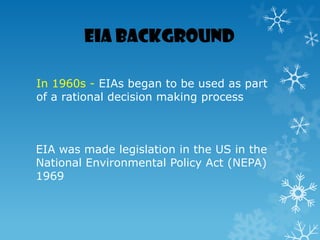
EIA Background
In 1960s - EIAs began to be used as part
of a rational decision making process
EIA was made legislation in the US in the
National Environmental Policy Act (NEPA)
1969
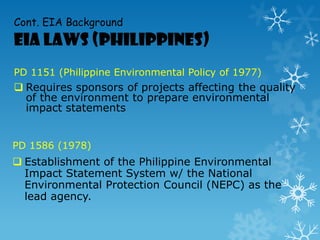
Cont. EIA Background
EIA Laws (Philippines)
PD 1151 (Philippine Environmental Policy of 1977)
 Requires sponsors of projects affecting the quality
of the environment to prepare environmental
impact statements
PD 1586 (1978)
 Establishment of the Philippine Environmental
Impact Statement System w/ the National
Environmental Protection Council (NEPC) as the
lead agency.
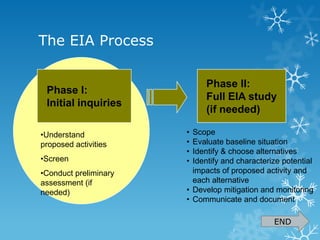
The EIA Process
7
• Scope
• Evaluate baseline situation
• Identify & choose alternatives
• Identify and characterize potential
impacts of proposed activity and
each alternative
• Develop mitigation and monitoring
• Communicate and document
Phase I:
Initial inquiries
Phase II:
Full EIA study
(if needed)
•Understand
proposed activities
•Screen
•Conduct preliminary
assessment (if
needed)
END
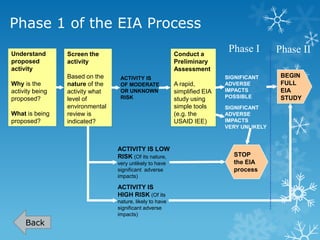
Screen the
activity
Based on the
nature of the
activity what
level of
environmental
review is
indicated?
Conduct a
Preliminary
Assessment
A rapid,
simplified EIA
study using
simple tools
(e.g. the
USAID IEE)
ACTIVITY IS
OF MODERATE
OR UNKNOWN
RISK
SIGNIFICANT
ADVERSE
IMPACTS
POSSIBLE
SIGNIFICANT
ADVERSE
IMPACTS
VERY UNLIKELY
ACTIVITY IS LOW
RISK (Of its nature,
very unlikely to have
significant adverse
impacts)
ACTIVITY IS
HIGH RISK (Of its
nature, likely to have
significant adverse
impacts)
Phase IIPhase IUnderstand
proposed
activity
Why is the
activity being
proposed?
What is being
proposed?
BEGIN
FULL
EIA
STUDY
STOP
the EIA
process
Phase 1 of the EIA Process
Back
END OF REPORT
 Baldovino, Elly Brent
 Cantero, Kenneth
 Lopena, Ermar

Environmental Impact Assessment

  • 1.
  • 2.
     Environmental impactassessment (EIA) - is an assessment of the possible positive or negative impact that a proposed project may have on the environment, together consisting of the environmental, social and economic aspects. What is Environmental impact assesment ?
  • 3.
    What is thepurpose of EIA ?  Identify those projects or activities that may cause potential significant impacts  To ensure that decision makers consider the ensuing environmental impacts when deciding whether to proceed with a project.
  • 4.
    EIA - theprocess of identifying, predicting, evaluating and mitigating the biophysical, social, and other relevant effects of development proposals prior to major decisions being taken and commitments made. EIA as a Process - International Association for Impact Assessment (IAIA)
  • 5.
    EIA Background In 1960s- EIAs began to be used as part of a rational decision making process EIA was made legislation in the US in the National Environmental Policy Act (NEPA) 1969
  • 6.
    Cont. EIA Background EIALaws (Philippines) PD 1151 (Philippine Environmental Policy of 1977)  Requires sponsors of projects affecting the quality of the environment to prepare environmental impact statements PD 1586 (1978)  Establishment of the Philippine Environmental Impact Statement System w/ the National Environmental Protection Council (NEPC) as the lead agency.
  • 7.
    The EIA Process 7 •Scope • Evaluate baseline situation • Identify & choose alternatives • Identify and characterize potential impacts of proposed activity and each alternative • Develop mitigation and monitoring • Communicate and document Phase I: Initial inquiries Phase II: Full EIA study (if needed) •Understand proposed activities •Screen •Conduct preliminary assessment (if needed) END
  • 8.
    Screen the activity Based onthe nature of the activity what level of environmental review is indicated? Conduct a Preliminary Assessment A rapid, simplified EIA study using simple tools (e.g. the USAID IEE) ACTIVITY IS OF MODERATE OR UNKNOWN RISK SIGNIFICANT ADVERSE IMPACTS POSSIBLE SIGNIFICANT ADVERSE IMPACTS VERY UNLIKELY ACTIVITY IS LOW RISK (Of its nature, very unlikely to have significant adverse impacts) ACTIVITY IS HIGH RISK (Of its nature, likely to have significant adverse impacts) Phase IIPhase IUnderstand proposed activity Why is the activity being proposed? What is being proposed? BEGIN FULL EIA STUDY STOP the EIA process Phase 1 of the EIA Process Back
  • 9.
    END OF REPORT Baldovino, Elly Brent  Cantero, Kenneth  Lopena, Ermar