

Waste Collection
Lesson Objectives
 Understand problems and concerns associated with
MSW collection.
 Compare and contrast privately and publicly
operated systems.
 Understand the types of collection systems
Waste Collection
History:
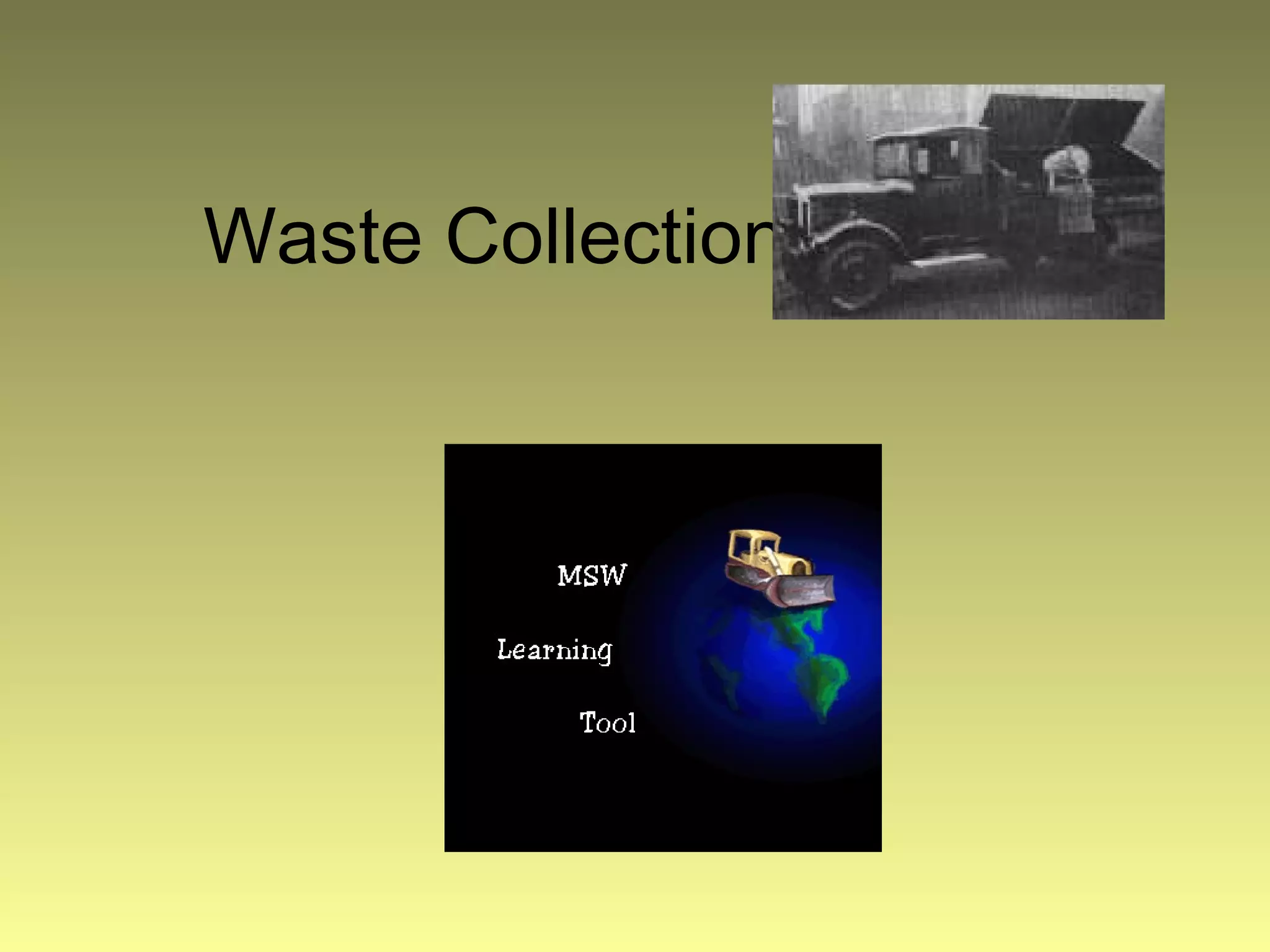
 Wagons and other means had been used for centuries to
haul away solid waste.
 Trucks were first used for this purpose soon after their
invention.
 The 1920s saw the first open topped trucks being used, but
due to poor odours and waste falling from the back
covered vehicles soon became more common.
 These covered trucks were first introduced in more densely
populated Europe then in North America, but were soon
used worldwide.
Waste Collection
 The main difficulty was that the waste collectors
needed to lift the waste to shoulder height.
 The first technique developed in the late 20s to
solve this problem was to build round
compartments with massive corkscrews that
would lift the load and bring it away from the rear.
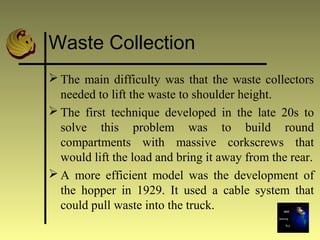
 A more efficient model was the development of
the hopper in 1929. It used a cable system that
could pull waste into the truck.
Waste Collection
In 1997 Lee Rathbun, introduced
the Lightning Rear Steer System.
This system includes an elevated, rear-
facing cab for both driving the truck and
operating the loader.
This configuration allows the operator to
follow behind haul trucks and load
continuously.
Types of Waste Collection
Systems
Refuse Collection Systems (residential)
Commercial Waste Collection
Recyclable Material Collection
Refuse Collection
(Residential)
Stationary container emptied into truck
– Manually
• High injury rates (heavy containers, broken
glass/sharp objects)
• Temporary containers that fall apart
– Automatic
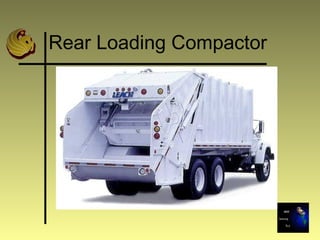
Rear Loading Compactor
Rear loaders have an opening at the
rear that a waste collector can throw
waste bags or empty the contents
of bins into. Often in many areas they
have a lifting mechanism to
automatically empty large carts without
the operator having to lift the waste by
hand
Rear Loading Compactor
 The modern rear loader usually compacts the
waste using a hydraulically powered plate
that scoops the waste out from the loading
hopper and compresses it against a moving
wall.
 In most compactor designs, the plate has a
pointed edge on its leading edge, which is
designed to apply point pressure to the waste
to break down bulky items in the hopper
before being drawn into the main body of the
truck.
Rear Loading Compactor
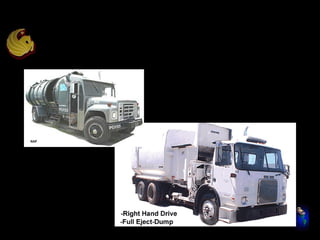
Side Loader
 These trucks are loaded from the side, either
manually, or with the assistance of an
automated lift. Lift-equipped trucks are referred
to as automated side loaders. The refuse is
then compacted towards the rear of the truck. 
 An Automated Side Loader only needs one
operator where as a traditional rear load
garbage truck may require two or three people
and has the additional advantage of reducing
on the job injuries to due repetitive heavy lifting.
Side Loader
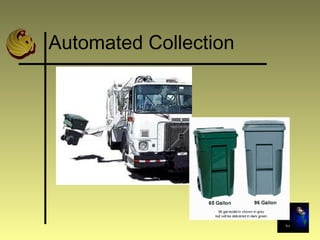
Automatic Collection
Usually only one driver required
Works best
– without on-street parking, low hanging
wires, narrow streets
– Where commitment to preventative
maintenance
– Where commitment to educating public
Automated Collection
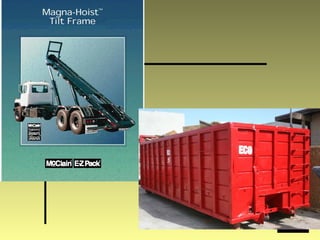
Commercial Waste Collection
Mechanically front loaded
Hoist trucks
Trash Trailers
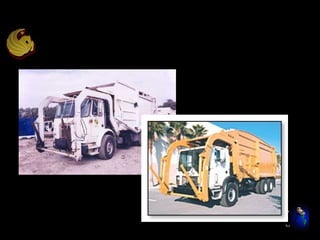
Front Loading Compactor
 Front loaders generally service commercial and industrial
businesses using large waste containers with lids known
as Dumpsters in the US. The truck is equipped with automated
forks on the front which the driver carefully aligns with sleeves on
the waste container using a joystick or a set of levers.
 The waste container is then lifted over the truck. Once it gets to the
top the container is then flipped upside down and the waste or
recyclable material is emptied into the vehicle's hopper.
 Once the waste is dumped, it is compacted by a large blade called a
"packer blade" that pushes the waste to the rear of the
vehicle. Most of the newer packing trucks have "pack-on-the-go
hydraulics" which lets the driver pack loads while driving,
allowing faster route times.
Front Loading Compactor
Collection with Recycling
 Collection of mixed MSW with sorting at MRP
(single stream)
 Collection of separated recyclables and
MSW(dual stream)
– Hand sorting of recyclables at MRP
– Hand sorting at point of collection (multi-
compartment trucks)
– Collection of separate yard waste
• Bags, bins, or carts (require automation)
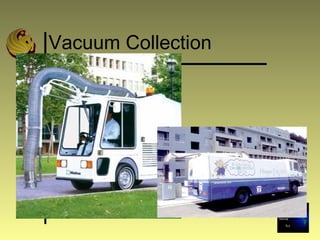
• Vacuum collection
• Dual compartment collection vehicle
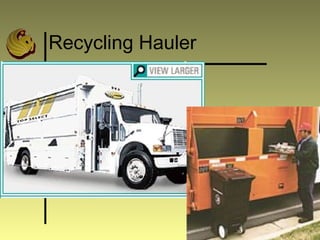
Recycling Hauler
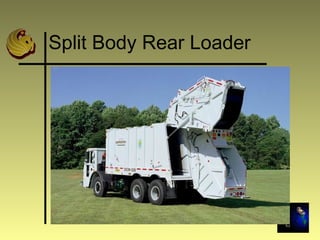
Split Body Rear Loader
Vacuum Collection
Collection Options
Public Collection
Private Collection
Labor
Labor intensive
Labor unskilled
High turn-over rates
Few prospects for mechanical
replacement of manual labor
Injuries and poor working conditions
Limited career opportunities
Customer Service
Frequency of service
Container and storage issues
particularly for commercial and
industrial
Location of pickup
Special wastes
Management and Financing
Issues
Low priority
Resistance to change and new
technologies
Lack of quality management
Changing with new regulations
Technological Issues
 Collection of recyclables, yard waste, special
wastes
 Yard waste containers - bagged material
must be debagged prior to composting
 Automated collection
 Development of efficient routes
 Vehicle weight restrictions
 Vehicle turning radius and clearance
Reasons for declining
collection frequency include
 Proportion of putrescible waste declined
(food grinders)
 Better design of collection vehicles controls
odors and flies
 Service costs increased
 Time between collection and disposal
decreased
 Better management
Safety
Third most dangerous job behind
fishing and timber cutting
– Falls off trucks
– Hit by cars
– Inappropriate disposal of wastes
– Lifting injuries
Fixed Factors Affecting
Design and Cost
 Fixed Factors
 Climate
 Topography
 Layout - container access (alley, curbside,
rear of house)
 Available transportation systems, traffic,
roads (Venice uses boats)
 Types of wastes collected
 Population density
Variable Factors Affecting
Design and Cost
Storage techniques employed
Recycling
Collection frequency
Crew size
Equipment
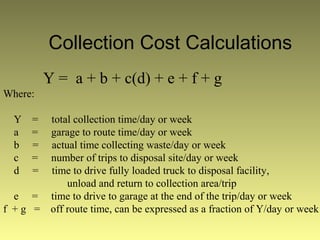
Y = a + b + c(d) + e + f + g
Where:
Y = total collection time/day or week
a = garage to route time/day or week
b = actual time collecting waste/day or week
c = number of trips to disposal site/day or week
d = time to drive fully loaded truck to disposal facility,
unload and return to collection area/trip
e = time to drive to garage at the end of the trip/day or week
f + g = off route time, can be expressed as a fraction of Y/day or week
Collection Cost Calculations
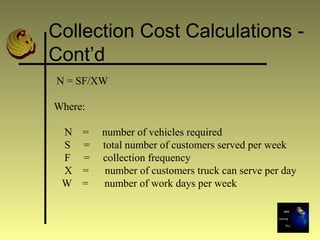
N = SF/XW
Where:
N = number of vehicles required
S = total number of customers served per week
F = collection frequency
X = number of customers truck can serve per day
W = number of work days per week
Collection Cost Calculations -
Cont’d
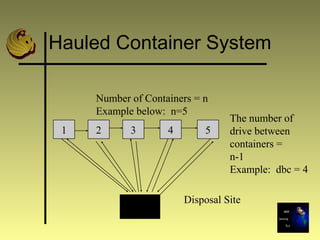
Hauled Container System
1 2 3 4 5
Disposal Site
Number of Containers = n
Example below: n=5
The number of
drive between
containers =
n-1
Example: dbc = 4
Thanks

Environmental Engineering (waste collection)

  • 1.
  • 2.
    Lesson Objectives  Understandproblems and concerns associated with MSW collection.  Compare and contrast privately and publicly operated systems.  Understand the types of collection systems
  • 3.
    Waste Collection History:  Wagonsand other means had been used for centuries to haul away solid waste.  Trucks were first used for this purpose soon after their invention.  The 1920s saw the first open topped trucks being used, but due to poor odours and waste falling from the back covered vehicles soon became more common.  These covered trucks were first introduced in more densely populated Europe then in North America, but were soon used worldwide.
  • 4.
    Waste Collection  Themain difficulty was that the waste collectors needed to lift the waste to shoulder height.  The first technique developed in the late 20s to solve this problem was to build round compartments with massive corkscrews that would lift the load and bring it away from the rear.  A more efficient model was the development of the hopper in 1929. It used a cable system that could pull waste into the truck.
  • 5.
    Waste Collection In 1997Lee Rathbun, introduced the Lightning Rear Steer System. This system includes an elevated, rear- facing cab for both driving the truck and operating the loader. This configuration allows the operator to follow behind haul trucks and load continuously.
  • 6.
    Types of WasteCollection Systems Refuse Collection Systems (residential) Commercial Waste Collection Recyclable Material Collection
  • 7.
    Refuse Collection (Residential) Stationary containeremptied into truck – Manually • High injury rates (heavy containers, broken glass/sharp objects) • Temporary containers that fall apart – Automatic
  • 8.
    Rear Loading Compactor Rearloaders have an opening at the rear that a waste collector can throw waste bags or empty the contents of bins into. Often in many areas they have a lifting mechanism to automatically empty large carts without the operator having to lift the waste by hand
  • 9.
    Rear Loading Compactor The modern rear loader usually compacts the waste using a hydraulically powered plate that scoops the waste out from the loading hopper and compresses it against a moving wall.  In most compactor designs, the plate has a pointed edge on its leading edge, which is designed to apply point pressure to the waste to break down bulky items in the hopper before being drawn into the main body of the truck.
  • 10.
  • 11.
    Side Loader  Thesetrucks are loaded from the side, either manually, or with the assistance of an automated lift. Lift-equipped trucks are referred to as automated side loaders. The refuse is then compacted towards the rear of the truck.   An Automated Side Loader only needs one operator where as a traditional rear load garbage truck may require two or three people and has the additional advantage of reducing on the job injuries to due repetitive heavy lifting.
  • 12.
  • 13.
    Automatic Collection Usually onlyone driver required Works best – without on-street parking, low hanging wires, narrow streets – Where commitment to preventative maintenance – Where commitment to educating public
  • 14.
  • 15.
    Commercial Waste Collection Mechanicallyfront loaded Hoist trucks Trash Trailers
  • 16.
    Front Loading Compactor Front loaders generally service commercial and industrial businesses using large waste containers with lids known as Dumpsters in the US. The truck is equipped with automated forks on the front which the driver carefully aligns with sleeves on the waste container using a joystick or a set of levers.  The waste container is then lifted over the truck. Once it gets to the top the container is then flipped upside down and the waste or recyclable material is emptied into the vehicle's hopper.  Once the waste is dumped, it is compacted by a large blade called a "packer blade" that pushes the waste to the rear of the vehicle. Most of the newer packing trucks have "pack-on-the-go hydraulics" which lets the driver pack loads while driving, allowing faster route times.
  • 17.
  • 19.
    Collection with Recycling Collection of mixed MSW with sorting at MRP (single stream)  Collection of separated recyclables and MSW(dual stream) – Hand sorting of recyclables at MRP – Hand sorting at point of collection (multi- compartment trucks) – Collection of separate yard waste • Bags, bins, or carts (require automation) • Vacuum collection • Dual compartment collection vehicle
  • 20.
  • 21.
  • 22.
  • 23.
  • 24.
    Labor Labor intensive Labor unskilled Highturn-over rates Few prospects for mechanical replacement of manual labor Injuries and poor working conditions Limited career opportunities
  • 25.
    Customer Service Frequency ofservice Container and storage issues particularly for commercial and industrial Location of pickup Special wastes
  • 26.
    Management and Financing Issues Lowpriority Resistance to change and new technologies Lack of quality management Changing with new regulations
  • 27.
    Technological Issues  Collectionof recyclables, yard waste, special wastes  Yard waste containers - bagged material must be debagged prior to composting  Automated collection  Development of efficient routes  Vehicle weight restrictions  Vehicle turning radius and clearance
  • 28.
    Reasons for declining collectionfrequency include  Proportion of putrescible waste declined (food grinders)  Better design of collection vehicles controls odors and flies  Service costs increased  Time between collection and disposal decreased  Better management
  • 29.
    Safety Third most dangerousjob behind fishing and timber cutting – Falls off trucks – Hit by cars – Inappropriate disposal of wastes – Lifting injuries
  • 30.
    Fixed Factors Affecting Designand Cost  Fixed Factors  Climate  Topography  Layout - container access (alley, curbside, rear of house)  Available transportation systems, traffic, roads (Venice uses boats)  Types of wastes collected  Population density
  • 31.
    Variable Factors Affecting Designand Cost Storage techniques employed Recycling Collection frequency Crew size Equipment
  • 32.
    Y = a+ b + c(d) + e + f + g Where: Y = total collection time/day or week a = garage to route time/day or week b = actual time collecting waste/day or week c = number of trips to disposal site/day or week d = time to drive fully loaded truck to disposal facility, unload and return to collection area/trip e = time to drive to garage at the end of the trip/day or week f + g = off route time, can be expressed as a fraction of Y/day or week Collection Cost Calculations
  • 33.
    N = SF/XW Where: N= number of vehicles required S = total number of customers served per week F = collection frequency X = number of customers truck can serve per day W = number of work days per week Collection Cost Calculations - Cont’d
  • 34.
    Hauled Container System 12 3 4 5 Disposal Site Number of Containers = n Example below: n=5 The number of drive between containers = n-1 Example: dbc = 4
  • 35.

Editor's Notes

  • #15 32, 64, 96 gal cars