garbage collection and management in smart city
what is smart city ?
is an urban development using Information and Communication Technology
(ICT) and Internet of Things (IoT) to provide useful information to effectively
manage resources and assets. This includes data collected from citizens and
mechanical devices, that are processed and analysed to monitor and manage
traffic and transport systems, power plants, water supply networks, waste
disposal , Also called eco-city or sustainable city, the smart city aims to
improve the quality of urban services or reduce its costs. It stands out for its
specificities: smart management, lifestyle, mobility, housing, as well as a smart
economy. Their main goal is to reconcile technological innovation with the
economic, social and ecological challenges of the city of tomorrow. Their
leitmotiv is the quality of life: how to live better together while respecting our
environment.
What is waste management for smart cities?
The smart cities are improving living conditions to Governments and private
companies also invest their budget, to
research and development of smart cities. efficient methods are used to make
the process easily .
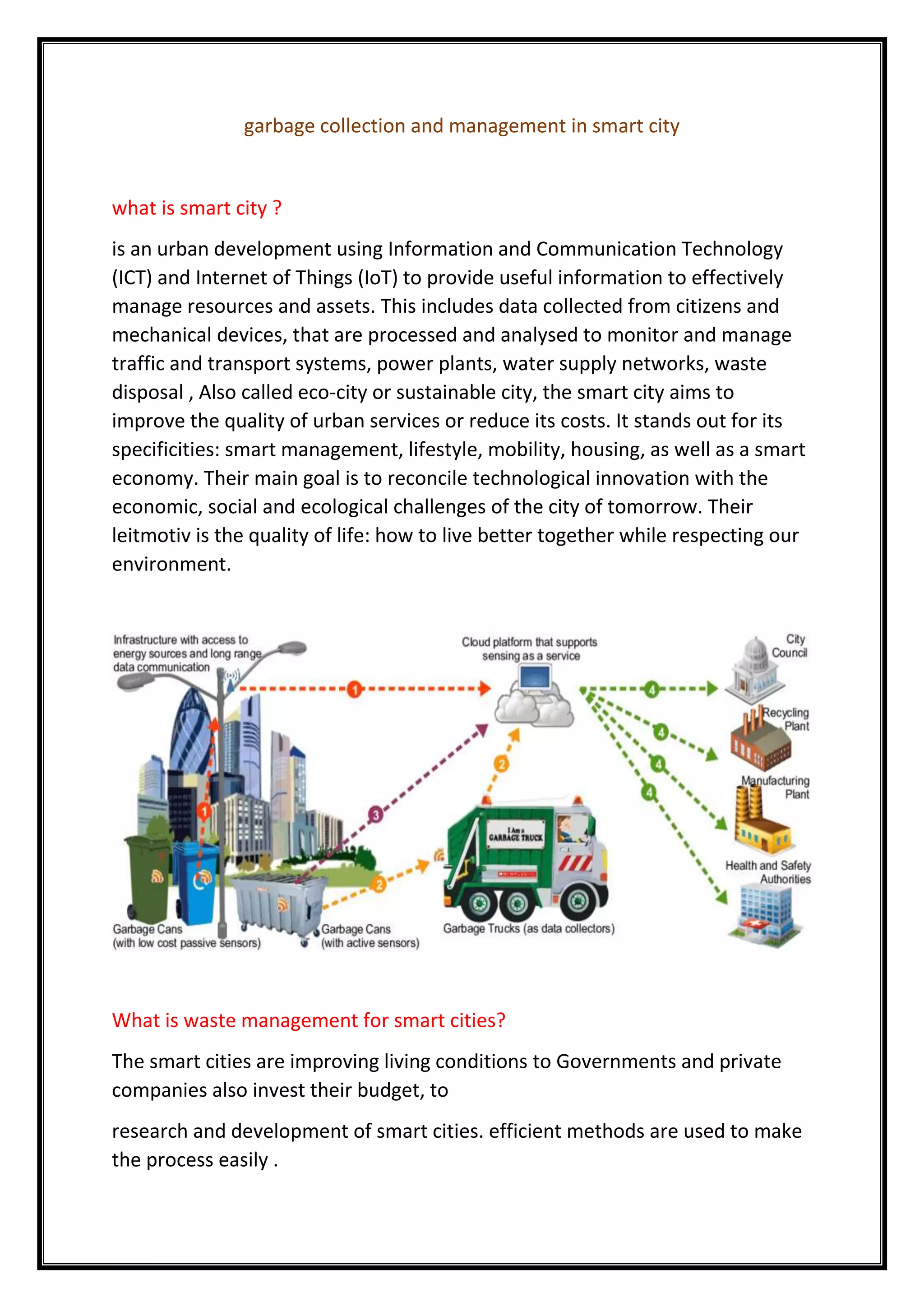
The project is based upon collecting the garbage using IOT technology. The
process is to check whether the dustbins all over the city is full or not .
In case if the bins are get filled that it detects over weight through moisture
sensor and then workers come to collect the garbage.
Currently without using IoT strategies in garbage collection:
The current process of waste management starts with the waste being created
by people in the cities and disposed in trash bins near its creation point.
Waste is collected by professionals in the capital week after week at once.
The trash at the collection centres’ is then sent for recycling. Garbage though
Psychologists are flooding from the container, spreading through the streets
and leading to unsanitary conditions ,
The smell will be overwhelming, polluting the air and spreading infection.
This process in current city setting solves the waste problem partially while it
creates other problems such as;
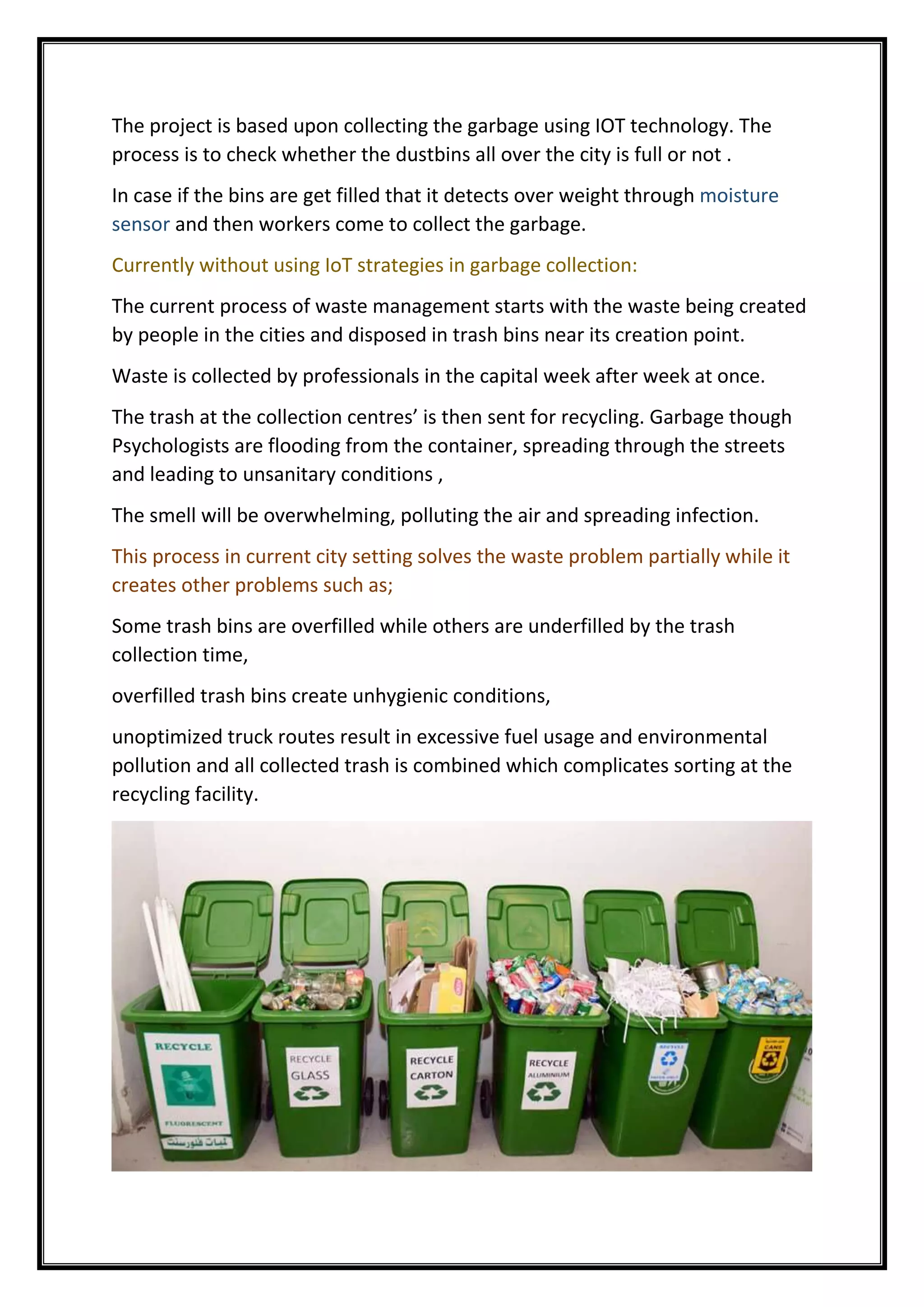
Some trash bins are overfilled while others are underfilled by the trash
collection time,
overfilled trash bins create unhygienic conditions,
unoptimized truck routes result in excessive fuel usage and environmental
pollution and all collected trash is combined which complicates sorting at the
recycling facility.
Problem mitigation through smart waste management:
The waste management services take care of a healthy environment allowing
optimization of the utilities and prevent overloading the carrier for waste
disposal.
Needs smart city to waste management:
1- Municipalities need to keep track of their own waste containers ,
through smart sensors that are located in smart waste bins .
2- The municipalities need to control that their waste trucks proceed in the
most efficient route possible , through With fleet management software,
you can easily control your waste trucks.
3- municipalities in waste management is that they need to cooperate with
their citizens in waste management processes , through You can
collaborate with fellow citizens on waste management operations.
4- Zero waste, through waste recycling .
What is technical process to Waste management:
1- Landfill : is generally stored on the ground. Landfills are the most
common and cheapest method for waste disposal in the world.
2- Incineration of waste : is a technique of transformation by the action of
fire. Waste combustion can be used to produce electricity and heat, but
also is an important source of air pollution.
3- Recycling : is the physical reprocessing of old materials such as metals,
plastics and e-waste - industrial or household - into new products.
4- Energy recovery : is the process converting non-recyclable waste
materials into usable heat, fuel or electricity through combustion
5- Biological reprocessing : Composting is a process of conversion and
recovery of organic matter into a stabilized, hygienic, soil-like product
rich in the compost.
What is technical process to Waste collection:
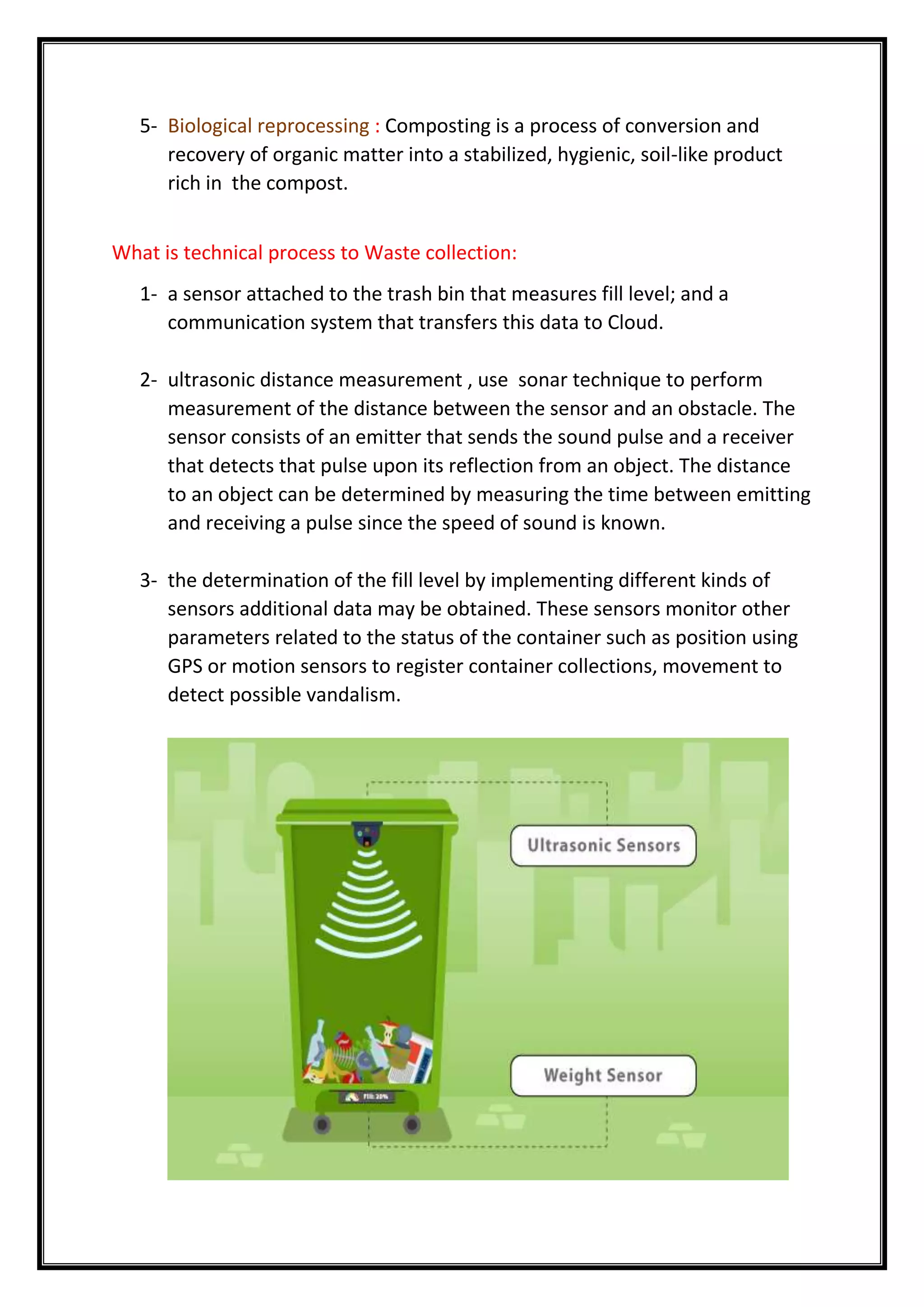
1- a sensor attached to the trash bin that measures fill level; and a
communication system that transfers this data to Cloud.
2- ultrasonic distance measurement , use sonar technique to perform
measurement of the distance between the sensor and an obstacle. The
sensor consists of an emitter that sends the sound pulse and a receiver
that detects that pulse upon its reflection from an object. The distance
to an object can be determined by measuring the time between emitting
and receiving a pulse since the speed of sound is known.
3- the determination of the fill level by implementing different kinds of
sensors additional data may be obtained. These sensors monitor other
parameters related to the status of the container such as position using
GPS or motion sensors to register container collections, movement to
detect possible vandalism.
Disadvantages of Solutions :
1- is related to the usage of the ultrasonic sensor. Trash is non-
uniformly distributed inside the container. Simple distance
measurement leads to false fill level measurement. Although several
software procedures have been proposed to increase the accuracy of
this sensor, unfortunately, results remain poor. By using multiple
sensors, the fill level can be determined more precisely, however, the
cost of the system also increases. So, this is usually not a
commercially preferred solution.
2- The second defect is that it is partial and incomplete, meaning that
when the waste is collected and disposed of in local garbage bins, it is
then sorted for recycling or burning . Current smart waste
management services do not offer any solution with regard to the
recycling process.
How does Japan dispose of garbage properly?
The waste and garbage disposal process in Japan seems a bit complicated,
especially since it differs from many countries in the world in the process of
sorting and classifying waste according to strict rules.
Japan is one of the developed countries in waste recycling and recycling
processes to protect the environment and preserve various resources from
depletion.
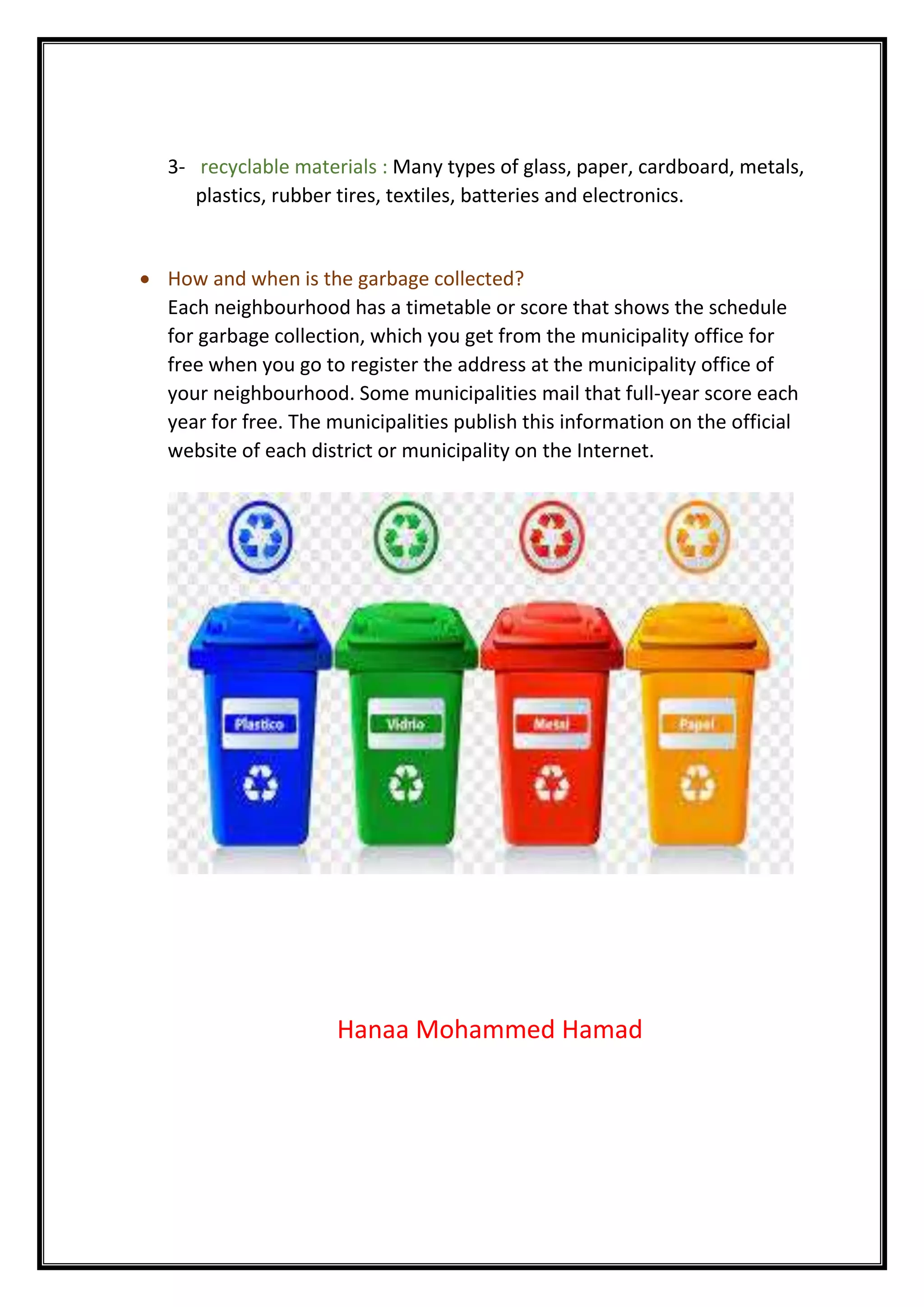
 Trash bags : Sorting the garbage carefully and dividing it according to its
type, and Tokyo was working to specify a specific colour for each type of
waste
 Garbage is divided for disposal according to:
1- Combustible materials : Waste to ash is directed down the chimney
while the downhill gases and heat generate electric power
2- non-combustible materials : They are like used or broken cell
phones, televisions, and computers
3- recyclable materials : Many types of glass, paper, cardboard, metals,
plastics, rubber tires, textiles, batteries and electronics.
 How and when is the garbage collected?
Each neighbourhood has a timetable or score that shows the schedule
for garbage collection, which you get from the municipality office for
free when you go to register the address at the municipality office of
your neighbourhood. Some municipalities mail that full-year score each
year for free. The municipalities publish this information on the official
website of each district or municipality on the Internet.
Hanaa Mohammed Hamad
garbage collection and management in smart city.docx

garbage collection and management in smart city.docx

  • 1.
    garbage collection andmanagement in smart city what is smart city ? is an urban development using Information and Communication Technology (ICT) and Internet of Things (IoT) to provide useful information to effectively manage resources and assets. This includes data collected from citizens and mechanical devices, that are processed and analysed to monitor and manage traffic and transport systems, power plants, water supply networks, waste disposal , Also called eco-city or sustainable city, the smart city aims to improve the quality of urban services or reduce its costs. It stands out for its specificities: smart management, lifestyle, mobility, housing, as well as a smart economy. Their main goal is to reconcile technological innovation with the economic, social and ecological challenges of the city of tomorrow. Their leitmotiv is the quality of life: how to live better together while respecting our environment. What is waste management for smart cities? The smart cities are improving living conditions to Governments and private companies also invest their budget, to research and development of smart cities. efficient methods are used to make the process easily .
  • 2.
    The project isbased upon collecting the garbage using IOT technology. The process is to check whether the dustbins all over the city is full or not . In case if the bins are get filled that it detects over weight through moisture sensor and then workers come to collect the garbage. Currently without using IoT strategies in garbage collection: The current process of waste management starts with the waste being created by people in the cities and disposed in trash bins near its creation point. Waste is collected by professionals in the capital week after week at once. The trash at the collection centres’ is then sent for recycling. Garbage though Psychologists are flooding from the container, spreading through the streets and leading to unsanitary conditions , The smell will be overwhelming, polluting the air and spreading infection. This process in current city setting solves the waste problem partially while it creates other problems such as; Some trash bins are overfilled while others are underfilled by the trash collection time, overfilled trash bins create unhygienic conditions, unoptimized truck routes result in excessive fuel usage and environmental pollution and all collected trash is combined which complicates sorting at the recycling facility.
  • 3.
    Problem mitigation throughsmart waste management: The waste management services take care of a healthy environment allowing optimization of the utilities and prevent overloading the carrier for waste disposal. Needs smart city to waste management: 1- Municipalities need to keep track of their own waste containers , through smart sensors that are located in smart waste bins . 2- The municipalities need to control that their waste trucks proceed in the most efficient route possible , through With fleet management software, you can easily control your waste trucks. 3- municipalities in waste management is that they need to cooperate with their citizens in waste management processes , through You can collaborate with fellow citizens on waste management operations. 4- Zero waste, through waste recycling . What is technical process to Waste management: 1- Landfill : is generally stored on the ground. Landfills are the most common and cheapest method for waste disposal in the world. 2- Incineration of waste : is a technique of transformation by the action of fire. Waste combustion can be used to produce electricity and heat, but also is an important source of air pollution. 3- Recycling : is the physical reprocessing of old materials such as metals, plastics and e-waste - industrial or household - into new products. 4- Energy recovery : is the process converting non-recyclable waste materials into usable heat, fuel or electricity through combustion
  • 4.
    5- Biological reprocessing: Composting is a process of conversion and recovery of organic matter into a stabilized, hygienic, soil-like product rich in the compost. What is technical process to Waste collection: 1- a sensor attached to the trash bin that measures fill level; and a communication system that transfers this data to Cloud. 2- ultrasonic distance measurement , use sonar technique to perform measurement of the distance between the sensor and an obstacle. The sensor consists of an emitter that sends the sound pulse and a receiver that detects that pulse upon its reflection from an object. The distance to an object can be determined by measuring the time between emitting and receiving a pulse since the speed of sound is known. 3- the determination of the fill level by implementing different kinds of sensors additional data may be obtained. These sensors monitor other parameters related to the status of the container such as position using GPS or motion sensors to register container collections, movement to detect possible vandalism.
  • 5.
    Disadvantages of Solutions: 1- is related to the usage of the ultrasonic sensor. Trash is non- uniformly distributed inside the container. Simple distance measurement leads to false fill level measurement. Although several software procedures have been proposed to increase the accuracy of this sensor, unfortunately, results remain poor. By using multiple sensors, the fill level can be determined more precisely, however, the cost of the system also increases. So, this is usually not a commercially preferred solution. 2- The second defect is that it is partial and incomplete, meaning that when the waste is collected and disposed of in local garbage bins, it is then sorted for recycling or burning . Current smart waste management services do not offer any solution with regard to the recycling process. How does Japan dispose of garbage properly? The waste and garbage disposal process in Japan seems a bit complicated, especially since it differs from many countries in the world in the process of sorting and classifying waste according to strict rules. Japan is one of the developed countries in waste recycling and recycling processes to protect the environment and preserve various resources from depletion.  Trash bags : Sorting the garbage carefully and dividing it according to its type, and Tokyo was working to specify a specific colour for each type of waste  Garbage is divided for disposal according to: 1- Combustible materials : Waste to ash is directed down the chimney while the downhill gases and heat generate electric power 2- non-combustible materials : They are like used or broken cell phones, televisions, and computers
  • 6.
    3- recyclable materials: Many types of glass, paper, cardboard, metals, plastics, rubber tires, textiles, batteries and electronics.  How and when is the garbage collected? Each neighbourhood has a timetable or score that shows the schedule for garbage collection, which you get from the municipality office for free when you go to register the address at the municipality office of your neighbourhood. Some municipalities mail that full-year score each year for free. The municipalities publish this information on the official website of each district or municipality on the Internet. Hanaa Mohammed Hamad