
Computational Design in Architecture
Prepared by: Dr. Nagham Ali Hassan
PhD in environmental design, energy efficiency and renewable energy
 The need for Environmental Building Software
Tools
 Aspects of using environmental design tools
 ED-Tools: selection and evaluation criteria
 How to select the best simulation software?
 What a future environment for building system
modeling and simulation may look like?
Dr. Nagham Ali Hasan 2
 Spitler (2006) states that “simulation of building thermal
performance using digital computers has been an active
area of investigation since the 1960s, with much of the early
work.
 Over the last 20 years large and continuous increases in
computational development of software tools that designed
to help designers and environmental engineering
consultants make such predictions.
Dr. Nagham Ali Hasan 3
1. Economic and social pressures
on natural resources globally
2. Climate change is a growing
concern politically
3. Mitigation of greenhouse gas
emissions and adaptation to a
changing climate are priority
issues
Dr. Nagham Ali Hasan 4
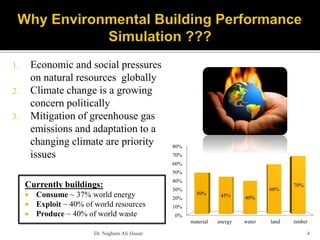
0%
10%
20%
30%
40%
50%
60%
70%
80%
material energy water land timber
50% 45% 40%
60%
70%Currently buildings:
 Consume ~ 37% world energy
 Exploit ~ 40% of world resources
 Produce ~ 40% of world waste
Dr. Nagham Ali Hasan 5
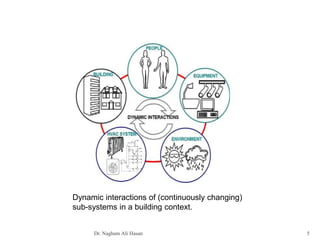
Dynamic interactions of (continuously changing)
sub-systems in a building context.
Dr. Nagham Ali Hasan 6
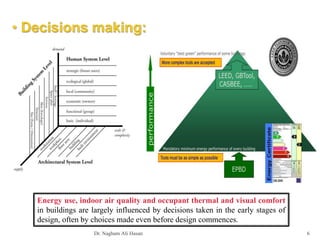
Energy use, indoor air quality and occupant thermal and visual comfort
in buildings are largely influenced by decisions taken in the early stages of
design, often by choices made even before design commences.
Purpose of a model is:
1. to enable the analyst to
predict the effect of
changes to the system.
2. a model should be a close
approximation to the real
system and incorporate
most of its salient
features.
A model is a representation of the construction and working of some system of
interest.
Dr. Nagham Ali Hasan 7
Fig: Designbuilder model interface
Modeling is one way of attaching metrics to
abstract policy and regulatory rhetoric. These
scenarios can augment team-based decision
making and business strategy formulation
Dr. Nagham Ali Hasan
8
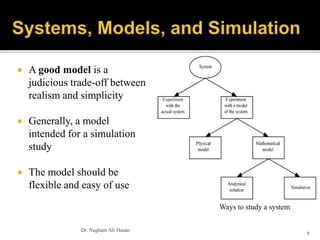
Ways to study a system
 A good model is a
judicious trade-off between
realism and simplicity
 Generally, a model
intended for a simulation
study
 The model should be
flexible and easy of use
Dr. Nagham Ali Hasan 9
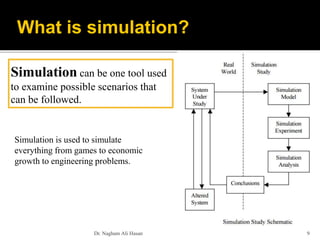
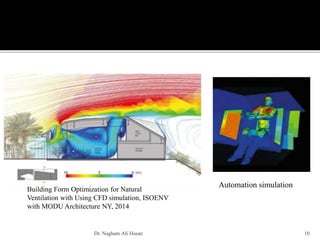
Simulation is used to simulate
everything from games to economic
growth to engineering problems.
Simulation can be one tool used
to examine possible scenarios that
can be followed.
What is simulation?
Building Form Optimization for Natural
Ventilation with Using CFD simulation, ISOENV
with MODU Architecture NY, 2014
Dr. Nagham Ali Hasan 10
Automation simulation
Dr. Nagham Ali Hasan 11
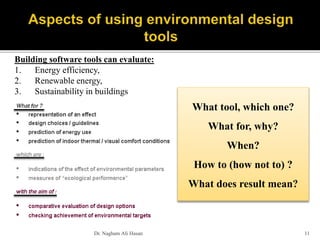
What tool, which one?
What for, why?
When?
How to (how not to) ?
What does result mean?
Building software tools can evaluate:
1. Energy efficiency,
2. Renewable energy,
3. Sustainability in buildings
Current use of performance simulation in
practical building design.
The actual
application is
generally
restricted to the
final phases in
building design
Dr. Nagham Ali Hasan
12
The application stages:
Dr. Nagham Ali Hasan 13
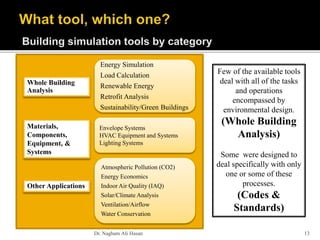
Energy Simulation
Load Calculation
Renewable Energy
Retrofit Analysis
Sustainability/Green Buildings
Envelope Systems
HVAC Equipment and Systems
Lighting Systems
Atmospheric Pollution (CO2)
Energy Economics
Indoor Air Quality (IAQ)
Solar/Climate Analysis
Ventilation/Airflow
Water Conservation
Whole Building
Analysis
Materials,
Components,
Equipment, &
Systems
Other Applications
Few of the available tools
deal with all of the tasks
and operations
encompassed by
environmental design.
(Whole Building
Analysis)
Some were designed to
deal specifically with only
one or some of these
processes.
(Codes &
Standards)
Dr. Nagham Ali Hasan 14
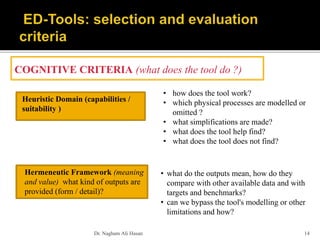
COGNITIVE CRITERIA (what does the tool do ?)
Heuristic Domain (capabilities /
suitability )
Hermeneutic Framework (meaning
and value) what kind of outputs are
provided (form / detail)?
• how does the tool work?
• which physical processes are modelled or
omitted ?
• what simplifications are made?
• what does the tool help find?
• what does the tool does not find?
• what do the outputs mean, how do they
compare with other available data and with
targets and benchmarks?
• can we bypass the tool's modelling or other
limitations and how?
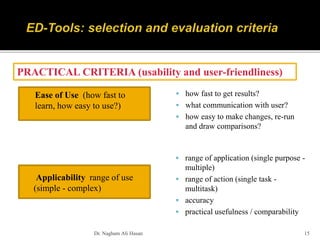
 Applicability range of use
(simple - complex)
Dr. Nagham Ali Hasan 15
PRACTICAL CRITERIA (usability and user-friendliness)
 Ease of Use (how fast to
learn, how easy to use?)
 how fast to get results?
 what communication with user?
 how easy to make changes, re-run
and draw comparisons?
 range of application (single purpose -
multiple)
 range of action (single task -
multitask)
 accuracy
 practical usefulness / comparability
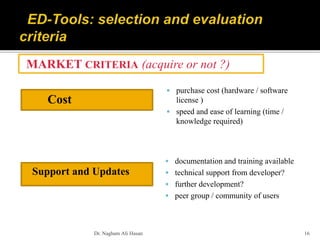
 documentation and training available
 technical support from developer?
 further development?
 peer group / community of users
Dr. Nagham Ali Hasan 16
MARKET CRITERIA (acquire or not ?)
 Cost
Support and Updates
 purchase cost (hardware / software
license )
 speed and ease of learning (time /
knowledge required)
Dr. Nagham Ali Hasan 17
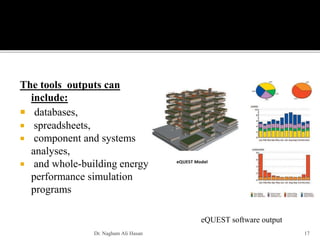
The tools outputs can
include:
 databases,
 spreadsheets,
 component and systems
analyses,
 and whole-building energy
performance simulation
programs
eQUEST software output
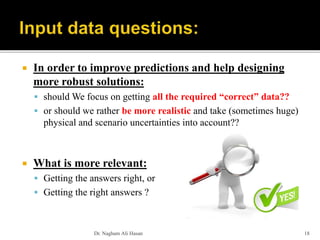
 In order to improve predictions and help designing
more robust solutions:
 should We focus on getting all the required “correct” data??
 or should we rather be more realistic and take (sometimes huge)
physical and scenario uncertainties into account??
 What is more relevant:
 Getting the answers right, or
 Getting the right answers ?
Dr. Nagham Ali Hasan 18
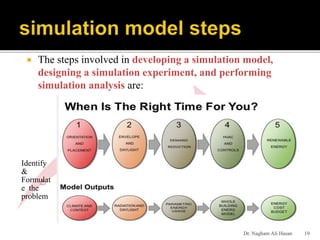
 The steps involved in developing a simulation model,
designing a simulation experiment, and performing
simulation analysis are:
Dr. Nagham Ali Hasan 19
Identify
&
Formulat
e the
problem
Collect and
process real
system data.
&develop the
model
Validate
the
model. Select appropriate
experimental
design
Perform
simulation
runs.
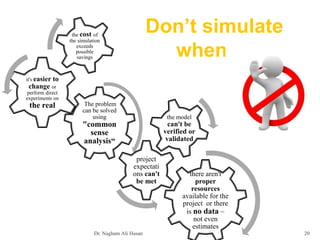
Dr. Nagham Ali Hasan 20
The problem
can be solved
using
"common
sense
analysis“
it's easier to
change or
perform direct
experiments on
the real
the cost of
the simulation
exceeds
possible
savings
there aren't
proper
resources
available for the
project or there
is no data –
not even
estimates
project
expectati
ons can't
be met
the model
can't be
verified or
validated
Don’t simulate
when …
What a future environment for building
system modeling and simulation may look
like???
Dr. Nagham Ali Hasan 21
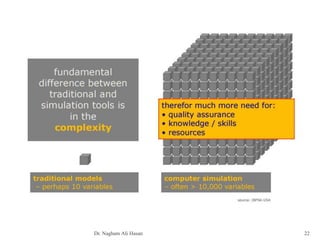
Dr. Nagham Ali Hasan 22
 The most widely used from among the tools that deal with thermal analysis
have become increasingly more designer-oriented aiming to address both
three-dimensional visualisation (and thus also studies of solar access and
shading design) and the processes of natural ventilation and solar gain that
are of critical importance in contemporary building design.
 With increasing computer power there has been a continuous trend of
integration and greater capability.
 Calculations that needed to be run overnight a few years ago are now
performed in a few minutes.
 Nevertheless, there is still discrepancy between designers' conception of
realism and accuracy and that possible by the application of most of the
current tools.
 Clearly users must have an understanding of the underlying structure and
theoretical basis of the tools they use
Dr. Nagham Ali Hasan 23
Dr. Nagham Ali Hasan
24

Environmental building design performance modelling and simulation

  • 1.
    Computational Design inArchitecture Prepared by: Dr. Nagham Ali Hassan PhD in environmental design, energy efficiency and renewable energy
  • 2.
     The needfor Environmental Building Software Tools  Aspects of using environmental design tools  ED-Tools: selection and evaluation criteria  How to select the best simulation software?  What a future environment for building system modeling and simulation may look like? Dr. Nagham Ali Hasan 2
  • 3.
     Spitler (2006)states that “simulation of building thermal performance using digital computers has been an active area of investigation since the 1960s, with much of the early work.  Over the last 20 years large and continuous increases in computational development of software tools that designed to help designers and environmental engineering consultants make such predictions. Dr. Nagham Ali Hasan 3
  • 4.
    1. Economic andsocial pressures on natural resources globally 2. Climate change is a growing concern politically 3. Mitigation of greenhouse gas emissions and adaptation to a changing climate are priority issues Dr. Nagham Ali Hasan 4 0% 10% 20% 30% 40% 50% 60% 70% 80% material energy water land timber 50% 45% 40% 60% 70%Currently buildings:  Consume ~ 37% world energy  Exploit ~ 40% of world resources  Produce ~ 40% of world waste
  • 5.
    Dr. Nagham AliHasan 5 Dynamic interactions of (continuously changing) sub-systems in a building context.
  • 6.
    Dr. Nagham AliHasan 6 Energy use, indoor air quality and occupant thermal and visual comfort in buildings are largely influenced by decisions taken in the early stages of design, often by choices made even before design commences.
  • 7.
    Purpose of amodel is: 1. to enable the analyst to predict the effect of changes to the system. 2. a model should be a close approximation to the real system and incorporate most of its salient features. A model is a representation of the construction and working of some system of interest. Dr. Nagham Ali Hasan 7 Fig: Designbuilder model interface Modeling is one way of attaching metrics to abstract policy and regulatory rhetoric. These scenarios can augment team-based decision making and business strategy formulation
  • 8.
    Dr. Nagham AliHasan 8 Ways to study a system  A good model is a judicious trade-off between realism and simplicity  Generally, a model intended for a simulation study  The model should be flexible and easy of use
  • 9.
    Dr. Nagham AliHasan 9 Simulation is used to simulate everything from games to economic growth to engineering problems. Simulation can be one tool used to examine possible scenarios that can be followed. What is simulation?
  • 10.
    Building Form Optimizationfor Natural Ventilation with Using CFD simulation, ISOENV with MODU Architecture NY, 2014 Dr. Nagham Ali Hasan 10 Automation simulation
  • 11.
    Dr. Nagham AliHasan 11 What tool, which one? What for, why? When? How to (how not to) ? What does result mean? Building software tools can evaluate: 1. Energy efficiency, 2. Renewable energy, 3. Sustainability in buildings
  • 12.
    Current use ofperformance simulation in practical building design. The actual application is generally restricted to the final phases in building design Dr. Nagham Ali Hasan 12 The application stages:
  • 13.
    Dr. Nagham AliHasan 13 Energy Simulation Load Calculation Renewable Energy Retrofit Analysis Sustainability/Green Buildings Envelope Systems HVAC Equipment and Systems Lighting Systems Atmospheric Pollution (CO2) Energy Economics Indoor Air Quality (IAQ) Solar/Climate Analysis Ventilation/Airflow Water Conservation Whole Building Analysis Materials, Components, Equipment, & Systems Other Applications Few of the available tools deal with all of the tasks and operations encompassed by environmental design. (Whole Building Analysis) Some were designed to deal specifically with only one or some of these processes. (Codes & Standards)
  • 14.
    Dr. Nagham AliHasan 14 COGNITIVE CRITERIA (what does the tool do ?) Heuristic Domain (capabilities / suitability ) Hermeneutic Framework (meaning and value) what kind of outputs are provided (form / detail)? • how does the tool work? • which physical processes are modelled or omitted ? • what simplifications are made? • what does the tool help find? • what does the tool does not find? • what do the outputs mean, how do they compare with other available data and with targets and benchmarks? • can we bypass the tool's modelling or other limitations and how?
  • 15.
     Applicability rangeof use (simple - complex) Dr. Nagham Ali Hasan 15 PRACTICAL CRITERIA (usability and user-friendliness)  Ease of Use (how fast to learn, how easy to use?)  how fast to get results?  what communication with user?  how easy to make changes, re-run and draw comparisons?  range of application (single purpose - multiple)  range of action (single task - multitask)  accuracy  practical usefulness / comparability
  • 16.
     documentation andtraining available  technical support from developer?  further development?  peer group / community of users Dr. Nagham Ali Hasan 16 MARKET CRITERIA (acquire or not ?)  Cost Support and Updates  purchase cost (hardware / software license )  speed and ease of learning (time / knowledge required)
  • 17.
    Dr. Nagham AliHasan 17 The tools outputs can include:  databases,  spreadsheets,  component and systems analyses,  and whole-building energy performance simulation programs eQUEST software output
  • 18.
     In orderto improve predictions and help designing more robust solutions:  should We focus on getting all the required “correct” data??  or should we rather be more realistic and take (sometimes huge) physical and scenario uncertainties into account??  What is more relevant:  Getting the answers right, or  Getting the right answers ? Dr. Nagham Ali Hasan 18
  • 19.
     The stepsinvolved in developing a simulation model, designing a simulation experiment, and performing simulation analysis are: Dr. Nagham Ali Hasan 19 Identify & Formulat e the problem Collect and process real system data. &develop the model Validate the model. Select appropriate experimental design Perform simulation runs.
  • 20.
    Dr. Nagham AliHasan 20 The problem can be solved using "common sense analysis“ it's easier to change or perform direct experiments on the real the cost of the simulation exceeds possible savings there aren't proper resources available for the project or there is no data – not even estimates project expectati ons can't be met the model can't be verified or validated Don’t simulate when …
  • 21.
    What a futureenvironment for building system modeling and simulation may look like??? Dr. Nagham Ali Hasan 21
  • 22.
  • 23.
     The mostwidely used from among the tools that deal with thermal analysis have become increasingly more designer-oriented aiming to address both three-dimensional visualisation (and thus also studies of solar access and shading design) and the processes of natural ventilation and solar gain that are of critical importance in contemporary building design.  With increasing computer power there has been a continuous trend of integration and greater capability.  Calculations that needed to be run overnight a few years ago are now performed in a few minutes.  Nevertheless, there is still discrepancy between designers' conception of realism and accuracy and that possible by the application of most of the current tools.  Clearly users must have an understanding of the underlying structure and theoretical basis of the tools they use Dr. Nagham Ali Hasan 23
  • 24.