Environment
•The surroundings or
conditions in which a
person, animal, or plant
lives or operates
•The natural world, as a
whole or in a particular
geographical area,
especially as affected
by human activity.
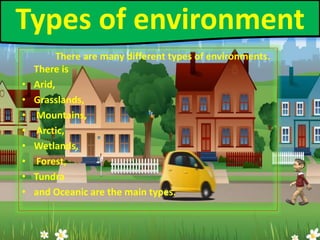
There are many different types of environments.
There is
• Arid,
• Grasslands,
• Mountains,
• Arctic,
• Wetlands,
• Forest,
• Tundra
• and Oceanic are the main types.
Types of environment
Impact On health
Impacts from Heat Waves
Impacts from Extreme Weather Events
Impacts from Reduced Air Quality
Impacts from Climate-Sensitive Diseases
Impact On behavior
Impact On Life
Impact on human Development
Environment Impact On Humans
The environment provide us food we
eat , air we breath , the water we
drink .
Food
We burn fuel to
heat our homes
Gasoline
We use fuel in our
vehicles.
Fuel
We use to build our
structure and devices.
Minerals
We wears and color
our perception of
theology and reality.
Clothes
when a certain amount of UV
rays penetrates the skin, it
helps the human body use
vitamin D to absorb the
calcium necessary for strong
bones.
Impact On Bones
• Pollution
• Reduced air
Quality(Anxity ,
lung problems)
• Necessary For Life(Oxygen)
• Certain Chemical 7 Bio
Chemical Reactions
Air Quality
• There are many different types of environmental
disease including:
• Lifestyle disease such as cardiovascular disease,
diseases caused by substance abuse such as
alcoholism, and smoking-related disease
• Disease caused by physical factors in the
environment, such as skin cancer caused by
excessive exposure to ultraviolet radiation in
sunlight
• Disease caused by exposure to chemicals in the
environment such as toxic metals
Types Of Environmental dieses
First, there are those caused by the ancient metals :
lead and mercury.
Then there are those caused by the other metals:
arsenic, phosphorus, and zinc.
The newer metals can also cause environmental
disease: beryllium, cadmium, chromium, manganese,
nickel, cobalt, osmium, platinum, selenium,
tellurium, thallium, uranium, and vanadium.
Categories of environmental disease
Ground-level ozone is formed when certain air pollutants, such as
carbon monoxide, oxides of nitrogen (also called NOX), and
volatile organic compounds, are exposed to each other in sunlight.
Ground-level ozone is one of the pollutants in smog.
Formation Of Ground level Ozone
• Changes in climate may enhance the spread of
some diseases.Disease-causing agents, called
pathogens, can be transmitted through food,
water, and animals such as deer, birds, mice,
and insects. Climate change could affect all of
these transmitters.
Impacts from Climate-Sensitive Diseases
Higher air temperatures can
increase cases of salmonella
and other bacteria-related food
poisoning because bacteria
grow more rapidly in warm
environments. These diseases
can cause gastrointestinal
distress and, in severe cases,
death.
The environment can create or reduce
stress, which in turn impacts our
bodies in multiple ways. This is
because our brain and our nervous,
endocrine, and immune systems are
constantly interacting. According to
neuroscientist , "What you are
thinking at any moment is changing
your biochemistry."
Stress
• Anxiety
• Flue ,Cough
• Foot Rod
• Sickness
• Eye Sight
• Cancer(colon ,breast
,lung, Brain. etc.)
• Asthma
• Respiratory Problems
• Heart Disease
• Immune System Damage
• Tuberculosis
Flue Virus
Environmental Disease
Through
Migration Of Pathogens
Disease
Malaria
Nile Virus
Flue
Sleeping Sickness
Diarrhea
Typhoid
Hepatitis
Skin Lesion
Cryptosporidium lodged in the lining of the intestine
Formations Of Disease
Resources
•Dead bodies
•Fesses
•Waste Material
•Sewerage Water
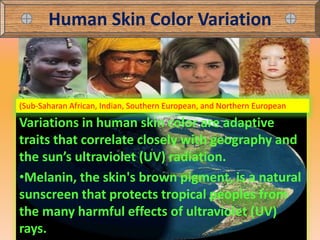
Variations in human skin color are adaptive
traits that correlate closely with geography and
the sun’s ultraviolet (UV) radiation.
•Melanin, the skin's brown pigment, is a natural
sunscreen that protects tropical peoples from
the many harmful effects of ultraviolet (UV)
rays.
(Sub-Saharan African, Indian, Southern European, and Northern European
Human Skin Color Variation
UV rays can, for
example, strip
away folic acid, a
nutrient
essential to the
development of
healthy fetuses.
Impact On Human Development
Behavior
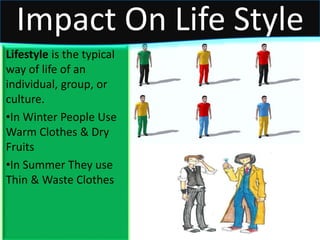
Lifestyle is the typical
way of life of an
individual, group, or
culture.
•In Winter People Use
Warm Clothes & Dry
Fruits
•In Summer They use
Thin & Waste Clothes
Impact On Life Style
•Danger To
Lung Tissue
•Asthma
•Chronic
Long tissues
Through Ozone
• Heat Stroke
• Dehydration
• Northern Latitude Ares & High Temperature
• Climate Condition will Likely To Extreme Weather
Conditions(Heavy Rain Causing Flooding)
Heat wave
Extreme Events
Negative Impact
• Volcanoes
• Earth Quick
• Flooding
• Tornadoes
• Heavy Rain fall
Positive Impact
• Formation Of New land
• New Valleys
• Fertile Ground
• Soil Exchange
• Source Of water
The geographic range of
ticks that carry Lyme disease
is limited by temperature. As
air temperatures rise, the
range of these ticks is likely
to continue to expand
northward. Typical
symptoms of Lyme
disease include fever,
headache, fatigue, and a
characteristic skin rash.
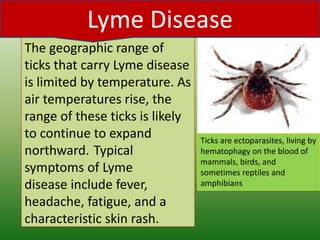
Ticks are ectoparasites, living by
hematophagy on the blood of
mammals, birds, and
sometimes reptiles and
amphibians
Lyme Disease

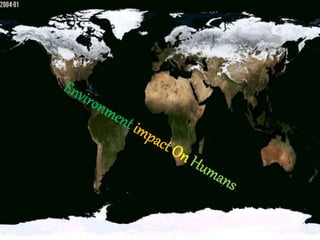
Environment impact on humans

  • 2.
    Environment •The surroundings or conditionsin which a person, animal, or plant lives or operates •The natural world, as a whole or in a particular geographical area, especially as affected by human activity.
  • 3.
    There are manydifferent types of environments. There is • Arid, • Grasslands, • Mountains, • Arctic, • Wetlands, • Forest, • Tundra • and Oceanic are the main types. Types of environment
  • 4.
    Impact On health Impactsfrom Heat Waves Impacts from Extreme Weather Events Impacts from Reduced Air Quality Impacts from Climate-Sensitive Diseases Impact On behavior Impact On Life Impact on human Development Environment Impact On Humans
  • 5.
    The environment provideus food we eat , air we breath , the water we drink . Food
  • 6.
    We burn fuelto heat our homes Gasoline We use fuel in our vehicles. Fuel
  • 7.
    We use tobuild our structure and devices. Minerals
  • 8.
    We wears andcolor our perception of theology and reality. Clothes
  • 9.
    when a certainamount of UV rays penetrates the skin, it helps the human body use vitamin D to absorb the calcium necessary for strong bones. Impact On Bones
  • 10.
    • Pollution • Reducedair Quality(Anxity , lung problems) • Necessary For Life(Oxygen) • Certain Chemical 7 Bio Chemical Reactions Air Quality
  • 11.
    • There aremany different types of environmental disease including: • Lifestyle disease such as cardiovascular disease, diseases caused by substance abuse such as alcoholism, and smoking-related disease • Disease caused by physical factors in the environment, such as skin cancer caused by excessive exposure to ultraviolet radiation in sunlight • Disease caused by exposure to chemicals in the environment such as toxic metals Types Of Environmental dieses
  • 12.
    First, there arethose caused by the ancient metals : lead and mercury. Then there are those caused by the other metals: arsenic, phosphorus, and zinc. The newer metals can also cause environmental disease: beryllium, cadmium, chromium, manganese, nickel, cobalt, osmium, platinum, selenium, tellurium, thallium, uranium, and vanadium. Categories of environmental disease
  • 13.
    Ground-level ozone isformed when certain air pollutants, such as carbon monoxide, oxides of nitrogen (also called NOX), and volatile organic compounds, are exposed to each other in sunlight. Ground-level ozone is one of the pollutants in smog. Formation Of Ground level Ozone
  • 14.
    • Changes inclimate may enhance the spread of some diseases.Disease-causing agents, called pathogens, can be transmitted through food, water, and animals such as deer, birds, mice, and insects. Climate change could affect all of these transmitters. Impacts from Climate-Sensitive Diseases
  • 15.
    Higher air temperaturescan increase cases of salmonella and other bacteria-related food poisoning because bacteria grow more rapidly in warm environments. These diseases can cause gastrointestinal distress and, in severe cases, death.
  • 16.
    The environment cancreate or reduce stress, which in turn impacts our bodies in multiple ways. This is because our brain and our nervous, endocrine, and immune systems are constantly interacting. According to neuroscientist , "What you are thinking at any moment is changing your biochemistry." Stress
  • 17.
    • Anxiety • Flue,Cough • Foot Rod • Sickness • Eye Sight • Cancer(colon ,breast ,lung, Brain. etc.) • Asthma • Respiratory Problems • Heart Disease • Immune System Damage • Tuberculosis Flue Virus Environmental Disease
  • 18.
    Through Migration Of Pathogens Disease Malaria NileVirus Flue Sleeping Sickness Diarrhea Typhoid Hepatitis Skin Lesion Cryptosporidium lodged in the lining of the intestine Formations Of Disease
  • 19.
  • 20.
    Variations in humanskin color are adaptive traits that correlate closely with geography and the sun’s ultraviolet (UV) radiation. •Melanin, the skin's brown pigment, is a natural sunscreen that protects tropical peoples from the many harmful effects of ultraviolet (UV) rays. (Sub-Saharan African, Indian, Southern European, and Northern European Human Skin Color Variation
  • 21.
    UV rays can,for example, strip away folic acid, a nutrient essential to the development of healthy fetuses. Impact On Human Development
  • 22.
  • 23.
    Lifestyle is thetypical way of life of an individual, group, or culture. •In Winter People Use Warm Clothes & Dry Fruits •In Summer They use Thin & Waste Clothes Impact On Life Style
  • 24.
  • 25.
    • Heat Stroke •Dehydration • Northern Latitude Ares & High Temperature • Climate Condition will Likely To Extreme Weather Conditions(Heavy Rain Causing Flooding) Heat wave
  • 26.
    Extreme Events Negative Impact •Volcanoes • Earth Quick • Flooding • Tornadoes • Heavy Rain fall Positive Impact • Formation Of New land • New Valleys • Fertile Ground • Soil Exchange • Source Of water
  • 27.
    The geographic rangeof ticks that carry Lyme disease is limited by temperature. As air temperatures rise, the range of these ticks is likely to continue to expand northward. Typical symptoms of Lyme disease include fever, headache, fatigue, and a characteristic skin rash. Ticks are ectoparasites, living by hematophagy on the blood of mammals, birds, and sometimes reptiles and amphibians Lyme Disease