The Envelope Theorem
• The envelope theorem concerns how the
optimal value for a particular function
changes when a parameter of the function
changes
• This is easiest to see by using an example
The Envelope Theorem
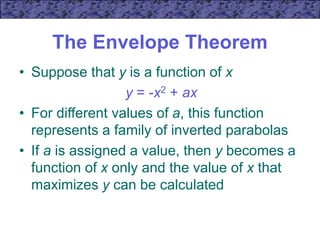
• Suppose that y is a function of x
y = -x2 + ax
• For different values of a, this function
represents a family of inverted parabolas
• If a is assigned a value, then y becomes a
function of x only and the value of x that
maximizes y can be calculated
The Envelope Theorem
Value of a Value of x* Value of y*
0 0 0
1 1/2 1/4
2 1 1
3 3/2 9/4
4 2 4
5 5/2 25/4
6 3 9
Optimal Values of x and y for alternative values of a
The Envelope Theorem
0
1
2
3
4
5
6
7
8
9
10
0 1 2 3 4 5 6 7
a
y*
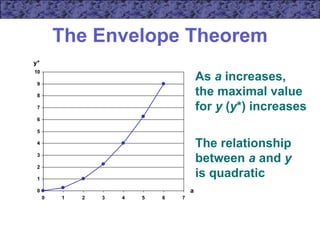
As a increases,
the maximal value
for y (y*) increases
The relationship
between a and y
is quadratic
The Envelope Theorem
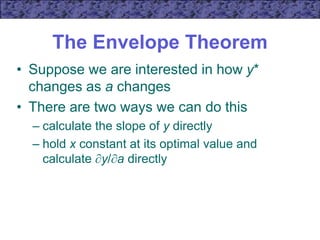
• Suppose we are interested in how y*
changes as a changes
• There are two ways we can do this
– calculate the slope of y directly
– hold x constant at its optimal value and
calculate y/a directly
The Envelope Theorem
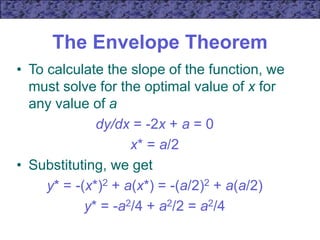
• To calculate the slope of the function, we
must solve for the optimal value of x for
any value of a
dy/dx = -2x + a = 0
x* = a/2
• Substituting, we get
y* = -(x*)2 + a(x*) = -(a/2)2 + a(a/2)
y* = -a2/4 + a2/2 = a2/4
The Envelope Theorem
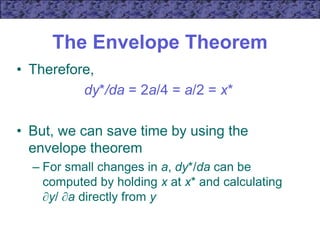
• Therefore,
dy*/da = 2a/4 = a/2 = x*
• But, we can save time by using the
envelope theorem
– For small changes in a, dy*/da can be
computed by holding x at x* and calculating
y/ a directly from y
The Envelope Theorem
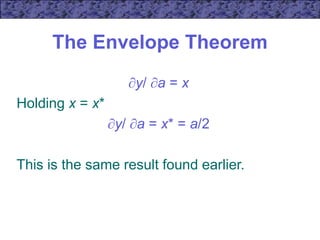
y/ a = x
Holding x = x*
y/ a = x* = a/2
This is the same result found earlier.
The Envelope Theorem
• The envelope theorem states that the
change in the optimal value of a function
with respect to a parameter of that function
can be found by partially differentiating the
objective function while holding x (or
several x’s) at its optimal value
)}
(
*
{
*
a
x
x
a
y
da
dy




The Envelope Theorem
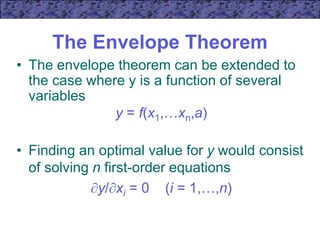
• The envelope theorem can be extended to
the case where y is a function of several
variables
y = f(x1,…xn,a)
• Finding an optimal value for y would consist
of solving n first-order equations
y/xi = 0 (i = 1,…,n)
The Envelope Theorem
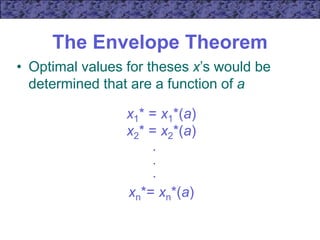
• Optimal values for theses x’s would be
determined that are a function of a
x1* = x1*(a)
x2* = x2*(a)
xn*= xn*(a)
.
.
.
The Envelope Theorem
• Substituting into the original objective
function yields an expression for the optimal
value of y (y*)
y* = f [x1*(a), x2*(a),…,xn*(a),a]
• Differentiating yields
a
f
da
dx
x
f
da
dx
x
f
da
dx
x
f
da
dy n
n 














 ...
* 2
2
1
1
The Envelope Theorem
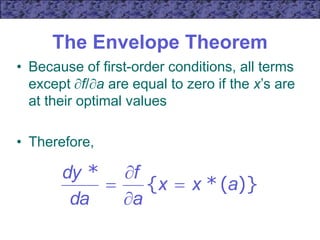
• Because of first-order conditions, all terms
except f/a are equal to zero if the x’s are
at their optimal values
• Therefore,
)}
(
*
{
*
a
x
x
a
f
da
dy





Envelope Theorem.s05.ppt

  • 1.
    The Envelope Theorem •The envelope theorem concerns how the optimal value for a particular function changes when a parameter of the function changes • This is easiest to see by using an example
  • 2.
    The Envelope Theorem •Suppose that y is a function of x y = -x2 + ax • For different values of a, this function represents a family of inverted parabolas • If a is assigned a value, then y becomes a function of x only and the value of x that maximizes y can be calculated
  • 3.
    The Envelope Theorem Valueof a Value of x* Value of y* 0 0 0 1 1/2 1/4 2 1 1 3 3/2 9/4 4 2 4 5 5/2 25/4 6 3 9 Optimal Values of x and y for alternative values of a
  • 4.
    The Envelope Theorem 0 1 2 3 4 5 6 7 8 9 10 01 2 3 4 5 6 7 a y* As a increases, the maximal value for y (y*) increases The relationship between a and y is quadratic
  • 5.
    The Envelope Theorem •Suppose we are interested in how y* changes as a changes • There are two ways we can do this – calculate the slope of y directly – hold x constant at its optimal value and calculate y/a directly
  • 6.
    The Envelope Theorem •To calculate the slope of the function, we must solve for the optimal value of x for any value of a dy/dx = -2x + a = 0 x* = a/2 • Substituting, we get y* = -(x*)2 + a(x*) = -(a/2)2 + a(a/2) y* = -a2/4 + a2/2 = a2/4
  • 7.
    The Envelope Theorem •Therefore, dy*/da = 2a/4 = a/2 = x* • But, we can save time by using the envelope theorem – For small changes in a, dy*/da can be computed by holding x at x* and calculating y/ a directly from y
  • 8.
    The Envelope Theorem y/a = x Holding x = x* y/ a = x* = a/2 This is the same result found earlier.
  • 9.
    The Envelope Theorem •The envelope theorem states that the change in the optimal value of a function with respect to a parameter of that function can be found by partially differentiating the objective function while holding x (or several x’s) at its optimal value )} ( * { * a x x a y da dy    
  • 10.
    The Envelope Theorem •The envelope theorem can be extended to the case where y is a function of several variables y = f(x1,…xn,a) • Finding an optimal value for y would consist of solving n first-order equations y/xi = 0 (i = 1,…,n)
  • 11.
    The Envelope Theorem •Optimal values for theses x’s would be determined that are a function of a x1* = x1*(a) x2* = x2*(a) xn*= xn*(a) . . .
  • 12.
    The Envelope Theorem •Substituting into the original objective function yields an expression for the optimal value of y (y*) y* = f [x1*(a), x2*(a),…,xn*(a),a] • Differentiating yields a f da dx x f da dx x f da dx x f da dy n n                 ... * 2 2 1 1
  • 13.
    The Envelope Theorem •Because of first-order conditions, all terms except f/a are equal to zero if the x’s are at their optimal values • Therefore, )} ( * { * a x x a f da dy    