What are we going to learn today?
1
 Biological Production and ecosystem energy flow
 Primary and secondary ecological successions
Lec 10; MrL
Biological Production and Ecosystem Energy Flow
2
 Ecosystem energy flow is the movement of
energy through an ecosystem from the external
environment through a series of organisms and back
to the external environment.
 Energy enters an ecosystem by two pathways:
 energy fixed by organisms and moving through food webs
within an ecosystem; and
 heat energy that is transferred by air or water currents or
by convection through soils and sediments and warms living
things. For instance, when a warm air mass passes over a
forest, heat energy is transferred from the air to the land and
to the organisms.
Lec 10; MrL
 Although most of the time energy is invisible to us, with infrared
film we can see the differences between warm and cold objects,
and we can see some things about energy flow that affect life.
With infrared film, warm objects appear red, and cool objects
blue.
FIGURE 5.10 Making energy visible. Top: A birch forest in New Hampshire as
we see it, using normal photographic film (a) and the same forest photographed
with infrared film (b). Red color means warmer temperatures; the leaves are
warmer than the surroundings because they are heated by sunlight.Lec 10; MrL
3
The Laws of Thermodynamics and the
Ultimate Limit on the Abundance of Life
4
 This seems to lead us to a confusing, contradictory
answer—it seems to say that we don’t need to take in
any energy at all! If the total amount of energy is
always conserved—if it remains constant—then why
can’t we just recycle energy inside our bodies?
states that “in any physical or chemical
change, energy is neither created nor
destroyed but merely changed from one
form to another”.
The first law of thermodynamics
Lec 10; MrL
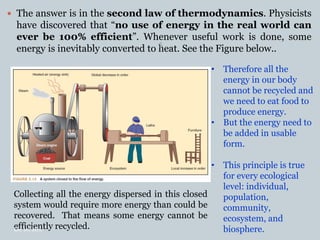
 The answer is in the second law of thermodynamics. Physicists
have discovered that “no use of energy in the real world can
ever be 100% efficient”. Whenever useful work is done, some
energy is inevitably converted to heat. See the Figure below..
• Therefore all the
energy in our body
cannot be recycled and
we need to eat food to
produce energy.
• But the energy need to
be added in usable
form.
• This principle is true
for every ecological
level: individual,
population,
community,
ecosystem, and
biosphere.
Collecting all the energy dispersed in this closed
system would require more energy than could be
recovered. That means some energy cannot be
efficiently recycled.Lec 10; MrL
5
Primary and secondary ecological successions
6
When disturbed, ecosystems can recover through ecological
succession if the damage is not too great.
Two types: primary or secondary
 Primary succession is the establishment and development of an
ecosystem where one did not exist previously.
 E.g., 1) forests that develop on new lava flows, like those released by
the volcano on the big island of Hawaii (Figure 5.14a),
 2) forests that develop at the edges of retreating glaciers (Figure
5.14b).
Lec 10; MrL
7
 Secondary succession is reestablishment of
an ecosystem after disturbances.
 In secondary succession, there are remnants of a
previous biological community, including such things
as organic matter and seeds.
 E.g., forests that develop after hurricanes, floods, or fires
Fig. SIDR in the
Sundarbans and
secondary succession
Lec 10; MrL
References for today’s lecture
BOTKIN, D. B. & KELLER, E.A. 2011.
ENVIRONMENTAL SCIENCE: EARTH AS A LIVING
PLANET (Eighth Edition). JOHN WILEY & SONS, INC.
8
Lec 10; MrL
ANY
QUESTION?
9
Lec 10; MrL
Env field trip
Lec 10; MrL
10
 7 November
 Committee
 Safika
 Tauhid
 Samin
 Mushfiq – Spondon
 Safari park
 Bank of Jumuna/resort
 Vairab, Meghna – a picnic spot
 BIRDS Comilla
 Eco Park, Dhaka
 BRAC CDM, Rajendrapur, Gazipur
 A picnic spot in Manikganj
 Nakhtra Bari

ENV 107 -Lectures 10

  • 1.
    What are wegoing to learn today? 1  Biological Production and ecosystem energy flow  Primary and secondary ecological successions Lec 10; MrL
  • 2.
    Biological Production andEcosystem Energy Flow 2  Ecosystem energy flow is the movement of energy through an ecosystem from the external environment through a series of organisms and back to the external environment.  Energy enters an ecosystem by two pathways:  energy fixed by organisms and moving through food webs within an ecosystem; and  heat energy that is transferred by air or water currents or by convection through soils and sediments and warms living things. For instance, when a warm air mass passes over a forest, heat energy is transferred from the air to the land and to the organisms. Lec 10; MrL
  • 3.
     Although mostof the time energy is invisible to us, with infrared film we can see the differences between warm and cold objects, and we can see some things about energy flow that affect life. With infrared film, warm objects appear red, and cool objects blue. FIGURE 5.10 Making energy visible. Top: A birch forest in New Hampshire as we see it, using normal photographic film (a) and the same forest photographed with infrared film (b). Red color means warmer temperatures; the leaves are warmer than the surroundings because they are heated by sunlight.Lec 10; MrL 3
  • 4.
    The Laws ofThermodynamics and the Ultimate Limit on the Abundance of Life 4  This seems to lead us to a confusing, contradictory answer—it seems to say that we don’t need to take in any energy at all! If the total amount of energy is always conserved—if it remains constant—then why can’t we just recycle energy inside our bodies? states that “in any physical or chemical change, energy is neither created nor destroyed but merely changed from one form to another”. The first law of thermodynamics Lec 10; MrL
  • 5.
     The answeris in the second law of thermodynamics. Physicists have discovered that “no use of energy in the real world can ever be 100% efficient”. Whenever useful work is done, some energy is inevitably converted to heat. See the Figure below.. • Therefore all the energy in our body cannot be recycled and we need to eat food to produce energy. • But the energy need to be added in usable form. • This principle is true for every ecological level: individual, population, community, ecosystem, and biosphere. Collecting all the energy dispersed in this closed system would require more energy than could be recovered. That means some energy cannot be efficiently recycled.Lec 10; MrL 5
  • 6.
    Primary and secondaryecological successions 6 When disturbed, ecosystems can recover through ecological succession if the damage is not too great. Two types: primary or secondary  Primary succession is the establishment and development of an ecosystem where one did not exist previously.  E.g., 1) forests that develop on new lava flows, like those released by the volcano on the big island of Hawaii (Figure 5.14a),  2) forests that develop at the edges of retreating glaciers (Figure 5.14b). Lec 10; MrL
  • 7.
    7  Secondary successionis reestablishment of an ecosystem after disturbances.  In secondary succession, there are remnants of a previous biological community, including such things as organic matter and seeds.  E.g., forests that develop after hurricanes, floods, or fires Fig. SIDR in the Sundarbans and secondary succession Lec 10; MrL
  • 8.
    References for today’slecture BOTKIN, D. B. & KELLER, E.A. 2011. ENVIRONMENTAL SCIENCE: EARTH AS A LIVING PLANET (Eighth Edition). JOHN WILEY & SONS, INC. 8 Lec 10; MrL
  • 9.
  • 10.
    Env field trip Lec10; MrL 10  7 November  Committee  Safika  Tauhid  Samin  Mushfiq – Spondon  Safari park  Bank of Jumuna/resort  Vairab, Meghna – a picnic spot  BIRDS Comilla  Eco Park, Dhaka  BRAC CDM, Rajendrapur, Gazipur  A picnic spot in Manikganj  Nakhtra Bari

Editor's Notes

  • #6 To understand why we cannot recycle energy, imagine a closed system (a system that receives no input after the initial input) containing a pile of coal, a tank of water, air, a steam engine, and an engineer (Figure 5.13). Suppose the engine runs a lathe that makes furniture. The engineer lights a fire to boil the water, creating steam to run the engine. As the engine runs, the heat from the fire gradually warms the entire system. When all the coal is completely burned, the engineer will not be able to boil any more water, and the engine will stop. The average temperature of the system is now higher than the starting temperature. The energy that was in the coal is dispersed throughout the entire system, much of it as heat in the air. That’s Why the engineer can’t recover all that energy, recompact it, put it under the boiler, and run the engine.