Enumeration of 2-level polytopes
Vissarion Fisikopoulos
Computer Science Department, Algorithms Group
ACA Kalamata 2015
Enumeration of 2-level polytopes (to appear in ESA’15)
Joint work with:
Adam Bohn (now in Tailand)
Yuri Faenza (now at EPFL)
Samuel Fiorini (ULB)
Marco Macchia (ULB)
Kanstantsin Pashkovich (now at Waterloo)
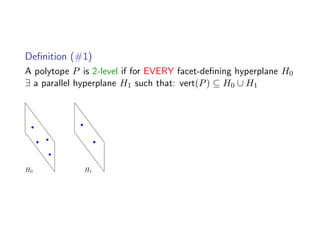
Definition (#1)
A polytope P is 2-level if for EVERY facet-defining hyperplane H0
∃ a parallel hyperplane H1 such that: vert(P) ⊆ H0 ∪ H1
H0 H1
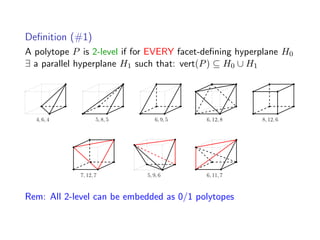
Definition (#1)
A polytope P is 2-level if for EVERY facet-defining hyperplane H0
∃ a parallel hyperplane H1 such that: vert(P) ⊆ H0 ∪ H1
4, 6, 4 5, 8, 5 6, 9, 5 6, 12, 8 8, 12, 6
7, 12, 7 5, 9, 6 6, 11, 7
Rem: All 2-level can be embedded as 0/1 polytopes
Definition
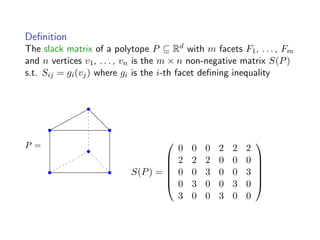
The slack matrix of a polytope P ⊆ Rd with m facets F1, . . . , Fm
and n vertices v1, . . . , vn is the m × n non-negative matrix S(P)
s.t. Sij = gi(vj) where gi is the i-th facet defining inequality
P =
S(P) =






0 0 0 2 2 2
2 2 2 0 0 0
0 0 3 0 0 3
0 3 0 0 3 0
3 0 0 3 0 0






Definition (#2)
A polytope P is 2-level iff its slack matrix is 0/1 (perhaps after
scaling some facets)
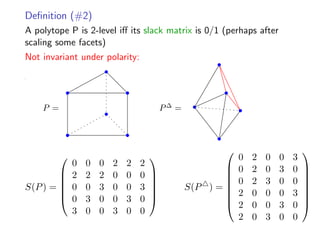
Definition (#2)
A polytope P is 2-level iff its slack matrix is 0/1 (perhaps after
scaling some facets)
Not invariant under polarity:
P = P∆
=
S(P) =






0 0 0 2 2 2
2 2 2 0 0 0
0 0 3 0 0 3
0 3 0 0 3 0
3 0 0 3 0 0






S(P ) =








0 2 0 0 3
0 2 0 3 0
0 2 3 0 0
2 0 0 0 3
2 0 0 3 0
2 0 3 0 0








Examples of 2-level polytopes
Birkhoff polytopes := convhull of permutation matrices
Order polytopes := convhull of characteristic vectors of all
partial orders of a set
Hanner polytopes := iterated products / free sums of
segments
Stable set polytope STAB(G) with G perfect graph
Hansen polytopes := twisted prisms over STAB(G), G perfect
{x ∈ [0, 1]d | Ax = b} where A is totally unimodular and b
integer
General properties of 2-level polytopes (2LPs)
A d-dim 2LP has at most 2d vertices and facets [GPT ’10]
Every face of a 2LP is a 2LP
General properties of 2-level polytopes (2LPs)
A d-dim 2LP has at most 2d vertices and facets [GPT ’10]
Every face of a 2LP is a 2LP
The combinatorial type of a 2LP determines its affine type
A 2LP has a simple vertex iff it is STAB(G), G perfect
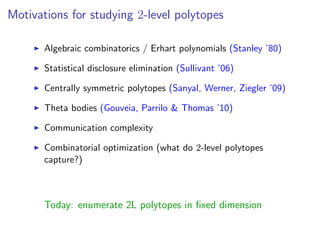
Motivations for studying 2-level polytopes
Algebraic combinatorics / Erhart polynomials (Stanley ’80)
Statistical disclosure elimination (Sullivant ’06)
Centrally symmetric polytopes (Sanyal, Werner, Ziegler ’09)
Theta bodies (Gouveia, Parrilo & Thomas ’10)
Communication complexity
Combinatorial optimization (what do 2-level polytopes
capture?)
Motivations for studying 2-level polytopes
Algebraic combinatorics / Erhart polynomials (Stanley ’80)
Statistical disclosure elimination (Sullivant ’06)
Centrally symmetric polytopes (Sanyal, Werner, Ziegler ’09)
Theta bodies (Gouveia, Parrilo & Thomas ’10)
Communication complexity
Combinatorial optimization (what do 2-level polytopes
capture?)
Today: enumerate 2L polytopes in fixed dimension
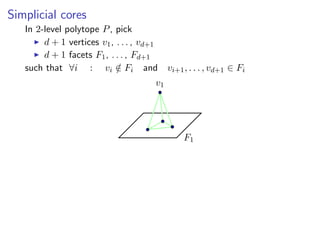
Simplicial cores
In 2-level polytope P, pick
d + 1 vertices v1, . . . , vd+1
d + 1 facets F1, . . . , Fd+1
such that ∀i : vi /∈ Fi and vi+1, . . . , vd+1 ∈ Fi
v1
F1
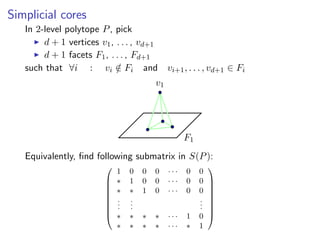
Simplicial cores
In 2-level polytope P, pick
d + 1 vertices v1, . . . , vd+1
d + 1 facets F1, . . . , Fd+1
such that ∀i : vi /∈ Fi and vi+1, . . . , vd+1 ∈ Fi
v1
F1
Equivalently, find following submatrix in S(P):









1 0 0 0 · · · 0 0
∗ 1 0 0 · · · 0 0
∗ ∗ 1 0 · · · 0 0
...
...
...
∗ ∗ ∗ ∗ · · · 1 0
∗ ∗ ∗ ∗ · · · ∗ 1









H-embedding or 0/1 facets









1 0 0 0 · · · 0 0
∗ 1 0 0 · · · 0 0
∗ ∗ 1 0 · · · 0 0
.
.
.
.
.
.
.
.
.
∗ ∗ ∗ ∗ · · · 1 0
∗ ∗ ∗ ∗ · · · ∗ 1









= M
Lemma
For 2L P an H-embedding has 0/1 facets:
P = {x ∈ Rd
| ∀E ∈ E : 0
i∈E
xi 1}
for some E with subsets of [d] and vert(P) ⊆ M−1{0, 1}d ⊆ Zd
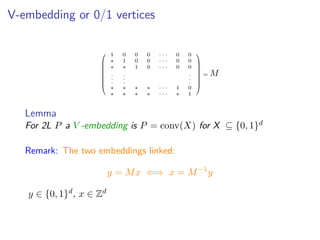
V-embedding or 0/1 vertices









1 0 0 0 · · · 0 0
∗ 1 0 0 · · · 0 0
∗ ∗ 1 0 · · · 0 0
.
.
.
.
.
.
.
.
.
∗ ∗ ∗ ∗ · · · 1 0
∗ ∗ ∗ ∗ · · · ∗ 1









= M
Lemma
For 2L P a V -embedding is P = conv(X) for X ⊆ {0, 1}d
Remark: The two embeddings linked:
y = Mx ⇐⇒ x = M−1
y
y ∈ {0, 1}d, x ∈ Zd
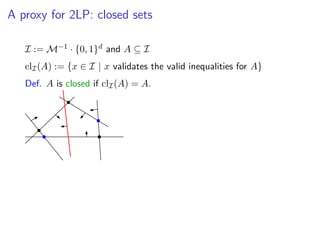
A proxy for 2LP: closed sets
I := M−1 · {0, 1}d and A ⊆ I
clI(A) := {x ∈ I | x validates the valid inequalities for A}
Def. A is closed if clI(A) = A.
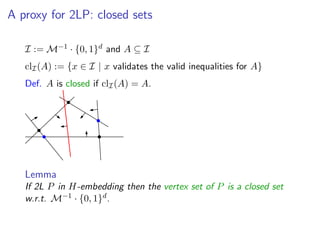
A proxy for 2LP: closed sets
I := M−1 · {0, 1}d and A ⊆ I
clI(A) := {x ∈ I | x validates the valid inequalities for A}
Def. A is closed if clI(A) = A.
Lemma
If 2L P in H-embedding then the vertex set of P is a closed set
w.r.t. M−1 · {0, 1}d.
The enumeration algorithm
Input: List Ld−1 of d − 1-dim 2L polytopes & simplicial cores
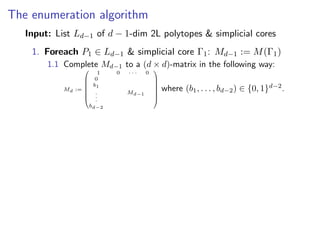
The enumeration algorithm
Input: List Ld−1 of d − 1-dim 2L polytopes & simplicial cores
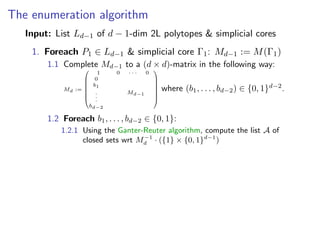
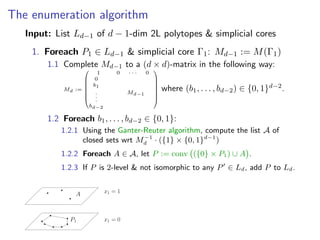
1. Foreach P1 ∈ Ld−1 & simplicial core Γ1: Md−1 := M(Γ1)
1.1 Complete Md−1 to a (d × d)-matrix in the following way:
Md :=








1 0 · · · 0
0
b1
.
.
.
bd−2
Md−1








where (b1, . . . , bd−2) ∈ {0, 1}d−2
.
The enumeration algorithm
Input: List Ld−1 of d − 1-dim 2L polytopes & simplicial cores
1. Foreach P1 ∈ Ld−1 & simplicial core Γ1: Md−1 := M(Γ1)
1.1 Complete Md−1 to a (d × d)-matrix in the following way:
Md :=








1 0 · · · 0
0
b1
.
.
.
bd−2
Md−1








where (b1, . . . , bd−2) ∈ {0, 1}d−2
.
1.2 Foreach b1, . . . , bd−2 ∈ {0, 1}:
1.2.1 Using the Ganter-Reuter algorithm, compute the list A of
closed sets wrt M−1
d · ({1} × {0, 1}d−1
)
The enumeration algorithm
Input: List Ld−1 of d − 1-dim 2L polytopes & simplicial cores
1. Foreach P1 ∈ Ld−1 & simplicial core Γ1: Md−1 := M(Γ1)
1.1 Complete Md−1 to a (d × d)-matrix in the following way:
Md :=








1 0 · · · 0
0
b1
.
.
.
bd−2
Md−1








where (b1, . . . , bd−2) ∈ {0, 1}d−2
.
1.2 Foreach b1, . . . , bd−2 ∈ {0, 1}:
1.2.1 Using the Ganter-Reuter algorithm, compute the list A of
closed sets wrt M−1
d · ({1} × {0, 1}d−1
)
1.2.2 Foreach A ∈ A, let P := conv ({0} × P1) ∪ A .
1.2.3 If P is 2-level & not isomorphic to any P ∈ Ld, add P to Ld.
P1 x1 = 0
x1 = 1A
Experimental results
d 2L ∆-f STAB polar CS Birk 0/1 closed sets
3 5 4 4 4 2 4 8 19
4 19 12 11 12 4 11 192 277
5 106 41 33 42 13 33 ∼ 106
10963
6 1150 248 148 276 45 129 ∼ 1.8 · 1019
∼ 1.9 · 106
7 - - - - 238 661 - -
Combinatorially equivalent 0/1 polytopes and 2L polytopes
∆-f: with on simplicial facet
STAB: stable sets polytopes of perfect graphs
polar: 2-level polytopes whose polar is 2-level
CS: centrally symmetric
Birk: Birkhoff polytope faces [Paffenholz13]
’-’: exact numbers are unknown.
Statistics: facets vs vertices
0
10
20
30
40
50
60
70
0 10 20 30 40 50 60 70
facets
vertices
2-level
centrally-symmetric
f(x) = 64*12/x
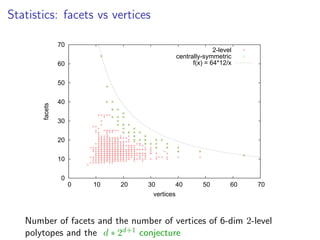
Number of facets and the number of vertices of 6-dim 2-level
polytopes and the d ∗ 2d+1 conjecture
Statistics: number of 2L
0
20
40
60
80
100
120
0 10 20 30 40 50 60 70 80
2Lpolytopes
vertices
no simplicial facet
one simplicial facet
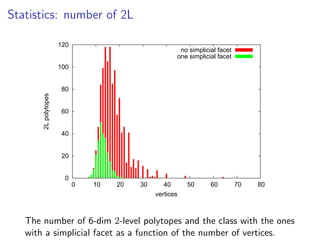
The number of 6-dim 2-level polytopes and the class with the ones
with a simplicial facet as a function of the number of vertices.
Open questions
Output-sensitive enumeration algorithm for 2L polytopes
(Hint: better proxy)
g(d) := #(d-dimensional 2L polytopes, up to isomorphism)
Is g(d) = 2poly(d)?
Known: g(d) 2Ω(d2) (e.g., STAB(G) with G bipartite)
Open questions
Output-sensitive enumeration algorithm for 2L polytopes
(Hint: better proxy)
g(d) := #(d-dimensional 2L polytopes, up to isomorphism)
Is g(d) = 2poly(d)?
Known: g(d) 2Ω(d2) (e.g., STAB(G) with G bipartite)
THANK YOU!

Enumeration of 2-level polytopes

  • 1.
    Enumeration of 2-levelpolytopes Vissarion Fisikopoulos Computer Science Department, Algorithms Group ACA Kalamata 2015
  • 2.
    Enumeration of 2-levelpolytopes (to appear in ESA’15) Joint work with: Adam Bohn (now in Tailand) Yuri Faenza (now at EPFL) Samuel Fiorini (ULB) Marco Macchia (ULB) Kanstantsin Pashkovich (now at Waterloo)
  • 3.
    Definition (#1) A polytopeP is 2-level if for EVERY facet-defining hyperplane H0 ∃ a parallel hyperplane H1 such that: vert(P) ⊆ H0 ∪ H1 H0 H1
  • 4.
    Definition (#1) A polytopeP is 2-level if for EVERY facet-defining hyperplane H0 ∃ a parallel hyperplane H1 such that: vert(P) ⊆ H0 ∪ H1 4, 6, 4 5, 8, 5 6, 9, 5 6, 12, 8 8, 12, 6 7, 12, 7 5, 9, 6 6, 11, 7 Rem: All 2-level can be embedded as 0/1 polytopes
  • 5.
    Definition The slack matrixof a polytope P ⊆ Rd with m facets F1, . . . , Fm and n vertices v1, . . . , vn is the m × n non-negative matrix S(P) s.t. Sij = gi(vj) where gi is the i-th facet defining inequality P = S(P) =       0 0 0 2 2 2 2 2 2 0 0 0 0 0 3 0 0 3 0 3 0 0 3 0 3 0 0 3 0 0      
  • 6.
    Definition (#2) A polytopeP is 2-level iff its slack matrix is 0/1 (perhaps after scaling some facets)
  • 7.
    Definition (#2) A polytopeP is 2-level iff its slack matrix is 0/1 (perhaps after scaling some facets) Not invariant under polarity: P = P∆ = S(P) =       0 0 0 2 2 2 2 2 2 0 0 0 0 0 3 0 0 3 0 3 0 0 3 0 3 0 0 3 0 0       S(P ) =         0 2 0 0 3 0 2 0 3 0 0 2 3 0 0 2 0 0 0 3 2 0 0 3 0 2 0 3 0 0        
  • 8.
    Examples of 2-levelpolytopes Birkhoff polytopes := convhull of permutation matrices Order polytopes := convhull of characteristic vectors of all partial orders of a set Hanner polytopes := iterated products / free sums of segments Stable set polytope STAB(G) with G perfect graph Hansen polytopes := twisted prisms over STAB(G), G perfect {x ∈ [0, 1]d | Ax = b} where A is totally unimodular and b integer
  • 9.
    General properties of2-level polytopes (2LPs) A d-dim 2LP has at most 2d vertices and facets [GPT ’10] Every face of a 2LP is a 2LP
  • 10.
    General properties of2-level polytopes (2LPs) A d-dim 2LP has at most 2d vertices and facets [GPT ’10] Every face of a 2LP is a 2LP The combinatorial type of a 2LP determines its affine type A 2LP has a simple vertex iff it is STAB(G), G perfect
  • 11.
    Motivations for studying2-level polytopes Algebraic combinatorics / Erhart polynomials (Stanley ’80) Statistical disclosure elimination (Sullivant ’06) Centrally symmetric polytopes (Sanyal, Werner, Ziegler ’09) Theta bodies (Gouveia, Parrilo & Thomas ’10) Communication complexity Combinatorial optimization (what do 2-level polytopes capture?)
  • 12.
    Motivations for studying2-level polytopes Algebraic combinatorics / Erhart polynomials (Stanley ’80) Statistical disclosure elimination (Sullivant ’06) Centrally symmetric polytopes (Sanyal, Werner, Ziegler ’09) Theta bodies (Gouveia, Parrilo & Thomas ’10) Communication complexity Combinatorial optimization (what do 2-level polytopes capture?) Today: enumerate 2L polytopes in fixed dimension
  • 13.
    Simplicial cores In 2-levelpolytope P, pick d + 1 vertices v1, . . . , vd+1 d + 1 facets F1, . . . , Fd+1 such that ∀i : vi /∈ Fi and vi+1, . . . , vd+1 ∈ Fi v1 F1
  • 14.
    Simplicial cores In 2-levelpolytope P, pick d + 1 vertices v1, . . . , vd+1 d + 1 facets F1, . . . , Fd+1 such that ∀i : vi /∈ Fi and vi+1, . . . , vd+1 ∈ Fi v1 F1 Equivalently, find following submatrix in S(P):          1 0 0 0 · · · 0 0 ∗ 1 0 0 · · · 0 0 ∗ ∗ 1 0 · · · 0 0 ... ... ... ∗ ∗ ∗ ∗ · · · 1 0 ∗ ∗ ∗ ∗ · · · ∗ 1         
  • 15.
    H-embedding or 0/1facets          1 0 0 0 · · · 0 0 ∗ 1 0 0 · · · 0 0 ∗ ∗ 1 0 · · · 0 0 . . . . . . . . . ∗ ∗ ∗ ∗ · · · 1 0 ∗ ∗ ∗ ∗ · · · ∗ 1          = M Lemma For 2L P an H-embedding has 0/1 facets: P = {x ∈ Rd | ∀E ∈ E : 0 i∈E xi 1} for some E with subsets of [d] and vert(P) ⊆ M−1{0, 1}d ⊆ Zd
  • 16.
    V-embedding or 0/1vertices          1 0 0 0 · · · 0 0 ∗ 1 0 0 · · · 0 0 ∗ ∗ 1 0 · · · 0 0 . . . . . . . . . ∗ ∗ ∗ ∗ · · · 1 0 ∗ ∗ ∗ ∗ · · · ∗ 1          = M Lemma For 2L P a V -embedding is P = conv(X) for X ⊆ {0, 1}d Remark: The two embeddings linked: y = Mx ⇐⇒ x = M−1 y y ∈ {0, 1}d, x ∈ Zd
  • 17.
    A proxy for2LP: closed sets I := M−1 · {0, 1}d and A ⊆ I clI(A) := {x ∈ I | x validates the valid inequalities for A} Def. A is closed if clI(A) = A.
  • 18.
    A proxy for2LP: closed sets I := M−1 · {0, 1}d and A ⊆ I clI(A) := {x ∈ I | x validates the valid inequalities for A} Def. A is closed if clI(A) = A. Lemma If 2L P in H-embedding then the vertex set of P is a closed set w.r.t. M−1 · {0, 1}d.
  • 19.
    The enumeration algorithm Input:List Ld−1 of d − 1-dim 2L polytopes & simplicial cores
  • 20.
    The enumeration algorithm Input:List Ld−1 of d − 1-dim 2L polytopes & simplicial cores 1. Foreach P1 ∈ Ld−1 & simplicial core Γ1: Md−1 := M(Γ1) 1.1 Complete Md−1 to a (d × d)-matrix in the following way: Md :=         1 0 · · · 0 0 b1 . . . bd−2 Md−1         where (b1, . . . , bd−2) ∈ {0, 1}d−2 .
  • 21.
    The enumeration algorithm Input:List Ld−1 of d − 1-dim 2L polytopes & simplicial cores 1. Foreach P1 ∈ Ld−1 & simplicial core Γ1: Md−1 := M(Γ1) 1.1 Complete Md−1 to a (d × d)-matrix in the following way: Md :=         1 0 · · · 0 0 b1 . . . bd−2 Md−1         where (b1, . . . , bd−2) ∈ {0, 1}d−2 . 1.2 Foreach b1, . . . , bd−2 ∈ {0, 1}: 1.2.1 Using the Ganter-Reuter algorithm, compute the list A of closed sets wrt M−1 d · ({1} × {0, 1}d−1 )
  • 22.
    The enumeration algorithm Input:List Ld−1 of d − 1-dim 2L polytopes & simplicial cores 1. Foreach P1 ∈ Ld−1 & simplicial core Γ1: Md−1 := M(Γ1) 1.1 Complete Md−1 to a (d × d)-matrix in the following way: Md :=         1 0 · · · 0 0 b1 . . . bd−2 Md−1         where (b1, . . . , bd−2) ∈ {0, 1}d−2 . 1.2 Foreach b1, . . . , bd−2 ∈ {0, 1}: 1.2.1 Using the Ganter-Reuter algorithm, compute the list A of closed sets wrt M−1 d · ({1} × {0, 1}d−1 ) 1.2.2 Foreach A ∈ A, let P := conv ({0} × P1) ∪ A . 1.2.3 If P is 2-level & not isomorphic to any P ∈ Ld, add P to Ld. P1 x1 = 0 x1 = 1A
  • 23.
    Experimental results d 2L∆-f STAB polar CS Birk 0/1 closed sets 3 5 4 4 4 2 4 8 19 4 19 12 11 12 4 11 192 277 5 106 41 33 42 13 33 ∼ 106 10963 6 1150 248 148 276 45 129 ∼ 1.8 · 1019 ∼ 1.9 · 106 7 - - - - 238 661 - - Combinatorially equivalent 0/1 polytopes and 2L polytopes ∆-f: with on simplicial facet STAB: stable sets polytopes of perfect graphs polar: 2-level polytopes whose polar is 2-level CS: centrally symmetric Birk: Birkhoff polytope faces [Paffenholz13] ’-’: exact numbers are unknown.
  • 24.
    Statistics: facets vsvertices 0 10 20 30 40 50 60 70 0 10 20 30 40 50 60 70 facets vertices 2-level centrally-symmetric f(x) = 64*12/x Number of facets and the number of vertices of 6-dim 2-level polytopes and the d ∗ 2d+1 conjecture
  • 25.
    Statistics: number of2L 0 20 40 60 80 100 120 0 10 20 30 40 50 60 70 80 2Lpolytopes vertices no simplicial facet one simplicial facet The number of 6-dim 2-level polytopes and the class with the ones with a simplicial facet as a function of the number of vertices.
  • 26.
    Open questions Output-sensitive enumerationalgorithm for 2L polytopes (Hint: better proxy) g(d) := #(d-dimensional 2L polytopes, up to isomorphism) Is g(d) = 2poly(d)? Known: g(d) 2Ω(d2) (e.g., STAB(G) with G bipartite)
  • 27.
    Open questions Output-sensitive enumerationalgorithm for 2L polytopes (Hint: better proxy) g(d) := #(d-dimensional 2L polytopes, up to isomorphism) Is g(d) = 2poly(d)? Known: g(d) 2Ω(d2) (e.g., STAB(G) with G bipartite) THANK YOU!