Introduction to MySQL Spatial
Features and Real-World Use Cases
Vissarion Fisikopoulos
Friday 21 November 2025
Outline
A brief histoy of GIS in MySQL
Spatial Reference Systems
Spatial data types and functions
Storage and indexing
Examples and use cases
Outline
A brief histoy of GIS in MySQL
Spatial Reference Systems
Spatial data types and functions
Storage and indexing
Examples and use cases
History of MySQL GIS
Milestones
• MySQL ≤ 5.6: Basic functions, homegrown algorithms
• MySQL 5.7: ”Reboot”, Boost Geometry, standard compiant
(OGC, SQL/MM), only cartesian
• MySQL 8.0: Spatial reference systems
Boost Geometry as a MySQL geometry engine
• Part of Boost C++ libraries
• Open source; supported by a small but vibrant community
• All (heavy) geometric computations are done at Boost
Geometry side
• Separation between geometry and database internals
• Generic design; works with MySQL data types; no conversions!
Build-in GIS support
• No plugin, works out of the box
• Fully integrated with other MySQL functionality
• Data dictionary tables
• INFORMATION SCHEMA views (spatial metadata)
• GeoJSON parsed by general JSON parser
Alternatives to MySQL Spatial
PostgreSQL + PostGIS
• OGC and SQL/MM standards
• Extensive function set: topology, raster, routing, 3D,
geography
• Advanced indexing and optimizer integration
SQLite + SpatiaLite
• Supports most OGC functions and coordinate systems
• Supported by QGIS
Microsoft SQL Server/ Oracle spatial
• Feature rich
• Optimized and standard compliant
• Closed source, limited flexibility
Outline
A brief histoy of GIS in MySQL
Spatial Reference Systems
Spatial data types and functions
Storage and indexing
Examples and use cases
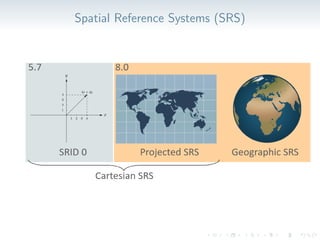
Spatial Reference Systems (SRS)
Spatial Reference Systems
Basic properties
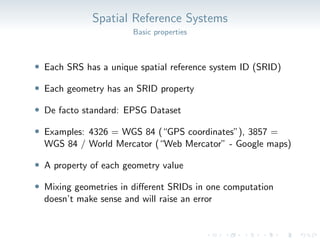
• Each SRS has a unique spatial reference system ID (SRID)
• Each geometry has an SRID property
• De facto standard: EPSG Dataset
• Examples: 4326 = WGS 84 (“GPS coordinates”), 3857 =
WGS 84 / World Mercator (“Web Mercator” - Google maps)
• A property of each geometry value
• Mixing geometries in different SRIDs in one computation
doesn’t make sense and will raise an error
Spatial Reference Systems
Current status
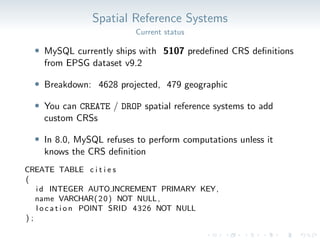
• MySQL currently ships with 5107 predefined CRS definitions
from EPSG dataset v9.2
• Breakdown: 4628 projected, 479 geographic
• You can CREATE / DROP spatial reference systems to add
custom CRSs
• In 8.0, MySQL refuses to perform computations unless it
knows the CRS definition
CREATE TABLE c i t i e s
(
i d INTEGER AUTO INCREMENT PRIMARY KEY,
name VARCHAR(20) NOT NULL,
l o c a t i o n POINT SRID 4326 NOT NULL
) ;
Outline
A brief histoy of GIS in MySQL
Spatial Reference Systems
Spatial data types and functions
Storage and indexing
Examples and use cases
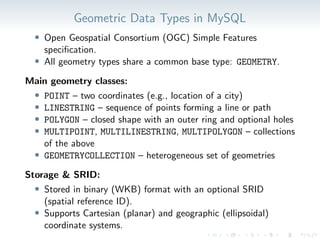
Geometric Data Types in MySQL
• Open Geospatial Consortium (OGC) Simple Features
specification.
• All geometry types share a common base type: GEOMETRY.
Main geometry classes:
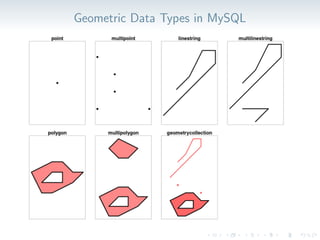
• POINT – two coordinates (e.g., location of a city)
• LINESTRING – sequence of points forming a line or path
• POLYGON – closed shape with an outer ring and optional holes
• MULTIPOINT, MULTILINESTRING, MULTIPOLYGON – collections
of the above
• GEOMETRYCOLLECTION – heterogeneous set of geometries
Storage & SRID:
• Stored in binary (WKB) format with an optional SRID
(spatial reference ID).
• Supports Cartesian (planar) and geographic (ellipsoidal)
coordinate systems.
Geometric Data Types in MySQL
Spatial Functions in MySQL
Categories of spatial functions
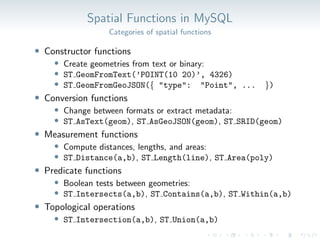
• Constructor functions
• Create geometries from text or binary:
• ST GeomFromText(’POINT(10 20)’, 4326)
• ST GeomFromGeoJSON({ "type": "Point", ... })
• Conversion functions
• Change between formats or extract metadata:
• ST AsText(geom), ST AsGeoJSON(geom), ST SRID(geom)
• Measurement functions
• Compute distances, lengths, and areas:
• ST Distance(a,b), ST Length(line), ST Area(poly)
• Predicate functions
• Boolean tests between geometries:
• ST Intersects(a,b), ST Contains(a,b), ST Within(a,b)
• Topological operations
• ST Intersection(a,b), ST Union(a,b)
Spatial Functions in MySQL
Coordinate-aware behavior
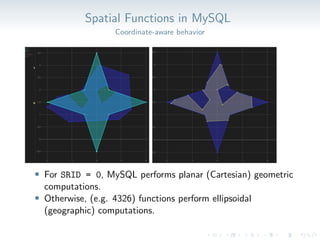
• For SRID = 0, MySQL performs planar (Cartesian) geometric
computations.
• Otherwise, (e.g. 4326) functions perform ellipsoidal
(geographic) computations.
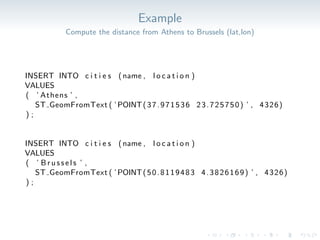
Example
Compute the distance from Athens to Brussels (lat,lon)
INSERT INTO c i t i e s (name , l o c a t i o n )
VALUES
( ’ Athens ’ ,
ST GeomFromText ( ’POINT(37.971536 23.725750) ’ , 4326)
) ;
INSERT INTO c i t i e s (name , l o c a t i o n )
VALUES
( ’ Brussels ’ ,
ST GeomFromText ( ’POINT(50.8119483 4.3826169) ’ , 4326)
) ;
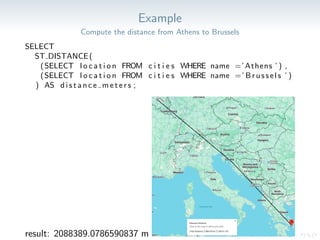
Example
Compute the distance from Athens to Brussels
SELECT
ST DISTANCE(
(SELECT l o c a t i o n FROM c i t i e s WHERE name =’Athens ’ ) ,
(SELECT l o c a t i o n FROM c i t i e s WHERE name =’ Brussels ’ )
) AS d i s t a n c e m e t e r s ;
result: 2088389.0786590837 m
Outline
A brief histoy of GIS in MySQL
Spatial Reference Systems
Spatial data types and functions
Storage and indexing
Examples and use cases
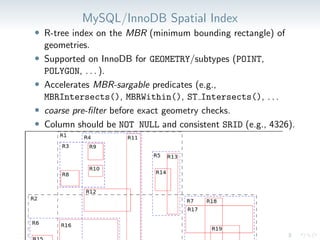
MySQL/InnoDB Spatial Index
• R-tree index on the MBR (minimum bounding rectangle) of
geometries.
• Supported on InnoDB for GEOMETRY/subtypes (POINT,
POLYGON, . . . ).
• Accelerates MBR-sargable predicates (e.g.,
MBRIntersects(), MBRWithin(), ST Intersects(), . . .
• coarse pre-filter before exact geometry checks.
• Column should be NOT NULL and consistent SRID (e.g., 4326).
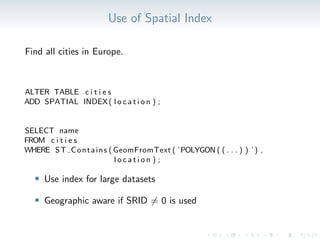
Use of Spatial Index
Find all cities in Europe.
ALTER TABLE c i t i e s
ADD SPATIAL INDEX( l o c a t i o n ) ;
SELECT name
FROM c i t i e s
WHERE ST Contains ( GeomFromText ( ’POLYGON ( ( . . . ) ) ’) ,
l o c a t i o n ) ;
• Use index for large datasets
• Geographic aware if SRID ̸= 0 is used
Outline
A brief histoy of GIS in MySQL
Spatial Reference Systems
Spatial data types and functions
Storage and indexing
Examples and use cases
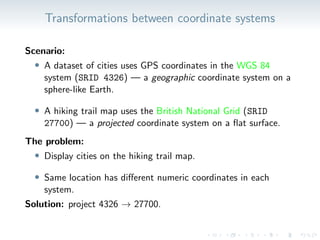
Transformations between coordinate systems
Scenario:
• A dataset of cities uses GPS coordinates in the WGS 84
system (SRID 4326) — a geographic coordinate system on a
sphere-like Earth.
• A hiking trail map uses the British National Grid (SRID
27700) — a projected coordinate system on a flat surface.
The problem:
• Display cities on the hiking trail map.
• Same location has different numeric coordinates in each
system.
Solution: project 4326 → 27700.
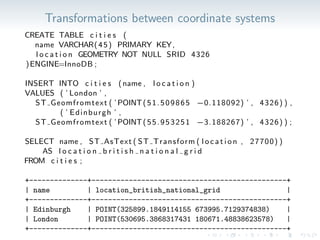
Transformations between coordinate systems
CREATE TABLE c i t i e s (
name VARCHAR(45) PRIMARY KEY,
l o c a t i o n GEOMETRY NOT NULL SRID 4326
)ENGINE=InnoDB ;
INSERT INTO c i t i e s (name , l o c a t i o n )
VALUES ( ’ London ’ ,
ST Geomfromtext ( ’POINT(51.509865 −0.118092) ’ , 4326) ) ,
( ’ Edinburgh ’ ,
ST Geomfromtext ( ’POINT(55.953251 −3.188267) ’ , 4326) ) ;
SELECT name , ST AsText ( ST Transform ( l o c a t i o n , 27700) )
AS l o c a t i o n b r i t i s h n a t i o n a l g r i d
FROM c i t i e s ;
+--------------+-----------------------------------------------+
| name | location_british_national_grid |
+--------------+-----------------------------------------------+
| Edinburgh | POINT(325899.1849114155 673995.7129374838) |
| London | POINT(530695.3868317431 180671.48838623578) |
+--------------+-----------------------------------------------+
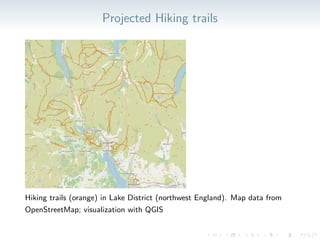
Projected Hiking trails
Hiking trails (orange) in Lake District (northwest England). Map data from
OpenStreetMap; visualization with QGIS
Analysing trajectories
Scenario:
• A dataset of trajectories representing movements of walkers in
a park.
The problem:
• Given a query trajectory return the set of the most similar
trajectories.
Solution: Use trajectory similarity functions like frechet distance
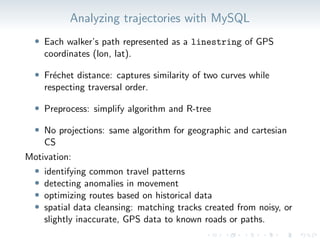
Analyzing trajectories with MySQL
• Each walker’s path represented as a linestring of GPS
coordinates (lon, lat).
• Fréchet distance: captures similarity of two curves while
respecting traversal order.
• Preprocess: simplify algorithm and R-tree
• No projections: same algorithm for geographic and cartesian
CS
Motivation:
• identifying common travel patterns
• detecting anomalies in movement
• optimizing routes based on historical data
• spatial data cleansing: matching tracks created from noisy, or
slightly inaccurate, GPS data to known roads or paths.
Walkers’ trajectories example
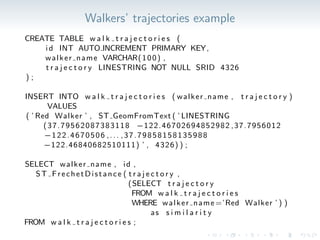
CREATE TABLE w a l k t r a j e c t o r i e s (
i d INT AUTO INCREMENT PRIMARY KEY,
walker name VARCHAR(100) ,
t r a j e c t o r y LINESTRING NOT NULL SRID 4326
) ;
INSERT INTO w a l k t r a j e c t o r i e s ( walker name , t r a j e c t o r y )
VALUES
( ’ Red Walker ’ , ST GeomFromText ( ’ LINESTRING
(37.79562087383118 −122.46702694852982 ,37.7956012
−122.4670506 ,... ,37.79858158135988
−122.46840682510111) ’ , 4326) ) ;
SELECT walker name , id ,
ST FrechetDistance ( t r a j e c t o r y ,
(SELECT t r a j e c t o r y
FROM w a l k t r a j e c t o r i e s
WHERE walker name =’Red Walker ’ ) )
as s i m i l a r i t y
FROM w a l k t r a j e c t o r i e s ;
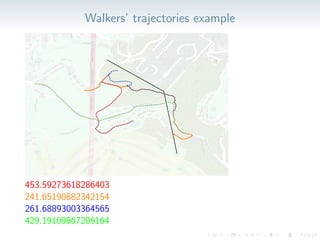
Walkers’ trajectories example
453.59273618286403
241.65190882342154
261.68893003364565
429.19109867209164
Resources
• MySQL source code:
• MySQL documentation:
• MySQL spatial blogs:
Thank you — Questions?

Introduction to MySQL Spatial Features and Real-World Use Cases

  • 1.
    Introduction to MySQLSpatial Features and Real-World Use Cases Vissarion Fisikopoulos Friday 21 November 2025
  • 2.
    Outline A brief histoyof GIS in MySQL Spatial Reference Systems Spatial data types and functions Storage and indexing Examples and use cases
  • 3.
    Outline A brief histoyof GIS in MySQL Spatial Reference Systems Spatial data types and functions Storage and indexing Examples and use cases
  • 4.
    History of MySQLGIS Milestones • MySQL ≤ 5.6: Basic functions, homegrown algorithms • MySQL 5.7: ”Reboot”, Boost Geometry, standard compiant (OGC, SQL/MM), only cartesian • MySQL 8.0: Spatial reference systems
  • 5.
    Boost Geometry asa MySQL geometry engine • Part of Boost C++ libraries • Open source; supported by a small but vibrant community • All (heavy) geometric computations are done at Boost Geometry side • Separation between geometry and database internals • Generic design; works with MySQL data types; no conversions!
  • 6.
    Build-in GIS support •No plugin, works out of the box • Fully integrated with other MySQL functionality • Data dictionary tables • INFORMATION SCHEMA views (spatial metadata) • GeoJSON parsed by general JSON parser
  • 7.
    Alternatives to MySQLSpatial PostgreSQL + PostGIS • OGC and SQL/MM standards • Extensive function set: topology, raster, routing, 3D, geography • Advanced indexing and optimizer integration SQLite + SpatiaLite • Supports most OGC functions and coordinate systems • Supported by QGIS Microsoft SQL Server/ Oracle spatial • Feature rich • Optimized and standard compliant • Closed source, limited flexibility
  • 8.
    Outline A brief histoyof GIS in MySQL Spatial Reference Systems Spatial data types and functions Storage and indexing Examples and use cases
  • 9.
  • 10.
    Spatial Reference Systems Basicproperties • Each SRS has a unique spatial reference system ID (SRID) • Each geometry has an SRID property • De facto standard: EPSG Dataset • Examples: 4326 = WGS 84 (“GPS coordinates”), 3857 = WGS 84 / World Mercator (“Web Mercator” - Google maps) • A property of each geometry value • Mixing geometries in different SRIDs in one computation doesn’t make sense and will raise an error
  • 11.
    Spatial Reference Systems Currentstatus • MySQL currently ships with 5107 predefined CRS definitions from EPSG dataset v9.2 • Breakdown: 4628 projected, 479 geographic • You can CREATE / DROP spatial reference systems to add custom CRSs • In 8.0, MySQL refuses to perform computations unless it knows the CRS definition CREATE TABLE c i t i e s ( i d INTEGER AUTO INCREMENT PRIMARY KEY, name VARCHAR(20) NOT NULL, l o c a t i o n POINT SRID 4326 NOT NULL ) ;
  • 12.
    Outline A brief histoyof GIS in MySQL Spatial Reference Systems Spatial data types and functions Storage and indexing Examples and use cases
  • 13.
    Geometric Data Typesin MySQL • Open Geospatial Consortium (OGC) Simple Features specification. • All geometry types share a common base type: GEOMETRY. Main geometry classes: • POINT – two coordinates (e.g., location of a city) • LINESTRING – sequence of points forming a line or path • POLYGON – closed shape with an outer ring and optional holes • MULTIPOINT, MULTILINESTRING, MULTIPOLYGON – collections of the above • GEOMETRYCOLLECTION – heterogeneous set of geometries Storage & SRID: • Stored in binary (WKB) format with an optional SRID (spatial reference ID). • Supports Cartesian (planar) and geographic (ellipsoidal) coordinate systems.
  • 14.
  • 15.
    Spatial Functions inMySQL Categories of spatial functions • Constructor functions • Create geometries from text or binary: • ST GeomFromText(’POINT(10 20)’, 4326) • ST GeomFromGeoJSON({ "type": "Point", ... }) • Conversion functions • Change between formats or extract metadata: • ST AsText(geom), ST AsGeoJSON(geom), ST SRID(geom) • Measurement functions • Compute distances, lengths, and areas: • ST Distance(a,b), ST Length(line), ST Area(poly) • Predicate functions • Boolean tests between geometries: • ST Intersects(a,b), ST Contains(a,b), ST Within(a,b) • Topological operations • ST Intersection(a,b), ST Union(a,b)
  • 16.
    Spatial Functions inMySQL Coordinate-aware behavior • For SRID = 0, MySQL performs planar (Cartesian) geometric computations. • Otherwise, (e.g. 4326) functions perform ellipsoidal (geographic) computations.
  • 17.
    Example Compute the distancefrom Athens to Brussels (lat,lon) INSERT INTO c i t i e s (name , l o c a t i o n ) VALUES ( ’ Athens ’ , ST GeomFromText ( ’POINT(37.971536 23.725750) ’ , 4326) ) ; INSERT INTO c i t i e s (name , l o c a t i o n ) VALUES ( ’ Brussels ’ , ST GeomFromText ( ’POINT(50.8119483 4.3826169) ’ , 4326) ) ;
  • 18.
    Example Compute the distancefrom Athens to Brussels SELECT ST DISTANCE( (SELECT l o c a t i o n FROM c i t i e s WHERE name =’Athens ’ ) , (SELECT l o c a t i o n FROM c i t i e s WHERE name =’ Brussels ’ ) ) AS d i s t a n c e m e t e r s ; result: 2088389.0786590837 m
  • 19.
    Outline A brief histoyof GIS in MySQL Spatial Reference Systems Spatial data types and functions Storage and indexing Examples and use cases
  • 20.
    MySQL/InnoDB Spatial Index •R-tree index on the MBR (minimum bounding rectangle) of geometries. • Supported on InnoDB for GEOMETRY/subtypes (POINT, POLYGON, . . . ). • Accelerates MBR-sargable predicates (e.g., MBRIntersects(), MBRWithin(), ST Intersects(), . . . • coarse pre-filter before exact geometry checks. • Column should be NOT NULL and consistent SRID (e.g., 4326).
  • 21.
    Use of SpatialIndex Find all cities in Europe. ALTER TABLE c i t i e s ADD SPATIAL INDEX( l o c a t i o n ) ; SELECT name FROM c i t i e s WHERE ST Contains ( GeomFromText ( ’POLYGON ( ( . . . ) ) ’) , l o c a t i o n ) ; • Use index for large datasets • Geographic aware if SRID ̸= 0 is used
  • 22.
    Outline A brief histoyof GIS in MySQL Spatial Reference Systems Spatial data types and functions Storage and indexing Examples and use cases
  • 23.
    Transformations between coordinatesystems Scenario: • A dataset of cities uses GPS coordinates in the WGS 84 system (SRID 4326) — a geographic coordinate system on a sphere-like Earth. • A hiking trail map uses the British National Grid (SRID 27700) — a projected coordinate system on a flat surface. The problem: • Display cities on the hiking trail map. • Same location has different numeric coordinates in each system. Solution: project 4326 → 27700.
  • 24.
    Transformations between coordinatesystems CREATE TABLE c i t i e s ( name VARCHAR(45) PRIMARY KEY, l o c a t i o n GEOMETRY NOT NULL SRID 4326 )ENGINE=InnoDB ; INSERT INTO c i t i e s (name , l o c a t i o n ) VALUES ( ’ London ’ , ST Geomfromtext ( ’POINT(51.509865 −0.118092) ’ , 4326) ) , ( ’ Edinburgh ’ , ST Geomfromtext ( ’POINT(55.953251 −3.188267) ’ , 4326) ) ; SELECT name , ST AsText ( ST Transform ( l o c a t i o n , 27700) ) AS l o c a t i o n b r i t i s h n a t i o n a l g r i d FROM c i t i e s ; +--------------+-----------------------------------------------+ | name | location_british_national_grid | +--------------+-----------------------------------------------+ | Edinburgh | POINT(325899.1849114155 673995.7129374838) | | London | POINT(530695.3868317431 180671.48838623578) | +--------------+-----------------------------------------------+
  • 25.
    Projected Hiking trails Hikingtrails (orange) in Lake District (northwest England). Map data from OpenStreetMap; visualization with QGIS
  • 26.
    Analysing trajectories Scenario: • Adataset of trajectories representing movements of walkers in a park. The problem: • Given a query trajectory return the set of the most similar trajectories. Solution: Use trajectory similarity functions like frechet distance
  • 27.
    Analyzing trajectories withMySQL • Each walker’s path represented as a linestring of GPS coordinates (lon, lat). • Fréchet distance: captures similarity of two curves while respecting traversal order. • Preprocess: simplify algorithm and R-tree • No projections: same algorithm for geographic and cartesian CS Motivation: • identifying common travel patterns • detecting anomalies in movement • optimizing routes based on historical data • spatial data cleansing: matching tracks created from noisy, or slightly inaccurate, GPS data to known roads or paths.
  • 28.
    Walkers’ trajectories example CREATETABLE w a l k t r a j e c t o r i e s ( i d INT AUTO INCREMENT PRIMARY KEY, walker name VARCHAR(100) , t r a j e c t o r y LINESTRING NOT NULL SRID 4326 ) ; INSERT INTO w a l k t r a j e c t o r i e s ( walker name , t r a j e c t o r y ) VALUES ( ’ Red Walker ’ , ST GeomFromText ( ’ LINESTRING (37.79562087383118 −122.46702694852982 ,37.7956012 −122.4670506 ,... ,37.79858158135988 −122.46840682510111) ’ , 4326) ) ; SELECT walker name , id , ST FrechetDistance ( t r a j e c t o r y , (SELECT t r a j e c t o r y FROM w a l k t r a j e c t o r i e s WHERE walker name =’Red Walker ’ ) ) as s i m i l a r i t y FROM w a l k t r a j e c t o r i e s ;
  • 29.
  • 30.
    Resources • MySQL sourcecode: • MySQL documentation: • MySQL spatial blogs: Thank you — Questions?