ORGANIZATIONAL PLAN DISCUSSION ON B a s e d  o n  t h e  P e r s p e c t I v e  o f  B a n g l a d e s h
S.M. Al-Amin BBA 027 07837 Arifur Rahman BBA 027 08076 Rizwana Chowdhury BBA 027 08094 Israt Ara Khan BBA 027 07393
An  Organizational Plan  is basically a “to do” list for an organization. It lists out the plan of work, programs, and organizational growth over a period of time - six months, a year or five. The tasks involved, who is responsible for them, and when they’ll be done. •  Set priorities for work •  Make sure tasks get done on time •  Focus on one thing at a time •  Share work among staff, board members & volunteers •  Make goals clear to investors •  Get a handle on big projects by breaking them down •  See the big picture of what organization is doing An Organizational Plan  Helps  To:
Management’s ability and commitment to the new venture are significant to investors. Investors demand that the management team not operate the business as part time venture. developing the  management  team management team to operate the business full time at a modest salary Drawing out large salaries for the management team is unacceptable to an Entrepreneur and considered to be a lack of psychological commitment to the business
basic  legal forms  are Proprietorship  form of business with single owner; unlimited liability; control over all decisions; receives all profits Legal forms of  Business Partnership  form of business with 2 or more individual with unlimited liability, pooling resources to own a business. Corporation  form of business with separate legal entity, run by stockholders having limited liability & regulated by statute
Factors  of the three forms of  Business Formation Amount of capital contribution is limit of shareholder’s liability In general partnership, individuals are liable for business liabilities. In Limited Partnership partners are liable for capital contribution Individual Liable for business Liability Liability of Owners No Limitation on number of stockholders No Limitation on Number of partners Individual Ownership Corporation Partnership Proprietorship Factors
Created only by statute, Articles of incorporation, filing fees, taxes, and fees for states in which corporation is registers to do business Partnership agreement, legal cost, and minor filing fees for trade name. Limited partnership requires more comprehensive agreement, hence higher cost Only Filing Fees for trade name Costs of Starting Business Corporation Partnership Proprietorship Factors
Greatest form of continuity. Death or withdrawal of owner(s) will not affect legal existence of business Death or withdrawal of one partner terminates partnership unless partnership agreement stipulates otherwise. In limited partnership death or withdrawal of one partner has no effect on continuity. Limited partners can withdraw capital six months after notice is provided Death dissolves the business Continuity of Business Corporation Partnership Proprietorship Factors
Stockholders can sell or buy stock at will. Stocks’ transfer may be restricted by agreement. In S corporation, stock may be transferred only to an individual General Partner can transfer his/her interest only with consent of all other general partners. Limited partner can sell interest without consent of general partners. Complete freedom to sell or transfer any part of business Transfer-ability of interest New Capital raised by sale of stock or bonds or by borrowing in name of Corp. In S Corp. only one class of stock & limited to 75 shareholders Loans or new contributions by partners require a change in partnership agreement Capital raised only by loan or increased contribution by proprietor. Capital Requirements Corporation Partnership Proprietorship Factors
With limited liability for owners, more attractive as an investment opportunity Depends on capability of partners and success of business Depends on capability of proprietor and success of business Attractive-ness for raising capital Majority stockholder(s) have most control from legal point of view. Day-to-day control in hands of management who may not be major stockholders. All partners have equal control and majority rules. In limited partnership, only the general partners control the business. Proprietor makes all decision and can act immediately Management Control Shareholders can share in profits by receipt of dividends Depends on partnership agreement and investment by partners. Proprietor responsible and receives all profits and losses Distribution of profits and losses Corporation Partnership Proprietorship Factors
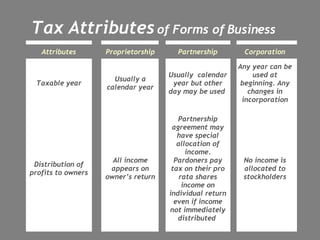
Tax Attributes  of Forms of Business No income is allocated to stockholders Partnership agreement may have special allocation of income. Pardoners pay tax on their pro rata shares income on individual return even if income not immediately distributed  All income appears on owner’s return Distribution of profits to owners Any year can be used at beginning. Any changes in incorporation Usually  calendar year but other day may be used  Usually a calendar year Taxable year Corporation Partnership Proprietorship Attributes
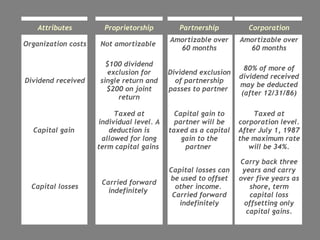
Carry back three years and carry over five years as shore, term capital loss offsetting only capital gains. Capital losses can be used to offset other income.  Carried forward indefinitely Carried forward indefinitely  Capital losses Taxed at corporation level. After July 1, 1987 the maximum rate will be 34%. Capital gain to partner will be taxed as a capital gain to the partner  Taxed at individual level. A deduction is allowed for long term capital gains  Capital gain  80% of more of dividend received may be deducted (after 12/31/86) Dividend exclusion of partnership passes to partner  $100 dividend exclusion for single return and $200 on joint return Dividend received Amortizable over 60 months Amortizable over 60 months Not amortizable  Organization costs Corporation Partnership Proprietorship Attributes
No losses allowed except on sale of stock or liquidation of corporation. Partnership investment plus share of resources liability if any. At risk rules may apply except for real estate partnership Amount of risk may be deducted except for real estate activities Limitations on losses deductible for real estate activities Acquisition of stock for cash entails no immediate taxes. Transfer if stock value greater than contributed property Contribution of property to a partnership not taxed Commencement of business results in no additional tax for individuals Initial organization Corporation Partnership Proprietorship Attributes
Cost of employee shareholder coverage deductible as business expense if designed for benefits of employee. Cost of partner’s benefit is not deductible to business as an expense. Possible deduction at partner level Itemized deduction for medical expense in excess of adjusted gross income on individual’s return. No deduction for insurance premium Medical Benefit Corporation Partnership Proprietorship Attributes
Limitations on benefits on benefits from defined plans-lesser of $ 90,000 or 100% of corporation. Limitation on contribution to defined  contribution plans-lesser of $ 30,000 or 25% of compensation ( 15% of  aggregate for profit-sharing plans) Same as for corporations Limitation and restrictions basically same as regular corporation Retirement benefits Corporation Partnership Proprietorship Attributes
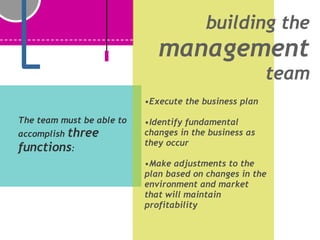
The team must be able to accomplish  three functions : Execute the business plan Identify fundamental changes in the business as they occur Make adjustments to the plan based on changes in the environment and market that will maintain profitability building the  management  team
Once  legal form of organization  is determined, the entrepreneur will need to prepare a  job description  and  job analysis.  building a successful  organizational culture  The  job analysis  will be serving as a guide in determining hiring procedures, training, performance appraisal, compensation program, and job description and specification.
Job description  Specify the details of the work that is to be performed and any special conditions or skill involved in performing the job. Job description should contain a job summary, skills or experience required, a summary of the responsibilities and duties the authority of the individual and standards of performance. building a successful  organizational culture  Job specification  outlines the skills and abilities needed to perform the job including prior experience. Outlining the job specification for a trained employee is easier than for the untrained people who will be trained on the job. So the entrepreneur should focus on specific qualities that will be required, such as personality, physical traits, interest, or sensory skill.
Reviewing operating and capital budgets Developing long-term strategic plans for growth and expansion role of the  Board of Directors  Supporting day to day activities  Resolving conflicts among owners or shareholders Ensuring the proper use of assets or Developing a network of information sources for the entrepreneurs
The member of  board members  should be carefully selected considering the following  criteria selecting  Board members Select individuals who can work with a diverse group and will commit to the venture mission Select candidates who understand the market environment or can contribute important skills to the new venture’s achievement of planning goals Select candidates who will show good judgment in business decision making
Board of  Advisors Loosely tied to the organizations Serve the venture in an advisory capacity Has no legal status Meet less frequently; depending on the important venture decision Useful in a family business Selection process similar to the BOD Compensated per meeting basis or with stock Provide reality check Uses  of Board of Advisors Formal part of a venture Outside advisors, such as lawyers, accountants, ad agencies, etc.
Summary
thank you

Organizational Plan

  • 1.
    ORGANIZATIONAL PLAN DISCUSSIONON B a s e d o n t h e P e r s p e c t I v e o f B a n g l a d e s h
  • 2.
    S.M. Al-Amin BBA027 07837 Arifur Rahman BBA 027 08076 Rizwana Chowdhury BBA 027 08094 Israt Ara Khan BBA 027 07393
  • 3.
    An OrganizationalPlan is basically a “to do” list for an organization. It lists out the plan of work, programs, and organizational growth over a period of time - six months, a year or five. The tasks involved, who is responsible for them, and when they’ll be done. • Set priorities for work • Make sure tasks get done on time • Focus on one thing at a time • Share work among staff, board members & volunteers • Make goals clear to investors • Get a handle on big projects by breaking them down • See the big picture of what organization is doing An Organizational Plan Helps To:
  • 4.
    Management’s ability andcommitment to the new venture are significant to investors. Investors demand that the management team not operate the business as part time venture. developing the management team management team to operate the business full time at a modest salary Drawing out large salaries for the management team is unacceptable to an Entrepreneur and considered to be a lack of psychological commitment to the business
  • 5.
    basic legalforms are Proprietorship form of business with single owner; unlimited liability; control over all decisions; receives all profits Legal forms of Business Partnership form of business with 2 or more individual with unlimited liability, pooling resources to own a business. Corporation form of business with separate legal entity, run by stockholders having limited liability & regulated by statute
  • 6.
    Factors ofthe three forms of Business Formation Amount of capital contribution is limit of shareholder’s liability In general partnership, individuals are liable for business liabilities. In Limited Partnership partners are liable for capital contribution Individual Liable for business Liability Liability of Owners No Limitation on number of stockholders No Limitation on Number of partners Individual Ownership Corporation Partnership Proprietorship Factors
  • 7.
    Created only bystatute, Articles of incorporation, filing fees, taxes, and fees for states in which corporation is registers to do business Partnership agreement, legal cost, and minor filing fees for trade name. Limited partnership requires more comprehensive agreement, hence higher cost Only Filing Fees for trade name Costs of Starting Business Corporation Partnership Proprietorship Factors
  • 8.
    Greatest form ofcontinuity. Death or withdrawal of owner(s) will not affect legal existence of business Death or withdrawal of one partner terminates partnership unless partnership agreement stipulates otherwise. In limited partnership death or withdrawal of one partner has no effect on continuity. Limited partners can withdraw capital six months after notice is provided Death dissolves the business Continuity of Business Corporation Partnership Proprietorship Factors
  • 9.
    Stockholders can sellor buy stock at will. Stocks’ transfer may be restricted by agreement. In S corporation, stock may be transferred only to an individual General Partner can transfer his/her interest only with consent of all other general partners. Limited partner can sell interest without consent of general partners. Complete freedom to sell or transfer any part of business Transfer-ability of interest New Capital raised by sale of stock or bonds or by borrowing in name of Corp. In S Corp. only one class of stock & limited to 75 shareholders Loans or new contributions by partners require a change in partnership agreement Capital raised only by loan or increased contribution by proprietor. Capital Requirements Corporation Partnership Proprietorship Factors
  • 10.
    With limited liabilityfor owners, more attractive as an investment opportunity Depends on capability of partners and success of business Depends on capability of proprietor and success of business Attractive-ness for raising capital Majority stockholder(s) have most control from legal point of view. Day-to-day control in hands of management who may not be major stockholders. All partners have equal control and majority rules. In limited partnership, only the general partners control the business. Proprietor makes all decision and can act immediately Management Control Shareholders can share in profits by receipt of dividends Depends on partnership agreement and investment by partners. Proprietor responsible and receives all profits and losses Distribution of profits and losses Corporation Partnership Proprietorship Factors
  • 11.
    Tax Attributes of Forms of Business No income is allocated to stockholders Partnership agreement may have special allocation of income. Pardoners pay tax on their pro rata shares income on individual return even if income not immediately distributed All income appears on owner’s return Distribution of profits to owners Any year can be used at beginning. Any changes in incorporation Usually calendar year but other day may be used Usually a calendar year Taxable year Corporation Partnership Proprietorship Attributes
  • 12.
    Carry back threeyears and carry over five years as shore, term capital loss offsetting only capital gains. Capital losses can be used to offset other income. Carried forward indefinitely Carried forward indefinitely Capital losses Taxed at corporation level. After July 1, 1987 the maximum rate will be 34%. Capital gain to partner will be taxed as a capital gain to the partner Taxed at individual level. A deduction is allowed for long term capital gains Capital gain 80% of more of dividend received may be deducted (after 12/31/86) Dividend exclusion of partnership passes to partner $100 dividend exclusion for single return and $200 on joint return Dividend received Amortizable over 60 months Amortizable over 60 months Not amortizable Organization costs Corporation Partnership Proprietorship Attributes
  • 13.
    No losses allowedexcept on sale of stock or liquidation of corporation. Partnership investment plus share of resources liability if any. At risk rules may apply except for real estate partnership Amount of risk may be deducted except for real estate activities Limitations on losses deductible for real estate activities Acquisition of stock for cash entails no immediate taxes. Transfer if stock value greater than contributed property Contribution of property to a partnership not taxed Commencement of business results in no additional tax for individuals Initial organization Corporation Partnership Proprietorship Attributes
  • 14.
    Cost of employeeshareholder coverage deductible as business expense if designed for benefits of employee. Cost of partner’s benefit is not deductible to business as an expense. Possible deduction at partner level Itemized deduction for medical expense in excess of adjusted gross income on individual’s return. No deduction for insurance premium Medical Benefit Corporation Partnership Proprietorship Attributes
  • 15.
    Limitations on benefitson benefits from defined plans-lesser of $ 90,000 or 100% of corporation. Limitation on contribution to defined contribution plans-lesser of $ 30,000 or 25% of compensation ( 15% of aggregate for profit-sharing plans) Same as for corporations Limitation and restrictions basically same as regular corporation Retirement benefits Corporation Partnership Proprietorship Attributes
  • 16.
    The team mustbe able to accomplish three functions : Execute the business plan Identify fundamental changes in the business as they occur Make adjustments to the plan based on changes in the environment and market that will maintain profitability building the management team
  • 17.
    Once legalform of organization is determined, the entrepreneur will need to prepare a job description and job analysis. building a successful organizational culture The job analysis will be serving as a guide in determining hiring procedures, training, performance appraisal, compensation program, and job description and specification.
  • 18.
    Job description Specify the details of the work that is to be performed and any special conditions or skill involved in performing the job. Job description should contain a job summary, skills or experience required, a summary of the responsibilities and duties the authority of the individual and standards of performance. building a successful organizational culture Job specification outlines the skills and abilities needed to perform the job including prior experience. Outlining the job specification for a trained employee is easier than for the untrained people who will be trained on the job. So the entrepreneur should focus on specific qualities that will be required, such as personality, physical traits, interest, or sensory skill.
  • 19.
    Reviewing operating andcapital budgets Developing long-term strategic plans for growth and expansion role of the Board of Directors Supporting day to day activities Resolving conflicts among owners or shareholders Ensuring the proper use of assets or Developing a network of information sources for the entrepreneurs
  • 20.
    The member of board members should be carefully selected considering the following criteria selecting Board members Select individuals who can work with a diverse group and will commit to the venture mission Select candidates who understand the market environment or can contribute important skills to the new venture’s achievement of planning goals Select candidates who will show good judgment in business decision making
  • 21.
    Board of Advisors Loosely tied to the organizations Serve the venture in an advisory capacity Has no legal status Meet less frequently; depending on the important venture decision Useful in a family business Selection process similar to the BOD Compensated per meeting basis or with stock Provide reality check Uses of Board of Advisors Formal part of a venture Outside advisors, such as lawyers, accountants, ad agencies, etc.
  • 22.
  • 23.