1AS.1 ENTERPRISE
THE NATURE OF BUSINESS ACTIVITY
PURPOSE OF BUSINESS ACTIVITY
• An organisation that uses resources to meet the needs of
customers by providing a product or service that is in
demand.
• There are several stages in the production of finished goods
involving adding value to resources, such as raw materials
and semi finished goods, and making them more desirable
the buyer.
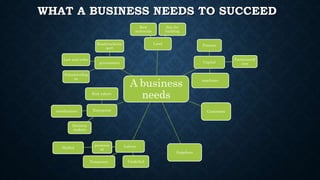
WHAT A BUSINESS NEEDS TO SUCCEED
A business
needs
Land
Raw
materials
Site for
building
Capital
Finance
Factories/off
ices
machines
Customers
Suppliers
LabourSkilled
UnskilledTemporary
permane
nt
Enterprise
Risk takers
Decision
makers
coordinators
government
Roads/rails/air
port
Law and order
Schools/colleg
es
BUSINESS ENVIRONMENT IS DYNAMIC
WHAT DO BUSINESSES DO?
• They identify needs
• They purchase factors of production, produce those
goods in order to satisfy the needs of consumers and
make a profit.
WHAT DO BUSINESSES NEED TO PRODUCE
GOODS AND SERVICES?
• Land- includes land, renewable and non-renewable
resources such as coal, crude oil and timber.
• labour- manual and skilled labour.
• Capital- finance, man-made resources such as computers,
machines, factories, offices and vehicles.
• Enterprise- driving force, combining the factors of
production into a driving force, it provides a managing,
decision-making and coordination role.
THE CONCEPT OF ADDING VALUE
(ADDED VALUE)
• Value is added to raw materials it uses to produce goods and
services.
• It is a key objective in a business.
• Consumers who pay the price that is more than raw
materials used to produce the goods has been successful in
adding value
ROLE OF THE ENTREPRENEUR
• Someone who takes the financial risk of starting and managing a new
venture
• Entrepreneurs have:
• An idea for a new business
• Invested some of their own savings and capital
• Accepted the responsibility of managing the business
• Accepted the possible risks of failure
CHARACTERISTICS OF SUCCESSFUL
ENTREPRENEURS
• Innovation
• Commitment and self-motivation
• Multi-skilled
• Leadership skills
• Self-confidence and an ability to ‘bounce back’
• Risk taking
MAJOR CHALLENGES FACED BY
ENTREPRENEURS
• Identifying successful business opportunities
• Sourcing capital (finance)
• Determining a location
• Competition
• Building a customer base
IDENTIFYING SUCCESSFUL BUSINESS
OPPORTUNITIES
Ideas for new businesses come from:
• Own skills or hobbies
• Previous employment experience
• Franchising conferences and exhibitions
• Small-budget market research
SOURCING CAPITAL (FINANCE)
• After an idea has been decided on, an entrepreneur has to raise the necessary
capital.
Why is obtaining finance such a major problem for entrepreneurs?
• Lack of sufficient own finance
• Lack of awareness of the financial support and grants available
• Lack of trading record to present to banks as evidence of past business success
• A poorly produced business plan that fails to convince potential investors of
the chance of a business’s success
DETERMINING A LOCATION
• When choosing a location, you must minimise fixed costs
Drawbacks:
• It may not be close to the area with the biggest market potential
• It lacks status - a business with its own prestigious premises tends to
generate confidence
• It may cause family tensions
• It may be difficult to separate private life from working life
COMPETITION
• New businesses experience competition from older
established businesses
• Entrepreneurs have to offer better customer services to
overcome the cost and pricing advantages that bigger
businesses offer.
BUILDING A CUSTOMER BASE
• Long term strength of a business depends on the customers who
return to purchase goods.
Small business try to offer a better service than larger businesses such
as:
• Personal customer service
• Knowledgeable pre- and after – sales services
• Providing for one-off customer requests that larger firms may be
reluctant to provide for.
WHY DO BUSINESSES OFTEN FAIL
Lack of record keeping
Lack of working capital
Poor management skills
Changes in the business environment
LACK OF RECORD KEEPING
• Some entrepreneurs fail to pay sufficient attention
to this as they believe it is less important than
meeting the needs of customers’.
• Some businesses keep records on computers and it is
important to keep them on paper too.
LACK OF WORKING CAPITAL
Capital is needed for day-to-day business affairs. Capital deficiencies
can be avoided if certain steps can be taken when establishing a
business:
• Construct a cash flow forecast so that liquidity and working capital
needs of the business can be assessed monthly.
• Inject sufficient capital into the business at start-up to last for a few
months of business.
• Establish good relations with the bank so that short term problem can
be overcome with an overdraft extension.
• Use effective credit control over customers’ accounts
POOR MANAGEMENT SKILLS
Some entrepreneurs have work experience, not always at management level, they
may not have gained experience of:
• Leadership skills
• Cash handling and cash management skills
• Planning and coordinating skills
• Decision-making skills
• Communication skills
• Marketing, promotion and selling skills
Potential entrepreneurs are encouraged to attend training courses to gain some of
these skills.
CHANGES IN THE BUSINESS ENVIRONMENT
Businesses may fail if any of the following changes occur:
• New competitors
• Legal changes
• Economic changes that leave customers with much less
money to spend
• Technological changes that make the methods used by the
new business, old-fashioned and expensive
COMMON TYPES OF ENTREPRENEURIAL
BUSINESSES
• Primary sector
• Fishing
• Market gardening
• Secondary sector
• Jewellery making
• Dress making
• Tertiary/service sector
• Hairdressing
• Car repairs
IMPACT OF ENTERPRISE ON A COUNTRY’S
ECONOMY
What are the claimed benefits to the economy of business enterprise?
• Employment creation
• Economic growth- an increase in the output of goods/services will increase the gross domestic
product of a country.
• Firms’ survival and growth
• Innovation and technological change- new businesses tend to be innovative and this adds
dynamism to an economy.
• Exports- expanding to the export market will increase the value of a nation’s exports and improve
its international competitiveness.
• Personal development- can encourage others to follow and lead to further successful enterprises
that will further boost the economy.
• Increased social cohesion- entrepreneurship can help to achieve social cohesion in a country.
SOCIAL ENTERPRISE
• Social enterprise is a proper business that makes its money in socially
responsible ways and uses most of any surplus made to benefit society.
• Use business principles to achieve social objectives.
Most social enterprises have these common features:
• They directly produce goods or provide services
• They have social aims and use ethical ways of achieving them
• They need to make a surplus or profit to survive as they cannot rely
on donations as charities do.
SOCIAL ENTERPRISE - OBJECTIVES
Economic – make a profit to reinvest back into the business and provide
some return to owners
Social – provide jobs or support for local, often disadvantaged, communities
Environmental – to protect the environment and to manage the business in
and environmentally sustainable way.
This is called the triple bottom line
This means that profit is not the main objective
ECONOMIC ACTIVITY AND THE PROBLEM OF
CHOICE
• Poor people are unable to obtain the very basic requirements of life and have
many unsatisfied needs and wants.
• Not all rich people can afford to satisfy their wants for luxury goods and services.
• There are insufficient goods to satisfy all of our needs and wants at any time.
• It is the purpose of economic activity to provide for as many of our wants as
possible.
• This need to choose is not exclusive to people as consumers.
• All economic units have to make choices- governments, businesses, workers,
charities, etc.
OPPORTUNITY COST
• In deciding to purchase or obtain one item, we must give up
other goods as they cannot all be purchased.
• The benefit of the next most desired option which is given
up

Cambridge Topic 1 AS Level - Enterprise

  • 1.
  • 2.
    THE NATURE OFBUSINESS ACTIVITY PURPOSE OF BUSINESS ACTIVITY • An organisation that uses resources to meet the needs of customers by providing a product or service that is in demand. • There are several stages in the production of finished goods involving adding value to resources, such as raw materials and semi finished goods, and making them more desirable the buyer.
  • 3.
    WHAT A BUSINESSNEEDS TO SUCCEED A business needs Land Raw materials Site for building Capital Finance Factories/off ices machines Customers Suppliers LabourSkilled UnskilledTemporary permane nt Enterprise Risk takers Decision makers coordinators government Roads/rails/air port Law and order Schools/colleg es
  • 4.
  • 6.
    WHAT DO BUSINESSESDO? • They identify needs • They purchase factors of production, produce those goods in order to satisfy the needs of consumers and make a profit.
  • 7.
    WHAT DO BUSINESSESNEED TO PRODUCE GOODS AND SERVICES? • Land- includes land, renewable and non-renewable resources such as coal, crude oil and timber. • labour- manual and skilled labour. • Capital- finance, man-made resources such as computers, machines, factories, offices and vehicles. • Enterprise- driving force, combining the factors of production into a driving force, it provides a managing, decision-making and coordination role.
  • 8.
    THE CONCEPT OFADDING VALUE (ADDED VALUE) • Value is added to raw materials it uses to produce goods and services. • It is a key objective in a business. • Consumers who pay the price that is more than raw materials used to produce the goods has been successful in adding value
  • 9.
    ROLE OF THEENTREPRENEUR • Someone who takes the financial risk of starting and managing a new venture • Entrepreneurs have: • An idea for a new business • Invested some of their own savings and capital • Accepted the responsibility of managing the business • Accepted the possible risks of failure
  • 10.
    CHARACTERISTICS OF SUCCESSFUL ENTREPRENEURS •Innovation • Commitment and self-motivation • Multi-skilled • Leadership skills • Self-confidence and an ability to ‘bounce back’ • Risk taking
  • 11.
    MAJOR CHALLENGES FACEDBY ENTREPRENEURS • Identifying successful business opportunities • Sourcing capital (finance) • Determining a location • Competition • Building a customer base
  • 12.
    IDENTIFYING SUCCESSFUL BUSINESS OPPORTUNITIES Ideasfor new businesses come from: • Own skills or hobbies • Previous employment experience • Franchising conferences and exhibitions • Small-budget market research
  • 13.
    SOURCING CAPITAL (FINANCE) •After an idea has been decided on, an entrepreneur has to raise the necessary capital. Why is obtaining finance such a major problem for entrepreneurs? • Lack of sufficient own finance • Lack of awareness of the financial support and grants available • Lack of trading record to present to banks as evidence of past business success • A poorly produced business plan that fails to convince potential investors of the chance of a business’s success
  • 14.
    DETERMINING A LOCATION •When choosing a location, you must minimise fixed costs Drawbacks: • It may not be close to the area with the biggest market potential • It lacks status - a business with its own prestigious premises tends to generate confidence • It may cause family tensions • It may be difficult to separate private life from working life
  • 15.
    COMPETITION • New businessesexperience competition from older established businesses • Entrepreneurs have to offer better customer services to overcome the cost and pricing advantages that bigger businesses offer.
  • 16.
    BUILDING A CUSTOMERBASE • Long term strength of a business depends on the customers who return to purchase goods. Small business try to offer a better service than larger businesses such as: • Personal customer service • Knowledgeable pre- and after – sales services • Providing for one-off customer requests that larger firms may be reluctant to provide for.
  • 17.
    WHY DO BUSINESSESOFTEN FAIL Lack of record keeping Lack of working capital Poor management skills Changes in the business environment
  • 18.
    LACK OF RECORDKEEPING • Some entrepreneurs fail to pay sufficient attention to this as they believe it is less important than meeting the needs of customers’. • Some businesses keep records on computers and it is important to keep them on paper too.
  • 19.
    LACK OF WORKINGCAPITAL Capital is needed for day-to-day business affairs. Capital deficiencies can be avoided if certain steps can be taken when establishing a business: • Construct a cash flow forecast so that liquidity and working capital needs of the business can be assessed monthly. • Inject sufficient capital into the business at start-up to last for a few months of business. • Establish good relations with the bank so that short term problem can be overcome with an overdraft extension. • Use effective credit control over customers’ accounts
  • 20.
    POOR MANAGEMENT SKILLS Someentrepreneurs have work experience, not always at management level, they may not have gained experience of: • Leadership skills • Cash handling and cash management skills • Planning and coordinating skills • Decision-making skills • Communication skills • Marketing, promotion and selling skills Potential entrepreneurs are encouraged to attend training courses to gain some of these skills.
  • 21.
    CHANGES IN THEBUSINESS ENVIRONMENT Businesses may fail if any of the following changes occur: • New competitors • Legal changes • Economic changes that leave customers with much less money to spend • Technological changes that make the methods used by the new business, old-fashioned and expensive
  • 22.
    COMMON TYPES OFENTREPRENEURIAL BUSINESSES • Primary sector • Fishing • Market gardening • Secondary sector • Jewellery making • Dress making • Tertiary/service sector • Hairdressing • Car repairs
  • 23.
    IMPACT OF ENTERPRISEON A COUNTRY’S ECONOMY What are the claimed benefits to the economy of business enterprise? • Employment creation • Economic growth- an increase in the output of goods/services will increase the gross domestic product of a country. • Firms’ survival and growth • Innovation and technological change- new businesses tend to be innovative and this adds dynamism to an economy. • Exports- expanding to the export market will increase the value of a nation’s exports and improve its international competitiveness. • Personal development- can encourage others to follow and lead to further successful enterprises that will further boost the economy. • Increased social cohesion- entrepreneurship can help to achieve social cohesion in a country.
  • 24.
    SOCIAL ENTERPRISE • Socialenterprise is a proper business that makes its money in socially responsible ways and uses most of any surplus made to benefit society. • Use business principles to achieve social objectives. Most social enterprises have these common features: • They directly produce goods or provide services • They have social aims and use ethical ways of achieving them • They need to make a surplus or profit to survive as they cannot rely on donations as charities do.
  • 25.
    SOCIAL ENTERPRISE -OBJECTIVES Economic – make a profit to reinvest back into the business and provide some return to owners Social – provide jobs or support for local, often disadvantaged, communities Environmental – to protect the environment and to manage the business in and environmentally sustainable way. This is called the triple bottom line This means that profit is not the main objective
  • 26.
    ECONOMIC ACTIVITY ANDTHE PROBLEM OF CHOICE • Poor people are unable to obtain the very basic requirements of life and have many unsatisfied needs and wants. • Not all rich people can afford to satisfy their wants for luxury goods and services. • There are insufficient goods to satisfy all of our needs and wants at any time. • It is the purpose of economic activity to provide for as many of our wants as possible. • This need to choose is not exclusive to people as consumers. • All economic units have to make choices- governments, businesses, workers, charities, etc.
  • 27.
    OPPORTUNITY COST • Indeciding to purchase or obtain one item, we must give up other goods as they cannot all be purchased. • The benefit of the next most desired option which is given up