LOGO


 Business Overview
LOGO


 Etymology: Busy+ness
 Refers to the “state of being busy” in the context of the
 individual as well as the society..

 TO BE BUSY- to be doing commercially viable and profitable
 work

 As such, we can say that a business is put up for
 gaining a profit.
Business:
- the organized effort of individuals
-To produce and sell
- for profit
- there is goods and services
- satisfies society’s needs
To be successful, a business must
perform 3 activities:
1. It must be organized
- 4 resources: materials, human,
    financial, info.
2. It must satisfy needs
-ultimate objective
3. It must earn profit
-Profit =revenues-expenses
Classification
of Business
By SIZE
By OWNERSHIP
By DIVISION
Business by SIZE

Under 20 employees   - very small
20- 99 employees     - small
100-499 employees    - medium
500 or more          - large
Business by OWNERSHIP


Single/Sole Proprietorship
Partnership
Corporation
Cooperatives
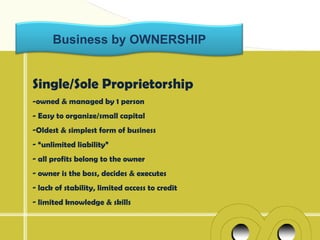
Business by OWNERSHIP


Single/Sole Proprietorship
-owned & managed by 1 person
- Easy to organize/small capital
-Oldest & simplest form of business
- “unlimited liability”
- all profits belong to the owner
- owner is the boss, decides & executes
- lack of stability, limited access to credit
- limited knowledge & skills
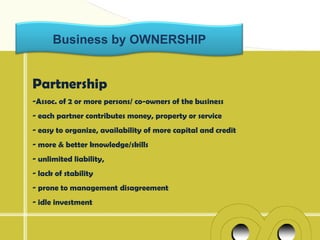
Business by OWNERSHIP


Partnership
-Assoc. of 2 or more persons/ co-owners of the business
- each partner contributes money, property or service
- easy to organize, availability of more capital and credit
- more & better knowledge/skills
- unlimited liability,
- lack of stability
- prone to management disagreement
- idle investment
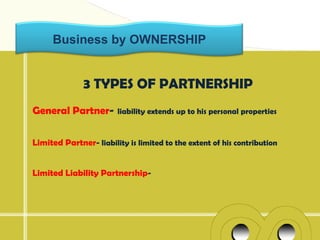
Business by OWNERSHIP


              3 TYPES OF PARTNERSHIP
General Partner-        liability extends up to his personal properties


Limited Partner- liability is limited to the extent of his contribution


Limited Liability Partnership-
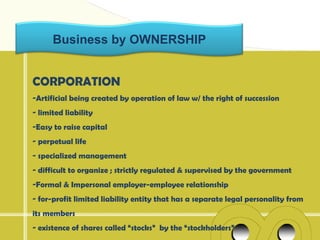
Business by OWNERSHIP


CORPORATION
-Artificial being created by operation of law w/ the right of succession
- limited liability
-Easy to raise capital
- perpetual life
- specialized management
- difficult to organize ; strictly regulated & supervised by the government
-Formal & Impersonal employer-employee relationship
- for-profit limited liability entity that has a separate legal personality from
its members
- existence of shares called “stocks” by the “stockholders”
Business by OWNERSHIP


COOPERATIVES
        - referred to as Co-op business or Co-op
        - Voluntary business organization by members-patrons for
the purpose of carrying on a business activity that directly benefits
its members
        - a non-profit enterprise
        - Types of cooperatives are: Credit, Consumer, Producers,
Marketing, Service & Multi-purpose
Business by DIVISION

COMMERSE
-the transfer or exchange of goods & services w/ the
movements of goods from point of production to point
of consumption
- encompasses buying, selling, marketing, &
merchandising of goods
- also include activities such as collecting of goods,
warehousing, transportation, insurance trading and
retailing, wholesaling both domestic and foreign
products
Business by DIVISION

INDUSTRY
-mainly concerned on production.
-the application of labor upon raw materials
-Production of goods used by consumers or by other industries for
further production

        4 CATEGORIES
Genetic industry-          includes agri, forestry, fish culture
Extractive industry-        prods drawn from nature
                  ex.mining, lumbering, hunting–
Manufacturing industry- working on materials /supplies turned out by
                                     the extractive industries
                  ex. Coconut oil from copra, plywood from logs
Constructive industry-     building of highways, airports, buildings,
                           residences
Business by DIVISION

SERVICES:
-Cater to personal needs of the public.
- not involved in buying or selling, manufacturing of goods
- may be termed Professional or trade services

•Recreational services- include motion pictures prod, distribution
theater for drama & stage presentations, television
•Personal services- include businesses such as restaurants, hotels,
laundry shops, beauty salons
•Professional services- include lawyers, doctors, accountants,
consultants
Evaluation

Students should research on a company. They should
specify what the classification of the business is. In
the written report, it would be advisable to state the
company’s mission and vision, the future plans of the
company-short term & long term plans.

Font size 12
Arial
Short bond paper
Business Organizations

Any two or more persons who pool their resources & work together to attain
their common objective. A group is an organization regardless whether it is
small or huge.

Business is also defined as an organization of people with varied skill, which
uses properties & talents to produce goods & services, which can be sold to
others for more than their costs, thereby gaining profit.

DEFINITION OF ORGANIZATION:
-A collection of persons working together for a common purpose
- a group of individuals who are cooperating willingly & effectively for a
common end
- it is the process of continuing the work which individuals or groups have to
perform with the faculties necessary for its execution.
Basic Considerations in
    Organizations

1. Clear and Complete Statement of Objectives
- There should be a specific purpose.(should be clearly defined & well-balanced) The objectives
      personates all activities within an enterprise.
3. Thorough Analysis of the entire position surrounding
   the business
- External & internal factors should be looked into. It serve as the basis for the future operation of
      the business.

3.Necessary functions should be determined
- The scope of work and duties should be clearly defined to avoid confusion within the members
      of the organization
4. Men best fitted for work & to head each department or
   division should be selected
- dep’t heads should be competent in performing their task(ability of the executive who will
      manage the enterprise is an important consideration). They should be able to work well &
      effectively with other dept heads.
Principles of Organization
  • Principle of Objective
  -The dev’t of plans depends on the clear understanding of the objective. It adheres to a definite
  purpose & goal(serves as a guide to future planning & action)


  • Principle of Analysis
  -The act of breaking up a whole into its parts so as to find out their nature, qualities &
  importance(a full knowledge of the req’s of the business)


  • Principle of Simplicity
  -Activities which are not significant should be eliminated. (a position should be created on its
  functionality)


  • Principle of Functionalization
  - Nature of business determines the main function. Function is a normal or characteristic way of
  doing a task(e.g. accounting, sales, marketing)
Principles of Organization

• Principle of Departmentalization or Departmentation
-this helps achieve smoother flow of operations. A territory or location offer advantages in cutting
operation expense. It may lead to growth & expansion.


• Principle of Centralization of Authority &
Responsibility
-(a centralized executive control. The delegation of authority) The delegation of authority &
responsibilities to his subordinates for the purpose of accomplishing a given task or goal in the
shortest period of time.


• Principle of Limited Span of Executive Control
- Span of control is the number of subordinates an executive can manage effectively. Well trained
subordinates require minimal controlling, can initiate & execute proper action quickly.
Economic System Models
A set of economic institution that dominates a given economy. The objective
is to satisfy the needs of the people.

                              CAPITALISM

                              COMMUNISM

                               SOCIALISM

                                FASCISM

                        LAISSEZ-FAIRE THEORY

                     FREE ENTERPRISE ECONOMY
SOCIALISM
-The mixture of capitalism and communism
- the major industries belong to the state while the minor industries
belong to the private individuals
- according to Karl Marx, it is the lower stage of post-capitalism.
- in this system, man produces output as a result of incentive such as
wages & salaries, but goods are not yet sufficiently produced to meet
all the material needs of the members of the society.
CAPITALISM
-A system of economic organization wherein privately owned funds &
property rights are privately invested with the purpose of gain for these
individual owners

- production & distribution are owned & managed by private individuals

- the enterprise being a private property would have features which
include; having economic freedom, exercising free competition, & profit
oriented

- known as “market economy”, prices serve as indicators between the
consumers & the producers
COMMUNISM
-Exact opposite of capitalism

- factors of production and distribution are owned and managed by the state

- no one owns property privately

- the government is the only producer and seller, there is no economic
freedom and profit motive is prohibited

- it stands for the collective ownership by the state of consumption &
production of goods

-Prohibition of private ownership of material goods & of other factors of
production is the purpose of avoiding the presence of one individual having
power over another
Fascism
• a system which retains production of goods in private hands but
makes an investment & management of capital subject to state control
for state defined objectives

Note:
The Philippine business is essentially capitalistic. It carries elements of
government guidance & control. The government lays down the rules
for economic activities, retains excesses like monopoly or other harmful
competitions. It also assists business with monetary policies & outright
financial assistance as needed.
Laissez-faire Theory
(let do, let alone, let pass)

-A competition can be trusted to guide a business activity towards
socially desirable ends.

- it completes the process of molding the business society into its present
form

-It allows people to do as they choose

- it allows everything to run its own course

- there exist minimum direction and maximum freedom where the group
is allowed to make decisions.
Free Enterprise Economy
-An era of liberalization and deregulation

- it may mean more foreign goods & services will be allowed to enter the
country

-On the part of the government, it sells its corporation to the private sector

-It reduces the regulatory power over the operations of the business

-It indicates thrust towards free trade, free market or the free enterprise
economy

( This gives the individual the freedom to dream & to work for his own progress. Its principle is;
if every individual shows progress, the betterment of the society becomes a consequence.
However, this may result to widespread poverty wherein the rich becomes richer and the poor
becomes poorer.
Organizing a Business

Factors affecting how a business is organized:
2.The size & scope of the business and its anticipated
management & ownership
-            Smaller business tends to be more flexible while companies with wider ownership &
with more formal structure are more organized as corporations or partnership.

2. The sector and country
- Private profit making businesses are different from gov’t owned bodies. In some countries,
certain businesses are legally obliged to be organized in certain ways.

3. Limited liability
-Corporations, limited liability partnerships, & other specific types of business organizations
protect their owners from business failure by doing business under a separate legal entity with
certain legal protections.


4. Tax advantages
-Different structures are treated differently in tax law, and many have advantages for this reason.

5. Disclosure and compliance requirements
- Different business structures may be required to make more or less information or reported to
relevant authorities) & may be bound to comply with different rules & regulations.
EVALUATION:

Short Quiz (20 items) covering lessons from week 1-2

4 groups: Each group must prepare in a short bond paper an
organizational chart of a company/ establishment( levels of
management)

Assignment:
1. Visit Chikka’s homepage (www.chikka.com) & explore what it has to offer &
what it says about how the company is managed.
Write a 1-2 page descriptive report of the chikka website, explaining how it came
to be and how the company is managed.

2. Group activity: Same grouping of 4, they must interview a manager. They
should identify manager’s skill, technical, conceptual and interpersonal.

3. Prepare a role play incorporating the skills & roles that managers play in an
organization.
MANAGEMENT: An Overview

 Management is defined as the pursuit of organizational
 goals efficiently and effectively by integrating the work
 of people through planning, organizing, leading , &
 controlling.
 Efficiency
 To be efficient means to use resources- people, money, raw materials, and
 the like, wisely and cost-effectively.

 Effectiveness
 To be effective means to achieve results, to make the right decisions, &
 successfully carry them out so that they achieve the organization’s goals.
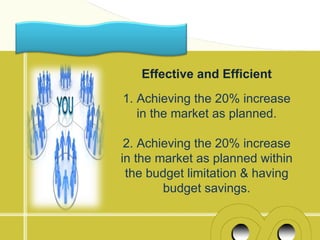
Effective and Efficient
1. Achieving the 20% increase
   in the market as planned.

 2. Achieving the 20% increase
in the market as planned within
 the budget limitation & having
        budget savings.
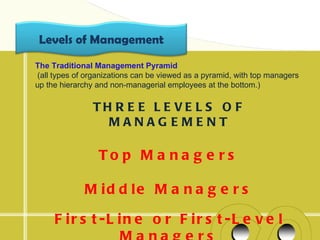
Levels of Management
The Traditional Management Pyramid
 (all types of organizations can be viewed as a pyramid, with top managers
up the hierarchy and non-managerial employees at the bottom.)

                TH R E E L E VE L S O F
                  MANAGEMENT

                 To p M a n a g e rs

             M id d le M a n a g e r s

     F i r s t -L i n e o r F i r s t - L e v e l
Top Managers
 known as the executives: chief executive office(CEO),
     chief operating officer(COO) & the president

  are responsible for long-term decisions on overall
     management & direction of the organization

establish the goals & objectives, operating policies, &
                   strategies for it.

They must be future-oriented, dealing with uncertain,
          highly competitive conditions.
Middle Managers
 Job titles may include:”division head, marketing
  director, plant manager, or dean of students”

responsible for the implementation of the policies &
        plans made by the top managers,

supervises & coordinates activities of the first-line
             managers below them.
First-Line or First-Level Managers

 include titles such as; “department head, foreman or
        forewoman, team leader, & supervisor”

responsible for making short-term operating decisions,

   Directs & supervises the daily activities of non-
               managerial employees
The Managerial Skills


TECHNICAL SKILLS: The Ability to Perform a Specific
Task
-Involves mastery of a specific knowledge, methods ,
procedures, techniques, & equipment, needed to
perform competently in a specialized field.
(important at lower level management)

CONCEPTUAL SKILLS: The Ability to Think
Analogically & Strategically
-The ability to see the organization as a whole, and
the relationship among its parts.(important to top
managers)
INTERPERSONAL SKILLS:
The Ability to Interact and Work with Other People

-The ability to work well in cooperation & coordination
w/ other people to achieve goals (necessary for all
management levels)

- development of these skills is an ongoing, lifelong
endeavor
MANAGERIAL ROLES

According to Mintzberg, managers play three (3) broad types of roles or
“organized sets of behavior” :

3.INTERPERSONAL ROLES
Pertains to relationships with people since managers interact w/ others
inside & outside their work units.
Figurehead Role: performing symbolic tasks to represent the
organization.

Leadership Role: being responsible for the actions of the subordinates
which encompasses communicating, influencing & motivating them.

 Liaison Role: interacting & working with other people both within &
outside the organization.
MANAGERIAL ROLES

2. INFORMATIONAL ROLES
These includes receiving & communicating information w/ other people
inside & outside the organization to develop an information network.

Monitor Role: a manager should be constantly alert in seeking current &
useful information from various sources

Disseminator Role: constantly transmitting/disseminating vital information
to other parts of the organization.

 Spokesperson Role: serves as a diplomat, representing & speaking for
the units, both inside & outside the organization.
3. Decisional Roles
These pertains to those events about which managers use information to
make decisions & actions, or to take advantage of opportunities.

Entrepreneur Role: involves initiation & encouragement of change &
innovation.

Disturbance Handler/Problem Solver: involves resolving conflicts, or
handling unforeseen problems.

Negotiator Role: working & bargaining w/ people both within & outside the
organization.

Resource Allocator Role: set priorities about the use of resources
Business overview

Business overview

  • 1.
  • 2.
    LOGO Etymology: Busy+ness Refers to the “state of being busy” in the context of the individual as well as the society.. TO BE BUSY- to be doing commercially viable and profitable work As such, we can say that a business is put up for gaining a profit.
  • 3.
    Business: - the organizedeffort of individuals -To produce and sell - for profit - there is goods and services - satisfies society’s needs
  • 4.
    To be successful,a business must perform 3 activities: 1. It must be organized - 4 resources: materials, human, financial, info. 2. It must satisfy needs -ultimate objective 3. It must earn profit -Profit =revenues-expenses
  • 5.
  • 6.
    Business by SIZE Under20 employees - very small 20- 99 employees - small 100-499 employees - medium 500 or more - large
  • 7.
    Business by OWNERSHIP Single/SoleProprietorship Partnership Corporation Cooperatives
  • 8.
    Business by OWNERSHIP Single/SoleProprietorship -owned & managed by 1 person - Easy to organize/small capital -Oldest & simplest form of business - “unlimited liability” - all profits belong to the owner - owner is the boss, decides & executes - lack of stability, limited access to credit - limited knowledge & skills
  • 9.
    Business by OWNERSHIP Partnership -Assoc.of 2 or more persons/ co-owners of the business - each partner contributes money, property or service - easy to organize, availability of more capital and credit - more & better knowledge/skills - unlimited liability, - lack of stability - prone to management disagreement - idle investment
  • 10.
    Business by OWNERSHIP 3 TYPES OF PARTNERSHIP General Partner- liability extends up to his personal properties Limited Partner- liability is limited to the extent of his contribution Limited Liability Partnership-
  • 11.
    Business by OWNERSHIP CORPORATION -Artificialbeing created by operation of law w/ the right of succession - limited liability -Easy to raise capital - perpetual life - specialized management - difficult to organize ; strictly regulated & supervised by the government -Formal & Impersonal employer-employee relationship - for-profit limited liability entity that has a separate legal personality from its members - existence of shares called “stocks” by the “stockholders”
  • 12.
    Business by OWNERSHIP COOPERATIVES - referred to as Co-op business or Co-op - Voluntary business organization by members-patrons for the purpose of carrying on a business activity that directly benefits its members - a non-profit enterprise - Types of cooperatives are: Credit, Consumer, Producers, Marketing, Service & Multi-purpose
  • 13.
    Business by DIVISION COMMERSE -thetransfer or exchange of goods & services w/ the movements of goods from point of production to point of consumption - encompasses buying, selling, marketing, & merchandising of goods - also include activities such as collecting of goods, warehousing, transportation, insurance trading and retailing, wholesaling both domestic and foreign products
  • 14.
    Business by DIVISION INDUSTRY -mainlyconcerned on production. -the application of labor upon raw materials -Production of goods used by consumers or by other industries for further production 4 CATEGORIES Genetic industry- includes agri, forestry, fish culture Extractive industry- prods drawn from nature ex.mining, lumbering, hunting– Manufacturing industry- working on materials /supplies turned out by the extractive industries ex. Coconut oil from copra, plywood from logs Constructive industry- building of highways, airports, buildings, residences
  • 15.
    Business by DIVISION SERVICES: -Caterto personal needs of the public. - not involved in buying or selling, manufacturing of goods - may be termed Professional or trade services •Recreational services- include motion pictures prod, distribution theater for drama & stage presentations, television •Personal services- include businesses such as restaurants, hotels, laundry shops, beauty salons •Professional services- include lawyers, doctors, accountants, consultants
  • 16.
    Evaluation Students should researchon a company. They should specify what the classification of the business is. In the written report, it would be advisable to state the company’s mission and vision, the future plans of the company-short term & long term plans. Font size 12 Arial Short bond paper
  • 17.
    Business Organizations Any twoor more persons who pool their resources & work together to attain their common objective. A group is an organization regardless whether it is small or huge. Business is also defined as an organization of people with varied skill, which uses properties & talents to produce goods & services, which can be sold to others for more than their costs, thereby gaining profit. DEFINITION OF ORGANIZATION: -A collection of persons working together for a common purpose - a group of individuals who are cooperating willingly & effectively for a common end - it is the process of continuing the work which individuals or groups have to perform with the faculties necessary for its execution.
  • 18.
    Basic Considerations in Organizations 1. Clear and Complete Statement of Objectives - There should be a specific purpose.(should be clearly defined & well-balanced) The objectives personates all activities within an enterprise. 3. Thorough Analysis of the entire position surrounding the business - External & internal factors should be looked into. It serve as the basis for the future operation of the business. 3.Necessary functions should be determined - The scope of work and duties should be clearly defined to avoid confusion within the members of the organization 4. Men best fitted for work & to head each department or division should be selected - dep’t heads should be competent in performing their task(ability of the executive who will manage the enterprise is an important consideration). They should be able to work well & effectively with other dept heads.
  • 19.
    Principles of Organization • Principle of Objective -The dev’t of plans depends on the clear understanding of the objective. It adheres to a definite purpose & goal(serves as a guide to future planning & action) • Principle of Analysis -The act of breaking up a whole into its parts so as to find out their nature, qualities & importance(a full knowledge of the req’s of the business) • Principle of Simplicity -Activities which are not significant should be eliminated. (a position should be created on its functionality) • Principle of Functionalization - Nature of business determines the main function. Function is a normal or characteristic way of doing a task(e.g. accounting, sales, marketing)
  • 20.
    Principles of Organization •Principle of Departmentalization or Departmentation -this helps achieve smoother flow of operations. A territory or location offer advantages in cutting operation expense. It may lead to growth & expansion. • Principle of Centralization of Authority & Responsibility -(a centralized executive control. The delegation of authority) The delegation of authority & responsibilities to his subordinates for the purpose of accomplishing a given task or goal in the shortest period of time. • Principle of Limited Span of Executive Control - Span of control is the number of subordinates an executive can manage effectively. Well trained subordinates require minimal controlling, can initiate & execute proper action quickly.
  • 21.
    Economic System Models Aset of economic institution that dominates a given economy. The objective is to satisfy the needs of the people. CAPITALISM COMMUNISM SOCIALISM FASCISM LAISSEZ-FAIRE THEORY FREE ENTERPRISE ECONOMY
  • 22.
    SOCIALISM -The mixture ofcapitalism and communism - the major industries belong to the state while the minor industries belong to the private individuals - according to Karl Marx, it is the lower stage of post-capitalism. - in this system, man produces output as a result of incentive such as wages & salaries, but goods are not yet sufficiently produced to meet all the material needs of the members of the society.
  • 23.
    CAPITALISM -A system ofeconomic organization wherein privately owned funds & property rights are privately invested with the purpose of gain for these individual owners - production & distribution are owned & managed by private individuals - the enterprise being a private property would have features which include; having economic freedom, exercising free competition, & profit oriented - known as “market economy”, prices serve as indicators between the consumers & the producers
  • 24.
    COMMUNISM -Exact opposite ofcapitalism - factors of production and distribution are owned and managed by the state - no one owns property privately - the government is the only producer and seller, there is no economic freedom and profit motive is prohibited - it stands for the collective ownership by the state of consumption & production of goods -Prohibition of private ownership of material goods & of other factors of production is the purpose of avoiding the presence of one individual having power over another
  • 25.
    Fascism • a systemwhich retains production of goods in private hands but makes an investment & management of capital subject to state control for state defined objectives Note: The Philippine business is essentially capitalistic. It carries elements of government guidance & control. The government lays down the rules for economic activities, retains excesses like monopoly or other harmful competitions. It also assists business with monetary policies & outright financial assistance as needed.
  • 26.
    Laissez-faire Theory (let do,let alone, let pass) -A competition can be trusted to guide a business activity towards socially desirable ends. - it completes the process of molding the business society into its present form -It allows people to do as they choose - it allows everything to run its own course - there exist minimum direction and maximum freedom where the group is allowed to make decisions.
  • 27.
    Free Enterprise Economy -Anera of liberalization and deregulation - it may mean more foreign goods & services will be allowed to enter the country -On the part of the government, it sells its corporation to the private sector -It reduces the regulatory power over the operations of the business -It indicates thrust towards free trade, free market or the free enterprise economy ( This gives the individual the freedom to dream & to work for his own progress. Its principle is; if every individual shows progress, the betterment of the society becomes a consequence. However, this may result to widespread poverty wherein the rich becomes richer and the poor becomes poorer.
  • 28.
    Organizing a Business Factorsaffecting how a business is organized: 2.The size & scope of the business and its anticipated management & ownership - Smaller business tends to be more flexible while companies with wider ownership & with more formal structure are more organized as corporations or partnership. 2. The sector and country - Private profit making businesses are different from gov’t owned bodies. In some countries, certain businesses are legally obliged to be organized in certain ways. 3. Limited liability -Corporations, limited liability partnerships, & other specific types of business organizations protect their owners from business failure by doing business under a separate legal entity with certain legal protections. 4. Tax advantages -Different structures are treated differently in tax law, and many have advantages for this reason. 5. Disclosure and compliance requirements - Different business structures may be required to make more or less information or reported to relevant authorities) & may be bound to comply with different rules & regulations.
  • 29.
    EVALUATION: Short Quiz (20items) covering lessons from week 1-2 4 groups: Each group must prepare in a short bond paper an organizational chart of a company/ establishment( levels of management) Assignment: 1. Visit Chikka’s homepage (www.chikka.com) & explore what it has to offer & what it says about how the company is managed. Write a 1-2 page descriptive report of the chikka website, explaining how it came to be and how the company is managed. 2. Group activity: Same grouping of 4, they must interview a manager. They should identify manager’s skill, technical, conceptual and interpersonal. 3. Prepare a role play incorporating the skills & roles that managers play in an organization.
  • 30.
    MANAGEMENT: An Overview Management is defined as the pursuit of organizational goals efficiently and effectively by integrating the work of people through planning, organizing, leading , & controlling. Efficiency To be efficient means to use resources- people, money, raw materials, and the like, wisely and cost-effectively. Effectiveness To be effective means to achieve results, to make the right decisions, & successfully carry them out so that they achieve the organization’s goals.
  • 31.
    Effective and Efficient 1.Achieving the 20% increase in the market as planned. 2. Achieving the 20% increase in the market as planned within the budget limitation & having budget savings.
  • 32.
    Levels of Management TheTraditional Management Pyramid (all types of organizations can be viewed as a pyramid, with top managers up the hierarchy and non-managerial employees at the bottom.) TH R E E L E VE L S O F MANAGEMENT To p M a n a g e rs M id d le M a n a g e r s F i r s t -L i n e o r F i r s t - L e v e l
  • 33.
    Top Managers  knownas the executives: chief executive office(CEO), chief operating officer(COO) & the president are responsible for long-term decisions on overall management & direction of the organization establish the goals & objectives, operating policies, & strategies for it. They must be future-oriented, dealing with uncertain, highly competitive conditions.
  • 34.
    Middle Managers Jobtitles may include:”division head, marketing director, plant manager, or dean of students” responsible for the implementation of the policies & plans made by the top managers, supervises & coordinates activities of the first-line managers below them.
  • 35.
    First-Line or First-LevelManagers include titles such as; “department head, foreman or forewoman, team leader, & supervisor” responsible for making short-term operating decisions, Directs & supervises the daily activities of non- managerial employees
  • 36.
    The Managerial Skills TECHNICALSKILLS: The Ability to Perform a Specific Task -Involves mastery of a specific knowledge, methods , procedures, techniques, & equipment, needed to perform competently in a specialized field. (important at lower level management) CONCEPTUAL SKILLS: The Ability to Think Analogically & Strategically -The ability to see the organization as a whole, and the relationship among its parts.(important to top managers)
  • 37.
    INTERPERSONAL SKILLS: The Abilityto Interact and Work with Other People -The ability to work well in cooperation & coordination w/ other people to achieve goals (necessary for all management levels) - development of these skills is an ongoing, lifelong endeavor
  • 38.
    MANAGERIAL ROLES According toMintzberg, managers play three (3) broad types of roles or “organized sets of behavior” : 3.INTERPERSONAL ROLES Pertains to relationships with people since managers interact w/ others inside & outside their work units. Figurehead Role: performing symbolic tasks to represent the organization. Leadership Role: being responsible for the actions of the subordinates which encompasses communicating, influencing & motivating them.  Liaison Role: interacting & working with other people both within & outside the organization.
  • 39.
    MANAGERIAL ROLES 2. INFORMATIONALROLES These includes receiving & communicating information w/ other people inside & outside the organization to develop an information network. Monitor Role: a manager should be constantly alert in seeking current & useful information from various sources Disseminator Role: constantly transmitting/disseminating vital information to other parts of the organization.  Spokesperson Role: serves as a diplomat, representing & speaking for the units, both inside & outside the organization.
  • 40.
    3. Decisional Roles Thesepertains to those events about which managers use information to make decisions & actions, or to take advantage of opportunities. Entrepreneur Role: involves initiation & encouragement of change & innovation. Disturbance Handler/Problem Solver: involves resolving conflicts, or handling unforeseen problems. Negotiator Role: working & bargaining w/ people both within & outside the organization. Resource Allocator Role: set priorities about the use of resources