

Chapter 8
TheThe MechanicsMechanics ofof
Writing an EffectiveWriting an Effective
Business PlanBusiness Plan
This Week’s KEYThis Week’s KEY
ResourcesResources
Resources
Resources
Resources
Resources
Resources
• The understanding you get from the planning
process required to write the plan is invaluable
• Details every major characteristic of the business
• Critical for TWOTWO reasons:
– External legitimacyExternal legitimacy: when somebody requires it
– Internal understandingInternal understanding: getting everything clear in
your mind
• Telling a story about your future business
The Planning Process
• Vision (10 words)
• Mission (25-50 words)
• Elevator Pitch (60-100 words)
• Executive Summary (250-500 words)
• Business Plan (40 pages)
Levels of Involvement
• Expresses the fundamental idea or goal
of the business.
• It tells everyone where your organization
wants to go to.
• Tagline, slogan or mantra:
– Our Vision is to…“Help You Achieve Your
Dream Job”
Vision Statement
cesces
• Related to the vision statement
• Adds competitive advantage information
• Written from the perspective of what
will make a difference for a customer
– Our mission is to: “Help you to find your life’sHelp you to find your life’s
passion, and make it your careerpassion, and make it your career.”
• Keep it Simple, short, and direct
Mission Statement
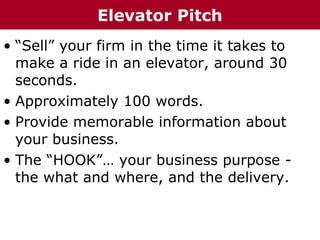
• “Sell” your firm in the time it takes to
make a ride in an elevator, around 30
seconds.
• Approximately 100 words.
• Provide memorable information about
your business.
• The “HOOK”… your business purpose -
the what and where, and the delivery.
Elevator Pitch
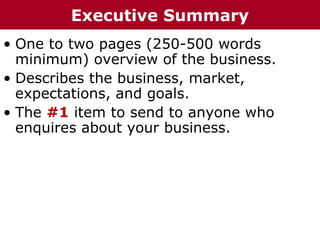
• One to two pages (250-500 words
minimum) overview of the business.
• Describes the business, market,
expectations, and goals.
• The #1 item to send to anyone who
enquires about your business.
Executive Summary
Resources
• Mantra: 3-6 words (Quality is Job 1.)
• Mission: co. name, product/service,
customer, and market.
• Measures: business goals given as
measurable results.
• Method: the activities that will turn your
business into a success.
• Mechanics: the tasks that are required
to accomplish what’s listed in the
method.
5-M Model
• 1st
paragraph: Introduce yourself and
your business.
• 2nd
paragraph: Explain your company in
greater detail.
• 3rd
paragraph: describe the current
situation of your business and explain
what you are looking for from the
recipient.
• 4th
paragraph: Close and thank them for
their consideration.
Cover Letter
• Co. Name
• Contact information
• Date the version was completed
• Proprietary statement to protect your
ideas
Title Page
• T.O.C
• Executive Summary
• The Company
– Co. Description: 1-2 pages
– Product/Service & Industry: 1-8 pages
Other Stuff
The MarketThe Market
• It’s all about your customers – who they are,
where they are, how to find them and keep
them
• The total population of people or businesses
you aim to serve, defined by size and scope
(where they are)
• Target customer: the ideal customer to buy
your product or service
• Competition and Competitive Advantage: who
are they, what do they offer, how much do they
charge, what makes them unique
The Market
• Focus on 1) overall business strategy to pursue
your market 2) sales plan, and 3) longer term
plan to protect your company against
competitors:
– Business Strategy discusses your general strategy
with respect to differentiation, cost, and focus
– Sales plan: Addresses how you are going to generate
sales. Show how you will convert the value benefits
your clients are looking for into your pricing,
promotional activities, advertising, etc.
– Long term plans to protect against competitors using
R&D to develop new offerings, key partnerships,
superior service, intellectual property, etc.
Your Marketing Strategy
• The legal form of the business (LLC, sole
proprietorship)
• Use org charts for larger firms
• Key personnel: owners, managers, salespeople,
influential outsiders, service providers
• Location: home-based business?
The Organization
FinancialsFinancials
$ $ $$ $ $
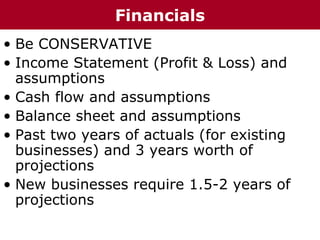
• Be CONSERVATIVE
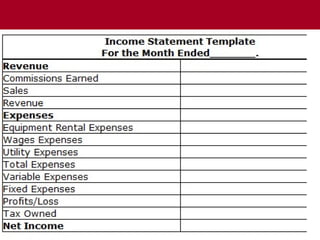
• Income Statement (Profit & Loss) and
assumptions
• Cash flow and assumptions
• Balance sheet and assumptions
• Past two years of actuals (for existing
businesses) and 3 years worth of
projections
• New businesses require 1.5-2 years of
projections
Financials
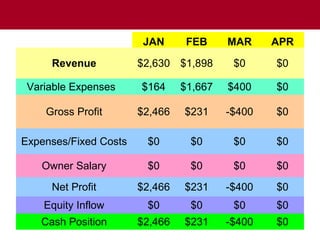
  JAN FEB MAR APR
Revenue $2,630 $1,898 $0 $0
Variable Expenses   $164 $1,667 $400 $0
Gross Profit $2,466 $231 -$400 $0
Expenses/Fixed Costs $0 $0 $0 $0
Owner Salary $0 $0 $0 $0
Net Profit $2,466 $231 -$400 $0
Equity Inflow $0 $0 $0 $0
Cash Position $2,466 $231 -$400 $0
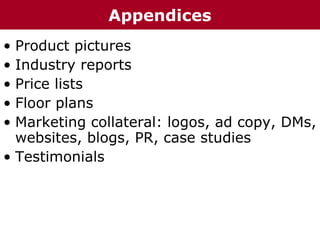
• Product pictures
• Industry reports
• Price lists
• Floor plans
• Marketing collateral: logos, ad copy, DMs,
websites, blogs, PR, case studies
• Testimonials
Appendices
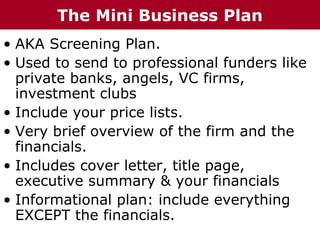
• AKA Screening Plan.
• Used to send to professional funders like
private banks, angels, VC firms,
investment clubs
• Include your price lists.
• Very brief overview of the firm and the
financials.
• Includes cover letter, title page,
executive summary & your financials
• Informational plan: include everything
EXCEPT the financials.
The Mini Business Plan

Entrepreneurship Chapter 8 Ethan Chazin

  • 1.
    Chapter 8 TheThe MechanicsMechanicsofof Writing an EffectiveWriting an Effective Business PlanBusiness Plan
  • 2.
    This Week’s KEYThisWeek’s KEY ResourcesResources
  • 3.
  • 4.
  • 5.
  • 6.
  • 7.
  • 8.
    • The understandingyou get from the planning process required to write the plan is invaluable • Details every major characteristic of the business • Critical for TWOTWO reasons: – External legitimacyExternal legitimacy: when somebody requires it – Internal understandingInternal understanding: getting everything clear in your mind • Telling a story about your future business The Planning Process
  • 9.
    • Vision (10words) • Mission (25-50 words) • Elevator Pitch (60-100 words) • Executive Summary (250-500 words) • Business Plan (40 pages) Levels of Involvement
  • 10.
    • Expresses thefundamental idea or goal of the business. • It tells everyone where your organization wants to go to. • Tagline, slogan or mantra: – Our Vision is to…“Help You Achieve Your Dream Job” Vision Statement
  • 11.
  • 12.
    • Related tothe vision statement • Adds competitive advantage information • Written from the perspective of what will make a difference for a customer – Our mission is to: “Help you to find your life’sHelp you to find your life’s passion, and make it your careerpassion, and make it your career.” • Keep it Simple, short, and direct Mission Statement
  • 14.
    • “Sell” yourfirm in the time it takes to make a ride in an elevator, around 30 seconds. • Approximately 100 words. • Provide memorable information about your business. • The “HOOK”… your business purpose - the what and where, and the delivery. Elevator Pitch
  • 15.
    • One totwo pages (250-500 words minimum) overview of the business. • Describes the business, market, expectations, and goals. • The #1 item to send to anyone who enquires about your business. Executive Summary
  • 16.
  • 17.
    • Mantra: 3-6words (Quality is Job 1.) • Mission: co. name, product/service, customer, and market. • Measures: business goals given as measurable results. • Method: the activities that will turn your business into a success. • Mechanics: the tasks that are required to accomplish what’s listed in the method. 5-M Model
  • 18.
    • 1st paragraph: Introduceyourself and your business. • 2nd paragraph: Explain your company in greater detail. • 3rd paragraph: describe the current situation of your business and explain what you are looking for from the recipient. • 4th paragraph: Close and thank them for their consideration. Cover Letter
  • 19.
    • Co. Name •Contact information • Date the version was completed • Proprietary statement to protect your ideas Title Page
  • 20.
    • T.O.C • ExecutiveSummary • The Company – Co. Description: 1-2 pages – Product/Service & Industry: 1-8 pages Other Stuff
  • 21.
  • 22.
    • It’s allabout your customers – who they are, where they are, how to find them and keep them • The total population of people or businesses you aim to serve, defined by size and scope (where they are) • Target customer: the ideal customer to buy your product or service • Competition and Competitive Advantage: who are they, what do they offer, how much do they charge, what makes them unique The Market
  • 23.
    • Focus on1) overall business strategy to pursue your market 2) sales plan, and 3) longer term plan to protect your company against competitors: – Business Strategy discusses your general strategy with respect to differentiation, cost, and focus – Sales plan: Addresses how you are going to generate sales. Show how you will convert the value benefits your clients are looking for into your pricing, promotional activities, advertising, etc. – Long term plans to protect against competitors using R&D to develop new offerings, key partnerships, superior service, intellectual property, etc. Your Marketing Strategy
  • 24.
    • The legalform of the business (LLC, sole proprietorship) • Use org charts for larger firms • Key personnel: owners, managers, salespeople, influential outsiders, service providers • Location: home-based business? The Organization
  • 25.
  • 26.
    • Be CONSERVATIVE •Income Statement (Profit & Loss) and assumptions • Cash flow and assumptions • Balance sheet and assumptions • Past two years of actuals (for existing businesses) and 3 years worth of projections • New businesses require 1.5-2 years of projections Financials
  • 30.
      JAN FEBMAR APR Revenue $2,630 $1,898 $0 $0 Variable Expenses   $164 $1,667 $400 $0 Gross Profit $2,466 $231 -$400 $0 Expenses/Fixed Costs $0 $0 $0 $0 Owner Salary $0 $0 $0 $0 Net Profit $2,466 $231 -$400 $0 Equity Inflow $0 $0 $0 $0 Cash Position $2,466 $231 -$400 $0
  • 31.
    • Product pictures •Industry reports • Price lists • Floor plans • Marketing collateral: logos, ad copy, DMs, websites, blogs, PR, case studies • Testimonials Appendices
  • 32.
    • AKA ScreeningPlan. • Used to send to professional funders like private banks, angels, VC firms, investment clubs • Include your price lists. • Very brief overview of the firm and the financials. • Includes cover letter, title page, executive summary & your financials • Informational plan: include everything EXCEPT the financials. The Mini Business Plan