ENTERPRENEURSHIP SKILLS
• What is entrepreneurship?
• Importance of entrepreneurship
• Types of entrepreneurship
• The for main fears of entrepreneurship
• Challenges of being an entrepreneur – General discussion
• Understanding myself, the entrepreneur – self-assessment quiz
• Qualities of an entrepreneur
Understanding Entrepreneurship
What is
entrepreneurship?
Entrepreneurship is;
The process of designing, launching and
running a new business often small
business.
And someone who creates and runs a
new business is called “an entrepreneur”
Entrepreneurship is the process of turning
a concept into a developed product.
Who is an Entrepreneur?
• An entrepreneur is any person who
creates and develops a business
idea and takes the risk of setting
up an enterprise to produce a
product or service which satisfies
customer needs.
• An entrepreneur is a job-creator
not a job-seeker.
• An entrepreneur is a
person/Individual who:
 Has a dream. Has a vision.
 Is willing to take the risk
has the ability to identify and pursue a
business opportunity;
Undertakes, operates a business
venture;
raises the capital to finance it;
gathers the necessary physical,
financial and human resources
needed to
sets goals for him/herself and others;
 initiates appropriate action to ensure
success
Entrepreneurship is used to;
Create of a new business
Small business
Family owned business
Highly growth new business
Important Notes:
Three characteristics of entrepreneurial
activity (innovating, running a business and
risk taking.
Share an Inspiring Story
Anyone have an inspiring business Story?
Brainstorming Session – 15 min
1. Why do you want to become an entrepreneur?
Share your BIG Dream and Passion!
2. Do you already have a business idea in mind?
3. I don’t have a business idea but have the drive
and enthusiastic to get started?
4. Or have several business ideas?
The importance of Entrepreneurship
Entrepreneurship enables new markets to develop in the
form of goods, services, and technology.
It paves ways of generating wealth; these higher
earnings contribute to increased national income and
tax revenues.
It promotes innovation, self-reliance and generates
employment opportunities.
Entrepreneurial activities may influence a country's
economic performance by bringing new products,
methods, and production processes to the market and
by boosting productivity and competition more broadly.
Types of Entrepreneurship
Here are the different types of entrepreneurship:
Small business entrepreneurship
Large company entrepreneurship
Scalable startup entrepreneurship
Social entrepreneurship
Innovative entrepreneurship
Hustler entrepreneurship
Imitator entrepreneurship
Researcher entrepreneurship
Buyer entrepreneurship
Small business entrepreneurship
A majority of businesses are small businesses.
People interested in small business
entrepreneurship are most likely to make a profit
that supports their family and a modest lifestyle.
They aren't seeking large-scale profits or venture
capital funding.
Small business entrepreneurship is often when a
person owns and runs their own business.
Large company entrepreneurship
 Large company entrepreneurship is when a company has a finite
amount of life cycles.
 This type of entrepreneurship is for an advanced professional who
knows how to sustain innovation.
 Large companies often create new services and products based on
consumer preferences to meet market demand.
 Small business entrepreneurship can turn into large company
entrepreneurship when the company rapidly grows.
 This can also happen when a large company acquires them.
Companies such as Microsoft, Google and Disney are examples of
this kind of entrepreneurship.
Scalable startup entrepreneurship
This kind of entrepreneurship is when entrepreneurs believe
that their company can change the world.
Scalable startups look for things that are missing in the
market and create solutions for them.
Many of these types of businesses start in Silicon Valley and
are technology-focused. They seek rapid expansion and
big profit returns.
Examples of scalable startups are Facebook, Instagram
and Uber
Social entrepreneurship
An entrepreneur who wants to solve social
problems with their products and services is in this
category of entrepreneurship.
Their main goal is to make the world a better
place.
They don't work to make big profits or wealth.
Instead, these kinds of entrepreneurs tend to start
nonprofits or companies that dedicate themselves
to working toward social good.
Innovative entrepreneurship
Innovative entrepreneurs are people who are
constantly coming up with new ideas and inventions.
They take these ideas and turn them into business
ventures.
They often aim to change the way people live for the
better.
Innovators tend to be very motivated and passionate
people. They look for ways to make their products and
services stand out from other things on the market.
People like Steve Jobs and Bill Gates are examples of
innovative entrepreneurs.
Hustler entrepreneurship
 People who are willing to work hard and put in constant effort are
considered hustler entrepreneurs.
 They often start small and work toward growing a bigger business
with hard work rather than capital.
 Their aspirations are what motivates them, and they are willing to
do what it takes to achieve their goals.
 They do not give up easily and are willing to experience
challenges to get what they want.
 For example, someone who is a hustler is willing to call many
people in order to make one sale
Imitator entrepreneurship
Imitators are entrepreneurs who use others' business ideas as
inspiration but work to improve them.
They look to make certain products and services better and
more profitable.
An imitator is a combination between an innovator and a
hustler.
They are willing to think of new ideas and work hard, yet they
start by copying others.
People who are imitators have a lot of self-confidence and
determination.
They can learn from others' mistakes when making their own
business.
Researcher entrepreneurship
Researchers take their time when starting their own
business.
They want to do as much research as possible before
offering a product or service.
 They believe that with the right preparation and
information, they have a higher chance of being
successful.
A researcher makes sure they understand every aspect of
their business and have an in-depth understanding of what
they are doing.
Buyer entrepreneurship
A buyer is a type of entrepreneur who uses their wealth to fuel their
business ventures.
 Their specialty is to use their fortunes to buy businesses that they think will
be successful.
They identify promising businesses and look to acquire them. Then, they
make any management or structural changes they feel are necessary.
Their goal is to grow the businesses they acquire and expand their profits.
This kind of entrepreneurship is less risky because they are purchasing
already well-established companies.
The four main fears of entrepreneurship
Fear is a common emotion that often manifests
itself into excuses, procrastination, or
inaction.Indeed, many psychologists say that
fear is the root cause of most human problems.
Listed below are four of the most common fears
associated with starting a business.
1. Age
 Exactly what age is too old or too young to run a
business?
 Years ago, the owner of a sporting goods store in the
USA celebrated his 100th birthday (he opened his
enterprise in 1933). He was only working four hours a day,
but he was still working, and introducing new products,
and beating his competitors. Colonel Sanders, the man
who invented Kentucky Fried Chicken, began selling his
secret formula to franchisees at the age of 64.
2. Lack of Money
There’s no doubt that having lots of capital makes
starting a business somewhat easier. Yet a sizeable
number of successful practitioners steadfastly believe
that having a better-than-average amount of start-up
capital has little to do with overall success.
 Indeed, quite a few hard-nosed entrepreneurs claim
that it’s actually beneficial to create a business with as
little money as possible.
3. Fear of Rejection
Most successful business owners readily admit that
the path to prosperity is paved with rejection.
Indeed, many hard-core entrepreneurs state quite
openly that they often fail twice as much as others.
So why do they end up succeeding? Because they
try more. Instead of giving up, successful business
owners learn to deal with failure and adversity and
then move on.
4. Lack of Education or Experience
There is evidence that suggests a college education
does not guarantee business success. Indeed, it
sometimes appears otherwise. Steven Jobs and
Stephen Wozniak, for example, founded Apple
Computer after dropping out of college. Neither
one of them had any entrepreneurial experience.
Michael Dell, the multi-millionaire founder of Dell
Computer, is also a college dropout.
“The man who wins is the man who works,
Who neither labor nor trouble shirks
(avoids/neglects responsibility); Who uses
his head, his hands, his eyes – The man who
wins is the man who tries.”
Conrad Hilton
Personal Qualifies Self-
assessment Exercise 15min
Use the checklist below to assess your Personal Entrepreneurial Characteristics
(PEC) by ticking the answer that most nearly expresses you. Be as honest as
you can!
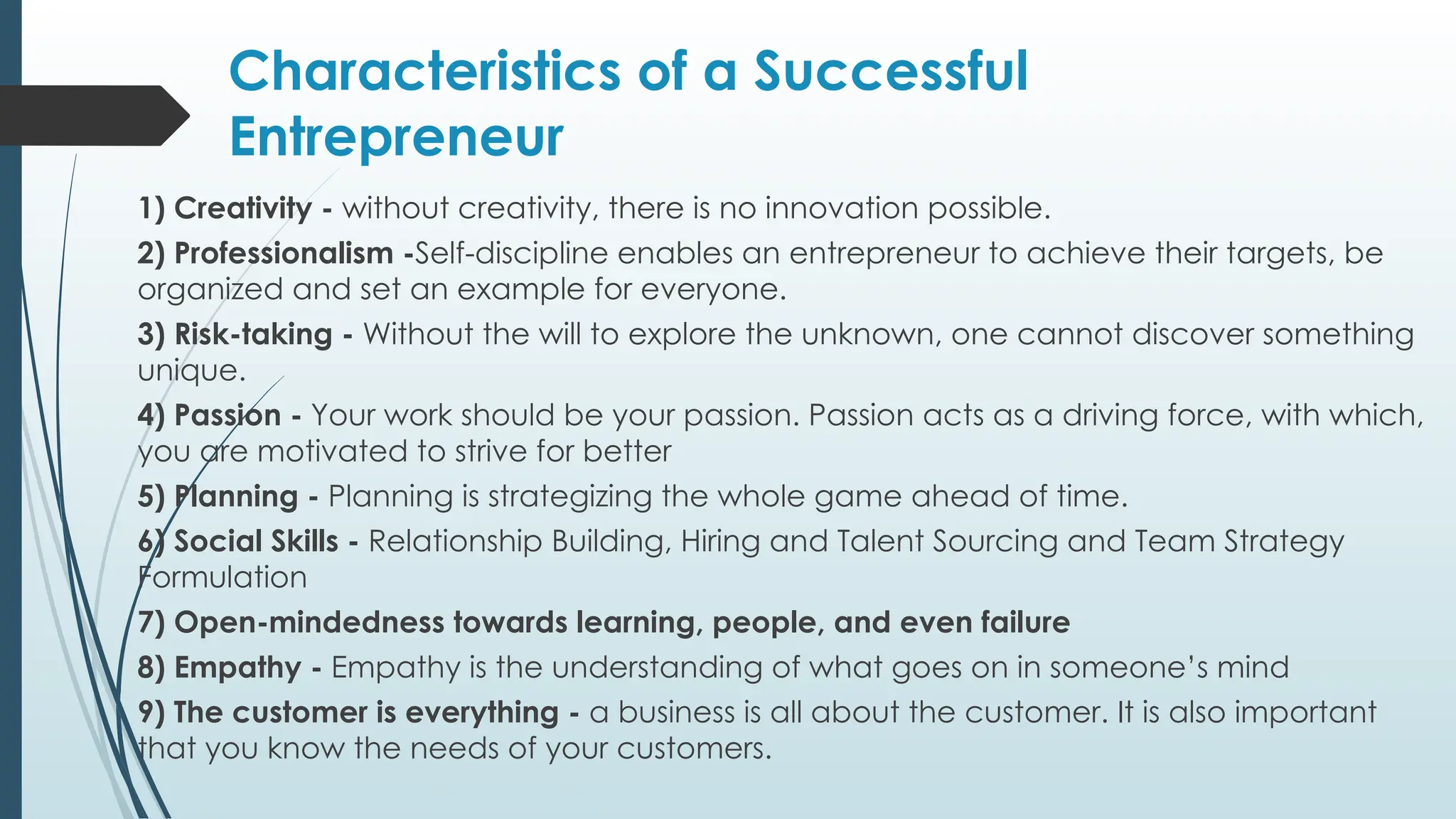
Characteristics of a Successful
Entrepreneur
1) Creativity - without creativity, there is no innovation possible.
2) Professionalism -Self-discipline enables an entrepreneur to achieve their targets, be
organized and set an example for everyone.
3) Risk-taking - Without the will to explore the unknown, one cannot discover something
unique.
4) Passion - Your work should be your passion. Passion acts as a driving force, with which,
you are motivated to strive for better
5) Planning - Planning is strategizing the whole game ahead of time.
6) Social Skills - Relationship Building, Hiring and Talent Sourcing and Team Strategy
Formulation
7) Open-mindedness towards learning, people, and even failure
8) Empathy - Empathy is the understanding of what goes on in someone’s mind
9) The customer is everything - a business is all about the customer. It is also important
that you know the needs of your customers.
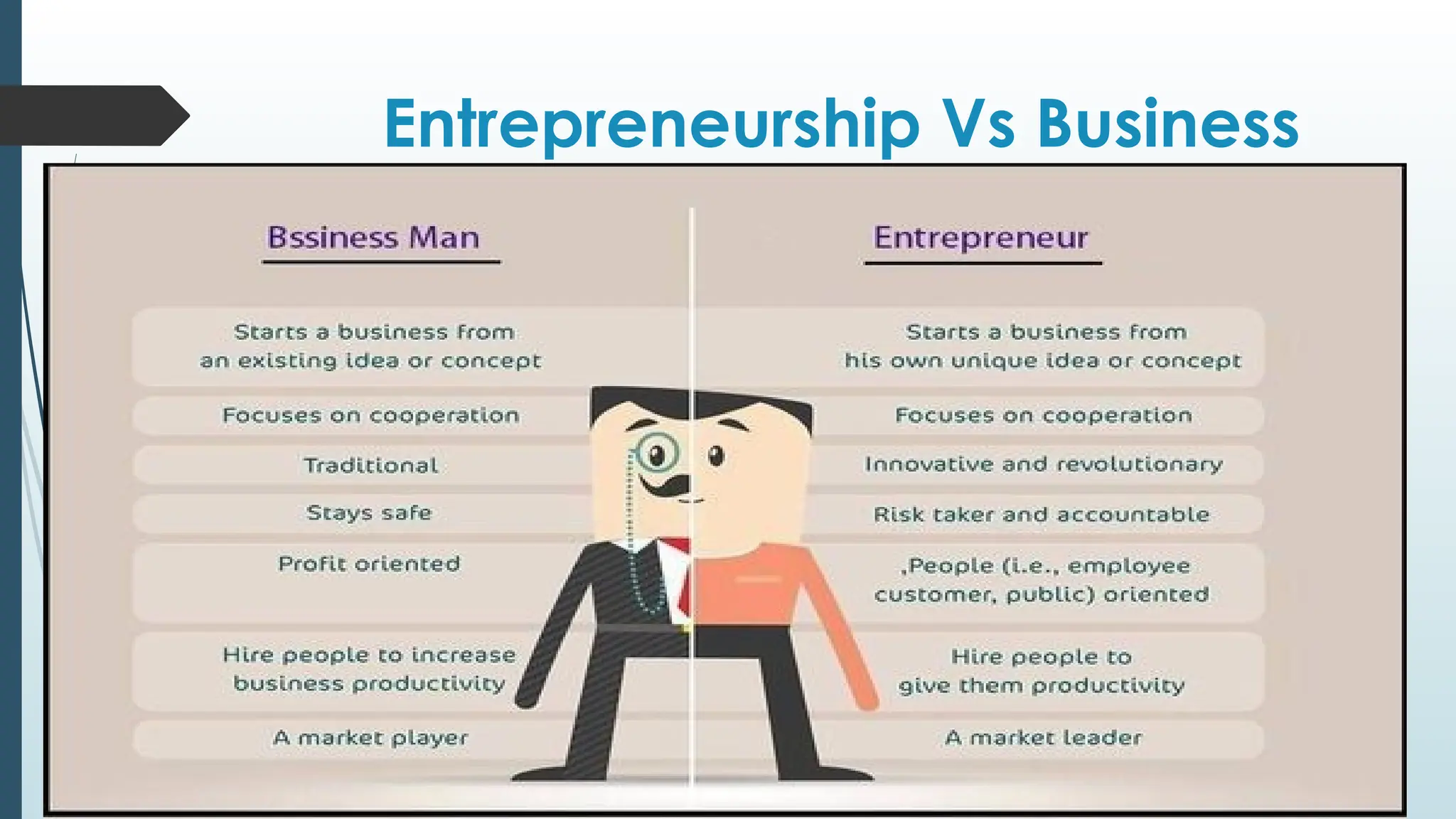
Entrepreneurship Vs Business
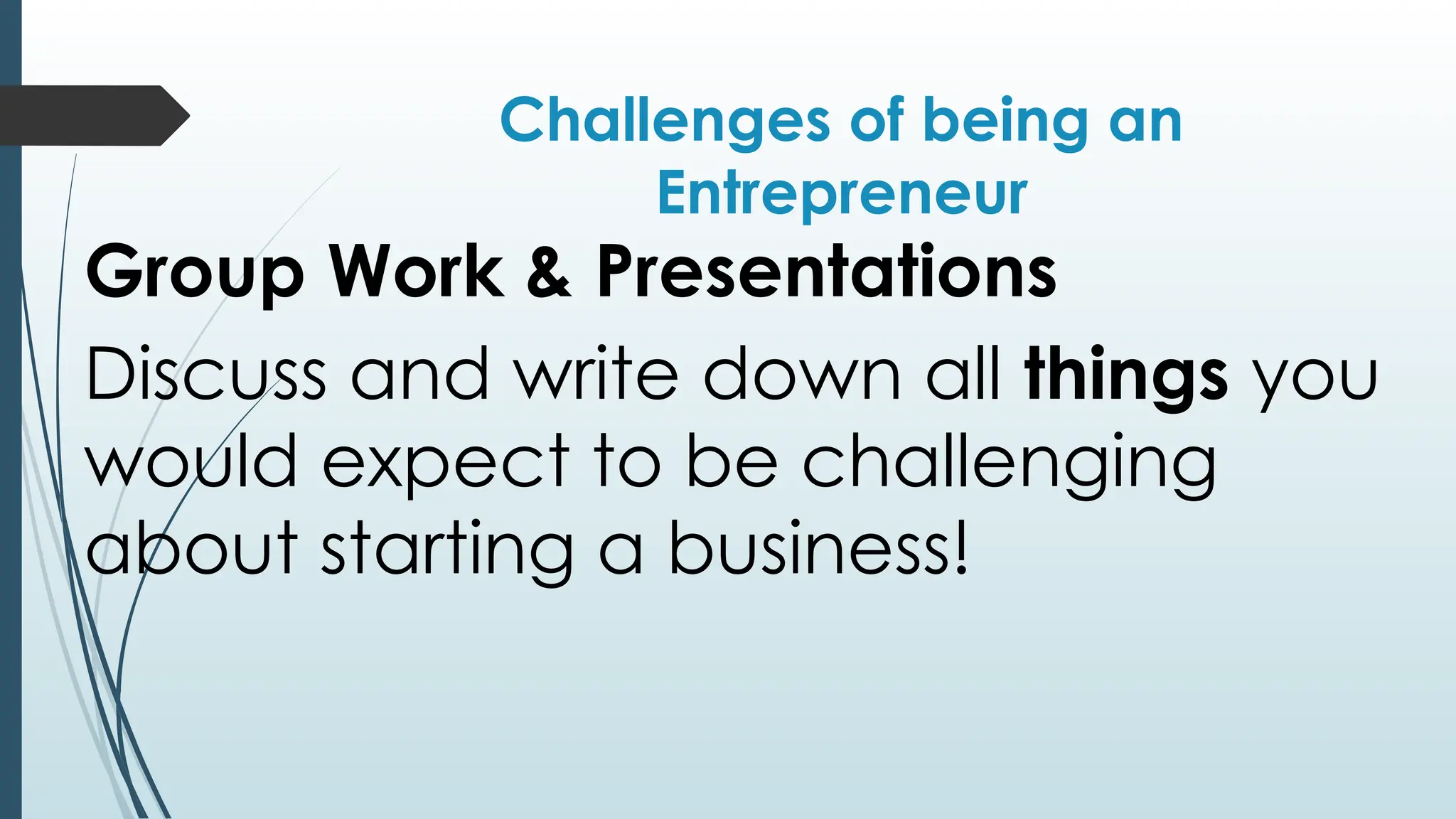
Challenges of being an
Entrepreneur
Group Work & Presentations
Discuss and write down all things you
would expect to be challenging
about starting a business!
Wrap Up(15min)
• Summary for the day
• Now everyone can shoot one or two things that s/he can remember
from today’s session.
Thank You
Any Question?

TOT on Enterpreneurship for University lecturers DAY 1.ppt

  • 1.
    ENTERPRENEURSHIP SKILLS • Whatis entrepreneurship? • Importance of entrepreneurship • Types of entrepreneurship • The for main fears of entrepreneurship • Challenges of being an entrepreneur – General discussion • Understanding myself, the entrepreneur – self-assessment quiz • Qualities of an entrepreneur
  • 2.
    Understanding Entrepreneurship What is entrepreneurship? Entrepreneurshipis; The process of designing, launching and running a new business often small business. And someone who creates and runs a new business is called “an entrepreneur” Entrepreneurship is the process of turning a concept into a developed product.
  • 3.
    Who is anEntrepreneur? • An entrepreneur is any person who creates and develops a business idea and takes the risk of setting up an enterprise to produce a product or service which satisfies customer needs. • An entrepreneur is a job-creator not a job-seeker. • An entrepreneur is a person/Individual who:  Has a dream. Has a vision.  Is willing to take the risk has the ability to identify and pursue a business opportunity; Undertakes, operates a business venture; raises the capital to finance it; gathers the necessary physical, financial and human resources needed to sets goals for him/herself and others;  initiates appropriate action to ensure success
  • 4.
    Entrepreneurship is usedto; Create of a new business Small business Family owned business Highly growth new business Important Notes: Three characteristics of entrepreneurial activity (innovating, running a business and risk taking.
  • 5.
    Share an InspiringStory Anyone have an inspiring business Story?
  • 6.
    Brainstorming Session –15 min 1. Why do you want to become an entrepreneur? Share your BIG Dream and Passion! 2. Do you already have a business idea in mind? 3. I don’t have a business idea but have the drive and enthusiastic to get started? 4. Or have several business ideas?
  • 7.
    The importance ofEntrepreneurship Entrepreneurship enables new markets to develop in the form of goods, services, and technology. It paves ways of generating wealth; these higher earnings contribute to increased national income and tax revenues. It promotes innovation, self-reliance and generates employment opportunities. Entrepreneurial activities may influence a country's economic performance by bringing new products, methods, and production processes to the market and by boosting productivity and competition more broadly.
  • 8.
    Types of Entrepreneurship Hereare the different types of entrepreneurship: Small business entrepreneurship Large company entrepreneurship Scalable startup entrepreneurship Social entrepreneurship Innovative entrepreneurship Hustler entrepreneurship Imitator entrepreneurship Researcher entrepreneurship Buyer entrepreneurship
  • 9.
    Small business entrepreneurship Amajority of businesses are small businesses. People interested in small business entrepreneurship are most likely to make a profit that supports their family and a modest lifestyle. They aren't seeking large-scale profits or venture capital funding. Small business entrepreneurship is often when a person owns and runs their own business.
  • 10.
    Large company entrepreneurship Large company entrepreneurship is when a company has a finite amount of life cycles.  This type of entrepreneurship is for an advanced professional who knows how to sustain innovation.  Large companies often create new services and products based on consumer preferences to meet market demand.  Small business entrepreneurship can turn into large company entrepreneurship when the company rapidly grows.  This can also happen when a large company acquires them. Companies such as Microsoft, Google and Disney are examples of this kind of entrepreneurship.
  • 11.
    Scalable startup entrepreneurship Thiskind of entrepreneurship is when entrepreneurs believe that their company can change the world. Scalable startups look for things that are missing in the market and create solutions for them. Many of these types of businesses start in Silicon Valley and are technology-focused. They seek rapid expansion and big profit returns. Examples of scalable startups are Facebook, Instagram and Uber
  • 12.
    Social entrepreneurship An entrepreneurwho wants to solve social problems with their products and services is in this category of entrepreneurship. Their main goal is to make the world a better place. They don't work to make big profits or wealth. Instead, these kinds of entrepreneurs tend to start nonprofits or companies that dedicate themselves to working toward social good.
  • 13.
    Innovative entrepreneurship Innovative entrepreneursare people who are constantly coming up with new ideas and inventions. They take these ideas and turn them into business ventures. They often aim to change the way people live for the better. Innovators tend to be very motivated and passionate people. They look for ways to make their products and services stand out from other things on the market. People like Steve Jobs and Bill Gates are examples of innovative entrepreneurs.
  • 14.
    Hustler entrepreneurship  Peoplewho are willing to work hard and put in constant effort are considered hustler entrepreneurs.  They often start small and work toward growing a bigger business with hard work rather than capital.  Their aspirations are what motivates them, and they are willing to do what it takes to achieve their goals.  They do not give up easily and are willing to experience challenges to get what they want.  For example, someone who is a hustler is willing to call many people in order to make one sale
  • 15.
    Imitator entrepreneurship Imitators areentrepreneurs who use others' business ideas as inspiration but work to improve them. They look to make certain products and services better and more profitable. An imitator is a combination between an innovator and a hustler. They are willing to think of new ideas and work hard, yet they start by copying others. People who are imitators have a lot of self-confidence and determination. They can learn from others' mistakes when making their own business.
  • 16.
    Researcher entrepreneurship Researchers taketheir time when starting their own business. They want to do as much research as possible before offering a product or service.  They believe that with the right preparation and information, they have a higher chance of being successful. A researcher makes sure they understand every aspect of their business and have an in-depth understanding of what they are doing.
  • 17.
    Buyer entrepreneurship A buyeris a type of entrepreneur who uses their wealth to fuel their business ventures.  Their specialty is to use their fortunes to buy businesses that they think will be successful. They identify promising businesses and look to acquire them. Then, they make any management or structural changes they feel are necessary. Their goal is to grow the businesses they acquire and expand their profits. This kind of entrepreneurship is less risky because they are purchasing already well-established companies.
  • 18.
    The four mainfears of entrepreneurship Fear is a common emotion that often manifests itself into excuses, procrastination, or inaction.Indeed, many psychologists say that fear is the root cause of most human problems. Listed below are four of the most common fears associated with starting a business.
  • 19.
    1. Age  Exactlywhat age is too old or too young to run a business?  Years ago, the owner of a sporting goods store in the USA celebrated his 100th birthday (he opened his enterprise in 1933). He was only working four hours a day, but he was still working, and introducing new products, and beating his competitors. Colonel Sanders, the man who invented Kentucky Fried Chicken, began selling his secret formula to franchisees at the age of 64.
  • 20.
    2. Lack ofMoney There’s no doubt that having lots of capital makes starting a business somewhat easier. Yet a sizeable number of successful practitioners steadfastly believe that having a better-than-average amount of start-up capital has little to do with overall success.  Indeed, quite a few hard-nosed entrepreneurs claim that it’s actually beneficial to create a business with as little money as possible.
  • 21.
    3. Fear ofRejection Most successful business owners readily admit that the path to prosperity is paved with rejection. Indeed, many hard-core entrepreneurs state quite openly that they often fail twice as much as others. So why do they end up succeeding? Because they try more. Instead of giving up, successful business owners learn to deal with failure and adversity and then move on.
  • 22.
    4. Lack ofEducation or Experience There is evidence that suggests a college education does not guarantee business success. Indeed, it sometimes appears otherwise. Steven Jobs and Stephen Wozniak, for example, founded Apple Computer after dropping out of college. Neither one of them had any entrepreneurial experience. Michael Dell, the multi-millionaire founder of Dell Computer, is also a college dropout.
  • 23.
    “The man whowins is the man who works, Who neither labor nor trouble shirks (avoids/neglects responsibility); Who uses his head, his hands, his eyes – The man who wins is the man who tries.” Conrad Hilton
  • 24.
    Personal Qualifies Self- assessmentExercise 15min Use the checklist below to assess your Personal Entrepreneurial Characteristics (PEC) by ticking the answer that most nearly expresses you. Be as honest as you can!
  • 25.
    Characteristics of aSuccessful Entrepreneur 1) Creativity - without creativity, there is no innovation possible. 2) Professionalism -Self-discipline enables an entrepreneur to achieve their targets, be organized and set an example for everyone. 3) Risk-taking - Without the will to explore the unknown, one cannot discover something unique. 4) Passion - Your work should be your passion. Passion acts as a driving force, with which, you are motivated to strive for better 5) Planning - Planning is strategizing the whole game ahead of time. 6) Social Skills - Relationship Building, Hiring and Talent Sourcing and Team Strategy Formulation 7) Open-mindedness towards learning, people, and even failure 8) Empathy - Empathy is the understanding of what goes on in someone’s mind 9) The customer is everything - a business is all about the customer. It is also important that you know the needs of your customers.
  • 26.
  • 27.
    Challenges of beingan Entrepreneur Group Work & Presentations Discuss and write down all things you would expect to be challenging about starting a business!
  • 28.
    Wrap Up(15min) • Summaryfor the day • Now everyone can shoot one or two things that s/he can remember from today’s session.
  • 29.