Presented by-
   Anjali Patel
   Naynee Kukreja
BUSINESS ENVIRONMENT

The term Business Environment is composed
of two words „Business‟ and „Environment‟.

 Theword Business in its economic sense
 means human activities like production,
 extraction or purchase or sales of goods
 that are performed for earning profits.

 „Environment‟   refers to the aspects of
 surroundings.
BUSINESS ENVIRONMENT
      Business environment may be defined as
the set of external and internal factors which
affects the decisions of business.

“Comprises of the complex factors, largely if not
totally beyond the control of management in
which a particular enterprise operates”.

The firms Success and survival is dependent on
its inter-linkages, synergy and its adaptability to
the environment.
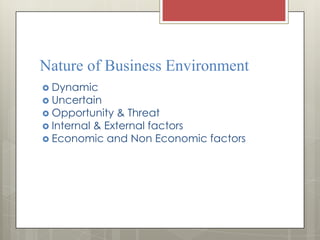
Nature of Business Environment
 Dynamic
 Uncertain
 Opportunity  & Threat
 Internal & External factors
 Economic and Non Economic factors
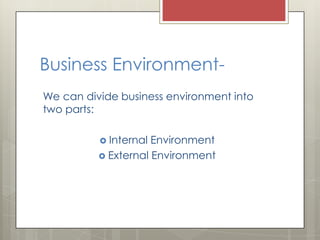
Business Environment-
We can divide business environment into
two parts:

           Internal Environment
           External Environment
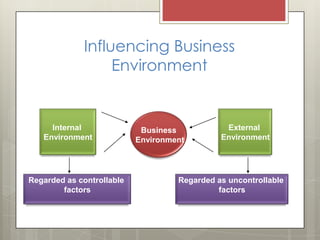
Influencing Business
                  Environment


     Internal               Business           External
   Environment             Environment        Environment


Regarded as controllable            Regarded as uncontrollable
        factors                              factors
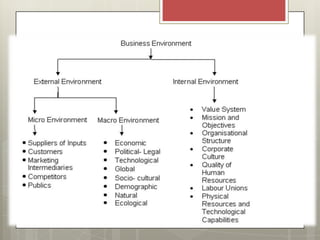
The Micro Environment
These are powers which are deeply related
with company and company can control
these type of environment by improving its
capacity and efficiency.
Micro Environment
Suppliers
  Suppliers are the persons who supply raw
  material to company.

   If uncertainty (regular supply, quality, price)
    about suppliers exists, high inventory cost.
   Egs- JIT, WalMart
   Suppliers as partners
   Vertical integration
Micro Environment
Customers
 Customers are the persons who buy goods
 from company.


   Profile
   Customer switching
   Relationship marketing
Micro Environment
Market Intermediaries
     Market intermediaries are those person
     who helps company to sell its products.

   Distribution channels
   Logistics, Warehouse
   Ad agencies, Market research firm,
    Consultancy
Micro Environment
Financial Intermediaries
     Financial intermediaries are those
     institutions who provide loan, credit
     and advance to company.
 Banks
 NBFCs
 Agencies
Micro Environment
Competitors
    Competitors are those who also sell
    same product as the company.

 Mono/Duo/Oligopoly/Perfect
  competition
 Desire/Generic/Product form/Brand
  competition
Micro Environment
Public
       Public is that group of people who
       can buy or who can show their
       interest to buy the products of
       company.
 Media
 Citizen
 NGOs
 Local public
Micro Environment

 More  controllable than the macro
  environment
 May be firm specific
 More intimately linked with firm than the
  macro environment
The Macro Environment
Macro environment of business
means all external factors which
affects company and its business and
there is no control of company on
these factors.
Macro Environment
Economic
We can introduce economic environment as all
the factors which affect business due to changing
the economic policies, economic system and
economic conditions.

 Stage   of economic cycle, Growth rate
 National Income-GDP, GNP, Per capita
  Income, Income distribution
 Inflation- CPI, WPI
Macro Environment
Political environment
Political environment also affects business
with different business laws. These laws
controls all the activities of business.

   Political system (forms of govt)- Pure
    democracy, Republic, Theocracy,
    Totalitarianism
   Political philosophy- LPG, Political stability,
    Institutions
   Regulations and laws for general
   Code of conduct of business, Govt. policies.
Macro Environment
Demography
In demographic environment of business,
we can include following things.

   Size of population
   Growth rate
   family size
   Educational level
   Age composition
   Sex composition
Macro Environment
Technological Environment

   efficiency of infrastructure, including: roads, ports,
    airports, rolling stock, hospitals, education,
    healthcare, communication, etc.
   industrial productivity
   new manufacturing processes
   new products and services of competitors
   new products and services of supply chain
    partners
   any new technology that could impact the
    company
Status of Technological
Environment or Technology in
India :-
    Establishment of technological and research
    institute
    Positive Technical policy
    High Growth Rate of Information Technology
    in India.
    Incentive for promoting Technology in India
Significance of B.E.
   Facilitates operations of the organization.
   Form the basis of long term policies, plans and
    strategies of organization.
   Help organization in identifying &
    understanding its competitors.
   Help the firms to expand & grow.
   In-cashing business opportunities
   Affect internal control
Significance of B.E.
   Optimize scare resources
   Market relevant technology development
   Avoiding threats
   Competitors analysis, Sustainable competitive
    advantage
   Monitoring and forecasting
   Strategy formulation
   Power relationships and lobbying
   International trade

Business environment

  • 1.
    Presented by-  Anjali Patel  Naynee Kukreja
  • 2.
    BUSINESS ENVIRONMENT The termBusiness Environment is composed of two words „Business‟ and „Environment‟.  Theword Business in its economic sense means human activities like production, extraction or purchase or sales of goods that are performed for earning profits.  „Environment‟ refers to the aspects of surroundings.
  • 3.
    BUSINESS ENVIRONMENT Business environment may be defined as the set of external and internal factors which affects the decisions of business. “Comprises of the complex factors, largely if not totally beyond the control of management in which a particular enterprise operates”. The firms Success and survival is dependent on its inter-linkages, synergy and its adaptability to the environment.
  • 4.
    Nature of BusinessEnvironment  Dynamic  Uncertain  Opportunity & Threat  Internal & External factors  Economic and Non Economic factors
  • 5.
    Business Environment- We candivide business environment into two parts:  Internal Environment  External Environment
  • 6.
    Influencing Business Environment Internal Business External Environment Environment Environment Regarded as controllable Regarded as uncontrollable factors factors
  • 8.
    The Micro Environment Theseare powers which are deeply related with company and company can control these type of environment by improving its capacity and efficiency.
  • 9.
    Micro Environment Suppliers Suppliers are the persons who supply raw material to company.  If uncertainty (regular supply, quality, price) about suppliers exists, high inventory cost.  Egs- JIT, WalMart  Suppliers as partners  Vertical integration
  • 10.
    Micro Environment Customers Customersare the persons who buy goods from company.  Profile  Customer switching  Relationship marketing
  • 11.
    Micro Environment Market Intermediaries Market intermediaries are those person who helps company to sell its products.  Distribution channels  Logistics, Warehouse  Ad agencies, Market research firm, Consultancy
  • 12.
    Micro Environment Financial Intermediaries Financial intermediaries are those institutions who provide loan, credit and advance to company.  Banks  NBFCs  Agencies
  • 13.
    Micro Environment Competitors Competitors are those who also sell same product as the company.  Mono/Duo/Oligopoly/Perfect competition  Desire/Generic/Product form/Brand competition
  • 14.
    Micro Environment Public Public is that group of people who can buy or who can show their interest to buy the products of company.  Media  Citizen  NGOs  Local public
  • 15.
    Micro Environment  More controllable than the macro environment  May be firm specific  More intimately linked with firm than the macro environment
  • 16.
    The Macro Environment Macroenvironment of business means all external factors which affects company and its business and there is no control of company on these factors.
  • 17.
    Macro Environment Economic We canintroduce economic environment as all the factors which affect business due to changing the economic policies, economic system and economic conditions.  Stage of economic cycle, Growth rate  National Income-GDP, GNP, Per capita Income, Income distribution  Inflation- CPI, WPI
  • 18.
    Macro Environment Political environment Politicalenvironment also affects business with different business laws. These laws controls all the activities of business.  Political system (forms of govt)- Pure democracy, Republic, Theocracy, Totalitarianism  Political philosophy- LPG, Political stability, Institutions  Regulations and laws for general  Code of conduct of business, Govt. policies.
  • 19.
    Macro Environment Demography In demographicenvironment of business, we can include following things.  Size of population  Growth rate  family size  Educational level  Age composition  Sex composition
  • 20.
    Macro Environment Technological Environment  efficiency of infrastructure, including: roads, ports, airports, rolling stock, hospitals, education, healthcare, communication, etc.  industrial productivity  new manufacturing processes  new products and services of competitors  new products and services of supply chain partners  any new technology that could impact the company
  • 21.
    Status of Technological Environmentor Technology in India :-  Establishment of technological and research institute  Positive Technical policy  High Growth Rate of Information Technology in India.  Incentive for promoting Technology in India
  • 22.
    Significance of B.E.  Facilitates operations of the organization.  Form the basis of long term policies, plans and strategies of organization.  Help organization in identifying & understanding its competitors.  Help the firms to expand & grow.  In-cashing business opportunities  Affect internal control
  • 23.
    Significance of B.E.  Optimize scare resources  Market relevant technology development  Avoiding threats  Competitors analysis, Sustainable competitive advantage  Monitoring and forecasting  Strategy formulation  Power relationships and lobbying  International trade

Editor's Notes

  • #10 We can control them, if we pay them on the time. We should also keep contacts with multiple sources because it is very less risky. If one supplier stops to supply us, we can get raw material from other supplier.
  • #11 If the customers do not feel delighted they will buy from other sources leading to decline in sales.hence we should maintain good relations with our customers.
  • #12 Middlemen, physical distribution firms and marketing service agencies are main market intermediaries. We should choose best market intermediaries for fast distribution of our products.
  • #14 . If company has to win competition, it has to sell good quality product at lower price.
  • #18  In big companies, there may be large number of economist whose work is to make economic policies and economic planning They monitor all external economic factors and to reduce company's economic weaknesses and risks.
  • #19 In India, there are lots of laws which has been made by Indian Govt. In these laws, we can add company law 1956 and Factory act 1948. For controlling stock exchanges,Govt. has made SEBI. For controlling banking business, Govt. has made RBI.
  • #20  1. Size of population- All these elements are relating to business. If size of population is increasing with high growth rate, demand is increased.2. Growth rate- High growth rate of population is also tells us high rate of supply of laborers. Many companies motives to invest money in developing countries due Cheap labor power and developing market. 3. family size:Suppose, we are making residential rooms. For making residential rooms, we should study the number of family members who will live in it4. Educational level-Educational level of our customer may also affect our marketing techniques. If our customers are very educated, we can use online advertising, if they are not educated we have to use old means of advertising.5 Age composition- Before producing the product, we see what age group will use this. For example, young population are interested to wear jeans but old age population are interested to wear kurta and pajama.6. Sex composition-Sex composition are two one is male and other is female. We also study the number of our customers who are female and no. of our customers are female. If female are more than male, we will care their need specially in making of our products.
  • #21 We can include ecommerce technology, online payment, Internet technology, mobile banking and 3G technology and all other new technology which affect company's business.New inventions to produce the products.New inventions relating to marketing like BPO for selling online in international market