Entrepreneurship
Development
STARTING A NEW VENTURE
An entrepreneur have several options to
start his entrepreneurial activities
 He/She may buy an existing business
 Starting a new business
 Franchising
Buying an existing business
Reasons for buying an existing firm:
 To reduce some of the uncertainties and unknowns that
must be faced in starting a business from the ground up.
 To acquire a business with ongoing operations and
established relationships with customers and suppliers.
 To obtain an established business at a price below what it
would cost to start a new business.
 To own a successful establishment with goodwill.
 To avail the facility of good location.
 To avoid the difficulties of capital formation and market
development.
Pros and Cons of Buying an
Existing Business
Pros
 High chance of success
 Less planning
 Existing customers/
suppliers
 Necessary equipment
 Experienced employees
 Existing business records
 Existing problems
 Poor quality of current
employees
 Poor business image
 Modernization required
 Purchase price based on
inaccurate data
 Poor business location
Factors to be considered
before buying
 History of the business and its related industry.
 Business profit, sales, cash flows, market condition and expense
figures(Past and projected).
 Business Profile(Image and goodwill).
 Cost of purchasing the firm.
 Reasons for sale.
 Other areas of concern:
 Assets and Liabilities.
 Location.
 Licenses.
 Employees.
 Merchandise.
 Machineries and equipments.
Finding Out Why the Business Is
For Sale
 Owner’s reasons for selling the business:
 Old age or illness.
 Interest for another business
 High rate of taxes and other levies.
 Desire to relocate in a different section of the country
 Decision to accept a position with another company
 Unprofitability of the business
 Discontinuance of an sales
 Maturation of the industry and lack of growth potential
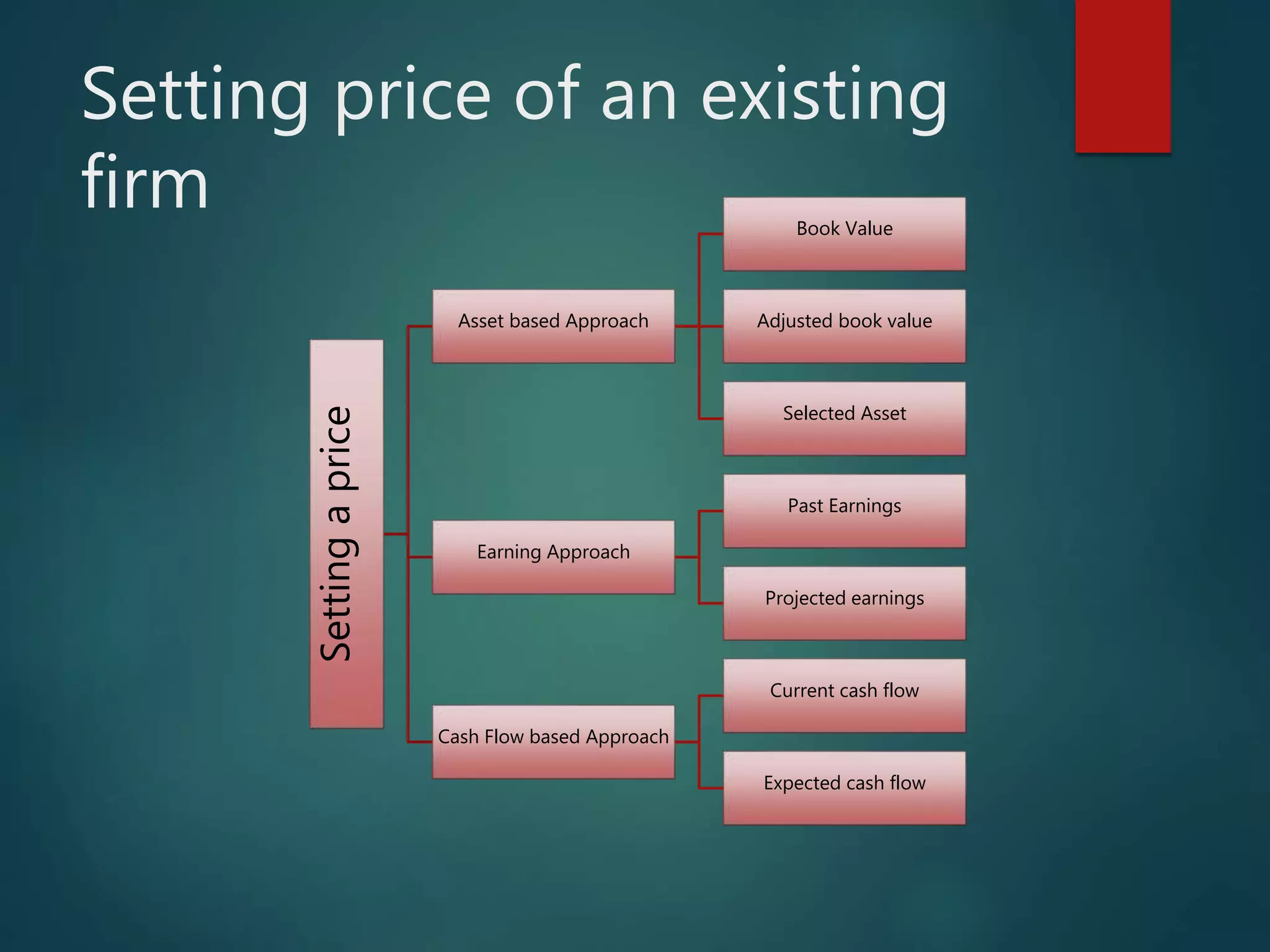
Setting price of an existing
firm
Settingaprice
Asset based Approach
Book Value
Adjusted book value
Selected Asset
Earning Approach
Past Earnings
Projected earnings
Cash Flow based Approach
Current cash flow
Expected cash flow
Non-quantitative Factors in
Valuing a Business
 Competition
 Market
 Future Community Development
 Legal Commitments
 Union Contracts
 Buildings
 Product Prices
Negotiating and Closing the
Deal
 Terms of Purchase
-Assets purchase or total entity
–Indemnification clause
–Payment in full or partial payments over time
 Closing the sale
–Best handled by a third party
-Bill of sale
-Tax certifications
-Payment-to-seller agreements and guarantees
Reasons for starting a new
business
 Environmental factors( geographical location, easy access to
market, abundance of resources, density of population)
 Motivational factors( liberty, Self-satisfaction, goodwill, self-
esteem, risk reference group)
 Technical factors( personal skill, advancement of technology)
 Financial factors( family income, credit facility)
Reasons against starting a
new business
 Risk
 Operational complexity
 Managerial complexity (Planning, organizing,
controlling)
 Lack of proper education, skill and experience,
 Finance issue
 Bureaucracy
 Environmental issue
 Market condition
 Uncertainty
Essentials of starting a new
business
Entrepreneurial
Skill
Interpersonal
Technical
Educational
Analytical
Factors affecting the decision of
starting new business
Individual
Environment
Organization
Process
Steps to be followed to start
a new business
Decision to
start
Selecting an
industry
Forms of
Ownership
Name Selection
Location
Decision
Legal clearance
Bank Account
Decision to start
 Innovation
 Motivations behind starting new business
 Drawbacks of other options( Franchising, buying
existing firms)
 Financing Issues( Capital Sources-personal/bank/other
sources)
Selecting an industry
 Trading Business
 Export-Import
 Manufacturing
 Service
Forms of Ownership
 Sole proprietorship
 Partnership
 Co-operative
 Company
Name Selection
 Name Selection
 Clearance
 Trade License
Location Decision
(factors)
 Market and customers
 Transportation
 Labor supply
 Raw material supply
 Tax rate
 Community attitude
 Land
 climate
Legal clearance
Necessary documents for an entrepreneur
 Trade license
 Certificate of incorporation
 TIN
 Vat registration no.
 Cert. from dept. of environment
 Fire license, etc.
Bank Account
 Separate bank Account is also important for a business. For
this entrepreneur have to open a bank account in a specific
bank with a specific name.
Franchising
Franchising is a system used by a company (franchisor) that grants
others(franchisees) the right and license (franchise) to market a
product or service under the franchisor’s trade names, trademarks,
service marks, know-how and method of doing business. It is a
system for distributing products or services through independent
resellers. It is a format of mutual dependence which allows both the
franchisor and the franchisee realize profits and benefits.
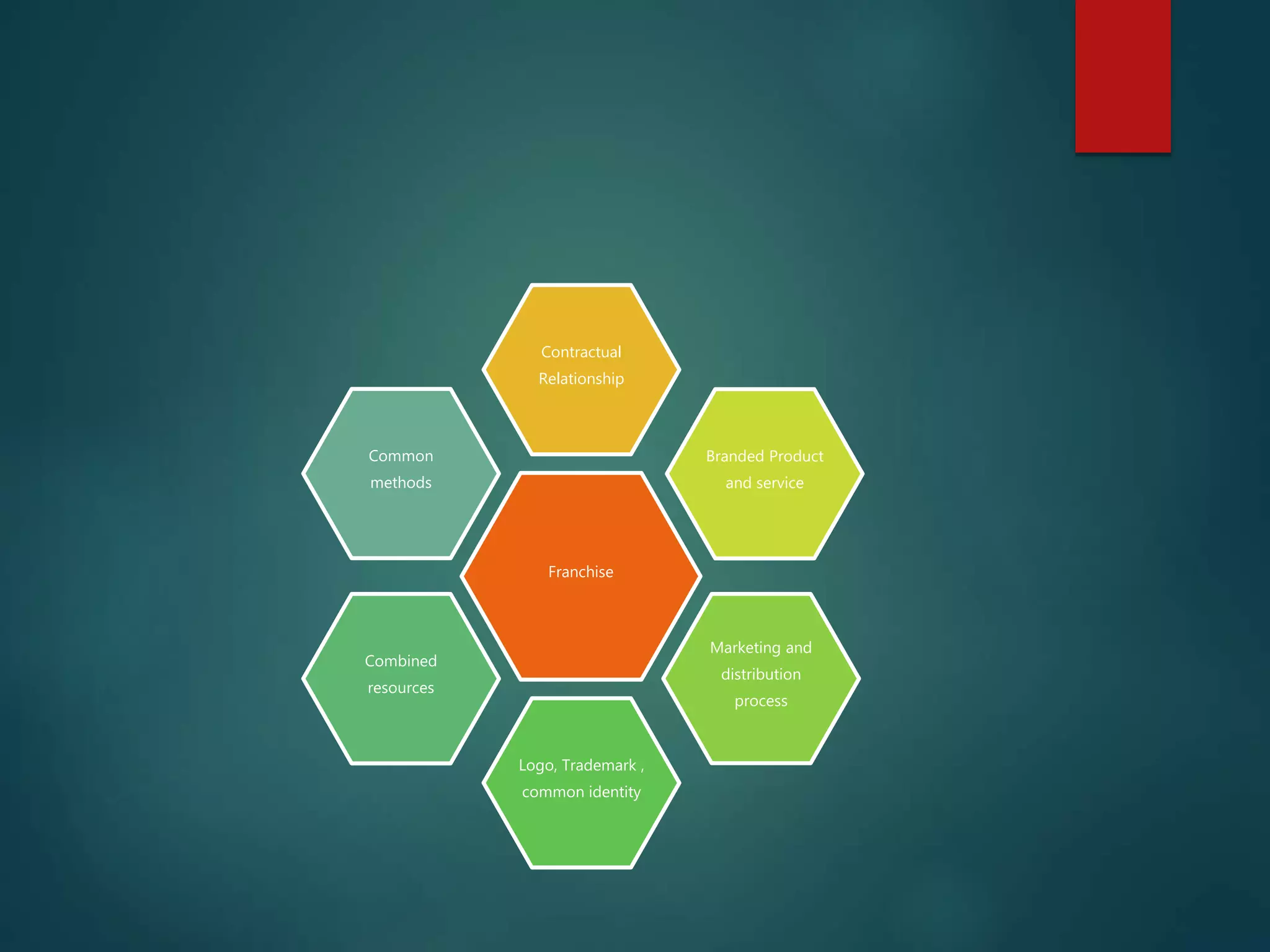
Franchise
Contractual
Relationship
Branded Product
and service
Marketing and
distribution
process
Logo, Trademark ,
common identity
Combined
resources
Common
methods
Some Terms Regarding
Franchising
Franchisor:
The licensing company in the franchise agreement.
Franchisee:
The independent owner of a franchise outlet who enters into an
agreement with a franchisor.
Franchise:
The right to use a specific business name and sell its goods or services in
a specific city, region or country.
ADVANTAGES & DISADVANTAGES
OF FRANCHISING(To the Franchisee)
ADVANTAGES
 Established Concept
 Tools for Success
 Technical & Managerial Help
 Standards & Quality Control
 Minimum Risk
 Less Operating Capital
 Access to Credit
 Research & Development
 Advertisement & Promotion
 Other Opportunities
DISADVANTAGES
 Unfulfilled Expectations
 Lack of Freedom
 Advertisement & Promotion
 Practices
 Cost of Services
 Over Dependence
 Monotony & Lack of
Challenge
 Termination and Renewal
 Other problems
ADVANTAGES & DISADVANTAGES
OF FRANCHISING(To the Franchisor)
ADVANTAGES
 Business Expansion
 Buying Power
 Operational Convenience
 Franchisee’s Contribution
 Motivation & Cooperation
DISADVANTAGES
 Lack of Freedom
 Franchisee’s Financial
Situation
 Franchisee Recruitment,
Selection and Retention
 Communication
Purposes of Franchising
 Getting the Brand Recognition
 Taking advantage of Growth Opportunities
 Achieving Management and Technical Experience.
 Maintaining Quality and Consistency
 To compete with big business.
 To allow consumers to buy good quality items or
services at the right price.
 To provide entrepreneurs a means to enter business
with a low capital investment and risk.
TWO MAIN TYPES OF
FRANCHISING
 PRODUCT DISTRIBUTION FRANCHISE
 BUSINESS FORMAT FRANCHISE
PRODUCT DISTRIBUTION
FRANCHISE
 Franchise that simply sells the
products of the franchisor and
have supplier-dealer
relationships.
 The franchisor licenses its
trademarks and logo to the
franchisee but does not
necessarily provide them with an
ENTIRE system for running their
business.
BUSINESS FORMAT
FRANCHISE
 This type of franchise includes
not only the a product, service
and trademark but also the
complete method to conduct the
business itself, such as the
marketing plan and operations
manual. examples: fast food,
service, restaurants

Starting a new venture

  • 1.
  • 2.
    An entrepreneur haveseveral options to start his entrepreneurial activities  He/She may buy an existing business  Starting a new business  Franchising
  • 3.
    Buying an existingbusiness Reasons for buying an existing firm:  To reduce some of the uncertainties and unknowns that must be faced in starting a business from the ground up.  To acquire a business with ongoing operations and established relationships with customers and suppliers.  To obtain an established business at a price below what it would cost to start a new business.  To own a successful establishment with goodwill.  To avail the facility of good location.  To avoid the difficulties of capital formation and market development.
  • 4.
    Pros and Consof Buying an Existing Business Pros  High chance of success  Less planning  Existing customers/ suppliers  Necessary equipment  Experienced employees  Existing business records  Existing problems  Poor quality of current employees  Poor business image  Modernization required  Purchase price based on inaccurate data  Poor business location
  • 5.
    Factors to beconsidered before buying  History of the business and its related industry.  Business profit, sales, cash flows, market condition and expense figures(Past and projected).  Business Profile(Image and goodwill).  Cost of purchasing the firm.  Reasons for sale.  Other areas of concern:  Assets and Liabilities.  Location.  Licenses.  Employees.  Merchandise.  Machineries and equipments.
  • 6.
    Finding Out Whythe Business Is For Sale  Owner’s reasons for selling the business:  Old age or illness.  Interest for another business  High rate of taxes and other levies.  Desire to relocate in a different section of the country  Decision to accept a position with another company  Unprofitability of the business  Discontinuance of an sales  Maturation of the industry and lack of growth potential
  • 7.
    Setting price ofan existing firm Settingaprice Asset based Approach Book Value Adjusted book value Selected Asset Earning Approach Past Earnings Projected earnings Cash Flow based Approach Current cash flow Expected cash flow
  • 8.
    Non-quantitative Factors in Valuinga Business  Competition  Market  Future Community Development  Legal Commitments  Union Contracts  Buildings  Product Prices
  • 9.
    Negotiating and Closingthe Deal  Terms of Purchase -Assets purchase or total entity –Indemnification clause –Payment in full or partial payments over time  Closing the sale –Best handled by a third party -Bill of sale -Tax certifications -Payment-to-seller agreements and guarantees
  • 10.
    Reasons for startinga new business  Environmental factors( geographical location, easy access to market, abundance of resources, density of population)  Motivational factors( liberty, Self-satisfaction, goodwill, self- esteem, risk reference group)  Technical factors( personal skill, advancement of technology)  Financial factors( family income, credit facility)
  • 11.
    Reasons against startinga new business  Risk  Operational complexity  Managerial complexity (Planning, organizing, controlling)  Lack of proper education, skill and experience,  Finance issue  Bureaucracy  Environmental issue  Market condition  Uncertainty
  • 12.
    Essentials of startinga new business Entrepreneurial Skill Interpersonal Technical Educational Analytical
  • 13.
    Factors affecting thedecision of starting new business Individual Environment Organization Process
  • 14.
    Steps to befollowed to start a new business Decision to start Selecting an industry Forms of Ownership Name Selection Location Decision Legal clearance Bank Account
  • 15.
    Decision to start Innovation  Motivations behind starting new business  Drawbacks of other options( Franchising, buying existing firms)  Financing Issues( Capital Sources-personal/bank/other sources)
  • 16.
    Selecting an industry Trading Business  Export-Import  Manufacturing  Service
  • 17.
    Forms of Ownership Sole proprietorship  Partnership  Co-operative  Company
  • 18.
    Name Selection  NameSelection  Clearance  Trade License
  • 19.
    Location Decision (factors)  Marketand customers  Transportation  Labor supply  Raw material supply  Tax rate  Community attitude  Land  climate
  • 20.
    Legal clearance Necessary documentsfor an entrepreneur  Trade license  Certificate of incorporation  TIN  Vat registration no.  Cert. from dept. of environment  Fire license, etc.
  • 21.
    Bank Account  Separatebank Account is also important for a business. For this entrepreneur have to open a bank account in a specific bank with a specific name.
  • 22.
    Franchising Franchising is asystem used by a company (franchisor) that grants others(franchisees) the right and license (franchise) to market a product or service under the franchisor’s trade names, trademarks, service marks, know-how and method of doing business. It is a system for distributing products or services through independent resellers. It is a format of mutual dependence which allows both the franchisor and the franchisee realize profits and benefits.
  • 23.
    Franchise Contractual Relationship Branded Product and service Marketingand distribution process Logo, Trademark , common identity Combined resources Common methods
  • 24.
    Some Terms Regarding Franchising Franchisor: Thelicensing company in the franchise agreement. Franchisee: The independent owner of a franchise outlet who enters into an agreement with a franchisor. Franchise: The right to use a specific business name and sell its goods or services in a specific city, region or country.
  • 25.
    ADVANTAGES & DISADVANTAGES OFFRANCHISING(To the Franchisee) ADVANTAGES  Established Concept  Tools for Success  Technical & Managerial Help  Standards & Quality Control  Minimum Risk  Less Operating Capital  Access to Credit  Research & Development  Advertisement & Promotion  Other Opportunities DISADVANTAGES  Unfulfilled Expectations  Lack of Freedom  Advertisement & Promotion  Practices  Cost of Services  Over Dependence  Monotony & Lack of Challenge  Termination and Renewal  Other problems
  • 26.
    ADVANTAGES & DISADVANTAGES OFFRANCHISING(To the Franchisor) ADVANTAGES  Business Expansion  Buying Power  Operational Convenience  Franchisee’s Contribution  Motivation & Cooperation DISADVANTAGES  Lack of Freedom  Franchisee’s Financial Situation  Franchisee Recruitment, Selection and Retention  Communication
  • 27.
    Purposes of Franchising Getting the Brand Recognition  Taking advantage of Growth Opportunities  Achieving Management and Technical Experience.  Maintaining Quality and Consistency  To compete with big business.  To allow consumers to buy good quality items or services at the right price.  To provide entrepreneurs a means to enter business with a low capital investment and risk.
  • 28.
    TWO MAIN TYPESOF FRANCHISING  PRODUCT DISTRIBUTION FRANCHISE  BUSINESS FORMAT FRANCHISE
  • 29.
    PRODUCT DISTRIBUTION FRANCHISE  Franchisethat simply sells the products of the franchisor and have supplier-dealer relationships.  The franchisor licenses its trademarks and logo to the franchisee but does not necessarily provide them with an ENTIRE system for running their business. BUSINESS FORMAT FRANCHISE  This type of franchise includes not only the a product, service and trademark but also the complete method to conduct the business itself, such as the marketing plan and operations manual. examples: fast food, service, restaurants