"Now Everyone Can Fly"..
BACKGROUND/HISTORY
BACKGROUND/HISTORY
Thai National Airline was the only one
airline which could fly in the main routes
such as Bangkok-Chiang Mai by non-stop

traveling in the past.
Other airlines had to land at Utapao airport
before taking off to Chiang Mai.
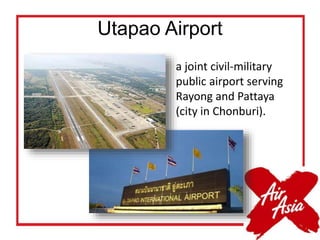
Utapao Airport
a joint civil-military
public airport serving
Rayong and Pattaya
(city in Chonburi).
BACKGROUND/HISTORY
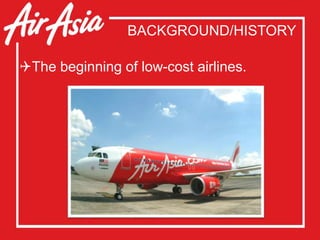
The beginning of low-cost airlines.
BACKGROUND/HISTORY
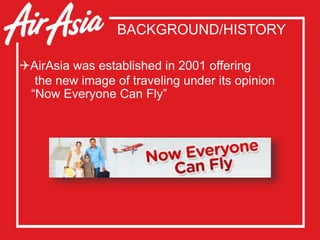
AirAsia was established in 2001 offering
the new image of traveling under its opinion
“Now Everyone Can Fly”
BACKGROUND/HISTORY
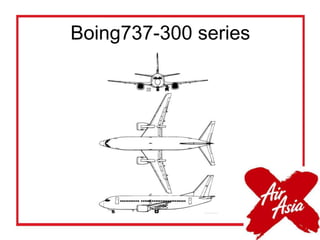
AirAsia began with only 2 Boing737-300
series and started its first
point-to-point flight.
Boing737-300 series
BACKGROUND/HISTORY
It presented low rate of fares as well as
services which is necessible.
BACKGROUND/HISTORY
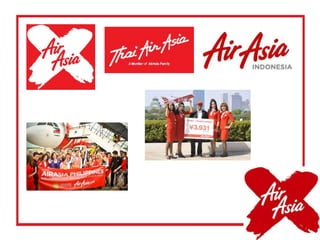
AirAsia has swiftly broken travel norms
around the globe and has risen to become
the world’s best.
With a route network that spans through to
over 20 countries,
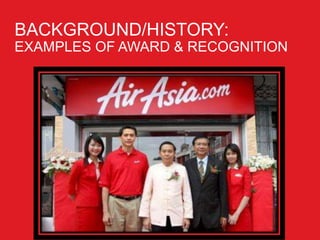
BACKGROUND/HISTORY:
EXAMPLES OF AWARD & RECOGNITION
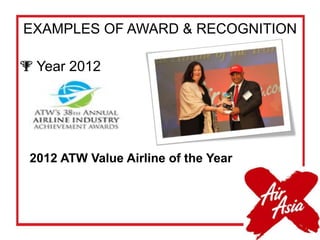
 Year 2012
2012 ATW Value Airline of the Year
EXAMPLES OF AWARD & RECOGNITION
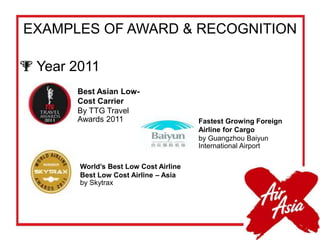
 Year 2011
Best Asian Low-
Cost Carrier
By TTG Travel
Awards 2011
World’s Best Low Cost Airline
Best Low Cost Airline – Asia
by Skytrax
Fastest Growing Foreign
Airline for Cargo
by Guangzhou Baiyun
International Airport
EXAMPLES OF AWARD & RECOGNITION
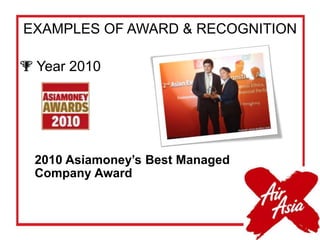
 Year 2010
2010 Asiamoney’s Best Managed
Company Award
VISION
 To be the largest low cost airline in Asia
and serving the 3 billion people who are
currently underserved with poor
connectivity and high fares.
MISSION
To be the best company to work for whereby
employees are treated as part of a big family
 Create a globally recognized ASEAN brand
 To attain the lowest cost so that everyone
can fly with AirAsia
 Maintain the highest quality product, embracing
technology to reduce cost and enhance service levels
VALUES
 Safety First
 High Aircraft Utilization
 Low Fare, No Frills
 Streamline Operations
 Lean Distribution System
 Point to Point Network
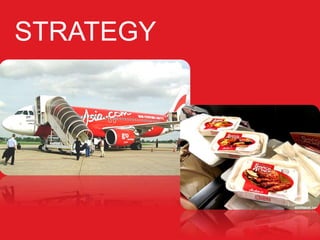
STRATEGY
STRATEGY
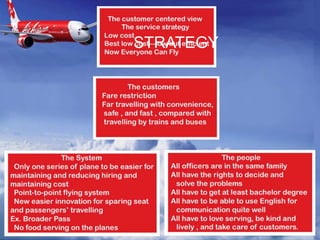
Strategy-Customer
Strategy-System
Strategy-People
System-Customer
System-People
Customer-People
STRATEGY
Strategy-Customer
Strategy that AirAsia uses is the low-cost
strategy for everyone can fly with AirAsia.
STRATEGY
Strategy-System
AirAsia uses cost-leadership and aims to
reduce cost by using the same series of
plane.
In addition, flying from point to point can
extremely reduce cost of the airline.
STRATEGY
Strategy-People
AirAsia treats their officers as
they are part of the firm.
This matches to the direct service
developing strategy
System-Customer
Target customer of AirAsia don’t expect any
extraordinary service, but only the low fare and
fast flying one.
STRATEGY
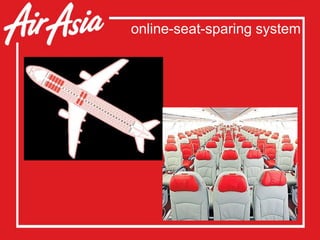
online-seat-sparing system
System-People
AirAsia sets up the employees’ required
attributes to fit to the well-organised
system.
STRATEGY
Customer-People
AirAsia trains officers to solve the problems
for the customers immediately when being
asked for help.
STRATEGY
STRATEGY
MARKETING:
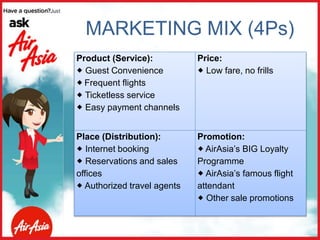
MARKETING MIX (4Ps)
MARKETING MIX (4Ps)
Product (Service):
 Guest Convenience
 Frequent flights
 Ticketless service
 Easy payment channels
Price:
 Low fare, no frills
Place (Distribution):
 Internet booking
 Reservations and sales
offices
 Authorized travel agents
Promotion:
 AirAsia’s BIG Loyalty
Programme
 AirAsia’s famous flight
attendant
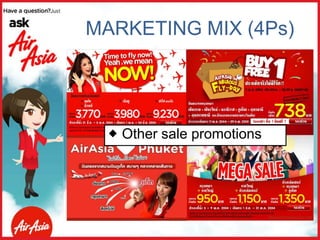
 Other sale promotions
MARKETING MIX (4Ps)
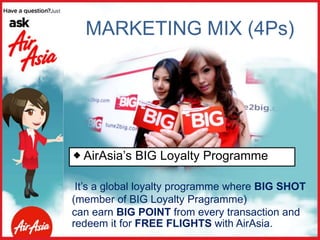
It’s a global loyalty programme where BIG SHOT
(member of BIG Loyalty Pragramme)
can earn BIG POINT from every transaction and
redeem it for FREE FLIGHTS with AirAsia.
 AirAsia’s BIG Loyalty Programme
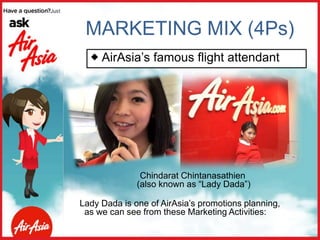
Chindarat Chintanasathien
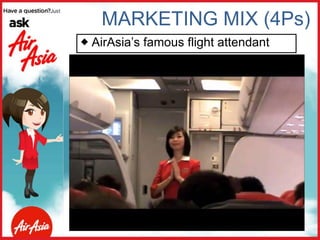
(also known as “Lady Dada”)
Lady Dada is one of AirAsia’s promotions planning,
as we can see from these Marketing Activities:
MARKETING MIX (4Ps)
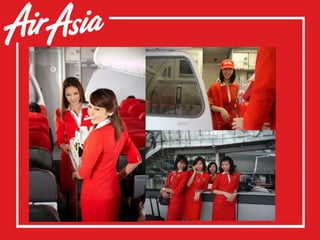
 AirAsia’s famous flight attendant
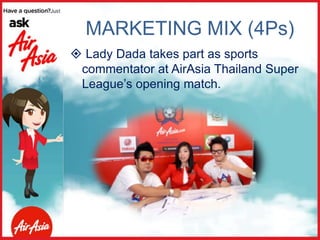
 Lady Dada takes part as sports
commentator at AirAsia Thailand Super
League’s opening match.
MARKETING MIX (4Ps)
 AirAsia launches two new dishes
onboard- “Dada’s grilled chicken with
sticky rice” and Chicken Lasagne!
MARKETING MIX (4Ps)
MARKETING MIX (4Ps)
 AirAsia’s famous flight attendant
MARKETING MIX (4Ps)
 Other sale promotions
MARKETING:
TARGET MARKET
TARGET MARKET
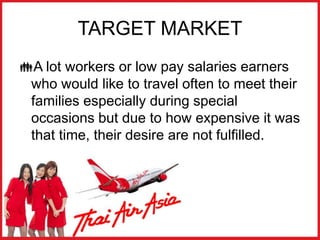
A lot workers or low pay salaries earners
who would like to travel often to meet their
families especially during special
occasions but due to how expensive it was
that time, their desire are not fulfilled.
MARKETING:
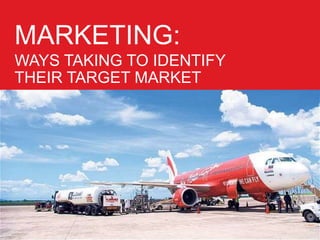
WAYS TAKING TO IDENTIFY
THEIR TARGET MARKET
WAYS TAKING TO IDENTIFY
THEIR TARGET MARKET
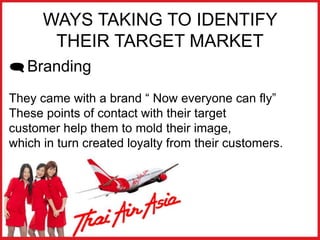
 Branding
They came with a brand “ Now everyone can fly”
These points of contact with their target
customer help them to mold their image,
which in turn created loyalty from their customers.
WAYS TAKING TO IDENTIFY
THEIR TARGET MARKET
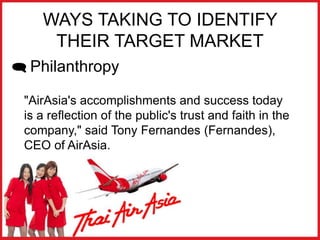
 Philanthropy
"AirAsia's accomplishments and success today
is a reflection of the public's trust and faith in the
company," said Tony Fernandes (Fernandes),
CEO of AirAsia.
WAYS TAKING TO IDENTIFY
THEIR TARGET MARKET
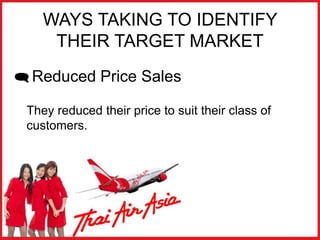
 Reduced Price Sales
They reduced their price to suit their class of
customers.
WAYS TAKING TO IDENTIFY
THEIR TARGET MARKET
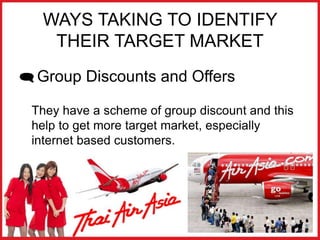
 Group Discounts and Offers
They have a scheme of group discount and this
help to get more target market, especially
internet based customers.
WAYS TAKING TO IDENTIFY
THEIR TARGET MARKET
 Foreign workers and Contractors strategy
AirAsia also target most foreign workers from
Indonesia, Singapore, Thailand, China, Macau who
may not afford the expensive flight home.
MARKETING:
SWOT ANALYSIS
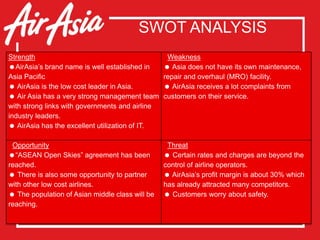
SWOT ANALYSIS
Strength
AirAsia’s brand name is well established in
Asia Pacific
 AirAsia is the low cost leader in Asia.
 Air Asia has a very strong management team
with strong links with governments and airline
industry leaders.
 AirAsia has the excellent utilization of IT.
Weakness
 Asia does not have its own maintenance,
repair and overhaul (MRO) facility.
 AirAsia receives a lot complaints from
customers on their service.
Opportunity
“ASEAN Open Skies” agreement has been
reached.
 There is also some opportunity to partner
with other low cost airlines.
 The population of Asian middle class will be
reaching.
Threat
 Certain rates and charges are beyond the
control of airline operators.
 AirAsia’s profit margin is about 30% which
has already attracted many competitors.
 Customers worry about safety.
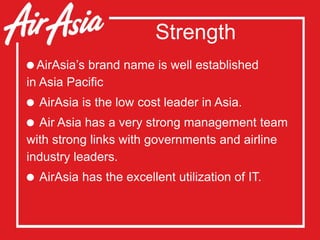
Strength
AirAsia’s brand name is well established
in Asia Pacific
 AirAsia is the low cost leader in Asia.
 Air Asia has a very strong management team
with strong links with governments and airline
industry leaders.
 AirAsia has the excellent utilization of IT.
Weakness
AirAsia receives a lot complaints from
customers on their service.
 Asia does not have its own
maintenance, repair and overhaul (MRO)
facility.
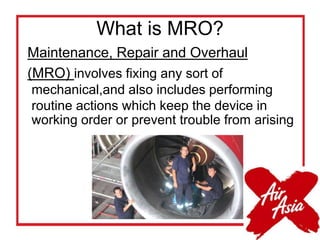
What is MRO?
Maintenance, Repair and Overhaul
(MRO) involves fixing any sort of
mechanical,and also includes performing
routine actions which keep the device in
working order or prevent trouble from arising
Opportunity
 There is also some opportunity to
partner with other low cost airlines.
The population of Asian middle class will
be reaching.
“ASEAN Open Skies” agreement has
been reached.
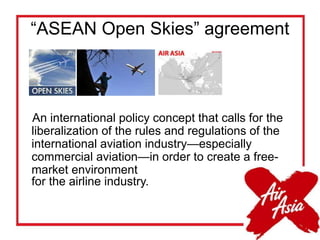
“ASEAN Open Skies” agreement
An international policy concept that calls for the
liberalization of the rules and regulations of the
international aviation industry—especially
commercial aviation—in order to create a free-
market environment
for the airline industry.
Threat
Certain rates and charges are beyond
the control of airline operators.
Customers worry about safety.
AirAsia’s profit margin is about 30%
which has already attracted many
competitors.
THANK YOU FOR YOUR ATTENTION

Air Asia Marketing Analysis

  • 1.
  • 2.
  • 3.
    BACKGROUND/HISTORY Thai National Airlinewas the only one airline which could fly in the main routes such as Bangkok-Chiang Mai by non-stop traveling in the past. Other airlines had to land at Utapao airport before taking off to Chiang Mai.
  • 4.
    Utapao Airport a jointcivil-military public airport serving Rayong and Pattaya (city in Chonburi).
  • 5.
  • 6.
    BACKGROUND/HISTORY AirAsia was establishedin 2001 offering the new image of traveling under its opinion “Now Everyone Can Fly”
  • 7.
    BACKGROUND/HISTORY AirAsia began withonly 2 Boing737-300 series and started its first point-to-point flight.
  • 8.
  • 9.
    BACKGROUND/HISTORY It presented lowrate of fares as well as services which is necessible.
  • 10.
    BACKGROUND/HISTORY AirAsia has swiftlybroken travel norms around the globe and has risen to become the world’s best. With a route network that spans through to over 20 countries,
  • 12.
  • 13.
    EXAMPLES OF AWARD& RECOGNITION  Year 2012 2012 ATW Value Airline of the Year
  • 14.
    EXAMPLES OF AWARD& RECOGNITION  Year 2011 Best Asian Low- Cost Carrier By TTG Travel Awards 2011 World’s Best Low Cost Airline Best Low Cost Airline – Asia by Skytrax Fastest Growing Foreign Airline for Cargo by Guangzhou Baiyun International Airport
  • 15.
    EXAMPLES OF AWARD& RECOGNITION  Year 2010 2010 Asiamoney’s Best Managed Company Award
  • 16.
    VISION  To bethe largest low cost airline in Asia and serving the 3 billion people who are currently underserved with poor connectivity and high fares.
  • 17.
    MISSION To be thebest company to work for whereby employees are treated as part of a big family  Create a globally recognized ASEAN brand  To attain the lowest cost so that everyone can fly with AirAsia  Maintain the highest quality product, embracing technology to reduce cost and enhance service levels
  • 18.
    VALUES  Safety First High Aircraft Utilization  Low Fare, No Frills  Streamline Operations  Lean Distribution System  Point to Point Network
  • 19.
  • 20.
  • 21.
    STRATEGY Strategy-Customer Strategy that AirAsiauses is the low-cost strategy for everyone can fly with AirAsia.
  • 22.
    STRATEGY Strategy-System AirAsia uses cost-leadershipand aims to reduce cost by using the same series of plane. In addition, flying from point to point can extremely reduce cost of the airline.
  • 23.
    STRATEGY Strategy-People AirAsia treats theirofficers as they are part of the firm. This matches to the direct service developing strategy
  • 24.
    System-Customer Target customer ofAirAsia don’t expect any extraordinary service, but only the low fare and fast flying one. STRATEGY
  • 25.
  • 26.
    System-People AirAsia sets upthe employees’ required attributes to fit to the well-organised system. STRATEGY
  • 27.
    Customer-People AirAsia trains officersto solve the problems for the customers immediately when being asked for help. STRATEGY
  • 29.
  • 30.
  • 31.
    MARKETING MIX (4Ps) Product(Service):  Guest Convenience  Frequent flights  Ticketless service  Easy payment channels Price:  Low fare, no frills Place (Distribution):  Internet booking  Reservations and sales offices  Authorized travel agents Promotion:  AirAsia’s BIG Loyalty Programme  AirAsia’s famous flight attendant  Other sale promotions
  • 32.
    MARKETING MIX (4Ps) It’sa global loyalty programme where BIG SHOT (member of BIG Loyalty Pragramme) can earn BIG POINT from every transaction and redeem it for FREE FLIGHTS with AirAsia.  AirAsia’s BIG Loyalty Programme
  • 33.
    Chindarat Chintanasathien (also knownas “Lady Dada”) Lady Dada is one of AirAsia’s promotions planning, as we can see from these Marketing Activities: MARKETING MIX (4Ps)  AirAsia’s famous flight attendant
  • 34.
     Lady Dadatakes part as sports commentator at AirAsia Thailand Super League’s opening match. MARKETING MIX (4Ps)
  • 35.
     AirAsia launchestwo new dishes onboard- “Dada’s grilled chicken with sticky rice” and Chicken Lasagne! MARKETING MIX (4Ps)
  • 36.
    MARKETING MIX (4Ps) AirAsia’s famous flight attendant
  • 37.
    MARKETING MIX (4Ps) Other sale promotions
  • 38.
  • 39.
    TARGET MARKET A lotworkers or low pay salaries earners who would like to travel often to meet their families especially during special occasions but due to how expensive it was that time, their desire are not fulfilled.
  • 40.
    MARKETING: WAYS TAKING TOIDENTIFY THEIR TARGET MARKET
  • 41.
    WAYS TAKING TOIDENTIFY THEIR TARGET MARKET  Branding They came with a brand “ Now everyone can fly” These points of contact with their target customer help them to mold their image, which in turn created loyalty from their customers.
  • 42.
    WAYS TAKING TOIDENTIFY THEIR TARGET MARKET  Philanthropy "AirAsia's accomplishments and success today is a reflection of the public's trust and faith in the company," said Tony Fernandes (Fernandes), CEO of AirAsia.
  • 43.
    WAYS TAKING TOIDENTIFY THEIR TARGET MARKET  Reduced Price Sales They reduced their price to suit their class of customers.
  • 44.
    WAYS TAKING TOIDENTIFY THEIR TARGET MARKET  Group Discounts and Offers They have a scheme of group discount and this help to get more target market, especially internet based customers.
  • 45.
    WAYS TAKING TOIDENTIFY THEIR TARGET MARKET  Foreign workers and Contractors strategy AirAsia also target most foreign workers from Indonesia, Singapore, Thailand, China, Macau who may not afford the expensive flight home.
  • 46.
  • 47.
    SWOT ANALYSIS Strength AirAsia’s brandname is well established in Asia Pacific  AirAsia is the low cost leader in Asia.  Air Asia has a very strong management team with strong links with governments and airline industry leaders.  AirAsia has the excellent utilization of IT. Weakness  Asia does not have its own maintenance, repair and overhaul (MRO) facility.  AirAsia receives a lot complaints from customers on their service. Opportunity “ASEAN Open Skies” agreement has been reached.  There is also some opportunity to partner with other low cost airlines.  The population of Asian middle class will be reaching. Threat  Certain rates and charges are beyond the control of airline operators.  AirAsia’s profit margin is about 30% which has already attracted many competitors.  Customers worry about safety.
  • 48.
    Strength AirAsia’s brand nameis well established in Asia Pacific  AirAsia is the low cost leader in Asia.  Air Asia has a very strong management team with strong links with governments and airline industry leaders.  AirAsia has the excellent utilization of IT.
  • 49.
    Weakness AirAsia receives alot complaints from customers on their service.  Asia does not have its own maintenance, repair and overhaul (MRO) facility.
  • 50.
    What is MRO? Maintenance,Repair and Overhaul (MRO) involves fixing any sort of mechanical,and also includes performing routine actions which keep the device in working order or prevent trouble from arising
  • 51.
    Opportunity  There isalso some opportunity to partner with other low cost airlines. The population of Asian middle class will be reaching. “ASEAN Open Skies” agreement has been reached.
  • 52.
    “ASEAN Open Skies”agreement An international policy concept that calls for the liberalization of the rules and regulations of the international aviation industry—especially commercial aviation—in order to create a free- market environment for the airline industry.
  • 53.
    Threat Certain rates andcharges are beyond the control of airline operators. Customers worry about safety. AirAsia’s profit margin is about 30% which has already attracted many competitors.
  • 54.
    THANK YOU FORYOUR ATTENTION