Overcoming the Fear Factor
Breaking Down Customer-Facing Organizational Silos
for Product Strategy Excellence
Top 3 takeaways for participants
Learn how to identify and recruit potential ‘landing zones’ for your ideas
Build evidence to reduce risk and gain buy-in
Learn best practices for equipping others to promote on your behalf
Marla Hetzel
Director of Innovation at AARP Services Inc
“I can’t go back to yesterday because I was a different person then.”
Lewis Carroll, Alice in Wonderland
“Well behaved women rarely make history.”
Laurel Thatcher Ulrich
Jennifer Draklellis
Director of Innovation at UnitedHealthcare
A story of innovation
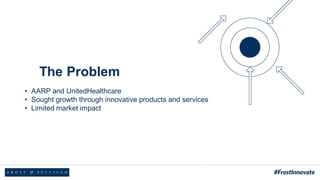
The Problem
• AARP and UnitedHealthcare
• Sought growth through innovative products and services
• Limited market impact
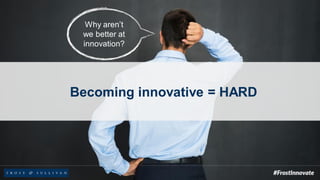
Becoming innovative = HARD
Why aren’t
we better at
innovation?
Achieve
Impact
Develop
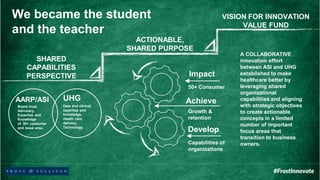
We became the student
and the teacher
Brand trust.
Advocacy.
Expertise and
Knowledge
of 50+ consumer
and issue area.
Data and clinical
expertise and
knowledge.
Health care
delivery.
Technology.
UHG
50+ Consumer
Growth &
retention
Capabilities of
organizations
SHARED
CAPABILITIES
PERSPECTIVE
ACTIONABLE,
SHARED PURPOSE
VISION FOR INNOVATION
VALUE FUND
A COLLABORATIVE
innovation effort
between ASI and UHG
established to make
healthcare better by
leveraging shared
organizational
capabilities and aligning
with strategic objectives
to create actionable
concepts in a limited
number of important
focus areas that
transition to business
owners.
AARP/ASI
Operator vs Innovator Mindset
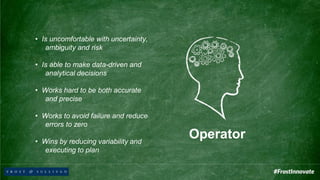
Operator
• Is uncomfortable with uncertainty,
ambiguity and risk
• Is able to make data-driven and
analytical decisions
• Works hard to be both accurate
and precise
• Works to avoid failure and reduce
errors to zero
• Wins by reducing variability and
executing to plan
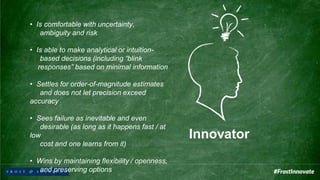
Innovator
• Is comfortable with uncertainty,
ambiguity and risk
• Is able to make analytical or intuition-
based decisions (including “blink
responses” based on minimal information
• Settles for order-of-magnitude estimates
and does not let precision exceed
accuracy
• Sees failure as inevitable and even
desirable (as long as it happens fast / at
low
cost and one learns from it)
• Wins by maintaining flexibility / openness,
and preserving options
Decision Making Biases
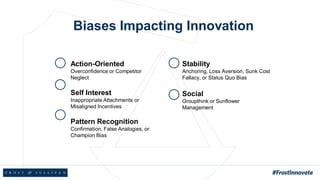
Biases Impacting Innovation
Action-Oriented
Overconfidence or Competitor
Neglect
Self Interest
Inappropriate Attachments or
Misaligned Incentives
Pattern Recognition
Confirmation, False Analogies, or
Champion Bias
Stability
Anchoring, Loss Aversion, Sunk Cost
Fallacy, or Status Quo Bias
Social
Groupthink or Sunflower
Management
Accountability in Innovation
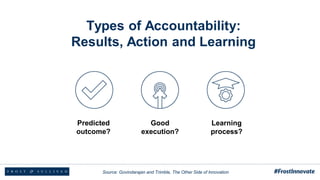
Types of Accountability:
Results, Action and Learning
Predicted
outcome?
Good
execution?
Learning
process?
Source: Govindarajan and Trimble, The Other Side of Innovation
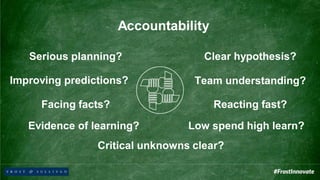
Accountability
Serious planning? Clear hypothesis?
Team understanding?Improving predictions?
Reacting fast?Facing facts?
Low spend high learn?Evidence of learning?
Critical unknowns clear?
“We now accept the fact that learning is a
lifelong process of keeping abreast of
change. And the most pressing task is to
teach people how to learn.”
Peter F. Drucker
An Inherent Tension
the challenge of the performance engine
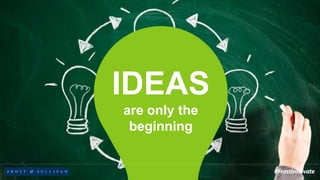
IDEAS
are only the
beginning
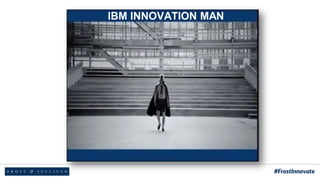
IBM INNOVATION MAN
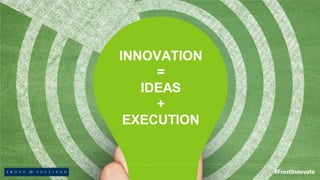
INNOVATION
=
IDEAS
+
EXECUTION
But there is a problem...
Companies are built for efficiency, not innovation...
“Landing zones”
Identifying and recruiting
“When it comes to embracing a new idea,
most will demur unless you can pack a
parachute that will allow them to jump safely
from their [way of doing things] to yours.”
Source: Whitney Johnson, “Make Your Innovative Idea Seem Less Terrifying”, HBR Blog
7 HINTS FOR
SELLING IDEAS
Source: Rosabeth Moss Kanter, “Seven Hints for Selling Ideas”, HBR Blog
Seek many inputs
#1
Do Your Homework
#2
Make the rounds
#3
See Critics in Private and Hear Them Out
#4
Make the Benefits Clear
#5
Be Specific
#6
Show That You Can Deliver
#7
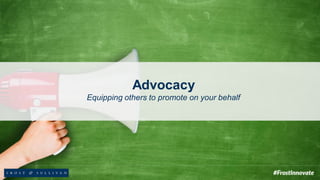
Advocacy
Equipping others to promote on your behalf
Become a champion
What
Find 2-3 meetings to present
our work to an audience
When
Between now and
when we next meet
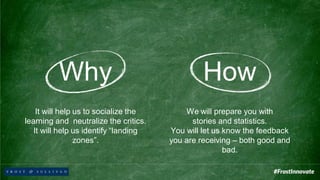
Why
It will help us to socialize the
learning and neutralize the critics.
It will help us identify “landing
zones”.
How
We will prepare you with
stories and statistics.
You will let us know the feedback
you are receiving – both good and
bad.
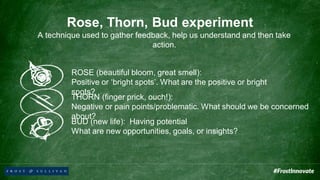
Rose, Thorn, Bud experiment
ROSE (beautiful bloom, great smell):
Positive or ‘bright spots’. What are the positive or bright
spots?
THORN (finger prick, ouch!):
Negative or pain points/problematic. What should we be concerned
about?
BUD (new life): Having potential
What are new opportunities, goals, or insights?
A technique used to gather feedback, help us understand and then take
action.
Facilitating execution
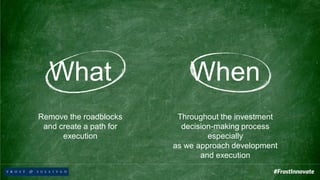
Remove the roadblocks
and create a path for
execution
What When
Throughout the investment
decision-making process
especially
as we approach development
and execution
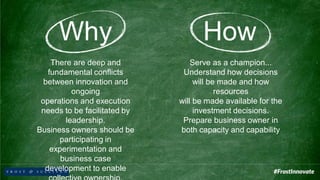
There are deep and
fundamental conflicts
between innovation and
ongoing
operations and execution
needs to be facilitated by
leadership.
Business owners should be
participating in
experimentation and
business case
development to enable
Why How
Serve as a champion...
Understand how decisions
will be made and how
resources
will be made available for the
investment decisions.
Prepare business owner in
both capacity and capability
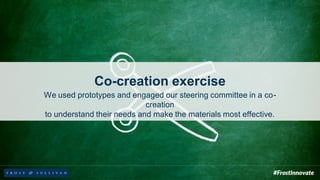
Co-creation exercise
We used prototypes and engaged our steering committee in a co-
creation
to understand their needs and make the materials most effective.
Questions?
Continue the Conversation
Marla
mhetzel@aarp.org
Marla J Hetzel
(LinkedIn)
@hetzelmj
Jennifer
jennifer_draklellis@uhc.co
m
Jennifer Draklellis
(LinkedIn)
@jdraklellis

AARPUHC_Frost&Sullivan_2015

  • 1.
    Overcoming the FearFactor Breaking Down Customer-Facing Organizational Silos for Product Strategy Excellence
  • 2.
    Top 3 takeawaysfor participants Learn how to identify and recruit potential ‘landing zones’ for your ideas Build evidence to reduce risk and gain buy-in Learn best practices for equipping others to promote on your behalf
  • 3.
    Marla Hetzel Director ofInnovation at AARP Services Inc “I can’t go back to yesterday because I was a different person then.” Lewis Carroll, Alice in Wonderland
  • 4.
    “Well behaved womenrarely make history.” Laurel Thatcher Ulrich Jennifer Draklellis Director of Innovation at UnitedHealthcare
  • 5.
    A story ofinnovation
  • 6.
    The Problem • AARPand UnitedHealthcare • Sought growth through innovative products and services • Limited market impact
  • 7.
    Becoming innovative =HARD Why aren’t we better at innovation?
  • 8.
    Achieve Impact Develop We became thestudent and the teacher Brand trust. Advocacy. Expertise and Knowledge of 50+ consumer and issue area. Data and clinical expertise and knowledge. Health care delivery. Technology. UHG 50+ Consumer Growth & retention Capabilities of organizations SHARED CAPABILITIES PERSPECTIVE ACTIONABLE, SHARED PURPOSE VISION FOR INNOVATION VALUE FUND A COLLABORATIVE innovation effort between ASI and UHG established to make healthcare better by leveraging shared organizational capabilities and aligning with strategic objectives to create actionable concepts in a limited number of important focus areas that transition to business owners. AARP/ASI
  • 9.
  • 10.
    Operator • Is uncomfortablewith uncertainty, ambiguity and risk • Is able to make data-driven and analytical decisions • Works hard to be both accurate and precise • Works to avoid failure and reduce errors to zero • Wins by reducing variability and executing to plan
  • 11.
    Innovator • Is comfortablewith uncertainty, ambiguity and risk • Is able to make analytical or intuition- based decisions (including “blink responses” based on minimal information • Settles for order-of-magnitude estimates and does not let precision exceed accuracy • Sees failure as inevitable and even desirable (as long as it happens fast / at low cost and one learns from it) • Wins by maintaining flexibility / openness, and preserving options
  • 12.
  • 13.
    Biases Impacting Innovation Action-Oriented Overconfidenceor Competitor Neglect Self Interest Inappropriate Attachments or Misaligned Incentives Pattern Recognition Confirmation, False Analogies, or Champion Bias Stability Anchoring, Loss Aversion, Sunk Cost Fallacy, or Status Quo Bias Social Groupthink or Sunflower Management
  • 14.
  • 15.
    Types of Accountability: Results,Action and Learning Predicted outcome? Good execution? Learning process? Source: Govindarajan and Trimble, The Other Side of Innovation
  • 16.
    Accountability Serious planning? Clearhypothesis? Team understanding?Improving predictions? Reacting fast?Facing facts? Low spend high learn?Evidence of learning? Critical unknowns clear?
  • 17.
    “We now acceptthe fact that learning is a lifelong process of keeping abreast of change. And the most pressing task is to teach people how to learn.” Peter F. Drucker
  • 18.
    An Inherent Tension thechallenge of the performance engine
  • 19.
  • 20.
  • 21.
  • 22.
    But there isa problem... Companies are built for efficiency, not innovation...
  • 24.
  • 25.
    “When it comesto embracing a new idea, most will demur unless you can pack a parachute that will allow them to jump safely from their [way of doing things] to yours.” Source: Whitney Johnson, “Make Your Innovative Idea Seem Less Terrifying”, HBR Blog
  • 26.
    7 HINTS FOR SELLINGIDEAS Source: Rosabeth Moss Kanter, “Seven Hints for Selling Ideas”, HBR Blog
  • 27.
  • 28.
  • 29.
  • 30.
    See Critics inPrivate and Hear Them Out #4
  • 31.
  • 32.
  • 33.
    Show That YouCan Deliver #7
  • 34.
    Advocacy Equipping others topromote on your behalf
  • 35.
  • 36.
    What Find 2-3 meetingsto present our work to an audience When Between now and when we next meet
  • 37.
    Why It will helpus to socialize the learning and neutralize the critics. It will help us identify “landing zones”. How We will prepare you with stories and statistics. You will let us know the feedback you are receiving – both good and bad.
  • 38.
    Rose, Thorn, Budexperiment ROSE (beautiful bloom, great smell): Positive or ‘bright spots’. What are the positive or bright spots? THORN (finger prick, ouch!): Negative or pain points/problematic. What should we be concerned about? BUD (new life): Having potential What are new opportunities, goals, or insights? A technique used to gather feedback, help us understand and then take action.
  • 39.
  • 40.
    Remove the roadblocks andcreate a path for execution What When Throughout the investment decision-making process especially as we approach development and execution
  • 41.
    There are deepand fundamental conflicts between innovation and ongoing operations and execution needs to be facilitated by leadership. Business owners should be participating in experimentation and business case development to enable Why How Serve as a champion... Understand how decisions will be made and how resources will be made available for the investment decisions. Prepare business owner in both capacity and capability
  • 42.
    Co-creation exercise We usedprototypes and engaged our steering committee in a co- creation to understand their needs and make the materials most effective.
  • 45.
  • 46.
    Continue the Conversation Marla mhetzel@aarp.org MarlaJ Hetzel (LinkedIn) @hetzelmj Jennifer jennifer_draklellis@uhc.co m Jennifer Draklellis (LinkedIn) @jdraklellis