BY SHARIQA AISHA
DEPARTMENT OF BIORESOURCES
UNIVERSITY OF KASHMIR
 The Fenna-Matthews-Olson (FMO) complex is a
water-soluble complex and was the first pigment-
protein complex (PPC) to be structure analyzed by x-
ray spectroscopy.
 It appears in green sulfur bacteria and mediates the
excitation energy transfer from light-harvesting
chlorosomes to the membrane-embedded bacterial
reaction center (bRC).
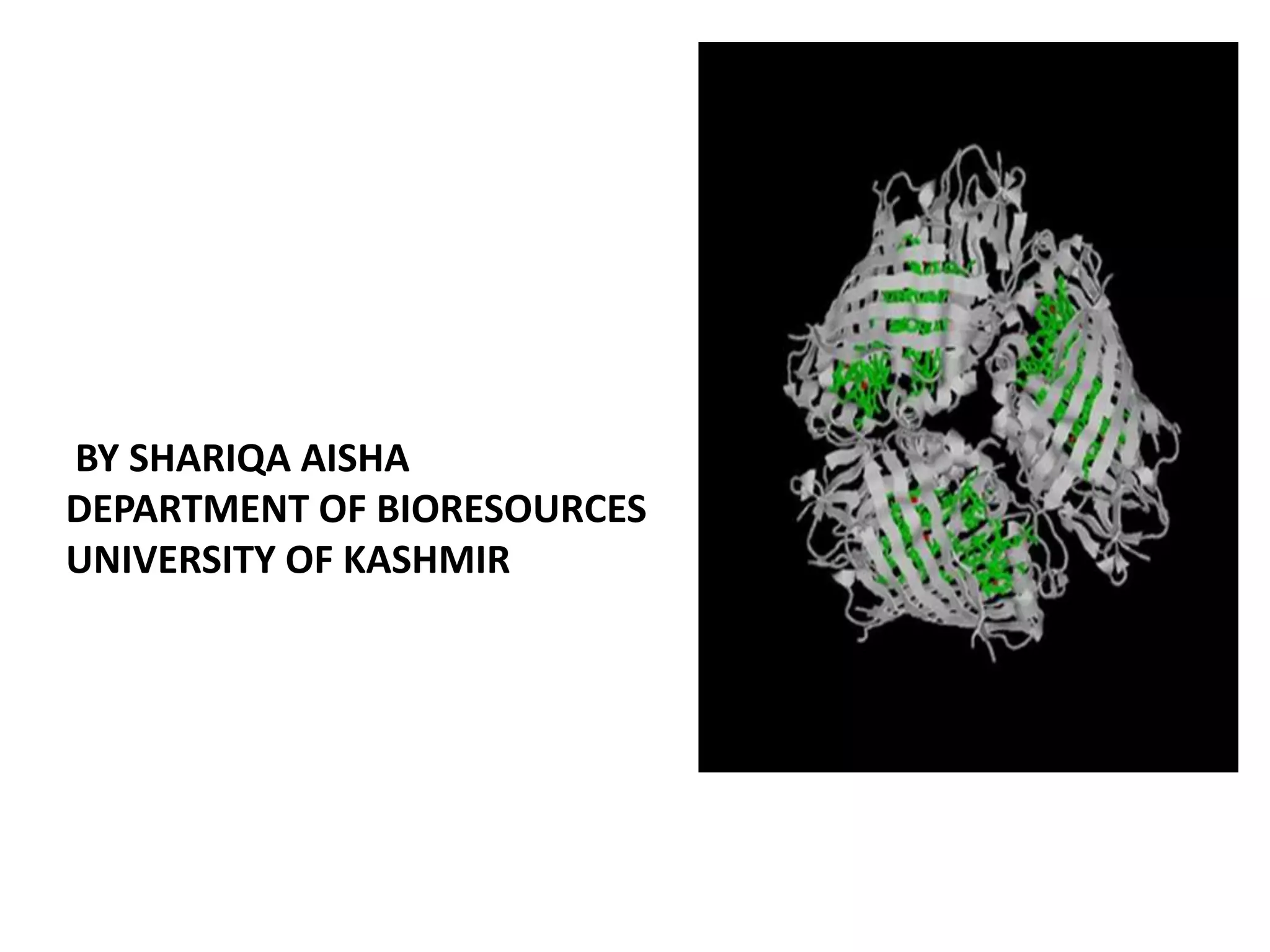
 Its structure is trimeric (C3-symmetry). Each of the
three monomers contains eight bacteriochlorophyll a
(BChl a) molecules. They are bound to the protein
scaffold via chelation of their central magnesium
atom either to amino acids of the protein (mostly
histidine) or water-bridged oxygen atoms (only one
BChl a of each monomer).
The FMO protein trimer
 Fenna–Matthews–Olson (FMO) complex, a
trimeric pigment–protein complex which lies
between the antennae complexes and the
reaction center of the photosystem II of sulfur
green bacteria, and whose primary function is to
serve as a molecular wire transporting the
excitons generated during light harvesting by the
pigments toward the reaction center where the
cascade of redox chemical reactions take place.
 The excitation energy transfer dynamics are
required to be fast or otherwise it is lost.
 It is now known that this transport occurs with
quantum coherence; that is, very little energy is
dissipated as heat or radiation, making it an
almost 100% efficient process.
Fmo cpmplex

Fmo cpmplex

  • 1.
    BY SHARIQA AISHA DEPARTMENTOF BIORESOURCES UNIVERSITY OF KASHMIR
  • 2.
     The Fenna-Matthews-Olson(FMO) complex is a water-soluble complex and was the first pigment- protein complex (PPC) to be structure analyzed by x- ray spectroscopy.  It appears in green sulfur bacteria and mediates the excitation energy transfer from light-harvesting chlorosomes to the membrane-embedded bacterial reaction center (bRC).  Its structure is trimeric (C3-symmetry). Each of the three monomers contains eight bacteriochlorophyll a (BChl a) molecules. They are bound to the protein scaffold via chelation of their central magnesium atom either to amino acids of the protein (mostly histidine) or water-bridged oxygen atoms (only one BChl a of each monomer). The FMO protein trimer
  • 3.
     Fenna–Matthews–Olson (FMO)complex, a trimeric pigment–protein complex which lies between the antennae complexes and the reaction center of the photosystem II of sulfur green bacteria, and whose primary function is to serve as a molecular wire transporting the excitons generated during light harvesting by the pigments toward the reaction center where the cascade of redox chemical reactions take place.  The excitation energy transfer dynamics are required to be fast or otherwise it is lost.  It is now known that this transport occurs with quantum coherence; that is, very little energy is dissipated as heat or radiation, making it an almost 100% efficient process.