Contents
Koch experiments
Disease discovered by scientist
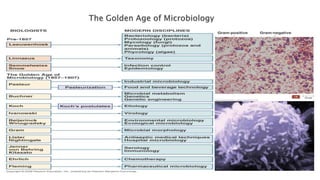
Discipline of microbiology
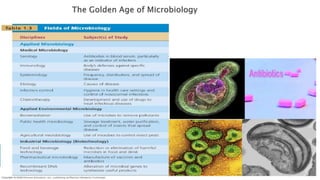
Fields of microbiology
Applied microbiology
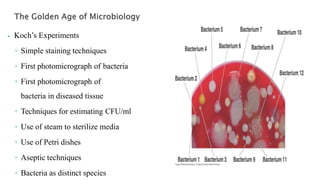
⦁ Koch’s Experiments
◦ Simple staining techniques
◦ First photomicrograph of bacteria
◦ First photomicrograph of
bacteria in diseased tissue
◦ Techniques for estimating CFU/ml
◦ Use of steam to sterilize media
◦ Use of Petri dishes
◦ Aseptic techniques
◦ Bacteria as distinct species
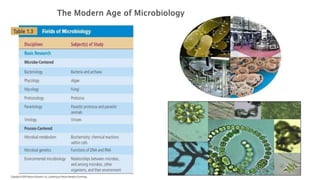
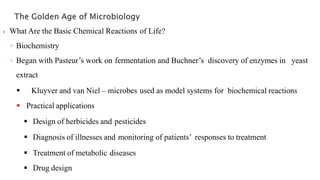
⦁ What Are the Basic Chemical Reactions of Life?
◦ Biochemistry
◦ Began with Pasteur’s work on fermentation and Buchner’s discovery of enzymes in yeast
extract
 Kluyver and van Niel – microbes used as model systems for biochemical reactions
 Practical applications
 Design of herbicides and pesticides
 Diagnosis of illnesses and monitoring of patients’ responses to treatment
 Treatment of metabolic diseases
 Drug design
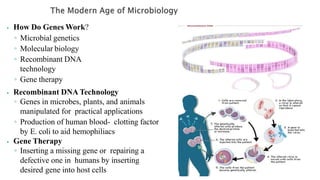
⦁ How Do Genes Work?
◦ Microbial genetics
◦ Molecular biology
◦ Recombinant DNA
technology
◦ Gene therapy
⦁ Recombinant DNA Technology
◦ Genes in microbes, plants, and animals
manipulated for practical applications
◦ Production of human blood- clotting factor
by E. coli to aid hemophiliacs
⦁ Gene Therapy
◦ Inserting a missing gene or repairing a
defective one in humans by inserting
desired gene into host cells

lecture 2 microbiology..pptx

  • 1.
    Contents Koch experiments Disease discoveredby scientist Discipline of microbiology Fields of microbiology Applied microbiology
  • 2.
    ⦁ Koch’s Experiments ◦Simple staining techniques ◦ First photomicrograph of bacteria ◦ First photomicrograph of bacteria in diseased tissue ◦ Techniques for estimating CFU/ml ◦ Use of steam to sterilize media ◦ Use of Petri dishes ◦ Aseptic techniques ◦ Bacteria as distinct species
  • 7.
    ⦁ What Arethe Basic Chemical Reactions of Life? ◦ Biochemistry ◦ Began with Pasteur’s work on fermentation and Buchner’s discovery of enzymes in yeast extract  Kluyver and van Niel – microbes used as model systems for biochemical reactions  Practical applications  Design of herbicides and pesticides  Diagnosis of illnesses and monitoring of patients’ responses to treatment  Treatment of metabolic diseases  Drug design
  • 8.
    ⦁ How DoGenes Work? ◦ Microbial genetics ◦ Molecular biology ◦ Recombinant DNA technology ◦ Gene therapy ⦁ Recombinant DNA Technology ◦ Genes in microbes, plants, and animals manipulated for practical applications ◦ Production of human blood- clotting factor by E. coli to aid hemophiliacs ⦁ Gene Therapy ◦ Inserting a missing gene or repairing a defective one in humans by inserting desired gene into host cells