

History of ER (entity
relationship) Diagram:
Peter Chen developed ERDs in 1976. Since then
Charles Bachman and James Martin have added
some slight refinements to the basic ERD
principles.
ER (entity relationship)
Diagram:
ER Model is represented by means of an ER
diagram. Any object, for example, entities, attributes
of an entity, relationship sets, and attributes of
relationship sets, can be represented with the help of
an ER diagram.
Why we design ER diagrams?
Why we design ER
diagrams?
The software developer/analyst or database
designer/analyst gains a better understanding of
the information to be contained in the database
through the process of constructing the ERD.
The ERD serves as a documenting tool.
ER (entity relationship)
Diagram:
There are three basic elements in ER-Diagrams:
 Entities are the "things" for which we want to
store information. An entity is a person, place,
thing or event.
 Attributes are the data we want to collect for an
entity.
 Relationships describe the relations between
the entities.
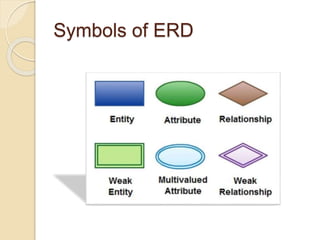
Symbols of ERD
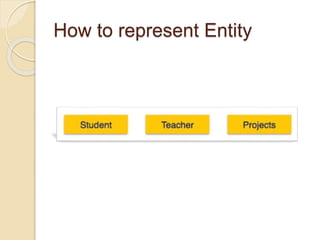
Entity
Any object having attributes and their values
from real word is entity. Entities are represented
by means of rectangles. Rectangles are named
with the entity set they represent.
How to represent Entity
Relationship
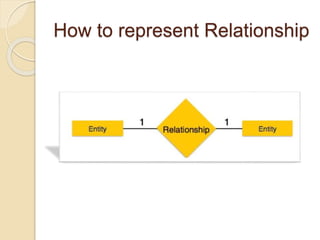
Relationships are represented by diamond-shaped
box. Name of the relationship is written inside the
diamond-box. All the entities (rectangles)
participating in a relationship, are connected to it by
a line.
How to represent Relationship
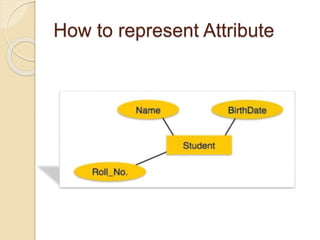
Attribute
Attributes are the properties of entities. Attributes
are represented by means of ellipses. Every
ellipse represents one attribute and is directly
connected to its entity (rectangle).
How to represent Attribute
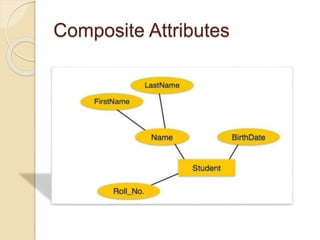
Composite attributes
If the attributes are composite, they are further
divided in a tree like structure. Every node is then
connected to its attribute. That is, composite
attributes are represented by ellipses that are
connected with an ellipse.
Composite Attributes
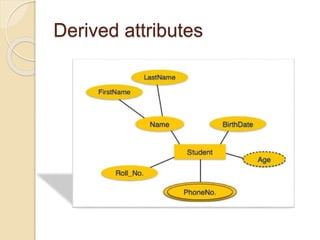
Derived attributes
Derived attributes are depicted by dashed
ellipse.
Derived attributes
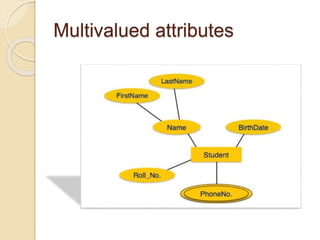
Multivalued attributes
Multivalued are depicted by double ellipse.
Multivalued attributes
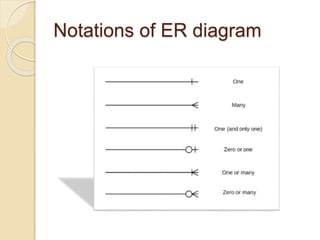
Notations of ER diagram
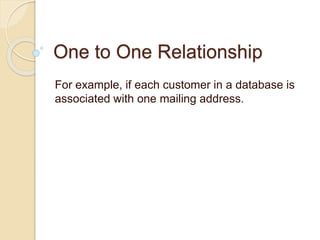
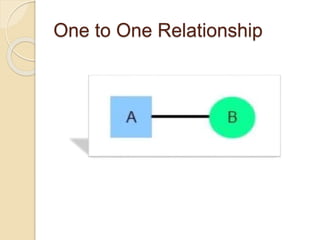
One to One Relationship
For example, if each customer in a database is
associated with one mailing address.
One to One Relationship
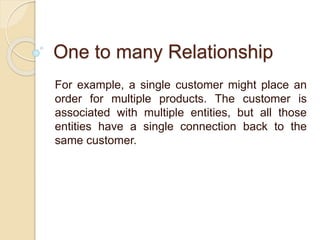
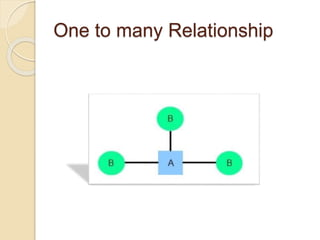
One to many Relationship
For example, a single customer might place an
order for multiple products. The customer is
associated with multiple entities, but all those
entities have a single connection back to the
same customer.
One to many Relationship
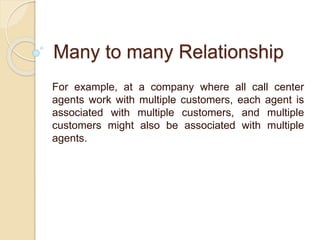
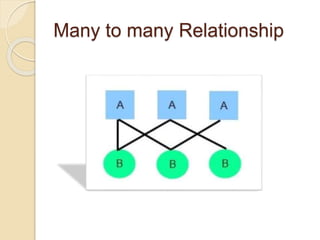
Many to many Relationship
For example, at a company where all call center
agents work with multiple customers, each agent is
associated with multiple customers, and multiple
customers might also be associated with multiple
agents.
Many to many Relationship
The phase in which we
need to design an ER
diagram
In Designing phase we need to design ERDs.
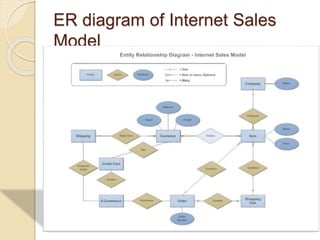
ER diagram of Internet Sales
Model
Any Questions ??
Thank you for your attention!

Entity relation(1)

  • 1.
    History of ER(entity relationship) Diagram: Peter Chen developed ERDs in 1976. Since then Charles Bachman and James Martin have added some slight refinements to the basic ERD principles.
  • 2.
    ER (entity relationship) Diagram: ERModel is represented by means of an ER diagram. Any object, for example, entities, attributes of an entity, relationship sets, and attributes of relationship sets, can be represented with the help of an ER diagram.
  • 3.
    Why we designER diagrams?
  • 4.
    Why we designER diagrams? The software developer/analyst or database designer/analyst gains a better understanding of the information to be contained in the database through the process of constructing the ERD. The ERD serves as a documenting tool.
  • 5.
    ER (entity relationship) Diagram: Thereare three basic elements in ER-Diagrams:  Entities are the "things" for which we want to store information. An entity is a person, place, thing or event.  Attributes are the data we want to collect for an entity.  Relationships describe the relations between the entities.
  • 6.
  • 7.
    Entity Any object havingattributes and their values from real word is entity. Entities are represented by means of rectangles. Rectangles are named with the entity set they represent.
  • 8.
  • 9.
    Relationship Relationships are representedby diamond-shaped box. Name of the relationship is written inside the diamond-box. All the entities (rectangles) participating in a relationship, are connected to it by a line.
  • 10.
    How to representRelationship
  • 11.
    Attribute Attributes are theproperties of entities. Attributes are represented by means of ellipses. Every ellipse represents one attribute and is directly connected to its entity (rectangle).
  • 12.
  • 13.
    Composite attributes If theattributes are composite, they are further divided in a tree like structure. Every node is then connected to its attribute. That is, composite attributes are represented by ellipses that are connected with an ellipse.
  • 14.
  • 15.
    Derived attributes Derived attributesare depicted by dashed ellipse.
  • 16.
  • 17.
    Multivalued attributes Multivalued aredepicted by double ellipse.
  • 18.
  • 19.
  • 20.
    One to OneRelationship For example, if each customer in a database is associated with one mailing address.
  • 21.
    One to OneRelationship
  • 22.
    One to manyRelationship For example, a single customer might place an order for multiple products. The customer is associated with multiple entities, but all those entities have a single connection back to the same customer.
  • 23.
    One to manyRelationship
  • 24.
    Many to manyRelationship For example, at a company where all call center agents work with multiple customers, each agent is associated with multiple customers, and multiple customers might also be associated with multiple agents.
  • 25.
    Many to manyRelationship
  • 26.
    The phase inwhich we need to design an ER diagram In Designing phase we need to design ERDs.
  • 27.
    ER diagram ofInternet Sales Model
  • 28.
  • 29.
    Thank you foryour attention!