UNIT 4
ENTERPRISE RESOURCE PLANNING
An Overview
Enterprise Resource Planning
•ERP: is a business management software that allows an organization to use a system of
integrated applications to manage the business.
•Being specific ERP systems are large computer systems that integrate application programs in
accounting (i.e ACCOUNTS RECEIVABLE), Sales (ORDER BOOKING), Manufacturing (Product
Shipping) and the other functions in the firm.
EVOLUTION
•1960s: Software Packages with Inventory
•1970s : MRP (Material Requirement Planning) Systems (Production schedule with materials
management).
•1980s: MRPII systems (Adds financial accounting system)
•1990s: MRPII (Integrated systems for manufacturing execution
•Late 1990s: ERP (Integrated manufacturing with supply chain)
MAJOR REASONS FOR ADOPTING ERP
• Integrate financial information
•Integrate customer order information
•Standardize and speed up operations processes
•Reduce inventory
•Standardize Human Resource information
Components Of ERP System
•Finance: modules for book keeping and making sure the bills are paid in time. Examples
General ledger
Accounts Receivable
Accounts Payable
•HR: Software for handling personnel-related tasks for corporate managers and individuals
employees. Examples
HR administration
Payroll
Self-service HR
Business Intelligence (BI)
•Business Intelligence is data transformed into actionable insights that support better, faster
decision making.
•Business Intelligence has become a standard component of most ERP packages, BI tools allow
users to share and analyze the data collected across the enterprise and centralized in the ERP
database.
•BI can come in the form of dashboards, automated reporting and analysis tools used to monitor
the organizational business performance. BI supports informed decision making by everyone,
from executives to line managers and accounts.
Supply chain Management
• Sometimes referred to as logistics, improves the flow of materials through an organization by
managing planning, scheduling, procurement, and fulfillment, to maximize customer satisfaction and
profitability.
•Sub module in SCM often include production scheduling, demand management, distribution
management, warehouse management, procurement and order management.
Manufacturing Operations
•It makes manufacturing operations more efficient through product configuration, job costing and bill of
materials management.
•ERP Manufacturing modules often include capacity requirements planning, materials Requirement
planning, forecasting, Master production scheduling, work order management and shop floor control.
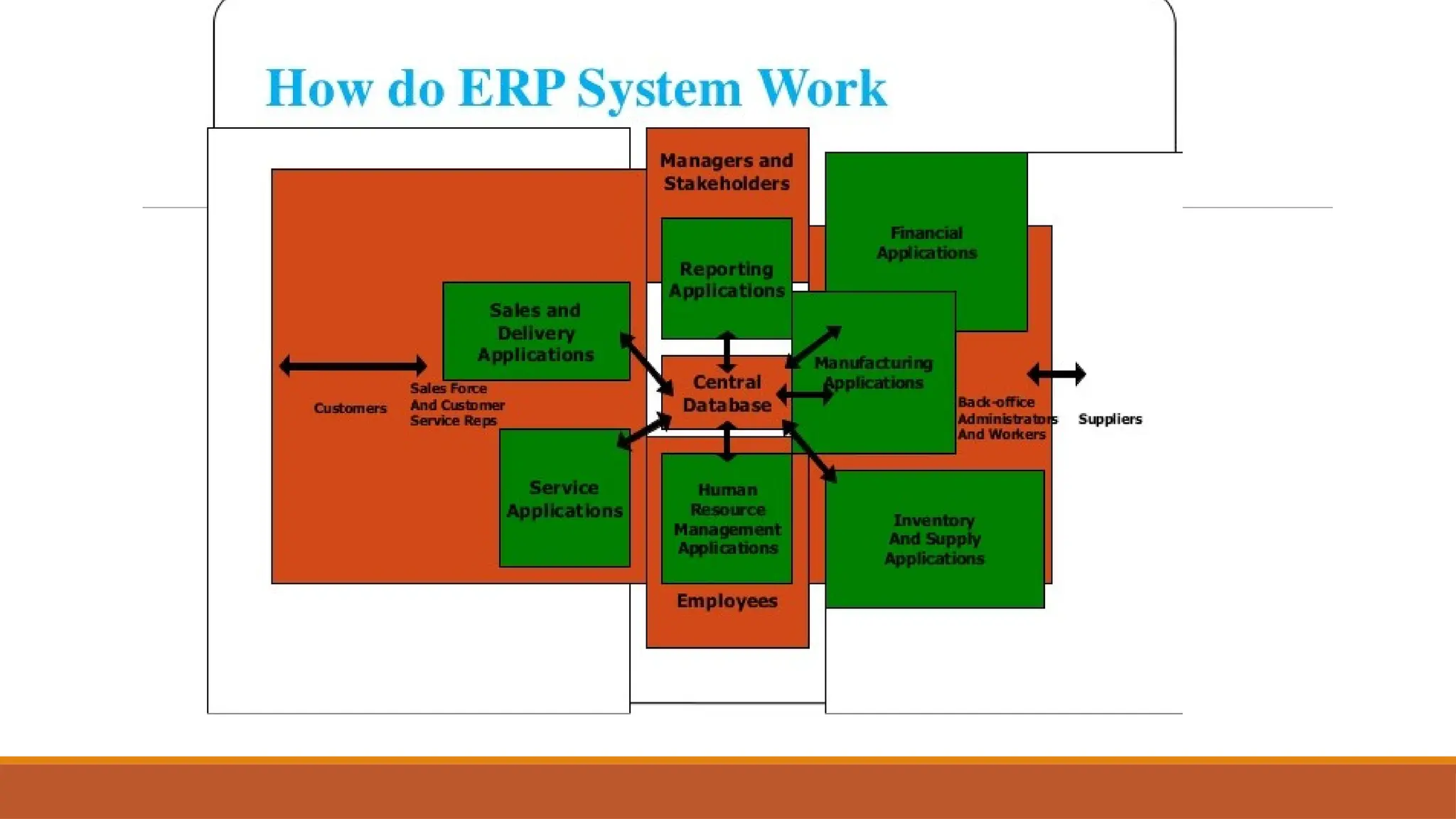
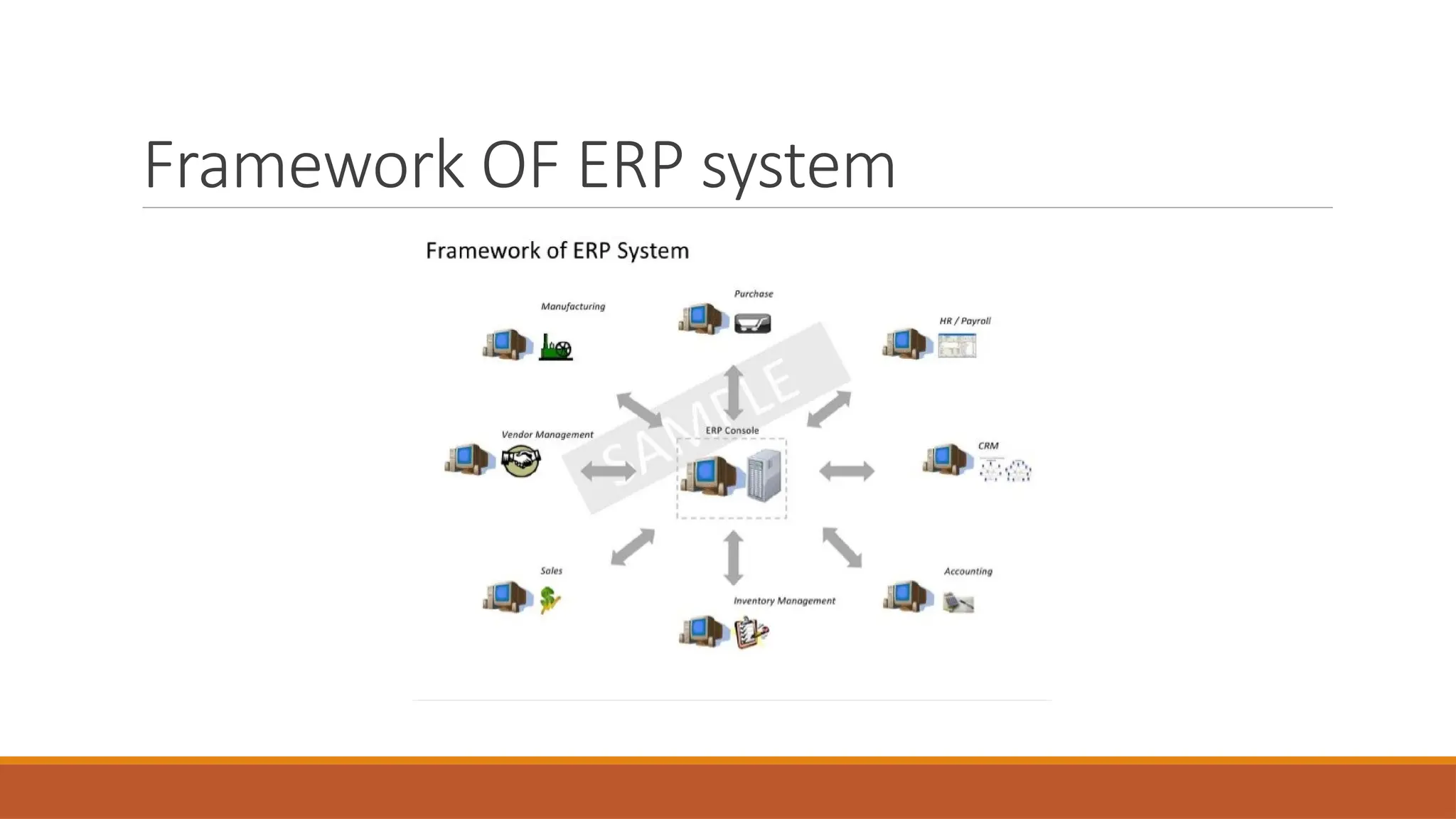
Framework OF ERP system
Benefits of ERP
•Integration of a single source of data.
•A real time system
•Increased productivity
•Reduced operating costs
•Improved internal communication
•Foundation for future improvement
•Improved customer service and order fulfillment
•Improved communication with suppliers and customers
•Enhanced competitive position
•Increased sales and profits.
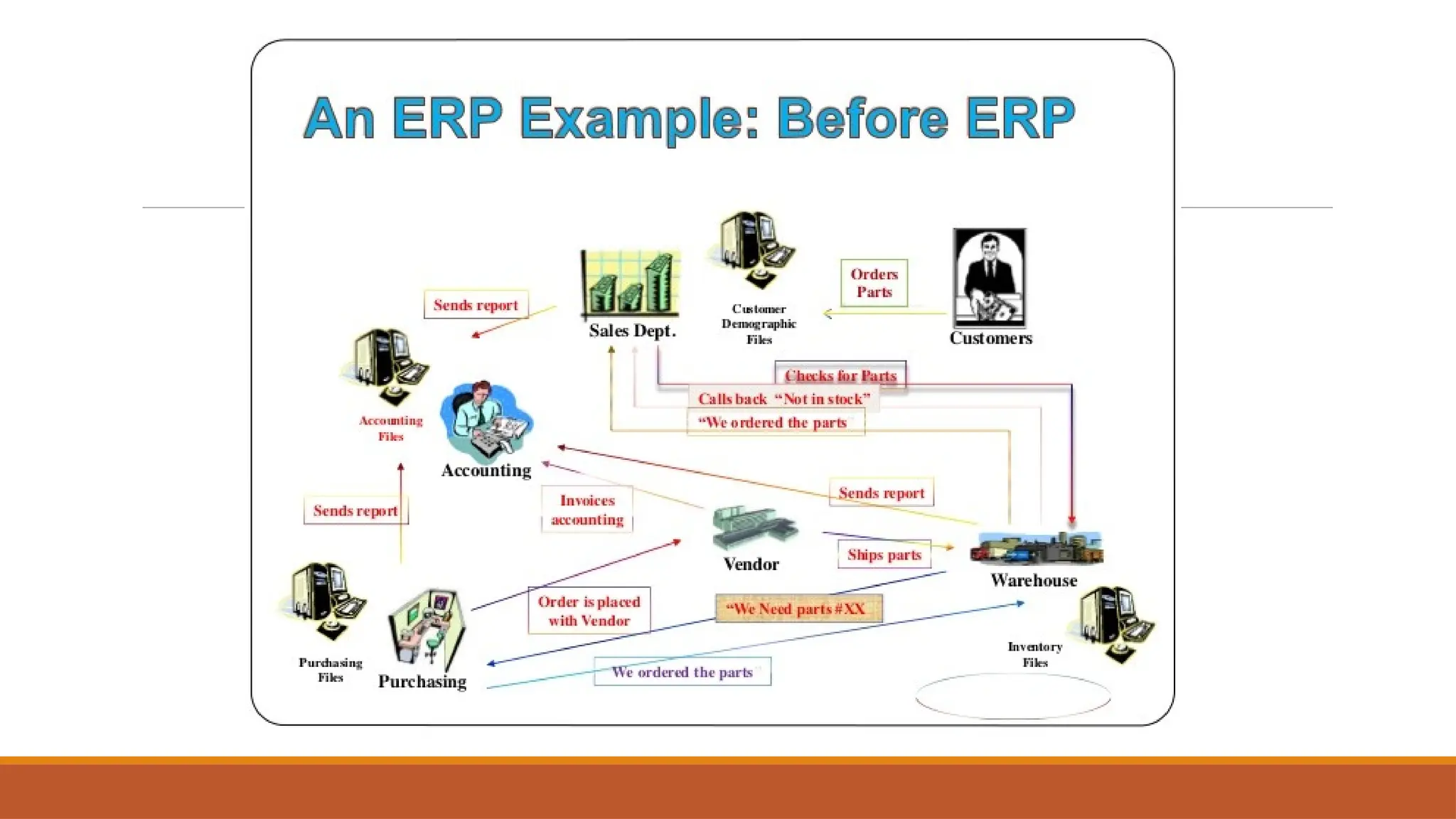
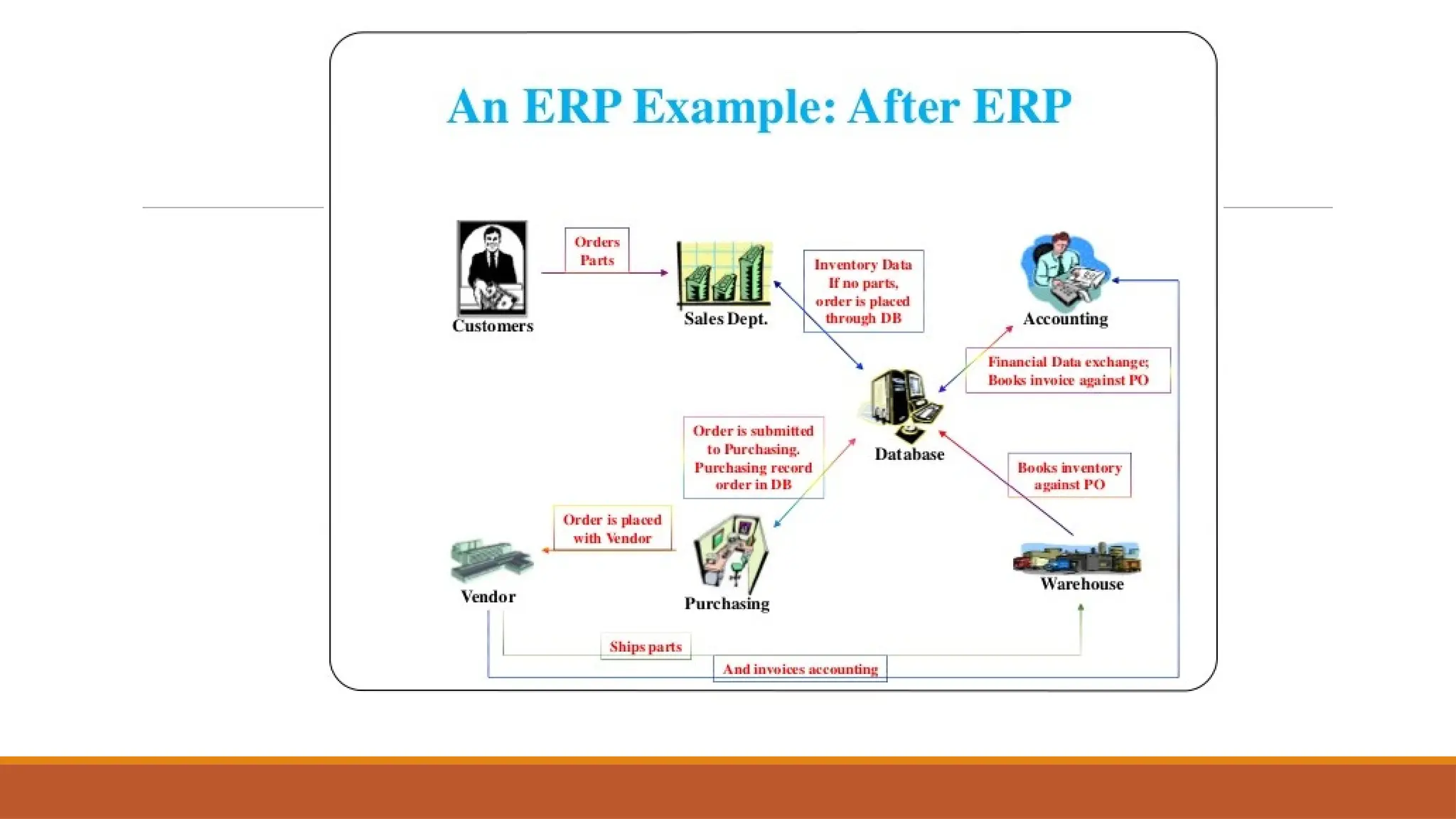
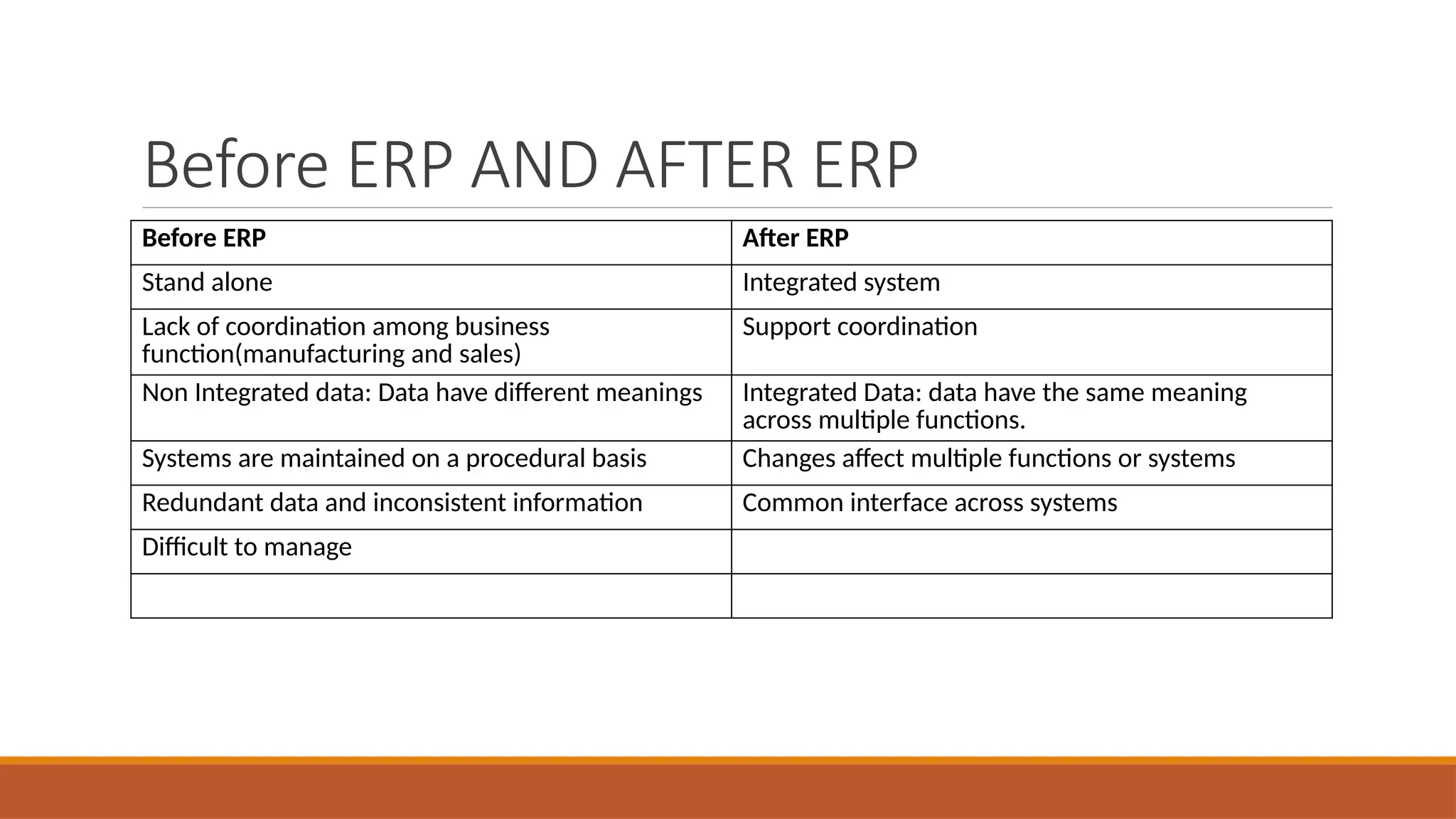
Before ERP AND AFTER ERP
Before ERP After ERP
Stand alone Integrated system
Lack of coordination among business
function(manufacturing and sales)
Support coordination
Non Integrated data: Data have different meanings Integrated Data: data have the same meaning
across multiple functions.
Systems are maintained on a procedural basis Changes affect multiple functions or systems
Redundant data and inconsistent information Common interface across systems
Difficult to manage
MODULES OF ERP
•Finance
•Material
•Sales
•Marketing
•Personnel
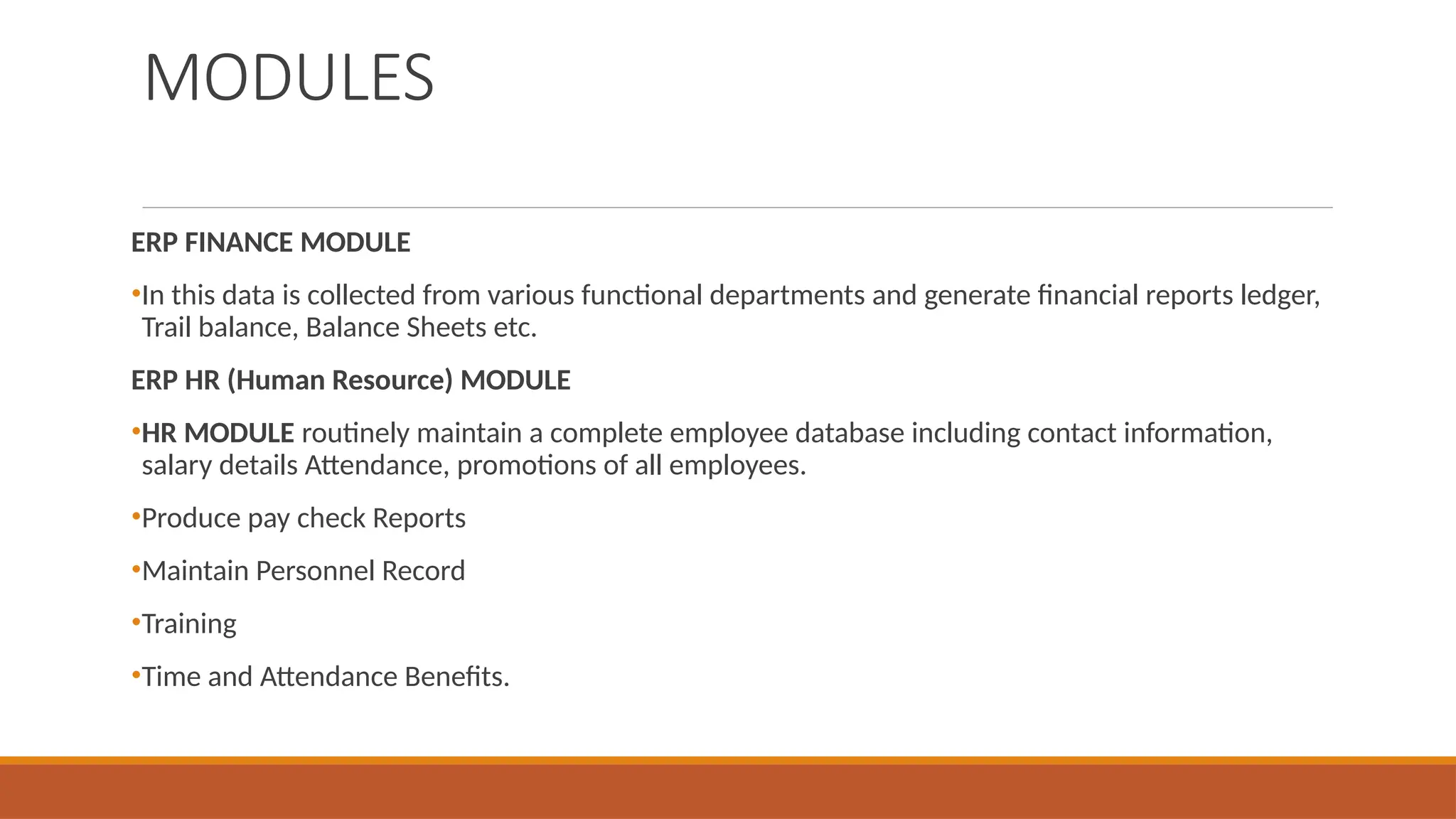
MODULES
ERP FINANCE MODULE
•In this data is collected from various functional departments and generate financial reports ledger,
Trail balance, Balance Sheets etc.
ERP HR (Human Resource) MODULE
•HR MODULE routinely maintain a complete employee database including contact information,
salary details Attendance, promotions of all employees.
•Produce pay check Reports
•Maintain Personnel Record
•Training
•Time and Attendance Benefits.
ERP Purchasing Module
•Purchasing module is tightly with the inventory control and production planning modules.
ERP Inventory Module
•inventory module facilitates processes of maintaining the appropriate level of stock in a
warehouse.
Limitations of the ERP SYSTEMS
•Managers cannot generate custom reports or queries without the help from a programmer and
inhibits them from obtaining information quickly, which is essential for making a competitive
advantage.
•ERP systems provide current status only, such as open orders. Manager often need to look past
status to find trends and patterns that aid better decision making.
•The data in the ERP application is integrated with other enterprise or division systems and does
not include external intelligence.
ERP AND Related technologies
There are many technologies that help to overcome these limitations. These technologies when used in conjunction with
the ERP package, help in overcoming the limitations of stand-alone ERP system and thus help the employees make better
decisions.
Some of these technologies:
•Business Process RE-Engineering (BPR).
•Management Information System.
•Decision Support Systems
•Executive Information Systems
•Data Warehousing
•Data Mining
•Online Analytical Processing (OLAP).
•Supply Chain Management.
Business process reengineering
•BPR is the fundamental rethinking and radical redesign of business processes to achieve
dramatic improvements in critical, contemporary measures of performance such as cost, quality,
services and speed.
•One of the main tools for making this change is the information Technology (IT).
•Any BPR effort that fails to understand the importance of IT, and goes through the pre-BPR
analysis and planning phases without considering the various IT options available, and the effort
of the proposed IT solutions on the employees and the organization is bound to crash during off.
BPR PHASES
Step 1: Prepare for Reengineering
There must be significant need for the process to be reengineered. Identifying the customer
driven objectives, the mission and vision statement is formulated.
Step 2: Map and Analyze As-Is Process
Understand the existing process and its shortfalls and improvement areas of redesign.
Activity and process models are documented then , the amount and cost of each activity is
calculated.
Step 3: Design To Be Process
The objective of this phase is to produce one or more alternatives to the current situation that
satisfies strategic goals of the enterprise.
Step 4: Implement Reengineering Process
Using prototype and simulation method plans are designed and demonstrated.
Training programs for the workers are initiated and the plan is executed in full scale.
Step 5: Improving the reengineering process Continuously
The progress of action is measured on change acceptance in broader perspective of the
organization, how well the employee are informed and their commitments.
Monitoring the results measures employee attitude, customer perception, supplier
responsiveness etc.
Benefits of Reengineering
• Eliminates waste, and obsolete or inefficient process.
•Significant reduction in cost and time.
•Revolutionary improvements in many business processes measured by quality and customer
service
•Increasing the competency of both top and low level companies.
•It helps in integrating the various business processes of the organization.
•With good ERP package, the organization will be able to achieve dramatic improvements in
areas such as cost, quality, speed, etc. hence many BPR initiatives are used in ERP
implementation.
Data Warehousing
•If operational data is kept in the database of ERP system, it can create a lot of problems.
•As time passes, the amount of data will increase and this will affect the performance of the ERP
system.
•However once the operational use of the data is over, it should be removed from the
operational databases.
What is Data Warehouse
•A single complete and consistent store of data obtained from a variety of different sources made
available to end users in a what they can understand and use business context.
What is Data Warehousing?
•a process of transforming data into information and making it available to users in a timely
enough manner to make a difference.
•It is a relational or multidimensional database management system designed to support
management decision making.
Data Warehousing Characteristics
•Subject Oriented: Data that gives information about a particular subject instead of about a
company’s on going operations.
•Integrated: Data that is gathered into the data warehouse from a variety of sources and merged
into a coherent(clear) whole.
•Time-Variant: all data in the data warehouse is identified with a particular time period.
•Non-Volatile: Data is stable in a data warehouse, more data is added but data is never removed.
This enables management to gain consistent picture of the business.
Evolution in organizational use of data
warehouse
The following are the general stages of the data warehouse can be distinguished.
Offline operational Database: Data warehouses in this initial stage are developed by simply
copying the data off an operational system to another server where the processing load of
reporting against the copied data does not impact the operational system performance.
Offline Data Warehouse: data warehouse at this stage are updated from data in the operational
systems on a regular basis and the data warehouse data is stored in a data structure designed to
facilitate reporting.
Real Time Data warehouse: data warehouses at this stage are updated every time an
operational system performs a transaction (e.g. an order or a delivery or a booking).
Integrated Data warehouse: data warehouses at this stage are updated every time an
operational system performs a transaction. The data warehouses then generate transactions
that are passed back into the operational systems.
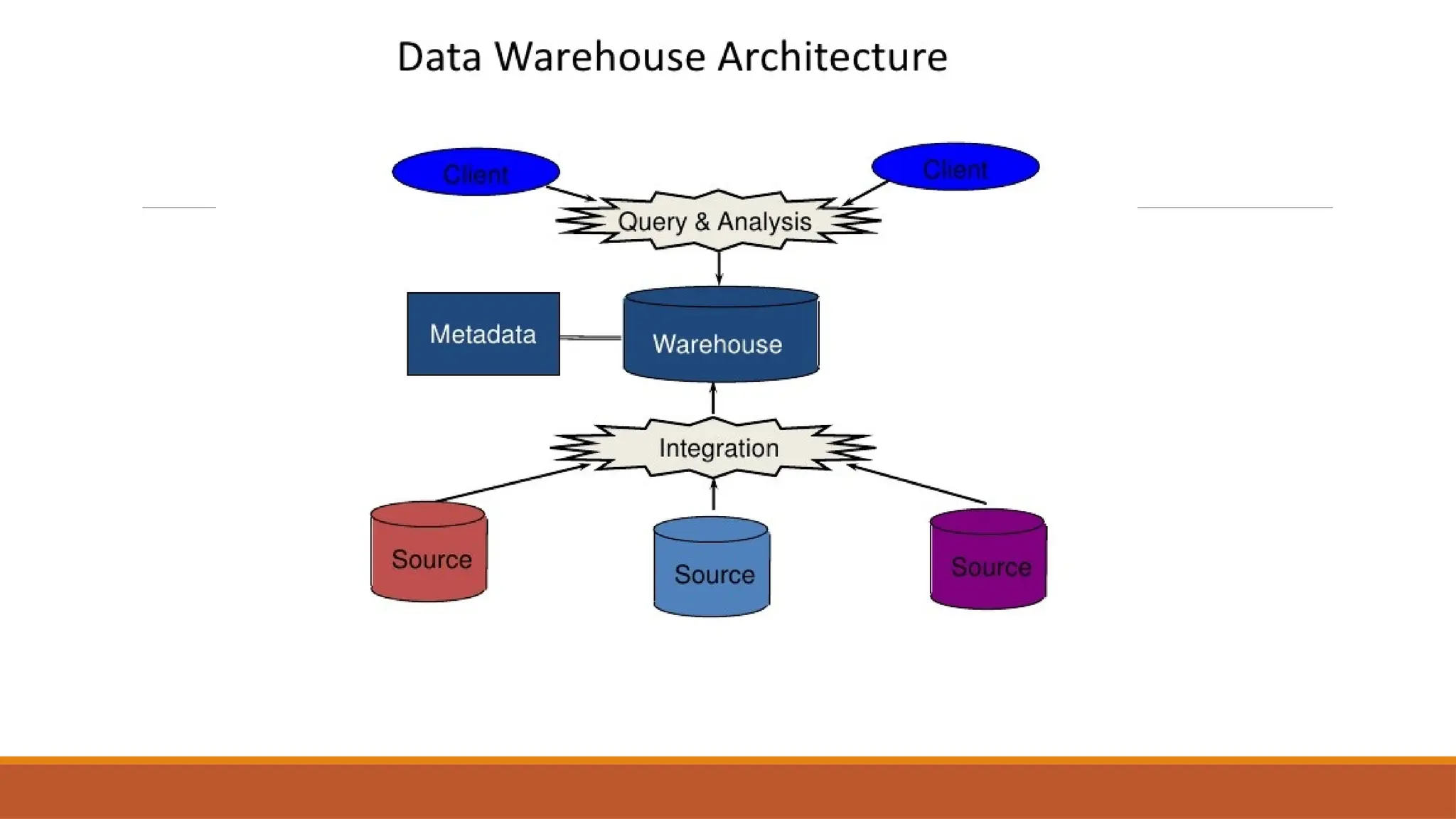
•The data has been selected from various sources and then integrate and store the data in a
single and particular format.
•Data warehouses contain current detailed data, historical detailed data, lightly and highly
summarized data, and meta data.
•Current and historical data are voluminous because they are stored at the highest level of detail.
•Lightly and highly summarized data are necessary to save processing time when users request
them are readily accessible.
•Metadata are data about data. It is important for designing, constructing, retrieving and
controlling the data warehouse data.
•Technical metadata: include where the data come from, how the data were changed, how the
data are organized, who owns the data, who is responsible for the data and how to contact
them, who can access the data and date of last updated.
•Business metadata: include what data are available, where the data are, what the data mean,
how to access the data, predefined reports and queries, and how current the data are.
Types
1. Enterprise Data Warehouse
•Enterprise data warehouse is a centralized warehouse. It provides decision support service
across the enterprise.
•It offers a unified approach for organizing and representing data.
•It also provide the ability to classify data according to the subject and give access according to
those divisions.
2. Operational Data Store
•Operational data store, which is also called ODS, are nothing but data store required when
neither Data warehouse nor OLTP systems support organizations reporting needs.
•In ODS, data warehouse is refreshed in real time. Hence it is widely used preferred for routine
activities like storing records of the employees.
3. Data Mart
A data mart is a subset of the data warehouse .
It specially designed for a particular line of business, such as sales, finance, sales or finance. In
an independent data mart, data can collect directly from sources.
Importance Of Data Warehousing
•The primary concept of the data warehousing is that the data stored for the business analysis
can be accessed most effectively by separating it from the data in operational systems.
•The most important reason for separating data for business analysis, from the operational data,
has always been the operational data, has always been the potential performance degradation
on the operational systems that can result from the analysis process.
•Higher performance and quick response time is almost universally critical for operational system.
Advantages
•It provides business users with a “customer-centric” view of the company’s heterogeneous data
by helping to integrate data from sales, service, manufacturing and distribution and other
customer-related business systems.
•It provides added value to company’s customer by allowing them to access better information
when data warehousing is coupled with internet technology.
•It consolidates data about individual customers and provides a repository of all customer for
segment modelling, customer retention planning and cross sales analysis.
•It removes barriers among functional areas by offering a way to reconcile views from multiple
areas, thus providing a look at activities that cross functional lines.
•It reports on trends across multidivisional , multinational operating units, including trends or
relationships in areas such as merchandising , production planning etc.
Disadvantages of data warehouse
•Data warehouses are not the optimal environment for unstructured data.
•Because data must be extracted, transformed and loaded into the warehouse, there is an
element of latency in data warehouse data.
•Over their life, data warehouses can have high costs, maintenance costs are high.
•Data warehouses can get outdated relatively quickly, There is a cost of delivering suboptimal
information to the organization.
•There is often a fine line between data warehouses and operational systems. Duplicate,
expensive functionality may be developed in the data warehouse that, in retrospect , should
have been developed in the operational systems and vice versa.
Data Mining
Data mining is the process of identifying valid, novel, potentially useful and ultimately
comprehensible information from database that is used to make crucial business decisions.
•The main reason for needing automated computer systems for intelligent data analysis is the
enormous volume of existing and newly appearing data that require processing.
•The amount of data accumulated each day by various businesses scientific and governmental
organizations around the world is daunting.
•Research organizations, academic institutions and commercial organizations create and store
huge amounts of data each day.
•It becomes impossible for human analysists to cope with such overwhelming amounts of data.
Two other problems that surface when human analysists process data are:
i. The inadequacy of the human brain when searching for complex multi-factorial dependence
in the data.
ii. The lack of objectiveness in analyzing the data.
Advantages
•While data mining does not eliminate human participation in solving the task completely, it
significantly simplifies the job and allows an analyst, who is not a professional in statistics and
programming to manage the process of extracting knowledge from data.
Online analytical processing (OLAP)
OLAP (Online analytical processing) is computer processing that enables a user to easily and
selectively extract and view data from different points of view.
•OLAP allows users to analyze database information from multiple database systems at one time.
CHARACTERISTICS
Involves historical processing of information
OLAP systems are used by knowledge workers such as executives, managers and analysts
Useful in analyzing the business
It focuses on information out.
Contains historical data.
Number of users is in hundreds
Highly flexible
Online analytical processing (OLAP)
OLAP can be defined as fast analysis of shared multi dimensional information.
Fast: means that the system is targeted to deliver most responses to users within about 5
seconds, with the simplest analysis not taking more than 20 seconds.
Analysis: means that the system can cope with any business logic and statistical analysis that is
relevant for the application and the user. And keep it easy enough for the target user.
Shared: means that the system implements all the security requirements for confidentiality and
if multiple write access is needed, concurrent update locking at an appropriate level.
Multi-dimensional: means that the system must provide a multi-dimensional conceptual view of
data including support for hierarchies and multiple hierarchies.
Information is defined data that is accurate, timely and relevant to the user.
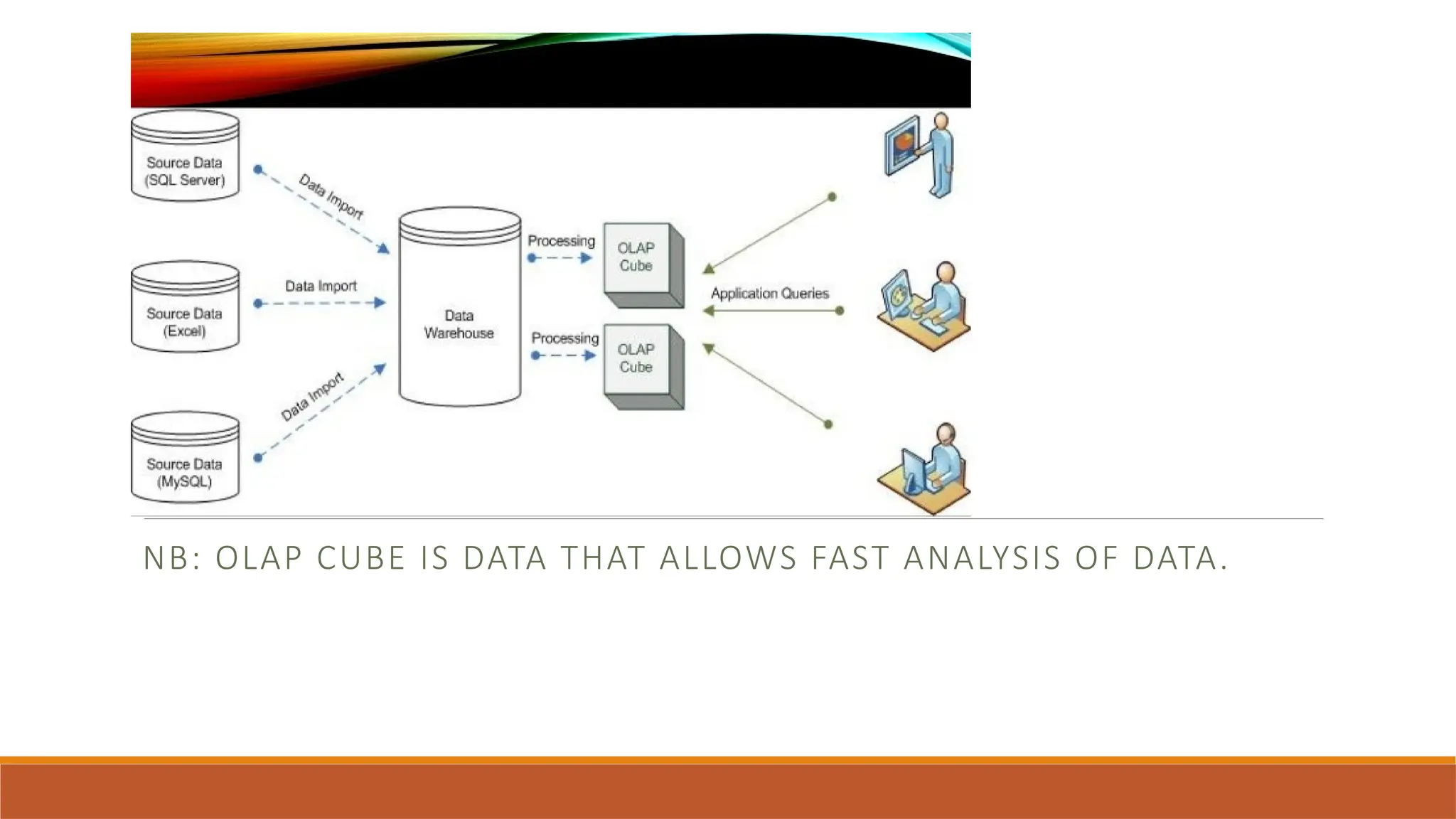
NB: OLAP CUBE IS DATA THAT ALLOWS FAST ANALYSIS OF DATA.
Importance
•OLAP technology is being used in an increasingly wide range applications.
•The most common are sales and marketing analysis, financial reporting and consolidation and
budgeting and planning.
•OLAP is being used for applications such as product, profitability and pricing analysis, activity
based coating ; manpower planning and quality analysis or for that matter any management
system that requires a flexible top down view of an organization.
THANK YOU

UNIT 4 management information Sytems.pptx

  • 1.
  • 2.
    An Overview Enterprise ResourcePlanning •ERP: is a business management software that allows an organization to use a system of integrated applications to manage the business. •Being specific ERP systems are large computer systems that integrate application programs in accounting (i.e ACCOUNTS RECEIVABLE), Sales (ORDER BOOKING), Manufacturing (Product Shipping) and the other functions in the firm.
  • 3.
    EVOLUTION •1960s: Software Packageswith Inventory •1970s : MRP (Material Requirement Planning) Systems (Production schedule with materials management). •1980s: MRPII systems (Adds financial accounting system) •1990s: MRPII (Integrated systems for manufacturing execution •Late 1990s: ERP (Integrated manufacturing with supply chain)
  • 4.
    MAJOR REASONS FORADOPTING ERP • Integrate financial information •Integrate customer order information •Standardize and speed up operations processes •Reduce inventory •Standardize Human Resource information
  • 6.
    Components Of ERPSystem •Finance: modules for book keeping and making sure the bills are paid in time. Examples General ledger Accounts Receivable Accounts Payable •HR: Software for handling personnel-related tasks for corporate managers and individuals employees. Examples HR administration Payroll Self-service HR
  • 7.
    Business Intelligence (BI) •BusinessIntelligence is data transformed into actionable insights that support better, faster decision making. •Business Intelligence has become a standard component of most ERP packages, BI tools allow users to share and analyze the data collected across the enterprise and centralized in the ERP database. •BI can come in the form of dashboards, automated reporting and analysis tools used to monitor the organizational business performance. BI supports informed decision making by everyone, from executives to line managers and accounts.
  • 8.
    Supply chain Management •Sometimes referred to as logistics, improves the flow of materials through an organization by managing planning, scheduling, procurement, and fulfillment, to maximize customer satisfaction and profitability. •Sub module in SCM often include production scheduling, demand management, distribution management, warehouse management, procurement and order management. Manufacturing Operations •It makes manufacturing operations more efficient through product configuration, job costing and bill of materials management. •ERP Manufacturing modules often include capacity requirements planning, materials Requirement planning, forecasting, Master production scheduling, work order management and shop floor control.
  • 9.
  • 12.
    Benefits of ERP •Integrationof a single source of data. •A real time system •Increased productivity •Reduced operating costs •Improved internal communication •Foundation for future improvement •Improved customer service and order fulfillment •Improved communication with suppliers and customers •Enhanced competitive position •Increased sales and profits.
  • 13.
    Before ERP ANDAFTER ERP Before ERP After ERP Stand alone Integrated system Lack of coordination among business function(manufacturing and sales) Support coordination Non Integrated data: Data have different meanings Integrated Data: data have the same meaning across multiple functions. Systems are maintained on a procedural basis Changes affect multiple functions or systems Redundant data and inconsistent information Common interface across systems Difficult to manage
  • 14.
  • 15.
    MODULES ERP FINANCE MODULE •Inthis data is collected from various functional departments and generate financial reports ledger, Trail balance, Balance Sheets etc. ERP HR (Human Resource) MODULE •HR MODULE routinely maintain a complete employee database including contact information, salary details Attendance, promotions of all employees. •Produce pay check Reports •Maintain Personnel Record •Training •Time and Attendance Benefits.
  • 16.
    ERP Purchasing Module •Purchasingmodule is tightly with the inventory control and production planning modules. ERP Inventory Module •inventory module facilitates processes of maintaining the appropriate level of stock in a warehouse.
  • 17.
    Limitations of theERP SYSTEMS •Managers cannot generate custom reports or queries without the help from a programmer and inhibits them from obtaining information quickly, which is essential for making a competitive advantage. •ERP systems provide current status only, such as open orders. Manager often need to look past status to find trends and patterns that aid better decision making. •The data in the ERP application is integrated with other enterprise or division systems and does not include external intelligence.
  • 18.
    ERP AND Relatedtechnologies There are many technologies that help to overcome these limitations. These technologies when used in conjunction with the ERP package, help in overcoming the limitations of stand-alone ERP system and thus help the employees make better decisions. Some of these technologies: •Business Process RE-Engineering (BPR). •Management Information System. •Decision Support Systems •Executive Information Systems •Data Warehousing •Data Mining •Online Analytical Processing (OLAP). •Supply Chain Management.
  • 19.
    Business process reengineering •BPRis the fundamental rethinking and radical redesign of business processes to achieve dramatic improvements in critical, contemporary measures of performance such as cost, quality, services and speed. •One of the main tools for making this change is the information Technology (IT). •Any BPR effort that fails to understand the importance of IT, and goes through the pre-BPR analysis and planning phases without considering the various IT options available, and the effort of the proposed IT solutions on the employees and the organization is bound to crash during off.
  • 20.
    BPR PHASES Step 1:Prepare for Reengineering There must be significant need for the process to be reengineered. Identifying the customer driven objectives, the mission and vision statement is formulated. Step 2: Map and Analyze As-Is Process Understand the existing process and its shortfalls and improvement areas of redesign. Activity and process models are documented then , the amount and cost of each activity is calculated. Step 3: Design To Be Process The objective of this phase is to produce one or more alternatives to the current situation that satisfies strategic goals of the enterprise.
  • 21.
    Step 4: ImplementReengineering Process Using prototype and simulation method plans are designed and demonstrated. Training programs for the workers are initiated and the plan is executed in full scale. Step 5: Improving the reengineering process Continuously The progress of action is measured on change acceptance in broader perspective of the organization, how well the employee are informed and their commitments. Monitoring the results measures employee attitude, customer perception, supplier responsiveness etc.
  • 22.
    Benefits of Reengineering •Eliminates waste, and obsolete or inefficient process. •Significant reduction in cost and time. •Revolutionary improvements in many business processes measured by quality and customer service •Increasing the competency of both top and low level companies. •It helps in integrating the various business processes of the organization. •With good ERP package, the organization will be able to achieve dramatic improvements in areas such as cost, quality, speed, etc. hence many BPR initiatives are used in ERP implementation.
  • 23.
    Data Warehousing •If operationaldata is kept in the database of ERP system, it can create a lot of problems. •As time passes, the amount of data will increase and this will affect the performance of the ERP system. •However once the operational use of the data is over, it should be removed from the operational databases.
  • 24.
    What is DataWarehouse •A single complete and consistent store of data obtained from a variety of different sources made available to end users in a what they can understand and use business context. What is Data Warehousing? •a process of transforming data into information and making it available to users in a timely enough manner to make a difference. •It is a relational or multidimensional database management system designed to support management decision making.
  • 25.
    Data Warehousing Characteristics •SubjectOriented: Data that gives information about a particular subject instead of about a company’s on going operations. •Integrated: Data that is gathered into the data warehouse from a variety of sources and merged into a coherent(clear) whole. •Time-Variant: all data in the data warehouse is identified with a particular time period. •Non-Volatile: Data is stable in a data warehouse, more data is added but data is never removed. This enables management to gain consistent picture of the business.
  • 26.
    Evolution in organizationaluse of data warehouse The following are the general stages of the data warehouse can be distinguished. Offline operational Database: Data warehouses in this initial stage are developed by simply copying the data off an operational system to another server where the processing load of reporting against the copied data does not impact the operational system performance. Offline Data Warehouse: data warehouse at this stage are updated from data in the operational systems on a regular basis and the data warehouse data is stored in a data structure designed to facilitate reporting. Real Time Data warehouse: data warehouses at this stage are updated every time an operational system performs a transaction (e.g. an order or a delivery or a booking). Integrated Data warehouse: data warehouses at this stage are updated every time an operational system performs a transaction. The data warehouses then generate transactions that are passed back into the operational systems.
  • 28.
    •The data hasbeen selected from various sources and then integrate and store the data in a single and particular format. •Data warehouses contain current detailed data, historical detailed data, lightly and highly summarized data, and meta data. •Current and historical data are voluminous because they are stored at the highest level of detail. •Lightly and highly summarized data are necessary to save processing time when users request them are readily accessible. •Metadata are data about data. It is important for designing, constructing, retrieving and controlling the data warehouse data.
  • 29.
    •Technical metadata: includewhere the data come from, how the data were changed, how the data are organized, who owns the data, who is responsible for the data and how to contact them, who can access the data and date of last updated. •Business metadata: include what data are available, where the data are, what the data mean, how to access the data, predefined reports and queries, and how current the data are.
  • 30.
    Types 1. Enterprise DataWarehouse •Enterprise data warehouse is a centralized warehouse. It provides decision support service across the enterprise. •It offers a unified approach for organizing and representing data. •It also provide the ability to classify data according to the subject and give access according to those divisions.
  • 31.
    2. Operational DataStore •Operational data store, which is also called ODS, are nothing but data store required when neither Data warehouse nor OLTP systems support organizations reporting needs. •In ODS, data warehouse is refreshed in real time. Hence it is widely used preferred for routine activities like storing records of the employees.
  • 32.
    3. Data Mart Adata mart is a subset of the data warehouse . It specially designed for a particular line of business, such as sales, finance, sales or finance. In an independent data mart, data can collect directly from sources.
  • 33.
    Importance Of DataWarehousing •The primary concept of the data warehousing is that the data stored for the business analysis can be accessed most effectively by separating it from the data in operational systems. •The most important reason for separating data for business analysis, from the operational data, has always been the operational data, has always been the potential performance degradation on the operational systems that can result from the analysis process. •Higher performance and quick response time is almost universally critical for operational system.
  • 34.
    Advantages •It provides businessusers with a “customer-centric” view of the company’s heterogeneous data by helping to integrate data from sales, service, manufacturing and distribution and other customer-related business systems. •It provides added value to company’s customer by allowing them to access better information when data warehousing is coupled with internet technology. •It consolidates data about individual customers and provides a repository of all customer for segment modelling, customer retention planning and cross sales analysis. •It removes barriers among functional areas by offering a way to reconcile views from multiple areas, thus providing a look at activities that cross functional lines. •It reports on trends across multidivisional , multinational operating units, including trends or relationships in areas such as merchandising , production planning etc.
  • 35.
    Disadvantages of datawarehouse •Data warehouses are not the optimal environment for unstructured data. •Because data must be extracted, transformed and loaded into the warehouse, there is an element of latency in data warehouse data. •Over their life, data warehouses can have high costs, maintenance costs are high. •Data warehouses can get outdated relatively quickly, There is a cost of delivering suboptimal information to the organization. •There is often a fine line between data warehouses and operational systems. Duplicate, expensive functionality may be developed in the data warehouse that, in retrospect , should have been developed in the operational systems and vice versa.
  • 36.
    Data Mining Data miningis the process of identifying valid, novel, potentially useful and ultimately comprehensible information from database that is used to make crucial business decisions. •The main reason for needing automated computer systems for intelligent data analysis is the enormous volume of existing and newly appearing data that require processing. •The amount of data accumulated each day by various businesses scientific and governmental organizations around the world is daunting. •Research organizations, academic institutions and commercial organizations create and store huge amounts of data each day. •It becomes impossible for human analysists to cope with such overwhelming amounts of data.
  • 37.
    Two other problemsthat surface when human analysists process data are: i. The inadequacy of the human brain when searching for complex multi-factorial dependence in the data. ii. The lack of objectiveness in analyzing the data.
  • 38.
    Advantages •While data miningdoes not eliminate human participation in solving the task completely, it significantly simplifies the job and allows an analyst, who is not a professional in statistics and programming to manage the process of extracting knowledge from data.
  • 39.
    Online analytical processing(OLAP) OLAP (Online analytical processing) is computer processing that enables a user to easily and selectively extract and view data from different points of view. •OLAP allows users to analyze database information from multiple database systems at one time.
  • 40.
    CHARACTERISTICS Involves historical processingof information OLAP systems are used by knowledge workers such as executives, managers and analysts Useful in analyzing the business It focuses on information out. Contains historical data. Number of users is in hundreds Highly flexible
  • 41.
    Online analytical processing(OLAP) OLAP can be defined as fast analysis of shared multi dimensional information. Fast: means that the system is targeted to deliver most responses to users within about 5 seconds, with the simplest analysis not taking more than 20 seconds. Analysis: means that the system can cope with any business logic and statistical analysis that is relevant for the application and the user. And keep it easy enough for the target user. Shared: means that the system implements all the security requirements for confidentiality and if multiple write access is needed, concurrent update locking at an appropriate level. Multi-dimensional: means that the system must provide a multi-dimensional conceptual view of data including support for hierarchies and multiple hierarchies. Information is defined data that is accurate, timely and relevant to the user.
  • 42.
    NB: OLAP CUBEIS DATA THAT ALLOWS FAST ANALYSIS OF DATA.
  • 43.
    Importance •OLAP technology isbeing used in an increasingly wide range applications. •The most common are sales and marketing analysis, financial reporting and consolidation and budgeting and planning. •OLAP is being used for applications such as product, profitability and pricing analysis, activity based coating ; manpower planning and quality analysis or for that matter any management system that requires a flexible top down view of an organization.
  • 51.