EPN
ENTERPRISE PRIVATE NETWOR
GROUP MEMBERS
• MEHMOOD RAZA
• AFNAN NADEEM
• KHUZAIMA SHAHID PERACHA
BSBA 5th A BUITMES QUETTA
TELECOMMUNICATION NETWORK
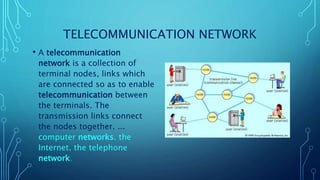
• A telecommunication
network is a collection of
terminal nodes, links which
are connected so as to enable
telecommunication between
the terminals. The
transmission links connect
the nodes together. ...
computer networks. the
Internet. the telephone
network.
TYPES OF TELECOMMUNICATION NETWORKS
There are many different network structures to
efficiently route messages, for example:
• Wide area networks (WAN)
• Metropolitan area networks (MAN)
• Local area networks (LAN)
• Internet area networks (IAN)
• Campus area networks (CAN)
• Virtual private networks (VPN)
• Enterprise private networks (EPN)
ENTERPRISE PRIVATE NETWORK (EPN)
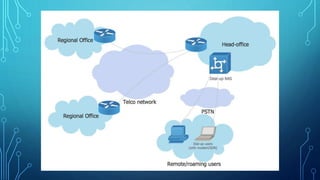
• An enterprise private network is a computer
network that helps enterprise companies with a
number of disparate offices connect those offices
to each in a secure way over a network. An
enterprise private network is mainly set up to
share computer resources.
• It is a computer network that is entirely
controlled by one organisation and it is used to
connect multiple locations.
HISTORY
• In the U.S., private networks were started in the early 1970s by
AT&T. The networks were mainly operated over
telecommunications networks. During 1990s as Internet
technology evolved, a new type of network called virtual private
networks originated. This type of network was built over public
infrastructure, and the data was encrypted to protect it from
eavesdroppers.
• Nowadays, networks built by companies are still called enterprise
private networks when privacy is maintained through security
procedures and tunneling protocols like Layer 2 Tunneling
Protocol.
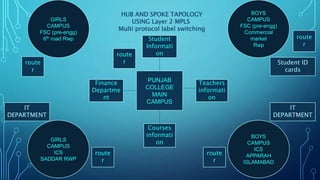
PUNJAB
COLLEGE
MAIN
CAMPUS
BOYS
CAMPUS
FSC (pre-engg)
Commercial
market
Rwp
Student
Informati
on
Teachers
informati
on
Courses
informati
on
Finance
Departme
nt
HUB AND SPOKE TAPOLOGY
USING Layer 2 MPLS
Multi protocol label switching
GIRLS
CAMPUS
FSC (pre-engg)
6th road Rwp
GIRLS
CAMPUS
ICS
SADDAR RWP
BOYS
CAMPUS
ICS
APPARAH
ISLAMABAD
route
r
route
r
route
r
route
r
route
r Student ID
cards
IT
DEPARTMENT
IT
DEPARTMENT
ADVANTAGES
• Security
• Sharing
• Centralize (communication)
• It help in business continuity and development.
USEFUL INFORMATION
Many business applications of telecommunication involve the use of the internet,
extranet, and other networks to form interenterprise networks.
Such networks link a company’s headquarters and other location to the networks of
its customer, suppliers and other organization.
For example:
You think of a customer account inquiry system that provides intranet access by
employees and extranet access by customer.so it is an other example of
interenterprise network.
So is the use of Electronic data interchange.(EDI) systems that link the
computers of a company with those of its suppliers and customers for the electronic
exchange of business documents.
INTRANET
EXTRANET
It is a computer network system in which a specific organisation system
information computing services and operational system with each othe
the use of internet (IP) technology.
It is a type of computer network that allows the
outside users to access the intranet of organisation.
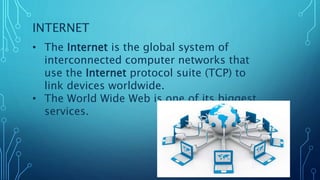
INTERNET
• The Internet is the global system of
interconnected computer networks that
use the Internet protocol suite (TCP) to
link devices worldwide.
• The World Wide Web is one of its biggest
services.
ELECTRONIC DATA INTERCHANGE
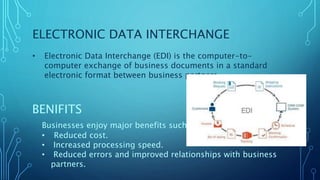
• Electronic Data Interchange (EDI) is the computer-to-
computer exchange of business documents in a standard
electronic format between business partners.
BENIFITS
Businesses enjoy major benefits such as
• Reduced cost.
• Increased processing speed.
• Reduced errors and improved relationships with business
partners.
BUSINESS DOCUMENTS
These are any of the documents that are typically exchanged
between businesses. The most common documents exchanged
via EDI are
• purchase orders
• invoices
• advance ship notices.
• But there are many, many others such as bill of lading, customs
documents, inventory documents, shipping status documents
and payment documents.
• A standard format must be used so that the computer will be
able to read and understand the documents.
BELOW IS AN OUTLINE OF THE DIFFERENT
METHODS AVAILABLE
• Direct EDI/Point-to-Point
• EDI via VAN
• EDI Network Services Provider
• EDI via AS2
• EDI via FTP/VPN, SFTP, FTPS Web
• EDI Mobile EDI
• EDI Outsourcing
• EDI Software
WORLD WIDE WEB
• It is a standard to communicate on web and
publication information.
• It provide base to different software's and for
different languages
THANK YOU !

Enterprise private network

  • 1.
  • 2.
    GROUP MEMBERS • MEHMOODRAZA • AFNAN NADEEM • KHUZAIMA SHAHID PERACHA BSBA 5th A BUITMES QUETTA
  • 3.
    TELECOMMUNICATION NETWORK • Atelecommunication network is a collection of terminal nodes, links which are connected so as to enable telecommunication between the terminals. The transmission links connect the nodes together. ... computer networks. the Internet. the telephone network.
  • 4.
    TYPES OF TELECOMMUNICATIONNETWORKS There are many different network structures to efficiently route messages, for example: • Wide area networks (WAN) • Metropolitan area networks (MAN) • Local area networks (LAN) • Internet area networks (IAN) • Campus area networks (CAN) • Virtual private networks (VPN) • Enterprise private networks (EPN)
  • 5.
    ENTERPRISE PRIVATE NETWORK(EPN) • An enterprise private network is a computer network that helps enterprise companies with a number of disparate offices connect those offices to each in a secure way over a network. An enterprise private network is mainly set up to share computer resources. • It is a computer network that is entirely controlled by one organisation and it is used to connect multiple locations.
  • 7.
    HISTORY • In theU.S., private networks were started in the early 1970s by AT&T. The networks were mainly operated over telecommunications networks. During 1990s as Internet technology evolved, a new type of network called virtual private networks originated. This type of network was built over public infrastructure, and the data was encrypted to protect it from eavesdroppers. • Nowadays, networks built by companies are still called enterprise private networks when privacy is maintained through security procedures and tunneling protocols like Layer 2 Tunneling Protocol.
  • 8.
    PUNJAB COLLEGE MAIN CAMPUS BOYS CAMPUS FSC (pre-engg) Commercial market Rwp Student Informati on Teachers informati on Courses informati on Finance Departme nt HUB ANDSPOKE TAPOLOGY USING Layer 2 MPLS Multi protocol label switching GIRLS CAMPUS FSC (pre-engg) 6th road Rwp GIRLS CAMPUS ICS SADDAR RWP BOYS CAMPUS ICS APPARAH ISLAMABAD route r route r route r route r route r Student ID cards IT DEPARTMENT IT DEPARTMENT
  • 9.
    ADVANTAGES • Security • Sharing •Centralize (communication) • It help in business continuity and development.
  • 10.
    USEFUL INFORMATION Many businessapplications of telecommunication involve the use of the internet, extranet, and other networks to form interenterprise networks. Such networks link a company’s headquarters and other location to the networks of its customer, suppliers and other organization. For example: You think of a customer account inquiry system that provides intranet access by employees and extranet access by customer.so it is an other example of interenterprise network. So is the use of Electronic data interchange.(EDI) systems that link the computers of a company with those of its suppliers and customers for the electronic exchange of business documents.
  • 12.
    INTRANET EXTRANET It is acomputer network system in which a specific organisation system information computing services and operational system with each othe the use of internet (IP) technology. It is a type of computer network that allows the outside users to access the intranet of organisation.
  • 13.
    INTERNET • The Internetis the global system of interconnected computer networks that use the Internet protocol suite (TCP) to link devices worldwide. • The World Wide Web is one of its biggest services.
  • 14.
    ELECTRONIC DATA INTERCHANGE •Electronic Data Interchange (EDI) is the computer-to- computer exchange of business documents in a standard electronic format between business partners. BENIFITS Businesses enjoy major benefits such as • Reduced cost. • Increased processing speed. • Reduced errors and improved relationships with business partners.
  • 15.
    BUSINESS DOCUMENTS These areany of the documents that are typically exchanged between businesses. The most common documents exchanged via EDI are • purchase orders • invoices • advance ship notices. • But there are many, many others such as bill of lading, customs documents, inventory documents, shipping status documents and payment documents. • A standard format must be used so that the computer will be able to read and understand the documents.
  • 16.
    BELOW IS ANOUTLINE OF THE DIFFERENT METHODS AVAILABLE • Direct EDI/Point-to-Point • EDI via VAN • EDI Network Services Provider • EDI via AS2 • EDI via FTP/VPN, SFTP, FTPS Web • EDI Mobile EDI • EDI Outsourcing • EDI Software
  • 17.
    WORLD WIDE WEB •It is a standard to communicate on web and publication information. • It provide base to different software's and for different languages
  • 18.