BY- Ms. Mansi Tiwari
 PM is a subset of HRM function focuses on
facilitation support to employees for their
individual & overall organizational development.
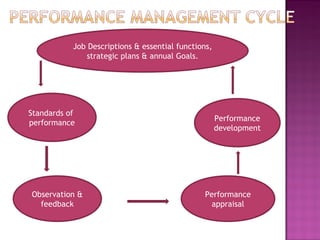
 PM cycle starts from core job descriptions to
reformulating the standards of performance.
 It is continues as an ongoing employee
development function.
Job Descriptions & essential functions,
strategic plans & annual Goals.
Standards of
performance
Observation &
feedback
Performance
appraisal
Performance
development
 To develop a performance culture in
organization.
 In a competitive global environment ,
employees of organization must have up to
date information.
 It will help in providing information about
new technologies, market & customers etc..
 It is a cyclical process.
 Organization manages performances with two
folds objectives-
1. To assess the employee’s performances
2. To develop the employee’s performances
 Through the performance assessments
organization can map following-
1. Performance gap
2. Identify the employee’s potentiality
3. Accordingly develop employee’s capabilities
through continuous development(KSA)
Definition by the Institute of personnel mgmt in
1992
“ PM is a strategy which relates to every activity
of the organizations, set in the context of it’s
human resource policies, culture, style &
communication system”
Important points features as per the definitions-
 Communicating vision to all employees
 Translating vision into mission
 Converting mission into overall objectives
 Setting departmental & individual performances
targets that are related to overall objectives
 Converting such targets in terms of measureable
outputs
 Developing the formal appraisal procedures &
systems
 Linking performance to pay
 Using the reviews as the basis to identify
training, development & rewards
 Evaluating the performances holistically to
improve organizational effectiveness
 Conducting formal performance reviews to track
the process towards achieving the targets
According to Briscoe & claus (2008)
“PM is a system through which organizations set
work goals, determine performance standards
,assign & evaluate work, provide performance
feedback , determine T&D needs & distribute
rewards”
“It is a process of planning the performance,
appraising the performance, giving its feedback
& counseling an employee to improve his
performance”.
 Boosting the performances of the employeesBoosting the performances of the employees
by encouraging employee empowerment ,by encouraging employee empowerment ,
motivation & effective reward mechanism.motivation & effective reward mechanism.
 Promoting personal growth & advancement inPromoting personal growth & advancement in
the career of the employee by helping them inthe career of the employee by helping them in
acquiring the desired KSA.acquiring the desired KSA.
 Identifying the barriers to effectiveIdentifying the barriers to effective
performance & resolving those barriersperformance & resolving those barriers
through constant monitoring , coaching &through constant monitoring , coaching &
development.development.
 Concerned with the output & inputs
 Concerned with the measurement of results
 Concerned with defining the business plan
 Concerned with continuous improvement &
development
 Concern with establishing the culture of trust
& mutual understanding
 Concerned with the information sharing on
core values
 Concerned with the provision of procedural
fairness & transparency in decision making
 PM approach has become a tool in the hands
of the corporate as it ensures that the
people uphold the corporate values in the
path of accomplishments of the ultimate
corporate vision & mission.
 It is forward looking process as it involves
both the supervisors & employees as a joint
planning & goal setting in the beginning of
the year
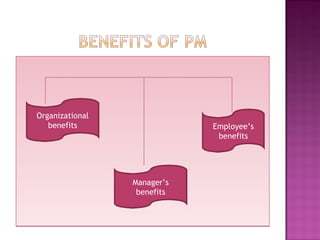
Organizational
benefits
Manager’s
benefits
Employee’s
benefits
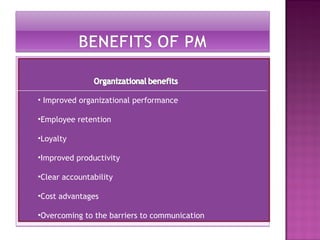
• Improved organizational performance
•Employee retention
•Loyalty
•Improved productivity
•Clear accountability
•Cost advantages
•Overcoming to the barriers to communication
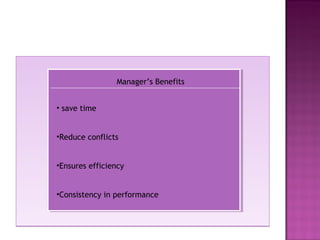
Manager’s Benefits
• save time
•Reduce conflicts
•Ensures efficiency
•Consistency in performance
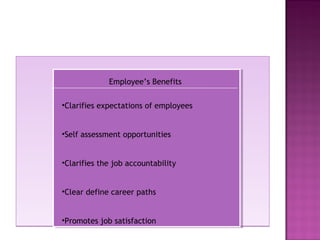
Employee’s Benefits
•Clarifies expectations of employees
•Self assessment opportunities
•Clarifies the job accountability
•Clear define career paths
•Promotes job satisfaction
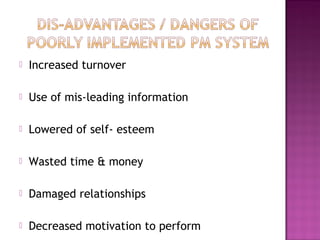
 Increased turnover
 Use of mis-leading information
 Lowered of self- esteem
 Wasted time & money
 Damaged relationships
 Decreased motivation to perform
 Employee burnout
 Job dissatisfaction
 Unclear rating system
 Strong interpersonal skills
 Customer service orientations
 Team work
 Effective communication
 Analysis & solving problems
 Decision making & result orientations
 It is a continuous process of monitoring &
feedback
 It is closely linked to other system of HRM like
planning & development
 It is closely concerned with organizational
culture
 It involves effective use of technology
It covers any organization where interaction takes
place between employee to organization &
organization to employees
Parameters of Organizational Dynamics-
 Expectation of organization from employees &
expectations of employees from organization
 Motivation level of employees
 Morale of the group of employees
 Interpersonal relations
 Inter- group relations
 Role conflicts
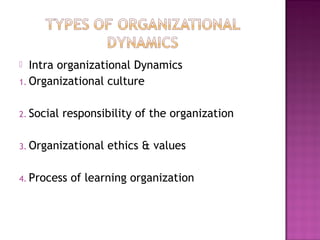
 Intra organizational Dynamics
1. Organizational culture
2. Social responsibility of the organization
3. Organizational ethics & values
4. Process of learning organization
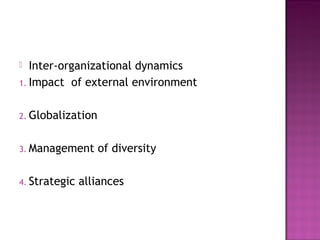
 Inter-organizational dynamics
1. Impact of external environment
2. Globalization
3. Management of diversity
4. Strategic alliances
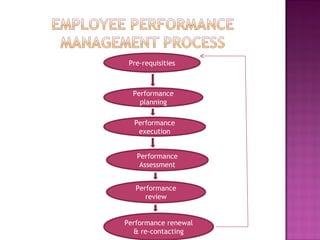
Pre-requisities
Performance
planning
Performance
execution
Performance
Assessment
Performance
review
Performance renewal
& re-contacting
A team is a small no of people with
complementary skills who are committed to a
common purpose, common performance & an
approach for which they hold themselves
mutually accountable.
Teams comprise small numbers of people
possessing complementary skills & committed
to common purpose
 They plan, control & improve their own work
processes.
 They set their own goals & inspect their own work
 They often create their own schedules & review
their performances.
 They may prepare their own budgets & coordinate
their work with other department
 They are frequently responsible for acquiring any
training they might need
 They offers suggestions & give feedback to others
 Enhanced performance
 Employee benefits
 Quality dimensions
 Improved processes
 Global competitiveness
 Flexibility
 Increased productivity
 Increased satisfaction
 Improved communication
The team in the organization should consider
following factors-
 Supportive environment
 Skills & role clarity
 Super oriented goals
 Team rewards
 Cooperation
 Trust
 Training
 Code of conduct
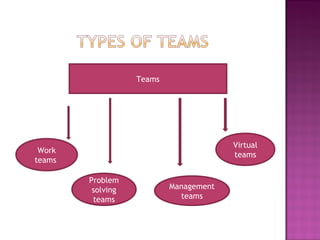
Teams
Work
teams
Problem
solving
teams
Management
teams
Virtual
teams
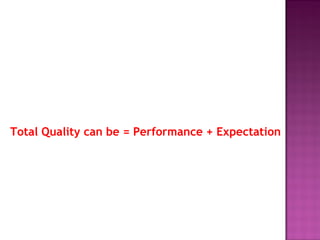
Total Quality can be = Performance + Expectation

Performance Management

  • 1.
  • 2.
     PM isa subset of HRM function focuses on facilitation support to employees for their individual & overall organizational development.  PM cycle starts from core job descriptions to reformulating the standards of performance.  It is continues as an ongoing employee development function.
  • 3.
    Job Descriptions &essential functions, strategic plans & annual Goals. Standards of performance Observation & feedback Performance appraisal Performance development
  • 4.
     To developa performance culture in organization.  In a competitive global environment , employees of organization must have up to date information.  It will help in providing information about new technologies, market & customers etc..
  • 5.
     It isa cyclical process.  Organization manages performances with two folds objectives- 1. To assess the employee’s performances 2. To develop the employee’s performances
  • 6.
     Through theperformance assessments organization can map following- 1. Performance gap 2. Identify the employee’s potentiality 3. Accordingly develop employee’s capabilities through continuous development(KSA)
  • 7.
    Definition by theInstitute of personnel mgmt in 1992 “ PM is a strategy which relates to every activity of the organizations, set in the context of it’s human resource policies, culture, style & communication system” Important points features as per the definitions-  Communicating vision to all employees  Translating vision into mission  Converting mission into overall objectives
  • 8.
     Setting departmental& individual performances targets that are related to overall objectives  Converting such targets in terms of measureable outputs  Developing the formal appraisal procedures & systems  Linking performance to pay
  • 9.
     Using thereviews as the basis to identify training, development & rewards  Evaluating the performances holistically to improve organizational effectiveness  Conducting formal performance reviews to track the process towards achieving the targets
  • 10.
    According to Briscoe& claus (2008) “PM is a system through which organizations set work goals, determine performance standards ,assign & evaluate work, provide performance feedback , determine T&D needs & distribute rewards” “It is a process of planning the performance, appraising the performance, giving its feedback & counseling an employee to improve his performance”.
  • 12.
     Boosting theperformances of the employeesBoosting the performances of the employees by encouraging employee empowerment ,by encouraging employee empowerment , motivation & effective reward mechanism.motivation & effective reward mechanism.  Promoting personal growth & advancement inPromoting personal growth & advancement in the career of the employee by helping them inthe career of the employee by helping them in acquiring the desired KSA.acquiring the desired KSA.  Identifying the barriers to effectiveIdentifying the barriers to effective performance & resolving those barriersperformance & resolving those barriers through constant monitoring , coaching &through constant monitoring , coaching & development.development.
  • 13.
     Concerned withthe output & inputs  Concerned with the measurement of results  Concerned with defining the business plan  Concerned with continuous improvement & development
  • 14.
     Concern withestablishing the culture of trust & mutual understanding  Concerned with the information sharing on core values  Concerned with the provision of procedural fairness & transparency in decision making
  • 15.
     PM approachhas become a tool in the hands of the corporate as it ensures that the people uphold the corporate values in the path of accomplishments of the ultimate corporate vision & mission.  It is forward looking process as it involves both the supervisors & employees as a joint planning & goal setting in the beginning of the year
  • 16.
  • 17.
    • Improved organizationalperformance •Employee retention •Loyalty •Improved productivity •Clear accountability •Cost advantages •Overcoming to the barriers to communication
  • 18.
    Manager’s Benefits • savetime •Reduce conflicts •Ensures efficiency •Consistency in performance
  • 19.
    Employee’s Benefits •Clarifies expectationsof employees •Self assessment opportunities •Clarifies the job accountability •Clear define career paths •Promotes job satisfaction
  • 20.
     Increased turnover Use of mis-leading information  Lowered of self- esteem  Wasted time & money  Damaged relationships  Decreased motivation to perform
  • 21.
     Employee burnout Job dissatisfaction  Unclear rating system
  • 22.
     Strong interpersonalskills  Customer service orientations  Team work  Effective communication  Analysis & solving problems  Decision making & result orientations
  • 23.
     It isa continuous process of monitoring & feedback  It is closely linked to other system of HRM like planning & development  It is closely concerned with organizational culture  It involves effective use of technology
  • 24.
    It covers anyorganization where interaction takes place between employee to organization & organization to employees Parameters of Organizational Dynamics-  Expectation of organization from employees & expectations of employees from organization
  • 25.
     Motivation levelof employees  Morale of the group of employees  Interpersonal relations  Inter- group relations  Role conflicts
  • 26.
     Intra organizationalDynamics 1. Organizational culture 2. Social responsibility of the organization 3. Organizational ethics & values 4. Process of learning organization
  • 27.
     Inter-organizational dynamics 1.Impact of external environment 2. Globalization 3. Management of diversity 4. Strategic alliances
  • 28.
  • 29.
    A team isa small no of people with complementary skills who are committed to a common purpose, common performance & an approach for which they hold themselves mutually accountable. Teams comprise small numbers of people possessing complementary skills & committed to common purpose
  • 30.
     They plan,control & improve their own work processes.  They set their own goals & inspect their own work  They often create their own schedules & review their performances.  They may prepare their own budgets & coordinate their work with other department  They are frequently responsible for acquiring any training they might need  They offers suggestions & give feedback to others
  • 31.
     Enhanced performance Employee benefits  Quality dimensions  Improved processes  Global competitiveness  Flexibility  Increased productivity  Increased satisfaction  Improved communication
  • 32.
    The team inthe organization should consider following factors-  Supportive environment  Skills & role clarity  Super oriented goals  Team rewards  Cooperation  Trust  Training  Code of conduct
  • 33.
  • 34.
    Total Quality canbe = Performance + Expectation