Kindling Innovation Across the
Digital Enterprise
Sunil Maulik
SunilM1
sunil@sunilm1.net
Megatrends in the Economy
Today
Megatrends Affecting the Digital
Economy
1,350M
343M
332M
284M
230M
200M
618M
829M
7.5Bn Mobile
Devices (>Earth’s
Population!)
We live in Exponential Times
Enabling Health/Wellness
Behavior Change & Habit Design
Enabling Sustainable Energy
Design for the Smart Grid
Enabling The Internet Everywhere
Big Data & the Internet of Things
Internet of Things (IoT)
Applications of IoT
Enterprise Opportunities
Impact on Organizations
- Transparency
- Experimentation
- Segmenting groups
- Supports automated decision
making
- Enabling new business models,
products
Impact on Productivity
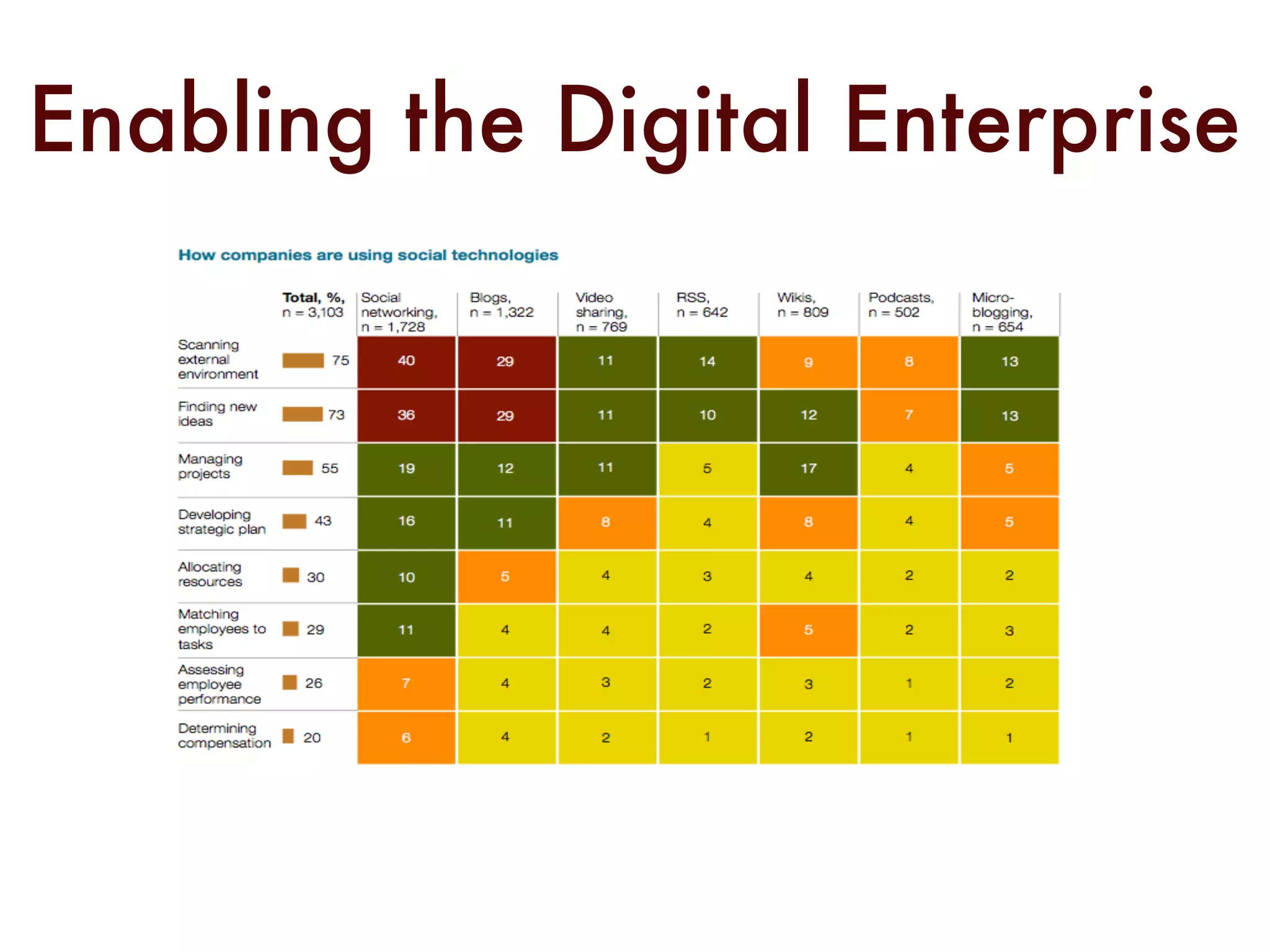
Enabling the Digital Enterprise
Digital Transformation across
Markets
Digital Affects Processes,Enterprises &
Transactions
• Mobile Access
• Social Engagement
• Sensors & Wearable Devices
• Digital Financial Models and Transactions
• Connected Devices
• Digital Content Management
Then - Now
Then: Old fashioned, proprietary POS system.
Now: Tablet + Square Reader
Then - Now
Then: Yard Sales/Flea Markets
Now: Etsy, Pinterest, eBay, etc.
Then - Now
Then: Mass Manufacturing
Now: Personalized, Customized,
On-Demand
Then - Now
Then: Bake Sales, Flyers, Car-Washes
Now: Kickstarter, kiva.org, Causes
Then - Now
Then: Slow, Bureaucratic, Restrictive
Now: Fast, Custom, Varied
Then - Now
Then: Job-Fairs, Campus Recruitment, Word-of-
mouth
Now: LinkedIn, Klout, Social Relevance, Personal
Brand
Then - Now
Then: Classrooms, Lectures, Reading Materials
Now: Coursera, Khan Academy, Udacity Online,
Certification, Anyone/Anywhere/Anytime
Then - Now
Then: Taxis, Minicabs, Limousines
Now: Uber, Lyft, SideCar
Then - Now
Then: Hotels, Vacation Swap
Now: AirBnB, Couchsurfing, OneFineStay
The Design Economy
• (Re)Designing Processes
• (Re)Designing Enterprises
• (Re)Designing Transactions
• OLD: Plan, Design, Implement, Deliver, Improve
• NEW: Launch, Feedback, Improve (Repeat until done!)
Redesigning Processes
New Processes
• “Code fast and break things”
• “Perpetually in Beta”
• “Release early, release often”
• “If you are not truly embarrassed by
your product, you waited far too long
to release it”
Iterative Refinement
• Start with an initial model
(hypothesis or idea.)
• Collect data from the field. (Show
users prototypes or basic
schematics.)
• Measure users empathetic
response.
• Adjust model so that it more
adequately fits the measured data
(meets the users needs.)
• Repeat the process until no further
refinement is possible.
Appeal to the Head & the Heart
Business Objectives vs. User Needs
Who’s on First?
Digital Decision-Making
•System 1: Fast, automatic, frequent, emotional,
stereotypic, subconscious
•System 2: Slow, effortful, infrequent, logical,
calculating, conscious
“Thinking, Fast & Slow” Daniel Kahneman
How the Mind Decides What to Do
• Most of the time, we’re not consciously
deciding what to do next.
• We often act based on habits. They can
be created, but are hard to defeat.
• We often make intuitive, immediate
decisions based on our past experiences.
• When consciously thinking, we often
avoid hard work. We “wing it” with
rough guesses based on similar, but
simpler, problems.
• We follow other people, especially peers
and experts.
Decision-Making & Habits
Decision-making & Processes
Story Telling vs. Specifications
Redesigning Enterprises
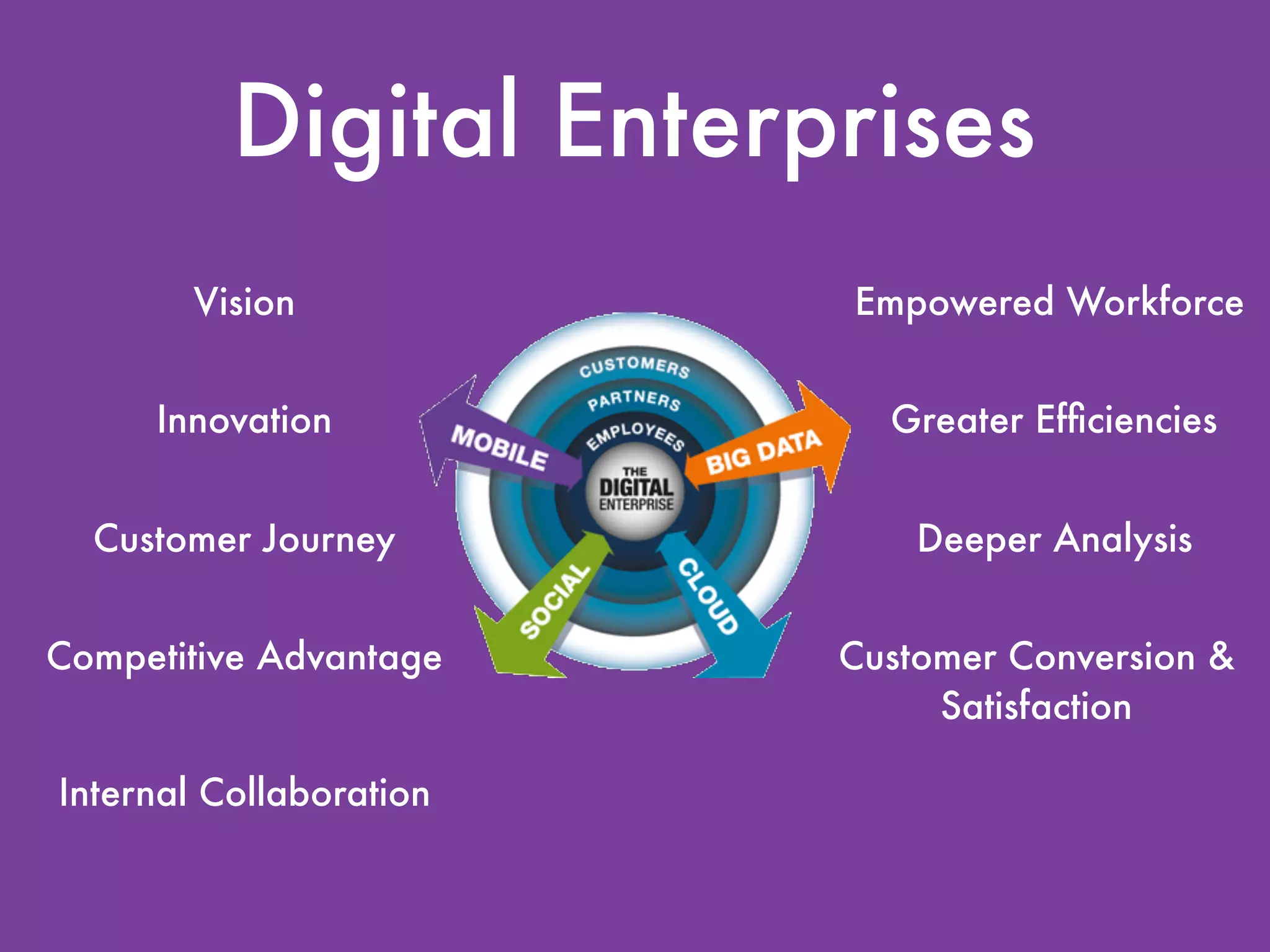
Digital Enterprises
Vision
Innovation
Customer Journey
Competitive Advantage
Internal Collaboration
Empowered Workforce
Greater Efficiencies
Deeper Analysis
Customer Conversion &
Satisfaction
Challenges to Enterprises
• Who will the next customer be?
• What will they want?
• How can they be motivated to
become long-lasting?
The Lean Start-Up (LSU) Model
Lean StartUp: A temporary organization designed to find
a repeatable, scalable business model under conditions of
extreme uncertainty
The History of the Lean Start-Up
• Founded by Steve Blank (Customer
Development; Repeatable Business
Model Hypothesis; Rapid Experimental
Design)
• Expanded by Eric Ries (Minimum
Viable Product (MVP); The Pivot)
• Assisted by Alex Osterwalder (The
Business Model Canvas)
How the LSU Benefits Enterprises
• Extreme uncertainty also
occurs at large enterprises
• Existing Lines of Business
(LoBs) often require new
business models
• Discovering new revenue
opportunities requires
innovation
The Business Model Canvas
What are the most important costs inherent in our business model?
Which Key Resources are most expensive?
Which Key Activities are most expensive?
Through which Channels do our Customer Segments
want to be reached?
How are we reaching them now?
How are our Channels integrated?
Which ones work best?
Which ones are most cost-efficient?
How are we integrating them with customer routines?
For what value are our customers really willing to pay?
For what do they currently pay?
How are they currently paying?
How would they prefer to pay?
How much does each Revenue Stream contribute to overall revenues?
For whom are we creating value?
Who are our most important customers?
What type of relationship does each of our Customer
Segments expect us to establish and maintain with them?
Which ones have we established?
How are they integrated with the rest of our business model?
How costly are they?
What value do we deliver to the customer?
Which one of our customer’s problems are we helping to solve?
What bundles of products and services are we offering to each Customer Segment?
Which customer needs are we satisfying?
What Key Activities do our Value Propositions require?
Our Distribution Channels?
Customer Relationships?
Revenue streams?
Who are our Key Partners?
Who are our key suppliers?
Which Key Resources are we acquiring from partners?
Which Key Activities do partners perform?
What Key Resources do our Value Propositions require?
Our Distribution Channels? Customer Relationships?
Revenue Streams?
Day Month Year
No.
This work is licensed under the Creative Commons Attribution-Share Alike 3.0 Unported License.
To view a copy of this license, visit http://creativecommons.org/licenses/by-sa/3.0/
or send a letter to Creative Commons, 171 Second Street, Suite 300, San Francisco, California, 94105, USA.
LSU Methodology
• Test Hypotheses: Run high-speed
experiments with rapid prototyping
to validate/discard hypotheses.
• Explore: Interviews, Observations,
Re-enactment. Use Design Thinking to
relate to customer’s emotional state.
• Pitch: Present an idea as if it were a
finished product. Get buy-in from all
stakeholders.
• Prototype & Test: Launch product
as unique brand. Spin-out. Isolate in
a test-market.
Summary: LSU Model
• Create a business model canvas
for each opportunity in portfolio
• Check which ones show evidence
for customer segment, value
proposition, etc.
• Use LSU model to validate these
projects
• If none validate, pivot to another
hypothesis/opportunity
Digital Enterprise Examples
• Burberry: Connected in-store experience
• Nike: Customer Engagement
• Volvo: Digital CRM
• Harrah’s: Location-based marketing
• Starbucks: Mobile payments, loyalty points, incentives
• Virgin America: Twitter-based customer service
• L’Oreal: Customer engagement channels
• Intel: Recruiting via Social Media
• P&G: Improved productivity and enterprise
innovation
Redesigning Transactions
• Sharing
• Alternative Payments
• Alternative Currencies
A $26Bn Economy (Economist, March 2013)
Average Revenue Per User:
•Air B’nB - $9800/year
•SnapGoods - $58/month
•RelayRides - $250/year
Reimagine Exchange
Alternative Payments
• Real-time bank transfers
• Offline credit transfers
• Direct debits
• eWallets
• Paper-based payments
• Mobile payments
Alternate Currencies
Market Share Variation
“BitCoin is the next
Internet Platform” -
Chris Dixon, Andreessen
Horowitz
The Digital Enterprise
Digital Transformation
1. Social, Mobile & Real-Time are causing
significant disruption
2. Digital Transformation is becoming a priority
for organizations
3. Digital Transformation is driven largely by
customer behavior
4. Digital Transformation is based on 3 key
elements: leadership, optimizing customer
experience, and a digital experience ‘swat
team’
Transforming the Enterprise
Digital Maturity
Assesment
Digital Strategy
Digital Program
Management
Digital ‘Fabric’
Gap Analysis
Experience &
Engagement
Digital Foundation
Transformation
Framework
Business Case(s) Digital Business Models Digital Architecture Digital Asset Maturity
Competitive Threat ‘Mobile-first’ impact
Program Execution &
Management
Hyper-connected, multi-
model access
Assess Strategize Execute Transform
Enterprise Challenges
• Departments act as their own fiefdoms.
• Managers act from a position of self-
preservation.
• Distribution of roles in customer journey.
• Budgets/resources not officially allocated.
• Educating the enterprise of the value of the
transformation is difficult.
Key Elements to Digital Transformation
• Vision & Leadership
• Digital Transformation Team
• Digital Customer Experience
Vision & Leadership
ROLE OF CHANGE AGENT
In the absence of digital leadership,
change agents must rise from within the
enterprise, unite with each other, and
partner with executives to collaborate for
change.
UPDATED VISION
For digital transformation to mean
something to all involved, a vision
must be clearly articulated to
explain why change is needed,
what it looks like, and its value to
customers and employees.
EXEC SUPPORT
Strategists must make the case
and create a sense of urgency
to gain executive sponsorship
and support.
Digital Transformation Team
CENTER OF
EXCELLENCE
It’s necessary to form a cross-
functional group tasked with
redesigning and optimizing the
customer experience, including
roles, responsibilities and projects.
ORGANIZATIONAL
STRUCTURE
Digital expertise may not be common
throughout the organization, but it
should be sought. The goal should be to
organize a qualified team of strategists
who can educate key stakeholders.
IT PARTNERSHIP
A strategic alliance between
IT and marketing will
streamline and help scale
digital transformation efforts.
Digital Customer Experience
CxO FOCUS
Companies must rethink
the entire customer
journey and experience.
INNOVATION
CULTURE
Journey mapping
often leads to
unplanned products or
services that reflect
actual customer needs
and behaviors.
DATA
INTEGRATION
New roles are needed to
analyze data, connect it to
lines of business, and
present it in actionable
ways.
COLLABORATION
Journey mapping should
lead to insights into which
departments need to work
more closely together.
Benefits of Digital Transformation
Work 2.0: Designing for
Behavior Change
Work 2.0 - The Digital Enterprise
• View boundaries not as edges but as
areas of overlap
• Enable employees to see the impact of
their work
• Design for culture: Link culture to
brand
• Maintain identity in a distributed
world
• Adhere to core principles while
adopting to changing conditions
Purpose
Mastery
Autonomy
Towards a New Culture
From Work to Network
• Microtasking/Crowdsourcing:
Disintermediating work from the
enterprise
• Open Innovation: Involving
ecosystem in new inventions
and products
• Generativity: Creation of
completely new products or
processes from existing systems
Management 2.0
• Coordinating communities of practice will require new
forms of managerial skills (data analytics, efficiency)
• Managers will need to manage cooperation,
competition and conflict simultaneously
• Data will be critical for decision making, risk assessment,
and developing new products
• Instinct, gut-feeling and tacit knowledge can still uncover
patterns and insights that data analytics might overlook
Agile Management?
Management by Holocracy?
Affecting Employee Behavior
Five Stages of Behavior Design
• Understand: How the employee decides to act
• Discover: The right behavior to change, given your goal
• Design: The process to bind to a specific behavior
• Refine: Measure impact & success based on careful
measurement and analysis
• Iterate: Cycle through this process until the desired
behavior becomes habit-forming
Environmental Design
Constructing the Environment
• Help employees see themselves as people who would
naturally take the action.
• Help employees build strong associations between
things they are already familiar with and enjoy, and
the new action.
• Provide employees with clear instructions on what they
need to do and any other essential information to act.
Quantitate Changes in
Employee Behavior
Optimizing Behavior Change
• Ensure employees are motivated to act, and that
motivation is at the front of their minds.
• Ensure they are cued to act now. (Ask them.)
• Ensure they know if they are succeeding or failing—give
them actionable feedback.
• Avoid or co-opt behaviors that are competing for their
attention. (Ideally, piggyback onto something they are
already doing.)

Enterprise digital transformation

  • 1.
    Kindling Innovation Acrossthe Digital Enterprise Sunil Maulik SunilM1 sunil@sunilm1.net
  • 2.
    Megatrends in theEconomy Today
  • 3.
    Megatrends Affecting theDigital Economy 1,350M 343M 332M 284M 230M 200M 618M 829M 7.5Bn Mobile Devices (>Earth’s Population!)
  • 4.
    We live inExponential Times
  • 5.
  • 6.
  • 7.
    Enabling The InternetEverywhere Big Data & the Internet of Things
  • 8.
  • 9.
  • 10.
  • 11.
    Impact on Organizations -Transparency - Experimentation - Segmenting groups - Supports automated decision making - Enabling new business models, products
  • 12.
  • 13.
  • 14.
  • 15.
    Digital Affects Processes,Enterprises& Transactions • Mobile Access • Social Engagement • Sensors & Wearable Devices • Digital Financial Models and Transactions • Connected Devices • Digital Content Management
  • 16.
    Then - Now Then:Old fashioned, proprietary POS system. Now: Tablet + Square Reader
  • 17.
    Then - Now Then:Yard Sales/Flea Markets Now: Etsy, Pinterest, eBay, etc.
  • 18.
    Then - Now Then:Mass Manufacturing Now: Personalized, Customized, On-Demand
  • 19.
    Then - Now Then:Bake Sales, Flyers, Car-Washes Now: Kickstarter, kiva.org, Causes
  • 20.
    Then - Now Then:Slow, Bureaucratic, Restrictive Now: Fast, Custom, Varied
  • 21.
    Then - Now Then:Job-Fairs, Campus Recruitment, Word-of- mouth Now: LinkedIn, Klout, Social Relevance, Personal Brand
  • 22.
    Then - Now Then:Classrooms, Lectures, Reading Materials Now: Coursera, Khan Academy, Udacity Online, Certification, Anyone/Anywhere/Anytime
  • 23.
    Then - Now Then:Taxis, Minicabs, Limousines Now: Uber, Lyft, SideCar
  • 24.
    Then - Now Then:Hotels, Vacation Swap Now: AirBnB, Couchsurfing, OneFineStay
  • 26.
    The Design Economy •(Re)Designing Processes • (Re)Designing Enterprises • (Re)Designing Transactions
  • 27.
    • OLD: Plan,Design, Implement, Deliver, Improve • NEW: Launch, Feedback, Improve (Repeat until done!) Redesigning Processes
  • 28.
    New Processes • “Codefast and break things” • “Perpetually in Beta” • “Release early, release often” • “If you are not truly embarrassed by your product, you waited far too long to release it”
  • 29.
    Iterative Refinement • Startwith an initial model (hypothesis or idea.) • Collect data from the field. (Show users prototypes or basic schematics.) • Measure users empathetic response. • Adjust model so that it more adequately fits the measured data (meets the users needs.) • Repeat the process until no further refinement is possible.
  • 30.
    Appeal to theHead & the Heart Business Objectives vs. User Needs
  • 31.
  • 32.
    Digital Decision-Making •System 1:Fast, automatic, frequent, emotional, stereotypic, subconscious •System 2: Slow, effortful, infrequent, logical, calculating, conscious “Thinking, Fast & Slow” Daniel Kahneman
  • 33.
    How the MindDecides What to Do • Most of the time, we’re not consciously deciding what to do next. • We often act based on habits. They can be created, but are hard to defeat. • We often make intuitive, immediate decisions based on our past experiences. • When consciously thinking, we often avoid hard work. We “wing it” with rough guesses based on similar, but simpler, problems. • We follow other people, especially peers and experts.
  • 34.
  • 35.
    Decision-making & Processes StoryTelling vs. Specifications
  • 36.
  • 37.
    Digital Enterprises Vision Innovation Customer Journey CompetitiveAdvantage Internal Collaboration Empowered Workforce Greater Efficiencies Deeper Analysis Customer Conversion & Satisfaction
  • 38.
    Challenges to Enterprises •Who will the next customer be? • What will they want? • How can they be motivated to become long-lasting?
  • 39.
    The Lean Start-Up(LSU) Model Lean StartUp: A temporary organization designed to find a repeatable, scalable business model under conditions of extreme uncertainty
  • 40.
    The History ofthe Lean Start-Up • Founded by Steve Blank (Customer Development; Repeatable Business Model Hypothesis; Rapid Experimental Design) • Expanded by Eric Ries (Minimum Viable Product (MVP); The Pivot) • Assisted by Alex Osterwalder (The Business Model Canvas)
  • 41.
    How the LSUBenefits Enterprises • Extreme uncertainty also occurs at large enterprises • Existing Lines of Business (LoBs) often require new business models • Discovering new revenue opportunities requires innovation
  • 42.
    The Business ModelCanvas What are the most important costs inherent in our business model? Which Key Resources are most expensive? Which Key Activities are most expensive? Through which Channels do our Customer Segments want to be reached? How are we reaching them now? How are our Channels integrated? Which ones work best? Which ones are most cost-efficient? How are we integrating them with customer routines? For what value are our customers really willing to pay? For what do they currently pay? How are they currently paying? How would they prefer to pay? How much does each Revenue Stream contribute to overall revenues? For whom are we creating value? Who are our most important customers? What type of relationship does each of our Customer Segments expect us to establish and maintain with them? Which ones have we established? How are they integrated with the rest of our business model? How costly are they? What value do we deliver to the customer? Which one of our customer’s problems are we helping to solve? What bundles of products and services are we offering to each Customer Segment? Which customer needs are we satisfying? What Key Activities do our Value Propositions require? Our Distribution Channels? Customer Relationships? Revenue streams? Who are our Key Partners? Who are our key suppliers? Which Key Resources are we acquiring from partners? Which Key Activities do partners perform? What Key Resources do our Value Propositions require? Our Distribution Channels? Customer Relationships? Revenue Streams? Day Month Year No. This work is licensed under the Creative Commons Attribution-Share Alike 3.0 Unported License. To view a copy of this license, visit http://creativecommons.org/licenses/by-sa/3.0/ or send a letter to Creative Commons, 171 Second Street, Suite 300, San Francisco, California, 94105, USA.
  • 43.
    LSU Methodology • TestHypotheses: Run high-speed experiments with rapid prototyping to validate/discard hypotheses. • Explore: Interviews, Observations, Re-enactment. Use Design Thinking to relate to customer’s emotional state. • Pitch: Present an idea as if it were a finished product. Get buy-in from all stakeholders. • Prototype & Test: Launch product as unique brand. Spin-out. Isolate in a test-market.
  • 44.
    Summary: LSU Model •Create a business model canvas for each opportunity in portfolio • Check which ones show evidence for customer segment, value proposition, etc. • Use LSU model to validate these projects • If none validate, pivot to another hypothesis/opportunity
  • 45.
    Digital Enterprise Examples •Burberry: Connected in-store experience • Nike: Customer Engagement • Volvo: Digital CRM • Harrah’s: Location-based marketing • Starbucks: Mobile payments, loyalty points, incentives • Virgin America: Twitter-based customer service • L’Oreal: Customer engagement channels • Intel: Recruiting via Social Media • P&G: Improved productivity and enterprise innovation
  • 46.
  • 47.
    Redesigning Transactions • Sharing •Alternative Payments • Alternative Currencies
  • 48.
    A $26Bn Economy(Economist, March 2013) Average Revenue Per User: •Air B’nB - $9800/year •SnapGoods - $58/month •RelayRides - $250/year
  • 49.
  • 50.
    Alternative Payments • Real-timebank transfers • Offline credit transfers • Direct debits • eWallets • Paper-based payments • Mobile payments
  • 51.
  • 52.
  • 53.
    “BitCoin is thenext Internet Platform” - Chris Dixon, Andreessen Horowitz
  • 54.
  • 55.
    Digital Transformation 1. Social,Mobile & Real-Time are causing significant disruption 2. Digital Transformation is becoming a priority for organizations 3. Digital Transformation is driven largely by customer behavior 4. Digital Transformation is based on 3 key elements: leadership, optimizing customer experience, and a digital experience ‘swat team’
  • 56.
    Transforming the Enterprise DigitalMaturity Assesment Digital Strategy Digital Program Management Digital ‘Fabric’ Gap Analysis Experience & Engagement Digital Foundation Transformation Framework Business Case(s) Digital Business Models Digital Architecture Digital Asset Maturity Competitive Threat ‘Mobile-first’ impact Program Execution & Management Hyper-connected, multi- model access Assess Strategize Execute Transform
  • 57.
    Enterprise Challenges • Departmentsact as their own fiefdoms. • Managers act from a position of self- preservation. • Distribution of roles in customer journey. • Budgets/resources not officially allocated. • Educating the enterprise of the value of the transformation is difficult.
  • 58.
    Key Elements toDigital Transformation • Vision & Leadership • Digital Transformation Team • Digital Customer Experience
  • 59.
    Vision & Leadership ROLEOF CHANGE AGENT In the absence of digital leadership, change agents must rise from within the enterprise, unite with each other, and partner with executives to collaborate for change. UPDATED VISION For digital transformation to mean something to all involved, a vision must be clearly articulated to explain why change is needed, what it looks like, and its value to customers and employees. EXEC SUPPORT Strategists must make the case and create a sense of urgency to gain executive sponsorship and support.
  • 60.
    Digital Transformation Team CENTEROF EXCELLENCE It’s necessary to form a cross- functional group tasked with redesigning and optimizing the customer experience, including roles, responsibilities and projects. ORGANIZATIONAL STRUCTURE Digital expertise may not be common throughout the organization, but it should be sought. The goal should be to organize a qualified team of strategists who can educate key stakeholders. IT PARTNERSHIP A strategic alliance between IT and marketing will streamline and help scale digital transformation efforts.
  • 61.
    Digital Customer Experience CxOFOCUS Companies must rethink the entire customer journey and experience. INNOVATION CULTURE Journey mapping often leads to unplanned products or services that reflect actual customer needs and behaviors. DATA INTEGRATION New roles are needed to analyze data, connect it to lines of business, and present it in actionable ways. COLLABORATION Journey mapping should lead to insights into which departments need to work more closely together.
  • 62.
    Benefits of DigitalTransformation
  • 63.
    Work 2.0: Designingfor Behavior Change
  • 64.
    Work 2.0 -The Digital Enterprise • View boundaries not as edges but as areas of overlap • Enable employees to see the impact of their work • Design for culture: Link culture to brand • Maintain identity in a distributed world • Adhere to core principles while adopting to changing conditions Purpose Mastery Autonomy
  • 65.
  • 66.
    From Work toNetwork • Microtasking/Crowdsourcing: Disintermediating work from the enterprise • Open Innovation: Involving ecosystem in new inventions and products • Generativity: Creation of completely new products or processes from existing systems
  • 67.
    Management 2.0 • Coordinatingcommunities of practice will require new forms of managerial skills (data analytics, efficiency) • Managers will need to manage cooperation, competition and conflict simultaneously • Data will be critical for decision making, risk assessment, and developing new products • Instinct, gut-feeling and tacit knowledge can still uncover patterns and insights that data analytics might overlook
  • 68.
  • 69.
  • 70.
  • 71.
    Five Stages ofBehavior Design • Understand: How the employee decides to act • Discover: The right behavior to change, given your goal • Design: The process to bind to a specific behavior • Refine: Measure impact & success based on careful measurement and analysis • Iterate: Cycle through this process until the desired behavior becomes habit-forming
  • 72.
  • 73.
    Constructing the Environment •Help employees see themselves as people who would naturally take the action. • Help employees build strong associations between things they are already familiar with and enjoy, and the new action. • Provide employees with clear instructions on what they need to do and any other essential information to act.
  • 74.
  • 75.
    Optimizing Behavior Change •Ensure employees are motivated to act, and that motivation is at the front of their minds. • Ensure they are cued to act now. (Ask them.) • Ensure they know if they are succeeding or failing—give them actionable feedback. • Avoid or co-opt behaviors that are competing for their attention. (Ideally, piggyback onto something they are already doing.)