© 2015 by CreeseConsulting All rights reserved
ACTING FOR DIGITAL TRANSFORMATION ACROSS
SCOTTISH LOCAL GOVERNMENT
STIRLING, 30TH JULY 2015
Jos Creese
Independent Digital Consultant
#scotlgdigital
@JosCreese
Digital Transformation Workshop
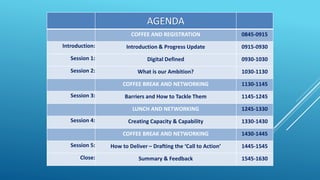
AGENDA
COFFEE AND REGISTRATION 0845-0915
Introduction: Introduction & Progress Update 0915-0930
Session 1: Digital Defined 0930-1030
Session 2: What is our Ambition? 1030-1130
COFFEE BREAK AND NETWORKING 1130-1145
Session 3: Barriers and How to Tackle Them 1145-1245
LUNCH AND NETWORKING 1245-1330
Session 4: Creating Capacity & Capability 1330-1430
COFFEE BREAK AND NETWORKING 1430-1445
Session 5: How to Deliver – Drafting the ‘Call to Action’ 1445-1545
Close: Summary & Feedback 1545-1630
© 2015 by CreeseConsulting All rights reserved
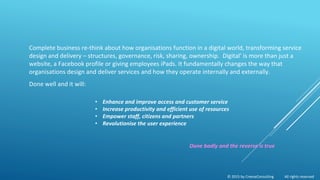
Complete business re-think about how organisations function in a digital world, transforming service
design and delivery – structures, governance, risk, sharing, ownership. ‘Digital’ is more than just a
website, a Facebook profile or giving employees iPads. It fundamentally changes the way that
organisations design and deliver services and how they operate internally and externally.
Done well and it will:
• Enhance and improve access and customer service
• Increase productivity and efficient use of resources
• Empower staff, citizens and partners
• Revolutionise the user experience
Done badly and the reverse is true
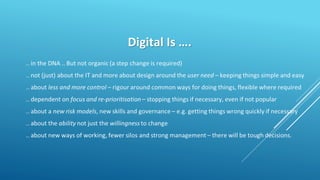
Digital Is ….
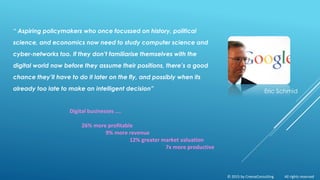
“ Aspiring policymakers who once focussed on history, political
science, and economics now need to study computer science and
cyber-networks too. If they don’t familiarise themselves with the
digital world now before they assume their positions, there’s a good
chance they’ll have to do it later on the fly, and possibly when its
already too late to make an intelligent decision”
Digital businesses ….
26% more profitable
9% more revenue
12% greater market valuation
7x more productive
Eric Schmid
© 2015 by CreeseConsulting All rights reserved
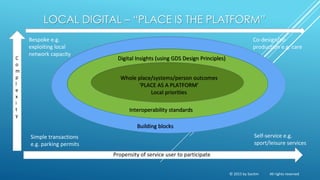
LOCAL DIGITAL – “PLACE IS THE PLATFORM”
Whole place/systems/person outcomes
‘PLACE AS A PLATFORM’
Local priorities
Digital Insights (using GDS Design Principles)
Interoperability standards
Bespoke e.g.
exploiting local
network capacity
Co-design/co-
production e.g. care
Self-service e.g.
sport/leisure services
Simple transactions
e.g. parking permits
Propensity of service user to participate
C
o
m
p
l
e
x
i
t
y
Building blocks
© 2015 by Socitm All rights reserved
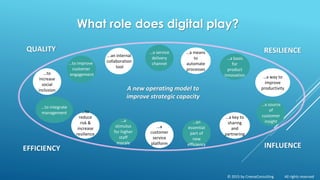
What role does digital play?
…a service
delivery
channel
…a means
to
automate
processes
…a basis
for
product
innovation
…to improve
customer
engagement
…a
customer
service
platform
...an internal
collaboration
tool
…a source
of
customer
insight
…a way to
improve
productivityA new operating model to
improve strategic capacity
…a key to
sharing
and
partnering
…an
essential
part of
new
efficiency
…to
increase
social
inclusion
…a
stimulus
for higher
staff
morale
…to
reduce
risk &
increase
resilience
…to integrate
management
QUALITY RESILIENCE
EFFICIENCY
© 2015 by CreeseConsulting All rights reserved
INFLUENCE
© 2015 by CreeseConsulting All rights reserved
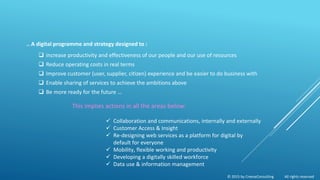
.. A digital programme and strategy designed to :
 increase productivity and effectiveness of our people and our use of resources
 Reduce operating costs in real terms
 Improve customer (user, supplier, citizen) experience and be easier to do business with
 Enable sharing of services to achieve the ambitions above
 Be more ready for the future …
This implies actions in all the areas below:
 Collaboration and communications, internally and externally
 Customer Access & Insight
 Re-designing web services as a platform for digital by
default for everyone
 Mobility, flexible working and productivity
 Developing a digitally skilled workforce
 Data use & information management
3. Barriers and How to Tackle Them
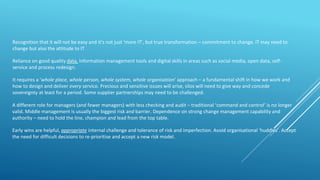
Recognition that it will not be easy and it's not just ‘more IT’, but true transformation – commitment to change. IT may need to
change but also the attitude to IT
Reliance on good quality data, information management tools and digital skills in areas such as social media, open data, self-
service and process redesign.
It requires a ‘whole place, whole person, whole system, whole organisation’ approach – a fundamental shift in how we work and
how to design and deliver every service. Precious and sensitive issues will arise, silos will need to give way and concede
sovereignty at least for a period. Some supplier partnerships may need to be challenged.
A different role for managers (and fewer managers) with less checking and audit – traditional ‘command and control’ is no longer
valid. Middle management is usually the biggest risk and barrier. Dependence on strong change management capability and
authority – need to hold the line, champion and lead from the top table.
Early wins are helpful, appropriate internal challenge and tolerance of risk and imperfection. Avoid organisational ‘huddles’. Accept
the need for difficult decisions to re-prioritise and accept a new risk model.
4. Creating Capacity And Capability
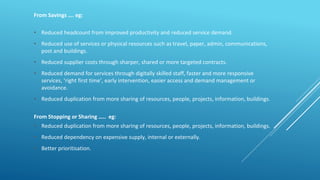
From Savings …. eg:
• Reduced headcount from improved productivity and reduced service demand.
• Reduced use of services or physical resources such as travel, paper, admin, communications,
post and buildings.
• Reduced supplier costs through sharper, shared or more targeted contracts.
• Reduced demand for services through digitally skilled staff, faster and more responsive
services, ‘right first time’, early intervention, easier access and demand management or
avoidance.
• Reduced duplication from more sharing of resources, people, projects, information, buildings.
From Stopping or Sharing ….. eg:
• Reduced duplication from more sharing of resources, people, projects, information, buildings.
• Reduced dependency on expensive supply, internal or externally.
• Better prioritisation.
5. How to Deliver – Drafting the ‘Call to Action’
© 2015 by CreeseConsulting All rights reserved
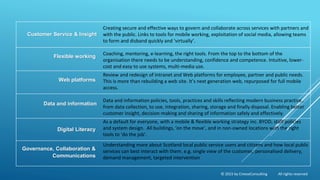
Governance, Collaboration &
Communications
Customer Service & Insight
Web platforms
Flexible working
Digital Literacy
Data and information
Creating secure and effective ways to govern and collaborate across services with partners and
with the public. Links to tools for mobile working, exploitation of social media, allowing teams
to form and disband quickly and ‘virtually’.
Coaching, mentoring, e-learning, the right tools. From the top to the bottom of the
organisation there needs to be understanding, confidence and competence. Intuitive, lower-
cost and easy to use systems, multi-media use.
Review and redesign of Intranet and Web platforms for employee, partner and public needs.
This is more than rebuilding a web site. It’s next generation web, repurposed for full mobile
access.
Data and information policies, tools, practices and skills reflecting modern business practice..
from data collection, to use, integration, sharing, storage and finally disposal. Enabling better
customer insight, decision-making and sharing of information safely and effectively.
As a default for everyone, with a mobile & flexible working strategy inc. BYOD, staff policies
and system design. All buildings, ‘on the move’, and in non-owned locations with the right
tools to ‘do the job’.
Understanding more about Scotland local public service users and citizens and how local public
services can best interact with them. e.g. single view of the customer, personalised delivery,
demand management, targeted intervention
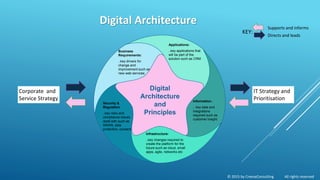
Digital Architecture
Business
Requirements:
..key drivers for
change and
improvement such as
new web services
Applications:
..key applications that
will be part of the
solution such as CRM
Information.:
.. key data and
integrations
required such as
customer insight
Infrastructure:
..key changes required to
create the platform for the
future such as cloud, small
apps, agile, networks etc
Security &
Regulation
..key risks and
compliance issues
dealt with such as
SWAN, data
protection, consent
Digital
Architecture
and
Principles
Corporate and
Service Strategy
IT Strategy and
Prioritisation
Supports and informs
Directs and leads
KEY:
© 2015 by CreeseConsulting All rights reserved
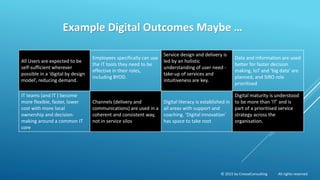
All Users are expected to be
self-sufficient wherever
possible in a ‘digital by design
model’, reducing demand.
Employees specifically can use
the IT tools they need to be
effective in their roles,
including BYOD.
Service design and delivery is
led by an holistic
understanding of user need -
take-up of services and
intuitiveness are key.
Data and information are used
better for faster decision
making, IoT and ‘big data’ are
planned, and SIRO role
prioritised
IT teams (and IT ) become
more flexible, faster, lower
cost with more local
ownership and decision-
making around a common IT
core
Channels (delivery and
communications) are used in a
coherent and consistent way,
not in service silos
Digital literacy is established in
all areas with support and
coaching. ‘Digital innovation’
has space to take root
Digital maturity is understood
to be more than 'IT' and is
part of a prioritised service
strategy across the
organisation.
Example Digital Outcomes Maybe …
Summary and Feedback

Digital Transformation Scotland Workshop, Stirling 2015

  • 1.
    © 2015 byCreeseConsulting All rights reserved ACTING FOR DIGITAL TRANSFORMATION ACROSS SCOTTISH LOCAL GOVERNMENT STIRLING, 30TH JULY 2015 Jos Creese Independent Digital Consultant #scotlgdigital @JosCreese Digital Transformation Workshop
  • 2.
    AGENDA COFFEE AND REGISTRATION0845-0915 Introduction: Introduction & Progress Update 0915-0930 Session 1: Digital Defined 0930-1030 Session 2: What is our Ambition? 1030-1130 COFFEE BREAK AND NETWORKING 1130-1145 Session 3: Barriers and How to Tackle Them 1145-1245 LUNCH AND NETWORKING 1245-1330 Session 4: Creating Capacity & Capability 1330-1430 COFFEE BREAK AND NETWORKING 1430-1445 Session 5: How to Deliver – Drafting the ‘Call to Action’ 1445-1545 Close: Summary & Feedback 1545-1630
  • 4.
    © 2015 byCreeseConsulting All rights reserved Complete business re-think about how organisations function in a digital world, transforming service design and delivery – structures, governance, risk, sharing, ownership. ‘Digital’ is more than just a website, a Facebook profile or giving employees iPads. It fundamentally changes the way that organisations design and deliver services and how they operate internally and externally. Done well and it will: • Enhance and improve access and customer service • Increase productivity and efficient use of resources • Empower staff, citizens and partners • Revolutionise the user experience Done badly and the reverse is true
  • 5.
  • 6.
    “ Aspiring policymakerswho once focussed on history, political science, and economics now need to study computer science and cyber-networks too. If they don’t familiarise themselves with the digital world now before they assume their positions, there’s a good chance they’ll have to do it later on the fly, and possibly when its already too late to make an intelligent decision” Digital businesses …. 26% more profitable 9% more revenue 12% greater market valuation 7x more productive Eric Schmid © 2015 by CreeseConsulting All rights reserved
  • 7.
    LOCAL DIGITAL –“PLACE IS THE PLATFORM” Whole place/systems/person outcomes ‘PLACE AS A PLATFORM’ Local priorities Digital Insights (using GDS Design Principles) Interoperability standards Bespoke e.g. exploiting local network capacity Co-design/co- production e.g. care Self-service e.g. sport/leisure services Simple transactions e.g. parking permits Propensity of service user to participate C o m p l e x i t y Building blocks © 2015 by Socitm All rights reserved
  • 8.
    What role doesdigital play? …a service delivery channel …a means to automate processes …a basis for product innovation …to improve customer engagement …a customer service platform ...an internal collaboration tool …a source of customer insight …a way to improve productivityA new operating model to improve strategic capacity …a key to sharing and partnering …an essential part of new efficiency …to increase social inclusion …a stimulus for higher staff morale …to reduce risk & increase resilience …to integrate management QUALITY RESILIENCE EFFICIENCY © 2015 by CreeseConsulting All rights reserved INFLUENCE
  • 10.
    © 2015 byCreeseConsulting All rights reserved .. A digital programme and strategy designed to :  increase productivity and effectiveness of our people and our use of resources  Reduce operating costs in real terms  Improve customer (user, supplier, citizen) experience and be easier to do business with  Enable sharing of services to achieve the ambitions above  Be more ready for the future … This implies actions in all the areas below:  Collaboration and communications, internally and externally  Customer Access & Insight  Re-designing web services as a platform for digital by default for everyone  Mobility, flexible working and productivity  Developing a digitally skilled workforce  Data use & information management
  • 11.
    3. Barriers andHow to Tackle Them
  • 12.
    Recognition that itwill not be easy and it's not just ‘more IT’, but true transformation – commitment to change. IT may need to change but also the attitude to IT Reliance on good quality data, information management tools and digital skills in areas such as social media, open data, self- service and process redesign. It requires a ‘whole place, whole person, whole system, whole organisation’ approach – a fundamental shift in how we work and how to design and deliver every service. Precious and sensitive issues will arise, silos will need to give way and concede sovereignty at least for a period. Some supplier partnerships may need to be challenged. A different role for managers (and fewer managers) with less checking and audit – traditional ‘command and control’ is no longer valid. Middle management is usually the biggest risk and barrier. Dependence on strong change management capability and authority – need to hold the line, champion and lead from the top table. Early wins are helpful, appropriate internal challenge and tolerance of risk and imperfection. Avoid organisational ‘huddles’. Accept the need for difficult decisions to re-prioritise and accept a new risk model.
  • 13.
    4. Creating CapacityAnd Capability
  • 14.
    From Savings ….eg: • Reduced headcount from improved productivity and reduced service demand. • Reduced use of services or physical resources such as travel, paper, admin, communications, post and buildings. • Reduced supplier costs through sharper, shared or more targeted contracts. • Reduced demand for services through digitally skilled staff, faster and more responsive services, ‘right first time’, early intervention, easier access and demand management or avoidance. • Reduced duplication from more sharing of resources, people, projects, information, buildings. From Stopping or Sharing ….. eg: • Reduced duplication from more sharing of resources, people, projects, information, buildings. • Reduced dependency on expensive supply, internal or externally. • Better prioritisation.
  • 15.
    5. How toDeliver – Drafting the ‘Call to Action’
  • 16.
    © 2015 byCreeseConsulting All rights reserved Governance, Collaboration & Communications Customer Service & Insight Web platforms Flexible working Digital Literacy Data and information Creating secure and effective ways to govern and collaborate across services with partners and with the public. Links to tools for mobile working, exploitation of social media, allowing teams to form and disband quickly and ‘virtually’. Coaching, mentoring, e-learning, the right tools. From the top to the bottom of the organisation there needs to be understanding, confidence and competence. Intuitive, lower- cost and easy to use systems, multi-media use. Review and redesign of Intranet and Web platforms for employee, partner and public needs. This is more than rebuilding a web site. It’s next generation web, repurposed for full mobile access. Data and information policies, tools, practices and skills reflecting modern business practice.. from data collection, to use, integration, sharing, storage and finally disposal. Enabling better customer insight, decision-making and sharing of information safely and effectively. As a default for everyone, with a mobile & flexible working strategy inc. BYOD, staff policies and system design. All buildings, ‘on the move’, and in non-owned locations with the right tools to ‘do the job’. Understanding more about Scotland local public service users and citizens and how local public services can best interact with them. e.g. single view of the customer, personalised delivery, demand management, targeted intervention
  • 17.
    Digital Architecture Business Requirements: ..key driversfor change and improvement such as new web services Applications: ..key applications that will be part of the solution such as CRM Information.: .. key data and integrations required such as customer insight Infrastructure: ..key changes required to create the platform for the future such as cloud, small apps, agile, networks etc Security & Regulation ..key risks and compliance issues dealt with such as SWAN, data protection, consent Digital Architecture and Principles Corporate and Service Strategy IT Strategy and Prioritisation Supports and informs Directs and leads KEY: © 2015 by CreeseConsulting All rights reserved
  • 18.
    © 2015 byCreeseConsulting All rights reserved All Users are expected to be self-sufficient wherever possible in a ‘digital by design model’, reducing demand. Employees specifically can use the IT tools they need to be effective in their roles, including BYOD. Service design and delivery is led by an holistic understanding of user need - take-up of services and intuitiveness are key. Data and information are used better for faster decision making, IoT and ‘big data’ are planned, and SIRO role prioritised IT teams (and IT ) become more flexible, faster, lower cost with more local ownership and decision- making around a common IT core Channels (delivery and communications) are used in a coherent and consistent way, not in service silos Digital literacy is established in all areas with support and coaching. ‘Digital innovation’ has space to take root Digital maturity is understood to be more than 'IT' and is part of a prioritised service strategy across the organisation. Example Digital Outcomes Maybe …
  • 19.

Editor's Notes

  • #8 Work by Socitm re. extending the Government’s digital ambition into local public services (Budget Statement, March 2015) … Building on the work of Mark Thompson (Judge Business School and co-author of Digitizing Government) and GDS re. ‘Government as a Platform’. ‘Place as a Platform’ = Local is where it all comes together Place – outcomes – needs - people – communities – cultures – organisations - systems – processes – delivery What scope is there build a set of standard components that can be chosen and combined to meet diverse local needs, politics and priorities? Digital by design – application of standard digital service design principles (Socitm’s Digital Insights – 5 core and 10 supporting - GDS derived principles) Interoperability standards – focused on delivering key outcomes – not abstract standards as an end in themselves. Migrate towards standard, low cost, reusable building blocks/components. Complex range of local public service types - not like central government high volume, small value transactions. Local public services – small numbers of people generate high percentage of costs. Local public services can be defined by two dimensions: How willing is the service user to participate? How complex is the service requirement ? Simple service requirement, user unwilling or unable to participate = SIMPLE transaction e.g. apply for a resident’s parking permit. Make as simple and joined-up as possible. Simple, high willingness to participate = SELF-SERVICE e.g. book a cricket pitch at one of several venues. Complex, low participation= BESPOKE e.g. combine existing assets in new ways – reuse spare academic (JANET) network capacity to extend reach of high bandwidth broadband in Cambridge. Complex, high participation = CO-DESIGN and CO-PRODUCE e.g. adult care (elderly care assessment, discharge from hospital, apply to become an adopter) – users actively involved with professionals in designing and joining-up the service to be delivered. Each of these offers scope for re-design and savings – the more you go to the top right, the more we see the consequences of accretion of process over many years with no attention to good service design. The further you go to the top right, the greater the scope for service transformation (productivity, risk management, user consent, security improvement, quality of the user experience and cost reduction). THIS IS WHERE THE COST IS IN LOCAL PUBLIC SERVICES – not like central government with its high volume simple transactions. Where is the understanding? Where is the collaborative leadership to address the opportunities presented?
  • #17 It would support mobile and flexible working by staff, but will also exploit social media and other communications and collaboration methods, allowing teams to form, disband, innovate, share and communicate more effectively, both internally and externally. E.g. creating a single view of the customer across services to personalise delivery, manage demand and anticipate when intervention is required. Do the intranet and web platforms meet changing staff, supplier and citizen needs for self-service – transactions, information, consultation and communications? These portals will be key to repurposing service for mobile devices and less intervention, securely and easily A comprehensive strategy for the use of mobile devices, including BYOD, linked to how services and systems will be used in the future. It would include ensuring digital maturity of IT users in risk, potential and practice of digital tools, linked to performance management. Digital skills come from use – providing the right tools, support, coaching, mentoring will be key – alongside designing systems which are easy to use and intuitive. It would include self-service e-learning, peer-to-peer training and developing the multi-media content required to develop digital skills Data and information are key to success – how data & information are collected, stored, accessed and re-used. This supports customer insight, faster decision making and improved sharing of data across areas. It canalso help with the provision of higher quality services to citizens by supporting early identification initiatives and demand planning.