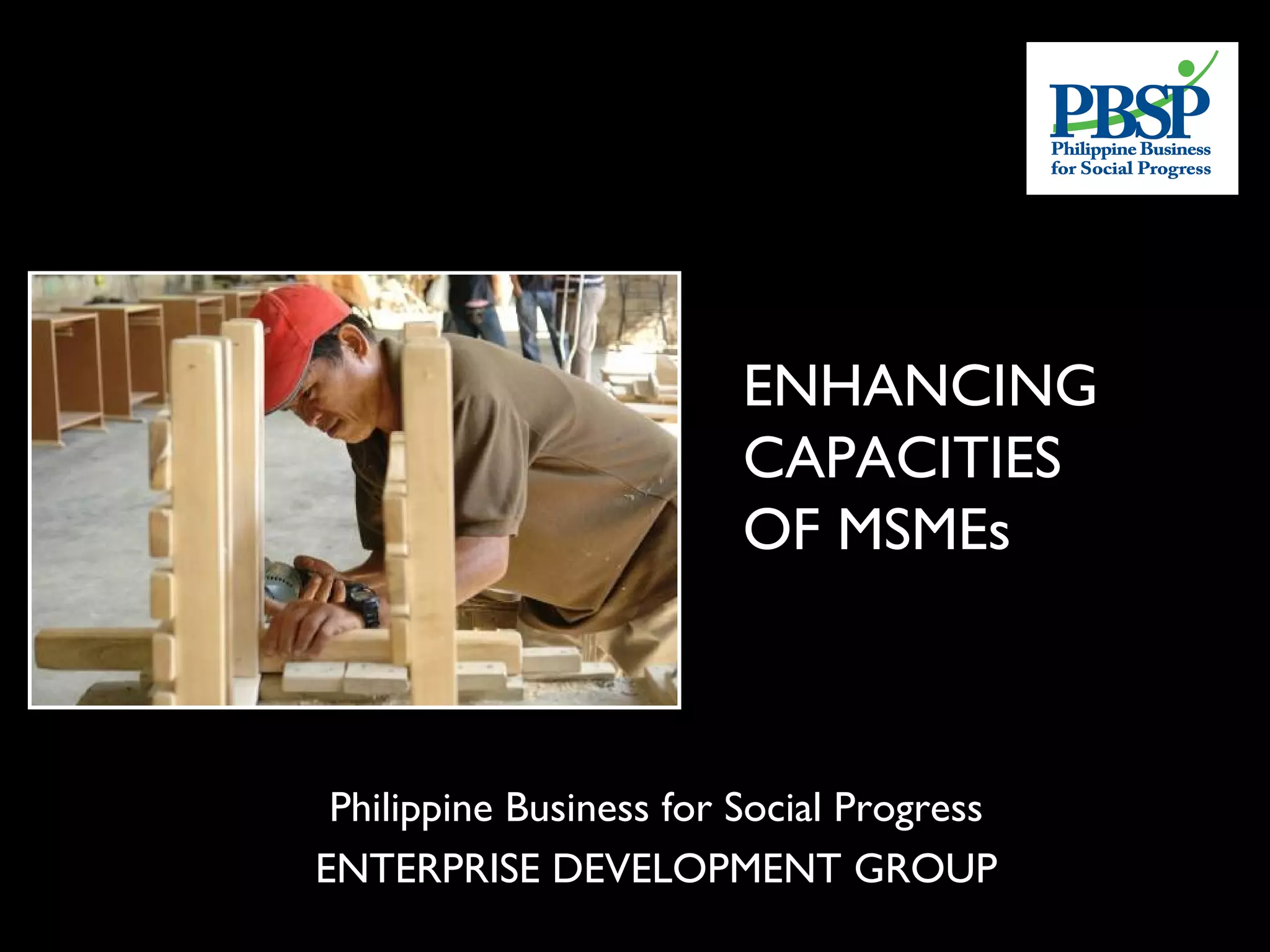
ENHANCING
                         CAPACITIES
                         OF MSMEs


 Philippine Business for Social Progress
ENTERPRISE DEVELOPMENT GROUP
• The largest corporate-led, non-profit, social development
  foundation in the Philippines.
• Founded in the 1970s by 50 business leaders; now has 255
  corporate members.
• PBSP is at the forefront in the fight against poverty
  through trailblazing corporate social responsibility (CSR)
  or corporate citizenship programs.
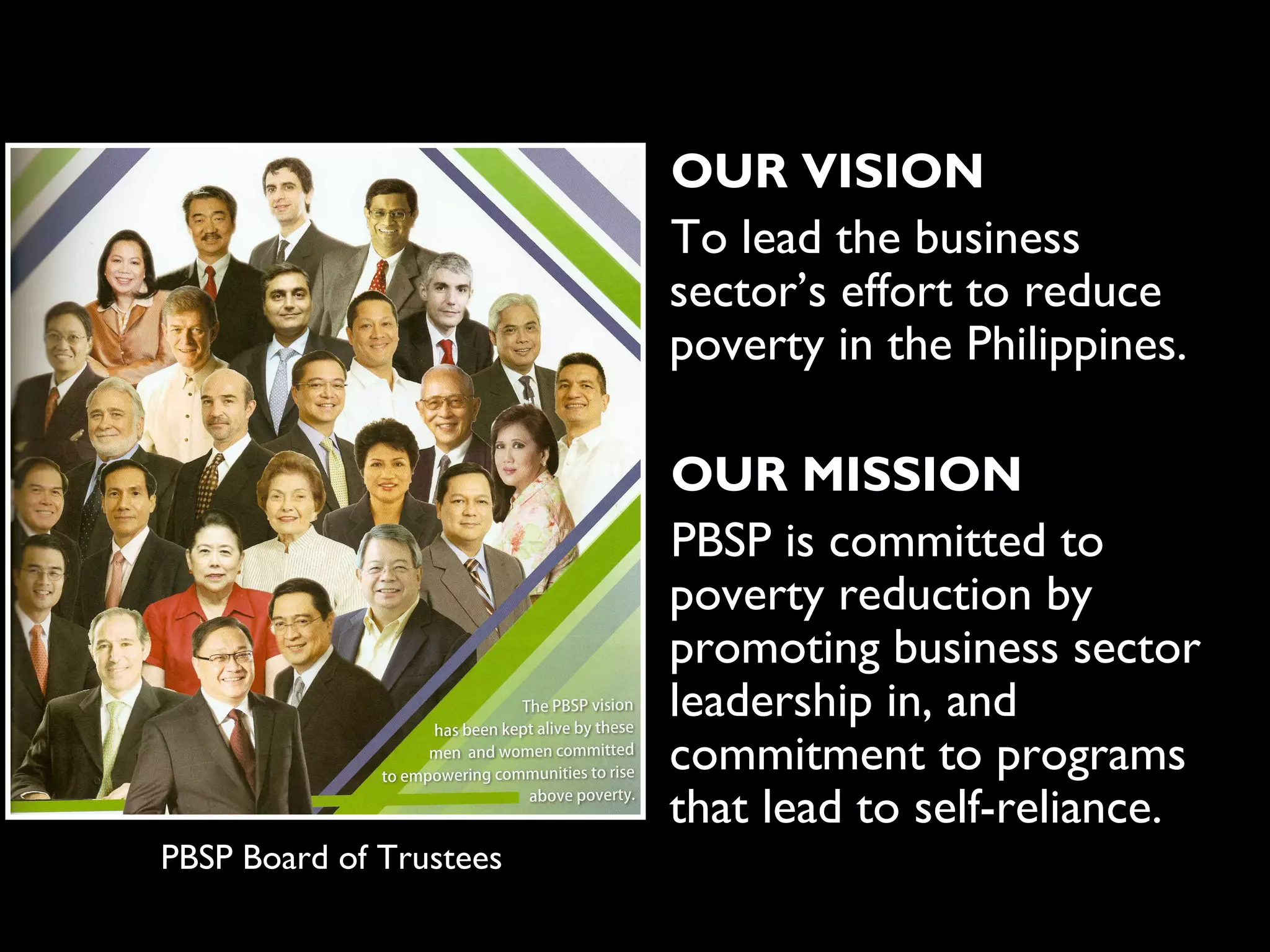
OUR VISION
                         To lead the business
                         sector’s effort to reduce
                         poverty in the Philippines.

                         OUR MISSION
                         PBSP is committed to
                         poverty reduction by
                         promoting business sector
                         leadership in, and
                         commitment to programs
                         that lead to self-reliance.
PBSP Board of Trustees
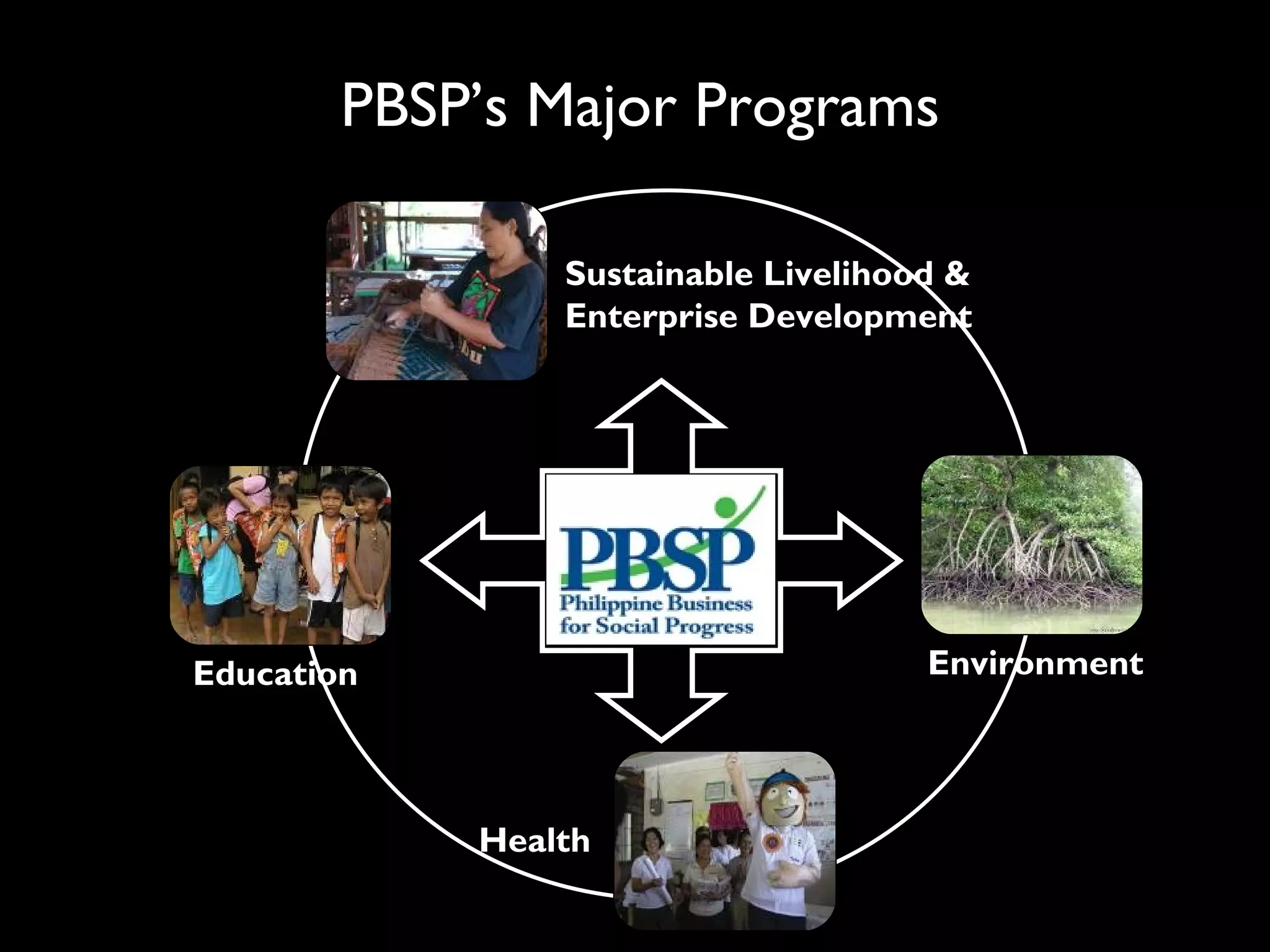
PBSP’s Major Programs

                Sustainable Livelihood &
                Enterprise Development


Education                            Environment


            Health
THE WAY TO GO

PBSP’s Enterprise Development Program


    CREDIT                          BDS
    Market-based approaches to poverty reduction
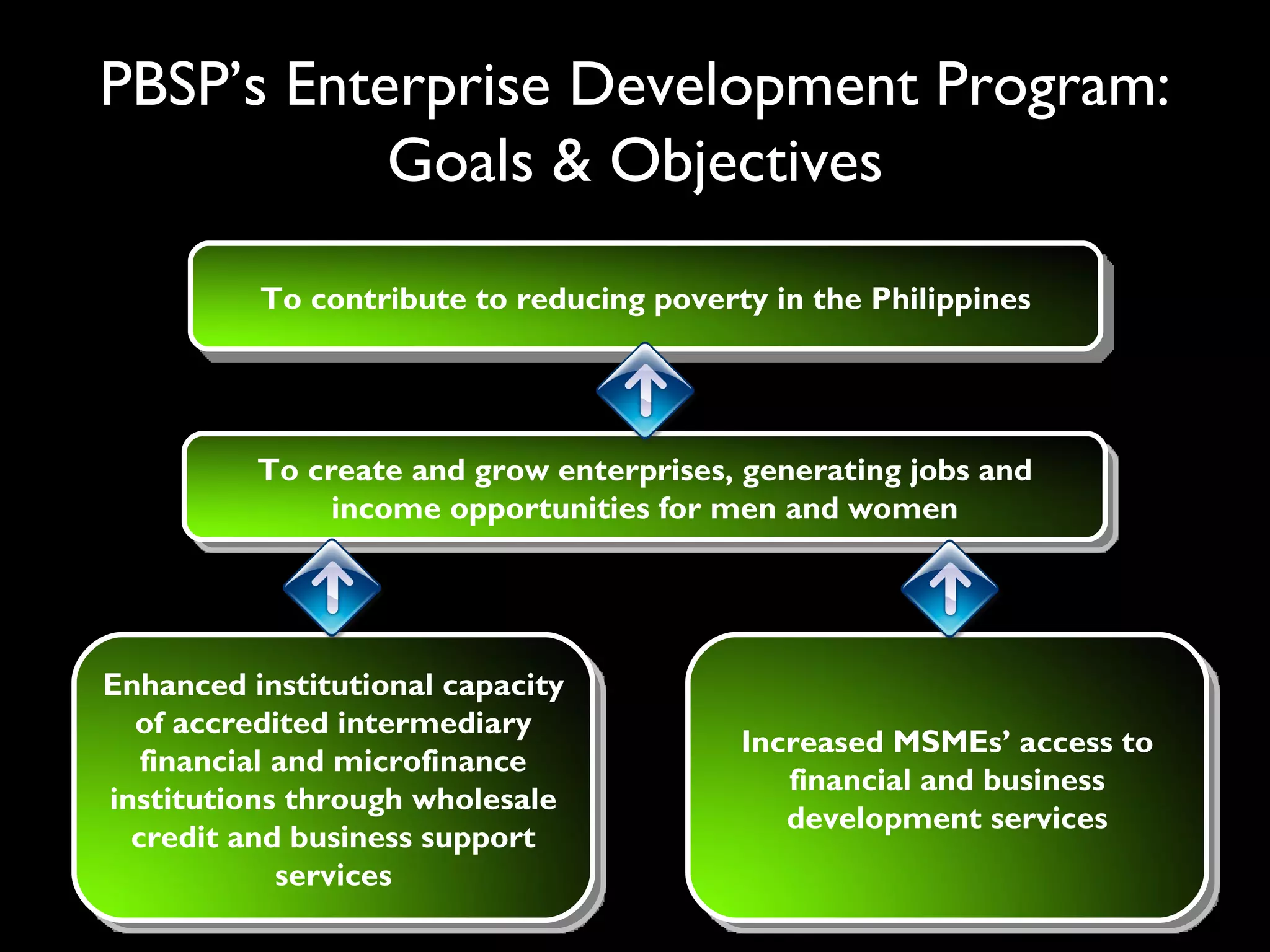
PBSP’s Enterprise Development Program:
           Goals & Objectives

          To contribute to reducing poverty in the Philippines


          To create and grow enterprises, generating jobs and
               income opportunities for men and women


Enhanced institutional capacity
  of accredited intermediary
                                          Increased MSMEs’ access to
   financial and microfinance
                                             financial and business
institutions through wholesale
                                             development services
  credit and business support
             services
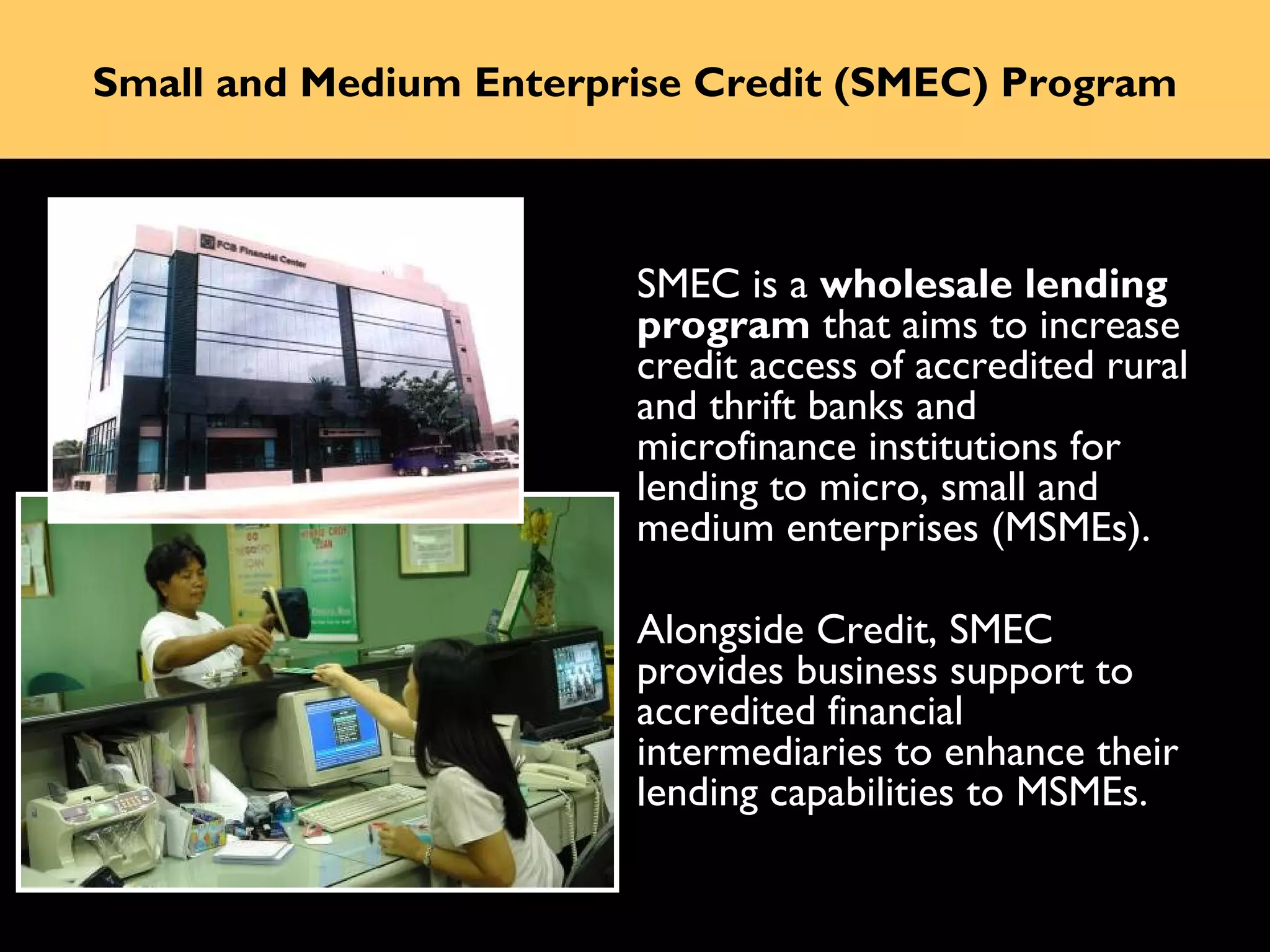
Small and Medium Enterprise Credit (SMEC) Program


                        SMEC is a wholesale lending
                        program that aims to increase
                        credit access of accredited rural
                        and thrift banks and
                        microfinance institutions for
                        lending to micro, small and
                        medium enterprises (MSMEs).

                        Alongside Credit, SMEC
                        provides business support to
                        accredited financial
                        intermediaries to enhance their
                        lending capabilities to MSMEs.
SMEC Background

• 1989 – established SMEC thru a US$13M grant from USAID

• 1995 – ownership of the fund was transferred to DoF, held in
  trust by DBP


• 1995 & 1998 – KfW (German Dev’t. Bank) augmented
  funding by PhP389.7M under a bilateral loan agreement
  among KfW, Landbank, as the borrower, and PBSP as the
  Project Executing Agency

• 2008 – DoF approved the extension of SMEC until 201x
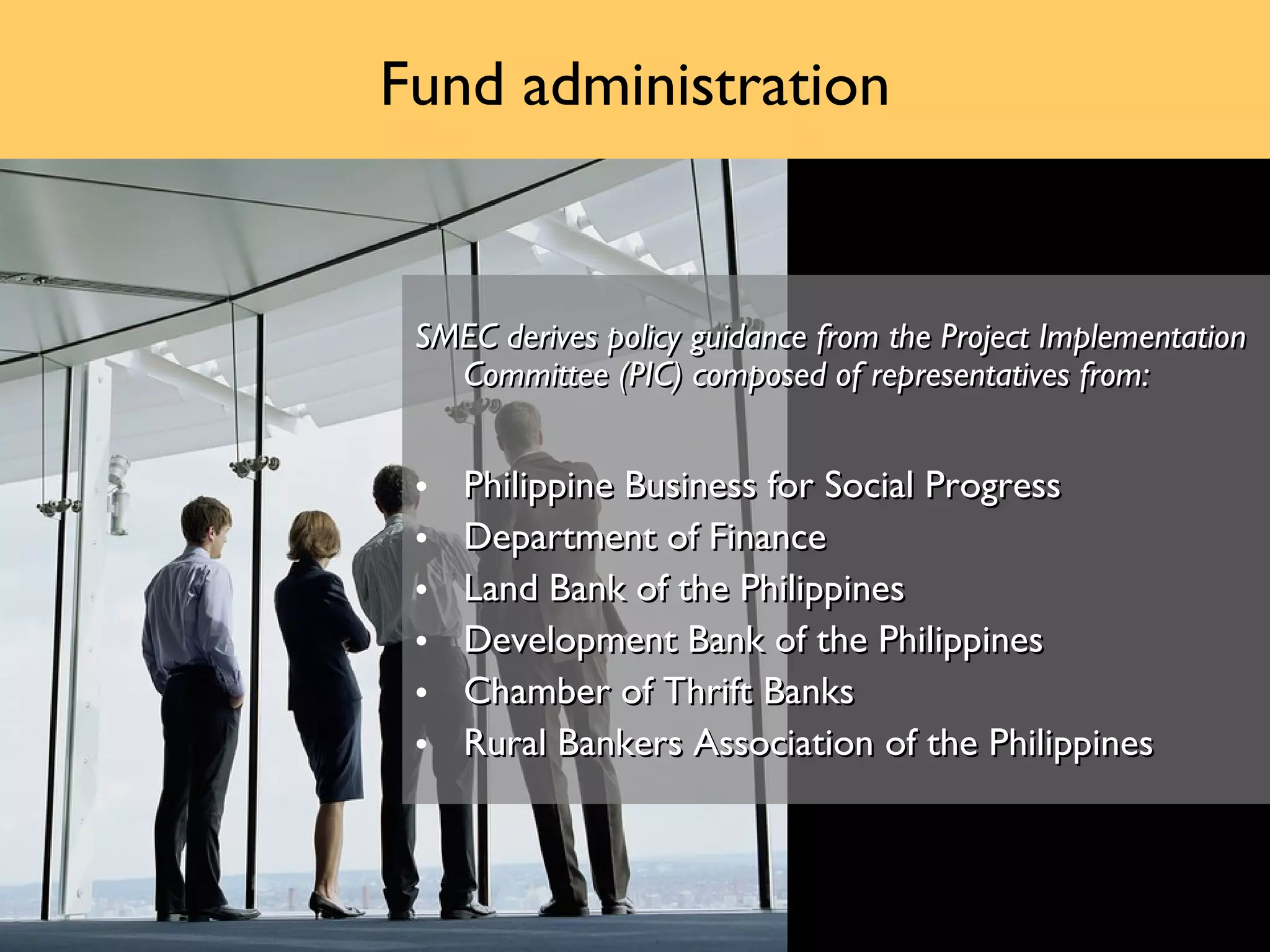
Fund administration


 SMEC derives policy guidance from the Project Implementation
   Committee (PIC) composed of representatives from:


 •   Philippine Business for Social Progress
 •   Department of Finance
 •   Land Bank of the Philippines
 •   Development Bank of the Philippines
 •   Chamber of Thrift Banks
 •   Rural Bankers Association of the Philippines
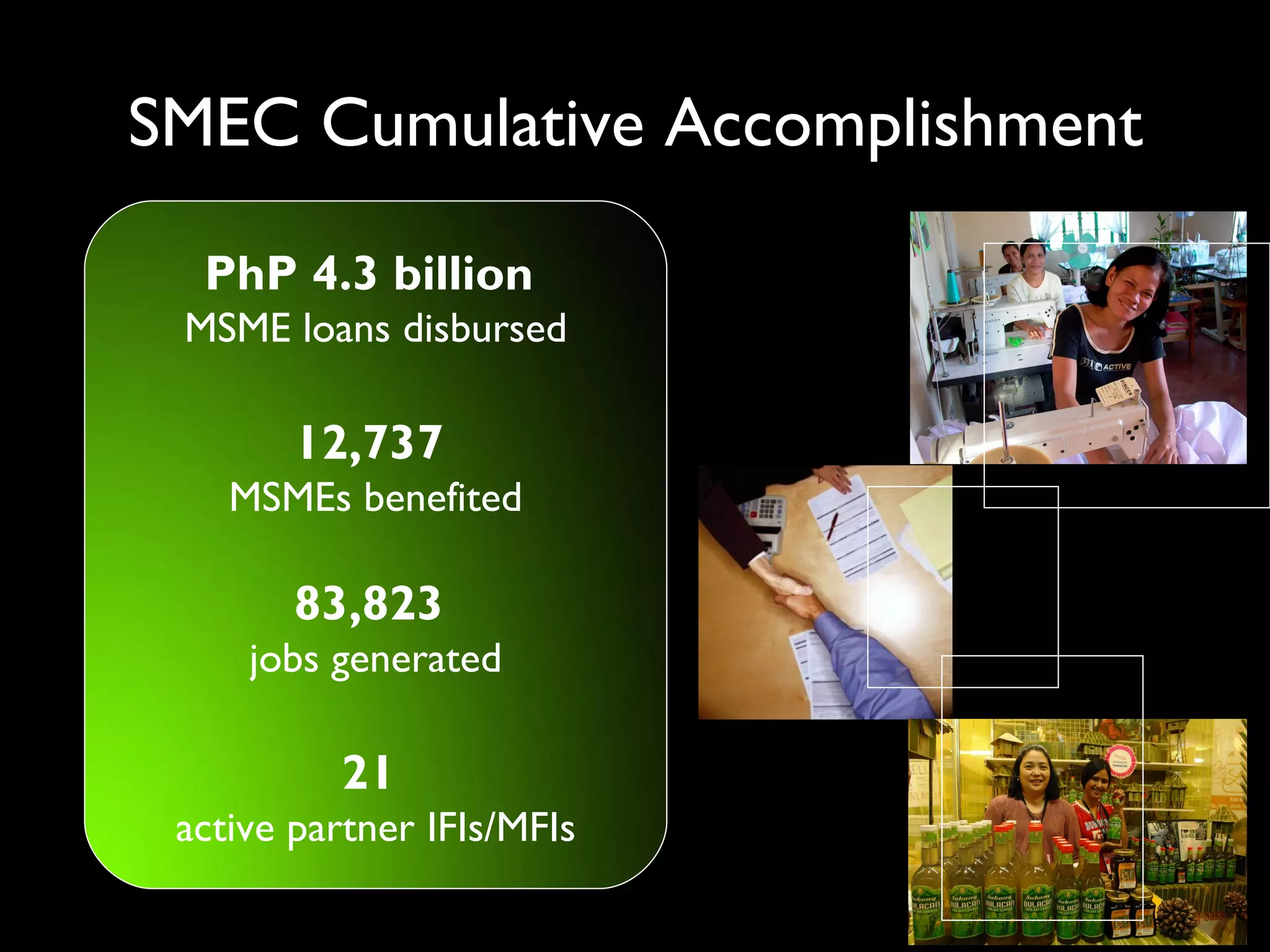
SMEC Cumulative Accomplishment

  PhP 4.3 billion
 MSME loans disbursed

        12,737
    MSMEs benefited

        83,823
     jobs generated

          21
 active partner IFIs/MFIs
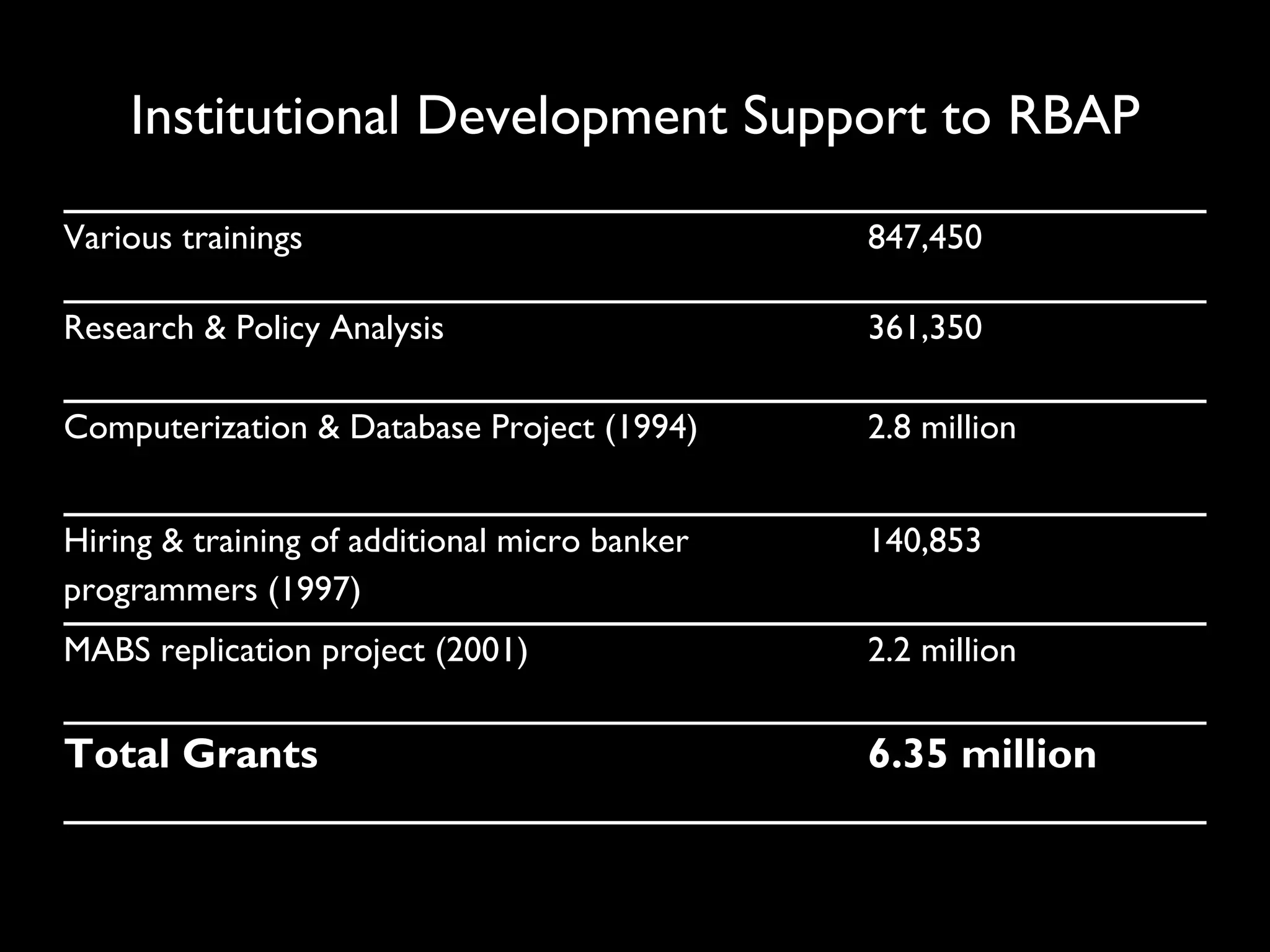
Institutional Development Support to RBAP

Various trainings                              847,450

Research & Policy Analysis                     361,350

Computerization & Database Project (1994)      2.8 million


Hiring & training of additional micro banker   140,853
programmers (1997)
MABS replication project (2001)                2.2 million


Total Grants                                   6.35 million
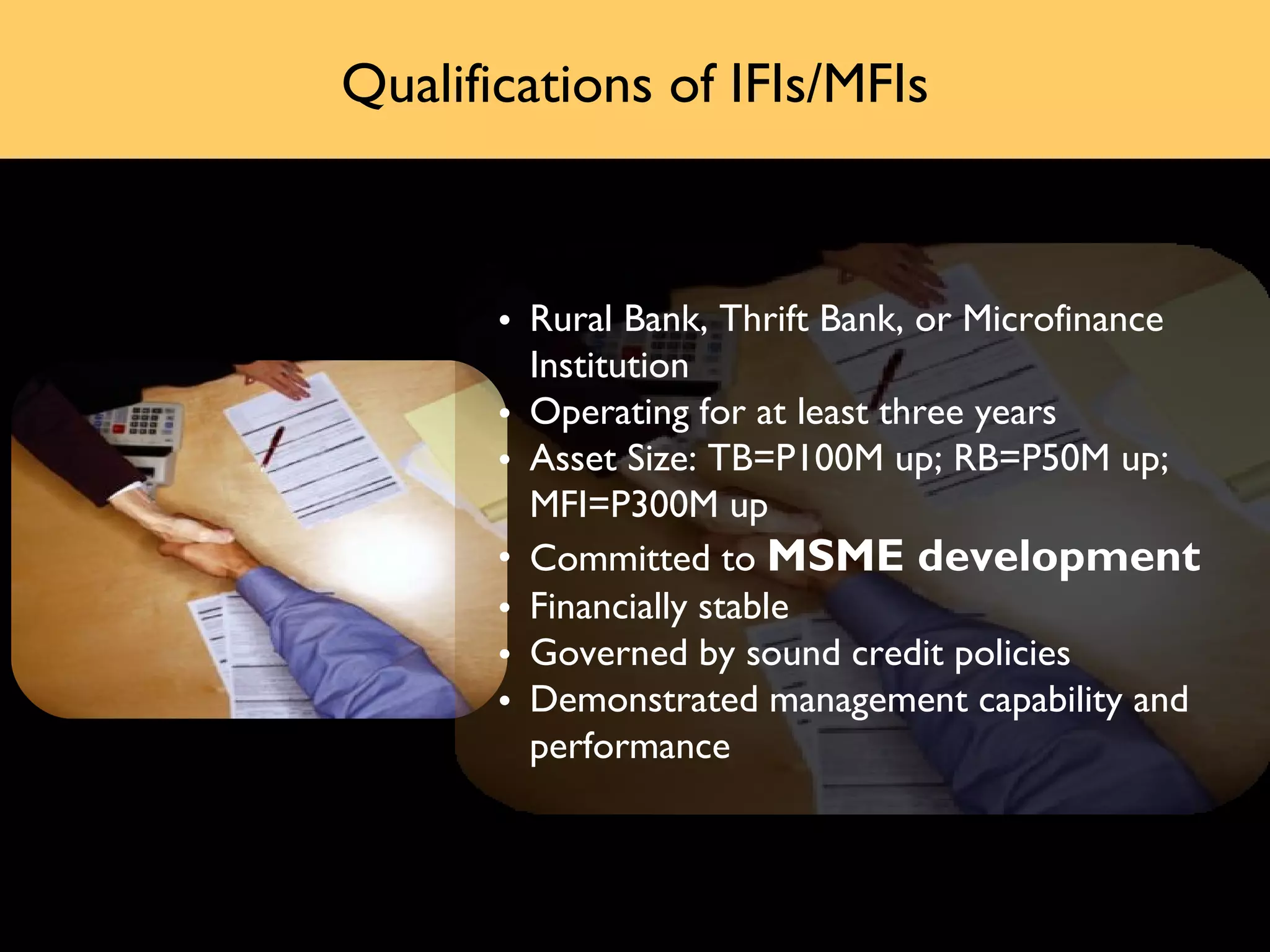
Qualifications of IFIs/MFIs


       • Rural Bank, Thrift Bank, or Microfinance
         Institution
       • Operating for at least three years
       • Asset Size: TB=P100M up; RB=P50M up;
         MFI=P300M up
       • Committed to MSME development
       • Financially stable
       • Governed by sound credit policies
       • Demonstrated management capability and
         performance
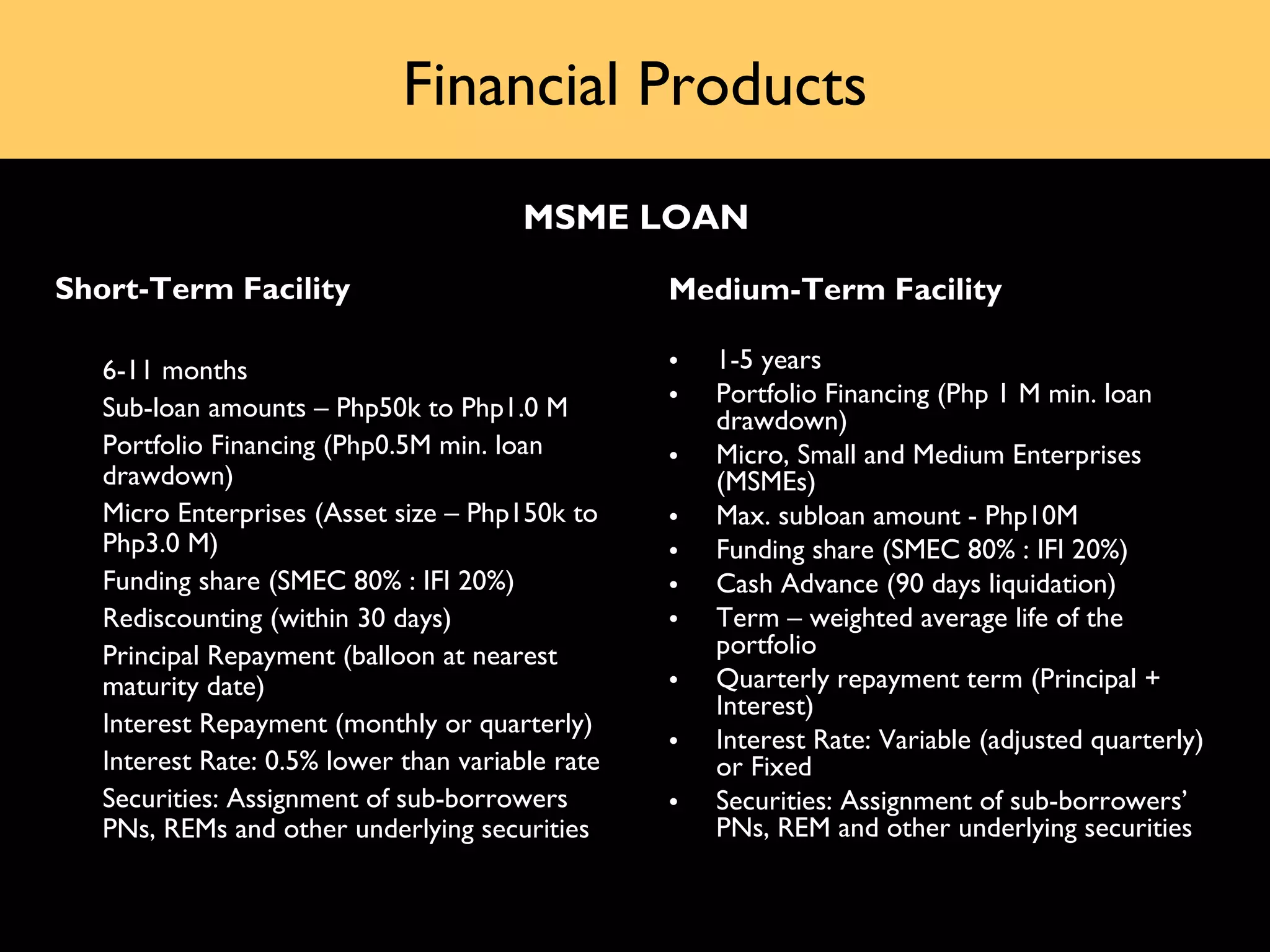
Financial Products
                                         MSME LOAN
Short-Term Facility                                Medium-Term Facility

•   6-11 months                                    •   1-5 years
•                                                  •   Portfolio Financing (Php 1 M min. loan
    Sub-loan amounts – Php50k to Php1.0 M              drawdown)
•   Portfolio Financing (Php0.5M min. loan         •   Micro, Small and Medium Enterprises
    drawdown)                                          (MSMEs)
•   Micro Enterprises (Asset size – Php150k to     •   Max. subloan amount - Php10M
    Php3.0 M)                                      •   Funding share (SMEC 80% : IFI 20%)
•   Funding share (SMEC 80% : IFI 20%)             •   Cash Advance (90 days liquidation)
•   Rediscounting (within 30 days)                 •   Term – weighted average life of the
•   Principal Repayment (balloon at nearest            portfolio
    maturity date)                                 •   Quarterly repayment term (Principal +
                                                       Interest)
•   Interest Repayment (monthly or quarterly)
                                                   •   Interest Rate: Variable (adjusted quarterly)
•   Interest Rate: 0.5% lower than variable rate       or Fixed
•   Securities: Assignment of sub-borrowers        •   Securities: Assignment of sub-borrowers’
    PNs, REMs and other underlying securities          PNs, REM and other underlying securities
Financial Products
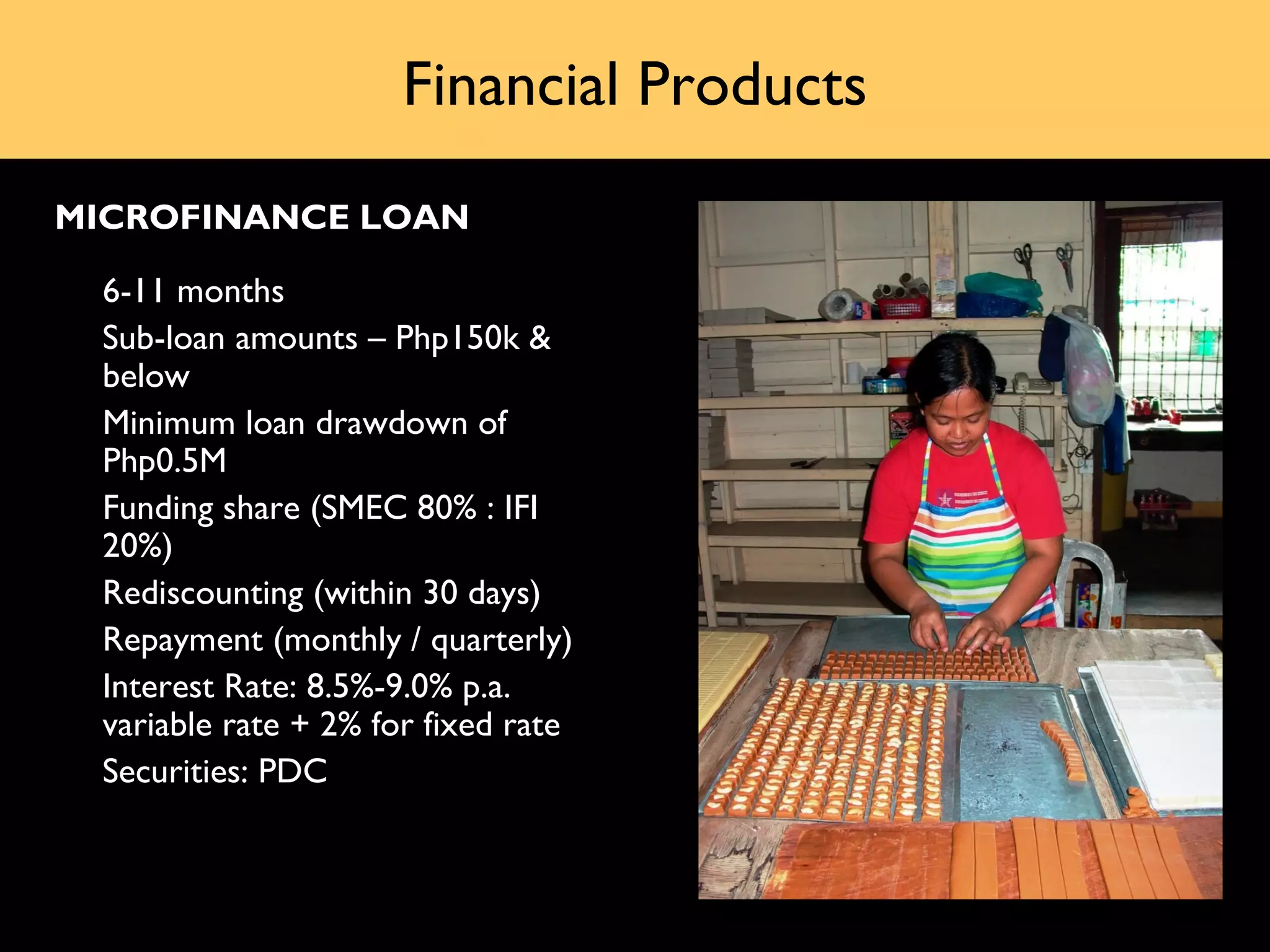
MICROFINANCE LOAN

•   6-11 months
•   Sub-loan amounts – Php150k &
    below
•   Minimum loan drawdown of
    Php0.5M
•   Funding share (SMEC 80% : IFI
    20%)
•   Rediscounting (within 30 days)
•   Repayment (monthly / quarterly)
•   Interest Rate: 8.5%-9.0% p.a.
    variable rate + 2% for fixed rate
•   Securities: PDC
Eligible MSME sub-borrowers


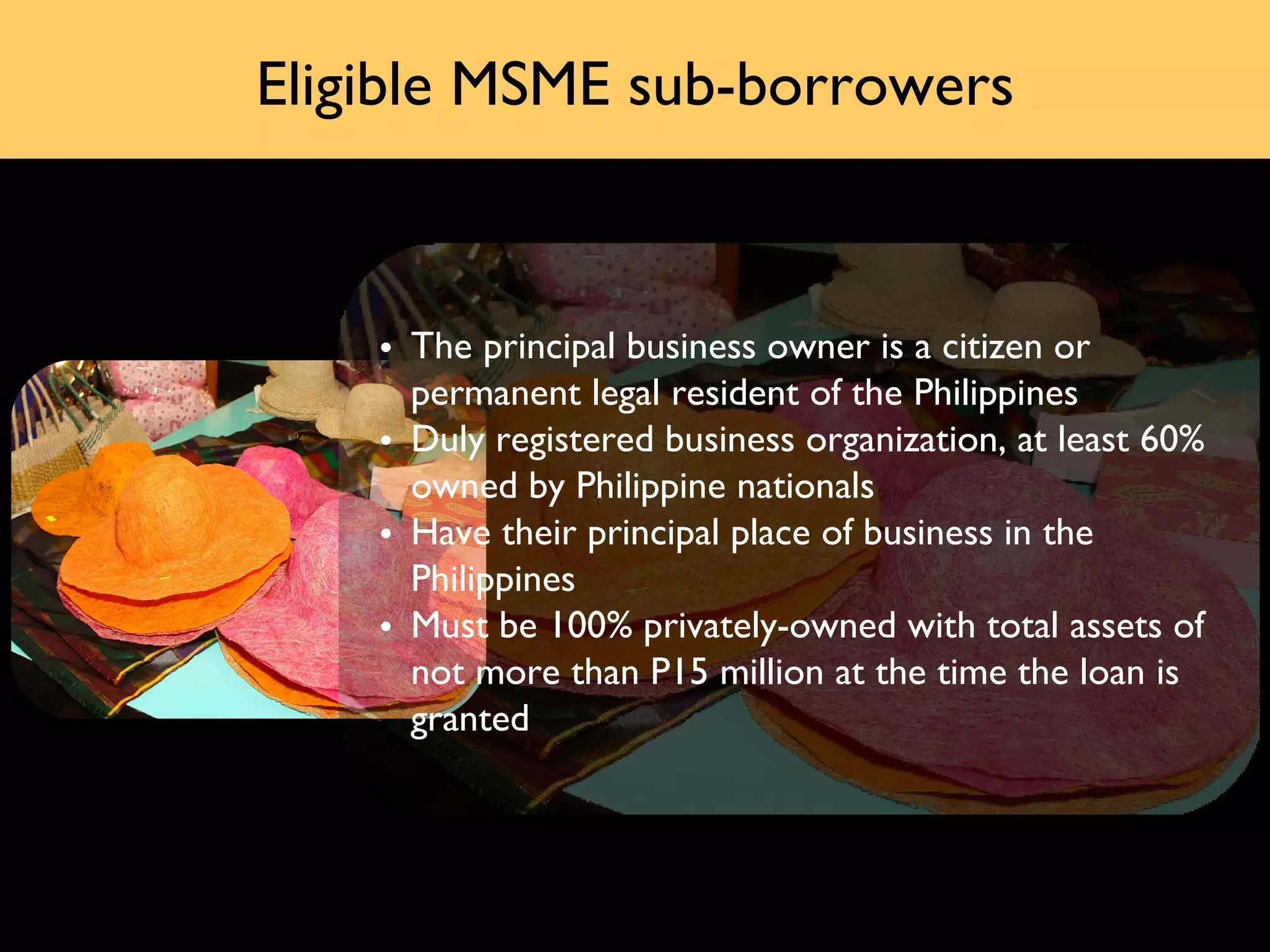
    • The principal business owner is a citizen or
      permanent legal resident of the Philippines
    • Duly registered business organization, at least 60%
      owned by Philippine nationals
    • Have their principal place of business in the
      Philippines
    • Must be 100% privately-owned with total assets of
      not more than P15 million at the time the loan is
      granted
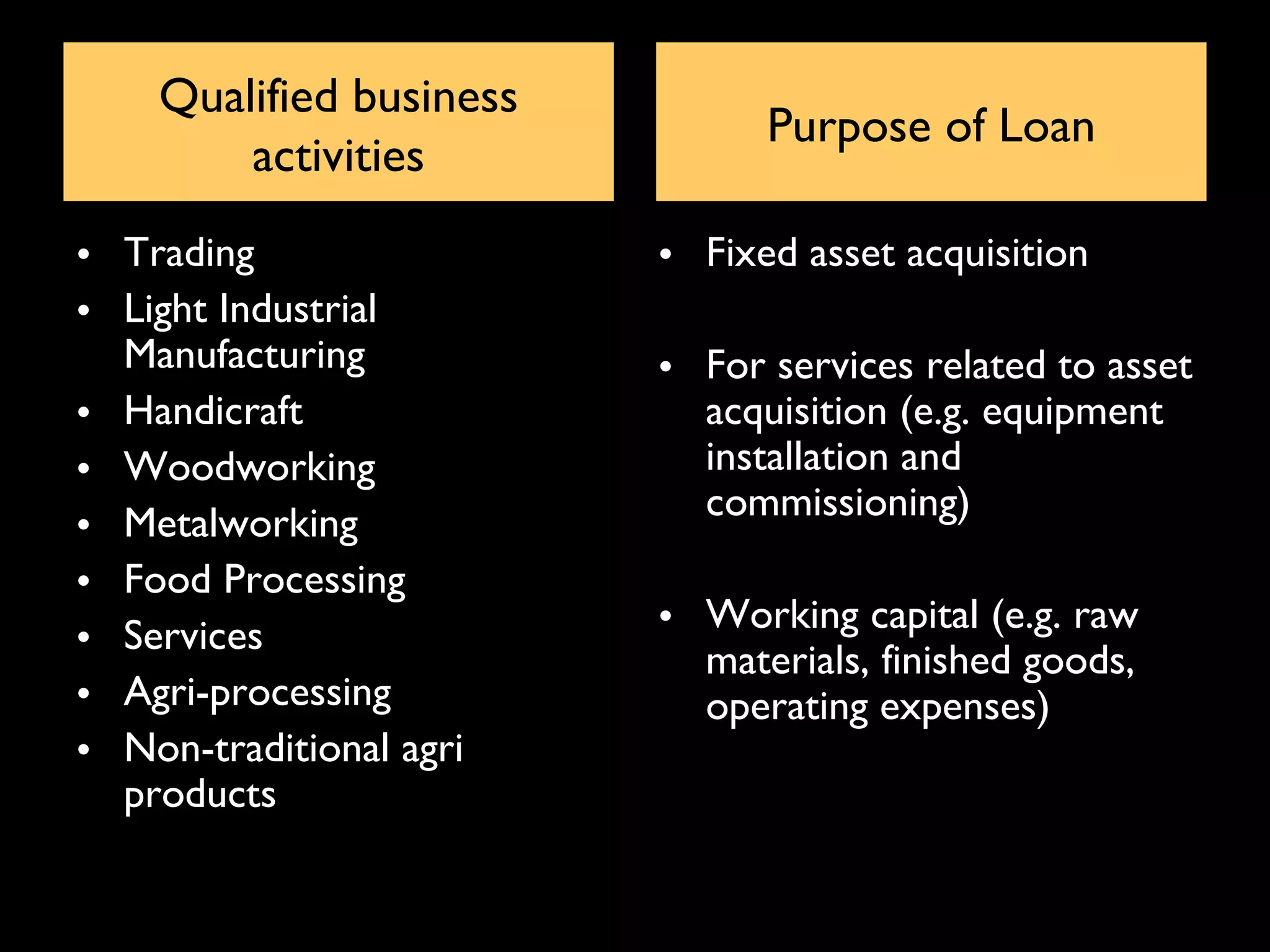
Qualified business
                               Purpose of Loan
        activities
• Trading                • Fixed asset acquisition
• Light Industrial
  Manufacturing          • For services related to asset
• Handicraft               acquisition (e.g. equipment
• Woodworking              installation and
                           commissioning)
• Metalworking
• Food Processing
                         • Working capital (e.g. raw
• Services
                           materials, finished goods,
• Agri-processing          operating expenses)
• Non-traditional agri
  products
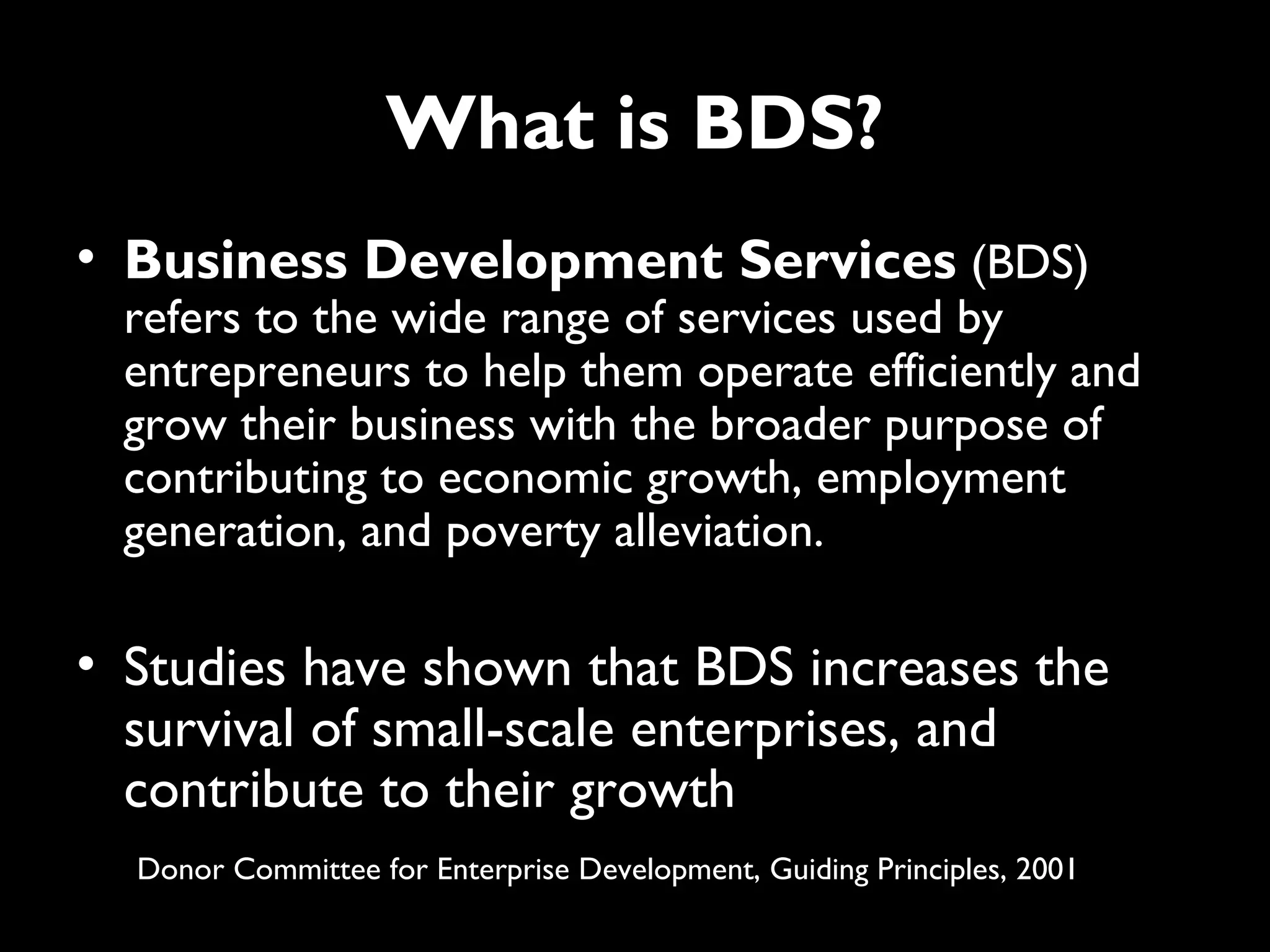
What is BDS?
• Business Development Services (BDS)
 refers to the wide range of services used by
 entrepreneurs to help them operate efficiently and
 grow their business with the broader purpose of
 contributing to economic growth, employment
 generation, and poverty alleviation.

• Studies have shown that BDS increases the
  survival of small-scale enterprises, and
  contribute to their growth
  Donor Committee for Enterprise Development, Guiding Principles, 2001
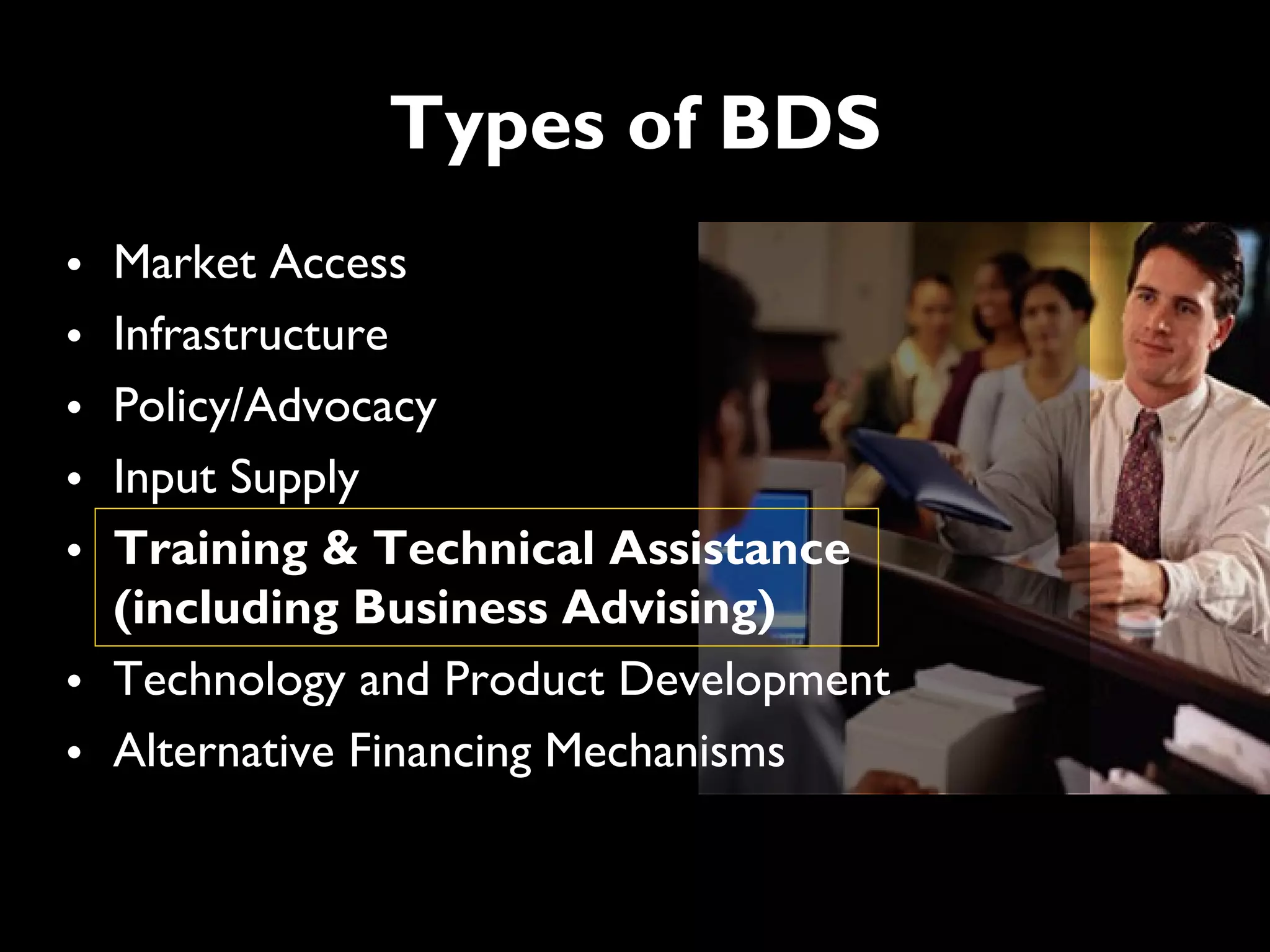
Types of BDS
• Market Access
• Infrastructure
• Policy/Advocacy
• Input Supply
• Training & Technical Assistance
  (including Business Advising)
• Technology and Product Development
• Alternative Financing Mechanisms
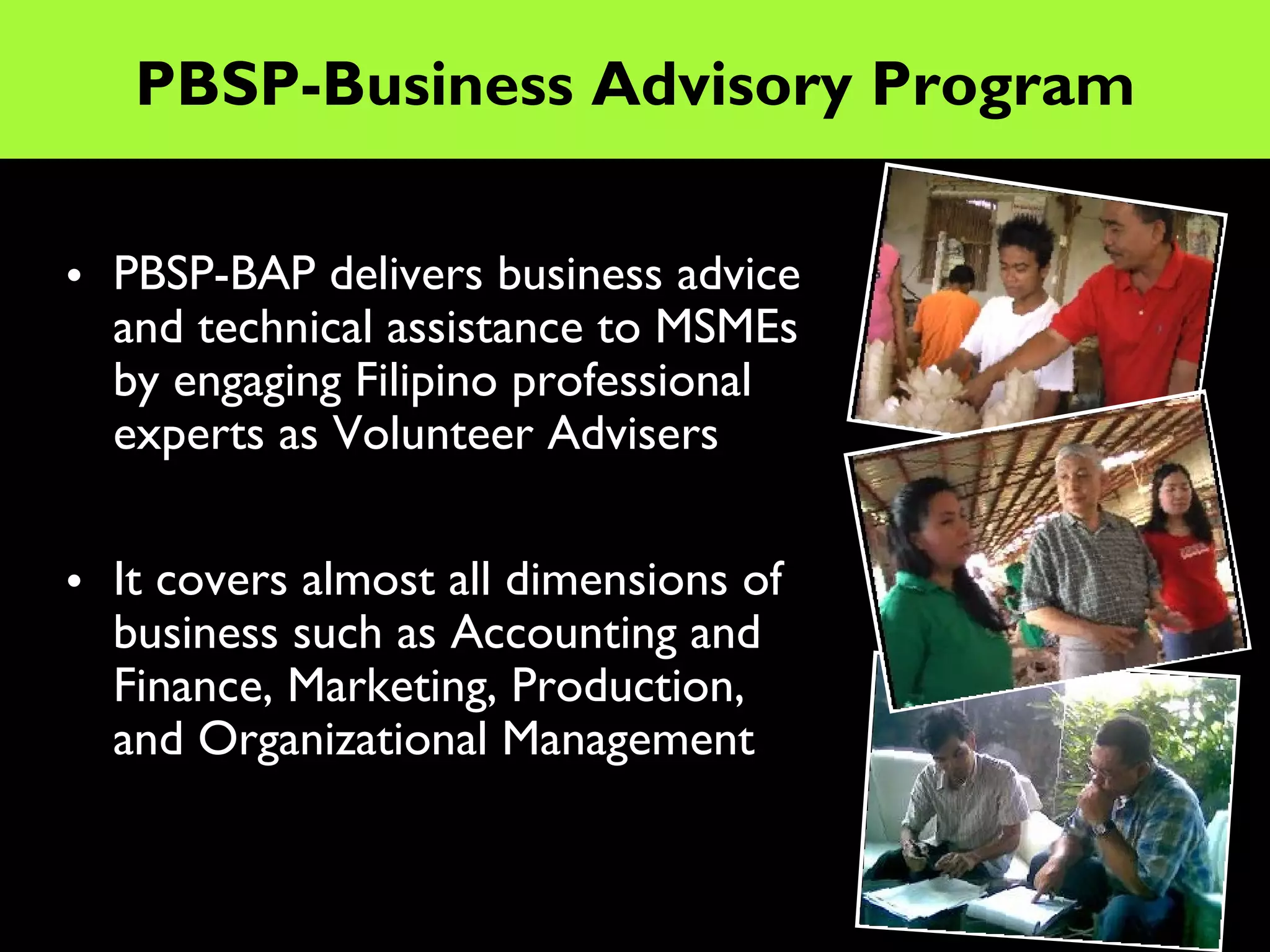
PBSP-Business Advisory Program

• PBSP-BAP delivers business advice
  and technical assistance to MSMEs
  by engaging Filipino professional
  experts as Volunteer Advisers


• It covers almost all dimensions of
  business such as Accounting and
  Finance, Marketing, Production,
  and Organizational Management
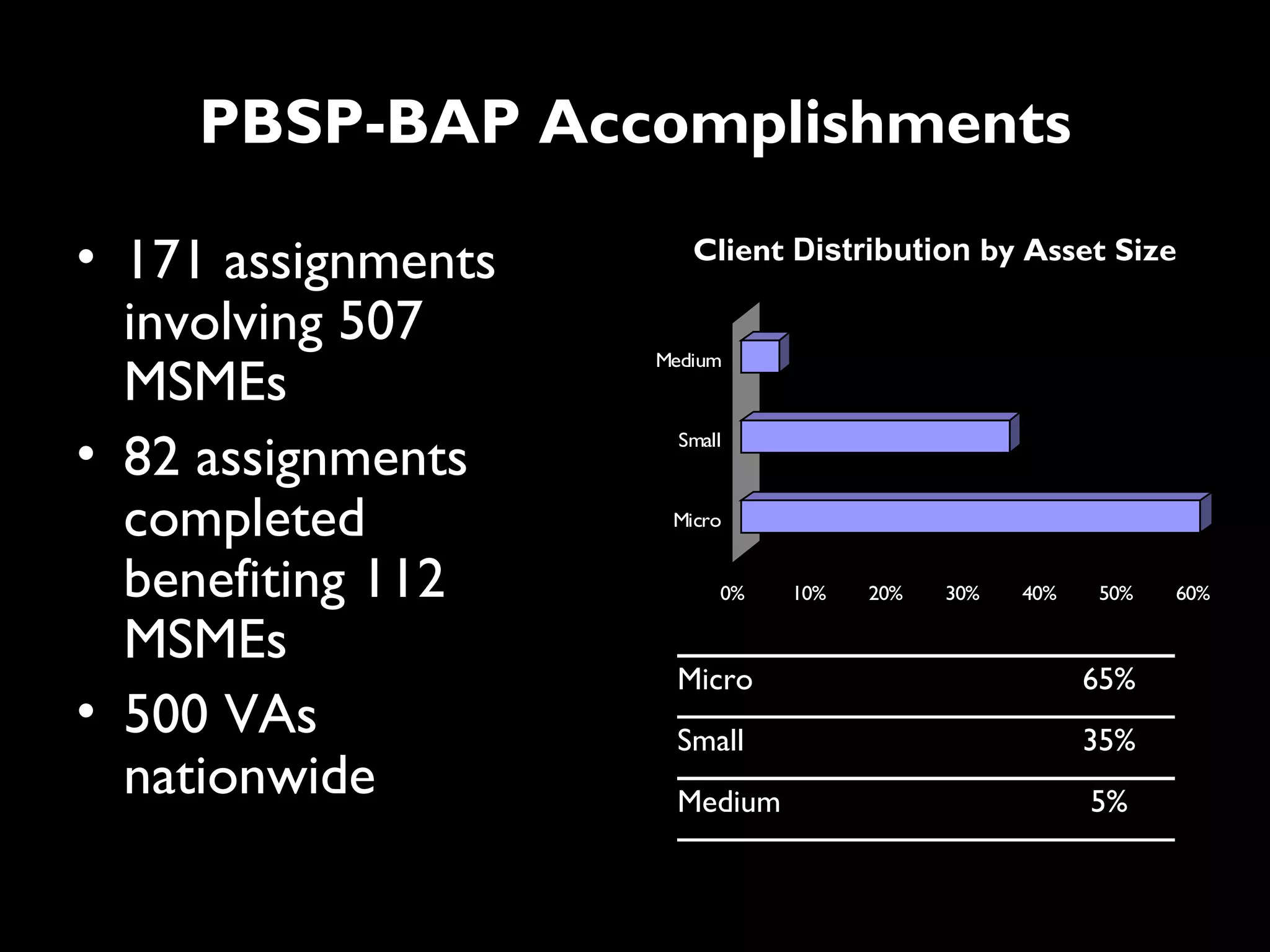
PBSP-BAP Accomplishments

• 171 assignments      Client Distribution by Asset Size

  involving 507
  MSMEs
                    Medium


• 82 assignments      Small


  completed          Micro


  benefiting 112          0%   10%   20%   30%   40%   50%   60%

  MSMEs
                     Micro                             65%
• 500 VAs            Small                             35%
  nationwide         Medium                            5%
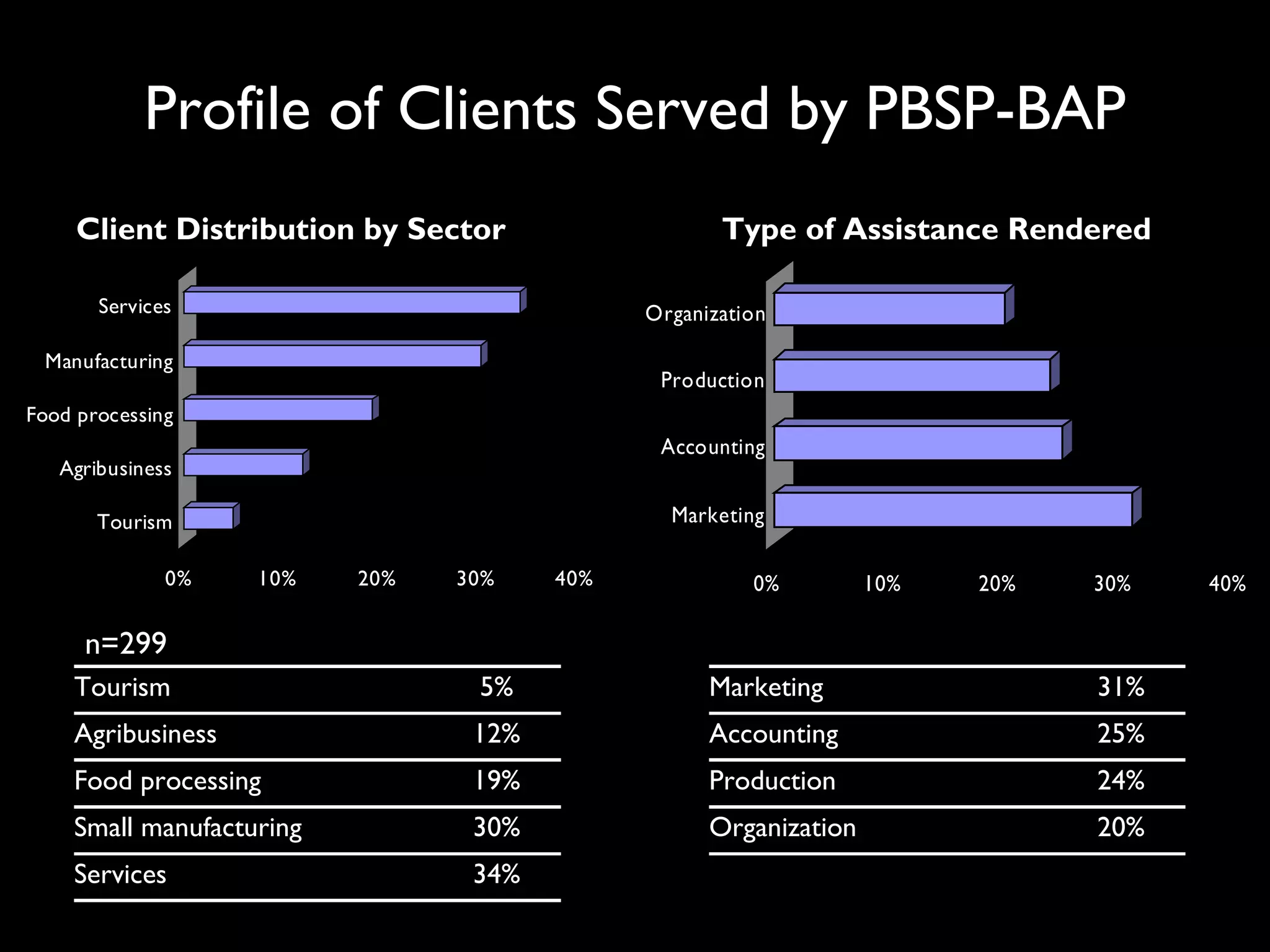
Profile of Clients Served by PBSP-BAP
     Client Distribution by Sector                  Type of Assistance Rendered

       Services                              Organization

 Manufacturing
                                              Production
Food processing
                                              Accounting
   Agribusiness

       Tourism                                 Marketing

              0%   10%    20%   30%    40%             0%         10%   20%   30%   40%

     n=299
    Tourism                      5%                Marketing                  31%
    Agribusiness                 12%               Accounting                 25%
    Food processing              19%               Production                 24%
    Small manufacturing          30%               Organization               20%
    Services                     34%
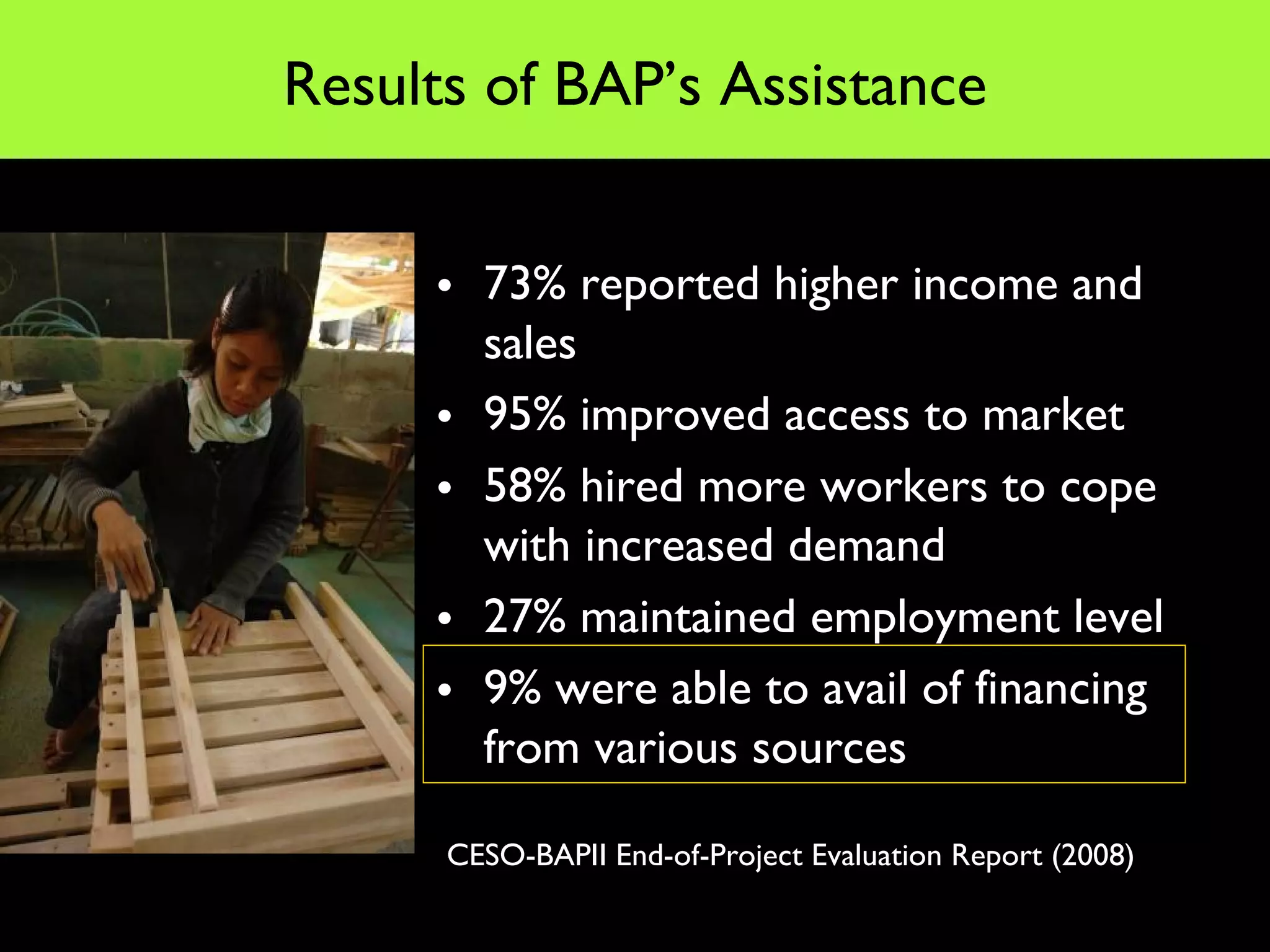
Results of BAP’s Assistance


     • 73% reported higher income and
       sales
     • 95% improved access to market
     • 58% hired more workers to cope
       with increased demand
     • 27% maintained employment level
     • 9% were able to avail of financing
       from various sources

      CESO-BAPII End-of-Project Evaluation Report (2008)
Integrating Business Advising
         with Financing
• Improve loan repayment; loan quality
• Enhance the financial performance and credit-
  worthiness of MSME-clients
• Improve business of MSME-clients, thus
  expanding demand for financing
• Strengthen MSME-client relations
• Improve the bank/MFI’s social performance
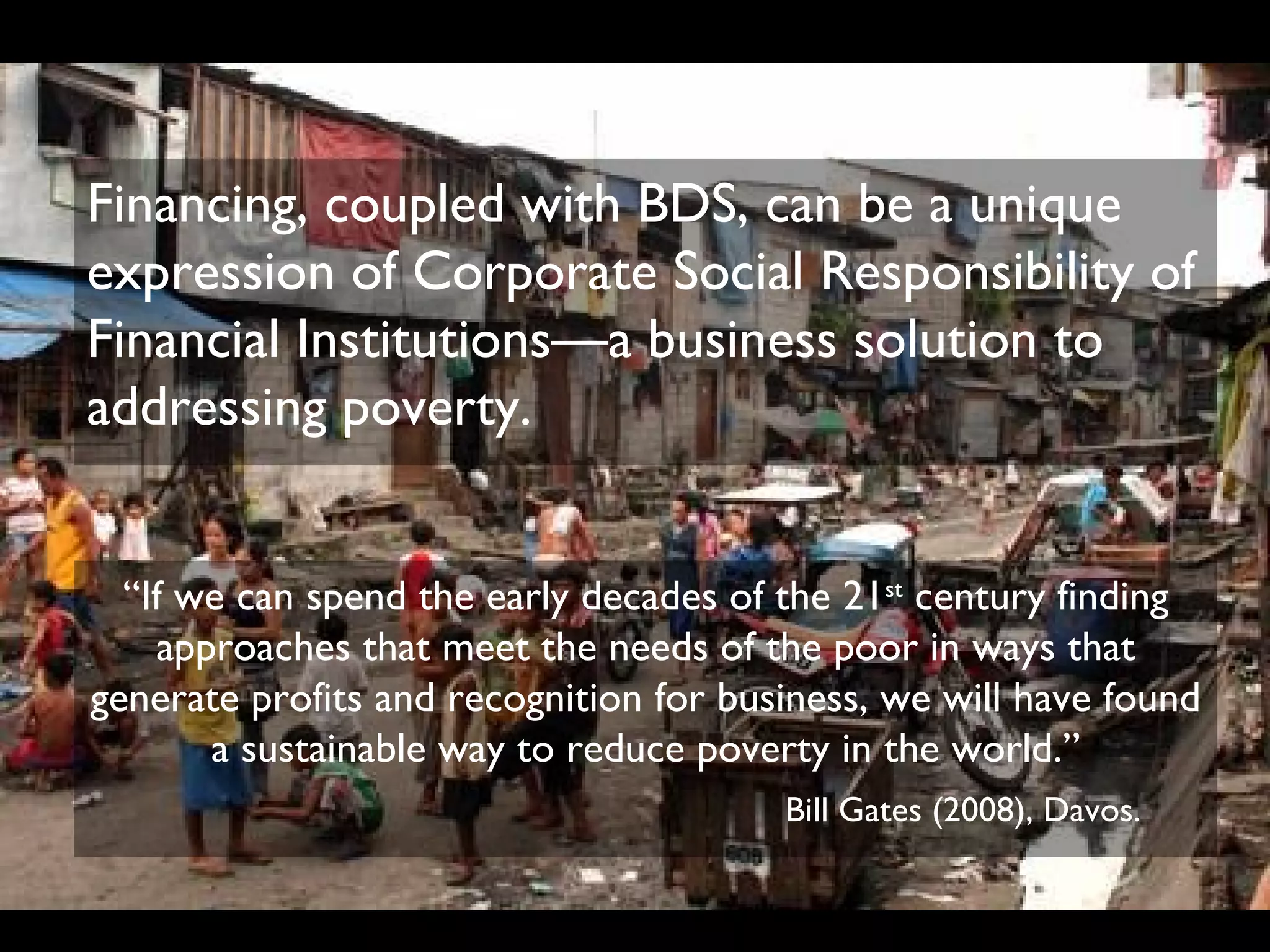
Financing, coupled with BDS, can be a unique
expression of Corporate Social Responsibility of
Financial Institutions—a business solution to
addressing poverty.


  “If we can spend the early decades of the 21st century finding
    approaches that meet the needs of the poor in ways that
generate profits and recognition for business, we will have found
       a sustainable way to reduce poverty in the world.”
                                        Bill Gates (2008), Davos.
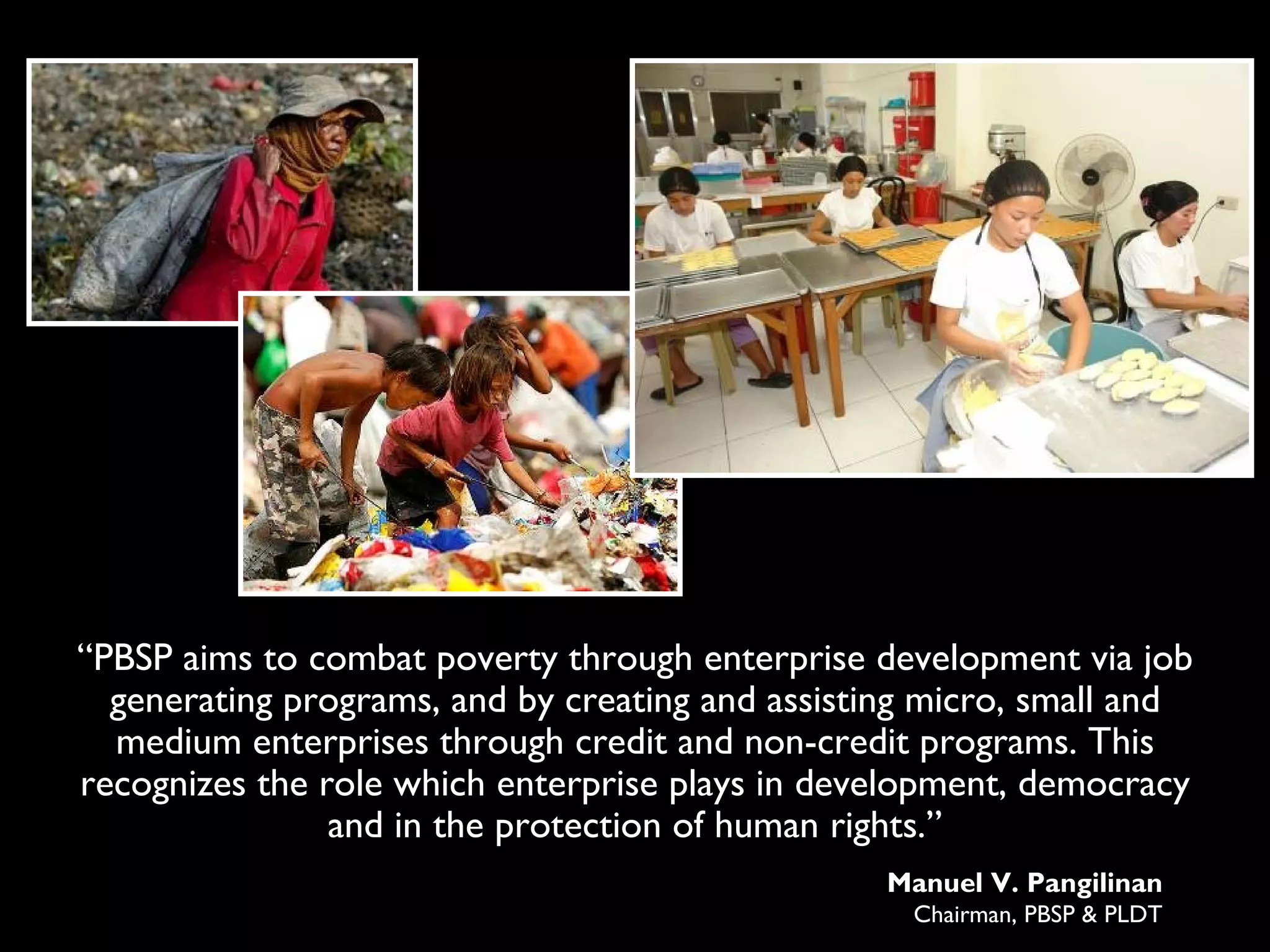
“PBSP aims to combat poverty through enterprise development via job
  generating programs, and by creating and assisting micro, small and
  medium enterprises through credit and non-credit programs. This
recognizes the role which enterprise plays in development, democracy
                and in the protection of human rights.”
                                                  Manuel V. Pangilinan
                                                   Chairman, PBSP & PLDT
Contact us:


                 The Group Director
         Enterprise Development Group
     PHILIPPINE BUSINESS FOR SOCIAL PROGRESS
         PSDC Building, Magallanes cor. Real Sts.,
           1002 Intramuros, Manila, Philippines

Telephones: (+63-2) 527-7741 to 48 | Fax (+63-2) 527-3751
                Email: pbsp@pbsp.org.ph


               www.pbsp.org.ph
Enterprise Development Program

  • 1.
    ENHANCING CAPACITIES OF MSMEs Philippine Business for Social Progress ENTERPRISE DEVELOPMENT GROUP
  • 2.
    • The largestcorporate-led, non-profit, social development foundation in the Philippines. • Founded in the 1970s by 50 business leaders; now has 255 corporate members. • PBSP is at the forefront in the fight against poverty through trailblazing corporate social responsibility (CSR) or corporate citizenship programs.
  • 3.
    OUR VISION To lead the business sector’s effort to reduce poverty in the Philippines. OUR MISSION PBSP is committed to poverty reduction by promoting business sector leadership in, and commitment to programs that lead to self-reliance. PBSP Board of Trustees
  • 4.
    PBSP’s Major Programs Sustainable Livelihood & Enterprise Development Education Environment Health
  • 5.
    THE WAY TOGO PBSP’s Enterprise Development Program CREDIT BDS Market-based approaches to poverty reduction
  • 6.
    PBSP’s Enterprise DevelopmentProgram: Goals & Objectives To contribute to reducing poverty in the Philippines To create and grow enterprises, generating jobs and income opportunities for men and women Enhanced institutional capacity of accredited intermediary Increased MSMEs’ access to financial and microfinance financial and business institutions through wholesale development services credit and business support services
  • 7.
    Small and MediumEnterprise Credit (SMEC) Program SMEC is a wholesale lending program that aims to increase credit access of accredited rural and thrift banks and microfinance institutions for lending to micro, small and medium enterprises (MSMEs). Alongside Credit, SMEC provides business support to accredited financial intermediaries to enhance their lending capabilities to MSMEs.
  • 8.
    SMEC Background • 1989– established SMEC thru a US$13M grant from USAID • 1995 – ownership of the fund was transferred to DoF, held in trust by DBP • 1995 & 1998 – KfW (German Dev’t. Bank) augmented funding by PhP389.7M under a bilateral loan agreement among KfW, Landbank, as the borrower, and PBSP as the Project Executing Agency • 2008 – DoF approved the extension of SMEC until 201x
  • 9.
    Fund administration SMECderives policy guidance from the Project Implementation Committee (PIC) composed of representatives from: • Philippine Business for Social Progress • Department of Finance • Land Bank of the Philippines • Development Bank of the Philippines • Chamber of Thrift Banks • Rural Bankers Association of the Philippines
  • 10.
    SMEC Cumulative Accomplishment PhP 4.3 billion MSME loans disbursed 12,737 MSMEs benefited 83,823 jobs generated 21 active partner IFIs/MFIs
  • 11.
    Institutional Development Supportto RBAP Various trainings 847,450 Research & Policy Analysis 361,350 Computerization & Database Project (1994) 2.8 million Hiring & training of additional micro banker 140,853 programmers (1997) MABS replication project (2001) 2.2 million Total Grants 6.35 million
  • 12.
    Qualifications of IFIs/MFIs • Rural Bank, Thrift Bank, or Microfinance Institution • Operating for at least three years • Asset Size: TB=P100M up; RB=P50M up; MFI=P300M up • Committed to MSME development • Financially stable • Governed by sound credit policies • Demonstrated management capability and performance
  • 13.
    Financial Products MSME LOAN Short-Term Facility Medium-Term Facility • 6-11 months • 1-5 years • • Portfolio Financing (Php 1 M min. loan Sub-loan amounts – Php50k to Php1.0 M drawdown) • Portfolio Financing (Php0.5M min. loan • Micro, Small and Medium Enterprises drawdown) (MSMEs) • Micro Enterprises (Asset size – Php150k to • Max. subloan amount - Php10M Php3.0 M) • Funding share (SMEC 80% : IFI 20%) • Funding share (SMEC 80% : IFI 20%) • Cash Advance (90 days liquidation) • Rediscounting (within 30 days) • Term – weighted average life of the • Principal Repayment (balloon at nearest portfolio maturity date) • Quarterly repayment term (Principal + Interest) • Interest Repayment (monthly or quarterly) • Interest Rate: Variable (adjusted quarterly) • Interest Rate: 0.5% lower than variable rate or Fixed • Securities: Assignment of sub-borrowers • Securities: Assignment of sub-borrowers’ PNs, REMs and other underlying securities PNs, REM and other underlying securities
  • 14.
    Financial Products MICROFINANCE LOAN • 6-11 months • Sub-loan amounts – Php150k & below • Minimum loan drawdown of Php0.5M • Funding share (SMEC 80% : IFI 20%) • Rediscounting (within 30 days) • Repayment (monthly / quarterly) • Interest Rate: 8.5%-9.0% p.a. variable rate + 2% for fixed rate • Securities: PDC
  • 15.
    Eligible MSME sub-borrowers • The principal business owner is a citizen or permanent legal resident of the Philippines • Duly registered business organization, at least 60% owned by Philippine nationals • Have their principal place of business in the Philippines • Must be 100% privately-owned with total assets of not more than P15 million at the time the loan is granted
  • 16.
    Qualified business Purpose of Loan activities • Trading • Fixed asset acquisition • Light Industrial Manufacturing • For services related to asset • Handicraft acquisition (e.g. equipment • Woodworking installation and commissioning) • Metalworking • Food Processing • Working capital (e.g. raw • Services materials, finished goods, • Agri-processing operating expenses) • Non-traditional agri products
  • 17.
    What is BDS? •Business Development Services (BDS) refers to the wide range of services used by entrepreneurs to help them operate efficiently and grow their business with the broader purpose of contributing to economic growth, employment generation, and poverty alleviation. • Studies have shown that BDS increases the survival of small-scale enterprises, and contribute to their growth Donor Committee for Enterprise Development, Guiding Principles, 2001
  • 18.
    Types of BDS •Market Access • Infrastructure • Policy/Advocacy • Input Supply • Training & Technical Assistance (including Business Advising) • Technology and Product Development • Alternative Financing Mechanisms
  • 19.
    PBSP-Business Advisory Program •PBSP-BAP delivers business advice and technical assistance to MSMEs by engaging Filipino professional experts as Volunteer Advisers • It covers almost all dimensions of business such as Accounting and Finance, Marketing, Production, and Organizational Management
  • 20.
    PBSP-BAP Accomplishments • 171assignments Client Distribution by Asset Size involving 507 MSMEs Medium • 82 assignments Small completed Micro benefiting 112 0% 10% 20% 30% 40% 50% 60% MSMEs Micro 65% • 500 VAs Small 35% nationwide Medium 5%
  • 21.
    Profile of ClientsServed by PBSP-BAP Client Distribution by Sector Type of Assistance Rendered Services Organization Manufacturing Production Food processing Accounting Agribusiness Tourism Marketing 0% 10% 20% 30% 40% 0% 10% 20% 30% 40% n=299 Tourism 5% Marketing 31% Agribusiness 12% Accounting 25% Food processing 19% Production 24% Small manufacturing 30% Organization 20% Services 34%
  • 22.
    Results of BAP’sAssistance • 73% reported higher income and sales • 95% improved access to market • 58% hired more workers to cope with increased demand • 27% maintained employment level • 9% were able to avail of financing from various sources CESO-BAPII End-of-Project Evaluation Report (2008)
  • 23.
    Integrating Business Advising with Financing • Improve loan repayment; loan quality • Enhance the financial performance and credit- worthiness of MSME-clients • Improve business of MSME-clients, thus expanding demand for financing • Strengthen MSME-client relations • Improve the bank/MFI’s social performance
  • 24.
    Financing, coupled withBDS, can be a unique expression of Corporate Social Responsibility of Financial Institutions—a business solution to addressing poverty. “If we can spend the early decades of the 21st century finding approaches that meet the needs of the poor in ways that generate profits and recognition for business, we will have found a sustainable way to reduce poverty in the world.” Bill Gates (2008), Davos.
  • 25.
    “PBSP aims tocombat poverty through enterprise development via job generating programs, and by creating and assisting micro, small and medium enterprises through credit and non-credit programs. This recognizes the role which enterprise plays in development, democracy and in the protection of human rights.” Manuel V. Pangilinan Chairman, PBSP & PLDT
  • 26.
    Contact us: The Group Director Enterprise Development Group PHILIPPINE BUSINESS FOR SOCIAL PROGRESS PSDC Building, Magallanes cor. Real Sts., 1002 Intramuros, Manila, Philippines Telephones: (+63-2) 527-7741 to 48 | Fax (+63-2) 527-3751 Email: pbsp@pbsp.org.ph www.pbsp.org.ph