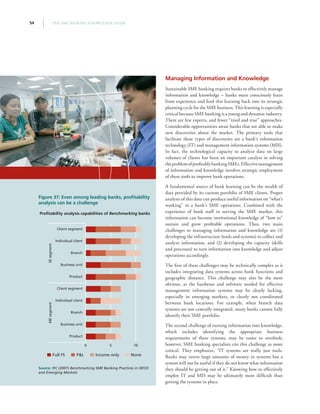
The SME Banking Knowledge Guide
IFC Advisory Services | access to finance
In Partnership with:
2010 © International Finance Corporation (IFC)
Second Edition
2121 Pennsylvania Avenue NW
Washington, D.C. 20433, USA
Telephone: 202–473–1000
Internet: IFC.org
All rights reserved
This information, while based on sources that IFC considers to be reliable, is not guaranteed as to accuracy and does not
purport to be complete.
This information shall not be construed, implicitly or explicitly, as containing any investment recommendations and,
accordingly, IFC is not registered under the U.S. Investment Advisers Act of 1940.
The denominations and geographical names in this publication are used solely for the convenience of the reader and do not
imply any judgment on the part of IFC, the World Bank, or other affiliates concerning the legal status of any territory or the
endorsement or acceptance of such boundaries.
Any views expressed herein are those of the authors and do not necessarily represent the views of the World Bank or the
International Finance Corporation.
Rights and Permissions
The material in this publication is copyrighted. Copying and/or transmitting portions or all of this work without permission
may be a violation of applicable law. The World Bank Group encourages dissemination of its work and will normally grant
permission to reproduce portions of the work promptly.
For permission to photocopy or reprint any part of this work, please send a request with complete information to the
Copyright Clearance Center Inc., 222 Rosewood Drive, Danvers, MA 01923, USA; telephone: 978–750–8400;
facsimile: 978–750–4470; Internet: www.copyright.com
All other queries on rights and licenses, including subsidiary rights, should be addressed to the Office of the Publisher,
The World Bank, 1818 H Street NW, Washington, D.C. 20433, USA; facsimile: 202–522–2422; e-mail: pubrights@worldbank.org.
List of Abbreviations	 2
Foreword	3
Preface	4
Executive Summary	 5
Introduction	7
SMEs and the “Missing Middle”	 9
Definitions of the SME market	 9
The economic importance of SMEs	 11
Unmet demand for banking services	 12
The SME banking opportunity	 16
Bridging the Middle: SME Banking Today	 19
Composition of the industry	 21
The role of the operating environment	 22
Challenges and Approaches along the Banking Value Chain	 27
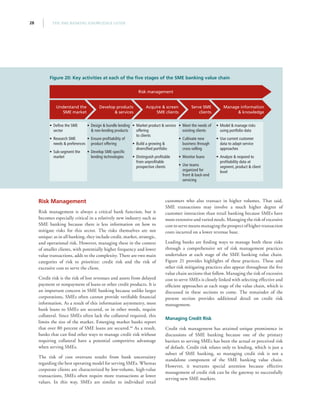
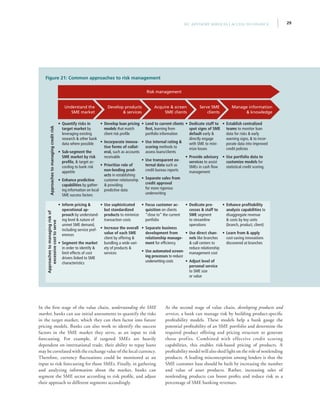
Risk management	 28
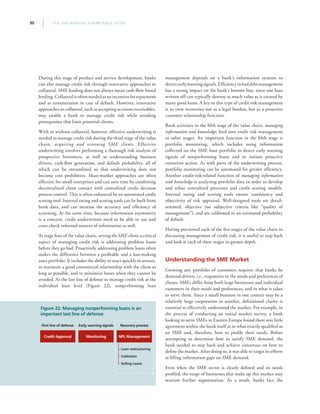
Understanding the SME market	 30
Developing products and services	 34
Acquiring and screening SME clients	 42
Serving SME clients	 48
Managing information and knowledge	 54
Banking the SME Market	 57
Lessons from SME banking today	 57
Getting started: entering or expanding SME banking	 61
Tools for initiating market entry or expansion	 63
Appendix A: Sample SME definitions	 70
Appendix B: List of bank case studies and vignettes	 71
Appendix C: Partnering with IFC	 72
Appendix D: About IFC	 73
References	74
Endnotes	76
Contents
THE SME BANKING KNOWLEDGE GUIDE2
ANDE Aspen Network of Development
Entrepreneurs
ATM Automated Teller Machine
BD Business Development
BRIC Brazil Russia India China
CAGR Compound Annual Growth Rate
CFO Chief Financial Officer
CRM Client Relationship Management
EBL Eastern Bank Limited
EBRD European Bank for Reconstruction
and Development
EM Emerging Markets
EMPEA Emerging Markets Private Equity
Association
EWS Early Warning Signals
FI Financial Institution
FELEBAN Latin American Federation
of Banks
FS Financial Statement
FY Fiscal Year
GDP Gross Domestic Product
GM General Manager
HQ Headquarters
IDB Inter-American Development Bank
IFC International Finance Corporation
IIC Inter-American Investment
Corporation
IT Information Technology
LE Large Enterprise
ME Medium Enterprise
MFI Microfinance Institution
MIF Multilateral Investment Fund
MIS Management Information System
MOEA Ministry of Economic Affairs (Taiwan)
MSME Micro, Small, and Medium Enterprise
NGO Nongovernmental Organization
NPL Nonperforming loan
OECD Organization for Economic
Cooperation and Development
P&L Profit and Loss
PE Private Equity
POF Purchase Order Financing
RM Relationship Manager
(Management)
ROA Return on Assets
SBA Small Business Administration
SE Small Enterprise
SME Small and Medium Enterprise
SRA Senior Resident Advisor
TA Technical Assistance
List of Abbreviations
3IFC Advisory Services | Access to Finance
Foreword
Fostering a dynamic small and medium enterprise (SME) sector is seen as a priority
amongst economic development goals, in both developed and emerging economies.
SMEs are a primary driver for job creation and GDP growth. They greatly contribute
to economic diversification and social stability and they play an important role in
private sector development. SME development also represents a major and difficult
challenge. SMEs typically face more severe constraints to growth than large
companies, their lack of critical size resulting in reduced access to markets, skills,
and capital.
Lack of access to financing is consistently cited by SMEs as one of the main barriers
to growth. Often considered by commercial banks and financial institutions as risky
and costly to serve, SMEs are largely underserved when it comes to basic financial
services. With such limited access to financing, SME owners struggle to make the
investments they need to increase productivity and competitiveness of their
business, develop new markets, and hire more people.
For more than 50 years, IFC has helped expand access to finance for sustainable
private enterprises in developing economies. Leveraging this track record and
learning from the experience of banks successful at serving SMEs, IFC has been
working with commercial banks to recognize and seize the untapped and profitable
opportunity that the SME segment represents. With IFC and others’ help, they are
learning how to better understand and cater to SME financial needs, how to better
manage SME risk, and how to process smaller transactions at lower cost and with
better service quality.
We are proud of our leadership in the SME finance arena. As of end fiscal year 2009,
IFC had a committed portfolio of $6.1 billion in 200 financial institutions
that primarily target small and medium enterprises in developing countries. About
half of these institutions also received advisory services from IFC. In total, these
institutions had an outstanding portfolio of 1.3 million SME loans amounting to
$90.6 billion.
The SME Banking Knowledge Guide synthesizes IFC lessons learned and aims to
share what we believe are key success factors for profitable SME Banking
operations. It is primarily a technical publication, intended for bank directors,
managers, and staff in developing economies, who see the untapped opportunity
in their local markets but still wonder about the optimal way to approach the SME
segment. It is also a useful tool for policy-makers and other financial sector actors
who seek to better understand the essentials of SME finance. We hope that this
guide will provide a useful reference to many financial institutions willing to
engage more actively with small and medium enterprises across the world.
Peer Stein
Global Business Line Leader
Access To Finance
THE SME BANKING KNOWLEDGE GUIDE4
The objective of the SME Banking Knowledge Guide is to share and disseminate IFC’s
experience and knowledge with financial institutions considering or currently
engaged in banking to small and medium enterprises. Financial services providers,
who may find this Guide particularly helpful in developing or expanding their SME
operations, include commercial banks, investment banks, leasing companies, private
equity institutions, and microfinance institutions. Other organizations interested in
SME access to finance issues, such as research institutes, government agencies, and
nongovernmental organizations (NGOs), may also benefit from the content of this
publication.
The SME Banking Knowledge Guide draws widely from existing research and
literature, as well as from numerous primary interviews with SME banking experts
and practitioners worldwide. It is not designed to be prescriptive and does not
advocate for a single approach to SME banking. Rather, the Guide seeks to support
financial services providers in making informed choices by sharing the challenges,
opportunities, and effective practices in SME banking from across the globe.
This Guide leverages IFC’s SME Banking CHECK Diagnostic framework used to assess
SME banking operations, as well as its SME Banking Benchmarking exercise used to
analyze good practice business models. In addition, practical examples of SME banking
from a number of featured financial institutions are provided. Such examples may
serve to highlight a good practice, or may simply serve to illustrate a learning
experience. Financial institutions featured in this publication include Access Bank,
Bank Muscat, Eastern Bank Limited, Hamkorbank, ICICI Bank, NBD Bank, Standard
Chartered and Wells Fargo. Additional SME banking experiences are drawn from a
variety of other banks and are cited throughout the text as appropriate.
IFC, a member of the World Bank Group, creates opportunity for people to escape
poverty and improve their lives. We foster sustainable economic growth in developing
countries by supporting private sector development, mobilizing private capital, and
providing advisory and risk mitigation services to businesses and governments. Our
new investments totaled $15 billion in FY09, helping play a prominent role in
addressing the financial crisis. For more information, visit www.ifc.org.
Acknowledgment
The IFC’s Global SME Banking Program would like to acknowledge our donor partners,
the Governments of Austria, Netherlands, Norway and Japan for their contribution and
partnership in the program.
IFC prepared this SME Banking Knowledge Guide under the supervision of a team led
by Ghada Teima and with the support of Melina Mirmulstein and Anushka
Thewarapperuma. The team would like to acknowledge the contributions of the IFC
and World Bank peer reviewers: Ary Naïm, Ignacio Estevez, Neil Ramsden, Paul Rusten,
Peer Stein, Sergio Shmukler, and Tony Lythgoe. We are also grateful to all the banks
that shared their experiences in the Guide, as well as our regional colleagues who
facilitated this process. We would particularly like to thank Dalberg Global Development
Advisors’ team of Peter Tynan, Yana Watson, and Jason Wendle, commissioned by IFC
to produce this Guide. Dalberg is a strategy and policy advisory firm specializing in
access to finance issues in emerging markets.
Preface
5IFC Advisory Services | Access to Finance
Executive Summary
Can small and medium enterprises be banked profitably, and is the market today
an attractive one? How do banks overcome the challenges and capture the
opportunities offered by the SME segment, particularly in developing countries?
What is the difference between SME lending and SME banking? How can banks
successfully expand their SME banking operations?
These are the types of questions explored in the SME Banking Knowledge Guide.
This Guide provides an overview of the current state of SME banking, and then
breaks down the approaches that banks are using to unlock the potential
opportunity in a challenging, but growing market. It concludes with guidance
for banks that want to begin to strategically engage the SME market.
The State of SME Banking Today
SME banking is an industry in transition. From a market that was considered too difficult
to serve, it has now become a strategic target of banks worldwide. The “missing middle,”
describing the gap in financial services provided to SMEs, is shrinking. SME banking appears to
be growing the fastest in emerging markets (low- and middle-income countries) where this gap has
been the widest. More and more emerging market banks are developing strategies and creating
SME units. IFC’s committed portfolio of investments in SME financial institutions has grown
dramatically over the last five years — by 271 percent — totaling $6.1 billion as of end of FY09.
Competition in other markets is one reason cited for commercial banks moving “downstream” to
serve SMEs. Also, governments around the world now recognize the importance of the SME sector
and have worked to support its access to finance, sometimes by addressing legal and regulatory
barriers or building credit infrastructure. But the key to the growth of SME banking may be
that banks are starting to understand the particular needs and preferences of SMEs, and are
developing tailored approaches to overcome the historical challenges of high credit risk and
cost to serve. One sign that banks are unlocking some of the potential in the market is that they
are reporting higher returns on assets from their SME operations. For example, leading banks
reported ROAs of 3–6 percent for their SME operations compared with 1–3 percent bank-wide.
Also, contrary to common perception, the SME market is served by a wide spectrum of
banks, not just smaller banks with relationship-based models.
Today, despite the significant challenges posed by the current (2009) global economic crisis, and
the uncertainty ahead, many banks seem to be holding fast to their strong commitment to the SME
sector, especially in emerging markets. While the full impact of the crisis is not yet apparent, banks
maintaining their focus on SMEs often cite a strong belief in the importance of the SME sector to
the national economy as a whole.
Bank Approaches to the Challenges of Serving SMEs
To effectively serve SMEs, banks have had to change the way they do business, and manage risk,
at each stage of the banking value chain. This begins with working to understand the market, and
how it differs from both the retail and commercial segments. Next, in developing products and
THE SME BANKING KNOWLEDGE GUIDE6
services, banks have begun to understand that SME banking
means much more than SME lending and are, therefore,
prioritizingnonlendingproductsinordertoprovidetotalcustomer
value. Leading banks report that more than 60 percent of
their SME revenues come from noncredit products.
Banks have found ways to manage both costs and credit risk as
they acquire and screen clients. A bank’s current portfolio
provides both a low-cost starting point for generating new
business and a source of valuable data that can enable it to
understand and predict the risks associated with SME clients.
Developing this capacity to predict risk without completely
reliable financial information, by using tools such as credit
scoring, has enabled banks to more effectively screen
potential clients. In serving SME clients, banks are improving
efficiency by using mass-market approaches for smaller
enterprises and using direct delivery channels where
appropriate. They also build their revenue base by prioritizing
cross selling to existing clients. Finally, banks are adapting IT
and MIS tools, and building capacity to effectively use these
tools for managing information and knowledge in their service
of the SME market, especially in understanding profitability
and risk.
The experience of individual banks such as ICICI Bank,
Wells Fargo and Standard Chartered demonstrate
innovative approaches to SME banking. Some of these
innovations include multi-level service segmentation and
creative involvement in equity financing of SMEs.
How to Begin Engaging the SME market
Banks looking to enter the market or expand their SME
operations will be able to draw from the lessons of other banks’
experience to date. These lessons apply to operations in five
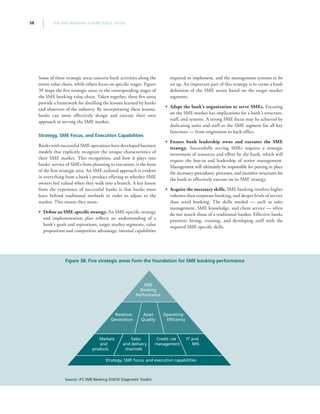
strategic areas: (1) strategy, SME focus and execution
capabilities; (2) market segmentation, products and
services; (3) sales culture and delivery channels; (4) credit
risk management; and (5) IT and MIS. Before putting these
lessons to use, however, banks need to follow a process for
market entry that begins with understanding the specific
opportunity in the SME sector and ends with developing a
strategy and implementation plan. Two tools that facilitate
this process are a market assessment and an operational
diagnostic. A market assessment is concerned with determining
the size and nature of the opportunity as well as the competitive
landscape. An operational diagnostic helps highlight a bank’s
strengths and weakness. IFC’s SME Banking CHECK
Diagnostic Toolkit is an operational diagnostic built upon the
five strategic areas of SME banking.
In summary, serving SMEs is proving to be profitable and
rewarding for individual banks, and assisting the growth of
SMEs will benefit national economies as well. Banks looking
to seize opportunities in the market can use this Guide as a
means to learn from industry experience to date. By debunking
misconceptions of SME banking, establishing its business
case, and sharing global good practices, the SME Banking
Knowledge Guide hopes to support banks in building stronger,
sounder services for small and medium enterprises worldwide.
7IFC Advisory Services | Access to Finance
Introduction
Small and medium enterprises are central to economic development, particularly
in emerging markets.i
In order for SMEs to grow and their positive impact on the
economy to continue, they need access to financial services, which has historically
been severely constrained.
Many SMEs in emerging markets often rely on informal sources of capital, such as borrowing
from relatives, to meet finance needs. However, when a small or medium enterprise does access
formal channels, it typically looks to a bank as its primary source of financial services. Banks
have begun to turn their attention toward this untapped market and their service of SMEs is a
major factor in increasing SME access to finance.
In its broadest definition, the banking sector includes commercial and investment banks, leasing
companies, microfinance institutions (MFIs), and other related institutions. The SME Banking
Knowledge Guide pays particular attention to commercial banks, which are the most important
financial intermediaries in most economies, as they link savings and investments. Commercial
banks are distinguished in that they normally lend to, rather than invest in, SMEs. Unlike other
specialized finance providers, commercial banks offer a broad suite of products and services
including deposit, credit, transaction and advisory services. They also focus on enterprises in the
formal sector, rather than informal microenterprises which MFIs traditionally serve. Figure 1
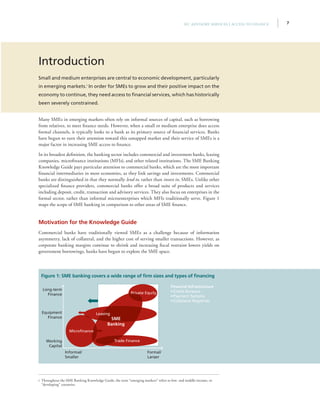
maps the scope of SME banking in comparison to other areas of SME finance.
Motivation for the Knowledge Guide
Commercial banks have traditionally viewed SMEs as a challenge because of information
asymmetry, lack of collateral, and the higher cost of serving smaller transactions. However, as
corporate banking margins continue to shrink and increasing fiscal restraint lowers yields on
government borrowings, banks have begun to explore the SME space.
i Throughout the SME Banking Knowledge Guide, the term “emerging markets” refers to low- and middle-income, or
“developing” countries.
Figure 1: SME banking covers a wide range of firm sizes and types of financing
Long-term
Finance
Equipment
Finance
Working
Capital
Informal/
Smaller
Microfinance
Leasing
Private Equity
Trade Finance
Formal/
Larger
SME
Banking
Financial Infrastructure
• Credit Bureaus
• Payment Systems
• Collateral Registries
THE SME BANKING KNOWLEDGE GUIDE8
In the developed world, banks have made significant strides in
serving the SME market in recent decades. However, in
emerging markets, many banks have only recently started to
expand their operations into the sector, and the market is a
long way from saturated. Many banks are still experimenting
with different approaches toward SMEs, but the success stories
thus far are highlighting a number of key principles for
profitably banking the SME sector. In this period of industry
transition, the SME Banking Knowledge Guide shares some of
these success stories and highlights the emerging lessons from
the experience of banks serving SMEs. There is no single
formula for effectively serving SMEs, but the principles in this
Guide can offer important insights to banks looking to
strategically engage the SME sector.
Chapter Objectives
Chapter 1 of the SME Banking Knowledge Guide provides an
overview of the SME banking market, including common
definitions of the SME sector, evidence of their economic
importance, and a discussion of the unmet demand of SMEs.
Evidence suggests that SME banking is a potentially rewarding
endeavor for banks, both now and in the future.
Chapter 2 discusses the state of the SME banking industry,
overall trends, and key factors in the operating environment
that impact a bank’s ability to serve SMEs. It features a special
section that describes important sources of data on SME
banking practices, and another that discusses the impact of the
current financial crisis on the SME banking industry. In
discussing the operating environment, section 2.2 examines
the role of government in supporting SME banking. A short
case study of Eastern Bank Limited in Bangladesh illustrates
that even in the most challenging operating environments,
determined banks are seizing opportunities to successfully
serve SMEs.
With an overview of the SME banking industry in place,
Chapter 3 explores bank approaches to serving SMEs at each
stage of the SME banking value chain. Each section within
Chapter 3 covers a specific stage of the value chain, and focuses
on the major challenges faced by banks. The chapter discusses
the approaches taken by the industry in general, and the
leading banks in particular, to address these challenges. The
end of each section covers “Steps to Excellence,” or examples of
approaches that distinguish great practices from good ones.
Three detailed case studies appear in Chapter 3, drawing
lessons from the experiences of Wells Fargo, Standard
Chartered, and ICICI Bank. Two other banks, Bank Muscat
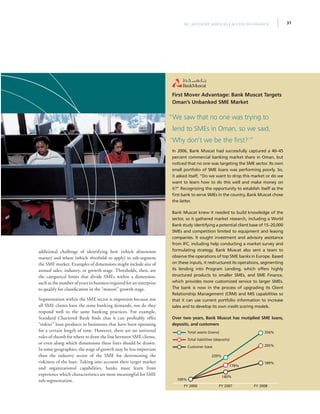
and Access Bank, are also highlighted in shorter vignettes.
Finally, Chapter 3 also features a discussion of the more recent
phenomenon of innovative banks engaging in equity financing
of SMEs.
Chapter 4 completes the Guide by providing tactical guidance
for banks looking to enter or expand their operations in the
SME market. The chapter opens by summarizing the key
lessons that can be taken from the experience of banks serving
SMEs. These lessons are organized according to five strategic
areas that are critical to success in serving SMEs. Next, section
4.2 describes how banks can get started and the key questions
they need to ask in developing a plan to serve SMEs. Finally,
the Guide concludes by describing a market assessment
approach and the IFC’s CHECK Diagnostic of SME banking
operations, two tools that can support the process of
strategically engaging the SME market. The two case studies
in Chapter 4 describe the experience of Hamkorbank and
NBD Bank in expanding their own SME operations.
9IFC Advisory Services | Access to Finance
SMEs and the “Missing Middle”
SMEs are firms whose financial requirements are too large for microfinance, but
are too small to be effectively served by corporate banking models. SMEs
represent a large and economically important sector in nearly every country in
the world. A thriving SME sector is commonly considered a sign of a thriving
economy as a whole. In high-income countries, and some middle-income
countries, SMEs account for over half of national output.
Yet, historically, SMEs have lacked access to financial products and services,
especially in developing countries. Especially elusive to SMEs are longer-term
debt instruments. However, although banks have previously focused on high-
value, low-risk corporate clients, there is an increasing consensus that the SME
market can be a profitable segment to bank. Available data from banks, though
limited, support this perception. By employing a range of measures, such as risk-
adjusted pricing, credit scoring models, and SME-tailored nonlending products,
banks are developing ways to mitigate risks, lower costs, and increase the overall
benefit accrued from SME banking.
SMEs, particularly in developing (low- and medium-incomeii
) countries, have historically lacked
access to financial products and services. MFIs have emerged to serve the smallest of these
enterprises, while banking institutions have typically concentrated on large corporations. SMEs
fall between these two markets where there is a finance gap commonly described as the “missing
middle.” However, in recent years, this has begun to change. SME banking, as an industry, is
growing. Banks are now demonstrating that the SME segment can be served profitably provided
it is properly understood.
Definitions of the SME Market
While there is general agreement that the SME market is significant in size and importance,
there is considerable variation in their definition around the world.
A common definition of SMEs includes registered businesses with less than 250 employees.1
This
places the vast majority of all firms in the SME sector. SMEs are estimated to account for at least
95 percent of registered firms worldwide; in Europe, for example, this number is well over 99
percent.2
To narrow this category, SMEs are sometimes distinguished from microenterprises as
having a minimum number of employees, such as 5 or 10. They can be further divided into small
ii  The World Bank defines low-income countries as those with gross national incomes (GNI) per capita of less than $935;
lower-middle with GNI/capita of $936–3,705, upper-middle $3,706–11,455; and high-income countries $11,456 and
above.
THE SME BANKING KNOWLEDGE GUIDE10
enterprises (SEs) and medium enterprises (MEs), though there
is even less consensus on where to divide them. Alternative
criteria for defining the sector includes annual sales, assets, and
size of loan or investment.
While the appropriate definition of the sector ultimately
depends on the local banking context, the most used SME
classification at the World Bank provides an illustration of
criteria similar to many used around the world. (Appendix A
provides other examples showing the contextual variation in
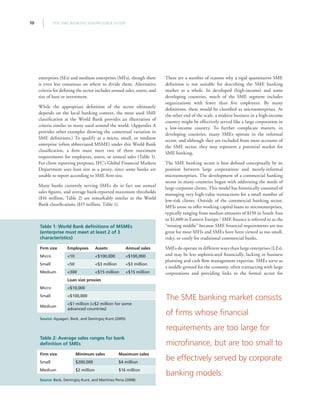
SME definitions.) To qualify as a micro, small, or medium
enterprise (often abbreviated MSME) under this World Bank
classification, a firm must meet two of three maximum
requirements for employees, assets, or annual sales (Table 1).
For client reporting purposes, IFC’s Global Financial Markets
Department uses loan size as a proxy, since some banks are
unable to report according to SME firm size.
Many banks currently serving SMEs do in fact use annual
sales figures, and average bank-reported maximum thresholds
($16 million, Table 2) are remarkably similar to the World
Bank classifications ($15 million, Table 1).
There are a number of reasons why a rigid quantitative SME
definition is not suitable for describing the SME banking
market as a whole. In developed (high-income) and some
developing countries, much of the SME segment includes
organizations with fewer than five employees. By many
definitions, these would be classified as microenterprises. At
the other end of the scale, a midsize business in a high-income
country might be effectively served like a large corporation in
a low-income country. To further complicate matters, in
developing countries, many SMEs operate in the informal
sector, and although they are excluded from most accounts of
the SME sector, they may represent a potential market for
SME banking.
The SME banking sector is best defined conceptually by its
position between large corporations and mostly-informal
microenterprises. The development of a commercial banking
sector in many countries began with addressing the needs of
large corporate clients. This model has historically consisted of
managing very high-value transactions for a small number of
low-risk clients. Outside of the commercial banking sector,
MFIs arose to offer working capital loans to microenterprises,
typically ranging from median amounts of $150 in South Asia
to $1,600 in Eastern Europe.3
SME finance is referred to as the
“missing middle” because SME financial requirements are too
great for most MFIs and SMEs have been viewed as too small,
risky, or costly for traditional commercial banks.
SMEs do operate in different ways than large enterprises (LEs),
and may be less sophisticated financially, lacking in business
planning and cash flow management expertise. SMEs serve as
a middle ground for the economy, often transacting with large
corporations and providing links to the formal sector for
Table 1: World Bank definitions of MSMEs
(enterprise must meet at least 2 of 3
characteristics)
Firm size Employees Assets Annual sales
Micro 10 $100,000 $100,000
Small 50 $3 million $3 million
Medium 300 $15 million $15 million
Loan size proxies
Micro $10,000
Small $100,000
Medium
$1 million ($2 million for some
advanced countries)
Source: Ayyagari, Beck, and Demirgüç-Kunt (2005)
Table 2: Average sales ranges for bank
definition of SMEs
Firm size Minimum sales Maximum sales
Small $200,000 $4 million
Medium $2 million $16 million
Source: Beck, Demirgüç-Kunt, and Martínez Pería (2008)
The SME banking market consists
of firms whose financial
requirements are too large for
microfinance, but are too small to
be effectively served by corporate
banking models.
11IFC Advisory Services | Access to Finance
microentrepreneurs. They are active at nearly every point in
the value chain as producers, suppliers, distributors, retailers,
and service providers, often in symbiotic relationships with
larger businesses.4
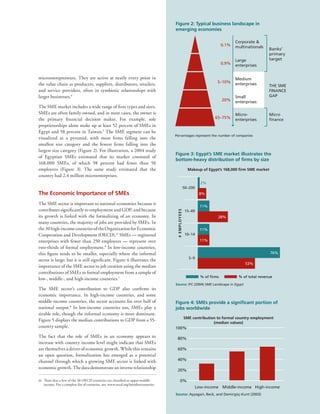
The SME market includes a wide range of firm types and sizes.
SMEs are often family owned, and in most cases, the owner is
the primary financial decision maker. For example, sole
proprietorships alone make up at least 52 percent of SMEs in
Egypt and 58 percent in Taiwan.5
The SME segment can be
visualized as a pyramid, with most firms falling into the
smallest size category and the fewest firms falling into the
largest size category (Figure 2). For illustration, a 2004 study
of Egyptian SMEs estimated that its market consisted of
168,000 SMEs, of which 98 percent had fewer than 50
employees (Figure 3). The same study estimated that the
country had 2.4 million microenterprises.
The Economic Importance of SMEs
The SME sector is important to national economies because it
contributes significantly to employment and GDP, and because
its growth is linked with the formalizing of an economy. In
many countries, the majority of jobs are provided by SMEs. In
the30high-incomecountriesoftheOrganizationforEconomic
Cooperation and Development (OECD),iii
SMEs — registered
enterprises with fewer than 250 employees — represent over
two-thirds of formal employment.6
In low-income countries,
this figure tends to be smaller, especially where the informal
sector is large; but it is still significant. Figure 4 illustrates the
importance of the SME sector to job creation using the median
contributions of SMEs to formal employment from a sample of
low-, middle-, and high-income countries.7
The SME sector’s contribution to GDP also confirms its
economic importance. In high-income countries, and some
middle-income countries, the sector accounts for over half of
national output.8
In low-income countries too, SMEs play a
sizable role, though the informal economy is more dominant.
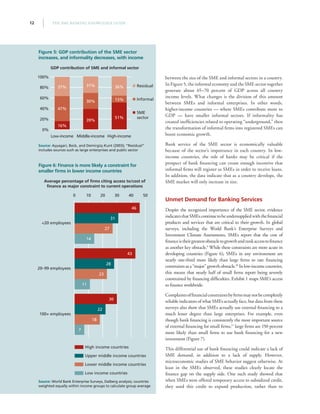
Figure 5 displays the median contributions to GDP from a 55-
country sample.
The fact that the role of SMEs in an economy appears to
increase with country income level might indicate that SMEs
are themselves a driver of economic growth. While this remains
an open question, formalization has emerged as a potential
channel through which a growing SME sector is linked with
economic growth. The data demonstrate an inverse relationship
iii  Note that a few of the 30 OECD countries are classified as upper-middle
income. For a complete list of countries, see: www.oecd.org/membercountries
Figure 2: Typical business landscape in
emerging economies
Percentages represent the number of companies
0.9%
Corporate 
multinationals
Large
enterprises
5–10%
Medium
enterprises
20%
Small
enterprises
65–75%
Micro-
enterprises
Banks’
primary
target
THE SME
FINANCE
GAP
Micro
finance
0.1%
Figure 4: SMEs provide a significant portion of
jobs worldwide
SME contribution to formal country employment
(median values)
Source: Ayyagari, Beck, and Demirgüç-Kunt (2003)
Figure 3: Egypt’s SME market illustrates the
bottom-heavy distribution of firms by size
Makeup of Egypt’s 168,000 firm SME market
Source: IFC (2004) SME Landscape in Egypt
50–200
15–49
10–14
5–9
% of firms % of total revenue
#EMPLOYEES
2%
8%
11%
28%
11%
11%
76%
53%
Low-income Middle-income High-income
0%
20%
40%
60%
80%
100%
THE SME BANKING KNOWLEDGE GUIDE12
between the size of the SME and informal sectors in a country.
In Figure 5, the informal economy and the SME sector together
generate about 65–70 percent of GDP across all country
income levels. What changes is the division of this amount
between SMEs and informal enterprises. In other words,
higher-income countries — where SMEs contribute more to
GDP — have smaller informal sectors. If informality has
created inefficiencies related to operating “underground,” then
the transformation of informal firms into registered SMEs can
boost economic growth.
Bank service of the SME sector is economically valuable
because of the sector’s importance in each country. In low-
income countries, the role of banks may be critical if the
prospect of bank financing can create enough incentive that
informal firms will register as SMEs in order to receive loans.
In addition, the data indicate that as a country develops, the
SME market will only increase in size.
Unmet Demand for Banking Services
Despite the recognized importance of the SME sector, evidence
indicatesthatSMEscontinuetobeundersuppliedwiththefinancial
products and services that are critical to their growth. In global
surveys, including the World Bank’s Enterprise Surveys and
Investment Climate Assessments, SMEs report that the cost of
financeistheirgreatestobstacletogrowthandrankaccesstofinance
as another key obstacle.9
While these constraints are more acute in
developing countries (Figure 6), SMEs in any environment are
nearly one-third more likely than large firms to rate financing
constraints as a “major” growth obstacle.10
In low-income countries,
this means that nearly half of small firms report being severely
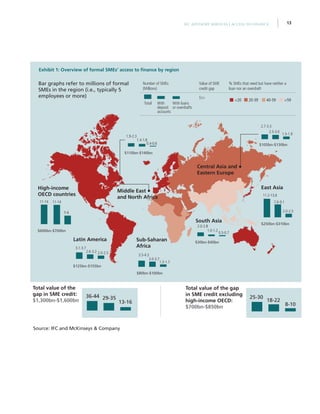
constrained by financing difficulties. Exhibit 1 maps SME’s access
to finance worldwide.
Complaintsoffinancialconstraintsbyfirmsmaynotbecompletely
reliable indicators of what SMEs actually face, but data from these
surveys also show that SMEs actually use external financing to a
much lesser degree than large enterprises. For example, even
though bank financing is consistently the most important source
of external financing for small firms,11
large firms are 150 percent
more likely than small firms to use bank financing for a new
investment (Figure 7).
This differential use of bank financing could indicate a lack of
SME demand, in addition to a lack of supply. However,
microeconomic studies of SME behavior suggest otherwise. At
least in the SMEs observed, these studies clearly locate the
finance gap on the supply side. One such study showed that
when SMEs were offered temporary access to subsidized credit,
they used this credit to expand production, rather than to
Figure 5: GDP contribution of the SME sector
increases, and informality decreases, with income
GDP contribution of SME and informal sector
Source: Ayyagari, Beck, and Demirgüç-Kunt (2003); “Residual”
includes sources such as large enterprises and public sector
Residual
Informal
SME
sector
0%
20%
40%
60%
80%
100%
0
20
40
60
80
100
Low-income
16%
47%
37%
Middle-income
39%
30%
31%
High-income
51%
13%
36%
Figure 6: Finance is more likely a constraint for
smaller firms in lower income countries
Average percentage of firms citing access to/cost of
finance as major constraint to current operations
Source: World Bank Enterprise Surveys, Dalberg analysis; countries
weighted equally within income groups to calculate group average
■ High income countries
■ Upper middle income countries
■ Lower middle income countries
■ Low income countries
20 employees
20–99 employees
100+ employees
0 10 20 30 40 50
46
31
27
14
43
28
23
11
30
22
18
7
13IFC Advisory Services | Access to Finance
1.9-2.3
1.4-1.8
0.4-0.6
$110bn-$140bn
3.5-4.3
3.0-3.7
1.3-1.7
$80bn-$100bn
2.0-2.8
1.0-1.2
0.5-0.7
$30bn-$40bn
11-14 11-14
5-6
$600bn-$700bn
3.1-3.7
2.6-3.2 2.0-2.5
$125bn-$155bn
36-44 29-35
13-16
Total value of the
gap in SME credit:
$1,300bn-$1,600bn
25-30
18-22
8-10
Total value of the gap
in SME credit excluding
high-income OECD:
$700bn-$850bn
High-income
OECD countries
Latin America
South Asia
Middle East
and North Africa 11.2-13.6
7.6-9.1
2.0-2.5
$250bn-$310bn
East Asia
Sub-Saharan
Africa
Central Asia and
Eastern Europe
2.7-3.3
2.5-3.0
1.5-1.9
$105bn-$130bn
Bar graphs refer to millions of formal
SMEs in the region (i.e., typically 5
employees or more)
Number of SMEs
(Millions)
$bn
Value of SME
credit gap
20-39 40-59 5920
% SMEs that need but have neither a
loan nor an overdraft
Total With
deposit
accounts
With loans
or overdrafts
Source: IFC and McKinseys  Company
Exhibit 1: Overview of formal SMEs’ access to finance by region
THE SME BANKING KNOWLEDGE GUIDE14
Highlights
1.	There are ~36-44Mn formal SMEs globally
(i.e. registered businesses with typically 5 employees and above)
•• ~65-70% of formal SMEs are in emerging markets
•• Very small enterprises (i.e., registered businesses with 5-9 employees) represent 54-68% of formal SMEs
2.	The credit gap encompasses 45-55% of formal SMEs in emerging markets
(12-15 Mn SMEs) which are unserved but need credit
•• 45-55% of formal SMEs in emerging markets are unserved, 21-24% are underserved (i.e., they identify financing as a
constraint) and 16-20% do not need credit
•• The magnitude of the credit gap varies by size of enterprises: 18-22% of formal medium enterprises in emerging
markets are unserved (i.e., do not have access to a financial institution loan or overdraft but need a loan) compared
to 49-59% of very small enterprises (i.e., registered businesses with 5-9 employees)
3.	The credit gap for formal SMEs in dollar terms is roughly ~$1.3-1.6 Tn globally
•• In emerging markets, the gap in credit financing of formal SMEs is $0.7-0.85 Tn, with 23-29% coming from medium
enterprises, 49-57% from small enterprises and 23-29% from very small enterprises
•• In emerging markets, the SME gap of $0.7-0.85 Tn is equivalent to 21-26% of current outstanding SME credit
•• The gap relative to current outstanding SME credit varies widely across regions, e.g., Sub-Saharan Africa requires
300% increase in outstanding SME credit compared to ~11-14% and ~16-20% in East Asia, and Eastern Europe 
Central Asia, respectively	
4.	82-86% of the value of formal SMEs’ credit gap (i.e., $0.6-0.7Tn) in emerging
markets comes from SMEs that already have a deposit account
•• 18.0-22.0 Mn formal SMEs in emerging markets (70-76% of total SMEs in emerging markets) have a bank account
•• 9.5-11.5Mn formal SMEs in emerging markets have no loans or overdraft and need one but have deposit accounts
(equivalent to 75-80% of all unserved)
•• 2-4% of formal medium enterprises in emerging markets are unserved and do not have a deposit accounts,
compared to 10-14% of very small enterprises (i.e., registered businesses with 5-9 employees)
•• Improvements of market infrastructure, broader competition in financial markets, innovation to reduce risk
(including risk-sharing facilities) and – most maybe importantly – non-financial infrastructure (e.g., property rights)
can play an important role in increasing SME coverage and serving SMEs that already have a deposit relationship
but no credit
5.	In addition to the credit gap, 24-30% of formal SMEs in emerging markets
(6.6-8.0Mn SMEs) do not have a deposit account; their un-intermediated
cash balances represent $150-180Bn
•• In emerging markets, 24-30% of formal SMEs have un-intermediated cash balances (i.e., deposits)
•• The value of un-intermediated cash balances (i.e., gap in deposits) for formal SMEs in emerging markets
is ~$150-180Bn
15IFC Advisory Services | Access to Finance
substitute for more expensive borrowing. The additional credit
received by SMEs was directly linked with expanded business
operations and increased sales and profits. The actions of these
firms strongly support the common complaint by SMEs that
finance is a major constraint to their growth.12
 
This claim is also supported by measurements of the impact of
financial constraints on firm growth. Not only do small firms have
more difficulty accessing finance, but they are more negatively
affectedbythisdifficultythanlargerfirms.Onestudyhasestimated
that the negative growth impact of financial constraints on small
firms is two-thirds greater than the negative impact of financial
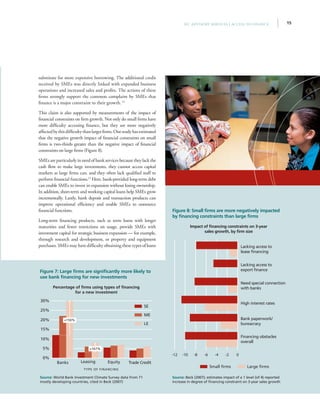
constraints on large firms (Figure 8).
SMEs are particularly in need of bank services because they lack the
cash flow to make large investments, they cannot access capital
markets as large firms can, and they often lack qualified staff to
perform financial functions.13
Here, bank-provided long-term debt
can enable SMEs to invest in expansion without losing ownership.
In addition, short-term and working capital loans help SMEs grow
incrementally. Lastly, bank deposit and transaction products can
improve operational efficiency and enable SMEs to outsource
financial functions.
Long-term financing products, such as term loans with longer
maturities and fewer restrictions on usage, provide SMEs with
investment capital for strategic business expansion — for example,
through research and development, or property and equipment
purchases. SMEs may have difficulty obtaining these types of loans
Figure 7: Large firms are significantly more likely to
use bank financing for new investments
Percentage of firms using types of financing
for a new investment
Source: World Bank Investment Climate Survey data from 71
mostly developing countries, cited in Beck (2007)
30%
25%
20%
15%
10%
5%
0%
Banks Leasing Equity Trade Credit
+150%
+167%
TYPE OF FINANCING
SE
ME
LE
Figure 8: Small firms are more negatively impacted
by financing constraints than large firms
Impact of financing constraints on 3-year
sales growth, by firm size
Source: Beck (2007); estimates impact of a 1 level (of 4) reported
increase in degree of financing constraint on 3-year sales growth
Small firms Large firms
Lacking access to
lease financing
Lacking access to
export finance
Need special connection
with banks
High interest rates
Bank paperwork/
bureacracy
Financing obstacles
overall
-12 -10 -8 -6 -4 -2 0
THE SME BANKING KNOWLEDGE GUIDE16
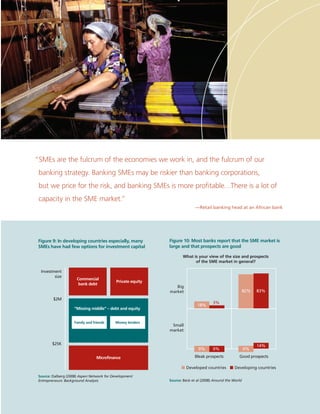
because of inadequate financial records or assets to use as collateral.
While some banks offer unsecured loans to SMEs, based on cash
flow rather than collateral, these loans often come with shorter
maturities; in general, collateral requirements have been the norm.
Partiallyduetothis,long-termfinanceisoneofthemostcommonly
cited needs of SMEs, and in many aspects, long-term loans are
wherethe“missingmiddle”problemhasbeenmostacute,especially
in developing countries.14
Figure 9 depicts the problem SMEs have
faced when looking for long-term finance.
Bank products can also enable SMEs to take on more and larger
contracts. A small or medium enterprise may have a potential order
from a customer in place, but need cash up front to complete the
order. Banks can provide short-term working capital to such SMEs
topurchasesupplies,payemployees,andmeetobligationstoclients.
Providing help with order fulfillment can extend across borders as
well, with trade financing assistance. For example, with a letter of
credit, exporting SMEs can offer customers better payment terms
because a bank pays the enterprise based upon documentation of
the sale and extends credit to the customer of the enterprise.
Finally, SMEs have important operational needs that banks
can meet with nonlending products that include deposits and
savings, transactional products, and advisory services. Some of
these products can effectively enable SMEs to outsource
financial functions to the bank.
•• Deposit and savings products
Deposit and savings products provide businesses with basic
financial management tools to help organize revenues and
savings. Additionally, mutual funds and other investment
products provide businesses with opportunities to obtain
earnings on excess capital.
•• Transactional products
Transactional products facilitate SME access to and use of
available cash. Automatic payroll and payment collection,
debit cards, and currency exchange are transactional bank
offerings that lower the cost of doing business and streamline
potentially complicated processes.
•• Advisory products
SMEs can benefit from help in producing reliable financial
statements, developing business plans, and selecting
appropriate financing products. These advisory services can
improve SME access to finance by enhancing its capacity to
apply for credit.
The SME Banking Opportunity
The SME market has been perceived in the past by banks as
risky, costly, and difficult to serve. However, mounting evidence
suggests that banks are finding effective solutions to challenges
such as determining credit risk and lowering operating costs, and
are profitably serving the SME sector. For these banks, unmet
SME demand for financial services has become an indicator of
opportunity to expand their market share and increase profit.15
Manybanksnowreportthattheyperceivesignificantopportunities
in the SME sector. Survey data from multiple studies show that
rather than overlooking or avoiding the market, banks have begun
to target SMEs as a profitable segment. For example, a recent
survey of 91 banks in 45 developed and developing countries —
Bank Financing for SMEs around the World16
— found that these
banks overwhelmingly perceived the SME sector as a large market
with good prospects (Figure 10).
The recent increase in banks’ commitment to the SME sector has
beentestedbythecurrent(2009)globalfinancialcrisis.iv
However,
even in Latin America, a region that has expressed some
uncertainty about the future for SMEs, a 2008 survey of banks
found that about three-quarters of large and midsize banks, and
half of small banks, still consider SMEs to be a strategic part of
bank business. In addition, about 90 percent of large and midsize
banks report having an active policy to finance SMEs.17
While
these numbers represent a slight decrease when compared with a
2006 version of the survey, they indicate that targeting SMEs has
become the rule, rather than exception, for most banks.
The potential profitability of serving SMEs has been enhanced
by the development of new business models to engage small
enterprises. SME banking had been assumed to require difficult-
to-scale relationship lending methods. However, many SME
banking operations today make use of sophisticated high-volume
approaches, use statistical inputs in credit risk assessment, and cost-
effectively provide nonlending products at scale.19
Banks have also
been able to develop synergies with existing bank operations, for
example,byintegratingtheserviceofSMEswiththatofthepersonal
banking of the owner through retail or private banking portfolios.
(Approaches to profitability are discussed in Chapter 3).
Risk-adjusted pricing models have also been important tools
enabling banks to profitably serve SMEs. Rather than avoid
risk, banks have found ways to incorporate the risks of serving
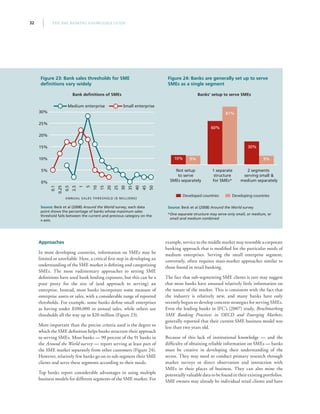
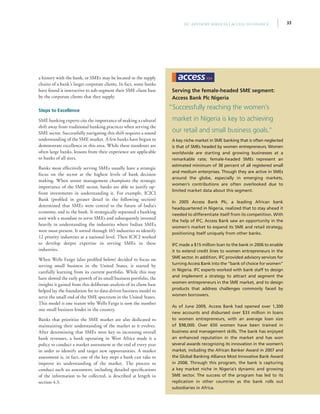
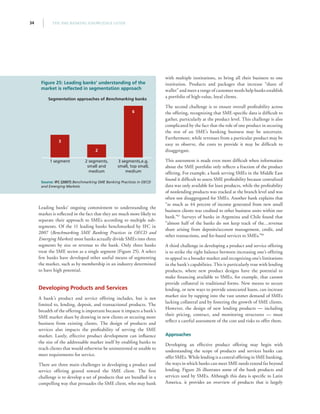
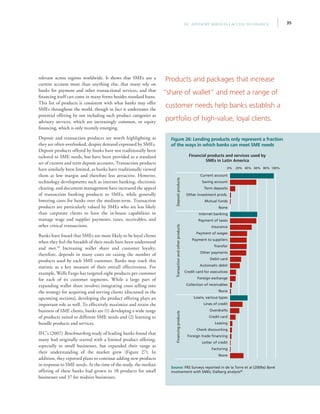
SMEs into their pricing of financial products. Some banks are
able to use risk calculations to develop multiple pricing
approaches within the SME segment.20
SMEs have proven
willing to pay these risk-adjusted prices because they value the
services provided and because alternative providers are often
more costly. As a result, banks have been able to successfully
serve this new and untapped market.
iv  At time of publication (2009) the global financial crisis that can be dated to 2007
had not yet been resolved. Box 2.2 discusses SME banking in light of this crisis.
17IFC Advisory Services | Access to Finance
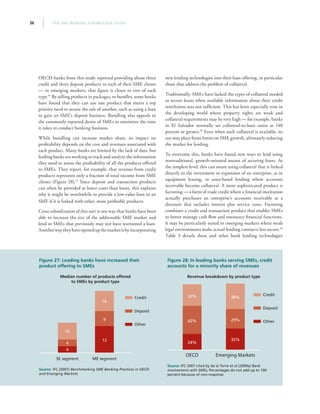
Figure 9: In developing countries especially, many
SMEs have had few options for investment capital
Source: Dalberg (2008) Aspen Network for Development
Entrepreneurs: Background Analysis
Investment
size
$2M
$25K
Commercial
bank debt
Private equity
Microfinance
“Missing middle” – debt and equity
Family and friends Money lenders
“SMEs are the fulcrum of the economies we work in, and the fulcrum of our
banking strategy. Banking SMEs may be riskier than banking corporations,
but we price for the risk, and banking SMEs is more profitable…There is a lot of
capacity in the SME market.”
—Retail banking head at an African bank
Figure 10: Most banks report that the SME market is
large and that prospects are good
What is your view of the size and prospects
of the SME market in general?
Source: Beck et al (2008) Around the World
Developed countries Developing countries
Big
market
Small
market
Bleak prospects Good prospects
83%82%
18%
0% 0% 0%
14%
3%
THE SME BANKING KNOWLEDGE GUIDE18
Having developed a strategic focus on the sector and applied
new banking models, banks are reporting income growth rates
and returns on assets in SME banking that exceed those of
their overall banking operations. Data collected in IFC’s
(2007) study, Benchmarking SME Banking Practices in OECD
and Emerging Markets, illustrate such cases of SME banking
revenue generation and profitability. The study profiled 11
“good practice” banks from OECD and emerging markets,
and received data from a number of these banks on income
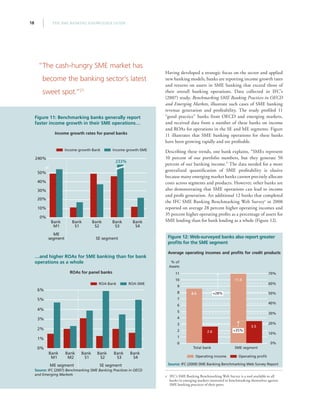
and ROAs for operations in the SE and ME segments. Figure
11 illustrates that SME banking operations for these banks
have been growing rapidly and are profitable.
Describing these trends, one bank explains, “SMEs represent
10 percent of our portfolio numbers, but they generate 50
percent of our banking income.” The data needed for a more
generalized quantification of SME profitability is elusive
because many emerging market banks cannot precisely allocate
costs across segments and products. However, other banks are
also demonstrating that SME operations can lead to income
and profit generation. An additional 12 banks that completed
the IFC SME Banking Benchmarking Web Surveyv
in 2008
reported on average 28 percent higher operating incomes and
35 percent higher operating profits as a percentage of assets for
SME lending than for bank lending as a whole (Figure 12).
v  IFC’s SME Banking Benchmarking Web Survey is a tool available to all
banks in emerging markets interested in benchmarking themselves against
SME banking practices of their peers.
Figure 11: Benchmarking banks generally report
faster income growth in their SME operations…
Income growth rates for panel banks
Source: IFC (2007) Benchmarking SME Banking Practices in OECD
and Emerging Markets
240%
50%
40%
30%
20%
10%
0%
Income growth-Bank Income growth-SME
Bank
M1
ME
segment SE segment
Bank
S1
Bank
S2
Bank
S3
233%
Bank
S4
6%
5%
4%
3%
2%
1%
0%
ROA-Bank ROA-SME
Bank
M1
Bank
M2
Bank
S1
Bank
S2
Bank
S3
Bank
S4
ME segment SE segment
…and higher ROAs for SME banking than for bank
operations as a whole
ROAs for panel banks
“The cash-hungry SME market has
become the banking sector’s latest
sweet spot.”21
Figure 12: Web-surveyed banks also report greater
profits for the SME segment
Average operating incomes and profits for credit products
Source: IFC (2009) SME Banking Benchmarking Web Survey Report
70%
60%
50%
40%
30%
20%
10%
0%
11
% of
Assets
Total bank SME segment
8.6
2.6
11.0
3.5
10
9
8
7
6
5
4
3
2
1
0
+28%
+35%
Operating income Operating profit
The SME banking industry is young and growing. While the full effect of the
current financial crisis on this industry is uncertain, the general orientation of
emerging market banks toward SMEs does not appear to have changed (Box 2.2).
Contrary to conventional wisdom, it is not exclusively small banks that successfully
serve SMEs. Many large banks have also moved “downstream” to serve SMEs and
are now dominant players in their markets. Also serving the market are a few MFIs
that have moved “upstream,” although this remains relatively rare due to their
bottom-of-the-pyramid mission.
The significant gap in SME access to finance between high- and low-income
countries has been attributed to factors in the operating environment, such as
regulation and macroeconomic conditions. However, these factors have generally
not prevented the growth of the industry. Most governments have policies to
support SME finance, though there is no single framework for effective support.
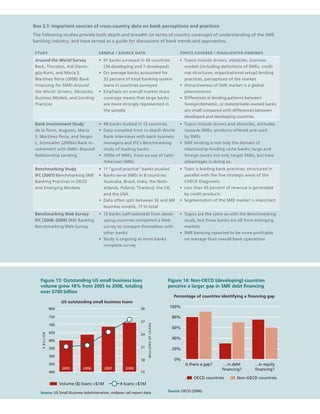
While banks have served small businesses to some extent for generations, SME banking has only
recently emerged as a distinct industry. In the United States, where SMEs represent nearly 98
percent of all employer firms, the Small Business Administration began tracking lending to
SMEs in 1994. Since then, the number of small business loans (defined by the SBA as loans $1
million) has multiplied more than four times, to over 27 million loans valued at over $700 billion
(or five percent of GDP), in 2008 (Figure 13).22
The significant expansion in lending to small businesses in the developed world over the last
couple of decades may be one reason why only 30 percent of OECD (developed) countries report
a gap in debt financing of SMEs. This is compared with 70 percent of non-OECD (developing)
countries responding to an OECD survey of government policy experts (Figure 14).23
While
banks around the world are optimistic about the SME market, these results indicate that the
opportunity, in terms of unmet demand, may be larger in developing countries.
The remaining debt financing gap in the developing world may reflect that the SME banking
industry is even less mature in low- and middle-income countries, where banks have been more
averse to risk. In India, one of the largest and most dynamic SME banking markets in the
developing world, the total outstanding national SME loan portfoliovi
is still only $88 billion,24
less than that of Taiwan, at $95 billion.25
The nascent stage of the SME market may explain why
74 percent of banks rated “perceived profitability in the SME segment” as their top reason for
involvement with SMEs.26
vi  Note that loan portfolio data does not fully reflect the size of the SME banking market, as revenues from nonlending
products are often greater than those from loans. However, as many banks themselves are not able to identify their total
SME revenues, complete data on market size are scarce.
Bridging the Middle:
SME Banking Today
Figure 13: Outstanding US small business loan
volume grew 18% from 2005 to 2008, totaling
over $700 billion
US outstanding small business loans
Source: US Small Business Administration, midyear call report data
800 30
27
24
21
18
15
750
700
650
800
550
500
450
400
2005 2006 2007 2008
Volume ($) loans $1M # loans $1M

MILLIONSOFLOANS
$BILLION
Figure 14: Non-OECD (developing) countries
perceive a larger gap in SME debt financing
Percentage of countries identifying a financing gap
Source: OECD (2006)
0%
20%
40%
60%
80%
100%
Is there a gap? …in debt
financing?
…in equity
financing?
OECD countries Non-OECD countries
Box 2.1: Important sources of cross-country data on bank perceptions and practices
The following studies provide both depth and breadth (in terms of country coverage) of understanding of the SME
banking industry, and have served as a guide for discussions of bank trends and approaches.
Study Sample / Source data Topics covered / Highlighted findings
Around the World Survey
Beck, Thorsten, Asli Demir-
güç-Kunt, and Maria S.
Martínez Pería (2008) Bank
Financing for SMEs Around
the World: Drivers, Obstacles,
Business Models, and Lending
Practices
•• 91 banks surveyed in 45 countries
(38 developing and 7 developed)
•• On average banks accounted for
32 percent of total banking system
loans in countries surveyed
•• Emphasis on overall market share
coverage means that large banks
are more strongly represented in
the sample
•• Topics include drivers, obstacles, business
models (including definitions of SMEs, credit
risk structures, organizational setup) lending
practices, perceptions of the market
•• Attractiveness of SME market is a global
phenomenon
•• Differences in lending patterns between
foreign/domestic, or state/private-owned banks
are small compared with differences between
developed and developing countries
Bank Involvement Study
de la Torre, Augusto, Maria
S. Martínez Pería, and Sergio
L. Schmukler (2009a) Bank In-
volvement with SMEs: Beyond
Relationship Lending
•• 48 banks studied in 12 countries
•• Data compiled from in-depth World
Bank interviews with bank business
managers and IFC’s Benchmarking
study of leading banks
•• 1000s of SMEs, from survey of Latin
American SMEs
•• Topics include drivers and obstacles, attitudes
towards SMEs, products offered and used
by SMEs
•• SME lending is not only the domain of
relationship-lending niche banks; large and
foreign banks not only target SMEs, but have
advantages in doing so.
Benchmarking Study
IFC (2007) Benchmarking SME
Banking Practices in OECD
and Emerging Markets
•• 11 “good practice” banks studied
•• Banks serve SMEs in 8 countries:
Australia, Brazil, India, the Neth-
erlands, Poland, Thailand, the UK,
and the USA
•• Data often split between SE and ME
business models, 17 in total
•• Topic is leading bank practices, structured in
parallel with the five strategic areas of the
CHECK Diagnostic
•• Less than 40 percent of revenue is generated
by credit products
•• Segmentation of the SME market is important
Benchmarking Web Survey
IFC (2008–2009) SME Banking
Benchmarking Web Survey
•• 12 banks (self-selected) from devel-
oping countries completed a Web
survey to compare themselves with
other banks
•• Study is ongoing as more banks
complete survey
•• Topics are the same as with the Benchmarking
study, but these banks are all from emerging
markets
•• SME banking reported to be more profitable
on average than overall bank operations
21IFC Advisory Services | Access to Finance
Composition of the Industry
A classic view of the SME banking market is one served by
small local banks that specialize in niche market segments.
These banks employ a relationship-lending approach that
relies on “soft” information gathered through personal contact.
However, in response to perceived profitability, as well as
competition in other banking segments,27
many larger banks
— including private and government-owned domestic banks,
and foreign banks — have begun to move downstream in the
direction of the SME segment.
While this phenomenon has been observed in the developed
world as well, it is especially striking that many of the strongest
players in low- and middle-income countries today are large
banks, often headquartered in high-income countries. A
number of multinational banks based in London have large
SME banking operations in Asia, Africa, and the Middle East.
In Brazil and India, some of the largest domestic banks are also
some of most active in the SME market.
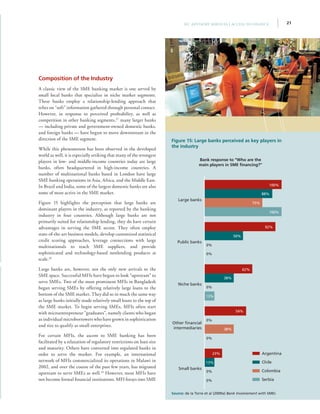
Figure 15 highlights the perception that large banks are
dominant players in the industry, as reported by the banking
industry in four countries. Although large banks are not
primarily suited for relationship lending, they do have certain
advantages in serving the SME sector. They often employ
state-of-the-art business models, develop customized statistical
credit scoring approaches, leverage connections with large
multinationals to reach SME suppliers, and provide
sophisticated and technology-based nonlending products at
scale.28
Large banks are, however, not the only new arrivals to the
SME space. Successful MFIs have begun to look “upstream” to
serve SMEs. Two of the most prominent MFIs in Bangladesh
began serving SMEs by offering relatively large loans to the
bottom of the SME market. They did so in much the same way
as large banks initially made relatively small loans to the top of
the SME market. To begin serving SMEs, MFIs often start
with microentrepreneur “graduates”, namely clients who began
as individual microborrowers who have grown in sophistication
and size to qualify as small enterprises.
For certain MFIs, the ascent to SME banking has been
facilitated by a relaxation of regulatory restrictions on loan size
and maturity. Others have converted into regulated banks in
order to serve the market. For example, an international
network of MFIs commercialized its operations in Malawi in
2002, and over the course of the past few years, has migrated
upstream to serve SMEs as well.29
However, most MFIs have
not become formal financial institutions. MFI forays into SME
Figure 15: Large banks perceived as key players in
the industry
Bank response to “Who are the
main players in SME financing?”
Source: de la Torre et al (2009a) Bank Involvement with SMEs
Argentina
Chile
Colombia
Serbia
Other fi
Large banks
100%
88%
75%
100%
Public banks
92%
50%
0%
0%
Other financial
intermediaries
54%
38%
0%
0%
Niche banks
0%
13%
Small banks
0%
0%
13%
23%
62%
38%
THE SME BANKING KNOWLEDGE GUIDE22
banking have been relatively minimal. They have been limited
by a lack of financial and human capital, and by organizational
missions which remain targeted on poorer individuals.30
In addition to commercial banks that have moved downstream
and MFIs that have moved upstream, the SME banking
industry also includes banks that have been founded specifically
to target the SME sector. Examples of these include a number
of banks founded in Russia and Eastern Europe/Central Asia
shortly after the fall of communism. Some banks, such as
Hamkorbank in Uzbekistan (profiled in Chapter 4), have built
upon successful SME operations to expand into the retail
segment.
The Role of the Operating Environment
While the SME banking industry appears to be growing
rapidly in emerging markets, access to finance is generally still
easier for a small firm in a developed country than a firm of any
size in a developing country. Developing country banks
surveyed in Bank Financing for SMEs around the World, report
Box 2.2: SME banking during a global economic crisis
SME banking has not been immune to the effects of the current global financial crisis. Yet while momentum may
have slowed, and the full impact of the crisis is not yet known, early signs suggest that the overall trend is toward
continued growth and value in the SME market segment.
The current (2009) crisis was triggered in 2007 in high-income countries and has resulted in a contraction of credit
around the world. Unlike banks in OECD countries, many banks in emerging markets have generally avoided bad
loans and other “toxic” assets, and therefore, did not feel the immediate effects of the crisis. However, these banks
are still affected by the liquidity crunch and by the impact of the crisis on the real economy. Some emerging market
banks have reported a drop in demand, and some have had to pull back on many types of lending out of concern
for rising defaults.
In March 2009, the OECD Turin Round Table on the Impact of the Global Crisis on SME and Entrepreneurship
Financing and Policy Responses cited working capital as a critical need of SMEs during the crisis. This is illustrated by
reports that, for example, many manufacturing SMEs in China have been unable to withstand even a few months
of slowdown in orders from the West. In response to this need, many governments have worked to support lending
to SMEs, mostly through credit guarantees. While the Round Table cautioned that government policies must not
impair fair competition, it noted the importance of providing credit guarantees to the SME market. The head of
a leading international bank’s global small business operations welcomes this support, “This crisis is completely
different from those in the past as far as SMEs are concerned…SMEs used to be the first ones to be hit…now
governments have provided a credit backstop.”
While the financial crisis continues, and a complete picture of its impact on SME banking is yet to be seen, the
orientation of many emerging market banks toward SME banking does not seem to have changed significantly. This
is despite the fact that some banks are scaling back aggressive SME loan growth targets, citing a lack of demand
from SMEs. Says one executive regarding operations in Asia, Africa, and the Middle East, “Our loans have withstood
the current stress. Profitability will get impacted but I don’t think the default rates will go up like [in past crises].”
Banks interviewed in Ghana and India, even in the midst of the crisis, report seeing SMEs as the economic future
of their countries and express their desire to be positioned accordingly. In Latin America, even though 50 percent
of banks in a 2008 study believe the SME situation in their country will be the same or worse in two years, only 23
percent plan to reduce their exposure to SMEs in response to the crisis. The sentiment expressed by an executive at
one pan-African bank is not uncommon, “Our SMEs often sell to the developed world. Now people are not buying
their products. This has definitely affected us. But the impact is not a threat to our profitability at the moment.”
Sources: Bank and expert interviews; Summaries and reports from the Turin Round Table, OECD (2009); Latin America study: IIC/MIF, IDB and
FELEBAN with D’Alessio (2008)
23IFC Advisory Services | Access to Finance
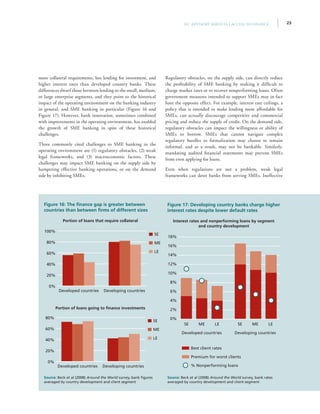
more collateral requirements, less lending for investment, and
higher interest rates than developed country banks. These
differences dwarf those between lending to the small, medium,
or large enterprise segments, and they point to the historical
impact of the operating environment on the banking industry
in general, and SME banking in particular (Figure 16 and
Figure 17). However, bank innovation, sometimes combined
with improvements in the operating environment, has enabled
the growth of SME banking in spite of these historical
challenges.
Three commonly cited challenges to SME banking in the
operating environment are (1) regulatory obstacles, (2) weak
legal frameworks, and (3) macroeconomic factors. These
challenges may impact SME banking on the supply side by
hampering effective banking operations, or on the demand
side by inhibiting SMEs.
Regulatory obstacles, on the supply side, can directly reduce
the profitability of SME banking by making it difficult to
charge market rates or to recover nonperforming loans. Often
government measures intended to support SMEs may in fact
have the opposite effect. For example, interest rate ceilings, a
policy that is intended to make lending more affordable for
SMEs, can actually discourage competitive and commercial
pricing and reduce the supply of credit. On the demand side,
regulatory obstacles can impact the willingness or ability of
SMEs to borrow. SMEs that cannot navigate complex
regulatory hurdles to formalization may choose to remain
informal, and as a result, may not be bankable. Similarly,
mandating audited financial statements may prevent SMEs
from even applying for loans.
Even when regulations are not a problem, weak legal
frameworks can deter banks from serving SMEs. Ineffective
Figure 16: The finance gap is greater between
countries than between firms of different sizes
Portion of loans that require collateral
Source: Beck et al (2008) Around the World survey, bank figures
averaged by country development and client segment
Developing countriesDeveloped countries
0%
20%
40%
60%
80%
100%
SE
ME
LE
Developed countries Developing countries
0%
20%
40%
60%
80%
SE
ME
LE
Portion of loans going to finance investments
Figure 17: Developing country banks charge higher
interest rates despite lower default rates
Interest rates and nonperforming loans by segment
and country development
Source: Beck et al (2008) Around the World survey, bank rates
averaged by country development and client segment
18%
16%
14%
12%
10%
8%
6%
4%
2%
0%
Best client rates
Premium for worst clients
% Nonperforming loans
Developed countries Developing countries
SE ME LE SE ME LE
THE SME BANKING KNOWLEDGE GUIDE24
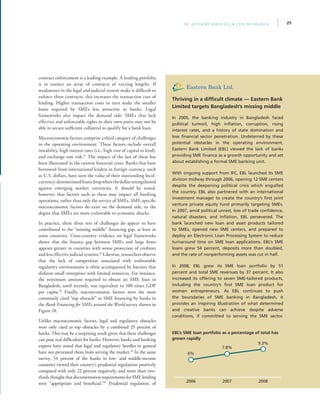
Figure 19: Countries with credit bureaus are
associated with lower SME financing constraints
Percentage of small firms reporting
high financing constraints
Source: Love and Mylenko (2003)
0%
10%
20%
30%
40%
50%
60%
With credit bureauWithout credit bureau
0%
10%
20%
30%
40%
50%
With credit bureauWithout credit bureau
Probability of obtaining a bank loan
for a small firm
Figure 18: Developing country banks rank macro-
economic factors the top obstacle to banking SMEs
Percentage of banks citing a factor as “top obstacle”
Source: Beck et al (2008) Around the World survey
0% 10% 20% 30% 40% 50%
Lack of adequate
demand
Nature of lending
technology to SMEs
Bank specific factors
Legal  contractual
environment
Competition in the
SME segment
Regulation
Macroeconomic
factors
0 10 20 30 40 50
Developed countriesNature of lending technology to SMEs
Bank specific factors
Legal and contractual environment
Competition in the SME segment
Regulations
Macroeconomic factors
Developing countries Developed countries
25IFC Advisory Services | Access to Finance
contract enforcement is a leading example. A lending portfolio
is in essence an array of contracts of varying lengths. If
weaknesses in the legal and judicial system make it difficult to
enforce these contracts, this increases the transaction cost of
lending. Higher transaction costs in turn make the smaller
loans required by SMEs less attractive to banks. Legal
frameworks also impact the demand side: SMEs that lack
effective and enforceable rights to their own assets may not be
able to secure sufficient collateral to qualify for a bank loan.
Macroeconomic factors comprise a third category of challenges
in the operating environment. These factors include overall
instability, high interest rates (i.e., high cost of capital to lend),
and exchange rate risk.31
The impact of the last of these has
been illustrated in the current financial crisis. Banks that have
borrowed from international lenders in foreign currency, such
as U.S. dollars, have seen the value of their outstanding local-
currency-denominatedloansdropwhenthedollarstrengthened
against emerging market currencies. It should be noted,
however, that factors such as these may impact all banking
operations, rather than only the service of SMEs. SME-specific
macroeconomic factors do exist on the demand side, to the
degree that SMEs are more vulnerable to economic shocks.
In practice, these three sets of challenges do appear to have
contributed to the “missing middle” financing gap, at least in
some countries. Cross-country evidence on legal frameworks
shows that the finance gap between SMEs and large firms
appears greater in countries with worse protection of creditors
and less effective judicial systems.32
Likewise, researchers observe
that the lack of competition associated with unfavorable
regulatory environments is often accompanied by barriers that
disfavor small enterprises with limited resources. For instance,
the minimum amount required to obtain an SME loan in
Bangladesh, until recently, was equivalent to 100 times GDP
per capita.33
Finally, macroeconomic factors were the most
commonly cited “top obstacle” to SME financing by banks in
the Bank Financing for SMEs around the World survey shown in
Figure 18.
Unlike macroeconomic factors, legal and regulatory obstacles
were only cited as top obstacles by a combined 25 percent of
banks. This may be a surprising result given that these challenges
can pose real difficulties for banks. However, banks and banking
experts have noted that legal and regulatory hurdles in general
have not prevented them from serving the market.34
In the same
survey, 54 percent of the banks in low- and middle-income
countries viewed their country’s prudential regulations positively
compared with only 22 percent negatively; and more than two-
thirdsthoughtthatdocumentationrequirementsforSMElending
were “appropriate and beneficial.”35
Prudential regulation, of
Thriving in a difficult climate — Eastern Bank
Limited targets Bangladesh’s missing middle
In 2005, the banking industry in Bangladesh faced
political turmoil, high inflation, corruption, rising
interest rates, and a history of state domination and
low financial sector penetration. Undeterred by these
potential obstacles in the operating environment,
Eastern Bank Limited (EBL) viewed the lack of banks
providing SME finance as a growth opportunity and set
about establishing a formal SME banking unit.
With ongoing support from IFC, EBL launched its SME
division midway through 2006, opening 12 SME centers
despite the deepening political crisis which engulfed
the country. EBL also partnered with an international
investment manager to create the country’s first joint
venture private equity fund primarily targeting SMEs.
In 2007, amid political unrest, loss of trade confidence,
natural disasters, and inflation, EBL persevered. The
bank launched new loan and asset products tailored
to SMEs, opened new SME centers, and prepared to
deploy an Electronic Loan Processing System to reduce
turnaround time on SME loan applications. EBL’s SME
loans grew 54 percent, deposits more than doubled,
and the rate of nonperforming assets was cut in half.
In 2008, EBL grew its SME loan portfolio by 51
percent and total SME revenues by 37 percent. It also
increased its offering to seven SME-tailored products,
including the country’s first SME loan product for
women entrepreneurs. As EBL continues to push
the boundaries of SME banking in Bangladesh, it
provides an inspiring illustration of what determined
and creative banks can achieve despite adverse
conditions, if committed to serving the SME sector.
EBL’s SME loan portfolio as a percentage of total has
grown rapidly
2008
9.3%
2007
7.8%
2006
6%
THE SME BANKING KNOWLEDGE GUIDE26
course, does play an important role in protecting economies from
the effects of excessive risk taking.
These survey results, however, do not negate the fact that legal
and regulatory challenges are very high in some countries.
Operating environments (and barriers to financial access) vary
significantly: there are no minimum balance requirements for
opening a commercial checking account in South Africa or
Swaziland, but the requirement in Cameroon is cited at $700,
which is greater than the national GDP per capita.36
Banks
serving SMEs in most developing countries may be undeterred
by regulatory obstacles or weak legal frameworks, but legal and
political institutions in the poorest countries may not have
reached a minimum threshold of reliability.37
These factors
might also limit the scale of SME banking in some middle-
income countries. Large majorities of banks in both Colombia
and Serbia report that “regulations” and the “legal and
contractual environment” are each significant (or greater)
obstacles to their exposure to SMEs.38
A fourth challenge in the operating environment is defined not
by the presence of a specific obstacle, but by the absence of an
important catalyst to SME banking, the credit information
infrastructure. Where reliable financial statements are lacking,
the information on prospective SME borrowers provided by
credit bureaus and collateral registries can be instrumental in
banks’ abilities to approve loans. SMEs find it more difficult to
obtain loans in countries where this information is lacking.
Figure 19 illustrates this association using data from a sample
of 5,000 SMEs in 51 countries.
Government Support of SME Finance
Recognizing the importance of the SME sector, governments
have undertaken a variety of measures to support SME access
to finance. These measures range from (1) reforming existing
legal/regulatory barriers, (2) taking actions to develop the
SME finance market broadly, and (3) intervening in the market
directly to jumpstart or incentivize lending to SMEs. The
impact of these policies on the operating environment for SME
banking varies by country context.39
While some measures
appear to be more beneficial than others, there is no single
framework for effective government support to the SME
banking sector.
Reforms that support SME access to finance may include
identifying and decreasing legal and regulatory obstacles, such
as those described above. In one country this may involve
streamlining accounting requirements or formalization
processes for SMEs. In another country, it could mean reducing
capital requirements for SME portfolios, perhaps by providing
exceptions to international regulations designed with large
loans in mind.40
Governments may also take action to support SME access to
finance by providing public goods and services targeted at
incomplete markets and market failures. This can be helpful,
particularly in countries where transparent information is
difficult to obtain. On the demand side, governments might
provide training to SMEs in financial statement preparation.
On the supply side, governments can work to build or support
the credit information infrastructure of the country, including
credit bureaus and collateral registries. Building this kind of
infrastructure is perceived by experts as a potentially important
role for any government. This view is supported by evidence on
the positive impact of credit registries on access to finance.41
The case is less clear for direct government intervention in the
banking market, but most governments do appear to intervene
in some form.42
Such interventions can include direct lending
through government-owned institutions and directed credit
programs, where the government provides capital to banks
specifically for lending to SMEs. The inspiration for these
interventions may come from underdeveloped markets where
banks had not previously been interested in SMEs. As banks are
targeting SMEs as a profitable sector, these government
interventions may risk distorting the market and generating
unintended consequences.43
Loan guarantees, where the
government shares a portion of the credit risk on SME loans,
have become a very common intervention, but studies of these
programs have reported mixed results as to their effectiveness.44
Although there are different policy perspectives on the relative
merits of government intervention, banks themselves appear
supportive of many such policies, particularly those that enable
better risk management. For instance, nearly 70 percent of the
developing country banks in the Around the World survey
stated that the existence of a credit bureau in their country
facilitated SME lending.45
This illustrates, first, that
governments are taking measures to lower some of the barriers
to SME banking and, second, that banks are receptive to these
measures. Every country context is unique however, and while
governments can provide welcome and beneficial interventions,
each must be assessed on a case-to-case basis.
There are many challenging aspects to SME banking. To understand how to
address each challenge, it is helpful to analyze these challenges in the context in
which they occur. The banking “value chain,” or chain of activities, provides a
framework for this disaggregated analysis. Shown in Figure 20, the value chain
facilitates a discussion of the challenges in serving the SME market by banking
activity. For each stage in the value chain, challenges, as well as effective bank
practices and examples of steps to excellence taken by leading banks, are
described. Risk management, especially credit risk management, is a critical
cross-cutting component of the SME banking value chain.
Highlighted observations from the five value chain stages are (1) Understanding
the market is critical and serves as a foundation to being able to address the
unique needs of SMEs, (2) Nonlending products should not be overlooked, as
they may generate more revenues than SME loans, (3) A bank’s current portfolio
is a critical potential source of new business, (4) Segmenting service approaches,
i.e., the level of relationship management by client value can help banks balance
customer service and operating cost concerns, and (5) IT systems are merely
tools; effective information management means knowing how to maximize the
use of these tools.
To frame the discussion of how banks approach the challenge of serving SMEs, we adopt a
standard banking value chain framework consisting of five discrete stages and one cross-cutting
task. The five stages of this banking value chain are (1) understanding the market, (2) developing
products and services, (3) acquiring and screening clients, (4) serving clients, and (5) managing
information and knowledge. Cutting across each of these five stages is the ongoing and critical
task of risk management. At each stage of the value chain, there are actions and considerations
particularly relevant to the SME sector. Figure 20 provides a condensed overview of the key
activities within each stage of the banking value chain in the context of serving SMEs, i.e., the
“SME banking value chain.”
Section 3.1 begins by highlighting key risk management considerations along each of the
sequential stages of the value chain, with particular emphasis on credit risk management. Each
of the five sections thereafter (3.2–3.6) covers a stage of the SME banking value chain in detail.
Each section discusses challenges faced by banks, describes how banks are approaching this
stage, and provides examples of leading banks moving toward excellence in SME banking.
Complementing this discussion, Chapter 4 provides greater detail on the lessons that have
emerged from bank experience along the SME banking value chain and on how banks can
strategically engage the SME market.
Challenges and Approaches along
the Banking Value Chain
THE SME BANKING KNOWLEDGE GUIDE28
Risk Management
Risk management is always a critical bank function, but it
becomes especially critical in a relatively new industry such as
SME banking because there is less information on how to
mitigate risks for this sector. The risks themselves are not
unique: as in all banking, they include credit, market, strategic,
and operational risk. However, managing these in the context
of smaller clients, with potentially higher frequency and lower
value transactions, adds to the complexity. There are two main
categories of risk to prioritize: credit risk and the risk of
excessive cost to serve the client.
Credit risk is the risk of lost revenues and assets from delayed
payment or nonpayment of loans or other credit products. It is
an important concern in SME banking because unlike larger
corporations, SMEs often cannot provide verifiable financial
information. As a result of this information asymmetry, most
bank loans to SMEs are secured, or in other words, require
collateral. Since SMEs often lack the collateral required, this
limits the size of the market. Emerging market banks report
that over 80 percent of SME loans are secured.46
As a result,
banks that can find other ways to manage credit risk without
requiring collateral have a potential competitive advantage
when serving SMEs.
The risk of cost overruns results from bank uncertainty
regarding the best operating model for serving SMEs. Whereas
corporate clients are characterized by low-volume, high-value
transactions, SMEs often require more transactions at lower
values. In this way, SMEs are similar to individual retail
customers who also transact in higher volumes. That said,
SME transactions may involve a much higher degree of
customer interaction than retail banking because SMEs have
more extensive and varied needs. Managing the risk of excessive
cost to serve means managing the prospect of higher transaction
costs incurred on a lower revenue base.
Leading banks are finding ways to manage both these risks
through a comprehensive set of risk management practices
undertaken at each stage of the SME banking value chain.
Figure 21 provides highlights of these practices. These and
other risk mitigating practices also appear throughout the five
value chain sections that follow. Managing the risk of excessive
cost to serve SMEs is closely linked with selecting effective and
efficient approaches at each stage of the value chain, which is
discussed in these sections to come. The remainder of the
present section provides additional detail on credit risk
management.
Managing Credit Risk
Credit risk management has attained unique prominence in
discussions of SME banking because one of the primary
barriers to serving SMEs has been the actual or perceived risk
of default. Credit risk relates only to lending, which is just a
subset of SME banking, so managing credit risk is not a
standalone component of the SME banking value chain.
However, it warrants special attention because effective
management of credit risk can be the gateway to successfully
serving new SME markets.
Figure 20: Key activities at each of the five stages of the SME banking value chain
•• Define the SME
sector
•• Research SME
needs  preferences
•• Sub-segment the
market
•• Design  bundle lending
 non-lending products
•• Ensure profitability of
product offering
•• Develop SME-specific
lending technologies
•• Market product  service
offering
to clients
•• Build a growing 
diversified portfolio
•• Distinguish profitable
from unprofitable
prospective clients
•• Meet the needs of
existing clients
•• Cultivate new
business through
cross-selling
•• Monitor loans
•• Use teams
organized for
front  back-end
servicing
•• Model  manage risks
using portfolio data
•• Use current customer
data to adapt service
approaches
•• Analyze  respond to
profitability data at
segment, product  client
level
Understand the
SME market
Develop products
 services
Serve SME
clients
Acquire  screen
SME clients
Manage information
 knowledge
Risk management
29IFC Advisory Services | Access to Finance
In the first stage of the value chain, understanding the SME
market, banks can use initial assessments to quantify the risks
in the target market, which they can then factor into future
pricing models. Banks can also work to identify the success
factors in the SME market they serve, as an input to risk
forecasting. For example, if targeted SMEs are heavily
dependent on international trade, their ability to repay loans
may be correlated with the exchange value of the local currency.
Therefore, currency fluctuations could be monitored as an
input to risk forecasting for those SMEs. Finally, in gathering
and analyzing information about the market, banks can
segment the SME sector according to risk profile, and adjust
their approach to different segments accordingly.
At the second stage of value chain, developing products and
services, a bank can manage risk by building product-specific
profitability models. These models help a bank gauge the
potential profitability of an SME portfolio and determine the
required product offering and pricing structure to generate
those profits. Combined with effective credit scoring
capabilities, this enables risk-based pricing of products. A
profitability model will also shed light on the role of nonlending
products. A leading misconception among lenders is that the
SME customer base should be built by increasing the number
and value of asset products. Rather, increasing sales of
nonlending products can boost profits and reduce risk as a
percentage of SME banking revenues.
Figure 21: Common approaches to risk management
Understand the
SME market
Develop products
 services
Serve SME
clients
Acquire  screen
SME clients
Manage information
 knowledge
Risk management
Approachestomanagingcreditrisk
•• Quantify risks in
target market by
leveraging existing
research  other bank
data where possible
•• Sub-segment the
SME market by risk
profile,  target ac-
cording to bank risk
appetite
•• Enhance predictive
capabilities by gather-
ing information on local
SME success factors
•• Develop loan pricing
models that match
client risk profile
•• Incorporate innova-
tive forms of collat-
eral, such as accounts
receivable
•• Prioritize role of
non-lending prod-
ucts in establishing
customer relationship
 providing
predictive data
•• Lend to current clients
first, learning from
portfolio information
•• Use internal rating 
scoring methods to
assess loans/clients
•• Use transparent ex-
ternal data such as
credit bureau reports
•• Separate sales from
credit approval
for more rigorous
underwriting
•• Dedicate staff to
spot signs of SME
default early 
directly engage
with SME to mini-
mize losses
•• Provide advisory
services to assist
SMEs in cash flow
management
•• Establish centralized
teams to monitor loan
data for risks  early
warning signs,  to incor-
porate data into improved
credit policies
•• Use portfolio data to
customize models for
statistical credit scoring
Approachestomanagingriskof
excessivecosttoserve
•• Inform pricing 
operational ap-
proach by understand-
ing level  nature of
unmet SME demand,
including service pref-
erences
•• Segment the market
in order to identify 
limit effects of cost
drivers linked to SME
characteristics
•• Use sophisticated
but standardized
products to minimize
transaction costs
•• Increase the overall
value of each SME
client by offering 
bundling a wide vari-
ety of products 
services
•• Focus customer ac-
quisition on clients
“close to” the current
portfolio
•• Separate business
development from
relationship manage-
ment for efficiency
•• Use automated screen-
ing processes to reduce
underwriting costs
•• Dedicate pro-
cesses  staff to
SME segment
to streamline
operations
•• Use direct chan-
nels like branches
 call centers to
reduce relationship
management cost
•• Adjust level of
personal service
to SME size
or value
•• Enhance profitability
analysis capabilities to
disaggregate revenue
 costs by key units
(branch, product, client)
•• Learn from  apply
cost-saving innovations
discovered at branches
THE SME BANKING KNOWLEDGE GUIDE30
During this stage of product and service development, banks
can also manage credit risk through innovative approaches to
collateral. SME lending does not always mean cash-flow-based
lending.Collateralisoftenneededasanincentiveforrepayment
and as remuneration in case of default. However, innovative
approaches to collateral, such as accepting accounts receivables,
may enable a bank to manage credit risk while avoiding
prerequisites that limit potential clients.
With or without collateral, however, effective underwriting is
needed to manage credit risk during the third stage of the value
chain, acquiring and screening SME clients. Effective
underwriting involves performing a thorough risk analysis of
prospective borrowers, as well as understanding business
drivers, cash-flow generation, and default probability, all of
which can be streamlined so that underwriting does not
become cost prohibitive. Mass-market approaches are often
effective for small enterprises and can save time by combining
decentralized client contact with centralized credit decision
process control. This is often enhanced by an automated credit
scoring tool. Internal rating and scoring tools can be built from
bank data, and can increase the accuracy and efficiency of
screening. At the same time, because information asymmetry
is a concern, credit underwriters need to be able to use and
cross check informal sources of information as well.
At stage four of the value chain, serving the SME client, a critical
aspect of managing credit risk is addressing problem loans
before they go bad. Proactively addressing problem loans often
makes the difference between a profitable and a loss-making
asset portfolio. It includes the ability to react quickly to arrears,
to maintain a good commercial relationship with the client as
long as possible, and to minimize losses when they cannot be
avoided. As the last line of defense to manage credit risk at the
individual loan level (Figure 22), nonperforming loan
management depends on a bank’s information systems to
detectearlywarningsignals.Efficiencyinbaddebtmanagement
has a strong impact on the bank’s bottom line, since one loan
written off can typically destroy as much value as is created by
many good loans. A key to this type of credit risk management
is to view recoveries not as a legal burden, but as a proactive
customer relationship function.
Bank activities in the fifth stage of the value chain, managing
information and knowledge, feed into credit risk management
in other stages. An important function in the fifth stage is
portfolio monitoring, which includes using information
collected on the SME loan portfolio to detect early warning
signals of nonperforming loans and to initiate proactive
corrective action. As with parts of the underwriting process,
portfolio monitoring can be automated for greater efficiency.
Another credit-risk-related function of managing information
and knowledge is analyzing portfolio data in order to develop
and refine centralized processes and credit scoring models.
Internal rating and scoring tools ensure consistency and
objectivity of risk appraisal. Well-designed tools are detail-
oriented, objective (no subjective criteria like “quality of
management”), and are calibrated to an estimated probability
of default.
Having previewed each of the five stages of the value chain in
discussing management of credit risk, it is useful to step back
and look at each of these stages in greater depth.
Understanding the SME Market
Growing any portfolio of customers requires that banks be
demand-driven, i.e., responsive to the needs and preferences of
clients. SMEs differ from both large businesses and individual
customers in their needs and preferences, and in what it takes
to serve them. Since a small business in one context may be a
relatively large corporation in another, definitional clarity is
essential to effectively understand the market. For example, in
the process of conducting an initial market survey, a bank
looking to serve SMEs in Eastern Europe found there was little
agreement within the bank itself as to what exactly qualified as
an SME and, therefore, how to profile their needs. Before
attempting to determine how to satisfy SME demand, the
bank needed to step back and achieve consensus on how to
define the market. After doing so, it was able to target its efforts
at filling information gaps on SME demand.
Even when the SME sector is clearly defined and its needs
profiled, the range of businesses that make up this market may
warrant further segmentation. As a result, banks face the
Figure 22: Managing nonperforming loans is an
important last line of defense
Credit Approval
First line of defense
Monitoring
Early warning signals
NPL Management
Recovery process
Loan restructuring
Collection
Selling Loans
31IFC Advisory Services | Access to Finance
additional challenge of identifying how (which dimensions
matter) and where (which thresholds to apply) to sub-segment
the SME market. Examples of dimensions might include size of
annual sales, industry, or growth stage. Thresholds, then, are
the categorical limits that divide SMEs within a dimension,
such as the number of years in business required for an enterprise
to qualify for classification in the “mature” growth stage.
Segmentation within the SME sector is important because not
all SME clients have the same banking demands, nor do they
respond well to the same banking practices. For example,
Standard Chartered Bank finds that it can profitably offer
“riskier” loan products to businesses that have been operating
for a certain length of time. However, there are no universal
rules of thumb for where to draw the line between SME clients,
or even along which dimensions these lines should be drawn.
In some geographies, the stage of growth may be less important
than the industry sector of the SME for determining the
riskiness of the loan. Taking into account their target market
and organizational capabilities, banks must learn from
experience which characteristics are most meaningful for SME
sub-segmentation.
First Mover Advantage: Bank Muscat Targets
Oman’s Unbanked SME Market
In 2006, Bank Muscat had successfully captured a 40–45
percent commercial banking market share in Oman, but
noticed that no one was targeting the SME sector. Its own
small portfolio of SME loans was performing poorly. So,
it asked itself, “Do we want to drop this market or do we
want to learn how to do this well and make money on
it?” Recognizing the opportunity to establish itself as the
first bank to serve SMEs in the country, Bank Muscat chose
the latter.
Bank Muscat knew it needed to build knowledge of the
sector, so it gathered market research, including a World
Bank study identifying a potential client base of 15–20,000
SMEs and competition limited to equipment and leasing
companies. It sought investment and advisory assistance
from IFC, including help conducting a market survey and
formulating strategy. Bank Muscat also sent a team to
observe the operations of top SME banks in Europe. Based
on these inputs, it restructured its operations, segmenting
its lending into Program Lending, which offers highly
structured products to smaller SMEs, and SME Finance,
which provides more customized service to larger SMEs.
The bank is now in the process of upgrading its Client
Relationship Management (CRM) and MIS capabilities so
that it can use current portfolio information to increase
sales and to develop its own credit scoring models.
Over two years, Bank Muscat has mutiplied SME loans,
deposits, and customers
“We saw that no one was trying to
lend to SMEs in Oman, so we said,
‘Why don’t we be the first?’”
FY 2008FY 2007FY 2006
356%
220%
285%
178%
189%
140%
100%
Total assets (loans)
Total liabilities (deposits)
Customer base
THE SME BANKING KNOWLEDGE GUIDE32
Figure 24: Banks are generally set up to serve
SMEs as a single segment
Banks’ setup to serve SMEs
Source: Beck et al (2008) Around the World survey
*One separate structure may serve only small, or medium, or
small and medium combined
Developed countries Developing countries
0
17
34
51
68
85
Not setup to serv
2 segments
serving small 
medium separately
1 separate
structure
for SMEs*
Not setup
to serve
SMEs separately
10%
60%
81%
30%
9%9%
Figure 23: Bank sales thresholds for SME
definitions vary widely
Bank definitions of SMEs
Source: Beck et al (2008) Around the World survey; each data
point shows the percentage of banks whose maximum sales
threshold falls between the current and previous category on the
x-axis.
Approaches
In most developing countries, information on SMEs may be
limited or unreliable. Here, a critical first step in developing an
understanding of the SME market is defining and categorizing
SMEs. The most rudimentary approaches to setting SME
definitions have used bank lending exposure, but this can be a
poor proxy for the size of (and approach to serving) an
enterprise. Instead, most banks incorporate some measure of
enterprise assets or sales, with a considerable range of reported
thresholds. For example, some banks define small enterprises
as having under $100,000 in annual sales, while others use
thresholds all the way up to $20 million (Figure 23).
More important than the precise criteria used is the degree to
which the SME definition helps banks structure their approach
to serving SMEs. Most banks — 90 percent of the 91 banks in
the Around the World survey — report serving at least part of
the SME market separately from other customers (Figure 24).
However, relatively few banks go on to sub-segment their SME
clients and serve these segments according to their needs.
Top banks report considerable advantages in using multiple
business models for different segments of the SME market. For
example, service to the middle market may resemble a corporate
banking approach that is modified for the particular needs of
medium enterprises. Serving the small enterprise segment,
conversely, often requires mass-market approaches similar to
those found in retail banking.
The fact that sub-segmenting SME clients is rare may suggest
that most banks have amassed relatively little information on
the nature of the market. This is consistent with the fact that
the industry is relatively new, and many banks have only
recently begun to develop concrete strategies for serving SMEs.
Even the leading banks in IFC’s (2007) study, Benchmarking
SME Banking Practices in OECD and Emerging Markets,
generally reported that their current SME business model was
less than two years old.
Because of this lack of institutional knowledge — and the
difficulty of obtaining reliable information on SMEs — banks
must be creative in developing their understanding of the
sector. They may need to conduct primary research through
market surveys or direct observation and interaction with
SMEs in their places of business. They can also mine the
potentially valuable data to be found in their existing portfolios.
SME owners may already be individual retail clients and have
0%
5%
10%
15%
20%
25%
30%
Medium enterprise Small enterprise
50
45
40
35
30
25
20
15
10
5
2.5
1
0.5
0.25
0.1
0
5
10
15
20
25
30
Medium enterpriseSmall enterprise
50454035302520151052.510.50.250.1
ANNUAL SALES THRESHOLD ($ MILLIONS)
33IFC Advisory Services | Access to Finance
a history with the bank, or SMEs may be located in the supply
chains of a bank’s larger corporate clients. In fact, some banks
have found it instructive to sub-segment their SME client base
by the corporate clients that they supply.
Steps to Excellence
SME banking experts cite the importance of making a cultural
shift away from traditional banking practices when serving the
SME sector. Successfully navigating this shift requires a sound
understanding of the SME market. A few banks have begun to
demonstrate excellence in this area. While these standouts are
often large banks, lessons from their experience are applicable
to banks of all sizes.
Banks most effectively serving SMEs usually have a strategic
focus on the sector at the highest levels of bank decision
making. When senior management champions the strategic
importance of the SME sector, banks are able to justify up-
front investments in understanding it. For example, ICICI
Bank (profiled in greater detail in the following section)
determined that SMEs were central to the future of India’s
economy, and to the bank. It strategically separated a banking
unit with a mandate to serve SMEs and subsequently invested
heavily in understanding the industries where Indian SMEs
were most present. It sorted through 165 industries to identify
12 priority industries at a national level. Then ICICI worked
to develop deeper expertise in serving SMEs in these
industries.
When Wells Fargo (also profiled below) decided to focus on
serving small business in the United States, it started by
carefully learning from its current portfolio. While this may
have slowed the early growth of its small business portfolio, the
insights it gained from this deliberate analysis of its client base
helped lay the foundation for its data-driven business model to
serve the small end of the SME spectrum in the United States.
This model is one reason why Wells Fargo is now the number
one small business lender in the country.
Banks that prioritize the SME market are also dedicated to
maintaining their understanding of the market as it evolves.
After determining that SMEs were key to increasing overall
bank revenues, a bank operating in West Africa made it a
policy to conduct a market assessment at the end of every year
in order to identify and target new opportunities. A market
assessment is, in fact, one of the key steps a bank can take to
improve its understanding of the market. The process to
conduct such an assessment, including detailed specifications
of the information to be collected, is described at length in
section 4.3.
Serving the female-headed SME segment:
Access Bank Plc Nigeria
A key niche market in SME banking that is often neglected
is that of SMEs headed by women entrepreneurs. Women
worldwide are starting and growing businesses at a
remarkable rate; female-headed SMEs represent an
estimated minimum of 38 percent of all registered small
and medium enterprises. Though they are active in SMEs
around the globe, especially in emerging markets,
women’s contributions are often overlooked due to
limited market data about this segment.
In 2005 Access Bank Plc, a leading African bank
headquartered in Nigeria, realized that to stay ahead it
needed to differentiate itself from its competition. With
the help of IFC, Access Bank saw an opportunity in the
women’s market to expand its SME and retail strategy,
positioning itself uniquely from other banks.   
IFC made a $15 million loan to the bank in 2006 to enable
it to extend credit lines to women entrepreneurs in the
SME sector. In addition, IFC provided advisory services for
turning Access Bank into the “bank of choice for women”
in Nigeria. IFC experts worked with bank staff to design
and implement a strategy to attract and segment the
women entrepreneurs in the SME market, and to design
products that address challenges commonly faced by
women borrowers.
As of June 2009, Access Bank had opened over 1,300
new accounts and disbursed over $33 million in loans
to women entrepreneurs, with an average loan size
of $98,000. Over 650 women have been trained in
business and management skills. The bank has enjoyed
an enhanced reputation in the market and has won
several awards recognizing its innovation in the women’s
market, including the African Banker Award in 2007 and
the Global Banking Alliance Most Innovative Bank Award
in 2008. Through this program, the bank is capturing
a key market niche in Nigeria’s dynamic and growing
SME sector. The success of the program has led to its
replication in other countries as the bank rolls out
subsidiaries in Africa.
“Successfully reaching the women’s
market in Nigeria is key to achieving
our retail and small business goals.”
THE SME BANKING KNOWLEDGE GUIDE34
Leading banks’ ongoing commitment to understanding the
market is reflected in the fact that they are much more likely to
separate their approach to SMEs according to multiple sub-
segments. Of the 11 leading banks benchmarked by IFC in
2007 (Benchmarking SME Banking Practices in OECD and
Emerging Markets) most banks actually divide SMEs into three
segments by size or revenue to the bank. Only three banks
treat the SME sector as a single segment (Figure 25). A select
few banks have developed other useful means of segmenting
the market, such as by membership in an industry determined
to have high potential.
Developing Products and Services
A bank’s product and service offering includes, but is not
limited to, lending, deposit, and transactional products. The
breadth of the offering is important because it impacts a bank’s
SME market share by drawing in new clients or securing more
business from existing clients. The design of products and
services also impacts the profitability of serving the SME
market. Lastly, effective product development can influence
the size of the addressable market itself by enabling banks to
reach clients that would otherwise be uninterested or unable to
meet requirements for service.
There are three main challenges in developing a product and
service offering geared toward the SME client. The first
challenge is to develop a set of products that are bundled in a
compelling way that persuades the SME client, who may bank
with multiple institutions, to bring all their business to one
institution. Products and packages that increase “share of
wallet” and meet a range of customer needs help banks establish
a portfolio of high-value, loyal clients.
The second challenge is to ensure overall profitability across
the offering, recognizing that SME-specific data is difficult to
gather, particularly at the product level. This challenge is also
complicated by the fact that the role of one product in securing
the rest of an SME’s banking business may be uncertain.
Furthermore, while revenues from a particular product may be
easy to observe, the costs to provide it may be difficult to
disaggregate.
This assessment is made even more difficult when information
about the SME portfolio only reflects a fraction of the product
offering. For example, a bank serving SMEs in the Middle East
found it difficult to assess SME profitability because centralized
data was only available for loan products, while the profitability
of nonlending products was tracked at the branch level and was
often not disaggregated for SMEs. Another bank explains that
“as much as 44 percent of income generated from new small
business clients was credited to other business units within our
bank.”47
Surveys of banks in Argentina and Chile found that
“almost half of the banks do not keep track of the…revenue
share arising from deposits/account management, credit, and
other transactions, and fee-based services to SMEs.”48
A third challenge in developing a product and service offering
is to strike the right balance between increasing one’s offering
to appeal to a broader market and recognizing one’s limitations
in the bank’s capabilities. This is particularly true with lending
products, where new product designs have the potential to
make financing available to SMEs, for example, that cannot
provide collateral in traditional forms. New means to secure
lending, or new ways to provide unsecured loans, can increase
market size by tapping into the vast unmet demand of SMEs
lacking collateral and by fostering the growth of SME clients.
However, the design of new lending products — including
their pricing, contract, and monitoring structures — must
reflect a careful assessment of the cost and risks to offer them.
Approaches
Developing an effective product offering may begin with
understanding the scope of products and services banks can
offer SMEs. While lending is a central offering in SME banking,
the ways in which banks can meet SME needs extend far beyond
lending. Figure 26 illustrates some of the bank products and
services used by SMEs. Although this data is specific to Latin
America, it provides an overview of products that is largely
Figure 25: Leading banks’ understanding of the
market is reflected in segmentation approach
Segmentation approaches of Benchmarking banks
Source: IFC (2007) Benchmarking SME Banking Practices in OECD
and Emerging Markets
0
1
2
3
4
5
6
3 segments, e.g. small, top small, m2 segments, small  medium1 segment
3 segments,e.g.
small, top small,
medium
2 segments,
small and
medium
1 segment
3
2
6
35IFC Advisory Services | Access to Finance
relevant across regions worldwide. It shows that SMEs use a
current account more than anything else, that many rely on
banks for payment and other transactional services, and that
financing itself can come in many forms besides standard loans.
This list of products is consistent with what banks may offer
SMEs throughout the world, though in fact it understates the
potential offering by not including such product categories as
advisory services, which are increasingly common, or equity
financing, which is only recently emerging.
Deposit and transaction products are worth highlighting as
they are often overlooked, despite demand expressed by SMEs.
Deposit products offered by banks have not traditionally been
tailored to SME needs, but have been provided as a standard
set of current and term deposit accounts. Transaction products
have similarly been limited, as banks have traditionally viewed
them as low margin and therefore less attractive. However,
technology developments such as internet banking, electronic
clearing, and document management have increased the appeal
of transaction banking products to SMEs, while generally
lowering costs for banks over the medium-term. Transaction
products are particularly valued by SMEs who are less likely
than corporate clients to have the in-house capabilities to
manage wage and supplier payments, taxes, receivables, and
other critical transactions.
Banks have found that SMEs are more likely to be loyal clients
when they feel the breadth of their needs have been understood
and met.50
Increasing wallet share and customer loyalty,
therefore, depends in many cases on raising the number of
products used by each SME customer. Banks may track this
statistic as a key measure of their overall effectiveness. For
example, Wells Fargo has targeted eight products per customer
for each of its customer segments. While a large part of
expanding wallet share involves integrating cross selling into
the strategy for acquiring and serving clients (discussed in the
upcoming sections), developing the product offering plays an
important role as well. To effectively maximize and retain the
business of SME clients, banks are (1) developing a wide range
of products suited to different SME needs and (2) learning to
bundle products and services.
IFC’s (2007) Benchmarking study of leading banks found that
many had originally started with a limited product offering,
especially to small businesses, but expanded their range as
their understanding of the market grew (Figure 27). In
addition, they reported plans to continue adding new products
in response to SME needs. At the time of the study, the median
offering of these banks had grown to 18 products for small
businesses and 37 for midsize businesses.
Products and packages that increase
“share of wallet” and meet a range of
customer needs help banks establish a
portfolio of high-value, loyal clients.
Figure 26: Lending products only represent a fraction
of the ways in which banks can meet SME needs
Financial products and services used by
SMEs in Latin America
Source: FRS Surveys reported in de la Torre et al (2009a) Bank
involvement with SMEs; Dalberg analysis49
Non
Factorin
Letter of cred
Foreign trade financin
Check discountin
Leasin
Credit ca
Overdraf
Lines of cred
Loans, various typ
Non
Collection of receivabl
Foreign exchang
Credit card for executiv
Automatic deb
Debit ca
Other paymen
Transf
Payment to supplie
Payment of wag
Insuran
Payment of tax
Internet bankin
Non
Mutual fun
Other investment prod
Term deposi
Saving accou
Current accou
0% 20% 40% 60% 80% 100%
None
Factoring
Letter of credit
Foreign trade financing
Check discounting
Leasing
Credit card
Overdrafts
Lines of credit
Loans, various types
None
Collection of receivables
Foreign exchange
Credit card for executives
Automatic debit
Debit card
Other payments
Transfer
Payment to suppliers
Payment of wages
Insurance
Payment of taxes
Internet banking
None
Mutual funds
Other investment prods.
Term deposits
Saving account
DepositproductsTransactionandotherproductsFinancingproducts
Current account
THE SME BANKING KNOWLEDGE GUIDE36
OECD banks from this study reported providing about three
credit and three deposit products to each of their SME clients
— in emerging markets, that figure is closer to two of each
type.51
By selling products in packages, or bundles, some banks
have found that they can use one product that meets a top
priority need to secure the sale of another, such as using a loan
to gain an SME’s deposit business. Bundling also appeals to
the commonly reported desire of SMEs to minimize the time
it takes to conduct banking business.
While bundling can increase market share, its impact on
profitability depends on the cost and revenues associated with
each product. Many banks are limited by the lack of data, but
leading banks are working to track and analyze the information
they need to assess the profitability of all the products offered
to SMEs. They report, for example, that revenue from credit
products represents only a fraction of total income from SME
clients (Figure 28).52
Since deposit and transaction products
can often be provided at lower costs than loans, this explains
why it might be worthwhile to provide a low-value loan to an
SME if it is linked with other, more profitable products.
Cross subsidization of this sort is one way that banks have been
able to increase the size of the addressable SME market and
lend to SMEs that previously may not have warranted a loan.
Anotherwaytheyhaveopenedupthemarketisbyincorporating
new lending technologies into their loan offering, in particular
those that address the problem of collateral.
Traditionally, SMEs have lacked the types of collateral needed
to secure loans when available information about their credit
worthiness was not sufficient. This has been especially true in
the developing world where property rights are weak and
collateral requirements may be very high — for example, banks
in El Salvador normally set collateral-to-loan ratios at 140
percent or greater.53
Even when such collateral is available, its
use may place finite limits on SME growth, ultimately reducing
the market for lending.
To overcome this, banks have found new ways to lend using
nontraditional, growth-oriented means of securing loans. At
the simplest level, this can mean using collateral that is linked
directly to the investment or expansion of an enterprise, as in
equipment leasing, or asset-based lending where accounts
receivable become collateral. A more sophisticated product is
factoring — a form of trade credit where a financial institution
actually purchases an enterprise’s accounts receivable at a
discount that includes interest plus service costs. Factoring
combines a credit and transaction product that enables SMEs
to better manage cash flow and outsource financial functions.
It may be particularly suited to emerging markets where weak
legal environments make actual lending contracts less secure.54
Table 3 details these and other bank lending technologies
Figure 27: Leading banks have increased their
product offering to SMEs
Median number of products offered
to SMEs by product type
Source: IFC (2007) Benchmarking SME Banking Practices in OECD
and Emerging Markets
ME segmentSE segment
Credit
Deposit
Other
4
12
9
16
4
10
Figure 28: In leading banks serving SMEs, credit
accounts for a minority share of revenues
Revenue breakdown by product type
Source: IFC 2007 cited by de la Torre et al (2009a) Bank
involvement with SMEs; Percentages do not add up to 100
percent because of non-response
Emerging MarketsOECD
Credit
Deposit
Other
24%
32%
29%
38%
42%
32%
37IFC Advisory Services | Access to Finance
identified by researchers in describing a framework for SME
lending that extends beyond relationship lending methods.
Even when a new lending technology can increase the size of
the accessible market, banks must assess the risks and costs of
employing this technology. For example, factoring is an
effective solution only if the customers of the SMEs are likely
to pay their bills, and if the bank itself has the necessary
competencies to efficiently conduct collections operations.
Similarly, the cost of monitoring the assets used for asset-based
lending may make it unprofitable for smaller clients.
Thus, for many banks, effective product design includes
appropriate standardization. Banks must balance SME demand
for products that “fit” with the cost to provide them. For
example, banks often find it cost-effective to offer enterprises
under a predetermined size a fixed set of highly structured,
standardized loan products. In addition to limiting the types
of loans offered, some banks will standardize lending terms
— such as maturity, maximum amount, and collateral required
— as well as interest rates, fees, and commissions. To further
reduce the time it takes to deliver these loan products, banks
may incorporate a checklist of criteria by which to approve
SMEs for these loans.
Standardization enables banks to offer a range of products to
SMEs that can be sophisticated in their original design —
tailored to different SME growth stages, for example — but
inflexible and, therefore, efficient in their application. While
banks use less standardization when serving medium
enterprises, most report that flexibility remains limited.55
Table 3: Lending technologies
Technology Information source
Screening and
underwriting policies Contract structure Monitoring mechanisms
Small business
credit scoring
Hard information
(data points) about
the enterprise
Based on the SME’s score in
a statistical model
No collateral required,
higher interest rates
Observation of timely
repayments
Financial
statement
lending
Audited financial
statements
Based on the strength (and
credibility) of the SME’s
financial ratios
Contracts may vary but
future cash flow is primary
source of repayment
Ongoing review of
financial statements
Relationship
lending
Soft information on
the SME, owner, and
community, gathered
over time
Based primarily
on the decision or
recommendation of the
loan officer
Variety of structures Continued observation
of the enterprise’s
performance on all
dimensions of its banking
relationship
Factoring Value of collateral:
accounts receivable
Based on the quality of the
enterprise’s clients
Factor purchases the
accounts receivable
outright, thus taking over
credit and collections
Lender owns the accounts
receivable
Asset-based
lending
Value of collateral:
accounts receivable or
inventory
Based on value of collateral Primary method of
repayment is asset collateral
Problematic, as value
of the assets must be
regularly updated
Leasing Value of the asset
leased
Based on value of the asset Lessor purchases asset and
rents to borrower, who may
often purchase at end of
lease
Observation of timely
repayments
Fixed-asset
lending
Value of collateral:
real estate,
equipment
Based on the assessed
market value of the
asset, and coverage ratios
measuring the SME’s ability
to service debt
Collateral (asset) worth
over 100 percent of loan,
throughout amortization
schedule; lien prevents
borrower from selling asset
Observation of timely
repayments
Source: Berger and Udell (2006) “A more complete conceptual framework for SME finance”
Greaterlikelihood/levelofcollateral
THE SME BANKING KNOWLEDGE GUIDE38
Steps to Excellence
Banks that are moving toward excellence in developing
products and services for SMEs take different approaches, but
seem to share the same attitude. Specifically, they tend to take
a holistic view of the bank’s role in meeting the needs of the
SME client, realizing that lending is only the tip of the iceberg
in terms of what banks can offer. One of Australia’s top banks
serving SMEs has successfully formalized this attitude in its
“total customer value” model, whereby it assesses and can
measure the complete value of its relationship with an SME
client across all products and services. Similarly, ICICI Bank
in India refers to “complete relationship value” when discussing
its product and service offering to the SME sector.
Because of this perspective, top banks invest in learning the
needs of SMEs, that of both existing and potential clients.
For example, the bank might analyze what current products
are most popular among different client segments, thus
enabling the bank to target other clients in the segment with
the appropriate products. Once they learn what SMEs need,
effective banks are able to develop and quickly roll out new
products. Especially responsive banks are ready to develop
new products even if they fall outside the traditional SME
bank offering. ICICI Bank’s movement into equity financing
provides one such example. Another is purchase order
financing (POF), a new financing product that some banks
now offer SMEs. POF is similar to factoring in that the
source of repayment to the bank is the customer of the SME
bank client. However, with POF, banks provide up-front,
pre-shipment financing to enable SMEs to complete orders.
Because the contract term is short and easy to monitor, banks
waive collateral requirements. SMEs are then able to take on
new orders beyond their current financial capacities. For
international trade, POF can be an improvement over letters
of credit which often require coordination with overseas
banks and can be costly and time-consuming to provide to
small enterprises.
In designing and selecting a product offering, banks
demonstrating excellence are keen to ensure that SME-
tailored products are cost-effective and are aware of the point
at which the reward for providing a service is no longer worth
the investment. Leading banks offer standardized small
business loan products with clear guidelines for qualification,
such as a minimum number of years in business. Such
guidelines save time and money in loan processing, and the
design also ensures the profitability of the product by limiting
exposure to excessive credit risk.
39IFC Advisory Services | Access to Finance
Pioneering banks in emerging markets are redefining “bank
financing of SMEs” by engaging in equity and quasi-equity
investments. By leveraging the insight gained from their
understanding of the SME sector, and their access to capital,
bankswithSMEoperationsarehopingtocarveoutprofitable
roles for themselves in the rapidly growing emerging
markets private equity space. If successful, they will
contribute to providing the long-term risk capital needed
for high-growth SMEs, which also have positive effects on
the broader economy.
Trends in Bank Participation in SME Equity
Equity financing in emerging markets has been a growing
industry, and most equity investors — 78 percent in a 2009
survey56
— plan to increase their private equity exposure in
emerging markets over the next five years. Within this
market, the SME segment appears particularly attractive.
In Kenya, for example, most new PE funds are reported to
be focusing on SMEs, with investment deals that range from
$50,000 to $2 million.57
Bank involvement in this dynamic
space ranges from passive participation, such as investors in
SME equity funds, to active participation, such as setting up
equity funds like ICICI Bank’s SME-focused PE fund. Along
this spectrum, some banks act as shareholders of investment
firms and others provide advisory services to match their
SME clients with overseas investors.58
Not only are domestic
banks in emerging markets interested in investing locally,
but large multinationals are also investing in SMEs in these
markets.59
SME growth capital has been a burgeoning area of bank-
facilitated equity finance, especially in Africa, where growth
capital markets have been underdeveloped. In Ghana, in
2009, a leading pan-African bank announced it would build
on its successful SME banking operations by creating a
growth capital subsidiary. Banks in Nigeria entered the
growth capital market spurred on, in part, by a program
that had required them to set aside a portion of profits for
SME equity investments. Some worked through existing
investment managers, but others partnered together to
create new growth finance firms, or opened equity investing
subsidiaries. In cases like these, banks are actually at the
forefront of an emerging industry.60
Models for Partnership and Risk Mitigation
Although the potential for returns to the bank, and SME
impact, are exciting, banks need to mitigate certain risks in
equity investing. In particular, (1) equity investments might
be used to prop up bad loans, and (2) equity investing
requires a different set of investment skills that banks and
their credit officers may lack.61
Additional risks include
regulatory limits, such as capital adequacy ratios, and
internal bank credit rules that require credit-like information
on clients. Banks may address these risks by working through
partnerships that leverage the complementary strengths of
the bank and its partners.
For example, a bank may not be well equipped for some
aspects of the due diligence process or to provide technical
assistance to SME investees. However, it may be able to offer
origination services, leveraging local branch network and
client portfolio to provide reliable information that is
difficult to obtain in the emerging markets. The bank may
also be able to provide working capital loans to investees
during the lifespan of the investment. A number of models
that take these strengths into account have emerged around
the world.62
In one such model from Africa, a domestic bank
serving SMEs has partnered with an international equity
fund manager to provide long-term growth capital — in the
form of equity, quasi-equity, and debt — to domestic SMEs.
The fund manager leads the due diligence process and
secures the services of a technical assistance provider to
enhance the capacities of investee SMEs, while the bank
identifies deals and provides portfolio monitoring and
analysis (Figure 29).
A New Venture: Banks and SME Equity Finance in Emerging Markets
Technical
assistance
Venture
capital
Due
diligence
International
investment manager
Domestic bank
SME
SME
SME
SME
Working
capital
Deal
origination
3rd party TA
provider
Figure 29: SME equity risk capital partnership between
a bank and an international investment manager
Source: Dalberg research and analysis
THE SME BANKING KNOWLEDGE GUIDE40
3 Keys to ICICI’s Success
1.	“Beyond-lending” approach – ICICI recognizes that SME
needs go far beyond loans. As 95 percent of the bank’s
SME customers are non-borrowers, ICICI’s strategy
includes profitably serving the complete needs of its
SME customers through checking accounts, transaction
banking services, cash management services, trade
services, etc.
2.	Effective segmentation – By effectively dividing its
customers according to industry and business linkages,
ICICI is able to customize its service approach and
manage risk.
3.	360-degree credit risk evaluation – ICICI Bank uses
trade references, business profiles, transaction histories
and other non-traditional mechanisms to help
compensate for SMEs’ lack of financial statements.
ICICI Bank Background
With assets of $74 billionvii
, ICICI Bank is India’s largest
private sector bank and second largest bank overall.
Founded in 1955, initially as a development financial
institution, ICICI Bank is headquartered in Mumbai and has
locations in all of India’s 28 states as well as 18 countries
abroad. ICICI subsidiaries include asset management and
insurance companies. The bank itself is divided into groups
that include Retail, Wholesale, International, and Rural/
Micro. ICICI serves SMEs through a designated SME unit,
which is housed in its Retail Banking Group. It defines SMEs
as businesses with roughly less than $10 million in total net
worth.
vii  The INR (Rs) to USD ($) exchange rates used are 51.4 Rs/$ for 2009
figures, 43.5 for 2007, and 43.7 for 2005.
Bank Footprint
Branches 1,438
ATMs 4,713
Employees 35,000
Retail deposit clients 14,000,000
SME deposit clients 900,000
SME loan clients 46,000
Total assets $74 billion
SME Banking Overview
In the Indian market, where 70–80 banks are accessing the
SME space, ICICI claims a market share of 4–9 percent
depending on customer classification. While ICICI cites
classic challenges in serving SMEs, such as credit risk
evaluation and the cost of acquiring clients, it has witnessed
explosive growth since the re-launch of its SME strategy in
2003. In the past four years, both its SME loan portfolio
and overall SME revenues have nearly tripled.
“Beyond-lending” Approach
ICICI Bank credits at least part of its success to its dedication
to the SME client group and its “beyond-lending” approach
to serving SMEs. By offering SME clients products and
services that meet a full gamut of needs, ICICI Bank has been
able to increase its total SME client base to nearly
1 million enterprises, only 5 percent of which are lending
clients. This has been done with the use of technology-
enabled low-cost alternative channels. These channels and
applications help the bank serve SMEs in their day-to-day
business and meet their transactional needs more efficiently
with low turnaround times. In re-launching its strategy in
2003, ICICI investigated the sector and discovered that “SMEs
are starved for services beyond financing, but they look to
financiers for help with all their problems,” says SME Banking
Head Vijay Chandok. ICICI was well positioned to begin
“SME banking is not about providing a loan. It is about the complete relationship value
that you can offer the SME. This spans the opportunity on the liability side and the
opportunity on the transaction side.”
— V. Chandok, Senior General Manager, ICICI Bank
41IFC Advisory Services | Access to Finance
meetingtheseneedswithproductssuchascashmanagement
and advisory services. Today, most of its SME revenues come
from deposit and other nonlending products, while lending
revenues are growing quickly as deposit-only clients begin
to take loans.
Effective Segmentation
To strategically serve the market, ICICI divides its SME clients
into three groups: (1) Corporate Linked Businesses, which are
SMEs linked to ICICI’s current corporate client group, either as
vendors or distributors of goods and services, (2) the Cluster
Banking Group consisting of pre-selected and pre-defined
customer industry clusters that represent promising
opportunity markets within India, and (3) the Business
Banking Group that includes the remaining clients.
This segmentation enables ICICI to address challenges such
as risk management and knowledge development. For
example, corporate-linked SMEs represent lower-risk clients
because ICICI has a degree of familiarity with the corporate
customer and can provide lending products based on this
background information. Similarly, by selecting 12
industries, out of a possible 165, to focus on at a national
level, ICICI can target its knowledge development toward
understanding the most promising groups of SMEs at a
deeper level to learn how to better meet their needs and
assess their strength.
360-degree Credit Risk Evaluation
For its entire portfolio of SMEs, ICICI Bank uses a
“360-degree” approach to evaluating credit risk. Credit
score cards based on industry, linkages, or market segments
are developed and approved by the central risk department
to facilitate the client approval process at the branch level.
ICICI Bank combines this numbers-based credit scoring
process with analysis of SME value propositions, and the
human touch of relationship manager site visits and
personal references, to develop a multi-faceted credit risk
approval process. Combining standardized credit metrics
and relationship-based techniques means that ICICI Bank
can offer products and services to SMEs that would normally
fall through the cracks of traditional methods (such as
requiring audited financial statements) while still
maintaining profitability.
Next Steps: Equity Investing in SMEs
ICICI Bank recognizes that its investment in understanding
the SME sector can pay dividends in areas outside the scope
of traditional banking. One result of this is that ICICI is
seeking to become a leader in India’s emerging SME private
equity industry. Initially, this meant facilitating deals
between its SME clients and external PE funds, which often
involved a mix of bank debt and equity from the funds. In
addition, through its subsidiary ICICI Venture, the institution
began providing equity and quasi-equity funding to firms
that include growth-oriented midsize businesses. ICICI
Venture is currently in the process of closing India’s first
mezzanine fund. On top of this, ICICI Bank has announced
plans to develop a $150 million private equity fund focusing
on Emerging Corporates which will be launched by its
subsidiary ICICI Investment Management Company Limited,
targeting sectors including Infrastructure, Healthcare,
Education and other consumption- and corporate-driven
industries. These initiatives further demonstrate ICICI’s
commitment to the “complete relationship value” it offers
SMEs.
SME loan portfolio
Domestic Corporate loan portfolio
FY 2007
8
6
4
2
0
3
2.5
2
1.5
1
0.5
0
FY 2005 FY 2009
CAGR 27%
CORPORATELOANS($B)
SMELOANS($B)
Most SME revenues come from nonlending products
ICICI’s SME loan portfolio has nearly tripled since 2005
FY 2005 FY 2007 FY 2009
SMELOANS($M)
0
100
200
300
Net revenues from lending and trade products
Revenues from other products
Source: ICICI Bank
Source: ICICI Bank
THE SME BANKING KNOWLEDGE GUIDE42
Acquiring and Screening SME Clients
When building an SME client base, a bank should aim to draw
from its existing individual clients where possible and to build
a new client portfolio that is diverse in terms of SME size and
sector representation. Diversity enables banks to stagger loan
maturity cycles and to manage the risks of economic shock to
a certain industry or business segment. Two main challenges
that banks face in acquiring clients are (1) cost-effectively
marketing their product offering, and (2) managing credit risk
by effectively screening for profitable borrowers despite
incomplete information.
First, outreach to SMEs can be difficult because many SMEs
lack basic knowledge of how they can benefit from banks. As
such, they are less likely to be actively seeking bank products
and services. This is particularly true in developing countries
where SME banking is a new phenomenon and financial
literacy among SMEs may be lower. Standard Chartered,
operating in 30 mostly developing countries, notes that,
“When we enter an SME market we often find that we are the
first bank that our clients have ever worked with.” SME finance
specialists focusing on low-income countries have noted that
SME demand may be artificially muted because SMEs do not
know how they can utilize bank financial services or assume
they will be ineligible.
Secondly, in addition to the challenge of providing information
to SMEs, banks must also find ways to acquire information
from SMEs, as in the case of borrower screening. One clear
way to manage credit risk is at the point of loan origination,
but SMEs complicate this process when they are unable to
provide reliable financial information. This may pose a
particular challenge to commercial banks moving downstream,
which are used to working with audited financial statements
from corporate borrowers. In the SME market, these statements
are often unaudited, incomplete, or missing entirely. In the
least developed markets, this problem is further compounded
by a lack of information bureaus to provide credit history
data.
Outreach Approaches
To grow their portfolios, many banks have adopted SME-
specific approaches to customer acquisition, starting with
dedicating staff (and sometimes branches) solely to the SME
sector. To address the challenge of cost-effectively marketing
to and acquiring prospective clients, banks note the importance
of (1) taking a proactive approach, (2) dedicating an SME sales
force separate from relationship management, and (3)
employing multiple acquisition channels to reach clients.
IFC (2007) Benchmarking banks report taking a proactive
approach to generating sales, which means focusing on
outreach rather than responding to walk-ins. Since the primary
“In some cases, the problem of the SME finance gap may not be a shortage of
supply, but that the demand side cannot define their needs, and don’t believe
they have access or could have access to financial services. They don’t know the
right vocabulary.”
—Emerging market SME finance specialist
43IFC Advisory Services | Access to Finance
decision maker is often the owner of an SME, he or she may be
less likely to take time away from work to shop for banking
services. In such situations, especially in emerging markets,
bank sales staff rely on direct visits to SMEs’ premises to present
the bank’s offering to prospective clients. According to a bank,
“We make sure our sales staff have their feet out on the street.”63
Although labor-intensive, such outreach is necessary to deliver
information to and build trust among SMEs, especially those
who have not previously dealt with commercial banks.64
Because there may be no substitute for personal contact, banks
streamline sales for efficiency by dedicating a group of sales staff
to business development, as distinguished from traditional
relationship management (as well as from back-office staff). In
this “hunter and farmer” model, relationship managers (RMs)
focus on cross selling and customer service, while business
developers (BDs) work at efficiently generating new business.
Standard Chartered, for example, cites this as a means to balance
the importance of personal contact with the necessity of lowering
costs. Benchmarking banks rank RMs and BDs roughly equally
as the top two client acquisition channels (Figure 30).
However, in addition to building a proactive, dedicated sales
staff, banks have also diversified the channels through which
they acquire clients. In particular, for smaller businesses with a
lower relationship value, banks may use mass communication
techniques such as direct mail and telemarketing to reach new
clients. Wells Fargo has worked to master this approach on its
way to becoming the top provider of loans under $100,000 to
small businesses in the United States. Figure 30 shows that
Benchmarking banks rank these tools as more important for
small businesses than the middle market segment.
Finally, another way that banks build recognition, and at the
same time work to expand the potential demand for banking
services, is by providing SMEs with financial advisory services
and workshops. Large banks that take this approach include
one of Australia’s largest banks, which created a Cash Flow
Solutions Group to both educate SMEs and to advise them of
the bank’s transactional products; and ICICI Bank in India,
which partners with IFC and IBM to provide an online SME
Toolkit, among other resources, for SMEs. Banks like these see
their investments in SME knowledge as supporting a critical
sector of the national economy and a critical market for their
long-term strategies.
Steps to Outreach Excellence
Banks and industry experts report that one of the most cost-
effective ways to reach new clients is through existing clients.65
Based on this principle, banks moving toward excellence have
Figure 30: Relationship managers (RMs) and business
developers (BDs) rank as top acquisition channels
Importance of SME acquisition channels (5 = highest)
Source: IFC (2007) Benchmarking SME Banking Practices in OECD
and Emerging Markets
ME segment SE segment
0
1
2
3
4
5
ReferralsCall
center
Postal
mail
BDsRMs
Figure 31: Cost-effective outreach can involve
starting with prospective clients closest to the bank
Cu
rrent retail clien
ts
Client referrals
Lin
ked to clients in supply cha
in
Cold prospects
Current
SME clients
Business
development
Relationship
management
THE SME BANKING KNOWLEDGE GUIDE44
found ways to structure their approach to customer acquisition
to maximize quick (and inexpensive) gains generated from
the current portfolio, starting inward and moving outward
in focus.
In banks that have separated sales and service, this requires
strategic coordination between RM and BD functions. When a
bank can effectively identify prospective SME clients in the
existing portfolio, RMs may be best positioned to cross sell to
these clients, including retail customers that also own/manage
SMEs. To ensure this capacity, branches should be equipped as
one-stop shops that offer the full range of the bank’s products.
RMs may also be able to identify leads through client referrals.
BDs are then able to follow up on these leads, as well as leads
identified through SME prospects’ supply-chain connections
with existing clients. For example, business developers at a bank
in Ghana take a “portfolio approach” by targeting entire groups
of SME suppliers and distributors of large multinationals in the
bank’s corporate portfolio.66
Working from the inside out
(Figure 31) generates momentum upon which BDs can build as
they reach new prospects that lack an existing connection to the
bank. The role of the RM in serving the SME client is further
explored in section 3.5.
Screening Approaches
One advantage of an effective outreach strategy is that with a
surplus of potential clients, banks can be more selective in
screening clients. However, determining credit-worthiness is
still made difficult by SMEs’ lack of reliable financial
information. Some of the most common approaches to
effectively screening clients include (1) separating credit
underwriting from sales and other bank functions, (2) utilizing
credit rating and scoring tools, and (3) relying on transparent
external data on the enterprise or owner.67
Separating credit underwriting from sales diminishes or
eliminates the role of the RM (or BD) in credit approval. As a
result, a bank is not dependent on an individual RM’s ability
or incentive to screen loan applicants. Banks often do this by
using a centralized credit underwriting unit, but may instead
have decentralized credit underwriting teams that sit within
branches, or they may use fully automated scoring tools
developed by a central team but executed locally.
In surveys representing the SME banking markets of Argentina,
Chile, Colombia, and Serbia, most banks reported either
separating underwriting from sales or centralizing it at
headquarters (Figure 32). Leading banks, from IFC’s (2007)
Benchmarking study, are even more likely to separate under-
Figure 32: Most banks use independent credit
underwriting
Bank reported credit risk structures
Source: de la Torre et al (2009a), citing World Bank surveys in
4 countries and IFC’s (2007) Benchmarking study of OECD and
emerging markets (EM)
Creditunderwritingseparate
fromsales?
Creditunderwritingdone
primarilyatHQ?
0 50 100
Benchmarking, EM
Benchmarking, OECD
Serbia
Colombia
Chile
Argentina
Benchmarking, EM
Benchmarking, OECD
Serbia
Colombia
Chile
Argentina
Benchmarking, EM
Benchmarking, OECD
Serbia
Colombia
Chile
Argentina
Benchmarking, EM
Benchmarking, OECD
Serbia
Colombia
Chile
Argentina
0% 50% 100%
Yes No
Figure 33: A number of Benchmarking banks have
found effective ways to lend without collateral
Unsecured lending as a percentage of loan portfolio
Source: IFC (2007) Benchmarking SME Banking Practices in OECD
and Emerging Markets
60
80
100
0%
20%
40%
60%
80%
100%
ME segment SE segment
45IFC Advisory Services | Access to Finance
writing from sales, but at least some do so in a decentralized
manner.
Banks around the world have overwhelmingly rated the
“financial assessment of the business” as their most important
basis for the underwriting decision.68
However, especially with
the small business sector, traditional means of making this
assessment, such as financial statement and ratio analysis, are
limited by the reliability of the information provided. Banks
may supplement financial statement data with credit rating and
scoring tools, an approach that complements the independent
underwriting structure. These tools can range from risk-level
ratings of loans based on credit analyst expertise to statistically
validated scorecard approaches. Both rating and scoring use data
on a set of variables to assess a loan or customer, but scoring
explicitly employs a statistical model to assign a quantitative
value. This value represents the risk of default associated with
the various firm, loan, or owner characteristics taken into
account. The score is most often used as an input to credit
approval, but advanced banks also use it for applications that
include risk-based pricing.
Eighty-two percent of banks in developed countries and sixty-
five percent in developing countries report that scoring plays a
role in loan approvals, usually as just one input.69
One reason for
this discrepancy may be that scoring models must be developed
from historical data, and such data — whether the type of
external data used in generic models or bank-specific data —
often has a shorter history in emerging markets.
Even without scoring models, banks can address the information
asymmetry question by relying on transparent external data.
Sources for this external data include credit bureau reports on
the firm or the owner, whose finances are often inseparable from
those of the firm. In developing countries with poor credit
bureau coverage, banks may develop their own databases of
external information. Banks that can invest in a more hands-on
approach may directly assist SMEs in the preparation of financial
statements or gather information by directly visiting firm
premises or speaking with customers and suppliers.70
Steps to Screening Excellence
Banks demonstrating excellence at screening for profitable
client relationships are committed to overcoming information
asymmetry as a means to gain market share. These banks see
finding new ways to approve loans as key to their competitive
advantage. They effectively employ proxies for missing
information, such as data collected on noncredit clients’
transaction behavior, or qualitative information on the firm
and its owners. In addition, they determine how to combine
and weight data collected through multiple methods, based
upon factors such as a firm size or exposure. Some banks have
even addressed the lack of information bureaus by working to
develop new rating agencies or negotiating new SME scoring
techniques with existing bureaus.71
One sign that a bank has found ways to overcome information
asymmetry is that it provides a larger share of unsecured loans
because it does not need to fall back on collateral requirements.
Figure 33 shows the unsecured lending of IFC (2007)
Benchmarking banks. Most devote a much larger portion of
their portfolio to unsecured lending than the industry averages
of about 19 percent in developing countries and 42 percent in
developed countries.72
Unsecured lending is an important measure because it is
heavily demanded by SMEs. One of the emerging market
Benchmarking banks commenced operations with a fully
unsecured loan offering in a country without a fully developed
credit bureau. In only a few years, it had gained a 33 percent
market share.73
THE SME BANKING KNOWLEDGE GUIDE46
3 Lessons from Wells Fargo’s Experience
1.	Prioritize up-front learning – By balancing its goals of
customer acquisition with the need to understand
market risks and demand, Wells Fargo built a solid
foundation and identified prime opportunities.
2.	Match service approach to client types – Wells Fargo
recognized that many of its SME clients shared more
commonalities with retail clients than corporate and
capitalized on these similarities.
3.	Experiment with marketing approaches – In acquiring
its large portfolio of clients, Wells Fargo has found that
“constant testing, measuring, and learning is key to
effective small business marketing.”
Wells Fargo Background
Wells Fargo’s $1.3 trillion in assets makes it one of the five
largest banks in the United States. The bank was founded in
1852 with its first “store” (branch) opening in San Francisco
that same year. Wells Fargo served the American expansion
westward and, after its December 31, 2008, merger with
Wachovia, now operates stores in 39 states.
Bank footprint (post merger)
Branches 11,000
ATMs 12,300
Employees 281,000
Clients 70,000,000
Small business clients 2,000,000
Assets $1,300 billion
Two-thirds (or $28 billion in 2008) of Wells Fargo’s revenues
come from its Community Banking Group, which serves
retail consumers and small businesses with revenues up to
$20 million, though most are considerably smaller. Some
SMEs, generally incorporated and with at least $10 million
in revenues, are also served through its Wholesale Banking
Group.
SME Banking Highlights
Wells Fargo has consistently been the number one provider
of loans under $100,000 to small businesses in the United
States, with over $23 billion in total loans originated
nationwide in 2007, representing a 16 percent market share.
The bank attained this status through its direct lending
program, which started streamlining loans of this size in
1995. Today, it supplies 2 million small business clients with
products that include unsecured lines of credit, often
approved with the assistance of statistical scoring and priced
to match risk. Its loans under $1 million constituted a 10
percent market share in 2007. In addition to lending, Wells
Fargo places a high value on cross selling, and increasing
deposit and transaction products per SME customer is a core
part of its strategy.
Prioritizing Up-front Learning
During its entry into the SME market space, Wells Fargo made
the strategic decision to limit its initial pursuit of market share
in favor of an up-front learning approach. Over the course of
five years, Wells Fargo built a foundation of SME client
understanding. Wells Fargo focused on learning from its
current clients and cross selling those existing clients on its
product and service line. This enabled the bank to use client
feedback throughout its process of developing an SME
business practice area. It also provided the bank with statistical
data to identify and successfully target the untapped small
end of the business market by taking calculated risks. Today,
“Many small business owners have told us that we were the first to recognize their
business in a meaningful way, by giving it a line of credit.”
— M. Bernstein, Head of Small Business Banking
47IFC Advisory Services | Access to Finance
clients under $2 million in annual sales provide a large part of
Wells Fargo’s total SME revenues, deposits, and loan volume.
The bank found unique advantages in serving these clients,
including the ability to diversify its loan portfolio through a
high volume of small loans to businesses of all types
throughout the United States and Canada.
Matching Service Approach to Client Types
To determine its service approach, Wells Fargo divides its
small business banking clients into two types: (1) mass-
market clients and (2) relationship-managed clients. Mass-
market clients are those with under $2 million in annual
sales, though the group average is much closer to $300,000.
They make up the vast majority of Wells Fargo’s SME client
base, and the bank is distinctive in its commitment to this
market segment.
By dividing its client base between mass-market and
relationship-managed clients, Wells Fargo is able to reserve
the more expensive relationship-managed model for
higher-grossing clients. The bank determined that its mass-
market clients are better and more quickly serviced by
branches dedicated to their needs, and through call centers
and an extensive online platform. Even before its merger
with Wachovia, Wells Fargo had 1.1 million active online
small business clients using its Internet-based product and
advisory service offerings. Wells Fargo observed that its
mass-market clients do not require the level of customized
attention that their larger relationship-managed
counterparts do; instead, they look for convenient banking
options and timely access to an easy-to-understand
portfolio of product offerings.
Mass-market clients would often be interpreted by banks
as high-risk or high-cost. However, Wells Fargo has been
able to partially mitigate these risks and costs through
knowing the market by using statistics-based portfolio
monitoring mechanisms.
Experimenting with Marketing Approaches
In reaching clients, Wells Fargo has experimented with
new ways to offer its solutions to SME needs. The bank
was one of the first in the industry to target small business
clients using a similar approach to credit card companies.
Direct mailings and telemarketing calls from local bank
branches strategically target mass-market clients along
the most effective delivery channels. At the same time,
Wells Fargo initiates direct contact with SMEs through
conferences and workshops that educate small businesses
about financing options, business development,
management, and other issues important to SME success.
These efforts establish the bank’s commitment to the
sector and help bring new clients into the bank. In
addition, they provide useful feedback that the bank can
use in finding new ways to meet customer needs.
Future SME Banking Plans and Objectives
Wells Fargo’s plans for the future include widening its lead
as the #1 lender to small businesses in the United States
and increasing its cross selling to SME clients. The recent
merger with Wachovia has increased Wells Fargo’s
geographical reach and customer base, and will serve as
the launching point for its next phase of SME-financing
growth. Additionally, by improving its cross selling to SME
clients, the bank will increase customer retention and
profitability.
20
25
0
30
60
90
120
150
0
5
10
15
20
25
79
84
2007
86
2006
103
14.5
18.1
23.4
21.3
CAGR 17%
20052004
Total business loans
Small business loans ($100,000)
TOTALBUSINESSLOANS($B)
SMALLBUSINESSLOANS($B)
Wells Fargo’s loans $100,000 have grown steadily
Source: Latest available Community Reinvestment Act data
THE SME BANKING KNOWLEDGE GUIDE48
Serving SME Clients
Serving SME clients includes meeting the needs of existing clients,
cultivating new business through cross selling, and managing risk
by addressing problem loans. The results of effective service are
mutually beneficial relationships between the bank and a loyal
customerbase.Long-termSMEclientsprovidestableandgrowing
revenues and are excellent sources of information for banks. Banks
are often able to charge such clients lower interest rates, reflecting
the lower risks of serving them.74
Two key challenges in effectively serving SME clients are that
(1) SMEs have unique demands and value personal and
attentive service, in some cases even more than corporate
clients, and (2) meeting these demands can be costly given the
frequency of contact required and the potentially lower revenue
earned per client. Given these two challenges, banks must
balance the importance of keeping operating costs down with
the risk of under-investing in service, which could lead to
customer attrition, higher default rates, and lost sales
opportunities.
Banks that have begun to serve the SME market have found
that SMEs place a high priority on being perceived as a valued
customer by the bank. “They do not want to be treated like an
account number,” explains one bank. SME banking specialists
point to the importance of “respect” to the SME client, citing
that traditional commercial banking approaches have conveyed
to SMEs that they are insignificant. At the same time, SMEs
value simplicity, convenience, and quick service. “They do not
want to have to wait too long, or to be asked to produce a
bunch of paperwork that they do not have.”75
While banks may not be able to afford the level of dedicated
services offered to their largest clients, they cannot treat SMEs
entirely as retail customers — with limited personal contact.
“We have found that SMEs actually value relationships more than any other
segment, whereas large corporates take it for granted. SMEs are willing to pay
a higher price for this relationship. They do not want to be treated like an
account number.”
—Senior GM of a leading Indian bank
49IFC Advisory Services | Access to Finance
This is further complicated by the fact that SMEs may come to
a bank with a broader set of needs than a large corporation
would. According to one bank executive, “They look to
financiers for help with all their problems.”
Approaches
Banks serving SMEs have found ways to cost-effectively meet
and even capitalize on the unique demands of SMEs. They do
this by (1) using direct delivery channels, (2) segmenting and
redefining relationship management, and (3) turning demands
into opportunities through cross selling.
In contrast to wholesale banking, where most transactions are
channeled through a relationship manager, SME banking
often relies heavily on a bank’s branch network as a direct
delivery channel. More than half of the banks in the Around
the World survey reported decentralizing at least the sale of
nonlending products primarily to their branch network (Figure
34). Branch service of SMEs provides clients with the
availability of personal contact while utilizing economies of
scale and freeing dedicated RMs from involvement in every
transaction. It also meets a clear SME demand for proximity.
In a study in Egypt, for example, 71 percent of the SMEs
surveyed cited proximity of the bank branch as their reason for
selecting the bank.76
Leading banks report that effectively using branches requires
specialized staff to serve SMEs, and profit sharing schemes
between branches and RMs.77
In addition to specialized staff,
a number of banks dedicate entire branches to serve SMEs in
order to improve service and efficiency. These include four of
ten IFC (2007) Benchmarking banks in the small business
segment, three of which made these the primary point of SME
service.78
Banks also employ low-cost delivery channels such as call
centers and Internet banking. For example, 73 percent of
Benchmarking banks have dedicated in-bound and out-
bound call centers. Remote and technology-based banking
approaches like these meet SME demand for convenience
and time savings. Recall that Internet banking was the most
used transaction-based product in a survey of Latin American
SMEs (Figure 26). At the same time, these channels can
reduce the labor needed to serve SMEs. While a RM may
serve 30–100 clients, at least one bank reports that each
member of its telesales team can serve 5,000 clients
(Figure 35).
The ability to use multiple delivery channels makes it possible
for banks to segment their service approach, and redefine the
Figure 35: Banks that segment their approach can
provide multiple levels of personal service
Average client-to-RM ratios reported
by Benchmarking banks
Source: IFC (2007) Benchmarking SME Banking Practices in OECD
and Emerging Markets
Senior RM or ME segment
Junior RM or SE segment
Telesales team
PANELBANKS
1 10 100 1000
30
75
27
58
158
50
200
50
110
200
5000
35
85
70
120
40
70
Figure 34: Branches are the primary delivery
channel for nonlending products
Decentralization of SME banking functions to branches
Source: Beck at al (2008) Around the World survey
Developed countries Developing countries
0% 20% 40% 60% 80%
Nonperforming
loan recovery
Risk management
Loan approval
Sale of nonlending
products
THE SME BANKING KNOWLEDGE GUIDE50
role of relationship management from its traditional meaning
in corporate banking. Banks use client size or income of the
bank as a means to determine whether and what type of RM
should be assigned to an account. For example in the United
States, Wells Fargo defines clients with under $2 million in
annual revenues as its “mass-market” segment and primarily
serves these SMEs through direct channels like branches and
call centers. Other banks may use client income to the bank to
divide SMEs between junior and senior managers.
For clients that warrant a dedicated RM, the “hunter and
farmer” model described earlier helps banks increase the
number of clients a RM can serve, by freeing these managers
from client acquisition responsibilities. Also, whereas a
traditional RM might dedicate more time to evaluating
collateral or collections, these functions are now often
performed by dedicated teams.
This enables the RM to focus on client service and cross selling,
which are often one and the same. An effective RM can convey
a sense of importance to a small or medium enterprise and
increase sales volume by becoming its trusted partner. The
ability to understand and offer solutions to a full set of SME
needs can be the difference between a profitable and
unprofitableservicemodel.Deeplyunderstandingthecustomer
also enables RMs to foresee and even prevent problems with
existing loans. For this reason, most banks also include loan
monitoring as a key responsibility of RMs. (For instance, 100
percent of Benchmarking banks do so for the medium enterprise
segment.)
Steps to Excellence
Excellence in serving SME clients means ensuring that clients
feel valued, regardless of their size, while also ensuring the cost
to serve matches the client’s value to the bank. This includes
(1) finding and “institutionalizing” ways to convey customer
worth without investing additional labor in individual SMEs,
and (2) further refining service segmentation. Going further,
banks can reconcile the tradeoff between service and efficiency
by (3) moving SME operations from a product orientation to a
customer process orientation.
There are many ways to do this. Banks could institutionalize a
customer process orientation by designating space or special
queues within branches for SME clients or clearly branding
SME-specific solutions in marketing materials and Web sites.
A successful Australian bank serving SMEs uses its Web site to
convey the importance of small business clients by providing
an online business training platform (“the SB Hub”) and
clearly advertising that its SME services are specialized by
industry. It offers a section on the Web site for each of the
following SME groups:
•• Accountants
•• Agribusiness
•• Childcare
•• Financial planners
•• Franchising
•• Pharmacies
Figure 36: Standard Chartered uses four
relationship management approaches based on
customer value
Source: Standard Chartered Bank
SME client base
Increasingcustomervalue
Dedicated relationship
manager
Virtual relationship
manager
Portfolio manager
No manager
“Cross selling is the cornerstone of our sales model; we take every opportunity to
sell products that match our clients’ needs.”
—Benchmarking panel bank
51IFC Advisory Services | Access to Finance
The bank also illustrates another way to institutionalize client
value through customer process orientation, by specifically
hiring former small business owners and managers as SME
banking specialists. One expert estimates that 40 percent of the
bank’s RMs come from the ranks of SMEs themselves. These
tactics convey the bank’s commitment to SMEs and improve its
ability to meet SME needs, without necessarily increasing the
cost of individual client interactions.
Standard Chartered Bank also illustrates excellence in
balancing costs and service by refining its segmentation of
relationship management. Rather than use just one model for
small businesses and another for medium, Standard Chartered
calculates clients’ total value to the bank and assigns them to
one of four different relationship management approaches
(Figure 36). These include intermediate options such as
“portfolio manager” and “virtual relationship manager.”
As noted in the examples above, researchers of the industry have
proposedthatbanksshift from“product orientation” to “customer
process orientation.” These experts observe that banks typically
offer SMEs products that solve isolated problems, rather than
aligning their services to the business processes of the clients.79
Instead, they argue, banks should follow the example of other
industries and develop “customer-centric business processes.”
By mapping all of the business processes of SMEs and
determining which ones can be met in-house or through
cooperating partners, banks can identify new revenue streams.
At the same time, the alignment of bank business processes
with client processes will generate cost-saving efficiencies.
“Small and medium-sized enterprises only get offered products which solve isolated
problems, e.g., liquidity, financing, and investment services. However, these
services do not reflect the intrinsic requirements of business clients
such as procurement, sales and marketing, order fulfillment.”
Heckl and Moormann (2007)
THE SME BANKING KNOWLEDGE GUIDE52
“No bank that is ambitious can ignore the SME market. Given a reasonably stable
political situation, we are confident we can move into an emerging market and
profitably bank SMEs.”
— Mandeep Vohra, Head of Small Business, SME Banking
3 Lessons from Standard Chartered’s Experience
1.	Separation and dedication – By explicitly separating its
SME business and dedicating staff and strategic
resources across its global operations, Standard
Chartered can locate opportunities, reduce costs, and
increase customer satisfaction.
2.	Differentiation – On the front-end, Standard Chartered
serves SMEs as one segment, but on the back-end, its
differentiated policies enable them to streamline
underwriting and service processes in line with
customer value.
3.	Gender inclusiveness – Standard Chartered is
committed to meeting the needs and aspirations of
women in its staff, communities of operation, and
client portfolio, including female-headed SMEs.
Standard Chartered Background
Standard Chartered Group was formed in 1969 from a
merger between the Standard Bank of British South Africa,
founded in 1863, and the Chartered Bank of India, Australia
and China, founded in 1853. Operating in over 70 countries,
it derives over 90 percent of its profits from the “emerging
trade corridors” of Asia, Africa, and the Middle East.
Standard Chartered divides its operations between
Wholesale and Consumer Banking. SMEs are managed
within Consumer Banking, but are divided into two
segments: small enterprises, with annual sales under $10
million, and medium enterprises, with annual sales under
$25 million.
Bank Footprint
Branches 1,500
ATMs 5,500
Employees 70,000
Countries 70
Countries w/ SME operations 30
Clients 14,000,000
SME Clients 550,000
Assets $435 billion
SME Banking Overview
SME banking has become an increasingly important part of
Standard Chartered’s operations, contributing 19 percent
($600 million) of Consumer Banking income for the first
half of 2008, compared with only 9 percent ($110 million)
five years earlier. The bank has taken a proactive approach
to entering new markets, with dedicated SME operations
in 30 countries and counting. As its operations have grown,
Standard Chartered has seen liabilities growing faster than
assets, noting that in many cases the segment “has more
surplus funds than it requires funding.” Its current liability-
to-asset ratio is over 1.5.
Separation and Dedication
Standard Chartered credits its successful SME operations in
part to its fundamental separation of the SME segment as
a distinct business. This separation occurs at the highest
level as SME operations are coordinated by a global
strategy and continually analyzed for potential
improvements. Global coordination enables the bank to
53IFC Advisory Services | Access to Finance
leverage “consistency and scale,” while still benefiting
from local knowledge. It also translates into a visible
dedication of resources to the SME segment. Standard
Chartered assigns SME-specific sales, service, and risk teams,
and works to demonstrate the value it places on SMEs in its
communication and marketing materials as well as its
finely-tuned SME-specific product offering. One output of
this strategy has been the development of the “Business
Installment Loan,” which is an unsecured medium-term
loan product with standardized ranges (by country) for
loan amount and SME-size requirements. It can be
approved quickly with minimal paperwork. For example,
in Singapore, a small enterprise can be approved for up
to $100,000 in 24 hours by providing only six months of
bank statements.
Differentiation
Standard Chartered has developed an innovative approach
to the challenge of matching customer service with cost
efficiency. Where some leading banks offer one level of
service for small businesses and one for medium businesses,
Standard Chartered has identified four levels. It generally
provides a dedicated relationship manager to businesses
with over $10 million in annual revenue, but for smaller
firms, it uses the value of the customer to the bank to
determine one of the three other services levels: no RM
(entirely mass-market services), a portfolio manager who
manages smaller firms in groups, or a virtual RM, who
provides service primarily from a call center.
Gender Inclusiveness
Standard Chartered is committed to gender inclusiveness,
both internally with its staff (46 percent of whom are
female) and externally with customers (including women
who own or manage SMEs). Standard Chartered has formed
a Group Women’s Council to promote best practices in
gender diversity and inclusion, supporting its employee,
customer, and community strategies.
Outputs of the bank’s strategic focus in this area include a
growing offering of tailored products for women, including
loans designed and marketed for female entrepreneurs. It
has dedicated 700 female employees, or 38 percent of the
SME team, to SME banking. At a local level, in Bangladesh,
Standard Chartered has received recognition for developing
a business installment loan called “Orjon” specifically for
female heads of SMEs.
Next Steps: Global Customer Relationship Management
To better leverage its international presence, particularly
in facilitating international trade, Standard Chartered is
currently in the process of developing a fully integrated
global customer relationship management (CRM) system.
This will enable the bank to fully institutionalize and
streamline services to its clients across borders, with SMEs
operating and trading internationally, as well as across
service lines, such as private wealth management and
SME lending.
“Standard Chartered’s strength is the diversity of our people — mirroring our customers
and the communities we operate in. We believe that we also have the potential to lead
the way on gender diversity.”
— Joanna Fielding, CFO, Standard Chartered Bank (China) Ltd. and chair of Group Women’s Council
400
500
600
H1 2008
230
150
180
600
CAGR
40%
40
H1 2003
110
Foreign Exchange
Lending
Trade  Working
Capital
Cash Management
 Payments
All SME products
Standard Chartered’s SME income ($ million) has
grown nearly sixfold in five years
Source: Investor presentations by SCB; Note that this includes
organic and inorganic growth
THE SME BANKING KNOWLEDGE GUIDE54
Managing Information and Knowledge
Sustainable SME banking requires banks to effectively manage
information and knowledge – banks must consciously learn
from experience and feed this learning back into its strategic
planning cycle for the SME business. This learning is especially
critical because SME banking is a young and dynamic industry.
There are few experts, and fewer “tried and true” approaches.
Considerable opportunities await banks that are able to make
new discoveries about the market. The primary tools that
facilitate these types of discoveries are a bank’s information
technology (IT) and management information systems (MIS).
In fact, the technological capacity to analyze data on large
volumes of clients has been an important catalyst in solving
theproblemofprofitablybankingSMEs.Effectivemanagement
of information and knowledge involves strategic employment
of these tools to improve bank operations.
A fundamental source of bank learning can be the wealth of
data provided by its current portfolio of SME clients. Proper
analysis of this data can produce useful information on “what’s
working” in a bank’s SME operations. Combined with the
experience of bank staff in serving the SME market, this
information can become institutional knowledge of “how to”
sustain and grow profitable operations. Thus, two main
challenges to managing information and knowledge are (1)
developing the infrastructure (tools and systems) to collect and
analyze information, and (2) developing the capacity (skills
and processes) to turn information into knowledge and adjust
operations accordingly.
The first of these challenges may be technically complex as it
includes integrating data systems across bank functions and
geographic distance. This challenge may also be the most
obvious, as the hardware and software needed for effective
management information systems may be clearly lacking,
especially in emerging markets, or clearly not coordinated
between bank locations. For example, when branch data
systems are not centrally integrated, many banks cannot fully
identify their SME portfolio.
The second challenge of turning information into knowledge,
which includes identifying the appropriate business
requirements of these systems, may be easier to overlook;
however, SME banking specialists cite this challenge as more
critical. They emphasize, “IT systems are really just tools.
Banks may invest large amounts of money in systems but a
system will not be useful if they do not know what information
they should be getting out of it.” Knowing how to effectively
employ IT and MIS may be ultimately more difficult than
getting the systems in place.
Figure 37: Even among leading banks, profitability
analysis can be a challenge
Profitability analysis capabilities of Benchmarking banks
Source: IFC (2007) Benchmarking SME Banking Practices in OECD
and Emerging Markets
SEsegmentMEsegment
0 5 10
Product
Business unit
Branch
Individual client
Client segment
Product
Business unit
Branch
Individual client
Client segment
0 5 10
Product
Business unit
Branch
Individual client
Client segment
Product
Business unit
Branch
Individual client
Client segment
Full FS PL Income only None
55IFC Advisory Services | Access to Finance
Approaches
Bank approaches to managing information and knowledge
can be divided according to key functions. Some of the most
important of these functions are (1) risk modeling and
portfolio monitoring, (2) client relationship management,
and (3) profitability analysis.
Banks typically are most advanced in their abilities to track
and monitor loan data. Such portfolio data is necessary for risk
assessment, to spot early warning signals (EWS) of default,
and for the development of internal credit scoring models. As
is the case with knowledge management in general, leading
banks dedicate specific teams to closely monitor, analyze, and
apply loan information. This could mean a credit risk
department with the authority to adjust credit policies in
response to trends in portfolio data. Or, at a more specialized
level for example, a few banks employ “EWS teams,” and cite
them as key to their portfolio management.80
It is often more difficult for banks to centrally track and use
information on clients. This information is cited as key to
cross selling, as well as to improvements in products and
services. Most banks have systems to track important client
data, but it is often segregated by distribution channels,
branches, or bank areas. For example, the investment
account of a retail customer may not be linked to the loan
provided to the small enterprise he or she owns. To address
issues like these, banks are moving toward centrally
integrated CRM systems that are accessible throughout the
organization.
A third important function of information management is
detailed analysis of profitability. As discussed previously,
applications of this analysis include looking at a client’s total
profitability across all products to learn about the effectiveness
of a bundling strategy or the efficiency of its service approach.
Banks also need to be able to look at the profitability of a
particular client segment, a branch, an individual product, or
the small or medium business unit as a whole (Figure 37).
However, even some of the leading banks serving SMEs lack
one or more of these capacities.
Steps to Excellence
Excellence in managing information and knowledge is
demonstrated when information is directly linked with
improved operations at all levels of an organization. In other
words, the information for key decisions must be available and
the staff must know how to use it. This can be accomplished
by working backwards, from the targeted improvement to the
data to be collected. For example, Standard Chartered Bank is
looking to capitalize on its presence in 30 countries and expand
its trade service business by more effectively serving clients
across borders. It is in the process of rolling out a CRM system
that is fully integrated across countries, so that RMs in different
countries can provide consistent service to SMEs operating in
both.StandardCharteredalsolinksitsknowledgemanagement
directly to specific performance measurements, such as the
turnaround time for the entire process of lending. The goal of
continually improving on this metric provides a framework for
gathering the information and developing knowledge on how
to do so. This goes beyond data analysis to learning how to
“migrate best practices” from one part of the bank to another.
Some investments in knowledge development take a long time
to pay dividends. When Wells Fargo started what is now the
number one small business lending operation in the United
States, it spent a number of years conservatively growing its
portfolio, with a focus on collecting the data it would need to
determine statistical relationships. This meant identifying
early on which data would be useful and then patiently
collecting and analyzing it. Eventually, it had developed
statistical models that gave it a competitive edge for years on
end. This did not end the learning process, however. Looking
back today, its head of small business banking remarks, “We
used to depend almost exclusively on statistical models. Now
our loan officers are directly reviewing more of the data.”
At a practical level, though IT systems are just tools, banks
should not underestimate the importance of developing these
tools to effectively manage knowledge and information. SME
banking is a volume-driven business and often requires retail
tools. Given this, banks’ senior management must envision IT
investments as part of the core business and understand what
“IT systems are really just tools. Banks may invest large amounts of money in
systems but a system will not be useful if they do not know what information
they should be getting out of it.”
THE SME BANKING KNOWLEDGE GUIDE56
can be expected from IT and MIS in terms of client service,
product offering, cost efficiency, and overall competitive
advantage. Hardware architecture should ensure, among other
things, efficient and real-time communication with bank
branches, centralization of client and accounting data for real-
time consolidation, and adequate breakdown of processing
between de-centralized and central servers. Software
architecture should be flexible enough to answer growing client
needs and fully integrated so that data is singularly located. It
should ensure collection and secure storage of client and
account behavior data to allow development of CRM and risk
management tools. With the necessary IT systems in place, an
effective information management strategy can enable banks
to stay ahead of the market, and ensure future growth and
profitability.
Banking the SME Market
While there is no single formula for successful SME banking, there are lessons
and good practices that apply to five strategic areas: (1) strategy, SME focus, and
execution capabilities; (2) market segmentation, products, and services; (3) sales
culture and delivery channels; (4) credit risk management; and (5) IT and MIS.
Banks that want to implement these lessons, as they enter or expand their
operations in the SME market, need to follow a market entry process that begins
with understanding the specific opportunity in the SME sector and ends with
developing a strategy and implementation plan. To understand the opportunity
and survey the competitive landscape, banks can conduct a market assessment.
To identify strengths and weaknesses, and help lay out the implementation
plan, banks can use an operational diagnostic such as IFC’s SME Banking CHECK
Diagnostic Toolkit. The CHECK evaluates operations in the five strategic areas of
SME banking.
As this Knowledge Guide has described in detail, many banks have developed approaches that
enable them to take advantage of the opportunity offered by the SME market. As a result, the
path for other banks seeking to either enter or expand within the SME market has been helpfully
illuminated. Banks looking to strategically engage the market can (1) integrate the lessons of
current bank experience, (2) follow a clear process for initiating market entry or expansion, and
(3) employ existing tools to understand the opportunity and evaluate their SME banking
operations.
Lessons from SME Banking Today
The experience of banks serving SMEs along each stage of the value chain points to a number of
emerging lessons for banks that want to strategically engage the SME market. This has led IFC,
over time, to define its own framework — IFC SME banking CHECK Diagnostic Toolkit (the
CHECK) — to benchmark SME banking operations. Success at SME banking requires a bank
to develop its own approach in response to its specific opportunities and capacities. However,
banking performance ultimately depends on revenue generation (greater income), asset quality
(lower risks), and operating efficiency (lower costs). In the case of SME banking, five strategic
areas form a foundation for strong performance along these measures (Figure 38):
•• Strategy, SME focus, and execution capabilities
•• Market segmentation, products, and services
•• Sales culture and delivery channels
•• Credit risk management
•• IT and MIS
THE SME BANKING KNOWLEDGE GUIDE58
Some of these strategic areas concern bank activities along the
entire value chain, while others focus on specific stages. Figure
39 maps the five strategic areas to the corresponding stages of
the SME banking value chain. Taken together, these five areas
provide a framework for distilling the lessons learned by banks
and observers of the industry. By incorporating these lessons,
banks can more effectively design and execute their own
approach to serving the SME market.
Strategy, SME Focus, and Execution Capabilities
Banks with successful SME operations have developed business
models that explicitly recognize the unique characteristics of
their SME market. This recognition, and how it plays into
banks’ service of SMEs from planning to execution, is the basis
of the first strategic area. An SME-tailored approach is evident
in everything from a bank’s product offering to whether SME
owners feel valued when they walk into a branch. A key lesson
from the experience of successful banks is that banks must
leave behind traditional methods in order to adjust to the
market. This means they must:
•• Define an SME-specific strategy. An SME-specific strategy
and implementation plan reflects an understanding of a
bank’s goals and aspirations, target market segments, value
proposition and competitive advantage, internal capabilities
required to implement, and the management systems to be
set up. An important part of this strategy is to create a bank
definition of the SME sector based on the target market
segments.
•• Adapt the bank’s organization to serve SMEs. Focusing
on the SME market has implications for a bank’s structure,
staff, and systems. A strong SME focus may be achieved by
dedicating units and staff to the SME segment for all key
functions — from origination to back-office.
•• Ensure bank leadership owns and executes the SME
strategy. Successfully serving SMEs requires a strategic
investment of resources and effort by the bank, which will
require the buy-in and leadership of senior management.
Management will ultimately be responsible for putting in place
the necessary procedures, processes, and incentive structures for
the bank to effectively execute on its SME strategy.
•• Acquire the necessary skills. SME banking involves higher
volumes than corporate banking, and deeper levels of service
than retail banking. The skills needed — such as sales
management, SME knowledge, and client service — often
do not match those of a traditional banker. Effective banks
prioritize hiring, training, and developing staff with the
required SME-specific skills.
Figure 38: Five strategic areas form the foundation for SME banking performance
Source: IFC SME Banking CHECK Diagnostic Toolkit
Revenue
Generation
Markets
and
products
Credit risk
management
IT and
MIS
Sales
and delivery
channels
Asset
Quality
SME
Banking
Performance
Operating
Efficiency
Strategy, SME focus, and execution capabilities
59IFC Advisory Services | Access to Finance
Figure 39: Locating the five CHECK strategic areas on the SME banking value chain
Understand the
SME market
Develop products
 services
Serve SME
clients
Acquire  screen
SME clients
Manage information
 knowledge
4. Credit risk management
5. IT  MIS
1. Strategy, SME focus,  execution capabilities
2. Market segmentation,
products  services
3. Sales culture  delivery channels
Market Segmentation, Products, and Services
Effective SME banking models are not based on a single
approach to serving all SME clients. Instead, effective models
recognize the diversity in the market and segment clients
accordingly. Commonly, they incorporate more retail-inspired
products and services for smaller SMEs and more corporate
banking services for larger, more sophisticated SMEs.
Reflecting their understanding of SME needs, leading banks
look far beyond immediate lending revenue when determining
a customer’s value to the bank and offer a range of products
that reflect this understanding. Key lessons in the second
strategic area include:
•• Determine priority target segments. Banks may be able to
serve some segments of the SME sector more profitably
based on the nature of the opportunity, the competitive
landscape, and the bank’s own strengths and weaknesses.
Analysis of the bank’s current mix of clients may also help it
decide which segments to serve.
•• Use segmentation to adapt processes. To maximize service
quality and cost-effectiveness, banks must become adept at
segmenting by client type and value to the bank.
Opportunities, risks, and financial needs can all vary by
such characteristics as industry, ownership structure,
maturity of business, and reliance on international trade.
•• Offer a range of products, beyond lending. Loans are
often not the major drivers of SME banking profitability,
but may be best used as a means to attract and retain clients.
Strong revenues come from providing a suite of effectively
bundled, value-added products — including deposit and
transactional products — reflecting a sophisticated vision of
the client’s needs.
•• Build product development skills. These skills are needed
to create a strong value proposition in the product offering to
targeted clients, and on the bank side, to leverage simplicity
and standardization for cost effectiveness.
Sales Culture and Delivery Channels
Leading banks have shifted from a traditional relationship
management approach in the delivery of banking services to
SMEs. They have instead, adapted mass-market approaches
with a heavier emphasis on sales volume. This is often
demonstrated by separating the sales function from client
service, as well as from underwriting. Lessons from these
banks include:
•• Position the organization to emphasize sales. Sales
orientation is reflected in the management culture of
successful SME banking operations, in hiring criteria,
and in the organizational structure. Responsibilities for
THE SME BANKING KNOWLEDGE GUIDE60
business development and back-office functions are
separated, with mechanisms to find the right balance
between sales and risk.
•• Proactively acquire clients. The importance of sales
performance in SME banking means that acquiring clients has
to be proactive; banks cannot wait for walk-in clients. Success
in this approach requires the collection and mining of internal
and external market data, and following a well-organized
process to make sure all potential clients are contacted.
•• Ensure efficiency of the branch network as a delivery
channel. SMEs select their banks most often on the basis of
branch proximity. Since branches are an important, but
potentially costly delivery channel, banks need to maximize
efficiency by focusing branches on sales and client service,
centralizing back-office functions, and specializing branches
or staff for the needs of priority target segments.
•• Utilize low-cost delivery channels. Low-cost delivery
channels — such as direct marketing, Internet banking, call
centers, card centers, and point-of-sale banking — are
efficient and cost-effective ways to serve clients. Leading
banks are able to develop these channels and create incentives
for clients to use them.
•• Maximize cross selling and leverage SME networks.
Cross selling increases revenue per client. It is a cost-effective
way to boost sales because it relies on existing relationships
rather than attempting to sell to “cold prospects.” The
networks linking SMEs and theirs owners, clients, suppliers,
and employees are sources of sales synergies. Cross selling
emphasizes a customer-centric rather than a product-centric
approach to profitability.
Credit Risk Management
Banks with successful SME operations have left behind
traditionalapproachestocreditrisk,movingfromminimization
to management. Banks have found that they can include risk
premiums in their prices, and they do not need to rely solely on
relationship lending or collateral to secure loans. Leading
banks are finding ways to use available SME data to make up
for the lack of complete financial information. The lessons of
credit risk management, the fourth strategic area, include:
•• Segregate risk management from sales functions. Banks
have used a number of models to segregate loan origination,
underwriting, and disbursement. These models vary, but
have in common the fact that specific staff and processes
are dedicated to risk assessment and are separated from
sales. Segregation can also be achieved in a decentralized
environment, through an automated decision-making
system (see below).
•• Invest in underwriting capability. Learning how to
determine the credit risk of SMEs in the absence of
complete information is a process that takes time and
requires accumulation of data. Underwriting loans to
SMEs may often require a combination of data types,
including informal sources. As a bank builds knowledge
(and statistical models) of the sector, its ability to predict
credit risk improves.
•• Automate portfolio monitoring. Effective data systems
can enable banks to reduce costs by monitoring portfolios
based on automated early warning signals.
•• Prioritize efficiency in bad debt management. Banks
that can respond quickly to signs of problematic loans —
by viewing this as an important function of good customer
service — can prevent significant losses.
•• Develop and use risk modeling tools. Leading banks
have developed statistical models that enhance their ability
to estimate risk for SMEs. These tools, often built from
accumulated portfolio data, help ensure consistent and
objective credit underwriting and are also used for pricing,
incentives, delegated lending authorities, profitability
measurement, and economic capital allocation.
IT and MIS
To effectively serve SMEs, banks have had to reconfigure or
overhaul their IT and MIS systems so that the information
they collect and analyze is useful for making business decisions
and supports responsive procedures and processes. For example,
among other things, IT systems need to enable banks to assess
profitability at the client segment, product, and customer
levels. This informs key decisions about what type of products
a bank should offer and what clients it should target. Key
lessons emerging from bank experience with IT and MIS are:
•• Understand and value the role of IT and MIS. Because
SME banking is a volume-driven business, IT and MIS have
become critical for client service, product development, cost
savings, and overall competitive advantage. In leading
banks, management views IT investments as essential to the
core business.
•• Build adequate hardware and software architecture. Among
other functions, a bank’s hardware architecture should facilitate
the central storage of client and accounting data, and efficient
communicationbetweenbranches.Inparticular,centralizedand
61IFC Advisory Services | Access to Finance
consolidated client data is essential to understanding clients and
identifying opportunities in the current portfolio. This also
requires that software components be integrated to avoid
duplication of data.
•• Prioritize analytical capabilities. Data architecture is
essential to supporting a performance-oriented culture; a
quantitative approach to risk management; and CRM
capabilities, which include segmentation, direct marketing,
and optimization of distribution channels. For these
purposes, banks must be able to retrieve and analyze data,
and make data extracts and analysis available to operational
staff.
Getting Started: Entering or Expanding
SME Banking
The key takeaways of section 4.1 synthesize the collective
lessons that have emerged from SME banking experience
today. However, the question remains as to how banks should
implement these lessons. What are the steps toward successfully
entering or expanding one’s SME banking operations? Banks
can answer this question using a simple five-point “getting
started” process when seeking to enter or expand in the SME
market. The process begins with (1) understanding the
opportunity in the SME market and (2) surveying the
Leveraging outside assistance: NBD Bank
partners with IFC and other International
Financial Institutions (IFIs)
Founded in 1992, NBD Bank is a regional Russian
bank focused on SMEs. The bank has demonstrated
sustainable growth despite facing extreme financial
crises, including the 1998 Russian crisis and the
current (2009) global crisis. In addition to rigorous
underwriting standards involving deep analysis of
firms, NBD works to grow sustainably by partnering
with IFIs such as IFC.
Smaller banks may face a problem in funding long-
term loans to SMEs with capital from short-term
deposits. Since Russian legislation allows corporate
customers to remove term deposits at any time,
NBD needed to minimize its vulnerability to liquidity
shortages. It has worked to raise long-term capital,
targeting IFIs as a stepping stone to raising funds in
commercial capital markets. NBD has reached out to
IFIs such as the European Bank for Reconstruction
and Development and the Netherlands Development
Finance Company, and has partnered with IFC since
2001. IFIs account for 40 percent of its current funding
base. Some have provided syndication loans, where
IFI funds are supplemented with those of commercial
investors.
IFC’s support of NBD Bank extends beyond providing
capital, and includes IT and MIS training and
assistance with energy efficiency investments. In the
lattercase,IFChelpedNBDidentifypotentialprojects,
calculate potential energy savings generated in
order to measure increased client profitability, and
ultimately open a new business line in the process.
As with many banks, partnership with IFC makes it
easier to raise money from other sources, eventually
replacing IFI investments.
NBD Bank’s SME loan portfolio has grown from
$170 million in December 2006 to $250 million in
December 2008.
THE SME BANKING KNOWLEDGE GUIDE62
competitive landscape to identify how well SME banking
needs are being served. Once equipped with a clear sense of the
SME market opportunity, banks can (3) assess their own
capabilities and competitive advantage, and (4) identify
potential barriers to entry, risks, and key success factors.
Finally, in order to proceed in a stepwise and sustainable
manner, banks should (5) develop a strategic implementation
plan that identifies the resources required, and prioritizes
management and operational action that needs to be
undertaken by the bank, in a sequenced timeline.
Understand the SME Opportunity
As mentioned previously, and discussed at length in the section
to follow, the first step is to develop a clear, quantifiable view of
the SME market size, segmentation, growth trajectory, defining
characteristics,needs,andpreferences.Thisdetailedknowledge
at the segment level enables a bank to start identifying which
segments to prioritize and how best to serve them. Questions
to ask includeviii
:
•• What is the size and growth trajectory of the target SME
market by segment?
•• What are the defining characteristics, banking needs, and
preferences by segment?
•• Based on this, what are the SME banking segments that
emerge as potentially high-priority segments?
Survey the Competitive Landscapeix
Before target segments can be identified, informed intelligence
regarding the competitive landscape should be overlaid on the
SME market data. Questions to ask include:
•• Which competitors serve which segments of the SME market,
and with what products and services?
•• How are SME banking needs being met, and what are
competitors’ stronger and weaker areas of service?
•• Where SME needs are being met, are their preferences
addressed? Do competitor services to SMEs demonstrate
innovation and excellence?
•• What needs and preferences remain unmet?
viii  Note that these questions are not exhaustive.
ix  The primary tool to enable banks to understand the SME opportunity and
survey the competitive landscape is a market assessment. Section 4.3 describes
an SME market assessment and the key questions it answers in greater detail.
Assess Own Capabilities and Competitive Advantage
The next step for a bank is to turn this critical lens on its own
operations and assess its capabilities with regards to its
competitors’. Awareness of where the bank excels — not simply
does well but truly excels — will be important for prioritizing
which SME segments to target, which products to offer, and
how to provide them. Questions to ask include:
•• What are our bank’s key capabilities and competencies?
Where do we demonstrate true excellence?
•• Based on this, and our knowledge of competitor strengths,
what are we well positioned to offer?
•• Wherewillwehavetostrengthenandimproveouroperations,
and how will we accomplish that?
•• What are the internal hurdles that we face as a bank as we
seek to enter/expand SME operations, and how will we
overcome them?
Identify External Barriers, Risks, and Key Success Factors
An important step, though often overlooked, involves proactive
risk assessment and planning. Thinking beyond simply the
prospective SME clients, competitors, and the bank’s own
capabilities, it is critical to also explore exogenous factors and
understand how they might impact success. Navigating
financial, regulatory, and legislative environments is often
facilitated by forward planning. Questions to ask include:
•• What are the hurdles to clear for successful market entry?
•• What are the external risks to be proactively mitigated?
•• What are the top 1–2 external risks that our bank faces in
seeking to enter or expand SME banking?
•• Recognizing that excellence in each stage of the value chain
is the goal, what is the shortlist of things that our bank must
get right to succeed in serving the SME market?
Develop a Strategic Implementation Plan
The last operational step is the development of an actionable plan
to execute upon entry or expansion in the SME market. Three
aspects of this plan are particularly salient: resource requirements,
timing, and sequencing. Success requires recognition that not
everything can be undertaken simultaneously and that a phased
approach is often the best for enabling real-time learning and
course correction. Questions that a bank might ask when
developing a strategic implementation plan include:
63IFC Advisory Services | Access to Finance
•• What resources will be required to execute against the SME
banking opportunity successfully?
•• What are the tradeoffs and opportunity costs of deploying
resources against this effort?
•• How should we time and sequence of our market entry or
expansion plan?
•• What mechanisms can be created to ensure the bank learns
as it grows in SME banking?
Tools for Initiating Market Entry or
Expansion
A number of tools can guide banks through the process of
initiating market entry or expansion. Two tools that are
especially useful are (1) an SME market assessment, which
enables banks to understand the opportunities and the
competitive landscape, and (2) an operational diagnostic,
which helps highlight bank strengths and weaknesses in order
to assess capabilities and develop the market entry plan. IFC
has developed methodologies for each of these types of tools
based on its experience in assisting financial service providers
around the world serving the SME sector. Appendix C describes
how banks looking to serve SMEs can partner with IFC. For
the operational diagnosis, IFC created the SME Banking
CHECK Diagnostic Toolkit (the CHECK).
To illustrate the use of these tools, IFC’s SME market
assessment and the CHECK are explained below. These
explanations explore in greater depth some of the primary
lessons and steps in the “getting started” process discussed in
previous sections.
SME Market Assessment
A market assessment is the primary means through which
banks can accomplish the first two steps of the “getting
started” process: understanding the SME opportunity and
surveying the competitive landscape. The assessment can
be divided into three components: (1) quantifying and
qualifying customer demand, (2) evaluating the competitor
landscape, and (3) estimating the value to the bank of
serving the SME sector. The third component, estimating
the value of the opportunity, may also interact with the
CHECK Diagnostic because a bank’s strengths and
weaknesses can indicate how costly it will be for it to seize
an opportunity.
Quantifying and Qualifying Demand
The first objective of a market assessment is to quantify and
qualify the demand for SME banking products. This involves
sizing, segmenting, and describing the SME market, as well as
characterizing the financial needs of potential SME clients.
Key information to obtain, using as many data sources as
possible, includes:
•• SME definitions – Collect various definitions of SMEs used
in the country of operation such as the definitions used by
government ministries, mortgage legislation, and business
regulatory authorities. If possible, include differentiations
by size and any variation across industries.
•• Size of the market – Determine the number of SME
enterprises, contribution to national employment and GDP
(annual revenues), total deposits and loans with banks and
other FIs and estimates of financing potential.
•• Market composition – Breakdown the market size statistics
by sub-segment, including size of company, industry,
geographic location, legal status, ownership structure, and
number of years in business.
•• Market trends – Identify any important trends in the SME
sector, including growth trajectory, structural changes,
product, service and delivery channel evolution, and
expected regulatory changes.
•• SME financial needs – To complement data on total SME
deposits and loans, define a sample of representative SMEs
for each priority market segment. Survey or interview these
SMEs, gathering information on, for example, the firm’s
general manager, overall characteristics of the firm, attitude
toward banks and other financial service providers, financial
management needs and current tools used, processes and
tools to make payments to suppliers and employees,
management of receivables and debtors, and use of business
advisory services.
In addition to gathering the above information about the
market as a whole, a bank can complement this broader market
segmentation with data mining of its existing client portfolio.
This includes estimating how many current banking clients
might also be potential SME clients. According to one leading
bank, “The bulk of our Private Banking clients are SME
owners.”81
Having identified the size of existing SME clients,
the bank can segment and profile these clients according to
both business characteristics and financial needs in the same
way as the overall market analysis.
THE SME BANKING KNOWLEDGE GUIDE64
Mining internal data is especially important because existing
SME clients can represent a significant source of demand for
new products, and the bank may enjoy a competitive advantage
withtheseclients.Forexample,oftenonlyaverysmallpercentage
of SME bank account (deposit) holders are holders of loans, and
SMEs that borrow tend to take out loans from the banks where
they already hold deposits. Consider IFC’s assessment of the
Egyptian market,82
which found that 68 percent of SMEs were
bank (deposit) account holders, but only 8 percent of SMEs (12
percent of account holders) held loans. An additional 18 percent
(27 percent of account holders) expressed a desire to borrow in
the next two years, representing potential unmet demand among
existing bank clients (Figure 40).
This assessment also found that over three-quarters of the
Egyptian SMEs that held loans obtained them from the same
bank where they held deposits, which supports the notion that
unmet SME client demand, identified from a bank’s current
portfolio, represents a significant opportunity that may be
realized at low cost.
Evaluating the Competitor Landscape
Where quantifying demand is concerned with market size, the
second objective of a market assessment — to evaluate the
competitor landscape — is concerned with market share. A
bank should understand the degree to which its competitors are
already meeting the needs of SMEs, as this will shape its
opportunity to engage the market. In addition, it is valuable to
learn as much as possible about how competitors go about
serving SMEs. This will help the bank identify what competitors
do well, and where they fall short, and will provide insight to the
bank’s own strategy for customer service and product offering.
Techniquesforthisevaluationincludecommissioninginterviews
of competitor banks and “mystery shopping” — which involves
visiting competitor branches and recording observations guided
by a set of targeted questions. The interviews conducted with a
sample of SMEs regarding their financial needs, as part of the
demand assessment, can also be used to gain perspectives on
competitor banks. Key information and topics to address in
evaluating the competitor landscape include:
•• Competitor client servicing approach – Review competitor
banks’ SME definitions, delivery channels (for example,
standard retail branches versus special SME counters versus
fully SME-dedicated business centers), existence of
specialized staff to serve SMEs, marketing materials for
SMEs, and general attitudes toward/support of SMEs.
•• Competitor product range – Review the product range
offered by competitor banks. Questions might include:
•• What, if any, special products are offered to SMEs?
•• What types of credit products are offered?
•• Whatarethefeatures—forexample,installmentfrequency
options, loan size and maturity limitations, interest rates
and fees — of loan products?
•• Whataretheloanapplicationproceduresandrequirements,
and what do they indicate about the bank’s approach to
credit risk management?
•• What deposit, transactional and other products
are available?
•• SME perception of competitor banks – In addition to
interviewing the sample SMEs regarding their financial
needs, these interviews can also examine how SMEs perceive
the other financial service providers in the market. For
example, foreign banks may be successful despite offering
more expensive banking products. Questions around why
SMEs might be willing to pay higher prices at these banks
might include:
•• Are certain types of businesses, for example, export-
oriented SMEs, more attracted to foreign banks?
•• Are SMEs particularly attracted to certain products?
If so, which ones?
•• What other factors about the nature of these banks are
important? Such factors could include the presence of
multilingual or female staff, flexibility of hours, and ability
to make SMEs feel valued.
•• SME perception of the assessing bank – To complement
the perspectives collected on competitor banks, a bank
should investigate SME perceptions of its own services. In
such interviews, the bank could provide SMEs with a list of
65IFC Advisory Services | Access to Finance
banks that include itself and ask such questions as whether
each bank:
•• Has a good reputation?
•• Has products suited for SME needs?
•• Has a wide network of ATMs?
•• Has staff that understand the business needs?
Gathering data comparing bank service with competitor
service, and revealing SME awareness of bank offerings, will
illuminate the nature of the immediately addressable market
opportunity and highlight areas of strength or weakness. In
other words, if very few SMEs have a positive awareness of a
bank, capturing large segments of the market may be more of
a challenge. More broadly, each of the activities of the
competitor landscape evaluation will deepen a bank’s
competitive and client intelligence, and enhance its ability to
position itself strategically and develop a tailored customer
experience for the SME client.
Valuing the Opportunity
After investigating client demand and competitor supply, the
final objective of the market assessment is to integrate the
available information into an estimate of the potential value of
the opportunity to the bank, in terms of increased revenues
and profits. A simplified version of this process — with
illustrations from IFC’s (2004) SME Landscape in Egypt report
— might include the following steps.
1.	Quantify prospective new clients – Determine the number
of potential SME clients in the targeted market and estimate
the fraction of them the bank could reasonably serve. For
example, IFC’s Egypt market assessment estimated that there
were 5,000 SMEs with 10–200 employees in the Alexandria
area and that market penetration by banks was only 40
percent (2,000 SMEs).83
This suggests 3,000 potential new
(“first contact”) clients in the area, not counting those that
already had bank accounts. The attitude of surveyed SMEs
toward banks, the capabilities of competitors in this area, and
the strengths and weakness identified by an operational
diagnostic could help a bank determine how many of these
might become its clients. Figure 41 illustrates this
calculation.
2.	Identify the number of prospects among existing clients –
Identify the total number of SMEs in the bank’s current
portfolio and estimate the number that might be interested in
additional products or services. In Egypt, 27 percent of SMEs
Figure 40: Existing clients represent a key source of
unmet demand for loan products
Egyptian SMEs by bank product usage
Source: IFC (2004) SME Landscape in Egypt
No expressed demand for loan products
SMEs expressing intention to borrow
(potential unmet demand)
SMEs holding loans
All SMEs SMEs without
bank accounts
SMEs with
bank accounts
100%
80%
60%
40%
20%
0
68%
18%
8%
Figure 41: Projecting the number of “first-contact”
SME clients to be captured by fictional bank XYZ
Alexandrian SMEs estimated by
2004 IFC Egypt market assessment
Unlikely to capture
Bank XYZ likely to capture
SMEs with
10–200
employees
Existing market
penetration
Untapped
market
5000
4000
3000
2000
1000
0
X%
THE SME BANKING KNOWLEDGE GUIDE66
with deposit accounts expressed interest in obtaining a loan in
the next two years.84
If internal data gathering produced a
similar figure, this fraction of a bank’s existing clients might
be added to the number of “prospects” as well.
3. Estimate the type and volume of products to be sold –
Estimate the volume of each type of product likely to be
demanded by targeted new and existing SME clients. Of
existing clients with the intention to borrow, 30 percent of
Egyptian SMEs surveyed indicated they would be looking for
equipment financing. But the primary need for an enterprise’s
first contact with a bank was a current account in local currency
(cited by 99 percent).85
A bank targeting currently un-banked
clients might then expect the bulk of its new business to revolve
arounddepositproducts.Wherepossible,projectionsofproduct
demandshouldtakeintoaccountanyvariationbysub-segments
of the market targeted.
4. Project revenues per product sold – Estimate the likely
revenues for each type of product the bank plans to offer,
using data from the current portfolio, assessments of
competitor pricing, surveys of SMEs, or other sources of
market data (for example, the median interest rate paid by
Egyptian SMEs in the 2004 study was 12 percent). Where
revenue varies by transaction size, banks can use data such
as average loan/deposit amounts for targeted sub-segments
of the SME market. Multiplying the projected sales volumes
by revenues per product provides one expression of the value
of the opportunity to the bank.
5. Estimate the cost/profitability per client of providing these
products – To the extent possible, estimate the cost to
provide each SME client with the new products and services
and the resulting client profitability, adjusted for estimated
risks.Thisestimateprovidesanexpressionoftheopportunity
value in terms of additional profit. Obtaining information
about competitor costs or disaggregating internal costs by
client may be difficult. However, when properly identified,
data from a bank’s existing portfolio can help provide
approximations.
In reality, there are a number of factors that add complexity to
valuing the SME opportunity. A service such as payment
processing might appear costly to provide, but might help
catalyze the sales of profitable overdraft accounts when properly
bundled. The effectiveness and cost of soliciting and retaining
SMEs may be difficult to predict, as may identifying the fixed
costs associated with reaching a new market. However, the
CHECK Diagnostic tool can enhance the market assessment
by clarifying questions such as where new investment will be
needed. Furthermore, absolute precision in valuing the
Moving to the next level: Hamkorbank
restructures for sustainable growth
As a bank that had targeted SMEs since its founding in
1991, Hamkorbank was familiar with the SME market.
However, as it expanded beyond the Andijan region
of Uzbekistan toward a more national presence, it
needed to assess its operations and position itself for
sustainable growth. In 2006, IFC, which had worked
with Hamkorbank since 2001, combined an investment
in the bank with a technical assistance package that
included a senior resident advisor (SRA). The SRA
performed a CHECK Diagnostic that identified, among
other things, ways the bank could improve its structure
and streamline its processes to manage risk as it
expanded.
With IFC’s help, Hamkorbank created a risk
management department to oversee monitoring of
operations, compliance functions, and credit policies
and procedures. This enabled the bank to more clearly
separate the relationship management role at the
branchlevelfromthecentralizedmanagementofcredit
risk. Refined credit principles and guidance tools were
established at the head office and communicated to
credit officers at the branch level. With these processes
in place, Hamkorbank nearly doubled its number of SME
loans and more than tripled its quantity of lending.
Hamkorbank’s SME loan portfolio has increased
by 366% since 2006
0
25
50
75
0
5
10
15
20092006
Number of SME loans (R/H axis)
Volume ($M) of SME loans (L/H axis)
USD$M
THOUSANDSOFLOANS
67IFC Advisory Services | Access to Finance
opportunity is not required to make high-level decisions about
whether and how to target the SME market.
SME Banking CHECK Diagnostic Toolkit
An operational diagnostic serves a number of purposes, but for
banks looking to enter or expand in the SME market, it
provides a framework for assessing capabilities and developing
a strategic implementation plan. The CHECK is one such
diagnostic tool. It translates the emerging lessons on SME
banking into a concrete set of evaluation criteria by which a
bank can examine its current or planned SME operations. The
CHECK is normally conducted by experienced IFC specialists
and evaluates bank strengths and weaknesses in the five
strategic areas critical to SME banking performance detailed
above (section 4.1). Identifying these strengths can help a bank
understand its competitive advantages. Or, if the diagnostic
identifies a weakness in a competency known to be a key
success factor for SME banking, then improvement of this
competency will be a top priority in the implementation plan.
As noted earlier, an operational diagnostic such as the CHECK
can also interact with a market assessment by shedding light
on the potential profitability of seizing a given opportunity.
A bank can conduct the CHECK either on its own or with IFC
support as part of an Advisory Services package. In either case,
the bank’s level of expertise in the five strategic areas is rated.
The CHECK Diagnostic scoring tool facilitates this assessment
by identifying a total of 22 core competencies within the
strategic areas and 56 criteria for these competencies.
Table 4 lists these core competencies and criteria, along with a
description of the assessment for each of the five strategic areas.
The CHECK was developed specifically for banks aspiring to
enter or expand their SME operations. It is particularly useful
because, for each of the 56 criteria on which a bank is rated,
the scoring tool provides detailed descriptions of the
characteristics that differentiate bank capabilities. A bank is
scored according to whether it matches the description of a (1)
formative, (2) emerging, (3) developed, or (4) state-of-the-art
bank. In addition to addressing a bank’s current state, these
descriptions help a bank understand the potential focus of the
THE SME BANKING KNOWLEDGE GUIDE68
Table 4: Competencies assessed by the CHECK
Strategic area Description Core competencies Criteria
Strategy, SME focus
and execution
capabilities
Assess the bank’s ability to design a business
driven SME strategy and to consistently execute
this strategy. This involves the evaluation of
the overall framework for strategy design, HR
management, performance management, and the
evaluation of the specific SME focus implemented
in the bank’s strategy and organization.
Strategy •• Vision
•• Strategy formulation
•• Commitment to SME banking
•• Sustainable finance
Organizational set-up •• SME definition
•• Organizational set- up
Leadership and management •• SME and retail experience
•• Strategic planning
•• Operational integrity
HR management •• Role
•• Hiring
•• Skill set
•• Career development
•• Performance culture
Markets, products
and services
Assess the bank’s ability to understand and
address the needs of a broad range of market
segments from Consumer to Corporate, to identify
new market opportunities, and to design and
implement new products creating value for the
clients and the bank.
Market coverage •• Current client mix
Segmentation capabilities •• Market intelligence
•• Segmentation
•• Analytics
Range of products •• Product catalogue
•• SME-specific products
Product development •• Product design
•• Pricing
•• Product standardization
Sales, culture and
distribution channels
Assess the bank’s ability to shift from a traditional
corporate-lending culture, mainly based on
individual relationship banking, to a mass-market
culture focused on client acquisition, service, and
retention. To efficiently manage the tradeoff
between volume and risks, in SME Banking, sales
performance is critical. It allows the bank to
proactively cherry-pick the best clients rather than
being solicited by nonpriority prospects.
Sales strategy and
organization
•• Sales culture
•• Sales organization
•• Sales skills
Client acquisition •• Branding
•• Lead origination
Branch network •• Role of branches
•• Role of project managers
•• Network size and set-up
•• Relationship management
Low-cost delivery channels •• Low-cost delivery channels
Cross and up-selling
capabilities
•• Culture
•• Tools
•• Analytics
Credit risk
management
Assess the bank’s ability to shift from a traditional
risk management approach, based on risk-
avoidance, systematic collateralized lending,
and relationship lending, to an industrial and
objective approach to risk based on adequate
risk assessment, mitigation and pricing. A good
credit risk management framework should ensure
that (1) credit risk is appraised in a thorough
and consistent way across the institution, (2)
segregation of duties between origination,
underwriting, and disbursement is adequate, (3)
mechanisms are in place to efficiently manage and
monitor the portfolio, and to learn from negative
experiences.
Management and
organization
•• Organization of the credit risk function
•• Credit policy
Credit underwriting •• Approval criteria
•• Credit administration
Portfolio monitoring •• Monitoring process
•• Early warning signals
•• Early arrears management
•• Portfolio reviews
Bad debt management •• Recovery process
•• Rescheduling
•• Provisioning
•• Analytics
Risk modeling •• Risk modeling culture
•• Systems
IT/MIS Assess the ability of the bank to get the best of
available technology, with a view to (1) acquire
competitive advantage in serving clients, (2)
automate back-office tasks, (3) base daily decisions
on facts and data rather than on subjective
assessment and (4) pilot the bank via powerful
executive information systems.
MIS strategy and
technological culture
•• MIS strategy and technological culture
Hardware architecture •• Hardware architecture
Software architecture •• Range of functionalities
•• Future proofing
Analytical capabilities •• Client information
•• Data mining practices
69IFC Advisory Services | Access to Finance
Table 5: Sample scoring table for the “Low cost delivery channels” criteria
Low cost delivery channels
Formative Emerging Developed State-of-the-art
Branches are the
only delivery
channel. Some of
them have an ATM,
mainly used by
international card
holders.
The branch network is complemented by a
network of ATMs.
Basic Internet banking may be available, mainly
as a demonstration of the bank’s technical edge,
but is not seen as a potentially important distri-
bution channel. The bank’s Web site is primarily
used for PR support.
A large number of ATMs
allow performance of basic
cash and account checking
transactions.
Internet banking is available
and is promoted to clients
as a way to reduce cost of
account management for
the bank.
Call centers automate the
processing of incoming calls
from clients and prospects.
Clients are well-equipped
with credit cards and Inter-
net banking.
The bank uses branches,
call-centers, ATMs, and
Internet banking as a set of
distribution channels whose
cost is optimized by creating
incentives for clients to use
lowest-cost channels.
next level of operational improvement. The descriptions also
translate easily into the elements of a strategic implementation
plan. For example, Table 5 provides an illustrative scoring
table for the low-cost delivery channels criterion. A bank that is
rated as “emerging” might decide that a key goal to track in its
implementation plan would be that a given percentage of
incoming client calls will be handled by call centers within the
next year.
After a bank is scored in all of the competencies within one of
the five strategy areas, a stellar graph is produced, which
visually compares the bank’s results with the state-of-the-art
standard. For the first strategic area, the illustrative bank
profiled in Figure 42 is ranked as between “emerging” and
“developed” in strategy and organizational set-up, but is still at
a “formative” stage in its leadership and management. The
process of assessing SME operations against these competencies
can enable a bank to quickly identify and target areas where
improvement is most needed.
When IFC advisors conduct the CHECK, the final output of
the operational diagnostic also includes an analysis of strengths,
weaknesses, opportunities and threats (SWOT). Along with
this, banks are presented with a thorough analysis of all the
competencies in each strategic area and accompanying
recommendations.
Figure 42: Sample scoring of a bank on strategy,
SME focus and execution capabilities
Strategy, SME Focus and Execution Capabilities
State-of-the-
art Bank
Your Bank
Strategy
Leadership 
Management
Organizational
Set-Up
Human
Resource
Management
THE SME BANKING KNOWLEDGE GUIDE70
Table 6: The European Union defines SMEs as firms
with between 10 and 250 employees
Firm size Employees Annual sales
Micro 10 €2 million
Small 50 €10 million
Medium 250 €50 million
Source: Recommendation 96/280/CE, with the May 2003 update
Table 7: Malaysia SMIDEC defines SMEs differently depending on the industry
Firm size Manufacturing, Agro-based industries Service, ICT, or Primary Agriculture
Micro 5 employees OR $66,000 in sales 5 employees OR $53,000 in sales
Small 50 employees OR $2 million in sales 19 employees OR $200,000 in sales
Medium 150 employees OR $6.6 million in sales 50 employees OR $1 million in sales
Source: SMIDEC - Small and Medium Industries Development Corporation
Table 8: Often no single SME definition exists even within countries
Country Employees Annual Sales (Revenues)
United States 500 for most manufacturing and mining $7 million for most nonmanufacturing,
but ranges up to $35.5 million
Canada 10 to 250 CAD 50 million
Mexico 500 in manufacturing, 50 in services
South Africa 10–20 to 100–200, depending on industry ZAR 200–300,000 to ZAR 4–50 million,
depending on industry
Thailand 200 in labor-intensive industries and
100 in capital-intensive industries
Turkey 10 to 250
Sources: IFC (2004) SME Landscape in Egypt, U.S. Small Business Administration, Statistics Canada
Appendix A
Sample SME Definitions
71IFC Advisory Services | Access to Finance
Table 9: Bank case studies included in the Knowledge Guide
Bank, Primary market Themes
Case Studies ICICI Bank, India •• Beyond-lending approach to SME product development
•• Multifaceted underwriting process
•• Sub-segmentation of the market by industry
•• Equity and quasi-equity financing of SMEs
Wells Fargo, United States •• Learning about the most effective ways to bank SMEs from current client portfolio
•• Segmenting service approach by customer size
•• Experimenting with mass-marketing techniques to inform and acquire clients
Standard Chartered; Asia,
Middle East, and Africa
•• Strategic separation and dedication to the SME segment at the global level
•• Gender diversity and inclusiveness; targeting female entrepreneurs
•• Refined segmentation of service approach by customer revenue value
Vignettes Access Bank Plc, Nigeria •• Serving women entrepreneurs
•• Understanding and sub-segmenting the market
Bank Muscat, Oman •• First-mover entry into the SME space
•• Developing an understanding of the market through multiple sources of
knowledge
Eastern Bank Limited (EBL),
Bangladesh
•• Overcoming macroeconomic challenges
•• Entry into the market
Hamkorbank, Uzbekistan •• Using IFC’s CHECK methodology to target operational improvement
•• Developing dedicated credit risk teams
NBD Bank, Russia •• Leveraging the financial assistance of IFIs
•• Partnership with IFC
Appendix B
List of Bank Case Studies and Vignettes
THE SME BANKING KNOWLEDGE GUIDE72
Investment Services
The financial piece of IFC’s assistance consists of four primary
types of investments:
•• Loans include senior, subordinated, and convertible loans,
and can have fixed or variable rates.
•• Equity investments represent investments in share capital of
SME banks, as a minority shareholder.
•• Quasi-equity investments include subordinated loan income
notes, which normally rank junior to loans in the event of
liquidation, and frequently are counted as Tier 2 capital for
regulatory purposes.
•• Risk management products include guarantees on cross-
border bank loans, bond issues, and other debt service
obligations, as well as guarantees on client undertakings, such
as performance bonds.
As of end of FY09, IFC’s committed portfolio in SME FIs was
$6.1 billion (Figure 43).
Advisory Services
In addition to investing, as part of its development mission,
IFC has positioned itself as a leader in providing advisory
services that strengthen the capacity of FIs to downscale and
adopt international best practices. In 2007, IFC launched the
Global SME Banking Program. The program aims to have a
broad and global impact on providing access to SME financial
services in the developing world. IFC works to reduce the SME
finance gap by providing institution building services and
disseminating best practices to efficiently target the SME
segment.
Institution Building Services
IFC enables financial institutions serving SMEs to:
•• Design an SME-focused organization and strategy
•• Segment clients and build a strong value proposition in
product offering and brand
•• Standardize products and processes
•• Optimize the delivery cost of products and services through
appropriate delivery channels
•• Create a strong sales culture
•• Implement independent and objective risk management
systems and processes
•• Use credit scoring and rating tools for risk appraisal,
underwriting, process streamlining and risk-based pricing
•• Leverage technology to reduce the cost of services
Knowledge Tools
IFC also provides knowledge tools that enable FIs to efficiently
target the SME segment. These tools include:
•• IFC SME Banking CHECK Diagnostic Toolkit — conducts
a comprehensive assessment of FIs performance in more than
100 competencies
•• The IFC SME Banking Benchmarking Web Survey — a
Web-based survey available to all banks in emerging markets
interested in benchmarking themselves against SME banking
practices of their peers
Appendix C
Partnering with IFC
From initial assessment through implementation, IFC offers a range of assistance to banks serving SMEs.
A common IFC engagement with a bank will combine a multi-year financial investment with an advisory
service agreement.
Figure 43: IFC has dramatically increased its
investment in SME FIs
IFC’s Committed Portfolio in SME FIs
Source: IFC 2009
40
50
60
70
0
1,000
2,000
3,000
4,000
5,000
6,000
7,000
2009
2008
2007
2006
2005
2004
2003
2002
2001
2000
1999
$MILLIONS
73IFC Advisory Services | Access to Finance
Appendix D
About IFC
International Finance Corporation
IFC, as the private sector arm of the World Bank Group, shares
its mission:
•• To fight poverty with passion and professionalism for lasting
results
•• To help people help themselves and their environment by
providing resources, sharing knowledge, building capacity,
and forging partnerships in the public and private sectors
IFC fosters sustainable economic growth in developing
countries by financing private sector investment, mobilizing
capital in the international financial markets, and providing
advisory services to businesses and governments.
IFC helps companies and financial institutions in emerging
markets create jobs, generate tax revenues, improve corporate
governance and environmental performance, and contribute
to their local communities. The goal is to improve lives,
especially for the people who most need the benefits of
growth. 
THE SME BANKING KNOWLEDGE GUIDE74
Asheim, Bjørn T. (2004) “SME Innovation Policy and the
Formation of Regional Networks Innovation Systems.” In:
Global Knowledge Flows and Economic Development. Paris:
OECD LEED Programme.
Ayyagari, Meghana, Thorsten Beck, and Asli Demirgüç-Kunt
(2003) Small and Medium Enterprises across the Globe: A New
Database. Washington, D.C.: World Bank.
Banerjee, Abhijit V. and Esther Duflo (2004) Do Firms Want to
Borrow More? Testing Credit Constraints Using a Directed
Lending Program. London: CEPR.
Beck, Thorsten (2007) Financing Constraints of SMEs in
Developing Countries: Evidence, Determinants and Solutions.
Washington, D.C.: World Bank.
Beck, Thorsten and Asli Demirgüç-Kunt (2008) “Access to
Finance: An unfinished Agenda.” World Bank Economic
Review, 22: 383–396.
Beck, Thorsten, Asli Demirgüç-Kunt, and Maria S. Martínez
Pería (2008) Bank Financing for SMEs around the World:
Drivers, Obstacles, Business Models, and Lending Practices.
Washington, D.C.: World Bank.
Beck, Thorsten, Asli Demirgüç-Kunt, and Patrick Honohan
(2009) “Access to Financial Services: Measurement Impact
and Policies.” World Bank Research Observer, 24(1): 119–
145.
Beck, Thorsten, Asli Demirgüç-Kunt, and Vojislav Maksimovic
(2005) “Financial and Legal Constraints to Growth: Does
Firm Size Matter?” The Journal of Finance, LX: 137–177.
Beck, Thorsten, Asli Demirgüç-Kunt, and Vojislav Maksimovic
(2006) Determinants of Financing Obstacles. Washington,
D.C.: World Bank.
Berger, Allen N. and Gregory F. Udell (2006) “A More Complete
Conceptual Framework for SME Finance.” Journal of
Banking  Finance, 30th ser. 2966.
Bruns, Volker and Margaret Fletcher (2008) “Banks’ Risk
Assessment of Swedish SMEs.” Venture Capital, 10(2).
Dalberg (2008) Capital Aggregation: Briefing Paper for ANDE
Conference Session. Issue brief. New York: Dalberg.
Dalberg (2008) ANDE - Aspen Network for Development
Entrepreneurs: Background analysis. New York: Dalberg.
Dalberg (2008) ANDE - Aspen Network for Development
Entrepreneurs: Learnings from Analogous Markets. New York:
Dalberg.
de la Torre, Augusto, Maria S. Martínez Pería, and Sergio L.
Schmukler (2009a) Bank Involvement with SMEs: Beyond
Relationship Lending. Washington, D.C.: World Bank.
de la Torre, Augusto, Maria S. Martínez Pería, and Sergio L.
Schmukler (2009b) Drivers and Obstacles to Banking SMEs:
The Role of Competition and the Institutional Framework.
Washington, D.C.: World Bank.
de la Torre, Augusto, Martínez Pería, Maria Soledad, Mercedes
Politi,SergioSchmukler,andVictoriaVanasco(forthcoming)
“HowDoBanksServeSMEs?BusinessandRiskManagement
Models.” In: Benoît Leleux, Ximena Escobar de Nogales,
and Albert Diversé (eds.), Small and Medium Enterprise
Finance in Emerging and Frontier Markets. IMD and IFC.
EMPEA (2009) Emerging Markets Private Equity Survey 2009.
Washington, D.C.: Coller Capital, Emerging Markets
Private Equity Association.
Galindo, Arturo and Alejandro Micco (2005) “Bank Credit to
Small and Medium-Sized Enterprises: The Role of Creditor
Protection,” RES Working Papers 4399. Washington, D.C.:
Inter-American Development Bank.
Ganbold, Bataa (2008) Improving Access to Finance for SME:
International Good Experiences and Lessons for Mongolia.
Tokyo: Institute for Developing Economies  Japan
External Trade Organization.
Gold, Michael (2006) SME Finance in Emerging Markets. Prague:
Crimson Capital Corporation.
Gold, Michael and Greg Jacobs (2007) Analysis of the Potential for
Development of SME Purchase Order Finance Products.
Washington, D.C.: USAID.
GTZ (Portula, Dantes) (2008) Building a Profitable SME Lending
Business, Enhancing Access to SME Credit. Manila: SMEDSEP
Program.
KfW Bankengruppe (2005) “Mezzanine Capital for SMEs,”
presented at The SME Guarantee Facility Conference 2005:
SME Access to Finance, April 28, 2005, Luxembourg.
Hindu Business Line, The (2009) “SBI Pegs SME Portfolio
Growth Lower at 25%,” The Hindu Business Line, February
29, 2009.
Industrial Sourcebook (2008) “Fostering Growth through
Finance,” Rep. SEARCH.
International Finance Corporation (2004) SME Landscape in
Egypt: A Banking Sector Perspective. Washington, D.C.:
IFC.
IFC (2007) Benchmarking SME Banking Practices in OECD and
Emerging Markets. Washington, D.C.: IFC.
IFC (2008) Micro, Small, and Medium Enterprise Financing:
Opportunities in Financial Markets. Washington, D.C.:
IFC.
References
75IFC Advisory Services | Access to Finance
IFC (2008) FYO8 Reach Data. Washington, D.C.: IFC.
IFC (2009) “IFC SME Banking Benchmarking Web Survey
Report” (standard summary results from sample of 12
presented to banks that complete the survey). Washington,
D.C.: IFC.
IFC and McKinsey  Company (2010) “Assessing and Mapping
the Gap in Micro, Small and Medium Enterprise (MSME)
Finance.”
IFC (forthcoming) Investing Private Capital in Emerging and
Frontier Market Small and Medium Enterprises, Edited by Dr.
Benoît Leluex and Anouk Lavoie Orlick, 2nd Geneva Private
Capital Symposium. Washington, D.C.: IFC.
IIC/MIF, IDB and FELEBAN with D’Alessio IROL (2008)
Tracking the Propensity of Financial Institutions in Latin
America and the Caribbean to Finance Small and Medium
Enterprises. Buenos Aires: D’Allessio.
Love, Inessa and Nataliya Mylenko (2003) Credit Reporting and
Financing Constraints. Washington, D.C.: World Bank.
Klapper, Leora (2006) “The Role of Factoring for SME Finance.”
In: Access Finance. Washington, D.C.: World Bank Group.
Kozak, Marta (2007) Micro, Small and Medium Enterprises: A
Collection of Published Data. Washington, D.C.: IFC.
Love and Mylenko (2003) Credit Reporting and Financing
Constraints. Washington, D.C.: World Bank.
Milder, Brian (2008) “Closing the Gap: Reaching the Missing
Middle and Rural Poor through Value Chain Finance.”
Enterprise Development and Microfinance. London: Practical
Action Publishing.
Naïm, Ary (2007) SME Banking Practices: IFC’s Experience and
Benchmarking Results, IFC Presentation, November 2007.
OECD (2000) Small and Medium-sized Enterprises: Local Strength,
Global Reach. Issue brief. Paris: OECD Observer.
OECD (2005) SME and Entrepreneurship Outlook. Paris:
OECD.
OECD (2006) The SME Financing Gap, Vol. I: Theory and
Evidence. Paris: OECD.
OECD (2007a). OECD Framework for the Evaluation of SME and
Entrepreneurship Policies and Programmes. Paris: OECD.
OECD (2007b) The SME Financing Gap, Volume II: Proceedings
of the Brasilia Conference 2006. Paris: OECD.
OECD(2008)“RemovingBarrierstoSMEAccesstoInternational
Markets.” Report Prepared by OECD, Paris.
OECD (2009) “Turin Round Table on the Impact of the Global
Crisis on SME  Entrepreneurship Financing and Policy
Responses - Chairs’ Summary.” Report from roundtable in
Turin, Italy, March 26-27, 2009. Available at: http://www.
oecd.org/document/31/0,3343en_2649_34197_4211657
5_1_1_1_1,00.html
Oyekanmi, Rotimi (2005) “Venture Capital in Nigeria: the Story
So Far an Appetizer,” presented at African Venture Capital
Association Conference on November 9, 2005, Mombasa,
Kenya.
Peltoniemi, Janne (2007) “The Benefits of Relationship Banking:
Evidence from Small Business Financing in Finland.” Journal
of Financial Services Research, 31: 153–171
Ratio Magazine (2009) “Kenya: SME Private Equity Undeterred
by Global Crisis.” Available at: http://www.ratio-magazine.
com/20090514621/Kenya/-Kenya-SME-Private-Equity-
Undeterred-by-Global-Crisis.html
Roveda, Daniela, Jonathan M. White, and Glenn Yago (2007)
“Transatlantic Innovations in Affordable Capital for Small-
and Medium-Sized Enterprises: Prospects for Market-Based
Development Finance.” Report Prepared by German
Marshall Fund Paper Series, Washington, D.C.
Samson, Joseph (2009) “SBI Lowers SME Credit Target to 25%,”
Rupee Times, March 2, 2009.
Taiwan Ministry of Economic Affairs (MOEA) (2008) White
Paper on Small and Medium Enterprises in Taiwan. Taipei:
Taiwan Ministry of Economic Affairs, Small and Medium
Enterprise Administration.
Trade and Investment Division (2002) Trade Facilitation
Handbook for the Greater Mekong Subregion. Bangkok:
United Nations Economic and Social Commission for Asia
and the Pacific.
United States Small Business Administration (2009) “Banking
Studies: Small Business Lending in the U.S.” Available at:
www.sba.gov/advo/research/lending.html
THE SME BANKING KNOWLEDGE GUIDE76
1	 Employee-based thresholds used by various countries may range between
100 and 500. Kozak (2007)
2	 OECD (2006)
3	 Dalberg (2008)
4	Interviews
5	 IFC (2004) SME Landscape in Egypt: A Banking Sector Perspective; Taiwan
Ministry of Economic Affairs (2008)
6	 OECD (2005); Note that these estimates include formalized
microenterprises as SMEs
7	 Ayyagari, Beck, and Demirgüç-Kunt (2003); Note that these estimates
include formalized microenterprises as SMEs
8	Ibid.
9	 Beck (2007)
10	 Beck, Demirguc-Kunt and Maksimovic (2006)
11	 See, for example papers cited in Bruns and Fletcher (2008)
12	 Banerjee and Duflo (2004)
13	 Beck, Demirguc-Kunt, and Maksimovic (2005)
14	Interviews
15	 de la Torre, Martínez Pería, and Schmukler (2009a)
16	 Beck, Demirgüç-Kunt, and Martínez Pería (2008), referred to occasionally
in text as the Around the World survey
17	 IIC/MIF, IDB and FELEBAN with D’Alessio IROL (2008)
18	 Beck, Demirgüç-Kunt, and Martínez Pería (2008)
19	 de la Torre, Martínez Pería, and Schmukler (2009a)
20	 IFC (2007) Benchmarking SME Banking Practices in OECD and Emerging
Markets
21	 Australian Institute of Company Directors (2006) “You can’t bank on it,”
The Boardroom Report, Vol 4, Issue 7, April 11, 2006.
22	 United States Small Business Administration (2008)
23	 OECD (2006)
24	 Calculated from data in Hindu Business Line (2009) and Samson
(2009)
25	 Taiwan MOEA (2008)
26	 Beck, Demirgüç-Kunt, and Martínez Pería (2008)
27	 In the corporate segment, the competition is not always from other banks,
but also from increased direct access to capital markets.
28	 de la Torre, Martínez Pería, and Schmukler (2009a)
29	 Bank website
30	 OECD (2006) The SME Financing Gap, Vol. 1; Interviews
31	 Beck, Demirgüç-Kunt, and Martínez Pería (2008)
32	 Galindo and Micco (2005)
33	Roveda, White, and Yago (2007)
34	Interviews
35	 Beck, Demirgüç-Kunt, and Martínez Pería (2008)
36	 Beck and Demirgüç-Kunt (2008)
37	 de la Torre, Martínez Pería, and Schmukler (2009a)
38	Ibid.
39	 Beck, Demirgüç-Kunt, and Honohan (2009)
40	 Evidence in support of this type of reform is cited by Beck, Demirgüç-
Kunt, and Honohan (2009)
41	 Beck, Demirgüç-Kunt, and Honohan (2009)
42	 Beck, Demirgüç-Kunt, and Martínez Pería (2008)
43	 Beck, Demirgüç-Kunt, and Honohan (2009)
44	Ibid.
45	 Beck, Demirgüç-Kunt, and Martínez Pería (2008)
46	Ibid.
47	 IFC (2007) Benchmarking SME Banking Practices in OECD and Emerging
Markets
48	 de la Torre, Martínez Pería, and Schmukler (2009a)
49	 Percentages shown represent median response rates from surveys
conducted in seven Latin American countries. For loans, the percentage
represents the median of the highest value for any type of loan reported
for each country. Note that no use of investment loans was reported.
50	Interviews
51	 de la Torre, Martínez Pería, and Schmukler (2009a)
52	 As cited in de la Torre, Martínez Pería, and Schmukler (2009a);
percentages do not add up to 100 percent because of non-response to
some survey questions
53	 Gold and Jacobs (2007)
54	 Klapper (2006)
55	 IFC (2007) Benchmarking SME Banking Practices in OECD and Emerging
Markets
56	 EMPEA (2009)
57	Ratio Magazine (2009)
58	Interviews
59	 IFC (forthcoming) Investing Private Capital in Emerging and Frontier
Market Small and Medium Enterprises
60	 Oyekanmi (2005); Interviews
61	Interviews
62	 Dalberg research and analysis
63	 Quote and much of the lessons on bank approaches derived from IFC
(2007) Benchmarking SME Banking Practices in OECD and Emerging
Markets
64	Interviews
65	 In IFC’s SME Banking Benchmarking Web Survey, the top 3 (of 6)
responses to the question of the most important client acquisition sources
referred in some way to existing clients.
66	Interview
67	 Drawing from IFC (2007) Benchmarking SME Banking Practices in
OECD and Emerging Markets
68	 Beck, Demirgüç-Kunt, and Martínez Pería (2008)
69	Ibid.
70	Interviews
71	 IFC (2007) Benchmarking SME Banking Practices in OECD and Emerging
Markets
72	 These figures come from averaging the ME and SE values reported in the
91 bank study by Beck, Demirgüç-Kunt, and Martínez Pería (2008).
73	 IFC (2007) Benchmarking SME Banking Practices in OECD and Emerging
Markets
74	 See, for example, Peltoniemi (2007)
75	 Excerpts from interviews
76	 IFC (2004) SME Landscape in Egypt: A Banking Sector Perspective
77	 IFC (2007) Benchmarking SME Banking Practices in OECD and Emerging
Markets
78	Ibid.
79	 Heckl and Moormann (2007)
80	 IFC (2007) Benchmarking SME Banking Practices in OECD and Emerging
Markets
81	 Naïm (2007)
82	 IFC (2004) SME Landscape in Egypt: A Banking Sector Perspective
83	Ibid.
84	Ibid.
85	Ibid.
Endnotes
Photography
Cover-left, Aichin Lim Jones; Cover-right, Anvar Ilyasov;
Table of Contents, Stockbyte;
Page 1, IFC Photo Library; Page 9, David Summers;
Page 13, Richard Lord; Page 15, Sudue;
Page 17, Antoine Courcelle-Labrousse; Page 19, Mark Fallander;
Page 22, IFC Photo Library; Page 25, Mark Fallander;
Page 29, Richard Lord; Page 36, Michael Wild;
Page 40, IFC Photo Library; Page 43, Ronke-Amoni Ogunsulire;
Page 46, Matluba Mukhamedova; Page 49, IFC Photo Library;
Page 52, IFC Photo Library; Page 54, IFC Photo Library;
Page 55, Stockbyte; Page 59, IFC Photo Library;
Page 62, IFC Photo Library; Page 65, Aichin Lim Jones.
Design
Patricia Hord.Graphik Design
2121 Pennsylvania Avenue, N.W.
Washington, DC 20433 U.S.A.
Telephone: 202-473-3800
Fax: 202-974-4384
IFC.org
2010

1414071625IFCTheSMEBankingKnowledgeGuide

  • 1.
    The SME BankingKnowledge Guide IFC Advisory Services | access to finance In Partnership with:
  • 2.
    2010 © InternationalFinance Corporation (IFC) Second Edition 2121 Pennsylvania Avenue NW Washington, D.C. 20433, USA Telephone: 202–473–1000 Internet: IFC.org All rights reserved This information, while based on sources that IFC considers to be reliable, is not guaranteed as to accuracy and does not purport to be complete. This information shall not be construed, implicitly or explicitly, as containing any investment recommendations and, accordingly, IFC is not registered under the U.S. Investment Advisers Act of 1940. The denominations and geographical names in this publication are used solely for the convenience of the reader and do not imply any judgment on the part of IFC, the World Bank, or other affiliates concerning the legal status of any territory or the endorsement or acceptance of such boundaries. Any views expressed herein are those of the authors and do not necessarily represent the views of the World Bank or the International Finance Corporation. Rights and Permissions The material in this publication is copyrighted. Copying and/or transmitting portions or all of this work without permission may be a violation of applicable law. The World Bank Group encourages dissemination of its work and will normally grant permission to reproduce portions of the work promptly. For permission to photocopy or reprint any part of this work, please send a request with complete information to the Copyright Clearance Center Inc., 222 Rosewood Drive, Danvers, MA 01923, USA; telephone: 978–750–8400; facsimile: 978–750–4470; Internet: www.copyright.com All other queries on rights and licenses, including subsidiary rights, should be addressed to the Office of the Publisher, The World Bank, 1818 H Street NW, Washington, D.C. 20433, USA; facsimile: 202–522–2422; e-mail: pubrights@worldbank.org.
  • 3.
    List of Abbreviations 2 Foreword 3 Preface 4 Executive Summary 5 Introduction 7 SMEs and the “Missing Middle” 9 Definitions of the SME market 9 The economic importance of SMEs 11 Unmet demand for banking services 12 The SME banking opportunity 16 Bridging the Middle: SME Banking Today 19 Composition of the industry 21 The role of the operating environment 22 Challenges and Approaches along the Banking Value Chain 27 Risk management 28 Understanding the SME market 30 Developing products and services 34 Acquiring and screening SME clients 42 Serving SME clients 48 Managing information and knowledge 54 Banking the SME Market 57 Lessons from SME banking today 57 Getting started: entering or expanding SME banking 61 Tools for initiating market entry or expansion 63 Appendix A: Sample SME definitions 70 Appendix B: List of bank case studies and vignettes 71 Appendix C: Partnering with IFC 72 Appendix D: About IFC 73 References 74 Endnotes 76 Contents
  • 4.
    THE SME BANKINGKNOWLEDGE GUIDE2 ANDE Aspen Network of Development Entrepreneurs ATM Automated Teller Machine BD Business Development BRIC Brazil Russia India China CAGR Compound Annual Growth Rate CFO Chief Financial Officer CRM Client Relationship Management EBL Eastern Bank Limited EBRD European Bank for Reconstruction and Development EM Emerging Markets EMPEA Emerging Markets Private Equity Association EWS Early Warning Signals FI Financial Institution FELEBAN Latin American Federation of Banks FS Financial Statement FY Fiscal Year GDP Gross Domestic Product GM General Manager HQ Headquarters IDB Inter-American Development Bank IFC International Finance Corporation IIC Inter-American Investment Corporation IT Information Technology LE Large Enterprise ME Medium Enterprise MFI Microfinance Institution MIF Multilateral Investment Fund MIS Management Information System MOEA Ministry of Economic Affairs (Taiwan) MSME Micro, Small, and Medium Enterprise NGO Nongovernmental Organization NPL Nonperforming loan OECD Organization for Economic Cooperation and Development P&L Profit and Loss PE Private Equity POF Purchase Order Financing RM Relationship Manager (Management) ROA Return on Assets SBA Small Business Administration SE Small Enterprise SME Small and Medium Enterprise SRA Senior Resident Advisor TA Technical Assistance List of Abbreviations
  • 5.
    3IFC Advisory Services| Access to Finance Foreword Fostering a dynamic small and medium enterprise (SME) sector is seen as a priority amongst economic development goals, in both developed and emerging economies. SMEs are a primary driver for job creation and GDP growth. They greatly contribute to economic diversification and social stability and they play an important role in private sector development. SME development also represents a major and difficult challenge. SMEs typically face more severe constraints to growth than large companies, their lack of critical size resulting in reduced access to markets, skills, and capital. Lack of access to financing is consistently cited by SMEs as one of the main barriers to growth. Often considered by commercial banks and financial institutions as risky and costly to serve, SMEs are largely underserved when it comes to basic financial services. With such limited access to financing, SME owners struggle to make the investments they need to increase productivity and competitiveness of their business, develop new markets, and hire more people. For more than 50 years, IFC has helped expand access to finance for sustainable private enterprises in developing economies. Leveraging this track record and learning from the experience of banks successful at serving SMEs, IFC has been working with commercial banks to recognize and seize the untapped and profitable opportunity that the SME segment represents. With IFC and others’ help, they are learning how to better understand and cater to SME financial needs, how to better manage SME risk, and how to process smaller transactions at lower cost and with better service quality. We are proud of our leadership in the SME finance arena. As of end fiscal year 2009, IFC had a committed portfolio of $6.1 billion in 200 financial institutions that primarily target small and medium enterprises in developing countries. About half of these institutions also received advisory services from IFC. In total, these institutions had an outstanding portfolio of 1.3 million SME loans amounting to $90.6 billion. The SME Banking Knowledge Guide synthesizes IFC lessons learned and aims to share what we believe are key success factors for profitable SME Banking operations. It is primarily a technical publication, intended for bank directors, managers, and staff in developing economies, who see the untapped opportunity in their local markets but still wonder about the optimal way to approach the SME segment. It is also a useful tool for policy-makers and other financial sector actors who seek to better understand the essentials of SME finance. We hope that this guide will provide a useful reference to many financial institutions willing to engage more actively with small and medium enterprises across the world. Peer Stein Global Business Line Leader Access To Finance
  • 6.
    THE SME BANKINGKNOWLEDGE GUIDE4 The objective of the SME Banking Knowledge Guide is to share and disseminate IFC’s experience and knowledge with financial institutions considering or currently engaged in banking to small and medium enterprises. Financial services providers, who may find this Guide particularly helpful in developing or expanding their SME operations, include commercial banks, investment banks, leasing companies, private equity institutions, and microfinance institutions. Other organizations interested in SME access to finance issues, such as research institutes, government agencies, and nongovernmental organizations (NGOs), may also benefit from the content of this publication. The SME Banking Knowledge Guide draws widely from existing research and literature, as well as from numerous primary interviews with SME banking experts and practitioners worldwide. It is not designed to be prescriptive and does not advocate for a single approach to SME banking. Rather, the Guide seeks to support financial services providers in making informed choices by sharing the challenges, opportunities, and effective practices in SME banking from across the globe. This Guide leverages IFC’s SME Banking CHECK Diagnostic framework used to assess SME banking operations, as well as its SME Banking Benchmarking exercise used to analyze good practice business models. In addition, practical examples of SME banking from a number of featured financial institutions are provided. Such examples may serve to highlight a good practice, or may simply serve to illustrate a learning experience. Financial institutions featured in this publication include Access Bank, Bank Muscat, Eastern Bank Limited, Hamkorbank, ICICI Bank, NBD Bank, Standard Chartered and Wells Fargo. Additional SME banking experiences are drawn from a variety of other banks and are cited throughout the text as appropriate. IFC, a member of the World Bank Group, creates opportunity for people to escape poverty and improve their lives. We foster sustainable economic growth in developing countries by supporting private sector development, mobilizing private capital, and providing advisory and risk mitigation services to businesses and governments. Our new investments totaled $15 billion in FY09, helping play a prominent role in addressing the financial crisis. For more information, visit www.ifc.org. Acknowledgment The IFC’s Global SME Banking Program would like to acknowledge our donor partners, the Governments of Austria, Netherlands, Norway and Japan for their contribution and partnership in the program. IFC prepared this SME Banking Knowledge Guide under the supervision of a team led by Ghada Teima and with the support of Melina Mirmulstein and Anushka Thewarapperuma. The team would like to acknowledge the contributions of the IFC and World Bank peer reviewers: Ary Naïm, Ignacio Estevez, Neil Ramsden, Paul Rusten, Peer Stein, Sergio Shmukler, and Tony Lythgoe. We are also grateful to all the banks that shared their experiences in the Guide, as well as our regional colleagues who facilitated this process. We would particularly like to thank Dalberg Global Development Advisors’ team of Peter Tynan, Yana Watson, and Jason Wendle, commissioned by IFC to produce this Guide. Dalberg is a strategy and policy advisory firm specializing in access to finance issues in emerging markets. Preface
  • 7.
    5IFC Advisory Services| Access to Finance Executive Summary Can small and medium enterprises be banked profitably, and is the market today an attractive one? How do banks overcome the challenges and capture the opportunities offered by the SME segment, particularly in developing countries? What is the difference between SME lending and SME banking? How can banks successfully expand their SME banking operations? These are the types of questions explored in the SME Banking Knowledge Guide. This Guide provides an overview of the current state of SME banking, and then breaks down the approaches that banks are using to unlock the potential opportunity in a challenging, but growing market. It concludes with guidance for banks that want to begin to strategically engage the SME market. The State of SME Banking Today SME banking is an industry in transition. From a market that was considered too difficult to serve, it has now become a strategic target of banks worldwide. The “missing middle,” describing the gap in financial services provided to SMEs, is shrinking. SME banking appears to be growing the fastest in emerging markets (low- and middle-income countries) where this gap has been the widest. More and more emerging market banks are developing strategies and creating SME units. IFC’s committed portfolio of investments in SME financial institutions has grown dramatically over the last five years — by 271 percent — totaling $6.1 billion as of end of FY09. Competition in other markets is one reason cited for commercial banks moving “downstream” to serve SMEs. Also, governments around the world now recognize the importance of the SME sector and have worked to support its access to finance, sometimes by addressing legal and regulatory barriers or building credit infrastructure. But the key to the growth of SME banking may be that banks are starting to understand the particular needs and preferences of SMEs, and are developing tailored approaches to overcome the historical challenges of high credit risk and cost to serve. One sign that banks are unlocking some of the potential in the market is that they are reporting higher returns on assets from their SME operations. For example, leading banks reported ROAs of 3–6 percent for their SME operations compared with 1–3 percent bank-wide. Also, contrary to common perception, the SME market is served by a wide spectrum of banks, not just smaller banks with relationship-based models. Today, despite the significant challenges posed by the current (2009) global economic crisis, and the uncertainty ahead, many banks seem to be holding fast to their strong commitment to the SME sector, especially in emerging markets. While the full impact of the crisis is not yet apparent, banks maintaining their focus on SMEs often cite a strong belief in the importance of the SME sector to the national economy as a whole. Bank Approaches to the Challenges of Serving SMEs To effectively serve SMEs, banks have had to change the way they do business, and manage risk, at each stage of the banking value chain. This begins with working to understand the market, and how it differs from both the retail and commercial segments. Next, in developing products and
  • 8.
    THE SME BANKINGKNOWLEDGE GUIDE6 services, banks have begun to understand that SME banking means much more than SME lending and are, therefore, prioritizingnonlendingproductsinordertoprovidetotalcustomer value. Leading banks report that more than 60 percent of their SME revenues come from noncredit products. Banks have found ways to manage both costs and credit risk as they acquire and screen clients. A bank’s current portfolio provides both a low-cost starting point for generating new business and a source of valuable data that can enable it to understand and predict the risks associated with SME clients. Developing this capacity to predict risk without completely reliable financial information, by using tools such as credit scoring, has enabled banks to more effectively screen potential clients. In serving SME clients, banks are improving efficiency by using mass-market approaches for smaller enterprises and using direct delivery channels where appropriate. They also build their revenue base by prioritizing cross selling to existing clients. Finally, banks are adapting IT and MIS tools, and building capacity to effectively use these tools for managing information and knowledge in their service of the SME market, especially in understanding profitability and risk. The experience of individual banks such as ICICI Bank, Wells Fargo and Standard Chartered demonstrate innovative approaches to SME banking. Some of these innovations include multi-level service segmentation and creative involvement in equity financing of SMEs. How to Begin Engaging the SME market Banks looking to enter the market or expand their SME operations will be able to draw from the lessons of other banks’ experience to date. These lessons apply to operations in five strategic areas: (1) strategy, SME focus and execution capabilities; (2) market segmentation, products and services; (3) sales culture and delivery channels; (4) credit risk management; and (5) IT and MIS. Before putting these lessons to use, however, banks need to follow a process for market entry that begins with understanding the specific opportunity in the SME sector and ends with developing a strategy and implementation plan. Two tools that facilitate this process are a market assessment and an operational diagnostic. A market assessment is concerned with determining the size and nature of the opportunity as well as the competitive landscape. An operational diagnostic helps highlight a bank’s strengths and weakness. IFC’s SME Banking CHECK Diagnostic Toolkit is an operational diagnostic built upon the five strategic areas of SME banking. In summary, serving SMEs is proving to be profitable and rewarding for individual banks, and assisting the growth of SMEs will benefit national economies as well. Banks looking to seize opportunities in the market can use this Guide as a means to learn from industry experience to date. By debunking misconceptions of SME banking, establishing its business case, and sharing global good practices, the SME Banking Knowledge Guide hopes to support banks in building stronger, sounder services for small and medium enterprises worldwide.
  • 9.
    7IFC Advisory Services| Access to Finance Introduction Small and medium enterprises are central to economic development, particularly in emerging markets.i In order for SMEs to grow and their positive impact on the economy to continue, they need access to financial services, which has historically been severely constrained. Many SMEs in emerging markets often rely on informal sources of capital, such as borrowing from relatives, to meet finance needs. However, when a small or medium enterprise does access formal channels, it typically looks to a bank as its primary source of financial services. Banks have begun to turn their attention toward this untapped market and their service of SMEs is a major factor in increasing SME access to finance. In its broadest definition, the banking sector includes commercial and investment banks, leasing companies, microfinance institutions (MFIs), and other related institutions. The SME Banking Knowledge Guide pays particular attention to commercial banks, which are the most important financial intermediaries in most economies, as they link savings and investments. Commercial banks are distinguished in that they normally lend to, rather than invest in, SMEs. Unlike other specialized finance providers, commercial banks offer a broad suite of products and services including deposit, credit, transaction and advisory services. They also focus on enterprises in the formal sector, rather than informal microenterprises which MFIs traditionally serve. Figure 1 maps the scope of SME banking in comparison to other areas of SME finance. Motivation for the Knowledge Guide Commercial banks have traditionally viewed SMEs as a challenge because of information asymmetry, lack of collateral, and the higher cost of serving smaller transactions. However, as corporate banking margins continue to shrink and increasing fiscal restraint lowers yields on government borrowings, banks have begun to explore the SME space. i Throughout the SME Banking Knowledge Guide, the term “emerging markets” refers to low- and middle-income, or “developing” countries. Figure 1: SME banking covers a wide range of firm sizes and types of financing Long-term Finance Equipment Finance Working Capital Informal/ Smaller Microfinance Leasing Private Equity Trade Finance Formal/ Larger SME Banking Financial Infrastructure • Credit Bureaus • Payment Systems • Collateral Registries
  • 10.
    THE SME BANKINGKNOWLEDGE GUIDE8 In the developed world, banks have made significant strides in serving the SME market in recent decades. However, in emerging markets, many banks have only recently started to expand their operations into the sector, and the market is a long way from saturated. Many banks are still experimenting with different approaches toward SMEs, but the success stories thus far are highlighting a number of key principles for profitably banking the SME sector. In this period of industry transition, the SME Banking Knowledge Guide shares some of these success stories and highlights the emerging lessons from the experience of banks serving SMEs. There is no single formula for effectively serving SMEs, but the principles in this Guide can offer important insights to banks looking to strategically engage the SME sector. Chapter Objectives Chapter 1 of the SME Banking Knowledge Guide provides an overview of the SME banking market, including common definitions of the SME sector, evidence of their economic importance, and a discussion of the unmet demand of SMEs. Evidence suggests that SME banking is a potentially rewarding endeavor for banks, both now and in the future. Chapter 2 discusses the state of the SME banking industry, overall trends, and key factors in the operating environment that impact a bank’s ability to serve SMEs. It features a special section that describes important sources of data on SME banking practices, and another that discusses the impact of the current financial crisis on the SME banking industry. In discussing the operating environment, section 2.2 examines the role of government in supporting SME banking. A short case study of Eastern Bank Limited in Bangladesh illustrates that even in the most challenging operating environments, determined banks are seizing opportunities to successfully serve SMEs. With an overview of the SME banking industry in place, Chapter 3 explores bank approaches to serving SMEs at each stage of the SME banking value chain. Each section within Chapter 3 covers a specific stage of the value chain, and focuses on the major challenges faced by banks. The chapter discusses the approaches taken by the industry in general, and the leading banks in particular, to address these challenges. The end of each section covers “Steps to Excellence,” or examples of approaches that distinguish great practices from good ones. Three detailed case studies appear in Chapter 3, drawing lessons from the experiences of Wells Fargo, Standard Chartered, and ICICI Bank. Two other banks, Bank Muscat and Access Bank, are also highlighted in shorter vignettes. Finally, Chapter 3 also features a discussion of the more recent phenomenon of innovative banks engaging in equity financing of SMEs. Chapter 4 completes the Guide by providing tactical guidance for banks looking to enter or expand their operations in the SME market. The chapter opens by summarizing the key lessons that can be taken from the experience of banks serving SMEs. These lessons are organized according to five strategic areas that are critical to success in serving SMEs. Next, section 4.2 describes how banks can get started and the key questions they need to ask in developing a plan to serve SMEs. Finally, the Guide concludes by describing a market assessment approach and the IFC’s CHECK Diagnostic of SME banking operations, two tools that can support the process of strategically engaging the SME market. The two case studies in Chapter 4 describe the experience of Hamkorbank and NBD Bank in expanding their own SME operations.
  • 11.
    9IFC Advisory Services| Access to Finance SMEs and the “Missing Middle” SMEs are firms whose financial requirements are too large for microfinance, but are too small to be effectively served by corporate banking models. SMEs represent a large and economically important sector in nearly every country in the world. A thriving SME sector is commonly considered a sign of a thriving economy as a whole. In high-income countries, and some middle-income countries, SMEs account for over half of national output. Yet, historically, SMEs have lacked access to financial products and services, especially in developing countries. Especially elusive to SMEs are longer-term debt instruments. However, although banks have previously focused on high- value, low-risk corporate clients, there is an increasing consensus that the SME market can be a profitable segment to bank. Available data from banks, though limited, support this perception. By employing a range of measures, such as risk- adjusted pricing, credit scoring models, and SME-tailored nonlending products, banks are developing ways to mitigate risks, lower costs, and increase the overall benefit accrued from SME banking. SMEs, particularly in developing (low- and medium-incomeii ) countries, have historically lacked access to financial products and services. MFIs have emerged to serve the smallest of these enterprises, while banking institutions have typically concentrated on large corporations. SMEs fall between these two markets where there is a finance gap commonly described as the “missing middle.” However, in recent years, this has begun to change. SME banking, as an industry, is growing. Banks are now demonstrating that the SME segment can be served profitably provided it is properly understood. Definitions of the SME Market While there is general agreement that the SME market is significant in size and importance, there is considerable variation in their definition around the world. A common definition of SMEs includes registered businesses with less than 250 employees.1 This places the vast majority of all firms in the SME sector. SMEs are estimated to account for at least 95 percent of registered firms worldwide; in Europe, for example, this number is well over 99 percent.2 To narrow this category, SMEs are sometimes distinguished from microenterprises as having a minimum number of employees, such as 5 or 10. They can be further divided into small ii  The World Bank defines low-income countries as those with gross national incomes (GNI) per capita of less than $935; lower-middle with GNI/capita of $936–3,705, upper-middle $3,706–11,455; and high-income countries $11,456 and above.
  • 12.
    THE SME BANKINGKNOWLEDGE GUIDE10 enterprises (SEs) and medium enterprises (MEs), though there is even less consensus on where to divide them. Alternative criteria for defining the sector includes annual sales, assets, and size of loan or investment. While the appropriate definition of the sector ultimately depends on the local banking context, the most used SME classification at the World Bank provides an illustration of criteria similar to many used around the world. (Appendix A provides other examples showing the contextual variation in SME definitions.) To qualify as a micro, small, or medium enterprise (often abbreviated MSME) under this World Bank classification, a firm must meet two of three maximum requirements for employees, assets, or annual sales (Table 1). For client reporting purposes, IFC’s Global Financial Markets Department uses loan size as a proxy, since some banks are unable to report according to SME firm size. Many banks currently serving SMEs do in fact use annual sales figures, and average bank-reported maximum thresholds ($16 million, Table 2) are remarkably similar to the World Bank classifications ($15 million, Table 1). There are a number of reasons why a rigid quantitative SME definition is not suitable for describing the SME banking market as a whole. In developed (high-income) and some developing countries, much of the SME segment includes organizations with fewer than five employees. By many definitions, these would be classified as microenterprises. At the other end of the scale, a midsize business in a high-income country might be effectively served like a large corporation in a low-income country. To further complicate matters, in developing countries, many SMEs operate in the informal sector, and although they are excluded from most accounts of the SME sector, they may represent a potential market for SME banking. The SME banking sector is best defined conceptually by its position between large corporations and mostly-informal microenterprises. The development of a commercial banking sector in many countries began with addressing the needs of large corporate clients. This model has historically consisted of managing very high-value transactions for a small number of low-risk clients. Outside of the commercial banking sector, MFIs arose to offer working capital loans to microenterprises, typically ranging from median amounts of $150 in South Asia to $1,600 in Eastern Europe.3 SME finance is referred to as the “missing middle” because SME financial requirements are too great for most MFIs and SMEs have been viewed as too small, risky, or costly for traditional commercial banks. SMEs do operate in different ways than large enterprises (LEs), and may be less sophisticated financially, lacking in business planning and cash flow management expertise. SMEs serve as a middle ground for the economy, often transacting with large corporations and providing links to the formal sector for Table 1: World Bank definitions of MSMEs (enterprise must meet at least 2 of 3 characteristics) Firm size Employees Assets Annual sales Micro 10 $100,000 $100,000 Small 50 $3 million $3 million Medium 300 $15 million $15 million Loan size proxies Micro $10,000 Small $100,000 Medium $1 million ($2 million for some advanced countries) Source: Ayyagari, Beck, and Demirgüç-Kunt (2005) Table 2: Average sales ranges for bank definition of SMEs Firm size Minimum sales Maximum sales Small $200,000 $4 million Medium $2 million $16 million Source: Beck, Demirgüç-Kunt, and Martínez Pería (2008) The SME banking market consists of firms whose financial requirements are too large for microfinance, but are too small to be effectively served by corporate banking models.
  • 13.
    11IFC Advisory Services| Access to Finance microentrepreneurs. They are active at nearly every point in the value chain as producers, suppliers, distributors, retailers, and service providers, often in symbiotic relationships with larger businesses.4 The SME market includes a wide range of firm types and sizes. SMEs are often family owned, and in most cases, the owner is the primary financial decision maker. For example, sole proprietorships alone make up at least 52 percent of SMEs in Egypt and 58 percent in Taiwan.5 The SME segment can be visualized as a pyramid, with most firms falling into the smallest size category and the fewest firms falling into the largest size category (Figure 2). For illustration, a 2004 study of Egyptian SMEs estimated that its market consisted of 168,000 SMEs, of which 98 percent had fewer than 50 employees (Figure 3). The same study estimated that the country had 2.4 million microenterprises. The Economic Importance of SMEs The SME sector is important to national economies because it contributes significantly to employment and GDP, and because its growth is linked with the formalizing of an economy. In many countries, the majority of jobs are provided by SMEs. In the30high-incomecountriesoftheOrganizationforEconomic Cooperation and Development (OECD),iii SMEs — registered enterprises with fewer than 250 employees — represent over two-thirds of formal employment.6 In low-income countries, this figure tends to be smaller, especially where the informal sector is large; but it is still significant. Figure 4 illustrates the importance of the SME sector to job creation using the median contributions of SMEs to formal employment from a sample of low-, middle-, and high-income countries.7 The SME sector’s contribution to GDP also confirms its economic importance. In high-income countries, and some middle-income countries, the sector accounts for over half of national output.8 In low-income countries too, SMEs play a sizable role, though the informal economy is more dominant. Figure 5 displays the median contributions to GDP from a 55- country sample. The fact that the role of SMEs in an economy appears to increase with country income level might indicate that SMEs are themselves a driver of economic growth. While this remains an open question, formalization has emerged as a potential channel through which a growing SME sector is linked with economic growth. The data demonstrate an inverse relationship iii  Note that a few of the 30 OECD countries are classified as upper-middle income. For a complete list of countries, see: www.oecd.org/membercountries Figure 2: Typical business landscape in emerging economies Percentages represent the number of companies 0.9% Corporate multinationals Large enterprises 5–10% Medium enterprises 20% Small enterprises 65–75% Micro- enterprises Banks’ primary target THE SME FINANCE GAP Micro finance 0.1% Figure 4: SMEs provide a significant portion of jobs worldwide SME contribution to formal country employment (median values) Source: Ayyagari, Beck, and Demirgüç-Kunt (2003) Figure 3: Egypt’s SME market illustrates the bottom-heavy distribution of firms by size Makeup of Egypt’s 168,000 firm SME market Source: IFC (2004) SME Landscape in Egypt 50–200 15–49 10–14 5–9 % of firms % of total revenue #EMPLOYEES 2% 8% 11% 28% 11% 11% 76% 53% Low-income Middle-income High-income 0% 20% 40% 60% 80% 100%
  • 14.
    THE SME BANKINGKNOWLEDGE GUIDE12 between the size of the SME and informal sectors in a country. In Figure 5, the informal economy and the SME sector together generate about 65–70 percent of GDP across all country income levels. What changes is the division of this amount between SMEs and informal enterprises. In other words, higher-income countries — where SMEs contribute more to GDP — have smaller informal sectors. If informality has created inefficiencies related to operating “underground,” then the transformation of informal firms into registered SMEs can boost economic growth. Bank service of the SME sector is economically valuable because of the sector’s importance in each country. In low- income countries, the role of banks may be critical if the prospect of bank financing can create enough incentive that informal firms will register as SMEs in order to receive loans. In addition, the data indicate that as a country develops, the SME market will only increase in size. Unmet Demand for Banking Services Despite the recognized importance of the SME sector, evidence indicatesthatSMEscontinuetobeundersuppliedwiththefinancial products and services that are critical to their growth. In global surveys, including the World Bank’s Enterprise Surveys and Investment Climate Assessments, SMEs report that the cost of financeistheirgreatestobstacletogrowthandrankaccesstofinance as another key obstacle.9 While these constraints are more acute in developing countries (Figure 6), SMEs in any environment are nearly one-third more likely than large firms to rate financing constraints as a “major” growth obstacle.10 In low-income countries, this means that nearly half of small firms report being severely constrained by financing difficulties. Exhibit 1 maps SME’s access to finance worldwide. Complaintsoffinancialconstraintsbyfirmsmaynotbecompletely reliable indicators of what SMEs actually face, but data from these surveys also show that SMEs actually use external financing to a much lesser degree than large enterprises. For example, even though bank financing is consistently the most important source of external financing for small firms,11 large firms are 150 percent more likely than small firms to use bank financing for a new investment (Figure 7). This differential use of bank financing could indicate a lack of SME demand, in addition to a lack of supply. However, microeconomic studies of SME behavior suggest otherwise. At least in the SMEs observed, these studies clearly locate the finance gap on the supply side. One such study showed that when SMEs were offered temporary access to subsidized credit, they used this credit to expand production, rather than to Figure 5: GDP contribution of the SME sector increases, and informality decreases, with income GDP contribution of SME and informal sector Source: Ayyagari, Beck, and Demirgüç-Kunt (2003); “Residual” includes sources such as large enterprises and public sector Residual Informal SME sector 0% 20% 40% 60% 80% 100% 0 20 40 60 80 100 Low-income 16% 47% 37% Middle-income 39% 30% 31% High-income 51% 13% 36% Figure 6: Finance is more likely a constraint for smaller firms in lower income countries Average percentage of firms citing access to/cost of finance as major constraint to current operations Source: World Bank Enterprise Surveys, Dalberg analysis; countries weighted equally within income groups to calculate group average ■ High income countries ■ Upper middle income countries ■ Lower middle income countries ■ Low income countries 20 employees 20–99 employees 100+ employees 0 10 20 30 40 50 46 31 27 14 43 28 23 11 30 22 18 7
  • 15.
    13IFC Advisory Services| Access to Finance 1.9-2.3 1.4-1.8 0.4-0.6 $110bn-$140bn 3.5-4.3 3.0-3.7 1.3-1.7 $80bn-$100bn 2.0-2.8 1.0-1.2 0.5-0.7 $30bn-$40bn 11-14 11-14 5-6 $600bn-$700bn 3.1-3.7 2.6-3.2 2.0-2.5 $125bn-$155bn 36-44 29-35 13-16 Total value of the gap in SME credit: $1,300bn-$1,600bn 25-30 18-22 8-10 Total value of the gap in SME credit excluding high-income OECD: $700bn-$850bn High-income OECD countries Latin America South Asia Middle East and North Africa 11.2-13.6 7.6-9.1 2.0-2.5 $250bn-$310bn East Asia Sub-Saharan Africa Central Asia and Eastern Europe 2.7-3.3 2.5-3.0 1.5-1.9 $105bn-$130bn Bar graphs refer to millions of formal SMEs in the region (i.e., typically 5 employees or more) Number of SMEs (Millions) $bn Value of SME credit gap 20-39 40-59 5920 % SMEs that need but have neither a loan nor an overdraft Total With deposit accounts With loans or overdrafts Source: IFC and McKinseys Company Exhibit 1: Overview of formal SMEs’ access to finance by region
  • 16.
    THE SME BANKINGKNOWLEDGE GUIDE14 Highlights 1. There are ~36-44Mn formal SMEs globally (i.e. registered businesses with typically 5 employees and above) •• ~65-70% of formal SMEs are in emerging markets •• Very small enterprises (i.e., registered businesses with 5-9 employees) represent 54-68% of formal SMEs 2. The credit gap encompasses 45-55% of formal SMEs in emerging markets (12-15 Mn SMEs) which are unserved but need credit •• 45-55% of formal SMEs in emerging markets are unserved, 21-24% are underserved (i.e., they identify financing as a constraint) and 16-20% do not need credit •• The magnitude of the credit gap varies by size of enterprises: 18-22% of formal medium enterprises in emerging markets are unserved (i.e., do not have access to a financial institution loan or overdraft but need a loan) compared to 49-59% of very small enterprises (i.e., registered businesses with 5-9 employees) 3. The credit gap for formal SMEs in dollar terms is roughly ~$1.3-1.6 Tn globally •• In emerging markets, the gap in credit financing of formal SMEs is $0.7-0.85 Tn, with 23-29% coming from medium enterprises, 49-57% from small enterprises and 23-29% from very small enterprises •• In emerging markets, the SME gap of $0.7-0.85 Tn is equivalent to 21-26% of current outstanding SME credit •• The gap relative to current outstanding SME credit varies widely across regions, e.g., Sub-Saharan Africa requires 300% increase in outstanding SME credit compared to ~11-14% and ~16-20% in East Asia, and Eastern Europe Central Asia, respectively 4. 82-86% of the value of formal SMEs’ credit gap (i.e., $0.6-0.7Tn) in emerging markets comes from SMEs that already have a deposit account •• 18.0-22.0 Mn formal SMEs in emerging markets (70-76% of total SMEs in emerging markets) have a bank account •• 9.5-11.5Mn formal SMEs in emerging markets have no loans or overdraft and need one but have deposit accounts (equivalent to 75-80% of all unserved) •• 2-4% of formal medium enterprises in emerging markets are unserved and do not have a deposit accounts, compared to 10-14% of very small enterprises (i.e., registered businesses with 5-9 employees) •• Improvements of market infrastructure, broader competition in financial markets, innovation to reduce risk (including risk-sharing facilities) and – most maybe importantly – non-financial infrastructure (e.g., property rights) can play an important role in increasing SME coverage and serving SMEs that already have a deposit relationship but no credit 5. In addition to the credit gap, 24-30% of formal SMEs in emerging markets (6.6-8.0Mn SMEs) do not have a deposit account; their un-intermediated cash balances represent $150-180Bn •• In emerging markets, 24-30% of formal SMEs have un-intermediated cash balances (i.e., deposits) •• The value of un-intermediated cash balances (i.e., gap in deposits) for formal SMEs in emerging markets is ~$150-180Bn
  • 17.
    15IFC Advisory Services| Access to Finance substitute for more expensive borrowing. The additional credit received by SMEs was directly linked with expanded business operations and increased sales and profits. The actions of these firms strongly support the common complaint by SMEs that finance is a major constraint to their growth.12   This claim is also supported by measurements of the impact of financial constraints on firm growth. Not only do small firms have more difficulty accessing finance, but they are more negatively affectedbythisdifficultythanlargerfirms.Onestudyhasestimated that the negative growth impact of financial constraints on small firms is two-thirds greater than the negative impact of financial constraints on large firms (Figure 8). SMEs are particularly in need of bank services because they lack the cash flow to make large investments, they cannot access capital markets as large firms can, and they often lack qualified staff to perform financial functions.13 Here, bank-provided long-term debt can enable SMEs to invest in expansion without losing ownership. In addition, short-term and working capital loans help SMEs grow incrementally. Lastly, bank deposit and transaction products can improve operational efficiency and enable SMEs to outsource financial functions. Long-term financing products, such as term loans with longer maturities and fewer restrictions on usage, provide SMEs with investment capital for strategic business expansion — for example, through research and development, or property and equipment purchases. SMEs may have difficulty obtaining these types of loans Figure 7: Large firms are significantly more likely to use bank financing for new investments Percentage of firms using types of financing for a new investment Source: World Bank Investment Climate Survey data from 71 mostly developing countries, cited in Beck (2007) 30% 25% 20% 15% 10% 5% 0% Banks Leasing Equity Trade Credit +150% +167% TYPE OF FINANCING SE ME LE Figure 8: Small firms are more negatively impacted by financing constraints than large firms Impact of financing constraints on 3-year sales growth, by firm size Source: Beck (2007); estimates impact of a 1 level (of 4) reported increase in degree of financing constraint on 3-year sales growth Small firms Large firms Lacking access to lease financing Lacking access to export finance Need special connection with banks High interest rates Bank paperwork/ bureacracy Financing obstacles overall -12 -10 -8 -6 -4 -2 0
  • 18.
    THE SME BANKINGKNOWLEDGE GUIDE16 because of inadequate financial records or assets to use as collateral. While some banks offer unsecured loans to SMEs, based on cash flow rather than collateral, these loans often come with shorter maturities; in general, collateral requirements have been the norm. Partiallyduetothis,long-termfinanceisoneofthemostcommonly cited needs of SMEs, and in many aspects, long-term loans are wherethe“missingmiddle”problemhasbeenmostacute,especially in developing countries.14 Figure 9 depicts the problem SMEs have faced when looking for long-term finance. Bank products can also enable SMEs to take on more and larger contracts. A small or medium enterprise may have a potential order from a customer in place, but need cash up front to complete the order. Banks can provide short-term working capital to such SMEs topurchasesupplies,payemployees,andmeetobligationstoclients. Providing help with order fulfillment can extend across borders as well, with trade financing assistance. For example, with a letter of credit, exporting SMEs can offer customers better payment terms because a bank pays the enterprise based upon documentation of the sale and extends credit to the customer of the enterprise. Finally, SMEs have important operational needs that banks can meet with nonlending products that include deposits and savings, transactional products, and advisory services. Some of these products can effectively enable SMEs to outsource financial functions to the bank. •• Deposit and savings products Deposit and savings products provide businesses with basic financial management tools to help organize revenues and savings. Additionally, mutual funds and other investment products provide businesses with opportunities to obtain earnings on excess capital. •• Transactional products Transactional products facilitate SME access to and use of available cash. Automatic payroll and payment collection, debit cards, and currency exchange are transactional bank offerings that lower the cost of doing business and streamline potentially complicated processes. •• Advisory products SMEs can benefit from help in producing reliable financial statements, developing business plans, and selecting appropriate financing products. These advisory services can improve SME access to finance by enhancing its capacity to apply for credit. The SME Banking Opportunity The SME market has been perceived in the past by banks as risky, costly, and difficult to serve. However, mounting evidence suggests that banks are finding effective solutions to challenges such as determining credit risk and lowering operating costs, and are profitably serving the SME sector. For these banks, unmet SME demand for financial services has become an indicator of opportunity to expand their market share and increase profit.15 Manybanksnowreportthattheyperceivesignificantopportunities in the SME sector. Survey data from multiple studies show that rather than overlooking or avoiding the market, banks have begun to target SMEs as a profitable segment. For example, a recent survey of 91 banks in 45 developed and developing countries — Bank Financing for SMEs around the World16 — found that these banks overwhelmingly perceived the SME sector as a large market with good prospects (Figure 10). The recent increase in banks’ commitment to the SME sector has beentestedbythecurrent(2009)globalfinancialcrisis.iv However, even in Latin America, a region that has expressed some uncertainty about the future for SMEs, a 2008 survey of banks found that about three-quarters of large and midsize banks, and half of small banks, still consider SMEs to be a strategic part of bank business. In addition, about 90 percent of large and midsize banks report having an active policy to finance SMEs.17 While these numbers represent a slight decrease when compared with a 2006 version of the survey, they indicate that targeting SMEs has become the rule, rather than exception, for most banks. The potential profitability of serving SMEs has been enhanced by the development of new business models to engage small enterprises. SME banking had been assumed to require difficult- to-scale relationship lending methods. However, many SME banking operations today make use of sophisticated high-volume approaches, use statistical inputs in credit risk assessment, and cost- effectively provide nonlending products at scale.19 Banks have also been able to develop synergies with existing bank operations, for example,byintegratingtheserviceofSMEswiththatofthepersonal banking of the owner through retail or private banking portfolios. (Approaches to profitability are discussed in Chapter 3). Risk-adjusted pricing models have also been important tools enabling banks to profitably serve SMEs. Rather than avoid risk, banks have found ways to incorporate the risks of serving SMEs into their pricing of financial products. Some banks are able to use risk calculations to develop multiple pricing approaches within the SME segment.20 SMEs have proven willing to pay these risk-adjusted prices because they value the services provided and because alternative providers are often more costly. As a result, banks have been able to successfully serve this new and untapped market. iv  At time of publication (2009) the global financial crisis that can be dated to 2007 had not yet been resolved. Box 2.2 discusses SME banking in light of this crisis.
  • 19.
    17IFC Advisory Services| Access to Finance Figure 9: In developing countries especially, many SMEs have had few options for investment capital Source: Dalberg (2008) Aspen Network for Development Entrepreneurs: Background Analysis Investment size $2M $25K Commercial bank debt Private equity Microfinance “Missing middle” – debt and equity Family and friends Money lenders “SMEs are the fulcrum of the economies we work in, and the fulcrum of our banking strategy. Banking SMEs may be riskier than banking corporations, but we price for the risk, and banking SMEs is more profitable…There is a lot of capacity in the SME market.” —Retail banking head at an African bank Figure 10: Most banks report that the SME market is large and that prospects are good What is your view of the size and prospects of the SME market in general? Source: Beck et al (2008) Around the World Developed countries Developing countries Big market Small market Bleak prospects Good prospects 83%82% 18% 0% 0% 0% 14% 3%
  • 20.
    THE SME BANKINGKNOWLEDGE GUIDE18 Having developed a strategic focus on the sector and applied new banking models, banks are reporting income growth rates and returns on assets in SME banking that exceed those of their overall banking operations. Data collected in IFC’s (2007) study, Benchmarking SME Banking Practices in OECD and Emerging Markets, illustrate such cases of SME banking revenue generation and profitability. The study profiled 11 “good practice” banks from OECD and emerging markets, and received data from a number of these banks on income and ROAs for operations in the SE and ME segments. Figure 11 illustrates that SME banking operations for these banks have been growing rapidly and are profitable. Describing these trends, one bank explains, “SMEs represent 10 percent of our portfolio numbers, but they generate 50 percent of our banking income.” The data needed for a more generalized quantification of SME profitability is elusive because many emerging market banks cannot precisely allocate costs across segments and products. However, other banks are also demonstrating that SME operations can lead to income and profit generation. An additional 12 banks that completed the IFC SME Banking Benchmarking Web Surveyv in 2008 reported on average 28 percent higher operating incomes and 35 percent higher operating profits as a percentage of assets for SME lending than for bank lending as a whole (Figure 12). v  IFC’s SME Banking Benchmarking Web Survey is a tool available to all banks in emerging markets interested in benchmarking themselves against SME banking practices of their peers. Figure 11: Benchmarking banks generally report faster income growth in their SME operations… Income growth rates for panel banks Source: IFC (2007) Benchmarking SME Banking Practices in OECD and Emerging Markets 240% 50% 40% 30% 20% 10% 0% Income growth-Bank Income growth-SME Bank M1 ME segment SE segment Bank S1 Bank S2 Bank S3 233% Bank S4 6% 5% 4% 3% 2% 1% 0% ROA-Bank ROA-SME Bank M1 Bank M2 Bank S1 Bank S2 Bank S3 Bank S4 ME segment SE segment …and higher ROAs for SME banking than for bank operations as a whole ROAs for panel banks “The cash-hungry SME market has become the banking sector’s latest sweet spot.”21 Figure 12: Web-surveyed banks also report greater profits for the SME segment Average operating incomes and profits for credit products Source: IFC (2009) SME Banking Benchmarking Web Survey Report 70% 60% 50% 40% 30% 20% 10% 0% 11 % of Assets Total bank SME segment 8.6 2.6 11.0 3.5 10 9 8 7 6 5 4 3 2 1 0 +28% +35% Operating income Operating profit
  • 21.
    The SME bankingindustry is young and growing. While the full effect of the current financial crisis on this industry is uncertain, the general orientation of emerging market banks toward SMEs does not appear to have changed (Box 2.2). Contrary to conventional wisdom, it is not exclusively small banks that successfully serve SMEs. Many large banks have also moved “downstream” to serve SMEs and are now dominant players in their markets. Also serving the market are a few MFIs that have moved “upstream,” although this remains relatively rare due to their bottom-of-the-pyramid mission. The significant gap in SME access to finance between high- and low-income countries has been attributed to factors in the operating environment, such as regulation and macroeconomic conditions. However, these factors have generally not prevented the growth of the industry. Most governments have policies to support SME finance, though there is no single framework for effective support. While banks have served small businesses to some extent for generations, SME banking has only recently emerged as a distinct industry. In the United States, where SMEs represent nearly 98 percent of all employer firms, the Small Business Administration began tracking lending to SMEs in 1994. Since then, the number of small business loans (defined by the SBA as loans $1 million) has multiplied more than four times, to over 27 million loans valued at over $700 billion (or five percent of GDP), in 2008 (Figure 13).22 The significant expansion in lending to small businesses in the developed world over the last couple of decades may be one reason why only 30 percent of OECD (developed) countries report a gap in debt financing of SMEs. This is compared with 70 percent of non-OECD (developing) countries responding to an OECD survey of government policy experts (Figure 14).23 While banks around the world are optimistic about the SME market, these results indicate that the opportunity, in terms of unmet demand, may be larger in developing countries. The remaining debt financing gap in the developing world may reflect that the SME banking industry is even less mature in low- and middle-income countries, where banks have been more averse to risk. In India, one of the largest and most dynamic SME banking markets in the developing world, the total outstanding national SME loan portfoliovi is still only $88 billion,24 less than that of Taiwan, at $95 billion.25 The nascent stage of the SME market may explain why 74 percent of banks rated “perceived profitability in the SME segment” as their top reason for involvement with SMEs.26 vi  Note that loan portfolio data does not fully reflect the size of the SME banking market, as revenues from nonlending products are often greater than those from loans. However, as many banks themselves are not able to identify their total SME revenues, complete data on market size are scarce. Bridging the Middle: SME Banking Today
  • 22.
    Figure 13: OutstandingUS small business loan volume grew 18% from 2005 to 2008, totaling over $700 billion US outstanding small business loans Source: US Small Business Administration, midyear call report data 800 30 27 24 21 18 15 750 700 650 800 550 500 450 400 2005 2006 2007 2008 Volume ($) loans $1M # loans $1M MILLIONSOFLOANS $BILLION Figure 14: Non-OECD (developing) countries perceive a larger gap in SME debt financing Percentage of countries identifying a financing gap Source: OECD (2006) 0% 20% 40% 60% 80% 100% Is there a gap? …in debt financing? …in equity financing? OECD countries Non-OECD countries Box 2.1: Important sources of cross-country data on bank perceptions and practices The following studies provide both depth and breadth (in terms of country coverage) of understanding of the SME banking industry, and have served as a guide for discussions of bank trends and approaches. Study Sample / Source data Topics covered / Highlighted findings Around the World Survey Beck, Thorsten, Asli Demir- güç-Kunt, and Maria S. Martínez Pería (2008) Bank Financing for SMEs Around the World: Drivers, Obstacles, Business Models, and Lending Practices •• 91 banks surveyed in 45 countries (38 developing and 7 developed) •• On average banks accounted for 32 percent of total banking system loans in countries surveyed •• Emphasis on overall market share coverage means that large banks are more strongly represented in the sample •• Topics include drivers, obstacles, business models (including definitions of SMEs, credit risk structures, organizational setup) lending practices, perceptions of the market •• Attractiveness of SME market is a global phenomenon •• Differences in lending patterns between foreign/domestic, or state/private-owned banks are small compared with differences between developed and developing countries Bank Involvement Study de la Torre, Augusto, Maria S. Martínez Pería, and Sergio L. Schmukler (2009a) Bank In- volvement with SMEs: Beyond Relationship Lending •• 48 banks studied in 12 countries •• Data compiled from in-depth World Bank interviews with bank business managers and IFC’s Benchmarking study of leading banks •• 1000s of SMEs, from survey of Latin American SMEs •• Topics include drivers and obstacles, attitudes towards SMEs, products offered and used by SMEs •• SME lending is not only the domain of relationship-lending niche banks; large and foreign banks not only target SMEs, but have advantages in doing so. Benchmarking Study IFC (2007) Benchmarking SME Banking Practices in OECD and Emerging Markets •• 11 “good practice” banks studied •• Banks serve SMEs in 8 countries: Australia, Brazil, India, the Neth- erlands, Poland, Thailand, the UK, and the USA •• Data often split between SE and ME business models, 17 in total •• Topic is leading bank practices, structured in parallel with the five strategic areas of the CHECK Diagnostic •• Less than 40 percent of revenue is generated by credit products •• Segmentation of the SME market is important Benchmarking Web Survey IFC (2008–2009) SME Banking Benchmarking Web Survey •• 12 banks (self-selected) from devel- oping countries completed a Web survey to compare themselves with other banks •• Study is ongoing as more banks complete survey •• Topics are the same as with the Benchmarking study, but these banks are all from emerging markets •• SME banking reported to be more profitable on average than overall bank operations
  • 23.
    21IFC Advisory Services| Access to Finance Composition of the Industry A classic view of the SME banking market is one served by small local banks that specialize in niche market segments. These banks employ a relationship-lending approach that relies on “soft” information gathered through personal contact. However, in response to perceived profitability, as well as competition in other banking segments,27 many larger banks — including private and government-owned domestic banks, and foreign banks — have begun to move downstream in the direction of the SME segment. While this phenomenon has been observed in the developed world as well, it is especially striking that many of the strongest players in low- and middle-income countries today are large banks, often headquartered in high-income countries. A number of multinational banks based in London have large SME banking operations in Asia, Africa, and the Middle East. In Brazil and India, some of the largest domestic banks are also some of most active in the SME market. Figure 15 highlights the perception that large banks are dominant players in the industry, as reported by the banking industry in four countries. Although large banks are not primarily suited for relationship lending, they do have certain advantages in serving the SME sector. They often employ state-of-the-art business models, develop customized statistical credit scoring approaches, leverage connections with large multinationals to reach SME suppliers, and provide sophisticated and technology-based nonlending products at scale.28 Large banks are, however, not the only new arrivals to the SME space. Successful MFIs have begun to look “upstream” to serve SMEs. Two of the most prominent MFIs in Bangladesh began serving SMEs by offering relatively large loans to the bottom of the SME market. They did so in much the same way as large banks initially made relatively small loans to the top of the SME market. To begin serving SMEs, MFIs often start with microentrepreneur “graduates”, namely clients who began as individual microborrowers who have grown in sophistication and size to qualify as small enterprises. For certain MFIs, the ascent to SME banking has been facilitated by a relaxation of regulatory restrictions on loan size and maturity. Others have converted into regulated banks in order to serve the market. For example, an international network of MFIs commercialized its operations in Malawi in 2002, and over the course of the past few years, has migrated upstream to serve SMEs as well.29 However, most MFIs have not become formal financial institutions. MFI forays into SME Figure 15: Large banks perceived as key players in the industry Bank response to “Who are the main players in SME financing?” Source: de la Torre et al (2009a) Bank Involvement with SMEs Argentina Chile Colombia Serbia Other fi Large banks 100% 88% 75% 100% Public banks 92% 50% 0% 0% Other financial intermediaries 54% 38% 0% 0% Niche banks 0% 13% Small banks 0% 0% 13% 23% 62% 38%
  • 24.
    THE SME BANKINGKNOWLEDGE GUIDE22 banking have been relatively minimal. They have been limited by a lack of financial and human capital, and by organizational missions which remain targeted on poorer individuals.30 In addition to commercial banks that have moved downstream and MFIs that have moved upstream, the SME banking industry also includes banks that have been founded specifically to target the SME sector. Examples of these include a number of banks founded in Russia and Eastern Europe/Central Asia shortly after the fall of communism. Some banks, such as Hamkorbank in Uzbekistan (profiled in Chapter 4), have built upon successful SME operations to expand into the retail segment. The Role of the Operating Environment While the SME banking industry appears to be growing rapidly in emerging markets, access to finance is generally still easier for a small firm in a developed country than a firm of any size in a developing country. Developing country banks surveyed in Bank Financing for SMEs around the World, report Box 2.2: SME banking during a global economic crisis SME banking has not been immune to the effects of the current global financial crisis. Yet while momentum may have slowed, and the full impact of the crisis is not yet known, early signs suggest that the overall trend is toward continued growth and value in the SME market segment. The current (2009) crisis was triggered in 2007 in high-income countries and has resulted in a contraction of credit around the world. Unlike banks in OECD countries, many banks in emerging markets have generally avoided bad loans and other “toxic” assets, and therefore, did not feel the immediate effects of the crisis. However, these banks are still affected by the liquidity crunch and by the impact of the crisis on the real economy. Some emerging market banks have reported a drop in demand, and some have had to pull back on many types of lending out of concern for rising defaults. In March 2009, the OECD Turin Round Table on the Impact of the Global Crisis on SME and Entrepreneurship Financing and Policy Responses cited working capital as a critical need of SMEs during the crisis. This is illustrated by reports that, for example, many manufacturing SMEs in China have been unable to withstand even a few months of slowdown in orders from the West. In response to this need, many governments have worked to support lending to SMEs, mostly through credit guarantees. While the Round Table cautioned that government policies must not impair fair competition, it noted the importance of providing credit guarantees to the SME market. The head of a leading international bank’s global small business operations welcomes this support, “This crisis is completely different from those in the past as far as SMEs are concerned…SMEs used to be the first ones to be hit…now governments have provided a credit backstop.” While the financial crisis continues, and a complete picture of its impact on SME banking is yet to be seen, the orientation of many emerging market banks toward SME banking does not seem to have changed significantly. This is despite the fact that some banks are scaling back aggressive SME loan growth targets, citing a lack of demand from SMEs. Says one executive regarding operations in Asia, Africa, and the Middle East, “Our loans have withstood the current stress. Profitability will get impacted but I don’t think the default rates will go up like [in past crises].” Banks interviewed in Ghana and India, even in the midst of the crisis, report seeing SMEs as the economic future of their countries and express their desire to be positioned accordingly. In Latin America, even though 50 percent of banks in a 2008 study believe the SME situation in their country will be the same or worse in two years, only 23 percent plan to reduce their exposure to SMEs in response to the crisis. The sentiment expressed by an executive at one pan-African bank is not uncommon, “Our SMEs often sell to the developed world. Now people are not buying their products. This has definitely affected us. But the impact is not a threat to our profitability at the moment.” Sources: Bank and expert interviews; Summaries and reports from the Turin Round Table, OECD (2009); Latin America study: IIC/MIF, IDB and FELEBAN with D’Alessio (2008)
  • 25.
    23IFC Advisory Services| Access to Finance more collateral requirements, less lending for investment, and higher interest rates than developed country banks. These differences dwarf those between lending to the small, medium, or large enterprise segments, and they point to the historical impact of the operating environment on the banking industry in general, and SME banking in particular (Figure 16 and Figure 17). However, bank innovation, sometimes combined with improvements in the operating environment, has enabled the growth of SME banking in spite of these historical challenges. Three commonly cited challenges to SME banking in the operating environment are (1) regulatory obstacles, (2) weak legal frameworks, and (3) macroeconomic factors. These challenges may impact SME banking on the supply side by hampering effective banking operations, or on the demand side by inhibiting SMEs. Regulatory obstacles, on the supply side, can directly reduce the profitability of SME banking by making it difficult to charge market rates or to recover nonperforming loans. Often government measures intended to support SMEs may in fact have the opposite effect. For example, interest rate ceilings, a policy that is intended to make lending more affordable for SMEs, can actually discourage competitive and commercial pricing and reduce the supply of credit. On the demand side, regulatory obstacles can impact the willingness or ability of SMEs to borrow. SMEs that cannot navigate complex regulatory hurdles to formalization may choose to remain informal, and as a result, may not be bankable. Similarly, mandating audited financial statements may prevent SMEs from even applying for loans. Even when regulations are not a problem, weak legal frameworks can deter banks from serving SMEs. Ineffective Figure 16: The finance gap is greater between countries than between firms of different sizes Portion of loans that require collateral Source: Beck et al (2008) Around the World survey, bank figures averaged by country development and client segment Developing countriesDeveloped countries 0% 20% 40% 60% 80% 100% SE ME LE Developed countries Developing countries 0% 20% 40% 60% 80% SE ME LE Portion of loans going to finance investments Figure 17: Developing country banks charge higher interest rates despite lower default rates Interest rates and nonperforming loans by segment and country development Source: Beck et al (2008) Around the World survey, bank rates averaged by country development and client segment 18% 16% 14% 12% 10% 8% 6% 4% 2% 0% Best client rates Premium for worst clients % Nonperforming loans Developed countries Developing countries SE ME LE SE ME LE
  • 26.
    THE SME BANKINGKNOWLEDGE GUIDE24 Figure 19: Countries with credit bureaus are associated with lower SME financing constraints Percentage of small firms reporting high financing constraints Source: Love and Mylenko (2003) 0% 10% 20% 30% 40% 50% 60% With credit bureauWithout credit bureau 0% 10% 20% 30% 40% 50% With credit bureauWithout credit bureau Probability of obtaining a bank loan for a small firm Figure 18: Developing country banks rank macro- economic factors the top obstacle to banking SMEs Percentage of banks citing a factor as “top obstacle” Source: Beck et al (2008) Around the World survey 0% 10% 20% 30% 40% 50% Lack of adequate demand Nature of lending technology to SMEs Bank specific factors Legal contractual environment Competition in the SME segment Regulation Macroeconomic factors 0 10 20 30 40 50 Developed countriesNature of lending technology to SMEs Bank specific factors Legal and contractual environment Competition in the SME segment Regulations Macroeconomic factors Developing countries Developed countries
  • 27.
    25IFC Advisory Services| Access to Finance contract enforcement is a leading example. A lending portfolio is in essence an array of contracts of varying lengths. If weaknesses in the legal and judicial system make it difficult to enforce these contracts, this increases the transaction cost of lending. Higher transaction costs in turn make the smaller loans required by SMEs less attractive to banks. Legal frameworks also impact the demand side: SMEs that lack effective and enforceable rights to their own assets may not be able to secure sufficient collateral to qualify for a bank loan. Macroeconomic factors comprise a third category of challenges in the operating environment. These factors include overall instability, high interest rates (i.e., high cost of capital to lend), and exchange rate risk.31 The impact of the last of these has been illustrated in the current financial crisis. Banks that have borrowed from international lenders in foreign currency, such as U.S. dollars, have seen the value of their outstanding local- currency-denominatedloansdropwhenthedollarstrengthened against emerging market currencies. It should be noted, however, that factors such as these may impact all banking operations, rather than only the service of SMEs. SME-specific macroeconomic factors do exist on the demand side, to the degree that SMEs are more vulnerable to economic shocks. In practice, these three sets of challenges do appear to have contributed to the “missing middle” financing gap, at least in some countries. Cross-country evidence on legal frameworks shows that the finance gap between SMEs and large firms appears greater in countries with worse protection of creditors and less effective judicial systems.32 Likewise, researchers observe that the lack of competition associated with unfavorable regulatory environments is often accompanied by barriers that disfavor small enterprises with limited resources. For instance, the minimum amount required to obtain an SME loan in Bangladesh, until recently, was equivalent to 100 times GDP per capita.33 Finally, macroeconomic factors were the most commonly cited “top obstacle” to SME financing by banks in the Bank Financing for SMEs around the World survey shown in Figure 18. Unlike macroeconomic factors, legal and regulatory obstacles were only cited as top obstacles by a combined 25 percent of banks. This may be a surprising result given that these challenges can pose real difficulties for banks. However, banks and banking experts have noted that legal and regulatory hurdles in general have not prevented them from serving the market.34 In the same survey, 54 percent of the banks in low- and middle-income countries viewed their country’s prudential regulations positively compared with only 22 percent negatively; and more than two- thirdsthoughtthatdocumentationrequirementsforSMElending were “appropriate and beneficial.”35 Prudential regulation, of Thriving in a difficult climate — Eastern Bank Limited targets Bangladesh’s missing middle In 2005, the banking industry in Bangladesh faced political turmoil, high inflation, corruption, rising interest rates, and a history of state domination and low financial sector penetration. Undeterred by these potential obstacles in the operating environment, Eastern Bank Limited (EBL) viewed the lack of banks providing SME finance as a growth opportunity and set about establishing a formal SME banking unit. With ongoing support from IFC, EBL launched its SME division midway through 2006, opening 12 SME centers despite the deepening political crisis which engulfed the country. EBL also partnered with an international investment manager to create the country’s first joint venture private equity fund primarily targeting SMEs. In 2007, amid political unrest, loss of trade confidence, natural disasters, and inflation, EBL persevered. The bank launched new loan and asset products tailored to SMEs, opened new SME centers, and prepared to deploy an Electronic Loan Processing System to reduce turnaround time on SME loan applications. EBL’s SME loans grew 54 percent, deposits more than doubled, and the rate of nonperforming assets was cut in half. In 2008, EBL grew its SME loan portfolio by 51 percent and total SME revenues by 37 percent. It also increased its offering to seven SME-tailored products, including the country’s first SME loan product for women entrepreneurs. As EBL continues to push the boundaries of SME banking in Bangladesh, it provides an inspiring illustration of what determined and creative banks can achieve despite adverse conditions, if committed to serving the SME sector. EBL’s SME loan portfolio as a percentage of total has grown rapidly 2008 9.3% 2007 7.8% 2006 6%
  • 28.
    THE SME BANKINGKNOWLEDGE GUIDE26 course, does play an important role in protecting economies from the effects of excessive risk taking. These survey results, however, do not negate the fact that legal and regulatory challenges are very high in some countries. Operating environments (and barriers to financial access) vary significantly: there are no minimum balance requirements for opening a commercial checking account in South Africa or Swaziland, but the requirement in Cameroon is cited at $700, which is greater than the national GDP per capita.36 Banks serving SMEs in most developing countries may be undeterred by regulatory obstacles or weak legal frameworks, but legal and political institutions in the poorest countries may not have reached a minimum threshold of reliability.37 These factors might also limit the scale of SME banking in some middle- income countries. Large majorities of banks in both Colombia and Serbia report that “regulations” and the “legal and contractual environment” are each significant (or greater) obstacles to their exposure to SMEs.38 A fourth challenge in the operating environment is defined not by the presence of a specific obstacle, but by the absence of an important catalyst to SME banking, the credit information infrastructure. Where reliable financial statements are lacking, the information on prospective SME borrowers provided by credit bureaus and collateral registries can be instrumental in banks’ abilities to approve loans. SMEs find it more difficult to obtain loans in countries where this information is lacking. Figure 19 illustrates this association using data from a sample of 5,000 SMEs in 51 countries. Government Support of SME Finance Recognizing the importance of the SME sector, governments have undertaken a variety of measures to support SME access to finance. These measures range from (1) reforming existing legal/regulatory barriers, (2) taking actions to develop the SME finance market broadly, and (3) intervening in the market directly to jumpstart or incentivize lending to SMEs. The impact of these policies on the operating environment for SME banking varies by country context.39 While some measures appear to be more beneficial than others, there is no single framework for effective government support to the SME banking sector. Reforms that support SME access to finance may include identifying and decreasing legal and regulatory obstacles, such as those described above. In one country this may involve streamlining accounting requirements or formalization processes for SMEs. In another country, it could mean reducing capital requirements for SME portfolios, perhaps by providing exceptions to international regulations designed with large loans in mind.40 Governments may also take action to support SME access to finance by providing public goods and services targeted at incomplete markets and market failures. This can be helpful, particularly in countries where transparent information is difficult to obtain. On the demand side, governments might provide training to SMEs in financial statement preparation. On the supply side, governments can work to build or support the credit information infrastructure of the country, including credit bureaus and collateral registries. Building this kind of infrastructure is perceived by experts as a potentially important role for any government. This view is supported by evidence on the positive impact of credit registries on access to finance.41 The case is less clear for direct government intervention in the banking market, but most governments do appear to intervene in some form.42 Such interventions can include direct lending through government-owned institutions and directed credit programs, where the government provides capital to banks specifically for lending to SMEs. The inspiration for these interventions may come from underdeveloped markets where banks had not previously been interested in SMEs. As banks are targeting SMEs as a profitable sector, these government interventions may risk distorting the market and generating unintended consequences.43 Loan guarantees, where the government shares a portion of the credit risk on SME loans, have become a very common intervention, but studies of these programs have reported mixed results as to their effectiveness.44 Although there are different policy perspectives on the relative merits of government intervention, banks themselves appear supportive of many such policies, particularly those that enable better risk management. For instance, nearly 70 percent of the developing country banks in the Around the World survey stated that the existence of a credit bureau in their country facilitated SME lending.45 This illustrates, first, that governments are taking measures to lower some of the barriers to SME banking and, second, that banks are receptive to these measures. Every country context is unique however, and while governments can provide welcome and beneficial interventions, each must be assessed on a case-to-case basis.
  • 29.
    There are manychallenging aspects to SME banking. To understand how to address each challenge, it is helpful to analyze these challenges in the context in which they occur. The banking “value chain,” or chain of activities, provides a framework for this disaggregated analysis. Shown in Figure 20, the value chain facilitates a discussion of the challenges in serving the SME market by banking activity. For each stage in the value chain, challenges, as well as effective bank practices and examples of steps to excellence taken by leading banks, are described. Risk management, especially credit risk management, is a critical cross-cutting component of the SME banking value chain. Highlighted observations from the five value chain stages are (1) Understanding the market is critical and serves as a foundation to being able to address the unique needs of SMEs, (2) Nonlending products should not be overlooked, as they may generate more revenues than SME loans, (3) A bank’s current portfolio is a critical potential source of new business, (4) Segmenting service approaches, i.e., the level of relationship management by client value can help banks balance customer service and operating cost concerns, and (5) IT systems are merely tools; effective information management means knowing how to maximize the use of these tools. To frame the discussion of how banks approach the challenge of serving SMEs, we adopt a standard banking value chain framework consisting of five discrete stages and one cross-cutting task. The five stages of this banking value chain are (1) understanding the market, (2) developing products and services, (3) acquiring and screening clients, (4) serving clients, and (5) managing information and knowledge. Cutting across each of these five stages is the ongoing and critical task of risk management. At each stage of the value chain, there are actions and considerations particularly relevant to the SME sector. Figure 20 provides a condensed overview of the key activities within each stage of the banking value chain in the context of serving SMEs, i.e., the “SME banking value chain.” Section 3.1 begins by highlighting key risk management considerations along each of the sequential stages of the value chain, with particular emphasis on credit risk management. Each of the five sections thereafter (3.2–3.6) covers a stage of the SME banking value chain in detail. Each section discusses challenges faced by banks, describes how banks are approaching this stage, and provides examples of leading banks moving toward excellence in SME banking. Complementing this discussion, Chapter 4 provides greater detail on the lessons that have emerged from bank experience along the SME banking value chain and on how banks can strategically engage the SME market. Challenges and Approaches along the Banking Value Chain
  • 30.
    THE SME BANKINGKNOWLEDGE GUIDE28 Risk Management Risk management is always a critical bank function, but it becomes especially critical in a relatively new industry such as SME banking because there is less information on how to mitigate risks for this sector. The risks themselves are not unique: as in all banking, they include credit, market, strategic, and operational risk. However, managing these in the context of smaller clients, with potentially higher frequency and lower value transactions, adds to the complexity. There are two main categories of risk to prioritize: credit risk and the risk of excessive cost to serve the client. Credit risk is the risk of lost revenues and assets from delayed payment or nonpayment of loans or other credit products. It is an important concern in SME banking because unlike larger corporations, SMEs often cannot provide verifiable financial information. As a result of this information asymmetry, most bank loans to SMEs are secured, or in other words, require collateral. Since SMEs often lack the collateral required, this limits the size of the market. Emerging market banks report that over 80 percent of SME loans are secured.46 As a result, banks that can find other ways to manage credit risk without requiring collateral have a potential competitive advantage when serving SMEs. The risk of cost overruns results from bank uncertainty regarding the best operating model for serving SMEs. Whereas corporate clients are characterized by low-volume, high-value transactions, SMEs often require more transactions at lower values. In this way, SMEs are similar to individual retail customers who also transact in higher volumes. That said, SME transactions may involve a much higher degree of customer interaction than retail banking because SMEs have more extensive and varied needs. Managing the risk of excessive cost to serve means managing the prospect of higher transaction costs incurred on a lower revenue base. Leading banks are finding ways to manage both these risks through a comprehensive set of risk management practices undertaken at each stage of the SME banking value chain. Figure 21 provides highlights of these practices. These and other risk mitigating practices also appear throughout the five value chain sections that follow. Managing the risk of excessive cost to serve SMEs is closely linked with selecting effective and efficient approaches at each stage of the value chain, which is discussed in these sections to come. The remainder of the present section provides additional detail on credit risk management. Managing Credit Risk Credit risk management has attained unique prominence in discussions of SME banking because one of the primary barriers to serving SMEs has been the actual or perceived risk of default. Credit risk relates only to lending, which is just a subset of SME banking, so managing credit risk is not a standalone component of the SME banking value chain. However, it warrants special attention because effective management of credit risk can be the gateway to successfully serving new SME markets. Figure 20: Key activities at each of the five stages of the SME banking value chain •• Define the SME sector •• Research SME needs preferences •• Sub-segment the market •• Design bundle lending non-lending products •• Ensure profitability of product offering •• Develop SME-specific lending technologies •• Market product service offering to clients •• Build a growing diversified portfolio •• Distinguish profitable from unprofitable prospective clients •• Meet the needs of existing clients •• Cultivate new business through cross-selling •• Monitor loans •• Use teams organized for front back-end servicing •• Model manage risks using portfolio data •• Use current customer data to adapt service approaches •• Analyze respond to profitability data at segment, product client level Understand the SME market Develop products services Serve SME clients Acquire screen SME clients Manage information knowledge Risk management
  • 31.
    29IFC Advisory Services| Access to Finance In the first stage of the value chain, understanding the SME market, banks can use initial assessments to quantify the risks in the target market, which they can then factor into future pricing models. Banks can also work to identify the success factors in the SME market they serve, as an input to risk forecasting. For example, if targeted SMEs are heavily dependent on international trade, their ability to repay loans may be correlated with the exchange value of the local currency. Therefore, currency fluctuations could be monitored as an input to risk forecasting for those SMEs. Finally, in gathering and analyzing information about the market, banks can segment the SME sector according to risk profile, and adjust their approach to different segments accordingly. At the second stage of value chain, developing products and services, a bank can manage risk by building product-specific profitability models. These models help a bank gauge the potential profitability of an SME portfolio and determine the required product offering and pricing structure to generate those profits. Combined with effective credit scoring capabilities, this enables risk-based pricing of products. A profitability model will also shed light on the role of nonlending products. A leading misconception among lenders is that the SME customer base should be built by increasing the number and value of asset products. Rather, increasing sales of nonlending products can boost profits and reduce risk as a percentage of SME banking revenues. Figure 21: Common approaches to risk management Understand the SME market Develop products services Serve SME clients Acquire screen SME clients Manage information knowledge Risk management Approachestomanagingcreditrisk •• Quantify risks in target market by leveraging existing research other bank data where possible •• Sub-segment the SME market by risk profile, target ac- cording to bank risk appetite •• Enhance predictive capabilities by gather- ing information on local SME success factors •• Develop loan pricing models that match client risk profile •• Incorporate innova- tive forms of collat- eral, such as accounts receivable •• Prioritize role of non-lending prod- ucts in establishing customer relationship providing predictive data •• Lend to current clients first, learning from portfolio information •• Use internal rating scoring methods to assess loans/clients •• Use transparent ex- ternal data such as credit bureau reports •• Separate sales from credit approval for more rigorous underwriting •• Dedicate staff to spot signs of SME default early directly engage with SME to mini- mize losses •• Provide advisory services to assist SMEs in cash flow management •• Establish centralized teams to monitor loan data for risks early warning signs, to incor- porate data into improved credit policies •• Use portfolio data to customize models for statistical credit scoring Approachestomanagingriskof excessivecosttoserve •• Inform pricing operational ap- proach by understand- ing level nature of unmet SME demand, including service pref- erences •• Segment the market in order to identify limit effects of cost drivers linked to SME characteristics •• Use sophisticated but standardized products to minimize transaction costs •• Increase the overall value of each SME client by offering bundling a wide vari- ety of products services •• Focus customer ac- quisition on clients “close to” the current portfolio •• Separate business development from relationship manage- ment for efficiency •• Use automated screen- ing processes to reduce underwriting costs •• Dedicate pro- cesses staff to SME segment to streamline operations •• Use direct chan- nels like branches call centers to reduce relationship management cost •• Adjust level of personal service to SME size or value •• Enhance profitability analysis capabilities to disaggregate revenue costs by key units (branch, product, client) •• Learn from apply cost-saving innovations discovered at branches
  • 32.
    THE SME BANKINGKNOWLEDGE GUIDE30 During this stage of product and service development, banks can also manage credit risk through innovative approaches to collateral. SME lending does not always mean cash-flow-based lending.Collateralisoftenneededasanincentiveforrepayment and as remuneration in case of default. However, innovative approaches to collateral, such as accepting accounts receivables, may enable a bank to manage credit risk while avoiding prerequisites that limit potential clients. With or without collateral, however, effective underwriting is needed to manage credit risk during the third stage of the value chain, acquiring and screening SME clients. Effective underwriting involves performing a thorough risk analysis of prospective borrowers, as well as understanding business drivers, cash-flow generation, and default probability, all of which can be streamlined so that underwriting does not become cost prohibitive. Mass-market approaches are often effective for small enterprises and can save time by combining decentralized client contact with centralized credit decision process control. This is often enhanced by an automated credit scoring tool. Internal rating and scoring tools can be built from bank data, and can increase the accuracy and efficiency of screening. At the same time, because information asymmetry is a concern, credit underwriters need to be able to use and cross check informal sources of information as well. At stage four of the value chain, serving the SME client, a critical aspect of managing credit risk is addressing problem loans before they go bad. Proactively addressing problem loans often makes the difference between a profitable and a loss-making asset portfolio. It includes the ability to react quickly to arrears, to maintain a good commercial relationship with the client as long as possible, and to minimize losses when they cannot be avoided. As the last line of defense to manage credit risk at the individual loan level (Figure 22), nonperforming loan management depends on a bank’s information systems to detectearlywarningsignals.Efficiencyinbaddebtmanagement has a strong impact on the bank’s bottom line, since one loan written off can typically destroy as much value as is created by many good loans. A key to this type of credit risk management is to view recoveries not as a legal burden, but as a proactive customer relationship function. Bank activities in the fifth stage of the value chain, managing information and knowledge, feed into credit risk management in other stages. An important function in the fifth stage is portfolio monitoring, which includes using information collected on the SME loan portfolio to detect early warning signals of nonperforming loans and to initiate proactive corrective action. As with parts of the underwriting process, portfolio monitoring can be automated for greater efficiency. Another credit-risk-related function of managing information and knowledge is analyzing portfolio data in order to develop and refine centralized processes and credit scoring models. Internal rating and scoring tools ensure consistency and objectivity of risk appraisal. Well-designed tools are detail- oriented, objective (no subjective criteria like “quality of management”), and are calibrated to an estimated probability of default. Having previewed each of the five stages of the value chain in discussing management of credit risk, it is useful to step back and look at each of these stages in greater depth. Understanding the SME Market Growing any portfolio of customers requires that banks be demand-driven, i.e., responsive to the needs and preferences of clients. SMEs differ from both large businesses and individual customers in their needs and preferences, and in what it takes to serve them. Since a small business in one context may be a relatively large corporation in another, definitional clarity is essential to effectively understand the market. For example, in the process of conducting an initial market survey, a bank looking to serve SMEs in Eastern Europe found there was little agreement within the bank itself as to what exactly qualified as an SME and, therefore, how to profile their needs. Before attempting to determine how to satisfy SME demand, the bank needed to step back and achieve consensus on how to define the market. After doing so, it was able to target its efforts at filling information gaps on SME demand. Even when the SME sector is clearly defined and its needs profiled, the range of businesses that make up this market may warrant further segmentation. As a result, banks face the Figure 22: Managing nonperforming loans is an important last line of defense Credit Approval First line of defense Monitoring Early warning signals NPL Management Recovery process Loan restructuring Collection Selling Loans
  • 33.
    31IFC Advisory Services| Access to Finance additional challenge of identifying how (which dimensions matter) and where (which thresholds to apply) to sub-segment the SME market. Examples of dimensions might include size of annual sales, industry, or growth stage. Thresholds, then, are the categorical limits that divide SMEs within a dimension, such as the number of years in business required for an enterprise to qualify for classification in the “mature” growth stage. Segmentation within the SME sector is important because not all SME clients have the same banking demands, nor do they respond well to the same banking practices. For example, Standard Chartered Bank finds that it can profitably offer “riskier” loan products to businesses that have been operating for a certain length of time. However, there are no universal rules of thumb for where to draw the line between SME clients, or even along which dimensions these lines should be drawn. In some geographies, the stage of growth may be less important than the industry sector of the SME for determining the riskiness of the loan. Taking into account their target market and organizational capabilities, banks must learn from experience which characteristics are most meaningful for SME sub-segmentation. First Mover Advantage: Bank Muscat Targets Oman’s Unbanked SME Market In 2006, Bank Muscat had successfully captured a 40–45 percent commercial banking market share in Oman, but noticed that no one was targeting the SME sector. Its own small portfolio of SME loans was performing poorly. So, it asked itself, “Do we want to drop this market or do we want to learn how to do this well and make money on it?” Recognizing the opportunity to establish itself as the first bank to serve SMEs in the country, Bank Muscat chose the latter. Bank Muscat knew it needed to build knowledge of the sector, so it gathered market research, including a World Bank study identifying a potential client base of 15–20,000 SMEs and competition limited to equipment and leasing companies. It sought investment and advisory assistance from IFC, including help conducting a market survey and formulating strategy. Bank Muscat also sent a team to observe the operations of top SME banks in Europe. Based on these inputs, it restructured its operations, segmenting its lending into Program Lending, which offers highly structured products to smaller SMEs, and SME Finance, which provides more customized service to larger SMEs. The bank is now in the process of upgrading its Client Relationship Management (CRM) and MIS capabilities so that it can use current portfolio information to increase sales and to develop its own credit scoring models. Over two years, Bank Muscat has mutiplied SME loans, deposits, and customers “We saw that no one was trying to lend to SMEs in Oman, so we said, ‘Why don’t we be the first?’” FY 2008FY 2007FY 2006 356% 220% 285% 178% 189% 140% 100% Total assets (loans) Total liabilities (deposits) Customer base
  • 34.
    THE SME BANKINGKNOWLEDGE GUIDE32 Figure 24: Banks are generally set up to serve SMEs as a single segment Banks’ setup to serve SMEs Source: Beck et al (2008) Around the World survey *One separate structure may serve only small, or medium, or small and medium combined Developed countries Developing countries 0 17 34 51 68 85 Not setup to serv 2 segments serving small medium separately 1 separate structure for SMEs* Not setup to serve SMEs separately 10% 60% 81% 30% 9%9% Figure 23: Bank sales thresholds for SME definitions vary widely Bank definitions of SMEs Source: Beck et al (2008) Around the World survey; each data point shows the percentage of banks whose maximum sales threshold falls between the current and previous category on the x-axis. Approaches In most developing countries, information on SMEs may be limited or unreliable. Here, a critical first step in developing an understanding of the SME market is defining and categorizing SMEs. The most rudimentary approaches to setting SME definitions have used bank lending exposure, but this can be a poor proxy for the size of (and approach to serving) an enterprise. Instead, most banks incorporate some measure of enterprise assets or sales, with a considerable range of reported thresholds. For example, some banks define small enterprises as having under $100,000 in annual sales, while others use thresholds all the way up to $20 million (Figure 23). More important than the precise criteria used is the degree to which the SME definition helps banks structure their approach to serving SMEs. Most banks — 90 percent of the 91 banks in the Around the World survey — report serving at least part of the SME market separately from other customers (Figure 24). However, relatively few banks go on to sub-segment their SME clients and serve these segments according to their needs. Top banks report considerable advantages in using multiple business models for different segments of the SME market. For example, service to the middle market may resemble a corporate banking approach that is modified for the particular needs of medium enterprises. Serving the small enterprise segment, conversely, often requires mass-market approaches similar to those found in retail banking. The fact that sub-segmenting SME clients is rare may suggest that most banks have amassed relatively little information on the nature of the market. This is consistent with the fact that the industry is relatively new, and many banks have only recently begun to develop concrete strategies for serving SMEs. Even the leading banks in IFC’s (2007) study, Benchmarking SME Banking Practices in OECD and Emerging Markets, generally reported that their current SME business model was less than two years old. Because of this lack of institutional knowledge — and the difficulty of obtaining reliable information on SMEs — banks must be creative in developing their understanding of the sector. They may need to conduct primary research through market surveys or direct observation and interaction with SMEs in their places of business. They can also mine the potentially valuable data to be found in their existing portfolios. SME owners may already be individual retail clients and have 0% 5% 10% 15% 20% 25% 30% Medium enterprise Small enterprise 50 45 40 35 30 25 20 15 10 5 2.5 1 0.5 0.25 0.1 0 5 10 15 20 25 30 Medium enterpriseSmall enterprise 50454035302520151052.510.50.250.1 ANNUAL SALES THRESHOLD ($ MILLIONS)
  • 35.
    33IFC Advisory Services| Access to Finance a history with the bank, or SMEs may be located in the supply chains of a bank’s larger corporate clients. In fact, some banks have found it instructive to sub-segment their SME client base by the corporate clients that they supply. Steps to Excellence SME banking experts cite the importance of making a cultural shift away from traditional banking practices when serving the SME sector. Successfully navigating this shift requires a sound understanding of the SME market. A few banks have begun to demonstrate excellence in this area. While these standouts are often large banks, lessons from their experience are applicable to banks of all sizes. Banks most effectively serving SMEs usually have a strategic focus on the sector at the highest levels of bank decision making. When senior management champions the strategic importance of the SME sector, banks are able to justify up- front investments in understanding it. For example, ICICI Bank (profiled in greater detail in the following section) determined that SMEs were central to the future of India’s economy, and to the bank. It strategically separated a banking unit with a mandate to serve SMEs and subsequently invested heavily in understanding the industries where Indian SMEs were most present. It sorted through 165 industries to identify 12 priority industries at a national level. Then ICICI worked to develop deeper expertise in serving SMEs in these industries. When Wells Fargo (also profiled below) decided to focus on serving small business in the United States, it started by carefully learning from its current portfolio. While this may have slowed the early growth of its small business portfolio, the insights it gained from this deliberate analysis of its client base helped lay the foundation for its data-driven business model to serve the small end of the SME spectrum in the United States. This model is one reason why Wells Fargo is now the number one small business lender in the country. Banks that prioritize the SME market are also dedicated to maintaining their understanding of the market as it evolves. After determining that SMEs were key to increasing overall bank revenues, a bank operating in West Africa made it a policy to conduct a market assessment at the end of every year in order to identify and target new opportunities. A market assessment is, in fact, one of the key steps a bank can take to improve its understanding of the market. The process to conduct such an assessment, including detailed specifications of the information to be collected, is described at length in section 4.3. Serving the female-headed SME segment: Access Bank Plc Nigeria A key niche market in SME banking that is often neglected is that of SMEs headed by women entrepreneurs. Women worldwide are starting and growing businesses at a remarkable rate; female-headed SMEs represent an estimated minimum of 38 percent of all registered small and medium enterprises. Though they are active in SMEs around the globe, especially in emerging markets, women’s contributions are often overlooked due to limited market data about this segment. In 2005 Access Bank Plc, a leading African bank headquartered in Nigeria, realized that to stay ahead it needed to differentiate itself from its competition. With the help of IFC, Access Bank saw an opportunity in the women’s market to expand its SME and retail strategy, positioning itself uniquely from other banks.    IFC made a $15 million loan to the bank in 2006 to enable it to extend credit lines to women entrepreneurs in the SME sector. In addition, IFC provided advisory services for turning Access Bank into the “bank of choice for women” in Nigeria. IFC experts worked with bank staff to design and implement a strategy to attract and segment the women entrepreneurs in the SME market, and to design products that address challenges commonly faced by women borrowers. As of June 2009, Access Bank had opened over 1,300 new accounts and disbursed over $33 million in loans to women entrepreneurs, with an average loan size of $98,000. Over 650 women have been trained in business and management skills. The bank has enjoyed an enhanced reputation in the market and has won several awards recognizing its innovation in the women’s market, including the African Banker Award in 2007 and the Global Banking Alliance Most Innovative Bank Award in 2008. Through this program, the bank is capturing a key market niche in Nigeria’s dynamic and growing SME sector. The success of the program has led to its replication in other countries as the bank rolls out subsidiaries in Africa. “Successfully reaching the women’s market in Nigeria is key to achieving our retail and small business goals.”
  • 36.
    THE SME BANKINGKNOWLEDGE GUIDE34 Leading banks’ ongoing commitment to understanding the market is reflected in the fact that they are much more likely to separate their approach to SMEs according to multiple sub- segments. Of the 11 leading banks benchmarked by IFC in 2007 (Benchmarking SME Banking Practices in OECD and Emerging Markets) most banks actually divide SMEs into three segments by size or revenue to the bank. Only three banks treat the SME sector as a single segment (Figure 25). A select few banks have developed other useful means of segmenting the market, such as by membership in an industry determined to have high potential. Developing Products and Services A bank’s product and service offering includes, but is not limited to, lending, deposit, and transactional products. The breadth of the offering is important because it impacts a bank’s SME market share by drawing in new clients or securing more business from existing clients. The design of products and services also impacts the profitability of serving the SME market. Lastly, effective product development can influence the size of the addressable market itself by enabling banks to reach clients that would otherwise be uninterested or unable to meet requirements for service. There are three main challenges in developing a product and service offering geared toward the SME client. The first challenge is to develop a set of products that are bundled in a compelling way that persuades the SME client, who may bank with multiple institutions, to bring all their business to one institution. Products and packages that increase “share of wallet” and meet a range of customer needs help banks establish a portfolio of high-value, loyal clients. The second challenge is to ensure overall profitability across the offering, recognizing that SME-specific data is difficult to gather, particularly at the product level. This challenge is also complicated by the fact that the role of one product in securing the rest of an SME’s banking business may be uncertain. Furthermore, while revenues from a particular product may be easy to observe, the costs to provide it may be difficult to disaggregate. This assessment is made even more difficult when information about the SME portfolio only reflects a fraction of the product offering. For example, a bank serving SMEs in the Middle East found it difficult to assess SME profitability because centralized data was only available for loan products, while the profitability of nonlending products was tracked at the branch level and was often not disaggregated for SMEs. Another bank explains that “as much as 44 percent of income generated from new small business clients was credited to other business units within our bank.”47 Surveys of banks in Argentina and Chile found that “almost half of the banks do not keep track of the…revenue share arising from deposits/account management, credit, and other transactions, and fee-based services to SMEs.”48 A third challenge in developing a product and service offering is to strike the right balance between increasing one’s offering to appeal to a broader market and recognizing one’s limitations in the bank’s capabilities. This is particularly true with lending products, where new product designs have the potential to make financing available to SMEs, for example, that cannot provide collateral in traditional forms. New means to secure lending, or new ways to provide unsecured loans, can increase market size by tapping into the vast unmet demand of SMEs lacking collateral and by fostering the growth of SME clients. However, the design of new lending products — including their pricing, contract, and monitoring structures — must reflect a careful assessment of the cost and risks to offer them. Approaches Developing an effective product offering may begin with understanding the scope of products and services banks can offer SMEs. While lending is a central offering in SME banking, the ways in which banks can meet SME needs extend far beyond lending. Figure 26 illustrates some of the bank products and services used by SMEs. Although this data is specific to Latin America, it provides an overview of products that is largely Figure 25: Leading banks’ understanding of the market is reflected in segmentation approach Segmentation approaches of Benchmarking banks Source: IFC (2007) Benchmarking SME Banking Practices in OECD and Emerging Markets 0 1 2 3 4 5 6 3 segments, e.g. small, top small, m2 segments, small medium1 segment 3 segments,e.g. small, top small, medium 2 segments, small and medium 1 segment 3 2 6
  • 37.
    35IFC Advisory Services| Access to Finance relevant across regions worldwide. It shows that SMEs use a current account more than anything else, that many rely on banks for payment and other transactional services, and that financing itself can come in many forms besides standard loans. This list of products is consistent with what banks may offer SMEs throughout the world, though in fact it understates the potential offering by not including such product categories as advisory services, which are increasingly common, or equity financing, which is only recently emerging. Deposit and transaction products are worth highlighting as they are often overlooked, despite demand expressed by SMEs. Deposit products offered by banks have not traditionally been tailored to SME needs, but have been provided as a standard set of current and term deposit accounts. Transaction products have similarly been limited, as banks have traditionally viewed them as low margin and therefore less attractive. However, technology developments such as internet banking, electronic clearing, and document management have increased the appeal of transaction banking products to SMEs, while generally lowering costs for banks over the medium-term. Transaction products are particularly valued by SMEs who are less likely than corporate clients to have the in-house capabilities to manage wage and supplier payments, taxes, receivables, and other critical transactions. Banks have found that SMEs are more likely to be loyal clients when they feel the breadth of their needs have been understood and met.50 Increasing wallet share and customer loyalty, therefore, depends in many cases on raising the number of products used by each SME customer. Banks may track this statistic as a key measure of their overall effectiveness. For example, Wells Fargo has targeted eight products per customer for each of its customer segments. While a large part of expanding wallet share involves integrating cross selling into the strategy for acquiring and serving clients (discussed in the upcoming sections), developing the product offering plays an important role as well. To effectively maximize and retain the business of SME clients, banks are (1) developing a wide range of products suited to different SME needs and (2) learning to bundle products and services. IFC’s (2007) Benchmarking study of leading banks found that many had originally started with a limited product offering, especially to small businesses, but expanded their range as their understanding of the market grew (Figure 27). In addition, they reported plans to continue adding new products in response to SME needs. At the time of the study, the median offering of these banks had grown to 18 products for small businesses and 37 for midsize businesses. Products and packages that increase “share of wallet” and meet a range of customer needs help banks establish a portfolio of high-value, loyal clients. Figure 26: Lending products only represent a fraction of the ways in which banks can meet SME needs Financial products and services used by SMEs in Latin America Source: FRS Surveys reported in de la Torre et al (2009a) Bank involvement with SMEs; Dalberg analysis49 Non Factorin Letter of cred Foreign trade financin Check discountin Leasin Credit ca Overdraf Lines of cred Loans, various typ Non Collection of receivabl Foreign exchang Credit card for executiv Automatic deb Debit ca Other paymen Transf Payment to supplie Payment of wag Insuran Payment of tax Internet bankin Non Mutual fun Other investment prod Term deposi Saving accou Current accou 0% 20% 40% 60% 80% 100% None Factoring Letter of credit Foreign trade financing Check discounting Leasing Credit card Overdrafts Lines of credit Loans, various types None Collection of receivables Foreign exchange Credit card for executives Automatic debit Debit card Other payments Transfer Payment to suppliers Payment of wages Insurance Payment of taxes Internet banking None Mutual funds Other investment prods. Term deposits Saving account DepositproductsTransactionandotherproductsFinancingproducts Current account
  • 38.
    THE SME BANKINGKNOWLEDGE GUIDE36 OECD banks from this study reported providing about three credit and three deposit products to each of their SME clients — in emerging markets, that figure is closer to two of each type.51 By selling products in packages, or bundles, some banks have found that they can use one product that meets a top priority need to secure the sale of another, such as using a loan to gain an SME’s deposit business. Bundling also appeals to the commonly reported desire of SMEs to minimize the time it takes to conduct banking business. While bundling can increase market share, its impact on profitability depends on the cost and revenues associated with each product. Many banks are limited by the lack of data, but leading banks are working to track and analyze the information they need to assess the profitability of all the products offered to SMEs. They report, for example, that revenue from credit products represents only a fraction of total income from SME clients (Figure 28).52 Since deposit and transaction products can often be provided at lower costs than loans, this explains why it might be worthwhile to provide a low-value loan to an SME if it is linked with other, more profitable products. Cross subsidization of this sort is one way that banks have been able to increase the size of the addressable SME market and lend to SMEs that previously may not have warranted a loan. Anotherwaytheyhaveopenedupthemarketisbyincorporating new lending technologies into their loan offering, in particular those that address the problem of collateral. Traditionally, SMEs have lacked the types of collateral needed to secure loans when available information about their credit worthiness was not sufficient. This has been especially true in the developing world where property rights are weak and collateral requirements may be very high — for example, banks in El Salvador normally set collateral-to-loan ratios at 140 percent or greater.53 Even when such collateral is available, its use may place finite limits on SME growth, ultimately reducing the market for lending. To overcome this, banks have found new ways to lend using nontraditional, growth-oriented means of securing loans. At the simplest level, this can mean using collateral that is linked directly to the investment or expansion of an enterprise, as in equipment leasing, or asset-based lending where accounts receivable become collateral. A more sophisticated product is factoring — a form of trade credit where a financial institution actually purchases an enterprise’s accounts receivable at a discount that includes interest plus service costs. Factoring combines a credit and transaction product that enables SMEs to better manage cash flow and outsource financial functions. It may be particularly suited to emerging markets where weak legal environments make actual lending contracts less secure.54 Table 3 details these and other bank lending technologies Figure 27: Leading banks have increased their product offering to SMEs Median number of products offered to SMEs by product type Source: IFC (2007) Benchmarking SME Banking Practices in OECD and Emerging Markets ME segmentSE segment Credit Deposit Other 4 12 9 16 4 10 Figure 28: In leading banks serving SMEs, credit accounts for a minority share of revenues Revenue breakdown by product type Source: IFC 2007 cited by de la Torre et al (2009a) Bank involvement with SMEs; Percentages do not add up to 100 percent because of non-response Emerging MarketsOECD Credit Deposit Other 24% 32% 29% 38% 42% 32%
  • 39.
    37IFC Advisory Services| Access to Finance identified by researchers in describing a framework for SME lending that extends beyond relationship lending methods. Even when a new lending technology can increase the size of the accessible market, banks must assess the risks and costs of employing this technology. For example, factoring is an effective solution only if the customers of the SMEs are likely to pay their bills, and if the bank itself has the necessary competencies to efficiently conduct collections operations. Similarly, the cost of monitoring the assets used for asset-based lending may make it unprofitable for smaller clients. Thus, for many banks, effective product design includes appropriate standardization. Banks must balance SME demand for products that “fit” with the cost to provide them. For example, banks often find it cost-effective to offer enterprises under a predetermined size a fixed set of highly structured, standardized loan products. In addition to limiting the types of loans offered, some banks will standardize lending terms — such as maturity, maximum amount, and collateral required — as well as interest rates, fees, and commissions. To further reduce the time it takes to deliver these loan products, banks may incorporate a checklist of criteria by which to approve SMEs for these loans. Standardization enables banks to offer a range of products to SMEs that can be sophisticated in their original design — tailored to different SME growth stages, for example — but inflexible and, therefore, efficient in their application. While banks use less standardization when serving medium enterprises, most report that flexibility remains limited.55 Table 3: Lending technologies Technology Information source Screening and underwriting policies Contract structure Monitoring mechanisms Small business credit scoring Hard information (data points) about the enterprise Based on the SME’s score in a statistical model No collateral required, higher interest rates Observation of timely repayments Financial statement lending Audited financial statements Based on the strength (and credibility) of the SME’s financial ratios Contracts may vary but future cash flow is primary source of repayment Ongoing review of financial statements Relationship lending Soft information on the SME, owner, and community, gathered over time Based primarily on the decision or recommendation of the loan officer Variety of structures Continued observation of the enterprise’s performance on all dimensions of its banking relationship Factoring Value of collateral: accounts receivable Based on the quality of the enterprise’s clients Factor purchases the accounts receivable outright, thus taking over credit and collections Lender owns the accounts receivable Asset-based lending Value of collateral: accounts receivable or inventory Based on value of collateral Primary method of repayment is asset collateral Problematic, as value of the assets must be regularly updated Leasing Value of the asset leased Based on value of the asset Lessor purchases asset and rents to borrower, who may often purchase at end of lease Observation of timely repayments Fixed-asset lending Value of collateral: real estate, equipment Based on the assessed market value of the asset, and coverage ratios measuring the SME’s ability to service debt Collateral (asset) worth over 100 percent of loan, throughout amortization schedule; lien prevents borrower from selling asset Observation of timely repayments Source: Berger and Udell (2006) “A more complete conceptual framework for SME finance” Greaterlikelihood/levelofcollateral
  • 40.
    THE SME BANKINGKNOWLEDGE GUIDE38 Steps to Excellence Banks that are moving toward excellence in developing products and services for SMEs take different approaches, but seem to share the same attitude. Specifically, they tend to take a holistic view of the bank’s role in meeting the needs of the SME client, realizing that lending is only the tip of the iceberg in terms of what banks can offer. One of Australia’s top banks serving SMEs has successfully formalized this attitude in its “total customer value” model, whereby it assesses and can measure the complete value of its relationship with an SME client across all products and services. Similarly, ICICI Bank in India refers to “complete relationship value” when discussing its product and service offering to the SME sector. Because of this perspective, top banks invest in learning the needs of SMEs, that of both existing and potential clients. For example, the bank might analyze what current products are most popular among different client segments, thus enabling the bank to target other clients in the segment with the appropriate products. Once they learn what SMEs need, effective banks are able to develop and quickly roll out new products. Especially responsive banks are ready to develop new products even if they fall outside the traditional SME bank offering. ICICI Bank’s movement into equity financing provides one such example. Another is purchase order financing (POF), a new financing product that some banks now offer SMEs. POF is similar to factoring in that the source of repayment to the bank is the customer of the SME bank client. However, with POF, banks provide up-front, pre-shipment financing to enable SMEs to complete orders. Because the contract term is short and easy to monitor, banks waive collateral requirements. SMEs are then able to take on new orders beyond their current financial capacities. For international trade, POF can be an improvement over letters of credit which often require coordination with overseas banks and can be costly and time-consuming to provide to small enterprises. In designing and selecting a product offering, banks demonstrating excellence are keen to ensure that SME- tailored products are cost-effective and are aware of the point at which the reward for providing a service is no longer worth the investment. Leading banks offer standardized small business loan products with clear guidelines for qualification, such as a minimum number of years in business. Such guidelines save time and money in loan processing, and the design also ensures the profitability of the product by limiting exposure to excessive credit risk.
  • 41.
    39IFC Advisory Services| Access to Finance Pioneering banks in emerging markets are redefining “bank financing of SMEs” by engaging in equity and quasi-equity investments. By leveraging the insight gained from their understanding of the SME sector, and their access to capital, bankswithSMEoperationsarehopingtocarveoutprofitable roles for themselves in the rapidly growing emerging markets private equity space. If successful, they will contribute to providing the long-term risk capital needed for high-growth SMEs, which also have positive effects on the broader economy. Trends in Bank Participation in SME Equity Equity financing in emerging markets has been a growing industry, and most equity investors — 78 percent in a 2009 survey56 — plan to increase their private equity exposure in emerging markets over the next five years. Within this market, the SME segment appears particularly attractive. In Kenya, for example, most new PE funds are reported to be focusing on SMEs, with investment deals that range from $50,000 to $2 million.57 Bank involvement in this dynamic space ranges from passive participation, such as investors in SME equity funds, to active participation, such as setting up equity funds like ICICI Bank’s SME-focused PE fund. Along this spectrum, some banks act as shareholders of investment firms and others provide advisory services to match their SME clients with overseas investors.58 Not only are domestic banks in emerging markets interested in investing locally, but large multinationals are also investing in SMEs in these markets.59 SME growth capital has been a burgeoning area of bank- facilitated equity finance, especially in Africa, where growth capital markets have been underdeveloped. In Ghana, in 2009, a leading pan-African bank announced it would build on its successful SME banking operations by creating a growth capital subsidiary. Banks in Nigeria entered the growth capital market spurred on, in part, by a program that had required them to set aside a portion of profits for SME equity investments. Some worked through existing investment managers, but others partnered together to create new growth finance firms, or opened equity investing subsidiaries. In cases like these, banks are actually at the forefront of an emerging industry.60 Models for Partnership and Risk Mitigation Although the potential for returns to the bank, and SME impact, are exciting, banks need to mitigate certain risks in equity investing. In particular, (1) equity investments might be used to prop up bad loans, and (2) equity investing requires a different set of investment skills that banks and their credit officers may lack.61 Additional risks include regulatory limits, such as capital adequacy ratios, and internal bank credit rules that require credit-like information on clients. Banks may address these risks by working through partnerships that leverage the complementary strengths of the bank and its partners. For example, a bank may not be well equipped for some aspects of the due diligence process or to provide technical assistance to SME investees. However, it may be able to offer origination services, leveraging local branch network and client portfolio to provide reliable information that is difficult to obtain in the emerging markets. The bank may also be able to provide working capital loans to investees during the lifespan of the investment. A number of models that take these strengths into account have emerged around the world.62 In one such model from Africa, a domestic bank serving SMEs has partnered with an international equity fund manager to provide long-term growth capital — in the form of equity, quasi-equity, and debt — to domestic SMEs. The fund manager leads the due diligence process and secures the services of a technical assistance provider to enhance the capacities of investee SMEs, while the bank identifies deals and provides portfolio monitoring and analysis (Figure 29). A New Venture: Banks and SME Equity Finance in Emerging Markets Technical assistance Venture capital Due diligence International investment manager Domestic bank SME SME SME SME Working capital Deal origination 3rd party TA provider Figure 29: SME equity risk capital partnership between a bank and an international investment manager Source: Dalberg research and analysis
  • 42.
    THE SME BANKINGKNOWLEDGE GUIDE40 3 Keys to ICICI’s Success 1. “Beyond-lending” approach – ICICI recognizes that SME needs go far beyond loans. As 95 percent of the bank’s SME customers are non-borrowers, ICICI’s strategy includes profitably serving the complete needs of its SME customers through checking accounts, transaction banking services, cash management services, trade services, etc. 2. Effective segmentation – By effectively dividing its customers according to industry and business linkages, ICICI is able to customize its service approach and manage risk. 3. 360-degree credit risk evaluation – ICICI Bank uses trade references, business profiles, transaction histories and other non-traditional mechanisms to help compensate for SMEs’ lack of financial statements. ICICI Bank Background With assets of $74 billionvii , ICICI Bank is India’s largest private sector bank and second largest bank overall. Founded in 1955, initially as a development financial institution, ICICI Bank is headquartered in Mumbai and has locations in all of India’s 28 states as well as 18 countries abroad. ICICI subsidiaries include asset management and insurance companies. The bank itself is divided into groups that include Retail, Wholesale, International, and Rural/ Micro. ICICI serves SMEs through a designated SME unit, which is housed in its Retail Banking Group. It defines SMEs as businesses with roughly less than $10 million in total net worth. vii  The INR (Rs) to USD ($) exchange rates used are 51.4 Rs/$ for 2009 figures, 43.5 for 2007, and 43.7 for 2005. Bank Footprint Branches 1,438 ATMs 4,713 Employees 35,000 Retail deposit clients 14,000,000 SME deposit clients 900,000 SME loan clients 46,000 Total assets $74 billion SME Banking Overview In the Indian market, where 70–80 banks are accessing the SME space, ICICI claims a market share of 4–9 percent depending on customer classification. While ICICI cites classic challenges in serving SMEs, such as credit risk evaluation and the cost of acquiring clients, it has witnessed explosive growth since the re-launch of its SME strategy in 2003. In the past four years, both its SME loan portfolio and overall SME revenues have nearly tripled. “Beyond-lending” Approach ICICI Bank credits at least part of its success to its dedication to the SME client group and its “beyond-lending” approach to serving SMEs. By offering SME clients products and services that meet a full gamut of needs, ICICI Bank has been able to increase its total SME client base to nearly 1 million enterprises, only 5 percent of which are lending clients. This has been done with the use of technology- enabled low-cost alternative channels. These channels and applications help the bank serve SMEs in their day-to-day business and meet their transactional needs more efficiently with low turnaround times. In re-launching its strategy in 2003, ICICI investigated the sector and discovered that “SMEs are starved for services beyond financing, but they look to financiers for help with all their problems,” says SME Banking Head Vijay Chandok. ICICI was well positioned to begin “SME banking is not about providing a loan. It is about the complete relationship value that you can offer the SME. This spans the opportunity on the liability side and the opportunity on the transaction side.” — V. Chandok, Senior General Manager, ICICI Bank
  • 43.
    41IFC Advisory Services| Access to Finance meetingtheseneedswithproductssuchascashmanagement and advisory services. Today, most of its SME revenues come from deposit and other nonlending products, while lending revenues are growing quickly as deposit-only clients begin to take loans. Effective Segmentation To strategically serve the market, ICICI divides its SME clients into three groups: (1) Corporate Linked Businesses, which are SMEs linked to ICICI’s current corporate client group, either as vendors or distributors of goods and services, (2) the Cluster Banking Group consisting of pre-selected and pre-defined customer industry clusters that represent promising opportunity markets within India, and (3) the Business Banking Group that includes the remaining clients. This segmentation enables ICICI to address challenges such as risk management and knowledge development. For example, corporate-linked SMEs represent lower-risk clients because ICICI has a degree of familiarity with the corporate customer and can provide lending products based on this background information. Similarly, by selecting 12 industries, out of a possible 165, to focus on at a national level, ICICI can target its knowledge development toward understanding the most promising groups of SMEs at a deeper level to learn how to better meet their needs and assess their strength. 360-degree Credit Risk Evaluation For its entire portfolio of SMEs, ICICI Bank uses a “360-degree” approach to evaluating credit risk. Credit score cards based on industry, linkages, or market segments are developed and approved by the central risk department to facilitate the client approval process at the branch level. ICICI Bank combines this numbers-based credit scoring process with analysis of SME value propositions, and the human touch of relationship manager site visits and personal references, to develop a multi-faceted credit risk approval process. Combining standardized credit metrics and relationship-based techniques means that ICICI Bank can offer products and services to SMEs that would normally fall through the cracks of traditional methods (such as requiring audited financial statements) while still maintaining profitability. Next Steps: Equity Investing in SMEs ICICI Bank recognizes that its investment in understanding the SME sector can pay dividends in areas outside the scope of traditional banking. One result of this is that ICICI is seeking to become a leader in India’s emerging SME private equity industry. Initially, this meant facilitating deals between its SME clients and external PE funds, which often involved a mix of bank debt and equity from the funds. In addition, through its subsidiary ICICI Venture, the institution began providing equity and quasi-equity funding to firms that include growth-oriented midsize businesses. ICICI Venture is currently in the process of closing India’s first mezzanine fund. On top of this, ICICI Bank has announced plans to develop a $150 million private equity fund focusing on Emerging Corporates which will be launched by its subsidiary ICICI Investment Management Company Limited, targeting sectors including Infrastructure, Healthcare, Education and other consumption- and corporate-driven industries. These initiatives further demonstrate ICICI’s commitment to the “complete relationship value” it offers SMEs. SME loan portfolio Domestic Corporate loan portfolio FY 2007 8 6 4 2 0 3 2.5 2 1.5 1 0.5 0 FY 2005 FY 2009 CAGR 27% CORPORATELOANS($B) SMELOANS($B) Most SME revenues come from nonlending products ICICI’s SME loan portfolio has nearly tripled since 2005 FY 2005 FY 2007 FY 2009 SMELOANS($M) 0 100 200 300 Net revenues from lending and trade products Revenues from other products Source: ICICI Bank Source: ICICI Bank
  • 44.
    THE SME BANKINGKNOWLEDGE GUIDE42 Acquiring and Screening SME Clients When building an SME client base, a bank should aim to draw from its existing individual clients where possible and to build a new client portfolio that is diverse in terms of SME size and sector representation. Diversity enables banks to stagger loan maturity cycles and to manage the risks of economic shock to a certain industry or business segment. Two main challenges that banks face in acquiring clients are (1) cost-effectively marketing their product offering, and (2) managing credit risk by effectively screening for profitable borrowers despite incomplete information. First, outreach to SMEs can be difficult because many SMEs lack basic knowledge of how they can benefit from banks. As such, they are less likely to be actively seeking bank products and services. This is particularly true in developing countries where SME banking is a new phenomenon and financial literacy among SMEs may be lower. Standard Chartered, operating in 30 mostly developing countries, notes that, “When we enter an SME market we often find that we are the first bank that our clients have ever worked with.” SME finance specialists focusing on low-income countries have noted that SME demand may be artificially muted because SMEs do not know how they can utilize bank financial services or assume they will be ineligible. Secondly, in addition to the challenge of providing information to SMEs, banks must also find ways to acquire information from SMEs, as in the case of borrower screening. One clear way to manage credit risk is at the point of loan origination, but SMEs complicate this process when they are unable to provide reliable financial information. This may pose a particular challenge to commercial banks moving downstream, which are used to working with audited financial statements from corporate borrowers. In the SME market, these statements are often unaudited, incomplete, or missing entirely. In the least developed markets, this problem is further compounded by a lack of information bureaus to provide credit history data. Outreach Approaches To grow their portfolios, many banks have adopted SME- specific approaches to customer acquisition, starting with dedicating staff (and sometimes branches) solely to the SME sector. To address the challenge of cost-effectively marketing to and acquiring prospective clients, banks note the importance of (1) taking a proactive approach, (2) dedicating an SME sales force separate from relationship management, and (3) employing multiple acquisition channels to reach clients. IFC (2007) Benchmarking banks report taking a proactive approach to generating sales, which means focusing on outreach rather than responding to walk-ins. Since the primary “In some cases, the problem of the SME finance gap may not be a shortage of supply, but that the demand side cannot define their needs, and don’t believe they have access or could have access to financial services. They don’t know the right vocabulary.” —Emerging market SME finance specialist
  • 45.
    43IFC Advisory Services| Access to Finance decision maker is often the owner of an SME, he or she may be less likely to take time away from work to shop for banking services. In such situations, especially in emerging markets, bank sales staff rely on direct visits to SMEs’ premises to present the bank’s offering to prospective clients. According to a bank, “We make sure our sales staff have their feet out on the street.”63 Although labor-intensive, such outreach is necessary to deliver information to and build trust among SMEs, especially those who have not previously dealt with commercial banks.64 Because there may be no substitute for personal contact, banks streamline sales for efficiency by dedicating a group of sales staff to business development, as distinguished from traditional relationship management (as well as from back-office staff). In this “hunter and farmer” model, relationship managers (RMs) focus on cross selling and customer service, while business developers (BDs) work at efficiently generating new business. Standard Chartered, for example, cites this as a means to balance the importance of personal contact with the necessity of lowering costs. Benchmarking banks rank RMs and BDs roughly equally as the top two client acquisition channels (Figure 30). However, in addition to building a proactive, dedicated sales staff, banks have also diversified the channels through which they acquire clients. In particular, for smaller businesses with a lower relationship value, banks may use mass communication techniques such as direct mail and telemarketing to reach new clients. Wells Fargo has worked to master this approach on its way to becoming the top provider of loans under $100,000 to small businesses in the United States. Figure 30 shows that Benchmarking banks rank these tools as more important for small businesses than the middle market segment. Finally, another way that banks build recognition, and at the same time work to expand the potential demand for banking services, is by providing SMEs with financial advisory services and workshops. Large banks that take this approach include one of Australia’s largest banks, which created a Cash Flow Solutions Group to both educate SMEs and to advise them of the bank’s transactional products; and ICICI Bank in India, which partners with IFC and IBM to provide an online SME Toolkit, among other resources, for SMEs. Banks like these see their investments in SME knowledge as supporting a critical sector of the national economy and a critical market for their long-term strategies. Steps to Outreach Excellence Banks and industry experts report that one of the most cost- effective ways to reach new clients is through existing clients.65 Based on this principle, banks moving toward excellence have Figure 30: Relationship managers (RMs) and business developers (BDs) rank as top acquisition channels Importance of SME acquisition channels (5 = highest) Source: IFC (2007) Benchmarking SME Banking Practices in OECD and Emerging Markets ME segment SE segment 0 1 2 3 4 5 ReferralsCall center Postal mail BDsRMs Figure 31: Cost-effective outreach can involve starting with prospective clients closest to the bank Cu rrent retail clien ts Client referrals Lin ked to clients in supply cha in Cold prospects Current SME clients Business development Relationship management
  • 46.
    THE SME BANKINGKNOWLEDGE GUIDE44 found ways to structure their approach to customer acquisition to maximize quick (and inexpensive) gains generated from the current portfolio, starting inward and moving outward in focus. In banks that have separated sales and service, this requires strategic coordination between RM and BD functions. When a bank can effectively identify prospective SME clients in the existing portfolio, RMs may be best positioned to cross sell to these clients, including retail customers that also own/manage SMEs. To ensure this capacity, branches should be equipped as one-stop shops that offer the full range of the bank’s products. RMs may also be able to identify leads through client referrals. BDs are then able to follow up on these leads, as well as leads identified through SME prospects’ supply-chain connections with existing clients. For example, business developers at a bank in Ghana take a “portfolio approach” by targeting entire groups of SME suppliers and distributors of large multinationals in the bank’s corporate portfolio.66 Working from the inside out (Figure 31) generates momentum upon which BDs can build as they reach new prospects that lack an existing connection to the bank. The role of the RM in serving the SME client is further explored in section 3.5. Screening Approaches One advantage of an effective outreach strategy is that with a surplus of potential clients, banks can be more selective in screening clients. However, determining credit-worthiness is still made difficult by SMEs’ lack of reliable financial information. Some of the most common approaches to effectively screening clients include (1) separating credit underwriting from sales and other bank functions, (2) utilizing credit rating and scoring tools, and (3) relying on transparent external data on the enterprise or owner.67 Separating credit underwriting from sales diminishes or eliminates the role of the RM (or BD) in credit approval. As a result, a bank is not dependent on an individual RM’s ability or incentive to screen loan applicants. Banks often do this by using a centralized credit underwriting unit, but may instead have decentralized credit underwriting teams that sit within branches, or they may use fully automated scoring tools developed by a central team but executed locally. In surveys representing the SME banking markets of Argentina, Chile, Colombia, and Serbia, most banks reported either separating underwriting from sales or centralizing it at headquarters (Figure 32). Leading banks, from IFC’s (2007) Benchmarking study, are even more likely to separate under- Figure 32: Most banks use independent credit underwriting Bank reported credit risk structures Source: de la Torre et al (2009a), citing World Bank surveys in 4 countries and IFC’s (2007) Benchmarking study of OECD and emerging markets (EM) Creditunderwritingseparate fromsales? Creditunderwritingdone primarilyatHQ? 0 50 100 Benchmarking, EM Benchmarking, OECD Serbia Colombia Chile Argentina Benchmarking, EM Benchmarking, OECD Serbia Colombia Chile Argentina Benchmarking, EM Benchmarking, OECD Serbia Colombia Chile Argentina Benchmarking, EM Benchmarking, OECD Serbia Colombia Chile Argentina 0% 50% 100% Yes No Figure 33: A number of Benchmarking banks have found effective ways to lend without collateral Unsecured lending as a percentage of loan portfolio Source: IFC (2007) Benchmarking SME Banking Practices in OECD and Emerging Markets 60 80 100 0% 20% 40% 60% 80% 100% ME segment SE segment
  • 47.
    45IFC Advisory Services| Access to Finance writing from sales, but at least some do so in a decentralized manner. Banks around the world have overwhelmingly rated the “financial assessment of the business” as their most important basis for the underwriting decision.68 However, especially with the small business sector, traditional means of making this assessment, such as financial statement and ratio analysis, are limited by the reliability of the information provided. Banks may supplement financial statement data with credit rating and scoring tools, an approach that complements the independent underwriting structure. These tools can range from risk-level ratings of loans based on credit analyst expertise to statistically validated scorecard approaches. Both rating and scoring use data on a set of variables to assess a loan or customer, but scoring explicitly employs a statistical model to assign a quantitative value. This value represents the risk of default associated with the various firm, loan, or owner characteristics taken into account. The score is most often used as an input to credit approval, but advanced banks also use it for applications that include risk-based pricing. Eighty-two percent of banks in developed countries and sixty- five percent in developing countries report that scoring plays a role in loan approvals, usually as just one input.69 One reason for this discrepancy may be that scoring models must be developed from historical data, and such data — whether the type of external data used in generic models or bank-specific data — often has a shorter history in emerging markets. Even without scoring models, banks can address the information asymmetry question by relying on transparent external data. Sources for this external data include credit bureau reports on the firm or the owner, whose finances are often inseparable from those of the firm. In developing countries with poor credit bureau coverage, banks may develop their own databases of external information. Banks that can invest in a more hands-on approach may directly assist SMEs in the preparation of financial statements or gather information by directly visiting firm premises or speaking with customers and suppliers.70 Steps to Screening Excellence Banks demonstrating excellence at screening for profitable client relationships are committed to overcoming information asymmetry as a means to gain market share. These banks see finding new ways to approve loans as key to their competitive advantage. They effectively employ proxies for missing information, such as data collected on noncredit clients’ transaction behavior, or qualitative information on the firm and its owners. In addition, they determine how to combine and weight data collected through multiple methods, based upon factors such as a firm size or exposure. Some banks have even addressed the lack of information bureaus by working to develop new rating agencies or negotiating new SME scoring techniques with existing bureaus.71 One sign that a bank has found ways to overcome information asymmetry is that it provides a larger share of unsecured loans because it does not need to fall back on collateral requirements. Figure 33 shows the unsecured lending of IFC (2007) Benchmarking banks. Most devote a much larger portion of their portfolio to unsecured lending than the industry averages of about 19 percent in developing countries and 42 percent in developed countries.72 Unsecured lending is an important measure because it is heavily demanded by SMEs. One of the emerging market Benchmarking banks commenced operations with a fully unsecured loan offering in a country without a fully developed credit bureau. In only a few years, it had gained a 33 percent market share.73
  • 48.
    THE SME BANKINGKNOWLEDGE GUIDE46 3 Lessons from Wells Fargo’s Experience 1. Prioritize up-front learning – By balancing its goals of customer acquisition with the need to understand market risks and demand, Wells Fargo built a solid foundation and identified prime opportunities. 2. Match service approach to client types – Wells Fargo recognized that many of its SME clients shared more commonalities with retail clients than corporate and capitalized on these similarities. 3. Experiment with marketing approaches – In acquiring its large portfolio of clients, Wells Fargo has found that “constant testing, measuring, and learning is key to effective small business marketing.” Wells Fargo Background Wells Fargo’s $1.3 trillion in assets makes it one of the five largest banks in the United States. The bank was founded in 1852 with its first “store” (branch) opening in San Francisco that same year. Wells Fargo served the American expansion westward and, after its December 31, 2008, merger with Wachovia, now operates stores in 39 states. Bank footprint (post merger) Branches 11,000 ATMs 12,300 Employees 281,000 Clients 70,000,000 Small business clients 2,000,000 Assets $1,300 billion Two-thirds (or $28 billion in 2008) of Wells Fargo’s revenues come from its Community Banking Group, which serves retail consumers and small businesses with revenues up to $20 million, though most are considerably smaller. Some SMEs, generally incorporated and with at least $10 million in revenues, are also served through its Wholesale Banking Group. SME Banking Highlights Wells Fargo has consistently been the number one provider of loans under $100,000 to small businesses in the United States, with over $23 billion in total loans originated nationwide in 2007, representing a 16 percent market share. The bank attained this status through its direct lending program, which started streamlining loans of this size in 1995. Today, it supplies 2 million small business clients with products that include unsecured lines of credit, often approved with the assistance of statistical scoring and priced to match risk. Its loans under $1 million constituted a 10 percent market share in 2007. In addition to lending, Wells Fargo places a high value on cross selling, and increasing deposit and transaction products per SME customer is a core part of its strategy. Prioritizing Up-front Learning During its entry into the SME market space, Wells Fargo made the strategic decision to limit its initial pursuit of market share in favor of an up-front learning approach. Over the course of five years, Wells Fargo built a foundation of SME client understanding. Wells Fargo focused on learning from its current clients and cross selling those existing clients on its product and service line. This enabled the bank to use client feedback throughout its process of developing an SME business practice area. It also provided the bank with statistical data to identify and successfully target the untapped small end of the business market by taking calculated risks. Today, “Many small business owners have told us that we were the first to recognize their business in a meaningful way, by giving it a line of credit.” — M. Bernstein, Head of Small Business Banking
  • 49.
    47IFC Advisory Services| Access to Finance clients under $2 million in annual sales provide a large part of Wells Fargo’s total SME revenues, deposits, and loan volume. The bank found unique advantages in serving these clients, including the ability to diversify its loan portfolio through a high volume of small loans to businesses of all types throughout the United States and Canada. Matching Service Approach to Client Types To determine its service approach, Wells Fargo divides its small business banking clients into two types: (1) mass- market clients and (2) relationship-managed clients. Mass- market clients are those with under $2 million in annual sales, though the group average is much closer to $300,000. They make up the vast majority of Wells Fargo’s SME client base, and the bank is distinctive in its commitment to this market segment. By dividing its client base between mass-market and relationship-managed clients, Wells Fargo is able to reserve the more expensive relationship-managed model for higher-grossing clients. The bank determined that its mass- market clients are better and more quickly serviced by branches dedicated to their needs, and through call centers and an extensive online platform. Even before its merger with Wachovia, Wells Fargo had 1.1 million active online small business clients using its Internet-based product and advisory service offerings. Wells Fargo observed that its mass-market clients do not require the level of customized attention that their larger relationship-managed counterparts do; instead, they look for convenient banking options and timely access to an easy-to-understand portfolio of product offerings. Mass-market clients would often be interpreted by banks as high-risk or high-cost. However, Wells Fargo has been able to partially mitigate these risks and costs through knowing the market by using statistics-based portfolio monitoring mechanisms. Experimenting with Marketing Approaches In reaching clients, Wells Fargo has experimented with new ways to offer its solutions to SME needs. The bank was one of the first in the industry to target small business clients using a similar approach to credit card companies. Direct mailings and telemarketing calls from local bank branches strategically target mass-market clients along the most effective delivery channels. At the same time, Wells Fargo initiates direct contact with SMEs through conferences and workshops that educate small businesses about financing options, business development, management, and other issues important to SME success. These efforts establish the bank’s commitment to the sector and help bring new clients into the bank. In addition, they provide useful feedback that the bank can use in finding new ways to meet customer needs. Future SME Banking Plans and Objectives Wells Fargo’s plans for the future include widening its lead as the #1 lender to small businesses in the United States and increasing its cross selling to SME clients. The recent merger with Wachovia has increased Wells Fargo’s geographical reach and customer base, and will serve as the launching point for its next phase of SME-financing growth. Additionally, by improving its cross selling to SME clients, the bank will increase customer retention and profitability. 20 25 0 30 60 90 120 150 0 5 10 15 20 25 79 84 2007 86 2006 103 14.5 18.1 23.4 21.3 CAGR 17% 20052004 Total business loans Small business loans ($100,000) TOTALBUSINESSLOANS($B) SMALLBUSINESSLOANS($B) Wells Fargo’s loans $100,000 have grown steadily Source: Latest available Community Reinvestment Act data
  • 50.
    THE SME BANKINGKNOWLEDGE GUIDE48 Serving SME Clients Serving SME clients includes meeting the needs of existing clients, cultivating new business through cross selling, and managing risk by addressing problem loans. The results of effective service are mutually beneficial relationships between the bank and a loyal customerbase.Long-termSMEclientsprovidestableandgrowing revenues and are excellent sources of information for banks. Banks are often able to charge such clients lower interest rates, reflecting the lower risks of serving them.74 Two key challenges in effectively serving SME clients are that (1) SMEs have unique demands and value personal and attentive service, in some cases even more than corporate clients, and (2) meeting these demands can be costly given the frequency of contact required and the potentially lower revenue earned per client. Given these two challenges, banks must balance the importance of keeping operating costs down with the risk of under-investing in service, which could lead to customer attrition, higher default rates, and lost sales opportunities. Banks that have begun to serve the SME market have found that SMEs place a high priority on being perceived as a valued customer by the bank. “They do not want to be treated like an account number,” explains one bank. SME banking specialists point to the importance of “respect” to the SME client, citing that traditional commercial banking approaches have conveyed to SMEs that they are insignificant. At the same time, SMEs value simplicity, convenience, and quick service. “They do not want to have to wait too long, or to be asked to produce a bunch of paperwork that they do not have.”75 While banks may not be able to afford the level of dedicated services offered to their largest clients, they cannot treat SMEs entirely as retail customers — with limited personal contact. “We have found that SMEs actually value relationships more than any other segment, whereas large corporates take it for granted. SMEs are willing to pay a higher price for this relationship. They do not want to be treated like an account number.” —Senior GM of a leading Indian bank
  • 51.
    49IFC Advisory Services| Access to Finance This is further complicated by the fact that SMEs may come to a bank with a broader set of needs than a large corporation would. According to one bank executive, “They look to financiers for help with all their problems.” Approaches Banks serving SMEs have found ways to cost-effectively meet and even capitalize on the unique demands of SMEs. They do this by (1) using direct delivery channels, (2) segmenting and redefining relationship management, and (3) turning demands into opportunities through cross selling. In contrast to wholesale banking, where most transactions are channeled through a relationship manager, SME banking often relies heavily on a bank’s branch network as a direct delivery channel. More than half of the banks in the Around the World survey reported decentralizing at least the sale of nonlending products primarily to their branch network (Figure 34). Branch service of SMEs provides clients with the availability of personal contact while utilizing economies of scale and freeing dedicated RMs from involvement in every transaction. It also meets a clear SME demand for proximity. In a study in Egypt, for example, 71 percent of the SMEs surveyed cited proximity of the bank branch as their reason for selecting the bank.76 Leading banks report that effectively using branches requires specialized staff to serve SMEs, and profit sharing schemes between branches and RMs.77 In addition to specialized staff, a number of banks dedicate entire branches to serve SMEs in order to improve service and efficiency. These include four of ten IFC (2007) Benchmarking banks in the small business segment, three of which made these the primary point of SME service.78 Banks also employ low-cost delivery channels such as call centers and Internet banking. For example, 73 percent of Benchmarking banks have dedicated in-bound and out- bound call centers. Remote and technology-based banking approaches like these meet SME demand for convenience and time savings. Recall that Internet banking was the most used transaction-based product in a survey of Latin American SMEs (Figure 26). At the same time, these channels can reduce the labor needed to serve SMEs. While a RM may serve 30–100 clients, at least one bank reports that each member of its telesales team can serve 5,000 clients (Figure 35). The ability to use multiple delivery channels makes it possible for banks to segment their service approach, and redefine the Figure 35: Banks that segment their approach can provide multiple levels of personal service Average client-to-RM ratios reported by Benchmarking banks Source: IFC (2007) Benchmarking SME Banking Practices in OECD and Emerging Markets Senior RM or ME segment Junior RM or SE segment Telesales team PANELBANKS 1 10 100 1000 30 75 27 58 158 50 200 50 110 200 5000 35 85 70 120 40 70 Figure 34: Branches are the primary delivery channel for nonlending products Decentralization of SME banking functions to branches Source: Beck at al (2008) Around the World survey Developed countries Developing countries 0% 20% 40% 60% 80% Nonperforming loan recovery Risk management Loan approval Sale of nonlending products
  • 52.
    THE SME BANKINGKNOWLEDGE GUIDE50 role of relationship management from its traditional meaning in corporate banking. Banks use client size or income of the bank as a means to determine whether and what type of RM should be assigned to an account. For example in the United States, Wells Fargo defines clients with under $2 million in annual revenues as its “mass-market” segment and primarily serves these SMEs through direct channels like branches and call centers. Other banks may use client income to the bank to divide SMEs between junior and senior managers. For clients that warrant a dedicated RM, the “hunter and farmer” model described earlier helps banks increase the number of clients a RM can serve, by freeing these managers from client acquisition responsibilities. Also, whereas a traditional RM might dedicate more time to evaluating collateral or collections, these functions are now often performed by dedicated teams. This enables the RM to focus on client service and cross selling, which are often one and the same. An effective RM can convey a sense of importance to a small or medium enterprise and increase sales volume by becoming its trusted partner. The ability to understand and offer solutions to a full set of SME needs can be the difference between a profitable and unprofitableservicemodel.Deeplyunderstandingthecustomer also enables RMs to foresee and even prevent problems with existing loans. For this reason, most banks also include loan monitoring as a key responsibility of RMs. (For instance, 100 percent of Benchmarking banks do so for the medium enterprise segment.) Steps to Excellence Excellence in serving SME clients means ensuring that clients feel valued, regardless of their size, while also ensuring the cost to serve matches the client’s value to the bank. This includes (1) finding and “institutionalizing” ways to convey customer worth without investing additional labor in individual SMEs, and (2) further refining service segmentation. Going further, banks can reconcile the tradeoff between service and efficiency by (3) moving SME operations from a product orientation to a customer process orientation. There are many ways to do this. Banks could institutionalize a customer process orientation by designating space or special queues within branches for SME clients or clearly branding SME-specific solutions in marketing materials and Web sites. A successful Australian bank serving SMEs uses its Web site to convey the importance of small business clients by providing an online business training platform (“the SB Hub”) and clearly advertising that its SME services are specialized by industry. It offers a section on the Web site for each of the following SME groups: •• Accountants •• Agribusiness •• Childcare •• Financial planners •• Franchising •• Pharmacies Figure 36: Standard Chartered uses four relationship management approaches based on customer value Source: Standard Chartered Bank SME client base Increasingcustomervalue Dedicated relationship manager Virtual relationship manager Portfolio manager No manager “Cross selling is the cornerstone of our sales model; we take every opportunity to sell products that match our clients’ needs.” —Benchmarking panel bank
  • 53.
    51IFC Advisory Services| Access to Finance The bank also illustrates another way to institutionalize client value through customer process orientation, by specifically hiring former small business owners and managers as SME banking specialists. One expert estimates that 40 percent of the bank’s RMs come from the ranks of SMEs themselves. These tactics convey the bank’s commitment to SMEs and improve its ability to meet SME needs, without necessarily increasing the cost of individual client interactions. Standard Chartered Bank also illustrates excellence in balancing costs and service by refining its segmentation of relationship management. Rather than use just one model for small businesses and another for medium, Standard Chartered calculates clients’ total value to the bank and assigns them to one of four different relationship management approaches (Figure 36). These include intermediate options such as “portfolio manager” and “virtual relationship manager.” As noted in the examples above, researchers of the industry have proposedthatbanksshift from“product orientation” to “customer process orientation.” These experts observe that banks typically offer SMEs products that solve isolated problems, rather than aligning their services to the business processes of the clients.79 Instead, they argue, banks should follow the example of other industries and develop “customer-centric business processes.” By mapping all of the business processes of SMEs and determining which ones can be met in-house or through cooperating partners, banks can identify new revenue streams. At the same time, the alignment of bank business processes with client processes will generate cost-saving efficiencies. “Small and medium-sized enterprises only get offered products which solve isolated problems, e.g., liquidity, financing, and investment services. However, these services do not reflect the intrinsic requirements of business clients such as procurement, sales and marketing, order fulfillment.” Heckl and Moormann (2007)
  • 54.
    THE SME BANKINGKNOWLEDGE GUIDE52 “No bank that is ambitious can ignore the SME market. Given a reasonably stable political situation, we are confident we can move into an emerging market and profitably bank SMEs.” — Mandeep Vohra, Head of Small Business, SME Banking 3 Lessons from Standard Chartered’s Experience 1. Separation and dedication – By explicitly separating its SME business and dedicating staff and strategic resources across its global operations, Standard Chartered can locate opportunities, reduce costs, and increase customer satisfaction. 2. Differentiation – On the front-end, Standard Chartered serves SMEs as one segment, but on the back-end, its differentiated policies enable them to streamline underwriting and service processes in line with customer value. 3. Gender inclusiveness – Standard Chartered is committed to meeting the needs and aspirations of women in its staff, communities of operation, and client portfolio, including female-headed SMEs. Standard Chartered Background Standard Chartered Group was formed in 1969 from a merger between the Standard Bank of British South Africa, founded in 1863, and the Chartered Bank of India, Australia and China, founded in 1853. Operating in over 70 countries, it derives over 90 percent of its profits from the “emerging trade corridors” of Asia, Africa, and the Middle East. Standard Chartered divides its operations between Wholesale and Consumer Banking. SMEs are managed within Consumer Banking, but are divided into two segments: small enterprises, with annual sales under $10 million, and medium enterprises, with annual sales under $25 million. Bank Footprint Branches 1,500 ATMs 5,500 Employees 70,000 Countries 70 Countries w/ SME operations 30 Clients 14,000,000 SME Clients 550,000 Assets $435 billion SME Banking Overview SME banking has become an increasingly important part of Standard Chartered’s operations, contributing 19 percent ($600 million) of Consumer Banking income for the first half of 2008, compared with only 9 percent ($110 million) five years earlier. The bank has taken a proactive approach to entering new markets, with dedicated SME operations in 30 countries and counting. As its operations have grown, Standard Chartered has seen liabilities growing faster than assets, noting that in many cases the segment “has more surplus funds than it requires funding.” Its current liability- to-asset ratio is over 1.5. Separation and Dedication Standard Chartered credits its successful SME operations in part to its fundamental separation of the SME segment as a distinct business. This separation occurs at the highest level as SME operations are coordinated by a global strategy and continually analyzed for potential improvements. Global coordination enables the bank to
  • 55.
    53IFC Advisory Services| Access to Finance leverage “consistency and scale,” while still benefiting from local knowledge. It also translates into a visible dedication of resources to the SME segment. Standard Chartered assigns SME-specific sales, service, and risk teams, and works to demonstrate the value it places on SMEs in its communication and marketing materials as well as its finely-tuned SME-specific product offering. One output of this strategy has been the development of the “Business Installment Loan,” which is an unsecured medium-term loan product with standardized ranges (by country) for loan amount and SME-size requirements. It can be approved quickly with minimal paperwork. For example, in Singapore, a small enterprise can be approved for up to $100,000 in 24 hours by providing only six months of bank statements. Differentiation Standard Chartered has developed an innovative approach to the challenge of matching customer service with cost efficiency. Where some leading banks offer one level of service for small businesses and one for medium businesses, Standard Chartered has identified four levels. It generally provides a dedicated relationship manager to businesses with over $10 million in annual revenue, but for smaller firms, it uses the value of the customer to the bank to determine one of the three other services levels: no RM (entirely mass-market services), a portfolio manager who manages smaller firms in groups, or a virtual RM, who provides service primarily from a call center. Gender Inclusiveness Standard Chartered is committed to gender inclusiveness, both internally with its staff (46 percent of whom are female) and externally with customers (including women who own or manage SMEs). Standard Chartered has formed a Group Women’s Council to promote best practices in gender diversity and inclusion, supporting its employee, customer, and community strategies. Outputs of the bank’s strategic focus in this area include a growing offering of tailored products for women, including loans designed and marketed for female entrepreneurs. It has dedicated 700 female employees, or 38 percent of the SME team, to SME banking. At a local level, in Bangladesh, Standard Chartered has received recognition for developing a business installment loan called “Orjon” specifically for female heads of SMEs. Next Steps: Global Customer Relationship Management To better leverage its international presence, particularly in facilitating international trade, Standard Chartered is currently in the process of developing a fully integrated global customer relationship management (CRM) system. This will enable the bank to fully institutionalize and streamline services to its clients across borders, with SMEs operating and trading internationally, as well as across service lines, such as private wealth management and SME lending. “Standard Chartered’s strength is the diversity of our people — mirroring our customers and the communities we operate in. We believe that we also have the potential to lead the way on gender diversity.” — Joanna Fielding, CFO, Standard Chartered Bank (China) Ltd. and chair of Group Women’s Council 400 500 600 H1 2008 230 150 180 600 CAGR 40% 40 H1 2003 110 Foreign Exchange Lending Trade Working Capital Cash Management Payments All SME products Standard Chartered’s SME income ($ million) has grown nearly sixfold in five years Source: Investor presentations by SCB; Note that this includes organic and inorganic growth
  • 56.
    THE SME BANKINGKNOWLEDGE GUIDE54 Managing Information and Knowledge Sustainable SME banking requires banks to effectively manage information and knowledge – banks must consciously learn from experience and feed this learning back into its strategic planning cycle for the SME business. This learning is especially critical because SME banking is a young and dynamic industry. There are few experts, and fewer “tried and true” approaches. Considerable opportunities await banks that are able to make new discoveries about the market. The primary tools that facilitate these types of discoveries are a bank’s information technology (IT) and management information systems (MIS). In fact, the technological capacity to analyze data on large volumes of clients has been an important catalyst in solving theproblemofprofitablybankingSMEs.Effectivemanagement of information and knowledge involves strategic employment of these tools to improve bank operations. A fundamental source of bank learning can be the wealth of data provided by its current portfolio of SME clients. Proper analysis of this data can produce useful information on “what’s working” in a bank’s SME operations. Combined with the experience of bank staff in serving the SME market, this information can become institutional knowledge of “how to” sustain and grow profitable operations. Thus, two main challenges to managing information and knowledge are (1) developing the infrastructure (tools and systems) to collect and analyze information, and (2) developing the capacity (skills and processes) to turn information into knowledge and adjust operations accordingly. The first of these challenges may be technically complex as it includes integrating data systems across bank functions and geographic distance. This challenge may also be the most obvious, as the hardware and software needed for effective management information systems may be clearly lacking, especially in emerging markets, or clearly not coordinated between bank locations. For example, when branch data systems are not centrally integrated, many banks cannot fully identify their SME portfolio. The second challenge of turning information into knowledge, which includes identifying the appropriate business requirements of these systems, may be easier to overlook; however, SME banking specialists cite this challenge as more critical. They emphasize, “IT systems are really just tools. Banks may invest large amounts of money in systems but a system will not be useful if they do not know what information they should be getting out of it.” Knowing how to effectively employ IT and MIS may be ultimately more difficult than getting the systems in place. Figure 37: Even among leading banks, profitability analysis can be a challenge Profitability analysis capabilities of Benchmarking banks Source: IFC (2007) Benchmarking SME Banking Practices in OECD and Emerging Markets SEsegmentMEsegment 0 5 10 Product Business unit Branch Individual client Client segment Product Business unit Branch Individual client Client segment 0 5 10 Product Business unit Branch Individual client Client segment Product Business unit Branch Individual client Client segment Full FS PL Income only None
  • 57.
    55IFC Advisory Services| Access to Finance Approaches Bank approaches to managing information and knowledge can be divided according to key functions. Some of the most important of these functions are (1) risk modeling and portfolio monitoring, (2) client relationship management, and (3) profitability analysis. Banks typically are most advanced in their abilities to track and monitor loan data. Such portfolio data is necessary for risk assessment, to spot early warning signals (EWS) of default, and for the development of internal credit scoring models. As is the case with knowledge management in general, leading banks dedicate specific teams to closely monitor, analyze, and apply loan information. This could mean a credit risk department with the authority to adjust credit policies in response to trends in portfolio data. Or, at a more specialized level for example, a few banks employ “EWS teams,” and cite them as key to their portfolio management.80 It is often more difficult for banks to centrally track and use information on clients. This information is cited as key to cross selling, as well as to improvements in products and services. Most banks have systems to track important client data, but it is often segregated by distribution channels, branches, or bank areas. For example, the investment account of a retail customer may not be linked to the loan provided to the small enterprise he or she owns. To address issues like these, banks are moving toward centrally integrated CRM systems that are accessible throughout the organization. A third important function of information management is detailed analysis of profitability. As discussed previously, applications of this analysis include looking at a client’s total profitability across all products to learn about the effectiveness of a bundling strategy or the efficiency of its service approach. Banks also need to be able to look at the profitability of a particular client segment, a branch, an individual product, or the small or medium business unit as a whole (Figure 37). However, even some of the leading banks serving SMEs lack one or more of these capacities. Steps to Excellence Excellence in managing information and knowledge is demonstrated when information is directly linked with improved operations at all levels of an organization. In other words, the information for key decisions must be available and the staff must know how to use it. This can be accomplished by working backwards, from the targeted improvement to the data to be collected. For example, Standard Chartered Bank is looking to capitalize on its presence in 30 countries and expand its trade service business by more effectively serving clients across borders. It is in the process of rolling out a CRM system that is fully integrated across countries, so that RMs in different countries can provide consistent service to SMEs operating in both.StandardCharteredalsolinksitsknowledgemanagement directly to specific performance measurements, such as the turnaround time for the entire process of lending. The goal of continually improving on this metric provides a framework for gathering the information and developing knowledge on how to do so. This goes beyond data analysis to learning how to “migrate best practices” from one part of the bank to another. Some investments in knowledge development take a long time to pay dividends. When Wells Fargo started what is now the number one small business lending operation in the United States, it spent a number of years conservatively growing its portfolio, with a focus on collecting the data it would need to determine statistical relationships. This meant identifying early on which data would be useful and then patiently collecting and analyzing it. Eventually, it had developed statistical models that gave it a competitive edge for years on end. This did not end the learning process, however. Looking back today, its head of small business banking remarks, “We used to depend almost exclusively on statistical models. Now our loan officers are directly reviewing more of the data.” At a practical level, though IT systems are just tools, banks should not underestimate the importance of developing these tools to effectively manage knowledge and information. SME banking is a volume-driven business and often requires retail tools. Given this, banks’ senior management must envision IT investments as part of the core business and understand what “IT systems are really just tools. Banks may invest large amounts of money in systems but a system will not be useful if they do not know what information they should be getting out of it.”
  • 58.
    THE SME BANKINGKNOWLEDGE GUIDE56 can be expected from IT and MIS in terms of client service, product offering, cost efficiency, and overall competitive advantage. Hardware architecture should ensure, among other things, efficient and real-time communication with bank branches, centralization of client and accounting data for real- time consolidation, and adequate breakdown of processing between de-centralized and central servers. Software architecture should be flexible enough to answer growing client needs and fully integrated so that data is singularly located. It should ensure collection and secure storage of client and account behavior data to allow development of CRM and risk management tools. With the necessary IT systems in place, an effective information management strategy can enable banks to stay ahead of the market, and ensure future growth and profitability.
  • 59.
    Banking the SMEMarket While there is no single formula for successful SME banking, there are lessons and good practices that apply to five strategic areas: (1) strategy, SME focus, and execution capabilities; (2) market segmentation, products, and services; (3) sales culture and delivery channels; (4) credit risk management; and (5) IT and MIS. Banks that want to implement these lessons, as they enter or expand their operations in the SME market, need to follow a market entry process that begins with understanding the specific opportunity in the SME sector and ends with developing a strategy and implementation plan. To understand the opportunity and survey the competitive landscape, banks can conduct a market assessment. To identify strengths and weaknesses, and help lay out the implementation plan, banks can use an operational diagnostic such as IFC’s SME Banking CHECK Diagnostic Toolkit. The CHECK evaluates operations in the five strategic areas of SME banking. As this Knowledge Guide has described in detail, many banks have developed approaches that enable them to take advantage of the opportunity offered by the SME market. As a result, the path for other banks seeking to either enter or expand within the SME market has been helpfully illuminated. Banks looking to strategically engage the market can (1) integrate the lessons of current bank experience, (2) follow a clear process for initiating market entry or expansion, and (3) employ existing tools to understand the opportunity and evaluate their SME banking operations. Lessons from SME Banking Today The experience of banks serving SMEs along each stage of the value chain points to a number of emerging lessons for banks that want to strategically engage the SME market. This has led IFC, over time, to define its own framework — IFC SME banking CHECK Diagnostic Toolkit (the CHECK) — to benchmark SME banking operations. Success at SME banking requires a bank to develop its own approach in response to its specific opportunities and capacities. However, banking performance ultimately depends on revenue generation (greater income), asset quality (lower risks), and operating efficiency (lower costs). In the case of SME banking, five strategic areas form a foundation for strong performance along these measures (Figure 38): •• Strategy, SME focus, and execution capabilities •• Market segmentation, products, and services •• Sales culture and delivery channels •• Credit risk management •• IT and MIS
  • 60.
    THE SME BANKINGKNOWLEDGE GUIDE58 Some of these strategic areas concern bank activities along the entire value chain, while others focus on specific stages. Figure 39 maps the five strategic areas to the corresponding stages of the SME banking value chain. Taken together, these five areas provide a framework for distilling the lessons learned by banks and observers of the industry. By incorporating these lessons, banks can more effectively design and execute their own approach to serving the SME market. Strategy, SME Focus, and Execution Capabilities Banks with successful SME operations have developed business models that explicitly recognize the unique characteristics of their SME market. This recognition, and how it plays into banks’ service of SMEs from planning to execution, is the basis of the first strategic area. An SME-tailored approach is evident in everything from a bank’s product offering to whether SME owners feel valued when they walk into a branch. A key lesson from the experience of successful banks is that banks must leave behind traditional methods in order to adjust to the market. This means they must: •• Define an SME-specific strategy. An SME-specific strategy and implementation plan reflects an understanding of a bank’s goals and aspirations, target market segments, value proposition and competitive advantage, internal capabilities required to implement, and the management systems to be set up. An important part of this strategy is to create a bank definition of the SME sector based on the target market segments. •• Adapt the bank’s organization to serve SMEs. Focusing on the SME market has implications for a bank’s structure, staff, and systems. A strong SME focus may be achieved by dedicating units and staff to the SME segment for all key functions — from origination to back-office. •• Ensure bank leadership owns and executes the SME strategy. Successfully serving SMEs requires a strategic investment of resources and effort by the bank, which will require the buy-in and leadership of senior management. Management will ultimately be responsible for putting in place the necessary procedures, processes, and incentive structures for the bank to effectively execute on its SME strategy. •• Acquire the necessary skills. SME banking involves higher volumes than corporate banking, and deeper levels of service than retail banking. The skills needed — such as sales management, SME knowledge, and client service — often do not match those of a traditional banker. Effective banks prioritize hiring, training, and developing staff with the required SME-specific skills. Figure 38: Five strategic areas form the foundation for SME banking performance Source: IFC SME Banking CHECK Diagnostic Toolkit Revenue Generation Markets and products Credit risk management IT and MIS Sales and delivery channels Asset Quality SME Banking Performance Operating Efficiency Strategy, SME focus, and execution capabilities
  • 61.
    59IFC Advisory Services| Access to Finance Figure 39: Locating the five CHECK strategic areas on the SME banking value chain Understand the SME market Develop products services Serve SME clients Acquire screen SME clients Manage information knowledge 4. Credit risk management 5. IT MIS 1. Strategy, SME focus, execution capabilities 2. Market segmentation, products services 3. Sales culture delivery channels Market Segmentation, Products, and Services Effective SME banking models are not based on a single approach to serving all SME clients. Instead, effective models recognize the diversity in the market and segment clients accordingly. Commonly, they incorporate more retail-inspired products and services for smaller SMEs and more corporate banking services for larger, more sophisticated SMEs. Reflecting their understanding of SME needs, leading banks look far beyond immediate lending revenue when determining a customer’s value to the bank and offer a range of products that reflect this understanding. Key lessons in the second strategic area include: •• Determine priority target segments. Banks may be able to serve some segments of the SME sector more profitably based on the nature of the opportunity, the competitive landscape, and the bank’s own strengths and weaknesses. Analysis of the bank’s current mix of clients may also help it decide which segments to serve. •• Use segmentation to adapt processes. To maximize service quality and cost-effectiveness, banks must become adept at segmenting by client type and value to the bank. Opportunities, risks, and financial needs can all vary by such characteristics as industry, ownership structure, maturity of business, and reliance on international trade. •• Offer a range of products, beyond lending. Loans are often not the major drivers of SME banking profitability, but may be best used as a means to attract and retain clients. Strong revenues come from providing a suite of effectively bundled, value-added products — including deposit and transactional products — reflecting a sophisticated vision of the client’s needs. •• Build product development skills. These skills are needed to create a strong value proposition in the product offering to targeted clients, and on the bank side, to leverage simplicity and standardization for cost effectiveness. Sales Culture and Delivery Channels Leading banks have shifted from a traditional relationship management approach in the delivery of banking services to SMEs. They have instead, adapted mass-market approaches with a heavier emphasis on sales volume. This is often demonstrated by separating the sales function from client service, as well as from underwriting. Lessons from these banks include: •• Position the organization to emphasize sales. Sales orientation is reflected in the management culture of successful SME banking operations, in hiring criteria, and in the organizational structure. Responsibilities for
  • 62.
    THE SME BANKINGKNOWLEDGE GUIDE60 business development and back-office functions are separated, with mechanisms to find the right balance between sales and risk. •• Proactively acquire clients. The importance of sales performance in SME banking means that acquiring clients has to be proactive; banks cannot wait for walk-in clients. Success in this approach requires the collection and mining of internal and external market data, and following a well-organized process to make sure all potential clients are contacted. •• Ensure efficiency of the branch network as a delivery channel. SMEs select their banks most often on the basis of branch proximity. Since branches are an important, but potentially costly delivery channel, banks need to maximize efficiency by focusing branches on sales and client service, centralizing back-office functions, and specializing branches or staff for the needs of priority target segments. •• Utilize low-cost delivery channels. Low-cost delivery channels — such as direct marketing, Internet banking, call centers, card centers, and point-of-sale banking — are efficient and cost-effective ways to serve clients. Leading banks are able to develop these channels and create incentives for clients to use them. •• Maximize cross selling and leverage SME networks. Cross selling increases revenue per client. It is a cost-effective way to boost sales because it relies on existing relationships rather than attempting to sell to “cold prospects.” The networks linking SMEs and theirs owners, clients, suppliers, and employees are sources of sales synergies. Cross selling emphasizes a customer-centric rather than a product-centric approach to profitability. Credit Risk Management Banks with successful SME operations have left behind traditionalapproachestocreditrisk,movingfromminimization to management. Banks have found that they can include risk premiums in their prices, and they do not need to rely solely on relationship lending or collateral to secure loans. Leading banks are finding ways to use available SME data to make up for the lack of complete financial information. The lessons of credit risk management, the fourth strategic area, include: •• Segregate risk management from sales functions. Banks have used a number of models to segregate loan origination, underwriting, and disbursement. These models vary, but have in common the fact that specific staff and processes are dedicated to risk assessment and are separated from sales. Segregation can also be achieved in a decentralized environment, through an automated decision-making system (see below). •• Invest in underwriting capability. Learning how to determine the credit risk of SMEs in the absence of complete information is a process that takes time and requires accumulation of data. Underwriting loans to SMEs may often require a combination of data types, including informal sources. As a bank builds knowledge (and statistical models) of the sector, its ability to predict credit risk improves. •• Automate portfolio monitoring. Effective data systems can enable banks to reduce costs by monitoring portfolios based on automated early warning signals. •• Prioritize efficiency in bad debt management. Banks that can respond quickly to signs of problematic loans — by viewing this as an important function of good customer service — can prevent significant losses. •• Develop and use risk modeling tools. Leading banks have developed statistical models that enhance their ability to estimate risk for SMEs. These tools, often built from accumulated portfolio data, help ensure consistent and objective credit underwriting and are also used for pricing, incentives, delegated lending authorities, profitability measurement, and economic capital allocation. IT and MIS To effectively serve SMEs, banks have had to reconfigure or overhaul their IT and MIS systems so that the information they collect and analyze is useful for making business decisions and supports responsive procedures and processes. For example, among other things, IT systems need to enable banks to assess profitability at the client segment, product, and customer levels. This informs key decisions about what type of products a bank should offer and what clients it should target. Key lessons emerging from bank experience with IT and MIS are: •• Understand and value the role of IT and MIS. Because SME banking is a volume-driven business, IT and MIS have become critical for client service, product development, cost savings, and overall competitive advantage. In leading banks, management views IT investments as essential to the core business. •• Build adequate hardware and software architecture. Among other functions, a bank’s hardware architecture should facilitate the central storage of client and accounting data, and efficient communicationbetweenbranches.Inparticular,centralizedand
  • 63.
    61IFC Advisory Services| Access to Finance consolidated client data is essential to understanding clients and identifying opportunities in the current portfolio. This also requires that software components be integrated to avoid duplication of data. •• Prioritize analytical capabilities. Data architecture is essential to supporting a performance-oriented culture; a quantitative approach to risk management; and CRM capabilities, which include segmentation, direct marketing, and optimization of distribution channels. For these purposes, banks must be able to retrieve and analyze data, and make data extracts and analysis available to operational staff. Getting Started: Entering or Expanding SME Banking The key takeaways of section 4.1 synthesize the collective lessons that have emerged from SME banking experience today. However, the question remains as to how banks should implement these lessons. What are the steps toward successfully entering or expanding one’s SME banking operations? Banks can answer this question using a simple five-point “getting started” process when seeking to enter or expand in the SME market. The process begins with (1) understanding the opportunity in the SME market and (2) surveying the Leveraging outside assistance: NBD Bank partners with IFC and other International Financial Institutions (IFIs) Founded in 1992, NBD Bank is a regional Russian bank focused on SMEs. The bank has demonstrated sustainable growth despite facing extreme financial crises, including the 1998 Russian crisis and the current (2009) global crisis. In addition to rigorous underwriting standards involving deep analysis of firms, NBD works to grow sustainably by partnering with IFIs such as IFC. Smaller banks may face a problem in funding long- term loans to SMEs with capital from short-term deposits. Since Russian legislation allows corporate customers to remove term deposits at any time, NBD needed to minimize its vulnerability to liquidity shortages. It has worked to raise long-term capital, targeting IFIs as a stepping stone to raising funds in commercial capital markets. NBD has reached out to IFIs such as the European Bank for Reconstruction and Development and the Netherlands Development Finance Company, and has partnered with IFC since 2001. IFIs account for 40 percent of its current funding base. Some have provided syndication loans, where IFI funds are supplemented with those of commercial investors. IFC’s support of NBD Bank extends beyond providing capital, and includes IT and MIS training and assistance with energy efficiency investments. In the lattercase,IFChelpedNBDidentifypotentialprojects, calculate potential energy savings generated in order to measure increased client profitability, and ultimately open a new business line in the process. As with many banks, partnership with IFC makes it easier to raise money from other sources, eventually replacing IFI investments. NBD Bank’s SME loan portfolio has grown from $170 million in December 2006 to $250 million in December 2008.
  • 64.
    THE SME BANKINGKNOWLEDGE GUIDE62 competitive landscape to identify how well SME banking needs are being served. Once equipped with a clear sense of the SME market opportunity, banks can (3) assess their own capabilities and competitive advantage, and (4) identify potential barriers to entry, risks, and key success factors. Finally, in order to proceed in a stepwise and sustainable manner, banks should (5) develop a strategic implementation plan that identifies the resources required, and prioritizes management and operational action that needs to be undertaken by the bank, in a sequenced timeline. Understand the SME Opportunity As mentioned previously, and discussed at length in the section to follow, the first step is to develop a clear, quantifiable view of the SME market size, segmentation, growth trajectory, defining characteristics,needs,andpreferences.Thisdetailedknowledge at the segment level enables a bank to start identifying which segments to prioritize and how best to serve them. Questions to ask includeviii : •• What is the size and growth trajectory of the target SME market by segment? •• What are the defining characteristics, banking needs, and preferences by segment? •• Based on this, what are the SME banking segments that emerge as potentially high-priority segments? Survey the Competitive Landscapeix Before target segments can be identified, informed intelligence regarding the competitive landscape should be overlaid on the SME market data. Questions to ask include: •• Which competitors serve which segments of the SME market, and with what products and services? •• How are SME banking needs being met, and what are competitors’ stronger and weaker areas of service? •• Where SME needs are being met, are their preferences addressed? Do competitor services to SMEs demonstrate innovation and excellence? •• What needs and preferences remain unmet? viii  Note that these questions are not exhaustive. ix  The primary tool to enable banks to understand the SME opportunity and survey the competitive landscape is a market assessment. Section 4.3 describes an SME market assessment and the key questions it answers in greater detail. Assess Own Capabilities and Competitive Advantage The next step for a bank is to turn this critical lens on its own operations and assess its capabilities with regards to its competitors’. Awareness of where the bank excels — not simply does well but truly excels — will be important for prioritizing which SME segments to target, which products to offer, and how to provide them. Questions to ask include: •• What are our bank’s key capabilities and competencies? Where do we demonstrate true excellence? •• Based on this, and our knowledge of competitor strengths, what are we well positioned to offer? •• Wherewillwehavetostrengthenandimproveouroperations, and how will we accomplish that? •• What are the internal hurdles that we face as a bank as we seek to enter/expand SME operations, and how will we overcome them? Identify External Barriers, Risks, and Key Success Factors An important step, though often overlooked, involves proactive risk assessment and planning. Thinking beyond simply the prospective SME clients, competitors, and the bank’s own capabilities, it is critical to also explore exogenous factors and understand how they might impact success. Navigating financial, regulatory, and legislative environments is often facilitated by forward planning. Questions to ask include: •• What are the hurdles to clear for successful market entry? •• What are the external risks to be proactively mitigated? •• What are the top 1–2 external risks that our bank faces in seeking to enter or expand SME banking? •• Recognizing that excellence in each stage of the value chain is the goal, what is the shortlist of things that our bank must get right to succeed in serving the SME market? Develop a Strategic Implementation Plan The last operational step is the development of an actionable plan to execute upon entry or expansion in the SME market. Three aspects of this plan are particularly salient: resource requirements, timing, and sequencing. Success requires recognition that not everything can be undertaken simultaneously and that a phased approach is often the best for enabling real-time learning and course correction. Questions that a bank might ask when developing a strategic implementation plan include:
  • 65.
    63IFC Advisory Services| Access to Finance •• What resources will be required to execute against the SME banking opportunity successfully? •• What are the tradeoffs and opportunity costs of deploying resources against this effort? •• How should we time and sequence of our market entry or expansion plan? •• What mechanisms can be created to ensure the bank learns as it grows in SME banking? Tools for Initiating Market Entry or Expansion A number of tools can guide banks through the process of initiating market entry or expansion. Two tools that are especially useful are (1) an SME market assessment, which enables banks to understand the opportunities and the competitive landscape, and (2) an operational diagnostic, which helps highlight bank strengths and weaknesses in order to assess capabilities and develop the market entry plan. IFC has developed methodologies for each of these types of tools based on its experience in assisting financial service providers around the world serving the SME sector. Appendix C describes how banks looking to serve SMEs can partner with IFC. For the operational diagnosis, IFC created the SME Banking CHECK Diagnostic Toolkit (the CHECK). To illustrate the use of these tools, IFC’s SME market assessment and the CHECK are explained below. These explanations explore in greater depth some of the primary lessons and steps in the “getting started” process discussed in previous sections. SME Market Assessment A market assessment is the primary means through which banks can accomplish the first two steps of the “getting started” process: understanding the SME opportunity and surveying the competitive landscape. The assessment can be divided into three components: (1) quantifying and qualifying customer demand, (2) evaluating the competitor landscape, and (3) estimating the value to the bank of serving the SME sector. The third component, estimating the value of the opportunity, may also interact with the CHECK Diagnostic because a bank’s strengths and weaknesses can indicate how costly it will be for it to seize an opportunity. Quantifying and Qualifying Demand The first objective of a market assessment is to quantify and qualify the demand for SME banking products. This involves sizing, segmenting, and describing the SME market, as well as characterizing the financial needs of potential SME clients. Key information to obtain, using as many data sources as possible, includes: •• SME definitions – Collect various definitions of SMEs used in the country of operation such as the definitions used by government ministries, mortgage legislation, and business regulatory authorities. If possible, include differentiations by size and any variation across industries. •• Size of the market – Determine the number of SME enterprises, contribution to national employment and GDP (annual revenues), total deposits and loans with banks and other FIs and estimates of financing potential. •• Market composition – Breakdown the market size statistics by sub-segment, including size of company, industry, geographic location, legal status, ownership structure, and number of years in business. •• Market trends – Identify any important trends in the SME sector, including growth trajectory, structural changes, product, service and delivery channel evolution, and expected regulatory changes. •• SME financial needs – To complement data on total SME deposits and loans, define a sample of representative SMEs for each priority market segment. Survey or interview these SMEs, gathering information on, for example, the firm’s general manager, overall characteristics of the firm, attitude toward banks and other financial service providers, financial management needs and current tools used, processes and tools to make payments to suppliers and employees, management of receivables and debtors, and use of business advisory services. In addition to gathering the above information about the market as a whole, a bank can complement this broader market segmentation with data mining of its existing client portfolio. This includes estimating how many current banking clients might also be potential SME clients. According to one leading bank, “The bulk of our Private Banking clients are SME owners.”81 Having identified the size of existing SME clients, the bank can segment and profile these clients according to both business characteristics and financial needs in the same way as the overall market analysis.
  • 66.
    THE SME BANKINGKNOWLEDGE GUIDE64 Mining internal data is especially important because existing SME clients can represent a significant source of demand for new products, and the bank may enjoy a competitive advantage withtheseclients.Forexample,oftenonlyaverysmallpercentage of SME bank account (deposit) holders are holders of loans, and SMEs that borrow tend to take out loans from the banks where they already hold deposits. Consider IFC’s assessment of the Egyptian market,82 which found that 68 percent of SMEs were bank (deposit) account holders, but only 8 percent of SMEs (12 percent of account holders) held loans. An additional 18 percent (27 percent of account holders) expressed a desire to borrow in the next two years, representing potential unmet demand among existing bank clients (Figure 40). This assessment also found that over three-quarters of the Egyptian SMEs that held loans obtained them from the same bank where they held deposits, which supports the notion that unmet SME client demand, identified from a bank’s current portfolio, represents a significant opportunity that may be realized at low cost. Evaluating the Competitor Landscape Where quantifying demand is concerned with market size, the second objective of a market assessment — to evaluate the competitor landscape — is concerned with market share. A bank should understand the degree to which its competitors are already meeting the needs of SMEs, as this will shape its opportunity to engage the market. In addition, it is valuable to learn as much as possible about how competitors go about serving SMEs. This will help the bank identify what competitors do well, and where they fall short, and will provide insight to the bank’s own strategy for customer service and product offering. Techniquesforthisevaluationincludecommissioninginterviews of competitor banks and “mystery shopping” — which involves visiting competitor branches and recording observations guided by a set of targeted questions. The interviews conducted with a sample of SMEs regarding their financial needs, as part of the demand assessment, can also be used to gain perspectives on competitor banks. Key information and topics to address in evaluating the competitor landscape include: •• Competitor client servicing approach – Review competitor banks’ SME definitions, delivery channels (for example, standard retail branches versus special SME counters versus fully SME-dedicated business centers), existence of specialized staff to serve SMEs, marketing materials for SMEs, and general attitudes toward/support of SMEs. •• Competitor product range – Review the product range offered by competitor banks. Questions might include: •• What, if any, special products are offered to SMEs? •• What types of credit products are offered? •• Whatarethefeatures—forexample,installmentfrequency options, loan size and maturity limitations, interest rates and fees — of loan products? •• Whataretheloanapplicationproceduresandrequirements, and what do they indicate about the bank’s approach to credit risk management? •• What deposit, transactional and other products are available? •• SME perception of competitor banks – In addition to interviewing the sample SMEs regarding their financial needs, these interviews can also examine how SMEs perceive the other financial service providers in the market. For example, foreign banks may be successful despite offering more expensive banking products. Questions around why SMEs might be willing to pay higher prices at these banks might include: •• Are certain types of businesses, for example, export- oriented SMEs, more attracted to foreign banks? •• Are SMEs particularly attracted to certain products? If so, which ones? •• What other factors about the nature of these banks are important? Such factors could include the presence of multilingual or female staff, flexibility of hours, and ability to make SMEs feel valued. •• SME perception of the assessing bank – To complement the perspectives collected on competitor banks, a bank should investigate SME perceptions of its own services. In such interviews, the bank could provide SMEs with a list of
  • 67.
    65IFC Advisory Services| Access to Finance banks that include itself and ask such questions as whether each bank: •• Has a good reputation? •• Has products suited for SME needs? •• Has a wide network of ATMs? •• Has staff that understand the business needs? Gathering data comparing bank service with competitor service, and revealing SME awareness of bank offerings, will illuminate the nature of the immediately addressable market opportunity and highlight areas of strength or weakness. In other words, if very few SMEs have a positive awareness of a bank, capturing large segments of the market may be more of a challenge. More broadly, each of the activities of the competitor landscape evaluation will deepen a bank’s competitive and client intelligence, and enhance its ability to position itself strategically and develop a tailored customer experience for the SME client. Valuing the Opportunity After investigating client demand and competitor supply, the final objective of the market assessment is to integrate the available information into an estimate of the potential value of the opportunity to the bank, in terms of increased revenues and profits. A simplified version of this process — with illustrations from IFC’s (2004) SME Landscape in Egypt report — might include the following steps. 1. Quantify prospective new clients – Determine the number of potential SME clients in the targeted market and estimate the fraction of them the bank could reasonably serve. For example, IFC’s Egypt market assessment estimated that there were 5,000 SMEs with 10–200 employees in the Alexandria area and that market penetration by banks was only 40 percent (2,000 SMEs).83 This suggests 3,000 potential new (“first contact”) clients in the area, not counting those that already had bank accounts. The attitude of surveyed SMEs toward banks, the capabilities of competitors in this area, and the strengths and weakness identified by an operational diagnostic could help a bank determine how many of these might become its clients. Figure 41 illustrates this calculation. 2. Identify the number of prospects among existing clients – Identify the total number of SMEs in the bank’s current portfolio and estimate the number that might be interested in additional products or services. In Egypt, 27 percent of SMEs Figure 40: Existing clients represent a key source of unmet demand for loan products Egyptian SMEs by bank product usage Source: IFC (2004) SME Landscape in Egypt No expressed demand for loan products SMEs expressing intention to borrow (potential unmet demand) SMEs holding loans All SMEs SMEs without bank accounts SMEs with bank accounts 100% 80% 60% 40% 20% 0 68% 18% 8% Figure 41: Projecting the number of “first-contact” SME clients to be captured by fictional bank XYZ Alexandrian SMEs estimated by 2004 IFC Egypt market assessment Unlikely to capture Bank XYZ likely to capture SMEs with 10–200 employees Existing market penetration Untapped market 5000 4000 3000 2000 1000 0 X%
  • 68.
    THE SME BANKINGKNOWLEDGE GUIDE66 with deposit accounts expressed interest in obtaining a loan in the next two years.84 If internal data gathering produced a similar figure, this fraction of a bank’s existing clients might be added to the number of “prospects” as well. 3. Estimate the type and volume of products to be sold – Estimate the volume of each type of product likely to be demanded by targeted new and existing SME clients. Of existing clients with the intention to borrow, 30 percent of Egyptian SMEs surveyed indicated they would be looking for equipment financing. But the primary need for an enterprise’s first contact with a bank was a current account in local currency (cited by 99 percent).85 A bank targeting currently un-banked clients might then expect the bulk of its new business to revolve arounddepositproducts.Wherepossible,projectionsofproduct demandshouldtakeintoaccountanyvariationbysub-segments of the market targeted. 4. Project revenues per product sold – Estimate the likely revenues for each type of product the bank plans to offer, using data from the current portfolio, assessments of competitor pricing, surveys of SMEs, or other sources of market data (for example, the median interest rate paid by Egyptian SMEs in the 2004 study was 12 percent). Where revenue varies by transaction size, banks can use data such as average loan/deposit amounts for targeted sub-segments of the SME market. Multiplying the projected sales volumes by revenues per product provides one expression of the value of the opportunity to the bank. 5. Estimate the cost/profitability per client of providing these products – To the extent possible, estimate the cost to provide each SME client with the new products and services and the resulting client profitability, adjusted for estimated risks.Thisestimateprovidesanexpressionoftheopportunity value in terms of additional profit. Obtaining information about competitor costs or disaggregating internal costs by client may be difficult. However, when properly identified, data from a bank’s existing portfolio can help provide approximations. In reality, there are a number of factors that add complexity to valuing the SME opportunity. A service such as payment processing might appear costly to provide, but might help catalyze the sales of profitable overdraft accounts when properly bundled. The effectiveness and cost of soliciting and retaining SMEs may be difficult to predict, as may identifying the fixed costs associated with reaching a new market. However, the CHECK Diagnostic tool can enhance the market assessment by clarifying questions such as where new investment will be needed. Furthermore, absolute precision in valuing the Moving to the next level: Hamkorbank restructures for sustainable growth As a bank that had targeted SMEs since its founding in 1991, Hamkorbank was familiar with the SME market. However, as it expanded beyond the Andijan region of Uzbekistan toward a more national presence, it needed to assess its operations and position itself for sustainable growth. In 2006, IFC, which had worked with Hamkorbank since 2001, combined an investment in the bank with a technical assistance package that included a senior resident advisor (SRA). The SRA performed a CHECK Diagnostic that identified, among other things, ways the bank could improve its structure and streamline its processes to manage risk as it expanded. With IFC’s help, Hamkorbank created a risk management department to oversee monitoring of operations, compliance functions, and credit policies and procedures. This enabled the bank to more clearly separate the relationship management role at the branchlevelfromthecentralizedmanagementofcredit risk. Refined credit principles and guidance tools were established at the head office and communicated to credit officers at the branch level. With these processes in place, Hamkorbank nearly doubled its number of SME loans and more than tripled its quantity of lending. Hamkorbank’s SME loan portfolio has increased by 366% since 2006 0 25 50 75 0 5 10 15 20092006 Number of SME loans (R/H axis) Volume ($M) of SME loans (L/H axis) USD$M THOUSANDSOFLOANS
  • 69.
    67IFC Advisory Services| Access to Finance opportunity is not required to make high-level decisions about whether and how to target the SME market. SME Banking CHECK Diagnostic Toolkit An operational diagnostic serves a number of purposes, but for banks looking to enter or expand in the SME market, it provides a framework for assessing capabilities and developing a strategic implementation plan. The CHECK is one such diagnostic tool. It translates the emerging lessons on SME banking into a concrete set of evaluation criteria by which a bank can examine its current or planned SME operations. The CHECK is normally conducted by experienced IFC specialists and evaluates bank strengths and weaknesses in the five strategic areas critical to SME banking performance detailed above (section 4.1). Identifying these strengths can help a bank understand its competitive advantages. Or, if the diagnostic identifies a weakness in a competency known to be a key success factor for SME banking, then improvement of this competency will be a top priority in the implementation plan. As noted earlier, an operational diagnostic such as the CHECK can also interact with a market assessment by shedding light on the potential profitability of seizing a given opportunity. A bank can conduct the CHECK either on its own or with IFC support as part of an Advisory Services package. In either case, the bank’s level of expertise in the five strategic areas is rated. The CHECK Diagnostic scoring tool facilitates this assessment by identifying a total of 22 core competencies within the strategic areas and 56 criteria for these competencies. Table 4 lists these core competencies and criteria, along with a description of the assessment for each of the five strategic areas. The CHECK was developed specifically for banks aspiring to enter or expand their SME operations. It is particularly useful because, for each of the 56 criteria on which a bank is rated, the scoring tool provides detailed descriptions of the characteristics that differentiate bank capabilities. A bank is scored according to whether it matches the description of a (1) formative, (2) emerging, (3) developed, or (4) state-of-the-art bank. In addition to addressing a bank’s current state, these descriptions help a bank understand the potential focus of the
  • 70.
    THE SME BANKINGKNOWLEDGE GUIDE68 Table 4: Competencies assessed by the CHECK Strategic area Description Core competencies Criteria Strategy, SME focus and execution capabilities Assess the bank’s ability to design a business driven SME strategy and to consistently execute this strategy. This involves the evaluation of the overall framework for strategy design, HR management, performance management, and the evaluation of the specific SME focus implemented in the bank’s strategy and organization. Strategy •• Vision •• Strategy formulation •• Commitment to SME banking •• Sustainable finance Organizational set-up •• SME definition •• Organizational set- up Leadership and management •• SME and retail experience •• Strategic planning •• Operational integrity HR management •• Role •• Hiring •• Skill set •• Career development •• Performance culture Markets, products and services Assess the bank’s ability to understand and address the needs of a broad range of market segments from Consumer to Corporate, to identify new market opportunities, and to design and implement new products creating value for the clients and the bank. Market coverage •• Current client mix Segmentation capabilities •• Market intelligence •• Segmentation •• Analytics Range of products •• Product catalogue •• SME-specific products Product development •• Product design •• Pricing •• Product standardization Sales, culture and distribution channels Assess the bank’s ability to shift from a traditional corporate-lending culture, mainly based on individual relationship banking, to a mass-market culture focused on client acquisition, service, and retention. To efficiently manage the tradeoff between volume and risks, in SME Banking, sales performance is critical. It allows the bank to proactively cherry-pick the best clients rather than being solicited by nonpriority prospects. Sales strategy and organization •• Sales culture •• Sales organization •• Sales skills Client acquisition •• Branding •• Lead origination Branch network •• Role of branches •• Role of project managers •• Network size and set-up •• Relationship management Low-cost delivery channels •• Low-cost delivery channels Cross and up-selling capabilities •• Culture •• Tools •• Analytics Credit risk management Assess the bank’s ability to shift from a traditional risk management approach, based on risk- avoidance, systematic collateralized lending, and relationship lending, to an industrial and objective approach to risk based on adequate risk assessment, mitigation and pricing. A good credit risk management framework should ensure that (1) credit risk is appraised in a thorough and consistent way across the institution, (2) segregation of duties between origination, underwriting, and disbursement is adequate, (3) mechanisms are in place to efficiently manage and monitor the portfolio, and to learn from negative experiences. Management and organization •• Organization of the credit risk function •• Credit policy Credit underwriting •• Approval criteria •• Credit administration Portfolio monitoring •• Monitoring process •• Early warning signals •• Early arrears management •• Portfolio reviews Bad debt management •• Recovery process •• Rescheduling •• Provisioning •• Analytics Risk modeling •• Risk modeling culture •• Systems IT/MIS Assess the ability of the bank to get the best of available technology, with a view to (1) acquire competitive advantage in serving clients, (2) automate back-office tasks, (3) base daily decisions on facts and data rather than on subjective assessment and (4) pilot the bank via powerful executive information systems. MIS strategy and technological culture •• MIS strategy and technological culture Hardware architecture •• Hardware architecture Software architecture •• Range of functionalities •• Future proofing Analytical capabilities •• Client information •• Data mining practices
  • 71.
    69IFC Advisory Services| Access to Finance Table 5: Sample scoring table for the “Low cost delivery channels” criteria Low cost delivery channels Formative Emerging Developed State-of-the-art Branches are the only delivery channel. Some of them have an ATM, mainly used by international card holders. The branch network is complemented by a network of ATMs. Basic Internet banking may be available, mainly as a demonstration of the bank’s technical edge, but is not seen as a potentially important distri- bution channel. The bank’s Web site is primarily used for PR support. A large number of ATMs allow performance of basic cash and account checking transactions. Internet banking is available and is promoted to clients as a way to reduce cost of account management for the bank. Call centers automate the processing of incoming calls from clients and prospects. Clients are well-equipped with credit cards and Inter- net banking. The bank uses branches, call-centers, ATMs, and Internet banking as a set of distribution channels whose cost is optimized by creating incentives for clients to use lowest-cost channels. next level of operational improvement. The descriptions also translate easily into the elements of a strategic implementation plan. For example, Table 5 provides an illustrative scoring table for the low-cost delivery channels criterion. A bank that is rated as “emerging” might decide that a key goal to track in its implementation plan would be that a given percentage of incoming client calls will be handled by call centers within the next year. After a bank is scored in all of the competencies within one of the five strategy areas, a stellar graph is produced, which visually compares the bank’s results with the state-of-the-art standard. For the first strategic area, the illustrative bank profiled in Figure 42 is ranked as between “emerging” and “developed” in strategy and organizational set-up, but is still at a “formative” stage in its leadership and management. The process of assessing SME operations against these competencies can enable a bank to quickly identify and target areas where improvement is most needed. When IFC advisors conduct the CHECK, the final output of the operational diagnostic also includes an analysis of strengths, weaknesses, opportunities and threats (SWOT). Along with this, banks are presented with a thorough analysis of all the competencies in each strategic area and accompanying recommendations. Figure 42: Sample scoring of a bank on strategy, SME focus and execution capabilities Strategy, SME Focus and Execution Capabilities State-of-the- art Bank Your Bank Strategy Leadership Management Organizational Set-Up Human Resource Management
  • 72.
    THE SME BANKINGKNOWLEDGE GUIDE70 Table 6: The European Union defines SMEs as firms with between 10 and 250 employees Firm size Employees Annual sales Micro 10 €2 million Small 50 €10 million Medium 250 €50 million Source: Recommendation 96/280/CE, with the May 2003 update Table 7: Malaysia SMIDEC defines SMEs differently depending on the industry Firm size Manufacturing, Agro-based industries Service, ICT, or Primary Agriculture Micro 5 employees OR $66,000 in sales 5 employees OR $53,000 in sales Small 50 employees OR $2 million in sales 19 employees OR $200,000 in sales Medium 150 employees OR $6.6 million in sales 50 employees OR $1 million in sales Source: SMIDEC - Small and Medium Industries Development Corporation Table 8: Often no single SME definition exists even within countries Country Employees Annual Sales (Revenues) United States 500 for most manufacturing and mining $7 million for most nonmanufacturing, but ranges up to $35.5 million Canada 10 to 250 CAD 50 million Mexico 500 in manufacturing, 50 in services South Africa 10–20 to 100–200, depending on industry ZAR 200–300,000 to ZAR 4–50 million, depending on industry Thailand 200 in labor-intensive industries and 100 in capital-intensive industries Turkey 10 to 250 Sources: IFC (2004) SME Landscape in Egypt, U.S. Small Business Administration, Statistics Canada Appendix A Sample SME Definitions
  • 73.
    71IFC Advisory Services| Access to Finance Table 9: Bank case studies included in the Knowledge Guide Bank, Primary market Themes Case Studies ICICI Bank, India •• Beyond-lending approach to SME product development •• Multifaceted underwriting process •• Sub-segmentation of the market by industry •• Equity and quasi-equity financing of SMEs Wells Fargo, United States •• Learning about the most effective ways to bank SMEs from current client portfolio •• Segmenting service approach by customer size •• Experimenting with mass-marketing techniques to inform and acquire clients Standard Chartered; Asia, Middle East, and Africa •• Strategic separation and dedication to the SME segment at the global level •• Gender diversity and inclusiveness; targeting female entrepreneurs •• Refined segmentation of service approach by customer revenue value Vignettes Access Bank Plc, Nigeria •• Serving women entrepreneurs •• Understanding and sub-segmenting the market Bank Muscat, Oman •• First-mover entry into the SME space •• Developing an understanding of the market through multiple sources of knowledge Eastern Bank Limited (EBL), Bangladesh •• Overcoming macroeconomic challenges •• Entry into the market Hamkorbank, Uzbekistan •• Using IFC’s CHECK methodology to target operational improvement •• Developing dedicated credit risk teams NBD Bank, Russia •• Leveraging the financial assistance of IFIs •• Partnership with IFC Appendix B List of Bank Case Studies and Vignettes
  • 74.
    THE SME BANKINGKNOWLEDGE GUIDE72 Investment Services The financial piece of IFC’s assistance consists of four primary types of investments: •• Loans include senior, subordinated, and convertible loans, and can have fixed or variable rates. •• Equity investments represent investments in share capital of SME banks, as a minority shareholder. •• Quasi-equity investments include subordinated loan income notes, which normally rank junior to loans in the event of liquidation, and frequently are counted as Tier 2 capital for regulatory purposes. •• Risk management products include guarantees on cross- border bank loans, bond issues, and other debt service obligations, as well as guarantees on client undertakings, such as performance bonds. As of end of FY09, IFC’s committed portfolio in SME FIs was $6.1 billion (Figure 43). Advisory Services In addition to investing, as part of its development mission, IFC has positioned itself as a leader in providing advisory services that strengthen the capacity of FIs to downscale and adopt international best practices. In 2007, IFC launched the Global SME Banking Program. The program aims to have a broad and global impact on providing access to SME financial services in the developing world. IFC works to reduce the SME finance gap by providing institution building services and disseminating best practices to efficiently target the SME segment. Institution Building Services IFC enables financial institutions serving SMEs to: •• Design an SME-focused organization and strategy •• Segment clients and build a strong value proposition in product offering and brand •• Standardize products and processes •• Optimize the delivery cost of products and services through appropriate delivery channels •• Create a strong sales culture •• Implement independent and objective risk management systems and processes •• Use credit scoring and rating tools for risk appraisal, underwriting, process streamlining and risk-based pricing •• Leverage technology to reduce the cost of services Knowledge Tools IFC also provides knowledge tools that enable FIs to efficiently target the SME segment. These tools include: •• IFC SME Banking CHECK Diagnostic Toolkit — conducts a comprehensive assessment of FIs performance in more than 100 competencies •• The IFC SME Banking Benchmarking Web Survey — a Web-based survey available to all banks in emerging markets interested in benchmarking themselves against SME banking practices of their peers Appendix C Partnering with IFC From initial assessment through implementation, IFC offers a range of assistance to banks serving SMEs. A common IFC engagement with a bank will combine a multi-year financial investment with an advisory service agreement. Figure 43: IFC has dramatically increased its investment in SME FIs IFC’s Committed Portfolio in SME FIs Source: IFC 2009 40 50 60 70 0 1,000 2,000 3,000 4,000 5,000 6,000 7,000 2009 2008 2007 2006 2005 2004 2003 2002 2001 2000 1999 $MILLIONS
  • 75.
    73IFC Advisory Services| Access to Finance Appendix D About IFC International Finance Corporation IFC, as the private sector arm of the World Bank Group, shares its mission: •• To fight poverty with passion and professionalism for lasting results •• To help people help themselves and their environment by providing resources, sharing knowledge, building capacity, and forging partnerships in the public and private sectors IFC fosters sustainable economic growth in developing countries by financing private sector investment, mobilizing capital in the international financial markets, and providing advisory services to businesses and governments. IFC helps companies and financial institutions in emerging markets create jobs, generate tax revenues, improve corporate governance and environmental performance, and contribute to their local communities. The goal is to improve lives, especially for the people who most need the benefits of growth. 
  • 76.
    THE SME BANKINGKNOWLEDGE GUIDE74 Asheim, Bjørn T. (2004) “SME Innovation Policy and the Formation of Regional Networks Innovation Systems.” In: Global Knowledge Flows and Economic Development. Paris: OECD LEED Programme. Ayyagari, Meghana, Thorsten Beck, and Asli Demirgüç-Kunt (2003) Small and Medium Enterprises across the Globe: A New Database. Washington, D.C.: World Bank. Banerjee, Abhijit V. and Esther Duflo (2004) Do Firms Want to Borrow More? Testing Credit Constraints Using a Directed Lending Program. London: CEPR. Beck, Thorsten (2007) Financing Constraints of SMEs in Developing Countries: Evidence, Determinants and Solutions. Washington, D.C.: World Bank. Beck, Thorsten and Asli Demirgüç-Kunt (2008) “Access to Finance: An unfinished Agenda.” World Bank Economic Review, 22: 383–396. Beck, Thorsten, Asli Demirgüç-Kunt, and Maria S. Martínez Pería (2008) Bank Financing for SMEs around the World: Drivers, Obstacles, Business Models, and Lending Practices. Washington, D.C.: World Bank. Beck, Thorsten, Asli Demirgüç-Kunt, and Patrick Honohan (2009) “Access to Financial Services: Measurement Impact and Policies.” World Bank Research Observer, 24(1): 119– 145. Beck, Thorsten, Asli Demirgüç-Kunt, and Vojislav Maksimovic (2005) “Financial and Legal Constraints to Growth: Does Firm Size Matter?” The Journal of Finance, LX: 137–177. Beck, Thorsten, Asli Demirgüç-Kunt, and Vojislav Maksimovic (2006) Determinants of Financing Obstacles. Washington, D.C.: World Bank. Berger, Allen N. and Gregory F. Udell (2006) “A More Complete Conceptual Framework for SME Finance.” Journal of Banking Finance, 30th ser. 2966. Bruns, Volker and Margaret Fletcher (2008) “Banks’ Risk Assessment of Swedish SMEs.” Venture Capital, 10(2). Dalberg (2008) Capital Aggregation: Briefing Paper for ANDE Conference Session. Issue brief. New York: Dalberg. Dalberg (2008) ANDE - Aspen Network for Development Entrepreneurs: Background analysis. New York: Dalberg. Dalberg (2008) ANDE - Aspen Network for Development Entrepreneurs: Learnings from Analogous Markets. New York: Dalberg. de la Torre, Augusto, Maria S. Martínez Pería, and Sergio L. Schmukler (2009a) Bank Involvement with SMEs: Beyond Relationship Lending. Washington, D.C.: World Bank. de la Torre, Augusto, Maria S. Martínez Pería, and Sergio L. Schmukler (2009b) Drivers and Obstacles to Banking SMEs: The Role of Competition and the Institutional Framework. Washington, D.C.: World Bank. de la Torre, Augusto, Martínez Pería, Maria Soledad, Mercedes Politi,SergioSchmukler,andVictoriaVanasco(forthcoming) “HowDoBanksServeSMEs?BusinessandRiskManagement Models.” In: Benoît Leleux, Ximena Escobar de Nogales, and Albert Diversé (eds.), Small and Medium Enterprise Finance in Emerging and Frontier Markets. IMD and IFC. EMPEA (2009) Emerging Markets Private Equity Survey 2009. Washington, D.C.: Coller Capital, Emerging Markets Private Equity Association. Galindo, Arturo and Alejandro Micco (2005) “Bank Credit to Small and Medium-Sized Enterprises: The Role of Creditor Protection,” RES Working Papers 4399. Washington, D.C.: Inter-American Development Bank. Ganbold, Bataa (2008) Improving Access to Finance for SME: International Good Experiences and Lessons for Mongolia. Tokyo: Institute for Developing Economies Japan External Trade Organization. Gold, Michael (2006) SME Finance in Emerging Markets. Prague: Crimson Capital Corporation. Gold, Michael and Greg Jacobs (2007) Analysis of the Potential for Development of SME Purchase Order Finance Products. Washington, D.C.: USAID. GTZ (Portula, Dantes) (2008) Building a Profitable SME Lending Business, Enhancing Access to SME Credit. Manila: SMEDSEP Program. KfW Bankengruppe (2005) “Mezzanine Capital for SMEs,” presented at The SME Guarantee Facility Conference 2005: SME Access to Finance, April 28, 2005, Luxembourg. Hindu Business Line, The (2009) “SBI Pegs SME Portfolio Growth Lower at 25%,” The Hindu Business Line, February 29, 2009. Industrial Sourcebook (2008) “Fostering Growth through Finance,” Rep. SEARCH. International Finance Corporation (2004) SME Landscape in Egypt: A Banking Sector Perspective. Washington, D.C.: IFC. IFC (2007) Benchmarking SME Banking Practices in OECD and Emerging Markets. Washington, D.C.: IFC. IFC (2008) Micro, Small, and Medium Enterprise Financing: Opportunities in Financial Markets. Washington, D.C.: IFC. References
  • 77.
    75IFC Advisory Services| Access to Finance IFC (2008) FYO8 Reach Data. Washington, D.C.: IFC. IFC (2009) “IFC SME Banking Benchmarking Web Survey Report” (standard summary results from sample of 12 presented to banks that complete the survey). Washington, D.C.: IFC. IFC and McKinsey Company (2010) “Assessing and Mapping the Gap in Micro, Small and Medium Enterprise (MSME) Finance.” IFC (forthcoming) Investing Private Capital in Emerging and Frontier Market Small and Medium Enterprises, Edited by Dr. Benoît Leluex and Anouk Lavoie Orlick, 2nd Geneva Private Capital Symposium. Washington, D.C.: IFC. IIC/MIF, IDB and FELEBAN with D’Alessio IROL (2008) Tracking the Propensity of Financial Institutions in Latin America and the Caribbean to Finance Small and Medium Enterprises. Buenos Aires: D’Allessio. Love, Inessa and Nataliya Mylenko (2003) Credit Reporting and Financing Constraints. Washington, D.C.: World Bank. Klapper, Leora (2006) “The Role of Factoring for SME Finance.” In: Access Finance. Washington, D.C.: World Bank Group. Kozak, Marta (2007) Micro, Small and Medium Enterprises: A Collection of Published Data. Washington, D.C.: IFC. Love and Mylenko (2003) Credit Reporting and Financing Constraints. Washington, D.C.: World Bank. Milder, Brian (2008) “Closing the Gap: Reaching the Missing Middle and Rural Poor through Value Chain Finance.” Enterprise Development and Microfinance. London: Practical Action Publishing. Naïm, Ary (2007) SME Banking Practices: IFC’s Experience and Benchmarking Results, IFC Presentation, November 2007. OECD (2000) Small and Medium-sized Enterprises: Local Strength, Global Reach. Issue brief. Paris: OECD Observer. OECD (2005) SME and Entrepreneurship Outlook. Paris: OECD. OECD (2006) The SME Financing Gap, Vol. I: Theory and Evidence. Paris: OECD. OECD (2007a). OECD Framework for the Evaluation of SME and Entrepreneurship Policies and Programmes. Paris: OECD. OECD (2007b) The SME Financing Gap, Volume II: Proceedings of the Brasilia Conference 2006. Paris: OECD. OECD(2008)“RemovingBarrierstoSMEAccesstoInternational Markets.” Report Prepared by OECD, Paris. OECD (2009) “Turin Round Table on the Impact of the Global Crisis on SME Entrepreneurship Financing and Policy Responses - Chairs’ Summary.” Report from roundtable in Turin, Italy, March 26-27, 2009. Available at: http://www. oecd.org/document/31/0,3343en_2649_34197_4211657 5_1_1_1_1,00.html Oyekanmi, Rotimi (2005) “Venture Capital in Nigeria: the Story So Far an Appetizer,” presented at African Venture Capital Association Conference on November 9, 2005, Mombasa, Kenya. Peltoniemi, Janne (2007) “The Benefits of Relationship Banking: Evidence from Small Business Financing in Finland.” Journal of Financial Services Research, 31: 153–171 Ratio Magazine (2009) “Kenya: SME Private Equity Undeterred by Global Crisis.” Available at: http://www.ratio-magazine. com/20090514621/Kenya/-Kenya-SME-Private-Equity- Undeterred-by-Global-Crisis.html Roveda, Daniela, Jonathan M. White, and Glenn Yago (2007) “Transatlantic Innovations in Affordable Capital for Small- and Medium-Sized Enterprises: Prospects for Market-Based Development Finance.” Report Prepared by German Marshall Fund Paper Series, Washington, D.C. Samson, Joseph (2009) “SBI Lowers SME Credit Target to 25%,” Rupee Times, March 2, 2009. Taiwan Ministry of Economic Affairs (MOEA) (2008) White Paper on Small and Medium Enterprises in Taiwan. Taipei: Taiwan Ministry of Economic Affairs, Small and Medium Enterprise Administration. Trade and Investment Division (2002) Trade Facilitation Handbook for the Greater Mekong Subregion. Bangkok: United Nations Economic and Social Commission for Asia and the Pacific. United States Small Business Administration (2009) “Banking Studies: Small Business Lending in the U.S.” Available at: www.sba.gov/advo/research/lending.html
  • 78.
    THE SME BANKINGKNOWLEDGE GUIDE76 1 Employee-based thresholds used by various countries may range between 100 and 500. Kozak (2007) 2 OECD (2006) 3 Dalberg (2008) 4 Interviews 5 IFC (2004) SME Landscape in Egypt: A Banking Sector Perspective; Taiwan Ministry of Economic Affairs (2008) 6 OECD (2005); Note that these estimates include formalized microenterprises as SMEs 7 Ayyagari, Beck, and Demirgüç-Kunt (2003); Note that these estimates include formalized microenterprises as SMEs 8 Ibid. 9 Beck (2007) 10 Beck, Demirguc-Kunt and Maksimovic (2006) 11 See, for example papers cited in Bruns and Fletcher (2008) 12 Banerjee and Duflo (2004) 13 Beck, Demirguc-Kunt, and Maksimovic (2005) 14 Interviews 15 de la Torre, Martínez Pería, and Schmukler (2009a) 16 Beck, Demirgüç-Kunt, and Martínez Pería (2008), referred to occasionally in text as the Around the World survey 17 IIC/MIF, IDB and FELEBAN with D’Alessio IROL (2008) 18 Beck, Demirgüç-Kunt, and Martínez Pería (2008) 19 de la Torre, Martínez Pería, and Schmukler (2009a) 20 IFC (2007) Benchmarking SME Banking Practices in OECD and Emerging Markets 21 Australian Institute of Company Directors (2006) “You can’t bank on it,” The Boardroom Report, Vol 4, Issue 7, April 11, 2006. 22 United States Small Business Administration (2008) 23 OECD (2006) 24 Calculated from data in Hindu Business Line (2009) and Samson (2009) 25 Taiwan MOEA (2008) 26 Beck, Demirgüç-Kunt, and Martínez Pería (2008) 27 In the corporate segment, the competition is not always from other banks, but also from increased direct access to capital markets. 28 de la Torre, Martínez Pería, and Schmukler (2009a) 29 Bank website 30 OECD (2006) The SME Financing Gap, Vol. 1; Interviews 31 Beck, Demirgüç-Kunt, and Martínez Pería (2008) 32 Galindo and Micco (2005) 33 Roveda, White, and Yago (2007) 34 Interviews 35 Beck, Demirgüç-Kunt, and Martínez Pería (2008) 36 Beck and Demirgüç-Kunt (2008) 37 de la Torre, Martínez Pería, and Schmukler (2009a) 38 Ibid. 39 Beck, Demirgüç-Kunt, and Honohan (2009) 40 Evidence in support of this type of reform is cited by Beck, Demirgüç- Kunt, and Honohan (2009) 41 Beck, Demirgüç-Kunt, and Honohan (2009) 42 Beck, Demirgüç-Kunt, and Martínez Pería (2008) 43 Beck, Demirgüç-Kunt, and Honohan (2009) 44 Ibid. 45 Beck, Demirgüç-Kunt, and Martínez Pería (2008) 46 Ibid. 47 IFC (2007) Benchmarking SME Banking Practices in OECD and Emerging Markets 48 de la Torre, Martínez Pería, and Schmukler (2009a) 49 Percentages shown represent median response rates from surveys conducted in seven Latin American countries. For loans, the percentage represents the median of the highest value for any type of loan reported for each country. Note that no use of investment loans was reported. 50 Interviews 51 de la Torre, Martínez Pería, and Schmukler (2009a) 52 As cited in de la Torre, Martínez Pería, and Schmukler (2009a); percentages do not add up to 100 percent because of non-response to some survey questions 53 Gold and Jacobs (2007) 54 Klapper (2006) 55 IFC (2007) Benchmarking SME Banking Practices in OECD and Emerging Markets 56 EMPEA (2009) 57 Ratio Magazine (2009) 58 Interviews 59 IFC (forthcoming) Investing Private Capital in Emerging and Frontier Market Small and Medium Enterprises 60 Oyekanmi (2005); Interviews 61 Interviews 62 Dalberg research and analysis 63 Quote and much of the lessons on bank approaches derived from IFC (2007) Benchmarking SME Banking Practices in OECD and Emerging Markets 64 Interviews 65 In IFC’s SME Banking Benchmarking Web Survey, the top 3 (of 6) responses to the question of the most important client acquisition sources referred in some way to existing clients. 66 Interview 67 Drawing from IFC (2007) Benchmarking SME Banking Practices in OECD and Emerging Markets 68 Beck, Demirgüç-Kunt, and Martínez Pería (2008) 69 Ibid. 70 Interviews 71 IFC (2007) Benchmarking SME Banking Practices in OECD and Emerging Markets 72 These figures come from averaging the ME and SE values reported in the 91 bank study by Beck, Demirgüç-Kunt, and Martínez Pería (2008). 73 IFC (2007) Benchmarking SME Banking Practices in OECD and Emerging Markets 74 See, for example, Peltoniemi (2007) 75 Excerpts from interviews 76 IFC (2004) SME Landscape in Egypt: A Banking Sector Perspective 77 IFC (2007) Benchmarking SME Banking Practices in OECD and Emerging Markets 78 Ibid. 79 Heckl and Moormann (2007) 80 IFC (2007) Benchmarking SME Banking Practices in OECD and Emerging Markets 81 Naïm (2007) 82 IFC (2004) SME Landscape in Egypt: A Banking Sector Perspective 83 Ibid. 84 Ibid. 85 Ibid. Endnotes
  • 79.
    Photography Cover-left, Aichin LimJones; Cover-right, Anvar Ilyasov; Table of Contents, Stockbyte; Page 1, IFC Photo Library; Page 9, David Summers; Page 13, Richard Lord; Page 15, Sudue; Page 17, Antoine Courcelle-Labrousse; Page 19, Mark Fallander; Page 22, IFC Photo Library; Page 25, Mark Fallander; Page 29, Richard Lord; Page 36, Michael Wild; Page 40, IFC Photo Library; Page 43, Ronke-Amoni Ogunsulire; Page 46, Matluba Mukhamedova; Page 49, IFC Photo Library; Page 52, IFC Photo Library; Page 54, IFC Photo Library; Page 55, Stockbyte; Page 59, IFC Photo Library; Page 62, IFC Photo Library; Page 65, Aichin Lim Jones. Design Patricia Hord.Graphik Design
  • 80.
    2121 Pennsylvania Avenue,N.W. Washington, DC 20433 U.S.A. Telephone: 202-473-3800 Fax: 202-974-4384 IFC.org 2010