Entrepreneurial Skills – I
Unit 4
This Unit Covers:
 Roles of Entrepreneurship
 Entrepreneurial Process
 Entrepreneurial Skills
 Types of Business
 Community Business Activities
 Distinguished Characteristics of Entrepreneurship
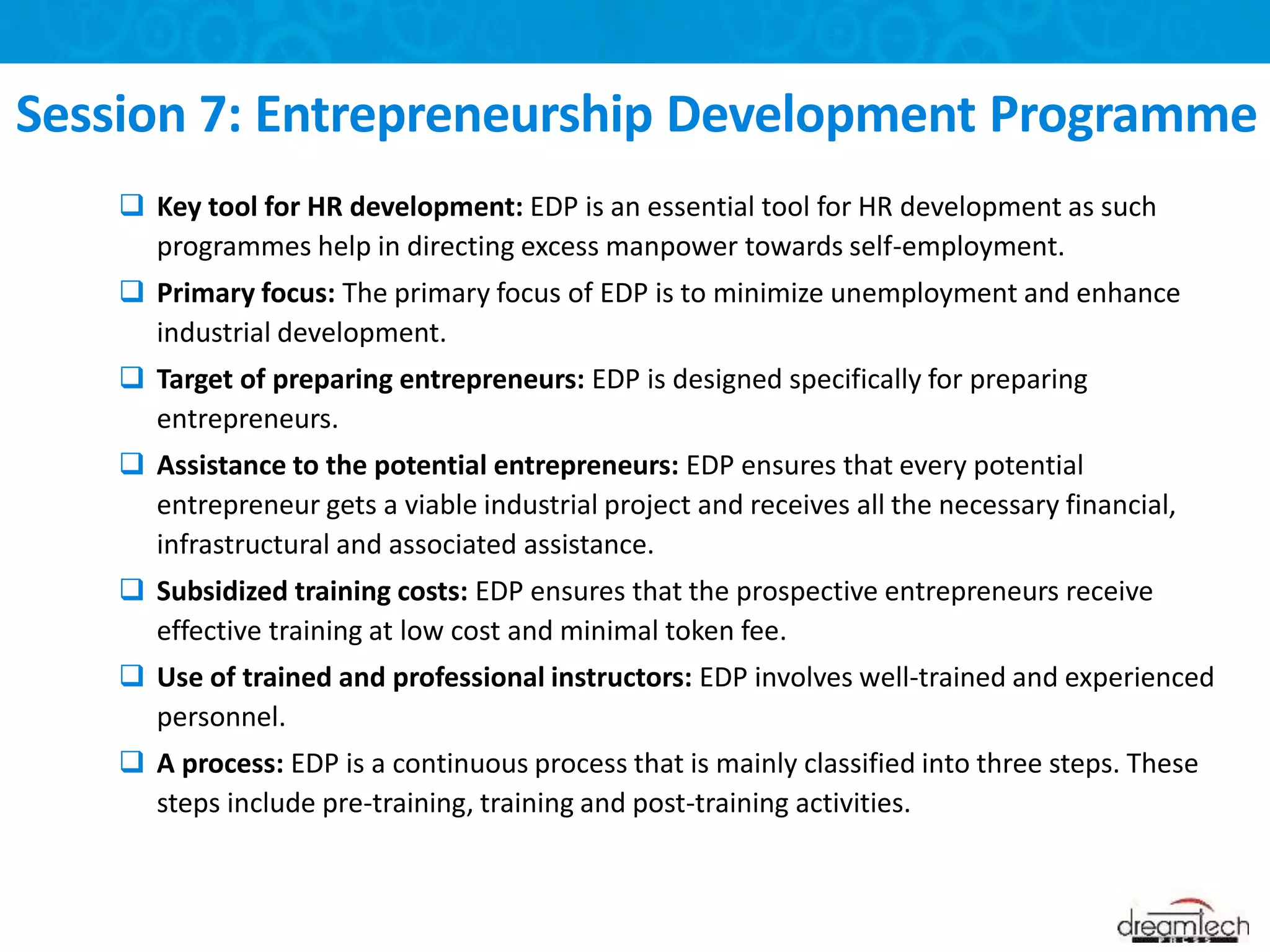
 Entrepreneurship Development Programme (EDP)
 Rewards of Entrepreneurship
 Scope of Entrepreneurship in India
Learning Objectives
 An enterprise can be defined as an entity, organization or undertaking that is
formed for commercial purposes or business ventures.
 The main purpose of an enterprise is to provide goods and services while
considering financial, commercial and industrial aspects. It comprises people
and physical assets with a common objective of generating profits.
 An entrepreneur is a person who starts an enterprise and is involved with the
operations of the business.
 Entrepreneurship can be defined as a process of organizing and managing a
business venture together with the risks involved in it.
 The process involves creating and implementing new ideas and creative
solutions. However, the success or failure of an enterprise depends on the
efficiency of the entrepreneur.
 An entrepreneur needs to be focused on adapting himself according to the
changes taking place in the national economy, industries and markets.
Introduction
 Entrepreneurs and entrepreneurship play a significant role in the
socioeconomic development of a country.
 The roles of entrepreneurship are as follows:
 It increases the productivity through technical and other innovative approaches.
 It creates the employment opportunities by forming new enterprises.
 It aids the transfer of technology.
 It plays a strategic role in commercializing new products and inventions.
 It aids the effective utilization of resources.
 It enhances the living standards of people.
 It helps in transforming the economy.
 It drives the industries forward by bringing in innovative products.
 It creates new markets and enables expansion into global markets.
Session 1: Roles of Entrepreneurship
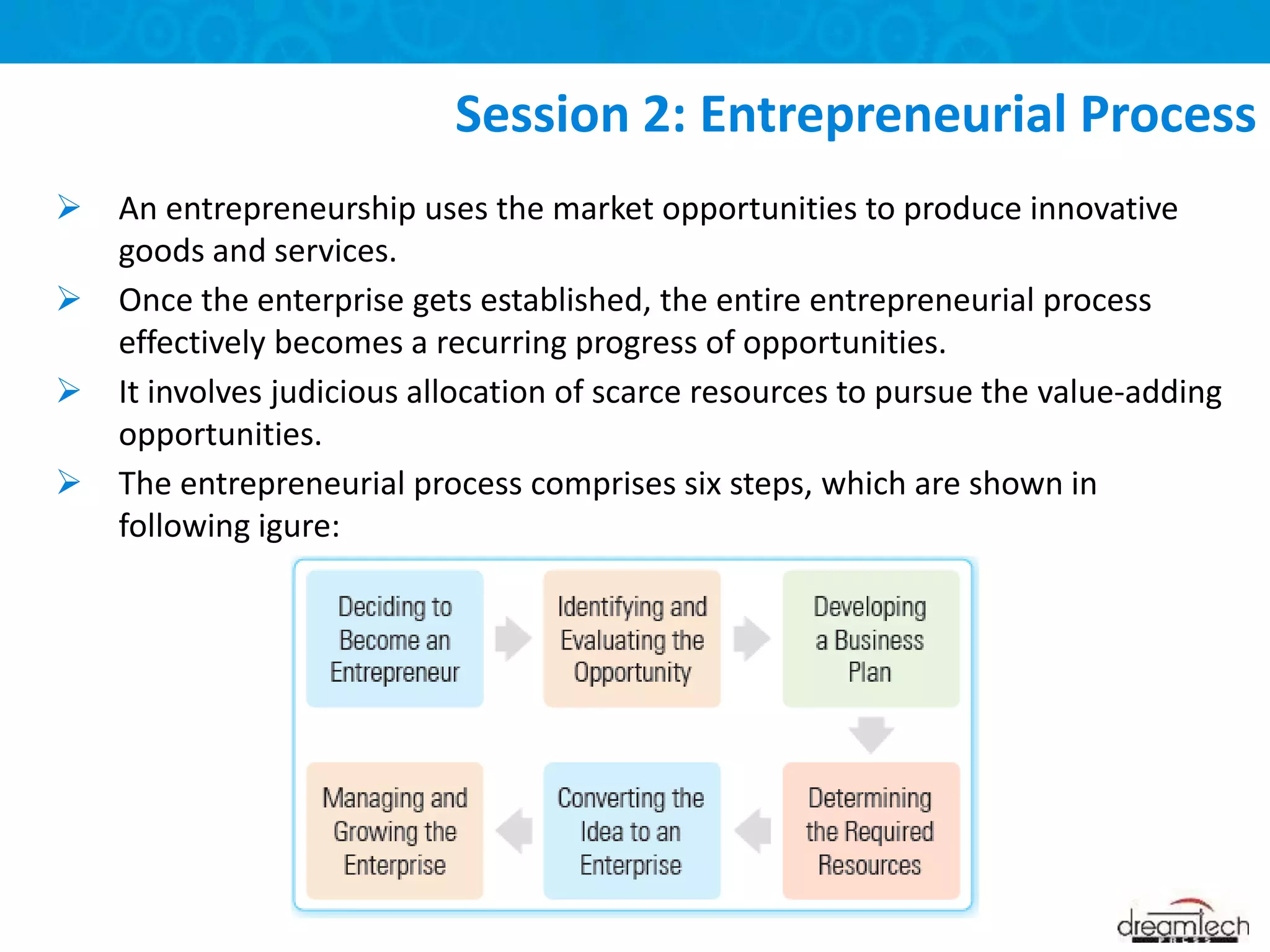
 An entrepreneurship uses the market opportunities to produce innovative
goods and services.
 Once the enterprise gets established, the entire entrepreneurial process
effectively becomes a recurring progress of opportunities.
 It involves judicious allocation of scarce resources to pursue the value-adding
opportunities.
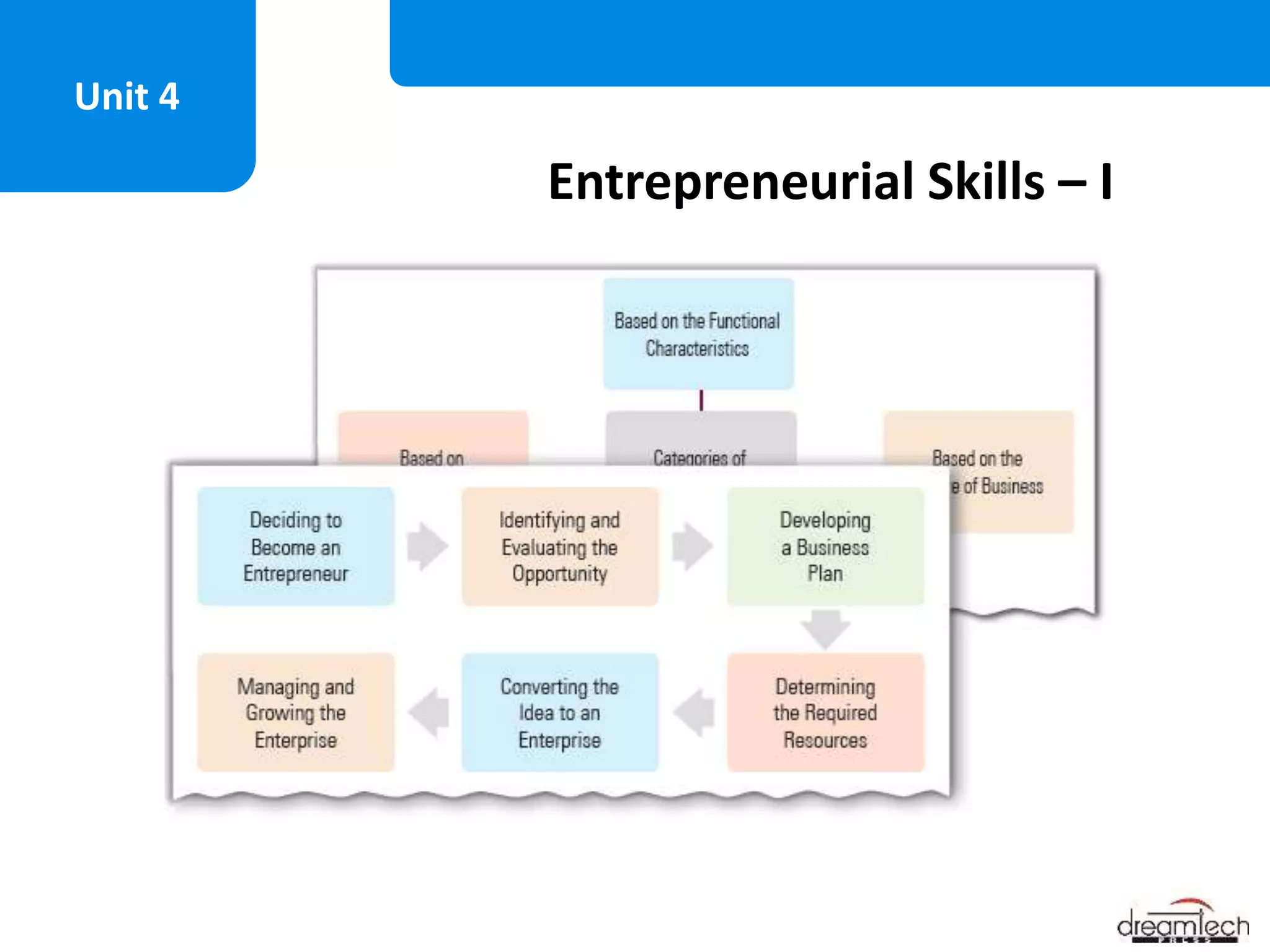
 The entrepreneurial process comprises six steps, which are shown in
following igure:
Session 2: Entrepreneurial Process
 The description of the steps involved in the entrepreneurial process are as
follows:
 Deciding to become an entrepreneur: In this stage, the entrepreneur decides to start
his own enterprise. The desire to become an entrepreneur may be triggered by any of
the following factors:
 Surfacing of an innovative idea backed by the ability to start a business.
 Inheriting wealth and skills to establish an enterprise and Prevailing problems in the existing jobs.
 Willing to become one’s own boss, and Realizing the need of earning money.
 Identifying and evaluating the opportunities: In this stage, the entrepreneur identifies
the prospective opportunities.
 Developing a business plan: In order to effectively utilize the identified opportunity, a
proper business plan is required.
 Determining the required resources: It involves determining the resources required to
meet the identified opportunity.
 Converting the idea to an enterprise: In this step, the entrepreneur develops his own
enterprise to execute the identified opportunity.
 Managing and growing the enterprise: Finally, once the resources are acquired, the
entrepreneur uses them efficiently to carry out the business plan successfully.
Session 2: Entrepreneurial Process
 The success or failure of an enterprise depends on the efficiency of an
entrepreneur, who is involved in formulating and implementing a business
plan and managing resources.
 Some of the traits and characteristics of a successful entrepreneur are given
as follows:
 Creativity: It refers to the ability of an entrepreneur to bring out the new ways to run a
business.
 Innovation: It refers to the ability of an entrepreneur to provide things in a novel
manner.
 Dynamism: A successful entrepreneur should strive to bring dynamism to industries
and markets by transforming a new idea into a successful innovation.
 Risk-taking and decision-making ability: It refers to the capability of entrepreneurs to
make decisions under uncertain conditions.
 Time management: It refers to the entrepreneur’s ability to manage time efficiently.
Session 3: Entrepreneurial Skills
 Self-motivation: It means that the entrepreneurs can be successful only if they are
guided by self motivation to achieve the well-defined objectives.
 Self-confidence: It refers to the strong self-confidence that the entrepreneurs have in
their own abilities to carry out a certain task successfully even in adverse conditions.
 Persistence: It implies that the entrepreneurs must keep on persisting with a task until
the goal is achieved.
 Problem-solving: It refers to the way in which the entrepreneurs are able to address
various issues in their enterprise operations.
 Flexibility: It helps an entrepreneur to be flexible enough to be able to adapt to the
varying market environment, strategies of competitors and preferences of customers.
 Vision: It refers to the characteristic of an entrepreneur to visualize the way to
successfully complete the tasks to achieve the set goals and objectives.
 Leadership: This essential quality enables the entrepreneur to move forward in each
sphere of life.
 Technical knowledge: It implies that an entrepreneur must know the technical aspects
of operations taking place in the enterprise. For example, these operations may include
systems, procedures and methodology used in production.
Session 3: Entrepreneurial Skills
 An entrepreneur takes risk and organizes resources to establish and operate
his enterprise.
 He identifies the existing market opportunities, analyses the uncertainties
involved and performs the promotional activities to launch the enterprise.
 Some of the functions of an entrepreneur are described as follows:
 Idea generation: It implies that an entrepreneur identifies the business opportunities,
chooses the most appropriate business opportunity and transforms that
opportunity/idea into a successful business venture.
 Promotion: It indicates that the activities of an entrepreneur are not limited to
establishing an enterprise. It also involves promoting the enterprise, attracting the
investors, expanding the existing enterprise and merging two or more enterprises.
 Risk and uncertainty bearing: It points to the fact that an entrepreneur requires to take
risks in forming a new enterprise and be aware of any losses due to adverse conditions.
 Arranging finance: It implies that an entrepreneur is involved in arranging finance for
establishing his enterprise.
 Staffing: It signifies that an entrepreneur requires employing individuals with the
required skill sets for carrying out the various organizational functions effectively.
Functions of an Entrepreneur
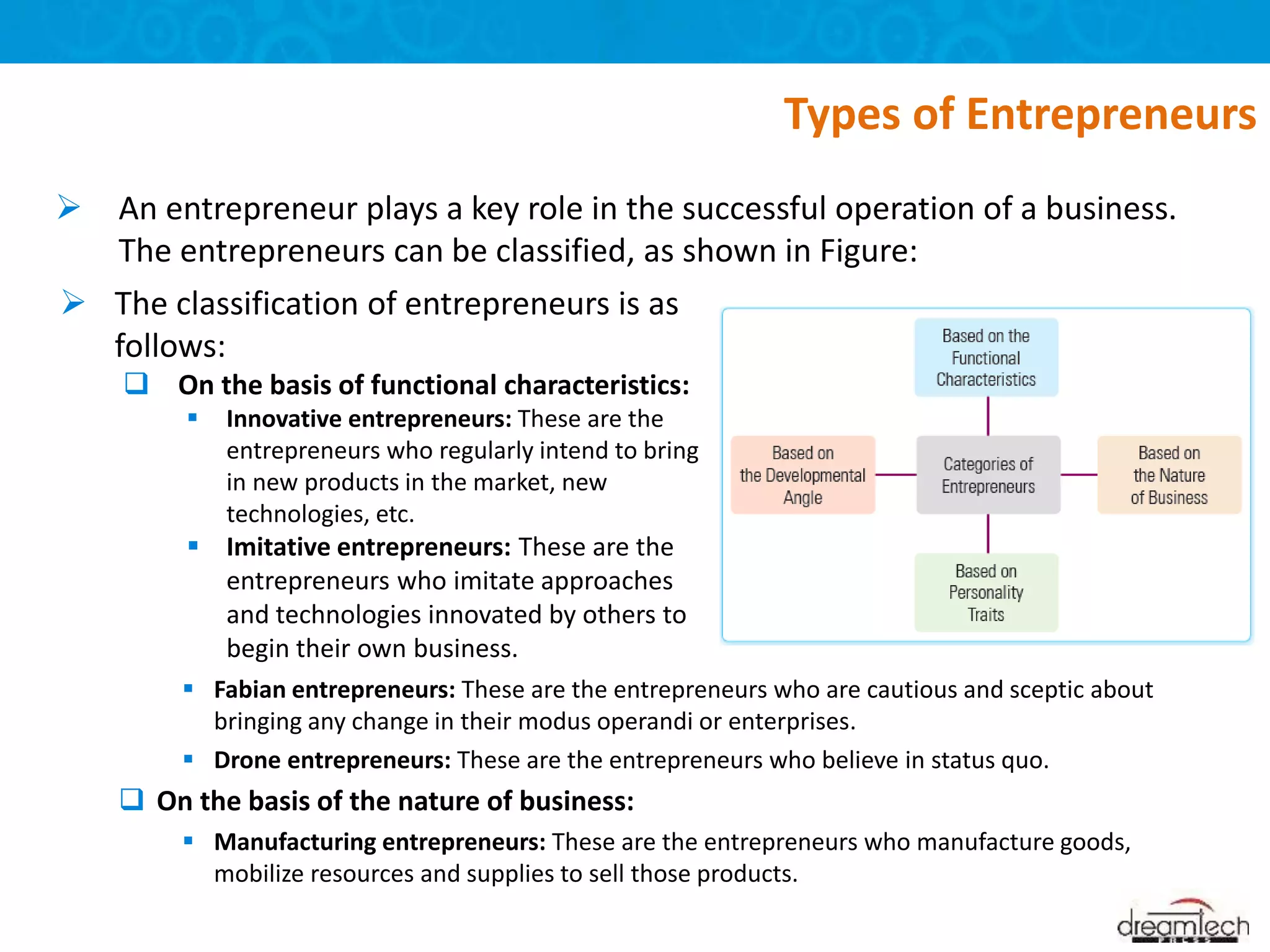
 An entrepreneur plays a key role in the successful operation of a business.
The entrepreneurs can be classified, as shown in Figure:
 Fabian entrepreneurs: These are the entrepreneurs who are cautious and sceptic about
bringing any change in their modus operandi or enterprises.
 Drone entrepreneurs: These are the entrepreneurs who believe in status quo.
 On the basis of the nature of business:
 Manufacturing entrepreneurs: These are the entrepreneurs who manufacture goods,
mobilize resources and supplies to sell those products.
Types of Entrepreneurs
 The classification of entrepreneurs is as
follows:
 On the basis of functional characteristics:
 Innovative entrepreneurs: These are the
entrepreneurs who regularly intend to bring
in new products in the market, new
technologies, etc.
 Imitative entrepreneurs: These are the
entrepreneurs who imitate approaches
and technologies innovated by others to
begin their own business.
 Service entrepreneurs: These are the entrepreneurs who are involved in manufacturing and
rendering services rather than goods; for example, software installation services etc.
 Trading entrepreneurs: These are the entrepreneurs who carry out the trading activities only.
 Private entrepreneurs: These are the entrepreneurs who establish and operate private
enterprises without any government control. They work for personal interests.
 State or public entrepreneurs: These are the entrepreneurs who are associated with the
enterprises that are owned and controlled by the state government. They work for public
interests.
 Joint entrepreneurs: These are the entrepreneurs who form and operate the enterprises in
partnership or involve two or more persons to invest or manage the organization with equal
rights.
 On the basis of developmental angle:
 Large-scale entrepreneurs: These are the entrepreneurs who carry out the entrepreneurial
activities at a large scale.
 Small-scale entrepreneurs: These are the entrepreneurs whose activities are confined to local
markets only.
 Satellites: These are the entrepreneurs who start as suppliers and move towards a productive
enterprise.
 Managers: These are the entrepreneurs who do not initiate expansion and are satisfied in
managing and keeping the business in operation.
Types of Entrepreneurs
 Minor innovators: These are the entrepreneurs who participate in the economic growth by
efficiently utilizing the existing resources.
 On the basis of personality traits:
 Advisors: These are the entrepreneurs who offer a great degree of advice and help to the
customers. For example, these may include lawyers, accountants and financial advisors.
 Administrators or organizers: These are the entrepreneurs who manage different events and
processes. For instance, managers, wedding planners, accountants and data operators.
 Builders or creators: These are the entrepreneurs who are involved in building or creative
works.
 Communicators or trainers: These are the entrepreneurs who offer information services.
 Caretakers: These are the entrepreneurs who have an extremely helpful nature and indulge in
taking care of the people and property. For example, security guards and escorts.
 Entertainers/hosts: These are the entrepreneurs who associate themselves with the people
and are involved in hospitality or service industries. For example, chefs, hairdressers et.
 Investors/owners: These are the entrepreneurs who invest money to generate profits.
 Sellers: These are the entrepreneurs who make profits through commissions obtained by
customer purchases. For example, salesmen, brokers, insurance agents and property dealers.
 Technologists: These are the entrepreneurs who offer technological services. For example,
software developers and engineers.
Types of Entrepreneurs
 A business entity can be defined as an organization that utilizes economic
resources or inputs to make goods or services available to the customers
either in exchange of money or different types of goods and services.
 There are various types of businesses, some of which are as follows:
 Service Business: It is a type of business in which intangible products are provided.
Tangible products do not have any physical existence.
 Merchandizing Business: It is a type of business in which the products are bought at
wholesale prices and are sold at retail prices. This business is also called ‘buy and sell’
business.
 Manufacturing Business: In this type of business, different types of products are
bought to use them as materials for creating a new product.
 Hybrid Business: In this type of business, the companies are involved in more than one
type of business. For example, consider an example of a restaurant that makes a fine
meal by using the raw materials and also involves in selling wine to the customers.
Session 4: Types of Business
 A community business is set up by the communities facing challenges
together in developing a business. Some examples of community business
are shops, call centres, farms, etc.
 The profit generated by the community business creates a positive impact
over the whole community and boosts the local economy.
 This profit amount is further used for the development of the local area.
 Some key features of a community business are as follows:
 Locally rooted: The community business is rooted in a specific geographical location
and works for its betterment.
 Trading for the benefit of the local community: The community business is set up with
the intention to share profit among the communities involved in trading.
 Accountable to the local community: The community business is strictly accountable
for the benefit of the local people.
 Broad community impact: The community business benefits and impacts the overall
local community.
Session 5: Community Business Activities
 Entrepreneurship enables creation of employment opportunities, earning
foreign exchange and enhancing the income of a country.
 The development of entrepreneurship needs proper attention and
supervision by the entrepreneur.
 Some distinguished characteristics of an entrepreneurship are as follows:
 Economic and dynamic activity: It is not wrong to say that entrepreneurship is an
economic activity as it emphasizes on the development and operation of an enterprise
with the intention of value or wealth creation by making sure the optimum utilization
of the resources present in limited amount. This value creation activity is performed in
the middle of an unreliable business environment. Therefore, entrepreneurship is also
known as a dynamic activity.
 Related to innovation: In entrepreneurship, an entrepreneur always remains in search
of new ideas.
 Profit potential: In entrepreneurship, profit potential is the ability of an entrepreneur
through which he develops an idea into a concrete business venture.
 Risk-bearing: The core of entrepreneurship lies in the assumption of risk appearance
while implementing the new thoughts in business.
Session 6: Distinguished Characteristics of Entrepreneurship
 Entrepreneurship Development Programme (EDP) was designed to promote
small enterprises by identifying and training the prospective entrepreneurs.
 EDP was designed as a unique, integrated approach for providing instructions
and counselling from the selection stage to the main operation process.
 EDP focuses more on enhancement in operations than academic training to
meet certain requirements of the participants.
 Some of the essential characteristics of EDP are given as follows:
 Motivation: The prospective entrepreneurs need to be motivated to carry out the
specific tasks in their enterprises.
 Provide opportunities: EDP provides opportunities for the potential entrepreneurs to
enhance their knowledge and skills required for the effective functioning of an
enterprise.
 Purpose of developing the first-generation entrepreneurs: EDPs help to ensure the
development of the first-generation entrepreneurs who fail to achieve the desired
objective of a successful entrepreneur.
Session 7: Entrepreneurship Development Programme
 Key tool for HR development: EDP is an essential tool for HR development as such
programmes help in directing excess manpower towards self-employment.
 Primary focus: The primary focus of EDP is to minimize unemployment and enhance
industrial development.
 Target of preparing entrepreneurs: EDP is designed specifically for preparing
entrepreneurs.
 Assistance to the potential entrepreneurs: EDP ensures that every potential
entrepreneur gets a viable industrial project and receives all the necessary financial,
infrastructural and associated assistance.
 Subsidized training costs: EDP ensures that the prospective entrepreneurs receive
effective training at low cost and minimal token fee.
 Use of trained and professional instructors: EDP involves well-trained and experienced
personnel.
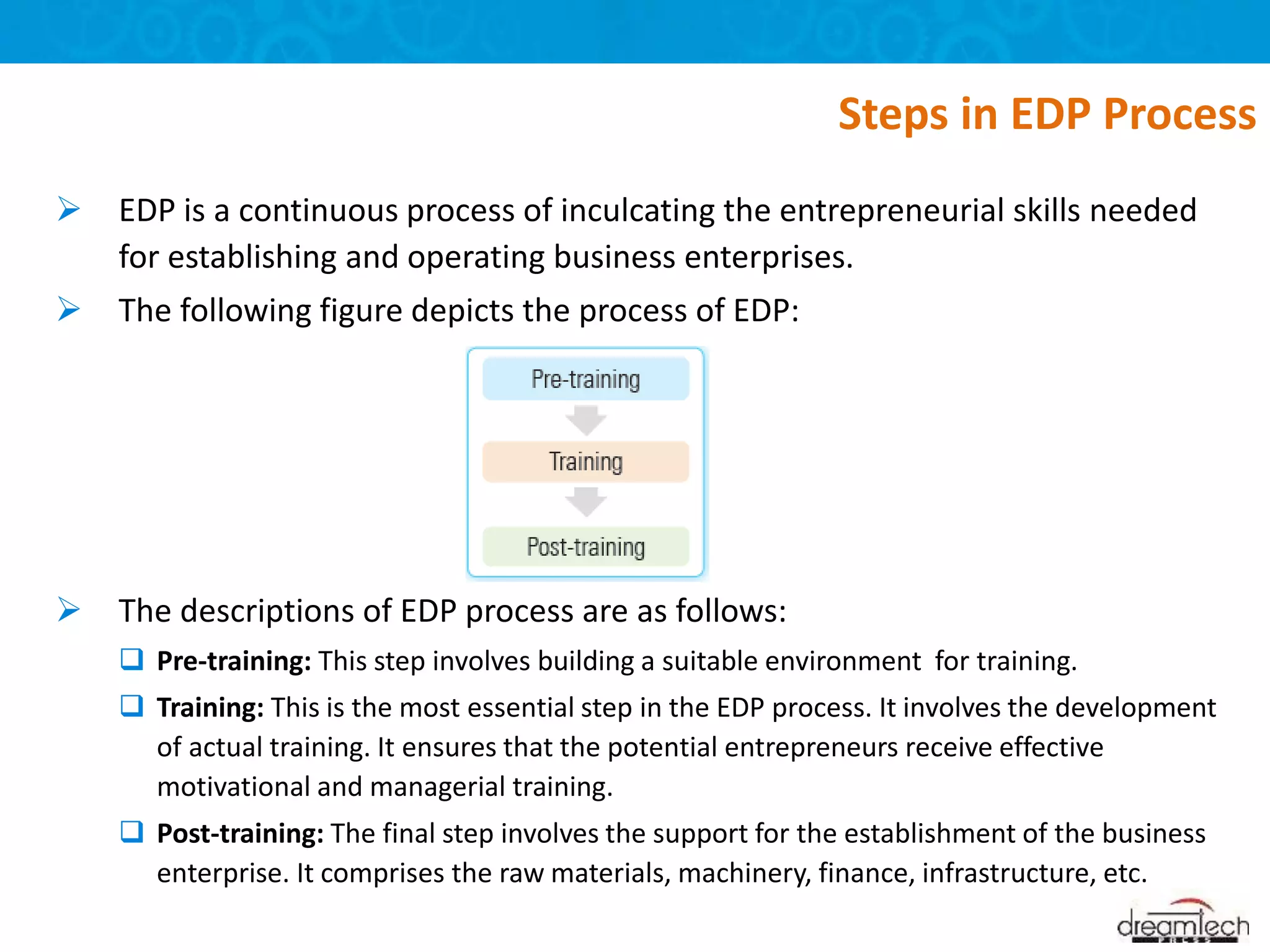
 A process: EDP is a continuous process that is mainly classified into three steps. These
steps include pre-training, training and post-training activities.
Session 7: Entrepreneurship Development Programme
 EDP is a continuous process of inculcating the entrepreneurial skills needed
for establishing and operating business enterprises.
 The following figure depicts the process of EDP:
 The descriptions of EDP process are as follows:
 Pre-training: This step involves building a suitable environment for training.
 Training: This is the most essential step in the EDP process. It involves the development
of actual training. It ensures that the potential entrepreneurs receive effective
motivational and managerial training.
 Post-training: The final step involves the support for the establishment of the business
enterprise. It comprises the raw materials, machinery, finance, infrastructure, etc.
Steps in EDP Process
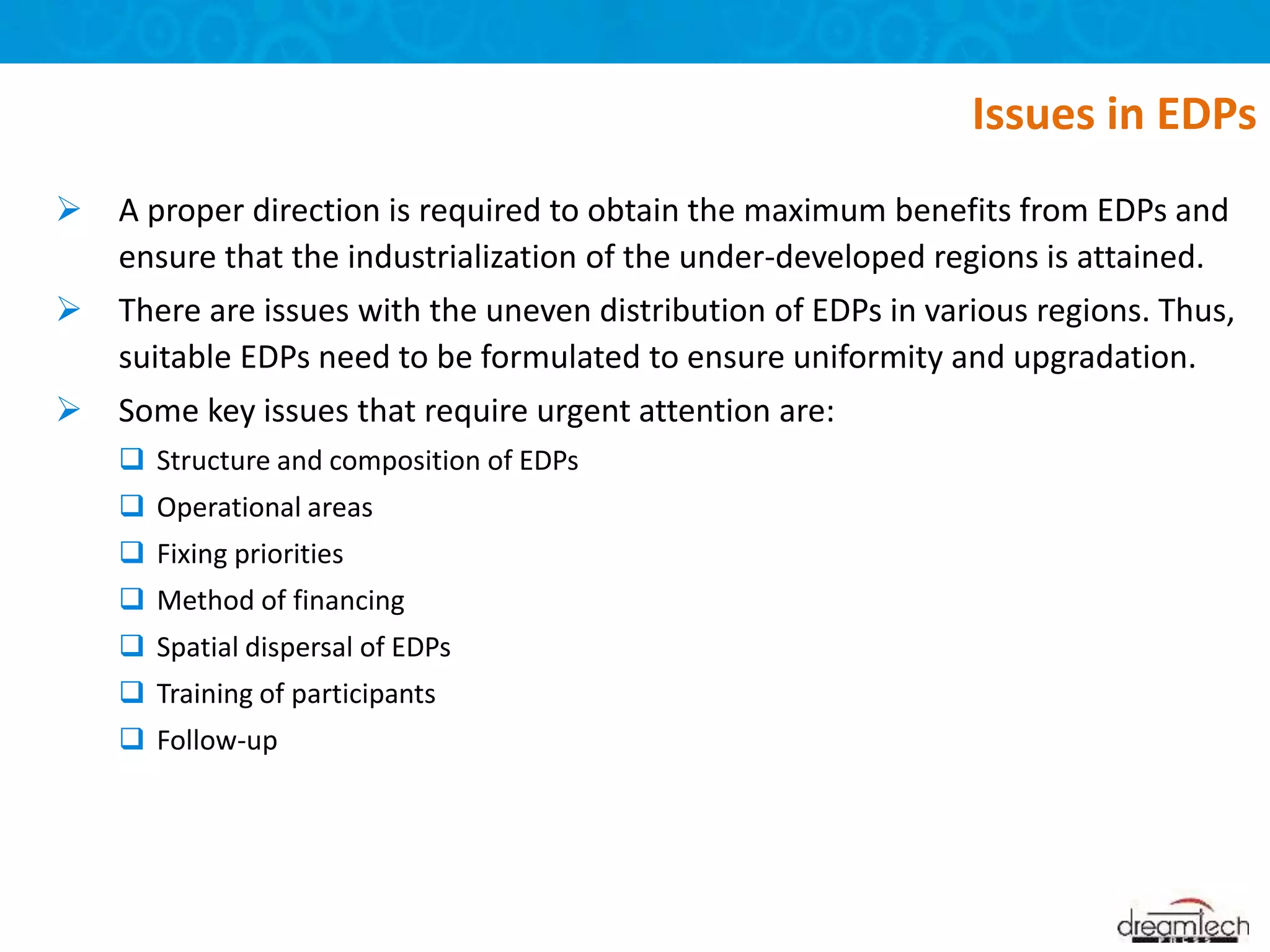
 A proper direction is required to obtain the maximum benefits from EDPs and
ensure that the industrialization of the under-developed regions is attained.
 There are issues with the uneven distribution of EDPs in various regions. Thus,
suitable EDPs need to be formulated to ensure uniformity and upgradation.
 Some key issues that require urgent attention are:
 Structure and composition of EDPs
 Operational areas
 Fixing priorities
 Method of financing
 Spatial dispersal of EDPs
 Training of participants
 Follow-up
Issues in EDPs
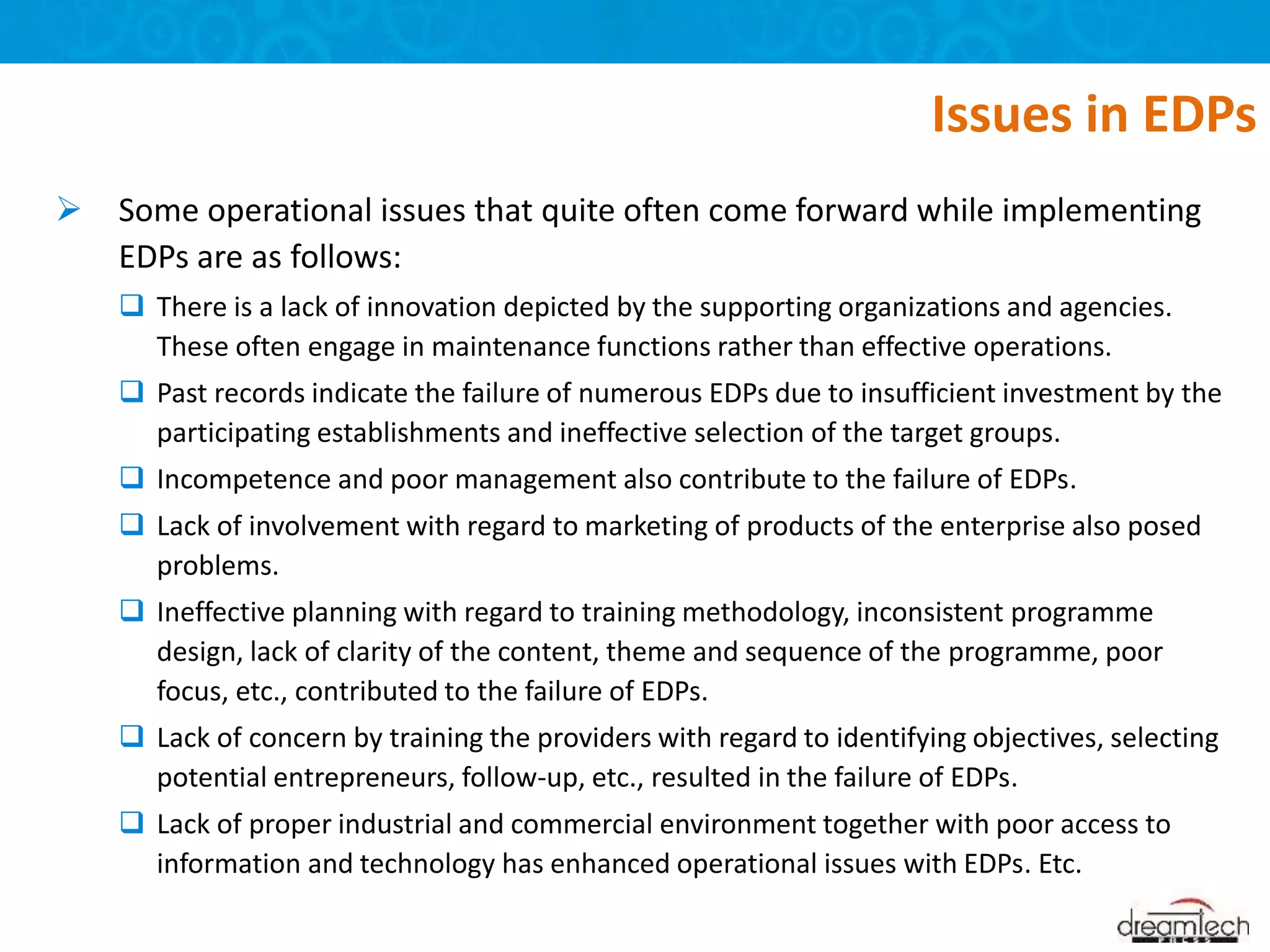
 Some operational issues that quite often come forward while implementing
EDPs are as follows:
 There is a lack of innovation depicted by the supporting organizations and agencies.
These often engage in maintenance functions rather than effective operations.
 Past records indicate the failure of numerous EDPs due to insufficient investment by the
participating establishments and ineffective selection of the target groups.
 Incompetence and poor management also contribute to the failure of EDPs.
 Lack of involvement with regard to marketing of products of the enterprise also posed
problems.
 Ineffective planning with regard to training methodology, inconsistent programme
design, lack of clarity of the content, theme and sequence of the programme, poor
focus, etc., contributed to the failure of EDPs.
 Lack of concern by training the providers with regard to identifying objectives, selecting
potential entrepreneurs, follow-up, etc., resulted in the failure of EDPs.
 Lack of proper industrial and commercial environment together with poor access to
information and technology has enhanced operational issues with EDPs. Etc.
Issues in EDPs
 An entire team of individuals along with the entrepreneur contributes
equally to the success of an enterprise.
 Some rewards or advantages of being an entrepreneur are as follows:
 An entrepreneur is his own boss. Therefore, being a boss, he remains involved in the
activities from the beginning of the project till its end. It gives him huge self-satisfaction
as he has taken all the decisions himself throughout the project.
 An entrepreneur does not have a stipulated income and his salary is dependent on the
performance of the enterprise. The more he works hard for his enterprise, the more
will be the profits.
 An entrepreneur can experiment with the new ideas to deal with the advancement in
the society.
 An entrepreneur is the owner of an enterprise. Hence, he has to deal with all the risks
and uncertainties in his business. He can take his own decisions to deal with the risks
and uncertainties. Ultimately, an entrepreneur becomes a good decision-maker.
 An entrepreneur can set his own schedule according to his personal priorities. There is a
lot of flexibility for him to set his own work timings. Nobody in the company can
question him about his coming late to office or leaving early from office.
Session 8: Rewards of Entrepreneurship
 Entrepreneurship relates to establishing small enterprises. In India, the
potential entrepreneurs possess dynamic confidence and vision to establish
small enterprises.
 The Indian government, after realizing this, has started offering all the
necessary facilities and incentives to the potential entrepreneurs.
 Therefore, the government has updated the industrial policies and five-year
plans to enhance industrial growth.
 The government has started offering various incentives and concessions,
which comprise capital subsidy, marketing facilities, technical know-how,
industrial facilities, etc.
 After the formation of the Industrial Financial Corporation of India (IFCI) by
the central government, various state governments have started their own
financial corporations.
 These corporations aim to help the entrepreneurs in acquiring finance and
offering the required technical facility.
Session 9: Scope of Entrepreneurship in India
 The scope of entrepreneurship in India is enhanced with the help of
institutions, such as Industrial Development Bank of India (IDBI), Small
Industries Development Bank of India (SIDBI) etc.
 Some of these financial institutions have even started offering venture
capital to the prospective entrepreneurs.
 The continued efforts of the government along with these institutions have
started yielding positive results.
 Some of the well-known examples of the successful entrepreneurs are Mr N
R Narayana Murthy of Infosys Technologies and Mr Shiv Nadar of HCL
Technologies. Mr Dhirubhai Ambani established Reliance Industries, India’s
largest private sector company. It was the first Indian company to feature in
the ‘Forbes 500’ list etc.
Session 9: Scope of Entrepreneurship in India
Thank You

Enterpreneureurial skills class-9-pranavi-verma

  • 1.
  • 2.
    This Unit Covers: Roles of Entrepreneurship  Entrepreneurial Process  Entrepreneurial Skills  Types of Business  Community Business Activities  Distinguished Characteristics of Entrepreneurship  Entrepreneurship Development Programme (EDP)  Rewards of Entrepreneurship  Scope of Entrepreneurship in India Learning Objectives
  • 3.
     An enterprisecan be defined as an entity, organization or undertaking that is formed for commercial purposes or business ventures.  The main purpose of an enterprise is to provide goods and services while considering financial, commercial and industrial aspects. It comprises people and physical assets with a common objective of generating profits.  An entrepreneur is a person who starts an enterprise and is involved with the operations of the business.  Entrepreneurship can be defined as a process of organizing and managing a business venture together with the risks involved in it.  The process involves creating and implementing new ideas and creative solutions. However, the success or failure of an enterprise depends on the efficiency of the entrepreneur.  An entrepreneur needs to be focused on adapting himself according to the changes taking place in the national economy, industries and markets. Introduction
  • 4.
     Entrepreneurs andentrepreneurship play a significant role in the socioeconomic development of a country.  The roles of entrepreneurship are as follows:  It increases the productivity through technical and other innovative approaches.  It creates the employment opportunities by forming new enterprises.  It aids the transfer of technology.  It plays a strategic role in commercializing new products and inventions.  It aids the effective utilization of resources.  It enhances the living standards of people.  It helps in transforming the economy.  It drives the industries forward by bringing in innovative products.  It creates new markets and enables expansion into global markets. Session 1: Roles of Entrepreneurship
  • 5.
     An entrepreneurshipuses the market opportunities to produce innovative goods and services.  Once the enterprise gets established, the entire entrepreneurial process effectively becomes a recurring progress of opportunities.  It involves judicious allocation of scarce resources to pursue the value-adding opportunities.  The entrepreneurial process comprises six steps, which are shown in following igure: Session 2: Entrepreneurial Process
  • 6.
     The descriptionof the steps involved in the entrepreneurial process are as follows:  Deciding to become an entrepreneur: In this stage, the entrepreneur decides to start his own enterprise. The desire to become an entrepreneur may be triggered by any of the following factors:  Surfacing of an innovative idea backed by the ability to start a business.  Inheriting wealth and skills to establish an enterprise and Prevailing problems in the existing jobs.  Willing to become one’s own boss, and Realizing the need of earning money.  Identifying and evaluating the opportunities: In this stage, the entrepreneur identifies the prospective opportunities.  Developing a business plan: In order to effectively utilize the identified opportunity, a proper business plan is required.  Determining the required resources: It involves determining the resources required to meet the identified opportunity.  Converting the idea to an enterprise: In this step, the entrepreneur develops his own enterprise to execute the identified opportunity.  Managing and growing the enterprise: Finally, once the resources are acquired, the entrepreneur uses them efficiently to carry out the business plan successfully. Session 2: Entrepreneurial Process
  • 7.
     The successor failure of an enterprise depends on the efficiency of an entrepreneur, who is involved in formulating and implementing a business plan and managing resources.  Some of the traits and characteristics of a successful entrepreneur are given as follows:  Creativity: It refers to the ability of an entrepreneur to bring out the new ways to run a business.  Innovation: It refers to the ability of an entrepreneur to provide things in a novel manner.  Dynamism: A successful entrepreneur should strive to bring dynamism to industries and markets by transforming a new idea into a successful innovation.  Risk-taking and decision-making ability: It refers to the capability of entrepreneurs to make decisions under uncertain conditions.  Time management: It refers to the entrepreneur’s ability to manage time efficiently. Session 3: Entrepreneurial Skills
  • 8.
     Self-motivation: Itmeans that the entrepreneurs can be successful only if they are guided by self motivation to achieve the well-defined objectives.  Self-confidence: It refers to the strong self-confidence that the entrepreneurs have in their own abilities to carry out a certain task successfully even in adverse conditions.  Persistence: It implies that the entrepreneurs must keep on persisting with a task until the goal is achieved.  Problem-solving: It refers to the way in which the entrepreneurs are able to address various issues in their enterprise operations.  Flexibility: It helps an entrepreneur to be flexible enough to be able to adapt to the varying market environment, strategies of competitors and preferences of customers.  Vision: It refers to the characteristic of an entrepreneur to visualize the way to successfully complete the tasks to achieve the set goals and objectives.  Leadership: This essential quality enables the entrepreneur to move forward in each sphere of life.  Technical knowledge: It implies that an entrepreneur must know the technical aspects of operations taking place in the enterprise. For example, these operations may include systems, procedures and methodology used in production. Session 3: Entrepreneurial Skills
  • 9.
     An entrepreneurtakes risk and organizes resources to establish and operate his enterprise.  He identifies the existing market opportunities, analyses the uncertainties involved and performs the promotional activities to launch the enterprise.  Some of the functions of an entrepreneur are described as follows:  Idea generation: It implies that an entrepreneur identifies the business opportunities, chooses the most appropriate business opportunity and transforms that opportunity/idea into a successful business venture.  Promotion: It indicates that the activities of an entrepreneur are not limited to establishing an enterprise. It also involves promoting the enterprise, attracting the investors, expanding the existing enterprise and merging two or more enterprises.  Risk and uncertainty bearing: It points to the fact that an entrepreneur requires to take risks in forming a new enterprise and be aware of any losses due to adverse conditions.  Arranging finance: It implies that an entrepreneur is involved in arranging finance for establishing his enterprise.  Staffing: It signifies that an entrepreneur requires employing individuals with the required skill sets for carrying out the various organizational functions effectively. Functions of an Entrepreneur
  • 10.
     An entrepreneurplays a key role in the successful operation of a business. The entrepreneurs can be classified, as shown in Figure:  Fabian entrepreneurs: These are the entrepreneurs who are cautious and sceptic about bringing any change in their modus operandi or enterprises.  Drone entrepreneurs: These are the entrepreneurs who believe in status quo.  On the basis of the nature of business:  Manufacturing entrepreneurs: These are the entrepreneurs who manufacture goods, mobilize resources and supplies to sell those products. Types of Entrepreneurs  The classification of entrepreneurs is as follows:  On the basis of functional characteristics:  Innovative entrepreneurs: These are the entrepreneurs who regularly intend to bring in new products in the market, new technologies, etc.  Imitative entrepreneurs: These are the entrepreneurs who imitate approaches and technologies innovated by others to begin their own business.
  • 11.
     Service entrepreneurs:These are the entrepreneurs who are involved in manufacturing and rendering services rather than goods; for example, software installation services etc.  Trading entrepreneurs: These are the entrepreneurs who carry out the trading activities only.  Private entrepreneurs: These are the entrepreneurs who establish and operate private enterprises without any government control. They work for personal interests.  State or public entrepreneurs: These are the entrepreneurs who are associated with the enterprises that are owned and controlled by the state government. They work for public interests.  Joint entrepreneurs: These are the entrepreneurs who form and operate the enterprises in partnership or involve two or more persons to invest or manage the organization with equal rights.  On the basis of developmental angle:  Large-scale entrepreneurs: These are the entrepreneurs who carry out the entrepreneurial activities at a large scale.  Small-scale entrepreneurs: These are the entrepreneurs whose activities are confined to local markets only.  Satellites: These are the entrepreneurs who start as suppliers and move towards a productive enterprise.  Managers: These are the entrepreneurs who do not initiate expansion and are satisfied in managing and keeping the business in operation. Types of Entrepreneurs
  • 12.
     Minor innovators:These are the entrepreneurs who participate in the economic growth by efficiently utilizing the existing resources.  On the basis of personality traits:  Advisors: These are the entrepreneurs who offer a great degree of advice and help to the customers. For example, these may include lawyers, accountants and financial advisors.  Administrators or organizers: These are the entrepreneurs who manage different events and processes. For instance, managers, wedding planners, accountants and data operators.  Builders or creators: These are the entrepreneurs who are involved in building or creative works.  Communicators or trainers: These are the entrepreneurs who offer information services.  Caretakers: These are the entrepreneurs who have an extremely helpful nature and indulge in taking care of the people and property. For example, security guards and escorts.  Entertainers/hosts: These are the entrepreneurs who associate themselves with the people and are involved in hospitality or service industries. For example, chefs, hairdressers et.  Investors/owners: These are the entrepreneurs who invest money to generate profits.  Sellers: These are the entrepreneurs who make profits through commissions obtained by customer purchases. For example, salesmen, brokers, insurance agents and property dealers.  Technologists: These are the entrepreneurs who offer technological services. For example, software developers and engineers. Types of Entrepreneurs
  • 13.
     A businessentity can be defined as an organization that utilizes economic resources or inputs to make goods or services available to the customers either in exchange of money or different types of goods and services.  There are various types of businesses, some of which are as follows:  Service Business: It is a type of business in which intangible products are provided. Tangible products do not have any physical existence.  Merchandizing Business: It is a type of business in which the products are bought at wholesale prices and are sold at retail prices. This business is also called ‘buy and sell’ business.  Manufacturing Business: In this type of business, different types of products are bought to use them as materials for creating a new product.  Hybrid Business: In this type of business, the companies are involved in more than one type of business. For example, consider an example of a restaurant that makes a fine meal by using the raw materials and also involves in selling wine to the customers. Session 4: Types of Business
  • 14.
     A communitybusiness is set up by the communities facing challenges together in developing a business. Some examples of community business are shops, call centres, farms, etc.  The profit generated by the community business creates a positive impact over the whole community and boosts the local economy.  This profit amount is further used for the development of the local area.  Some key features of a community business are as follows:  Locally rooted: The community business is rooted in a specific geographical location and works for its betterment.  Trading for the benefit of the local community: The community business is set up with the intention to share profit among the communities involved in trading.  Accountable to the local community: The community business is strictly accountable for the benefit of the local people.  Broad community impact: The community business benefits and impacts the overall local community. Session 5: Community Business Activities
  • 15.
     Entrepreneurship enablescreation of employment opportunities, earning foreign exchange and enhancing the income of a country.  The development of entrepreneurship needs proper attention and supervision by the entrepreneur.  Some distinguished characteristics of an entrepreneurship are as follows:  Economic and dynamic activity: It is not wrong to say that entrepreneurship is an economic activity as it emphasizes on the development and operation of an enterprise with the intention of value or wealth creation by making sure the optimum utilization of the resources present in limited amount. This value creation activity is performed in the middle of an unreliable business environment. Therefore, entrepreneurship is also known as a dynamic activity.  Related to innovation: In entrepreneurship, an entrepreneur always remains in search of new ideas.  Profit potential: In entrepreneurship, profit potential is the ability of an entrepreneur through which he develops an idea into a concrete business venture.  Risk-bearing: The core of entrepreneurship lies in the assumption of risk appearance while implementing the new thoughts in business. Session 6: Distinguished Characteristics of Entrepreneurship
  • 16.
     Entrepreneurship DevelopmentProgramme (EDP) was designed to promote small enterprises by identifying and training the prospective entrepreneurs.  EDP was designed as a unique, integrated approach for providing instructions and counselling from the selection stage to the main operation process.  EDP focuses more on enhancement in operations than academic training to meet certain requirements of the participants.  Some of the essential characteristics of EDP are given as follows:  Motivation: The prospective entrepreneurs need to be motivated to carry out the specific tasks in their enterprises.  Provide opportunities: EDP provides opportunities for the potential entrepreneurs to enhance their knowledge and skills required for the effective functioning of an enterprise.  Purpose of developing the first-generation entrepreneurs: EDPs help to ensure the development of the first-generation entrepreneurs who fail to achieve the desired objective of a successful entrepreneur. Session 7: Entrepreneurship Development Programme
  • 17.
     Key toolfor HR development: EDP is an essential tool for HR development as such programmes help in directing excess manpower towards self-employment.  Primary focus: The primary focus of EDP is to minimize unemployment and enhance industrial development.  Target of preparing entrepreneurs: EDP is designed specifically for preparing entrepreneurs.  Assistance to the potential entrepreneurs: EDP ensures that every potential entrepreneur gets a viable industrial project and receives all the necessary financial, infrastructural and associated assistance.  Subsidized training costs: EDP ensures that the prospective entrepreneurs receive effective training at low cost and minimal token fee.  Use of trained and professional instructors: EDP involves well-trained and experienced personnel.  A process: EDP is a continuous process that is mainly classified into three steps. These steps include pre-training, training and post-training activities. Session 7: Entrepreneurship Development Programme
  • 18.
     EDP isa continuous process of inculcating the entrepreneurial skills needed for establishing and operating business enterprises.  The following figure depicts the process of EDP:  The descriptions of EDP process are as follows:  Pre-training: This step involves building a suitable environment for training.  Training: This is the most essential step in the EDP process. It involves the development of actual training. It ensures that the potential entrepreneurs receive effective motivational and managerial training.  Post-training: The final step involves the support for the establishment of the business enterprise. It comprises the raw materials, machinery, finance, infrastructure, etc. Steps in EDP Process
  • 19.
     A properdirection is required to obtain the maximum benefits from EDPs and ensure that the industrialization of the under-developed regions is attained.  There are issues with the uneven distribution of EDPs in various regions. Thus, suitable EDPs need to be formulated to ensure uniformity and upgradation.  Some key issues that require urgent attention are:  Structure and composition of EDPs  Operational areas  Fixing priorities  Method of financing  Spatial dispersal of EDPs  Training of participants  Follow-up Issues in EDPs
  • 20.
     Some operationalissues that quite often come forward while implementing EDPs are as follows:  There is a lack of innovation depicted by the supporting organizations and agencies. These often engage in maintenance functions rather than effective operations.  Past records indicate the failure of numerous EDPs due to insufficient investment by the participating establishments and ineffective selection of the target groups.  Incompetence and poor management also contribute to the failure of EDPs.  Lack of involvement with regard to marketing of products of the enterprise also posed problems.  Ineffective planning with regard to training methodology, inconsistent programme design, lack of clarity of the content, theme and sequence of the programme, poor focus, etc., contributed to the failure of EDPs.  Lack of concern by training the providers with regard to identifying objectives, selecting potential entrepreneurs, follow-up, etc., resulted in the failure of EDPs.  Lack of proper industrial and commercial environment together with poor access to information and technology has enhanced operational issues with EDPs. Etc. Issues in EDPs
  • 21.
     An entireteam of individuals along with the entrepreneur contributes equally to the success of an enterprise.  Some rewards or advantages of being an entrepreneur are as follows:  An entrepreneur is his own boss. Therefore, being a boss, he remains involved in the activities from the beginning of the project till its end. It gives him huge self-satisfaction as he has taken all the decisions himself throughout the project.  An entrepreneur does not have a stipulated income and his salary is dependent on the performance of the enterprise. The more he works hard for his enterprise, the more will be the profits.  An entrepreneur can experiment with the new ideas to deal with the advancement in the society.  An entrepreneur is the owner of an enterprise. Hence, he has to deal with all the risks and uncertainties in his business. He can take his own decisions to deal with the risks and uncertainties. Ultimately, an entrepreneur becomes a good decision-maker.  An entrepreneur can set his own schedule according to his personal priorities. There is a lot of flexibility for him to set his own work timings. Nobody in the company can question him about his coming late to office or leaving early from office. Session 8: Rewards of Entrepreneurship
  • 22.
     Entrepreneurship relatesto establishing small enterprises. In India, the potential entrepreneurs possess dynamic confidence and vision to establish small enterprises.  The Indian government, after realizing this, has started offering all the necessary facilities and incentives to the potential entrepreneurs.  Therefore, the government has updated the industrial policies and five-year plans to enhance industrial growth.  The government has started offering various incentives and concessions, which comprise capital subsidy, marketing facilities, technical know-how, industrial facilities, etc.  After the formation of the Industrial Financial Corporation of India (IFCI) by the central government, various state governments have started their own financial corporations.  These corporations aim to help the entrepreneurs in acquiring finance and offering the required technical facility. Session 9: Scope of Entrepreneurship in India
  • 23.
     The scopeof entrepreneurship in India is enhanced with the help of institutions, such as Industrial Development Bank of India (IDBI), Small Industries Development Bank of India (SIDBI) etc.  Some of these financial institutions have even started offering venture capital to the prospective entrepreneurs.  The continued efforts of the government along with these institutions have started yielding positive results.  Some of the well-known examples of the successful entrepreneurs are Mr N R Narayana Murthy of Infosys Technologies and Mr Shiv Nadar of HCL Technologies. Mr Dhirubhai Ambani established Reliance Industries, India’s largest private sector company. It was the first Indian company to feature in the ‘Forbes 500’ list etc. Session 9: Scope of Entrepreneurship in India
  • 24.