UNIT 3
Foundations of Entrepreneurship
By:
Pushpalata Pavya
Asst. Professor, SDMCET
DHARWAD
ENTREPRENEURSHIP
Introduction
• Entrepreneurship is a trait by an entrepreneur.
• Entrepreneur is an innovator, who carries out new combinations in ever changing
environment to initiate and accelerate the process of economics, social and
technological development.
• An entrepreneur is an economic agent who plays an important role in the
economic development of a country.
• He identifies opportunities and grabs them for economic benefits.
• Entrepreneurship is a dynamic activity which helps the entrepreneur to bring
changes in the process of production, innovations in business, new ideas and usage
of resources, establishing new markets etc.
Meaning and Evolution Of Concept
• The word “entrepreneur” is derived from the french verb
“entreprendre” which means “to undertake” .
• In early 18th
century french economist richard cantillon used the word
entrepreneur to business.
• Since then the word entrepreneur is used to one who takes the risk of
stating new organisation or business or introducing a new idea,
product or service to society.
• An entrepreneur is the person who bear risk, unites various factors of
production, to explore the perceived opportunities in order to evoke
demand, create wealth and employment.
Functions of entrepreneur according to
Joseph Schumpeter
• Introduction of new product
• Introduction of new methods of production
• Development of new markets and finding fresh sources
of raw materials and
• Making changes
Functions of an Entrepreneur
The functions are broadly classified into three groups.
• Primary functions
• Other functions and
• Functions important for developing countries
1. Planning:
• It is the first step.
• He prepares his plan of proposed project or business in systematic
way. It involves:
 Study of various ideas
 Scanning and selecting the best idea
 Selection of product line and location of plant
 Deciding the type of business organization
 Preparation of budget and identifying capital sources
 Studying the government rules, regulations and policies.
 Study and selection of work force
 Study and selection of marketing strategies
Primary functions
2. Organisation:
An entrepreneur coordinates and supervises the various tasks of
organizing for optimal utilization of resources.
3. Decision making:
He has to take effective decisions with regard to business objectives of
the enterprise, arrangement of resources and facilities like men,
material, machines, money, methods, technology etc., development of
market and maintain good relationship with others.
4. Management:
It refers to managing of the day-to-day problems. These include future
expansion and policies in long run.
5. Innovation:
He should be innovative in launching new products, introduction of new
technology in production line, creation of new market, new or better
source of raw material.
6.Risk bearing:
He should undertake responsibility of risk due to unseen situations.
7. Leading
8. controlling
• Other functions:
1. Diversification of production
2. Expansion of the enterprise
3. Maintaining cordial employer and employee relations
4. Talking labour problems
5. Coordination with outside agencies
• Functions important for developing countries:
1. Management of scarce resources
2. Dealing with public
3. Engineering
4. New product development
5. Parallel opportunities
6. Marketing
7. Management
8. Customer relation
1. According to the type of business
2. According to the use of technology
3. According to motivation
4. According to the growth
5. According to the stages of development
6. According to the area
7. According to the age and gender
8. According to the scale of operation
Types of Entrepreneur
According to the type of business
1. Business entrepreneurs
Business entrepreneurs are individuals who conceive an idea for a new
product or service leading to new business. He deals with product
development, marketing and sales.
2. Trading entrepreneurs:
He is the one who undertakes trading activities and is not concerned
with the manufacturing work. He is engaged in only trading.
3. Industrial entrepreneurs:
Industrial entrepreneurs is generally a manufacturer who identifies the
potential needs of customers and tailors a product or service to meet
the marketing needs.
4. Corporate Entrepreneurs:
Corporate entrepreneurs demonstrates his innovative skill in
organizing and managing corporate undertaking.
5. Agricultural Entrepreneur:
Agricultural entrepreneurs undertake activities such as raising and
marketing of crops, fertilizers and other inputs of agriculture. They
cover a broad spectrum of the agricultural sector and its related areas.
According to the use of technology
1. Technical entrepreneur:
• Technical entrepreneur is also called as “craftsman”, develops improved quality
goods.
• His concentration is oriented towards manufacture than marketing and selling.
• His aim is to develop quality goods using his innovative ideas and craftsmanship.
2. Non-technical entrepreneur:
• Non-technical entrepreneur is not concerned with technical aspects of a product.
• They are mainly concerned with development of alternative marketing and
distribution strategies to promote their business.
3. Professional entrepreneur:
• He is a person whose interest is to establish a business but does not deal with its
management and organizing it.
• Professional entrepreneur sells out the established business and starts other
venture. He is very dynamic who keeps on conceiving and venturing new ideas.
According to motivation
1. Pure entrepreneur:
• A Pure entrepreneur is a person who gets motivated by psychological
and not by economic rewards.
• He works for his own satisfaction or for his own status.
2. Induced entrepreneur:
• An Induced entrepreneur is one who is induced to take up a task due
to policy measures that provide assistance, incentives and concessions
etc., to start an enterprise.
• Many small scale industries are started by people because government
and institutions are giving support and lots of concession.
3. Motivated entrepreneur:
• New entrepreneurs are motivated by the desire for self-fulfillment.
• They come into existence because of the possibility of making and
marketing some new product.
Conti…
4. Spontaneous entrepreneurs:
• This type of entrepreneur start their business by natural talents
inherent in them.
• They posses traits like initiative, boldness and self confidence
which motivate them to take up entrepreneurship.
According to the growth
• Growth of an enterprise may be termed as low, medium, high or
super high growth.
• the development of a new venture leads to a chance of growth.
• Growth entrepreneurs are those who take up an industry with
substantial growth prospects.
• On the other hand, super growth entrepreneurs show enormous
growth performance in any venture they take up.
According to the stages of development
1. First generation entrepreneur: (first)
A First generation entrepreneur is one who starts an industrial unit by
his own innovative ideas and skills.
2. Modern entrepreneur:
A Modern entrepreneur is one who undertakes those projects that are
well needed and suited for changing demands.
3. Classical entrepreneur: (Inherit)
A classical entrepreneur is one who is concerned with the customers
and marketing needs while developing a new venture(maximizing
profit).
• According to the area
1. Urban entrepreneur
2. Rural entrepreneur
• According to the age and gender
1. Young entrepreneur
2. Old entrepreneur
3. Male entrepreneur
4. Female entrepreneur
• According to the scale of operation
Small scale entrepreneur
Medium scale entrepreneur
Large scale entrepreneur
• According to the other type
1.professional and non professional entrepreneur
2. Modern entrepreneur
3. Traditional (commercial) entrepreneur
4. Skilled and non-skilled entrepreneur
5. Forced entrepreneur
6. Inherited entrepreneur
7. National or international entrepreneur
Concept of Entrepreneurship
• Entrepreneurship is a process undertaken by an entrepreneur to
augment his business interests.
• Entrepreneurship is the individual process flourishes, when
interlinked dimensions of individual psychological
entrepreneurship, entrepreneur traits, social encouragement ,
business opportunities, government policies, availability of
resources and opportunities towards the common good,
development of the society and economy.
• Entrepreneurship lies more in the ability to minimize the use of
resources and to put them to maximum advantage.
• It is the product of teamwork and the ability to create, build and
work as a team.
• It is the process of identifying opportunities in the market place,
arranging the resources required to pursue these opportunities and
inverting the resources to exploit the opportunities for better gains.
Characteristics of Entrepreneurship
1. Innovation: Entrepreneurship involves innovation of new things to
effect changes and good success in economy. It should create
conditions for growth of economy.
2. Risk-taking: It is a inbuilt element of any business. Entrepreneurship
should be risk bearing to cater uncertainty of future.
3. Skillful management: Entrepreneurship brings together various
functions of the management planning, organizing, staffing, directing,
controlling and leading.
4. Organization: It brings together various facilities of production for an
efficient and economical use.
5. Decision making: It is a vital characteristic of an entrepreneurship.
Taking decisions at all levels and stages of an entrepreneurship is a
routine task.
6. Making the enterprise a success: It involves in satisfying the needs of
customers with the help of production and distribution of goods and
services. This makes the enterprise a success.
Role of Entrepreneur in Economic
Development
• It involves in initiating and effecting the change in the structure of
business or society.
• This change gives way to growth and higher output that leads to
higher profits.
• Innovation plays very important role in economic growth both in
developing new products or services and stimulating idea of an
investment in new ventures.
• Entrepreneur bridges gap between science and the market place,
creating new enterprises and brings new products and services into
the market.
• In some areas entrepreneur creates new products and new
employment.
• Thus entrepreneur thrusts impact and plays a vital role both in
overall economic development and creating employment to people.
Barriers of Entrepreneurship
1. Lack of capital
2. Lack of technical knowledge
3. Economic business cycles
4. Non availability of raw materials and resources.
5. Government regulations
6. Obsolescence of technology or idea
7. Unstable and unpredictable market
8. Globalization and entry of foreign goods
9. Risk
Small Scale Industry (SSI)
Definition
• SSI play a key role in the industrialization of any developing country.
• The first official idea was in terms of gross investment in land, building, plant and
machinery and number of workers engaged.
• From time to time, there have been many changes in the limit of investment in
plant and machinery.
• During 1955, for SSI, the ceiling limit for investment was 5 lakh with less than 50
employees when using power or less than 100 employees when power is not used.
• A small scale industry id defined as” A unit in manufacturing, servicing,
processing and preservation of goods having investment in plant and machinery, at
an original cost not exceeding Rs. 60 lakhs”
• The term SSI has been defined in three ways.
1. Conventional definition:
It includes cottage and handicraft industries that employ conventional labour-oriented
methods to produce conventional products, mainly in the rural areas. Ex: handloom
and handicrafts
2. Operational definition:
The operational definition for the policy includes” all the undertakings
having an investment in fixed assets in plant and machinery, whether held
on ownership terms or by lease or hire purchase, not exceeding Rs. 60
lakhs”.
3. National income accounting:
It includes all manufacturing and processing activities, including
maintenance and repair services, undertaken by both household and non
household small scale manufacturing units not registered under factories act.
Characteristics of SSIs
• Capital investment is small and most of them have small number of workers.
• Generally owned by a single or that most two persons and enaged in production
of small goods.
• Most of them are family owned industries.
• Workers are not well recognized and they may do different types of works as
need arises.
• Funded by owner’s savings or short term loans.
• SSI industrial activity is mainly dependent on owner’s entrepreneurship.
• Exploitation of natural resources and human resources.
• Generally management or organization are very poor or nonexistent in SSIs.
• Incidents of early closure are of highest order.
• Profit margins are less due to competition.
• Innovation and risk bearing are high in SSIs
• Faces cut throat competition.
• Few of them many grow as medium scale industries.
• Technology may become obsolete, resulting in closure of SSIs
• Generally found in urban or semi urban areas.
Objectives of SSIs
1. Creation of employment opportunities
2. Improvement of output, income and better standard of living.
3. Elimination of economic backwardness of rural and underdeveloped
areas.
4. To reduce regional imbalances
5. To provide employment and means of regular source of income to the
needy people living in rural and semi-urban areas.
6. To improve the quality of industrial products produced in cottage
industries and increase production and profits.
7. To facilitate import substitution
8. To encourage Entrepreneurship and self reliance.
9. To mobilize regional resources of capital.
Role of SSI in Economic Development
• Economic development is defined as an increase in per-capita income of a
person resulting in improvement in the levels of living.
• The development of SSIs contributes to the increase in per-capita income.
• SSIs generate immediate employment opportunities with relatively low capital
investment, promote evenly spread of national income, make effective
mobilization of untapped capital and human skills and lead to dispersal of
manufacturing activities all over the country.
• It results in the growth of villages, small towns and economically lagging
regions which creates balanced regional development.
• Increase in number, production, employment and exports of small scale
industries over a period of time are some of the parameters that indicate the role
played by SSIs in India.
Advantages of SSIs
SSIs have both economic and social advantages, some of them are listed
below:
1. SSIs don’t require to a high level of technology.
2. The source and capabilities of under employed and unemployed people
can be used for productive purpose.
3. They don’t require large capital
4. The projects related to SSIs can be completed in short period and hence
become productive in short period.
5. SSIs can be based on the processing of locally produced raw materials
like agricultural goods, forest and mineral resources.
6. Possibility of earning and saving foreign exchange by exporting goods
produced from local resources.
7. Source of employment for local people, either fulltime or part time.
8. SSIs act like training area for local entrepreneurs.
9. SSI can bring about more uniform distribution of income in the society.
Conti….
10. SSIs create immediate employment at a relatively small capital
investment.
11. SSIs have small gestation period(teething).
12. They offer a method of equitable distribution of national income.
13. SSIs facilitate mobilization of capital and skills which often
remain unutilized.
14. They meet the increased demand of consumer goods and mass
consumption goods.
15. They help in economic growth of the country.
16. SSIs make possible to shift manufacturing activities from busy
towns to rural areas.. This helps in geographical distribution of skills
and technology in country.
17. SSIs help in creating jobs for unemployed.
18. They help in developing rural areas.
Steps to start a SSI
The various steps involved in starting a SSI are given below:
• Selection of industry.
• Arrange for know-how/technology
• Study of resource requirement
• Selection of land and premises
• Study of investment requirement
• Study of requirement of plant and equipment
• Study of requirement of raw material and sources of supply
• Study of economic viability like marketing and pricing strategy,
financing, staffing, SWOT analysis, break even analysis, return
on investment etc.
• Preparation of project report
• Application to financial institutions for loan fixed assets and
working capital.
Conti….
• Application to directorate of industries for no objection
certificate, registration of SSI, power and permission.
• Get NOC and permission from local body(muncipality,
corporation, village panchayat)
• Apply for power connection
• Recruit staff and workers
• Order for plant and machinery
• Order for raw materials
• Install the machinery
• Trial runs
• Production and sales
• Profits and pay creditors
Impact of Liberalization, Privatization and Globalisation on
SSIs
• Liberalization, Privatization and Globalisation (LPG)process
started in India in July 1991.
• It has attracted new areas of development, foreign direct
investments and new business areas.
• This made Indian economy to grow at an average steady rate of
5% of per-capita income.
• The exports have increased.
• Liberalisation had made import of scarce and non-available raw
materials easy.
• Many entrepreneurs have started many SSIs which was not
possible due to non-availibility of certain raw materials and
resources.
• Example: effect of liberalization in electronic and computer
industries that have seen tremendous growth in past 2 decades.
Conti….
• Privatization, threw open to many challenging entrepreneurs to produce
similar goods and service at much competitive price and of better
quality.
• Example: life insurance sector which was earlier monopolized by LIC.
Now there are private agencies offering Life Insurance, health
Insurance and others.
• Gobalisation has helped in setting many small scale industries.
• It made possible the export of goods produced in SSI.
• Indian entrepreneurs in Pharma sector, I.T. Sector, steel sector have
gone to many countries to start new ventures.
• The spectacular growth is observed in Business Process
Outsourcing(BPO), transport, repair services, entertainment and
hospitality sectors.
• There has been a big growth of entrepreneurial activities in rural India
in the areas like food processing, ready-to-eat and packed food products
like fish, meat etc.
Ancillary Industry
• Ancillary Industries are small industries having investment in
fixed assets, plant and machinery not exceeding Rs.75 lakhs
and engaged in
a) Manufacturing of parts, components, sub assemblies, toolings
or intermediates
b) The rendering of services, supplying, rendering or proposing to
supply or render 30% production of the total services, to other
units of other articles.
• All the service oriented enterprises are now eligible for
registration as SSIs and are entitled for the same concessions
and incentives that are offered for SSIs.
Advantages of Ancillary units
• Indirect development of business activities in areas where
ancillary industries have been setup.
• Creating cadres of single disciplined experts.
• Providing an effective solution to the marketing problems of
SSIs.
• Complementary with regard to output and enable reduction in
the production cost.
• Employment generation and utilization of money in untapped
hands.
• Reduction in gestation period of production.
Objectives of Ancillary Industries
• Development of employment opportunities.
• Help the medium and large scale industries with specialized
functions.
• Increase the production of SSIs
• Growth of low cost economy
• Dispersal of industrial activities in various regions resulting in
equitable distribution of economy.
Tiny Industry
• A unit is treated as tiny industry where the investment in plant and
machinery does not exceed 25 lakhs.
• The growth in tiny industries facilitates self-employment, results
in wider dispersal of industrial and economic activities and
ensures maximum utilization of local resources.
Advantages:
 Utilization of local resources like men and materials.
 Limited capital to start the industry.
 Less risk involved
 Smaller gestation period.
 Production of goods as per choice of consumers.
 Exports, there by earning foreign exchange.
 Employment generation to rural people
 Regional and entrepreneurial development
Government and Institutional Support
Support from government
• The contribution of small industries and businesses to the Indian economy is
simply immeasurable.
• They not only create wealth and employment but are also a big factor in social
development.
• In fact, so great is their importance that we have a special ministry dedicated
to Micro, Small and Medium Industries.
• India is focusing on rural industries and cottage industries.
• Both central and state government have been emphasizing more on self-
employment opportunities in rural sectors by providing help and support in
financing in terms of loans, training in terms of programs, infrastructure, raw
materials and technology.
Conti…
• The core purpose of the government is to utilise the local
manpower and locally available resources.
• Which are further transformed into action by local departments,
agencies, corporations, etc.
• The support of small industries include:
1. National Bank for Agriculture and Rural Development
(NABARD)
2. A Rural Small Business Development Centre (RSBDC)
3. National Small Industries Corporation (NSIC)
4. Small Industries Development Bank of India (SIDBI)
5. Rural and Women Entrepreneurship Development (RWED)
Conti…
• The programs and schemes vary from state to state.
• Together they form a package of benefits and incentives to attract
industries in the backward areas.
• Small industries receive various benefits from the government of
India such as Land, Power, Water, Sales Tax, Raw materials,
Finance, Industrial estates and Tax holiday.
• Even though enough importance is given to backward areas and
small industries, there is still an imbalance in their economic growth.
• India is diligent in the framework of World Trade Organisation as it
is one of the founder members.
• Because of it, Indian economy is integrated with the global market
and small business can explore capabilities and establish new
markets.
• Indian businesses have to reform over time to keep up with the
world’s standard.
Objectives and functions of SISI
Objectives:
• The Small Industries Service Institutes (SISI) are set up to provide
consultancy and training to small entrepreneurs-both existing and
prospective.
• The activities of SISI are coordinated by the industrial management
training division.
• There are 28 SISIs and 30 branch SISIs set up in state capital and other
places all over the country.
Functions:
• To serve as interface between central and state governments.
• To render technical support services
• To conduct entrepreneurship development programmes
• To initiate promotional programmes.
• Economic consultancy/Information/EDP consultancy
• Trade and market information
• Project profiles
Conti….
• State industrial potential survey
• District industrial potential surveys
• Modernisation and in-plant studies
• Workshop facilities
• Training in various trade/activities
Small Industries Development Bank of India
(SIDBI)
• SIDBI was set up in1989 as entirely owned subsidiary of the IDBI.
• The idea of starting SIDBI was in response to demand from small-scale
sector for an top level institution promotion, financing and development
of small scale industries.
• It does both financial and non-financial assistance to small scale sectors.
• It does collaborative efforts to facilitate timely flow of credit for both
term loans and working capital to small-scale industries in collaboration
with commercial banks.
• It does refinancing, discounting of bills, loan on soft terms, term loan,
working capital both in rupee and foreign currencies and different forms
of resource support to banks and other institutions.
• SIDBI finances for technology transfer and upgradation, quality
improvement, exports environmental care and industrialization.
• For these activities SIDBI involves consultants and national and
international level for improvements.
District Industries Centres (DICs)/Single Window Concept
• The DIC programme was started during 1978 with a view to
provide integrated administrative framework at the district level for
promotion of small-scale industries in rural areas.
• The DICs are foreseen as single window interacting agency with the
entrepreneur at the district level.
• Services and support are provided to small entrepreneurs under a
single roof through the DIC.
• They are implementing arm (executive branch) of central and state
governments of the various schemes and programmes.
• Registration of small industries are done at the District Industries
Centers.
• Management and running of DICs is done by the state government.
• The organizational structure consists of one general manager, four
functional managers and three project managers to provide
technical in the area relevant to the needs.
Functions of DICs:
• To conduct industrial potential surveys keeping in view the availability
of resources in terms of material and human skill, infrastructure, demand
for product etc., to prepare techno-economic surveys and identify
product lines and then to provide investment advice to entrepreneurs.
• To prepare an action plan to effectively implement the schemes
identified.
• To guide entrepreneurs in matters relating to selecting the most
appropriate machinery and equipment, sources of its supply and
procedure for procuring imported machinery, if needed assessing
requirements for raw materials etc.
• To appraise the worthiness of the various proposals received from
entrepreneurs.
• To assist entrepreneurs in marketing their products and assess the
possibilities of engaging in the manufacture/production and export
promotion of their products.
• To undertake product development work appropriate to small industries
• To conduct artisan training programmes.
Karnataka Industrial Areas Development
Board (KIADB)
History:
• The Karnataka Industrial Areas Development Ordinance (KIADB
Ordinance) –dated 20th June 1966, is a statutory body constituted for
the purpose of speedy and orderly establishment and development of
industries in the industrial zones of the State of Karnataka.
• Providing basic industrial requirements and facilities.
• Provides for quick acquisition of land for the purpose of providing
industrial and basic needs.
• The Board consists of senior government officials who are
empowered. Board members meet regularly to take decisions and
monitor activities.
• KIADB's foresight and world-class infrastructure have attracted the
attention of investors from around the world, who consider
Karnataka as an ideal location for their start-ups.
Introduction
• KIADB has so far developed 173 industrial zones in 30 districts of the
state.
A model industrial zone developed by the board will have the following
basic facilities:
• Straight roads and internal roads with rainwater culverts.
• Street lights and electrical system.
• Water supply.
• CETP/STP
• Training Centers and Research Development Centers (R&D).
• Provision is also made for a bank, post office, telephone exchange,
pharmacies and canteens and other general necessities.
• Power substations.
• Hotels and Hospitals.
• Houses for accommodation of workers in industries.
Aims and Objectives:
• Promotion of rapid and systematic industrial development in the
state.
• Cooperation in implementation of government schemes falling
under the purview of KIAD Act.
• To facilitate installation of infrastructure.
• "No profit - no loss" approach.
Activities:
• Land acquisition and development of industrial zones in the
state.
• Provision of infrastructure in industrial zones.
• Land acquisition for single unit complexes.
• Acquisition of land for schemes of government agencies and for
infrastructure projects.
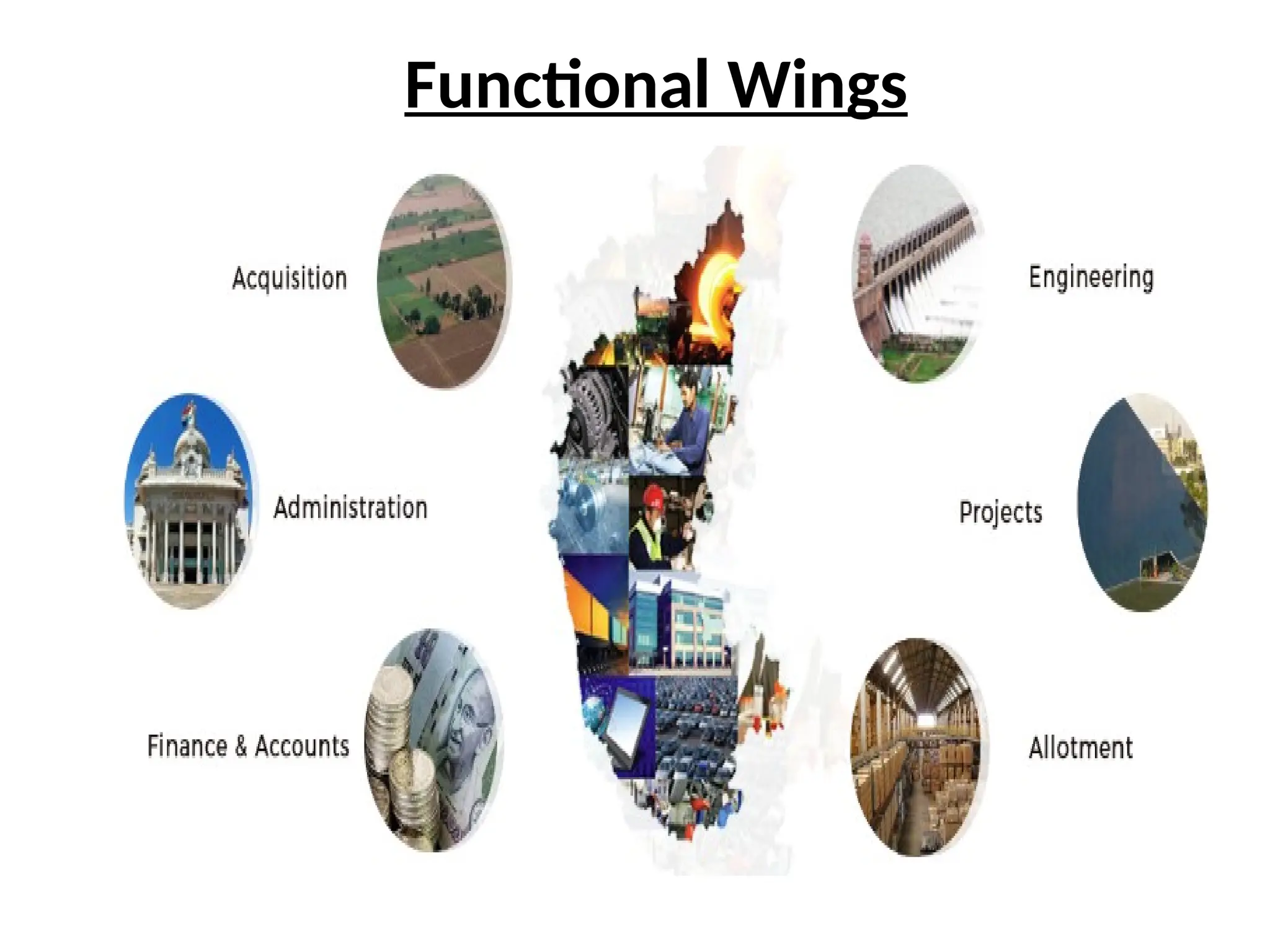
Functional Wings
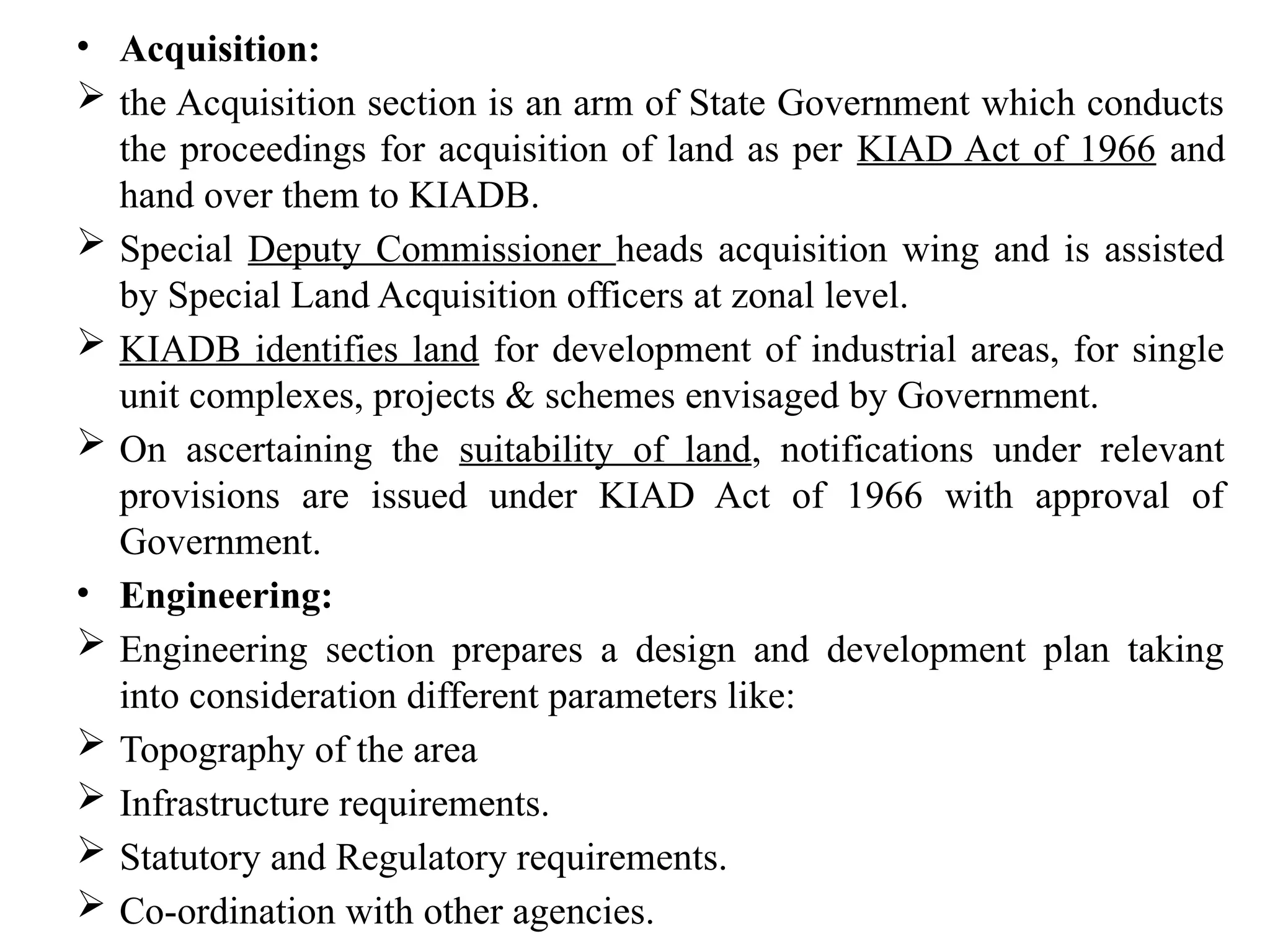
• Acquisition:
 the Acquisition section is an arm of State Government which conducts
the proceedings for acquisition of land as per KIAD Act of 1966 and
hand over them to KIADB.
 Special Deputy Commissioner heads acquisition wing and is assisted
by Special Land Acquisition officers at zonal level.
 KIADB identifies land for development of industrial areas, for single
unit complexes, projects & schemes envisaged by Government.
 On ascertaining the suitability of land, notifications under relevant
provisions are issued under KIAD Act of 1966 with approval of
Government.
• Engineering:
 Engineering section prepares a design and development plan taking
into consideration different parameters like:
 Topography of the area
 Infrastructure requirements.
 Statutory and Regulatory requirements.
 Co-ordination with other agencies.
Conti…
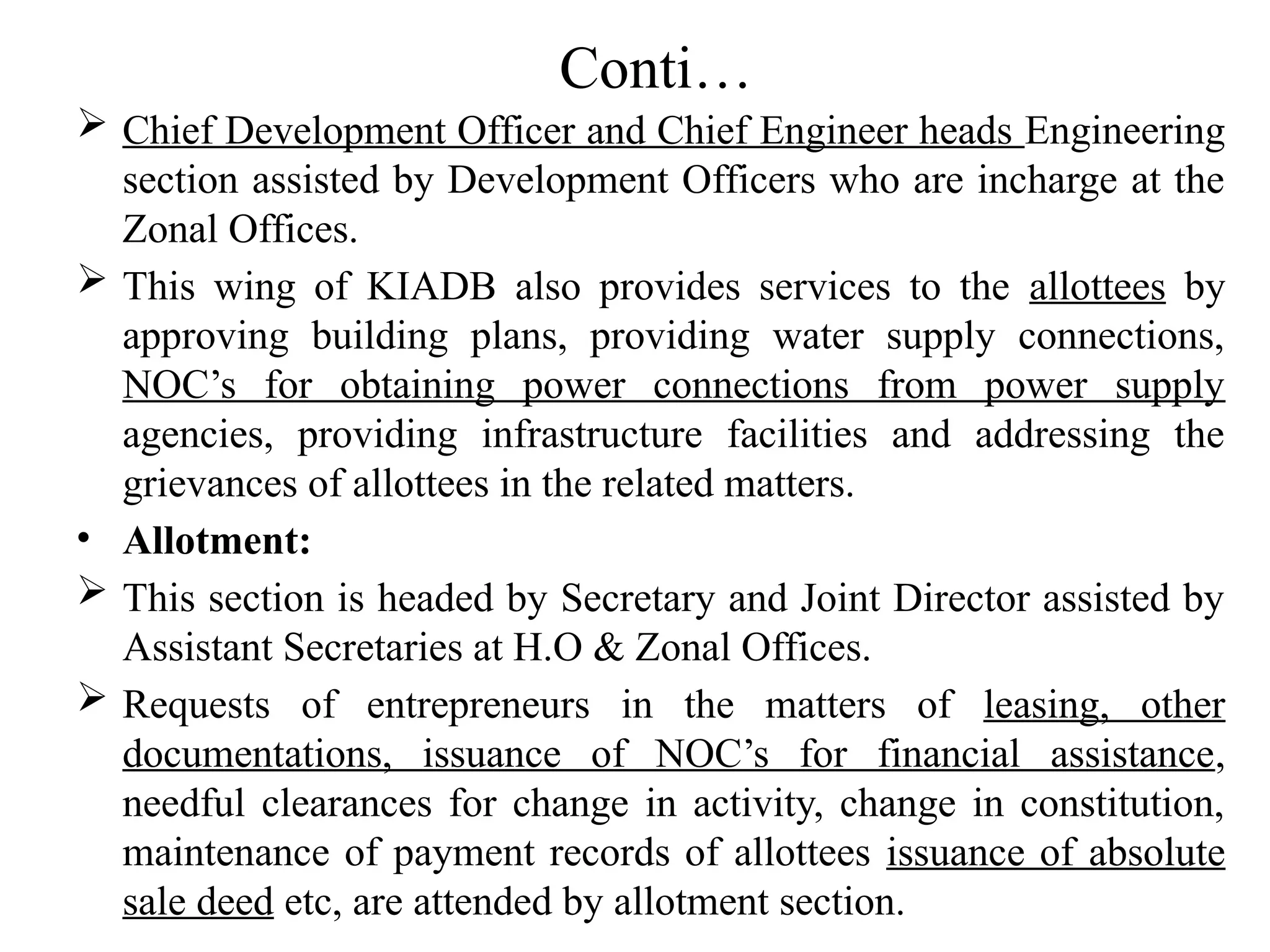
 Chief Development Officer and Chief Engineer heads Engineering
section assisted by Development Officers who are incharge at the
Zonal Offices.
 This wing of KIADB also provides services to the allottees by
approving building plans, providing water supply connections,
NOC’s for obtaining power connections from power supply
agencies, providing infrastructure facilities and addressing the
grievances of allottees in the related matters.
• Allotment:
 This section is headed by Secretary and Joint Director assisted by
Assistant Secretaries at H.O & Zonal Offices.
 Requests of entrepreneurs in the matters of leasing, other
documentations, issuance of NOC’s for financial assistance,
needful clearances for change in activity, change in constitution,
maintenance of payment records of allottees issuance of absolute
sale deed etc, are attended by allotment section.
conti;…
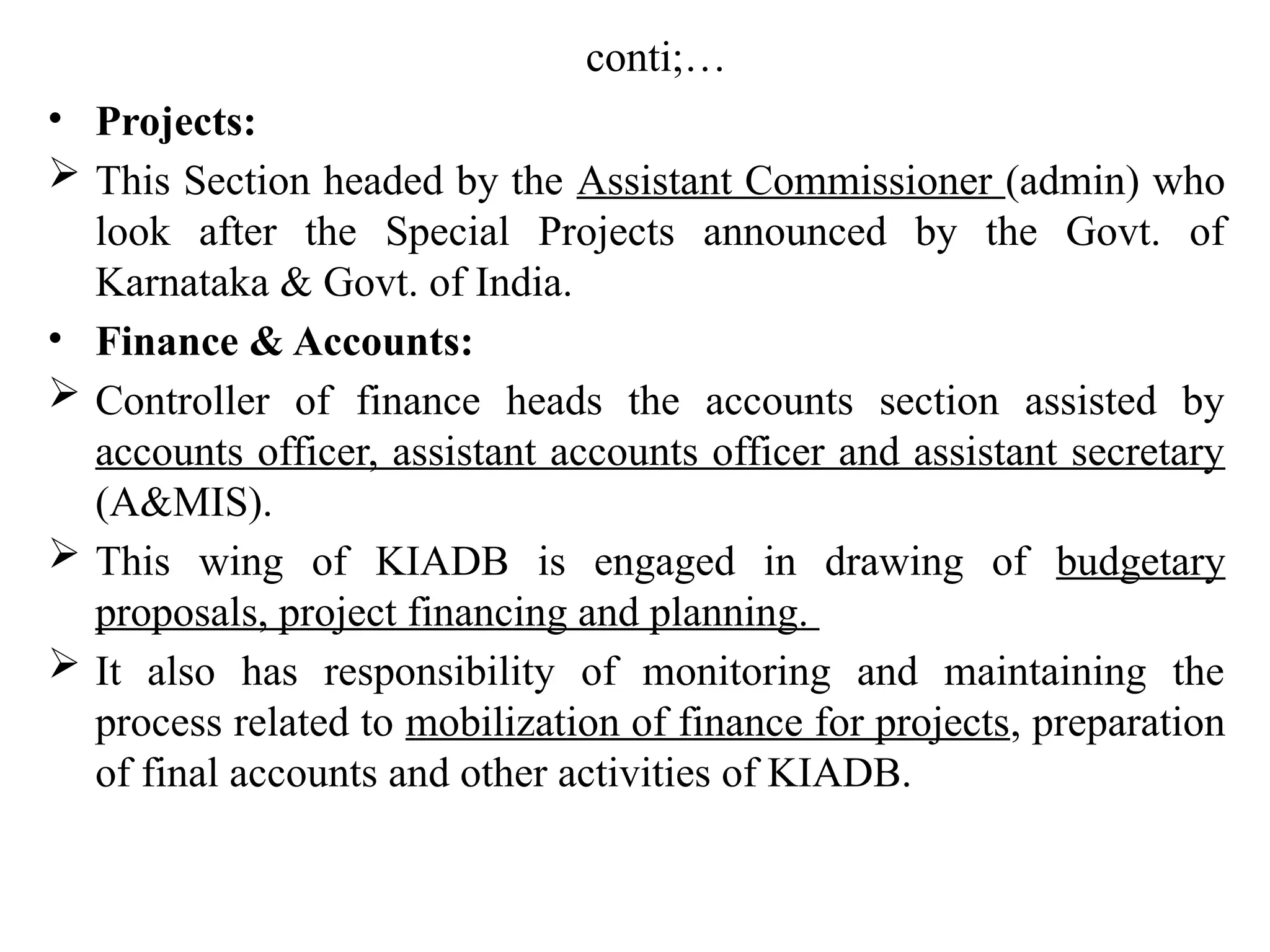
• Projects:
 This Section headed by the Assistant Commissioner (admin) who
look after the Special Projects announced by the Govt. of
Karnataka & Govt. of India.
• Finance & Accounts:
 Controller of finance heads the accounts section assisted by
accounts officer, assistant accounts officer and assistant secretary
(A&MIS).
 This wing of KIADB is engaged in drawing of budgetary
proposals, project financing and planning.
 It also has responsibility of monitoring and maintaining the
process related to mobilization of finance for projects, preparation
of final accounts and other activities of KIADB.
Conti…
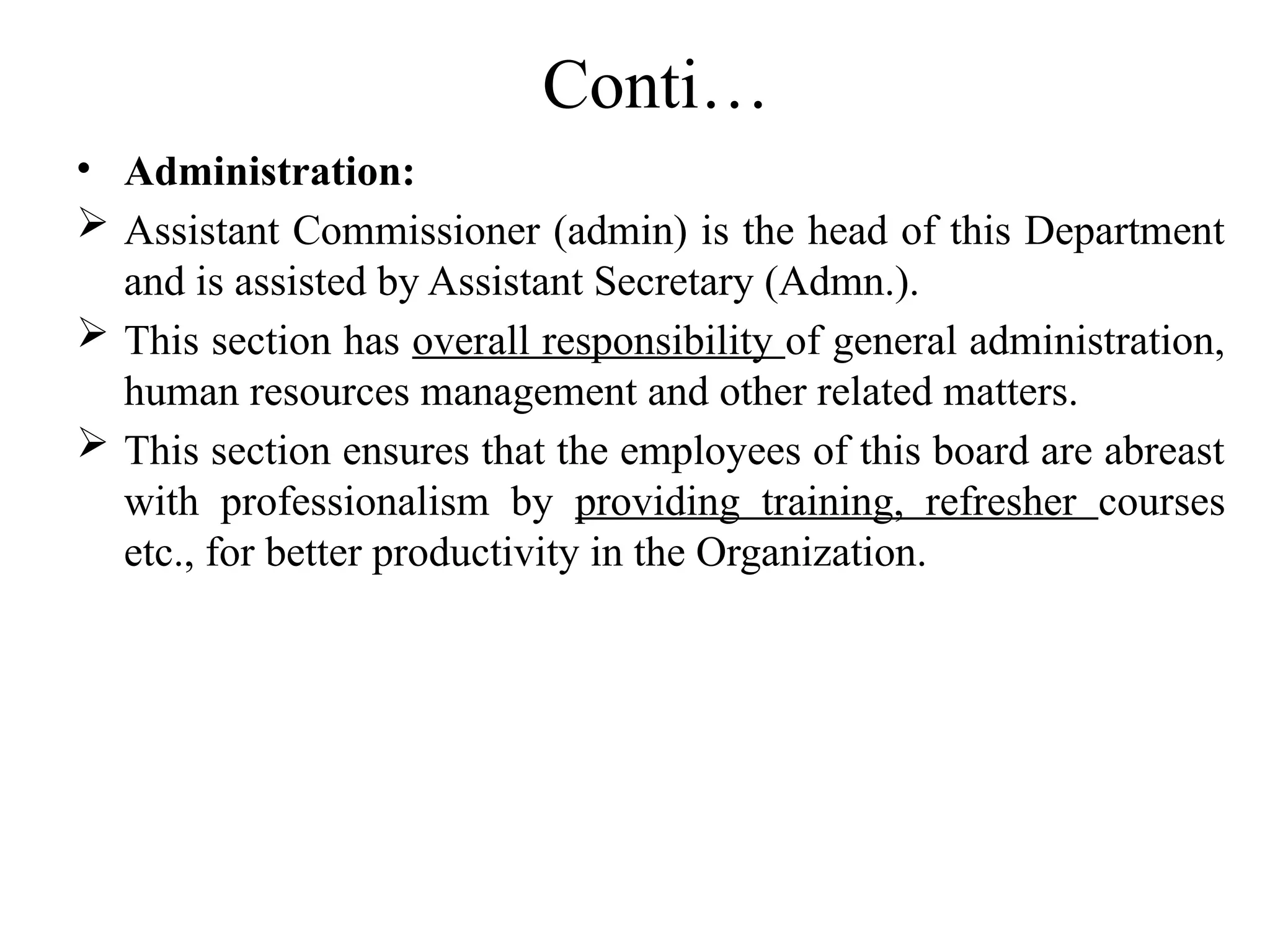
• Administration:
 Assistant Commissioner (admin) is the head of this Department
and is assisted by Assistant Secretary (Admn.).
 This section has overall responsibility of general administration,
human resources management and other related matters.
 This section ensures that the employees of this board are abreast
with professionalism by providing training, refresher courses
etc., for better productivity in the Organization.
Karnataka State Small Industries Development
Corporation Limited(KSSIDC)
• The growth of Small Scale Industries in our country since
independence is rightly regarded as one of the most significant
features of planned economic development.
• Various programmes to sustain, modernise and further develop
this group of industries were initiated soon after the
independence and the modern small-scale industry scheme has
gradually emerged out of this programme.
• On the basis of the recommendations of the central small scale
industries advisory board the state level organisations to assist
the small scale industries for procurement of scarce raw
materials, establishment of industrial estates etc, have been set
up in all states.
• KSSIDC, is one of such Corporations, established on 29th April
1960.
Conti…
• The registered office of the Company started functioning at
Bengaluru in the State of Karnataka. The Company framed
comprehensive and well-defined Memorandum of Association
and Articles of Association.
• It permited the Corporation to take up any activity aimed at the
rapid development of small-scale industry, subject to the
guidelines issued by the Government from time to time and also
as per Govt. order as under.
The Corporation started with the following as its Main Services :
• Establishment and Management of Industrial Estates.
• Procurement and distribution of raw materials.
• Assistance towards marketing.
• Dissemination of information by participating in the internal and
international exhibitions.
• Supply of machinery under Hire Purchase Scheme.
• Providing Guidance to SSI Entrepreneurs.
• Providing Technical Library facilities.
Establishment and management of industrial estates
• The programme of establishment of industrial estates, which has been
carried out by the State Government involved in construction of
industrial and providing them with essential amenities such as roads,
water supply, sewerage line and electricity.
• The maintenance and upkeep of the sheds also became a part of the
responsibility of the Corporation.
• Offering developed plots to the entrepreneurs to put up their own
factory sheds.
• The progress of the industrial estates for the last five-decades
increased enormously and the Company as on date has established
network of 177 developed Industrial Estates throughout the State in
almost all the districts and taluka of Karnataka and constructed 6180
Industrial Sheds, flats, godowns and shops apart from formation of
8258 Industrial Plots.
• The company also established exclusive and prominent ancillary
industrial estates in the vicinities of large and medium scale industry
to cater to their services to public sectors like BEL, ITI, HAL, NGEF,
BHEL, BEML, VISL and Mysore Lamps.
STRUCTURE OF THE COMPANY
• The company apart from Board of Directors and Managing
Director is having Three General Managers, two Deputy
General Managers and Superintendent Engineer, who constitute
the core of the service management.
• The Company, apart from its Head Office at Bengaluru has Two
Zonal Offices of which, One is situated at Bengaluru, another at
Hubli.
• The Company has Seven Division Offices headed by Deputy
Chief Managers and 9 Raw Material Depots spread throughout
the State of Karnataka.
• The total staff strength of the company is 177.
• The company has computerized most of its activities with a
view to keep up-dated information in all the spheres of small
industries development.
• The company is also making efforts for simplifying the
procedures and to de-centralise the powers so as to ensure that
Karnataka State Financial Corporation (KSFC)
• Karnataka State Financial Corporation (KSFC) is a State level
Financial Institution established by the State Government in
the year 1959 under the State Financial Corporations’ Act
1951 to cater to the long-term and short term financial needs
of small and medium enterprises (SMEs) in the State of
Karnataka.
• KSFC began by sanctioning Rs.28 lakhs to 11 projects in the
year 1959, its first year of operation.
• In the last 61 years of existence, KSFC has contributed most
significantly for the growth of SSIs, development of backward
area and promotion of first generation entrepreneurs.
• KSFC has assisted more than 1,74,000 units with cumulative
sanctions of over Rs.17,880 crore out of which more than 50%
is towards SSIs indicating the major role in industrial
development of the state.
Conti….
• Global giants like INFOSYS, BIOCON, MTR Foods, BPL
India Limited, Sansera Engineering, Reva Electric Cars, 24/7
Customers.com, Ace Designers Ltd, and many others started
their ventures with assistance of KSFC when they were start
ups.
• In the last 61 years of existence, KSFC has contributed most
significantly for the growth of SSIs, development of backward
area and promotion of first generation entrepreneurs.
• Assistance to first generation entrepreneurs stood at Rs.7679
crore (42%) to 87129 units.
• The flow of assistance to backward areas stood at Rs.6665
crore (37%) to 81216 units.
• The Corporation is acting as the catalyst of industrial
development in the state of Karnataka for various schemes of
Government of Karnataka.
Activities / Schemes For Financial Assistance
• General Scheme :
For establishment of new Tiny/SSI/MSI/ Service Units and for
Expansion/ Modernization
• Assistance To Construction/ Infrastructure Related Activities
For establishing Commercial Complexes, Residential Apartments,
Development of Residential Layouts, Software Parks, Godowns,
Warehouses, Acquisition of Ready built Offices/New Office and other
infrastructure projects like Flyovers, Bridges etc and Construction,
Development and Maintenance of Roads.
• Assistance To Hotels/ Restaurants
For setting up of Medium and Star Category Standard Hotels in the
State Capital, District and Taluk HQ, Important Tourist Centres.
The Hotels should have Boarding, Lodging and Restaurant Facilities
and Building Plan approved by Local Authorities.
Assistance for Mobile Canteens is also available.
Conti……
• Assistance To Tourism Related Activities
Setting up of amusement parks, Convention Centres, Travel and
Transport, Tourist Service Agencies and Restaurants
• Assistance To Doctors / Nursing Homes / Hospitals /
Electro Medical Equipments
For setting up Clinics, Nursing Homes, Hospitals, and for
acquiring Electro- Medical Equipment.
• Assistance To Entertainment Industry
For construction and purchase of cinema halls and multiplexes,
production of short TV serials and feature films, software for
visual media publicity.
Conti…
• Single Window Scheme
To provide loan both for fixed assets and working capital to tiny
and small scale units whose project cost does not exceed Rs. 35
lakhs and working capital requirement does not exceed Rs. 15
lakhs.
• Corporate Loan Scheme
Short term loans to the existing Successful Units who require
urgent Working Capital Funds either to meet gap in the Working
Capital requirements or funds required for executing the rush of
orders and also for meeting statutory dues to government like
payment of income tax, sales tax excise duty etc.
• Small Road Transport Operators (SRTOs)
Assistance to Small Road Transport Operators to meet expenditure
towards cost of Chassis, Body Building, Initial Taxes, Insurance etc
Conti….
• Acquisition Of ISO 9000 Series Certification
Assistance to existing industrial concerns in the SSI sector having a
good track record, to meet expenses on consultancy,
documentation, audit certification fees, equipment and calibrating
instruments required for acquisition of ISO certification.
• Training Institution
Assistance to existing units with successful track record for setting
up InHouse Training Facilities including Construction of Building,
acquisition of Furniture, Equipments etc.

unit 3.pptx fo sjundations of enterprise.

  • 1.
    UNIT 3 Foundations ofEntrepreneurship By: Pushpalata Pavya Asst. Professor, SDMCET DHARWAD
  • 2.
    ENTREPRENEURSHIP Introduction • Entrepreneurship isa trait by an entrepreneur. • Entrepreneur is an innovator, who carries out new combinations in ever changing environment to initiate and accelerate the process of economics, social and technological development. • An entrepreneur is an economic agent who plays an important role in the economic development of a country. • He identifies opportunities and grabs them for economic benefits. • Entrepreneurship is a dynamic activity which helps the entrepreneur to bring changes in the process of production, innovations in business, new ideas and usage of resources, establishing new markets etc.
  • 3.
    Meaning and EvolutionOf Concept • The word “entrepreneur” is derived from the french verb “entreprendre” which means “to undertake” . • In early 18th century french economist richard cantillon used the word entrepreneur to business. • Since then the word entrepreneur is used to one who takes the risk of stating new organisation or business or introducing a new idea, product or service to society. • An entrepreneur is the person who bear risk, unites various factors of production, to explore the perceived opportunities in order to evoke demand, create wealth and employment.
  • 4.
    Functions of entrepreneuraccording to Joseph Schumpeter • Introduction of new product • Introduction of new methods of production • Development of new markets and finding fresh sources of raw materials and • Making changes
  • 5.
    Functions of anEntrepreneur The functions are broadly classified into three groups. • Primary functions • Other functions and • Functions important for developing countries
  • 6.
    1. Planning: • Itis the first step. • He prepares his plan of proposed project or business in systematic way. It involves:  Study of various ideas  Scanning and selecting the best idea  Selection of product line and location of plant  Deciding the type of business organization  Preparation of budget and identifying capital sources  Studying the government rules, regulations and policies.  Study and selection of work force  Study and selection of marketing strategies Primary functions
  • 7.
    2. Organisation: An entrepreneurcoordinates and supervises the various tasks of organizing for optimal utilization of resources. 3. Decision making: He has to take effective decisions with regard to business objectives of the enterprise, arrangement of resources and facilities like men, material, machines, money, methods, technology etc., development of market and maintain good relationship with others. 4. Management: It refers to managing of the day-to-day problems. These include future expansion and policies in long run.
  • 8.
    5. Innovation: He shouldbe innovative in launching new products, introduction of new technology in production line, creation of new market, new or better source of raw material. 6.Risk bearing: He should undertake responsibility of risk due to unseen situations. 7. Leading 8. controlling
  • 9.
    • Other functions: 1.Diversification of production 2. Expansion of the enterprise 3. Maintaining cordial employer and employee relations 4. Talking labour problems 5. Coordination with outside agencies
  • 10.
    • Functions importantfor developing countries: 1. Management of scarce resources 2. Dealing with public 3. Engineering 4. New product development 5. Parallel opportunities 6. Marketing 7. Management 8. Customer relation
  • 11.
    1. According tothe type of business 2. According to the use of technology 3. According to motivation 4. According to the growth 5. According to the stages of development 6. According to the area 7. According to the age and gender 8. According to the scale of operation Types of Entrepreneur
  • 12.
    According to thetype of business 1. Business entrepreneurs Business entrepreneurs are individuals who conceive an idea for a new product or service leading to new business. He deals with product development, marketing and sales. 2. Trading entrepreneurs: He is the one who undertakes trading activities and is not concerned with the manufacturing work. He is engaged in only trading. 3. Industrial entrepreneurs: Industrial entrepreneurs is generally a manufacturer who identifies the potential needs of customers and tailors a product or service to meet the marketing needs.
  • 13.
    4. Corporate Entrepreneurs: Corporateentrepreneurs demonstrates his innovative skill in organizing and managing corporate undertaking. 5. Agricultural Entrepreneur: Agricultural entrepreneurs undertake activities such as raising and marketing of crops, fertilizers and other inputs of agriculture. They cover a broad spectrum of the agricultural sector and its related areas.
  • 14.
    According to theuse of technology 1. Technical entrepreneur: • Technical entrepreneur is also called as “craftsman”, develops improved quality goods. • His concentration is oriented towards manufacture than marketing and selling. • His aim is to develop quality goods using his innovative ideas and craftsmanship. 2. Non-technical entrepreneur: • Non-technical entrepreneur is not concerned with technical aspects of a product. • They are mainly concerned with development of alternative marketing and distribution strategies to promote their business. 3. Professional entrepreneur: • He is a person whose interest is to establish a business but does not deal with its management and organizing it. • Professional entrepreneur sells out the established business and starts other venture. He is very dynamic who keeps on conceiving and venturing new ideas.
  • 15.
    According to motivation 1.Pure entrepreneur: • A Pure entrepreneur is a person who gets motivated by psychological and not by economic rewards. • He works for his own satisfaction or for his own status. 2. Induced entrepreneur: • An Induced entrepreneur is one who is induced to take up a task due to policy measures that provide assistance, incentives and concessions etc., to start an enterprise. • Many small scale industries are started by people because government and institutions are giving support and lots of concession. 3. Motivated entrepreneur: • New entrepreneurs are motivated by the desire for self-fulfillment. • They come into existence because of the possibility of making and marketing some new product.
  • 16.
    Conti… 4. Spontaneous entrepreneurs: •This type of entrepreneur start their business by natural talents inherent in them. • They posses traits like initiative, boldness and self confidence which motivate them to take up entrepreneurship.
  • 17.
    According to thegrowth • Growth of an enterprise may be termed as low, medium, high or super high growth. • the development of a new venture leads to a chance of growth. • Growth entrepreneurs are those who take up an industry with substantial growth prospects. • On the other hand, super growth entrepreneurs show enormous growth performance in any venture they take up.
  • 18.
    According to thestages of development 1. First generation entrepreneur: (first) A First generation entrepreneur is one who starts an industrial unit by his own innovative ideas and skills. 2. Modern entrepreneur: A Modern entrepreneur is one who undertakes those projects that are well needed and suited for changing demands. 3. Classical entrepreneur: (Inherit) A classical entrepreneur is one who is concerned with the customers and marketing needs while developing a new venture(maximizing profit).
  • 19.
    • According tothe area 1. Urban entrepreneur 2. Rural entrepreneur • According to the age and gender 1. Young entrepreneur 2. Old entrepreneur 3. Male entrepreneur 4. Female entrepreneur • According to the scale of operation Small scale entrepreneur Medium scale entrepreneur Large scale entrepreneur • According to the other type 1.professional and non professional entrepreneur 2. Modern entrepreneur 3. Traditional (commercial) entrepreneur 4. Skilled and non-skilled entrepreneur 5. Forced entrepreneur 6. Inherited entrepreneur 7. National or international entrepreneur
  • 20.
    Concept of Entrepreneurship •Entrepreneurship is a process undertaken by an entrepreneur to augment his business interests. • Entrepreneurship is the individual process flourishes, when interlinked dimensions of individual psychological entrepreneurship, entrepreneur traits, social encouragement , business opportunities, government policies, availability of resources and opportunities towards the common good, development of the society and economy. • Entrepreneurship lies more in the ability to minimize the use of resources and to put them to maximum advantage. • It is the product of teamwork and the ability to create, build and work as a team. • It is the process of identifying opportunities in the market place, arranging the resources required to pursue these opportunities and inverting the resources to exploit the opportunities for better gains.
  • 21.
    Characteristics of Entrepreneurship 1.Innovation: Entrepreneurship involves innovation of new things to effect changes and good success in economy. It should create conditions for growth of economy. 2. Risk-taking: It is a inbuilt element of any business. Entrepreneurship should be risk bearing to cater uncertainty of future. 3. Skillful management: Entrepreneurship brings together various functions of the management planning, organizing, staffing, directing, controlling and leading. 4. Organization: It brings together various facilities of production for an efficient and economical use. 5. Decision making: It is a vital characteristic of an entrepreneurship. Taking decisions at all levels and stages of an entrepreneurship is a routine task. 6. Making the enterprise a success: It involves in satisfying the needs of customers with the help of production and distribution of goods and services. This makes the enterprise a success.
  • 22.
    Role of Entrepreneurin Economic Development • It involves in initiating and effecting the change in the structure of business or society. • This change gives way to growth and higher output that leads to higher profits. • Innovation plays very important role in economic growth both in developing new products or services and stimulating idea of an investment in new ventures. • Entrepreneur bridges gap between science and the market place, creating new enterprises and brings new products and services into the market. • In some areas entrepreneur creates new products and new employment. • Thus entrepreneur thrusts impact and plays a vital role both in overall economic development and creating employment to people.
  • 23.
    Barriers of Entrepreneurship 1.Lack of capital 2. Lack of technical knowledge 3. Economic business cycles 4. Non availability of raw materials and resources. 5. Government regulations 6. Obsolescence of technology or idea 7. Unstable and unpredictable market 8. Globalization and entry of foreign goods 9. Risk
  • 24.
    Small Scale Industry(SSI) Definition • SSI play a key role in the industrialization of any developing country. • The first official idea was in terms of gross investment in land, building, plant and machinery and number of workers engaged. • From time to time, there have been many changes in the limit of investment in plant and machinery. • During 1955, for SSI, the ceiling limit for investment was 5 lakh with less than 50 employees when using power or less than 100 employees when power is not used. • A small scale industry id defined as” A unit in manufacturing, servicing, processing and preservation of goods having investment in plant and machinery, at an original cost not exceeding Rs. 60 lakhs” • The term SSI has been defined in three ways. 1. Conventional definition: It includes cottage and handicraft industries that employ conventional labour-oriented methods to produce conventional products, mainly in the rural areas. Ex: handloom and handicrafts
  • 25.
    2. Operational definition: Theoperational definition for the policy includes” all the undertakings having an investment in fixed assets in plant and machinery, whether held on ownership terms or by lease or hire purchase, not exceeding Rs. 60 lakhs”. 3. National income accounting: It includes all manufacturing and processing activities, including maintenance and repair services, undertaken by both household and non household small scale manufacturing units not registered under factories act.
  • 26.
    Characteristics of SSIs •Capital investment is small and most of them have small number of workers. • Generally owned by a single or that most two persons and enaged in production of small goods. • Most of them are family owned industries. • Workers are not well recognized and they may do different types of works as need arises. • Funded by owner’s savings or short term loans. • SSI industrial activity is mainly dependent on owner’s entrepreneurship. • Exploitation of natural resources and human resources. • Generally management or organization are very poor or nonexistent in SSIs. • Incidents of early closure are of highest order. • Profit margins are less due to competition. • Innovation and risk bearing are high in SSIs • Faces cut throat competition. • Few of them many grow as medium scale industries. • Technology may become obsolete, resulting in closure of SSIs • Generally found in urban or semi urban areas.
  • 27.
    Objectives of SSIs 1.Creation of employment opportunities 2. Improvement of output, income and better standard of living. 3. Elimination of economic backwardness of rural and underdeveloped areas. 4. To reduce regional imbalances 5. To provide employment and means of regular source of income to the needy people living in rural and semi-urban areas. 6. To improve the quality of industrial products produced in cottage industries and increase production and profits. 7. To facilitate import substitution 8. To encourage Entrepreneurship and self reliance. 9. To mobilize regional resources of capital.
  • 28.
    Role of SSIin Economic Development • Economic development is defined as an increase in per-capita income of a person resulting in improvement in the levels of living. • The development of SSIs contributes to the increase in per-capita income. • SSIs generate immediate employment opportunities with relatively low capital investment, promote evenly spread of national income, make effective mobilization of untapped capital and human skills and lead to dispersal of manufacturing activities all over the country. • It results in the growth of villages, small towns and economically lagging regions which creates balanced regional development. • Increase in number, production, employment and exports of small scale industries over a period of time are some of the parameters that indicate the role played by SSIs in India.
  • 29.
    Advantages of SSIs SSIshave both economic and social advantages, some of them are listed below: 1. SSIs don’t require to a high level of technology. 2. The source and capabilities of under employed and unemployed people can be used for productive purpose. 3. They don’t require large capital 4. The projects related to SSIs can be completed in short period and hence become productive in short period. 5. SSIs can be based on the processing of locally produced raw materials like agricultural goods, forest and mineral resources. 6. Possibility of earning and saving foreign exchange by exporting goods produced from local resources. 7. Source of employment for local people, either fulltime or part time. 8. SSIs act like training area for local entrepreneurs. 9. SSI can bring about more uniform distribution of income in the society.
  • 30.
    Conti…. 10. SSIs createimmediate employment at a relatively small capital investment. 11. SSIs have small gestation period(teething). 12. They offer a method of equitable distribution of national income. 13. SSIs facilitate mobilization of capital and skills which often remain unutilized. 14. They meet the increased demand of consumer goods and mass consumption goods. 15. They help in economic growth of the country. 16. SSIs make possible to shift manufacturing activities from busy towns to rural areas.. This helps in geographical distribution of skills and technology in country. 17. SSIs help in creating jobs for unemployed. 18. They help in developing rural areas.
  • 31.
    Steps to starta SSI The various steps involved in starting a SSI are given below: • Selection of industry. • Arrange for know-how/technology • Study of resource requirement • Selection of land and premises • Study of investment requirement • Study of requirement of plant and equipment • Study of requirement of raw material and sources of supply • Study of economic viability like marketing and pricing strategy, financing, staffing, SWOT analysis, break even analysis, return on investment etc. • Preparation of project report • Application to financial institutions for loan fixed assets and working capital.
  • 32.
    Conti…. • Application todirectorate of industries for no objection certificate, registration of SSI, power and permission. • Get NOC and permission from local body(muncipality, corporation, village panchayat) • Apply for power connection • Recruit staff and workers • Order for plant and machinery • Order for raw materials • Install the machinery • Trial runs • Production and sales • Profits and pay creditors
  • 33.
    Impact of Liberalization,Privatization and Globalisation on SSIs • Liberalization, Privatization and Globalisation (LPG)process started in India in July 1991. • It has attracted new areas of development, foreign direct investments and new business areas. • This made Indian economy to grow at an average steady rate of 5% of per-capita income. • The exports have increased. • Liberalisation had made import of scarce and non-available raw materials easy. • Many entrepreneurs have started many SSIs which was not possible due to non-availibility of certain raw materials and resources. • Example: effect of liberalization in electronic and computer industries that have seen tremendous growth in past 2 decades.
  • 34.
    Conti…. • Privatization, threwopen to many challenging entrepreneurs to produce similar goods and service at much competitive price and of better quality. • Example: life insurance sector which was earlier monopolized by LIC. Now there are private agencies offering Life Insurance, health Insurance and others. • Gobalisation has helped in setting many small scale industries. • It made possible the export of goods produced in SSI. • Indian entrepreneurs in Pharma sector, I.T. Sector, steel sector have gone to many countries to start new ventures. • The spectacular growth is observed in Business Process Outsourcing(BPO), transport, repair services, entertainment and hospitality sectors. • There has been a big growth of entrepreneurial activities in rural India in the areas like food processing, ready-to-eat and packed food products like fish, meat etc.
  • 35.
    Ancillary Industry • AncillaryIndustries are small industries having investment in fixed assets, plant and machinery not exceeding Rs.75 lakhs and engaged in a) Manufacturing of parts, components, sub assemblies, toolings or intermediates b) The rendering of services, supplying, rendering or proposing to supply or render 30% production of the total services, to other units of other articles. • All the service oriented enterprises are now eligible for registration as SSIs and are entitled for the same concessions and incentives that are offered for SSIs.
  • 36.
    Advantages of Ancillaryunits • Indirect development of business activities in areas where ancillary industries have been setup. • Creating cadres of single disciplined experts. • Providing an effective solution to the marketing problems of SSIs. • Complementary with regard to output and enable reduction in the production cost. • Employment generation and utilization of money in untapped hands. • Reduction in gestation period of production.
  • 37.
    Objectives of AncillaryIndustries • Development of employment opportunities. • Help the medium and large scale industries with specialized functions. • Increase the production of SSIs • Growth of low cost economy • Dispersal of industrial activities in various regions resulting in equitable distribution of economy.
  • 38.
    Tiny Industry • Aunit is treated as tiny industry where the investment in plant and machinery does not exceed 25 lakhs. • The growth in tiny industries facilitates self-employment, results in wider dispersal of industrial and economic activities and ensures maximum utilization of local resources. Advantages:  Utilization of local resources like men and materials.  Limited capital to start the industry.  Less risk involved  Smaller gestation period.  Production of goods as per choice of consumers.  Exports, there by earning foreign exchange.  Employment generation to rural people  Regional and entrepreneurial development
  • 39.
    Government and InstitutionalSupport Support from government • The contribution of small industries and businesses to the Indian economy is simply immeasurable. • They not only create wealth and employment but are also a big factor in social development. • In fact, so great is their importance that we have a special ministry dedicated to Micro, Small and Medium Industries. • India is focusing on rural industries and cottage industries. • Both central and state government have been emphasizing more on self- employment opportunities in rural sectors by providing help and support in financing in terms of loans, training in terms of programs, infrastructure, raw materials and technology.
  • 40.
    Conti… • The corepurpose of the government is to utilise the local manpower and locally available resources. • Which are further transformed into action by local departments, agencies, corporations, etc. • The support of small industries include: 1. National Bank for Agriculture and Rural Development (NABARD) 2. A Rural Small Business Development Centre (RSBDC) 3. National Small Industries Corporation (NSIC) 4. Small Industries Development Bank of India (SIDBI) 5. Rural and Women Entrepreneurship Development (RWED)
  • 41.
    Conti… • The programsand schemes vary from state to state. • Together they form a package of benefits and incentives to attract industries in the backward areas. • Small industries receive various benefits from the government of India such as Land, Power, Water, Sales Tax, Raw materials, Finance, Industrial estates and Tax holiday. • Even though enough importance is given to backward areas and small industries, there is still an imbalance in their economic growth. • India is diligent in the framework of World Trade Organisation as it is one of the founder members. • Because of it, Indian economy is integrated with the global market and small business can explore capabilities and establish new markets. • Indian businesses have to reform over time to keep up with the world’s standard.
  • 42.
    Objectives and functionsof SISI Objectives: • The Small Industries Service Institutes (SISI) are set up to provide consultancy and training to small entrepreneurs-both existing and prospective. • The activities of SISI are coordinated by the industrial management training division. • There are 28 SISIs and 30 branch SISIs set up in state capital and other places all over the country. Functions: • To serve as interface between central and state governments. • To render technical support services • To conduct entrepreneurship development programmes • To initiate promotional programmes. • Economic consultancy/Information/EDP consultancy • Trade and market information • Project profiles
  • 43.
    Conti…. • State industrialpotential survey • District industrial potential surveys • Modernisation and in-plant studies • Workshop facilities • Training in various trade/activities
  • 44.
    Small Industries DevelopmentBank of India (SIDBI) • SIDBI was set up in1989 as entirely owned subsidiary of the IDBI. • The idea of starting SIDBI was in response to demand from small-scale sector for an top level institution promotion, financing and development of small scale industries. • It does both financial and non-financial assistance to small scale sectors. • It does collaborative efforts to facilitate timely flow of credit for both term loans and working capital to small-scale industries in collaboration with commercial banks. • It does refinancing, discounting of bills, loan on soft terms, term loan, working capital both in rupee and foreign currencies and different forms of resource support to banks and other institutions. • SIDBI finances for technology transfer and upgradation, quality improvement, exports environmental care and industrialization. • For these activities SIDBI involves consultants and national and international level for improvements.
  • 45.
    District Industries Centres(DICs)/Single Window Concept • The DIC programme was started during 1978 with a view to provide integrated administrative framework at the district level for promotion of small-scale industries in rural areas. • The DICs are foreseen as single window interacting agency with the entrepreneur at the district level. • Services and support are provided to small entrepreneurs under a single roof through the DIC. • They are implementing arm (executive branch) of central and state governments of the various schemes and programmes. • Registration of small industries are done at the District Industries Centers. • Management and running of DICs is done by the state government. • The organizational structure consists of one general manager, four functional managers and three project managers to provide technical in the area relevant to the needs.
  • 46.
    Functions of DICs: •To conduct industrial potential surveys keeping in view the availability of resources in terms of material and human skill, infrastructure, demand for product etc., to prepare techno-economic surveys and identify product lines and then to provide investment advice to entrepreneurs. • To prepare an action plan to effectively implement the schemes identified. • To guide entrepreneurs in matters relating to selecting the most appropriate machinery and equipment, sources of its supply and procedure for procuring imported machinery, if needed assessing requirements for raw materials etc. • To appraise the worthiness of the various proposals received from entrepreneurs. • To assist entrepreneurs in marketing their products and assess the possibilities of engaging in the manufacture/production and export promotion of their products. • To undertake product development work appropriate to small industries • To conduct artisan training programmes.
  • 47.
    Karnataka Industrial AreasDevelopment Board (KIADB) History: • The Karnataka Industrial Areas Development Ordinance (KIADB Ordinance) –dated 20th June 1966, is a statutory body constituted for the purpose of speedy and orderly establishment and development of industries in the industrial zones of the State of Karnataka. • Providing basic industrial requirements and facilities. • Provides for quick acquisition of land for the purpose of providing industrial and basic needs. • The Board consists of senior government officials who are empowered. Board members meet regularly to take decisions and monitor activities. • KIADB's foresight and world-class infrastructure have attracted the attention of investors from around the world, who consider Karnataka as an ideal location for their start-ups.
  • 48.
    Introduction • KIADB hasso far developed 173 industrial zones in 30 districts of the state. A model industrial zone developed by the board will have the following basic facilities: • Straight roads and internal roads with rainwater culverts. • Street lights and electrical system. • Water supply. • CETP/STP • Training Centers and Research Development Centers (R&D). • Provision is also made for a bank, post office, telephone exchange, pharmacies and canteens and other general necessities. • Power substations. • Hotels and Hospitals. • Houses for accommodation of workers in industries.
  • 49.
    Aims and Objectives: •Promotion of rapid and systematic industrial development in the state. • Cooperation in implementation of government schemes falling under the purview of KIAD Act. • To facilitate installation of infrastructure. • "No profit - no loss" approach. Activities: • Land acquisition and development of industrial zones in the state. • Provision of infrastructure in industrial zones. • Land acquisition for single unit complexes. • Acquisition of land for schemes of government agencies and for infrastructure projects.
  • 50.
  • 51.
    • Acquisition:  theAcquisition section is an arm of State Government which conducts the proceedings for acquisition of land as per KIAD Act of 1966 and hand over them to KIADB.  Special Deputy Commissioner heads acquisition wing and is assisted by Special Land Acquisition officers at zonal level.  KIADB identifies land for development of industrial areas, for single unit complexes, projects & schemes envisaged by Government.  On ascertaining the suitability of land, notifications under relevant provisions are issued under KIAD Act of 1966 with approval of Government. • Engineering:  Engineering section prepares a design and development plan taking into consideration different parameters like:  Topography of the area  Infrastructure requirements.  Statutory and Regulatory requirements.  Co-ordination with other agencies.
  • 52.
    Conti…  Chief DevelopmentOfficer and Chief Engineer heads Engineering section assisted by Development Officers who are incharge at the Zonal Offices.  This wing of KIADB also provides services to the allottees by approving building plans, providing water supply connections, NOC’s for obtaining power connections from power supply agencies, providing infrastructure facilities and addressing the grievances of allottees in the related matters. • Allotment:  This section is headed by Secretary and Joint Director assisted by Assistant Secretaries at H.O & Zonal Offices.  Requests of entrepreneurs in the matters of leasing, other documentations, issuance of NOC’s for financial assistance, needful clearances for change in activity, change in constitution, maintenance of payment records of allottees issuance of absolute sale deed etc, are attended by allotment section.
  • 53.
    conti;… • Projects:  ThisSection headed by the Assistant Commissioner (admin) who look after the Special Projects announced by the Govt. of Karnataka & Govt. of India. • Finance & Accounts:  Controller of finance heads the accounts section assisted by accounts officer, assistant accounts officer and assistant secretary (A&MIS).  This wing of KIADB is engaged in drawing of budgetary proposals, project financing and planning.  It also has responsibility of monitoring and maintaining the process related to mobilization of finance for projects, preparation of final accounts and other activities of KIADB.
  • 54.
    Conti… • Administration:  AssistantCommissioner (admin) is the head of this Department and is assisted by Assistant Secretary (Admn.).  This section has overall responsibility of general administration, human resources management and other related matters.  This section ensures that the employees of this board are abreast with professionalism by providing training, refresher courses etc., for better productivity in the Organization.
  • 55.
    Karnataka State SmallIndustries Development Corporation Limited(KSSIDC) • The growth of Small Scale Industries in our country since independence is rightly regarded as one of the most significant features of planned economic development. • Various programmes to sustain, modernise and further develop this group of industries were initiated soon after the independence and the modern small-scale industry scheme has gradually emerged out of this programme. • On the basis of the recommendations of the central small scale industries advisory board the state level organisations to assist the small scale industries for procurement of scarce raw materials, establishment of industrial estates etc, have been set up in all states. • KSSIDC, is one of such Corporations, established on 29th April 1960.
  • 56.
    Conti… • The registeredoffice of the Company started functioning at Bengaluru in the State of Karnataka. The Company framed comprehensive and well-defined Memorandum of Association and Articles of Association. • It permited the Corporation to take up any activity aimed at the rapid development of small-scale industry, subject to the guidelines issued by the Government from time to time and also as per Govt. order as under.
  • 57.
    The Corporation startedwith the following as its Main Services : • Establishment and Management of Industrial Estates. • Procurement and distribution of raw materials. • Assistance towards marketing. • Dissemination of information by participating in the internal and international exhibitions. • Supply of machinery under Hire Purchase Scheme. • Providing Guidance to SSI Entrepreneurs. • Providing Technical Library facilities.
  • 58.
    Establishment and managementof industrial estates • The programme of establishment of industrial estates, which has been carried out by the State Government involved in construction of industrial and providing them with essential amenities such as roads, water supply, sewerage line and electricity. • The maintenance and upkeep of the sheds also became a part of the responsibility of the Corporation. • Offering developed plots to the entrepreneurs to put up their own factory sheds. • The progress of the industrial estates for the last five-decades increased enormously and the Company as on date has established network of 177 developed Industrial Estates throughout the State in almost all the districts and taluka of Karnataka and constructed 6180 Industrial Sheds, flats, godowns and shops apart from formation of 8258 Industrial Plots. • The company also established exclusive and prominent ancillary industrial estates in the vicinities of large and medium scale industry to cater to their services to public sectors like BEL, ITI, HAL, NGEF, BHEL, BEML, VISL and Mysore Lamps.
  • 60.
    STRUCTURE OF THECOMPANY • The company apart from Board of Directors and Managing Director is having Three General Managers, two Deputy General Managers and Superintendent Engineer, who constitute the core of the service management. • The Company, apart from its Head Office at Bengaluru has Two Zonal Offices of which, One is situated at Bengaluru, another at Hubli. • The Company has Seven Division Offices headed by Deputy Chief Managers and 9 Raw Material Depots spread throughout the State of Karnataka. • The total staff strength of the company is 177. • The company has computerized most of its activities with a view to keep up-dated information in all the spheres of small industries development. • The company is also making efforts for simplifying the procedures and to de-centralise the powers so as to ensure that
  • 61.
    Karnataka State FinancialCorporation (KSFC) • Karnataka State Financial Corporation (KSFC) is a State level Financial Institution established by the State Government in the year 1959 under the State Financial Corporations’ Act 1951 to cater to the long-term and short term financial needs of small and medium enterprises (SMEs) in the State of Karnataka. • KSFC began by sanctioning Rs.28 lakhs to 11 projects in the year 1959, its first year of operation. • In the last 61 years of existence, KSFC has contributed most significantly for the growth of SSIs, development of backward area and promotion of first generation entrepreneurs. • KSFC has assisted more than 1,74,000 units with cumulative sanctions of over Rs.17,880 crore out of which more than 50% is towards SSIs indicating the major role in industrial development of the state.
  • 62.
    Conti…. • Global giantslike INFOSYS, BIOCON, MTR Foods, BPL India Limited, Sansera Engineering, Reva Electric Cars, 24/7 Customers.com, Ace Designers Ltd, and many others started their ventures with assistance of KSFC when they were start ups. • In the last 61 years of existence, KSFC has contributed most significantly for the growth of SSIs, development of backward area and promotion of first generation entrepreneurs. • Assistance to first generation entrepreneurs stood at Rs.7679 crore (42%) to 87129 units. • The flow of assistance to backward areas stood at Rs.6665 crore (37%) to 81216 units. • The Corporation is acting as the catalyst of industrial development in the state of Karnataka for various schemes of Government of Karnataka.
  • 63.
    Activities / SchemesFor Financial Assistance • General Scheme : For establishment of new Tiny/SSI/MSI/ Service Units and for Expansion/ Modernization • Assistance To Construction/ Infrastructure Related Activities For establishing Commercial Complexes, Residential Apartments, Development of Residential Layouts, Software Parks, Godowns, Warehouses, Acquisition of Ready built Offices/New Office and other infrastructure projects like Flyovers, Bridges etc and Construction, Development and Maintenance of Roads. • Assistance To Hotels/ Restaurants For setting up of Medium and Star Category Standard Hotels in the State Capital, District and Taluk HQ, Important Tourist Centres. The Hotels should have Boarding, Lodging and Restaurant Facilities and Building Plan approved by Local Authorities. Assistance for Mobile Canteens is also available.
  • 64.
    Conti…… • Assistance ToTourism Related Activities Setting up of amusement parks, Convention Centres, Travel and Transport, Tourist Service Agencies and Restaurants • Assistance To Doctors / Nursing Homes / Hospitals / Electro Medical Equipments For setting up Clinics, Nursing Homes, Hospitals, and for acquiring Electro- Medical Equipment. • Assistance To Entertainment Industry For construction and purchase of cinema halls and multiplexes, production of short TV serials and feature films, software for visual media publicity.
  • 65.
    Conti… • Single WindowScheme To provide loan both for fixed assets and working capital to tiny and small scale units whose project cost does not exceed Rs. 35 lakhs and working capital requirement does not exceed Rs. 15 lakhs. • Corporate Loan Scheme Short term loans to the existing Successful Units who require urgent Working Capital Funds either to meet gap in the Working Capital requirements or funds required for executing the rush of orders and also for meeting statutory dues to government like payment of income tax, sales tax excise duty etc. • Small Road Transport Operators (SRTOs) Assistance to Small Road Transport Operators to meet expenditure towards cost of Chassis, Body Building, Initial Taxes, Insurance etc
  • 66.
    Conti…. • Acquisition OfISO 9000 Series Certification Assistance to existing industrial concerns in the SSI sector having a good track record, to meet expenses on consultancy, documentation, audit certification fees, equipment and calibrating instruments required for acquisition of ISO certification. • Training Institution Assistance to existing units with successful track record for setting up InHouse Training Facilities including Construction of Building, acquisition of Furniture, Equipments etc.