Magdalena Sidhartani
1
 “Croup syndrome” : a group of diseases
• Laryngotracheitis
• Spasmodic croup,
• Bacterial tracheitis,
• Laryngotracheobronchitis, and
• Laryngotracheobronchopneumonitis.
 Manifestation : Hoarse voice ; dry, barking
cough; inspiratory stridor; and respiratory
distress ,develops over a brief period of time
 Infection: Common and typical
2
1. Acute viral infection : acute
laryngotracheitis  obstruction of the upper
airway, larynx, infraglottic tissues, trachea
2. Bacterial and atypical agents
3. Noninfectious : foreign body aspiration,
trauma (Intubation), and allergic reaction
( acute angioneurotic edema)
3
 15 % of respiratory tract disease
 Aged 1-6 years of age ( mean:18 mo)
 Peak incidence, 5 cases / 100 during
second year of life,
 Boys > Girls
4
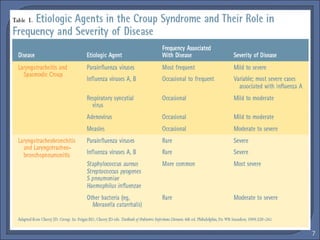
1. Parainfluenza viruses ( tipes 1,2 and
3) : 65 %
2. Adenovirus, RSV, Measles
3. Mycoplasma pneumoniae
5
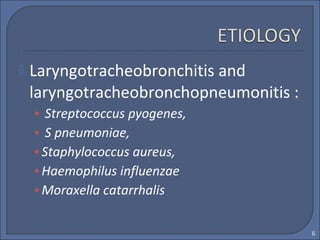
 Laryngotracheobronchitis and
laryngotracheobronchopneumonitis :
• Streptococcus pyogenes,
• S pneumoniae,
•Staphylococcus aureus,
•Haemophilus influenzae
•Moraxella catarrhalis
6
7
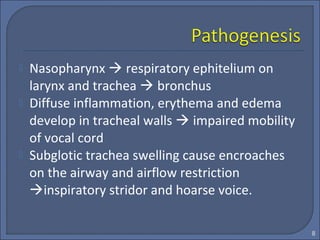
 Nasopharynx  respiratory ephitelium on
larynx and trachea  bronchus
 Diffuse inflammation, erythema and edema
develop in tracheal walls  impaired mobility
of vocal cord
 Subglotic trachea swelling cause encroaches
on the airway and airflow restriction
inspiratory stridor and hoarse voice.
8
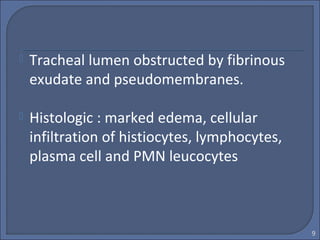
 Tracheal lumen obstructed by fibrinous
exudate and pseudomembranes.
 Histologic : marked edema, cellular
infiltration of histiocytes, lymphocytes,
plasma cell and PMN leucocytes
9
 Rhinorrhea, pharyngitis, low grade fever of
few days duration, and mild cough
 After 12-48 hours upper airway obstructive
sign and symtomss are noted “barking”
cough, hoarseness, and inspiratory stridor,
fever +/-
10
 Hoarse voice, coryza, a normal or inflamed
pharynx and slightly increased RR
 Most cases only the hoarseness and barky
cough, no evidence or airway obstruction
 Gradualy normalize whithin 3-7 days.
11
 Increasing severity of obstruction and
accompanied by:
• Increasing HR and RR
• Flaring of alar nasi
• Cyanosis with supra and infraclavicular and sternal
retraction
• Restless and anxious with the development of
progressive hypoxia
• Duration of illness 7-14 days
12
 Elevated WBC above 10x109
/L ( 10.000/cu mm
), PMN predominant
 Anterior CXR : subglottitis narrowing
13
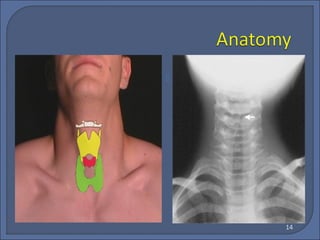

14
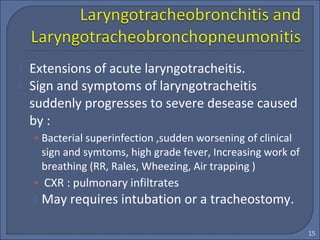
 Extensions of acute laryngotracheitis.
 Sign and symptoms of laryngotracheitis
suddenly progresses to severe desease caused
by :
• Bacterial superinfection ,sudden worsening of clinical
sign and symtoms, high grade fever, Increasing work of
breathing (RR, Rales, Wheezing, Air trapping )
• CXR : pulmonary infiltrates
 May requires intubation or a tracheostomy.
15
 Occur at night, children 3 months – 3
years
 Awakens at night with sudden dyspnea,
croupy cough, and inspiratory stridor
(sudden subglottic edema), no fever
 Endoscopic : pale and boggy laryngeal
mucosa
16
 Epiglottitis :
• Lack of croupy cough, drooling, toxic appearance,
growing anxiety and apprehension
• A sitting posture, chin pushed forward, refuse to lie
down
• Inspection : cherry-red epiglottis
17
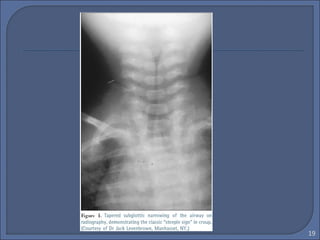
• Laringotracheitis :“ The Steeple
Sign”
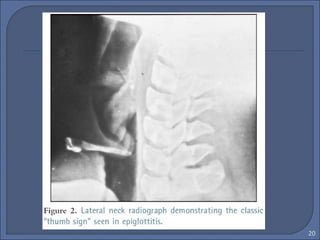
• Epiglottitis : “ Thumb Sign”
18
19
20
 DD :
• Foreign body aspiration and angioneurotic edema
• Laryngeal diphtheria
• Retropharyngeal or peritonsilar abscess
• Subglottic stenosis
• Infectious mononucleosis
• Bacterial tracheitis
• Paraquat poisoning
• Importance information : immunization history,
clinical evidence of pharyngeal involvement,
greater degree of hoarseness and relative
slowness of disease progression
21
 Primarily : Clinical
 CXR : Plain film of the neck
• Steeple sign
• Overdistended hypo pharynx( lateral)
 Pulse Oxymetri : maybe normal
 Need : serial observation and frequent
physical exam
22
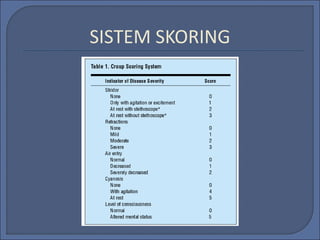
SISTEM SKORING
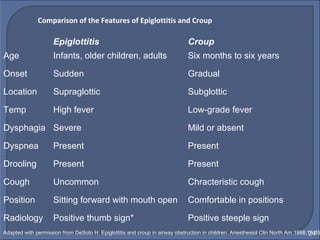
Epiglottitis Croup
Age Infants, older children, adults Six months to six years
Onset Sudden Gradual
Location Supraglottic Subglottic
Temp High fever Low-grade fever
Dysphagia Severe Mild or absent
Dyspnea Present Present
Drooling Present Present
Cough Uncommon Chracteristic cough
Position Sitting forward with mouth open Comfortable in positions
Radiology Positive thumb sign* Positive steeple sign
Adapted with permission from DeSoto H. Epiglottitis and croup in airway obstruction in children. Anesthesiol Clin North Am 1998;16:85
Comparison of the Features of Epiglottitis and Croup
24
 Serial observation
 Mist therapy
 Epinephrine
 Steroids
25
 Cool mist is as effective as hot steam
 Cool mist moistens airway secretions
 Humidity ↓ the viscosity of mucus
secretions
26
 Stimulate α-adrenergic receptor
 For moderate to severe distress
 Decreased stridor/retractions (<2hrs)
• Rebound phenomenon
• Observe 3-4hrs after administration
 Side effects: tachycardia, hypertension
27
 Dose : 0,25 - 0,75 ml of 2,25 % racemic
epinephrine solution in 2,5 ml NaCL, every 20
mnt
 If not available, 5 ml mixture of l-isomer
epinephrine and saline ( 1:100)
 Caution : tachycardia, ToF, Ventricular outlet
obstruction
28
 Single parenteral dose;
• 0,6 mg/kgBW dexamethason( max 10 mg)
• 0,15 mg /kgBW dexamethason is as effective as 0,3 or
0,6 mg /kgBW in relieving symptom
•Clinical improvement not apparent until 6
hrs of initiation of treatment
•Nebulized budesonide (dose 2 - 4 mg), rapid
effect (2-4 hour)
29
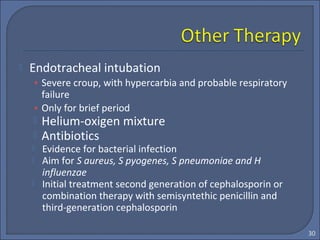
 Endotracheal intubation
• Severe croup, with hypercarbia and probable respiratory
failure
• Only for brief period
 Helium-oxigen mixture
 Antibiotics
 Evidence for bacterial infection
 Aim for S aureus, S pyogenes, S pneumoniae and H
influenzae
 Initial treatment second generation of cephalosporin or
combination therapy with semisyntethic penicillin and
third-generation cephalosporin
30
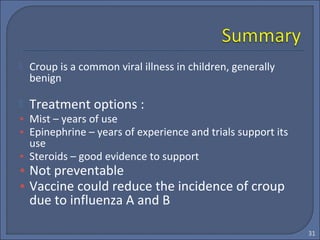
 Croup is a common viral illness in children, generally
benign
 Treatment options :
• Mist – years of use
• Epinephrine – years of experience and trials support its
use
• Steroids – good evidence to support
• Not preventable
• Vaccine could reduce the incidence of croup
due to influenza A and B
31
32
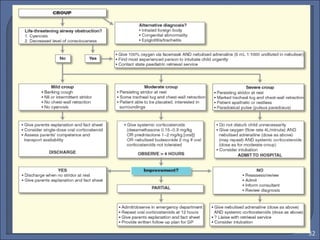
croup

croup

  • 1.
  • 2.
     “Croup syndrome”: a group of diseases • Laryngotracheitis • Spasmodic croup, • Bacterial tracheitis, • Laryngotracheobronchitis, and • Laryngotracheobronchopneumonitis.  Manifestation : Hoarse voice ; dry, barking cough; inspiratory stridor; and respiratory distress ,develops over a brief period of time  Infection: Common and typical 2
  • 3.
    1. Acute viralinfection : acute laryngotracheitis  obstruction of the upper airway, larynx, infraglottic tissues, trachea 2. Bacterial and atypical agents 3. Noninfectious : foreign body aspiration, trauma (Intubation), and allergic reaction ( acute angioneurotic edema) 3
  • 4.
     15 %of respiratory tract disease  Aged 1-6 years of age ( mean:18 mo)  Peak incidence, 5 cases / 100 during second year of life,  Boys > Girls 4
  • 5.
    1. Parainfluenza viruses( tipes 1,2 and 3) : 65 % 2. Adenovirus, RSV, Measles 3. Mycoplasma pneumoniae 5
  • 6.
     Laryngotracheobronchitis and laryngotracheobronchopneumonitis: • Streptococcus pyogenes, • S pneumoniae, •Staphylococcus aureus, •Haemophilus influenzae •Moraxella catarrhalis 6
  • 7.
  • 8.
     Nasopharynx respiratory ephitelium on larynx and trachea  bronchus  Diffuse inflammation, erythema and edema develop in tracheal walls  impaired mobility of vocal cord  Subglotic trachea swelling cause encroaches on the airway and airflow restriction inspiratory stridor and hoarse voice. 8
  • 9.
     Tracheal lumenobstructed by fibrinous exudate and pseudomembranes.  Histologic : marked edema, cellular infiltration of histiocytes, lymphocytes, plasma cell and PMN leucocytes 9
  • 10.
     Rhinorrhea, pharyngitis,low grade fever of few days duration, and mild cough  After 12-48 hours upper airway obstructive sign and symtomss are noted “barking” cough, hoarseness, and inspiratory stridor, fever +/- 10
  • 11.
     Hoarse voice,coryza, a normal or inflamed pharynx and slightly increased RR  Most cases only the hoarseness and barky cough, no evidence or airway obstruction  Gradualy normalize whithin 3-7 days. 11
  • 12.
     Increasing severityof obstruction and accompanied by: • Increasing HR and RR • Flaring of alar nasi • Cyanosis with supra and infraclavicular and sternal retraction • Restless and anxious with the development of progressive hypoxia • Duration of illness 7-14 days 12
  • 13.
     Elevated WBCabove 10x109 /L ( 10.000/cu mm ), PMN predominant  Anterior CXR : subglottitis narrowing 13
  • 14.
  • 15.
     Extensions ofacute laryngotracheitis.  Sign and symptoms of laryngotracheitis suddenly progresses to severe desease caused by : • Bacterial superinfection ,sudden worsening of clinical sign and symtoms, high grade fever, Increasing work of breathing (RR, Rales, Wheezing, Air trapping ) • CXR : pulmonary infiltrates  May requires intubation or a tracheostomy. 15
  • 16.
     Occur atnight, children 3 months – 3 years  Awakens at night with sudden dyspnea, croupy cough, and inspiratory stridor (sudden subglottic edema), no fever  Endoscopic : pale and boggy laryngeal mucosa 16
  • 17.
     Epiglottitis : •Lack of croupy cough, drooling, toxic appearance, growing anxiety and apprehension • A sitting posture, chin pushed forward, refuse to lie down • Inspection : cherry-red epiglottis 17
  • 18.
    • Laringotracheitis :“The Steeple Sign” • Epiglottitis : “ Thumb Sign” 18
  • 19.
  • 20.
  • 21.
     DD : •Foreign body aspiration and angioneurotic edema • Laryngeal diphtheria • Retropharyngeal or peritonsilar abscess • Subglottic stenosis • Infectious mononucleosis • Bacterial tracheitis • Paraquat poisoning • Importance information : immunization history, clinical evidence of pharyngeal involvement, greater degree of hoarseness and relative slowness of disease progression 21
  • 22.
     Primarily :Clinical  CXR : Plain film of the neck • Steeple sign • Overdistended hypo pharynx( lateral)  Pulse Oxymetri : maybe normal  Need : serial observation and frequent physical exam 22
  • 23.
  • 24.
    Epiglottitis Croup Age Infants,older children, adults Six months to six years Onset Sudden Gradual Location Supraglottic Subglottic Temp High fever Low-grade fever Dysphagia Severe Mild or absent Dyspnea Present Present Drooling Present Present Cough Uncommon Chracteristic cough Position Sitting forward with mouth open Comfortable in positions Radiology Positive thumb sign* Positive steeple sign Adapted with permission from DeSoto H. Epiglottitis and croup in airway obstruction in children. Anesthesiol Clin North Am 1998;16:85 Comparison of the Features of Epiglottitis and Croup 24
  • 25.
     Serial observation Mist therapy  Epinephrine  Steroids 25
  • 26.
     Cool mistis as effective as hot steam  Cool mist moistens airway secretions  Humidity ↓ the viscosity of mucus secretions 26
  • 27.
     Stimulate α-adrenergicreceptor  For moderate to severe distress  Decreased stridor/retractions (<2hrs) • Rebound phenomenon • Observe 3-4hrs after administration  Side effects: tachycardia, hypertension 27
  • 28.
     Dose :0,25 - 0,75 ml of 2,25 % racemic epinephrine solution in 2,5 ml NaCL, every 20 mnt  If not available, 5 ml mixture of l-isomer epinephrine and saline ( 1:100)  Caution : tachycardia, ToF, Ventricular outlet obstruction 28
  • 29.
     Single parenteraldose; • 0,6 mg/kgBW dexamethason( max 10 mg) • 0,15 mg /kgBW dexamethason is as effective as 0,3 or 0,6 mg /kgBW in relieving symptom •Clinical improvement not apparent until 6 hrs of initiation of treatment •Nebulized budesonide (dose 2 - 4 mg), rapid effect (2-4 hour) 29
  • 30.
     Endotracheal intubation •Severe croup, with hypercarbia and probable respiratory failure • Only for brief period  Helium-oxigen mixture  Antibiotics  Evidence for bacterial infection  Aim for S aureus, S pyogenes, S pneumoniae and H influenzae  Initial treatment second generation of cephalosporin or combination therapy with semisyntethic penicillin and third-generation cephalosporin 30
  • 31.
     Croup isa common viral illness in children, generally benign  Treatment options : • Mist – years of use • Epinephrine – years of experience and trials support its use • Steroids – good evidence to support • Not preventable • Vaccine could reduce the incidence of croup due to influenza A and B 31
  • 32.

Editor's Notes

  • #15 Behind cricoid cartilage is narrowest point of larynx – illness leads to inflammation/edema/obstruction of airflow
  • #26 Serial obs=frequent exams if in-house Mist tx: turning on shower in closed bathroom or taking child outside no evidence to support! One small study showed no difference in mod croup in ED, may cool mucosa, cause vasoconstriction and decr edema
  • #28 Epi decreases secretions and edema