Ensuring Continuing Access to Online Scholarly Resources   Stewardship & Service, Curation & Preservation, Open Access,  Geography & History! Peter Burnhill Director, EDINA National Data Centre,  University of Edinburgh, Scotland UK September 2009
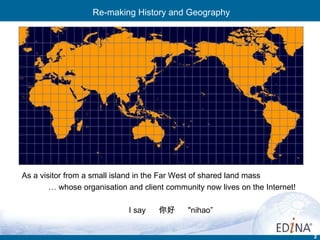
Re-making History and Geography As a visitor from a small island in the Far West of shared land mass …  whose organisation and client community now lives on the Internet! I say  你好   "nihao”
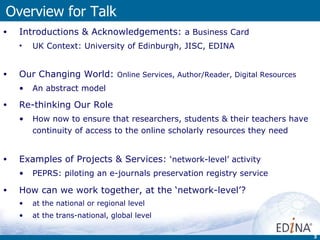
Overview for Talk  Introductions & Acknowledgements:  a  Business Card UK Context:  University of Edinburgh, JISC, EDINA Our Changing World:  Online Services, Author/Reader, Digital Resources An abstract model Re-thinking Our Role   How now to ensure that researchers, students & their teachers have continuity of access to the online scholarly resources they need Examples of Projects & Services:  ‘network-level’ activity PEPRS: piloting an e-journals preservation registry service How can we work together, at the ‘network-level’? at the national or regional level  at the trans-national, global level
Overview for Talk  * Happy to break for Questions after each part* Introductions & Acknowledgements:  a  Business Card UK Context:  University of Edinburgh, JISC, EDINA Our Changing World:  Online Services, Author/Reader, Digital Resources An abstract model Re-thinking Our Role   How now to ensure that researchers, students & their teachers have continuity of access to the online scholarly resources they need Examples of Projects & Services:  ‘network-level’ activity PEPRS: piloting an e-journals preservation registry service How can we work together, at the ‘network-level’? at the national or regional level  at the trans-national, global level
1.  Introduction and  Business Card: setting the scene Personal biography / background ‘ 25 years of digital  in experience’   [email_address]   University of Edinburgh   www.ed.ac.uk ‘ my employer’ and ‘the host institution for EDINA’ JISC - Joint Information Systems Committee  www.jisc.ac.uk ‘ UK context’, ‘the money’ and ‘the vision’ EDINA    www.edina.ac.uk ‘ the organisation I lead’
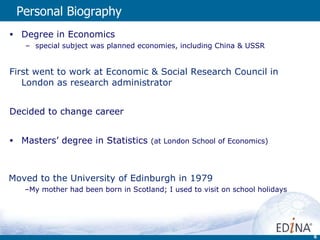
Personal Biography  Degree in Economics special subject was planned economies, including China & USSR First went to work at Economic & Social Research Council in London as research administrator  Decided to change career Masters’ degree in Statistics  (at London School of Economics)   Moved to the University of Edinburgh in 1979 My mother had been born in Scotland; I used to visit on school holidays
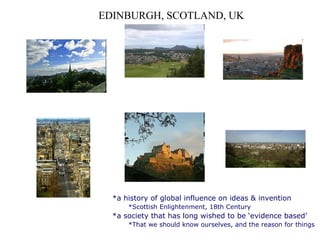
EDINBURGH, SCOTLAND, UK a history of global influence on ideas & invention Scottish Enlightenment, 18th Century  a society that has long wished to be ‘evidence based’ That we should know ourselves, and the reason for things
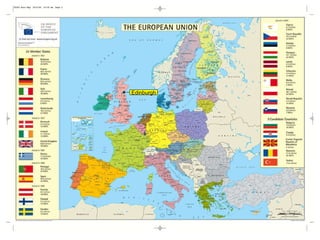
Edinburgh
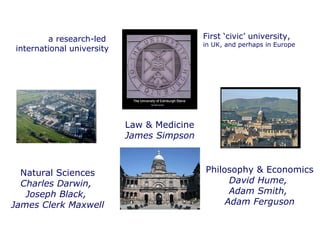
UNIVERSITY OF EDINBURGH.  Founded 1582 First ‘civic’ university,  in UK, and perhaps in Europe a research-led  international university Philosophy & Economics David Hume,  Adam Smith,  Adam Ferguson Natural Sciences Charles Darwin,  Joseph Black,  James Clerk Maxwell Law & Medicine James Simpson
University of Edinburgh is aiming to be World Class! 23rd  [up from 30th in 2005]  in ‘Times Higher’ 2008 World University Rankings: 1 st  Harvard (USA); 2 nd = Cambridge & Oxford (UK), Yale (USA)  .  6 th  Imperial College London; 7 th  University College London (UK) .  22 nd   Kings College London;   23 rd   Edinburgh;  29 th  Manchester USA has 58 in the top 200, EU has 82, including UK with 29 *  Not the only Index/Ranking;   Should anyone worry about such statistics? The six criteria, weighted and added together, are peer review (40%), citations (20%), staff/student ratio (20%), employer review (10%), international staff (5%) and international students (5%).
University of Edinburgh in 2007/8   (2003/4) Total Students:   25,700   (23,000)   full time: 21,500  (20,000) part time: 4,200  ( 3,000)   Type of student   % undergraduates 72  (75) taught postgraduates 14  (11)   research postgraduates 14  (14) Student Origin % from Scotland  46  (46) Other UK  32  (30) EU  9  ( 8) other international  15  (14) 2% from China Total income (ÂŁm):   555  (353)  HE Funding Councils  177  (125) Research Grants/Contracts  143  (103) Student Fees  82  ( 54) [3,000 academic + 3,000+ other staff = ÂŁ297m (ÂŁ202m)] Source of Research Income (ÂŁm):  143  (103) % Research Councils 41 (35) Charities  24 (28) UK Government, eg JISC  13 (22) EU Bodies 14  ( 7) Commerce  10  ( 6) Note:  in 2003/4, EDINA earnt ÂŁ2.5m of the ÂŁ4m the University gets from the JISC [update for 2007/08] 26,424 students in 2008/9 ?% from China Strategy is to reduce dependence on Government and to internationalize.
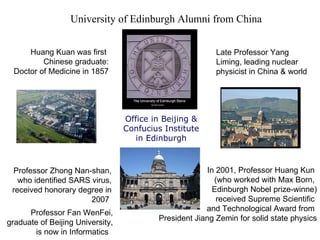
UNIVERSITY OF EDINBURGH.  Founded 1582 University of Edinburgh  Alumni from China  Office in Beijing &  Confucius Institute  in Edinburgh  Huang Kuan was first  Chinese graduate: Doctor of Medicine in 1857 Late Professor Yang Liming, leading nuclear physicist in China & world Professor Zhong Nan-shan, who identified SARS virus, received honorary degree in 2007  In 2001, Professor Huang Kun  (who worked with Max Born,  Edinburgh Nobel prize-winne) received Supreme Scientific  and Technological Award from  President Jiang Zemin for solid state physics Professor Fan WenFei, graduate of Beijing University, is now in Informatics
So, I’m a data person  Employed by the University of Edinburgh, since 1979 First as survey statistician in research centre for educational sociology & then senior lecturer in social science graduate school In 1984 I changed career again to set up Edinburgh University Data Library Then combining that with   Co-director, Regional Research Laboratory for Scotland, 1987/93 Director, EDINA national data centre, 1996 - present day Past-President of IASSIST, 1996 - 2001 international assoc. for data librarians and archivists www.iassistdata.org Director, Digital Curation Centre, 2004 - 2006  (Phase 1)   www.dcc.ac 25 years of digital  in experience  as information methodologist and strategist and I have had to learn to work with, and for: other researchers, librarians, software engineers, data curators, teachers, etc
wearing two formal hats Director, EDINA National Data Centre with a staff of 75+  serving staff and students at all UK universities and colleges 2. Member of the directorate of the Information Services at University of Edinburgh My boss: Vice-Principal for Knowledge Management & Librarian to University My colleagues: Directors of Libraries, of Computing and of AV/Learning Technology, now in converged service divisions   Also speaking here with you as a fellow professional trying to make sense of what is going on,  planning for the future during ‘interesting times’ funded by the JISC,  so I must say something about JISC!
 
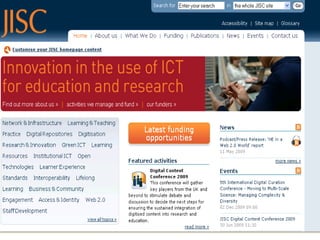
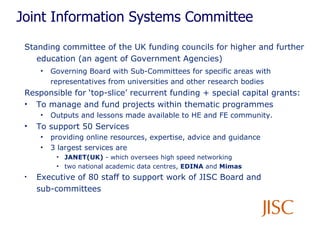
Joint Information Systems Committee Standing committee of the UK funding councils for higher and further education (an agent of Government Agencies) Governing Board with Sub-Committees for specific areas with representatives from universities and other research bodies Responsible for ‘top-slice’ recurrent funding + special capital grants:   To manage and fund projects within thematic programmes Outputs and lessons made available to HE and FE community.  To support 50 Services providing online resources, expertise, advice and guidance 3 largest services are  JANET(UK)  - which oversees high speed networking  two national academic data centres,  EDINA  and  Mimas Executive of 80 staff to support work of JISC Board and  sub-committees
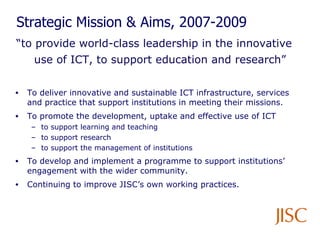
Strategic Mission & Aims, 2007-2009 “ to provide world-class leadership in the innovative use of ICT, to support education and research” To deliver innovative and sustainable ICT infrastructure, services and practice that support institutions in meeting their missions. To promote the development, uptake and effective use of ICT  to support learning and teaching to support research to support the management of institutions  To develop and implement a programme to support institutions’ engagement with the wider community. Continuing to improve JISC’s own working practices.
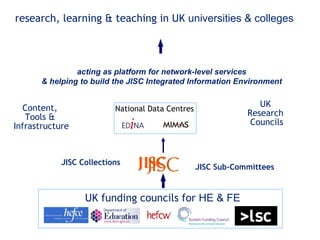
UK funding councils for  HE & FE  Content,  Tools &  Infrastructure JISC Sub-Committees JISC Collections acting as platform for network-level services  &   helping to build the JISC Integrated Information Environment  research, learning & teaching in UK  universities & colleges UK  Research  Councils National Data Centres
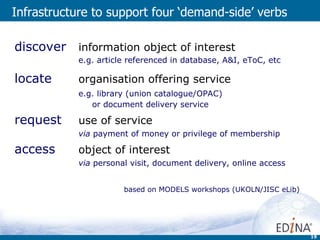
Infrastructure to support four ‘demand-side’ verbs discover  information object of interest e.g. article referenced in database, A&I, eToC, etc locate  organisation offering service   e.g. library (union catalogue/OPAC)    or document delivery service request use of service via  payment of money or privilege of membership  access object of interest via  personal visit, document delivery, online access   based on MODELS workshops (UKOLN/JISC eLib)
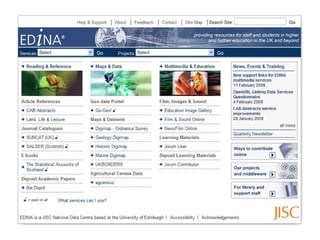
EDINA, UK National Data Centre Mission: to enhance productivity of research, learning & teaching in higher & further education delivering online services, 24/7 … http:// edina.ac.uk
 
EDINA, UK National Data Centre EDINA designated as national data centre in 1995/96 University had to compete for the role and status based on online experience of University’s Data Library, 1983/84 - There is a ‘sister’ national data centre, Mimas at University of Manchester Acknowledged high quality of online service, 24/7  (99% uptime) good reputation for helpdesk, user interfaces, FAQs etc geared to researchers and students and end-users with support of librarians and other academic support staff  Acknowledged project competence for R&D we work with Researchers; we turn their work into Development  Growth in online services, client base and usage, year-on-year E dinburgh  D ata  IN formation  A ccess ‘ Edina’ is also the poetic name for Edinburgh Referred to by Robert Burns in ‘Address to Edinburgh’, 1793 A digitized copy of the manuscript is on our website!
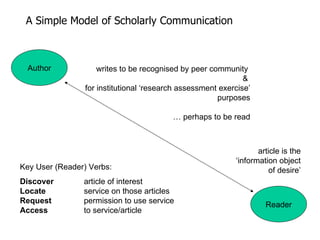
2.  Our Changing World   Time to re-examine old verities in our scholarly world about 40 years after the invention of the Internet  and only 13 years since the arrival of the Web. How should we re-think our online services, as value-added network-level services? as the relationship between Author and Reader is changing as we must deal with all sorts of digital resources Time to play with an abstract model …  ...  a picture show
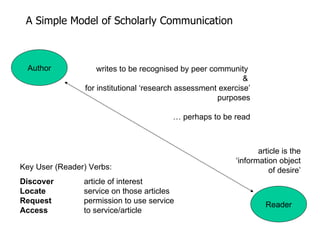
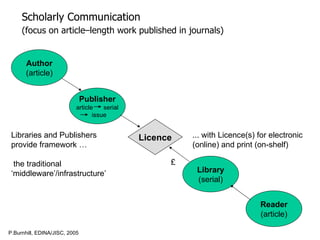
A Simple Model of Scholarly Communication Author Reader writes to be recognised by peer community  &  for institutional ‘research assessment exercise’ purposes    … perhaps to be read Key User (Reader) Verbs: Discover  article of interest Locate  service on those articles Request  permission to use service Access to service/article article is the ‘information object of desire’
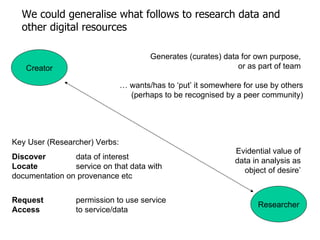
We could generalise what follows to research data and other digital resources  Creator Researcher Generates (curates) data for own purpose,  or as part of team     … wants/has to ‘put’ it somewhere for use by others (perhaps to be recognised by a peer community) Key User (Researcher) Verbs: Discover  data of interest Locate  service on that data with documentation on provenance etc  Request  permission to use service Access to service/data  Evidential value of data in analysis as object of desire’
A Simple Model of Scholarly Communication Author Reader writes to be recognised by peer community  &  for institutional ‘research assessment exercise’ purposes    … perhaps to be read Key User (Reader) Verbs: Discover  article of interest Locate  service on those articles Request  permission to use service Access to service/article article is the ‘information object of desire’
Author (article) Reader (article) Publisher article  serial issue Library (serial) Licence Scholarly Communication (focus on article–length work published in journals)   Libraries and Publishers provide framework … the traditional ‘middleware’/infrastructure’  ... with Licence(s) for electronic (online) and print (on-shelf) £ P.Burnhill, EDINA/JISC, 2005
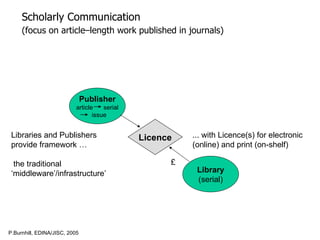
Publisher article  serial issue Library (serial) Licence Scholarly Communication (focus on article–length work published in journals)   Libraries and Publishers provide framework … the traditional ‘middleware’/infrastructure’  ... with Licence(s) for electronic (online) and print (on-shelf) £ P.Burnhill, EDINA/JISC, 2005
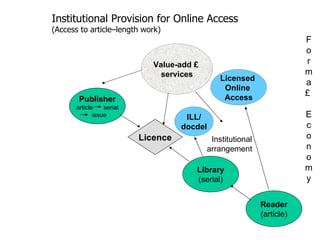
Reader (article) Publisher article  serial issue Library (serial) Licence Institutional Provision for Online Access  (Access to article–length work)  Institutional arrangement  Licensed  Online  Access Fo rma£  E c onomy ILL/ docdel Value-add £  services
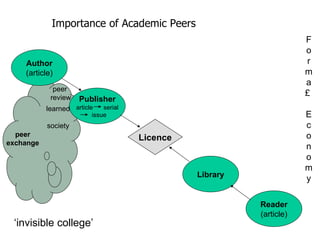
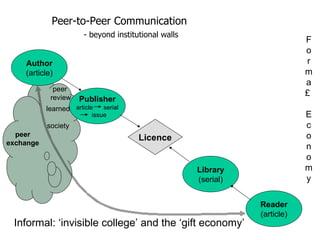
Author (article) Reader (article) Publisher article  serial issue Library Licence Importance of Academic Peers  peer  review peer exchange ‘ invisible college’ Fo rma£  E c onomy learned  society
Author (article) Reader (article) Publisher article  serial issue Library (serial) Licence Peer-to-Peer Communication  - beyond institutional walls peer  review peer exchange Informal: ‘invisible college’ and the ‘gift economy’ Fo rma£  E c onomy learned  society
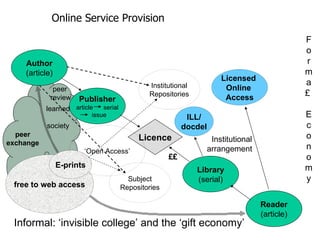
Author (article) Reader (article) Publisher article  serial issue Library (serial) Licence Online Service Provision peer  review peer exchange Informal: ‘invisible college’ and the ‘gift economy’ Institutional arrangement  Licensed  Online  Access Fo rma£  E c onomy ILL/ docdel ‘ Open Access’ Institutional Repositories free to web access E-prints ££ learned  society Subject Repositories
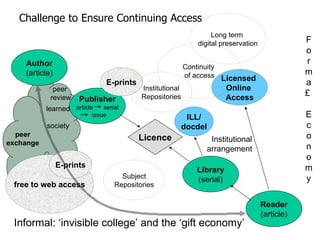
Author (article) Reader (article) Publisher article  serial issue Library (serial) Licence Challenge to Ensure Continuing Access peer  review peer exchange Informal: ‘invisible college’ and the ‘gift economy’ Institutional arrangement  Licensed  Online  Access Fo rma£  E c onomy ILL/ docdel Continuity  of access learned  society Long term  digital preservation E-prints Institutional Repositories free to web access E-prints Subject Repositories
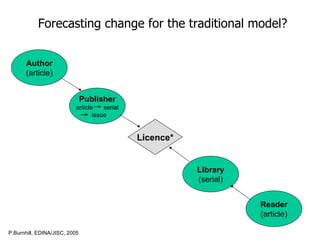
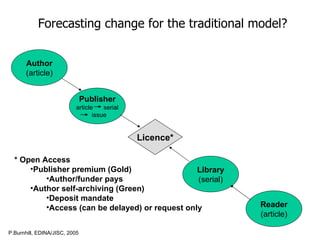
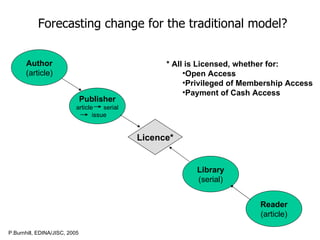
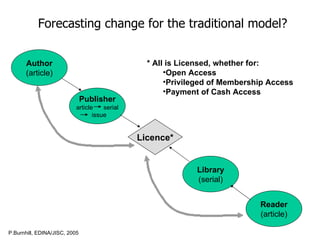
Author (article) Reader (article) Publisher article  serial issue Library (serial) Licence* Forecasting change for the traditional model?   P.Burnhill, EDINA/JISC, 2005
Author (article) Reader (article) Publisher article  serial issue Library (serial) Licence* Forecasting change for the traditional model?   P.Burnhill, EDINA/JISC, 2005 * Open Access Publisher premium (Gold) Author/funder pays Author self-archiving (Green) Deposit mandate Access (can be delayed) or request only
Author (article) Reader (article) Publisher article  serial issue Library (serial) Licence* Forecasting change for the traditional model?   P.Burnhill, EDINA/JISC, 2005 * All is Licensed, whether for: Open Access Privileged of Membership Access Payment of Cash Access
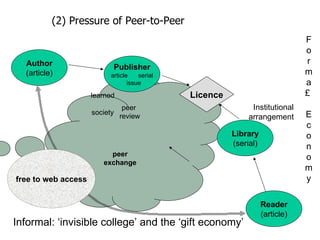
Author (article) Reader (article) Publisher article  serial issue Library (serial) Licence (2) Pressure of Peer-to-Peer peer  review peer exchange Informal: ‘invisible college’ and the ‘gift economy’ Institutional arrangement  Fo rma£  E c onomy learned  society free to web access
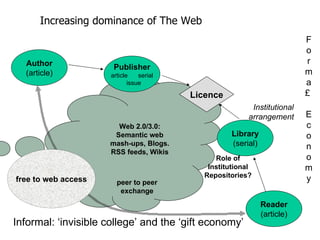
Author (article) Reader (article) Publisher article  serial issue Library (serial) Licence Increasing dominance of The Web peer to peer exchange Informal: ‘invisible college’ and the ‘gift economy’ Institutional arrangement   Fo rma£  E c onomy free to web access Role of Institutional Repositories? Web 2.0/3.0: Semantic web mash-ups, Blogs. RSS feeds, Wikis
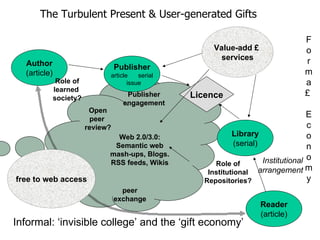
Author (article) Reader (article) Publisher article  serial issue Library (serial) Licence The Turbulent Present & User-generated Gifts  Open peer  review? peer exchange Informal: ‘invisible college’ and the ‘gift economy’ Institutional arrangement   Fo rma£  E c onomy Role of learned  society? free to web access Role of Institutional Repositories? Web 2.0/3.0: Semantic web mash-ups, Blogs. RSS feeds, Wikis Publisher engagement Value-add £  services
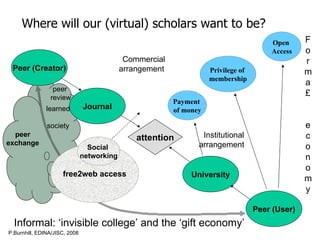
Peer (Creator) Peer (User) University attention Where will our (virtual) scholars want to be? peer  review peer exchange Informal: ‘invisible college’ and the ‘gift economy’ Institutional arrangement  Privilege of  membership Forma£  economy Open  Access free2web access Social  networking learned  society P.Burnhill, EDINA/JISC, 2008 Journal Commercial arrangement  Payment  of money
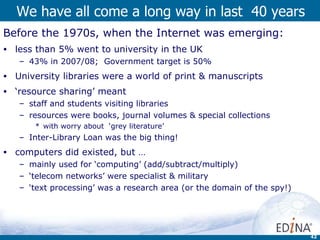
We have all come a long way in last  40 years  Before the 1970s, when the Internet was emerging: less than 5% went to university in the UK  43% in 2007/08;  Government target is 50% University libraries were a world of print & manuscripts ‘ resource sharing’ meant staff and students visiting libraries resources were books, journal volumes & special collections with worry about  ‘grey literature’ Inter-Library Loan was the big thing! computers did existed, but … mainly used for ‘computing’ (add/subtract/multiply) ‘ telecom networks’ were specialist & military  ‘ text processing’ was a research area (or the domain of the spy!)
3. Re-thinking Our Role: Emergence of Digital Library mix of the document tradition   ( signifying objects & their use)   and the computation tradition   ( applying algorithmic, logical, mathematical, and mechanical techniques to information management) “ Both traditions are needed. Information Science is rooted in part in humanities and qualitative social sciences. The landscape of Information Science is complex. An ecumenical view is needed.” M.Buckland,  Journal of American Society for Information Science, 50 p970-74 1999 More than ‘just’ published scholarly record in journals and books More than what has been digitized; need to include the ‘born digital’ The digital library has words, numbers, pictures and sounds  Numeric data, online learning & teaching materials, digital pictures and other audio-visual materials What do researchers do? And what do they want/need of a digital library - that they cannot do for themselves?
Re-thinking  stewardship for scholarly works The central task is to ensure that researchers, students & their teachers have continuity of access to the online scholarly resources they need Digital preservation is crucial but need to keep focus on ‘continuity of access’ "I am in no way interested in immortality,  but only in the taste of tea." Lu T'ung (born 755 A.D., reputedly lived 400 years)
4.  EDINA’s role at the network level In mid-90s, we had planned a future based on hosting key A&I Databases, but market changed. Since 2002 we have been re-making our future with: Suncat , UK national union catalogue of serials National OpenURL Router, as registry of OpenURL resolvers in use Access control: Privilege of Membership (rather than Payment of Money) Investigated Shibboleth for JISC and Developed pilot for UK Access Management Federation for Education & Research  Now funded as Technical (metadata) Operator & JISC Expert Group Digital preservation CLOCKSS Access Host for orphaned content; Edinburgh University as Archive Node Technical support for UK LOCKSS Alliance cooperative  Piloting an e-journals preservation registry, with ISSN-IC [will say more] User Generated Content & Open Access  The Depot, an Open Access deposit facility Jorum for learning and teaching materials  having already diversified with GeoSpatial and Multimedia, and supporting JISC with e-learning …
Examples of ‘Network-level’ Projects & Services For this talk: PEPRS: piloting an e-journals preservation registry service For some other talk: The Depot and OA Repository Junction  open access deposit Datashare  Data as ‘evidence’  how to support researchers and their research data Jorum  the UK national repository for online learning & teaching materials Spatial Data Infrastructure: Digimap and ShareGeo  Topographic mapping data, from national mapping agency Marine & Geological mapping data Sounds and Pictures (moving & still) as digital resource Enhancing the cultural record as data for research UK Access Management Federation / Shibboleth  Authentication & Authorisation
blank  <insert slides on PEPRS>
5. Framework for collaborative activity at the regional or national level  UK China, USA, etc at the trans-national level across EU Funding Programmes across nation states, eg ASEAN/AUNILO Internationally CLOCKSS:  (Controlled) Lots of Copies Keep Stuff Safe PEPRS
Re-thinking the reach of  our stewardship   What is special about scholarship?  What is so different about digital? What is so terrific about the tele-matics of the Internet? All that is digital & accessed from afar Sharing across geography with wider world Sharing across time with future scholarship Example The CLOCKSS initiative  www.clockss.org World’s leading publishers agree to the routine ingest of their digital journal content into global dark archive of 11 long-lived libraries acting as Archive Nodes Uses the LOCKSS (Lots Of Copies Keep Stuff Safe) technology that automatically checks across the Archive Nodes on the Internet to ensure bit-consistency and integrity
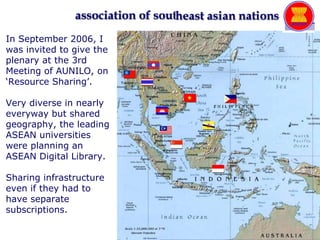
In September 2006, I was invited to give the plenary at the 3rd Meeting of AUNILO, on ‘Resource Sharing’.  Very diverse in nearly everyway but shared geography, the leading ASEAN universities were planning an ASEAN Digital Library. Sharing infrastructure even if they had to have separate subscriptions.
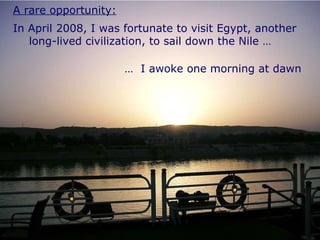
A rare opportunity: In April 2008, I was fortunate to visit Egypt, another long-lived civilization, to sail down the Nile … …  I awoke one morning at dawn
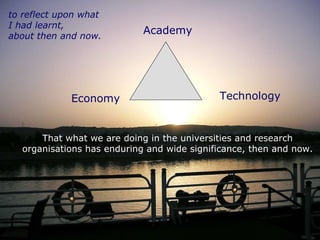
Academy Economy Technology That what we are doing in the universities and research  organisations has enduring and wide significance, then and now.  to reflect upon what  I had learnt,  about then and now.
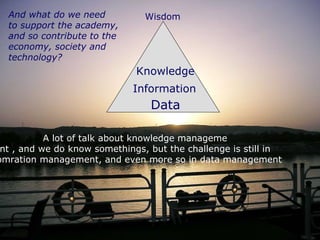
Knowledge Data Information A lot of talk about knowledge manageme nt , and we do know somethings, but the challenge is still in infomration management, and even more so in data management  And what do we need to support the academy,  and so contribute to the  economy, society and  technology? Wisdom
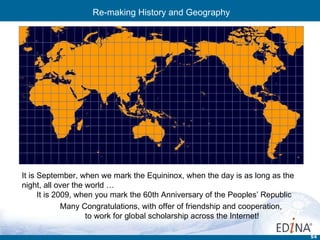
It is September, when we mark the Equininox, when the day is as long as the night, all over the world … It is 2009, when you mark the 60th Anniversary of the Peoples’ Republic Many Congratulations, with offer of friendship and cooperation,  to work for global scholarship across the Internet! Re-making History and Geography
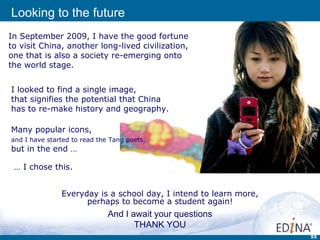
Everyday is a school day, I intend to learn more, perhaps to become a student again! In September 2009, I have the good fortune  to visit China, another long-lived civilization,  one that is also a society re-emerging onto the world stage. I looked to find a single image,  that signifies the potential that China  has to re-make history and geography.  Looking to the future Many popular icons,  and I have started to read the Tang poets,   but in the end … And I await your questions THANK YOU …  I chose this.

Ensuring Continuing Access to Online Scholarly Resources - China

  • 1.
    Ensuring Continuing Accessto Online Scholarly Resources Stewardship & Service, Curation & Preservation, Open Access, Geography & History! Peter Burnhill Director, EDINA National Data Centre, University of Edinburgh, Scotland UK September 2009
  • 2.
    Re-making History andGeography As a visitor from a small island in the Far West of shared land mass … whose organisation and client community now lives on the Internet! I say 你好 &quot;nihao”
  • 3.
    Overview for Talk Introductions & Acknowledgements: a Business Card UK Context: University of Edinburgh, JISC, EDINA Our Changing World: Online Services, Author/Reader, Digital Resources An abstract model Re-thinking Our Role How now to ensure that researchers, students & their teachers have continuity of access to the online scholarly resources they need Examples of Projects & Services: ‘network-level’ activity PEPRS: piloting an e-journals preservation registry service How can we work together, at the ‘network-level’? at the national or regional level at the trans-national, global level
  • 4.
    Overview for Talk * Happy to break for Questions after each part* Introductions & Acknowledgements: a Business Card UK Context: University of Edinburgh, JISC, EDINA Our Changing World: Online Services, Author/Reader, Digital Resources An abstract model Re-thinking Our Role How now to ensure that researchers, students & their teachers have continuity of access to the online scholarly resources they need Examples of Projects & Services: ‘network-level’ activity PEPRS: piloting an e-journals preservation registry service How can we work together, at the ‘network-level’? at the national or regional level at the trans-national, global level
  • 5.
    1. Introductionand Business Card: setting the scene Personal biography / background ‘ 25 years of digital in experience’ [email_address] University of Edinburgh www.ed.ac.uk ‘ my employer’ and ‘the host institution for EDINA’ JISC - Joint Information Systems Committee www.jisc.ac.uk ‘ UK context’, ‘the money’ and ‘the vision’ EDINA www.edina.ac.uk ‘ the organisation I lead’
  • 6.
    Personal Biography Degree in Economics special subject was planned economies, including China & USSR First went to work at Economic & Social Research Council in London as research administrator Decided to change career Masters’ degree in Statistics (at London School of Economics) Moved to the University of Edinburgh in 1979 My mother had been born in Scotland; I used to visit on school holidays
  • 7.
    EDINBURGH, SCOTLAND, UKa history of global influence on ideas & invention Scottish Enlightenment, 18th Century a society that has long wished to be ‘evidence based’ That we should know ourselves, and the reason for things
  • 8.
  • 9.
    UNIVERSITY OF EDINBURGH. Founded 1582 First ‘civic’ university, in UK, and perhaps in Europe a research-led international university Philosophy & Economics David Hume, Adam Smith, Adam Ferguson Natural Sciences Charles Darwin, Joseph Black, James Clerk Maxwell Law & Medicine James Simpson
  • 10.
    University of Edinburghis aiming to be World Class! 23rd [up from 30th in 2005] in ‘Times Higher’ 2008 World University Rankings: 1 st Harvard (USA); 2 nd = Cambridge & Oxford (UK), Yale (USA) . 6 th Imperial College London; 7 th University College London (UK) . 22 nd Kings College London; 23 rd Edinburgh; 29 th Manchester USA has 58 in the top 200, EU has 82, including UK with 29 * Not the only Index/Ranking; Should anyone worry about such statistics? The six criteria, weighted and added together, are peer review (40%), citations (20%), staff/student ratio (20%), employer review (10%), international staff (5%) and international students (5%).
  • 11.
    University of Edinburghin 2007/8 (2003/4) Total Students: 25,700 (23,000) full time: 21,500 (20,000) part time: 4,200 ( 3,000) Type of student % undergraduates 72 (75) taught postgraduates 14 (11) research postgraduates 14 (14) Student Origin % from Scotland 46 (46) Other UK 32 (30) EU 9 ( 8) other international 15 (14) 2% from China Total income (ÂŁm): 555 (353) HE Funding Councils 177 (125) Research Grants/Contracts 143 (103) Student Fees 82 ( 54) [3,000 academic + 3,000+ other staff = ÂŁ297m (ÂŁ202m)] Source of Research Income (ÂŁm): 143 (103) % Research Councils 41 (35) Charities 24 (28) UK Government, eg JISC 13 (22) EU Bodies 14 ( 7) Commerce 10 ( 6) Note: in 2003/4, EDINA earnt ÂŁ2.5m of the ÂŁ4m the University gets from the JISC [update for 2007/08] 26,424 students in 2008/9 ?% from China Strategy is to reduce dependence on Government and to internationalize.
  • 12.
    UNIVERSITY OF EDINBURGH. Founded 1582 University of Edinburgh Alumni from China Office in Beijing & Confucius Institute in Edinburgh Huang Kuan was first Chinese graduate: Doctor of Medicine in 1857 Late Professor Yang Liming, leading nuclear physicist in China & world Professor Zhong Nan-shan, who identified SARS virus, received honorary degree in 2007 In 2001, Professor Huang Kun (who worked with Max Born, Edinburgh Nobel prize-winne) received Supreme Scientific and Technological Award from President Jiang Zemin for solid state physics Professor Fan WenFei, graduate of Beijing University, is now in Informatics
  • 13.
    So, I’m adata person Employed by the University of Edinburgh, since 1979 First as survey statistician in research centre for educational sociology & then senior lecturer in social science graduate school In 1984 I changed career again to set up Edinburgh University Data Library Then combining that with Co-director, Regional Research Laboratory for Scotland, 1987/93 Director, EDINA national data centre, 1996 - present day Past-President of IASSIST, 1996 - 2001 international assoc. for data librarians and archivists www.iassistdata.org Director, Digital Curation Centre, 2004 - 2006 (Phase 1) www.dcc.ac 25 years of digital in experience as information methodologist and strategist and I have had to learn to work with, and for: other researchers, librarians, software engineers, data curators, teachers, etc
  • 14.
    wearing two formalhats Director, EDINA National Data Centre with a staff of 75+ serving staff and students at all UK universities and colleges 2. Member of the directorate of the Information Services at University of Edinburgh My boss: Vice-Principal for Knowledge Management & Librarian to University My colleagues: Directors of Libraries, of Computing and of AV/Learning Technology, now in converged service divisions Also speaking here with you as a fellow professional trying to make sense of what is going on, planning for the future during ‘interesting times’ funded by the JISC, so I must say something about JISC!
  • 15.
  • 16.
    Joint Information SystemsCommittee Standing committee of the UK funding councils for higher and further education (an agent of Government Agencies) Governing Board with Sub-Committees for specific areas with representatives from universities and other research bodies Responsible for ‘top-slice’ recurrent funding + special capital grants: To manage and fund projects within thematic programmes Outputs and lessons made available to HE and FE community. To support 50 Services providing online resources, expertise, advice and guidance 3 largest services are JANET(UK) - which oversees high speed networking two national academic data centres, EDINA and Mimas Executive of 80 staff to support work of JISC Board and sub-committees
  • 17.
    Strategic Mission &Aims, 2007-2009 “ to provide world-class leadership in the innovative use of ICT, to support education and research” To deliver innovative and sustainable ICT infrastructure, services and practice that support institutions in meeting their missions. To promote the development, uptake and effective use of ICT to support learning and teaching to support research to support the management of institutions To develop and implement a programme to support institutions’ engagement with the wider community. Continuing to improve JISC’s own working practices.
  • 18.
    UK funding councilsfor HE & FE Content, Tools & Infrastructure JISC Sub-Committees JISC Collections acting as platform for network-level services & helping to build the JISC Integrated Information Environment research, learning & teaching in UK universities & colleges UK Research Councils National Data Centres
  • 19.
    Infrastructure to supportfour ‘demand-side’ verbs discover information object of interest e.g. article referenced in database, A&I, eToC, etc locate organisation offering service e.g. library (union catalogue/OPAC) or document delivery service request use of service via payment of money or privilege of membership access object of interest via personal visit, document delivery, online access based on MODELS workshops (UKOLN/JISC eLib)
  • 20.
    EDINA, UK NationalData Centre Mission: to enhance productivity of research, learning & teaching in higher & further education delivering online services, 24/7 … http:// edina.ac.uk
  • 21.
  • 22.
    EDINA, UK NationalData Centre EDINA designated as national data centre in 1995/96 University had to compete for the role and status based on online experience of University’s Data Library, 1983/84 - There is a ‘sister’ national data centre, Mimas at University of Manchester Acknowledged high quality of online service, 24/7 (99% uptime) good reputation for helpdesk, user interfaces, FAQs etc geared to researchers and students and end-users with support of librarians and other academic support staff Acknowledged project competence for R&D we work with Researchers; we turn their work into Development Growth in online services, client base and usage, year-on-year E dinburgh D ata IN formation A ccess ‘ Edina’ is also the poetic name for Edinburgh Referred to by Robert Burns in ‘Address to Edinburgh’, 1793 A digitized copy of the manuscript is on our website!
  • 23.
    2. OurChanging World Time to re-examine old verities in our scholarly world about 40 years after the invention of the Internet and only 13 years since the arrival of the Web. How should we re-think our online services, as value-added network-level services? as the relationship between Author and Reader is changing as we must deal with all sorts of digital resources Time to play with an abstract model … ... a picture show
  • 24.
    A Simple Modelof Scholarly Communication Author Reader writes to be recognised by peer community & for institutional ‘research assessment exercise’ purposes … perhaps to be read Key User (Reader) Verbs: Discover article of interest Locate service on those articles Request permission to use service Access to service/article article is the ‘information object of desire’
  • 25.
    We could generalisewhat follows to research data and other digital resources Creator Researcher Generates (curates) data for own purpose, or as part of team … wants/has to ‘put’ it somewhere for use by others (perhaps to be recognised by a peer community) Key User (Researcher) Verbs: Discover data of interest Locate service on that data with documentation on provenance etc Request permission to use service Access to service/data Evidential value of data in analysis as object of desire’
  • 26.
    A Simple Modelof Scholarly Communication Author Reader writes to be recognised by peer community & for institutional ‘research assessment exercise’ purposes … perhaps to be read Key User (Reader) Verbs: Discover article of interest Locate service on those articles Request permission to use service Access to service/article article is the ‘information object of desire’
  • 27.
    Author (article) Reader(article) Publisher article serial issue Library (serial) Licence Scholarly Communication (focus on article–length work published in journals) Libraries and Publishers provide framework … the traditional ‘middleware’/infrastructure’ ... with Licence(s) for electronic (online) and print (on-shelf) £ P.Burnhill, EDINA/JISC, 2005
  • 28.
    Publisher article serial issue Library (serial) Licence Scholarly Communication (focus on article–length work published in journals) Libraries and Publishers provide framework … the traditional ‘middleware’/infrastructure’ ... with Licence(s) for electronic (online) and print (on-shelf) £ P.Burnhill, EDINA/JISC, 2005
  • 29.
    Reader (article) Publisherarticle serial issue Library (serial) Licence Institutional Provision for Online Access (Access to article–length work) Institutional arrangement Licensed Online Access Fo rma£ E c onomy ILL/ docdel Value-add £ services
  • 30.
    Author (article) Reader(article) Publisher article serial issue Library Licence Importance of Academic Peers peer review peer exchange ‘ invisible college’ Fo rma£ E c onomy learned society
  • 31.
    Author (article) Reader(article) Publisher article serial issue Library (serial) Licence Peer-to-Peer Communication - beyond institutional walls peer review peer exchange Informal: ‘invisible college’ and the ‘gift economy’ Fo rma£ E c onomy learned society
  • 32.
    Author (article) Reader(article) Publisher article serial issue Library (serial) Licence Online Service Provision peer review peer exchange Informal: ‘invisible college’ and the ‘gift economy’ Institutional arrangement Licensed Online Access Fo rma£ E c onomy ILL/ docdel ‘ Open Access’ Institutional Repositories free to web access E-prints ££ learned society Subject Repositories
  • 33.
    Author (article) Reader(article) Publisher article serial issue Library (serial) Licence Challenge to Ensure Continuing Access peer review peer exchange Informal: ‘invisible college’ and the ‘gift economy’ Institutional arrangement Licensed Online Access Fo rma£ E c onomy ILL/ docdel Continuity of access learned society Long term digital preservation E-prints Institutional Repositories free to web access E-prints Subject Repositories
  • 34.
    Author (article) Reader(article) Publisher article serial issue Library (serial) Licence* Forecasting change for the traditional model? P.Burnhill, EDINA/JISC, 2005
  • 35.
    Author (article) Reader(article) Publisher article serial issue Library (serial) Licence* Forecasting change for the traditional model? P.Burnhill, EDINA/JISC, 2005 * Open Access Publisher premium (Gold) Author/funder pays Author self-archiving (Green) Deposit mandate Access (can be delayed) or request only
  • 36.
    Author (article) Reader(article) Publisher article serial issue Library (serial) Licence* Forecasting change for the traditional model? P.Burnhill, EDINA/JISC, 2005 * All is Licensed, whether for: Open Access Privileged of Membership Access Payment of Cash Access
  • 37.
    Author (article) Reader(article) Publisher article serial issue Library (serial) Licence* Forecasting change for the traditional model? P.Burnhill, EDINA/JISC, 2005 * All is Licensed, whether for: Open Access Privileged of Membership Access Payment of Cash Access
  • 38.
    Author (article) Reader(article) Publisher article serial issue Library (serial) Licence (2) Pressure of Peer-to-Peer peer review peer exchange Informal: ‘invisible college’ and the ‘gift economy’ Institutional arrangement Fo rma£ E c onomy learned society free to web access
  • 39.
    Author (article) Reader(article) Publisher article serial issue Library (serial) Licence Increasing dominance of The Web peer to peer exchange Informal: ‘invisible college’ and the ‘gift economy’ Institutional arrangement Fo rma£ E c onomy free to web access Role of Institutional Repositories? Web 2.0/3.0: Semantic web mash-ups, Blogs. RSS feeds, Wikis
  • 40.
    Author (article) Reader(article) Publisher article serial issue Library (serial) Licence The Turbulent Present & User-generated Gifts Open peer review? peer exchange Informal: ‘invisible college’ and the ‘gift economy’ Institutional arrangement Fo rma£ E c onomy Role of learned society? free to web access Role of Institutional Repositories? Web 2.0/3.0: Semantic web mash-ups, Blogs. RSS feeds, Wikis Publisher engagement Value-add £ services
  • 41.
    Peer (Creator) Peer(User) University attention Where will our (virtual) scholars want to be? peer review peer exchange Informal: ‘invisible college’ and the ‘gift economy’ Institutional arrangement Privilege of membership Forma£ economy Open Access free2web access Social networking learned society P.Burnhill, EDINA/JISC, 2008 Journal Commercial arrangement Payment of money
  • 42.
    We have allcome a long way in last 40 years Before the 1970s, when the Internet was emerging: less than 5% went to university in the UK 43% in 2007/08; Government target is 50% University libraries were a world of print & manuscripts ‘ resource sharing’ meant staff and students visiting libraries resources were books, journal volumes & special collections with worry about ‘grey literature’ Inter-Library Loan was the big thing! computers did existed, but … mainly used for ‘computing’ (add/subtract/multiply) ‘ telecom networks’ were specialist & military ‘ text processing’ was a research area (or the domain of the spy!)
  • 43.
    3. Re-thinking OurRole: Emergence of Digital Library mix of the document tradition ( signifying objects & their use) and the computation tradition ( applying algorithmic, logical, mathematical, and mechanical techniques to information management) “ Both traditions are needed. Information Science is rooted in part in humanities and qualitative social sciences. The landscape of Information Science is complex. An ecumenical view is needed.” M.Buckland, Journal of American Society for Information Science, 50 p970-74 1999 More than ‘just’ published scholarly record in journals and books More than what has been digitized; need to include the ‘born digital’ The digital library has words, numbers, pictures and sounds Numeric data, online learning & teaching materials, digital pictures and other audio-visual materials What do researchers do? And what do they want/need of a digital library - that they cannot do for themselves?
  • 44.
    Re-thinking stewardshipfor scholarly works The central task is to ensure that researchers, students & their teachers have continuity of access to the online scholarly resources they need Digital preservation is crucial but need to keep focus on ‘continuity of access’ &quot;I am in no way interested in immortality, but only in the taste of tea.&quot; Lu T'ung (born 755 A.D., reputedly lived 400 years)
  • 45.
    4. EDINA’srole at the network level In mid-90s, we had planned a future based on hosting key A&I Databases, but market changed. Since 2002 we have been re-making our future with: Suncat , UK national union catalogue of serials National OpenURL Router, as registry of OpenURL resolvers in use Access control: Privilege of Membership (rather than Payment of Money) Investigated Shibboleth for JISC and Developed pilot for UK Access Management Federation for Education & Research Now funded as Technical (metadata) Operator & JISC Expert Group Digital preservation CLOCKSS Access Host for orphaned content; Edinburgh University as Archive Node Technical support for UK LOCKSS Alliance cooperative Piloting an e-journals preservation registry, with ISSN-IC [will say more] User Generated Content & Open Access The Depot, an Open Access deposit facility Jorum for learning and teaching materials having already diversified with GeoSpatial and Multimedia, and supporting JISC with e-learning …
  • 46.
    Examples of ‘Network-level’Projects & Services For this talk: PEPRS: piloting an e-journals preservation registry service For some other talk: The Depot and OA Repository Junction open access deposit Datashare Data as ‘evidence’ how to support researchers and their research data Jorum the UK national repository for online learning & teaching materials Spatial Data Infrastructure: Digimap and ShareGeo Topographic mapping data, from national mapping agency Marine & Geological mapping data Sounds and Pictures (moving & still) as digital resource Enhancing the cultural record as data for research UK Access Management Federation / Shibboleth Authentication & Authorisation
  • 47.
    blank <insertslides on PEPRS>
  • 48.
    5. Framework forcollaborative activity at the regional or national level UK China, USA, etc at the trans-national level across EU Funding Programmes across nation states, eg ASEAN/AUNILO Internationally CLOCKSS: (Controlled) Lots of Copies Keep Stuff Safe PEPRS
  • 49.
    Re-thinking the reachof our stewardship What is special about scholarship? What is so different about digital? What is so terrific about the tele-matics of the Internet? All that is digital & accessed from afar Sharing across geography with wider world Sharing across time with future scholarship Example The CLOCKSS initiative www.clockss.org World’s leading publishers agree to the routine ingest of their digital journal content into global dark archive of 11 long-lived libraries acting as Archive Nodes Uses the LOCKSS (Lots Of Copies Keep Stuff Safe) technology that automatically checks across the Archive Nodes on the Internet to ensure bit-consistency and integrity
  • 50.
    In September 2006,I was invited to give the plenary at the 3rd Meeting of AUNILO, on ‘Resource Sharing’. Very diverse in nearly everyway but shared geography, the leading ASEAN universities were planning an ASEAN Digital Library. Sharing infrastructure even if they had to have separate subscriptions.
  • 51.
    A rare opportunity:In April 2008, I was fortunate to visit Egypt, another long-lived civilization, to sail down the Nile … … I awoke one morning at dawn
  • 52.
    Academy Economy TechnologyThat what we are doing in the universities and research organisations has enduring and wide significance, then and now. to reflect upon what I had learnt, about then and now.
  • 53.
    Knowledge Data InformationA lot of talk about knowledge manageme nt , and we do know somethings, but the challenge is still in infomration management, and even more so in data management And what do we need to support the academy, and so contribute to the economy, society and technology? Wisdom
  • 54.
    It is September,when we mark the Equininox, when the day is as long as the night, all over the world … It is 2009, when you mark the 60th Anniversary of the Peoples’ Republic Many Congratulations, with offer of friendship and cooperation, to work for global scholarship across the Internet! Re-making History and Geography
  • 55.
    Everyday is aschool day, I intend to learn more, perhaps to become a student again! In September 2009, I have the good fortune to visit China, another long-lived civilization, one that is also a society re-emerging onto the world stage. I looked to find a single image, that signifies the potential that China has to re-make history and geography. Looking to the future Many popular icons, and I have started to read the Tang poets, but in the end … And I await your questions THANK YOU … I chose this.

Editor's Notes

  • #2 The arena for this sharing is defined by various aspects of geography. Most obviously there is the particular geography of the UK, and of China. Then there is the organisational geography of the universities, colleges and institutes in which research and teaching takes place. There is also the interesting twist that the Internet gives to the geography of access and supply.
  • #10 First ‘civic’ university in Britain, Founded as ‘Tounis College’ by Town Council of Edinburg Earlier European universities had been extensions of religious monasteries Bologna (Italy), Oxford, Cambridge, Paris, St Andrews (Scotland) even earlier ‘universities’ in what was to become Spain were Islamic Library is older: established by gift to the Council of printed works and manuscripts from Clement Little in 1580 Now have lead in Informatics (Digital Revolution)
  • #11 http://www.topuniversities.com/worlduniversityrankings/university_rankings_news/article/times_higher_education_qs_world_university_rankings_methodology/ I like to encourage the thought that EDINA is a jewel in the Crown! Edinburgh was also 23rd in 2007, up from 30th in 2005. University of Melbourne emerges by some distance as Asia’s favourite institution with recruiters - being taken as a challenge for UK universities! Asia/Pacific: Japan 10; Australia 9; China 6 - but changing all the time …
  • #12 26,424 students in 2008/9 Strategy is to reduce dependence on Government and to internationalize Note: EDINA earns (ÂŁ2.5m) of the (ÂŁ4m) the University gets from the JISC [update]
  • #13 Productive collaboration between the University of Edinburgh and China stretches back at least 150 years. The Confucius Institute for Scotland works to continue the University’s long tradition of innovation and internationalism. * promoting scholarship relating to China * developing senior visiting fellow programmes * supporting specific programmes of research
  • #16 JISC has just re-jigged its website - worth a look if you have any spare time - you can find it with Google …
  • #19 As many of you will know, JISC is the Joint Systems Committee of the UK funding bodies for higher and further education. It has a number of sub-committees which help inform policy and also watch over programmes of funding and the operation of services, such as those provided by the two National Data Centres. It has also set up a company, JISC Collections as a legal body to broker licences.
  • #22 EDINA may be less familiar, at least to all of you. It is a national academic data centre, established in 1995 following the success of the University of Edinburgh putting forward its Data Library in an open competition to set up three datacentres capable of hosting and providing access to bibliographic datasets and numeric research data. The other two were BIDS, which subsequently moved into the private sector as Ingenta, and MIDAS, the data centre at the University of Manchester - its now renamed as Mimas. The mission of EDINA, which incidentally is the older poetic name for Edinburgh, is to enhance productivity of research, learning and teaching in the UK. It used to host a range of key A&amp;T databaes like BIOSIS ~Previews, Compendex, Inspec, Art Abstracts etc, but now the services on journal …. As you can see, EDINA is a funded by JISC … &lt;click&gt;
  • #25 Focus here on ‘article-length’ work rather than longer working papers or book-length work,nor correspondence, annotation &amp; criticism, nor text books.
  • #26 Focus here on ‘article-length’ work rather than longer working papers or book-length work,nor correspondence, annotation &amp; criticism, nor text books.
  • #27 Focus here on ‘article-length’ work rather than longer working papers or book-length work,nor correspondence, annotation &amp; criticism, nor text books.