




Joint Information Systems Committee 30/01/15 | Supporting education and research | Slide 1
Collaboration in a Competitive Environment:
Sustaining Success through Shared Services
Sarah Porter, Head of Innovation, JISC
Joint Information Systems Committee Supporting education and research
Joint Information Systems Committee
The UK Higher Education Sector
 165 higher education institutions in the UK
 450 colleges of further education
 Average annual turnover of individual
universities is £100 million
 About 2 million full time students (1 in 7 from
overseas)
 Overseas’ student fees income: £1.3 billion
 England the favourite destination of
international students after the US university
system
 UK HE sector a substantial industry (£45.1bn
total output 2003/04)
 Income (earned revenue) of UK HEIs is
£16.87 billion (2003/04)
30/01/15 | Supporting education and research | Slide 2
Joint Information Systems Committee 30/01/15 | Supporting education and research | Slide 3
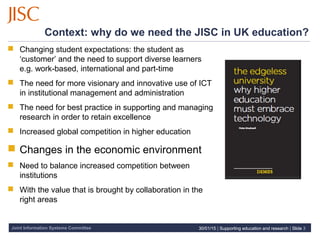
Context: why do we need the JISC in UK education?
 Changing student expectations: the student as
‘customer’ and the need to support diverse learners
e.g. work-based, international and part-time
 The need for more visionary and innovative use of ICT
in institutional management and administration
 The need for best practice in supporting and managing
research in order to retain excellence
 Increased global competition in higher education
 Changes in the economic environment
 Need to balance increased competition between
institutions
 With the value that is brought by collaboration in the
right areas
30/01/15 | Supporting education and research | Slide 3
Joint Information Systems Committee
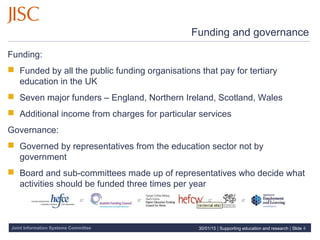
Funding and governance
Funding:
 Funded by all the public funding organisations that pay for tertiary
education in the UK
 Seven major funders – England, Northern Ireland, Scotland, Wales
 Additional income from charges for particular services
Governance:
 Governed by representatives from the education sector not by
government
 Board and sub-committees made up of representatives who decide what
activities should be funded three times per year
30/01/15 | Supporting education and research | Slide 4
Joint Information Systems Committee 30/01/15 | Supporting education and research | Slide 5
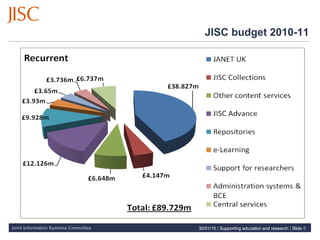
JISC budget 2010-11
30/01/15 | Supporting education and research | Slide 5
Joint Information Systems Committee 30/01/15 | Supporting education and research | Slide 6
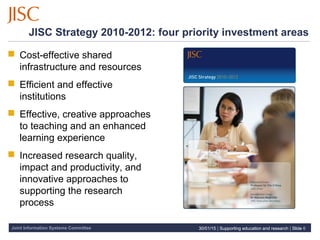
JISC Strategy 2010-2012: four priority investment areas
 Cost-effective shared
infrastructure and resources
 Efficient and effective
institutions
 Effective, creative approaches
to teaching and an enhanced
learning experience
 Increased research quality,
impact and productivity, and
innovative approaches to
supporting the research
process
30/01/15 | Supporting education and research | Slide 6
Joint Information Systems Committee
JISC: a shared service
 Aim: to provide services and resources that individual institutions
cannot provide as efficiently or effectively
 JANET: essential infrastructure
for research and education
 JISC Access Management Federation
 JISC Collections: for every £1 funding,
the community received services with
a commercial value of over £34
 JISC Advance: its services save the sector
around £12 for every £1 invested
in them
 Other specialist services provided such as
National Grid Service
30/01/15 | Supporting education and research | Slide 7
Joint Information Systems Committee 30/01/15 | Supporting education and research | Slide 8
Delivery: services
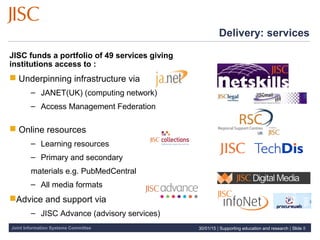
JISC funds a portfolio of 49 services giving
institutions access to :
 Underpinning infrastructure via
– JANET(UK) (computing network)
– Access Management Federation
 Online resources
– Learning resources
– Primary and secondary
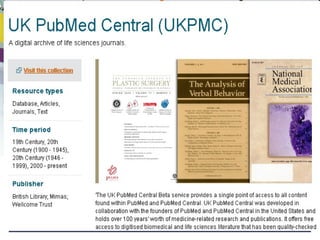
materials e.g. PubMedCentral
– All media formats
Advice and support via
– JISC Advance (advisory services)
Joint Information Systems Committee 30/01/15 | Supporting education and research | Slide 9
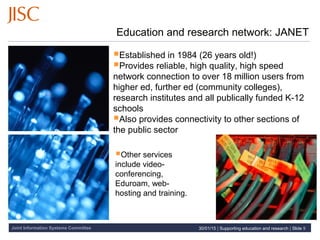
Education and research network: JANET
Established in 1984 (26 years old!)
Provides reliable, high quality, high speed
network connection to over 18 million users from
higher ed, further ed (community colleges),
research institutes and all publically funded K-12
schools
Also provides connectivity to other sections of
the public sector
Other services
include video-
conferencing,
Eduroam, web-
hosting and training.
Joint Information Systems Committee
Funding
 Block grant of about £40m per
year from JISC
 Additional one-off funding from
JISC for significant upgrades
 Tiered Annual Tariff for higher
education institutions based
on their annual income
 Access by colleges and
schools funded by income
from other central funding
bodies
30/01/15 | Supporting education and research | Slide 10
Joint Information Systems Committee 11
Joint Information Systems Committee 12
The UK access management federation
 Launched November 2006
 Replaced system that had been in
place since mid 1990s
 Used by all UK research institutes and
public education at all levels (K12,
community colleges and higher
education)
 Shibboleth based system
 Discovery Service
 Resilient WAYF service
 Hosting of metadata
 Monitoring of Service Providers and
Identity Providers
Joint Information Systems Committee
Funding and governance
 Organisational structure
 Federation ‘owned’ by JISC and
Becta
 Policy & Governance Board
 Technical Advisory Group
 Funding
– Funded entirely by JISC and
Becta at present
30/01/15 | Supporting education and research | Slide 13
Joint Information Systems Committee 30/01/15 | Supporting education and research | Slide 14
http://www.jisc-content.ac.uk/
Joint Information Systems Committee 30 January 2015 | | Slide 15
 Not-for-profit membership organisation
spun out from the JISC several years
ago
 Negotiates reasonable licence costs for
access to digital resources
 Tiered charging approach
 Some resources provided free to
education in perpetuity after bulk
purchase
 Delivered over £25 million in efficiency
gains in 2008/09
 Most collections heavily used. E.g.
Over 2 million articles were
downloaded from the Oxford Journals
Archive in 2008/09.

Joint Information Systems Committee 30/01/15 | Supporting education and research | Slide 16
Joint Information Systems Committee 30/01/15 | Supporting education and research | Slide 17
Joint Information Systems Committee
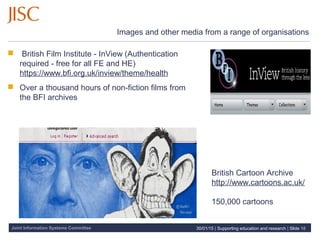
Images and other media from a range of organisations
 British Film Institute - InView (Authentication
required - free for all FE and HE)
https://www.bfi.org.uk/inview/theme/health
 Over a thousand hours of non-fiction films from
the BFI archives
30/01/15 | Supporting education and research | Slide 18
British Cartoon Archive
http://www.cartoons.ac.uk/
150,000 cartoons
Joint Information Systems Committee
Community content: repositories for learning, teaching and
research
 Medical image repository at Middlesex university:
http://www.jisc.ac.uk/whatwedo/programmes/inf11/su
e2/mirage.aspx
 biophysical repository at King’s College London
http://www.jisc.ac.uk/whatwedo/programmes/inf11/di
gpres/bril.aspx
 A Google maps type interface for exploring and
annotating embryo images:
http://www.jisc.ac.uk/whatwedo/programmes/inf11/su
e2/nextgenerationembryology.aspx
30/01/15 | Supporting education and research | Slide 19
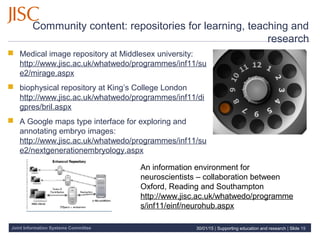
An information environment for
neuroscientists – collaboration between
Oxford, Reading and Southampton
http://www.jisc.ac.uk/whatwedo/programme
s/inf11/einf/neurohub.aspx
Joint Information Systems Committee
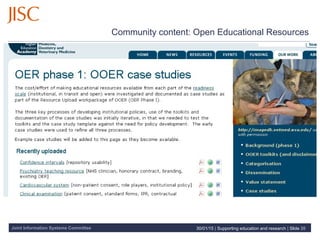
Community content: Open Educational Resources
30/01/15 | Supporting education and research | Slide 20
Joint Information Systems Committee 30/01/15 | Supporting education and research | Slide 21
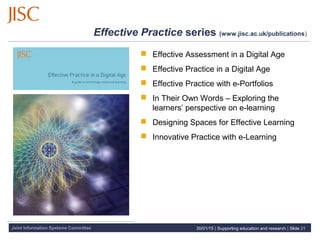
Effective Practice series (www.jisc.ac.uk/publications)
 Effective Assessment in a Digital Age
 Effective Practice in a Digital Age
 Effective Practice with e-Portfolios
 In Their Own Words – Exploring the
learners’ perspective on e-learning
 Designing Spaces for Effective Learning
 Innovative Practice with e-Learning
Joint Information Systems Committee
Development of Future Services
 UK Cloud for Higher Education
– Focused upon research community in
its first phase
– Challenging timescales for delivery
 Software and application services in
the Cloud
– Working with commercial sector to
work towards cloud-based hosting for
major administrative services used by
colleges and universities
– Not clear what areas should be
targeted
– Shared procurement services or
central hosting – or both?
30/01/15 | Supporting education and research | Slide 22
Joint Information Systems Committee
Other perspectives on Shared Services and Cloud Computing
Walter van Dijk, SURF NET, Dutch
approach to Shared Services and Cloud
Jacob-Steen Madsen, WAYF, Danish
approach to Shared Services and Cloud
30/01/15 | Supporting education and research | Slide 23
Joint Information Systems Committee
Key issue 1: business models
 Business model based upon central funding from government may be
challenged
– Also, not enough funding to provide all desired services (‘gap between
aspiration and resource’)
 Option: Pass all costs on to institutions?
 Risks:
– may lead to break up of the organisation
– May lead to ‘lowest common denominator’ instead of broad portfolio of
innovative services
 Option: collaborate with commercial sector or other bodies
 Risks
– May lose ability to respond to needs of public sector
30/01/15 | Supporting education and research | Slide 24
Joint Information Systems Committee
Key issue 2: governance
 Option to provide differentiated offer
– Core set of services for all
– ‘opt in’ services in some cases
 Risks:
– Need to retain balance in favour of core services for all
– Where value is considered for the consortium as a whole, not for each
individual organisation
– May lose bargaining power if fragmentation is allowed to start
30/01/15 | Supporting education and research | Slide 25
Joint Information Systems Committee
Key issue 3: sustaining innovation
 All services have developed from experimental, innovative funding
 After innovation has proved its value, becomes part of the JISC Service
Portfolio
– JANET, Access Management Federation, JISC Collections, data centres ...
 Need to sustain development of new services
 Whilst maintaining reliable portfolio with long-term commitment
 Models that allow innovation ‘bottom up’ rather than trying to anticipate
requirements centrally
30/01/15 | Supporting education and research | Slide 26
Joint Information Systems Committee
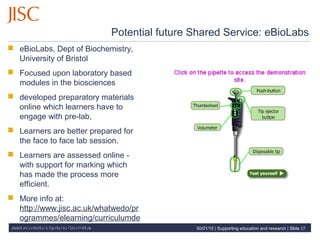
Potential future Shared Service: eBioLabs
 eBioLabs, Dept of Biochemistry,
University of Bristol
 Focused upon laboratory based
modules in the biosciences
 developed preparatory materials
online which learners have to
engage with pre-lab,
 Learners are better prepared for
the face to face lab session.
 Learners are assessed online -
with support for marking which
has made the process more
efficient.
 More info at:
http://www.jisc.ac.uk/whatwedo/pr
ogrammes/elearning/curriculumde
livery/ebiolabs.aspx 30/01/15 | Supporting education and research | Slide 27
Joint Information Systems Committee
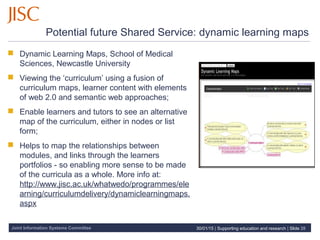
Potential future Shared Service: dynamic learning maps
 Dynamic Learning Maps, School of Medical
Sciences, Newcastle University
 Viewing the ‘curriculum’ using a fusion of
curriculum maps, learner content with elements
of web 2.0 and semantic web approaches;
 Enable learners and tutors to see an alternative
map of the curriculum, either in nodes or list
form;
 Helps to map the relationships between
modules, and links through the learners
portfolios - so enabling more sense to be made
of the curricula as a whole. More info at:
http://www.jisc.ac.uk/whatwedo/programmes/ele
arning/curriculumdelivery/dynamiclearningmaps.
aspx
30/01/15 | Supporting education and research | Slide 28
Joint Information Systems Committee
Contact details
 Sarah Porter, s.porter@jisc.ac.uk
 Tel. +44 203 006 6060
 http://www.jisc.ac.uk/
30/01/15 | Supporting education and research | Slide 29

Collaboration in a competitive environment: sustaining success through shared services

  • 1.
    Joint Information SystemsCommittee 30/01/15 | Supporting education and research | Slide 1 Collaboration in a Competitive Environment: Sustaining Success through Shared Services Sarah Porter, Head of Innovation, JISC Joint Information Systems Committee Supporting education and research
  • 2.
    Joint Information SystemsCommittee The UK Higher Education Sector  165 higher education institutions in the UK  450 colleges of further education  Average annual turnover of individual universities is £100 million  About 2 million full time students (1 in 7 from overseas)  Overseas’ student fees income: £1.3 billion  England the favourite destination of international students after the US university system  UK HE sector a substantial industry (£45.1bn total output 2003/04)  Income (earned revenue) of UK HEIs is £16.87 billion (2003/04) 30/01/15 | Supporting education and research | Slide 2
  • 3.
    Joint Information SystemsCommittee 30/01/15 | Supporting education and research | Slide 3 Context: why do we need the JISC in UK education?  Changing student expectations: the student as ‘customer’ and the need to support diverse learners e.g. work-based, international and part-time  The need for more visionary and innovative use of ICT in institutional management and administration  The need for best practice in supporting and managing research in order to retain excellence  Increased global competition in higher education  Changes in the economic environment  Need to balance increased competition between institutions  With the value that is brought by collaboration in the right areas 30/01/15 | Supporting education and research | Slide 3
  • 4.
    Joint Information SystemsCommittee Funding and governance Funding:  Funded by all the public funding organisations that pay for tertiary education in the UK  Seven major funders – England, Northern Ireland, Scotland, Wales  Additional income from charges for particular services Governance:  Governed by representatives from the education sector not by government  Board and sub-committees made up of representatives who decide what activities should be funded three times per year 30/01/15 | Supporting education and research | Slide 4
  • 5.
    Joint Information SystemsCommittee 30/01/15 | Supporting education and research | Slide 5 JISC budget 2010-11 30/01/15 | Supporting education and research | Slide 5
  • 6.
    Joint Information SystemsCommittee 30/01/15 | Supporting education and research | Slide 6 JISC Strategy 2010-2012: four priority investment areas  Cost-effective shared infrastructure and resources  Efficient and effective institutions  Effective, creative approaches to teaching and an enhanced learning experience  Increased research quality, impact and productivity, and innovative approaches to supporting the research process 30/01/15 | Supporting education and research | Slide 6
  • 7.
    Joint Information SystemsCommittee JISC: a shared service  Aim: to provide services and resources that individual institutions cannot provide as efficiently or effectively  JANET: essential infrastructure for research and education  JISC Access Management Federation  JISC Collections: for every £1 funding, the community received services with a commercial value of over £34  JISC Advance: its services save the sector around £12 for every £1 invested in them  Other specialist services provided such as National Grid Service 30/01/15 | Supporting education and research | Slide 7
  • 8.
    Joint Information SystemsCommittee 30/01/15 | Supporting education and research | Slide 8 Delivery: services JISC funds a portfolio of 49 services giving institutions access to :  Underpinning infrastructure via – JANET(UK) (computing network) – Access Management Federation  Online resources – Learning resources – Primary and secondary materials e.g. PubMedCentral – All media formats Advice and support via – JISC Advance (advisory services)
  • 9.
    Joint Information SystemsCommittee 30/01/15 | Supporting education and research | Slide 9 Education and research network: JANET Established in 1984 (26 years old!) Provides reliable, high quality, high speed network connection to over 18 million users from higher ed, further ed (community colleges), research institutes and all publically funded K-12 schools Also provides connectivity to other sections of the public sector Other services include video- conferencing, Eduroam, web- hosting and training.
  • 10.
    Joint Information SystemsCommittee Funding  Block grant of about £40m per year from JISC  Additional one-off funding from JISC for significant upgrades  Tiered Annual Tariff for higher education institutions based on their annual income  Access by colleges and schools funded by income from other central funding bodies 30/01/15 | Supporting education and research | Slide 10
  • 11.
  • 12.
    Joint Information SystemsCommittee 12 The UK access management federation  Launched November 2006  Replaced system that had been in place since mid 1990s  Used by all UK research institutes and public education at all levels (K12, community colleges and higher education)  Shibboleth based system  Discovery Service  Resilient WAYF service  Hosting of metadata  Monitoring of Service Providers and Identity Providers
  • 13.
    Joint Information SystemsCommittee Funding and governance  Organisational structure  Federation ‘owned’ by JISC and Becta  Policy & Governance Board  Technical Advisory Group  Funding – Funded entirely by JISC and Becta at present 30/01/15 | Supporting education and research | Slide 13
  • 14.
    Joint Information SystemsCommittee 30/01/15 | Supporting education and research | Slide 14 http://www.jisc-content.ac.uk/
  • 15.
    Joint Information SystemsCommittee 30 January 2015 | | Slide 15  Not-for-profit membership organisation spun out from the JISC several years ago  Negotiates reasonable licence costs for access to digital resources  Tiered charging approach  Some resources provided free to education in perpetuity after bulk purchase  Delivered over £25 million in efficiency gains in 2008/09  Most collections heavily used. E.g. Over 2 million articles were downloaded from the Oxford Journals Archive in 2008/09. 
  • 16.
    Joint Information SystemsCommittee 30/01/15 | Supporting education and research | Slide 16
  • 17.
    Joint Information SystemsCommittee 30/01/15 | Supporting education and research | Slide 17
  • 18.
    Joint Information SystemsCommittee Images and other media from a range of organisations  British Film Institute - InView (Authentication required - free for all FE and HE) https://www.bfi.org.uk/inview/theme/health  Over a thousand hours of non-fiction films from the BFI archives 30/01/15 | Supporting education and research | Slide 18 British Cartoon Archive http://www.cartoons.ac.uk/ 150,000 cartoons
  • 19.
    Joint Information SystemsCommittee Community content: repositories for learning, teaching and research  Medical image repository at Middlesex university: http://www.jisc.ac.uk/whatwedo/programmes/inf11/su e2/mirage.aspx  biophysical repository at King’s College London http://www.jisc.ac.uk/whatwedo/programmes/inf11/di gpres/bril.aspx  A Google maps type interface for exploring and annotating embryo images: http://www.jisc.ac.uk/whatwedo/programmes/inf11/su e2/nextgenerationembryology.aspx 30/01/15 | Supporting education and research | Slide 19 An information environment for neuroscientists – collaboration between Oxford, Reading and Southampton http://www.jisc.ac.uk/whatwedo/programme s/inf11/einf/neurohub.aspx
  • 20.
    Joint Information SystemsCommittee Community content: Open Educational Resources 30/01/15 | Supporting education and research | Slide 20
  • 21.
    Joint Information SystemsCommittee 30/01/15 | Supporting education and research | Slide 21 Effective Practice series (www.jisc.ac.uk/publications)  Effective Assessment in a Digital Age  Effective Practice in a Digital Age  Effective Practice with e-Portfolios  In Their Own Words – Exploring the learners’ perspective on e-learning  Designing Spaces for Effective Learning  Innovative Practice with e-Learning
  • 22.
    Joint Information SystemsCommittee Development of Future Services  UK Cloud for Higher Education – Focused upon research community in its first phase – Challenging timescales for delivery  Software and application services in the Cloud – Working with commercial sector to work towards cloud-based hosting for major administrative services used by colleges and universities – Not clear what areas should be targeted – Shared procurement services or central hosting – or both? 30/01/15 | Supporting education and research | Slide 22
  • 23.
    Joint Information SystemsCommittee Other perspectives on Shared Services and Cloud Computing Walter van Dijk, SURF NET, Dutch approach to Shared Services and Cloud Jacob-Steen Madsen, WAYF, Danish approach to Shared Services and Cloud 30/01/15 | Supporting education and research | Slide 23
  • 24.
    Joint Information SystemsCommittee Key issue 1: business models  Business model based upon central funding from government may be challenged – Also, not enough funding to provide all desired services (‘gap between aspiration and resource’)  Option: Pass all costs on to institutions?  Risks: – may lead to break up of the organisation – May lead to ‘lowest common denominator’ instead of broad portfolio of innovative services  Option: collaborate with commercial sector or other bodies  Risks – May lose ability to respond to needs of public sector 30/01/15 | Supporting education and research | Slide 24
  • 25.
    Joint Information SystemsCommittee Key issue 2: governance  Option to provide differentiated offer – Core set of services for all – ‘opt in’ services in some cases  Risks: – Need to retain balance in favour of core services for all – Where value is considered for the consortium as a whole, not for each individual organisation – May lose bargaining power if fragmentation is allowed to start 30/01/15 | Supporting education and research | Slide 25
  • 26.
    Joint Information SystemsCommittee Key issue 3: sustaining innovation  All services have developed from experimental, innovative funding  After innovation has proved its value, becomes part of the JISC Service Portfolio – JANET, Access Management Federation, JISC Collections, data centres ...  Need to sustain development of new services  Whilst maintaining reliable portfolio with long-term commitment  Models that allow innovation ‘bottom up’ rather than trying to anticipate requirements centrally 30/01/15 | Supporting education and research | Slide 26
  • 27.
    Joint Information SystemsCommittee Potential future Shared Service: eBioLabs  eBioLabs, Dept of Biochemistry, University of Bristol  Focused upon laboratory based modules in the biosciences  developed preparatory materials online which learners have to engage with pre-lab,  Learners are better prepared for the face to face lab session.  Learners are assessed online - with support for marking which has made the process more efficient.  More info at: http://www.jisc.ac.uk/whatwedo/pr ogrammes/elearning/curriculumde livery/ebiolabs.aspx 30/01/15 | Supporting education and research | Slide 27
  • 28.
    Joint Information SystemsCommittee Potential future Shared Service: dynamic learning maps  Dynamic Learning Maps, School of Medical Sciences, Newcastle University  Viewing the ‘curriculum’ using a fusion of curriculum maps, learner content with elements of web 2.0 and semantic web approaches;  Enable learners and tutors to see an alternative map of the curriculum, either in nodes or list form;  Helps to map the relationships between modules, and links through the learners portfolios - so enabling more sense to be made of the curricula as a whole. More info at: http://www.jisc.ac.uk/whatwedo/programmes/ele arning/curriculumdelivery/dynamiclearningmaps. aspx 30/01/15 | Supporting education and research | Slide 28
  • 29.
    Joint Information SystemsCommittee Contact details  Sarah Porter, s.porter@jisc.ac.uk  Tel. +44 203 006 6060  http://www.jisc.ac.uk/ 30/01/15 | Supporting education and research | Slide 29

Editor's Notes

  • #6 HEFCE contribution to recurrent budget is 74.8%. May wish to mention cuts / that we are subject to similar spending controls as HEFCE. JISC receives core funding on an annual basis (August - July) from its core funders (HEFCE, SFC, HEFCW, DCELLS & DEL N.I.). In addition to this, JISC receives capital funding for new innovation programmes from HEFCE and HEFCW.  The funding (whether core or capital) used for each activity impacts on the eligibility of HE/FE institutions from the devolved countries.
  • #7 JISC funds through thematic areas of investment based around the strategic objectives. These objectives match the main relevant concerns of universities and colleges, the funding councils and central and devolved governments. Investment areas are also influenced by and seek to influence relevant global issues and concerns.
  • #22 A popular set of guides created from the findings from our innovation programmes. They will be of interest to anyone who seeks to better understand better how to integrate technology into teaching.
  • #29 Newcastle University