Introduction to EIGRP
(Enhanced Interior Gateway Routing
Protocol)
EIGRP
• Improved Interior Gateway Routing Protocol (IGRP)
• Hybrid
More like distance vector, but with some link state ideas
• Scalable
• Support for Classless inter-Domain Routing (CIDR) and
Variable Length subnet Mask(VLSM)
• Multi-protocol support
PDMs (protocol dependant modules)
• Rapid convergence with DUAL
• Partial, bounded updates
EIGRP Features
– Cisco proprietary and is Hybrid: (containing Advanced
distance vector and several link-state features)
– Fast convergence : stores all its neighbors’ routing
tables so that it can quickly adapt to alternate routes. If
no appropriate route exists, EIGRP queries its neighbors
to discover an alternate route which continues until an
alternate route is found.
– Support for VLSM and discontiguous subnets: as a
classless routing protocol, EIGRP advertises a subnet
mask for each destination network; enabling it to
support dis contiguous subnet works and VLSM.
Routes are automatically summarized at the major
network number boundary, and can be configured to
summarize on any bit boundary on any router interface.
Cont’d
– Partial updates: Sends partial triggered updates as
opposed to periodic updates--sent only when the path or
metric changes containing information about the changed
route. For this reason EIGRP consumes significantly less
bandwidth than IGRP. This behavior is different than that of
link-state protocols, in which an update is transmitted to all
link-state routers within an area.
– Support for multiple network-layer protocols: EIGRP
supports IP, AppleTalk, and Novell NetWare Internet Packet
Exchange (IPX) through the use of protocol-dependent
modules. The rapid convergence and sophisticated metric
structure of EIGRP offers superior performance and stability
when implemented in IPX and AppleTalk networks.
Cont’d
– Flexible network design
– Multicast and unicast instead of broadcast
address: EIGRP uses multicast and unicast, rather
than broadcast. The multicast address used for
EIGRP is 224.0.0.10.
– Manual summarization at any point
– 100% loop-free classless routing
– Easy configuration for WANs and LANs
– Load balancing
EIGRP Key Technologies
• Neighbor discover/recovery: Uses Hello
packets between neighbors
• Reliable Transport Protocol (RTP):
Guaranteed, ordered delivery of EIGRP
packets to all neighbors
• DUAL finite-state machine: Selects lowest-
cost, loop-free, paths to each destination
• Protocol-dependent modules (PDMs) : EIGRP
supports IP, AppleTalk, and Novell NetWare;
Each protocol has its own EIGRP module and
operates independently from any of the
others that may be running
The Diffusing Update Algorithm
(DUAL)
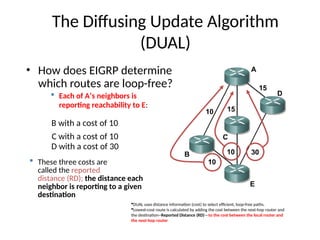
• How does EIGRP determine
which routes are loop-free?
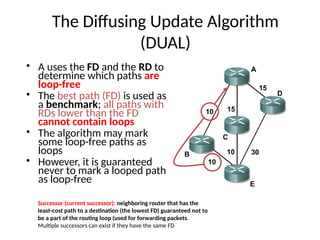
B with a cost of 10
 Each of A’s neighbors is
reporting reachability to E:
C with a cost of 10
D with a cost of 30
 These three costs are
called the reported
distance (RD); the distance each
neighbor is reporting to a given
destination
DUAL uses distance information (cost) to select efficient, loop-free paths.
Lowest-cost route is calculated by adding the cost between the next-hop router and
the destination--Reported Distance (RD)—to the cost between the local router and
the next-hop router
The Diffusing Update Algorithm
(DUAL)
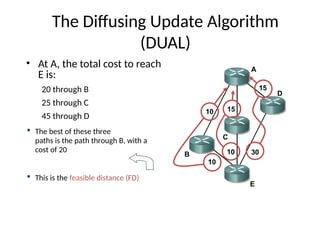
• At A, the total cost to reach
E is:
 The best of these three
paths is the path through B, with a
cost of 20
20 through B
25 through C
45 through D
 This is the feasible distance (FD)
The Diffusing Update Algorithm
(DUAL)
• A uses the FD and the RD to
determine which paths are
loop-free
• The best path (FD) is used as
a benchmark; all paths with
RDs lower than the FD
cannot contain loops
• The algorithm may mark
some loop-free paths as
loops
• However, it is guaranteed
never to mark a looped path
as loop-free
Successor (current successor): neighboring router that has the
least-cost path to a destination (the lowest FD) guaranteed not to
be a part of the routing loop (used for forwarding packets.
Multiple successors can exist if they have the same FD
The Diffusing Update Algorithm
(DUAL)
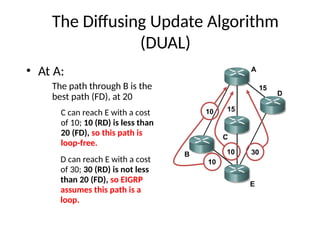
• At A:
The path through B is the
best path (FD), at 20
C can reach E with a cost
of 10; 10 (RD) is less than
20 (FD), so this path is
loop-free.
D can reach E with a cost
of 30; 30 (RD) is not less
than 20 (FD), so EIGRP
assumes this path is a
loop.
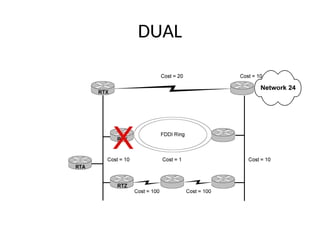
DUAL
DUAL
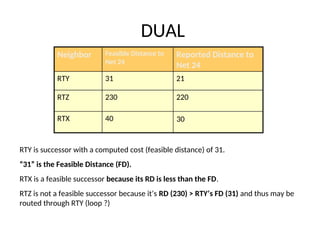
30
40
RTX
220
230
RTZ
21
31
RTY
Reported Distance to
Net 24
Feasible Distance to
Net 24
Neighbor
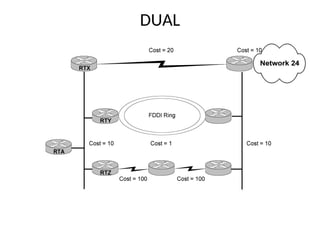
RTY is successor with a computed cost (feasible distance) of 31.
“31” is the Feasible Distance (FD).
RTX is a feasible successor because its RD is less than the FD.
RTZ is not a feasible successor because it’s RD (230) > RTY’s FD (31) and thus may be
routed through RTY (loop ?)
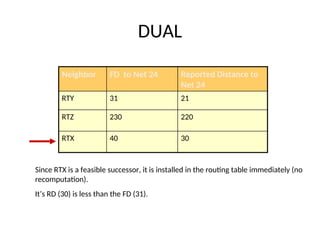
DUAL
DUAL
30
40
RTX
220
230
RTZ
21
31
RTY
Reported Distance to
Net 24
FD to Net 24
Neighbor
Since RTX is a feasible successor, it is installed in the routing table immediately (no
recomputation).
It’s RD (30) is less than the FD (31).
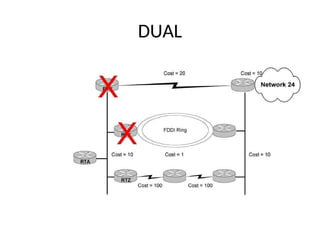
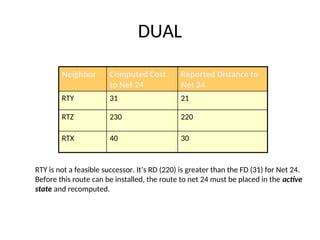
DUAL
DUAL
30
40
RTX
220
230
RTZ
21
31
RTY
Reported Distance to
Net 24
Computed Cost
to Net 24
Neighbor
RTY is not a feasible successor. It’s RD (220) is greater than the FD (31) for Net 24.
Before this route can be installed, the route to net 24 must be placed in the active
state and recomputed.
EIGRP Topology Table
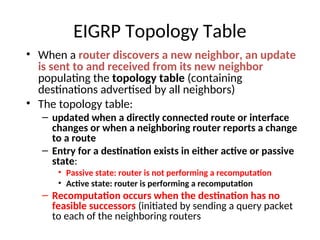
• When a router discovers a new neighbor, an update
is sent to and received from its new neighbor
populating the topology table (containing
destinations advertised by all neighbors)
• The topology table:
– updated when a directly connected route or interface
changes or when a neighboring router reports a change
to a route
– Entry for a destination exists in either active or passive
state:
• Passive state: router is not performing a recomputation
• Active state: router is performing a recomputation
– Recomputation occurs when the destination has no
feasible successors (initiated by sending a query packet
to each of the neighboring routers
EIGRP Topology Table
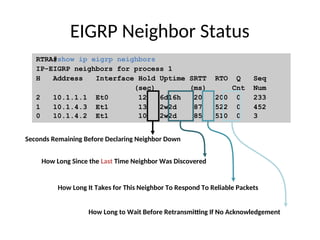
RTRA#show ip eigrp neighbors
IP-EIGRP neighbors for process 1
H Address Interface Hold Uptime SRTT RTO Q Seq
(sec) (ms) Cnt Num
2 10.1.1.1 Et0 12 6d16h 20 200 0 233
1 10.1.4.3 Et1 13 2w2d 87 522 0 452
0 10.1.4.2 Et1 10 2w2d 85 510 0 3
Seconds Remaining Before Declaring Neighbor Down
How Long Since the Last Time Neighbor Was Discovered
How Long It Takes for This Neighbor To Respond To Reliable Packets
How Long to Wait Before Retransmitting If No Acknowledgement
EIGRP Neighbor Status
EIGRP IP Routing Table
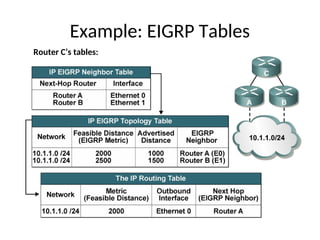
Example: EIGRP Tables
Router C’s tables:
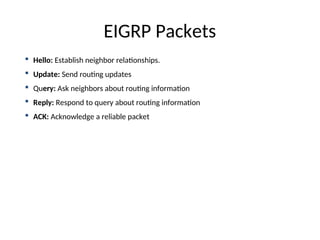
EIGRP Packets
 Hello: Establish neighbor relationships.
 Update: Send routing updates
 Query: Ask neighbors about routing information
 Reply: Respond to query about routing information
 ACK: Acknowledge a reliable packet
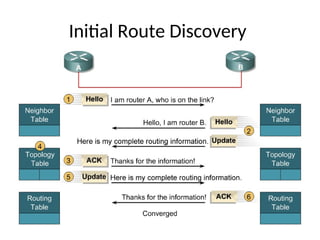
Initial Route Discovery
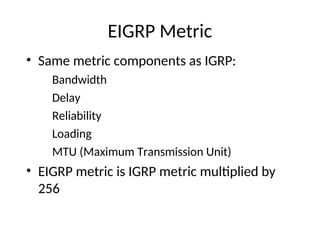
EIGRP Metric
• Same metric components as IGRP:
Bandwidth
Delay
Reliability
Loading
MTU (Maximum Transmission Unit)
• EIGRP metric is IGRP metric multiplied by
256
EIGRP Metric
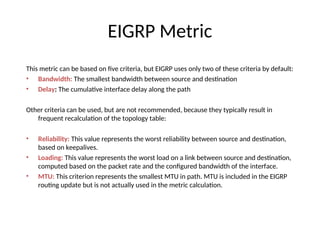
This metric can be based on five criteria, but EIGRP uses only two of these criteria by default:
• Bandwidth: The smallest bandwidth between source and destination
• Delay: The cumulative interface delay along the path
Other criteria can be used, but are not recommended, because they typically result in
frequent recalculation of the topology table:
• Reliability: This value represents the worst reliability between source and destination,
based on keepalives.
• Loading: This value represents the worst load on a link between source and destination,
computed based on the packet rate and the configured bandwidth of the interface.
• MTU: This criterion represents the smallest MTU in path. MTU is included in the EIGRP
routing update but is not actually used in the metric calculation.
EIGRP Metric Calculation
• By default, EIGRP metric:
Metric = bandwidth (slowest link) + delay (sum
of delays)
• Delay = sum of the delays in the path, in
tens of microseconds, multiplied by 256.
• Bandwidth = [107
/ (minimum bandwidth
link along the path, in kilobits per second)] *
256
EIGRP Metrics Calculation Example
A  B  C  D Least bandwidth 64 kbps Total delay 6,000
A  X  Y  Z  D Least bandwidth 256 kbps Total delay 8,000
 Delay is the sum of all the delays of the links along the paths:
Delay = [delay in tens of microseconds] x 256
 BW is the lowest bandwidth of the links along the paths:
BW = [10,000,000 / (bandwidth in kbps)] x 256
LAB
Configuration of Dyanamic Routing-EIGRP
EIGRP Configuration Step-by-Step Guide

Introduction to EIGRP ppt notes - learn to day.

  • 1.
    Introduction to EIGRP (EnhancedInterior Gateway Routing Protocol)
  • 2.
    EIGRP • Improved InteriorGateway Routing Protocol (IGRP) • Hybrid More like distance vector, but with some link state ideas • Scalable • Support for Classless inter-Domain Routing (CIDR) and Variable Length subnet Mask(VLSM) • Multi-protocol support PDMs (protocol dependant modules) • Rapid convergence with DUAL • Partial, bounded updates
  • 3.
    EIGRP Features – Ciscoproprietary and is Hybrid: (containing Advanced distance vector and several link-state features) – Fast convergence : stores all its neighbors’ routing tables so that it can quickly adapt to alternate routes. If no appropriate route exists, EIGRP queries its neighbors to discover an alternate route which continues until an alternate route is found. – Support for VLSM and discontiguous subnets: as a classless routing protocol, EIGRP advertises a subnet mask for each destination network; enabling it to support dis contiguous subnet works and VLSM. Routes are automatically summarized at the major network number boundary, and can be configured to summarize on any bit boundary on any router interface.
  • 4.
    Cont’d – Partial updates:Sends partial triggered updates as opposed to periodic updates--sent only when the path or metric changes containing information about the changed route. For this reason EIGRP consumes significantly less bandwidth than IGRP. This behavior is different than that of link-state protocols, in which an update is transmitted to all link-state routers within an area. – Support for multiple network-layer protocols: EIGRP supports IP, AppleTalk, and Novell NetWare Internet Packet Exchange (IPX) through the use of protocol-dependent modules. The rapid convergence and sophisticated metric structure of EIGRP offers superior performance and stability when implemented in IPX and AppleTalk networks.
  • 5.
    Cont’d – Flexible networkdesign – Multicast and unicast instead of broadcast address: EIGRP uses multicast and unicast, rather than broadcast. The multicast address used for EIGRP is 224.0.0.10. – Manual summarization at any point – 100% loop-free classless routing – Easy configuration for WANs and LANs – Load balancing
  • 6.
    EIGRP Key Technologies •Neighbor discover/recovery: Uses Hello packets between neighbors • Reliable Transport Protocol (RTP): Guaranteed, ordered delivery of EIGRP packets to all neighbors • DUAL finite-state machine: Selects lowest- cost, loop-free, paths to each destination • Protocol-dependent modules (PDMs) : EIGRP supports IP, AppleTalk, and Novell NetWare; Each protocol has its own EIGRP module and operates independently from any of the others that may be running
  • 7.
    The Diffusing UpdateAlgorithm (DUAL) • How does EIGRP determine which routes are loop-free? B with a cost of 10  Each of A’s neighbors is reporting reachability to E: C with a cost of 10 D with a cost of 30  These three costs are called the reported distance (RD); the distance each neighbor is reporting to a given destination DUAL uses distance information (cost) to select efficient, loop-free paths. Lowest-cost route is calculated by adding the cost between the next-hop router and the destination--Reported Distance (RD)—to the cost between the local router and the next-hop router
  • 8.
    The Diffusing UpdateAlgorithm (DUAL) • At A, the total cost to reach E is:  The best of these three paths is the path through B, with a cost of 20 20 through B 25 through C 45 through D  This is the feasible distance (FD)
  • 9.
    The Diffusing UpdateAlgorithm (DUAL) • A uses the FD and the RD to determine which paths are loop-free • The best path (FD) is used as a benchmark; all paths with RDs lower than the FD cannot contain loops • The algorithm may mark some loop-free paths as loops • However, it is guaranteed never to mark a looped path as loop-free Successor (current successor): neighboring router that has the least-cost path to a destination (the lowest FD) guaranteed not to be a part of the routing loop (used for forwarding packets. Multiple successors can exist if they have the same FD
  • 10.
    The Diffusing UpdateAlgorithm (DUAL) • At A: The path through B is the best path (FD), at 20 C can reach E with a cost of 10; 10 (RD) is less than 20 (FD), so this path is loop-free. D can reach E with a cost of 30; 30 (RD) is not less than 20 (FD), so EIGRP assumes this path is a loop.
  • 11.
  • 12.
    DUAL 30 40 RTX 220 230 RTZ 21 31 RTY Reported Distance to Net24 Feasible Distance to Net 24 Neighbor RTY is successor with a computed cost (feasible distance) of 31. “31” is the Feasible Distance (FD). RTX is a feasible successor because its RD is less than the FD. RTZ is not a feasible successor because it’s RD (230) > RTY’s FD (31) and thus may be routed through RTY (loop ?)
  • 13.
  • 14.
    DUAL 30 40 RTX 220 230 RTZ 21 31 RTY Reported Distance to Net24 FD to Net 24 Neighbor Since RTX is a feasible successor, it is installed in the routing table immediately (no recomputation). It’s RD (30) is less than the FD (31).
  • 15.
  • 16.
    DUAL 30 40 RTX 220 230 RTZ 21 31 RTY Reported Distance to Net24 Computed Cost to Net 24 Neighbor RTY is not a feasible successor. It’s RD (220) is greater than the FD (31) for Net 24. Before this route can be installed, the route to net 24 must be placed in the active state and recomputed.
  • 17.
    EIGRP Topology Table •When a router discovers a new neighbor, an update is sent to and received from its new neighbor populating the topology table (containing destinations advertised by all neighbors) • The topology table: – updated when a directly connected route or interface changes or when a neighboring router reports a change to a route – Entry for a destination exists in either active or passive state: • Passive state: router is not performing a recomputation • Active state: router is performing a recomputation – Recomputation occurs when the destination has no feasible successors (initiated by sending a query packet to each of the neighboring routers
  • 18.
  • 19.
    RTRA#show ip eigrpneighbors IP-EIGRP neighbors for process 1 H Address Interface Hold Uptime SRTT RTO Q Seq (sec) (ms) Cnt Num 2 10.1.1.1 Et0 12 6d16h 20 200 0 233 1 10.1.4.3 Et1 13 2w2d 87 522 0 452 0 10.1.4.2 Et1 10 2w2d 85 510 0 3 Seconds Remaining Before Declaring Neighbor Down How Long Since the Last Time Neighbor Was Discovered How Long It Takes for This Neighbor To Respond To Reliable Packets How Long to Wait Before Retransmitting If No Acknowledgement EIGRP Neighbor Status
  • 20.
  • 21.
  • 22.
    EIGRP Packets  Hello:Establish neighbor relationships.  Update: Send routing updates  Query: Ask neighbors about routing information  Reply: Respond to query about routing information  ACK: Acknowledge a reliable packet
  • 23.
  • 24.
    EIGRP Metric • Samemetric components as IGRP: Bandwidth Delay Reliability Loading MTU (Maximum Transmission Unit) • EIGRP metric is IGRP metric multiplied by 256
  • 25.
    EIGRP Metric This metriccan be based on five criteria, but EIGRP uses only two of these criteria by default: • Bandwidth: The smallest bandwidth between source and destination • Delay: The cumulative interface delay along the path Other criteria can be used, but are not recommended, because they typically result in frequent recalculation of the topology table: • Reliability: This value represents the worst reliability between source and destination, based on keepalives. • Loading: This value represents the worst load on a link between source and destination, computed based on the packet rate and the configured bandwidth of the interface. • MTU: This criterion represents the smallest MTU in path. MTU is included in the EIGRP routing update but is not actually used in the metric calculation.
  • 26.
    EIGRP Metric Calculation •By default, EIGRP metric: Metric = bandwidth (slowest link) + delay (sum of delays) • Delay = sum of the delays in the path, in tens of microseconds, multiplied by 256. • Bandwidth = [107 / (minimum bandwidth link along the path, in kilobits per second)] * 256
  • 27.
    EIGRP Metrics CalculationExample A  B  C  D Least bandwidth 64 kbps Total delay 6,000 A  X  Y  Z  D Least bandwidth 256 kbps Total delay 8,000  Delay is the sum of all the delays of the links along the paths: Delay = [delay in tens of microseconds] x 256  BW is the lowest bandwidth of the links along the paths: BW = [10,000,000 / (bandwidth in kbps)] x 256
  • 28.
    LAB Configuration of DyanamicRouting-EIGRP EIGRP Configuration Step-by-Step Guide

Editor's Notes

  • #6 Neighbor discovery/recovery -- Uses Hello packets between neighbors. Reliable Transport Protocol (RTP) -- Guaranteed, ordered delivery of EIGRP packets to all neighbors. DUAL finite-state machine -- Selects lowest-cost, loop-free, paths to each destination Protocol-dependent modules (PDMs) -- EIGRP supports IP, AppleTalk, and Novell NetWare; Each protocol has its own EIGRP module and operates independently from any of the others that may be running.
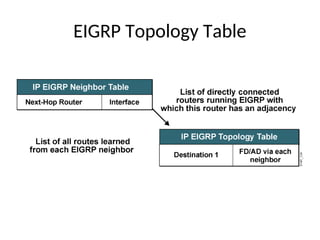
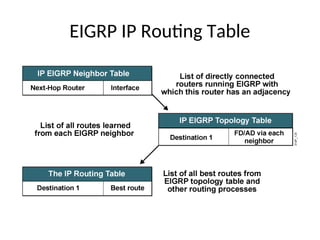
  • #19 How EIGRP uses these tables: EIGRP uses the Neighbor table to list adjacent routers. Topology table lists all learned routes to each destination Routing table contains the best route (successor route) and backup route (feasible successor route) When a neighbor adjacency is formed, it records the neighbor’s address and the interface through which it can be reached as an entry in the neighbor table. One neighbor table exists for each protocol-dependent module. The EIGRP neighbor table is comparable to the adjacencies database that link-state routing protocols use and serves the same purpose: to ensure bidirectional communication between each of the directly connected neighbors. When the hello packet is sent, it advertises a hold time (time a router reports a neighbor as reachable and operational). If a hello packet from a neighboring router is not received within the hold time, it expires, and DUAL is informed of the topology change. The neighbor-table includes information required by RTP. Sequence numbers are used to match acknowledgments with data packets (helping to check out-of-order packets). transmission list is used to queue packets for possible retransmission on a per-neighbor basis. Round-trip timers are kept in the neighbor-table entry to estimate an optimal retransmission interval.
  • #20 A router compares all Feasible Distances (FDs) to reach a specific network and then selects the route with the lowest FD and places it in the IP routing table; this is the successor route. The FD for the chosen route becomes the EIGRP routing metric to reach that network in the routing table.
  • #21 The network shown illustrates router C’s EIGRP tables. Routers A and B have established a neighbor relationship with router C. Both routers A and B have paths to network 10.1.1.0/24, among many others that are not shown. Router A has an EIGRP metric of 1000 for 10.1.1.0/24, so router A advertises 10.1.1.0/24 to router C with a metric of 1000. Router C installs the route to 10.1.1.0/24 via router A in its EIGRP topology table with an advertised distance of 1000. Router B has network 10.1.1.0/24 with a metric of 1500 in its IP routing table, so router B advertises 10.1.1.0/24 to router C with an advertised distance of 1500. Router C places the route to 10.1.1.0/24 network via router B in the EIGRP topology table with an advertised distance of 1500. Router C has two entries to reach 10.1.1.0/24 in its topology table. The EIGRP metric for router C to reach both routers A and B is 1000. This cost (1000) is added to the respective advertised distance from each router, resulting in the feasible distances from router C to reach network 10.1.1.0/24 shown in the figure. Router C chooses the least-cost feasible distance, which is 2000, via router A, and installs it in the IP routing table as the best route to reach 10.1.1.0/24. The EIGRP metric in the routing table is equal to the feasible distance from the EIGRP topology table. Router A is the successor for the route to 10.1.1.0/24.