INTRODUCTIONTO EIGRP 1.BY
NORBERT
• EIGRP stand for Enhanced Interior Gateway Routing Protocol.
• It is a Cisco proprietary hybrid routing protocol that contains features of distance
vector and link state routing protocol.
• EIGRP refers to a network protocol that enable routers to exchange information
more efficiently than earlier network protocol such as Interior Gateway Routing
Protocol(IGRP) or Broader Gateway Routing Protocol(BGP).
• EIGRP is a distance-vector routing protocol developed by Cisco Systems. It's used for
routing traffic in large, complex networks.
3.
CONT…
• EIGRP isan enhanced distance vector protocol which relies on Diffuse Update
Algorithm (DUAL) to calculate the shortest path to the destination within a
network.
• It's an enhanced version of IGRP.The same distance vector topology found in. IGRP
is also used in EIGRP and the underlying distance information remains unchanged.
• The convergence properties and the operating efficiency of this protocol have
improved significantly.This allows for an improved architecture while returning
existing investment in IGRP.
4.
CONT…
• The convergencytopology is based on research conducted at SRI
internation.The Diffusing Update Algorithm (DUAL) is the algorithm used
to obtain loop-freedom at every instant through a routing computation.
• This allows all routers involved in the topology changes to synchronize at
the same time.
• Routers that are not affected by changes are not involved in the
computation.The convergence time with DUAL rivals that of any existing
routing protocol.
• EIGRP has been extended to the network layer protocol independent,
there by allowing DUAL to support other protocol suites.
5.
HOW EIGRPWORKS.
• NeighborDiscovery. Routers discover and form adjacencies with neighboring routers.
• RoutingTable Creation. Each router builds a routing table based on received updates.
• Route Selection. Routers select the best path for each destination network.
• Route Propagation. Routers share routing updates with neighbors.
EIGRP Packet Types
Hello. Used for neighbor discovery and adjacency formation.
Update. Used for routing table updates.
Query. Used for route queries.
Reply. Used for route replies.
6.
NOTE.
1.DistanceVector Routing Protocol.Arouting protocol that calculates the
best path to a destination network based on the distance (metric) from the
router to the destination.
2. Link State Routing Protocol.A routing protocol that builds a complete
map of the network by exchanging information about the state of each link
between routers
7.
EIGRRP FEATURES 2.BY RACHEAL
• Diffusing Update Algorithm (DUAL), DUAL is designed to calculate and maintain the best
routes to destination networks efficiently. Here is how it works:
• Routing Table with Metrics : Each network node maintains a routing table that
contains information about neighboring nodes and their associated metrics (e.g.,
bandwidth, delay).
• . Network Changes : When a change in the network occurs, such as a link failure or a
new link being established, the affected node sends out an update to its neighbors.
• Calculating the Best Path: The neighbors receive the update and use DUAL to
calculate the shortest path to the affected node.
• Updating the Routing Table: If a neighbor finds a better route, it updates its own list
(routing table) to reflect this new information. It then tells its other neighbors about the
change, so they can also update their routes. This ensures that everyone in the network
knows the most efficient way to route.
8.
Establish neighbor adjacencies:In EIGRP routers must form adjacencies with their neighbor before they can
share information with that neighbor. EIGRP Router sends Hello packets out EIGRP -enabled interfaces to determine whether
neighbors are present on those links. If a neighbor is present, the EIGRP -enabled router attempts to establish a neighbor
adjacency with that neighbor.
The Process Of Establishing Neighbor Adjacencies :
1.Hello Packets:. In EIGRP, routers send out "Hello" packets through all their EIGRP -enabled connections (interfaces).These
Hello packets are like calling out to see if any neighboring routers are nearby.
2.Finding Neighbors:When a router sends out Hello packets, it listens for responses from other EIGRP -enabled routers
connected to the same network segment .If a router hears a Hello from another router, it means they're both on the same
network segment and could potentially become neighbors.
3.Establishing Adjacency: Once two routers confirm they can hear each other's Hello packets and are on the same network
segment, they start the process of forming a neighbor relationship or adjacency.
4. Why Adjacency Matters:Adjacency allows routers to securely exchange routing information, like sharing maps with each
other. It's crucial because routers need accurate and up-to-date information about network paths to make efficient routing
decisions.
5.Maintaining Connections:After forming an adjacency, routers continue to exchange Hello packets periodically to make sure
their neighbor is still there and reachable. If something changes (like a link going down), they'll notice and can adjust their routing
accordingly.
9.
Reliable Transport Protocol(RTP) : Is used for communication between EIGRP-speaking routers. As the name
implies, reliability is a key feature of this protocol, and it is designed to enable quick delivery of updates between
EIGRP neighbors
It Operates The Following Manner
Connection Establishment : When a new EIGRP neighbor relationship is formed, RTP establishes a logical
connection between the neighboring routers.
Packet acknowledgment: Foreach EIGRP packet sent, the receiver sends acknowledgment back to the sender. If the
sender does receive the ACK within a predefined time, it retransmits the packet.
Sequence Numbering, RIP assigns sequence numbers to EIGRP packets to maintain the correct order of delivery.
Congestion Avoidance : RIP implements congestion avoidance algorithms, such as Additive Increase Multiplicative
Decrease (AIMD), to adjust the transmission rate based on network conditions
Note: EIGRP doesn’t send messages with UDP or TCP
No UDP orTCP: Unlike many other protocols that use UDP (User Datagram Protocol) orTCP (Transmission Control
Protocol) for communication, EIGRP uses its own protocol called ReliableTransport Protocol (RTP).
Reliability: RTP is designed to ensure that messages sent between EIGRP routers are delivered reliably and in the correct order.
Think of it like sending a package with tracking and guaranteed delivery instead of sending a letter that might get lost.
Quick Updates: RTP allows EIGRP routers to quickly exchange updates about changes in the network, such as when a link goes
down or a new path becomes available.This helps routers stay updated on the best routes to send data.
DataTracking: RTP includes mechanisms to track whether messages have been received by the destination router. It ensures
that if a message doesn't reach its destination, it can be re-sent until successful delivery is confirmed.
Efficient Communication: By using RTP, EIGRP routers can communicate efficiently even in dynamic network environments,
ensuring that routing decisions are based on the most current information available.
10.
EIGRP supports authenticationto ensure integrity and security of the routing
information exchanged between EIGRP neighbors.
EIGRP authentication ensures that routers only accept routing information from
other routers that have been configured with the same password or authentication
information.
11.
EIGRP has thecapability for routing several different protocols, including IPv4 and IPv6, using
protocol-dependent modules (PDMs).
PDMs are responsible for the specific routing tasks for each network layer protocol,
including:
Maintaining the neighbor and topology tables of EIGRP routers that belong to that protocol
suite
Building and translating protocol-specific packets for DUAL
Interfacing DUAL to the protocol-specific routing table
Computing the metric and passing this information to DUAL
Implementing filtering and access lists
Performing redistribution functions to and from other routing protocols
Redistributing routes that are learned by other routing protocol
12.
The Five TypesOf Packets In EIGRP : work together to enable the efficient operation of the
EIGRP routing protocol.
Hello packets: used for neighbor discovery
Update packets: used to send routing information between EIGRP neighbors
Query packets: used by EIGRP routers to request information from their neighbors.
Reply packets: used by EIGRP routers to respond to queries received from neighbors
Acknowledgement(ACK) packets: used to acknowledge the receipt of the EIGRP
packets, such as updates and replies.
RELIABLE TRANSPORT PROTOCOL(RTP)
•EIGRP works on CISCO routers.
• A proprietary protocol(means it works only on cisco)
• Reliability is a key feature.
• EIGRP uses RTP to ensure that packets are delivered in their order and
that routers receive specific packets.
• EIGRP utilizes the RTP to ensure the delivery of routing information.
• Use multicast and unicast to ensure updates are delivered quickly.
• EIGRP use class D IP address 244.0.0.1 to know its neighbors.
15.
HOW RTP WORKS??
•It sends multicast to know its neighbors.
• If a neighbor replies, a list is built according to it.
• If a neighbor doesn’t reply, unicast that is one to one message is sent for
more 16 attempts.
• If the reply doesn’t come then that neighbor is declared dead.
16.
5 DIFFERENT TYPESOF PACKETS(ENVELOPS)
• UPDATE. This packet contains route information sent in response to a route change. If
one route is to be updated, unicast is sent.
• QUERY. This packet is sent when they lose a route to host or network.
• REPLY. In reply to the query packet that an alternative route to the host or network
is found or declare that there is no known route.
• HELLO. Hello packet is used to discover EIGRP neighbors and don’t require
acknowledgement.
• ACK. This is always a unicast and is sent in response to an update.
17.
ESTABLISHING EIGRP (ENHANCEDINTERIOR
GATEWAY ROUTING PROTOCOL) NEIGHBOR
ADJACENCY
WHEN ESTABLISHING EIGRP NEIGHBOR ADJACENCIES, ROUTERS
FOLLOW A SPECIFIC PROCESS.
4. BY GRACE
18.
HELLO PACKETS EXCHANGE:
oWhen you enable EIGRP on two routers (let’s call them R1 and R2), they start
sending hello packets.
o R1 is usually the first router to send a hello packet.
o As soon as R2 receives the hello packet from R1, it responds by sending
update packets containing all the routing information from its routing table.
o Note that routes learned on this interface due to split horizon are not sent in
these update packets.
o The update packet from R2 has the initialization bit set, indicating the
“initialization process.”
o However, there is still no neighbor adjacency until R2 sends a hello packet to
R1.
19.
NEIGHBOR ADJACENCY SETUP:
oOnce R2 sends a hello packet to R1, both routers can continue setting
up a neighbor adjacency.
o After exchanging hello packets, they establish the neighbor adjacency.
o R1 acknowledges receipt of the update packets from R2.
o The routing information in the update packets is saved in the EIGRP
topology table.
o R2 also wants routing information, so R1 sends update packets to R2,
which saves this data in its EIGRP topology table.
o R2 then sends an ACK back to R1 to confirm everything is okay.
20.
EIGRP METRICS 5.BY FIONA
• EIGRP routing protocol calculates the cost of each route. This feature helps EIGRP in
selecting the best route for each destination. Metrics refer to numerical values used to
measure and compare the quality of network path. To calculate the cost of a route, EIGRP
uses a composite metric calculation formula. The formula can use five components in the
calculation. These components are Bandwidth, Delay, Load, Reliability, and MTU.
• By default, the formula uses only Bandwidth and Delay. If you want to include the
remaining components in the formula, you have to enable them. In simple words, the
formula uses only the enabled components in the calculation and by default, only the
Bandwidth and Delay are enabled.
• To enable or disable components, the formula uses K-values. K-values are the placeholder
in the formula. When you enable or disable a K-value, the formula adds or removes the
component associated with the K-value in the formula.
21.
The following tablelists all K-values and their associated components.
K-Value Component Description
K1=1 Bandwidth Lowest bandwidth of
the route
K2=0 Load Worst load on the
route based on the
packet rate
K3=1 Delay Cumulative interface
delay of the route
K4=0 Reliability Worst reliability of the
route
K5=0 MTU Smallest MTU in the
22.
THEVALUES
• Bandwidth isthe amount of data that can be transferred over a link within a given
amount of time. It is a static value. It changes only when you make some physical
(layer1) changes in the route such as changing a cable or upgrading a link' type.
EIGRP picks the lowest bandwidth from all out going interfaces of the route.
• If EIGRP picks the maximum bandwidth of the route, it will get the equivalent or
lower bandwidth throughout the route. But if it picks the minimum bandwidth of the
route, it will get equivalent or higher bandwidth throughout the route. Picking the
lowest bandwidth is the guarantee of equivalent or higher bandwidth throughout the
route.
• Load is the volume of traffic passing through the interface in comparison to the
maximum capacity. It is expressed on a scale of 255 where 1 represents that an
interface is empty and 255 represents that an interface is fully utilized. It is a dynamic
value that changes frequently.
• Since data flows from both directions, the router maintains two separate load
counters: -
Txload for the outgoing traffic
23.
• Delay isthe time taken by a packet in crossing the interface. It is measured in fractions of
a second and is expressed as tens of microseconds. It is a static value. You can configure
this value by using the 'delay' command.
• EIGRP uses total delay in the metric calculation formula. Total delay is the sum of the
delay received from the neighboring router and the delay configured on the interface
• Reliability is a dynamic value. It compares all successfully received frames against all
received frames. 100% reliability indicates that all received frames are good. If the
reliability is less than 100%, it indicates that some frames have been received as corrupt.
• Reliability is expressed on a scale of 0 to 255. 255 expresses 100% reliability
while 0 represents 0% reliability. If K4 is enabled in the metric calculation formula, it
will use the minimum reliability.
• MTU stands for Maximum Transmission Unit. It is advertised with the routing update
but does not actively participate in the metric calculation. EIGRP uses it when the number
24.
Delay is thetime taken by a packet in crossing the interface. It is measured in fractions of a second and is expressed
as tens of microseconds. It is a static value. You can configure this value by using the 'delay' command.
EIGRP uses total delay in the metric calculation formula. Total delay is the sum of the delay received from the
neighboring router and the delay configured on the interface
Reliability is a dynamic value. It compares all successfully received frames against all received
frames. 100% reliability indicates that all received frames are good. If the reliability is less than 100%, it indicates
that some frames have been received as corrupt.
Reliability is expressed on a scale of 0 to 255. 255 expresses 100% reliability while 0 represents 0% reliability. If
K4 is enabled in the metric calculation formula, it will use the minimum reliability.
MTU stands for Maximum Transmission Unit. It is advertised with the routing update but does not actively
participate in the metric calculation. EIGRP uses it when the number of similar cost paths to the same destination
exceeds the number of allowed paths.
25.
• EIGRP usesfive components in the metric calculation formula. If all five components are enabled, it uses the
following formula to produce a single 32 bits metric.
26.
CISCO USES FOLLOWINGTHE CONFIGURATION
VALUES FOR BANDWIDTH AND DELAY.
• Bandwidth = 107
/ least bandwidth of the route [Lowest bandwidth from
all interfaces between source and destination.]
• Delay = cumulative delay of the route [Sum of all outgoing interfaces'
delay.]
EIGRP STANDS FOR(ENHANCED INTERIOR
GATEWAY ROUTING PROTOCOL)
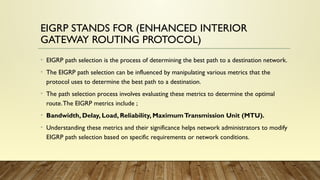
• EIGRP path selection is the process of determining the best path to a destination network.
• The EIGRP path selection can be influenced by manipulating various metrics that the
protocol uses to determine the best path to a destination.
• The path selection process involves evaluating these metrics to determine the optimal
route.The EIGRP metrics include ;
• Bandwidth, Delay, Load, Reliability, MaximumTransmission Unit (MTU).
• Understanding these metrics and their significance helps network administrators to modify
EIGRP path selection based on specific requirements or network conditions.
29.
By default, fromthe different metric values, EIGRP only uses the minimum bandwidth on
the path to a destination network and the total delay to compute routing metrics.
*The bandwidth and delay metrics are determined from static values configured on the
interfaces from devices along the path towards the destination, in other words these two
parameters are not measured dynamically.
1. Bandwidth:The slowest link in the path
2. Delay:The cumulative delay along the path
3. Reliability:The reliability of the links in the path
4. Load:The load on the links in the path
5. MTU:The smallest MTU in the path
30.
METRIC CALCULATION:
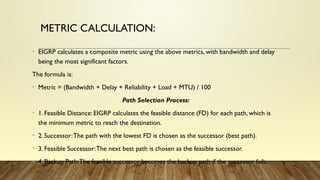
• EIGRPcalculates a composite metric using the above metrics, with bandwidth and delay
being the most significant factors.
The formula is:
• Metric = (Bandwidth + Delay + Reliability + Load + MTU) / 100
Path Selection Process:
• 1. Feasible Distance: EIGRP calculates the feasible distance (FD) for each path, which is
the minimum metric to reach the destination.
• 2. Successor:The path with the lowest FD is chosen as the successor (best path).
• 3. Feasible Successor:The next best path is chosen as the feasible successor.
• 4. Backup Path:The feasible successor becomes the backup path if the successor fails.
31.
PATH SELECTION CRITERIA:
EIGRPselects the path with the:
• Lowest metric (FD), Highest reliability, Lowest delay, Highest bandwidth
Influencing Path Selection:
• To influence path selection, you can adjust the metric weights using the "metric weights"
command.This allows you to prioritize specific metrics, such as bandwidth or delay.
EIGRP Path Selection Example:
Suppose we have two paths to a destination network:
Path 1: 100 Mbps link with 10 ms delay
Path 2: 50 Mbps link with 5 ms delay
EIGRP calculates the metric as:
Path 1: Metric = (100 + 10 + 5 + 5 + 1500) / 100 = 26.5
Path 2: Metric = (50 + 5 + 5 + 5 + 1500) / 100 = 23.5
Path 2 is chosen as the successor (best path) due to its lower metric.
32.
Aside from themetric manipulation, route filtering can also be used to influence the path
selection in EIGRP
Route filtering involves controlling the information that is allowed or denied to enter or exit a
router routing table.
Filtering routes can be done for various reasons, including optimizing routing tables, or
managing network traffic.
Some of the key features related to route filtering in EIGRP include, distribute lists, prefix
lists, route maps and leak maps.
These mechanisms offer a powerful and flexible way for controlling routing information that
can be used by network administrators to tailor EIGRP routing tables to meet specific
criteria and improve network efficiency
33.
8. By MukisaPatience
Explore Load Balancing and Sharing in EIGRP .
EIGRP Is an Enhanced Interior Gateway Routing protocol that supports load balancing and sharing through equal-cost load
balancing mechanism.
Equal-cost Load Balancing: EIGRP supports equal-cost balancing by default.
Multiple paths to a destination network have the same cost. EIGRP will distribute traffic evenly across these paths, allowing up to
four equal-cost paths to be installed in the routing table.
Metric Calculation:
EIGRP calculates a composite metric for each route to determine the best path to a destination. This metric is based on several
factors such as bandwidth, delay, reliability, and load along the path.
Paths with the same metric (equal-cost paths) are eligible for load balancing. EIGRP can load balance across up to four equal-
cost paths to a destination.
Feasibility Condition:
To ensure loop-free operation during load balancing, EIGRP uses the feasibility condition. This condition states that a backup
path (feasible distance) must have a metric lower than the current best path’s metric (reported distance) to be considered eligible
for use in load balancing.
34.
Feasible successors arealternative paths that can replace the current best path in case of a link failure without
causing routing loops.
Variance Command:
EIGRP allows administrators to adjust the feasibility condition using the variance command.It has ability to
load balance across un-equal-cost path with a single command, up to 6different paths. It only works when the cost
of the path is lower than the variance number multiplied by the best metric.
For example, setting variance 2 would allow paths with metrics up to twice the FD(feasible distance) to be included
in load balancing calculations.
Unequal-Cost Load Balancing:
EIGRP can also be configured for unequal-cost load balancing. This feature allows traffic to be distributed across
paths with different metrics.
Unequal-cost load balancing requires manual configuration using the variance command to specify the metric
variance threshold beyond which paths are considered for load balancing.
Path Selection: When multiple paths are available, EIGRP uses a formula to determine the best path. This formula
takes into account the cumulative metric, path reliability or Delay, and path bandwidth to select the optimal path.
35.
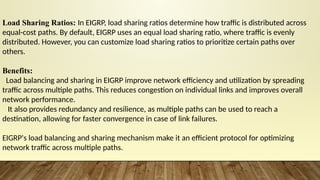
Load Sharing Ratios:In EIGRP, load sharing ratios determine how traffic is distributed across
equal-cost paths. By default, EIGRP uses an equal load sharing ratio, where traffic is evenly
distributed. However, you can customize load sharing ratios to prioritize certain paths over
others.
Benefits:
Load balancing and sharing in EIGRP improve network efficiency and utilization by spreading
traffic across multiple paths. This reduces congestion on individual links and improves overall
network performance.
It also provides redundancy and resilience, as multiple paths can be used to reach a
destination, allowing for faster convergence in case of link failures.
EIGRP's load balancing and sharing mechanism make it an efficient protocol for optimizing
network traffic across multiple paths.
DEFINITIONS.
• EIGRP-is anabbreviation for Enhanced Interior Gateway Routing Protocols.
• This is an enhanced distance vector protocol which relies on the Diffused
Update Algorithm(DUAL) to calculate the shortest path to a destination within
a network.
• OSPF-is an abbreviation for Open Shortest Path First.
• This is a popular link-state routing protocol used for interior gateway routing.
• It is also known for its scalability , flexibility and fast convergence.
38.
SIMILARITIES.
• Both areinterior gateway protocols(IGPs).
• Both are used for routing in enterprise networks.
• Both support variable-length subnet mask(VLSM).
• Both enable load balancing and route summarization.
39.
DIFFERENCES.
EIGRP(ENHANCED INTERIOR
GATEWAY ROUTINGPROTOCOL)
1. Uses the hybrid type of protocol.(distance
vector and link-state)
2. Its more complexed in terms of its
complexity.
3. Its suitable for large complexed network.
4. Has better scalability.
5. Uses querry process to propagate routes.
OSPF(OPEN SHORTEST PATH FIRST)
• Uses only the link-state type of protocol.
• Its less complexed in terms of its complexity.
• Its suitable for smaller to medium-sized
network.
• Has limited scalability.
• Uses flooding process to propagate routes.
40.
IN CONCLUSION,
• Whenusing a large complexed network with many devices, the EIGRP is a
better choice.
• If you are using a smaller to medium sized network with vendor devices,
the OSPF is the best choice to use.








![CISCO USES FOLLOWING THE CONFIGURATION
VALUES FOR BANDWIDTH AND DELAY.
• Bandwidth = 107
/ least bandwidth of the route [Lowest bandwidth from
all interfaces between source and destination.]
• Delay = cumulative delay of the route [Sum of all outgoing interfaces'
delay.]](https://image.slidesharecdn.com/grouptwo-250411063851-48b7b835/85/GROUP-TWO-EIGRP-protocol-in-Cisco-1-pptx-26-320.jpg)