ELEMENT
MANAGEMENT
SYSTEM
Prepared and Presented by,
Deval Naik
Ashley T
Tushar Sharma
Rohit Kulkarni
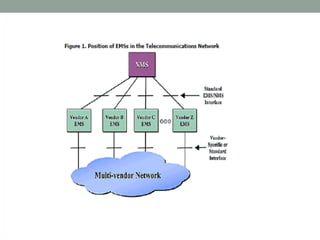
What is EMS?
• One or more specific type of network element
• Manage of functions and capabilities within NE
• But doesn’t not manage traffic between different NE, for
that it need to report higher level
EMS and four function model
• Service Provisioning
• Service assurance
• EMS and NE operation support
• Automation enabler
EMS architecture requirements
• Correct level of management
• Scalable to grow with the requirements and complexity of
the network
• Supports scalability and availability
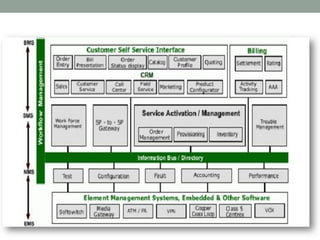
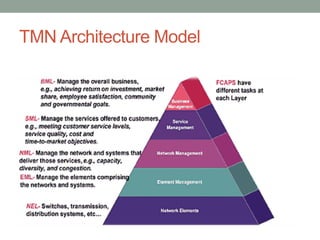
TMN Architecture Model
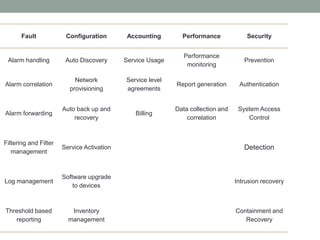
Fault Configuration Accounting Performance Security
Alarm handling Auto Discovery Service Usage
Performance
monitoring
Prevention
Alarm correlation
Network
provisioning
Service level
agreements
Report generation Authentication
Alarm forwarding
Auto back up and
recovery
Billing
Data collection and
correlation
System Access
Control
Filtering and Filter
management
Service Activation Detection
Log management
Software upgrade
to devices
Intrusion recovery
Threshold based
reporting
Inventory
management
Containment and
Recovery
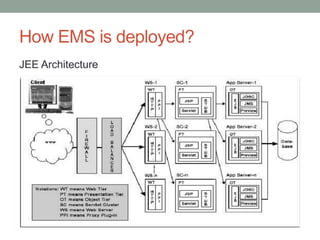
How EMS is deployed?
JEE Architecture
Approaches to deploy EMS
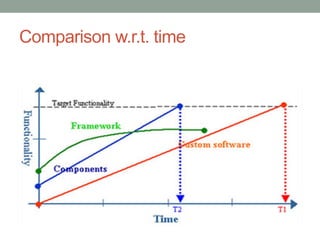
• Custom approach
• Development is done in house by the EV or outsourced to the other
company
• Highly customized
• Time consuming
• High cost
Approaches to deploy EMS(Contd.)
• Framework approach
• Additional application layer needs to be added to meet the
individual requirements
• Same look and feel for the different vendors
• Limited customization
• Additional functionality cannot be added
Approaches to deploy EMS(Contd.)
• Components based approach
• Architected from scratch by using pre built components
• Combined approach components and framework approach
• Pre built components
Comparison w.r.t. time
Challenges in deploying EMS for Wireless
Networks
• Managing back up plan
• Manage active and stand by/ back up link
• Tracks the clients. Hence, it helps in network planning
• Handle clients intelligently
• Evaluate the throughput and interference from the other
access point and report it to NMS
ELEMENT MANAGEMENT SYSTEM
Nortel’s
Nortel’s Element Management System
• Management of Media Gateways within VoiP networks
• OAM&P of Nortel’s families of Media Gateways
• Manages Nortel’s multiple digital Media Gateway systems
• Manages Nortel’s analog VoIP Media Gateway customer
Premises Equipment (CPE)
Characteristics
• Versatile System
• FCAPS
• Open Standard Design
• Private Labeling
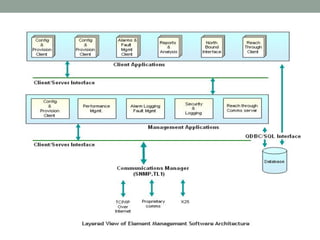
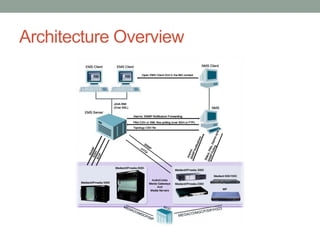
Architecture Overview
Specifications
• TMN Standards
• Fault Management
• Media Gateways Automatic Detection and Monitoring
• Media Gateways Provisioning
• Security Management
• Performance Management
• Media Gateways Maintenance Actions
User Interface and External Interfaces
Specifications
• User Access Control Local
• Northbound Interface
• Southbound Interface
• Multi-Platform
• Relational Database
Supported VoIP Equipment
• Media Pack
• Mediant 1000 Media Gateway
• Mediant 600 Media Gateway
• Media Pack MP-500
• Mediant 5000 Media Gateway
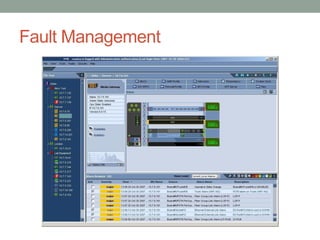
Fault Management
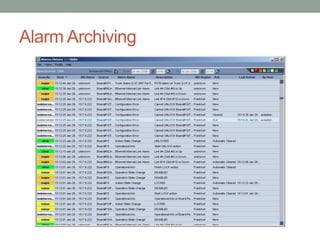
Alarm Archiving
Configuration Management
• Automatic GW Software Version Detection
• Media Gateway Status Summary
• Navigation Buttons
• Inventory Management
• Real-Time, Color-Coded Media Gateway View
• One-Click Access to Element Provisioning & Actions
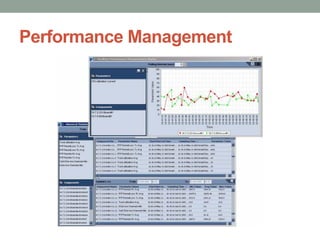
Performance Management
Continued ……………
• Real-Time Graphs
• History (Background) Performance Monitoring
• Aggregated PMs
• Performance Thresholds
Security Management
• Network Communication Security
• EMS Users Authentication and Authorization
• Using Centralized Radius Server OR
• Local Users Management
• EMS Users Actions Journal
• EMS Server Machine Security & Hardening (including
UNIX and Oracle related items)
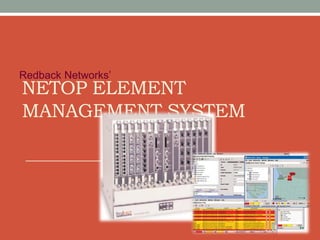
NETOP ELEMENT
MANAGEMENT SYSTEM
Redback Networks’
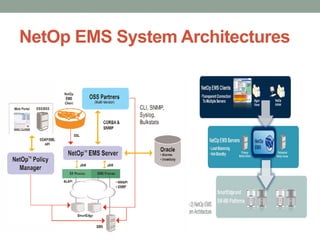
NetOp EMS System Architectures
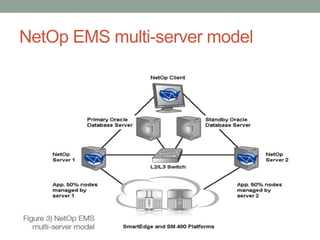
NetOp EMS multi-server model
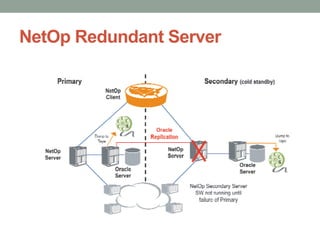
NetOp Redundant Server
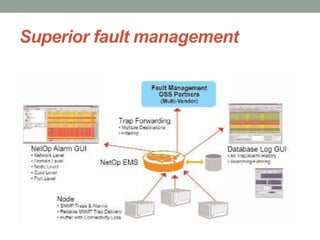
Intuitive GUI Enables Fast, Effective Management
• Operators can perform fault and security
management for the Redback platforms using the
NetOp EMS software's intuitive GUI.
Superior fault management
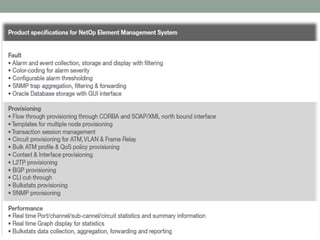
Flow Through Service Provisioning
• A Flow Through Service Provisioning CORBA
interface has been implemented in the NetOp.
• This helps the service provider reduce the
following:
• Provisioning Time
• Operation Training
• Operational Errors
CONTD.
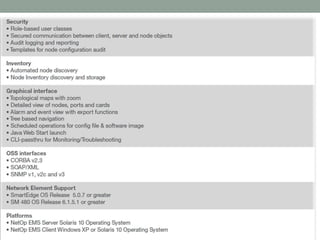
• Efficient inventory management
• Configuration Management
• Auto Node Discovery
• Security
• Bulk Operations
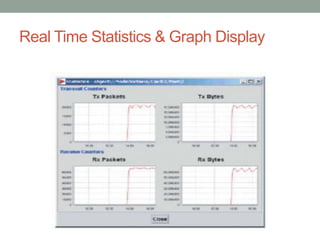
Real Time Statistics & Graph Display
Embedded Management
• CLI
• SNMP
• BulkStats
• BGP Attribute-Based Accounting
NetOp Policy Manager functions
• Enforcing policies for
• Metering policies (time-based, duration (byte) based)
• Security policies (eg. Web login)
• Provisioning policies as a result of a subscriber
selecting a new service
• Removing policies when a subscriber cancels a
service
• Modifying Policies when a subscriber modifies a
service
CONTD..
• Maintaining a persistent store of each
subscriber's services and the policies to be
applied for the services
• Proxying RADIUS accounting packets to other
RADIUS servers or billing systems
• Storing accounting data
• Providing centralized authentication
• Enforcing service admission control
OSS Partners
• Sheer Networks
• Syndesis
• Micromuse
• Narus
• Concord
• Quallaby
• Visionael
Functions within a multi-vendor network
• VPN and QOS provisioning
• Multi-vendor provisioning
• Fault monitoring
• Statistics collection and mediation
• SLAs
• Inventory reporting
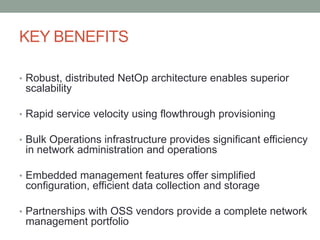
KEY BENEFITS
• Robust, distributed NetOp architecture enables superior
scalability
• Rapid service velocity using flowthrough provisioning
• Bulk Operations infrastructure provides significant efficiency
in network administration and operations
• Embedded management features offer simplified
configuration, efficient data collection and storage
• Partnerships with OSS vendors provide a complete network
management portfolio
Thank You

Element Management Subsystem

  • 1.
    ELEMENT MANAGEMENT SYSTEM Prepared and Presentedby, Deval Naik Ashley T Tushar Sharma Rohit Kulkarni
  • 2.
    What is EMS? •One or more specific type of network element • Manage of functions and capabilities within NE • But doesn’t not manage traffic between different NE, for that it need to report higher level
  • 3.
    EMS and fourfunction model • Service Provisioning • Service assurance • EMS and NE operation support • Automation enabler
  • 6.
    EMS architecture requirements •Correct level of management • Scalable to grow with the requirements and complexity of the network • Supports scalability and availability
  • 8.
  • 9.
    Fault Configuration AccountingPerformance Security Alarm handling Auto Discovery Service Usage Performance monitoring Prevention Alarm correlation Network provisioning Service level agreements Report generation Authentication Alarm forwarding Auto back up and recovery Billing Data collection and correlation System Access Control Filtering and Filter management Service Activation Detection Log management Software upgrade to devices Intrusion recovery Threshold based reporting Inventory management Containment and Recovery
  • 10.
    How EMS isdeployed? JEE Architecture
  • 11.
    Approaches to deployEMS • Custom approach • Development is done in house by the EV or outsourced to the other company • Highly customized • Time consuming • High cost
  • 12.
    Approaches to deployEMS(Contd.) • Framework approach • Additional application layer needs to be added to meet the individual requirements • Same look and feel for the different vendors • Limited customization • Additional functionality cannot be added
  • 13.
    Approaches to deployEMS(Contd.) • Components based approach • Architected from scratch by using pre built components • Combined approach components and framework approach • Pre built components
  • 14.
  • 15.
    Challenges in deployingEMS for Wireless Networks • Managing back up plan • Manage active and stand by/ back up link • Tracks the clients. Hence, it helps in network planning • Handle clients intelligently • Evaluate the throughput and interference from the other access point and report it to NMS
  • 16.
  • 17.
    Nortel’s Element ManagementSystem • Management of Media Gateways within VoiP networks • OAM&P of Nortel’s families of Media Gateways • Manages Nortel’s multiple digital Media Gateway systems • Manages Nortel’s analog VoIP Media Gateway customer Premises Equipment (CPE)
  • 18.
    Characteristics • Versatile System •FCAPS • Open Standard Design • Private Labeling
  • 19.
  • 20.
    Specifications • TMN Standards •Fault Management • Media Gateways Automatic Detection and Monitoring • Media Gateways Provisioning • Security Management • Performance Management • Media Gateways Maintenance Actions
  • 21.
    User Interface andExternal Interfaces Specifications • User Access Control Local • Northbound Interface • Southbound Interface • Multi-Platform • Relational Database
  • 22.
    Supported VoIP Equipment •Media Pack • Mediant 1000 Media Gateway • Mediant 600 Media Gateway • Media Pack MP-500 • Mediant 5000 Media Gateway
  • 23.
  • 24.
  • 25.
    Configuration Management • AutomaticGW Software Version Detection • Media Gateway Status Summary • Navigation Buttons • Inventory Management • Real-Time, Color-Coded Media Gateway View • One-Click Access to Element Provisioning & Actions
  • 26.
  • 27.
    Continued …………… • Real-TimeGraphs • History (Background) Performance Monitoring • Aggregated PMs • Performance Thresholds
  • 28.
    Security Management • NetworkCommunication Security • EMS Users Authentication and Authorization • Using Centralized Radius Server OR • Local Users Management • EMS Users Actions Journal • EMS Server Machine Security & Hardening (including UNIX and Oracle related items)
  • 29.
  • 30.
    NetOp EMS SystemArchitectures
  • 31.
  • 32.
  • 33.
    Intuitive GUI EnablesFast, Effective Management • Operators can perform fault and security management for the Redback platforms using the NetOp EMS software's intuitive GUI.
  • 34.
  • 35.
    Flow Through ServiceProvisioning • A Flow Through Service Provisioning CORBA interface has been implemented in the NetOp. • This helps the service provider reduce the following: • Provisioning Time • Operation Training • Operational Errors
  • 36.
    CONTD. • Efficient inventorymanagement • Configuration Management • Auto Node Discovery • Security • Bulk Operations
  • 37.
    Real Time Statistics& Graph Display
  • 38.
    Embedded Management • CLI •SNMP • BulkStats • BGP Attribute-Based Accounting
  • 39.
    NetOp Policy Managerfunctions • Enforcing policies for • Metering policies (time-based, duration (byte) based) • Security policies (eg. Web login) • Provisioning policies as a result of a subscriber selecting a new service • Removing policies when a subscriber cancels a service • Modifying Policies when a subscriber modifies a service
  • 40.
    CONTD.. • Maintaining apersistent store of each subscriber's services and the policies to be applied for the services • Proxying RADIUS accounting packets to other RADIUS servers or billing systems • Storing accounting data • Providing centralized authentication • Enforcing service admission control
  • 41.
    OSS Partners • SheerNetworks • Syndesis • Micromuse • Narus • Concord • Quallaby • Visionael
  • 42.
    Functions within amulti-vendor network • VPN and QOS provisioning • Multi-vendor provisioning • Fault monitoring • Statistics collection and mediation • SLAs • Inventory reporting
  • 45.
    KEY BENEFITS • Robust,distributed NetOp architecture enables superior scalability • Rapid service velocity using flowthrough provisioning • Bulk Operations infrastructure provides significant efficiency in network administration and operations • Embedded management features offer simplified configuration, efficient data collection and storage • Partnerships with OSS vendors provide a complete network management portfolio
  • 46.