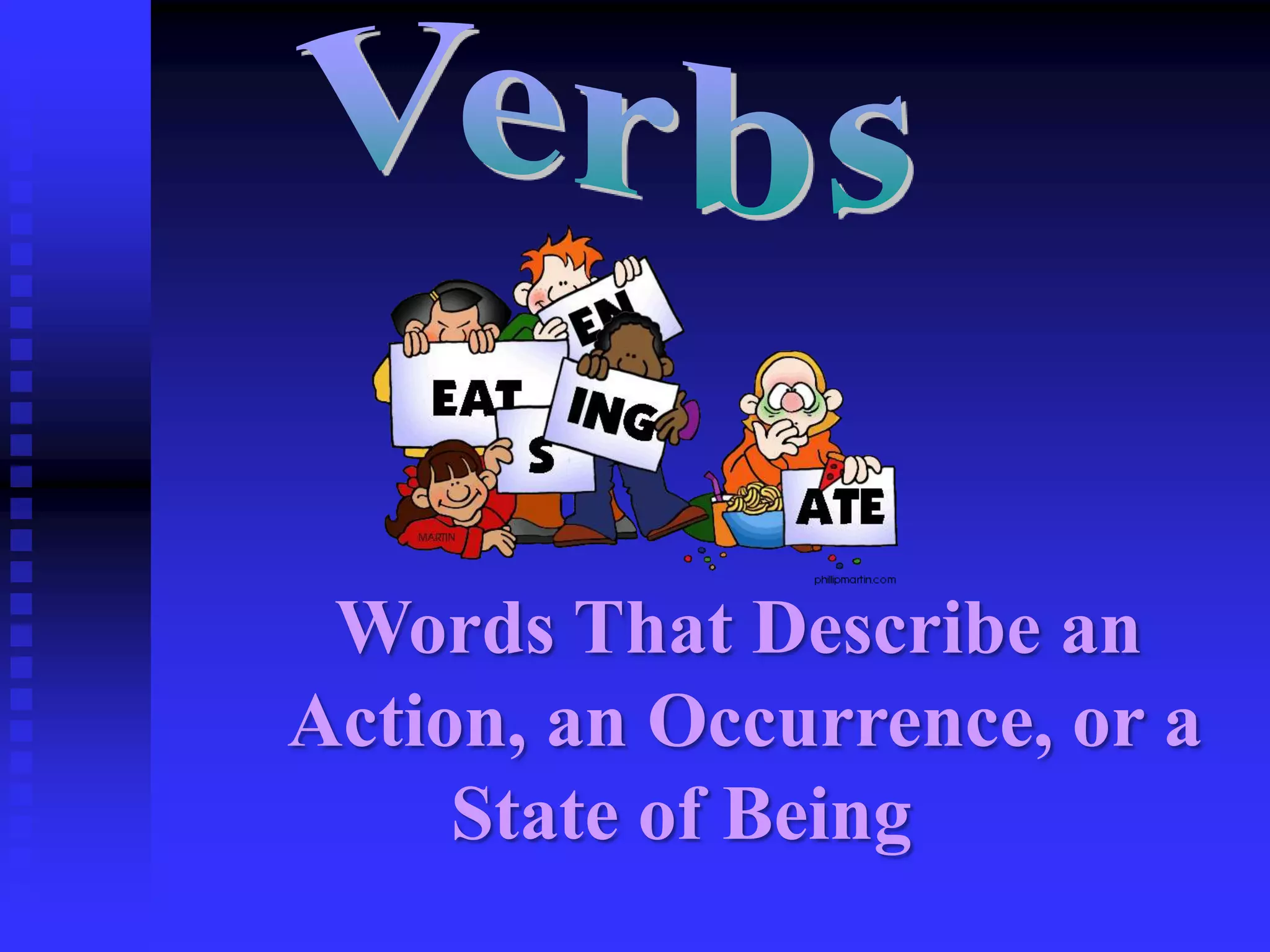
Words That Describe an
Action, an Occurrence, or a
State of Being
Using Verbs Correctly
More than one-half of all mistakes in English are
caused by the misuse of verbs.
It is time for you to put an end to careless mistakes.

Verbs just have a few rules to follow.
Verbs are NOT difficult.
Let’s get started.
Regular Verbs
• Here’s a new word for many of you: conjugate. For
grammar, the word means listing the verb, its helpers,
and tenses. Right now, you need to know present tense,
past tense, and past participle form. Don’t panic. This
is not as difficult as it sounds. The present tense form of
the verb is just the regular verb. With regular verbs, to
make them past tense, usually just add an –ed. The past
participle form will take a form of have (had or has) and
usually the past tense form of the verb. If you have to
know the future tense, put will or shall in from of the
present tense verb. On the next slide, we will see how
easy this is to do.
Action Verbs Describe an Activity

Physical Actions: eat, walk, run, sleep,
swim, scream, read, write, watch, etc.
Quite Actions:
love, think, sleep, watch, plan, care, grow, for
give, concentrate, etc.
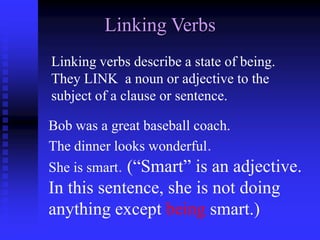
Linking Verbs
Linking verbs describe a state of being.
They LINK a noun or adjective to the
subject of a clause or sentence.
Bob was a great baseball coach.
The dinner looks wonderful.
She is smart. (“Smart” is an adjective.

In this sentence, she is not doing
anything except being smart.)
Linking Verbs

Be Verbs
Other
Linking
Verbs

be, am, is, are, was, were,
been, being
appear, become, feel, grow,
look, seem, remain, smell,
sound, stay, taste, turn
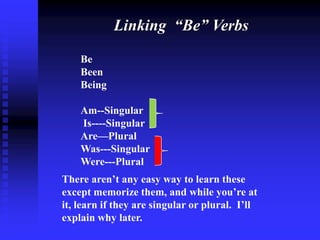
Linking “Be” Verbs
Be
Been
Being
Am--Singular
Is----Singular
Are—Plural
Was---Singular
Were---Plural
There aren’t any easy way to learn these
except memorize them, and while you’re at
it, learn if they are singular or plural. I’ll
explain why later.
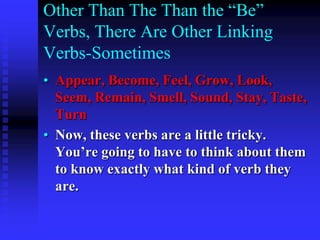
Other Than The Than the “Be”
Verbs, There Are Other Linking
Verbs-Sometimes
• Appear, Become, Feel, Grow, Look,
Seem, Remain, Smell, Sound, Stay, Taste,
Turn
• Now, these verbs are a little tricky.
You’re going to have to think about them
to know exactly what kind of verb they
are.
Tricky Linking Verbs
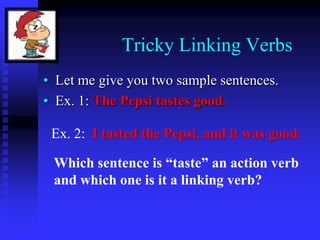
• Let me give you two sample sentences.
• Ex. 1: The Pepsi tastes good.
Ex. 2: I tasted the Pepsi, and it was good.
Which sentence is ―taste‖ an action verb
and which one is it a linking verb?
Tricky Linking Verbs
• If you see someone drinking a Pepsi, there is a lot
of action taking place. The can is raised to the
lips; the Pepsi is poured or sipped into the mouth;
the taste buds on the tongue spring into life and
send a message to the brain, which sends a
message to the throat to open and swallow the
liquid because the Pepsi isn’t rotten or something.
Ex. 2 is the action verb.
Ex. 1 is the linking verb. Why? Well, let me
explain on the next slide.
Tricky Linking Verbs
• BUT that is not what the Sample 1 sentence says.
It says that the Pepsi tastes good. Pepsi CANNOT
taste. It doesn’t have taste buds or a tongue. You
get the idea. In English, we are always trying to
make things faster and easier, and that is why we
have a shorten sentence that uses the linking verbs
in this manner. Only the “Be” Verbs and the 12
other verbs in the chart will ever be linking verbs
or action verbs. You must test them to tell. Can
the subject be doing the action? If not, and it is
one of these verbs in the chart, it is a linking verb.
Helping verbs help the main verb
describe action that happened in the past,
is happening in the present, or will
happen in the future. The experts say that these
helping verbs “carry the time.” They tell the
reader or speaker when the action happened.
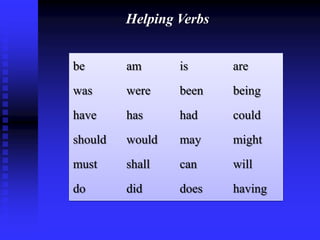
Helping Verbs
be

am

is

are

was

were

been

being

have

has

had

could

should

would

may

might

must

shall

can

will

do

did

does

having
Helping Verbs
I can hear some of you screaming (silently) at me because
have noticed that the “Be” Verbs are on this list also. Well,
let me explain again. The “Be” Verbs are linking verbs if
they are the only verb in the sentence, but if one more or is
with another verb, they are helping verbs.
Ex. 1 They are smart. Linking verb because no other verb
is present.
Ex. 2 They are going to town with their mother. Helping
verb because “going” is the action verb and “are” is
helping. There may be as many as 3 helping verbs in a
sentence.
Ex. 3 They may have been going to town tonight.
NOT Is Never a Verb

NOT and no form of it will ever be a verb. Be careful
when you are asked to underline the verbs in a
sentence. If you accidently underline or mark “n’t” in
a contraction, it is wrong.
Ex. 1 She didn’t go with us tonight.

Verbs
Just So You Will Know
• Using the words do or did as helping verbs is
using the emphatic tense.
• Ex.1: I wrote my paper last night.
• This sentence is just a simple declarative sentence.
• Ex. 2: I did write my paper last night.
• That sentence is called an emphatic sentence
because the did is used to show there is an
emphasis put on the verb. This not something you
have to know now, but you will need it in the
future, and I wanted to prepare you for it.
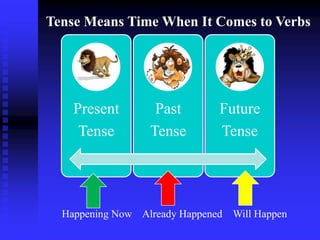
Tense Means Time When It Comes to Verbs

Present
Tense

Past
Tense

Future
Tense

Happening Now Already Happened Will Happen
Present tense – now
The lions chase the zebra.
Past tense – before now
The lion chased the zebra.
Future tense – has not happened yet
The lion will chase the zebra.
A participle is usually a verb.
There are two kinds of participles – past
and present.
Present Participles usually end in -ing.
Past Participles usually end in -ed or -en,
or -d, -t, or –n, and follow the helping
verbs have or had.
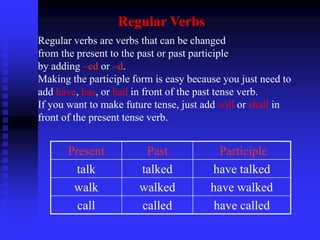
Regular Verbs
Regular verbs are verbs that can be changed
from the present to the past or past participle
by adding –ed or –d.
Making the participle form is easy because you just need to
add have, has, or had in front of the past tense verb.
If you want to make future tense, just add will or shall in
front of the present tense verb.

Present
talk
walk
call

Past
talked
walked
called

Participle
have talked
have walked
have called
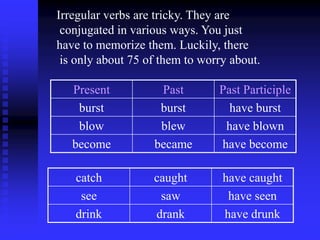
Irregular verbs are tricky. They are
conjugated in various ways. You just
have to memorize them. Luckily, there
is only about 75 of them to worry about.
Present
burst
blow
become

Past
burst
blew
became

Past Participle
have burst
have blown
have become

catch
see
drink

caught
saw
drank

have caught
have seen
have drunk
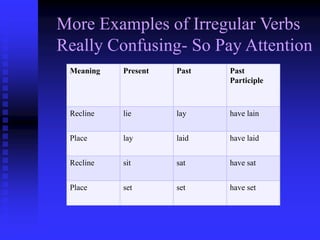
More Examples of Irregular Verbs
Really Confusing- So Pay Attention
Meaning

Present

Past

Past
Participle

Recline

lie

lay

have lain

Place

lay

laid

have laid

Recline

sit

sat

have sat

Place

set

set

have set
The End

English Verbs Leon

  • 1.
    Words That Describean Action, an Occurrence, or a State of Being
  • 2.
    Using Verbs Correctly Morethan one-half of all mistakes in English are caused by the misuse of verbs. It is time for you to put an end to careless mistakes. Verbs just have a few rules to follow. Verbs are NOT difficult. Let’s get started.
  • 3.
    Regular Verbs • Here’sa new word for many of you: conjugate. For grammar, the word means listing the verb, its helpers, and tenses. Right now, you need to know present tense, past tense, and past participle form. Don’t panic. This is not as difficult as it sounds. The present tense form of the verb is just the regular verb. With regular verbs, to make them past tense, usually just add an –ed. The past participle form will take a form of have (had or has) and usually the past tense form of the verb. If you have to know the future tense, put will or shall in from of the present tense verb. On the next slide, we will see how easy this is to do.
  • 4.
    Action Verbs Describean Activity Physical Actions: eat, walk, run, sleep, swim, scream, read, write, watch, etc. Quite Actions: love, think, sleep, watch, plan, care, grow, for give, concentrate, etc.
  • 5.
    Linking Verbs Linking verbsdescribe a state of being. They LINK a noun or adjective to the subject of a clause or sentence. Bob was a great baseball coach. The dinner looks wonderful. She is smart. (“Smart” is an adjective. In this sentence, she is not doing anything except being smart.)
  • 6.
    Linking Verbs Be Verbs Other Linking Verbs be,am, is, are, was, were, been, being appear, become, feel, grow, look, seem, remain, smell, sound, stay, taste, turn
  • 7.
    Linking “Be” Verbs Be Been Being Am--Singular Is----Singular Are—Plural Was---Singular Were---Plural Therearen’t any easy way to learn these except memorize them, and while you’re at it, learn if they are singular or plural. I’ll explain why later.
  • 8.
    Other Than TheThan the “Be” Verbs, There Are Other Linking Verbs-Sometimes • Appear, Become, Feel, Grow, Look, Seem, Remain, Smell, Sound, Stay, Taste, Turn • Now, these verbs are a little tricky. You’re going to have to think about them to know exactly what kind of verb they are.
  • 9.
    Tricky Linking Verbs •Let me give you two sample sentences. • Ex. 1: The Pepsi tastes good. Ex. 2: I tasted the Pepsi, and it was good. Which sentence is ―taste‖ an action verb and which one is it a linking verb?
  • 10.
    Tricky Linking Verbs •If you see someone drinking a Pepsi, there is a lot of action taking place. The can is raised to the lips; the Pepsi is poured or sipped into the mouth; the taste buds on the tongue spring into life and send a message to the brain, which sends a message to the throat to open and swallow the liquid because the Pepsi isn’t rotten or something. Ex. 2 is the action verb. Ex. 1 is the linking verb. Why? Well, let me explain on the next slide.
  • 11.
    Tricky Linking Verbs •BUT that is not what the Sample 1 sentence says. It says that the Pepsi tastes good. Pepsi CANNOT taste. It doesn’t have taste buds or a tongue. You get the idea. In English, we are always trying to make things faster and easier, and that is why we have a shorten sentence that uses the linking verbs in this manner. Only the “Be” Verbs and the 12 other verbs in the chart will ever be linking verbs or action verbs. You must test them to tell. Can the subject be doing the action? If not, and it is one of these verbs in the chart, it is a linking verb.
  • 12.
    Helping verbs helpthe main verb describe action that happened in the past, is happening in the present, or will happen in the future. The experts say that these helping verbs “carry the time.” They tell the reader or speaker when the action happened.
  • 13.
  • 14.
    Helping Verbs I canhear some of you screaming (silently) at me because have noticed that the “Be” Verbs are on this list also. Well, let me explain again. The “Be” Verbs are linking verbs if they are the only verb in the sentence, but if one more or is with another verb, they are helping verbs. Ex. 1 They are smart. Linking verb because no other verb is present. Ex. 2 They are going to town with their mother. Helping verb because “going” is the action verb and “are” is helping. There may be as many as 3 helping verbs in a sentence. Ex. 3 They may have been going to town tonight.
  • 15.
    NOT Is Nevera Verb NOT and no form of it will ever be a verb. Be careful when you are asked to underline the verbs in a sentence. If you accidently underline or mark “n’t” in a contraction, it is wrong. Ex. 1 She didn’t go with us tonight. Verbs
  • 16.
    Just So YouWill Know • Using the words do or did as helping verbs is using the emphatic tense. • Ex.1: I wrote my paper last night. • This sentence is just a simple declarative sentence. • Ex. 2: I did write my paper last night. • That sentence is called an emphatic sentence because the did is used to show there is an emphasis put on the verb. This not something you have to know now, but you will need it in the future, and I wanted to prepare you for it.
  • 17.
    Tense Means TimeWhen It Comes to Verbs Present Tense Past Tense Future Tense Happening Now Already Happened Will Happen
  • 18.
    Present tense –now The lions chase the zebra. Past tense – before now The lion chased the zebra. Future tense – has not happened yet The lion will chase the zebra.
  • 19.
    A participle isusually a verb. There are two kinds of participles – past and present. Present Participles usually end in -ing. Past Participles usually end in -ed or -en, or -d, -t, or –n, and follow the helping verbs have or had.
  • 20.
    Regular Verbs Regular verbsare verbs that can be changed from the present to the past or past participle by adding –ed or –d. Making the participle form is easy because you just need to add have, has, or had in front of the past tense verb. If you want to make future tense, just add will or shall in front of the present tense verb. Present talk walk call Past talked walked called Participle have talked have walked have called
  • 21.
    Irregular verbs aretricky. They are conjugated in various ways. You just have to memorize them. Luckily, there is only about 75 of them to worry about. Present burst blow become Past burst blew became Past Participle have burst have blown have become catch see drink caught saw drank have caught have seen have drunk
  • 22.
    More Examples ofIrregular Verbs Really Confusing- So Pay Attention Meaning Present Past Past Participle Recline lie lay have lain Place lay laid have laid Recline sit sat have sat Place set set have set
  • 23.