What is a verb?
Click here to find out....
jump
Verbs
 A verb is one of the most
important parts of the sentence.
 It tells the subjects actions,
events, or state of being.
 It is always found in the
predicate of a sentence.
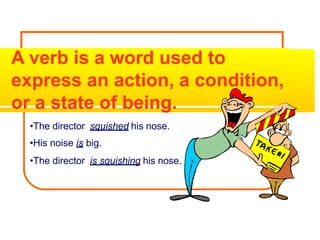
A verb is a word used to
express an action, a condition,
or a state of being.
•The director squished his nose.
•His noise is big.
•The director is squishing his nose.
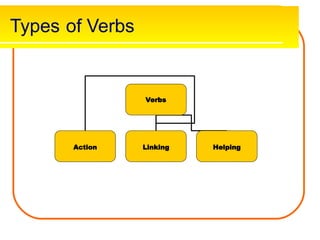
Types of Verbs
Action Linking Helping
Verbs
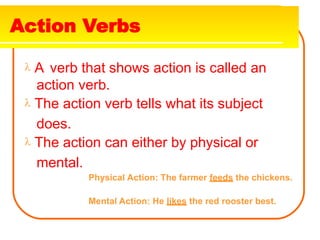
Action Verbs
 A verb that shows action is called an
action verb.
 The action verb tells what its subject
does.
 The action can either by physical or
mental.
Physical Action: The farmer feeds the chickens.
Mental Action: He likes the red rooster best.
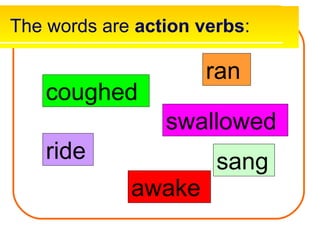
The words are action verbs:
awake
sang
ride
swallowed
coughed
ran
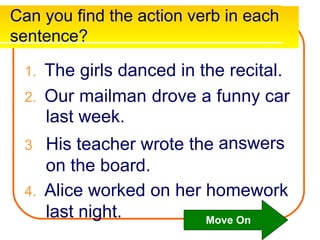
Can you find the action verb in each
sentence?
1. The girls danced in the recital.
2. Our mailman drove a
last week.
3 His teacher wrote the
on the board.
funny car
answers
4. Alice worked on her homework
last night. Move On
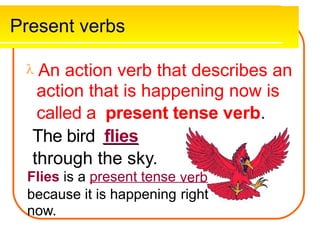
Present verbs
 An action verb that describes an
action that is happening now is
called a present tense
The bird flies
verb.
through the sky.
Flies is a present tense verb
because it is happening
now.
right
Present tense verbs
 Many present tense verbs
end
end with s, but some
ies.
with es, or
splashes
sleeps
cries
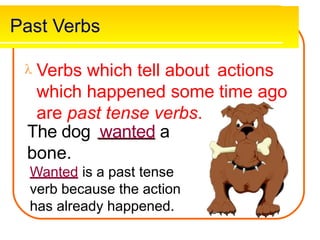
Past Verbs
 Verbs which tell about
which happened some
are past tense verbs.
The dog wanted a
actions
time ago
bone.
Wanted is a past tense
verb because the action
has already happened.
Past tense verbs
 Many past tense verbs end
with ed, but some end with d,
or ied.
played
clapped
tried
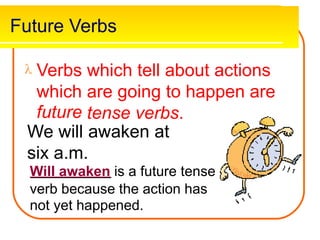
Future Verbs
 Verbs which tell about actions
which
future
We will
are going to happen
tense verbs.
awaken at
are
six a.m.
Will awaken is a future tense
verb because the action has
not yet happened.
Future tense verbs
 Future tense verbs use
special words to talk about
things
going
that will happen: will,
to, shall, aim to, etc.
shall email
will enjoy
going to start
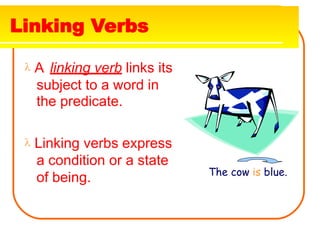
Linking Verbs
 A linking verb links its
subject to a word in
the predicate.
 Linking verbs express
a condition or a state
of being. The cow is blue.
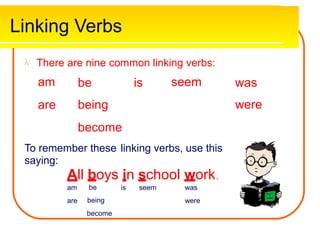
Linking Verbs
There
am
are
are nine common linking verbs:
seem

be
being
become
is was
were
To remember these
saying:
linking verbs, use this
All
am
are
boys
be
being
become
in
is
school
seem
work.
was
were
Helping Verbs
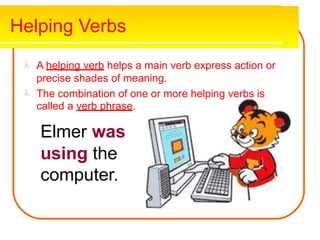
A helping verb helps a main verb express action or

precise shades of meaning.
The combination of one
called a verb phrase.
or more helping verbs is

Elmer was
using the
computer.
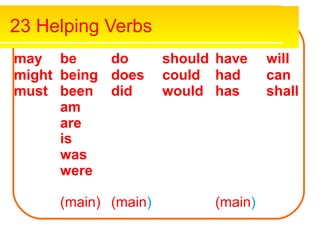
23 Helping Verbs
may
might
must
be
being
been
am
are
is
was
were
do
does
did
should
could
would
have
had
has
will
can
shall
(main) (main) (main)
Helping Verbs
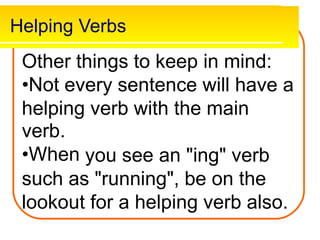
Other things to keep in mind:
•Not every sentence will have a
helping
verb.
•When
verb with the main
you see an "ing" verb
such as "running", be on the
lookout for a helping verb also.
Helping Verbs
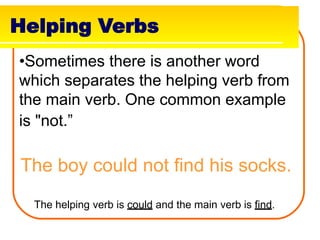
•Sometimes there is another word
which separates the helping verb from
the main verb. One common example
is "not.”
The boy could not find his socks.
The helping verb is could and the main verb is find.
Helping Verbs
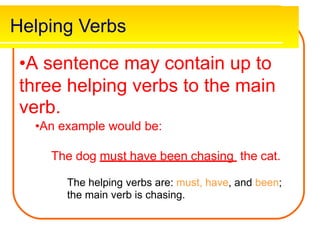
•A sentence may contain up to
three helping verbs to the main
verb.
•An example would be:
The dog must have been chasing the cat.
The helping verbs are: must, have, and been;
the main verb is chasing.
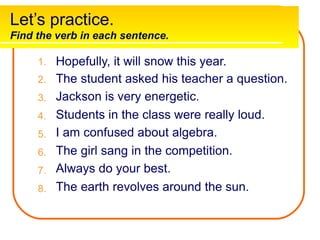
Let’s practice.
Find the verb in each sentence.
Hopefully, it will snow this year.
The student asked his teacher a question.
Jackson is very energetic.
Students in the class were really loud.
I am confused about algebra.
The girl sang in the competition.
Always do your best.
The earth revolves around the sun.
1.
2.
3.
4.
5.
6.
7.
8.
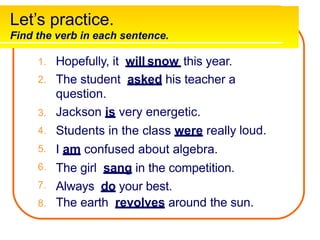
Let’s practice.
Find the verb in each sentence.
Hopefully, it will snow this year.
1.
2. The student asked his teacher a
question.
Jackson is very energetic.
Students in the class were really
I am confused about algebra.
The girl sang in the competition.
Always do your best.
3.
4.
5.
6.
7.
8.
loud.
The earth revolves around the sun.
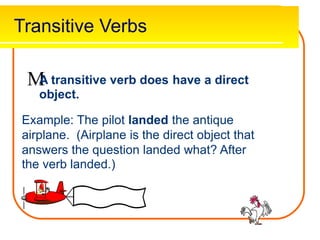
Transitive Verbs

A transitive verb does
object.
have a direct
Example: The pilot landed the antique
airplane. (Airplane is the direct object that
answers the question landed what? After
the verb landed.)
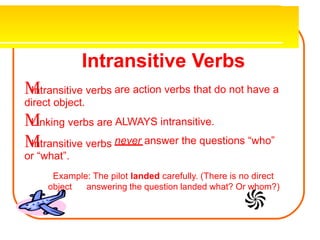
Intransitive Verbs

Intransitive verbs
direct object.

Linking verbs are

Intransitive verbs
or “what”.
are action verbs that do not have a
ALWAYS intransitive.
never answer the questions “who”
Example: The pilot landed carefully. (There is no direct
object answering the question landed what? Or whom?)
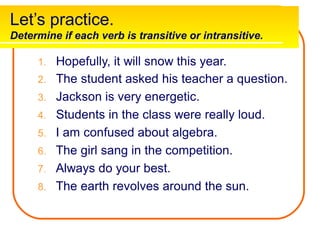
Let’s practice.
Determine if each verb is transitive or intransitive.
1. Hopefully, it will snow this year.
2. The student asked his teacher a question.
3. Jackson is very energetic.
4. Students in the class were really loud.
5. I am confused about algebra.
6. The girl sang in the competition.
7. Always do your best.
8. The earth revolves around the sun.
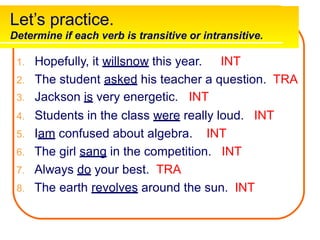
Let’s practice.
Determine if each verb is transitive or intransitive.
1. Hopefully, it willsnow this year. INT
2. The student asked his teacher a question.
3. Jackson is very energetic. INT
TRA
4. Students in the class were really loud. INT
5. Iam confused about algebra. INT
6. The girl sang in the competition. INT
7. Always do your best. TRA
8. The earth revolves around the sun. INT

verbs-action-140328123730-phpapp02.pptx

  • 1.
    What is averb? Click here to find out.... jump
  • 2.
    Verbs  A verbis one of the most important parts of the sentence.  It tells the subjects actions, events, or state of being.  It is always found in the predicate of a sentence.
  • 3.
    A verb isa word used to express an action, a condition, or a state of being. •The director squished his nose. •His noise is big. •The director is squishing his nose.
  • 4.
    Types of Verbs ActionLinking Helping Verbs
  • 5.
    Action Verbs  Averb that shows action is called an action verb.  The action verb tells what its subject does.  The action can either by physical or mental. Physical Action: The farmer feeds the chickens. Mental Action: He likes the red rooster best.
  • 6.
    The words areaction verbs: awake sang ride swallowed coughed ran
  • 7.
    Can you findthe action verb in each sentence? 1. The girls danced in the recital. 2. Our mailman drove a last week. 3 His teacher wrote the on the board. funny car answers 4. Alice worked on her homework last night. Move On
  • 8.
    Present verbs  Anaction verb that describes an action that is happening now is called a present tense The bird flies verb. through the sky. Flies is a present tense verb because it is happening now. right
  • 9.
    Present tense verbs Many present tense verbs end end with s, but some ies. with es, or splashes sleeps cries
  • 10.
    Past Verbs  Verbswhich tell about which happened some are past tense verbs. The dog wanted a actions time ago bone. Wanted is a past tense verb because the action has already happened.
  • 11.
    Past tense verbs Many past tense verbs end with ed, but some end with d, or ied. played clapped tried
  • 12.
    Future Verbs  Verbswhich tell about actions which future We will are going to happen tense verbs. awaken at are six a.m. Will awaken is a future tense verb because the action has not yet happened.
  • 13.
    Future tense verbs Future tense verbs use special words to talk about things going that will happen: will, to, shall, aim to, etc. shall email will enjoy going to start
  • 14.
    Linking Verbs  Alinking verb links its subject to a word in the predicate.  Linking verbs express a condition or a state of being. The cow is blue.
  • 15.
    Linking Verbs There am are are ninecommon linking verbs: seem  be being become is was were To remember these saying: linking verbs, use this All am are boys be being become in is school seem work. was were
  • 16.
    Helping Verbs A helpingverb helps a main verb express action or  precise shades of meaning. The combination of one called a verb phrase. or more helping verbs is  Elmer was using the computer.
  • 17.
  • 18.
    Helping Verbs Other thingsto keep in mind: •Not every sentence will have a helping verb. •When verb with the main you see an "ing" verb such as "running", be on the lookout for a helping verb also.
  • 19.
    Helping Verbs •Sometimes thereis another word which separates the helping verb from the main verb. One common example is "not.” The boy could not find his socks. The helping verb is could and the main verb is find.
  • 20.
    Helping Verbs •A sentencemay contain up to three helping verbs to the main verb. •An example would be: The dog must have been chasing the cat. The helping verbs are: must, have, and been; the main verb is chasing.
  • 21.
    Let’s practice. Find theverb in each sentence. Hopefully, it will snow this year. The student asked his teacher a question. Jackson is very energetic. Students in the class were really loud. I am confused about algebra. The girl sang in the competition. Always do your best. The earth revolves around the sun. 1. 2. 3. 4. 5. 6. 7. 8.
  • 22.
    Let’s practice. Find theverb in each sentence. Hopefully, it will snow this year. 1. 2. The student asked his teacher a question. Jackson is very energetic. Students in the class were really I am confused about algebra. The girl sang in the competition. Always do your best. 3. 4. 5. 6. 7. 8. loud. The earth revolves around the sun.
  • 23.
    Transitive Verbs  A transitiveverb does object. have a direct Example: The pilot landed the antique airplane. (Airplane is the direct object that answers the question landed what? After the verb landed.)
  • 24.
    Intransitive Verbs  Intransitive verbs directobject.  Linking verbs are  Intransitive verbs or “what”. are action verbs that do not have a ALWAYS intransitive. never answer the questions “who” Example: The pilot landed carefully. (There is no direct object answering the question landed what? Or whom?)
  • 25.
    Let’s practice. Determine ifeach verb is transitive or intransitive. 1. Hopefully, it will snow this year. 2. The student asked his teacher a question. 3. Jackson is very energetic. 4. Students in the class were really loud. 5. I am confused about algebra. 6. The girl sang in the competition. 7. Always do your best. 8. The earth revolves around the sun.
  • 26.
    Let’s practice. Determine ifeach verb is transitive or intransitive. 1. Hopefully, it willsnow this year. INT 2. The student asked his teacher a question. 3. Jackson is very energetic. INT TRA 4. Students in the class were really loud. INT 5. Iam confused about algebra. INT 6. The girl sang in the competition. INT 7. Always do your best. TRA 8. The earth revolves around the sun. INT