All You Ever Wanted to Know About Verbs!
THREE TYPES OF VERBS:
~~~~~~~~~~~~~~~~~~~~~~~~~~~~~~~~~~~~~~~~~~~~~~~~~~~~~~~~~~~~~~~~~~~~~~~~~~~~~~~~
A verb is a part of speech that usually denotes action ("bring", "read"), occurrence ("decompose", "glitter"), or
a state of being ("exist", "stand"). Depending on the language, a verb may vary in form according to many
factors, possibly including its tense, aspect, mood and voice. It may also agree with the person, gender, and/or
number of some of its arguments (subject, object, etc.).
From Wikipedia, the free encyclopedia
~~~~~~~~~~~~~~~~~~~~~~~~~~~~~~~~~~~~~~~~~~~~~~~~~~~~~~~~~~~~~~~~~~~~~~~~~~~~~~~~~~~
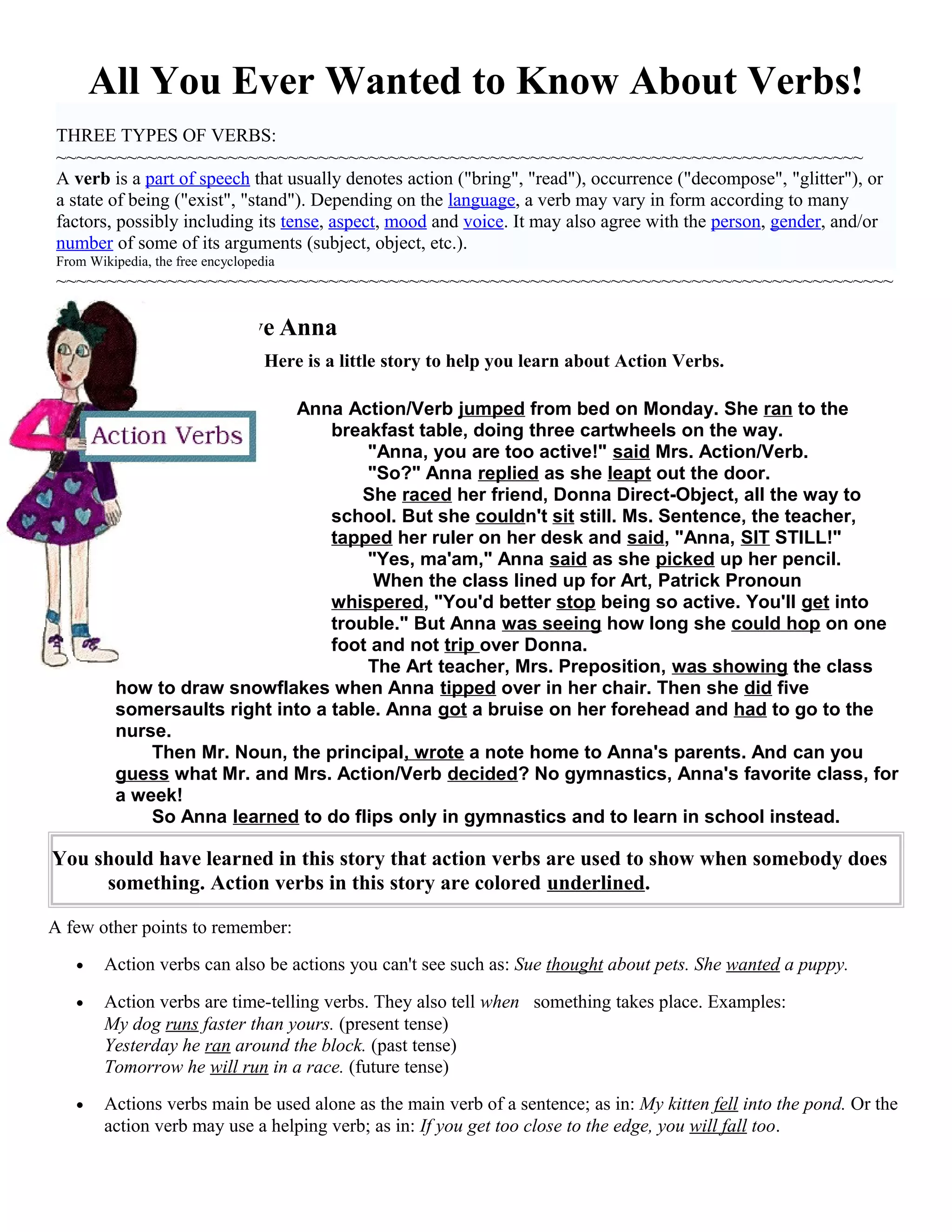
Action Verbs: Active Anna
Here is a little story to help you learn about Action Verbs.
Anna Action/Verb jumped from bed on Monday. She ran to the
breakfast table, doing three cartwheels on the way.
"Anna, you are too active!" said Mrs. Action/Verb.
"So?" Anna replied as she leapt out the door.
She raced her friend, Donna Direct-Object, all the way to
school. But she couldn't sit still. Ms. Sentence, the teacher,
tapped her ruler on her desk and said, "Anna, SIT STILL!"
"Yes, ma'am," Anna said as she picked up her pencil.
When the class lined up for Art, Patrick Pronoun
whispered, "You'd better stop being so active. You'll get into
trouble." But Anna was seeing how long she could hop on one
foot and not trip over Donna.
The Art teacher, Mrs. Preposition, was showing the class
how to draw snowflakes when Anna tipped over in her chair. Then she did five
somersaults right into a table. Anna got a bruise on her forehead and had to go to the
nurse.
Then Mr. Noun, the principal, wrote a note home to Anna's parents. And can you
guess what Mr. and Mrs. Action/Verb decided? No gymnastics, Anna's favorite class, for
a week!
So Anna learned to do flips only in gymnastics and to learn in school instead.
You should have learned in this story that action verbs are used to show when somebody does
something. Action verbs in this story are colored underlined.
A few other points to remember:
• Action verbs can also be actions you can't see such as: Sue thought about pets. She wanted a puppy.
• Action verbs are time-telling verbs. They also tell when something takes place. Examples:
My dog runs faster than yours. (present tense)
Yesterday he ran around the block. (past tense)
Tomorrow he will run in a race. (future tense)
• Actions verbs main be used alone as the main verb of a sentence; as in: My kitten fell into the pond. Or the
action verb may use a helping verb; as in: If you get too close to the edge, you will fall too.
Helping and Main Verbs
Hi! I'm Harry Helping Verb and I'm so helpful I will help you learn the 23
Helping Verbs by telling you a story. The title of the story is Old Mr. Do.
Like some stories, this story has a moral. The moral is: "Maybe Mr. Do should
have a will". Read on and you will see why!
Old Mr. Do
Once upon a time there was a wealthy merchant named Mr. Do. Mr. Do was
very old and very rich. His many relatives were dreaming of the day the
old man would die. They wondered which one of them would inherit his
money. Finally, one day Mr. Do did die. All the relatives searched his
house for a will. They didn't find one. They searched his house three
times. They still did not find a will. The relatives did not get one dime of
Mr. Do's fortune.
The moral: Maybe Mr. Do should have a will.
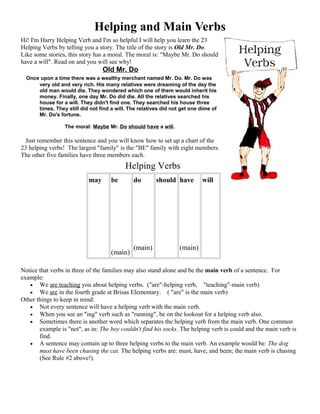
Just remember this sentence and you will know how to set up a chart of the
23 helping verbs! The largest "family" is the "BE" family with eight members.
The other five families have three members each.
Helping Verbs
may be
(main)
do
(main)
should have
(main)
will
Notice that verbs in three of the families may also stand alone and be the main verb of a sentence. For
example:
• We are teaching you about helping verbs. ("are"-helping verb, "teaching"-main verb)
• We are in the fourth grade at Brisas Elementary. ( "are" is the main verb)
Other things to keep in mind:
• Not every sentence will have a helping verb with the main verb.
• When you see an "ing" verb such as "running", be on the lookout for a helping verb also.
• Sometimes there is another word which separates the helping verb from the main verb. One common
example is "not", as in: The boy couldn't find his socks. The helping verb is could and the main verb is
find.
• A sentence may contain up to three helping verbs to the main verb. An example would be: The dog
must have been chasing the cat. The helping verbs are: must, have, and been; the main verb is chasing
(See Rule #2 above!).
State-of-Being Verbs
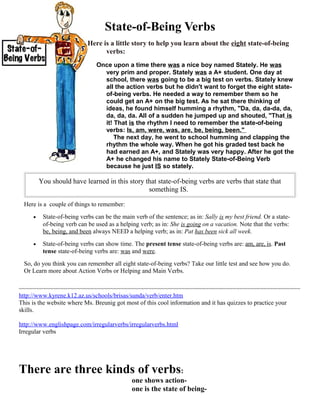
Here is a little story to help you learn about the eight state-of-being
verbs:
Once upon a time there was a nice boy named Stately. He was
very prim and proper. Stately was a A+ student. One day at
school, there was going to be a big test on verbs. Stately knew
all the action verbs but he didn't want to forget the eight state-
of-being verbs. He needed a way to remember them so he
could get an A+ on the big test. As he sat there thinking of
ideas, he found himself humming a rhythm, "Da, da, da-da, da,
da, da, da. All of a sudden he jumped up and shouted, "That is
it! That is the rhythm I need to remember the state-of-being
verbs: Is, am, were, was, are, be, being, been."
The next day, he went to school humming and clapping the
rhythm the whole way. When he got his graded test back he
had earned an A+, and Stately was very happy. After he got the
A+ he changed his name to Stately State-of-Being Verb
because he just IS so stately.
You should have learned in this story that state-of-being verbs are verbs that state that
something IS.
Here is a couple of things to remember:
• State-of-being verbs can be the main verb of the sentence; as in: Sally is my best friend. Or a state-
of-being verb can be used as a helping verb; as in: She is going on a vacation. Note that the verbs:
be, being, and been always NEED a helping verb; as in: Pat has been sick all week.
• State-of-being verbs can show time. The present tense state-of-being verbs are: am, are, is. Past
tense state-of-being verbs are: was and were.
So, do you think you can remember all eight state-of-being verbs? Take our little test and see how you do.
Or Learn more about Action Verbs or Helping and Main Verbs.
~~~~~~~~~~~~~~~~~~~~~~~~~~~~~~~~~~~~~~~~~~~~~~~~~~~~~~~~~~~~~~~~~~~~~~~~~~~~~~~~~~~
http://www.kyrene.k12.az.us/schools/brisas/sunda/verb/enter.htm
This is the website where Ms. Breunig got most of this cool information and it has quizzes to practice your
skills.
http://www.englishpage.com/irregularverbs/irregularverbs.html
Irregular verbs
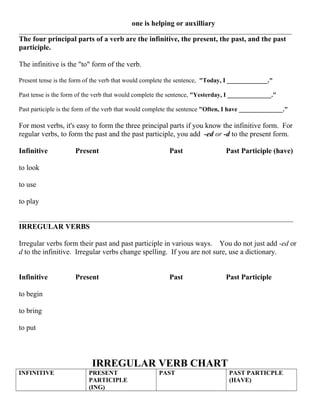
There are three kinds of verbs:
one shows action-
one is the state of being-
one is helping or auxilliary
_______________________________________________________________________________________
The four principal parts of a verb are the infinitive, the present, the past, and the past
participle.
The infinitive is the "to" form of the verb.
Present tense is the form of the verb that would complete the sentence, "Today, I _____________."
Past tense is the form of the verb that would complete the sentence, "Yesterday, I ______________."
Past participle is the form of the verb that would complete the sentence "Often, I have ______________."
For most verbs, it's easy to form the three principal parts if you know the infinitive form. For
regular verbs, to form the past and the past participle, you add -ed or -d to the present form.
Infinitive Present Past Past Participle (have)
to look
to use
to play
___________________________________________________________________________
IRREGULAR VERBS
Irregular verbs form their past and past participle in various ways. You do not just add -ed or
d to the infinitive. Irregular verbs change spelling. If you are not sure, use a dictionary.
Infinitive Present Past Past Participle
to begin
to bring
to put
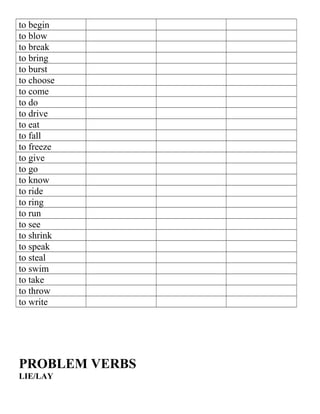
IRREGULAR VERB CHART
INFINITIVE PRESENT
PARTICIPLE
(ING)
PAST PAST PARTICPLE
(HAVE)
to begin
to blow
to break
to bring
to burst
to choose
to come
to do
to drive
to eat
to fall
to freeze
to give
to go
to know
to ride
to ring
to run
to see
to shrink
to speak
to steal
to swim
to take
to throw
to write
PROBLEM VERBS
LIE/LAY
Few people use lie and lay and their principal part correctly, perhaps because few people
know the difference in meaning between the two. The verb lie means “to rest or recline.”
The verb lay means “to put or place.”
The table below shows the principal parts of each of these verbs. Their meaning, written
in the correct form, appears in parentheses.
Present Progressive Past Past participle
(Used with have, has or had)
Lie, lies lying lay lain
(rest, rests) (resting) (rested) (rested)
Lay, lays laying laid laid
(place, places) (placing) (placed) (placed)
To choose the correct form of lie or lay, simply look at the meanings in parentheses. Choose the word in
parentheses that makes the most sense and use the corresponding form of lie or lay. Sometimes non of the
words seem especially appropriate. Nevertheless, choose the option that makes more sense than any of the
others. If a sentence contains the down, mentally delete the word from the sentence to make the appropriate
verb more obvious. Examine the sample sentences to see how this is done.
1. The garbage cans are _______________ in the middle of the street. [Requires progressive]
Resting makes better sense than placing.
2. Keith told Nan to ________________________ the mail on the dining room table. [Requires present]
Place makes better sense than rest.
3. The sandwiches _____________ in the sun for over an hour before we ate them. [Requires past]
Rested makes better sense than placed.
4. Yesterday afternoon, I __________________ down for and hour. [Requires past]
Remove the word down.
Rested makes better sense than placed.
5. Barry thought he had ______________________________ the papers near the copy machine. [Requires
past participle]
Placed makes better sense than rested.
Write the correct form of lie or lay in each of the blanks below.
6. After the alarm sounded, I ___________________ in bed for another hour.
7. __________________ the packages on the mailroom floor.
8. The latest edition of the newspaper ____________________ on the desk.
9. The paper carrier ______________________ the latest edition of the newspaper on the desk.
10. No one had any idea how long the sandwiches had _______________________ in the sun or who
had ____________________________ them there in the first place.
SIT/SET
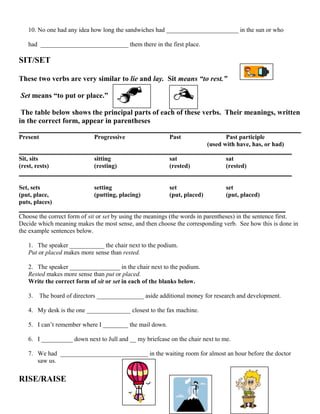
These two verbs are very similar to lie and lay. Sit means “to rest.”
Set means “to put or place.”
The table below shows the principal parts of each of these verbs. Their meanings, written
in the correct form, appear in parentheses
Present Progressive Past Past participle
(used with have, has, or had)
_______________________________________________________________________________________
Sit, sits sitting sat sat
(rest, rests) (resting) (rested) (rested)
_______________________________________________________________________________________
Set, sets setting set set
(put, place, (putting, placing) (put, placed) (put, placed)
puts, places)
_____________________________________________________________________________________
Choose the correct form of sit or set by using the meanings (the words in parentheses) in the sentence first.
Decide which meaning makes the most sense, and then choose the corresponding verb. See how this is done in
the example sentences below.
1. The speaker ___________ the chair next to the podium.
Put or placed makes more sense than rested.
2. The speaker ________________ in the chair next to the podium.
Rested makes more sense than put or placed.
Write the correct form of sit or set in each of the blanks below.
3. The board of directors _______________ aside additional money for research and development.
4. My desk is the one ______________ closest to the fax machine.
5. I can’t remember where I ________ the mail down.
6. I __________ down next to Jull and __ my briefcase on the chair next to me.
7. We had ____________________________ in the waiting room for almost an hour before the doctor
saw us.
RISE/RAISE
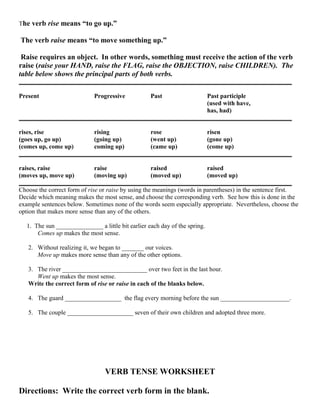
The verb rise means “to go up.”
The verb raise means “to move something up.”
Raise requires an object. In other words, something must receive the action of the verb
raise (raise your HAND, raise the FLAG, raise the OBJECTION, raise CHILDREN). The
table below shows the principal parts of both verbs.
_______________________________________________________________________________________
Present Progressive Past Past participle
(used with have,
has, had)
_______________________________________________________________________________________
rises, rise rising rose risen
(goes up, go up) (going up) (went up) (gone up)
(comes up, come up) coming up) (came up) (come up)
_______________________________________________________________________________________
raises, raise raise raised raised
(moves up, move up) (moving up) (moved up) (moved up)
_______________________________________________________________________________________
Choose the correct form of rise or raise by using the meanings (words in parentheses) in the sentence first.
Decide which meaning makes the most sense, and choose the corresponding verb. See how this is done in the
example sentences below. Sometimes none of the words seem especially appropriate. Nevertheless, choose the
option that makes more sense than any of the others.
1. The sun _______________ a little bit earlier each day of the spring.
Comes up makes the most sense.
2. Without realizing it, we began to _______ our voices.
Move up makes more sense than any of the other options.
3. The river ___________________________ over two feet in the last hour.
Went up makes the most sense.
Write the correct form of rise or raise in each of the blanks below.
4. The guard __________________ the flag every morning before the sun ______________________.
5. The couple _____________________ seven of their own children and adopted three more.
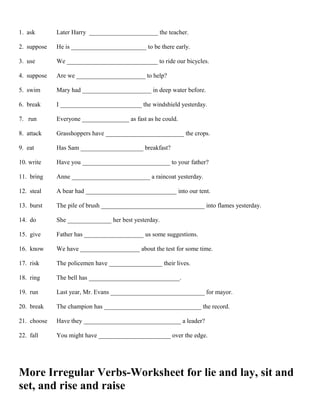
VERB TENSE WORKSHEET
Directions: Write the correct verb form in the blank.
1. ask Later Harry ______________________ the teacher.
2. suppose He is ________________________ to be there early.
3. use We _____________________________ to ride our bicycles.
4. suppose Are we ______________________ to help?
5. swim Mary had ______________________ in deep water before.
6. break I __________________________ the windshield yesterday.
7. run Everyone _______________ as fast as he could.
8. attack Grasshoppers have _________________________ the crops.
9. eat Has Sam ____________________ breakfast?
10. write Have you ____________________________ to your father?
11. bring Anne _________________________ a raincoat yesterday.
12. steal A bear had _____________________________ into our tent.
13. burst The pile of brush _________________________________ into flames yesterday.
14. do She ______________ her best yesterday.
15. give Father has ___________________ us some suggestions.
16. know We have ___________________ about the test for some time.
17. risk The policemen have _________________ their lives.
18. ring The bell has _____________________________.
19. run Last year, Mr. Evans ______________________________ for mayor.
20. break The champion has _______________________________ the record.
21. choose Have they _______________________________ a leader?
22. fall You might have _______________________ over the edge.
More Irregular Verbs-Worksheet for lie and lay, sit and
set, and rise and raise
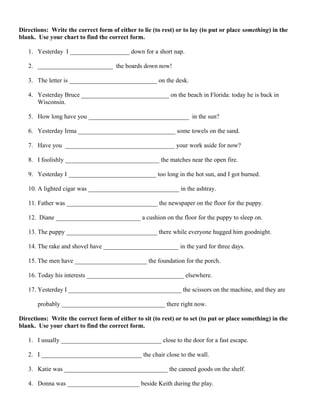
Directions: Write the correct form of either to lie (to rest) or to lay (to put or place something) in the
blank. Use your chart to find the correct form.
1. Yesterday I ___________________ down for a short nap.
2. ________________________ the boards down now!
3. The letter is ____________________________ on the desk.
4. Yesterday Bruce ____________________________ on the beach in Florida: today he is back in
Wisconsin.
5. How long have you ________________________________ in the sun?
6. Yesterday Irma _______________________________ some towels on the sand.
7. Have you ___________________________________ your work aside for now?
8. I foolishly ______________________________ the matches near the open fire.
9. Yesterday I ____________________________ too long in the hot sun, and I got burned.
10. A lighted cigar was _____________________________ in the ashtray.
11. Father was _____________________________ the newspaper on the floor for the puppy.
12. Diane ___________________________ a cushion on the floor for the puppy to sleep on.
13. The puppy _____________________________ there while everyone hugged him goodnight.
14. The rake and shovel have ________________________ in the yard for three days.
15. The men have _______________________ the foundation for the porch.
16. Today his interests _______________________________ elsewhere.
17. Yesterday I ____________________________________ the scissors on the machine, and they are
probably _________________________________ there right now.
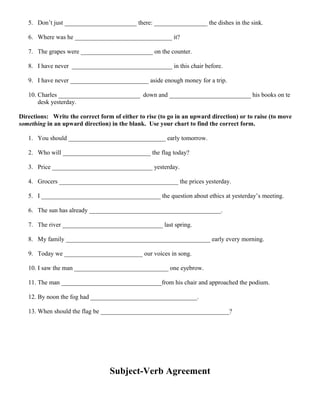
Directions: Write the correct form of either to sit (to rest) or to set (to put or place something) in the
blank. Use your chart to find the correct form.
1. I usually ________________________________ close to the door for a fast escape.
2. I ________________________________ the chair close to the wall.
3. Katie was _________________________________ the canned goods on the shelf.
4. Donna was _______________________ beside Keith during the play.
5. Don’t just _______________________ there: _________________ the dishes in the sink.
6. Where was he _______________________________ it?
7. The grapes were _______________________ on the counter.
8. I have never ________________________________ in this chair before.
9. I have never _________________________ aside enough money for a trip.
10. Charles __________________________ down and __________________________ his books on te
desk yesterday.
Directions: Write the correct form of either to rise (to go in an upward direction) or to raise (to move
something in an upward direction) in the blank. Use your chart to find the correct form.
1. You should _______________________________ early tomorrow.
2. Who will ____________________________ the flag today?
3. Price ________________________________ yesterday.
4. Grocers ______________________________________ the prices yesterday.
5. I ______________________________________ the question about ethics at yesterday’s meeting.
6. The sun has already __________________________________________.
7. The river ________________________________ last spring.
8. My family ______________________________________________ early every morning.
9. Today we _________________________ our voices in song.
10. I saw the man ______________________________ one eyebrow.
11. The man ________________________________from his chair and approached the podium.
12. By noon the fog had __________________________________.
13. When should the flag be _________________________________________?
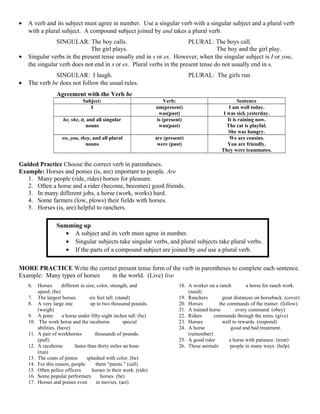
Subject-Verb Agreement
• A verb and its subject must agree in number. Use a singular verb with a singular subject and a plural verb
with a plural subject. A compound subject joined by and takes a plural verb.
SINGULAR: The boy calls. PLURAL: The boys call.
The girl plays. The boy and the girl play.
• Singular verbs in the present tense usually end in s or es. However, when the singular subject is I or you,
the singular verb does not end in s or es. Plural verbs in the present tense do not usually end in s.
SINGULAR: I laugh. PLURAL: The girls run
• The verb be does not follow the usual rules.
Agreement with the Verb be
Subject: Verb: Sentence
I am(present)
was(past)
I am well today.
I was sick yesterday.
he, she, it, and all singular
nouns
is (present)
was(past)
It is raining now.
The cat is playful.
She was hungry.
we, you, they, and all plural
nouns
are (present)
were (past)
We are cousins.
You are friendly.
They were teammates.
Guided Practice Choose the correct verb in parentheses.
Example: Horses and ponies (is, are) important to people. Are
1. Many people (ride, rides) horses for pleasure.
2. Often a horse and a rider (become, becomes) good friends.
3. In many different jobs, a horse (work, works) hard.
4. Some farmers (low, plows) their fields with horses.
5. Horses (is, are) helpful to ranchers.
Summing up
• A subject and its verb must agree in number.
• Singular subjects take singular verbs, and plural subjects take plural verbs.
• If the parts of a compound subject are joined by and use a plural verb.
MORE PRACTICE Write the correct present tense form of the verb in parentheses to complete each sentence.
Example: Many types of horses live in the world. (Live) live
6. Horses are different in size, color, strength, and
speed. (be)
7. The largest horses stand six feet tall. (stand)
8. A very large one weighs up to two thousand pounds.
(weigh)
9. A pony isa a horse under fifty-eight inches tall. (be)
10. The work horse and the racehorse have special
abilities. (have)
11. A pair of workhorses pulls thousands of pounds.
(pull)
12. A racehorse runs faster than thirty miles an hour.
(run)
13. The coats of pintos are splashed with color. (be)
14. For this reason, people call them “paints.” (call)
15. Often police officers ride horses in their work. (ride)
16. Some popular performers are horses. (be)
17. Horses and ponies even act in movies. (act)
18. A worker on a ranch needs a horse for ranch work.
(need)
19. Ranchers cover great distances on horseback. (cover)
20. Horses follow the commands of the trainer. (follow)
21. A trained horse obeys every command. (obey)
22. Riders give commands through the reins. (give)
23. Horses respond well to rewards. (respond)
24. A horse remembers good and bad treatment.
(remember)
25. A good rider treats a horse with patience. (treat)
26. These animals help people in many ways. (help)
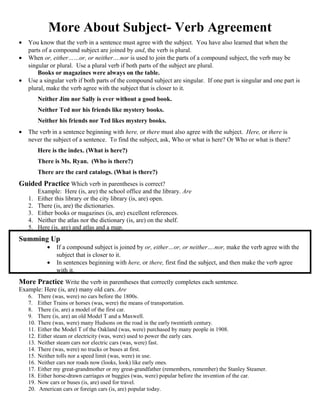
More About Subject- Verb Agreement
• You know that the verb in a sentence must agree with the subject. You have also learned that when the
parts of a compound subject are joined by and, the verb is plural.
• When or, either……or, or neither….nor is used to join the parts of a compound subject, the verb may be
singular or plural. Use a plural verb if both parts of the subject are plural.
Books or magazines were always on the table.
• Use a singular verb if both parts of the compound subject are singular. If one part is singular and one part is
plural, make the verb agree with the subject that is closer to it.
Neither Jim nor Sally is ever without a good book.
Neither Ted nor his friends like mystery books.
Neither his friends nor Ted likes mystery books.
• The verb in a sentence beginning with here, or there must also agree with the subject. Here, or there is
never the subject of a sentence. To find the subject, ask, Who or what is here? Or Who or what is there?
Here is the index. (What is here?)
There is Ms. Ryan. (Who is there?)
There are the card catalogs. (What is there?)
Guided Practice Which verb in parentheses is correct?
Example: Here (is, are) the school office and the library. Are
1. Either this library or the city library (is, are) open.
2. There (is, are) the dictionaries.
3. Either books or magazines (is, are) excellent references.
4. Neither the atlas nor the dictionary (is, are) on the shelf.
5. Here (is, are) and atlas and a map.
Summing Up
• If a compound subject is joined by or, either…or, or neither….nor, make the verb agree with the
subject that is closer to it.
• In sentences beginning with here, or there, first find the subject, and then make the verb agree
with it.
More Practice Write the verb in parentheses that correctly completes each sentence.
Example: Here (is, are) many old cars. Are
6. There (was, were) no cars before the 1800s.
7. Either Trains or horses (was, were) the means of transportation.
8. There (is, are) a model of the first car.
9. There (is, are) an old Model T and a Maxwell.
10. There (was, were) many Hudsons on the road in the early twentieth century.
11. Either the Model T of the Oakland (was, were) purchased by many people in 1908.
12. Either steam or electricity (was, were) used to power the early cars.
13. Neither steam cars nor electric cars (was, were) fast.
14. There (was, were) no trucks or buses at first.
15. Neither tolls nor a speed limit (was, were) in use.
16. Neither cars nor roads now (looks, look) like early ones.
17. Either my great-grandmother or my great-grandfather (remembers, remember) the Stanley Steamer.
18. Either horse-drawn carriages or buggies (was, were) popular before the invention of the car.
19. Now cars or buses (is, are) used for travel.
20. American cars or foreign cars (is, are) popular today.

All aboutverbs

  • 1.
    All You EverWanted to Know About Verbs! THREE TYPES OF VERBS: ~~~~~~~~~~~~~~~~~~~~~~~~~~~~~~~~~~~~~~~~~~~~~~~~~~~~~~~~~~~~~~~~~~~~~~~~~~~~~~~~ A verb is a part of speech that usually denotes action ("bring", "read"), occurrence ("decompose", "glitter"), or a state of being ("exist", "stand"). Depending on the language, a verb may vary in form according to many factors, possibly including its tense, aspect, mood and voice. It may also agree with the person, gender, and/or number of some of its arguments (subject, object, etc.). From Wikipedia, the free encyclopedia ~~~~~~~~~~~~~~~~~~~~~~~~~~~~~~~~~~~~~~~~~~~~~~~~~~~~~~~~~~~~~~~~~~~~~~~~~~~~~~~~~~~ Action Verbs: Active Anna Here is a little story to help you learn about Action Verbs. Anna Action/Verb jumped from bed on Monday. She ran to the breakfast table, doing three cartwheels on the way. "Anna, you are too active!" said Mrs. Action/Verb. "So?" Anna replied as she leapt out the door. She raced her friend, Donna Direct-Object, all the way to school. But she couldn't sit still. Ms. Sentence, the teacher, tapped her ruler on her desk and said, "Anna, SIT STILL!" "Yes, ma'am," Anna said as she picked up her pencil. When the class lined up for Art, Patrick Pronoun whispered, "You'd better stop being so active. You'll get into trouble." But Anna was seeing how long she could hop on one foot and not trip over Donna. The Art teacher, Mrs. Preposition, was showing the class how to draw snowflakes when Anna tipped over in her chair. Then she did five somersaults right into a table. Anna got a bruise on her forehead and had to go to the nurse. Then Mr. Noun, the principal, wrote a note home to Anna's parents. And can you guess what Mr. and Mrs. Action/Verb decided? No gymnastics, Anna's favorite class, for a week! So Anna learned to do flips only in gymnastics and to learn in school instead. You should have learned in this story that action verbs are used to show when somebody does something. Action verbs in this story are colored underlined. A few other points to remember: • Action verbs can also be actions you can't see such as: Sue thought about pets. She wanted a puppy. • Action verbs are time-telling verbs. They also tell when something takes place. Examples: My dog runs faster than yours. (present tense) Yesterday he ran around the block. (past tense) Tomorrow he will run in a race. (future tense) • Actions verbs main be used alone as the main verb of a sentence; as in: My kitten fell into the pond. Or the action verb may use a helping verb; as in: If you get too close to the edge, you will fall too.
  • 2.
    Helping and MainVerbs Hi! I'm Harry Helping Verb and I'm so helpful I will help you learn the 23 Helping Verbs by telling you a story. The title of the story is Old Mr. Do. Like some stories, this story has a moral. The moral is: "Maybe Mr. Do should have a will". Read on and you will see why! Old Mr. Do Once upon a time there was a wealthy merchant named Mr. Do. Mr. Do was very old and very rich. His many relatives were dreaming of the day the old man would die. They wondered which one of them would inherit his money. Finally, one day Mr. Do did die. All the relatives searched his house for a will. They didn't find one. They searched his house three times. They still did not find a will. The relatives did not get one dime of Mr. Do's fortune. The moral: Maybe Mr. Do should have a will. Just remember this sentence and you will know how to set up a chart of the 23 helping verbs! The largest "family" is the "BE" family with eight members. The other five families have three members each. Helping Verbs may be (main) do (main) should have (main) will Notice that verbs in three of the families may also stand alone and be the main verb of a sentence. For example: • We are teaching you about helping verbs. ("are"-helping verb, "teaching"-main verb) • We are in the fourth grade at Brisas Elementary. ( "are" is the main verb) Other things to keep in mind: • Not every sentence will have a helping verb with the main verb. • When you see an "ing" verb such as "running", be on the lookout for a helping verb also. • Sometimes there is another word which separates the helping verb from the main verb. One common example is "not", as in: The boy couldn't find his socks. The helping verb is could and the main verb is find. • A sentence may contain up to three helping verbs to the main verb. An example would be: The dog must have been chasing the cat. The helping verbs are: must, have, and been; the main verb is chasing (See Rule #2 above!).
  • 3.
    State-of-Being Verbs Here isa little story to help you learn about the eight state-of-being verbs: Once upon a time there was a nice boy named Stately. He was very prim and proper. Stately was a A+ student. One day at school, there was going to be a big test on verbs. Stately knew all the action verbs but he didn't want to forget the eight state- of-being verbs. He needed a way to remember them so he could get an A+ on the big test. As he sat there thinking of ideas, he found himself humming a rhythm, "Da, da, da-da, da, da, da, da. All of a sudden he jumped up and shouted, "That is it! That is the rhythm I need to remember the state-of-being verbs: Is, am, were, was, are, be, being, been." The next day, he went to school humming and clapping the rhythm the whole way. When he got his graded test back he had earned an A+, and Stately was very happy. After he got the A+ he changed his name to Stately State-of-Being Verb because he just IS so stately. You should have learned in this story that state-of-being verbs are verbs that state that something IS. Here is a couple of things to remember: • State-of-being verbs can be the main verb of the sentence; as in: Sally is my best friend. Or a state- of-being verb can be used as a helping verb; as in: She is going on a vacation. Note that the verbs: be, being, and been always NEED a helping verb; as in: Pat has been sick all week. • State-of-being verbs can show time. The present tense state-of-being verbs are: am, are, is. Past tense state-of-being verbs are: was and were. So, do you think you can remember all eight state-of-being verbs? Take our little test and see how you do. Or Learn more about Action Verbs or Helping and Main Verbs. ~~~~~~~~~~~~~~~~~~~~~~~~~~~~~~~~~~~~~~~~~~~~~~~~~~~~~~~~~~~~~~~~~~~~~~~~~~~~~~~~~~~ http://www.kyrene.k12.az.us/schools/brisas/sunda/verb/enter.htm This is the website where Ms. Breunig got most of this cool information and it has quizzes to practice your skills. http://www.englishpage.com/irregularverbs/irregularverbs.html Irregular verbs There are three kinds of verbs: one shows action- one is the state of being-
  • 4.
    one is helpingor auxilliary _______________________________________________________________________________________ The four principal parts of a verb are the infinitive, the present, the past, and the past participle. The infinitive is the "to" form of the verb. Present tense is the form of the verb that would complete the sentence, "Today, I _____________." Past tense is the form of the verb that would complete the sentence, "Yesterday, I ______________." Past participle is the form of the verb that would complete the sentence "Often, I have ______________." For most verbs, it's easy to form the three principal parts if you know the infinitive form. For regular verbs, to form the past and the past participle, you add -ed or -d to the present form. Infinitive Present Past Past Participle (have) to look to use to play ___________________________________________________________________________ IRREGULAR VERBS Irregular verbs form their past and past participle in various ways. You do not just add -ed or d to the infinitive. Irregular verbs change spelling. If you are not sure, use a dictionary. Infinitive Present Past Past Participle to begin to bring to put IRREGULAR VERB CHART INFINITIVE PRESENT PARTICIPLE (ING) PAST PAST PARTICPLE (HAVE)
  • 5.
    to begin to blow tobreak to bring to burst to choose to come to do to drive to eat to fall to freeze to give to go to know to ride to ring to run to see to shrink to speak to steal to swim to take to throw to write PROBLEM VERBS LIE/LAY
  • 6.
    Few people uselie and lay and their principal part correctly, perhaps because few people know the difference in meaning between the two. The verb lie means “to rest or recline.” The verb lay means “to put or place.” The table below shows the principal parts of each of these verbs. Their meaning, written in the correct form, appears in parentheses. Present Progressive Past Past participle (Used with have, has or had) Lie, lies lying lay lain (rest, rests) (resting) (rested) (rested) Lay, lays laying laid laid (place, places) (placing) (placed) (placed) To choose the correct form of lie or lay, simply look at the meanings in parentheses. Choose the word in parentheses that makes the most sense and use the corresponding form of lie or lay. Sometimes non of the words seem especially appropriate. Nevertheless, choose the option that makes more sense than any of the others. If a sentence contains the down, mentally delete the word from the sentence to make the appropriate verb more obvious. Examine the sample sentences to see how this is done. 1. The garbage cans are _______________ in the middle of the street. [Requires progressive] Resting makes better sense than placing. 2. Keith told Nan to ________________________ the mail on the dining room table. [Requires present] Place makes better sense than rest. 3. The sandwiches _____________ in the sun for over an hour before we ate them. [Requires past] Rested makes better sense than placed. 4. Yesterday afternoon, I __________________ down for and hour. [Requires past] Remove the word down. Rested makes better sense than placed. 5. Barry thought he had ______________________________ the papers near the copy machine. [Requires past participle] Placed makes better sense than rested. Write the correct form of lie or lay in each of the blanks below. 6. After the alarm sounded, I ___________________ in bed for another hour. 7. __________________ the packages on the mailroom floor. 8. The latest edition of the newspaper ____________________ on the desk. 9. The paper carrier ______________________ the latest edition of the newspaper on the desk.
  • 7.
    10. No onehad any idea how long the sandwiches had _______________________ in the sun or who had ____________________________ them there in the first place. SIT/SET These two verbs are very similar to lie and lay. Sit means “to rest.” Set means “to put or place.” The table below shows the principal parts of each of these verbs. Their meanings, written in the correct form, appear in parentheses Present Progressive Past Past participle (used with have, has, or had) _______________________________________________________________________________________ Sit, sits sitting sat sat (rest, rests) (resting) (rested) (rested) _______________________________________________________________________________________ Set, sets setting set set (put, place, (putting, placing) (put, placed) (put, placed) puts, places) _____________________________________________________________________________________ Choose the correct form of sit or set by using the meanings (the words in parentheses) in the sentence first. Decide which meaning makes the most sense, and then choose the corresponding verb. See how this is done in the example sentences below. 1. The speaker ___________ the chair next to the podium. Put or placed makes more sense than rested. 2. The speaker ________________ in the chair next to the podium. Rested makes more sense than put or placed. Write the correct form of sit or set in each of the blanks below. 3. The board of directors _______________ aside additional money for research and development. 4. My desk is the one ______________ closest to the fax machine. 5. I can’t remember where I ________ the mail down. 6. I __________ down next to Jull and __ my briefcase on the chair next to me. 7. We had ____________________________ in the waiting room for almost an hour before the doctor saw us. RISE/RAISE
  • 8.
    The verb risemeans “to go up.” The verb raise means “to move something up.” Raise requires an object. In other words, something must receive the action of the verb raise (raise your HAND, raise the FLAG, raise the OBJECTION, raise CHILDREN). The table below shows the principal parts of both verbs. _______________________________________________________________________________________ Present Progressive Past Past participle (used with have, has, had) _______________________________________________________________________________________ rises, rise rising rose risen (goes up, go up) (going up) (went up) (gone up) (comes up, come up) coming up) (came up) (come up) _______________________________________________________________________________________ raises, raise raise raised raised (moves up, move up) (moving up) (moved up) (moved up) _______________________________________________________________________________________ Choose the correct form of rise or raise by using the meanings (words in parentheses) in the sentence first. Decide which meaning makes the most sense, and choose the corresponding verb. See how this is done in the example sentences below. Sometimes none of the words seem especially appropriate. Nevertheless, choose the option that makes more sense than any of the others. 1. The sun _______________ a little bit earlier each day of the spring. Comes up makes the most sense. 2. Without realizing it, we began to _______ our voices. Move up makes more sense than any of the other options. 3. The river ___________________________ over two feet in the last hour. Went up makes the most sense. Write the correct form of rise or raise in each of the blanks below. 4. The guard __________________ the flag every morning before the sun ______________________. 5. The couple _____________________ seven of their own children and adopted three more. VERB TENSE WORKSHEET Directions: Write the correct verb form in the blank.
  • 9.
    1. ask LaterHarry ______________________ the teacher. 2. suppose He is ________________________ to be there early. 3. use We _____________________________ to ride our bicycles. 4. suppose Are we ______________________ to help? 5. swim Mary had ______________________ in deep water before. 6. break I __________________________ the windshield yesterday. 7. run Everyone _______________ as fast as he could. 8. attack Grasshoppers have _________________________ the crops. 9. eat Has Sam ____________________ breakfast? 10. write Have you ____________________________ to your father? 11. bring Anne _________________________ a raincoat yesterday. 12. steal A bear had _____________________________ into our tent. 13. burst The pile of brush _________________________________ into flames yesterday. 14. do She ______________ her best yesterday. 15. give Father has ___________________ us some suggestions. 16. know We have ___________________ about the test for some time. 17. risk The policemen have _________________ their lives. 18. ring The bell has _____________________________. 19. run Last year, Mr. Evans ______________________________ for mayor. 20. break The champion has _______________________________ the record. 21. choose Have they _______________________________ a leader? 22. fall You might have _______________________ over the edge. More Irregular Verbs-Worksheet for lie and lay, sit and set, and rise and raise
  • 10.
    Directions: Write thecorrect form of either to lie (to rest) or to lay (to put or place something) in the blank. Use your chart to find the correct form. 1. Yesterday I ___________________ down for a short nap. 2. ________________________ the boards down now! 3. The letter is ____________________________ on the desk. 4. Yesterday Bruce ____________________________ on the beach in Florida: today he is back in Wisconsin. 5. How long have you ________________________________ in the sun? 6. Yesterday Irma _______________________________ some towels on the sand. 7. Have you ___________________________________ your work aside for now? 8. I foolishly ______________________________ the matches near the open fire. 9. Yesterday I ____________________________ too long in the hot sun, and I got burned. 10. A lighted cigar was _____________________________ in the ashtray. 11. Father was _____________________________ the newspaper on the floor for the puppy. 12. Diane ___________________________ a cushion on the floor for the puppy to sleep on. 13. The puppy _____________________________ there while everyone hugged him goodnight. 14. The rake and shovel have ________________________ in the yard for three days. 15. The men have _______________________ the foundation for the porch. 16. Today his interests _______________________________ elsewhere. 17. Yesterday I ____________________________________ the scissors on the machine, and they are probably _________________________________ there right now. Directions: Write the correct form of either to sit (to rest) or to set (to put or place something) in the blank. Use your chart to find the correct form. 1. I usually ________________________________ close to the door for a fast escape. 2. I ________________________________ the chair close to the wall. 3. Katie was _________________________________ the canned goods on the shelf. 4. Donna was _______________________ beside Keith during the play.
  • 11.
    5. Don’t just_______________________ there: _________________ the dishes in the sink. 6. Where was he _______________________________ it? 7. The grapes were _______________________ on the counter. 8. I have never ________________________________ in this chair before. 9. I have never _________________________ aside enough money for a trip. 10. Charles __________________________ down and __________________________ his books on te desk yesterday. Directions: Write the correct form of either to rise (to go in an upward direction) or to raise (to move something in an upward direction) in the blank. Use your chart to find the correct form. 1. You should _______________________________ early tomorrow. 2. Who will ____________________________ the flag today? 3. Price ________________________________ yesterday. 4. Grocers ______________________________________ the prices yesterday. 5. I ______________________________________ the question about ethics at yesterday’s meeting. 6. The sun has already __________________________________________. 7. The river ________________________________ last spring. 8. My family ______________________________________________ early every morning. 9. Today we _________________________ our voices in song. 10. I saw the man ______________________________ one eyebrow. 11. The man ________________________________from his chair and approached the podium. 12. By noon the fog had __________________________________. 13. When should the flag be _________________________________________? Subject-Verb Agreement
  • 12.
    • A verband its subject must agree in number. Use a singular verb with a singular subject and a plural verb with a plural subject. A compound subject joined by and takes a plural verb. SINGULAR: The boy calls. PLURAL: The boys call. The girl plays. The boy and the girl play. • Singular verbs in the present tense usually end in s or es. However, when the singular subject is I or you, the singular verb does not end in s or es. Plural verbs in the present tense do not usually end in s. SINGULAR: I laugh. PLURAL: The girls run • The verb be does not follow the usual rules. Agreement with the Verb be Subject: Verb: Sentence I am(present) was(past) I am well today. I was sick yesterday. he, she, it, and all singular nouns is (present) was(past) It is raining now. The cat is playful. She was hungry. we, you, they, and all plural nouns are (present) were (past) We are cousins. You are friendly. They were teammates. Guided Practice Choose the correct verb in parentheses. Example: Horses and ponies (is, are) important to people. Are 1. Many people (ride, rides) horses for pleasure. 2. Often a horse and a rider (become, becomes) good friends. 3. In many different jobs, a horse (work, works) hard. 4. Some farmers (low, plows) their fields with horses. 5. Horses (is, are) helpful to ranchers. Summing up • A subject and its verb must agree in number. • Singular subjects take singular verbs, and plural subjects take plural verbs. • If the parts of a compound subject are joined by and use a plural verb. MORE PRACTICE Write the correct present tense form of the verb in parentheses to complete each sentence. Example: Many types of horses live in the world. (Live) live 6. Horses are different in size, color, strength, and speed. (be) 7. The largest horses stand six feet tall. (stand) 8. A very large one weighs up to two thousand pounds. (weigh) 9. A pony isa a horse under fifty-eight inches tall. (be) 10. The work horse and the racehorse have special abilities. (have) 11. A pair of workhorses pulls thousands of pounds. (pull) 12. A racehorse runs faster than thirty miles an hour. (run) 13. The coats of pintos are splashed with color. (be) 14. For this reason, people call them “paints.” (call) 15. Often police officers ride horses in their work. (ride) 16. Some popular performers are horses. (be) 17. Horses and ponies even act in movies. (act) 18. A worker on a ranch needs a horse for ranch work. (need) 19. Ranchers cover great distances on horseback. (cover) 20. Horses follow the commands of the trainer. (follow) 21. A trained horse obeys every command. (obey) 22. Riders give commands through the reins. (give) 23. Horses respond well to rewards. (respond) 24. A horse remembers good and bad treatment. (remember) 25. A good rider treats a horse with patience. (treat) 26. These animals help people in many ways. (help)
  • 13.
    More About Subject-Verb Agreement • You know that the verb in a sentence must agree with the subject. You have also learned that when the parts of a compound subject are joined by and, the verb is plural. • When or, either……or, or neither….nor is used to join the parts of a compound subject, the verb may be singular or plural. Use a plural verb if both parts of the subject are plural. Books or magazines were always on the table. • Use a singular verb if both parts of the compound subject are singular. If one part is singular and one part is plural, make the verb agree with the subject that is closer to it. Neither Jim nor Sally is ever without a good book. Neither Ted nor his friends like mystery books. Neither his friends nor Ted likes mystery books. • The verb in a sentence beginning with here, or there must also agree with the subject. Here, or there is never the subject of a sentence. To find the subject, ask, Who or what is here? Or Who or what is there? Here is the index. (What is here?) There is Ms. Ryan. (Who is there?) There are the card catalogs. (What is there?) Guided Practice Which verb in parentheses is correct? Example: Here (is, are) the school office and the library. Are 1. Either this library or the city library (is, are) open. 2. There (is, are) the dictionaries. 3. Either books or magazines (is, are) excellent references. 4. Neither the atlas nor the dictionary (is, are) on the shelf. 5. Here (is, are) and atlas and a map. Summing Up • If a compound subject is joined by or, either…or, or neither….nor, make the verb agree with the subject that is closer to it. • In sentences beginning with here, or there, first find the subject, and then make the verb agree with it. More Practice Write the verb in parentheses that correctly completes each sentence. Example: Here (is, are) many old cars. Are 6. There (was, were) no cars before the 1800s. 7. Either Trains or horses (was, were) the means of transportation. 8. There (is, are) a model of the first car. 9. There (is, are) an old Model T and a Maxwell. 10. There (was, were) many Hudsons on the road in the early twentieth century. 11. Either the Model T of the Oakland (was, were) purchased by many people in 1908. 12. Either steam or electricity (was, were) used to power the early cars. 13. Neither steam cars nor electric cars (was, were) fast. 14. There (was, were) no trucks or buses at first. 15. Neither tolls nor a speed limit (was, were) in use. 16. Neither cars nor roads now (looks, look) like early ones. 17. Either my great-grandmother or my great-grandfather (remembers, remember) the Stanley Steamer. 18. Either horse-drawn carriages or buggies (was, were) popular before the invention of the car. 19. Now cars or buses (is, are) used for travel. 20. American cars or foreign cars (is, are) popular today.