Grammar: The Basics 
EasyShiksha.Com - A Way of Simple Learning
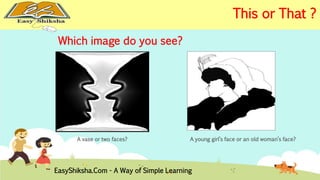
Which image do you see? 
A vase or two faces? 
A young girl’s face or an old woman’s face? 
EasyShiksha.Com - A Way of Simple Learning 
This or That ?
Objective 
Sentences Construction 
 Understand the difference between SVO / SOV 
 Use the rule effectively for Sentence construction 
EasyShiksha.Com - A Way of Simple Learning
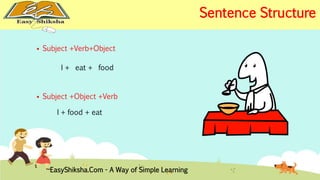
 Subject +Verb+Object 
I + eat + food 
 Subject +Object +Verb 
I + food + eat 
EasyShiksha.Com - A Way of Simple Learning 
Sentence Structure
Objective 
 Identify the commonly made mistakes while 
speaking in English 
 To increase fluency in English 
EasyShiksha.Com - A Way of Simple Learning 
Gamer Grammar
EasyShiksha.Com - A Way of Simple Learning 
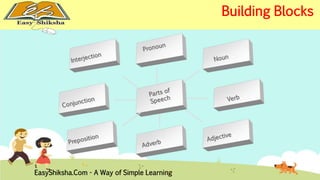
Building Blocks
Noun 
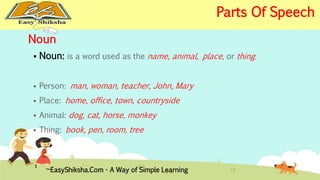
 Noun: is a word used as the name, animal, place, or thing. 
 Person: man, woman, teacher, John, Mary 
 Place: home, office, town, countryside 
 Animal: dog, cat, horse, monkey 
 Thing: book, pen, room, tree 
EasyShiksha.Com - A Way of Simple Learning 
Parts Of Speech
Noun 
Types Of Nouns 
 Common Noun 
 Proper Noun 
 Collective Noun 
 Abstract Noun 
 Countable / Uncountable Nouns 
EasyShiksha.Com - A Way of Simple Learning 
Parts Of Speech
Noun 
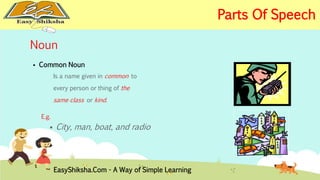
 Common Noun 
Is a name given in common to 
every person or thing of the 
same class or kind. 
E.g. 
 City, man, boat, and radio 
EasyShiksha.Com - A Way of Simple Learning 
Parts Of Speech
Noun 
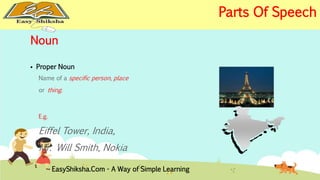
 Proper Noun 
Name of a specific person, place 
or thing. 
E.g. 
Eiffel Tower, India, 
Mr. Will Smith, Nokia 
EasyShiksha.Com - A Way of Simple Learning 
Parts Of Speech
Noun 
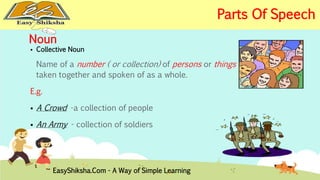
 Collective Noun 
Name of a number ( or collection) of persons or things 
taken together and spoken of as a whole. 
E.g. 
 A Crowd -a collection of people 
 An Army - collection of soldiers 
EasyShiksha.Com - A Way of Simple Learning 
Parts Of Speech
Noun 
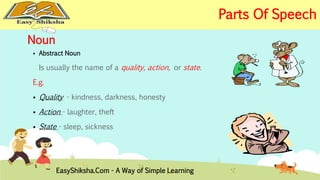
 Abstract Noun 
Is usually the name of a quality, action, or state. 
E.g. 
 Quality - kindness, darkness, honesty 
 Action - laughter, theft 
 State - sleep, sickness 
EasyShiksha.Com - A Way of Simple Learning 
Parts Of Speech
Noun 
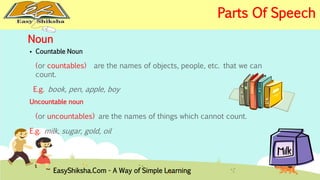
 Countable Noun 
(or countables) are the names of objects, people, etc. that we can 
count. 
E.g. book, pen, apple, boy 
Uncountable noun 
(or uncountables) are the names of things which cannot count. 
E.g. milk, sugar, gold, oil 
EasyShiksha.Com - A Way of Simple Learning 
Parts Of Speech
Noun 
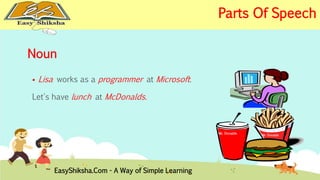
 Lisa works as a programmer at Microsoft. 
Let's have lunch at McDonalds. 
Mc Donalds 
Mc Donalds 
EasyShiksha.Com - A Way of Simple Learning 
Parts Of Speech
Noun 
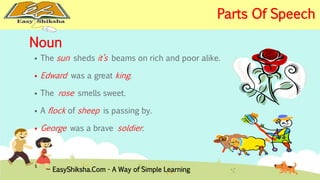
 The sun sheds it’s beams on rich and poor alike. 
 Edward was a great king. 
 The rose smells sweet. 
 A flock of sheep is passing by. 
 George was a brave soldier. 
EasyShiksha.Com - A Way of Simple Learning 
Parts Of Speech
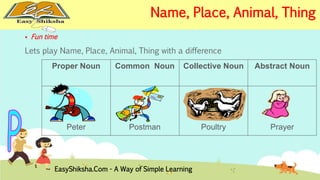
Name, Place, Animal, Thing 
 Fun time 
Lets play Name, Place, Animal, Thing with a difference 
Proper Noun Common Noun Collective Noun Abstract Noun 
Peter Postman Poultry Prayer 
EasyShiksha.Com - A Way of Simple Learning
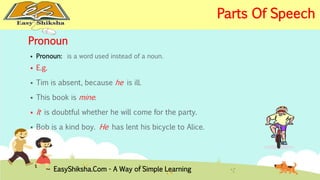
Pronoun 
 Pronoun: is a word used instead of a noun. 
 E.g. 
 Tim is absent, because he is ill. 
 This book is mine. 
 It is doubtful whether he will come for the party. 
 Bob is a kind boy. He has lent his bicycle to Alice. 
EasyShiksha.Com - A Way of Simple Learning 
Parts Of Speech
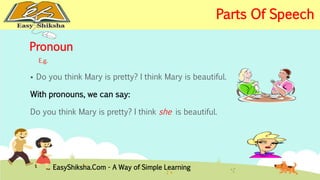
Pronoun 
E.g. 
 Do you think Mary is pretty? I think Mary is beautiful. 
With pronouns, we can say: 
Do you think Mary is pretty? I think she is beautiful. 
EasyShiksha.Com - A Way of Simple Learning 
Parts Of Speech
Pronoun 
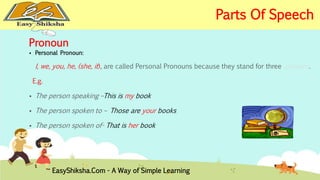
 Personal Pronoun: 
I, we, you, he, (she, it), are called Personal Pronouns because they stand for three persons. 
E.g. 
 The person speaking –This is my book 
 The person spoken to – Those are your books 
 The person spoken of- That is her book 
EasyShiksha.Com - A Way of Simple Learning 
Parts Of Speech
Pronoun 
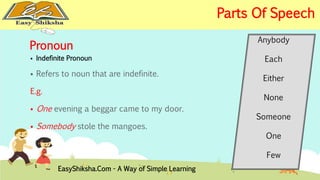
 Indefinite Pronoun 
 Refers to noun that are indefinite. 
E.g. 
 One evening a beggar came to my door. 
 Somebody stole the mangoes. 
Anybody 
Each 
Either 
None 
Someone 
One 
Few 
EasyShiksha.Com - A Way of Simple Learning 
Parts Of Speech
Pronoun 
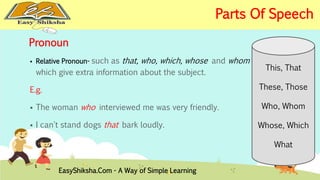
 Relative Pronoun- such as that, who, which, whose and whom 
which give extra information about the subject. 
E.g. 
 The woman who interviewed me was very friendly. 
 I can't stand dogs that bark loudly. 
This, That 
These, Those 
Who, Whom 
Whose, Which 
What 
EasyShiksha.Com - A Way of Simple Learning 
Parts Of Speech
Pronoun 
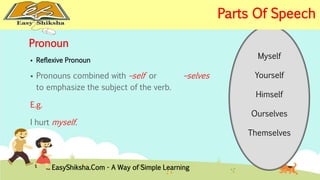
 Reflexive Pronoun 
 Pronouns combined with –self or –selves 
to emphasize the subject of the verb. 
E.g. 
I hurt myself. 
Myself 
Yourself 
Himself 
Ourselves 
Themselves 
EasyShiksha.Com - A Way of Simple Learning 
Parts Of Speech
Pronoun 
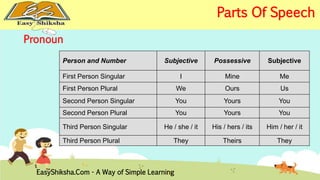
Person and Number Subjective Possessive Subjective 
First Person Singular I Mine Me 
First Person Plural We Ours Us 
Second Person Singular You Yours You 
Second Person Plural You Yours You 
Third Person Singular He / she / it His / hers / its Him / her / it 
Third Person Plural They Theirs They 
EasyShiksha.Com - A Way of Simple Learning 
Parts Of Speech
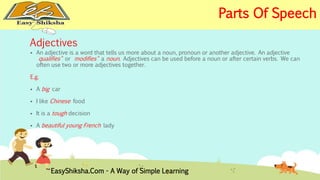
Adjectives 
 An adjective is a word that tells us more about a noun, pronoun or another adjective. An adjective 
"qualifies" or "modifies" a noun. Adjectives can be used before a noun or after certain verbs. We can 
often use two or more adjectives together. 
E.g. 
 A big car 
 I like Chinese food 
 It is a tough decision 
 A beautiful young French lady 
EasyShiksha.Com - A Way of Simple Learning 
Parts Of Speech
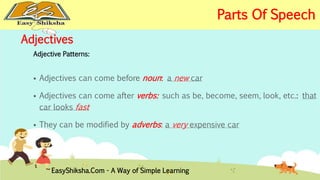
Adjectives 
Adjective Patterns: 
 Adjectives can come before noun: a new car 
 Adjectives can come after verbs: such as be, become, seem, look, etc.: that 
car looks fast 
 They can be modified by adverbs: a very expensive car 
EasyShiksha.Com - A Way of Simple Learning 
Parts Of Speech
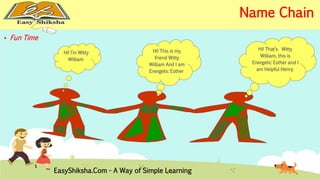
 Fun Time 
Hi! I’m Witty 
William 
Hi! This is my 
friend Witty 
William And I am 
Energetic Esther 
Hi! That’s Witty 
William, this is 
Energetic Esther and I 
am Helpful Henry 
EasyShiksha.Com - A Way of Simple Learning 
Name Chain
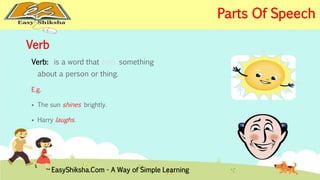
Verb 
Verb: is a word that tells something 
about a person or thing. 
E.g. 
 The sun shines brightly. 
 Harry laughs. 
EasyShiksha.Com - A Way of Simple Learning 
Parts Of Speech
Verb 
Types of Verbs 
Auxiliary Verbs 
 Regular Verbs 
 Irregular Verbs 
 Modal Verbs 
EasyShiksha.Com - A Way of Simple Learning 
Parts Of Speech
Verb 
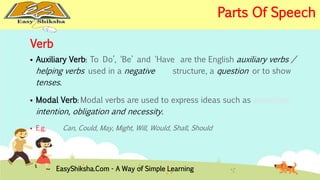
 Auxiliary Verb: ‘To Do’, ‘Be’ and ‘Have’ are the English auxiliary verbs / 
helping verbs used in a negative structure, a question or to show 
tenses. 
 Modal Verb: Modal verbs are used to express ideas such as possibility, 
intention, obligation and necessity. 
 E.g. Can, Could, May, Might, Will, Would, Shall, Should 
EasyShiksha.Com - A Way of Simple Learning 
Parts Of Speech
Verb 
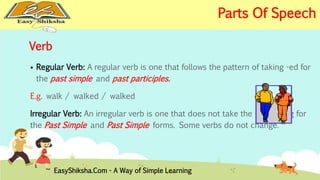
 Regular Verb: A regular verb is one that follows the pattern of taking -ed for 
the past simple and past participles. 
E.g. walk / walked / walked 
Irregular Verb: An irregular verb is one that does not take the -ed ending for 
the Past Simple and Past Simple forms. Some verbs do not change. 
EasyShiksha.Com - A Way of Simple Learning 
Parts Of Speech
Verb 
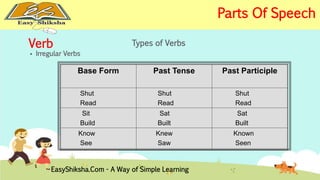
 Irregular Verbs 
Base Form Past Tense Past Participle 
Shut 
Read 
Shut 
Read 
Shut 
Read 
Sit 
Build 
Sat 
Built 
Sat 
Built 
Know 
See 
Knew 
Saw 
Known 
Seen 
Types of Verbs 
EasyShiksha.Com - A Way of Simple Learning 
Parts Of Speech
Verb 
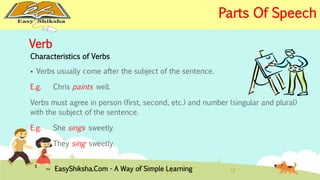
Characteristics of Verbs 
 Verbs usually come after the subject of the sentence. 
E.g. Chris paints well. 
Verbs must agree in person (first, second, etc.) and number (singular and plural) 
with the subject of the sentence. 
E.g. She sings sweetly. 
They sing sweetly. 
EasyShiksha.Com - A Way of Simple Learning 
Parts Of Speech
Adverb 
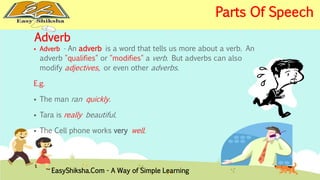
 Adverb - An adverb is a word that tells us more about a verb. An 
adverb "qualifies" or "modifies" a verb. But adverbs can also 
modify adjectives, or even other adverbs. 
E.g. 
 The man ran quickly. 
 Tara is really beautiful. 
 The Cell phone works very well. 
EasyShiksha.Com - A Way of Simple Learning 
Parts Of Speech
Adverb 
Characteristics of Adverb 
Function 
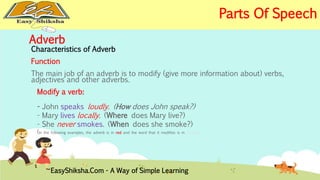
The main job of an adverb is to modify (give more information about) verbs, 
adjectives and other adverbs. 
Modify a verb: 
- John speaks loudly. (How does John speak?) 
- Mary lives locally. (Where does Mary live?) 
- She never smokes. (When does she smoke?) 
(In the following examples, the adverb is in red and the word that it modifies is in purple.) 
EasyShiksha.Com - A Way of Simple Learning 
Parts Of Speech
Adverb 
2. Form 
3. Many adverbs end in -ly. 
E.g. quickly, softly, strongly, honestly, interestingly. 
 But not all words that end in -ly are adverbs. 
E.g. "Friendly", is an adjective. 
 Some adverbs have no particular form. 
E.g. well, fast, very, never, always, often, still 
EasyShiksha.Com - A Way of Simple Learning 
Parts Of Speech
Adverb 
3. Position 
Adverbs have three main positions in the sentence: 
 Front (before the subject): 
- Now we will study adverbs. 
Middle (between the subject and the main verb): 
- We often study adverbs. 
End (after the verb or object): 
- We study adverbs carefully. 
EasyShiksha.Com - A Way of Simple Learning 
Parts Of Speech
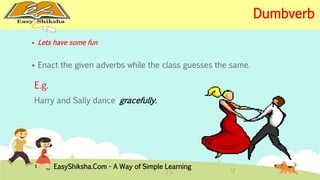
 Lets have some fun 
 Enact the given adverbs while the class guesses the same. 
E.g. 
Harry and Sally dance gracefully. 
EasyShiksha.Com - A Way of Simple Learning 
Dumbverb
Prepositions 
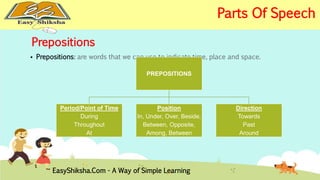
 Prepositions: are words that we can use to indicate time, place and space. 
PREPOSITIONS 
Period/Point of Time 
During 
Throughout 
At 
Position 
In, Under, Over, Beside, 
Between, Opposite, 
Among, Between 
Direction 
Towards 
Past 
Around 
EasyShiksha.Com - A Way of Simple Learning 
Parts Of Speech
Prepositions 
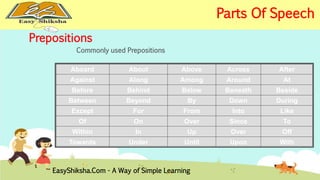
Commonly used Prepositions 
Aboard About Above Across After 
Against Along Among Around At 
Before Behind Below Beneath Beside 
Between Beyond By Down During 
Except For From Into Like 
Of On Over Since To 
Within In Up Over Off 
Towards Under Until Upon With 
EasyShiksha.Com - A Way of Simple Learning 
Parts Of Speech
Prepositions 
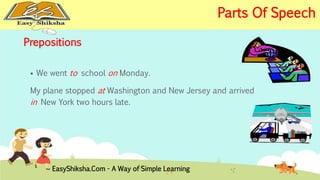
 We went to school on Monday. 
My plane stopped at Washington and New Jersey and arrived 
in New York two hours late. 
EasyShiksha.Com - A Way of Simple Learning 
Parts Of Speech
Fun Time 
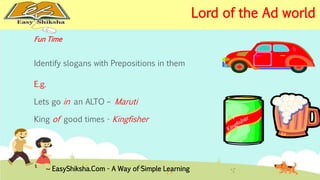
Identify slogans with Prepositions in them 
E.g. 
Lets go in an ALTO – Maruti 
King of good times - Kingfisher 
EasyShiksha.Com - A Way of Simple Learning 
Lord of the Ad world
Conjunctions 
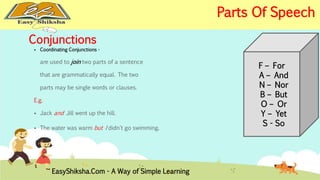
 Coordinating Conjunctions - 
are used to join two parts of a sentence 
that are grammatically equal. The two 
parts may be single words or clauses. 
E.g. 
 Jack and Jill went up the hill. 
 The water was warm but I didn't go swimming. 
F – For 
A – And 
N – Nor 
B – But 
O – Or 
Y – Yet 
S - So 
EasyShiksha.Com - A Way of Simple Learning 
Parts Of Speech
Conjunctions 
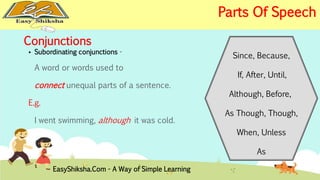
 Subordinating conjunctions - 
A word or words used to 
connect unequal parts of a sentence. 
E.g. 
I went swimming, although it was cold. 
Since, Because, 
If, After, Until, 
Although, Before, 
As Though, Though, 
When, Unless 
As 
EasyShiksha.Com - A Way of Simple Learning 
Parts Of Speech
Conjunctions 
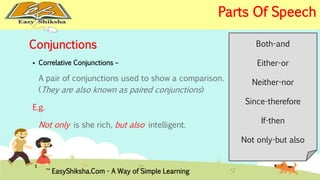
 Correlative Conjunctions – 
A pair of conjunctions used to show a comparison. 
(They are also known as paired conjunctions) 
E.g. 
Not only is she rich, but also intelligent. 
Both-and 
Either-or 
Neither-nor 
Since-therefore 
If-then 
Not only-but also 
EasyShiksha.Com - A Way of Simple Learning 
Parts Of Speech
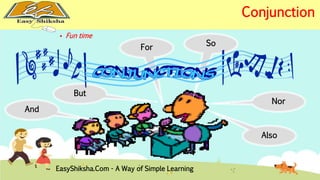
 Fun time 
And 
Also 
But 
Nor 
So 
For 
EasyShiksha.Com - A Way of Simple Learning 
Conjunction
Interjection 
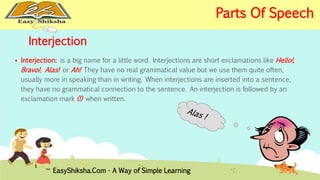
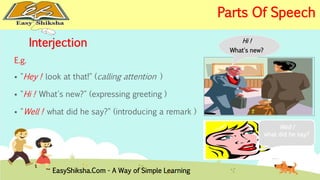
 Interjection: is a big name for a little word. Interjections are short exclamations like Hello!, 
Bravo!, Alas! or Ah! They have no real grammatical value but we use them quite often, 
usually more in speaking than in writing. When interjections are inserted into a sentence, 
they have no grammatical connection to the sentence. An interjection is followed by an 
exclamation mark (!) when written. 
EasyShiksha.Com - A Way of Simple Learning 
Parts Of Speech
Interjection 
E.g. 
 "Hey ! look at that!" (calling attention ) 
 "Hi ! What's new?" (expressing greeting ) 
 "Well ! what did he say?" (introducing a remark ) 
Well ! 
what did he say? 
Hi ! 
What's new? 
EasyShiksha.Com - A Way of Simple Learning 
Parts Of Speech

English Grammar Part 2

  • 1.
    Grammar: The Basics EasyShiksha.Com - A Way of Simple Learning
  • 2.
    Which image doyou see? A vase or two faces? A young girl’s face or an old woman’s face? EasyShiksha.Com - A Way of Simple Learning This or That ?
  • 3.
    Objective Sentences Construction  Understand the difference between SVO / SOV  Use the rule effectively for Sentence construction EasyShiksha.Com - A Way of Simple Learning
  • 4.
     Subject +Verb+Object I + eat + food  Subject +Object +Verb I + food + eat EasyShiksha.Com - A Way of Simple Learning Sentence Structure
  • 5.
    Objective  Identifythe commonly made mistakes while speaking in English  To increase fluency in English EasyShiksha.Com - A Way of Simple Learning Gamer Grammar
  • 6.
    EasyShiksha.Com - AWay of Simple Learning Building Blocks
  • 7.
    Noun  Noun:is a word used as the name, animal, place, or thing.  Person: man, woman, teacher, John, Mary  Place: home, office, town, countryside  Animal: dog, cat, horse, monkey  Thing: book, pen, room, tree EasyShiksha.Com - A Way of Simple Learning Parts Of Speech
  • 8.
    Noun Types OfNouns  Common Noun  Proper Noun  Collective Noun  Abstract Noun  Countable / Uncountable Nouns EasyShiksha.Com - A Way of Simple Learning Parts Of Speech
  • 9.
    Noun  CommonNoun Is a name given in common to every person or thing of the same class or kind. E.g.  City, man, boat, and radio EasyShiksha.Com - A Way of Simple Learning Parts Of Speech
  • 10.
    Noun  ProperNoun Name of a specific person, place or thing. E.g. Eiffel Tower, India, Mr. Will Smith, Nokia EasyShiksha.Com - A Way of Simple Learning Parts Of Speech
  • 11.
    Noun  CollectiveNoun Name of a number ( or collection) of persons or things taken together and spoken of as a whole. E.g.  A Crowd -a collection of people  An Army - collection of soldiers EasyShiksha.Com - A Way of Simple Learning Parts Of Speech
  • 12.
    Noun  AbstractNoun Is usually the name of a quality, action, or state. E.g.  Quality - kindness, darkness, honesty  Action - laughter, theft  State - sleep, sickness EasyShiksha.Com - A Way of Simple Learning Parts Of Speech
  • 13.
    Noun  CountableNoun (or countables) are the names of objects, people, etc. that we can count. E.g. book, pen, apple, boy Uncountable noun (or uncountables) are the names of things which cannot count. E.g. milk, sugar, gold, oil EasyShiksha.Com - A Way of Simple Learning Parts Of Speech
  • 14.
    Noun  Lisaworks as a programmer at Microsoft. Let's have lunch at McDonalds. Mc Donalds Mc Donalds EasyShiksha.Com - A Way of Simple Learning Parts Of Speech
  • 15.
    Noun  Thesun sheds it’s beams on rich and poor alike.  Edward was a great king.  The rose smells sweet.  A flock of sheep is passing by.  George was a brave soldier. EasyShiksha.Com - A Way of Simple Learning Parts Of Speech
  • 16.
    Name, Place, Animal,Thing  Fun time Lets play Name, Place, Animal, Thing with a difference Proper Noun Common Noun Collective Noun Abstract Noun Peter Postman Poultry Prayer EasyShiksha.Com - A Way of Simple Learning
  • 17.
    Pronoun  Pronoun:is a word used instead of a noun.  E.g.  Tim is absent, because he is ill.  This book is mine.  It is doubtful whether he will come for the party.  Bob is a kind boy. He has lent his bicycle to Alice. EasyShiksha.Com - A Way of Simple Learning Parts Of Speech
  • 18.
    Pronoun E.g. Do you think Mary is pretty? I think Mary is beautiful. With pronouns, we can say: Do you think Mary is pretty? I think she is beautiful. EasyShiksha.Com - A Way of Simple Learning Parts Of Speech
  • 19.
    Pronoun  PersonalPronoun: I, we, you, he, (she, it), are called Personal Pronouns because they stand for three persons. E.g.  The person speaking –This is my book  The person spoken to – Those are your books  The person spoken of- That is her book EasyShiksha.Com - A Way of Simple Learning Parts Of Speech
  • 20.
    Pronoun  IndefinitePronoun  Refers to noun that are indefinite. E.g.  One evening a beggar came to my door.  Somebody stole the mangoes. Anybody Each Either None Someone One Few EasyShiksha.Com - A Way of Simple Learning Parts Of Speech
  • 21.
    Pronoun  RelativePronoun- such as that, who, which, whose and whom which give extra information about the subject. E.g.  The woman who interviewed me was very friendly.  I can't stand dogs that bark loudly. This, That These, Those Who, Whom Whose, Which What EasyShiksha.Com - A Way of Simple Learning Parts Of Speech
  • 22.
    Pronoun  ReflexivePronoun  Pronouns combined with –self or –selves to emphasize the subject of the verb. E.g. I hurt myself. Myself Yourself Himself Ourselves Themselves EasyShiksha.Com - A Way of Simple Learning Parts Of Speech
  • 23.
    Pronoun Person andNumber Subjective Possessive Subjective First Person Singular I Mine Me First Person Plural We Ours Us Second Person Singular You Yours You Second Person Plural You Yours You Third Person Singular He / she / it His / hers / its Him / her / it Third Person Plural They Theirs They EasyShiksha.Com - A Way of Simple Learning Parts Of Speech
  • 24.
    Adjectives  Anadjective is a word that tells us more about a noun, pronoun or another adjective. An adjective "qualifies" or "modifies" a noun. Adjectives can be used before a noun or after certain verbs. We can often use two or more adjectives together. E.g.  A big car  I like Chinese food  It is a tough decision  A beautiful young French lady EasyShiksha.Com - A Way of Simple Learning Parts Of Speech
  • 25.
    Adjectives Adjective Patterns:  Adjectives can come before noun: a new car  Adjectives can come after verbs: such as be, become, seem, look, etc.: that car looks fast  They can be modified by adverbs: a very expensive car EasyShiksha.Com - A Way of Simple Learning Parts Of Speech
  • 26.
     Fun Time Hi! I’m Witty William Hi! This is my friend Witty William And I am Energetic Esther Hi! That’s Witty William, this is Energetic Esther and I am Helpful Henry EasyShiksha.Com - A Way of Simple Learning Name Chain
  • 27.
    Verb Verb: isa word that tells something about a person or thing. E.g.  The sun shines brightly.  Harry laughs. EasyShiksha.Com - A Way of Simple Learning Parts Of Speech
  • 28.
    Verb Types ofVerbs Auxiliary Verbs  Regular Verbs  Irregular Verbs  Modal Verbs EasyShiksha.Com - A Way of Simple Learning Parts Of Speech
  • 29.
    Verb  AuxiliaryVerb: ‘To Do’, ‘Be’ and ‘Have’ are the English auxiliary verbs / helping verbs used in a negative structure, a question or to show tenses.  Modal Verb: Modal verbs are used to express ideas such as possibility, intention, obligation and necessity.  E.g. Can, Could, May, Might, Will, Would, Shall, Should EasyShiksha.Com - A Way of Simple Learning Parts Of Speech
  • 30.
    Verb  RegularVerb: A regular verb is one that follows the pattern of taking -ed for the past simple and past participles. E.g. walk / walked / walked Irregular Verb: An irregular verb is one that does not take the -ed ending for the Past Simple and Past Simple forms. Some verbs do not change. EasyShiksha.Com - A Way of Simple Learning Parts Of Speech
  • 31.
    Verb  IrregularVerbs Base Form Past Tense Past Participle Shut Read Shut Read Shut Read Sit Build Sat Built Sat Built Know See Knew Saw Known Seen Types of Verbs EasyShiksha.Com - A Way of Simple Learning Parts Of Speech
  • 32.
    Verb Characteristics ofVerbs  Verbs usually come after the subject of the sentence. E.g. Chris paints well. Verbs must agree in person (first, second, etc.) and number (singular and plural) with the subject of the sentence. E.g. She sings sweetly. They sing sweetly. EasyShiksha.Com - A Way of Simple Learning Parts Of Speech
  • 33.
    Adverb  Adverb- An adverb is a word that tells us more about a verb. An adverb "qualifies" or "modifies" a verb. But adverbs can also modify adjectives, or even other adverbs. E.g.  The man ran quickly.  Tara is really beautiful.  The Cell phone works very well. EasyShiksha.Com - A Way of Simple Learning Parts Of Speech
  • 34.
    Adverb Characteristics ofAdverb Function The main job of an adverb is to modify (give more information about) verbs, adjectives and other adverbs. Modify a verb: - John speaks loudly. (How does John speak?) - Mary lives locally. (Where does Mary live?) - She never smokes. (When does she smoke?) (In the following examples, the adverb is in red and the word that it modifies is in purple.) EasyShiksha.Com - A Way of Simple Learning Parts Of Speech
  • 35.
    Adverb 2. Form 3. Many adverbs end in -ly. E.g. quickly, softly, strongly, honestly, interestingly.  But not all words that end in -ly are adverbs. E.g. "Friendly", is an adjective.  Some adverbs have no particular form. E.g. well, fast, very, never, always, often, still EasyShiksha.Com - A Way of Simple Learning Parts Of Speech
  • 36.
    Adverb 3. Position Adverbs have three main positions in the sentence:  Front (before the subject): - Now we will study adverbs. Middle (between the subject and the main verb): - We often study adverbs. End (after the verb or object): - We study adverbs carefully. EasyShiksha.Com - A Way of Simple Learning Parts Of Speech
  • 37.
     Lets havesome fun  Enact the given adverbs while the class guesses the same. E.g. Harry and Sally dance gracefully. EasyShiksha.Com - A Way of Simple Learning Dumbverb
  • 38.
    Prepositions  Prepositions:are words that we can use to indicate time, place and space. PREPOSITIONS Period/Point of Time During Throughout At Position In, Under, Over, Beside, Between, Opposite, Among, Between Direction Towards Past Around EasyShiksha.Com - A Way of Simple Learning Parts Of Speech
  • 39.
    Prepositions Commonly usedPrepositions Aboard About Above Across After Against Along Among Around At Before Behind Below Beneath Beside Between Beyond By Down During Except For From Into Like Of On Over Since To Within In Up Over Off Towards Under Until Upon With EasyShiksha.Com - A Way of Simple Learning Parts Of Speech
  • 40.
    Prepositions  Wewent to school on Monday. My plane stopped at Washington and New Jersey and arrived in New York two hours late. EasyShiksha.Com - A Way of Simple Learning Parts Of Speech
  • 41.
    Fun Time Identifyslogans with Prepositions in them E.g. Lets go in an ALTO – Maruti King of good times - Kingfisher EasyShiksha.Com - A Way of Simple Learning Lord of the Ad world
  • 42.
    Conjunctions  CoordinatingConjunctions - are used to join two parts of a sentence that are grammatically equal. The two parts may be single words or clauses. E.g.  Jack and Jill went up the hill.  The water was warm but I didn't go swimming. F – For A – And N – Nor B – But O – Or Y – Yet S - So EasyShiksha.Com - A Way of Simple Learning Parts Of Speech
  • 43.
    Conjunctions  Subordinatingconjunctions - A word or words used to connect unequal parts of a sentence. E.g. I went swimming, although it was cold. Since, Because, If, After, Until, Although, Before, As Though, Though, When, Unless As EasyShiksha.Com - A Way of Simple Learning Parts Of Speech
  • 44.
    Conjunctions  CorrelativeConjunctions – A pair of conjunctions used to show a comparison. (They are also known as paired conjunctions) E.g. Not only is she rich, but also intelligent. Both-and Either-or Neither-nor Since-therefore If-then Not only-but also EasyShiksha.Com - A Way of Simple Learning Parts Of Speech
  • 45.
     Fun time And Also But Nor So For EasyShiksha.Com - A Way of Simple Learning Conjunction
  • 46.
    Interjection  Interjection:is a big name for a little word. Interjections are short exclamations like Hello!, Bravo!, Alas! or Ah! They have no real grammatical value but we use them quite often, usually more in speaking than in writing. When interjections are inserted into a sentence, they have no grammatical connection to the sentence. An interjection is followed by an exclamation mark (!) when written. EasyShiksha.Com - A Way of Simple Learning Parts Of Speech
  • 47.
    Interjection E.g. "Hey ! look at that!" (calling attention )  "Hi ! What's new?" (expressing greeting )  "Well ! what did he say?" (introducing a remark ) Well ! what did he say? Hi ! What's new? EasyShiksha.Com - A Way of Simple Learning Parts Of Speech